The Memoir of Julius Loewenthal, Part V: Leaving Germany

This is the final chapter in the memoir of my cousin Julius Loewenthal. We saw in the prior chapter how his life began to fall apart after the Nazis took control of Germany and their persecution of the Jews began in 1933. Then the family suffered a great personal tragedy in October 1937 when Julius and Elsa’s daughter Ruth and her husband Leonhard Fulda were killed in a terrible car accident after traveling to Switzerland to find a sanitorium for Herbert Loewenthal, who was struggling with mental illness and was soon after confined to a sanitorium in Zurich.

In this last section of his memoir, Julius writes about the decision to leave Germany and their ultimate departure in December 1938.


Eventually the life of the German Jew became impossible. No longer could we travel. Our passports were taken away. Thus, we finally decided to sell the business. It was a very difficult decision. Our life blood and that of our ancestors was sentimentally involved in this enterprise, its buildings, its history.

If my departure from my desk after 45 years was difficult and slow, my departure from my homeland, however, was made brutally swift and final by the following events. During the night from the 9th to the 10th of November [1938], approximately 30 Nazi Storm Troopers broke into our home in Eschwege. They destroyed everything they could get their hands on. Furniture was broken. Upholstery was cut to shreds, china was broken, even paintings of internationally known artists were cut up. Even the marble window sills were broken in two.  My wife and our servant…had taken refuge in the upstairs bedroom as I was out of town on this night. They [the Nazis] broke into the bedroom, and my wife and [servant] took refuge on the outside balcony where they remained all night because had they been discovered, they would have been killed. It was a very cold and lonely frightful night.

I was reached by phone and came back to Eschwege to find my home in shambles and my wife frightened to the marrow of her bones. On the evening of my return, the Gestapo arrived at my home and told me that on order from higher authority, my life and that of my wife was not in danger. At that time I did not understand in full the meaning of this communication because it was not until later that I found out that nearly all the members of the Jewish congregation were arrested on that day, brutally mistreated, and shipped to the Concentration Camp at Buchenwald. Many, very many, never came back. I, however, had a guardian angel, as I was to find out later.

At night we drove to the Schlosshotel in Kassel where we were accepted and could stay, as in those days no Hotel accepted Jews anymore. We remained there two nights and obtained the necessary papers to emigrate from Germany….

It was the unbelievable energy and presence of mind of my dear wife that brought us through these hours, as it was she who arranged for the damaged silver and furniture to be repaired, arranged the travel papers, and supervised the packing of that which was possible to be taken with us. Thus, we were later able to sell a lot of these items in the USA in order to obtain some money and survive. …

During the second night of our stay in the Hotel in Kassel, the Hotel was checked by the Gestapo. We were not bothered this time, but preferred to move to Frankfurt where no Hotel accepted us. We took refuge in the empty Apartment of my niece Lotte Posen, my brother Siegfried’s daughter. Her husband had been arrested, and she had moved to her parents.

We had arrived on Friday afternoon, and our cousin Sitta Mainz sent us some fish and bread to eat; it was very nice of her. On Saturday morning my niece Lotte came to me and told me I could no longer stay in her Apartment as I resembled her father too much. My wife was at the English Consulate. What could I do? In spite of it being Shabbos, I took a taxi and drove to the English Consul in order to meet my wife. She became very upset when she saw me with my luggage, but she managed to take us to my cousin Selma Frankel, who took us with much love and cooperation and helped us in a very difficult situation. …

We returned once more to Eschwege for the final packing for just a few days and then back to Frankfurt where we stayed at the house of my aunt Hana Stern. [This must refer to Johanna Goldschmidt, wife of Abraham Stern, who was the brother of Julius’ mother Kiele Stern. Johanna was also, however, Kiele Stern’s first cousin, as Kiele’s mother Sarah Goldschmidt was the sister of Johanna’s father Selig Goldschmidt.] The house was occupied by her son-in-law who fled for his life in the middle of the night. [This must refer to Siegfried Oppenheimer, the husband of Alice Stern, as I wrote about here.] It was a terrible feeling as everyone around you took steps to save his naked life. Still living in the house upstairs lived the other son-in-law of my aunt, Albert Mainz [husband of Sitta Stern]. We had a last supper together, and the following morning we travelled to Stuttgart to ask at the American Consul for our visa. When we returned that same night, Albert Mainz and family also had fled. Our fright increased; we were very shaken and terrified. We decided to cross the Border that night. This move was long overdue.

We had just obtained the necessary railroad tickets and travel papers when 3 Gestapo Agents arrived and confiscated all my wife’s jewelry, even though we had received permission on a prior occasion to retain the same and take it with us. Now what? It was my last possession as I knew that none of the money I had left in the Bank would ever be transferred.

At that terrible moment I made a dangerous decision, unheard of in those days and beyond imagination. I called the head of the Internal Revenue for the State of Hessen, the top authority in the State, and requested his intervention. … My guardian angel who had protected me in the past so visibly also protected me now, and the Gestapo Agents were ordered to return the jewelry, which they did with much reluctance. Of course, this individual knew me as the seat of his Bureau was in Kassel and knew very well who I was, as in the past we were the largest taxpayers in the county of Eschwege.

We took the train to Holland. At the Border, the town of Emmrich, the passport control came through. After they had inspected us, the customs inspectors came through. In this sleeping car only people who were emigrating into Holland were travelling. All had to open their luggage and all had to surrender their jewelry and watches. When the inspectors came to me, they read my name and passed on. I did not have to open my bags nor did I have to surrender anything. My wife and myself looked at each other. We could not believe it. Fright was still deep in our bones. In a few minutes we were in Holland and finally able to sleep again. Our guardian angel was indeed a guardian to us.

It was the 8th of December, a dark and rainy day, but a happy day. We were only allowed to take with us 10 Marks in Dutch currency. Thus, I who had left Millions behind was happy to find a room on the third floor of a Pension where we could rest as now we were in a free land, and we were able to eat meat again. We were saved, but unfortunately without our Grandchild Margot. She eventually was brought out by her Grandfather Fulda, who even then still liked it in Germany. At this writing she is still in Amsterdam. I hope and with God’s help I will see her again. …

Thus, our lives’ work, our homes, our fortunes, absolutely everything went to nothing. I cannot express in this writing the feelings in my heart of how they have influenced my views on life itself. However, let me say that this is a Jewish destiny, which has not swayed me one iota in my faith in the Lord of our forefathers.


Julius Loewenthal and his wife Elsa left Holland for England and then immigrated to New York City in May, 1939, where their daughter Hilda and son-in-law Max Stern lived. When Julius wrote this memoir in 1940, his son Garry Warner was enlisted in the British Army. Garry immigrated to New York City a year after the end of World War II.

Garry Warner-Loewenthal, born Karl Werner Loewenthal.
Courtesy of Joanne Warner-Loewenthal

Julius died of a heart attack in Manhattan on November 26, 1946, at the age of 72. I assume he knew before he died that his beloved granddaughter Margot had been murdered by the Nazis at Sobibor along with her other grandparents. Elsa died in 1961, also in New York City.

According to Garry’s notes after his translation of the memoir, the firm of L.S Brinkmann, the knitwear company owned by Levi Brinkmann and later by Julius and his brother-in-law/second cousin Moritz Werner, was re-established after the war by Moritz and Garry and resumed business in 1949. It was once again a very successful business for many years, closing down in 1974.

Garry also commented on the fate of his brother Herbert, who was a patient in a sanitorium in Zurich during the war. He was released in 1953 and cared for by a Swiss guardian. He worked and was well liked and respected in the community. He was “an extremely intelligent and cultured person, a man of many abilities, the least of which was to become a painter.” Herbert died of a heart attack in Zurich in 1962. Garry and his wife and five year old daughter were in Europe at that time and on their way to visit him when he died.

According to his daughter Joanne, Garry continued to work in the knitwear business until 1969. He then moved to West Palm Beach, Florida. He died March 1, 2005, when he was 87. I am so grateful to him for translating his father’s memoir and to Joanne for sharing it with me.

Garry Warner-Loewenthal
Courtesy of Joanne Warner-Loewenthal

These are stories that must be shared. We must never, ever forget what these people endured or their courage and resilience in carrying on after surviving Nazi Germany and the Holocaust.


The Memoir of Julius Loewenthal, Part IV: Tragedy Strikes

When we last left Julius Loewenthal, he was still a successful businessman, living in Eschwege, Germany, with his wife Elsa, but he was worried about the dark clouds of anti-Semitism and the economic disasters that were feeding it.

In this next section, Julius writes about the period between 1933, when the Nazis took control of Germany, and the death of his daughter Ruth and son-in-law Leonhard Fulda in October 1937. This section was obviously painful for him to write, and I had to do a bit of reorganizing to tell his story in chronological order. The text is so powerful that it needs no images, which would only detract from it.


When I look back today on my life, I must say that I made every effort, spared no money to give my children the opportunity to learn and obtain an education in some trade. My daughter Ruth went to business college, Herbert went to other plants in Germany and England, Hilde went to the famous Art College in Berlin and Basel, Switzerland, and Karl Werner [Garry] went to the Textile College in Leicester, England as well as having served an apprenticeship in our factory for some years. The small town we lived in forced us to send our children away at an early age as they did not have the opportunity in Eschwege.

To describe the time between 1933 and our final departure from Germany causes my hand to hesitate. The wounds are too deep. Only an expert writer could describe the torture and the poison with which the German Fuhrer persecuted the Jews wherever they were. It started already in 1933 and the events were such and so often and so horrible that I will not recount the same here, and they are and will be well documented in the time to come. Little by little the personal life, the business activity was choked off with rules, laws and regulations that in the end nothing was left, and no Jew could work. The congregations which existed for 1000 years became mere shadows. … No one in the beginning was able to understand or to comprehend. After all we were descendants of people who had lived in the communities throughout Germany for 1000 years.

… When I traveled to Palestine (Israel) in the year of 1933, I received news of the Nazi takeover of Germany. Our business still operated, and the profit was no smaller. However, the political events cast a very dark shadow. At first the peace between employer and employees was being disturbed by a daily dose of stories of the unmoral character of the Jews. One would think that mature men who had been with us for long times, many 40 years, were mature enough to form their own opinions. It was, however, different. Little by little the whole German nation was saturated with the antisemitic poison, a steady unrelenting barrage. Thus, we were eventually forced to sell our business as we no longer were masters in our own house.

….[In 1933] I was forced to sell my home in Bad Sooden. It was a sad hour for me as I had spent many happy hours there. We rented a small house in Frankfurt where we spent many happy hours in seclusion. However, the pressure of the German Internal Revenue was such that we were forced to give up the house in 1937. Frankfurt had become a disappointment for me. The many once well established relatives, the many wealthy and substantial families had become poor, and many lived in worse than pleasant circumstances. Many had left or wanted but did not have the funds to do so as the tax levied on leaving the country meant leaving absolutely everything behind.

…We made the salient mistake of not leaving Germany in 1933. It was a most difficult decision, and no one anticipated the murderous and vicious intentions and its consequences in a Nation of such high culture. In 1934, I fell [and broke both legs] and was confined to a hospital for better than one year and that also contributed in not making a decision. We bought property, land, and a house, in Israel in order to have some possibility of having funds or roots abroad, but as it turned out the Company who sold us the land was operated by Jews abroad who would prey on the adversity of others, and the whole huge amounts of money were fleeced except for the land itself. It was later sold.

… In 1935 my son Herbert left Germany. He recognized the situation better than we did. It was a blow because I had hoped that some day he would take over the reins of the business. He went to New York where he became active in the business world at once. Unfortunately [he was afflicted by] a lingering ever progressing sickness which might have been overlooked because of the troubled and unstable times with its unbelievable personal and survival problems, together with the limited medical knowledge which was available at the time….

[In October 1937, My daughter Ruth, her husband Leonhard Fuld and I] traveled together to Muensingen in Switzerland in order to find a Sanitorium for Herbert. …. We arrived in Zurich, where we stayed over, then on to Muensingen, then Interlaken, and after Shabbos we started back to Germany…. We remained in our room because the place was full of Nazis.

The following morning on October 2nd, 1937, we continued the trip toward Rottweil when a Truck with an empty trailer came toward us, and it was speeding. The trailer swung around like a huge baseball bat and hit us. Ruth, who was driving, and Leonard, who was sitting behind her, had both their heads crashed in. Ruth fell dead in my arms, and Leonard died on October 4, 1937, in the hospital in Rottweil. … The death of my beloved children was a terrible blow to all of us and to the Jewish community of Germany…. …. We were forced to travel to America in January 1938 and escort [Herbert] to Switzerland where he was confined to a Sanitorium….

The world had grown dark for us. We had to bear this burden and much more what was to come toward us. Today when I write this almost 3 years have passed, and I am convinced that the good Lord arranged it so, as much pain and suffering was spared my children as the destiny of the Jew in Germany was to end in tragedy.


It was not long after the tragic deaths of Ruth and Leonhard and the commitment of Herbert to a sanitorium in Switzerland that Julius and Elsa made the heart-wrenching decision to leave Germany. More about that in the next post.


The Memoir of Julius Loewenthal, Part III: World War I and Its Aftermath of Darkening Clouds

By the turn of the 20th century, Julius Loewenthal was a young man in his late twenties who was making his mark as a business leader in his uncle’s knitwear business in Eschwege, Germany. The first three decades of the new century would provide him with many personal and professional challenges, as we will see.


In 1903 I married my second cousin Elsa Werner. I was 29 years old, and she was 20. We lived in the Reichensachser Strasse in an small apartment. In 1905 my daughter Ruth was born. Our happiness was great… Now that I had become a family man I was happy in a time before the 1st World War. The record player was invented and we were able to sit and listen to records. It was a monumental experience, to sit and listen to the latest opera and concerts. Guests came, and everybody was enchanted by the quiet life we were leading and the good food. In 1909 my son Herbert was born. He was a good son but had later on many problems, some of which were hard for me to understand.

Julius and Elsa (Werner) Loewenthal.
Courtesy of Joanne Warner-Loewenthal

In 1907 my dear uncle Levy died. The sorrow was great.

[Julius then described the growth of the family knitwear business in Eschwege after Levy Brinkmann’s death.]

The outbreak of the war changed everything. Jobs which had been done by men were now being done by women. There was great shortage of every imaginable item. Regulations came down which made life impossible and business worse. We worked full blast for the Army making sweaters and underwear. We were very strictly controlled and regulated, and one had one foot always in jail. German industries were not at all prepared for war, and chaos prevailed….

There were great shortages of raw materials, and we started to manufacture underwear from paper yarns which stood up well considering….Food was very short. My dear wife ran around the surrounding villages begging for a few eggs, milk, and butter. Our Matzoh on Passover was black like coal. Butter and meat could only be bought on the black market.

During the third year of the war I received prisoners from Belgium….They unfortunately all died of different diseases they contracted in the war zone. I lived between the living and the dead. I had to empty bed pans and play nurse, Doctor, Business Manager, etc. Doctors were not available because they were all at the front.

I was unable to have a free minute. I yearned for a vacation spot and a place of recreation. Thus, I got the idea to buy a house in Bad Sooden near Eschwege where we could vacation and spend the weekends. We called it Villa Elsa. It had a beautiful view of the forests and surroundings, and we owned the house from 1917 to 1933. …We spent as much time as we could in Bad Sooden. We kept 2 horses in Eschwege, which were used by the factory for hauling cases to and from the Station. On weekends we used them to take us to Sooden in a Landau, which was an experience in itself to travel the 10 miles by horse drawn carriage.

Bad Sooden, Germany
Jörg Braukmann / CC BY-SA (https://creativecommons.org/licenses/by-sa/3.0)

In 1920 a lot of refugees came to Eschwege and in particular to Sooden… One of the outstanding events of those days was the fact that already Antisemitism reared its ugly head. It became very widespread in Sooden. Our friendly relations with our neighbors became more and more strained because people lived from hand to mouth. Taxes were very high, and there existed sorrow and desperation among most people.

The stories were spread that the Jews were the cause of all that sorrow and were the cause of the War when the truth was that the Jews participated equally in the war and made their own bloody sacrifices as well as participated in the rebuilding of the country…. We were of the belief that this had all disappeared with the middles ages; however, we were wrong. … The hate remained and had nothing to do with reason. The seeds which were planted already then throughout the country were to blossom out in full during Hitler’s time.  We did not recognize the depth of all this and were subsequently taught a terrible lesson.

With the occupation of the Ruhr district by the French Army came the Inflation. Nobody knew what it was, nobody understood what it was, and subsequently poor were made out of the wealthy overnight and turned the whole nation into beggars and brought sorrow and desperation to each and every household. The wealth of my own family and that of my relations were gone overnight. Only a few ever recovered in their lifetime. Only those who had a business were able to recover and pull themselves out of the poorhouse.

In spite of that, the house in Sooden became a beautiful escape spot even though we no longer spoke with the neighbors. We lived alone for us. We were still respected and tolerated, but the Sun had grown darker.

Ruth had married Dr. Leonard Fulda from Mainz. He was a wonderful kind man, and the two were very happy with each other….

Already before the 1st World war was it our intention to build ourselves a house in Eschwege. The houses which were available were old, old-fashioned, and many without gas or electric. ….[w]ith the outbreak of the war we postponed the building. I was not called to the colors as my work was considered more important.

In 1926 we started to build…It was a house that was the talk of many throughout Europe as it incorporated many features which at that time were new, modern, unheard of, and the house remains just as modern today as it was at that time. [What follows is a detailed description of the house.] My daughter Hilde was married in the house, and the ceremony as well as the set table for more than 30 guests did not interfere with each other. We lived in this house from 1926 until 1938. We lived there happily until we were chased out of Germany by the Nazis. At this moment [1940] the Nazis have converted the house into a temporary hospital.

Home of Julius and Elsa (Werner) Loewnethal in Eschwege Courtesy of Joanne Warner-Loewenthal

[In the next section of his memoir, Julius described how despite the economic conditions in Germany generally, he was able to make extensive expansions in the family business including the construction of a new factory.]

The years 1924 through 1933 passed with growing political and unemployment tensions. …and the Jews became a very convenient place to heap the blame …[i]n spite of the fact that the German Jews were through their activity still one of the stable areas in the floundering economy. There were many Jewish owned businesses of different sizes throughout Germany, and nearly all commanded the respect of the business world including my own fine reputation, which reached far beyond the borders of Germany. This, while other non-Jewish businesses went bankrupt, contributed to the hate and jealousy of those unfortunate and unemployed. It was a vicious circle.


Somehow despite the awful economic suffering experienced throughout Germany after World War I, Julius Loewenthal managed to continue to expand his business and live comfortably both in Eschwege and in their vacation home in Bad Sooden. But he and his family were already experiencing the growth of anti-Semitism. They likely, however, had no idea just how bad things were going to get.

More in the next segment of Julius Loewenthal’s memoir in my next post. I will be taking a short break this week, but will post Parts IV and V next week.


The Memoir of Julius Loewenthal Part II: The Cholera Epidemic and Moving to Eschwege

Last time I shared the first part of the memoir of my cousin Julius Loewenthal, graciously shared with me by his granddaughter Joanne. We saw that Julius grew up in Frankfurt in the midst of the large and loving extended Goldschmidt family with his uncles and his grandmother and his grandmother’s siblings. They were a successful and wealthy family, but also a family that observed Jewish law and holidays. And Julius was a hard worker—both as a boy in school and then as an apprentice starting when he was fourteen.

The next section of his memoir describes his young adulthood, starting with a description of his experience with the cholera epidemic in 1892, an experience that strikes such a familiar chord in these days of the COVID19 pandemic.


After 2 years of apprenticeship I joined my father in his small wine business. It was small, and at the age of 17 I was forced to go out travel and sell. It was very hard for me; a lot of effort was needed to get business. The main customers of the business was the family, who however used large amounts of wine.

I travelled to Hannover, Berlin, and Hamburg, where in the year of 1892 I went through the Cholera epidemic. The town official withheld the information as to the serious nature of this sickness from the population. Thus, when it became known, panic set in and as hundreds died, everybody fled town, and I was unable to buy a railroad ticket for several days. The train went through several medical check points where we were examined and were only allowed to travel until Hannover.

Cholera epidemic at a hospital in Hamburg, 1892, https://commons.wikimedia.org/wiki/File:Cholerabaracke-HH-1892.gif

We arrived in the middle of the night and unable to get a Hotel room I went to an all-night Coffeeshop where because of lack of sleep and food I passed out. Fortunately, the Doctor on duty was my cousin Dr. Rafael Hirsch who took me into his home where I recovered. There is no question that he saved my life because had it not been for him I would have been sent to the Clinic which received all the late Cholera cases which were diagnosed at the check points. Most of the people sent to that Clinic never did come out.

After recovery I continued on to Eschwege to visit my dear uncle Levy Brinkmann and his lovely wife. [Levy Brinkmann was married to Lina Stern, sister of Kiele Stern Loewenthal, Julius’ mother.] …The Police made me stay in a Hotel in quarantine for 3 days and then I continued on to Frankfurt.

During this time I made up my mind not to stay in my father’s business but to join a larger Firm where I could find success and fortune. I joined with the permission of my father the firm of Sahl & Co. in Reudesheim and travelled and sold wine for 2 years. I visited Paris, Baden Baden and did nice business.

I was only 19 years old and not in strong health. I learned foreign languages and was an enthusiastic love of nature. Thus, I made the decision, and upon completion of my trip, to walk through the Black forest and the Odenwald back to Frankfurt. [See map below—this is a 158 miles walk that Google Maps estimates would take 53 hours.] This I did alone. It was wonderful and I found other tourists who walked with me for several days. I slept in small villages in order to save money because I had little money to spare. I sketched the mountains and the castles which I saw and saved some of those drawings to this day. I was indeed talented in drawing and played the piano well. It was my first vacation ever. [Editorial comment: I was amazed by how a young man who left school at fourteen was able to engage in so much self-education.]

When I was 20 years of age my uncle Levy Brinkmann visited with us in Frankfurt and offered me a position in his business LS Brinkmann in Eschwege. I was unsure and after several discussions I agreed and moved to Eschwege. In this beautiful little town surrounded by beauty of nature the Brinkmanns became my second parents because they treated me and surrounded me with love and kindness which gave me the opportunity to open up, and Eschwege became my home, my real home, where I felt protected and comfortable until I was forced to leave forever.

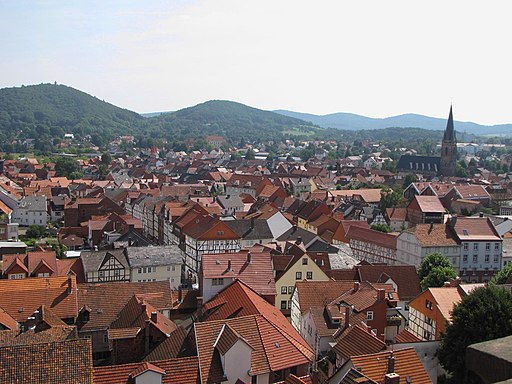
Eschwege, Germany
User: Celsius at wikivoyage shared / CC BY-SA (https://creativecommons.org/licenses/by-sa/3.0)

…The Jewish congregation of Eschwege had a nice Synagogue, a Jewish school, and a Rabbi…. Jewish life in Eschwege was not like I had been accustomed to in Frankfurt. Kosher meat was purchased at the gentile butcher, whose assurances had to be accepted that the meat was kosher….The strict Jewish life as was known in Frankfurt was not known in Eschwege.

….The congregational life in Eschwege however was a very close one. We had meeting hall, and every Saturday night everybody met to play cards, talk, and the youth danced and had fun…We had a large number of young people, mostly well to do, well mannered and educated. During the summers …the young people made excursions into the forests and mountains of the surrounding [area] which was blessed with nature’s beauty… It was a happy and carefree time and only later when everything was over with, the memory remained like a fairy tale.

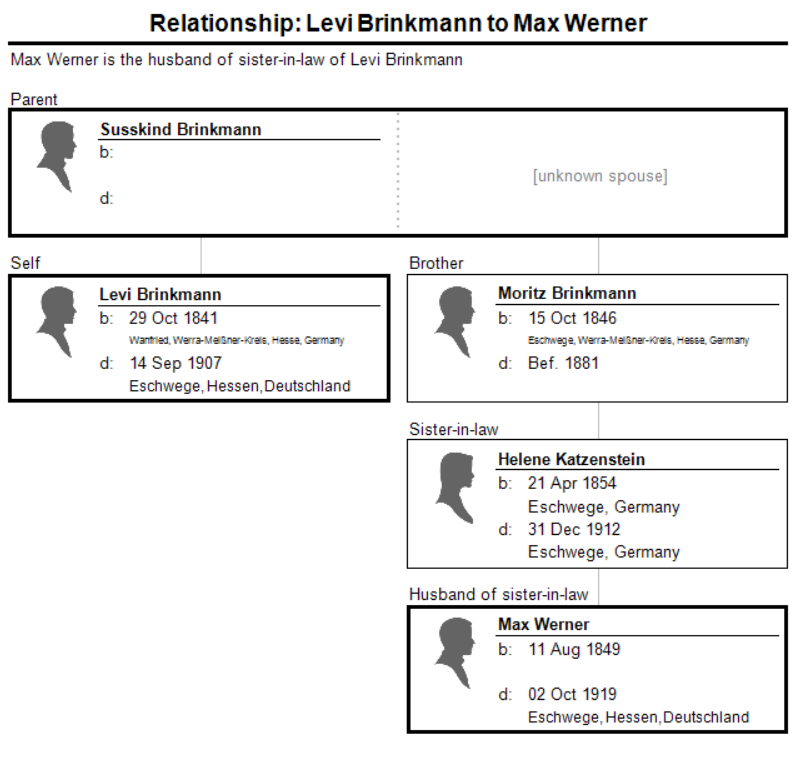
In the house Brinkmann lived on the second floor the partner and brother-in-law of Levy Brinkmann, Max Werner.

[Ed.: Max Werner was married to Helene Katzenstein, who was in fact a first cousin of Lina Stern, Levy Brinkmann’s wife. Helene and Lina were both granddaughters of Meyer Goldschmidt, the great-grandfather of Julius Loewenthal.]

In addition, as Julius describes, Helene Katzenstein had previously been married to Levy Brinkmann’s brother Moritz, who died six years after they were married in 1872; Helene then married Max Werner. So Helene was both Levy Brinkmann’s sister-in-law and the first cousin of his wife Lina.]

[Julius then described the business of Brinkmann and Werner—a wholesale business manufacturing stockings that were sold in the nearby villages.]

Max Werner was a beautiful human being. He contributed much to the happiness of all our lives. He was a personality, a very good businessman and a deeply religious Jew. Soon my uncle [Levy Brinkmann] expanded the business.  We tried to export and were successful with business transactions with England. It has to be considered that my uncle was born in a tiny village without a proper education and had deep drive and ambitions. In addition, he stuttered when he spoke which often caused much laughter in which he always participated. He knew how to tell stories and everyone was spellbound by it.

….I was 20 years old when I came to Eschwege. I was full of ideals and saturated with the teachings of Rabbi Hirsch. My Jewish education was extensive. Thus, every Saturday afternoon the Werner children had to come to my room and I had to teach them in Jewish history. All the children of the Werner household became religious Jews, even though the opportunity to became thus in Eschwege was not of the best….The third daughter Elsa, who was an extremely happy child, became my wife because I fell in love with her. The oldest son Moritz Werner became my partner….

After I had been in the bookkeeping department for better than a year events took place which brought me to new opportunities. One of our salesman left the firm and his post became available. My Aunt made the suggestion that I take his place and sell for the firm. …

I had opened a new sales territory in southern Germany…To travel was not an easy thing for me. I was young and could do it but to travel and remain strictly kosher was indeed a difficult task. I only lived on Eggs and Bread. … I was forced to fast more often than not….

Through my sales activity I acquired knowledge and feeling for the merchandise I was selling. I was exposed to the world…. This motivated me at the age of nearly 30 years old to study at the Textile School and Institute in Reutlingen, which remains one of the top schools to this day. My uncle became upset when I spoke of this plan. However, I knew that I had to have the technical knowledge if ever I wanted to become a success….and when I returned at the end of the year I was able to take charge with my newly acquired technical knowledge. I was very proud.

The original building of the Reutlingen Textile School and Institute, Vux / CC BY-SA (https://creativecommons.org/licenses/by-sa/3.0)

[Julius described how he convinced his uncle to purchase knitting machines and modernize the business as well as expand its product line from stockings to other knit goods.]

I don’t really know why I bother to write all that down because the Lord managed to take it all away again. However, I take the time to write it down so that our children know how big we once were, brought about through hard work and prayer.


I will end this segment here with Julius not yet thirty years old, but already a leader in his uncle’s business, a self-educated and self-made man whose ambition and intelligence helped him become a business success. In the next post I will post the sections from Julius’ memoir that cover the first three decades of the twentieth century from 1900 to 1930.


The Memoir of Julius Loewenthal, Part I: Growing Up in Frankfurt

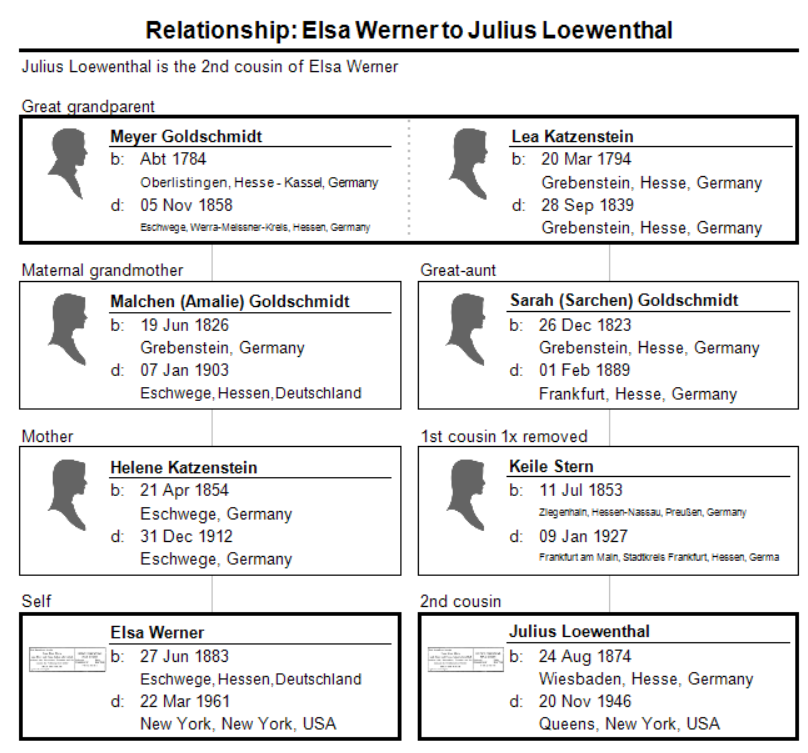
In March, 2020, I wrote about the family of my cousin Julius Loewenthal, the son of Kiele Stern and Abraham Loewenthal, grandson of Sarah Goldschmidt and Salomon Stern, and great-grandson of Meyer Goldschmidt, my four-times great-uncle. Julius was married to Elsa Werner, his second cousin, the daughter of Helene Katzenstein, granddaughter of Malchen Goldschmidt, Sarah Goldschmidt’s younger sister.

They had four children: Ruth, born in 1905, Herbert, born in 1907, Hilda, born in 1911, and Karl Werner Loewenthal, born in 1918.

The basic facts of their story were described in detail here: the car accident that killed Ruth Loewenthal and her husband Leonhard Fulda and seriously injured Julius; the escape of Julius and Elsa from Germany; the murder of Ruth and Leonhard’s daughter Margot by the Nazis; Hilda’s marriage and divorce from Max Stern, the founder of the Hartz Mountain Corporation; Herbert Loewenthal’s move to Zurich after first immigrating to New York; and Karl’s departure to England to study at the Leicester Textile School and then serve in the British armed forces during World War II, during which time he changed his name to Garry Warner on the advice of his superior officer in case he was captured by the Nazis.

Since writing that post back in March, I have had the pleasure of connecting with and talking to Garry Warner-Loewenthal’s daughter Joanne, my fifth cousin. She has shared with me the memoir her grandfather Julius Loewenthal wrote in 1940 while the war was still going on and before he learned of the fate of his granddaughter Margot.

Joanne has generously given me permission to share some of the memoir, which was translated from German to English by her father Garry. As always, having the words of someone who lived through these experiences is so much more powerful than the words of a third person like me. In the next set of posts I will share some of the most poignant parts of Julius Loewenthal’s memoir. Today’s post will focus on the early years of Julius’ life in the Jewish community of Frankfurt in the late nineteenth century.

I have made a few editing changes and have selected only portions of the memoir, but have preserved as much as possible the tone and content of the original, including the capitalization of nouns that Garry Warner-Loewenthal preserved when he translated his father’s text.


I saw the light of day on August 24th 1874 in Wiesbaden near Frankfurt in our home on the Orianenstrasse…. When I was one year old, my parents moved back to Frankfurt. My father established a Wine Dealership in Frankfurt. …I had to help there a great deal during my youth. I had to fill bottles, cork them, and seal them, then carry the Wine to the customers.

… Later my dear Grandmother Sara [Goldschmidt] Stern with her Sons Adolf [also known as Abraham] and Mayer moved in with us and we shared a common household. That was an enormous strain and work for my dear mother, especially since she had borne 6 children of whom one died….

When I was 5 ½ years of age I was already sent to school. The school was located near the Synagogue near our House; all this was near as in those days nearly all Jews in Frankfurt lived in this neighborhood of Rechneigraben. In that locality was a Fishmarket on Fridays and before the high holidays you could buy your Lulef and your chickens. Thus, there always was lots of activity and commerce.

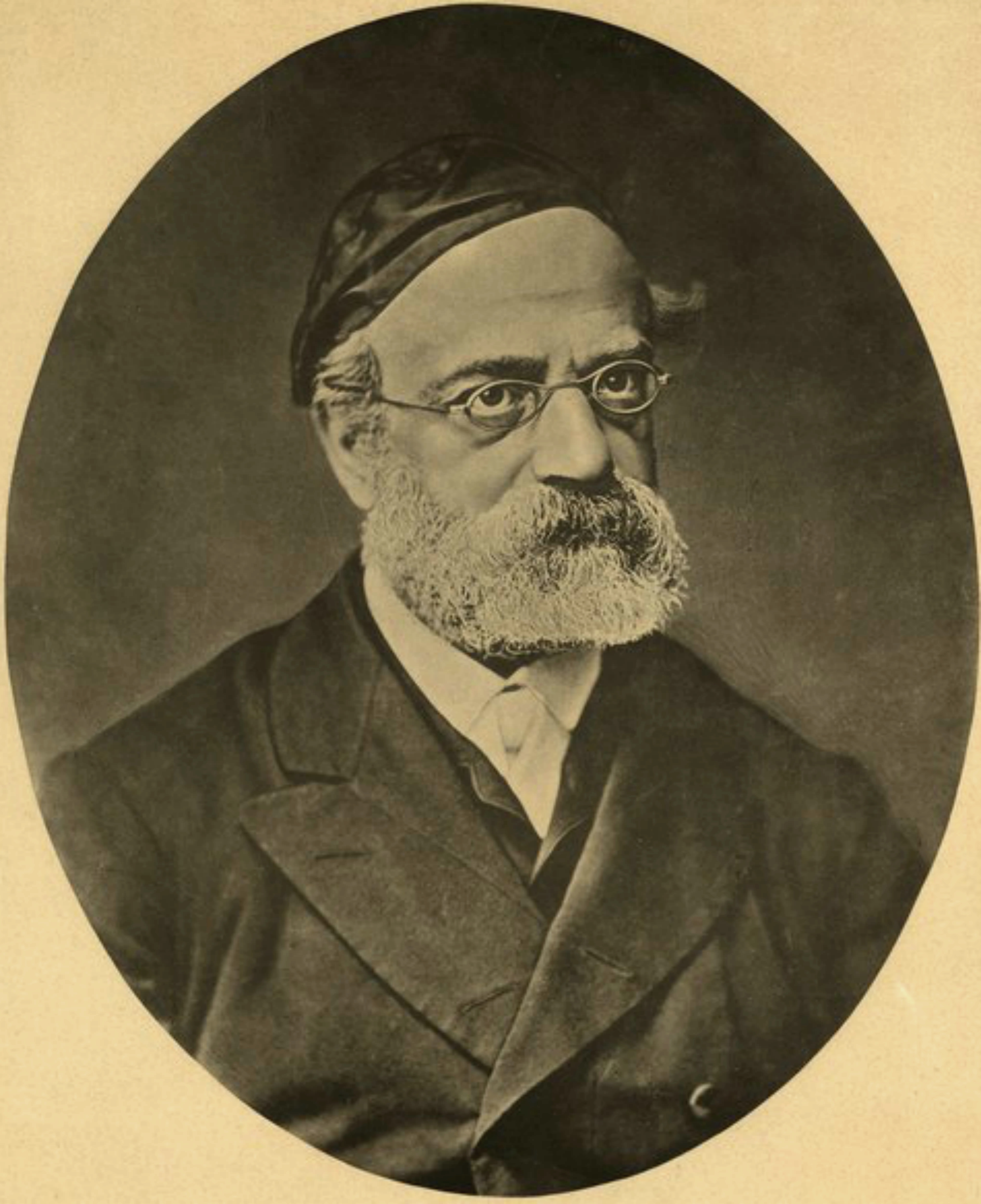
The Jewish community was led by the famous and highly respected Rabbi Samson Rafael Hirsch. I remember with joy this small in stature man with his brilliant eyes….

Selig Goldschmidt was the brother of my grandmother Sara Stern. He lived in Frankfurt during that time. He was a successful and very highly respected merchant. His knowledge of the world was great as were his religious convictions. He assisted Rabbi Hirsch in everything he could and what was necessary for the good of the Jewish community…..Rabbi Hirsch was the leader of a community who counted among its members many learned and wealthy individuals. Before the 1st World War there existed enormous wealth among the families of the Frankfurt congregation and the position of the Jews in Germany was then a respected one….Thus, their businesses were successful and they contributed much to Art and Culture of the country.

J & S Goldschmidt store on Kaiserstrasse in Frankfurt, c. 1890, Library of Congress Control Number 2002713666, found at https://lccn.loc.gov/2002713666

I attended the school I was enrolled in for 9 years. It was a very difficult time for me because much was demanded from me and much more than is expected of children today. Even on Sundays we had to go to school. I needed tutoring and for that I visited the house of my teacher Mr. Kauffmann. He was an unpleasant and very strict teacher who managed to rob me of the last sunshine of my youth. We had no free days at all, not even holidays….The results of this was that my health was never good and I became the easy victim of every serious sickness, which was dangerous as in those days little medication existed to combat these illnesses.

….There were always many family affairs. Bar mitzvahs, weddings, etc. never ended and were celebrated with pomp and generosity as befitted the wealth of those families. It was not a rare occasion when 600 or more people were invited to these affairs. It was common for individuals to create their music compositions and write their own theater pieces and present same on these occasions. Costumes were loaned from the Opera and Ballet houses. We children were always encouraged to make speeches during these festivities and after meals. We were encouraged to speak of Torah and general subjects. I write these things because I want to tell my children how happy the German Jews once lived.

The house of Selig Goldschmidt was a central meeting place for the family. Every Friday evening after the Evening meal was always a large reception in his home. During these occasions the family had much fun and for the children there was much activity. On Saturdays the central meeting place for the family was in his brother’s home, Falk Goldschmidt, who was a very humorous and charming individual who always kept everybody laughing and happy.

My Grandmother Sara Stern…lived in my parents’ house….Her brothers and sisters visited often and many many times we sat around our table talking by the light of the candles as gas and electric was not available at the time. I was very good at drawing when I was a child and often presented my drawings of different subjects to my relatives when they came to the house. It needs no mention that the Jewish holidays such as Seder, Succoth and all the others were celebrated with much joy and the strict observance of Jewish religious laws. … Both of our Uncles [Meier and Adolf] were like fathers to us and after my father died at an early age, they became our protectors and supporters until we children were old enough to take over.

Khal Adath Jeshurun synagogue in Frankfurt, the synagogue attended by the Goldschmidt family. https://www.kajinc.org/about/history

…I finished school at the age of 14 and my father sent me to a wholesale jobbing business as an apprentice. It was a very hard apprenticeship. … However, no one got me down. My first task was to bring order into the large inventory of the firm that even my employer praised as was not his custom to praise anyone. I requested a sample case and went out and sold merchandise with good results and much to the amazement of everyone. I made such a good place for myself that later the employer, Mr. Adler, requested that my brother Siegfried also join the firm as an apprentice.


I will end here for now and pick up in the next post with Julius as a young adult, his experience with the cholera epidemic, his marriage, and his life as an adult in Eschwege, Germany, before the rise of the Nazis to power in 1933.

I am so grateful to my cousin Joanne for allowing me to share these excerpts from her grandfather’s memoir. To read about their lives in the late nineteenth century has added such depth and color to my understanding of the lives led by my Goldschmidt family as Jews in Germany during those years.

Charles Bloch Redux, Part II: A Surprising Twist in the Family Tree

Although I ran into a brick wall trying to learn more about the time Charles Bloch spent in France during World War II, in the course of that research I discovered another twist in the Goldschmidt family tree.

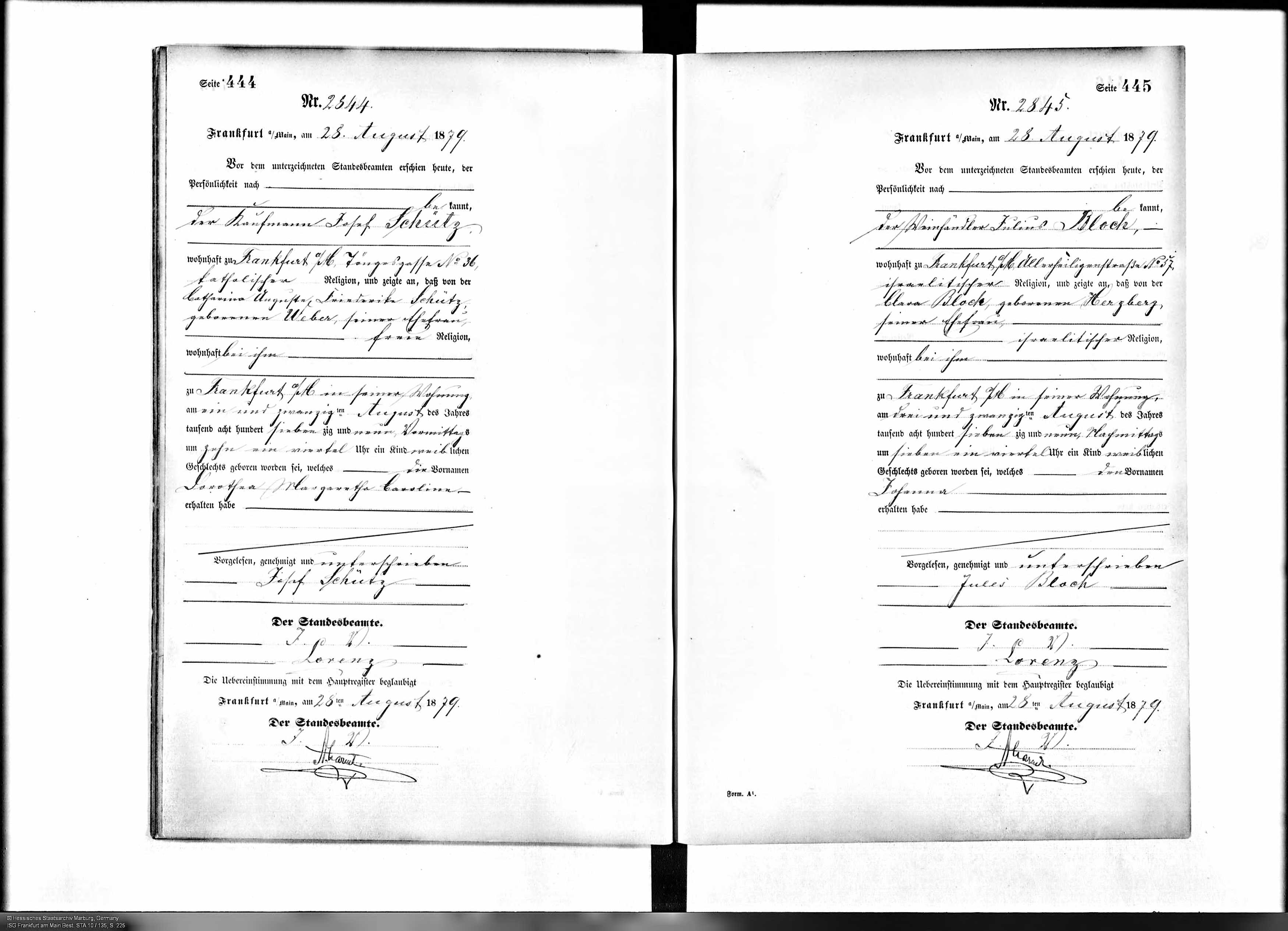
First, I learned that Charles Bloch had a sister. Julius Bloch and Clara Herzberg, parents of Charles Bloch, had a daughter named Johanna Bloch born in 1879.

Johanna Bloch, birth record, Hessisches Hauptstaatsarchiv; Wiesbaden, Deutschland; Bestand: 903; Signatur: 903_8931, Year Range: 1879, Ancestry.com. Hesse, Germany, Births, 1851-1901

Johanna married a man named Ludwig Dannheisser in 1900.

Johanna Bloch marriage record to Ludwig Dannheisser, Hessisches Hauptstaatsarchiv; Wiesbaden, Deutschland; Bestand: 903, Year Range: 1900, Ancestry.com. Hesse, Germany, Marriages, 1849-1930

Here is a beautiful photograph of Johanna taken in 1921 in Frankfurt when she was 42:

Johanna Bloch Dannheisser, 1921, Frankfurt, Germany. Courtesy of Ralph Dannheisser

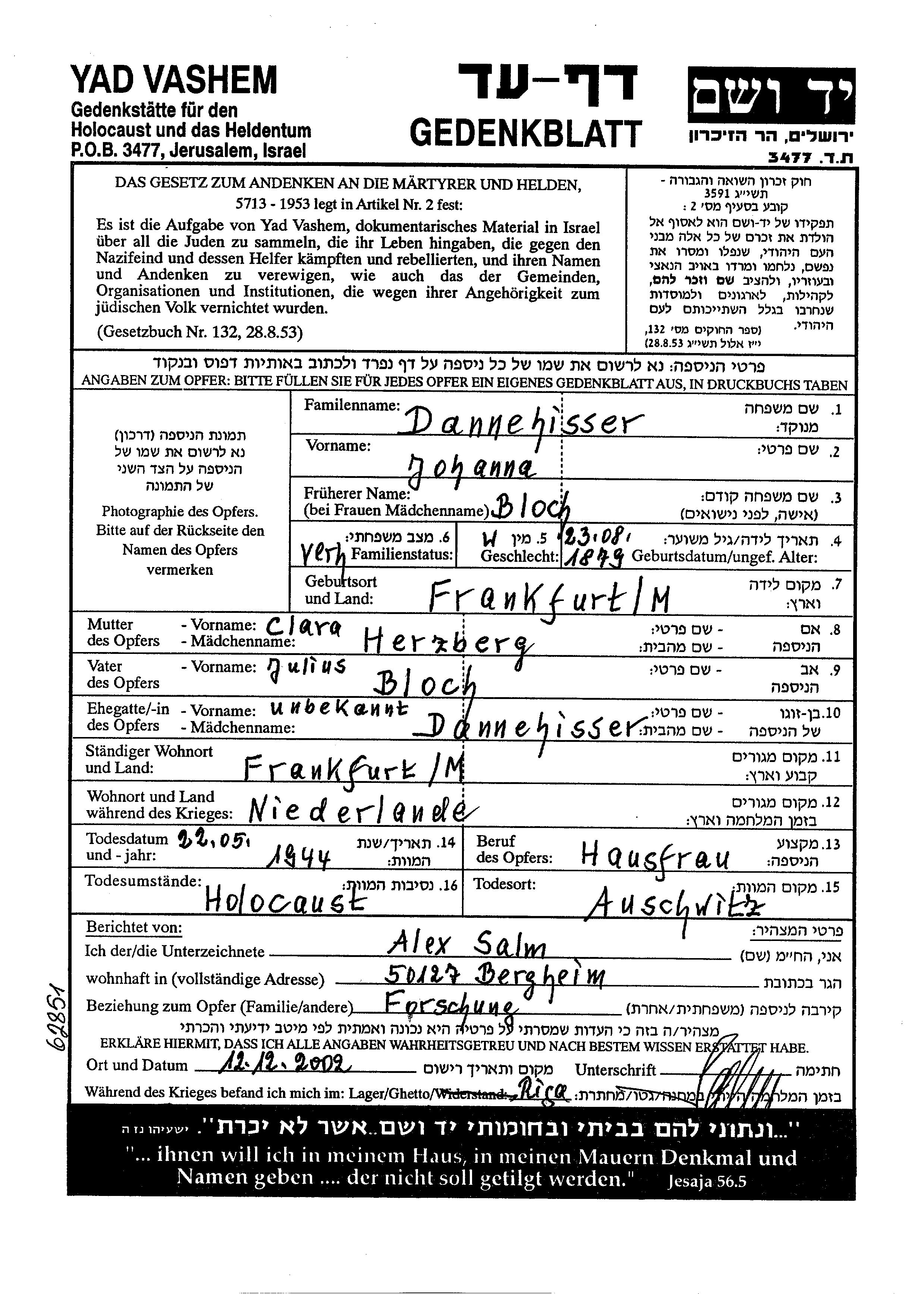
Tragically, both Johanna and Ludwig were killed at Auschwitz on May 22, 1944, after being deported from the Netherlands.1

Page of Testimony for Johanna Bloch Dannheisser at Yad Vashem, https://tinyurl.com/y58fweas

But their son Paul Dannheisser escaped from Germany to the Netherlands in 1938 and then to the US in 1940, settling in New York with his wife Dora Anni (known as Anni) nee Rosenthal and their son Ralph.2

This is a photograph taken at Paul and Anni’s wedding in October, 1932.

Wedding of Paul and Anni Dannheisser, October, 1932. Front row: Johanna Bloch Dannheisser, Anni Rosenthal Dannheisser, Paul Dannheisser, and Bertha Kaufmann Rosenthal. Standing behind Anni is her father-in-law Ludwig Dannheisser. Behind Paul to the right is Max Rosenthal.  Others are not identified. Courtesy of Ralph Dannheisser

When I saw the name Dannheisser, I knew something was familiar about it. Elizabeth Stern, the daughter of Alice Rapp and Saly Stern, was known as Elizabeth Dannheisser near the end of her life, according to the Social Security Claims and Applications Index.3 I had not found a marriage record for Elizabeth showing a marriage to someone named Dannheisser, only records showing a Paul Dannheisser married to Anni, but when I saw that Charles Bloch had a brother-in-law Ludwig and a nephew Paul with that surname, I wondered if there was a connection.

Fortunately, I was able to find and connect with Paul Dannheisser’s son Ralph, and he confirmed that in 1973, his father Paul Dannheisser had married my cousin Elizabeth Stern, the daughter of Saly Stern and Alice Rapp. He even shared a copy of the marriage certificate I couldn’t locate.

Courtesy of Ralph Dannheisser

Paul was 72 at the time, and Elizabeth was 54. Paul was a widower, his wife Anni having died the year before, and Elizabeth had divorced her first husband Gerhard Hirsch in 1950.4  Paul and Elizabeth had been introduced to each other by Ilse Bloch, known in the US as Helen Bloch, the daughter of Amalie Meyer and Charles Bloch.

Helen was Elizabeth’s second cousin; they were both great-granddaughters of Jacob Meier Goldschmidt and Jettchen Cahn:

Helen Bloch was also Paul Dannheisser’s first cousin; they were both the grandchildren of Julius Bloch and Clara Herzberg:

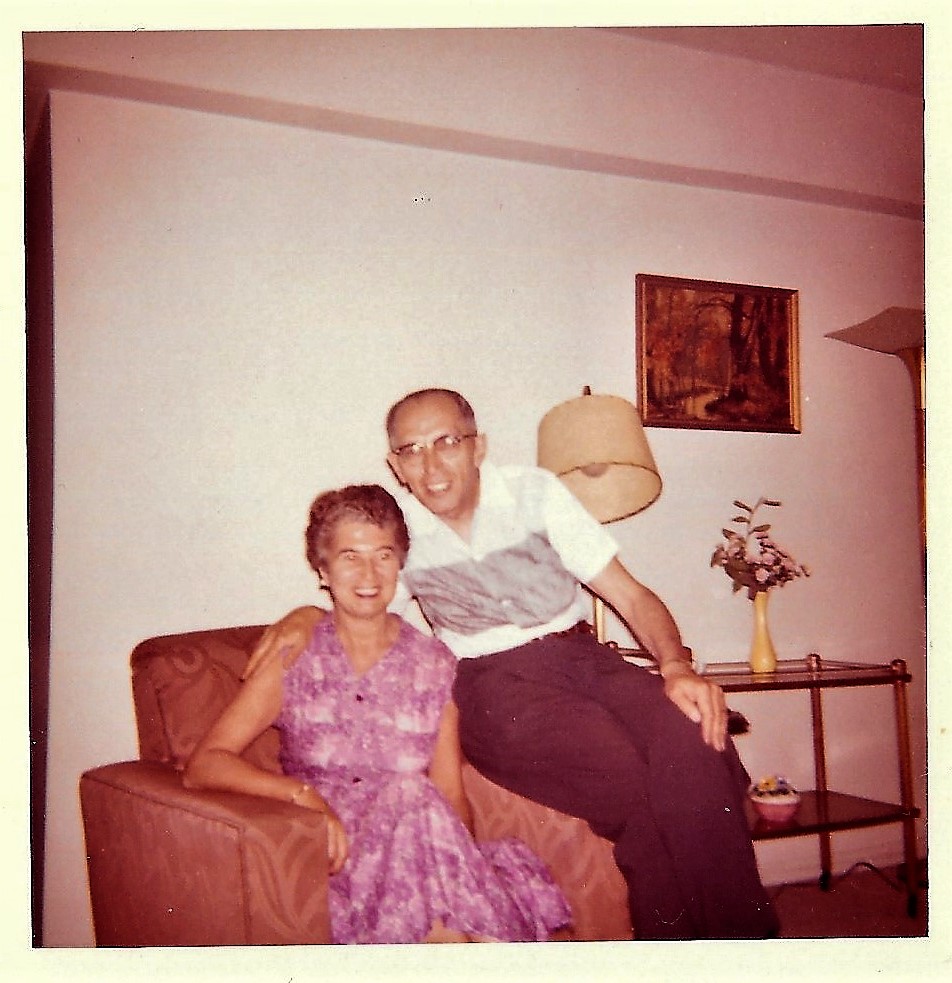
First cousins, Helen Bloch and Paul Dannheisser, 1961. Courtesy of Ralph Dannheisser

So Elizabeth Stern, the granddaughter of Helmina Goldschmidt Rapp, married the nephew of Charles Bloch, who was the husband of Amalie Meyer, daughter of Regina Goldschmidt and Aaron Meyer. Regina was Helmina’s older sister. Here’s another chart to show the connection.

Ralph, Paul Dannheisser’s son and the great-nephew of Charles Bloch, was thus the stepson of my cousin Elizabeth (known as Elsbeth). He also knew Charles and Amalie (whom he called Ama) Bloch. He often visited them in their New York City apartment on West 56th Street. He and his parents would go for monthly Sunday dinners. Ralph would listen to the radio or be entertained by Charles and Amalie’s daughter Helen while his parents and Charles and Amalie played bridge. Helen, who was an avid photographer, would show Ralph her photography magazines.

Ralph described Charles as a heavy-set bald man and Amalie as a handsome woman who wore her hair in a bun, and he said they were both very kind to him, as was Helen. In fact, he stayed close to Helen for many years, bringing his own children to visit her often. Unfortunately, however, Ralph was not able to tell me any more details of how Charles Bloch spent the years he was in France.5

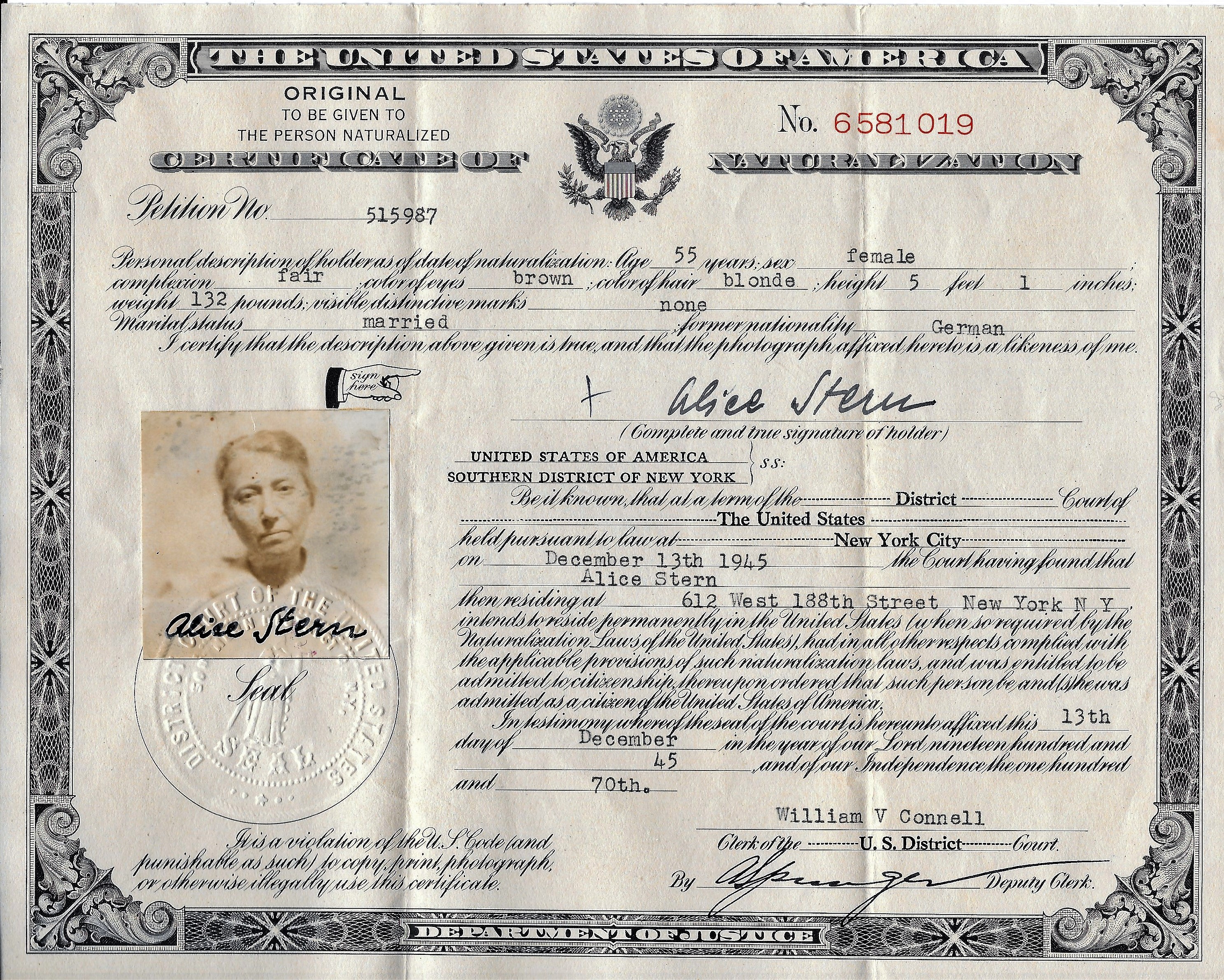
Ralph shared the certificates of naturalization issued to Alice, Saly, and Elizabeth Stern; these were particularly exciting to me because they included photographs of each of them. He also shared a collage of photos including one of Walter Stern, Elizabeth’s brother.

Ralph was very fond of Elizabeth Stern, his father’s second wife. He described her as a lovely woman who was very warm and wonderful to him and to his father. Ralph was very pleased when his father married her (he was already an adult by that time). Sadly, Elizabeth developed a terrible illness not long after she married Paul Dannheisser and spent many of the years at the end of her life in a nursing home, dying in February 1997.6

Her brother Walter Stern also endured difficult times. Ralph had a file filled with letters written to or about Walter that revealed much about his character and his work history and ethic. In Germany, Walter was a very well-regarded employee of a book dealer named J. Kauffmann before he immigrated to the US, and then for some time after he immigrated, he worked for a jewelry company in Washington, DC, where he was living when his parents and sister Elizabeth immigrated to the US. His employer at the jewelry company had written a letter in April 1939 to the American Consul in London (where his family was then living), extolling Walter’s virtues. My hunch is that this was a character reference to support the Consul’s issuance of a visa to Saly, Alice, and Elizabeth Stern so they could immigrate to the US.7

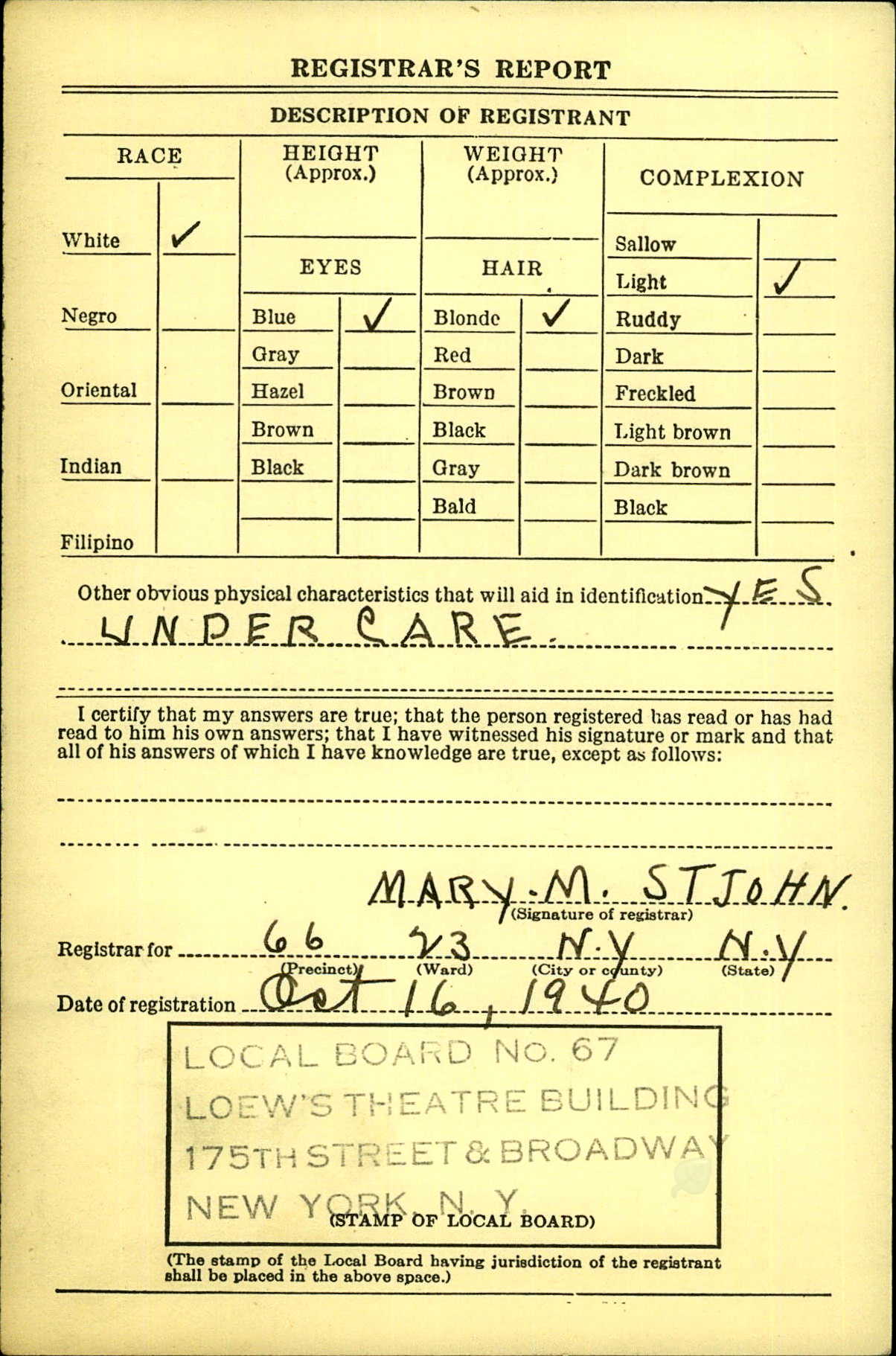
Walter returned to New York after his family arrived in March 1940 and worked for a company called Tonerde Incorporated, as listed on his World War II draft registration in October 1940. He left there on December 8, 1941, and received another positive letter of recommendation. But that draft registration hinted that something else was going on with Walter:

Walter Stern, World War II draft registration, Ancestry.com. U.S. WWII Draft Cards Young Men, 1940-1947

Ancestry.com. U.S. WWII Draft Cards Young Men, 1940-1947

Why was he “under care”? Family lore, according to Ralph, is that Walter was mugged and suffered a brain injury from which he never recovered. But as late as 1944, Walter received letters of thanks from the Treasury Department for his efforts in selling war bonds. 8

Ralph and I couldn’t put together the whole picture of what happened to Walter. In a December 1946 letter from the Immigration and Naturalization Service to Alice Rapp Stern, Walter’s mother, there is a reference to a warrant for Walter’s arrest that was being cancelled. My hunch is that once Walter’s declaration of intention to become a US citizen had expired after seven years, or in August, 1945, and he had not yet become a naturalized citizen, he was subject to deportation. How Alice Rapp Stern persuaded INS to close the case and cancel the arrest warrant is a mystery yet to be solved. I have filed a request for documents from the USCIS to see if I can learn more.

Courtesy of Ralph Dannheisser

What we do know is that by the end of 1947, Walter was institutionalized at the Rockland State Hospital and later at Brooklyn State Hospital, where he lived out the rest of his life, dying in October 1996, just a few months before his sister Elizabeth.9

I still have no details about how Charles Bloch survived the war in France, the original question that led me down this ambling path. But what an adventure the search for answers to that question has been: learning about the ITS document request process, thanks to Barbara; making the connection to Danny, who spent so much time helping me find French records; and then finding Ralph, my distant cousin by marriage, who brought to life some of the people I’d been researching.  All these connections and discoveries have made this a wonderful experience. I may not have all the answers, but sometimes it’s more about the journey than the destination.


  1. Entry for Ludwig Dannheisser in Yad Vashem, found at https://tinyurl.com/y5s4hkjj; Entry for Johanna Bloch Dannheisser at Yad Vashem, found at https://tinyurl.com/y58fweas 
  2. Telephone conversation with Ralph Dannheisser, July 22, 2020. 
  3. Elizabeth Ruth Stern, [Elizabeth Ruthhenrietta Hirsch] [Elizabeth Dannheisser] Birth Date: 21 Jan 1919, Birth Place: Frankfurt A, Federal Republic of Germany
    Death Date: 13 Feb 1997, Father: Sally Stern, Mother: Alice Rapp, SSN: 127144714
    Notes: Mar 1942: Name listed as ELIZABETH RUTH STERN; Jul 1943: Name listed as ELIZABETH RUTHHENRIETTA HIRSCH; Oct 1973: Name listed as ELIZABETH RUTH DANNHEISSER; Dec 1973: Name listed as ELIZABETH RUT DANNHEISSER; 22 Feb 1997: Name listed as ELIZABETH DANNHEISSER, Ancestry.com. U.S., Social Security Applications and Claims Index, 1936-2007 
  4. Ralph has a copy of Elizabeth’s Mexico divorce decree, dated August 5, 1950, as well as copy of her “get,” the Jewish divorce decree, dated July 3, 1952. 
  5. Telephone conversation with Ralph Dannheisser, July 29, 2020 
  6. Ibid. 
  7. Ibid. Files in possession of Ralph Dannheisser 
  8. Ibid. 
  9. Ibid. Files in possession of Ralph Dannheisser 

Charles Bloch Redux: A Lesson in French Genealogy Research

A few weeks ago I published my second post about Charles Bloch, searching for information about the time he spent in France during World War II. Charles was married to Amalie Meyer, granddaughter of Meyer Goldschmidt, my four-times great-uncle. He wasn’t related to me except by marriage, but I can’t seem to let go of his story. So this is my third Charles Bloch post. And there will be one more.

All I knew at the time of that second post was that Charles was still in Germany as of December, 1938, when he was released from the Buchenwald concentration camp, and that he arrived in the US from Toulouse, France, in 1946. I knew that his wife, Amalie Meyer Bloch, and his daughter Ilse Bloch, had both left Germany and were in the US by 1941, at which time Amalie reported on her declaration of intention that her husband Charles was in France.  But despite receiving additional documents from the International Tracing Service, I still didn’t know when Charles arrived in France or where or how he spent those war years.

I received a few suggestions from readers for additional research, but the most significant help came from a member of Tracing the Tribe named Danny Breslow. Danny has expertise in French genealogy research and was incredibly generous with his time helping me to find information.

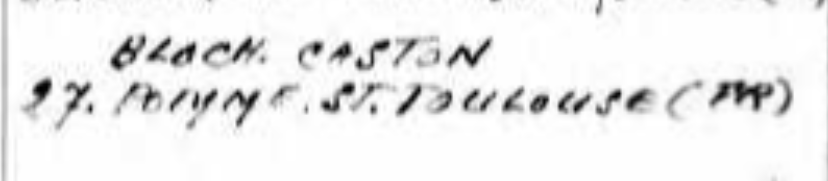
First, he noticed something I should have noticed. On Charles’ ship manifest coming to the US in 1946, he listed as the person left behind in his former place of residence a person named Gaston Bloch, residing at 27 “Pomme St.” in Toulouse.

Charles Bloch, passenger manifest p. 2, Year: 1946; Arrival: New York, New York, USA; Microfilm Serial: T715, 1897-1957; Line: 1; Page Number: 40, Ship or Roll Number: Fort Royal
Ancestry.com. New York, Passenger and Crew Lists (including Castle Garden and Ellis Island), 1820-1957

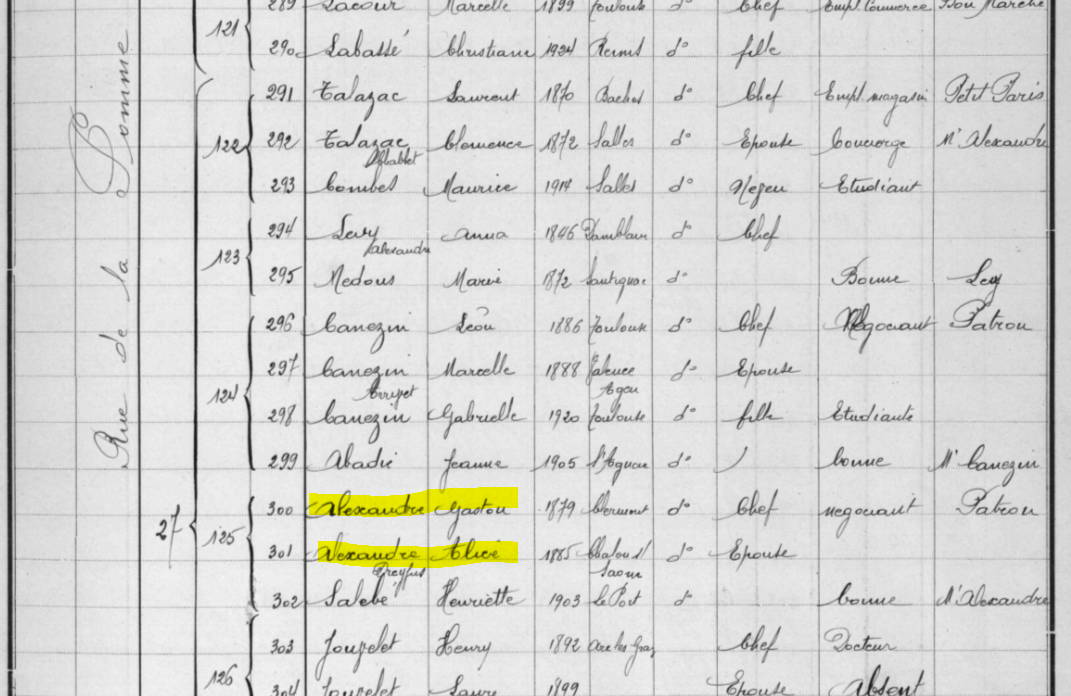
Danny then searched the 1936 Toulouse census (the most recent one available online) and discovered that in 1936, a couple named Gaston and Alice Alexandre lived at 27 Rue de la Pomme in Toulouse.

City of Toulouse, Municipal Archives, Call Number 1 F94, p. 301 (1936)

Could Charles have mistakenly referred to Gaston Alexandre as Gaston Bloch? Possibly, but not necessarily, as you will see.

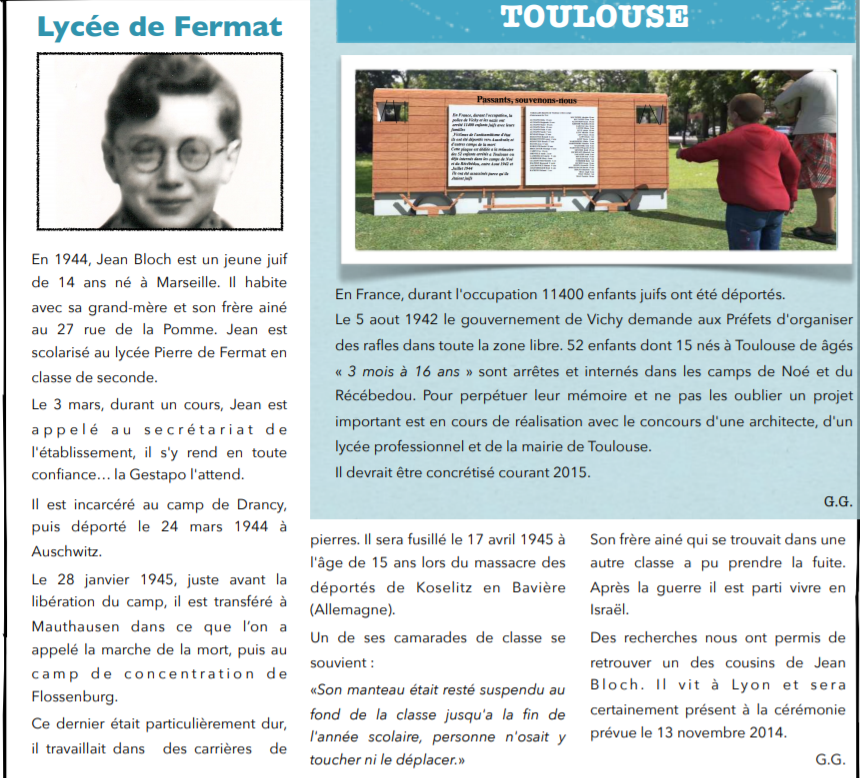
Danny discovered that a boy named Jean Bloch had also lived at 27 Rue de la Pomme in Toulouse. He was born in Marseilles, and according to an article Danny found in a French publication about the Jewish children of Toulouse, Jean Bloch was living in Toulouse with his grandmother and his older brother in 1944. Jean was only fourteen when he was arrested by the Nazis and sent to the concentration camp at Drancy and then to Auschwitz on March 24, 1944. He survived Auschwitz, but was later killed on a death march on April 17, 1945.

TOULOUSE-MÉMOIRE DES ENFANTS JUIFS DÉPORTÉS, September 2014

A profile on Geni managed by Jean Bloch’s nephew’s wife Hanna revealed that Jean Bloch was the son of Lucie Alexandre and Georges Bloch and that Lucie Alexandre was the daughter of Gaston and Alice Alexandre. Thus, young Jean Bloch had a grandfather named Gaston. Was this the “Gaston Bloch” living at 27 Rue de la Pomme that Charles Bloch named on his manifest? Connecting those dots proved challenging.

Danny and I tried to find some link between the lineage of Georges Bloch, whose in-laws lived at 27 Rue de la Pomme, and the lineage of Charles Bloch. According to Geni, Georges Bloch, Jean’s father, was the son of Albert Fortun Salomon Bloch, who in turn was the son of Joseph Bloch.1

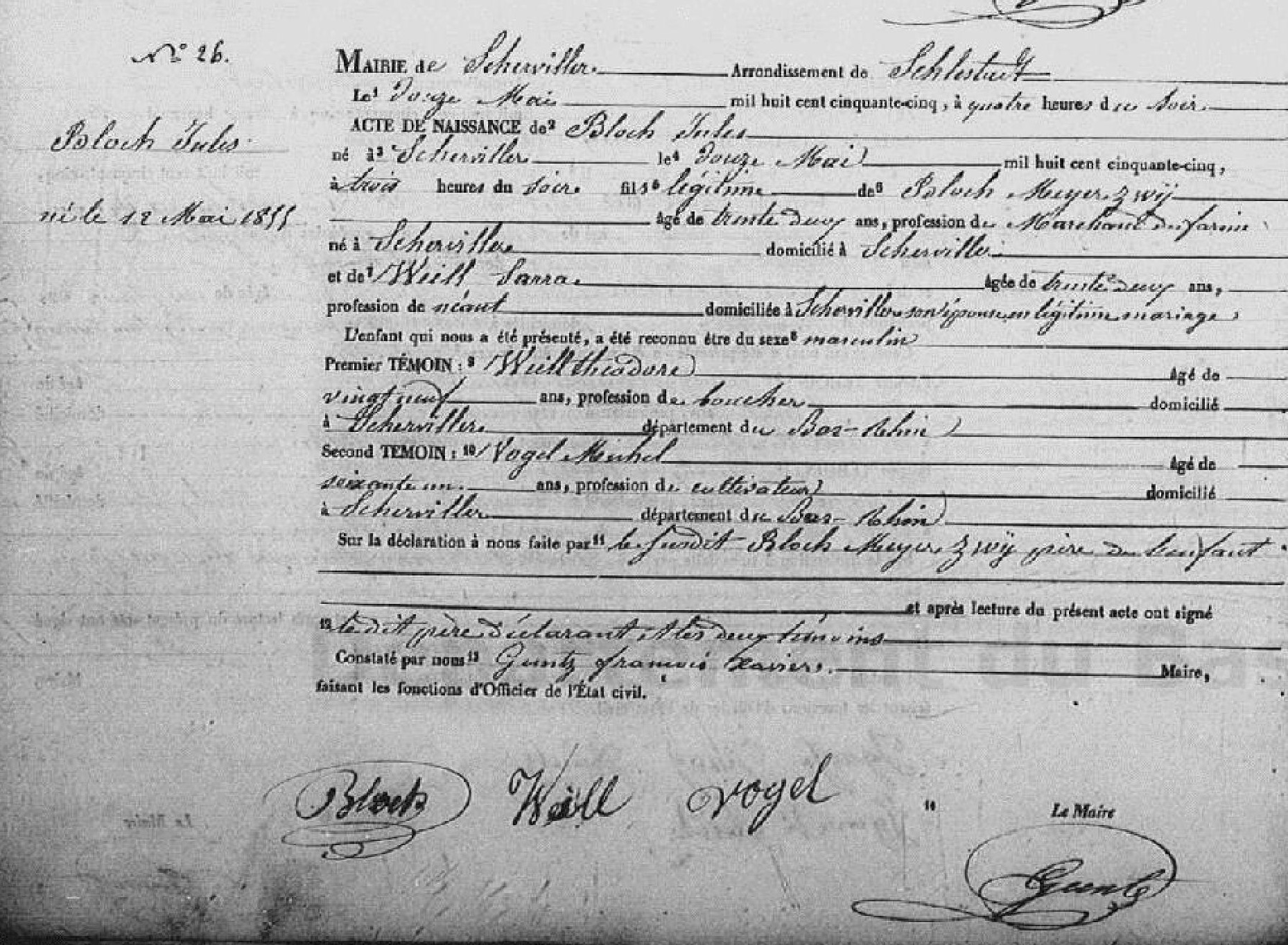
Danny’s knowledge of French genealogy came in handy as he located a birth record for Jules Bloch, Charles Bloch’s father, showing he was born in Scherwiller, France, in 1855. (That explained why Charles was identified as French on the ITS documents even though he was born in Frankfurt; his father was French-born.)

Birth record of Jules Bloch, 1885, Scherwiller – Etat civil – Registre de naissances 1855 – 4 E 445/5  found at http://archives.bas-rhin.fr/detail-document/ETAT-CIVIL-C441-P1-R241585#visio/page:ETAT-CIVIL-C441-P1-R241585-3028132

As seen on Jules Bloch’s birth record, he was the son of Meyer Bloch and Sarra Weill. I’ve tried to dig back further to see if I could find a tie between the Scherwiller Blochs and the Marseilles Blochs, but without success. With Danny’s help and my discovery of a Scherwiller Bloch family tree on Ancestry, a tree that is well sourced, we were able to trace Charles Bloch’s lineage back to the 1700s without finding a link to the Marseille Bloch family.

I also contacted Hanna, the manager of that Geni profile of Jean Bloch and  the daughter-in-law of Jean Bloch’s brother Michel; Michel had survived the war and immigrated to Israel. Hanna did not know of any connection to Charles Bloch and pointed out that there had been another Bloch family also living at 27 Rue de la Pomme who were not related to the Alexandre family. I’ve yet to find any records for that family though.

In addition, Danny discovered that a young Jewish woman named Nicole Bloch Klein, a resistance activist in France, also once lived at 27 Rue de la Pomme in Toulouse. Perhaps Bloch was a common enough name and 27 Rue de la Pomme was a big enough building that it’s purely coincidental that Charles Bloch ended up knowing people living in that building who also happened to be named Bloch?

I went back to look at the 1936 census again and counted five households living at 27 Rue de la Pomme that year. I don’t know what the odds are that, ten years later in 1946 when Charles Bloch reported a Gaston Bloch living at that address, there would have been another family named Bloch, unrelated to the family of Jean Bloch, living at that address.

So I cannot prove that there was a familial tie between Georges Bloch, the son-in-law of Gaston and Alice Alexandre of 27 Rue de la Pomme, and Charles Bloch, who listed the same address on his ship manifest. And I still don’t know how Charles survived the war. Who did he live with? How did he avoid deportation? Why did he wait a year after the war ended before joining his wife and daughter in the United States?

I still don’t know. But, in the course of researching the Bloch family, I discovered another interesting twist in the family tree.

To be continued…


  1. There were no records on Geni to support this, but since the profile is managed by a close family member, I assume that it is reliable. 

Sorry about that!

Sorry for the missing post. Believe it or not, I was working on the post and fell asleep and somehow my hand slipped and the post was published. I’ve taken it down to finish it, and it will be properly published next week!

Searching for Helene Rapp Lehmann and Her Family: A Genealogy Adventure

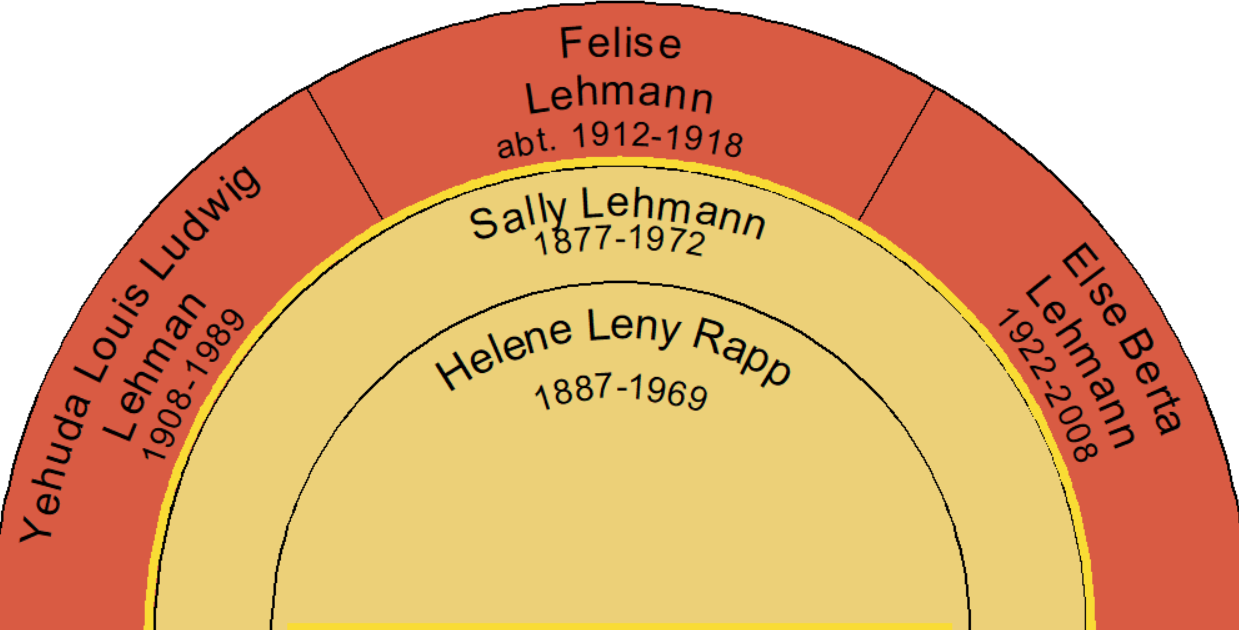
Helmina Goldschmidt’s oldest child, her daughter Helene Rapp Lehmann, was harder to trace than her two younger siblings, Arthur and Alice. I knew that Helene, her husband Sally, their daughter Else Berta, and their son Ludwig all eventually ended up in the United States because all four are listed in the Social Security Death Index. But it was hard to find information about their departure from Germany and about their eventual arrival and life in the US and the years in between.

This document from the Arolsen Archives on Ancestry provided the first clues. It shows that Sally Lehmann was a dentist and that Else Berta, daughter of Helene and Sally Lehmann, had immigrated to Palestine.

Arolsen Archives, Digital Archive; Bad Arolsen, Germany; Lists of Persecutees 2.1.1.1 Description Reference Code: 02010101 oS Source Information Ancestry.com. Europe, Registration of Foreigners and German Persecutees, 1939-1947

I then found Else’s immigration papers showing that she first entered Palestine on February 21, 1939, when she would have been only seventeen. She became a naturalized citizen of Palestine on June 25, 1941. She was unmarried at that time and a hair dresser. (These papers are located at the Israel Archives website located here.)

I assumed that since Else was so young, the rest of her family might have immigrated to Palestine also around the same time, but I could at first not find any Palestinian immigration papers for her parents Helene and Sally or for her brother Ludwig.

At the same time I was researching them all, I received an email from someone in Israel who had questions about one of my other relatives, and so I asked him for advice about finding more information about those who had left Europe for Israel in the 1930s and 1940s. He recommended that I become a member of IGRA—the Israel Genealogy Research Association. I had seen their website many times before, but had hesitated to spend the money to become a member. This time I bit the bullet and joined.

And I am so glad that I did because a quick search uncovered two records for Sally Lehmann. Sally was listed in a 1940 and a 1946 Tel Aviv directory of doctors, dentists, pharmacists and other medical professionals. Thus, I know now that he had immigrated to Israel by 1940.

In addition, I found a 1948 divorce record for Else Berta Lehman, daughter of Shlomo (Sally), from Leopold Ickelheimer, suggesting that Else was likely still in Israel in 1948.

Finally, the IGRA website had a file indicating that a Ludwig Lehmann had changed his name to Yehuda in April 1936. I couldn’t be certain that this was the same Ludwig Lehmann, but if it was, that would mean that the Lehmann family, or at least Ludwig, was in Palestine as early as 1936.

And then, you know how sometimes you search and search and find nothing, and then you return to the same source days later and suddenly a record appears? That’s what happened here. I returned to the Israel Archives website where the Palestinian immigration records are available, and this time found Sally and Helene (Rapp) Lehmann’s immigration and naturalization. The file revealed that Sally and Helene had first arrived in Palestine on July 4, 1938, and that they became naturalized citizens on June 17, 1941.

Sally Lehmann and Helene Rapp Palestinian immigration file found at https://www.archives.gov.il/en/archives/#/Archive/0b07170680034dc1/File/0b07170680bf6119

However, no one in the Lehmann family remained permanently in Israel. I found a 1955 manifest for a ship sailing from Haifa, Israel, to New York, that lists Sally and Helene Lehmann as passengers and as Israeli citizens.1

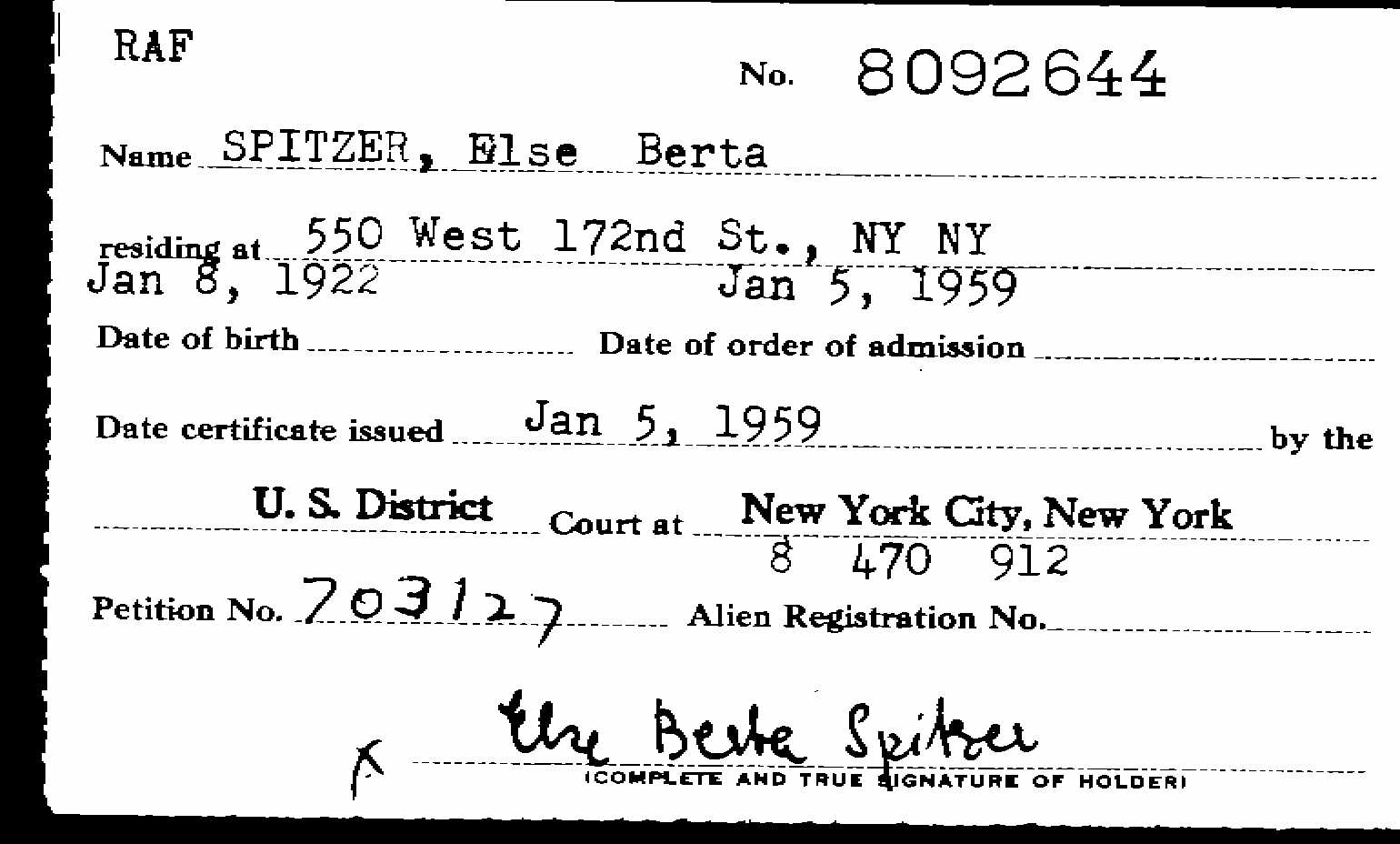
I also found one for an Else B. Spitzer, arriving April 24, 1953, that I thought might be Else Berta Lehmann, but wasn’t sure. There was no age or other identifying information, and she was listed as a German citizen, not an Israeli citizen. 2 But then I located this naturalization index card that shows an Else Berta Spitzer with the same birth date as Elsa Berta Lehmann, residing at 550 West 172nd Street in New York City.

Ancestry.com. New York, Index to Petitions for Naturalization filed in New York City, 1792-1989

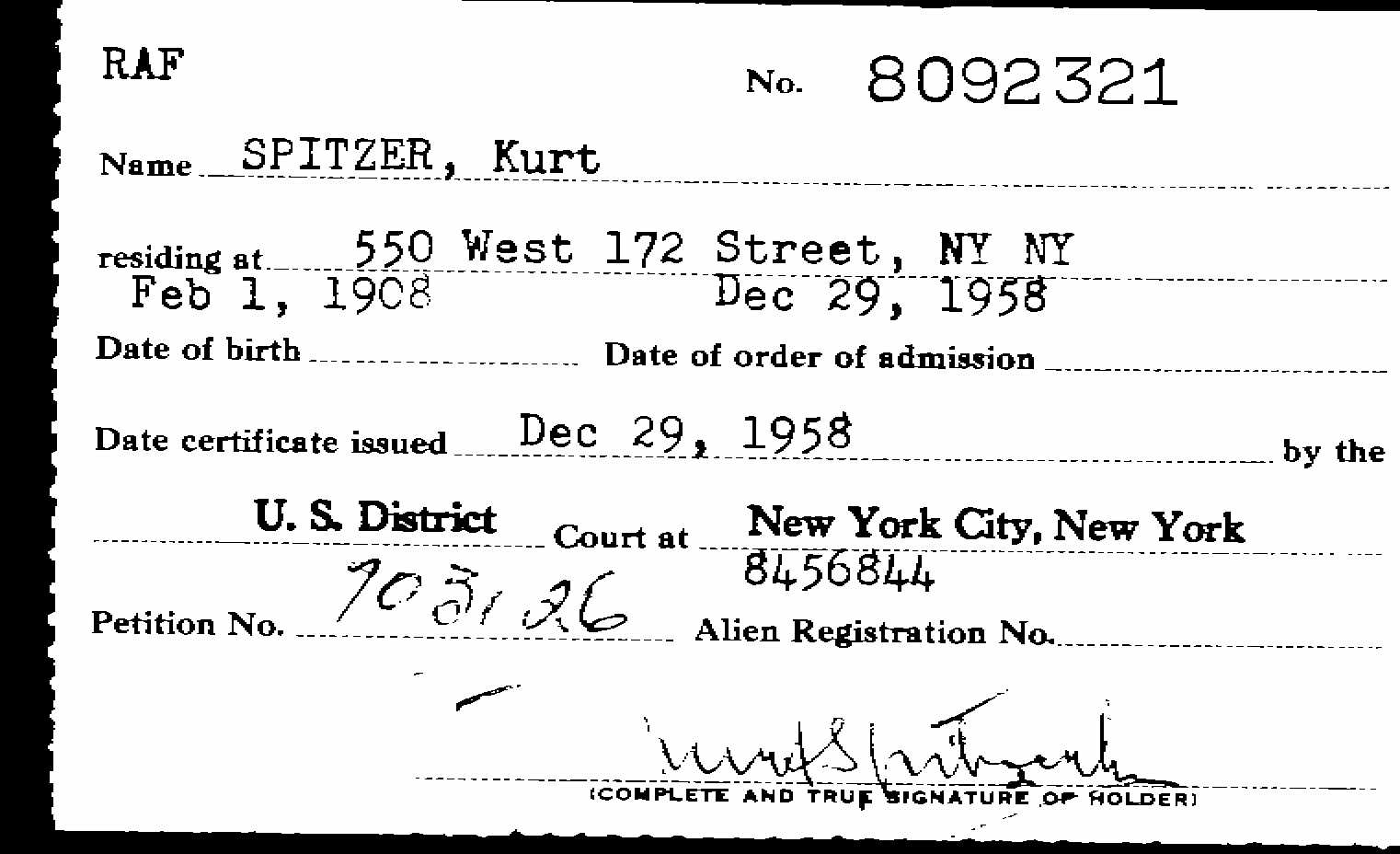
I used that address to search for Spitzers in the 1959 New York City directory living at 550 West 172nd Street and found a Kurt Spitzer living at that address, so now I knew that Else’s second husband was Kurt Spitzer.3 I also found his naturalization index card:

Ancestry.com. New York, Index to Petitions for Naturalization filed in New York City, 1792-1989

Unfortunately I cannot find any records showing Else with Kurt except for these two cards that show that they were living at the same address at the time of their naturalization. I did, however, find a record for Kurt’s enlistment in the US military on October 28, 1942, in New York, showing that he was a barber, beautifician, or manicurist, meaning he and Else were both in the hair dressing field. Kurt was already at that time a US citizen;4 he was born in Wurzburg, Germany, and immigrated to the US in 1925.5

Else’s brother, Sally and Helene’s son Yehuda Ludwig Lehmann, was particularly hard to locate with much certainty, After searching under all possible combinations of his names, I found a manifest with a Yehuda L. Lehmann coming to the US on December 29, 1952, from Cannes, France. He identified himself as divorced and as an Israeli citizen. He was 44 years old, and that would be consistent with the 1908 birth date I have for Ludwig Lehmann.

Yehuda Lehman, passenger manifest, Year: 1952; Arrival: New York, New York, USA; Microfilm Serial: T715, 1897-1957; Line: 1; Page Number: 137, Ship or Roll Number: Constitution
Ancestry.com. New York, Passenger and Crew Lists (including Castle Garden and Ellis Island), 1820-1957

Thus, all the members of Sally and Helene’s family had left Israel for the US in the 1950s. I don’t have much information about their lives after their arrival, although records show that Yehuda married in 1954, was divorced in 1956, and remarried in 1965.  I don’t know whether either Yehuda or Else had children in any of their marriages.

Their mother Helene Rapp Lehman died when she was 82 on September 17, 1969, in New York;6 her husband Sally was 94 when he died three years later in 1972.7 Their son Yehuda Louis Ludwig Lehmann died October 7, 1989, when he was 81.8 And Else Berta Lehmann Spitzer died on March 15, 2008, at age 86.9 According to her listing in the SSDI, her last residence had been in Berlin, Germany.

Thus, Helene Rapp Lehmann was among the fortunate ones who escaped Nazi Germany along with her husband and her children, first to Palestine/Israel, and then to the US. In fact, her siblings Arthur and Alice and their families as well as their mother Helmina Goldschmidt Rapp were also among those who safely escaped. That is quite remarkable.


Having completed the story of the family of Helmina Goldschmidt Rapp, I have now written about all the children of Jacob Meier Goldschmidt and Jettchen Cahn. Next I will turn to Jacob’s younger sister Malchen Goldschmidt, the fourth of the seven children of Meyer Goldschmidt and Lea Katzenstein and their youngest daughter. But first some updates to prior stories.


  1. Sally Lehmann and Helene Lehmann, passenger manifest, Year: 1955; Arrival: New York, New York, USA; Microfilm Serial: T715, 1897-1957; Line: 1; Page Number: 149, Ship or Roll Number: Jerusalem, Ancestry.com. New York, Passenger and Crew Lists (including Castle Garden and Ellis Island), 1820-1957 
  2. Else B. Spitzer, passenger manifest, Year: 1953; Arrival: New York, New York, USA; Microfilm Serial: T715, 1897-1957; Line: 1; Page Number: 347, Ship or Roll Number: Ryndam, Ancestry.com. New York, Passenger and Crew Lists (including Castle Garden and Ellis Island), 1820-1957 
  3. Manhattan, New York, City Directory, 1959, Ancestry.com. U.S. City Directories, 1822-1995 
  4.  Kurt B Spitzer, Marital status: Single, without dependents (Single), Rank: Private
    Birth Year: 1908, Nativity State or Country: Danzig or Germany, Citizenship: Citizen
    Residence: New York, New York, Education: Grammar school, Civil Occupation: Barbers, beauticians, and manicurists, Enlistment Date: 28 Oct 1942, Enlistment Place: New York City, New York, Service Number: 32610147, Branch: Branch Immaterial – Warrant Officers, USA, Component: Selectees (Enlisted Men), Source: Civil Life
    Height: 66, Weight: 149, National Archives at College Park; College Park, Maryland, USA; Electronic Army Serial Number Merged File, 1938-1946; NAID: 1263923; Record Group Title: Records of the National Archives and Records Administration, 1789-ca. 2007; Record Group: 64; Box Number: 05392; Reel: 203, Ancestry.com. U.S., World War II Army Enlistment Records, 1938-1946 
  5. Kurt Spitzer, Born: 1 Feb 1908, Birth Place: Wuerzburg, District: Lower Franconia
    Father: Josef, Mother: Karoline (Lina) nee STRAUSS, Last Residence: New York, NY
    Occupation: Merchant, employee, Naomi Teveth, comp. Germany, Jews in Würzburg, 1900-1945; Kurt Spitzer, ship manifest, Year: 1925; Arrival: New York, New York, USA; Microfilm Serial: T715, 1897-1957; Line: 1; Page Number: 197, Ship or Roll Number: Luetzow, Ancestry.com. New York, Passenger and Crew Lists (including Castle Garden and Ellis Island), 1820-1957 
  6. Helene Rap Lehmann, Gender: Female, Birth Date: 25 Aug 1887, Birth Place: Federal Republic of Germany, Claim Date: 21 Mar 1966, Father: Leopold Rapp
    Mother: Hermine[sic] Godschmidt, SSN: 076424080, Ancestry.com. U.S., Social Security Applications and Claims Index, 1936-2007 
  7.  Sally Lehmann, Social Security Number: 057-38-7312, Birth Date: 2 Sep 1877
    Issue Year: 1963, Issue State: New York, Last Residence: 10474, Bronx, Bronx, New York, USA, Death Date: Feb 1972, Social Security Administration; Washington D.C., USA; Social Security Death Index, Master File, Ancestry.com. U.S., Social Security Death Index, 1935-2014 
  8. Lou Ludwig Lehman, [Lou L Lehman], Gender: Male, Race: White
    Birth Date: 9 Feb 1908, Birth Place: Frankfort, Federal Republic of Germany
    Death Date: 7 Oct 1989, Father: Sally Lehmann, Mother: Helene Rapp
    SSN: 120280768,nAncestry.com. U.S., Social Security Applications and Claims Index, 1936-2007 
  9.  Else B. Spitzer, Social Security Number: 109-28-8645, Birth Date: 8 Jan 1922
    Issue Year: 1952-1954, Issue State: New York, Last Residence: 702, (U.S. Consulate) Berlin, Germany, Death Date: 15 Mar 2008, Social Security Administration; Washington D.C., USA; Social Security Death Index, Master File, Ancestry.com. U.S., Social Security Death Index, 1935-2014 

Arthur Rapp and Family: From Germany to England to Brazil to New York

In my last post, we saw that Helmina Goldschmidt Rapp and her daughter Alice Rapp Stern, son-in-law Saly Stern, and their daughters Elizabeth and Grete had first escaped to England from Nazi Germany, with Alice, Saly, and Elizabeth later immigrating to the US where their son Walter had already settled. Today’s post is about Helmina Goldschmidt Rapp’s son Arthur Rapp and his family.

Arthur and his wife Alice and their sons Helmut and Gunther also were in England by 1939. Arthur reported on the 1939 England and Wales Register that he was a retired telephone salesman. (The two black lines are presumably for Helmut/Harold and Gunther/Gordon, who must still have been living when the document was scanned.)

Arthur Rapp and Family,The National Archives; Kew, London, England; 1939 Register; Reference: RG 101/6823F, Enumeration District: WFQC, Ancestry.com. 1939 England and Wales Register

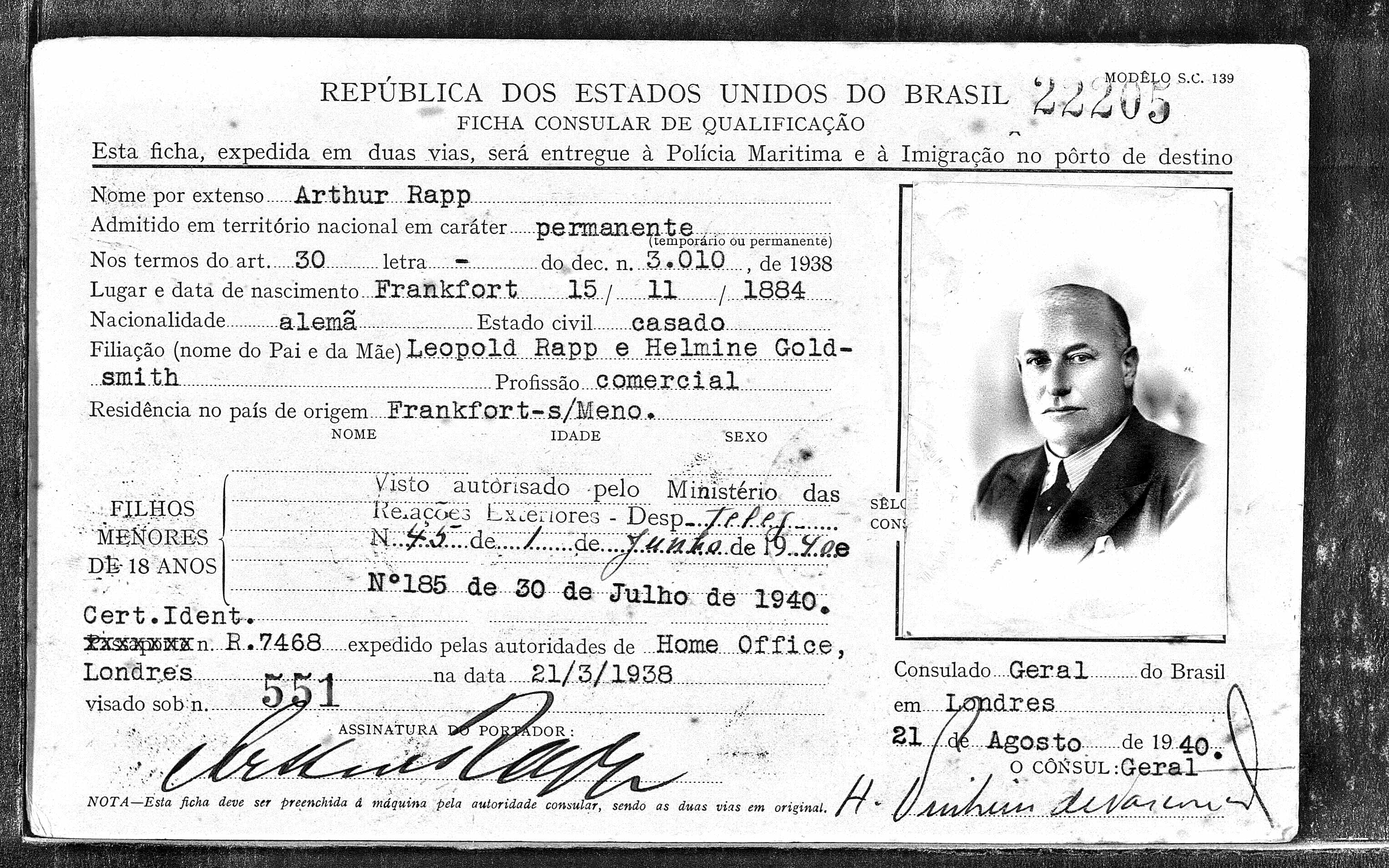
But like his sister Alice, Arthur did not stay in England. First, in 1940, he and his family immigrated to Brazil. I love having these photographs of Arthur and his family. Gunther is particularly adorable. But then I remember that these people had to leave their home in Frankfurt and then uproot themselves again to go from England to Brazil.

Arthur Rapp, Digital GS Number: 004816338, Ancestry.com. Rio de Janeiro, Brazil, Immigration Cards, 1900-1965

Alice Kahn Rapp, Digital GS Number: 004911328, Ancestry.com. Rio de Janeiro, Brazil, Immigration Cards, 1900-1965

Helmut Rapp, Digital GS Number: 004871140, Ancestry.com. Rio de Janeiro, Brazil, Immigration Cards, 1900-1965

Gunther Rapp, Digital GS Number: 004911328, Ancestry.com. Rio de Janeiro, Brazil, Immigration Cards, 1900-1965

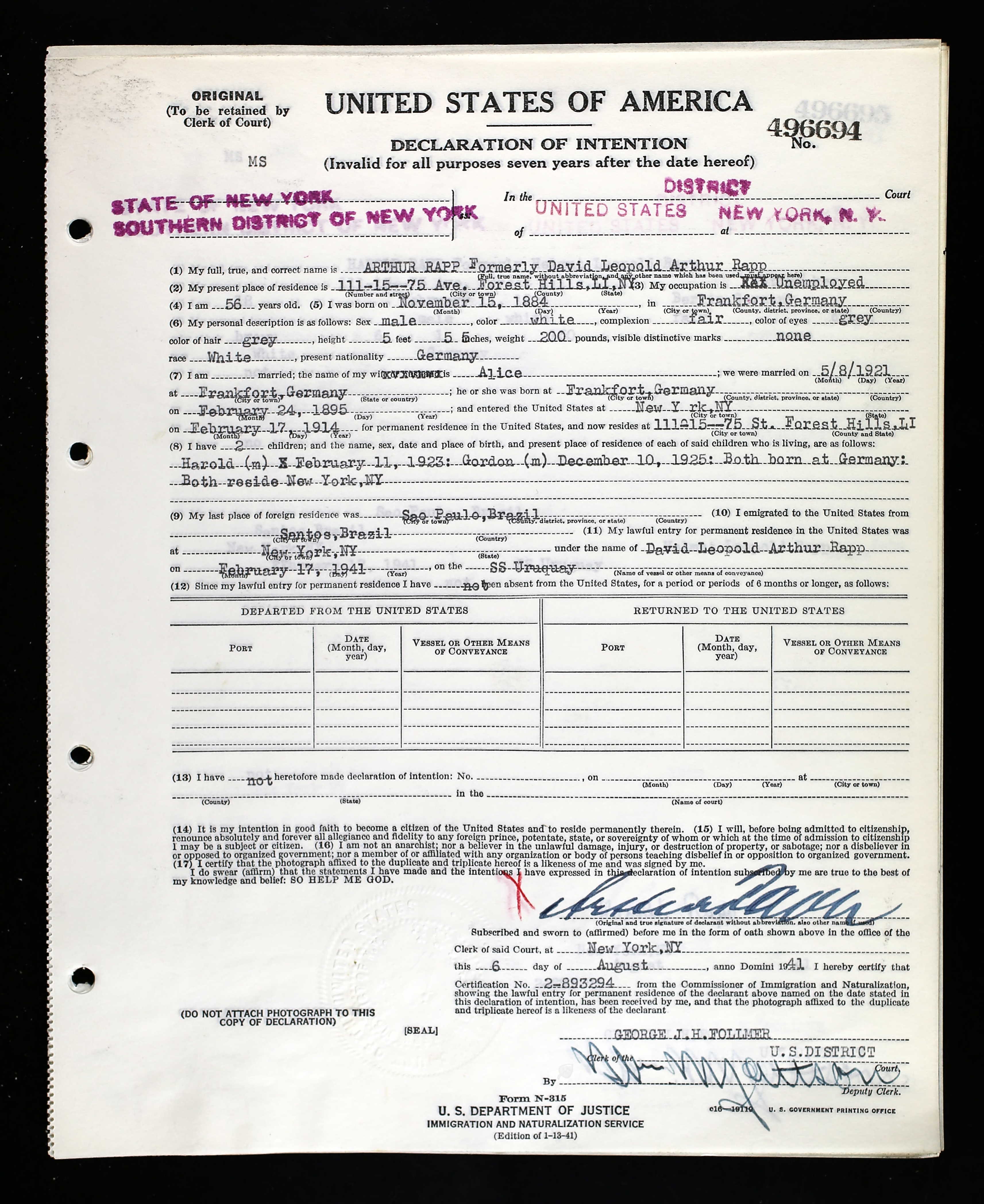
But a year later on February 27, 1941, they uprooted themselves again and left Brazil for New York where they settled in Forest Hills, New York, as seen on Arthur’s declaration of intention to become a US citizen.

Arthur Rapp, declaration of intention, The National Archives at Philadelphia; Philadelphia, Pennsylvania; NAI Title: Declarations of Intention for Citizenship, 1/19/1842 – 10/29/1959; NAI Number: 4713410; Record Group Title: Records of District Courts of the United States, 1685-2009; Record Group Number: 21, Description: (Roll 626) Declarations of Intention for Citizenship, 1842-1959 (No 496501-497400), Ancestry.com. New York, State and Federal Naturalization Records, 1794-1943

Arthur reported on his declaration of intention that he was unemployed, but his son Helmut, now using the name Harold, reported on his declaration that he was a watchmaker.

Harold (Helmut) Rapp, declaration of intention, The National Archives at Philadelphia; Philadelphia, Pennsylvania; NAI Title: Declarations of Intention for Citizenship, 1/19/1842 – 10/29/1959; NAI Number: 4713410; Record Group Title: Records of District Courts of the United States, 1685-2009; Record Group Number: 21, Description: (Roll 626) Declarations of Intention for Citizenship, 1842-1959 (No 496501-497400), Ancestry.com. New York, State and Federal Naturalization Records, 1794-1943

Arthur and Alice’s younger son Gunther, who became Gordon, was sixteen when they immigrated; on his World War II draft registration in 1943, he was living in Monmouth, New Jersey, working for Modern Farms.

Gordon (Gunther) Rapp, World War II draft registration, The National Archives in St. Louis, Missouri; St. Louis, Missouri; WWII Draft Registration Cards for New Jersey, 10/16/1940-03/31/1947; Record Group: Records of the Selective Service System, 147; Box: 539
Ancestry.com. U.S. WWII Draft Cards Young Men, 1940-1947

Arthur’s daughter from his first marriage, Henriette Rapp, also ended up in the US. She had married Siegmund Schwarz in Berlin on May 6, 1929, and they were living in Kirtof, Germany, in 1935.

Henriette Rapp marriage record to Siegmund Schwarz, Landesarchiv Berlin; Berlin, Deutschland; Personenstandsregister Heiratsregister; Laufendenummer: 189, 1929 (Erstregister)
Ancestry.com. Berlin, Germany, Marriages, 1874-1936

They immigrated to the US in 1937 and in June 1938 when Henriette, now using Rita, filed her declaration of intention to become a US citizen, they were living in San Francisco.

National Archives at Riverside; Riverside, California; NAI Number: 594890; Record Group Title: 21; Record Group Number: Records of District Courts of the United States, 1685-2009
Description: Petitions, 1943 (Box 0247), Ancestry.com. California, Federal Naturalization Records, 1843-1999

On the 1940 census, Rita and Siegmund, now going by Henry, were living in Los Angeles, and Henry reported no occupation, but Rita reported that she was a dressmaker.1 When Henry filed his World War II draft registration in 1942, he was still living in Los Angeles, but listed Alfred Kahn, not Rita, as  the person who would always know where he was, so perhaps they were no longer together.2 Rita did remarry on April 14, 1956, in Los Angeles, to Max Altura.3

Arthur Rapp died in New York on January 10, 1951, at the age of 66.4 He was survived by his wife Alice and his three children, Rita, Harold, and Gordon. Alice survived him by 26 years; she died in May 1977 at 82 years old.5

Rita died in Los Angeles on June 10, 2003; she was 94. According to her obituary in the June 13, 2003 The Los Angeles Times, Rita was a “life member and generous benefactor of Hadassah, Rita was devoted to Israel and the Jewish people.”6

Arthur Rapp’s two sons also lived long lives. Harold Rapp, who had started his career as a watchmaker, became the president of Bulova International in Basel, Switzerland, for many years and was 93 when he died on February 11, 2016.7

His brother Gordon died the following year at 92. According to his obituary, he graduated from Cornell University and received a master’s degree from Purdue University. His early interest in agriculture stayed with him. He had a career in poulty genetics before spending twenty years as a product and marketing manager with Corn Products Corporation . His obituary described him as follows: “He was known for his kindness, creativity, humor, wisdom, and talent as a prolific artist, photographer and writer. He was a Renaissance man of many interests, including tennis, tai chi and chess. He enjoyed museums and classical music concerts in New York City and later in Chapel Hill, NC.”8

I was struck by the fact that Harold and Gordon both continued to work in the same fields where they had started as young men, Harold in watches, Gordon in agriculture. Harold Rapp and Gordon Rapp were survived by their widows, children, and grandchildren.

Although Arthur Rapp did not have the blessing of a life as long as those of his three children, he was blessed with the good fortune of escaping with them from Nazi Germany and thus giving them the security and safety to live those long lives, during which they each made important contributions to their new homeland and left a legacy of their accomplishments and future generations to carry on the Rapp name.


  1. Rita and Henry Schwarz, 1940 US census, Census Place: Los Angeles, Los Angeles, California; Roll: m-t0627-00403; Page: 10B; Enumeration District: 60-828, Ancestry.com. 1940 United States Federal Census 
  2. Henry Schwarz, World War II draft registration, The National Archives in St. Louis, Missouri; St. Louis, Missouri; WWII Draft Registration Cards for California, 10/16/1940-03/31/1947; Record Group: Records of the Selective Service System, 147; Box: 1619,
    Ancestry.com. U.S. WWII Draft Cards Young Men, 1940-1947 
  3. Rita H Rapp, Estimated birth year: abt 1909, Age: 47, Marriage Date: 14 Apr 1956
    Marriage Place: Los Angeles, California, USA, Spouse: Max D Altura, Spouse Age: 55
    Ancestry.com. California, Marriage Index, 1949-1959 
  4. Arthur Rapp, Age: 66, Birth Date: abt 1885, Death Date: 10 Jan 1951
    Death Place: Queens, New York, New York, USA, Certificate Number: 481
    Ancestry.com. New York, New York, Death Index, 1949-1965 
  5.  Alice Rapp, Social Security Number: 105-36-2290, Birth Date: 24 Feb 1895
    Issue Year: 1962, Issue State: New York, Last Residence: 10028, New York, New York, New York, USA, Death Date: May 1977, Social Security Administration; Washington D.C., USA; Social Security Death Index, Master File, Ancestry.com. U.S., Social Security Death Index, 1935-2014 
  6.  Rita H. Altura, Social Security Number: 555-16-5231, Birth Date: 21 Sep 1908
    Issue Year: Before 1951, Issue State: California, Last Residence: 91335, Reseda, Los Angeles, California, USA, Death Date: 10 Jun 2003, Social Security Administration; Washington D.C., USA; Social Security Death Index, Master File, Ancestry.com. U.S., Social Security Death Index, 1935-2014. Obituary can be seen at https://www.legacy.com/obituaries/latimes/obituary.aspx?n=rita-altura&pid=1083894 
  7. I could not find Harold Rapp in the SSDI or any obituary, just this listing on FindAGrave. https://www.findagrave.com/memorial/159069023 However, I found numerous articles about his work at Bulova, and this wedding announcement for his son that mentions his career at Bulova. https://www.nytimes.com/2005/05/15/fashion/weddings/shelley-grubb-and-kenneth-rapp.html?searchResultPosition=2 
  8. Gordon Rapp, The New York Times, December 26, 2017, found at https://www.legacy.com/obituaries/nytimes/obituary.aspx?n=gordon-d-rapp&pid=187633991