The Memoirs of Lotte’s Sister Doris: Another Perspective on Life in Hitler’s Germany

Many of you enjoyed the memoirs and other writings of my cousin Lotte Furst, which are posted here, here, here, and here.  You will recall that Lotte and her family lived in Mannheim, Germany, and were living a comfortable life in a good home; Lotte’s father was a doctor, and her mother was the granddaughter of Hieronymous Seligmann, younger brother of my great-great-grandfather Bernard Seligman.  When the Nazis came to power, Lotte’s life changed forever.  After suffering through years of anti-Semitism and deprivation of their rights, her family finally decided to leave Germany and came to the United States.  Lotte’s writings described in vivid terms her perspective on all of this as she experienced it as a young girl and then as a young woman.

I recently learned that Lotte’s older sister Doris also wrote a memoir.  Doris was four years older than Lotte, and thus I was curious as to how her perspective was like or different from that of her younger sister.  When Hitler came to power in 1933, Doris was seventeen and thus would have had a more adult-like view of things.  Doris died in 2007, and her daughter Ruth was kind enough to share her mother’s memoirs with me.  Much of it is quite personal, so I am going to focus on those sections that provide insights into the larger questions: what was life like before Hitler came to power, how did it change when he did, and what led to the decision to leave Germany? [All material quoted from Doris Gruenewald’s writings is protected by copyright and may not be used without the permission of her children.]

By Snapshots Of The Past (Parade Place and Kaufhaus Karlsruhe Baden Germany) [CC BY-SA 2.0 (http://creativecommons.org/licenses/by-sa/2.0)], via Wikimedia Commons

By Snapshots Of The Past (Parade Place and Kaufhaus Karlsruhe Baden Germany) [CC BY-SA 2.0 (http://creativecommons.org/licenses/by-sa/2.0)%5D, via Wikimedia Commons

Doris was born in October 1916 in Mannheim; Germany was in the midst of World War I, and her father, Joseph Wiener, was drafted into the German army as a medical officer soon after she was born.  Her mother, Annie Winter Wiener, went with Doris to live with her parents, Samuel and Laura (Seligmann) Winter in Neunkirchen, where Samuel owned a women’s clothing business.  Annie’s brother Ernst had recently been killed while serving in the German army after volunteering against his parents’ wishes.  Doris wrote:

He had been the apple of their eyes and his death dealt a terrible blow to both.  My grandmother wore only black from then on, and my grandfather’s health began to deteriorate.  They also lost their sizable fortune, having bought war bonds as their patriotic duty, which at the end of the war were not worth anything anymore.  My grandfather’s business was dissolved and then reestablished on a much smaller scale.
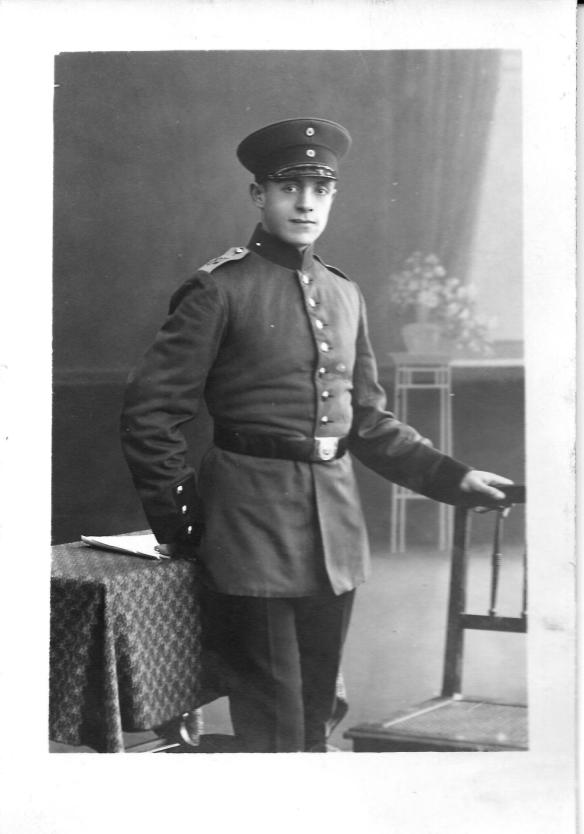
Ernst Winter Courtesy of Lotte Furst

Ernst Winter
Courtesy of Lotte Furst

Doris compared her grandparents’ home in Neunkirchen with her own home in Mannheim:

The house in Neunkirchen had a large garden in back of it, most of which was rented out.  The smallest part, directly behind the house, was used for growing some vegetables and flowers.  I remember loving to play in the garden and watching earthworms after a rain as well as other living creatures.  In Mannheim there was little opportunity for this kind of nature watching as we lived in a built-up urban area with little greenery, other than a well laid out park some distance from our apartment.
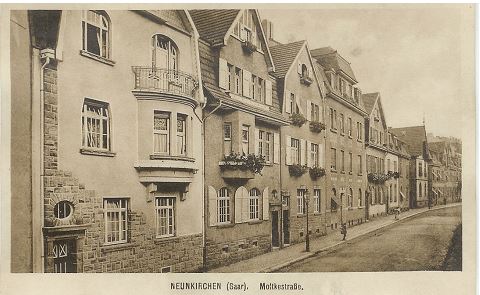
Neunkirchen

Neunkirchen

For several years while the French occupied parts of Germany after World War I, several family members housed French soldiers, and the neighborhood school Doris would have attended was also being used by the French military.  Thus, she had to go to a school somewhat further from her home for those years.  Like her sister Lotte, Doris pursued a highly academic path in school and was one of only six girls out of thirty students in her Gymnasium classes and then the only girl in her class when she reached the final years of her pre-university level education.

This excerpt provides a sense of the family’s lifestyle:

My parents employed a cook and a housemaid, and when my sister and I were still young, a “Kinderfraulein” who used to be an untrained young woman with an interest in children.  In other words, not quite a “governess.”  My father had help in his office and for some time also employed a driver after he developed a painful condition in his left arm, due to having to reach outside the car for shifting gears.  …. 

We had a Bechstein Grand piano in our living room. This instrument had been given to my mother as a young girl. She had really wanted to study music on a professional basis. But her parents felt that “proper” young ladies did not take up that kind of profession and did not allow her to pursue her wish. Instead, they bought her the Bechstein and let her have piano lessons.

I began taking piano lessons at age seven, with a teacher considered among the best in Mannheim. My mother, although an accomplished pianist, no longer played much. But occasionally, she and my father, who had learned to play the violin in his youth, would play duets together. That always was a special treat.

By Annaivanova (Own work) [CC BY-SA 3.0 (http://creativecommons.org/licenses/by-sa/3.0)], via Wikimedia Commons

By Annaivanova (Own work) [CC BY-SA 3.0 (http://creativecommons.org/licenses/by-sa/3.0)%5D, via Wikimedia Commons

I was particularly interested in what Doris wrote about the role of Judaism in the family’s life.

I grew up through the years with some awareness that we were Jewish, without knowing what significance that had then and later. Neither my parents nor my grandparents when I knew them observed any religious tenets. However, I was told that in past years my grandfather had been the head of the Jewish Congregation in Neunkirchen. My grandmother, who was president of the local Red Cross chapter for some time, used to fast on Yom Kippur. She reluctantly told me, when I kept asking her, that she had promised her dying mother to keep that tradition. As for me, I was kept home on the Jewish High Holy Days. My family did not attend any services.  …. 

At eight years of age I happened to be visiting my grandparents at the time of Passover. They had been invited by friends to a large Seder. Unfortunately, nobody thought of explaining to me what that was all about. My grandparents may have assumed that I knew, but I did not. I understood nothing of what was being read in Hebrew or spoken in German. I was utterly bored! Furthermore, when the ceremony asked for tasting the so-called bitter herbs, I bit off a piece of the horseradish on my plate and soon experienced the consequences of that act!

Unfortunately, I think far too many children, here in the US and elsewhere in the world, have that experience at seders.

The family was, however, required to provide some religious instruction because of the school system’s requirements:

There having been no separation of Church and State, religious instruction was part of the official curriculum. The students were separated one period per week according to their denominations. Most were Protestants, some were Catholics, and a few were Jewish. Since the number of Jewish children was so small, and in the case of my first-grade placement non-existent, my parents were required for that year to hire a private instructor in order to comply with the legal requirement. Thus, there suddenly appeared a not very clean looking young man with a greasy book, from which he proceeded to read and attempt to teach me-at six years of age-the Hebrew text. My recollection is that he came to our house only a very few times. I do not know how the religious instruction requirement was fulfilled after that disaster.

When, at fourth grade level, I changed schools, religion was taught by a little old man, a retired rabbi, who was very nice and even made some of what he taught rather interesting. But I developed no feeling for or interest in it at all, as it was totally divorced from the rest of my life.

Then, as Lotte also described, their father decided to withdraw from the Jewish community:

When I was fourteen, my father had some kind of a dispute with the Jewish Community, which was the official agency for collecting taxes. These taxes were legally mandated as a percentage of one’s general income tax obligation. I nearer knew exactly what the problem was, except that it had something to do with the amount owed, to which my father was apparently objecting. The Rabbi came to our house to straighten the matter out. Apparently he was not successful as subsequent events proved. (This rabbi became my brother-in-law at a much later time. He knew that I was far removed from religious observance, but he was always very tolerant and friendly to me.)

Whatever the problem had been, my father decided to leave the Jewish Congregation. Since I was already fourteen years old, I was required to state my personal intention. As I had no ties to the Jewish community, that was no problem for me. From then on I was without any religious affiliation, called “konfessionslos.” In practical terms it meant that I no longer had to attend religious instruction at school. I used the weekly free hour to visit the Art Gallery opposite the school building and saw a lot of very interesting, good art works.
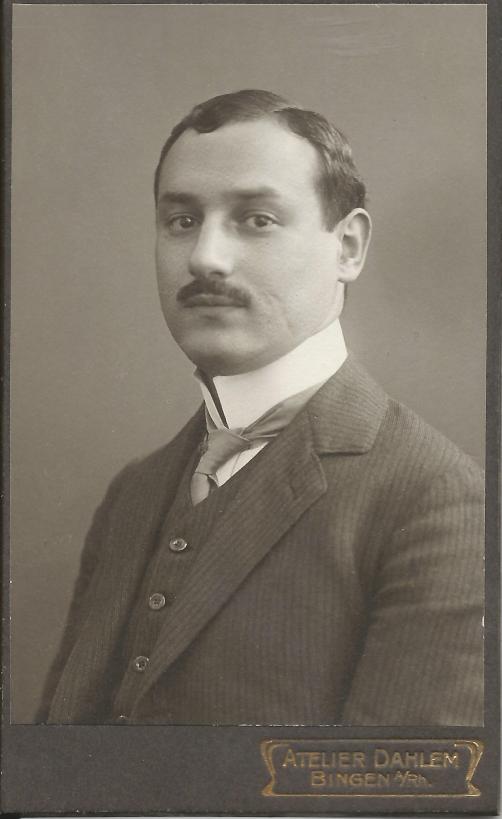
Dr. Joseph Wiener

Dr. Joseph Wiener  Courtesy of Lotte Furst

Of course, the family’s withdrawal from the Jewish community and lack of religious involvement did not make any difference in the eyes of the Nazis once they came to power.  Doris wrote:

Between 1932 and 1935 I had a valid German passport, used during those years primarily for trips to the Saar to visit my grandparents and take the then permitted two hundred German marks to be deposited outside Germany. In those years the Saar was still under the administration of a French post-World-War I governing authority. My grandmother took care of such transactions. By the time I needed a new passport, the Nazis had decided that a big “J” had to be stamped on any so-called non-Aryan, meaning Jewish, person’s passport. Word had gotten around that one of the clerks in the passport office in Mannheim would issue a “clean” document without the dreaded J, for suitable consideration. I went to that office, saw the clerk in question, and for the small sum of five marks was issued a regular passport without the J. I still have this passport as a memento.

When the Nazis assumed power in 1933, we as a family re-joined the Jewish Congregation as a matter of honor. Not that it would have made any difference had we not done so as the Nazis classified people not necessarily by religion but by their so-called racial identity.

German Jewish passports could be used to leave...

An example of German Jewish passport. (Photo credit: Wikipedia)

As Doris approached the end of her time in the local schools in the 1930s, she was both the only girl and the only Jew in her class.  She wrote that things did not change dramatically at school despite the political changes around them, but she did describe one troubling incident:

I entered the classroom in the morning, as usual. Upon approaching my desk, I saw that someone had pasted a viciously antisemitic sticker from the “Sturmer,” a rabidly anti-Jewish paper, on my desk. By that time, one of my classmates had begun wearing the SS uniform. I more or less assumed that he was the culprit, which in the end turned out not to have been the case. However, at that moment I decided not to confront him or anyone else. I sat down at another desk and waited for the right time to act. This came with the second period when the “Klassenlehrer”-the equivalent of our Home Room teacher-was due for his hour. … I waited for this teacher outside the classroom and told him my reason for doing so, adding that I knew there was nothing I could do about official policy and insults, but that I was not willing to put up with personal attacks.

This teacher, who, incidentally, had been an officer in World War I and had lost an arm, rose to the occasion. He and I entered the classroom together, and he immediately asked who had done this deed. Somewhat to my surprise, and perhaps his too, not one of the students admitted having put the sticker on my desk. There was nothing further he could have done: I do not remember whether he spoke to the class, but his earlier behavior had given ample proof of his opinion. … The incident occurred about one week before the final exam, the Abitur. It cast a pall over that important event.


Embed from Getty Images

Imagine being the only girl and the only Jew in the class and standing up for herself that way.  What courage it must have taken to do this.  What if her teacher had not been sympathetic?  Despite this stressful incident, Doris successfully passed the Abitur.  Although Doris was entitled to enroll in the university based on her father’s military service during World War I, Jews were prohibited from enrolling in either law school or medical school.  Instead, Doris decided to audit a few courses while awaiting a visa to leave Germany.  She wrote:

I had known for some time that I had to get out of Germany as there was no future there for me, and I was willing to take whichever came first [she had applied for both a US visa and a certificate to immigrate to Palestine]. However, I admit that I was relieved when the American visa materialized first.

The American Consulate closest to Mannheim was located in Stuttgart. In due course I was summoned for an interview with the American consular officials. I was in a somewhat unusual position in that my father had learned of a legal means of transferring money abroad, which was then discounted at the rate of fifty percent. The permissible amount was sufficient to enable me to show the U.S. Consulate that I had the requisite five thousand dollars for obtaining an immigration visa to the U.S. In this way I did not have to await my application number to come up in regular order, which would have taken a great deal more tame. I got my visa rather quickly. By that time I had also received a so-called Affidavit of Support from one of my grandmother’s cousins, whose father had emigrated in the nineteenth century and had settled in Cleveland, Ohio. This cousin was in very good financial circumstances and readily responded to our request for an affidavit.  …

I was very interested in determining who this cousin might have been.  If she was Laura Seligmann Winter’s cousin, she might have also been a cousin of mine, depending on whether she was a paternal cousin or not.  The only clues I had from Doris’ memoir were her married name (Irma Rosenfeld), her residence in Cleveland, her children: a son who was in his 20s in 1937, a daughter who was married, and another daughter who was a student at Vassar.

I found one Irma Rosenfeld living in Cleveland at that time who had two daughters and a son and was married to a man named Mortimer Centennial Rosenfeld (I assume the middle name was inspired by the fact that Mortimer was born in 1876, the centennial of the Declaration of Independence).  I sent Lotte the photo from that Irma’s passport application, but Lotte was unable to confirm from the photograph that it was the right Irma Rosenfeld.

Irma Rosenfeld and daughter passport photo 1924 Ancestry.com. U.S. Passport Applications, 1795-1925 [database on-line]. Provo, UT, USA: Ancestry.com Operations, Inc., 2007. Original data: Selected Passports. National Archives, Washington, D.C.

Irma Rosenfeld and daughter passport photo 1924
Ancestry.com. U.S. Passport Applications, 1795-1925 [database on-line]. Provo, UT, USA: Ancestry.com Operations, Inc., 2007.
Original data: Selected Passports. National Archives, Washington, D.C.

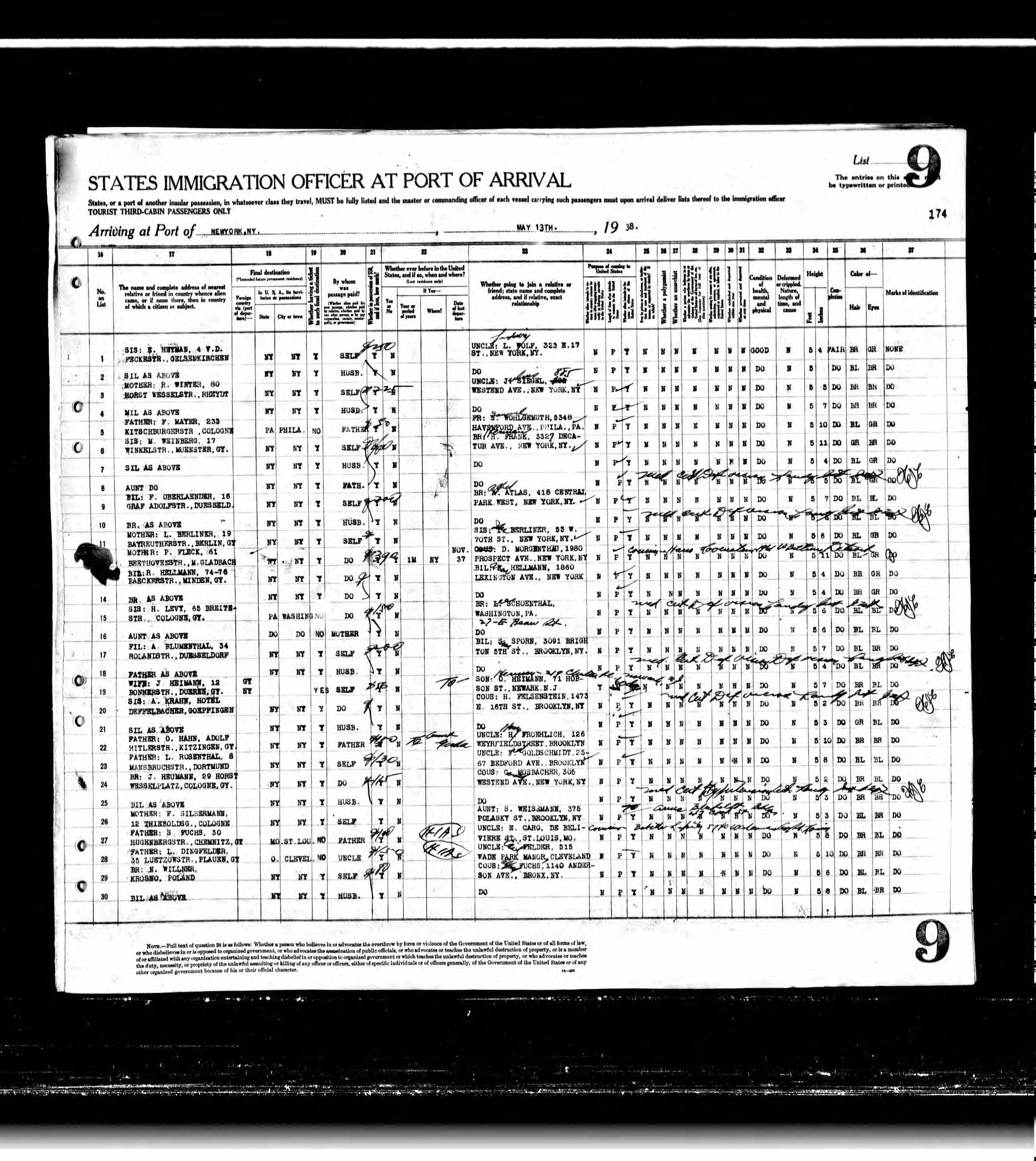
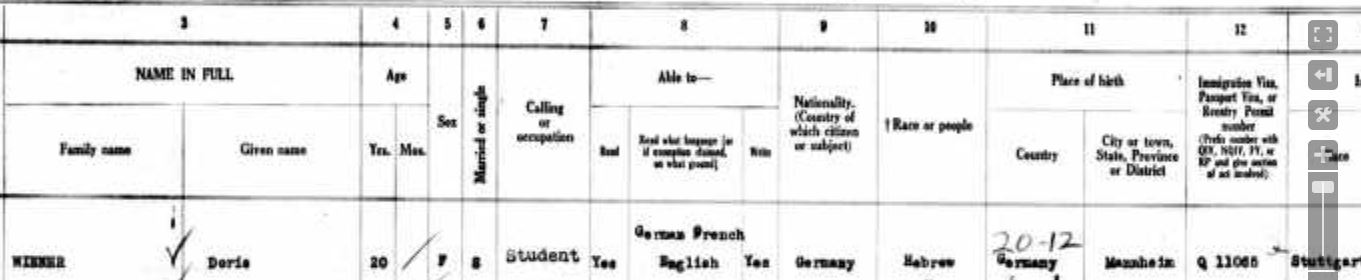
After reading Doris’ memoir, I went back to all the documents I had for her and examined more closely the passenger manifest for her trip to the US in 1937.  I had not seen the second page of it my first time through, but this time I noticed that it not only named Irma Rosenfeld; it had her street address in Cleveland.  It only took a glance at the 1940 US census for me to confirm that I had in fact found the correct Irma.
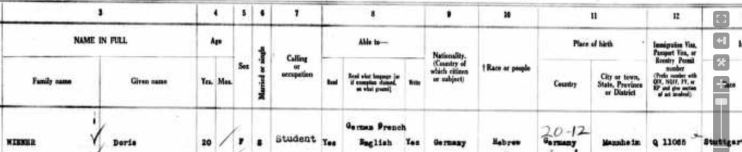
Doris Wiener 1937 ship manifest

Doris Wiener 1937 ship manifest part one

 p2 Ancestry.com. New York, Passenger Lists, 1820-1957 [database on-line]. Provo, UT, USA: Ancestry.com Operations, Inc., 2010. Original data: Passenger Lists of Vessels Arriving at New York, New York, 1820-1897.

p2
Ancestry.com. New York, Passenger Lists, 1820-1957 [database on-line]. Provo, UT, USA: Ancestry.com Operations, Inc., 2010.
Original data: Passenger Lists of Vessels Arriving at New York, New York, 1820-1897.

A little more research revealed that Irma’s birth name had been Irma Levi, daughter of Isaac Levi and Fanny Loeb.  Since Doris and Lotte’s great-grandfather (and my three-times great-uncle) Hieronymous Seligmann had married a woman named Anna Levi, I believe that that is the connection between Doris and Irma.  Anna Levi was a contemporary of Isaac Levi; perhaps they were siblings, and thus Irma Rosenfeld would have been a first cousin, twice removed, of Doris and Lotte, their grandmother Laura’s first cousin.  Obviously, the family had stayed in touch with these American cousins, and even though Irma was American-born and had never met Doris before, she reached out to help her escape the Nazi regime.

Continuing now with Doris and her emigration from Germany:

Necessary preliminaries having been taken care of and good-byes having been said, it was time to arrange for the journey to America. We bought a ticket for me on the SS Washington, a twenty-thousand ton ocean-going passenger boat, and also obtained railroad tickets for me and my mother who wanted to accompany me to Cherbourg, the place of embarkation. …

In Cherbourg I said good-bye to my mother, for whom the separation was very hard, more so than for me. For one thing, I was looking toward something new. But perhaps more importantly, I had unwittingly insulated myself to some degree from the impact of events. This condition lasted for a long time and to some extent gave me some emotional protection….

In contrast to so many, I confess that I had an easy time. Not only was the way for coming to America smoothed. My parents also were well able to pay for my ticket and whatever other expenses arose in connection with my leaving. I was twenty years old at that time.  …
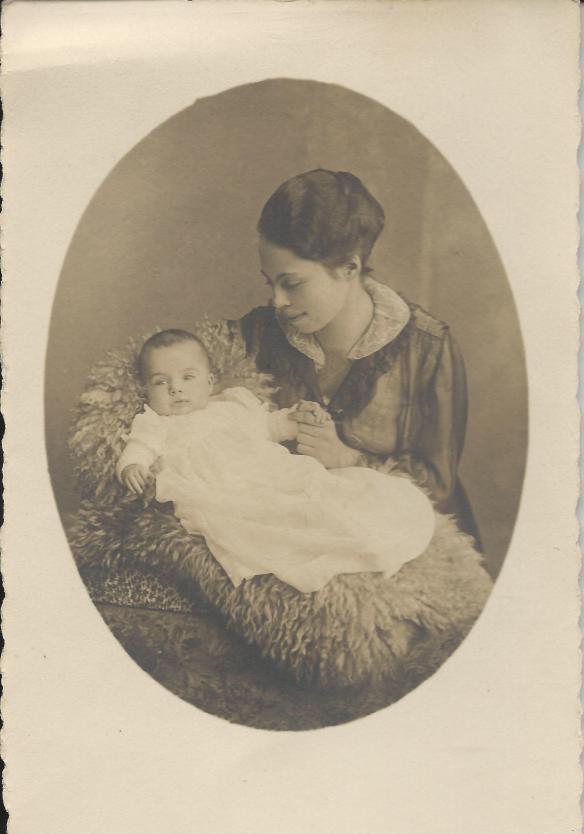
Aenne Wiener and Doris

Doris Wiener and her mother Courtesy of Lotte Furst

Doris explained why her parents and sister did not come with her:

The question has often been asked why my parents and sister did not come at the same time. Like a great many people, my father kept believing that the Hitler episode was just that, and he refused for a long time to see the situation realistically. Not so my mother. She was instrumental in organizing their own as well as her parents’ emigration to Luxembourg, and later their own to America.

Doris wrote that she arrived in New York in 1937 with $400.  Her parents had arranged for friends to meet her at the boat, and Doris stayed with them for a week before moving to her own apartment on the top floor of a building at 96th Street and Central Park West.  Doris also described a visit to Cleveland to see her grandmother’s cousin, Irma Rosenfeld, the woman who had provided the affidavit in support of Doris’ visa, as discussed above. “The slightly more than four weeks I spent with the Rosenfelds were very pleasant, with visits to their country club and other social activities.”  But Doris preferred to remain in New York City.

After returning to New York, Doris soon found employment in a dentist’s office and also soon met her future husband, Ernst Gruenewald.  They were married in May 1938.  Her mother Annie came to New York for the wedding, not only to witness the wedding but also “to gain insight into the international situation uninfluenced by German propaganda.”

My mother had intended to stay in America for about six weeks. But as she listened to the broadcasts available to us, she became increasingly agitated and decided to cut her visit short in order to initiate their emigration from Luxembourg to the United States. She had always been a very intelligent woman capable of making important decisions, many of which were advantageous. She returned to Luxembourg and was able to convince my father that this was the right thing to do. They arrived in the U.S. in April 1939, three weeks after the birth of our first child and about half a year before the outbreak of World War II.

Her grandparents, as we know from Lotte’s memoirs, did not fare as well:

During my childhood I had spent a good deal of time with them in Neunkirchen and was very fond of my grandmother. I knew her only from her mid-forties on, when in my eyes she was an old lady. She was a very reserved but warm person and managed their life very competently. My grandfather was a short, slim man who from the time I knew him as a person, was not well. …  My grandparents had applied for a visa to the United States before the outbreak of World War II, but failed to be granted immigrant status. In retrospect, I am convinced that my grandfather’s condition was the reason, as they had enough money to qualify for a visa. My parents also could have vouched for them. My grandfather ended up in Theresienstadt, where he died of pneumonia, as we were told after the war. My grandmother had suffered a fatal heart attack while still living in Luxembourg.

Doris and her husband Ernst and their family ended up relocating from New York to Chicago for a business opportunity a few years after her parents and Lotte arrived .  During the 1950s, Doris went back to school and obtained her bachelor’s degree while also raising her children; in 1961 she received a masters’ degree in psychology as well.  She then went on to get a Ph.D. in psychology, specializing in neuropsychology, which was itself still a relatively new field.  After obtaining her degree, she worked at Michael Reese Hospital in the Adult Inpatient department where she eventually became the director. Sadly, after twenty years there, she found herself forced out on the basis of their mandatory retirement age.  She had just turned seventy.

By Zol87 from Chicago, Illinois, USA (Michael Reese Hospital) [CC BY-SA 2.0 (http://creativecommons.org/licenses/by-sa/2.0)], via Wikimedia Commons

By Zol87 from Chicago, Illinois, USA (Michael Reese Hospital) [CC BY-SA 2.0 (http://creativecommons.org/licenses/by-sa/2.0)%5D, via Wikimedia Commons

In 1987 Doris and Ernst moved to California, where the winters were milder and where her sister Lotte was living.  Doris had obtained a California license before moving and was able to continue to practice as a psychologist when they moved, but did so only for a short period before retiring.  Ernst died in 1989, and Doris died almost twenty years later in 2007.

It was fascinating to me to read Doris’ memoirs after reading Lotte’s; both sisters wrote so clearly and so powerfully about their lives.  I can see that they had much in common: great intelligence, dedication to hard work and to family, astute powers of observation, and a love of language.  Doris struck me as the more thick-skinned of the two sisters, often talking about her independence and emotional distance from others, even as a young child.  Doris wrote about being somewhat of a loner and keeping her thoughts and feelings to herself.  I would imagine that those qualities served her well as she endured her teen years in Hitler’s Germany and a voyage alone to America in 1937 as well as her adjustment to life in America.

Overall, I am struck by how strong these two women were, both as children in Germany, as new immigrants to the US, and as women experiencing all the changes that came in the years after World War II.    I’d like to think some of that is the Seligmann DNA that we share, but I doubt that I would have been as resilient and brave as they had to be, if I had had to endure the challenges and hardships they did.



Moritz James Oppenheimer: The (More) Complete Story

Several weeks ago I received a comment on the blog from Angelika Oppenheimer, the granddaughter of Moritz James Oppenheimer, whose life I wrote about here.  He was the successful businessman who owned the horse breeding farm in Germany that was appropriated by the Nazis.  Moritz Oppenheimer died in 1941, an apparent suicide after being “visited” by the Gestapo.

Angelika found the blog because she was interested in knowing more about her grandfather’s family, and I am grateful because I now have learned more about her grandfather’s life and about the lives of his children and grandchildren.

Angelika Oppenheimer

Angelika Oppenheimer photo courtesy of Angelika

Angelika is my third cousin, once removed.  Here is a chart explaining our relationship:

Angelika to me chart


Moritz James Oppenheimer was born in 1879 in Butzbach, Germany, the youngest child of Maier Oppenheimer and Pauline Seligmann.  As seen above, he was the grandchild of Moritz Seligmann and Babetta Schoenfeld, my three-times great-grandparents.  Here is a photo of him as a young man from Fred Michel’s photo album,

Moritz Oppenheimer

Moritz Oppenheimer Photo courtesy of the Michel family

According to a resume provided to me by Angelika, in 1901 he founded the Mitteldeutsche Papierwarenfabrik situated in the Hanauer Landstraße and the Rheinische Sackfabrik.  Moritz was a member of the board of directors of several companies throughout Germany, including the Kostheimer Cellulose und Papierfabrik (Kostheim-Mainz), the Danziger Verpackungsindustrie at Danzig, the Fabbrica Italiana Sacchi Ercole at Villanovetta, the Mechanische Papiersackfabrik A.G. at Saarbrücken, the Sankt Georg Verlag at Berlin and the Bayrische Reitschule at Munich.

Emma Neuhoff and Moritz James Oppenheimer photo courtesy of Angelika Oppenheimer

Emma Neuhoff and Moritz James Oppenheimer
photo courtesy of Angelika Oppenheimer

Sometime before 1902, Moritz married Emma Katherina Neuhoff, who was not Jewish.  According to Angelika, she was a descendant of Theodor Neuhoff, born in Cologne, Germany, who traveled throughout Europe and was at one time the king of Corsica.  According to Wikipedia, “At Genoa, Neuhoff made the acquaintance of some Corsican rebels and exiles, and persuaded them that he could free their country from Genoese tyranny if they made him king of the island. With the help of the Bey of Tunis, he landed in Corsica in March 1736 with military aid. The islanders, whose campaign had not been successful, elected and crowned him king. He assumed the title of King Theodore I, issued edicts, instituted an order of knighthood, and waged war on the Genoese, at first with some success. But in-fighting among the rebels soon led to their defeat.”

Theodore Neuhoff

Theodor Neuhoff

Emma Neuhoff was a gifted musician and an excellent horsewoman, according to her granddaughter Angelika.

Emma Neuhoff Oppenheimer

Emma Neuhoff Oppenheimer  Photo courtesy of Angelika Oppenheimer

Here are two pages from a German magazine discussing M.J Oppenheimer and his wife Emma.  I think it’s a publication about thoroughbred breeding and racing, but I cannot read the pages.  Perhaps some kind German-speaking reader can help?

Familiengeschiche 2 Familiengeschichte3

(Angelika told me that the drawing of Emma illustrating this article was commissioned by the Historical Museum of Frankfort based on Emma’s reputation as an excellent horsewoman.)

Moritz and Emma had two children: Paula (1902) and Walter (1904), Angelika’s father.  Paula married a Catholic man named Rudolf Spiegler, a doctor, and converted to Catholicism; they had two children, Gabriele and Wolfgang. Paula and her family did not face any persecution during the war.

As for Angelika’s father Walter, he married Suzanne Zier on December 23, 1933.  Walter had been raised and baptized as a Christian, and his wife also was not Jewish, yet Walter faced substantial discrimination during the Nazi era.  In April 1945, as the war in Europe was ending, he wrote the following essay, describing both his own life and what happened to his father Moritz after the Nazis came to power:

27 April 1945

Biographical memorandum

I was born on 10 July 1904, son of the industrialist and thoroughbred horse-breeder Consul M.J. Oppenheimer, in Frankfurt am Main. After three years at preparatory school, I attended the Goethe Gymnasium in that city for nine years; I left school, having obtained my school leaving certificate (Abitur), at Easter 1923. After studying for six terms at Frankfurt University (Law and National Economy), I sat the examination for articled clerk at the Frankfurt Higher Regional Court [Oberlandesgericht]. After a period as an articled clerk at the court in Frankfurt, in 1927 I took my doctorate under Professor de Boor. After a lengthy period of practical training as a fitter in an engineering works, and as a paper-maker in paper-mills, I then joined my father’s paper-products company, the Mitteldeutsche mechanische Papierwarenfabrik, in Frankfurt. From 1931 I was Chief Company Secretary of this company belonging to my father as sole owner. At that time it was the largest company of its kind in Germany, and for a period employed together with its subsidiaries more than 1,000 people. In 1932 I built a major subsidiary factory for my father’s company in Berlin.

My father was arrested in the autumn of 1933, at the instigation of two [NSDAP] party members (August Hartmann and Helmut Vögler) working in collaboration with the NSDAP. His entire assets were put in the hands of the lawyer [Rechtsanwalt] Max-Ernst Cuntz as prospective administrator. A bankruptcy was thus brought about, and the assets liquidated at the lowest rate, the said lawyer Cuntz selling each item at a rate far below its value, for the most part at one twentieth of purchase value. The stud farm and stables, for example (probably the biggest and best of their kind in Germany), were disposed of at a price below the level of profits from racing for the following year. The case was similar in respect of the factories, share portfolios, Hippodrome A (whose director I also was, and all shares in which belonged to my father), etc. I myself was immediately removed without compensation from all my posts by the lawyer Cuntz, on the grounds of my non-Arian status. I was also compelled to surrender my own stables, representing an approximate worth of between 70,000 and 100,000 Reichsmark, without receiving any compensation. My father was also quite illegally disqualified from receiving the stud prize. To satisfy the rules in this latter regard, for years my mother and I continued to hold two mares for my father, so that he could legally be assigned 10% of all racing prizes won by horses bred by him, in accordance with stud rules: except with the proviso that no stud prizes could be paid out to a Jew; the authorities retained this annual sum, comprising up to 100,000 Reichsmark, and finally had it credited either to themselves or to the Union Klub. My father, who was perfectly healthy, became ill owing to ill-treatment during his detention. He was declared unfit for detention in 1934/5, and finally took his own life when he was about to be arrested again in 1941 preparatory to being sent to a camp.

I myself with my mother had founded the company Paverk, Gesellschaft für Papierverarbeitung in December 1933. As I could not appear in person as a holder of shares in a limited company, an Arian uncle of my mother acted for me. Then, in 1937, I transferred this share in trust to my father-in-law Otto Zier, now [April 1945] of Friedberg in Hessen, Dieffenbachstrasse 25, together with a further 20,000 Reichsmark of shares created in settlement of my assets, so that, of the total sum of 40,000 Reichsmark in shares of the above company, 10,000 Reichsmark of my mother’s and 30,000 of mine belonged in trust to my father-in-law. By the beginning of the war, however, with a nominal capital of 40,000 Reichsmark the company had an actual value of some 250,000 to 300,000 Reichsmark, as, thanks to the diligent efforts of my employees, the company had been highly successful under my stewardship.

My wife having died suddenly from pneumonia in April 1935, at the beginning of 1941 my father-in-law saw fit to attempt to misappropriate the shares that had been transferred to him in trust. As, owing to my status as a person of mixed blood, I myself could not appear as a plaintiff, I assigned my claim to my mother, who instituted legal proceedings and won her case, at both first and second instance. The papers relating to the case are still available in their entirety: reference 2/5 2/9 0 30/41. These papers clearly demonstrate how Zier attempted to influence the court using the entire gamut of National-Socialist arguments, with reports against me and the company being sent to all sections of the Party, including district and financial counsellors (Kreis- und Wirtschafts-berater – [advisors to the Gauleiter under National Socialism]) Eckhardt, Degenhardt, and Avieny, the DAF [Deutsche ArbeitsFront – national trades union organisation under the National Socialists], the Gestapo, etc. At last instance, the High Court [Reichsgericht] awarded my mother only 10,000 Reichsmark unconditionally, while presuming improper concealment [unsittliche Tarnung] in respect of the remaining 20,000 Reichsmark. This finding is the subject of a new trial before the District Court [Landgericht] in Frankfurt (2/5 0 36/44), over whose outcome in my mother’s favour there may be little reason to doubt. Quite apart from these machinations on Zier’s part, which caused not only the Paverk company but also my mother and myself endless spiritual and material harm, we had also much else to suffer at the hands of the NSDAP.

When the company was heavily bombed in 1943, and totally bombed out in February 1944, Herr Hermann of the Gauwirtschaftskammer [regional economic organization under National Socialism] prevented the rebuilding of the plant and re-acquisition of machines. In addition, I myself was arrested by the Gestapo in the autumn of 1942, the only charge against me being my engagement to an Arian woman in contravention of the rules. I was not released again until 28 May 1943. My entire household effects to the value of about 70,000 Reichsmark (peacetime value), including art collections etc., had meanwhile been taken, and the Gestapo official Wildhirt installed in my flat. In 1943, my fiancée was conscripted to work at the Mayfahrt company under the harshest of conditions at the direct instigation of the Gestapo. The main initiator in these matters was Zier, who did not, however, proceed in his own name, but employed the services of his friends Fabian-Gramlich (insofar as I have been able to determine up to now), while my furniture was removed by a painter by the name of Baumann, who did work for the police.

I married on 11 April 1945, immediately after the liberation by the Americans. I was allocated a flat at Freiherr vom Stein Strasse 56/1, which I immediately had redecorated and furnished with furniture belonging to my wife, only to have the flat abruptly requisitioned by US soldiers on 26 April 1945.

Initialled “W.O.” at Frankfurt am Main on 27 April 1945

I, David M.B. Richardson MCIoL, certify this to be a true and fair translation of a photocopied document in German provided to me by Frau Angelika Oppenheimer, daughter of Walter Oppenheimer.

Westcliff-on-Sea, 11 August 2015.

Walter’s essay reveals so much about the hate-filled and carefully plotted system used by the Nazis to crush, humiliate, and destroy the Jews.  First, they stripped them of their property, then they stripped them of their dignity, and finally they killed them and stripped them of their lives.  Moritz Oppenheimer, a man of great wealth, was brought to his knees by the Nazis and demoralized to the point that he took his own life rather than be subjected to further humiliation and abuse and ultimately murdered. One aspect of that humiliation and abuse not mentioned in Walter’s essay was the forced annulment of his marriage to Emma Neuhoff because of Moritz’s Jewish background.

Moritz and Emma’s son Walter, a highly educated and successful man in his own right and not even raised as a Jew, was denied his property and his rights and had his own father-in-law betray him and his trust after his first wife died in 1935.  According to Angelika, Walter’s brother-in-law was in the SS.  Only because Walter had a non-Jewish mother who bribed the local Nazi official in Frankfort was he allowed to survive.

As he wrote above, Walter married his second wife, Elsa Lina Wiegandt, in 1945, and they had a daughter, my cousin Angelika.   In 1946, Walter sought the return of the property that had been taken from him by the Gestapo, primarily the books he treasured so much.  Here is the letter he wrote and Angelika’s translation of that letter:

Walter Oppenheimer letter

Dr. Walter Oppenheimer                                  Frankfurt a. M., den 25. Oktober 1946          Niedenau 45

An das Archival Depot

Offenbach am Main

Mainstraße 167

Concerning: stolen books

With polite reference to the notice published the 22nd October under the above mentioned headword in the ‘Frankfurter Rundschau’, I take the liberty of presenting you the following:

I was arrested by the Gestapo the 26th October 1942 for purely political and racial reasons. My apartment was handed over to the Gestapo officer Wildhirt while my furniture was first and foremost transferred by a Gestapo agent to the second principal of the Gestapo here, Mister Grosse. The biggest part of my library was taken away with it. A part of the books was rubber-stamped with my name but the bigger part of it was without the name of the legitimate owner.

If there are any books of mine in your office, I ask you nicely to furnish information to me. Especially the following books mean much to me:

A 17-vlume gilt-edged edition of GOETHE in red morocco leather;

A complete half leather edition of HAUFF with gold ornament on the spine;

A half leather edition of KLEIST’s writings with gold ornament on the spine;

MUTHER: 3 volumes of history of painting, green cloth binding;

SPRINGER: 5 volumes on art history, half cloth binding and cloth binding respectively;

20 – 25 volumes of monographs on artists, partly half leather editions, partly with half cloth binding and cloth binding respectively, red with gold ornament, edition of the Stuttgarter Verlagsanstalt;

A five volume edition of HÖLDERLIN, grey pasteboards.

Many thanks indeed for your efforts in anticipation.

With all due respect to you!

I was impressed by the diversity of subjects in his library and by how much he valued his books. I also was struck by how polite and almost deferential he was in asking for the return of what was already rightfully his own.   At least some of the books were returned and remain today with Angelika.  Here is a photo of her father Walter.

Walter Oppenheimer 1972 courtesy of Angelika Oppenheimer

Walter Oppenheimer 
courtesy of Angelika Oppenheimer

Angelika shared this photograph of her family and friends at her Lutheran confirmation celebration taken in about 1961.

Angelika's confirmation Courtesy of Angelika Oppenheimer

Angelika’s confirmation c. 1961
Courtesy of Angelika Oppenheimer

From left to right: Paula Oppenheimer Spiegler (paternal aunt) , Emma Neuhoff Oppenheimer (grandmother), Christiane Wiegandt (Angelika’s maternal cousin), Christiane Bott (classmate), Sylvia Berres (classmate), Elsa (nee Wiegandt) Oppenheimer (Angelika’s mother), Angelika,, Walter Oppenheimer (Angelika’s father), Karl Wiegandt (Angelika’s maternal uncle), Karli (Angelika’s maternal cousin), Annie Wiegandt (wife of Karl), Herta Dorner (friend), Gabriele Spiegler (Paula’s daughter), either Wolfgang Spiegler or Gabriele’s husband.

I feel very fortunate that Angelika was able to find me through this blog.  Her family’s story is yet another lesson in the destructive power of prejudice, on the one hand, and the ultimate power that human beings have to survive and overcome those destructive forces, on the other.

Angelika and I have lived very different lives; we grew up with different religious backgrounds, we live in different countries, we speak different languages.  My immediate family lived through World War II in relative safety; hers was scarred forever.  But despite those differences, we know that we share a common history that ties us together as cousins.  Isn’t that remarkable?


Lotte’s Story, Part III: Coming to and Settling into America

In Parts I and II of Lotte’s story, we saw how my cousin Lotte’s idyllic childhood as the daughter of a successful doctor in Mannheim, Germany, was shattered after Hitler and the Nazis came to power in Germany in 1933.  By 1937, her sister Doris had left for the US, and a year later, Lotte and her parents Joseph and Anna (Winter) Wiener had moved to Luxembourg, where Anna’s parents, Samuel and Laura (Seligmann) Winter had already relocated.

After visiting her daughter Doris in the US, Anna returned to Luxembourg and convinced Joseph that they also should relocate there.  First, they had to obtain visas to travel to the US.  Lotte wrote:

The nearest American consulate was in Antwerp, Belgium, necessitating a fairly long trip. My grandparents were rather disabled by that time and in no condition to undertake the long journey. Reluctantly, we had to leave them behind when we made the trip. After a long wait we were admitted to the consul’s office where he sat, pipe in the corner of his mouth and feet on his huge executive desk. A most unfriendly man, he asked my parents all the necessary questions. When my turn came up, he quizzed me in some of the simplest arithmetic questions. When he was satisfied that I was not imbecile, he condescended to tell us that we could expect the visas in “six months to one hundred years”. Fortunately it took only a little over six months before we could sail.

While waiting for the visas to come through, Lotte worked at a baby hospital in Luxembourg.  She worked long hours taking care of the infants, and in the end she earned a Red Cross certificate, which proved to be quite valuable when she later applied to nursing school in New York.

The atmosphere in Luxembourg grew increasingly tense.  After the Munich agreement allowed Germany to take over the Sudetenland in Czechoslovakia in the fall of 1938, more and more Jewish refugees were leaving Germany for Luxembourg.

Bundesarchiv, Bild 183-R69173 / CC-BY-SA [CC BY-SA 3.0 de (http://creativecommons.org/licenses/by-sa/3.0/de/deed.en)], via Wikimedia Commons

Signing the Munich Agreement
From left to right: Chamberlain, Daladier, Hitler, Mussolini, and Ciano pictured. Bundesarchiv, Bild 183-R69173 / CC-BY-SA [CC BY-SA 3.0 de (http://creativecommons.org/licenses/by-sa/3.0/de/deed.en)%5D, via Wikimedia Commons

As Lotte described it:

Many Jewish refugees had arrived in Luxembourg, many only with their fur coats and jewelry in assets. Having nothing else to do but to wait for the possibility of a visa, most unlikely on the Austrian and Hungarian quotas, they spent a lot of time in the local cafés. That in turn aroused a certain amount of the latent antisemitism in the population. Or maybe it was not so latent. My roommate at the hospital, a devoutly Catholic young lady who went to mass almost every morning, confided in me that she needed to “confess” to the priest that she was sharing her room with a Jewish girl. She had to admit, however, that I neither had horns nor did anything evil as far as she knew.

It was becoming very clear that there would be a war in Europe, and the events of Kristallnacht in November, 1938, also frightened those who were still in Luxembourg.

Finally, in April 1939, Lotte and her parents received their visas and could leave for the United States.   There was, however, no way to take Lotte’s grandparents, Laura and Samuel, with them.

Tickets for the voyage were booked, and soon my parents and I found ourselves on a train to Le Havre without them. We never were to see them again. As we found out later, Oma died of a heart attack while looking for an apartment, having been evicted when the German army took over Luxembourg in the spring of 1940. Opa was deported to Theresienstadt where he reportedly died “of natural causes”.

When I think about these separations, it tears me apart.  I cannot imagine leaving my parents behind, as Annie Winter Wiener was forced to do.  Anyone who has seen the recent movie “A Woman in Gold” will remember the scene when Maria Altmann leaves her parents behind in Vienna for similar reasons.  It’s a scene that breaks your heart and stays with you long after the movie ends with Maria victorious in her legal battles over the Klimt painting.  Maria was a real person, just as Lotte is a real person.  These are not Hollywood stories written just to wring tears from viewers.  These are the lives and the experiences that thousands and thousands of people endured.

But somehow these people, including Lotte and her parents, survived and found the strength to move on.  Lotte’s description of her sea voyage to America, leaving her grandparents and her homeland forever, reveals that tenacity, the strength, that courage.

Below is the ship manifest listing, on lines 6,7, and 8, Lotte and her parents (her real first name is Leonore) and a photograph of the George Washington, the ship that brought them to the US.

Year: 1939; Arrival: New York, New York; Microfilm Serial: T715, 1897-1957; Microfilm Roll: Roll 6313; Line: 1; Page Number: 176

Year: 1939; Arrival: New York, New York; Microfilm Serial: T715, 1897-1957; Microfilm Roll: Roll 6313; Line: 1; Page Number: 176

The George Washington, the ship that Lotte and her parents sailed on to the US in 1939 Ancestry.com. Passenger Ships and Images [database on-line]. Provo, UT, USA: Ancestry.com Operations Inc, 2007. Original data: Various maritime reference sources.

The George Washington, the ship that Lotte and her parents sailed on to the US in 1939
Ancestry.com. Passenger Ships and Images [database on-line]. Provo, UT, USA: Ancestry.com Operations Inc, 2007.
Original data: Various maritime reference sources.

Lotte chose to write this section in the third person, which I found interesting and revealing.  Was she distancing herself from that teenaged girl who was herself distancing herself from her past?

It was a grey and rainy day in April of 1939. A wet and blistery wind blew, adding to the girl’s anxiety. The security of her world had been shattered, slowly at first, but then with increasing speed and ferocity. Her best friend had been left behind – without her being able to say a proper good-bye – perhaps they would never have a chance to see each other again. Here she stood at the pier in Le Havre, ready to embark on the longest journey of her young life. Slowly she and her parents stepped on the planks of the ship, the ocean liner which would bring them from a Europe threatened by the certain relentless march toward war to the vast and unknown entity of America which lay before her.

The voyage was stormy and rough. The ship rocked from side to side with the huge waves. Most of the time she felt sick. Staying in the cabin was awful. When she stepped on deck, she felt even worse. Looking at the ominous grey sky above as well as watching the wildly moving waves below made her dizzy. Eating became a nightmare. Keeping any food down was impossible. They suggested broth. That wouldn’t work. Eating a baked potato– who had ever heard of a baked potato before? The English spoken on board did not sound at all like what she had learned in school. The ship’s entertainment was provided by an enormously fat and very jolly man with the incongruous name of “Tiny”. Was everybody crazy?

Finally, during the fifth night, the storm passed, and in the morning the sea was calm and the sun shone brightly. She stepped outside and saw to her right the exhilarating sight she had been told to expect: New York Harbor with the Statue of Liberty. Suddenly she felt well. Her excitement grew. Soon she would be able to set foot on the land which would be her new home. She resolved that she would accept whatever there was. She would not compare things with what had been.

Statue of Liberty National Monument, Ellis Isl...

Statue of Liberty National Monument, Ellis Island and Liberty Island, Manhattan, in New York County (Photo credit: Wikipedia)

Lotte seemed to stay true to those resolutions.  She quickly adapted to life in New York City, working as a babysitter while awaiting acceptance to a nursing program.  She was accepted into Cornell University-New York Hospital’s nursing program for the fall of September, 1939, less than six months after her arrival in New York.  Lotte wrote about some of the culture shock she experienced when she began her nursing studies in New York:

Once I was notified that I had been accepted at the prestigious Cornell University – New York Hospital School of Nursing, it took me exactly one week to purchase the few required items and to pack my suitcase. Actually admissions had been closed quite a while before, but they had made an exception for me. Of course I had lost no time getting all my documents together and to have my credentials translated and notarized. I had taken a six-week crash course at a private school in Manhattan, located on Sixth Avenue behind the Public Library. How I had sweated that summer, taking the Subway from Kew Gardens to Times Square and back, and then to take the Regents exams! The courses, American History, 4th Year English, and Civics, were required in order to obtain a “Nurse Qualifying Certificate”.

So one fine September morning in 1939 my father and I, all of 18 years old, set out to travel from Kew Gardens, Queens, to the nurses’ residence on York Avenue in mid-Manhattan. With two big suitcases we walked to the subway station, went downstairs, took the  train to 59th Street and Lexington Avenue, dragged the suitcases back upstairs, walked to the Second or Third Avenue Elevated which was still running at that time, and then walked to the York Avenue address. As we entered, we saw several taxis pulling up, bringing some of my new classmates to the same destination. Only they did it the easy way. It had never occurred to us to take a cab as money was very tight. I said goodbye to my father and went about to register and to get settled in my new quarters.

The schedule of activities for the first day included a four o’clock tea for all the newcomers in the formal and somewhat stuffy library. True to my nature I was there right on time, the first one to appear, to be exact. All the others were still busy taking showers and changing into the kind of clothes you were supposed to wear for an afternoon tea. Little did I know that that was the thing to do. I was still in my travel outfit and felt rather sweaty. Well, I entered the library and found a stunning-looking white-haired woman in a gorgeous red dress seated at the solid oak table, “pouring” tea. I learned that she would be one of my nursing instructors. Soon the other students came, and we began to get acquainted.

*****

During the first six months the emphasis was on academics. Actually one of the entrance requirements had been one year of chemistry. Most of my classmates had two years of college with all the needed requirements behind them, while I had barely obtained my high school equivalent certificate. My European education had been superior in some ways, but badly missing in science. I did not even know how to balance a chemical equation. So here I was supposed to obtain a basic knowledge of inorganic as well as organic chemistry in all of six weeks. It seemed like it was going to be a disaster. But with the help of a fellow student who had dropped out of medical school, and with the kindness and understanding Miss Rynbergen, my teacher, showed to me, I did overcome that hurdle and even managed to get an “A” in the course. None of the other courses presented any problems, at least not academically.


Obviously, Lotte was an extremely gifted student.   She had neither the academic background nor the social benefits of most of her classmates, yet she excelled in her studies, even though English was her second language.  In fact, Lotte did so well that she tried to be admitted to NYU Medical School and met with the dean to discuss her application.  Here is what happened:

I had mustered a lot of courage. After two years of practicing hospital nursing I really wanted to pursue the ambition I had nurtured since childhood – to become a doctor like my father. Thus I marched up the long corridor at my hospital’s medical school and entered the dean’s office. Of course the visit had been properly scheduled ahead of time. The dean, bespectacled, grey-haired, lean and stern-looking, listened to my brief story: that I was dissatisfied with the prospect of my future nursing career, and that I really would like to find out how I could be admitted to the medical school. The man just took one look at me and smiled. “My dear, you are asking for the impossible. First of all, you are a woman. There is quite a limit placed on the number of females at our school. Secondly, you lack the necessary college preparation. It would take several years for you to catch up with our requirements. Thirdly, you are Jewish. Do you know what that means? All kinds of difficulties along the way! You’d better forget about it.”  

Lotte must have been devastated.  She was being discriminated against as a woman and as a Jew.  The fact that she had excelled in the nursing program was not enough to outweigh her limited pre-nursing school education.  She had left Germany to escape anti-Semitism, and here it was, thrown in her face again.

In 1942, as World War II was in full force with the US now itself involved, Lotte graduated from nursing school and began working the night shift in the internal medicine department at New York Hospital.  The family received news of Samuel Winter’s deportation to Theriesenstadt, and the news overall was quite disturbing.  Lotte somehow kept a positive outlook.

Terezin

Terezin

My mother was desperate. This war is going to end in a terrible nightmare of defeat, she stated. But I, being young and more optimistic by nature, I just KNEW that good had to prevail over evil, that things would eventually come out all right. I knew that history had its ups and downs. This was a down. Sooner or later there would be an up. I wrote so to my friends. I never gave up hope. In the end, I was right.

How incredible is it for Lotte to have concluded, after all she had experienced and all she would soon learn about her relatives in Europe, “that things would eventually come out all right?”  It truly takes a real strength of character and a positive view of the world to see things that way.  I greatly admire her for that depth of character and strength.

There is much more in Lotte’s memoirs—stories about how she met her husband, their courtship and wedding, and their happy marriage of 58 years.  There are stories about their travels and anecdotes about various events in Lotte’s adult life.  But I will end Lotte’s story with one that I think says so much about her—who she was as a child and who she is today.  It’s a story that brought tears to my eyes.  It has nothing to do with the Holocaust or the war per se; it’s about an incredibly sensitive and generous woman.  I hope you find it as powerful as I did.

A PRIZED POSSESSION

There was a piece which was part of me. Ever since I was a teenager it went with me wherever I moved. But it is no longer in my possession. I gave it away. But I do hope that whoever uses it now appreciates what I did and gets as much enjoyment from it as it gave me at one time. It was my violin, my beautiful Italian violin bearing a label, glued to the inside, reading

 “Matteo Albani fecit Bolzano anno 1698″.

How did I receive this beautiful instrument, and why did I dispose of it the way I did? It’s a long story which began in 1937 when my parents began to make preparations for our eventual emigration from Germany to the United States. Since they had been able to put aside a sizable sum of money which could not be legally transferred abroad, they had to find various ways to buy objects of value which might be suitable for a later sale in the U.S. or which might be useful to us. My mother schemed and bought a trousseau for my sister and also for me. They bought two Leica cameras, modern lamps, clothing and many other articles. But my father, who had at one time played the violin, insisted that he wanted to buy me a fine instrument which hopefully would not have to be sold so soon.

That’s why he traveled with me to Stuttgart, a city about two hours away, where, with the help of my violin teacher, he had located an internationally known dealer of fine string instruments, Hamma & Company, which incidentally is still in business at the present time. I did not have much to say in the matter, but between my father and my teacher they found a suitable violin, full size but not too large, for the acceptable  price of DM 3,000.00, bargained down to DM 2,200.00, a substantial sum of money at that time. Proud as a peacock I traveled home with my new possession, my princess, carefully wrapped in a blue silk cloth and placed in a light brown leather case with light blue plush lining.

Now I must describe my pride and joy: It was beautiful to look at with its light orange-brownish varnish. The top was made of spruce with fine, even grain. The back, pleasantly curved for an aesthetic feel of form, was made of two pieces of maple with small, faint flames. The label, mentioned above, was found on the inside, to be seen through the F-shaped openings on the top. Later on I was assured that the label was authentic, and that the violin really was the work of Matteo Albani, a highly respected violin maker, and that it was a fine example of his work.

Yes, it was beautiful to look at, and beautiful to feel. But the most important quality of such an instrument is, of course, its sound. Played by my teacher it sounded magnificent. My own technique left something to be desired, but I had received the impetus to improve, and I worked hard at it. Friends in my chamber-music group admired it, envied me for it. I took good care of it. I treated it like the princess it was, what with the silk wrap and plush lining of the case.

From now on the violin went with me wherever fate took me. In 1938 we left Germany. After one year in Luxembourg we embarked for New York where I ended up living in my hospital’s Nurses’ Residence. I did not have much time to practice or to play, but I did have my own private room where I could do so at various times. I also once participated in a talent show where I played something or other in a miserable performance. My fellow student nurses were not very kind. They made a number of nasty cracks about my playing, but assured me that it was all meant in good humor.

My violin was with me on Pearl Harbor Day. I had been playing some chamber music on a rare, free Sunday afternoon and found myself on the platform of the A-train subway in Washington Heights when the terrible news broke. I will never forget it.

Later on, while raising my family and through most of my married years, I played only sporadically, sometimes in orchestras, sometimes in chamber music groups. At one time I even took some more lessons. But I found that I did not have it in me to work at it the way I needed to in order to really improve. Most of the time my precious fiddle was locked up in a hall closet. Yet I knew it was there.

And then disaster struck. At pretty much the same time I developed arthritis and a great clumsiness in my fingers along with a noticeable loss of hearing. The latter distorted many of the higher frequency sounds, thus making it impossible for me to play with the required accuracy. I grew discouraged and finally gave up. Much as I loved my violin, I knew that it was no longer of service to me. I also knew that it had appreciated greatly in value. Thus I made a very painful decision.

Selling my violin would have been like selling a piece of me. Leaving it to my children might create problems and certainly cause unnecessary difficulties. Yet it was not doing me any good. So I decided that I would give it to someone who would truly appreciate it. I made a number of inquiries and soon learned that there was a place for my intended gift right here in town. The non-profit Colburn Foundation collects instruments for use by aspiring artists, to be loaned and returned when they can afford to buy their own.

The decision was easy, the execution was hard. On one rainy afternoon in 1996 my husband and I traveled to the magnificent Colburn mansion in the Hollywood Hills. We were greeted quite cordially and even received a tour of the estate. That’s where we left my beautiful princess, still wrapped in blue silk and in her blue plush-lined leather case, to be given to someone who really needed it. I never found out to whom it was given, but I do hope he or she is taking good care of it. After all, although the wound has healed, it was a part of me.

For me, that final sentence says it all.  It is not only about her lost violin, but also about every other loss she suffered:  her grandparents, her home, her friends, her school, her country, her language.

An Albani violin

An Albani violin

Perhaps someone reading this will know the fate of Lotte’s beloved violin.  If so, like Lotte, I hope it is being well taken care of and played with all the heart and soul and passion that Lotte herself has demonstrated through her writing and throughout her life.

Thank you, Lotte, for sharing your life story with us.

Lotte’s Story, Part II:  Life in Nazi Germany

This is the second part of a three-part post about the life of my cousin Lotte, who was born in Germany, left in 1938, and came to the United States in 1939.  You can read Part One here.

Although Lotte was only eleven years old on January 30, 1933, when Adolf Hitler became the Chancellor of Germany, she has vivid memories of that day and the events leading up to it.

Lotte wrote:

For years, the Nazis had been a minority party. Many people thought they could not possibly rise to power. But in 1933, Germany was in the grip of the world-wide depression precipitated by the crash of the American stock market and an enormous scandal involving Ivar Kreuger, the Swedish Match King, whose pyramid scam had caused the collapse of the European markets. Unemployment was widespread and severe. In addition, Germany’s pride, so badly hurt by the harsh and unrealistic provisions of the Treaty of Versailles, was crying for revenge. Thus the stage had been set for the dramatic rise of the Nazis whose promise of hope, and whose message of antisemitism, fell on accepting ears. In November of 1932 they succeeded in winning an election and joined up with the “German National Party”, a very rightist holdout of frustrated generals and army protagonists, frustrated because the German army was severely limited by the peace treaty. …But then, on that ominous day in January, President Paul von Hindenburg, a tottering and senile ex- general, appointed Adolf Hitler to be the chancellor.

Adolf Hitler and Hermann Göring performing the...

Adolf Hitler and Hermann Göring performing the salute at a Nazi party rally in Nuremberg (ca. 1928) (Photo credit: Wikipedia)

Like many Jewish residents of Germany, Lotte’s father at first was not overly concerned about Hitler and his party.  Her mother was more worried.

My father, who was a decorated veteran of World War One, owner of the Iron Cross medal, and a respected physician in the community, kept on stating that nothing could really happen to us. That the whole thing would blow over. My mother, always a realist, an activist and somewhat of a pessimist, painted a different picture. She was a convinced Social Democrat with a leftist leaning, whereas my father supported the more centrist “Zentrum” party. There had been many heated arguments about politics in our house, and both Doris and I were quite up-to-date on what had been going on.

It did not take long for Lotte’s mother to be proven right about her concerns about the Nazis.  By February, 1933, the father of one of Lotte’s close friends was sent to Dachau, and when he returned, he and his family left Germany.  While the father was still in Dachau, his daughter and Lotte were assaulted on the street by three boys, leaving Lotte with a bloody lip.

Lotte soon became fearful of saying the wrong thing and getting her family into trouble.  Lotte wrote:

A few days into February [1933] I found that a large picture of Adolf Hitler was hanging in my classroom. Without thinking I exclaimed more or less to myself: “Does that guy have to stare right into my face?” The boy sitting in front of me, known to be a “Nazi”, turned around and said “what did you say?” I don’t remember what I answered, but I was scared to death about the possibility that some harm could come to my father. Fortunately, the boy did not report the incidence, and nothing happened. But from there on I knew that I had to be extremely careful with what I said or did. There was always a certain pressure, a certain fear looming over my head, not a very healthy state for a child and then a teenager. And that fear increased as time went on.

By April, the Nazis had instituted a boycott of Jewish businesses, and Lotte’s father was directly affected by this:

A yellow sign with a Magen David (Jewish star) bearing the inscription “Jewish Enterprise” was plastered over my father’s medical shingle. An S.A. man (Nazi stormtrooper) was planted at the entrance to the building with instructions to prevent anyone other than residents from entering. But one well-meaning elderly woman told him to be ashamed of himself, that my father, who handled many deliveries, had actually brought him into this world, and the young man shamefacedly trotted away.

https://commons.wikimedia.org/wiki/File%3ABoycot_of_Jewish_shops_april_1_1933.jpeg

A stormtrooper stands in front of a store being boycotted (Not Lotte’s family) https://commons.wikimedia.org/wiki/File%3ABoycot_of_Jewish_shops_april_1_1933.jpeg

In her memoirs, Lotte describes the various ways that life for Jews in Germany became increasingly intolerable between 1933 and 1935, when the Nuremberg Laws were enacted.  Jews were not allowed in restaurants, theaters, and concert halls.  They could not ice skate or swim in public pools.  Blatant expressions of anti-Semitism by storm troopers and others became commonplace.  Even one of Lotte’s teachers espoused anti-Semitic rhetoric:

My French teacher, who had been known to have been a Social Democrat and who had quite opportunistically converted to Naziism, actually had the gall to try to console me by stating that none of the shenanigans were really meant to be antisemitic, but that the day would come when it would be discovered that the blood in Jewish veins actually was different from that of “Aryans”, the true Germans.

Although most Jewish children were forced to leave the public schools, Lotte was able to stay at the Gymnasium because her father had served in the army during World War I.  However, she knew she was facing discrimination:

At the end of each school year the three best scholars received prizes donated by local merchants. Being Jewish, I never received such a prize. My home room teacher used excuses, or I was given an undeserved “C” in a minor subject. Twice I just received an “honorable mention”.  Later on they no longer bothered to cover up, and I knew why.

Another incident occurred when Lotte attended a concert, violating the prohibition:

I attend a concert by the fourteen year old Yehudi Menuhin who, wearing shorts, looks like a little boy but plays beautifully. Of course being Jewish I am not supposed to be in the concert hall where I meet the grandmother of one of my non-Jewish friends. The lady looks the other way, completely ignoring me, although I have spent many hours at her house in friendlier times.

Meanwhile, Lotte became more interested in learning about her Jewish identity.  As described last time, her father had left the Jewish community, and Lotte’s upbringing had been completely secular.  Her limited exposure to Judaism had occurred when she had visited her maternal grandparents in Neunkirchen.  But once Hitler came to power, Lotte’s father Joseph rejoined the Jewish community, and Lotte felt a desire to learn more about what it meant to be Jewish.

First, she tried a class for Jewish religious instruction.  Her description may seem familiar to many who attended Hebrew School growing up in the US:

The teacher had one look at me and promptly asked what I was doing there, but condescended to let me stay. There was a lot of noise in the classroom, nobody was paying any attention, and the teacher could only try to keep some order by slapping the faces of some and shouting louder than the others. After attending twice I was completely turned off and never went there again. Nobody ever asked me to come back.

Lotte then enrolled in a Zionist youth group, Die Werkleute, where she found a group of like-minded Jewish youth and learned a lot more about Judaism.  Although her parents did not support the Zionist movement, for Lotte it became a political, religious, and social outlet.

As far as I was concerned, the concept of Zionism fell on fertile ears. I remembered the KKL box on my grandparents’ chest, and I needed something positive to look forward to, seeing how my future in Germany was being destroyed systematically. A few of my friends actually went to Israel by enrolling in the Youth Aliyah program which was in full force by then and was instrumental in to rescuing Jewish children. Others were planning to spend some time in preparation for their move to the Kibbutz by gaining work experience in agriculture, gardening and some of the trades. I was not quite ready to do just that, but I certainly expected to emigrate to Israel somehow at some time in the future. Fate had it that things worked out differently for me. But more about that later. 

I learned a lot about Judaism at that time. Some of the members were very observant, and everybody respected that, but on the whole religion was downplayed. It was discussed in a more or less theoretical context. Jewish history, especially the history of Zionism, and Jewish peoplehood were the thrust of our education. At the same time the value of our background of German culture was stressed. We took our mission very seriously.

Werkleute group in Frankfort, Germany 1927 (not Lotte's group) http://www.infocenters.co.il/gfh/multimedia/GFH/0000065842/0000065842_1_web.jpg

Werkleute group in Frankfort, Germany 1927 (not Lotte’s group)
http://www.infocenters.co.il/gfh/multimedia/GFH/0000065842/0000065842_1_web.jpg

In 1936, Lotte’s father was excluded from the state-run insurance system which had provided him with many of his patients.  He finally realized that it might be time to leave Germany before it was too late.  First, the family arranged for Lotte’s older sister Doris to emigrate; she left for the United States in 1937.  Lotte’s parents then began to make plans for their own emigration.  .

Lotte’s grandparents Laura (Seligmann) and Samuel Winter and her great-uncle Jakob Seligmann had already left Germany for Luxembourg a few years earlier.  As explained by Lotte, Neunkirchen was located in the Saar region, which had been under French control after World War I, as agreed to in the Treaty of Versailles.  In 1935, there was a plebiscite to determine whether or not the region should be returned to Germany, and the residents of the Saar region voted overwhelmingly to rejoin Germany (over 90%).  Under the terms of the Treaty, however, anyone dissatisfied with the result could leave the area.  Thus, Lotte’s grandparents and great-uncle had gone to Luxembourg, where German was spoken.  Lotte beautifully described where her grandparents lived in Luxembourg:

With my mother’s help they managed to move to a lovely small apartment at the foot of a hill in the fairytale-like city of Luxembourg. The view toward the skyline silhouette, way above, was breathtaking. The ruins of an ancient watchtower and of fortifications lay on the way up to the city. Grand-duchess Charlotte ruled the country which had an army of about 100 men. At times you could see two or three of the soldiers marching behind each other, rifles on their shoulders. Had it not been for a shortage of funds, it would have been an idyllic place to live.


Embed from Getty Images
Luxembourg


Lotte’s mother Anna persuaded her husband to move to Luxembourg when they made the decision to emigrate. Lotte wrote:

Once the decision was made, all the following steps fell into place. I had to leave school and take the courses needed to prepare me for a different life. My father closed his office. We obtained the necessary passports featuring the addition of the name “Sara” for my mother and me. “Joseph”, my father’s name, was sufficiently Jewish to avoid any changes. The passports were not hard to get since one of the officials at the office was known to oblige when a DM 10.00 note was slipped into each application. Ours was the last family in Mannheim to be allowed to pack most of its belongings.

Lotte remembers what this meant for her education.

Unfortunately my schooling was rudely interrupted when my parents began to make preparations for emigration. Much to my chagrin I had to quit school in the middle of the equivalent of my junior year. Instead, I took courses in English and French shorthand, typing and commercial correspondence at a private school. I also learned the rudiments of using a sewing machine, courtesy of a school run by nuns. I must add that for a couple of years I had also studied English with a very proper Oxford-trained teacher at the private Berlitz School.

On a more positive note, Lotte’s parents saw to it that she would have a good violin before they left Germany.

In preparation for eventual emigration my father and I travel to Stuttgart to buy a new violin for me. Or rather, it is a beautiful old Italian instrument, bearing a label stating that it was made by Matteo Albani in 1698. It has a gorgeous flamed wood back, gracefully molded. The sound is magnificent. My teacher assists in the purchase which also includes a light brown case lined with light blue plush. A piece of matching blue silk serves as a wrapper for the instrument. It will soon become a part of me. I am ecstatic.

An Albani violin

An Albani violin  http://www.bromptons.co/reference/articles/details/sears-danelectro-history.html


I would imagine that that feeling of ecstasy was tempered by some sadness about leaving behind her childhood home, the city of Mannheim where she’d grown up, and her birth country.  But Lotte’s memoirs do not convey sadness, just relief.

On the day scheduled for the packing, an inspector appeared whose job it was to supervise what we were doing. He was quite a jovial man. At lunchtime he attached a yellow ribbon across the doorway and announced that he was now going to be gone for about one hour. My mother took the hint and promptly hid a box with jewelry and cash in one of the suitcases destined for Luxembourg. After exactly one hour the good man returned. Luckily he did not ask any questions and did not inspect anything.

For a few more days we stayed at the home of some friends. On May 9, 1938 my parents and I boarded a train heading for Luxembourg. Again luck was with us. Our compartment was shared with a gentleman who turned out to be the Luxembourg consul posted in Stuttgart. The German border control officers of whom we had been afraid and who might have made a lot of trouble for us, they tipped their hats in deference and did not search the compartment very thoroughly. The Luxembourg officials were considered harmless.

Not long after settling in Luxembourg, Lotte’s mother traveled to New York to attend her daughter Doris’ wedding.  When she returned better informed about what was going on in Europe, she persuaded her husband that they should leave Luxembourg and immigrate to the United States.  How fortunate it was that Doris had moved to the United States a year earlier and that her mother had come to the US to attend her wedding.  If the Wiener family had not left Luxembourg, it is very likely that Lotte would not be here today to share this remarkable story.

Next, the family’s departure from Europe, journey to America, and Lotte’s life in the new country.


My Ever-growing Seligmann Family Tree

Of all my family lines, I have had the best luck with my Seligmann line. First, early on I found my cousin Pete, Arthur Seligman’s grandson, who had a wealth of information about the New Mexico Seligmans.  Then I was lucky to find people in Germany who provided me with the copies of vital records for Moritz Seligmann and his family as well as a book about the Jews of Gau-Algesheim.  From those sources, I learned the names of many of my German ancestors.

Then my cousin Wolfgang found my blog, and he has provided me with invaluable information and documents as well as his continuing help in deciphering and translating what he found in his cousin’s suitcase.  From there I was able to find my cousin Suzanne, who has provided me not only with more information and more documents but also with priceless photographs of many of my Seligmann relatives.

And now I have connected with two more cousins: George, an American descendant of Hieronymous Seligmann, a brother of my great-great-grandfather Bernard, and Davita, a descendant of Adolph Seligman, also my great-great-grandfather’s brother, who also settled in Santa Fe..  And from George and Davita I hope to learn even more about the family.

Right before I left and then while I was away, Wolfgang and Suzanne sent a bunch of new documents and new photographs that I want to share.  I am not even sure where to begin.  I think I will start with the newly discovered Westminster Bank document revealing the names of all the children of Hieronymous Seligmann; it answered some of the questions left open by my posts about the list of heirs to the estate of English James Seligman.

Westminster Bank family tree for Hieronymous Seligmann

Westminster Bank family tree for Hieronymous Seligmann

This must have been the family tree that Elsa Oppenheimer had found erroneous as described in her letter of July 9, 1984.  She had asserted that Hieronymous did not have a daughter named Johanna or Elizabeth (Bettina, on the tree), as the Bank’s tree indicated.  But Elsa also said that Moritz did not have a son named Adolph, and she was wrong about that.  I now think she was also wrong about Johanna and Bettina.  How do I know she was wrong?  Because there are pictures of both of these women in the photograph album that belonged to their cousin, Fred Michel.

First, here is a picture of Johanna Seligmann Bielefeld from the Michel album.  Despite Elsa’s protestations, Johanna was clearly the daughter of one of the Seligmann sons, and there is no reason to think that she was not a sibling of Jack, Rosina Laura, and Mathilde, as indicated on the Bank tree, and thus a daughter of Hieronymous.

Johanna Bielefeld nee Seligmann

Johanna Bielefeld nee Seligmann

As I posted earlier, Johanna married Alfred Bielefeld, and they had two children, Hans and Lily, both of whom immigrated to the United States.  Alfred and Johanna were both deported to Terezin, where Alfred died.  With the help of the archivist at Terezin, I was able to locate Alfred’s death certificate.

Albert Bielefeld death certificate from Terezin

Alfred Bielefeld death certificate from Terezin

From what I can interpret here, Alfred died from myocardial deterioration and cellulitis.  Johanna did not die at Terezin, but was later transported to Auschwitz, where she was killed.

As for Bettina, this beautiful photograph appears in the Michel photo album.

Bettina Arnfeld nee Seligmann

Bettina Arnfeld nee Seligmann

Wolfgang located a page in German for the stolperstein placed in her memory in Muelheim-Ruhr.

Stolperstein for Bettina Seligmann Arnfeld

Stolperstein for Bettina Seligmann Arnfeld   By RalfHuels (Own work) [CC BY-SA 4.0 (http://creativecommons.org/licenses/by-sa/4.0)%5D, via Wikimedia Commons

According to this page, Bettina was born in Gau-Algesheim on March 17, 1875, the daughter of Hieronymous Seligmann and Anna Levi.  She attended school in Bingen and married Adolf Arnfeld in 1900.  Adolf was in the fabric and clothing business in Mulheim-Ruhr, and he and Bettina were living there when their son Heinz was born in 1902.  Adolf died in 1927, and Bettina was still living in Mulheim when she was deported to Terezin on July 21, 1942.  She died six months later at Terezin from pneumonia.  Here is yet another chilling death certificate issued by the Nazis.

Bettina Seligmann Arnfeld death certificate from Terezin

Bettina Seligmann Arnfeld death certificate from Terezin

Unfortunately, I was not able to locate these death records while at Terezin so was unable to locate the specific gravesite where Albert Bielefeld and Bettina Arnfeld were buried.

Bettina’s biography also discussed her son Heinz.  After initially working for his father’s company, Heinz became an attorney and worked as a clerk in the court system until dismissed in 1933 under the anti-Semitic laws adopted by the Nazis.  He was imprisoned for a period of time in 1938 at Dachau (mostly likely in the aftermath of Kristallnacht), but was released.  He immigrated to England in 1939, where he married Liselotte Schondorff in 1945.  Heinz died in England on May 4, 1961.  I have not located any descendants.

Based on the photographs and the other information and documentation, I think it is quite evident that both Johanna and Bettina were the daughters of Hieronymous Seligmann, the younger brother of Bernard Seligman, my three-times great-grandfather.

There were two other names I was not certain about when I wrote about the list of heirs to the estate of English James Seligmann: Anna Wolf and Bettina Ochs.  I think I now have answers for those as well, with the help of Wolfgang and the photographs from Suzanne.

The list of heirs to English James Seligman’s estate had listed Anna Wolf right below Johanna Bielefeld and Bettina Arnfeld and referred to Johanna as her aunt.  It also indicated that Anna had died in December 1935 in Mulheim-Ruhr, the town where Bettina had lived.

heirs list p 1

On the Hieronymous family tree from the Westminster Bank, depicted above, one of his daughters, Mathilde Wolf, is listed as having a daughter Anna, who died in 1935. This certainly seems to indicate that the Anna Wolf on the list of heirs was the daughter of Mathilde, sister to both Johanna and Bettina.  That assumption is further supported by this photograph of what appears to be a stock certificate with the name Mathilde Wolf geb. (born) Seligmann written upon it.  I don’t know what happened to Mathilde or her husband or why she herself is not listed as an heir instead of her daughter Anna.

Mathilde Wolf geb Seligmann

There are several photographs of unidentified couples from the Michel album.  Perhaps one of these is Mathilde Seligmann Wolf and her husband; perhaps one is a photograph of Bettina Seligmann Arnfeld and her husband.  I don’t know.  I will post some of these in a subsequent post and ask for help from all of you.

As for Bettina Ochs, I had been quite perplexed by her name on the list of James Seligman’s heirs.  As I wrote, she is listed as Frau Bettina Ochs from Milan, Italy.  Ochs thus appeared to be her married name, so I had thought her birth name must have been Seligmann or Oppenheimer, but the list names her brother as Arthur Erlanger, suggesting that Bettina’s birth name was Erlanger.  So who was she, and how was she related to the Seligmanns?

Heirs List p 2

I was stumped.

Until I saw this photograph:

Emil Ochs and wife, daughter of Mathilde Erlanger geb Seligmann

Emil Ochs and wife, daughter of Mathilde Erlanger geb Seligmann

It says “Emil Ochs and wife, daughter of Mathilde Erlanger nee Seligmann.” So Bettina Ochs was the daughter of a Mathilde Seligmann, who had married someone named Erlanger.  But which Mathilde Seligmann?

Thanks to Wolfgang, I now have an answer.  Wolfgang found a page on Geni.com, another genealogy website, for Mathilde Erlanger nee Seligmann, which identified her as the daughter of Moritz and Babetta Seligmann. I looked back at my notes for the children of Moritz and Babetta, and sure enough there was a daughter named Mathilde for whom I had had no information beyond her birth date of January 31, 1845, which came from the records I’d obtained from Gau-Algesheim.  Now from the Geni page, the list of heirs, and the photograph, I know her married name and the names of her children, Bettina and Arthur, and I know Bettina’s husband’s name, Emil.  Unfortunately, however, I do not know what happened to Mathilde, her husband, Arthur or Bettina and Emil.  I don’t know why Bettina was listed as living in Milan or why she had an English lawyer, according to the list of heirs.  I don’t know why her brother was only listed as a secondary heir.

The only other record I have for Bettina so far is from the JewishGen database labeled “Switzerland, Jewish Arrivals 1938-1945,” which includes a listing for “Bettina Ochs-Erlanger (Bettina Oberdorfer).”  That listing says her nationality was Italian and that she arrived in Switzerland on August 5, 1944.  Where did she go from there?  Why is she also listed as Oberdorfer? What happened to Emil?  I don’t know.

So as always, some questions have been answered, leading to more to be answered.  Next post I will look at some of the other photographs from the album of Fred Michel.

Impressions of Vienna and Some Concluding Thoughts on our Trip

To be honest, Vienna was not originally on our itinerary.  We wanted to go to Prague and Budapest and, of course, Poland, and we felt that given the number of days we could travel that that was already an ambitious itinerary.  But we could not find non-stop flights even out of NYC to any of those places, and we hate layovers, so we decided to fly in and out of Vienna.  It may not make sense to those of you who are regular jetsetters, but getting me on a plane is a big enough accomplishment; making me change planes might send me…flying?

Anyway, we were going to fly in and out of Vienna so we added a day to our trip.  It seemed crazy not to spend at least 24 hours in one of the world’s great cities, even though we knew that 24 hours would not be enough to scratch the surface of what there is to see there.  It would take some intense prioritizing and great organization to pack even a few top sights into our day.

We actually ended up with a day and a half, as our train from Budapest to Vienna arrived around 2:15 pm, and we were able to check into our hotel (Radisson Blu) quickly and be on our way.  The hotel was extremely well-situated for us to see many of the important sites just a short walking distance away.  It’s not the Boscolo, but it is a very clean, contemporary, and small boutique hotel.

Just two blocks down the street was the Hofburg Palace where the Habsurgs lived in Vienna.  An outdoor music festival was going on that day, and there were crowds gathered to listen to the music—young choral groups performing primarily American music.  A bit incongruous—standing in front of an Austrian royal palace, listening to a group singing, “When the Saints Go Marching In.”  Our global world at work.

Hofburg Palace

Hofburg Palace

We wandered through the streets, passing many chic stores on Kohlmarket, and reached Graben, where there is a huge square lined with cafes and more fancy shops.  We stopped to see St. Stephen’s Cathedral and the all glass Haus Haus across the street.  Unlike the Hilton in Buda, this modern structure somehow blended in with the older buildings surrounding it.

IMG_2895 IMG_2896 IMG_2897 IMG_2898

We just had to stop and have some Viennese pastry, right?  It’s mandatory, I think. If one must drink beer in Prague, one must eat pastry in Vienna.  It was very much worth the unnecessary calories.  Vienna’s streets were packed with tourists, and there was lots of good people-watching to do from the café.

But we had miles to go in order to see at least some of the city, so off we marched towards the Opera House.  Like the Opera House in Budapest, it was a stately and beautiful building.  We opted not to do the tour inside this time, preferring to use our time to visit one of the art museums.

IMG_2907

It was already late in the afternoon, and we realized that we only had an hour until closing time, so we opted for the smaller Leopold Museum rather than the tremendous Kunsthistorische museum.  We were very glad that we did.  The museum focuses on the works of Gustav Klimt and Oskar Kokoschka as well as that of some of their less well-known contemporaries, and it does a masterful job of teaching about their art, their lives, and the politics and psychology that lie behind their art.  The room dedicated to the influence of Sigmund Freud was particularly well-done; a plaque with a quote from Freud hung near each painting, leaving it to the viewer to see the connection between the words and the art.

IMG_2909

We stayed until the museum closed and then wandered back to our hotel, not even realizing how close it was.  (We had basically walked a full circle from one side of the center of the city to the other and back without realizing it and were essentially behind the Hofburg Palace when we exited the museum quarter.)  We were amazed by how much we had seen in the few short hours since we’d arrived in Vienna.

The next day was jam-packed on my itinerary, but I quickly realized that there was no way we would get to the Schonbrunn Palace, even though I had pre-purchased tickets to go there.  It’s about 20 minutes outside of the city center, and since we were seeing the Hofburg Palace that morning, we decided that if you’ve seen one palace, you’ve seen them all. (Where is Spiro Agnew when you need him?)  Eliminating the Schonbrunn from the agenda loosened up our day considerably.

The Hofburg Palace was worth seeing; it tells the story of Emperor Franz Joseph and his wife Empress Elizabeth, commonly known as Sisi.  In particular, it tells the story of Sisi, who grew up as a young and independent child and married the emperor somewhat reluctantly, knowing that she would lose her freedom by doing so.  Eventually she became very unhappy living such a restricted life, and after one of her children died, she became severely depressed.  Although she contemplated suicide, in the end she was assassinated in Geneva by an Italian anarchist.  Her life story is well-told in the first several rooms in the palace.  After that, you then can see many of the lavish rooms where the emperor and empress lived and entertained in the palace.

After the palace tour, we went to see the performance of the Lipizzaner stallions at the Spanish Riding School.  This was another event that, like the baths in Budapest, several people said we could not miss.  We had standing room tickets, and the place was packed.  Within five minutes of the show starting, I almost left.  The first “act” involved some newer horses, and it was clear that at least one of them was not at all happy performing.  I couldn’t watch as the horse bucked and resisted his trainer’s attempts to control him.  We did stay for the next hour, and although the rest of the show involved more experienced horses, I just couldn’t shake the idea that these animals were being forced to do something they were not intended to do.  The horses are gorgeous, and if you love horses, you will either love this event or you will hate it.  I still am not sure how I feel about it. (We were not allowed to take photos, so I’ve inserted one from the internet.)


Embed from Getty Images

After lunch, I went to see the jewels at the Imperial Treasury while Harvey went to finalize our boarding passes for our flight the next morning.  The jewels were amazing.  I will let the pictures reveal what I saw.

IMG_2917

This opal was the size of a large pear. My Aunt Elaine would have loved it.

IMG_2920 IMG_2922 IMG_2927

The last thing we wanted to do before leaving Vienna was see some evidence of the Jewish world that once existed there.  Vienna had a large and thriving Jewish population before the Holocaust, including many famous artists, writers, musicians, and, of course, Freud.  Yet unlike Prague or Krakow or Budapest, there is almost nothing left in what was once the oldest Jewish section of the city to let you know that there once was a vibrant Jewish community there.  In that place, called Judenplatz, there are two reminders of the Jewish community: a museum which contains the remains of a medieval synagogue and a Holocaust memorial sculpture.  The museum’s exhibit is fascinating.  You can actually walk through the remains and see where the bima was, where the ark was, where the men sat to pray.

As for the Holocaust sculpture, it stands in the center of the square, and it is a large cube placed in the center of a larger platform.  On the sides of the cube are engraved the names of all the concentration and death camps.  I think it is supposed to evoke the sense of being locked inside, given the locked door on the exterior.  What was very disturbing about the memorial was the fact that there were many people sitting on the platform, idly eating ice cream and chatting, seemingly oblivious to the purpose of the sculpture.


The memorial to the 65,000 murdered Austrian J...

The memorial to the 65,000 murdered Austrian Jews in the Holocaust at Judenplatz in Vienna. (Photo credit: Wikipedia)

That perhaps is itself a metaphor for the Austrian attitude towards the Holocaust for many years after the war: denial.  As we learned at the main building of Jewish museum, it was not until fifty years after the war that Austrian officials apologized for their country’s role in the Holocaust.  They refused to acknowledge their complicity with the Nazis in the persecution and eventual murders of their Jewish citizens.  What had been a large and wealthy and intellectual community had been almost entirely wiped out.  Today there is some revival of Jewish life in Vienna, mostly made up of immigrants from the former Soviet Union.

We ended our trip going to the Musikverein, a great music hall in Vienna, where we heard Haydn, Poulenc, and Sibelius.  The sounds were as clear as could be, and the music was just wonderful.

IMG_2935

Musikverein Concert Hall

Although we saw so much of great beauty in Vienna—the buildings, the pastries, the jewels, the art, and the music, our visit to Judenplatz and to the Jewish museums put an overall damper on my feelings for Vienna.  Perhaps I am not being fair; we were there for such a short time, and perhaps a longer visit would have provided me with more perspective.  We had no guides in Vienna, just our handy Rick Steve’s guidebook and TripAdviser. I understand that there are a number of stolpersteins in the Second District where the Jewish community was located right before World War II.  We did not get there nor did we see where the current synagogues are located or talk to anyone familiar with the city and its history as we had in the other cities.  I am sure there is more than what we saw in such a short time—an important lesson to keep in mind in visiting any place.  You can’t see it all in a short visit as a tourist.

****

Thus ends my travelogue of our trip to Central Europe.  Some concluding thoughts:

  1. The best way to learn about the history, values, and people of another country is to go there and walk where they walk. If you do, be sure to find a way to talk to someone who lives in that place.  Guidebooks are great, group tours may be fine—but nothing beats developing a personal relationship with someone who knows that city like you know your home town and your history. Talk to them about their families, their personal history, and you will learn so much more than you ever could from a book or recorded tour.
  2. Take notes, take pictures. Memories vanish very quickly.  In writing this, I had to go back to my books, notes, photographs, and, yes, the internet, to be sure I had the right name for the right place and the right numbers and dates.
  3. Travel the way you want to travel.  I know many people prefer to travel on organized tours or at least with a group of friends.  Call us anti-social, but we have learned that traveling with others means compromising our own priorities.  We don’t get to travel as often as we’d like, and when we do, we want to go where we want to go, eat when and where we want to eat, and see and hear what we want to see and hear.  It’s really not that hard to research and plan your own trip.  Just my opinion, of course.  I fully understand that for other people, traveling with others is more comfortable and more fun.  Like I said, travel the way you want to travel.
  4. There is both incredible beauty in the world and incredible evil. Human beings have created incredibly awe-inspiring buildings, music, and art.  Each place we visited was a testament to man’s ability to create beauty.  Sadly, each place was also a testament to man’s ability to do incredible evil.  We tried always to let the beauty remind us that for the most part, human beings are good.
  5. If you know where your ancestors lived, go there, even if it’s a small town in the middle of nowhere where no traces are left of your ancestors or their community. I understand that some people have too many feelings of anger about the past to do this, but if you don’t feel that way and can go, go there.  You will be forever changed.

Thank you to all who have followed me through this telling of our trip.  I will now return to a focus on genealogy, but I felt a real need to write about this trip for so many reasons, not the least of which is to keep a record for me about what I saw and what I felt.  It is not an experience I ever want to forget.


Three Days in Budapest

Although leaving Poland was hard, arriving in Budapest was delightful.  We weren’t even ripped off by the cabbie this time.  We arrived at our hotel at 9 am after another overnight train, and when we walked into our hotel, the Boscolo, we were a bit in awe.  We’ve never been in a hotel as beautiful as the Boscolo.  The atrium in the lobby is glamorous and gorgeous.  It may be a bit ornate for our usual taste, but there was no denying the way that large, well-lit, and finely decorated space made us feel.  After a breakfast in their famous New York café, we were able to get an early check-in to our room, which also stopped us in our tracks—-a very large and well-appointed room with a little balcony.  It felt like we were in some fantasy world.

The Boscolo

The Boscolo

Breakfast at the New York Cafe in the Boscolo

Breakfast at the New York Cafe in the Boscolo

IMG_2729 atrium IMG_2731 skylight

Although it would have been tempting just to enjoy our surroundings, we had things to see and do.  Although the concierge at the hotel warned us that our destinations would require a long walk, we were not intimidated.  And as it turned out, although we walked quite a bit, we did not regret it.  We love walking in cities (and beaches and just about anywhere); only by walking do you get a feel for the scale of a city and its buildings and only by walking do you make eye to eye contact with the people around you.  So we ventured out for our first day in Budapest.

First, we went to the House of Terror, a museum that primarily tells the story of what life was like in Budapest under Soviet domination.  The museum is in the building which the Soviets used as their headquarters and where they also imprisoned, interrogated, and tortured prisoners.   The cells and the instruments of torture are still there.  It is a powerful museum; the use of symbols is particularly effective.  We were very moved by our experience there.

Our next stop was the Budapest Opera House, where we had tickets for a tour and a mini-concert.  The opera house was impressive and uplifting, especially after the darkness of the House of Terror.  The gold and red colors which ran throughout the building gave it a truly regal feeling.  And the mini-concert was fun—one opera singer came out and performed two arias for us.  (Don’t ask me what they were—-I am not really an opera fan.)

Hungarian State Opera House

Hungarian State Opera House

IMG_2741 Budapest Opera IMG_2748 opera house boxes IMG_2749 mini opera

We headed to our final stop for the afternoon, the Parliament, where we also had tickets for a tour.  The Parliament is huge—I don’t think I’ve ever seen such a large building.  It sits right on the Danube River, extending fairly far along its shore, and there is a huge open plaza surrounding the building.  We strolled around, looking at the not-at-all blue Danube and across the river to Buda and then entered the building in time for our tour.

Hungarian Parliament

Hungarian Parliament

IMG_2754 Danube

Danube River

The security to enter the building was more intense than what we had gone through at any airport, which was a bit unnerving.  But once we were in, the guide led our group through the building, which was originally intended to be finished for the 1896 Millennial Celebration, but was not finished in time.  Hungarians believe that the Magyars arrived from Asia to the Carpathian plains where Hungary is located around 895, but because plans for the millennial could not be completed in time for 1895, they postponed it a year and claim now that the country was founded in 896.  Like so many countries in Central Europe, Hungary was subjected to many invasions and wars over the year, eventually becoming part of the Austria-Hungary Empire as the result of a compromise with the Habsburgs in 1867.  The Parliament building was originally meant to be the Habsburg’s palace, but after World War I and the end of the Austria-Hungary Empire, it became the home of the Hungarian Parliament.

Like the Opera House and the hotel and many of the other buildings we would see in Budapest, it is an ornate and beautiful building, conveying a sense of prosperity and power.  The crown jewels sit in a case under a large dome (we were not allowed to photograph them), evidence of the royalty who once ruled the land.  We also saw the chambers of the Parliament, equipped with modern digital voting machines at each desk—a strange mix of the old and the new.  It was a very interesting tour and gave us a quick overview of Hungarian history.

IMG_2758 parliament budapest IMG_2760 Parliament staircase IMG_2764 chamber

By that time we were a bit tired and hungry and ready to find a place to eat.  We strolled along the river watching the Viking Cruise and other companies’ “river boats,” then turned to walk through the center of the city, where we happened upon a restaurant called Rezkaka.  The menu looked creative, and the atmosphere seemed relaxing, so we took a chance.  It was our best meal of the trip.  The violin and piano playing in the background didn’t hurt either.

As we left the restaurant, the night sky was getting dark (it was about 9 pm), the ferris wheel in the city center was lit up as were many of the buildings.  It was magical.  We decided to keep on walking (despite what the concierge had said), and we passed the Dohany Synagogue, all lit up.  We were using the GPS on my iPhone to guide us back to the hotel, and it led us through the Jewish quarter, which has become a hip place, filled with “ruin bars” patronized by 20-somethings.  It was an entertaining walk back, and by the time we reached the hotel, we were quite proud of ourselves for the distance we had walked and quite enamored with Budapest.

St Stephen's Basilica, Budapest

St Stephen’s Basilica, Budapest

IMG_2777

Dohany Synagogue

IMG_2774

Our next day started with a tram ride (we decided to give our feet a little break) to the Central Market in Budapest—an amazing place filled with fresh fruit, vegetables, meat of all kinds, paprika, and flowers.  And it’s a real market—not a tourist joint.  We could see regular people with shopping bags and carts, buying their groceries.

IMG_2786 IMG_2787 IMG_2788 IMG_2789 IMG_2790

From there we walked somewhat aimlessly through several streets and squares, passing the university buildings, a street of touristy shops, a street of high fashion designer shops, and the second McDonalds to open behind the Iron Curtain.

McDonalds in Budapest

We were aiming for the Holocaust Memorial on the river.  During the Holocaust, Jews were rounded up and brought to the river, where three people would remove their shoes, be tied together, and one would be shot, forcing all three to fall into the river and die.  The memorial captures this atrocity very simply and poignantly with sculptures of many pairs of empty shoes, lining the wall that abuts the river.

Holocaust Memorial, Budapest

Holocaust Memorial, Budapest

IMG_2798


plaque

For the afternoon we had signed up for a tour of the Budapest Jewish Quarter with Budapest Jewish Heritage Tours.  It was supposed to be a group tour, but luckily for us, no one else had signed up at that time, so we ended up with a private tour.  We actually had three guides.  Ann, our first guide, gave us a general introduction; she then brought us to the Jewish Museum, which is right next to the Dohany synagogue.  At the museum we were guided by Esther, who works for the museum.  After we finished at the museum, Fatima met us to take us to see the synagogues in the quarter.  Each guide was knowledgeable and personable, and we learned a great deal about the history of Budapest’s Jewish community.

There were Jews in Budapest from as early as Roman times, though not a permanent settlement.  As in the other countries in Central Europe we visited, Jews came to Hungary as traders and bankers.  They faced a great deal of violence and anti-Semitism, and for a long time were required to live on the Buda side of the river while working on the Pest side.  Eventually they were allowed to live on the Pest side, but outside the city walls.  The area where they settled in the 18th century became the Jewish Quarter where even today there are numerous active synagogues, kosher restaurants, and other Jewish institutions.  The community flourished in the 19th century, and by the 1930s there were over 200,000 Jews in Budapest.

Perhaps the best indication of the size and prosperity of the Jewish community in Budapest is the Dohany Synagogue, the second largest synagogue in the world and a magnificent structure built in the middle of the 19th century.  It was built for a congregation that wanted to be more modern in its practice of Judaism. They called themselves Neologs (new law).  Although men and women were still separated for services, there was an organ (played by Franz Liszt at the inauguration of the building), and the interior was designed to be more church-like than like a traditional synagogue.  Like the Spanish Synagogue in Prague, the design reflects a Moorish influence both inside and out.

Dohany Synagogue

Dohany Synagogue

IMG_2801 IMG_2806 IMG_2809

Our guides pointed out, however, that Hungary had a long history of anti-Semitism, and in the 1920s a law was passed establishing quotas at the universities.  In the 1930s. Hungary adopted laws stripping Jews of their rights even before the Nazis began their occupation of the country.  Although Hungarian Jews were among the last to be deported to concentration camps, our guide in Poland, Tomasz, had explained that that was simply because the Hungarians wanted to exploit the Jews for free labor, not because they were trying to protect them.  In the end, most of Hungary’s 600,000 Jews were killed, 400,000 of them at Auschwitz on some of the last transports to arrive there.

The Dohany Synagogue survived the war because it was used by the Nazis both for storage and as a place for radio towers since it had the two high spires on its roof.  Behind the Dohany Synagogue is a memorial garden dedicated to those who were killed in the Holocaust.  I found the sculpture of the Tree of Life that resembles an upside down menorah particularly moving.

IMG_2813

We saw two other synagogues after leaving the Dohany.  First we visited the Orthodox synagogue, built in 1912, another very beautiful building, and then we saw the Rumbach Street synagogue.  From what Vatima told us, this last synagogue was formed by a group that spit off from the Neologs; they felt the Neologs had moved too far away from traditional Judaism, but they also did not agree with the strict practice of the Orthodox synagogue.  This building was under renovation and not open to visitors, so we only got to see its exterior, which was quite beautiful.

IMG_2817 IMG_2820 IMG_2821 IMG_2822

Rumbach Synagogue

Rumbach Synagogue

Overall, our experience in the Jewish Quarter in Budapest was much more uplifting than in either Prague or Krakow in large part because we learned that there is still a very substantial and active Jewish community in Budapest, consisting of about 80,000 people.  Although that is less than half of the Jewish population of Budapest in 1939, it is nevertheless a promising sign of rebirth and hope for the future.

Our day in Budapest ended with a quick dinner and an organ concert at St. Stephen’s Basilica, the largest church in Budapest—and yet again, a magnificent building.

St Stephen's Basilica

St Stephen’s Basilica

IMG_2832 IMG_2835

For our third and last day in Budapest, we had arranged for a driving tour to see those sites that really are too far for walking, even for us.  Our guide Magdi took us out to Heroes Square and through the City Park, two more spaces that were developed specifically for the Millennial Celebration in 1896. We saw Hungarian soldiers practicing for a parade while we were there.

IMG_2850

Legend says if you touch this guy’s pen, your writing will be successful. FIgured it was worth a try….

IMG_2839 IMG_2840 IMG_2847 IMG_2848


Then we crossed the Danube to Buda where the Castle is—where once again we learned that almost everything there was either built or redone for the Millennial Celebration.  What impressed us most were the incredible panoramic views we could see from the Fishermen’s Bastion and from the Castle itself.  Magdi did point out some older buildings in Buda that dated back to earlier times, but overall most of what we saw dated from 1896 or so.  The glaring (literally and figuratively) exception was the Hilton, a modern building of reflective glass that just does not fit into the setting.

IMG_2868 IMG_2866 IMG_2861 IMG_2852 IMG_2851

IMG_2869

Finally we went to Gellert Hill, where we were able to view Budapest from yet another perspective and see the fortress built there.

IMG_2875 IMG_2877 IMG_2878 IMG_2879

Our tour ended by dropping us off at the Gellert Spa and Baths.  Everyone had told us that we had to try the baths while in Budapest, and so we did.  It was an interesting experience—soaking in a hot pool with a bunch of elderly Hungarian women who did not really look so pleased to have us invading their space.  But we were glad we tried it, and that hot water was very relaxing.  After all the walking we had done in our three days in Budapest, our feet certainly deserved the break!

Looking back on our time in Budapest, I would say it was the city where we had the most light-hearted moments in our trip.  Maybe we just needed to focus more on the beauty, less on the tragic, after seeing Terezin, Krakow, and Auschwitz.  Maybe it was the Hungarian people or the energy of the city, where the streets were crowded with young people at night.  Maybe it was all the beautiful buildings and breath-taking views and sights we saw.  For whatever reason, we left Budapest the next morning feeling uplifted.

IMG_2889 IMG_2890 IMG_2891

Our trip was almost over.  We had a train ride to Vienna and a day and a half in that city before returning home.   And home was starting to sound like a good place to be.


Walking in the Shadows of My Brotman Great-Grandparents

My third day in Poland was undoubtedly the highlight of the trip for me.  Visiting the town where my great-grandparents lived was the initial motivation for going to Central Europe in the first place.  The stops in Prague, Budapest, and Vienna were the icing on the cake, but the cake was Poland and, more specifically, Tarnobrzeg.  (I finally learned how to pronounce it, thanks to our guide Tomasz: TarNOBjeg.)  I had high and emotional expectations; they were exceeded by the reality.

First, some background.  When I first started doing genealogy research, I had no idea where my maternal grandmother’s family had lived in Europe other than they were Galitzianers—from Galicia.  My mother had no idea what town in Galicia had been their home, and for a long time the only location given on the records I could find was Austria, which made sense since Galicia was part of the Austria-Hungary Empire when the Brotmans lived there.

Then a few pieces came together—first, I obtained my great-uncle Hyman Brotman’s naturalization application giving his home town as Jeekief, which is a decent phonetic spelling of Dzikow, once a separate village but later incorporated into Tarnobrzeg, a much larger town.  Then I found a ship manifest for Yossel Brod, most likely my great-grandfather, from Tarnobchiek, another phonetic spelling, this time of Tarnobrzeg.  The ship manifests for my great-uncles Abraham and David Brotman gave their home town at Grebow, a small village less than ten miles from Tarnobrzeg.  It seemed clear to me that Tarnobrzeg was the area where my Brotman ancestors had lived in Galicia.  And I had to go there.

SelectedU.S.NaturalizationRecords-OriginalDocuments1790-1974ForHermanBrotman

Hyman Brotman’s Naturalization Application (Click twice to zoom in.)


David and Abe Brodmann on the Portia 1889

David and Abe Brodmann on the Portia 1889


Joseph Brotman ship manifest

Joseph Brotman ship manifest

I had originally hoped that there might be some records left in Tarnobrzeg that had not yet been digitized and put on line by JewishGen, Gesher Galicia, or JRI Poland, but our guide Tomasz warned me that he believed that whatever records still existed had in fact been found already and that we would not find any more in the town.  I adjusted my expectations accordingly, and I decided to enjoy the trip for the experience of being there rather than as a research opportunity.

Tomasz picked us up at our hotel at 9 am that morning, and we got to meet my recently found cousin Phyllis for the first time.  Phyllis and I had connected through DNA testing, which showed us as third cousins and showed her aunt Frieda and my mother as second cousins.  By comparing our family trees we had reached the conclusion that the likely connection was through my great-grandmother Bessie Brot Brotman and her grandmother Sabina Brot, whose father we believe was my great-grandmother’s brother.  Sabina’s home town in Galicia was Radomysl nad Sanem, another town about ten miles from Tarnobrzeg, which we would also visit that day.  The common surname and the proximity of residences seemed to support our hypothesis.  We quickly connected in person, chatting excitedly about our research, our travels, and our hopes for that day.

IMG_2705 cousins

As we drove from Krakow to Tarnobrzeg, Tomasz spoke about the history of Jews in Poland. By the 19th century Jews made up 10% of the population of Poland, and they lived all over the country—in the cities and in small towns and in villages.  The land we drove through was mostly rural even today, and Tomasz said that Jews were often invited by the kings or the aristocracy to live in the towns to support the local economy; Jews had the education and the skills to provide bookkeeping, trade, banking, and other economic necessities to the farmers who lived in these regions.  In Tarnobrzeg it was the Tarnowski family that owned the land and invited the Jews to come live there.


Castle of the Tarnowski family in Tarnobrzeg

Castle of the Tarnowski family in Tarnobrzeg


IMG_2697

When I asked him about the level of religious observance of the Jewish residents who lived in places like Tarnobrzeg, Tomasz said that there was a diverse range of religious observance—-from Hasidim to more traditional Orthodox to more liberal Jews and to secular Jews. Other sources point out that Tarnobrzeg was an important Hasidic center with well-regarded Hasidic leaders and rabbis.

Tomasz also spoke about the fact that Tarnobrzeg was one of the leading Jewish population and industrial centers in Galicia outside of Krakow.  The main industry aside from agriculture was the production of sulfur, a product that it still important to the local economy of the region.  Tarnobrzeg is located where two rivers meet—the Vistula (which also runs through Krakow) and the San, and thus was an important trade location.  It also is very close to what was once the border with the Russian Empire, and when Russia obtained that land, families were often separated, some living in Austria-Hungary, some in the Russian Empire.  In the 19th century when my great-grandparents lived there, the population of Tarnobrzeg was more than 75% Jewish.  There were about 2800 Jews living there in the 1880s when my great-grandparents decided to leave.

I asked Tomasz why people like my great-grandparents would ever have left a place like Tarnobrzeg, where Jews were doing well and treated well and were more than a majority of the town’s residents.  He said that in the late 19th century, there was both an economic crisis in Poland and a significant increase in the population. (There was also a great deal of anti-Semitism in Poland, as other sources describe.)  Jews and non-Jews left for greater economic opportunities.  When I pondered how a family would be able to tear themselves away from their home, both emotionally and financially, Tomasz explained that there were emigration agents facilitating these departures.  They would circulate brochures touting the advantages of going to America, and the fact that many others were leaving made it easier for a family like mine to make a similar choice.  I asked how they would actually leave, and Tomasz said there was a train that came to Tarnobrzeg that would take them to one of the port cities, like Gdansk or Hamburg, where they would catch a ship for America.  It would be costly, but the potential benefits made it all seem worth the risk.

Finally we arrived in Tarnobrzeg itself.  It was not exactly what I expected, as it is a large town, not a little shtetl, and it is a thriving town—lots of people, lots of stores, lots of cars.  Not a quiet little romantic village out of Fiddler on the Roof at all.  There was even a Lego store right on the main square.


Lego store on main square in Tarnobrzeg

Lego store on main square in Tarnobrzeg

But once we got out of the car and started to walk around, I felt some almost eerie connection—that this was a place where my great-grandparents had walked, had shopped, had worked.  Many of the buildings that surround the square were there back in the 1870s and 1880s when my great-grandparents and their children lived there.  Maybe one of those buildings contained a shop where my great-grandfather worked (on that ship manifest his occupation was given as “kaufmann” or merchant).  Maybe my family lived in one of them.


Main square in Tarnobrzeg

Main square in Tarnobrzeg


IMG_2657 old buildings on square in Tarnobrzeg


I stood in that square, imagining it 150 years ago as a place filled with families like my own, Jewish families of all sorts, living in a safe and comfortable way in a safe and comfortable place. I could imagine my great-uncle Chaim who became Hyman and then Herman and my great-aunt Tema who became Tillie, just small children, holding their mother’s hands as they walked through that square.   I could block out the Lego store and the ugly modern supermarket and see just the old buildings as they might have looked in the 1880s.


IMG_2663 Tomasz our guide in Tarnobrzeg

Our guide Tomasz Cebulski leading the way in Tarnobrzeg


IMG_2658 square in Tarnobrzeg IMG_2662 street in Tarnobrzeg IMG_2664 my ancestral town

Tomasz took us to the building which was once the synagogue. According to the official Tarnobrzeg website, it was heavily damaged by the Nazis and used to store grain.  It was renovated in the 1970s into a public library, and there is almost no sign today that it was ever a synagogue building.  The windows were changed, and inside where there was once a prayer hall and aron kodesh are now stacks filled with books.  When we asked in the library whether they had any photographs or books or records about the synagogue or the former Jewish community, all they could find was one copy of a brochure that had only been created a few years ago.

IMG_2659 where the prayer hall stood, now a library

Space where the prayer hall once was in the Tarnobrzeg synagogue

IMG_2661 former synagogue building

Exterior of building where the synagogue entrance had been


Tarnobrzeg Synagogue

Tarnobrzeg Synagogue (Photo credit: Wikipedia)

Here are some photographs of the building when it was a synagogue:

The only visible sign that the building was built as a synagogue is a small plaque on the exterior of the building in a location that almost no one could ever see or read if they were not looking for it.  We had to walk around the building through the lawn to get this photograph. The only small comfort was that the building was being used for books and education, not for commerce or worse.

IMG_2660 marker on library marking it as location of synagogue

Memorial plaque on the former synagogue building


Tomasz also pointed out that the first Jewish cemetery was located just a block away, but was now a parking lot for the shopping area that now exists there.  According to this video prepared in 2008, the Nazis destroyed the synagogue and used the headstones to pave a road. (I suggest downloading the hi-def version and watching it; it will give you a better sense of the town and its history.)

We then drove to the other Jewish cemetery in Tarnobrzeg, which was opened in the 20th century and  where there is still an ohel with a Star of David.  Sadly, the cemetery is not maintained at all, and there are just a handful of headstones still standing, most covered with weeds and snails.  I took photographs of as many as I could and now hope to get these translated.

IMG_2665 ohel for cemetery Tarnobrzeg IMG_2666 cemetery in Tarnobrzeg cemetery IMG_2668 IMG_2669 IMG_2670 IMG_2671 IMG_2672 IMG_2673 birdhouse in the cemetery IMG_2674 cemetery

After visiting the cemetery, we went to a small museum Tomasz knew about, where we met with an incredibly helpful woman who did not speak any English, but when Tomasz explained why I was there, she was very excited and anxious to help.  She provided us with some books with drawings and  photographs of Tarnobrzeg before World War II.

IMG_2677 images from books at the museum in Dzykow IMG_2678 IMG_2679 IMG_2685

The woman at the museum also explained where Dzikow had been located before it merged into Tarnobrzeg, so we drove there and saw some very old homes, built almost like log cabins.  I was enchanted and wondered whether one of these buildings had once been my great-grandparents’ home.

IMG_2690 IMG_2692 IMG_2693

As we left Tarnobrzeg, Tomasz told us what had happened to the Jews there during the Holocaust. Many were shot and killed just outside of town and buried there.  Many others were taken to the San River and shot, their bodies falling into the water.  The rest were eventually transported to a concentration camp or a death camp.  If any survived, they have not returned to Tarnobrzeg.  There are no known Jews living there today.  What would my great-grandparents, both of whom died before the Holocaust, have thought if they returned to their hometown today? It would no longer be the place they knew in almost any way, except for the old buildings that survive.

Nazis rounding up the Jews of Tarnobrzeg 1939

Nazis rounding up the Jews of Tarnobrzeg near the San River 1939


I could have stayed and wandered around Tarnobrzeg for hours, but we had two more stops to make: Radomysl nad Sanem and Grebow.  We headed first to Radomysl nad Sanem, where Phyllis’ grandmother had lived. It is on the other side of the San River and is a very small little town with a small town square and municipal building and perhaps fifty homes, if that many.  Its Jewish population before World War II was less than 400 people, and the village was mostly Jewish.  We drove from one end of the town to the other, and it took only a few minutes.  Even more so than in Tarnobrzeg, there is no sign that there were ever Jews there.  Phyllis was able to obtain some brochures about the town from the library there, but nothing that discussed the former Jewish community.

IMG_2698 Radomysl nad Sanem where Sabina Brot lived IMG_2699 IMG_2700 IMG_2701 IMG_2703


Our last stop was a quick one in Grebow, a town even smaller than Radomysl nad Sanem where there was not even a library we could visit.  I don’t know whether this was where Abraham and David Brotman were born or simply where they were living at the time they emigrated.  Perhaps they had moved here for greater opportunities than they could find in Tarnobrzeg.  I don’t know.  It’s such a tiny village that all I can do is imagine them living there and then wonder what they must have thought when they landed in a place as large and crowded and dirty as late 19th century New York City’s Lower East Side.

IMG_2706 tiny town of Grebow IMG_2707 Grebow IMG_2709 public building Grebow IMG_2710


We then headed back to Krakow.  I was exhausted and emotionally drained and filled with thoughts and feelings.  We were taking another night train that night, this time to Budapest.  As we ate a quick dinner at our hotel, I found myself overwhelmed with emotion in a way that surprised me.  My eyes filled with tears—tears for the people who had been killed, tears for my great-grandparents who had left this country for better things, tears of gratitude that they had done that, and tears of sadness that I was leaving a place that part of me truly felt was my homeland.


Auschwitz

I have really been struggling to figure out how to write about our second day in Poland, which started with a trip to the ghetto established by the Nazis in Podgorze, across the river from Krakow, and ended with a trip to Auschwitz.  We had an incredible guide, Tomasz Cebulski from Polin Travel.  He is a scholar in the field of the history of Polish Jewry and the Holocaust as well as an articulate, thoughtful, and sensitive person, and he wanted us to understand on a deeper level the methodology used by the Nazis during the Holocaust.  Without Tomasz and his way of preparing us for Auschwitz, I do not think we would have fully appreciated the horror of what we were seeing.

The ghetto in Podgorze.  The empty chairs evoke the chairs that were left behind by those who had been sitting while awaiting the transports that took them to the camps

The ghetto in Podgorze. The empty chairs evoke the chairs that were left behind by those who had been sitting while awaiting the transports that took them to the camps

Having said that, there is just no way that I can do the same for anyone reading this post.  Most of us have seen photographs; we’ve seen movies and read books about Auschwitz. Many of us have been to Yad Vashem and/or the Holocaust Museum in Washington. We think we understand what happened there.  But we don’t.  Even being there, I still don’t.  The more you learn about it, the less you understand.

What we learned from Tomasz was how ingenious the Nazis were in using psychology and technology and the instinct for greed to enlist not only Germans but citizens of other countries including France, Austria, Hungary, and Poland into their program for annihilating the Jewish population of the world.  And Jews weren’t helpless sheep being led to the slaughter; they also were the victims of the Nazi propaganda machine and its use of psychology to create the impression that somehow all would be fine in the end.   Corporations like IBM and many others saw the opportunities for making fortunes in developing the technology and equipment needed to facilitate the operation of the Nazi death machine.  Jews were also used as slave labor in the companies of many industrialists; Oskar Schindler was the exception, doing something to protect these people who were being forced to work in his factory across the river from Krakow and close to the concentration camp at Plaszow, which we also visited.


Ghetto Wall in Podgorze, built to look like headstones to demoralize the Jewish residents

Ghetto Wall in Podgorze, built to look like headstones to demoralize the Jewish residents

And the world sat back and let it happen, pretending that things could not be that bad, that focusing on the war effort itself was sufficient, and that there really could not be such things as death camps.  That a place like Auschwitz could not exist.  Are we any better today? Just as the Jews could not believe that they would be slaughtered like animals but that things would be okay in the end, so do we all.  We delude ourselves over and over again into believing that we can’t do anything to stop genocide, just as the world did during World War II.  We bend to the profit motive, and we buy into propaganda.  We forget, and we move on.

But Auschwitz is still there.  Although the other death camps were destroyed by the Nazis when they realized that they were losing the war (see Note below), Auschwitz survived more or less intact.  The Nazis did bomb the gas chambers and the crematoria, but there was enough evidence left to show the world what happened there.  And the fact that the Nazis made one serious error—placing the gas chambers and crematoria adjacent to barracks for concentration camp prisoners who could witness how they were being used—also ensured that history would not allow the Nazis to cover up their satanic ways completely.

Auschwitz memorial

Auschwitz is still there.  You can stand on the watchtower, and you can see the foundations of hundreds of barracks almost as far as the eye can see.  You can see the crematoria, the remains of the gas chambers, the barracks, the train tracks.  You can see the confiscated property of the people who were killed there—glasses, suitcases, clothing, ritual objects. Their hair and their prosthetic devices.  The glass case exhibiting baby clothes made me weep.  The clothes of children younger than my grandsons—evidence of the complete evil of these animals who watched babies get carried to their deaths with their mothers.  More than anything else, that devastated me.

How do you walk away from this and still have faith in humanity?  How can you have hope that good and beauty and love will prevail when there is so much capacity for evil? How can you ever trust anyone to be compassionate, fair, understanding?

You just have to.  Because it is just too painful to think that people can be so evil.  Because in fact most of us are good and loving and compassionate and fair.  Because we have no choice but to see the beauty and the love and the hope or we would all just give up and fall into the darkness.  We have to walk away, and we have to get up the next day and embrace life.  Otherwise, the Nazis and all the other evildoers in the world defeat us.  Yes, we need to stand up to evil.  Yes, we cannot close our eyes and hide.  But we also have to go on seeing the good in each other and loving each other as best we can.


*************************

Important Note: Although the other death camps were substantially destroyed by the Nazis to hide their genocidal activities, there is a movement to preserve the limited remains of the Belzec death camp in eastern Poland.  You can read about that project here.  It’s in German, but you can use Google Translate to read it in English.  There is some urgency as the property is to be sold at a public auction on June 22.  Please help preserve this place as another reminder us of our potential for evil and our need to fight against it.

UPDATE:  Due to public pressure, the auction has been cancelled, and the money already collected will be used for preservation.  The organization is no longer collecting donations.

Krakow

We arrived in Krakow after a pretty much sleepless night on the train, and the weather was nasty—very cool and raining hard.  Once again, we overpaid a cabdriver (though not by nearly as much) to get to our hotel at 7 am, where our room was, as expected, not ready.  (Check-in wasn’t until 3 pm.)  But the young man at the reception desk was so friendly and helpful that it immediately changed my outlook.  I highly recommend the Metropolitan Boutique Hotel in Krakow—a small and friendly hotel with an incredibly professional, efficient, and friendly staff.  Although the location on a small side street at first seemed odd, we soon realized how ideal that location was—about ten minutes from the main square in Krakow and even closer to the Jewish Quarter in Kazimierz.

Our sleeping accommodations from Prague to Krakow

Our sleeping accommodations from Prague to Krakow

After breakfast at the hotel, we decided to venture out and see the city.  We took umbrellas, but fortunately we never had to open them; the skies never turned blue, but the rain was gone.  We walked to the market in the main square of Krakow where we had planned to go on two group walking tours that day, one of the Old Town, the other of the Jewish quarter.  When we got to the main square, vendors were just starting to open their stands, and the square itself was fairly empty.  The square is magnificent in size—reportedly, the largest public square in Europe.  There are cafes and shops surrounding the square as well as a number of churches and government buildings.  We wandered around a bit, and there was almost a Fanueil Hall feel to the place—a large indoor market lined with souvenir stands.  Unfortunately, the weather really was not great, but we did take a few photographs.

IMG_2625 Main Square Old Town Krakow 5 24 IMG_2626 Cloth Hall Main Square Old Town Krakow IMG_2627 Krakow Street IMG_2628 Krakow Street scene

Krakow main square krakow

After some deliberation, we decided to go on a tour of the Jewish Quarter in the morning and Old Town in the afternoon with SeeKrakow.  Our tour guide was a middle-aged Polish man who spoke English well, and the group of about sixteen people was quite diverse in background.  We were the only people from an English speaking country.  There were people from Spain, France, Belgium, and Switzerland.  They all understood English; it was embarrassing.  We were the only people in the group who could not speak a second language.  Most of the others could speak three.  The American educational system is an utter failure in preparing our children for the global world we live in.

Anyway, we marched off with our leader (whose name escapes me, perhaps for good reason), and after a few stops, I realized that he was not a good fit for me.  Maybe it was the contrast to Andrea and Helena, our guides in Prague; maybe it was the nature of being on a group rather than private tour.  The tour leader was knowledgeable and pleasant, but I felt that he had a personal agenda to promote instead of providing an in-depth and historical view of the Jewish Quarter.  Over and over his message seemed to be that Poland had always been tolerant and accepting of its Jewish citizens and that the Polish people were also victims of the Holocaust.  What he said is historically accurate in many ways, but it was the way he delivered his message and his seeming defensiveness that troubled me.

After about the first hour, I started to think that (a) I didn’t want to go on the Old Town afternoon tour with this guide, and (b) I didn’t want to continue on the Jewish Quarter tour with this guide.  When we realized that his tour would not give us a chance to enter into any of the synagogues we passed (which he did describe, but at times showed us only the back or side of the building), we made a decision to leave the tour and explained to the guide that we wanted to spend more time in the Quarter rather than continue with the group.

Unfortunately, I had made one serious error in planning our itinerary—I had failed to check a Jewish calendar beforehand, and I had not realized that our one day in Krakow would be the holiday of Shavuot.  That meant that many of the synagogues, at least those still operating as synagogues, would not be open to the public for tours that day.  (It was also the Catholic holiday Pentecost, meaning that many stores and offices were also closed that day.)  If I could have changed one thing on our trip itinerary, I would have added at least another day to our stay in Krakow—not only because of the conflict with Shavuot, but also because we just did not have enough time to do the city justice.

But when you are traveling, you do what you can do.  So over lunch, we realized that we did not have time to see many of the sites in Krakow outside the Jewish Quarter—the Wawel Castle and the churches and other buildings we’d only glimpsed in Old Town.  We also realized that our sleepless night was catching up with us.  So we spent the afternoon wandering through the Jewish Quarter, soaking up what we could, and visiting the places we could enter.  I hope that someday we can return to Krakow and see the city in more depth.

Unlike the Jewish Quarter in Prague, which as I wrote was substantially torn down in the late 19th century, most of the structures from the original Jewish Quarter in Krakow are still standing—the winding cobblestones streets and old worn buildings have been there for hundreds of years.  As our guide said, Krakow’s Jewish quarter is much more “authentic” than that in Prague because it reflects the way the ghetto looked when it was a ghetto. It also reflects more of the wear and tear of time, neglect, and the war.  Here are some photos of the square where the Jewish market once operated; it still operates as a market—a flea market when we were there, although, of course, there are no Jewish vendors or customers today.

IMG_2631 former Jewish marketplace, still a market 5 24 IMG_2633 former Jewish marketplace

We saw six still-existing buildings in the Krakow Jewish Quarter that were once operating synagogues. As with the synagogues in Prague, the only reason they are still standing is that the Nazis found the spaces useful for storage.  The oldest of the existing synagogue buildings, appropriately referred to as the Old Synagogue, was built at the beginning of the 15th century.  Its interior was destroyed by the Nazis, and it was then used for storage during their occupation of Poland.  Today the building is operated as a museum, displaying Jewish ritual objects and a historical exhibition of Krakow before and during the Nazi occupation.

IMG_2641 Old Synagogue IMG_2642 front of Old Synagogue old synagogue 2 old synagogue krakow

The second oldest synagogue still standing is the Remu’h Synagogue.  It is still an active congregation, so we were not able to enter it during our visit, nor we could enter the Old Jewish cemetery that is located adjacent to the synagogue building.  All I could get was the one photograph through the gate.  The Remu’h synagogue was built in the mid-16th century, and its interior also was substantially destroyed by the Nazis and then used for storage.

Remu'h Synagogue

Remu’h Synagogue

Both the Old and the Remu’h synagogues are located on what was the main square in the Jewish quarter where today there are numerous restaurants, many providing “Jewish” dishes on their menus (but not kosher) and klezmer music at night.  It’s a very pretty square, but the faux Jewishness is clearly intended to manipulate Jewish tourists like us, coming to see a world that no longer exists.

IMG_2643 main square in Jewish Quarter Krakow 5 24 IMG_2644 Jewish Quarter Krakow

The High Synagogue was the third synagogue built in Krakow, sometime after the Remu’h but also in the 16th century.  It was called the High Synagogue because the prayer hall was located upstairs.  We were able to climb those stairs and visit the former prayer hall because today it is a museum.  The exhibit there was very moving.  Several families of former Krakow Jews provided photographs to the museum of their families, depicting what their lives were like in the 1920s and 1930s before the Nazis arrived.  I was surprised to see very modern-looking families, engaged in activities like skiing and boating, as opposed to the images I had had in my head of ultra-Orthodox men with payes and long black coats.  As in Prague, by the early 20th century Jews in Krakow were full citizens, no longer required to live in a ghetto.  Many were quite successful merchants, and their families lived very comfortable and modern lives.

IMG_2639 High Synagogue IMG_2640 Jewish quarter Jewish school

Of course, it doesn’t matter whether they were Hasidim or assimilated, but I have to admit it made it easier for me to identify with these people, knowing their lives were not unlike mine.  Reading the stories of what happened to these families was heartbreaking.  Even though someone survived in these families and was thus able to preserve the photographs and the stories, each of these families lost many members during the Holocaust.

The only other synagogue building we could enter was that of the former Kupa Synagogue.  It was built in the 17th century, and like the other synagogues, was severely damaged by the Nazis.  We were able to enter the building and see the prayer hall, where people seemed to be setting up for some event.  We are not sure exactly how this synagogue is used today since it was open for visitors on the holiday.

Back of Kupa Synagogue

Back of Kupa Synagogue showing the ghetto wall


We also stopped to see the outside of the Isaac Synagogue, also built in the 17th century and now the headquarters for Chabad in Krakow, and the newest of the synagogues, the Tempel Synagogue, a Reform synagogue built in the mid-19th century.  Neither was open to visitors.

Tempel Synagogue

Tempel Synagogue

IMG_2638 Izaak Synagogue now Chabad

Isaac Synagogue


But next to the Tempel Synagogue is the JCC of Krakow, which was open and where we spoke with a woman at the reception desk.  She told us that they have 500 members, although only 120 are “registered” Jews.  The JCC provides educational and cultural programming, Shabbat dinners, and holiday celebrations, and aims to revive a Jewish community in Krakow.  It was uplifting to be in this new building and see some signs of hope for the very small Jewish community that exists today in Krakow.

jcc krakow

We ended our walk through the Jewish Quarter on that somewhat high note.  We later returned for dinner at the Klezmer Huis, where we ate “Jewish-style” food and listened to Klezmer music (sung by three young people who I assume are not Jewish, but who were excellent).

IMG_2646 Klezmer Huis IMG_2648 Klezmer Huis harvey IMG_2649 interior of Klezmer Huis IMG_2650 IMG_2652 Klezmer peformers

But although that was fun (if somewhat corny), it did not really cover up the reality.  Before World War II, there were about 65,000 Jews in Krakow, and they made up about 25% of the city’s population.  Today, as I said, there are 120 Jews living in Krakow.  Walking those streets and seeing the old houses once occupied by Jewish families, entering those once flourishing synagogues that are now just museums, seeing those photographs of the families who were destroyed, I could not help but feel thousands of ghosts following us around.  What would Krakow be like today if the descendants of those 65,000 people were alive? My day in Krakow left me angry and very sad.

The second day of our visit to Poland we learned more about what happened to those people.  More on that in my next post.