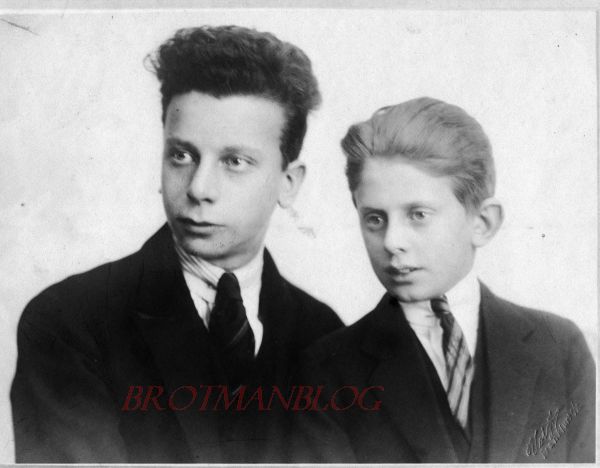
Arthur Rapp and Family: From Germany to England to Brazil to New York

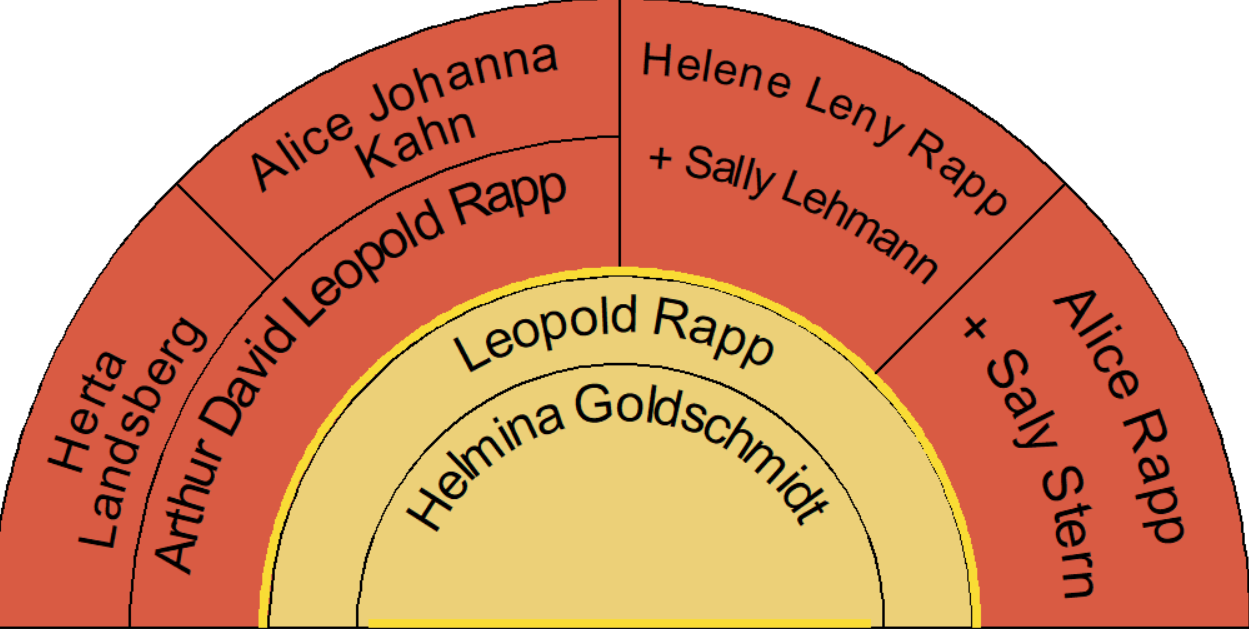
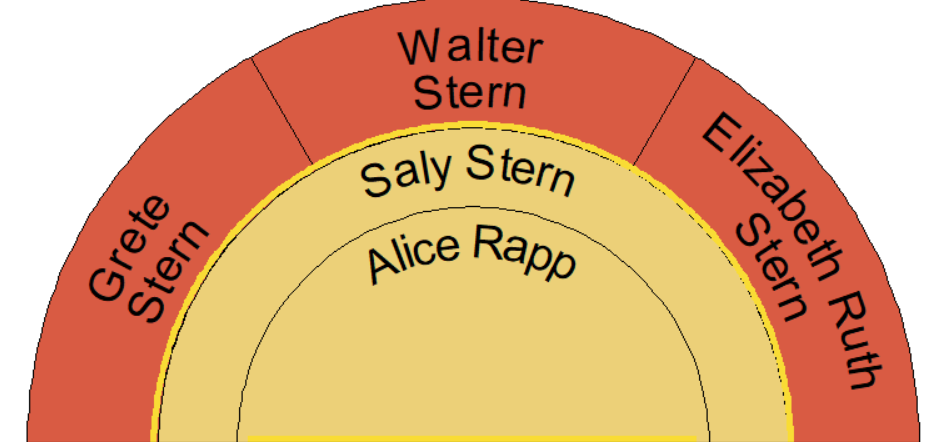
In my last post, we saw that Helmina Goldschmidt Rapp and her daughter Alice Rapp Stern, son-in-law Saly Stern, and their daughters Elizabeth and Grete had first escaped to England from Nazi Germany, with Alice, Saly, and Elizabeth later immigrating to the US where their son Walter had already settled. Today’s post is about Helmina Goldschmidt Rapp’s son Arthur Rapp and his family.

Arthur and his wife Alice and their sons Helmut and Gunther also were in England by 1939. Arthur reported on the 1939 England and Wales Register that he was a retired telephone salesman. (The two black lines are presumably for Helmut/Harold and Gunther/Gordon, who must still have been living when the document was scanned.)

Arthur Rapp and Family,The National Archives; Kew, London, England; 1939 Register; Reference: RG 101/6823F, Enumeration District: WFQC, Ancestry.com. 1939 England and Wales Register

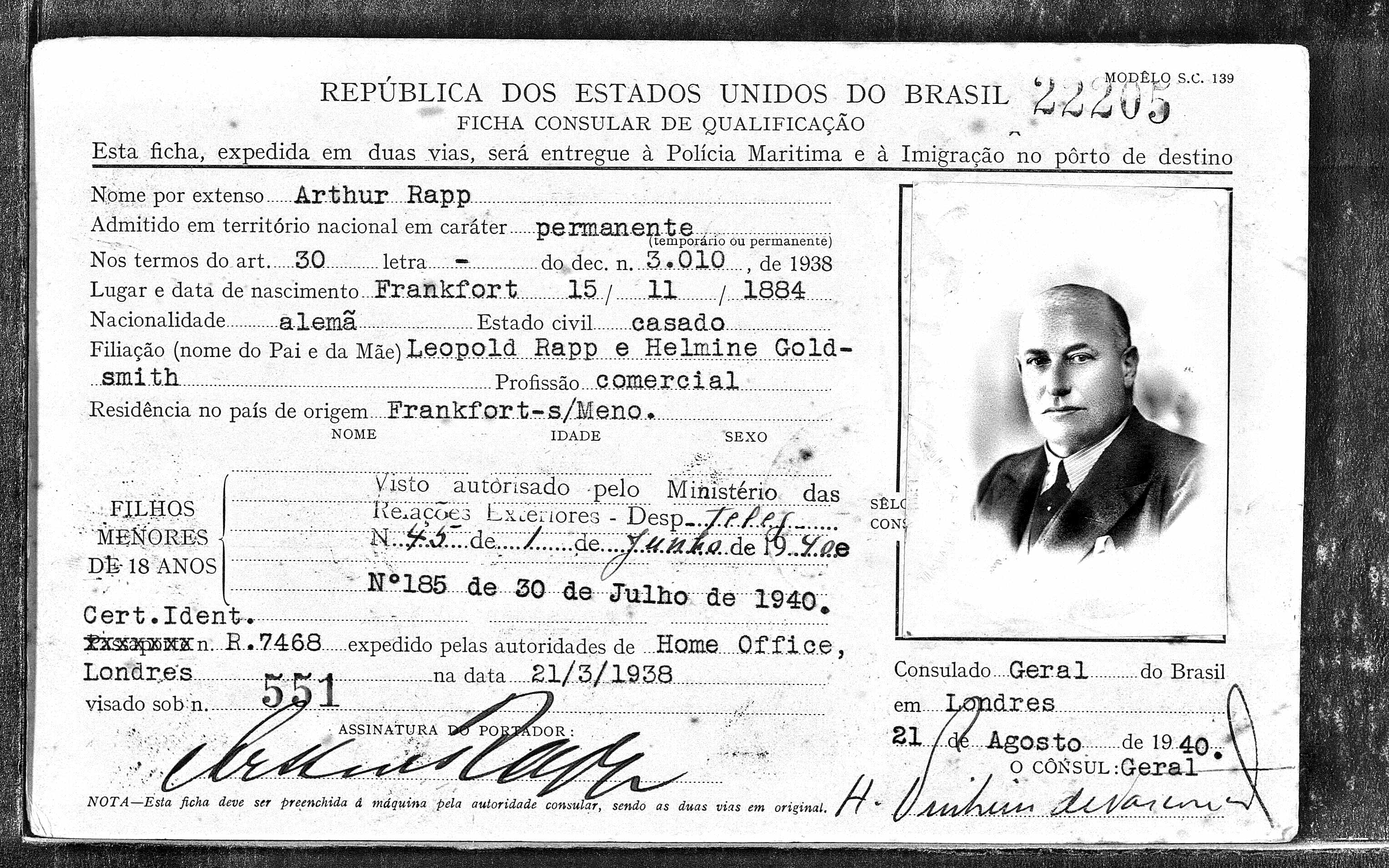
But like his sister Alice, Arthur did not stay in England. First, in 1940, he and his family immigrated to Brazil. I love having these photographs of Arthur and his family. Gunther is particularly adorable. But then I remember that these people had to leave their home in Frankfurt and then uproot themselves again to go from England to Brazil.

Arthur Rapp, Digital GS Number: 004816338, Ancestry.com. Rio de Janeiro, Brazil, Immigration Cards, 1900-1965

Alice Kahn Rapp, Digital GS Number: 004911328, Ancestry.com. Rio de Janeiro, Brazil, Immigration Cards, 1900-1965

Helmut Rapp, Digital GS Number: 004871140, Ancestry.com. Rio de Janeiro, Brazil, Immigration Cards, 1900-1965

Gunther Rapp, Digital GS Number: 004911328, Ancestry.com. Rio de Janeiro, Brazil, Immigration Cards, 1900-1965

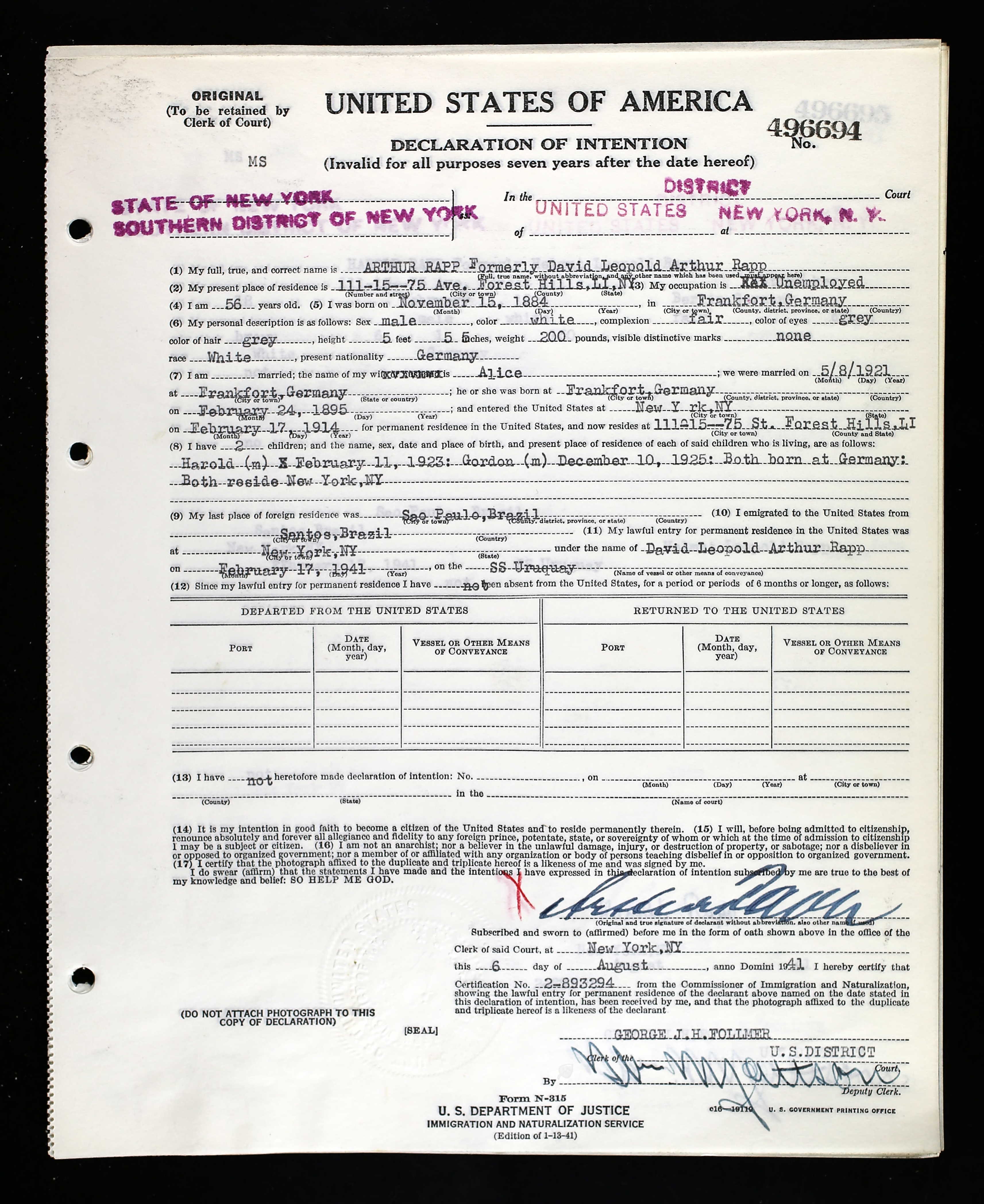
But a year later on February 27, 1941, they uprooted themselves again and left Brazil for New York where they settled in Forest Hills, New York, as seen on Arthur’s declaration of intention to become a US citizen.

Arthur Rapp, declaration of intention, The National Archives at Philadelphia; Philadelphia, Pennsylvania; NAI Title: Declarations of Intention for Citizenship, 1/19/1842 – 10/29/1959; NAI Number: 4713410; Record Group Title: Records of District Courts of the United States, 1685-2009; Record Group Number: 21, Description: (Roll 626) Declarations of Intention for Citizenship, 1842-1959 (No 496501-497400), Ancestry.com. New York, State and Federal Naturalization Records, 1794-1943

Arthur reported on his declaration of intention that he was unemployed, but his son Helmut, now using the name Harold, reported on his declaration that he was a watchmaker.

Harold (Helmut) Rapp, declaration of intention, The National Archives at Philadelphia; Philadelphia, Pennsylvania; NAI Title: Declarations of Intention for Citizenship, 1/19/1842 – 10/29/1959; NAI Number: 4713410; Record Group Title: Records of District Courts of the United States, 1685-2009; Record Group Number: 21, Description: (Roll 626) Declarations of Intention for Citizenship, 1842-1959 (No 496501-497400), Ancestry.com. New York, State and Federal Naturalization Records, 1794-1943

Arthur and Alice’s younger son Gunther, who became Gordon, was sixteen when they immigrated; on his World War II draft registration in 1943, he was living in Monmouth, New Jersey, working for Modern Farms.

Gordon (Gunther) Rapp, World War II draft registration, The National Archives in St. Louis, Missouri; St. Louis, Missouri; WWII Draft Registration Cards for New Jersey, 10/16/1940-03/31/1947; Record Group: Records of the Selective Service System, 147; Box: 539
Ancestry.com. U.S. WWII Draft Cards Young Men, 1940-1947

Arthur’s daughter from his first marriage, Henriette Rapp, also ended up in the US. She had married Siegmund Schwarz in Berlin on May 6, 1929, and they were living in Kirtof, Germany, in 1935.

Henriette Rapp marriage record to Siegmund Schwarz, Landesarchiv Berlin; Berlin, Deutschland; Personenstandsregister Heiratsregister; Laufendenummer: 189, 1929 (Erstregister)
Ancestry.com. Berlin, Germany, Marriages, 1874-1936

They immigrated to the US in 1937 and in June 1938 when Henriette, now using Rita, filed her declaration of intention to become a US citizen, they were living in San Francisco.

National Archives at Riverside; Riverside, California; NAI Number: 594890; Record Group Title: 21; Record Group Number: Records of District Courts of the United States, 1685-2009
Description: Petitions, 1943 (Box 0247), Ancestry.com. California, Federal Naturalization Records, 1843-1999

On the 1940 census, Rita and Siegmund, now going by Henry, were living in Los Angeles, and Henry reported no occupation, but Rita reported that she was a dressmaker.1 When Henry filed his World War II draft registration in 1942, he was still living in Los Angeles, but listed Alfred Kahn, not Rita, as  the person who would always know where he was, so perhaps they were no longer together.2 Rita did remarry on April 14, 1956, in Los Angeles, to Max Altura.3

Arthur Rapp died in New York on January 10, 1951, at the age of 66.4 He was survived by his wife Alice and his three children, Rita, Harold, and Gordon. Alice survived him by 26 years; she died in May 1977 at 82 years old.5

Rita died in Los Angeles on June 10, 2003; she was 94. According to her obituary in the June 13, 2003 The Los Angeles Times, Rita was a “life member and generous benefactor of Hadassah, Rita was devoted to Israel and the Jewish people.”6

Arthur Rapp’s two sons also lived long lives. Harold Rapp, who had started his career as a watchmaker, became the president of Bulova International in Basel, Switzerland, for many years and was 93 when he died on February 11, 2016.7

His brother Gordon died the following year at 92. According to his obituary, he graduated from Cornell University and received a master’s degree from Purdue University. His early interest in agriculture stayed with him. He had a career in poulty genetics before spending twenty years as a product and marketing manager with Corn Products Corporation . His obituary described him as follows: “He was known for his kindness, creativity, humor, wisdom, and talent as a prolific artist, photographer and writer. He was a Renaissance man of many interests, including tennis, tai chi and chess. He enjoyed museums and classical music concerts in New York City and later in Chapel Hill, NC.”8

I was struck by the fact that Harold and Gordon both continued to work in the same fields where they had started as young men, Harold in watches, Gordon in agriculture. Harold Rapp and Gordon Rapp were survived by their widows, children, and grandchildren.

Although Arthur Rapp did not have the blessing of a life as long as those of his three children, he was blessed with the good fortune of escaping with them from Nazi Germany and thus giving them the security and safety to live those long lives, during which they each made important contributions to their new homeland and left a legacy of their accomplishments and future generations to carry on the Rapp name.


  1. Rita and Henry Schwarz, 1940 US census, Census Place: Los Angeles, Los Angeles, California; Roll: m-t0627-00403; Page: 10B; Enumeration District: 60-828, Ancestry.com. 1940 United States Federal Census 
  2. Henry Schwarz, World War II draft registration, The National Archives in St. Louis, Missouri; St. Louis, Missouri; WWII Draft Registration Cards for California, 10/16/1940-03/31/1947; Record Group: Records of the Selective Service System, 147; Box: 1619,
    Ancestry.com. U.S. WWII Draft Cards Young Men, 1940-1947 
  3. Rita H Rapp, Estimated birth year: abt 1909, Age: 47, Marriage Date: 14 Apr 1956
    Marriage Place: Los Angeles, California, USA, Spouse: Max D Altura, Spouse Age: 55
    Ancestry.com. California, Marriage Index, 1949-1959 
  4. Arthur Rapp, Age: 66, Birth Date: abt 1885, Death Date: 10 Jan 1951
    Death Place: Queens, New York, New York, USA, Certificate Number: 481
    Ancestry.com. New York, New York, Death Index, 1949-1965 
  5.  Alice Rapp, Social Security Number: 105-36-2290, Birth Date: 24 Feb 1895
    Issue Year: 1962, Issue State: New York, Last Residence: 10028, New York, New York, New York, USA, Death Date: May 1977, Social Security Administration; Washington D.C., USA; Social Security Death Index, Master File, Ancestry.com. U.S., Social Security Death Index, 1935-2014 
  6.  Rita H. Altura, Social Security Number: 555-16-5231, Birth Date: 21 Sep 1908
    Issue Year: Before 1951, Issue State: California, Last Residence: 91335, Reseda, Los Angeles, California, USA, Death Date: 10 Jun 2003, Social Security Administration; Washington D.C., USA; Social Security Death Index, Master File, Ancestry.com. U.S., Social Security Death Index, 1935-2014. Obituary can be seen at https://www.legacy.com/obituaries/latimes/obituary.aspx?n=rita-altura&pid=1083894 
  7. I could not find Harold Rapp in the SSDI or any obituary, just this listing on FindAGrave. https://www.findagrave.com/memorial/159069023 However, I found numerous articles about his work at Bulova, and this wedding announcement for his son that mentions his career at Bulova. https://www.nytimes.com/2005/05/15/fashion/weddings/shelley-grubb-and-kenneth-rapp.html?searchResultPosition=2 
  8. Gordon Rapp, The New York Times, December 26, 2017, found at https://www.legacy.com/obituaries/nytimes/obituary.aspx?n=gordon-d-rapp&pid=187633991 

Helmina Goldschmidt Rapp, Part II: Leaving Germany with Alice Rapp Stern

As we saw, Jacob Meier Goldschmidt’s youngest child Helmina was widowed as a young woman and raised her three children alone from an early age. By the 1920s all three of those children were married and had children of their own.

When the Nazis came to power, Helmina and her family were among the fortunate ones who left Germany before it was too late. Today’s post will look at Helmina and her youngest child Alice and their escape from Germany.

By 1939, Helmina, her daughter Alice and son-in-law Saly and their daughter Grete were living in Harrow, Middlesex, England. Saly reported on the 1939 England and Wales Register that he was a refugee and thus not allowed to do business. Grete was a secretary for a leather goods manufacturer. All four family members were living in one household along with a housemaid.

The National Archives; Kew, London, England; 1939 Register; Reference: RG 101/799H
Enumeration District: BIHB, Ancestry.com. 1939 England and Wales Register

Alice and Saly Stern’s son Walter Stern had instead immigrated to the United States. According to his declaration of intention to become a US citizen, he arrived from Germany to New York on May 16, 1938, and was working as a shipping clerk when he filed his declaration on August 2, 1938.  He was living on Wadsworth Avenue in New York City in the Washington Heights neighborhood where so many German Jewish refugees settled in the 1930s and 1940s. (In yet another small world coincidence, my husband lived on Wadsworth Avenue in his early childhood, although his parents were not German Jewish refugees.)

The National Archives at Philadelphia; Philadelphia, Pennsylvania; NAI Title: Declarations of Intention for Citizenship, 1/19/1842 – 10/29/1959; NAI Number: 4713410; Record Group Title: Records of District Courts of the United States, 1685-2009; Record Group Number: 21
Description: (Roll 539) Declarations of Intention for Citizenship, 1842-1959 (No 417601-418600)
Ancestry.com. New York, State and Federal Naturalization Records, 1794-1943

Although I cannot find any record showing that Alice and Saly’s daughter Elizabeth was with them in England, I believe she must have been living there because on March 27, 1940, Alice, Saly, and Elizabeth all joined Walter in the United States. Strangely, this ship manifest shows all three sailing to New York, but Saly is listed separately and with a different English address.

Ancestry.com. UK and Ireland, Outward Passenger Lists, 1890-1960

On their US ship manifest, Alice and her daughter Elizabeth are again listed together, but Saly is listed on a different page. They all, however, were on the same ship arriving at the same time. And Alice’s declaration of intention shows that she and Saly arrived together and were residing together in New York on Ft. Washington Avenue, in the Washington Heights neighborhood where Walter had been residing in 1938.

Alice Stern, declaration of intention, The National Archives at Philadelphia; Philadelphia, Pennsylvania; NAI Title: Declarations of Intention for Citizenship, 1/19/1842 – 10/29/1959; NAI Number: 4713410; Record Group Title: Records of District Courts of the United States, 1685-2009; Record Group Number: 21,  (Roll 590) Declarations of Intention for Citizenship, 1842-1959 (No 463201-464100), Ancestry.com. New York, State and Federal Naturalization Records, 1794-1943

But the ship manifests for Alice, Elizabeth, and Saly report that by the time of their arrival in the spring of 1940, Walter was living in Washington DC.

However, when Walter registered for the World War II draft in October 1940, he was back living in New York. His registration card has three New York City addresses, all crossed out, but lists his father Saly as his contact person, residing on Ft. Washington Avenue.

Walter Stern, World War II draft registration, Ancestry.com. U.S. WWII Draft Cards Young Men, 1940-1947

Saly Stern’s draft registration, filed on April 26, 1942, two years after that of Walter, shows that he was then self-employed as a salesman and living at 612 West 188th Street in New York with his wife Alice.

Saly Stern, World War II draft registration, The National Archives at St. Louis; St. Louis, Missouri; Record Group Title: Records of the Selective Service System; Record Group Number: 147
Ancestry.com. U.S., World War II Draft Registration Cards, 1942

The following year their younger daughter Elizabeth Stern married Gerhard Hirsch, another German Jewish refugee, on March 28, 1943, in New York. Gerhard was born on September 24, 1908, in Berlin, and immigrated to the US in 1938.1

Meanwhile, Saly and Alice’s older daughter Grete Stern remained in England, as Alice reported on her naturalization papers, as did Alice’s mother Helmina Goldschmidt Rapp. Helmina died in England in July 1941, not long after her children in England had all left for the US.  She was 77 years old.2

Saly Stern died in New York on December 7, 1946.3 He was 69 years old. He had lived long enough to see most of his family settle safely in the US, except for his daughter Grete, who’d remained in England. Unfortunately he did not live to see Grete’s wedding. In 1948, Grete Stern married Kurt Lissauer, who was also a German Jewish refugee. He was born in Luebeck, Germany, on January 10, 1909. They were married in England.4

Elizabeth Stern’s marriage to Gerhard Hirsch did not last very long. She remarried in 1973 when she was 54; her second husband was Paul Dannheisser, a widower who was also a refugee from Germany.

Alice Rapp Stern outlived her husband by almost thirty years. She died in New York on January 28, 1974, at the age of 83.5 She was survived by her three children, Grete, Walter, and Elizabeth, all of whom died within a year of each other. Grete and Walter both died in October 1996; Grete was 85,6 Walter was almost 79.7 Their younger sister Elizabeth died just four months later on February 13, 1997.8 She had just turned 78. None of the three siblings had children, so there are no descendants.

The next post will tell the story of Alice Rapp Stern’s brother and Helmina Goldschmidt Rapp’s son, Arthur David Leopold Rapp, and his family.


  1.  Elizabeth Stern, Marriage License Date: 24 Mar 1943
    Marriage License Place: Manhattan, New York City, New York, USA
    Spouse: Gerhard Hirsch, License Number: 5751, New York City Municipal Archives; New York, New York; Borough: Manhattan; Volume Number: 3, Source Information
    Ancestry.com. New York, New York, Marriage License Indexes, 1907-2018. Also, Elizabeth’s declaration of intention, “New York, Southern District, U.S District Court Naturalization Records, 1824-1946,” database with images, FamilySearch (https://familysearch.org/ark:/61903/3:1:3QS7-99HD-2S59?cc=2060123&wc=M5P7-PTY%3A351618501 : 14 August 2019), Petitions for naturalization and petition evidence 1945 box 1026, no 515801-516050 > image 728 of 983; citing NARA microfilm publication M1972, Southern District of New York Petitions for Naturalization, 1897-1944. Records of District Courts of the United States, 1685 – 2009, RG 21. National Archives at New York. 
  2.  Helmina Rapp, Death Age: 78, Birth Date: abt 1863, Registration Date: Jul 1941
    Registration Quarter: Jul-Aug-Sep, Registration district: Hendon, Inferred County: Middlesex, Volume: 3a, Page: 656, General Register Office; United Kingdom; Volume: 3a; Page: 656, Ancestry.com. England & Wales, Civil Registration Death Index, 1916-2007 
  3.  Saly Stern, Marital status: Married, Age: 69, Birth Date: 26 Nov 1877, Birth Place: Germany, Residence Street Address: 612 W 188 St, Residence Place: New York
    Death Date: 7 Dec 1946, Death Street Address: 612 W 188th St, Death Place: New York City, Manhattan, New York, USA, Occupation: Clerk Stock’s, Father’s Birth Place: Germany, Mother’s Birth Place: Germany, Father: Marcus Stern, Mother: Francisca Stern, Spouse: Alice, Informant: Alice Stern, Informant Relationship: Wife
    Executor: Alice Stern, Executor Relationship: Wife, Certificate Number: 25862
    New York City Department of Records & Information Services; New York City, New York; New York City Death Certificates; Borough: Manhattan; Year: 1946, Ancestry.com. New York, New York, Index to Death Certificates, 1862-1948 
  4. Greta Stern, Registration Date: Apr 1948, Registration Quarter: Apr-May-Jun
    Registration district: Hendon, Inferred County: Middlesex, Spouse: Kurt Lissauer
    Volume Number: 5e, Page Number: 1260, General Register Office; United Kingdom; Volume: 5e; Page: 1260, Ancestry.com. England & Wales, Civil Registration Marriage Index, 1916-2005. Kurt Lissauer, Enemy Alien Registration, The National Archives; Kew, London, England; HO 396 WW2 Internees (Aliens) Index Cards 1939-1947; Reference Number: HO 396/56, Piece Number Description: 056: Internees at Liberty in UK 1939-1942: Lir-Lov, Ancestry.com. UK, WWII Alien Internees, 1939-1945 
  5.  Alice Stern, Social Security Number: 051-18-8391, Birth Date: 4 Oct 1890
    Issue Year: Before 1951, Issue State: New York,Last Residence: 10040, New York, New York, New York, USA, Death Date: Jan 1974, Social Security Administration; Washington D.C., USA; Social Security Death Index, Master File, Ancestry.com. U.S., Social Security Death Index, 1935-2014 
  6.  Grete Lissauer, Death Age: 85, Birth Date: 16 Sep 1911, Registration Date: Oct 1996, Registration district: Hendon, Inferred County: Greater London, Register Number: A41C, District and Subdistrict: 2351A, Entry Number: 108, General Register Office; United Kingdom, Ancestry.com. England & Wales, Civil Registration Death Index, 1916-2007 
  7. Walter Stern, Gender: Male, Birth Date: 1918, Death Date: 9 Oct 1996
    Claim Date: 2 Dec 1970, SSN: 056162574, Death Certificate Number: 350302
    Ancestry.com. U.S., Social Security Applications and Claims Index, 1936-2007 
  8. Elizabeth Ruth Stern, [Elizabeth Ruthhenrietta Hirsch], [Elizabeth Dannheisser]
    Gender: Female, Race: White, Birth Date: 21 Jan 1919, Birth Place: Frankfurt A, Federal Republic of Germany, Death Date: 13 Feb 1997, Father: Sally Stern
    Mother: Alice Rapp, SSN: 127144714, Ancestry.com. U.S., Social Security Applications and Claims Index, 1936-2007 

Gaps in the Story: How Did Amalie and Charles Bloch Escape from Nazi Germany?

Back in May, I wrote about Amalie Meyer Bloch, the granddaughter of Jacob Meier Goldschmidt and Jettchen Cahn, daughter of Regina Goldschmidt and Aaron Meyer. One question that lingered was how Amalie and her daughter Ilse ended up separated from Amalie’s husband Charles Bloch.

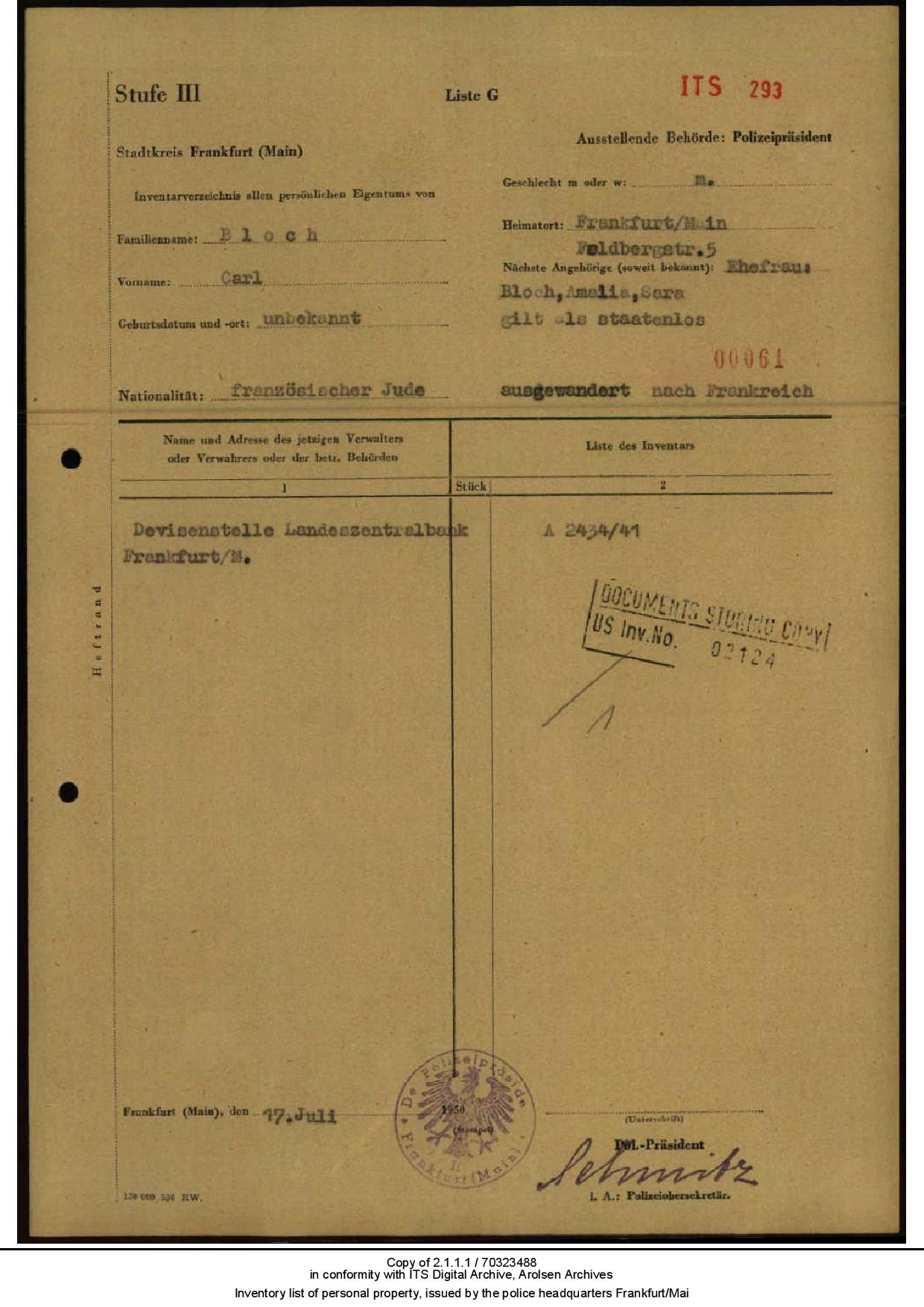
I knew from one of the Arolsen Archives document available through Ancestry that Charles had gone to Paris, and I knew that he eventually rejoined Amalie and Ilse in the US in 1946, reporting that his last address had been in Toulouse, France. But what I didn’t know was when Charles had gone to Paris and where he was in France during the war after Germany’s invasion of France in 1940.

Arolsen Archives, Digital Archive; Bad Arolsen, Germany; Lists of Persecutees 2.1.1.1; Series: 2.1.1.1, Reference Code: 02010101 oS, Ancestry.com. Europe, Registration of Foreigners and German Persecutees, 1939-1947

Barb276, one of my readers, suggested that I contact the ITS (International Tracing Service) and file a request for more information about Charles since not all of their documents are available through the Arolsen Archives. I did as she suggested back in May and was told that it would take ten months to complete the investigation and report back. I prepared myself for a long wait.

You can imagine my surprise when just a week or so ago I received a report back from ITS with more documents about Charles. Those documents don’t really answer my questions, unfortunately, but they did reveal one more piece of the puzzle.

Charles was one of the thousands of Jewish men who were rounded up during and after Kristallnacht in November 1938 and sent to the Buchenwald concentration camp. He was released in December 1938.

My working hypothesis is that upon his release, he left Germany for France. One of the ITS documents, a property inventory prepared after the war in 1950, described Charles as a “französischer Jude,” a French Jew. I wasn’t sure what to make of that since Charles was also documented as German-born—born in Frankfurt in 1881. That same document also states that Amalie is “gilt als staatenlos,” considered stateless. So maybe the reference to Charles as a French Jew meant that he had become a citizen of France after immigrating there.

It would make sense that Charles would leave Germany in early 1939 after his experience at Buchenwald. As seen in my earlier post, his daughter Ilse had gone to England by 1939. But it seems that Amalie was not in England or France at that point. On her November 27, 1941, declaration of intention to become a US citizen, Amalie reported that Charles was at that time residing in France, Ilse was residing in New York, and that Amalie herself had last resided in Lisbon, Portugal.

Amalie Meyer Bloch, declaration of intent, The National Archives at Philadelphia; Philadelphia, Pennsylvania; NAI Title: Declarations of Intention for Citizenship, 1/19/1842 – 10/29/1959; NAI Number: 4713410; Record Group Title: Records of District Courts of the United States, 1685-2009; Record Group Number: 21
Description: (Roll 641) Declarations of Intention for Citizenship, 1842-1959 (No 510101-511000)
Ancestry.com. New York, State and Federal Naturalization Records, 1794-1943

My hunch is that Amalie stayed behind in Germany longer than her husband and daughter and then somehow escaped to Portugal after the war started. But I could be wrong. My other hunch is that Charles escaped from Paris after the Nazis invaded and somehow survived the war in southern Vichy-controlled France, finally arriving in the US a year after the war. Although I don’t know more about Charles’ time there, I did find a Jewish Telegraphic Agency news release dated April 29, 1941, reporting that Jewish refugees had been expelled from Toulouse. I’ve no idea, however, how that impacted Charles Bloch.

Unfortunately, the ITS documents do not reveal anything about Charles’ time in France during or after the war. Nor do I have any more information about how Amalie ended up in Portugal or when. And since they have no living descendants, I fear I can only rely on my hunches and speculation to fill in these gaps.


Four Years of Learning German

Just about four years ago in the summer of 2016, I decided to learn German. It’s been an interesting and mostly enjoyable challenge. First, I used the app Duolingo for almost a year. I learned a fair amount of German vocabulary. I was disciplined and practiced every day. It was fun.

But then I tried to read some simple texts written in German, and I realized Duolingo was fine for vocabulary building, but it wasn’t enough if I really want to read, write, and speak German.  We were going to Germany in the spring of 2017 and I wanted to be able to speak to the people in their own language, so I bought a few German textbooks to learn how to conjugate verbs and some other basic grammar.

But that also wasn’t enough. That became glaringly obvious when I tried to speak German on our trip. I couldn’t string together a grammatically correct sentence, and often I would get blank stares when I tried to ask a simple question in a German store or restaurant. And if someone answered me in German? I had no idea what they were saying. So in the fall of 2017, I signed up for a German class offered by a local adult education program.

That course was good for grammar. Lots of grammar. Lots and lots of grammar. Rules, rules, rules. But no conversation and no opportunities to read texts or ask questions. So I formed a German conversation group with people from the class. That’s been lots of fun, but I remain the worst German speaker in the group. My reading has improved, my writing is coming along (with help from Google Translate), but it still is very hard for me to speak or understand spoken German. Mark Twain was right. Learning German is not for the faint of heart.

Mark Twain By Mathew Brady [Public domain], via Wikimedia Commons

Why am I writing about this now, you may wonder?

Well, I’ve had reason recently to reminisce about why I started learning German. Why did I want to learn German? Of course, it was related to genealogy. My paternal roots in Germany are deep and wide. Knowing German would therefore be helpful. But to be honest, most of what I need to know for genealogy purposes can be reduced to some very basic terms: geboren (born), heiratet (married), gestorben (died). Really, you don’t need to know much more than that to read German vital records for basic information. And even knowing those terms won’t help much unless you can also read German script. Which I can’t.

No, it wasn’t a desire to read German vital records or even longer letters or texts that motivated me to learn German. It was rather a particular book that I very much wanted to read: Die Alte und Die Neu Welt, written by my cousin Mathilde Gross Mayer in 1951, as I discussed here.

Mathilde was born in Bingen, Germany, in April 1869. Mathilde’s grandmother Martha Seligmann and my three-time great-grandfather Moritz Seligmann were sister and brother, so we were second cousins, three times removed, both being direct descendants of Jacob Seligmann and Martha Mayer. Mathilde left Germany in 1937 to escape from Nazi persecution when she was almost 68 years old and a grandmother; she lived over thirty years in the United States after leaving Germany, dying in September, 1969, when she was a hundred years old.  I was fascinated by her life and wanted to read her book. So I started learning German.

But despite studying for four years and having a fairly decent basic German vocabulary, every time I picked up Mathilde’s book, I got frustrated. I still had to look up so many words that I could not just read this book. It was exhausting and too time consuming. Using Google Translate to translate one letter is one thing, but a whole book? So I gave up.

And then? Then my cousin Elizabeth found me this spring. Elizabeth is Mathilde Mayer’s great-granddaughter. She found my blog and contacted me. We exchanged a number of emails, finding many common interests and places in our lives as well as our shared family roots. And in the course of those emails Elizabeth shared with me that she had an ENGLISH version of Mathilde’s book in pdf format. And that she would send it to me. Which she did.

So one day a couple of weeks ago I sat at my computer and read Mathilde’s book in English. And I am so glad that I did rather than ruining it by trying to read it in German. It is just a wonderfully touching book—full of colorful portraits of many of my Seligmann cousins and warm and loving anecdotes about Mathilde’s life growing up in Bingen and then raising a family in Bingen. She shares the tragedies and challenges her family suffered as well as many of their joys and successes. I never would have been able to get the feel for her personality if I’d suffered through reading her book in German.

Sure, if I were fluent in German, that would have been even better—to read it as she wrote it. But to butcher it by reading it all chopped up would have been a terrible mistake. Elizabeth has asked me not to share the book on the blog, and so, of course, I am respecting her wishes. But I am so grateful that she shared the English version with me. Mathilde’s story will now always be with me.

So do I regret four years of struggling to learn German? Not one bit! I will continue studying it as best I can, and maybe someday I will actually be able to read Mathilde’s story in her native tongue.


Minna Fuld and Her Descendants: New Cousins from Sao Paulo, But A Brick Wall Remains

Back in April, I posted about the dead ends I’d reached in my research of Minna Fuld and her family. To recap, Minna was the daughter of Helene Goldschmidt and Salmon Fuld,  the granddaughter of Jacob Meier Goldschmidt, and the great-granddaughter of Meyer Goldschmidt, who was my four-times great-uncle. Minna was married three times. First, she married Leo Offenstadt in 1894 when she was eighteen, and that marriage ended in divorce in 1904. She and Leo had had one child, Flora, in 1894. Then Minna married Ladislaus Polacovits in 1906, and he died in 1913; Minna had one child with Ladislaus, Liselotte, who was born in 1907. Finally, Minna married Hermann Heinrich Karl Reuss in 1923, with whom she had no children.

The first mystery was about Minna’s whereabouts during the 1930s and 1940s. I knew that her third husband Hermann was listed in the 1940 Frankfurt directory and died in Frankfurt on September 27, 1947. But several unsourced trees reported that Minna died in Tel Aviv on May 3, 1944. So had Minna gone to Palestine alone and died there? Had Hermann gone with her and returned to Germany after the war?

The second mystery was the fate of Minna’s daughter Flora Offenstadt during the Holocaust. Flora Offenstadt married Hermann Durlacher in 1918 and had two children with him, Siegfried Julius Thomas (known as Thomas) Durlacher and Ulla Louise Durlacher. I had records showing that Flora and the two children immigrated to Brazil in 1939, but no records for her husband Hermann or any information about what happened to them after they immigrated.

I also had no luck locating more information about Liselotte, Minna’s younger daughter with her second husband Ladislaus, although I knew she and Ladislaus were living in Palestine/Israel during the 1940s and that their son had married in England.

Having exhausted the usual genealogy tools and newspaper databases and Google, I turned to Tracing the Tribe to see if there was anyone with connections in Brazil who might be able to help me. And I was very, very fortunate that a group member named Jacqueline who is from Sao Paulo volunteered to help me.  She first located a marriage announcement for a son of Siegfried Julius Thomas Durlacher, which can be found here.

Then Jacqueline found a long magazine article, partly in German but mostly in Portuguese, that she summarized for me. According to the article, Thomas Durlacher started a library of German-language books in Atibaia, a town in the countryside outside of Sao Paulo; the library now has ten thousand books, some of which were Thomas’ parents’ books that they took with them out of Germany when they escaped from the Nazis and others were donated by other refugees from Germany. The article also mentioned that Thomas had two sons, one a doctor in Brazil and the other residing in Germany.

And then—the icing on the cake—Jacqueline located those sons and other members of the Durlacher family on Facebook! At that point, I took over and sent messages and friend requests to these descendants of Minna Fuld. And almost immediately two of Thomas Durlacher’s sons responded. They then connected me to their cousin Sergio, the son of Ulla Durlacher (Flora and Hermann’s daughter), who contacted me by email.

Sergio told me that his grandfather Hermann Durlacher was the first member of the family to immigrate to Brazil. When I asked him why Brazil, he explained that it was the destination of the first available ship that Hermann could take.  Hermann and Flora had already sent Thomas to the Netherlands to study; he lived with a wealthy family who were close friends of the family. Flora and her daughter Ulla remained in Germany, and Sergio said that his mother had very painful memories of those years.

Unfortunately, Sergio did not have any information about the fate of Minna Fuld, his great-grandmother, so that mystery remained unsolved.

He provided me with more contacts, however, and one of those contacts who was in fact on Sergio’s father’s side found this document about Minna:

The National Archives; Kew, London, England; HO 396 WW2 Internees (Aliens) Index Cards 1939-1947; Reference Number: HO 396/73, Description, Piece Number Description: 073: Internees at Liberty in UK 1939-1942: Reu-Rop, Source Information
Ancestry.com. UK, WWII Alien Internees, 1939-1945

I also realized that one of the documents I’d found about Hermann indicated that Minna had immigrated to England:

Arolsen Archives, Digital Archive; Bad Arolsen, Germany; Lists of Persecutees 2.1.1.1
Reference Code: 02010101 oS, Ancestry.com. Europe, Registration of Foreigners and German Persecutees, 1939-1947

So Minna was in England in 1940. I then located her on the 1939 England and Wales Register:

The National Archives; Kew, London, England; 1939 Register; Reference: RG 101/419G
Enumeration District: APDF, Ancestry.com. 1939 England and Wales Registe

Note that she reported that her marital status was married, but Hermann was not living with her in England. That might explain why he was still listed in the 1940 Frankfurt directory. Hermann was not Jewish and may have stayed behind to protect their interests in Germany.  But I could not find any later record for Minna. Since Hermann was a widower when he died in Frankfurt in 1947, Minna must have died sometime between 1940 and 1947, but where and when remains a mystery.

On the other hand, thanks to Jacqueline, I now am in touch with several of Minna’s descendants, my cousins who grew up in Brazil after their parents and grandparents escaped there from Germany in the 1930s. Someday someone will learn what happened to their ancestor Minna.


Berthold Goldschmidt Revisited: His Second Family

A year and a half ago I wrote about the tragic life of my cousin Berthold Goldschmidt, who outlived not only his wife Mathilde Freudenstein but six of their seven children. Their only surviving child, their son Siegfried Goldschmidt, was murdered in the Holocaust. I believed that Berthold had only one grandchild, Siegfried’s son Max, who had no children. Thus, I believed that Berthold Goldschmidt had no living descendants.

I’ve received two updates about Berthold’s family since then. In February, my friend in Germany, Julia Drinnenberg, sent me these photographs of two of Berthold and Mathilde’s sons taken during their service in World War I, Leopold, who was killed in the war, and the above-mentioned Siegfried.

Siegfried Goldschmidt

Leopold Goldschmidt

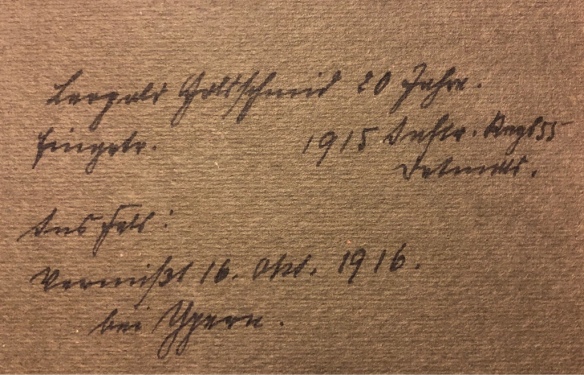
Then back in April, I received an email from David Baron, asking if I wanted to Zoom with a cousin named Rickey Slezak. I had no idea who Rickey was or how she was related to me, but soon discovered that she is a descendant of none other than Berthold Goldschmidt.

How does he have any descendants, you might wonder?

Well, in telling Berthold’s story I totally overlooked the fact that he had remarried after Mathilde’s death and had in fact had six more children with his second wife, Rika Giesberg, Rickey’s namesake. You can imagine how embarrassing this is!

Not that this takes away from the tragedies suffered by Berthold; that is still unimaginable. But Berthold’s story is somewhat softened by the fact that he went on to have a second family. And I was delighted not only to learn about this, but to make the connection to Rickey, my third cousin, once removed. Rickey shared with me an amazing album of old photographs of Berthold’s second family. This post is devoted to their story.

After losing his first wife Mathilde in 1911, Berthold Goldschmidt was left with four surviving children from that marriage: Paul, Leopold, Siegfried, and Hedwig. They were all still teenagers at that time.

On August 25, 1912, Berthold married Rika (sometimes spelled Richa or referred to as Rickchen) Giesberg, daughter of Jonas Giesberg and Henriette Loewenstein, in Trendelburg, Germany. Rika was born in Trendelburg on May 29, 1882, and was little more than ten to fifteen years older than her four stepchildren.

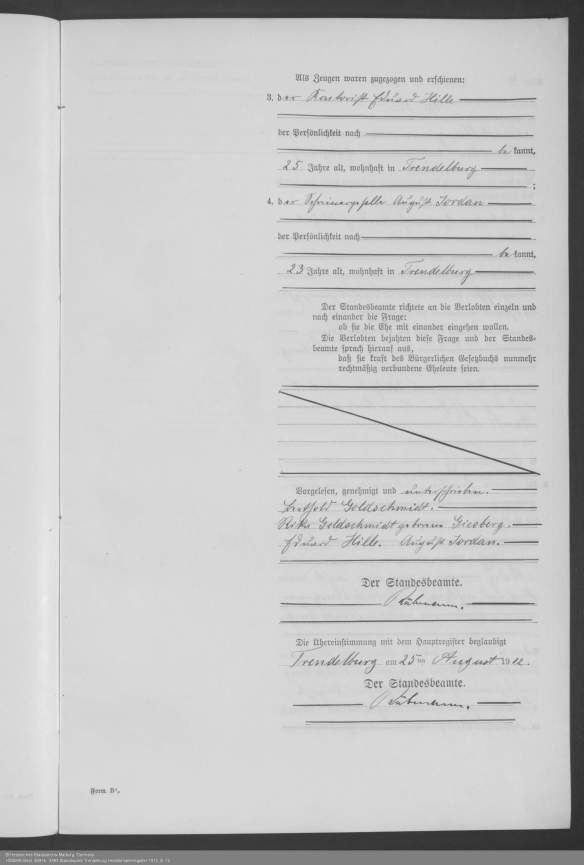
TitelStandesamt Trendelburg Heiratsnebenregister 1912 (HStAMR Best. 909 Nr. 9383)AutorHessisches Staatsarchiv MarburgErscheinungsortTrendelburg

Here are photographs of Berthold and Rika, courtesy of their granddaughter and my cousin, Rickey.

Berthold Goldschmidt, courtesy of the family

Rika Giesberg Goldschmidt, courtesy of the family

Rika and Berthold’s first child together, Walter Goldschmidt, was born in Oberlistingen, Germany, on April 24, 1913.1 A second son Herbert was born on December 20, 1914.2

Three of Berthold’s children from his first marriage died between 1915 and 1916, as discussed here. By 1917, Siegfried was then the only surviving child of the children Berthold had with Mathilde Freudenstein.

After those losses, Berthold and Rika had their first daughter, Hedwig, born June 1, 1918. She presumably was named for Berthold’s deceased daughter Hedwig from his first marriage.3

Here is a photograph of their family in about 1920 before their three youngest children were born:
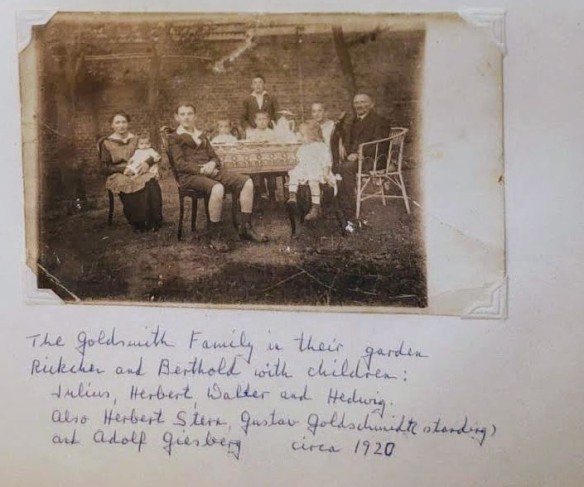
Berthold and Rika (Rickchen) Goldschmidt and family, c. 1920. Courtesy of the family

Their third son Jacob Julius Goldschmidt (known as Julius) was born on March 17, 1921.4 Albert Goldschmidt was born on September 9, 1924.5 Finally, their sixth and final child Elfriede was born August 17, 1926.6

This is a photograph of their home in Oberlistingen:

Berthold Goldschmidt family home in Oberlistingen. Courtesy of the family

Berthold Goldschmidt died on November 8, 1927. He was survived by his son Siegfried from his first marriage and the six children he had with Rika. Those six children lost their father before they reached adulthood. Their oldest child Walter was just fourteen, and their youngest child Elfriede just a year old. Rika was herself only 45 and left to care for the six children including four who were under ten years old.

Berthold Goldschmidt death record, Personenstandsregister Sterberegister; Signatur: 8196
Ancestry.com. Hesse, Germany, Deaths, 1851-1958 [

Rika was not destined to live a long life. She died at the age of 52 in Merxhausen, Germany, on March 1, 1935.7 I wondered why she died in Merxhausen, which is about 35 kilometers from Oberlistingen, and learned that there was a hospital there.

By that time Walter was almost 22, Herbert going on 21, Hedwig was almost seventeen, Julius almost fourteen, and the two youngest were still quite young; Albert was ten, and Elfriede only nine. I wonder who took care of these children, especially the three youngest, after they were orphaned.

Here are some photographs of some of the siblings taken in Germany before their lives changed forever:

Walter Goldschmidt
Courtesy of the family

Hedwig Goldschmidt Courtesy of the family

Julius Goldschmidt
Courtesy of the family

By the time of Rika’s death, the Nazis had taken power in Germany, and the Nuremberg Laws were adopted six months after her death.  It’s thus not surprising that by 1937 her two oldest sons decided to leave for the United States. Herbert left first, arriving in New York on July 30, 1937. According to the ship manifest, he left behind his brother Walter in Oberlistingen and was  going to a cousin, Leighton Steele, in Detroit, Michigan.  Leighton Steele was the son of Hedwig Goldschmidt Steele, a younger sister of Berthold Goldschmidt. Thus, Leighton, who was American-born, was Herbert’s first cousin, but they probably had never met.8

Walter Goldschmidt arrived just a few months after his brother Herbert; he arrived in New York on October 1, 1937. According to the ship manifest, he was heading to New York to a “cousin” named Joseph Guhl and was leaving behind an “uncle,” Salomon Strauss in Frankfurt. Salomon Strauss was married to Jenny Giesberg, Rika Giesberg Goldschmidt’s sister. Joseph Guhl was married to Meta Giesberg, the daughter of Leopold Giesberg, Rika’s brother.9

This photograph is labeled “Leaving for America” and shows Walter in Hamburg:

Courtesy of the family

The next sibling to arrive in the US was the youngest, Elfriede. She was only twelve years old when she arrived on March 24, 1939, and was sailing with her aunt Jenny Giesberg Strauss, her husband Salomon Strauss, and their son Walter. The ship manifest indicates that they all had been living in Frankfurt, so perhaps Elfriede had been taken in by her aunt after Rika died in 1935. They were leaving behind Salomon’s brother Julius and going to his cousin, Max Schoenmann, who lived at 1770 Andrews Avenue in the Bronx. I mention that only because my husband grew up down the block from there at 1940 Andrews Avenue. Small world.10

I don’t know whether or not Herbert ever went to Detroit to see Leighton Steele, but in 1940 both he and Walter were working as waiters for a restaurant in North Castle, New York, where they were both also living, according to the 1940 census.11  My cousin Rickey told me that the restaurant where they worked was a spot that became extremely popular as a music venue during the Big Band era, called Log Cabin Farms. You can see it mentioned on Herbert’s World War II draft registration.

Walter Goldschmidt, World War II draft registration, Ancestry.com. U.S. WWII Draft Cards Young Men, 1940-1947

Herbert Goldschmidt, World War II draft registration, Ancestry.com. U.S. WWII Draft Cards Young Men, 1940-1947

The North Castle Historical Society published an article about the Log Cabin Farms and all the performers who came there; you can find it here. As you can see from this postcard, the restaurant had a seating capacity of 1500!

Meanwhile, their sister Elfriede was living in the Bronx with their aunt Jenny Giesberg Strauss and her family in 1940.12 Rickey told me that her father revered his aunt Jenny, at least in part because of the care she gave to his little sister.

Herbert enlisted in the US military on January 22, 1941, almost a year before Pearl Harbor.13 I don’t know anything specific about his military service, but here is a photograph of him in uniform.

Herbert Goldschmidt/Goldsmith
Courtesy of the family

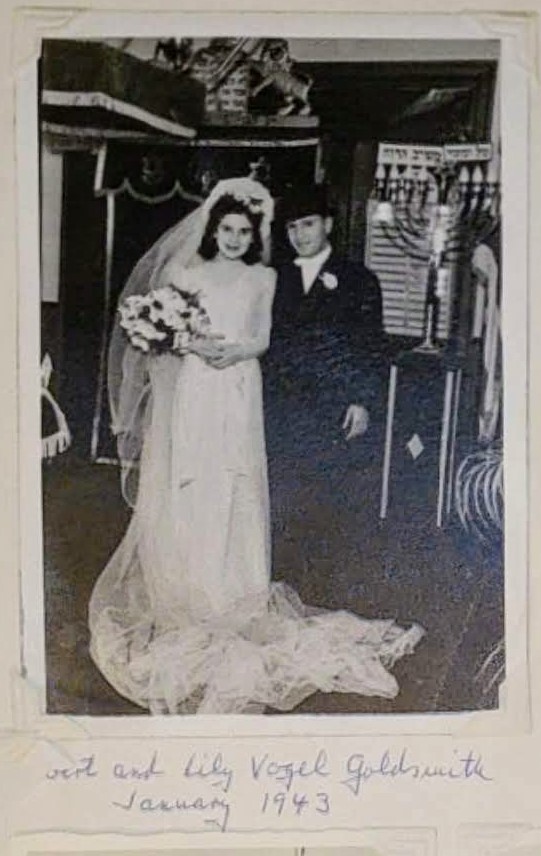
He applied for a marriage license to marry Lilly Vogel on January 19, 1943, in New York City.14

courtesy of the family

They did not have any children. According to my cousin Rickey, her uncle Herbert died in 1963.

His brother Walter enlisted on January 29, 1943, just ten days after Herbert and Lilly’s wedding.15 According to records his daughter Rickey has, Walter served three years including a year overseas. He was decorated several times, receiving the following medals: American Service Medal; Good Conduct Medal; European African Middle Eastern Service Medal; and a World War II Victory Medal.

On February 12, 1944, Walter married Hilda Weis,16 who was born on October 8, 1922, to Siegfried Weis and Else Scheuer in Gelnhausen, Germany.17 They had one child, my cousin Rickey, the source of all these wonderful photographs. Walter died on October 4, 1991; his widow Hilda died in 2001.18 They are survived by their daughter Rickey as well as several grandchildren and great-grandchildren.

Hilda Weis and Walter Goldschmidt/Goldsmith
Courtesy of their daughter Rickey

Elfriede married Alvin Kruger Colin with whom she had two children. This is a picture of them taken in March 1948. Given the way they are dressed, I assume this was their wedding day.19

Elfriede Goldschmidt and Al March 1948
Courtesy of the family

Elfriede died on January 6, 2011; she was survived by her children and grandchildren.20

Here is a photograph of the three siblings who made it to the US. I’d guess it was taken sometime after the war.

Courtesy of the family

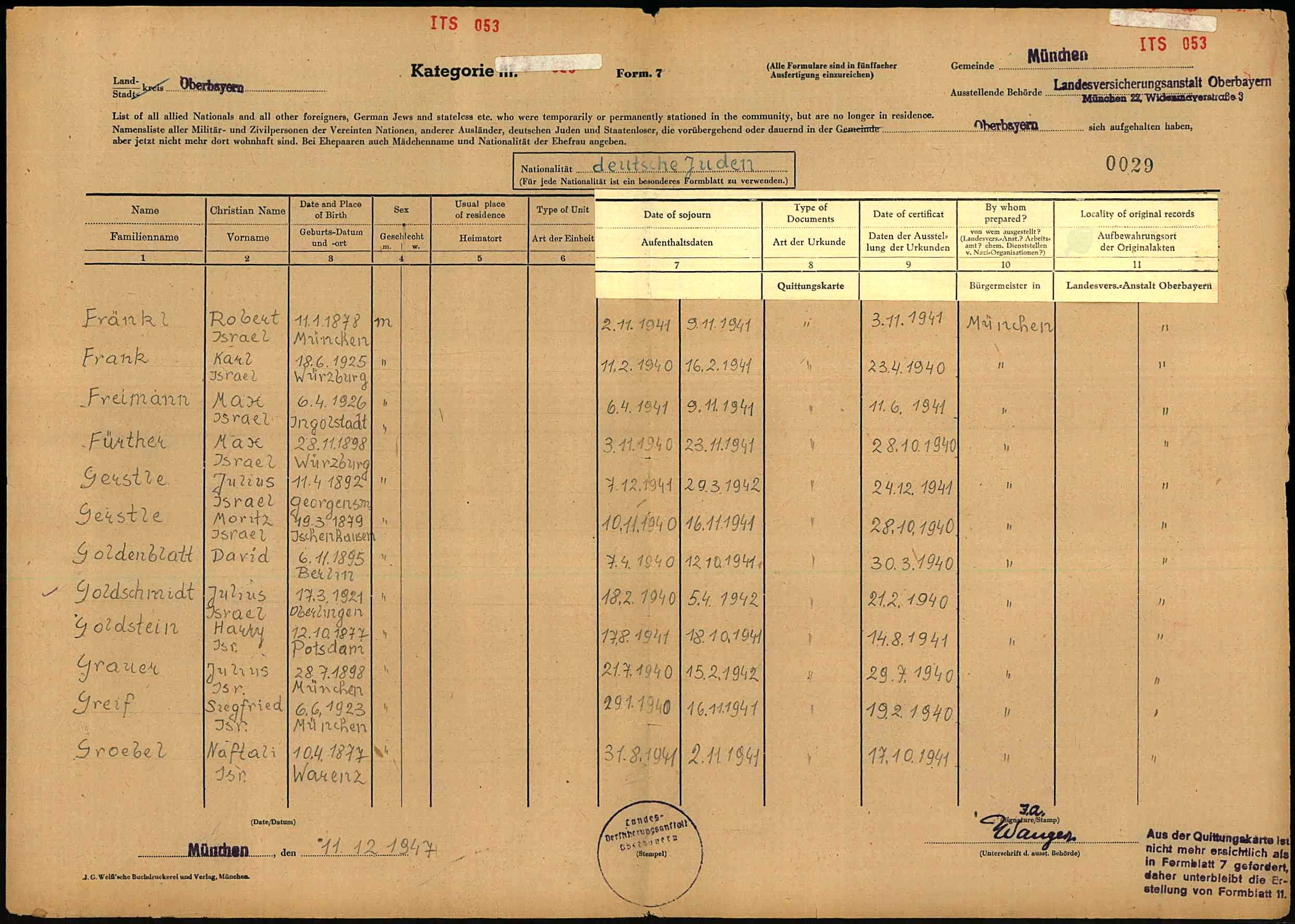
Unfortunately, two of the other children of Berthold and Rika did not leave Germany and were killed in the Holocaust. According to the Memorial Book for Victims of the Persecution of Jews under the National Socialist Tyranny in Germany 1933 – 1945, Jacob Julius Goldschmidt was sent to Dachau concentration camp on November 10, 1938, after Kristallnacht and was released from Dachau on December 8, 1938. He still, however, did not leave Germany. According to this document, he was living in Munich from February 18, 1940, until April 5, 1942.

UPDATE: Thank you to barb276 for finding more information about Jacob Julius Goldschmidt here. According to this page from the Munich archives, Jacob Julius had moved from Kassel to Munich by January 1, 1936, and was living there until October 26, 1940, when he went to a Hachsharah, a Zionist training camp in Steinhofel, where Jews were trained for life in Palestine/Israel. Unfortunately, Jacob Julius never got there.

Arolsen Archives, Digital Archive; Bad Arolsen, Germany; Lists of Persecutees 2.1.1.1
Reference Code: 02010101 oS, Ancestry.com. Europe, Registration of Foreigners and German Persecutees, 1939-1947

He was then deported to Poland and murdered at some unnamed location.

Hedwig Goldschmidt was also murdered by the Nazis. She had married Horst Starsky, who was born on July 10, 1909, in Wingeruppen, Germany. According to the Memorial Book for Victims of the Persecution of Jews under the National Socialist Tyranny in Germany 1933 – 1945, they were living in Berlin, and both were first imprisoned in a Jewish forestry labor camp in Kersdorf-Briesen. They were then deported to Auschwitz on April 19, 1943, where they were killed. As far as I’ve been able to determine, they did not have any children.

The fate of Albert Goldschmidt, Berthold and Rika’s youngest son, is less clear. My cousin Rickey believes that he ended up immigrating to Buenos Aires, Argentina, but I have no documentation showing that. Rickey also believed he married and had a child there, but again, we have no documentation. What we do have is this photograph of Albert apparently taken in front of a restaurant that has a Spanish name, I think—Coveteria Vievo Viena? Google Translate could not make sense of coveteria but translated Vievo Viena as I come Vienna. Possibly a restaurant serving Viennese (or German-style) food?

UPDATE: Thank you to my cousin Susana, who also came from Buenos Aires, for helping me to translate what this says. She said that it says “Confitería Viejo Viena” (Old Vienna tearoom) and would have been a patisserie or tearoom that likely specialized in German/Austrian pastries and cakes.

Courtesy of the family

Thus, Berthold Goldschmidt’s family with his second wife Rika endured a great deal of tragedy just as his family with his first wife Mathilde Freudenstein had. But the record must stand corrected. Berthold Goldschmidt does indeed have living descendants—his grandchildren, his great-grandchildren, and even some great-great-grandchildren.  And one of them is my wonderful cousin Rickey who helped me tell and illustrate their family’s story.



  1. Walter Goldschmidt, Birth Date: 24 Apr 1913, Birth Place: Oberlistingen, Germany,
    Ancestry.com. U.S. WWII Draft Cards Young Men, 1940-1947 
  2. Herbert Goldschmidt, Birth Date: 20 Dec 1914, Birth Place: Oberlistingen, Germany, Ancestry.com. U.S. WWII Draft Cards Young Men, 1940-1947 
  3.  Hedwig Goldschmidt, Birth Date: 1 Jun 1918, Birth Place: Oberlistingen, Reference Number: 02010101 oS, Document ID: 70442392, Arolsen Archives, Digital Archive; Bad Arolsen, Germany; Lists of Persecutees 2.1.1.1, Ancestry.com. Europe, Registration of Foreigners and German Persecutees, 1939-1947 
  4.  Julius Israel Goldschmidt, Birth Date: 17 Mrz 1921 (17 Mar 1921), Birth Place: Oberlingen, Reference Number: 02010101 oS, Document ID: 70126154, Arolsen Archives, Digital Archive; Bad Arolsen, Germany; Lists of Persecutees 2.1.1.1, Ancestry.com. Europe, Registration of Foreigners and German Persecutees, 1939-1947 
  5. I have no record of Albert’s birth date; this comes from the Goldschmidt family report done by Roger Cibella and David Baron. 
  6.  Elfriede Colin, Social Security Number: 112-16-3514, Birth Date: 17 Aug 1926
    Death Date: 6 Jan 2011, Social Security Administration; Washington D.C., USA; Social Security Death Index, Master File, Ancestry.com. U.S., Social Security Death Index, 1935-2014 
  7.  Richa Goldschmidt, Maiden Name: Giesberg, Gender: weiblich (Female)
    Age: 52, Birth Date: 29 Mai 1882 (29 May 1882), Death Date: 1 Mrz 1935 (1 Mar 1935)
    Death Place: Merxhausen, Hessen (Hesse), Deutschland (Germany), Civil Registration Office: Merxhausen, Certificate Number: 16, Personenstandsregister Sterberegister; Signatur: 6991, Ancestry.com. Hesse, Germany, Deaths, 1851-1958 
  8. Herbert Goldschmidt, ship manifest, Year: 1937; Arrival: New York, New York, USA; Microfilm Serial: T715, 1897-1957; Line: 25; Page Number: 38, Ancestry.com. New York, Passenger and Crew Lists (including Castle Garden and Ellis Island), 1820-1957 
  9. Walter Goldschmidt, ship manifest, Year: 1937; Arrival: New York, New York, USA; Microfilm Serial: T715, 1897-1957; Line: 8; Page Number: 36, Ancestry.com. New York, Passenger and Crew Lists (including Castle Garden and Ellis Island), 1820-1957. Salomon Strauss and Jenny Giesbech [sic], Arolsen Archives, Digital Archive; Bad Arolsen, Germany; Lists of Persecutees 2.1.1.1, Reference Code: 02010101 oS, Ancestry.com. Europe, Registration of Foreigners and German Persecutees, 1939-1947. Meta Giesberg, Marriage Date: 30 Apr 1936, Marriage Place: Manhattan, New York, USA, Spouse: Joseph A Guhl, Certificate Number: 11992, Ancestry.com. New York, New York, Extracted Marriage Index, 1866-1937 
  10. Elfriede Goldschmidt, ship manifest, Year: 1939; Arrival: New York, New York, USA; Microfilm Serial: T715, 1897-1957; Line: 6; Page Number: 8, Ancestry.com. New York, Passenger and Crew Lists (including Castle Garden and Ellis Island), 1820-1957 
  11. Walter Goldschmidt and Herbert Goldschmidt, 1940 US census, Year: 1940; Census Place: North Castle, Westchester, New York; Roll: m-t0627-02811; Page: 3B and Page 24A, Enumeration District: 60-250, Ancestry.com. 1940 United States Federal Census 
  12. Elfriede Goldschmidt, 1940 US census, Census Place: New York, Bronx, New York; Roll: m-t0627-02497; Page: 10B; Enumeration District: 3-1449, Ancestry.com. 1940 United States Federal Census 
  13. Ancestry.com. U.S., World War II Army Enlistment Records, 1938-1946 
  14.  Herbert Goldschmidt, Gender: Male, Marriage License Date: 19 Jan 1943
    Marriage License Place: Manhattan, New York City, New York, USA, Spouse: Lilly Vogel
    License Number: 1202, New York City Municipal Archives; New York, New York; Borough: Manhattan; Volume Number: 1, Ancestry.com. New York, New York, Marriage License Indexes, 1907-2018 
  15. Ancestry.com. U.S., Department of Veterans Affairs BIRLS Death File, 1850-2010 
  16.  Hilda Weis, Gender: Female, Marriage License Date: 10 Feb 1944
    Marriage License Place: Manhattan, New York City, New York, USA. Spouse: Walter Goldschmidt, License Number: 3826, New York City Municipal Archives; New York, New York; Borough: Manhattan; Volume Number: 6, Ancestry.com. New York, New York, Marriage License Indexes, 1907-2018 
  17. Hilda Goldsmith, [Hildegard Weis], [Hilda Goldschmidt] , Gender: Female,
    Birth Date: 8 Oct 1922, Birth Place: Gelnhausen, Federal Republic of Germany
    Death Date: 18 Sep 2001, Father: Siegfried Weis, Mother: Else Scheuer
    SSN: 085180692, Ancestry.com. U.S., Social Security Applications and Claims Index, 1936-2007 
  18. Name: Walter Goldsmith, Gender: Male, Birth Date: 24 Apr 1913, Death Date: 4 Oct 1991, Claim Date: 6 Mar 1975, SSN: 077165081, Ancestry.com. U.S., Social Security Applications and Claims Index, 1936-2007. For Hilda, see Note 17. 
  19.  Elfriede Goldsmith, Marriage License Date: 27 Feb 1948, Marriage License Place: Bronx, New York City, New York, USA, License Number: 1705, New York City Municipal Archives; New York, New York; Borough: Bronx, Ancestry.com. New York, New York, Marriage License Indexes, 1907-2018 
  20. Elfriede Colin, Social Security Number: 112-16-3514, Birth Date: 17 Aug 1926
    Issue Year: Before 1951, Issue State: New York, Last Residence: 33308, Fort Lauderdale, Broward, Florida, USA, Death Date: 6 Jan 2011, Social Security Administration; Washington D.C., USA; Social Security Death Index, Master File, Ancestry.com. U.S., Social Security Death Index, 1935-2014 

Martha Loewenthal Wolff’s Family: An Update from Israel

One of the more elusive Goldschmidt family members to research has been Martha Loewenthal Wolff and her family. Martha was the daughter of Kiele Stern and Abraham Loewenthal, the granddaughter of Sarah Goldschmidt and Salomon Stern, and my third cousin, twice removed. Thanks to my friend Aaron Knappstein, I now have more information and documents and even photographs of Martha and her family.

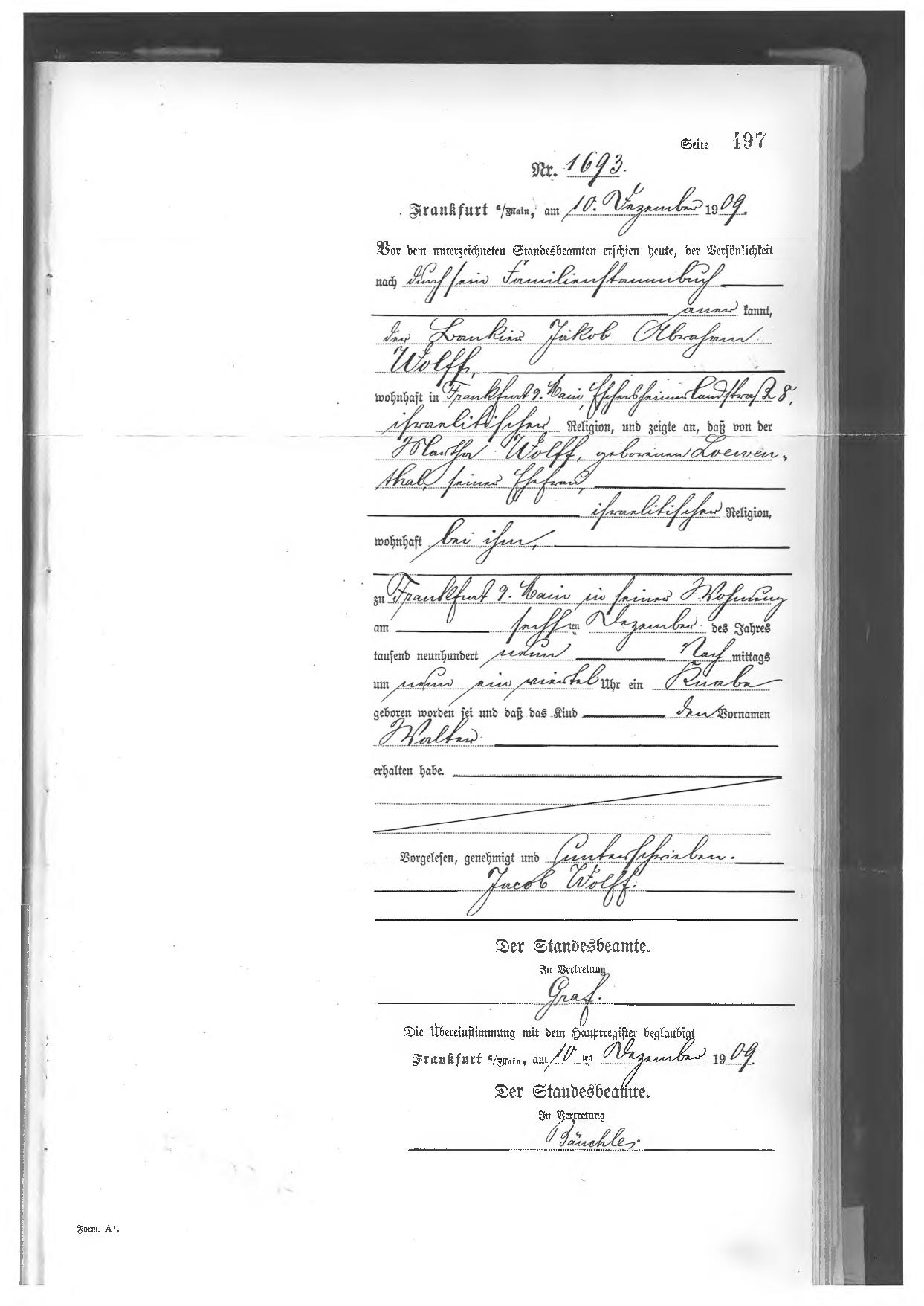
Martha was married to Jakob Wolff, as discussed here, and they had three children: Anna, Hans Anton, and Walter. I was missing birth records for all three children, and Aaron was able to locate all of them.

Birth record of Anna Wolff

Birth record of Hans Anton Abraham Wolff

Birth record of Walter Wolff

Martha died in 1930, and I could not find a death record for her until Aaron located it, as I wrote about here.

After Martha’s death and the Nazi takeover of Germany, Jakob Wolff and all three of their children immigrated to Israel, as I wrote about here.

But I did not know what happened to Jakob or his children after their immigration. And then Aaron came through for me again and located Hans Anton Wolff’s son Benjamin in Israel and connected me to him and his daughter Ravid. Now I have firsthand information about Martha’s family as well as photographs, thanks to Ravid Wolff, my fifth cousin, once removed.

First, some photographs of the family taken before they left Germany.

Jacob and Martha Wolff and their first car Courtesy of the Wolff family

Anna Wolff and her mother Martha Loewenthal Wolff Courtesy of the Wolff family

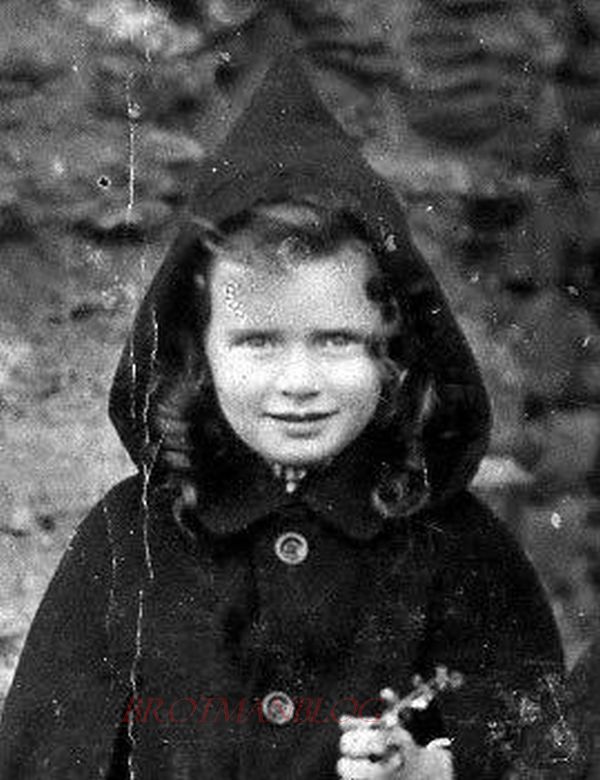
Anna Wolff as a child Courtesy of the Wolff family

Hans Anton and Walter Wolff Courtesy of the Wolff family

Ravid shared with me that her great-grandmother Martha was a very talented artist and sent me this image of a painting that Martha did while traveling with Jakob in what was then Palestine in the 1920s.

Painting by Martha Loewenthal Wolff

According to Ravid, her great-grandparents Martha and Jakob Wolff owned two banks in Frankfurt, Germany, and were quite wealthy. After Martha died from ovarian cancer in 1930, Jakob married Ilse Gruenebaum. When Hitler came to power, Jakob recognized how dangerous he was and, as a Zionist, decided to leave Germany for Israel (then Palestine) before it was too late. He was able to obtain visas to immigrate for a thousand pounds each, an exorbitant amount of money at that time, but had to leave all his other property and possessions behind. All of it including their home in Frankfurt was confiscated by the Nazis and never returned to the family.

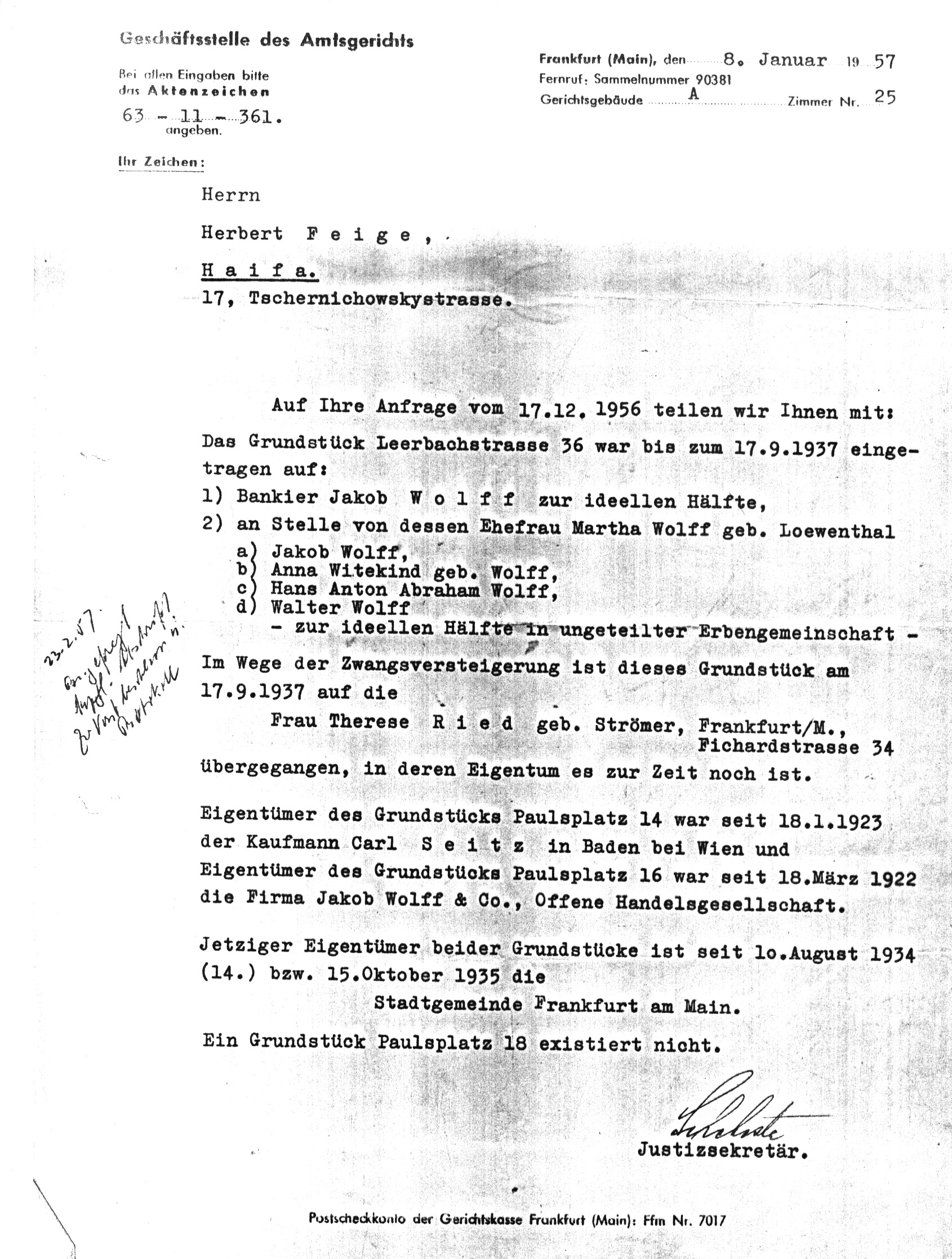
Ravid shared two letters with me that show that the requests for restitution of their property in Frankfurt were denied:

Google Translate helped me translate these letters. The one above translates as:

Upon your request of 17 December 1956, we will inform you: The property Leerbachstrasse 36 was registered until 17 September 1937 on:
Banker Jakob Wolff on the ideal half
Instead of his wife Martha Wolff [names of children] for ideal half in undivided community of heirs. [I am not sure what “ideal half” means.]
In the way of the forced auction, this plot of land on 17 9 1937 is given to Frau Therese Ried geb Stromer, [address]. It is still owned by them.
The owner of the Paulsplatz 14 property was the merchant Carl Seitz in Baden near Vienna in 18 1 1923 and the owner of the Paulsplatz 16 property was the Jakob Wolff & Co., Open Trade Company since 18 March 1922.
The current owner of both properties has been the municipal district of Frankfurt since August 10, 1934 bze, October 15, 1935. A piece of land at Paulsplatz 18 does not exist.

The second letter translated as:

The aforementioned property became the property of the City of Frankfurt on the basis of an additional resolution dated 2 4 1935. The compulsory auction had already started in 1932. The JRSO, which had previously asserted claims for reimbursement for the aforementioned property, accepted its application on Feb. 1, 1951. For your further information, we would like to inform you that the city has always contested a claim for reimbursement.
We hope to have served you with the above statements.

As for Martha and Jakob’s three children, Anna, the oldest, was married to Simon Wittekind when she immigrated, and they had two sons, Aharon and Baruch (as they were known in Israel) who were born in Berlin. Simon was a doctor who wanted to move to South Africa, but Anna felt safer in Israel, so she stayed there with her children.

Anna later married Herbert Feige. According to Ravid, Anna hated Germany and suffered great trauma because of what had happened there and unlike her brother Hans Anton refused to reclaim her German citizenship when that right became available to her. Her sons changed their surname to Yardeni (for the Jordan River) to identify with their new homeland. Ravid did not know exactly when Anna died, only that like her mother Martha, she died young and from cancer.

Ravid’s grandfather was Hans Anton Wolff, the second child of Martha Loewenthal and Jakob Wolff.  He married Susana Meseritz, another refugee from Germany, whom he met in Palestine. They had one child, Ravid’s father Benjamin. Hans had a doctorate in chemistry. He died from colon cancer in 1974, and his wife Susana died in 2002.

Walter, the youngest of the siblings, also married in Palestine/Israel. He owned a hotel in Jerusalem for many years. He and his wife Hedy Buller had two children. Walter died in 1968 in Jerusalem, also from cancer.

I am so indebted to Aaron Knappstein for finding the missing records of the Wolff children and even more so for connecting me to my cousin Ravid. And I am very, very grateful to Ravid for sharing her family’s story with me. Ravid, like her great-grandmother Martha and so many others in the extended Goldschmidt family, has a great interest in and great talents in art. Her photography captures in simple and yet complex ways the beauty of the world around us by using unusual perspectives and contrasting light and colors.

A Photo Essay of the Family of Selma Loewenthal Schwabacher

Another cousin who found my blog during these pandemic days is my fifth cousin, once removed, Carrie Schwabacher. She is the granddaughter of Gerhard Schwabacher, the great-granddaughter of Selma Loewenthal Schwabacher, great-great-granddaughter of Kiele Stern Loewenthal, three times great granddaughter of Sarah Goldschmidt Stern, and four-times great-granddaughter of Meyer Goldschmidt.

Carrie kindly shared with me these wonderful photographs as well as some heartwarming stories about her family. They start with her great-great-grandmother, Kiele (Caroline) Stern Loewenthal, the daughter of Sarah Goldschmidt and Salomon Stern, wife of Abraham Loewenthal. I wrote about Kiele here and here.

Kiele Stern Loewenthal.
Courtesy of her family

Here is a lovely photograph of Kiele and Abraham Loewenthal’s daughter, Selma, as a young woman; I see a strong resemblance to her mother.

Selma Loewenthal
Courtesy of her family

Selma married Nathan Schwabacher:

Nathan Schwabacher Courtesy of the Schwabacher family

And they had three children. Their daughter Alice was the oldest:

Alice Schwabacher Courtesy of the Schwabacher family

Alice was followed by Julius Alfred Schwabacher:

Julius Alfred Schwabacher Courtesy of the Schwabacher family

Gerhard Schwabacher, Carrie’s grandfather, was Selma and Nathan’s youngest child:

Gerhard Schwabacher
Courtesy of the family

The two sons look remarkably similar to each other and to their father Nathan.

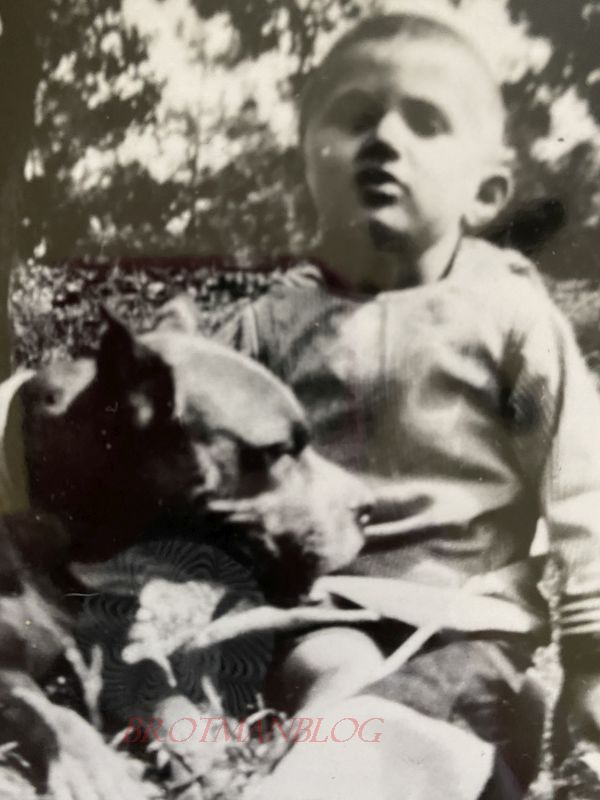
Alice Schwabacher married David Weinstein (later Wenten) and had one child, Wolfgang, depicted here as a young boy with his dog:

Wolfgang Weinstein and dog

Julius Schwabacher married Margaret Wuertenberg and had one child, Eva Lore, the adorable little girl shown here:

Eva Lore Schwabacher
Courtesy of the family

This photograph of Selma Loewenthal Schwabacher and her brother Julius Loewenthal is undated, but must have been taken before 1936 when Julius left for the United States. Selma died in 1937 in Berlin.

Selma Loewenthal Schwabacher and brother Julius Loewenthal
Courtesy of the family

Here is a closer one of Selma, probably taken around the same time:

The remaining photographs that Carrie shared with me appear to have been taken after the family immigrated to the United States. Their full story has been told here, so I won’t tell it again, but will share these photographs of the Schwabacher family in their new country and some of Carrie’s memories of her extended family.

She has wonderful memories of her grandparents, as she shared with me: “I have such great memories of my grand parents even though they died when I was 7. Christmas was a very special time – like a scene from the Nutcracker. As children, we celebrated Hanukkah, Christmas and Epiphany ( my mom’s side of the family is Russian Orthodox). We got presents for months, or it seemed like it.” She also wrote that her Opa, Gerhard Schwabacher, always gave each of his grandchildren a quarter every time he saw them.

Other holidays were spent with her great-uncle Julius Schwabacher, who became Fred Wenten in the US, and his wife Else in Proctor, Vermont: Fred and Elsa owned an Inn in Proctor Vt. The entire family spent a few holidays there as well. The toasts would go on for so long that someone would finally say “let the children eat their fruit cocktails before they fall asleep”. And then, dinner would start.”

Here’s a photograph of Fred Wenten in the US:

Fred Wenten (born Julius Alfred Schwabacher)
Courtesy of the family

Fred’s daughter Eva Lore was also a favorite of Carrie. Eva Lore married Henry Corton in 1951. Carrie wrote this about them:

“Henry was a fabulous dancer and would sometimes break into buck and wing ( tap dancing) in the kitchen even when he was old. We visited then often when they lived in Jamaica, Queens. We always went out for walks. We met Bella Abzug at the Cloisters in NY. He was very fond of Pavorotti and considered him a “distant cousin“. It got him back stage at the Met many times. Eva and Henri took us to Ringling Bro’s. And Barnum & Bailey Circus and the Ice Capades when we were little. We visited Eva Lore in LaGuna Hills, helped her pack and move to Baltimore, and took her to her first McDonalds meal. The “Apple Strudel “ was her favorite. Apple Pie. Even at 79, she was booking her own travel on her computer. They never had children, but spoiled us.”

Here are some of the photographs of Eva Lore and Henry that Carrie shared with me:

Eva Lore Schwabacher and Henry Corton Courtesy of the family

Eva Lore Schwabacher Corton Courtesy of the family

Eva Lore Schwabacher Corton Courtesy of the family

Eva Lore and Henry Corton Courtesy of the family

Carrie also has warm memories of her great-aunt Alice Schwabacher Weinstein (Wenten in the US):

“We went to visit Tanta Alice for the holidays every year in Washington Heights, NY. I always wanted to take a nap, because I loved the big square Feather pillows on the bed. She always had such great treats for us, German delicacies. She was extremely socially active. Wolf would remark that he had to make an appointment just to visit his mother. We had her 90 th birthday party at window on the worlds – top of the World Trade Center. It was incredible to meet so many people originally named Schwabacher.”

This photograph shows Alice with her son Wolfgang and his wife Ruth.

Alice Schwabacher Wenten Kingsley, Wolfgang Wenten, Ruth Pollinger Wenten
Courtesy of the family

Finally, this is a photograph of the three Schwabacher siblings and their spouses taken in the US:

Arthur Kingsley, Alice Schwabacher Kingsley, Julius (Fred Wenten) Schwabacher, Else Wenten, Alice Ferron Schwabacher, Gerhard Schwabacher
Courtesy of the family

I am extremely grateful to my cousin Carrie for sharing her memories and these photographs. She really has brought to life this strong and loving family who escaped from Germany and started a wonderful new life in the United States.

Hermann Gutmann Becomes Dennis Goodman: An Oral History, Part II

By the spring of 1940, Hermann Gutmann was seventeen years old and had been in England and separated from his parents since the fall of 1936.  He had completed his secondary education and had been working at a leather factory in Lancashire in the north of England since February 1940 and moved to London that May.1

On July 2, 1940, at 6 am he heard a knock on his door. The police told him to pack his bags and come with them to the police station. He protested, but to no avail, and along with many other German Jewish “enemy aliens,” he was taken to a camp, Huyton Camp, and housed in a tent with other young refugees from Nazi Germany. All those who were under eighteen, including Hermann, were told they were being taken out of England. He again protested and was told by the commanding officer that those leaving England would have the best chance of survival because England was likely to lose the war.

As the internees boarded the HMT Dunera on July 10, 1940, all their personal possessions were taken and never returned. The Jewish internees were placed in the hold in the rear of the ship and kept there by barbed wire fencing. They were only allowed up on the deck for thirty minutes a day for exercise where they were barefooted and often stepping on the broken beer bottles left behind by the guards, whom Hermann described as “football hooligans.” The internees slept on the hard floor and had open toilet stalls that he described as “awful.”  Hermann described the morale of the younger internees as fairly good, but said that those who were older had a much harder time and that there were even a few suicides during their voyage. There were also Nazi and Italian internees on the ship, but they were kept in a different location.

HMT Dunera. Not stated in the AWM record / Public domain

The internees had no idea where they were going until they arrived in Australia on September 6, 1940. Once in Australia, they were sent to New South Wales and housed at the Hay Internment Camp. There were about two thousand internees kept there, many of whom had been successful professionals—doctors, lawyers, professors, and so on. They formed their own government and even printed their own money. Hermann distributed newspapers and even started a Boy Scout group that was officially recognized by the London headquarters of the Boy Scouts.

They lived in huts, about forty to a hut, and conditions were good. Hermann noted several times that as a young man (he was seventeen), he was not as uncomfortable as those who were older, and he didn’t mind some of the living conditions. When asked whether he now resented having been interned during this time, he said no—that he understood it was done without much thought based on fear when the war started and that it was an awful waste of time and money, but that he did not feel any resentment towards the British for their actions.

In the fall of 1941, Hermann volunteered to join the British military as a means of getting out of the internment camp. He left Austrialia on October 13, 1941, and arrived back in England on November 28, 1941, just over a week before Pearl Harbor. He and other Jewish refugees were given no choice as to where to serve and were assigned to the Pioneer Corps, a corps assigned “light engineering tasks [that] included building anti-aircraft emplacements on the Home Front, working on the Mulberry harbours for D-Day, and serving during beach assaults in France and Italy. Pioneers also carried stretchers, built airfields, repaired railways, and moved stores and supplies.”

Pioneer Corps clearing rubble, Ministry of Information Photo Division Photographer / Public domain

It was during this time that his commanding officer asked him to change his name to something less German-sounding. Hermann chose the name Dennis John Goodman, his first name for a friend who had been killed in the war and Goodman as an Anglicized version of Gutmann. In the interview, he commented that he now regretted that he never returned to his birth name Hermann Gutmann as it had a very long history in his family.

Dennis was not content being in the Pioneer Corps because he wanted to be fighting the Nazis. In 1943, British policy changed, and Jewish German refugees like Dennis were allowed to serve more directly in combat. Dennis joined a tank unit and was on the beach at Normandy three days after D-Day, that is, on June 9, 1944. He ended up fighting in France, Belgium, the Netherlands, and finally in Germany. He was involved in many difficult and dangerous battles, made more dangerous by the fact that the English tanks were outmatched by the German Tiger Tanks they were facing. He experienced some very close encounters with death or capture by the Germans.

The interviewer asked him how he felt when he entered Germany, his country of birth, and fought on German soil. Dennis commented that “by that time I felt more English than German” and that he had no difficulty facing his former countrymen in battle. When the war ended, he was in Berlin for the British Victory Parade on July 21, 1945.

British Victory Parade in Berlin, National Archives and Records Administration / Public domain

By that time he already knew about the concentration camps.  He was given compassionate leave to go to Amsterdam to learn what had happened to his parents and learned of the deportation to and murder at Sobibor. In the interview, Dennis mentioned that at that time he learned that his grandmother had been hidden in the northern part of Holland and had survived.

I checked to see which grandmother, and it had to be his maternal grandmother, Hedwig Goldschmidt, because his paternal grandmother had died in 1932. I have no wartime records for Hedwig after March 15, 1938, when she was a passenger coming to England from Amsterdam.2 I initially thought that meant that she had moved to England at that time, but it appears from Hermann’s information that she had returned to Amsterdam, perhaps after visiting him in England.

Dennis remained in Germany after the war and joined the Review and Interrogation staff in Neuengamme, near Hamburg, where he was involved in interrogating Nazis about war crimes. He was struck by the ordinariness of the people who committed these crimes and their weak excuses for what they did. He also found some of them very arrogant. Several times during the interview, Dennis made the point that it was well known throughout Germany that Jews were being persecuted and that those who afterwards claimed that they hadn’t been aware of what was happening were either lying or repressing what they’d known.

In 1947, Dennis was discharged from the military and returned to England. He married a Polish-born Holocaust survivor after the war and had three children. I don’t know much about his life after the war, but did find several immigration documents from Brazil, starting in 1949, suggesting he might have been involved in international business or perhaps visiting family members who had immigrated to Brazil.

Ancestry.com. Rio de Janeiro, Brazil, Immigration Cards, 1900-1965. Original data: “Rio de Janeiro Brazil, Immigration Cards, 1900-1965”. FamilySearch, Salt Lake City, Utah, 2013.

Dennis John Goodman, born Hermann Gutmann, died in England in 2007. He had lived an extraordinary life, leaving his parents and homeland as a thirteen year old boy, being interned for over a year in Australia as an “enemy alien,” and then fighting valiantly against the Nazis for several years including post-war interrogation of war criminals. His parents had been murdered at Sobibor. He had every right to be an angry, resentful man.

But listening to his voice in the oral history interview, I detected no resentment towards his adopted country, despite the internment. Certainly he harbored anger with the Nazis for what they did to his parents and all the Jews in Europe and continuing bewilderment over the German citizenry’s acquiescence to it all. But I did not come away from the interview thinking of him as bitter or defeated; instead I heard a then 72 year old man who looked back on his life with pride in his ability to endure and succeed against all odds and in his strength and independence even as a young man. His story will stay with me forever.


  1. These facts come almost entirely from the oral history interview of Dennis Goodman, aka Hermann Gutmann, found on the Imperial War Museum website. Some of the dates in this post were found in an article written by his daughter, Naomi Levy, and published in the AJR [Association of Jewish Refugees] Journal of December 2018, on page 11, and found here
  2.  Hedwig Goldschmidt, Arrival Age: 61, Birth Date: abt 1877, Port of Departure: New York, New York, United States, Arrival Date: 15 Mar 1938, Port of Arrival: Plymouth, England, Ports of Voyage: New York, Ship Name: Washington, Shipping Line: United States Line, Official Number: 232210, The National Archives of the UK; Kew, Surrey, England; Board of Trade: Commercial and Statistical Department and successors: Inwards Passenger Lists.; Class: BT26; Piece: 1158, Ancestry.com. UK and Ireland, Incoming Passenger Lists, 1878-1960 

Hermann Gutmann, Child Refugee from the Nazis: An Oral History

As we saw last time, my cousin Else Goldschmidt Gutmann, daughter of Marcel Goldschmidt and Hedwig Goldschmidt, was murdered by the Nazis in 1943 at the Sobibor concentration camp along with her husband Siegfried Gutmann. They were, however, survived by their son, Hermann Gutmann. His story is captured in a moving and detailed oral history interview that was recorded for the British Imperial War Museums in 1995 and available online here.

The oral history interview is two hours long, and I listened to it in the course of one afternoon. If anyone has the time and the interest to listen, even if just to the first thirty minutes, it will provide insights into the strength and courage of those who escaped Nazi Germany as children. My words cannot possibly capture the emotion and the personality expressed by this man in retelling his life story fifty to sixty years after these tumultuous events. When you listen, the clarity of his memory, his composure, and his strength come shining through. Despite living in England since 1936, he still had the traces of a German accent. I will try and do justice to his story, but again, if you have time, listen to at least some of this interview.

One other editorial explanation. Hermann Gutmann changed his name in 1943 to Dennis John Goodman. I will refer to him as Hermann in discussing the years before that change and then as Dennis for the years after the name change. I hope that’s not too confusing.

All the facts in this post come directly from the oral history interview with Dennis John Goodman at the Imperial War Museum, Catalogue 15101.


Hermann Gutmann’s father Siegfried Gutmann was from a family of bankers in Stuttgart, and after the Stuttgart bank was taken over by a larger bank, Siegfried moved to Frankfurt to work for a bank in that city where he met and married Else Goldschmidt. Their only child Hermann Gutmann was born in Frankfurt on February 28, 1923. Hermann believed that the economic circumstances experienced in Germany in the 1920s made his parents reluctant to have more than one child. He described his childhood as a happy middle-class childhood in Frankfurt where his family was actively involved in the Jewish community as well as the general community.

Frankfurt, Germany, 1918,Carl Andreas Abt / Public domain

Hermann experienced anti-Semitism as early as 1931 when he was eight years old and saw people carrying anti-Semitic political posters while marching in the streets of Frankfurt. But things grew much worse after 1933 when Hitler was elected Chancellor. Hermann described himself as an outspoken and opinionated boy who fought back when he was attacked by students for being Jewish. When he finished primary school, his parents could no longer send him to a general secondary school because Jews were banned. Instead they sent him to an excellent Jewish day school where he was one of several hundred students.

But by 1936, his parents were concerned that Hermann would not be able to receive a quality education, and they decided that the best thing to do for their son was to send him to boarding school in England. His father spoke to young Hermann, expressing his fears, given how Hitler had perverted Germany and how their non-Jewish friends had drifted away out of fear.  When asked by the oral history interviewer how he felt about leaving his parents and his home, Hermann responded that he “just had to face it.” His acceptance of this reality seemed remarkable to me, especially given that he was only thirteen at the time.

So on October 5, 1936, thirteen year old Hermann Gutmann traveled to England with a family friend who happened also to be heading to England.  When they arrived in London, a relative met him at the station and made sure he boarded the right train to Brighton, where his new school, a Jewish boarding school called Whittinghame College, was located. He described his first year there as very lonely. He knew just a little English when he arrived, and there were only one or two other German students at the school. More German refugees had arrived by the time he left in 1939.

Thank you to the alumni association of Whittinghame College for permission to use these two photographs.

Hermann is probably in this photograph, but I don’t know which young man he is.

Whitinghame College students, 1939

His parents left Germany for Amsterdam in 1937. The interviewer asked him why his parents hadn’t come to England instead of Amsterdam, and he explained that his father had been offered a job in Amsterdam and that his parents believed they would be safe there. He said that no one anticipated in 1937 that Hitler would later invade the Netherlands and deport Jews to concentration camps. Hermann was able to visit his parents in Amsterdam during this time, and he said that although it was a big adjustment for them and especially for his father, whose new job was not in the banking field, they were reasonably happy living there.

Although Hermann said that he did not enjoy the “monastic existence” of the all-boys boarding school, he stated that he received an excellent education and that he even qualified to matriculate at Cambridge University for the fall of 1939, but “events intervened,” that is, the start of World War II. Once the war started, Hermann also was no longer able to visit his parents.

He finished his time at Whittinghame and obtained a job in a leather manufacturing factory in Lancashire, England, where he worked from February, 1940 until May, 1940. He had been in England for more than three years at that point. He had coped with adjusting to a new country, learning a new language, completing his secondary education at a Jewish boarding school, and enduring the long separation from his parents. In the interview, he commented that he had experienced no hostility in England based on his German background and that people had been very friendly.

But his life was about to change in the spring of 1940.