Sarah Goldschmidt’s Sons 1910-1930: Years of Comfort, Years of Loss

We saw that the family of Sarah Goldschmidt and Salomon Stern’s daughter Keile Stern Loewenthal experienced much growth and prosperity during the 1910s and 1920s. This post will focus on their two sons, Abraham and Mayer, and their lives between 1910 and 1930.

As of 1910, Abraham (known as Adolf) Stern and his wife and first cousin Johanna Goldschmidt had four grown children: Siegfried, Clementine, Sittah Sarah, and Alice. I am so grateful to Siegfried’s grandson Rafi Stern, my fifth cousin, who kindly shared the photographs that appear in this post.

This photograph shows the house where Abraham and Johanna lived and raised their children in Frankfurt. As you can see, the family was quite comfortably situated as Abraham was a successful merchant in Frankfurt.
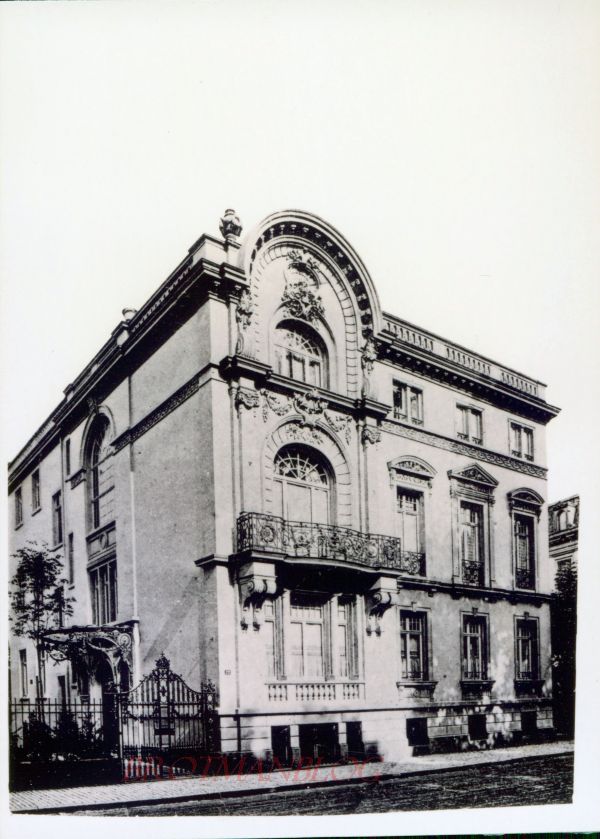
Home of Abraham Adolf Stern and Johanna Goldschmidt in Frankfurt. Courtesy of their great-grandson, Rafi Stern.

Their son Siegfried Stern married Lea Hirsch on June 4, 1912, in Frankfurt.1 She was born in Halberstadt, Germany, on April 10, 1892, to Abraham Hirsch and Mathilde Kulp.2 Siegfried and Lea had two sons, Erich Ernst Benjamin Stern, born March 27, 1913, in Frankfurt,3 and Gunther Stern, born May 5, 1916, in Frankfurt.4

Siegfried Stern, courtesy of Rafi Stern.
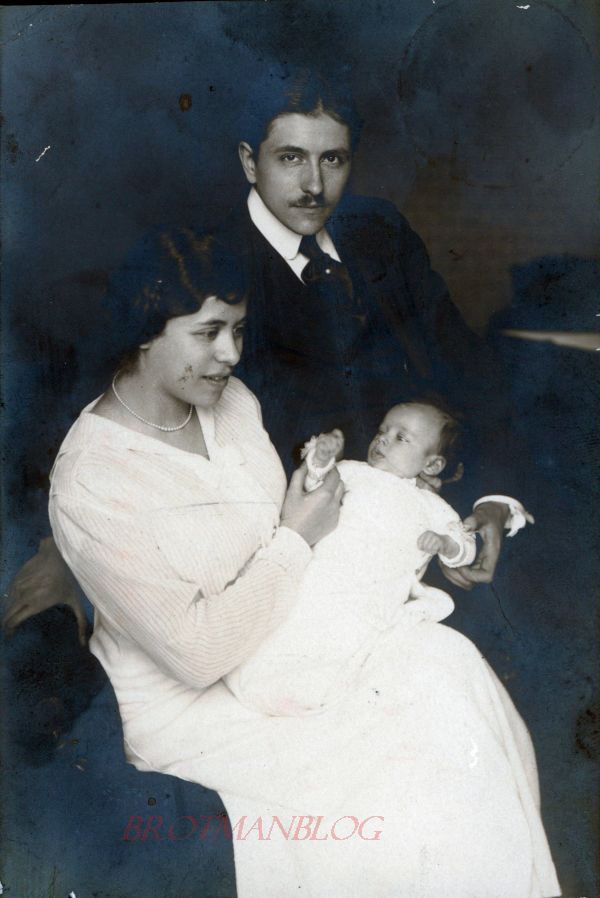
Siegfried, Lea, and Erich Stern c.

Siegfried, Lea, and Erich Stern, 1913. Courtesy of Siegfried’s grandson, Rafi Stern.

Home of Siegfried Stern as it looks today. Courtesy of his grandson, Rafi Stern.

Abraham and Johanna’s second child Clementine Stern was married to Siegfried Oppenheimer, a doctor, and had a daughter Erika, born in 1909, as seen in my earlier post. Clementine would have two more children, William Erwin Oppenheimer, born on October 29, 1912, in Frankfurt,5 and Sarah Gabriele Oppenheimer, born July 20, 1917, in Frankfurt.6

Clementine’s sister Sittah Sarah Stern married Abraham Albert Mainz on October 3, 1911, in Mainz. He was born in Paris, France, on May 31, 1883, to Leopold Mainz and Hermine Straus.
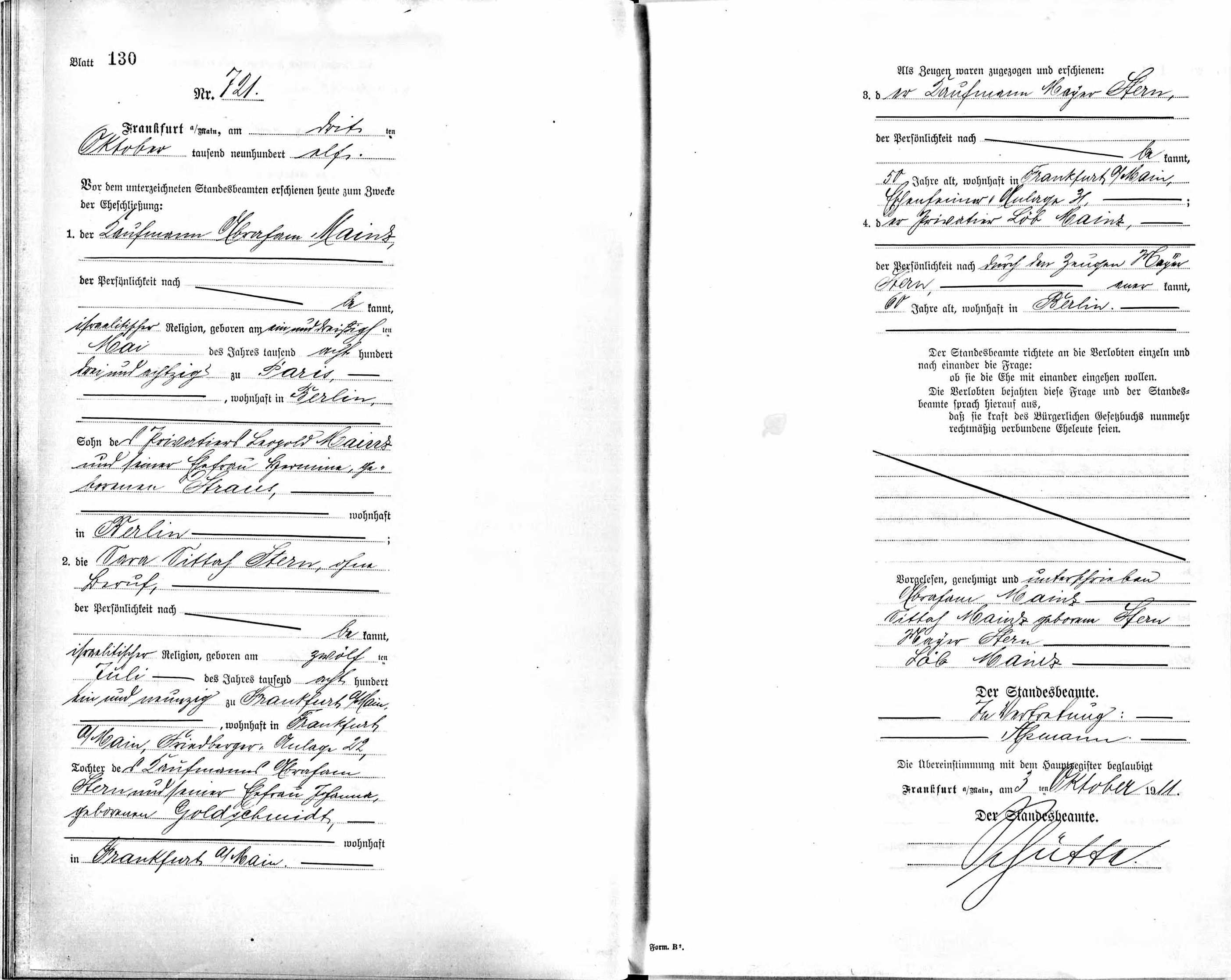
Marriage record of Sarah Sittah Stern and Abraham Mainz, Hessisches Hauptstaatsarchiv; Wiesbaden, Deutschland, Ancestry.com. Hesse, Germany, Marriages, 1849-1930

Sittah Sarah and Abraham Mainz would have two children, Marguerite Wera Mainz, born in Frankfurt on October 22, 1913,7 and Helmut Walter Solomon Mainz, born April 13, 1918, in Frankfurt.8 The photograph below depicts their home in Frankfurt on the first and second floors of the building.

Building in Frankfurt where Sittah Sarah and Abraham Mainz lived. Courtesy of Rafi Stern.

Abraham and Johanna would lose their two oldest children in the next several years. First, Clementine Stern Oppenheimer died on January 18, 1919, in Frankfurt. She was only 29 years old and left behind three young children, Erika (ten), William Erwin (seven), and Sarah Gabriele (two). Like millions of others, Clementine died from the Spanish flu epidemic, according to her great-nephew, my cousin Rafi.

Clementine Stern Oppenheimer death record, Personenstandsregister Sterberegister; Bestand: 903; Signatur: 10812, Ancestry.com. Hesse, Germany, Deaths, 1851-1958

A year later, as so often happened in Jewish families back then, Clementine’s younger sister Alice Lea Stern married Clementine’s widower Siegfried Oppenheimer. They were married on October 6, 1920, in Frankfurt.

Marriage record of Alice Lea Stern to Siegfried Oppenheimer, Hessisches Hauptstaatsarchiv; Wiesbaden, Deutschland; Bestand: 903, Ancestry.com. Hesse, Germany, Marriages, 1849-1930

Alice and Siegfried would have five children together in the 1920s.

Just two years after losing Clementine, Abraham and Johanna lost their first born, Siegfried Stern. He died on July 9, 1921, in Oberursel, Germany. He was only 32.  He died at the Frankfurter Kuranstalt Hohemark, a psychiatric hospital.  According to his grandson Rafi, Siegfried had suffered a business failure and become despondent. He was hospitalized and tragically took his own life. He left behind his wife Lea and their two young children Erich (eight) and Gunther (five).

Siegfried Stern death record, Personenstandsregister Sterberegister; Bestand: 908; Signatur: 3821, Ancestry.com. Hesse, Germany, Deaths, 1851-1958

Below is Siegfried’s gravestone, one of the most beautiful I’ve ever seen, and the inscription is heartbreaking to read, knowing Siegfried’s story. I am grateful to the members of Tracing the Tribe for this partial translation:

Here lies buried Mr. Shlomo son in Mr. Asher Avraham STERN “shlita” (indicates that his father was alive at the time of the sons death).
A man who feared G-d, he revived the hearts of the downtrodden in secret.

He was pure in his thoughts and pure in his body, and all his purpose was the returning of his soul, pure, to his maker.

He respected his father and his mother with all of his ability.

He respected his wife more than his own body.

He died with a good name at the age of 32 to the sorrow of all that knew him, on the holy day of Shabbos, 3 Tamuz, and was buried with crying and eulogies on Monday the 5th of the same month. (5)681 (according to the small count) (1921).
May his soul be bound in the bonds of life.


Gravestone of Siegfried Stern, courtesy of his grandson Rafi Stern.

Siegfried’s widow Lea remarried a few years after Siegfried’s death and would have two more children with her second husband, Ernst Sigmund Schwarzschhild.9

Not long after losing his children Siegfried and Clementine, Abraham Adolf Stern himself passed away. He died on December 29, 1925, at the age of 67. He was survived by his wife/cousin Johanna and his two remaining children, Sittah Sarah and Alice Lea, and his grandchildren.

Abraham Stern death record, Personenstandsregister Sterberegister; Bestand: 903; Signatur: 10909, Ancestry.com. Hesse, Germany, Deaths, 1851-1958

The kind people at Tracing the Tribe translated Abraham’s gravestone for me:

Here is buried
Asher Avraham son of Shlomo called Adolf Albert Stern
a great man and a leader of his people
complete in his deeds and of good discernment.
The beginning of his wisdom comes from his belief in God

He oversaw his children and descendants

His house was a house of the righteous and a dwelling place of Torah
His soul is entwined in that of his humble wife.
You are gone and caused the middle of the day to turn dark. From heaven you are alive with us.

Died 12 Tevet and buried 14th of the month, [year] 5686 / [abbreviation]

May his soul be bound in the bond of life.


Abraham Adolf Stern gravestone. Courtesy of his great-grandson, Rafi Stern.

Abraham’s brother Mayer Stern and his wife Gella Hirsch had two children born in the 1890s, Elsa and Markus. Elsa married Jacob Alfred Schwarzschild on January 22, 1911, in Frankfurt. Jacob was the son of Alfred Isaac Schwarzchild and Recha Goldschmidt and was born February 12, 1885 in Frankfurt.  Jacob was Elsa’s second cousin. His mother Recha was the daughter of Selig Goldschmidt, and Elsa’s father Mayer was the son of Sarah Goldschmidt, Selig’s older sister. Once again, the family tree was bending around itself.
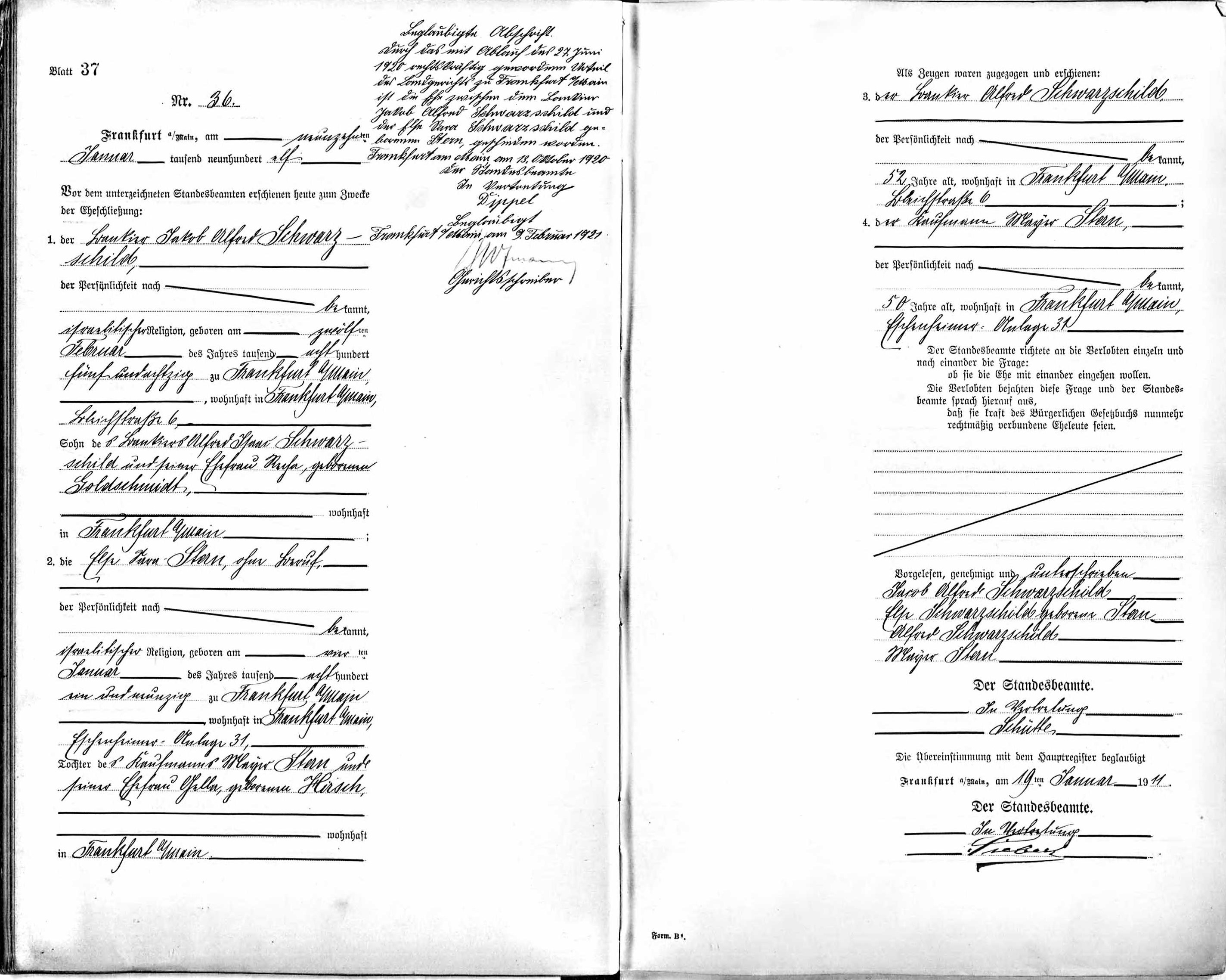
Marriage record of Elsa Stern and Jacob Schwarzschild, Hessisches Hauptstaatsarchiv; Wiesbaden, Deutschland, Ancestry.com. Hesse, Germany, Marriages, 1849-1930

Elsa and Jacob had one child, Elizabeth, reportedly born July 26, 1915, in Frankfurt.10

Elsa’s marriage to Jacob did not last, despite the cousin relationship. The marginal comment on their marriage record attests to their divorce. Thank you to the members of the German Genealogy group who provided the translation of this comment:
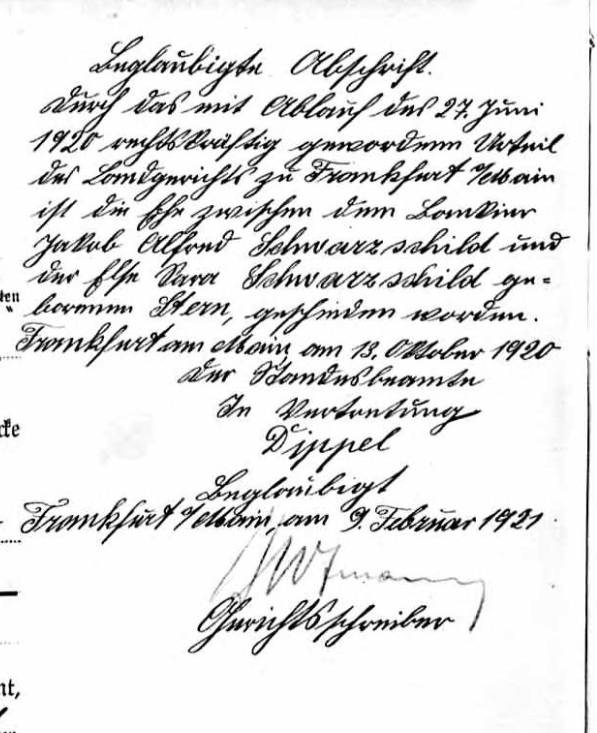
Certified transcript
By decree nisi of the Regional Court at Frankfurt on Main, which became final at the end of 27 June 1920, the marriage between the banker Jakob Alfred Schwarzschild and Else Sara Schwarzschild née Stern has been divorced.
Frankfurt on Main, 13 October 1920
Civil Registry Clerk
pp. Dippel
Certified
Frankfurt on Main, 9 February 1921
[Signature]
Court Clerk

On August 18, 1920, just months after the divorce became final, Elsa Stern Schwarzschild married Alfred Hirsch.  Alfred was born in Hamburg to Esaias Hirsch and Charlotte Wolf on May 19, 1890.  Together, Alfred and Elsa had three children born in the 1920s.11
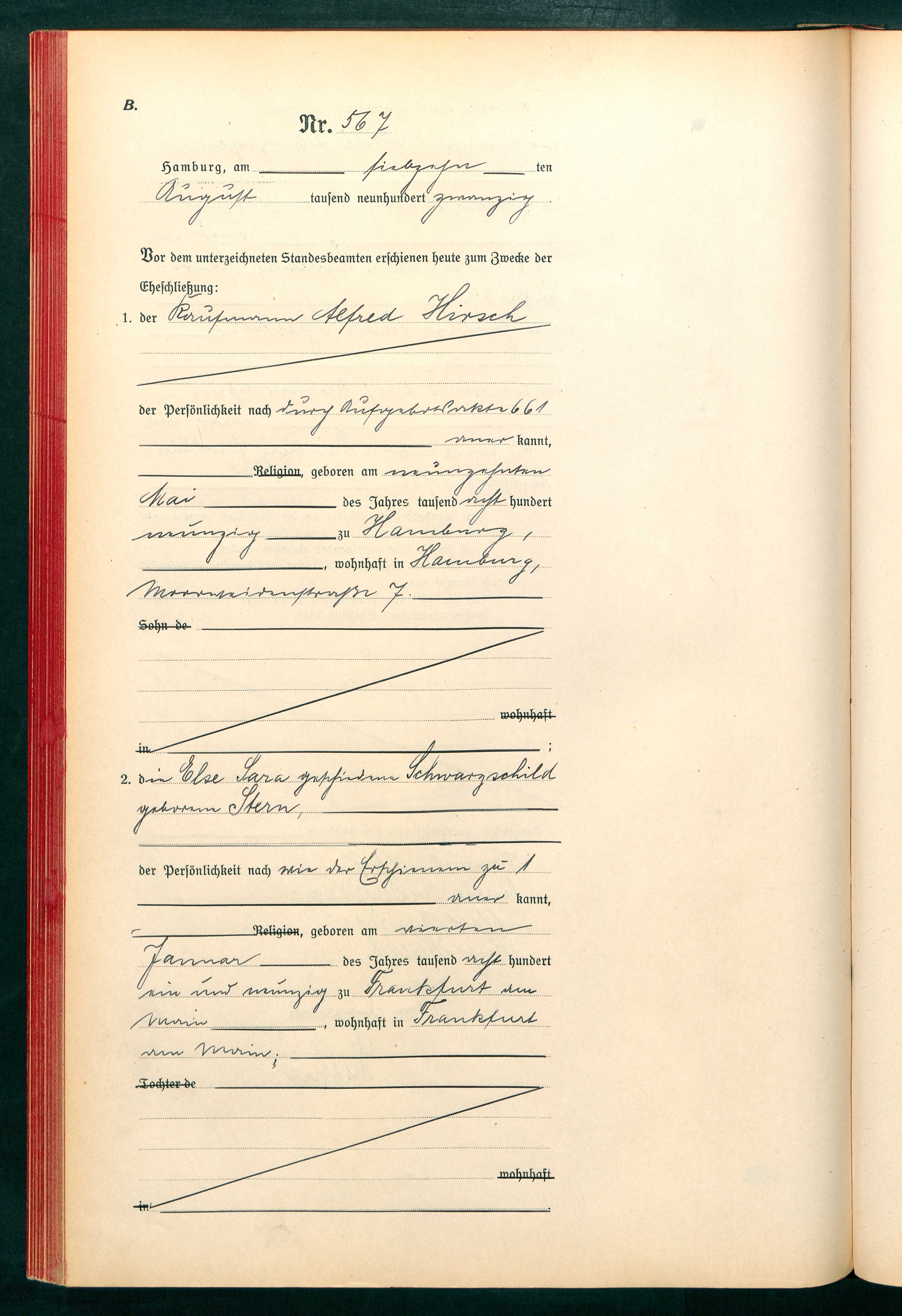
Marriage record of Elsa Stern to Alfred Hirsch, Year Range and Volume: 1920 Band 03
Ancestry.com. Hamburg, Germany, Marriages, 1874-1920

Mayer and Gella’s son Markus married Rhee (Rosa) Mess on August 25, 1923, in Frankfurt. She was born in Radziwillow, Poland on July 25, 1898, to Samuel Mess and Ester-Raza Landis.12

Thus, as the family approached the 1930s, Sarah Goldschmidt’s surviving descendants were living comfortable lives, but had suffered a number of terrible losses between 1910 and 1930, including two of Sarah’s children, Keile and Abraham, and three of her grandchildren, Abraham’s children Clementine Stern Oppenheimer and Siegfried Stern, and Keile’s daughter Martha Loewenthal Wolff.

But Lina and Mayer were still living as of 1930 as were eight of Sarah’s grandchildren. All of them would see their comfortable and prosperous lives as German Jews upturned by the rise of Nazism in the coming decade.


  1. The marriage date comes from the Cibella/Baron research; I have no primary source for this specific date, but it is clear that Siegfried and Lea married before 1913 when their son Erich was born. 
  2. Certificate Number: 98, Hessisches Hauptstaatsarchiv; Wiesbaden, Deutschland; Bestand: 903, Ancestry.com. Hesse, Germany, Marriages, 1849-1930. 
  3.  The National Archives; Kew, London, England; HO 396 WW2 Internees (Aliens) Index Cards 1939-1947; Reference Number: HO 396/89, Ancestry.com. UK, WWII Alien Internees, 1939-1945 
  4. The National Archives; Kew, London, England; HO 396 WW2 Internees (Aliens) Index Cards 1939-1947; Reference Number: HO 396/197, Ancestry.com. UK, WWII Alien Internees, 1939-1945  
  5. Application for Palestinian Citizenship, Israel State Archives website found at https://www.archives.gov.il/en/archives/#/Archive/0b07170680034dc1/File/0b071706810638e5 
  6. SSN: 121546243, Ancestry.com. U.S., Social Security Applications and Claims Index, 1936-2007 
  7.  The National Archives; Kew, London, England; HO 396 WW2 Internees (Aliens) Index Cards 1939-1947; Reference Number: HO 396/222, Description
    Piece Number Description: 222: Dead Index (Wives of Germans etc) 1941-1947: Eastw-Fey, Ancestry.com. UK, WWII Alien Internees, 1939-1945 
  8.  The National Archives; Kew, London, England; HO 396 WW2 Internees (Aliens) Index Cards 1939-1947; Reference Number: HO 396/58, Ancestry.com. UK, WWII Alien Internees, 1939-1945 
  9. Marriage record of Ernst Schwarzschild and Lea Hirsch Stern, Certificate Number: 98, Hessisches Hauptstaatsarchiv; Wiesbaden, Deutschland; Bestand: 903, Ancestry.com. Hesse, Germany, Marriages, 1849-1930 
  10. This is the date provided by Cibella/Baron. I also found one record for an Isabel Schwarzschild Weil born on that date: The National Archives at Washington, D.C.; Washington, D.C.; NAI Number: 2848504; Record Group Title: Records of the Immigration and Naturalization Service, 1787 – 2004; Record Group Number: 85; Series Number: A3998; NARA Roll Number: 701, Ancestry.com. New York State, Passenger and Crew Lists, 1917-1967. I believe this is for Elsa and Jacob’s daughter. I am still looking for additional records. 
  11. Application for Palestinian Citizenship, Israeli State Archives, at https://www.archives.gov.il/en/archives/#/Archive/0b07170680034dc1/File/0b07170680fd6abf 
  12.  National Archives and Records Administration; Washington, DC; NAI Title: Index to Petitions for Naturalizations Filed in Federal, State, and Local Courts in New York City, 1792-1906; NAI Number: 5700802; Record Group Title: Records of District Courts of the United States, 1685-2009; Record Group Number: RG 21, Description
    Description: (Roll 1256) Petition No· 352904 – Petition No· 353350, Ancestry.com. New York, State and Federal Naturalization Records, 1794-1943 

Sarah Goldschmidt’s Daughters and Their Children, 1910-1930: The Calm Before The Storm

In this post, I will focus on the two daughters of Sarah Goldschmidt and Salomon Stern, Lina and Keile, and their lives and the lives of Keile’s family between 1910 and 1930 in Germany.

Lina Stern Brinkmann

We saw last time that Lina lost her husband Levi Brinkmann on September 14, 1907, when she was fifty-five years old. Lina and Levi had not had children, and the only other record I have for Lina is her death record. She died on January 31, 1935, in Frankfurt, Germany. She was 84 years old. Lina experienced the first few years of Nazi reign in Germany. I wonder if in some way it hastened her death.

Lina Stern Brinkmann death record, Personenstandsregister Sterberegister; Bestand: 903; Signatur: 11044, Ancestry.com. Hesse, Germany, Deaths, 1851-1958

Keile Stern Loewenthal

We also saw last time that Lina’s sister Keile had lost her husband Abraham Loewenthal in the first decade of the 20th century.  He was survived by Keile and their five children: Selma, Julius, Helen, Siegfried, and Martha.

Selma Loewenthal was married to Nathan Schwabacher and had three children: Alice, Julius, and Gerhard.

UPDATE: Thanks to the generosity of her great-granddaughter Carrie, I am able to share these photographs of Selma, Nathan, and their children and grandchildren.

Selma Loewenthal younger

Selma Loewenthal Courtesy of her family

Nathan Schwabacher

Nathan Schwabacher

Alice Schwabacher younger

Alice Schwabacher

Gerhard Paul Schwabacher

Gerhard Schwabacher Courtesy of the family

Fred Wenten Julius Alfred Schwabacher

Julius Schwabacher

Wolfgang Schwabacher and dog

Wolfgang Weinstein and dog

IMG_0320

Eva Lore Schwabacher Courtesy of the family

Selma Loewenthal Schwabacher

Selma Loewenthal Schwabacher Courtesy of the family

Alice Schwabacher married David Weinstein on October 7, 1912, in Frankfurt. David was the son of Cappel Weinstein and Cecelia Weinstein and was born in Eschwege on December 19, 1885.

Marriage record of Alice Schwabacher and David Weinstein , Hessisches Hauptstaatsarchiv; Wiesbaden, Deutschland; Bestand: 903, Ancestry.com. Hesse, Germany, Marriages, 1849-1930

Alice and David had one son, Wolfgang Carl Weinstein, born in Eschwege on November 9, 1913. He was Keile’s first great-grandchild.1

Julius Schwabacher married Margarete Wurtemberg on September 20, 1920, in Erfurt Germany.  Margarete was born in that city in 1894; I could not find the names of her parents.2 Margarete gave birth to Eva Lore Schwabacher on June 11, 1921, in Frankfurt.3 But the marriage between Julius and Margarete did not last, and they were divorced in 1928.4

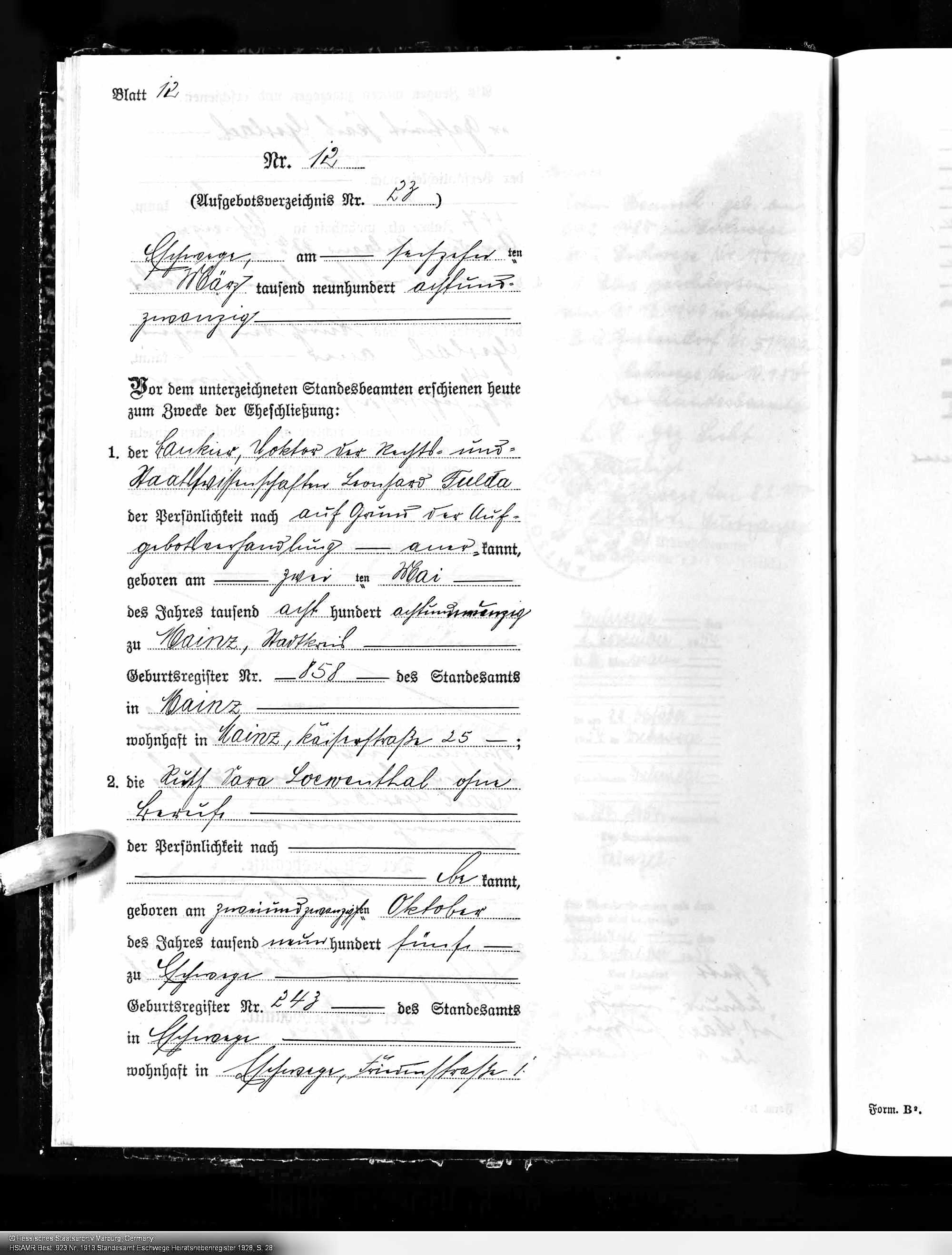
Julius Loewenthal and his wife Elsa Werner, had two children before 1910, Ruth and Herbert, and two more before 1920.  Hilda Henriette Loewenthal was born on October 22, 1911,5 and Karl-Werner Loewenthal, who was born on February 14, 1918, in Eschwege.6 Only Ruth married before 1930. She married Leonhard Fulda on March 16, 1928, in Eschwege. Leonhard was the son of Isaac Fulda and Johanna Rosenblatt, and he was born May 2, 1898, in Mainz, Germany.

Marriage Record of Ruth Loewenthal and Leonhard Fulda, Hessisches Hauptstaatsarchiv; Wiesbaden, Deutschland; Bestand: 923; Laufende Nummer: 1913
Ancestry.com. Hesse, Germany, Marriages, 1849-1930

Marriage Record of Ruth Loewenthal and Leonhard Fulda, Hessisches Hauptstaatsarchiv; Wiesbaden, Deutschland; Bestand: 923; Laufende Nummer: 1913 Ancestry.com. Hesse, Germany, Marriages, 1849-1930

Helene Loewenthal had married Eduard Feuchtwanger in 1897, but it appears that that marriage did not last. On October 9, 1913, Helene married Oskar Friedrich August Heinrich Maximilian Schultze. As you can see from the marriage record, Oskar was not Jewish, but “evangilische,” Protestant.

Helene Loewenthal Feuchtwanger marriage to Oskar Friedrich August Heinrich Maximilian Schultze, Hessisches Hauptstaatsarchiv; Wiesbaden, Deutschland; Bestand: 925; Laufende Nummer: 2493, Ancestry.com. Hesse, Germany, Marriages, 1849-1930

Helene and Oskar had one child, Elisabeth Auguste Aloysia Schultze born on December 3, 1914, and baptized on May 12, 1915, in Koblenz, Germany.

Birth record of Elisabeth Schultze, Description: Taufen, Heiraten u Tote 1869-1920
Ancestry.com. Rhineland, Prussia, Lutheran Baptisms, Marriages, and Burials, 1533-1950

Siegfried Loewenthal’s family also continued to grow in the 1910s. He and his wife Henriette Feuchtwanger had two more children in that decade, following the births of the first three children, Rosel in 1908 and Albert in 1909, and Louise Sarah Loewenthal in 1910, all in Frankfurt. Grete was born on April 16, 1913, and lastly, Lotte Loewenthal was born on October 3, 1914.7

UPDATE: Aaron Knappstein located Grete’s birth record.

Grete Loewenthal birth record from AK

Martha Loewenthal, Keile’s fifth and youngest child, and her husband Jakob Wolff did not have any additional children after 1910. Their three children Anna, Hans Anton, and Hans Walter, were growing up in that decade.

Thus, by 1920, Keile had fifteen grandchildren and one great-grandchild. The 1910s had been good to her and her children. But 1920 brought the next loss to the family when Nathan Schwabacher, Selma’s husband and Keile’s son-in-law, died on March 6, 1920, at the age of sixty.8

The decade ended with two big losses for the family. Keile Stern Loewenthal died on January 9, 1927, in Frankfurt; she was 73. She was survived by her five children, sixteen grandchildren, and one great-grandchild with more to come.

Keile Stern Loewenthal death record, Personenstandsregister Sterberegister; Bestand: 903; Signatur: 10926, Ancestry.com. Hesse, Germany, Deaths, 1851-1958

And her daughter Martha died three years later on May 19, 1930. She was only 47 years old and was survived by her husband Jakob Wolff and their three children.9

UPDATE: Aaron Knappstein also located Martha’s actual death record.

Martha Loewenthal Wolff death cert from AK

For Keile’s other children, Selma, Julius, Helene, and Siegfried, and for their children, the 15 years after Keile’s death in 1927 would bring many challenges and much heartache when life for Jews in Germany was forever altered by the rise of Hitler and Nazism.

Before we turn to that era, let’s catch up with Keile’s siblings, Sarah Goldschmidt’s sons, Abraham Stern and Mayer Stern, and their families.


  1. SSN: 041105870, Ancestry.com. U.S., Social Security Applications and Claims Index, 1936-2007 
  2. Julius Schwabacher naturalization papers, The National Archives at Philadelphia; Philadelphia, Pennsylvania; NAI Title: Declarations of Intention for Citizenship, 1/19/1842 – 10/29/1959; NAI Number: 4713410; Record Group Title: Records of District Courts of the United States, 1685-2009; Record Group Number: 21, Ancestry.com. New York, State and Federal Naturalization Records, 1794-1943 
  3. SSN: 045121672.
    Ancestry.com. U.S., Social Security Applications and Claims Index, 1936-2007 
  4. See footnote 2. 
  5.  National Archives and Records Administration; Washington, DC; NAI Title: Index to Petitions for Naturalizations Filed in Federal, State, and Local Courts in New York City, 1792-1906; NAI Number: 5700802; Record Group Title: Records of District Courts of the United States, 1685-2009; Record Group Number: RG 21, Description: (Roll 1126) Petition No· 304900 – Petition No· 305314, Ancestry.com. New York, State and Federal Naturalization Records, 1794-1943 
  6. Arolsen Archives, Digital Archive; Bad Arolsen, Germany; Lists of Persecutees 2.1.1.1; Series: 2.1.1.1, Reference Code: 02010101 oS, Ancestry.com. Europe, Registration of Foreigners and German Persecutees, 1939-1947 
  7. Grete’s birthdate comes from her immigration file at the Israel Archives, found at https://www.archives.gov.il/en/archives/#/Archive/0b07170680034dc1/File/0b07170680a31bed.  Lotte’s birth date appears in several documents including at Arolsen Archives, Digital Archive; Bad Arolsen, Germany; Lists of Persecutees 2.1.1.1; Series: 2.1.1.1, Reference Code: 02010101 oS, Ancestry.com. Europe, Registration of Foreigners and German Persecutees, 1939-1947. 
  8. Death record of Nathan Schwabacher, Certificate Number: 426,
    Personenstandsregister Sterberegister; Bestand: 903; Signatur: 10828,
    Ancestry.com. Hesse, Germany, Deaths, 1851-1958 
  9. Translated death record located in Jakob Wolff’s immigration file at the Israel Archives, found at https://www.archives.gov.il/en/archives/#/Archive/0b07170680034dc1/File/0b07170680e4ea29 

Sarah Goldschmidt’s Descendants: The Family Expands 1889-1909

As seen in my last post, Sarah Goldschmidt Stern was survived by four children, Lina, Keile, Abraham, and Mayer, and by eleven grandchildren: Keile’s five children, Abraham’s four children, and Mayer’s two children. Lina did not have children.

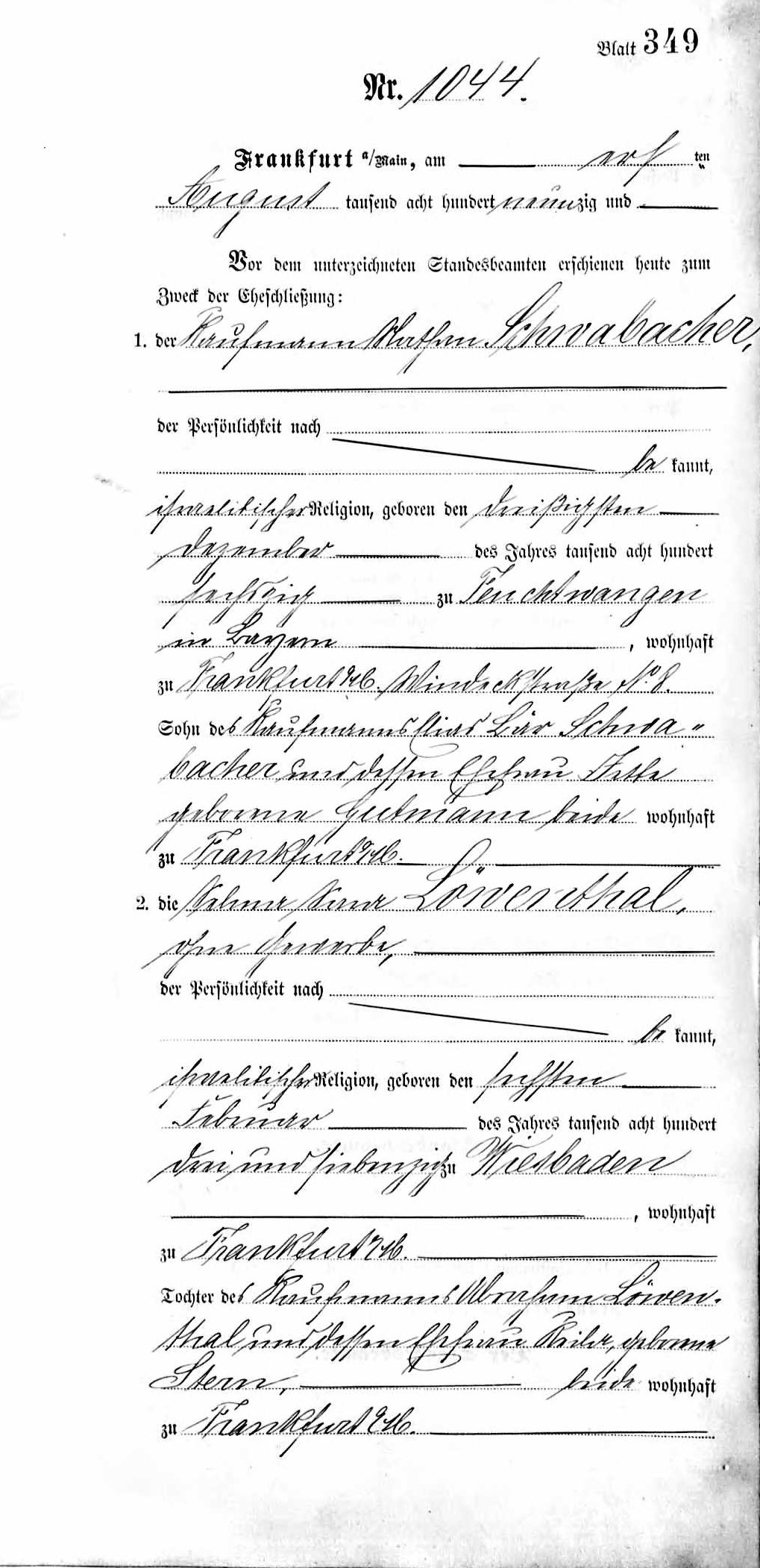
Before the dawn of the 20th century, Keile had herself become a grandmother. Her daughter Selma Loewenthal married Nathan Schwabacher on August 1, 1890, in Bornheim. He was born on December 30, 1860, in Feuchtwangen, Germany, to Elias Baer Schwabacher and Jette Gutmann. Notice that Levi Brinkmann, husband of Selma’s aunt Lina, was one of the witnesses.

Marriage record of Selma Loewenthal and Nathan Schwabacher, Hessisches Hauptstaatsarchiv; Wiesbaden, Deutschland; Signatur: 9490
Ancestry.com. Hesse, Germany, Marriages, 1849-1930

Selma and Nathan’s first child was Alice Therese Schwabacher, born December 29, 1891, in Frankfurt.

Alice Schwabacher birth record, Hessisches Hauptstaatsarchiv; Wiesbaden, Deutschland; Bestand: 903; Signatur: 903_9093, Ancestry.com. Hesse, Germany, Births, 1851-1901

Next came Julius Schwabacher, born May 17, 1893, in Frankfurt.

Julius Schwabacher birth record, Hessisches Hauptstaatsarchiv; Wiesbaden, Deutschland; Bestand: 903; Signatur: 903_9120, Ancestry.com. Hesse, Germany, Births, 1851-1901

Their third child Gerhard Schwabacher was actually born in the 20th century. He was born in Frankfurt on June 27, 1902.1

Keile and Abraham Loewenthal’s second oldest daughter Helene also married in the 1890s. She married Eduard Feuchtwanger on April 4, 1897, in Frankfurt. He was the son of Jacob Loew Feuchtwanger and Auguste Hahn, and was born in Munich on April 21, 1862. Keile’s brother Abraham Stern was a witness to this marriage.

Marriage of Helene Loewenthal and Eduard Feuchtwanger, Hessisches Hauptstaatsarchiv; Wiesbaden, Deutschland; Bestand: 903, Ancestry.com. Hesse, Germany, Marriages, 1849-1930

But the happiness brought by the marriages of Keile’s daughters Selma and Helene and the births of her grandchildren between 1891 and 1902 was unfortunately darkened by the death of her husband Abraham Loewenthal on January 28, 1903. He was sixty years old.

Abraham Loewenthal death record, Personenstandsregister Sterberegister; Bestand: 903; Signatur: 10570,Ancestry.com. Hesse, Germany, Deaths, 1851-1958

The first decade of the 20th century brought one other loss to the family when Lina’s husband Levi Brinkmann died on September 14, 1907, in Eschwege, Germany. He was only 65.

Levi Brinkmann death record, Personenstandsregister Sterberegister; Bestand: 903; Signatur: 11044, Ancestry.com. Hesse, Germany, Deaths, 1851-1958

Thus, both Keile and her sister Lina were widowed during that decade.

But that first decade also brought new members into the family as more of the grandchildren of Sarah Goldschmidt Stern began to marry and have children. First, Julius Loewenthal, Keile’s son, married Elsa Werner on November 16, 1903, in Eschwege, Germany. Elsa was the daughter of Max Werner and Helene Katzenstein, and she was born on June 27, 1883, in Eschwege.

UPDATE: Thank you to David Baron for pointing out that Elsa Werner was a second cousin to Julius Loewenthal. Her mother Helene Katzenstein Werner was the daughter of Malchen Goldschmidt Katzenstein, younger sister of Sarah Goldschmidt Stern. Thus, Julius and Elsa were both the great-grandchildren of Meyer Goldschmidt.

Julius Loewenthal and Elsa Stern marriage record, Hessisches Hauptstaatsarchiv; Wiesbaden, Deutschland; Bestand: 923, Ancestry.com. Hesse, Germany, Marriages, 1849-1930

Julius and Elsa had two children in the first decade of the 20th century. Ruth Loewenthal was born on October 22, 1905, in Eschwege,2 and Herbert Loewenthal was born on September 2, 1909.3 Two more children would come in the next decade.

Keile and Abraham Loewenthal’s daughter Martha also married in this decade. On November 8, 1904, she married Jakob Abraham Wolff, son of Abraham Wolff and Hannchen Wolff, in Frankfurt. Jakob was born in Aurich, Germany, on December 20, 1875. Keile’s brother Abraham Stern was once again a witness to this marriage.

Martha Loewenthal marriage to Jakob Wolff, Hessisches Hauptstaatsarchiv; Wiesbaden, Deutschland; Bestand: 903, Ancestry.com. Hesse, Germany, Marriages, 1849-1930

Martha and Jakob had three children.  Anna was born on July 23, 1905,4  Hans Anton was born on December 1, 1906, and Hans Walter on December 6, 1909. 5

Martha’s brother Siegfried Loewenthal also married in this decade. Siegfried married Henriette Feuchtwanger, daughter of Amson Feuchtwanger and Roeschen Oppenheimer, sometime before 1908. Henriette was born in Furth on October 13, 1881.6  Siegfried and Henriette had three children born between their marriage and 1910: Rosel on February 14, 1908,7 Albert on March 25, 1909,8 and Louise on December 25, 1910,9 all in Frankfurt. They would have two more children in the next decade.

Thus, by the end of 1910, Keile Stern Loewenthal had eleven grandchildren, Sarah Goldschmidt’s great-grandchildren, Meyer Goldschmidt’s great-great-grandchildren. My fourth cousins, once removed.

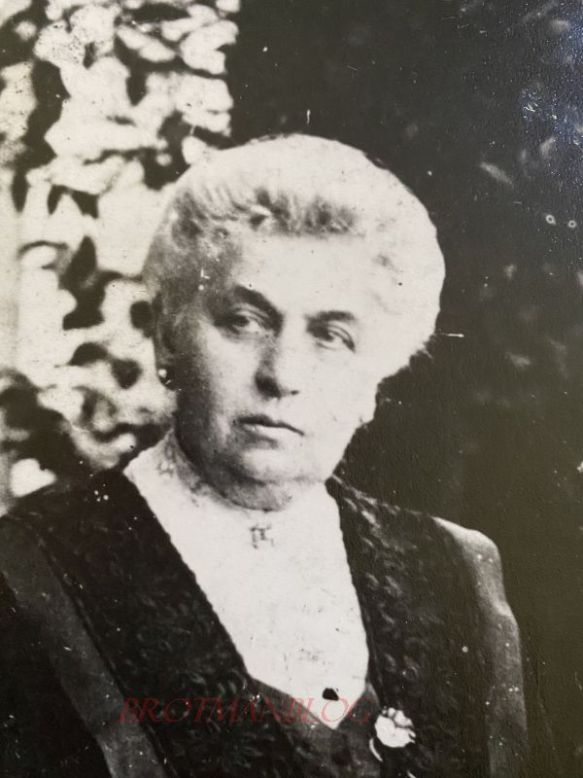
UPDATE: Thank you to my cousin Carrie for sharing this photograph of her great-great-grandmother, Kiele Stern Loewenthal.

Grandma Caroline Stern Born July 11, 1852

Keile Stern Loewenthal. Courtesy of her family

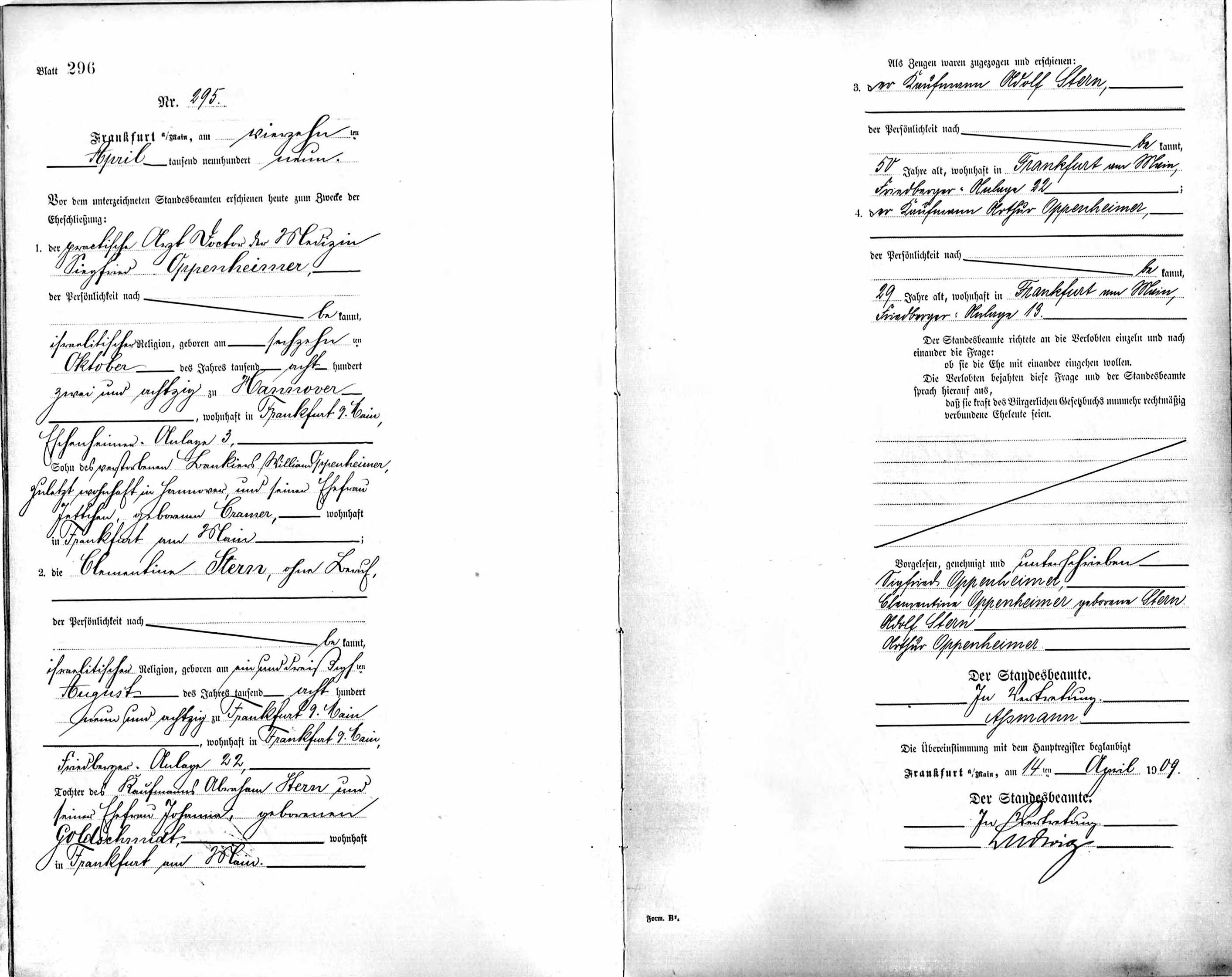
Keile was not the only child of Sarah Goldschmidt Stern to have grandchildren in the first decade of the 20th century. On April 14, 1909, Abraham Stern’s daughter Clementine married Siegfried Oppenheimer in Frankfurt. He was born in Hannover on October 16, 1882, the son of Wilhelm Oppenheimer and Jettchen Cramer. He was a physician.

Marriage of Clementine Stern and Siegfried Oppenheimer, Hessisches Hauptstaatsarchiv; Wiesbaden, Deutschland; Bestand: 903, Ancestry.com. Hesse, Germany, Marriages, 1849-1930

Clementine and Siegfried had twins on December 23, 1909. Sadly, one was stillborn. The other twin Erika survived.10 Given that Clementine and Siegfried were married just eight months when Clementine gave birth, I wonder whether the twins were born prematurely, thus contributing to or causing the death of one of those babies.

Death record of Oppenheimer infant, Personenstandsregister Sterberegister; Bestand: 903; Signatur: 10652, Ancestry.com. Hesse, Germany, Deaths, 1851-1958

Clementine and Siegfried would have more children in the next decade, as would Clementine’s siblings and her first cousins. But with the growth of the family tree during the twenty years that followed Sarah Goldschmidt’s death in 1889, it’s time to focus on each of her children and their children and grandchildren separately as we move forward into the 1910s and beyond.


  1. National Archives at Boston; Waltham, Massachusetts; ARC Title: Naturalization Record Books, 12/1893 – 9/1906; NAI Number: 2838938; Record Group Title: Records of District Courts of the United States, 1685-2009; Record Group Number: RG 21, Ancestry.com. Connecticut, Federal Naturalization Records, 1790-1996 
  2.  Certificate Number: 12, Hessisches Hauptstaatsarchiv; Wiesbaden, Deutschland; Bestand: 923; Laufende Nummer: 1913, Ancestry.com. Hesse, Germany, Marriages, 1849-1930 
  3.  Arolsen Archives, Digital Archive; Bad Arolsen, Germany; Lists of Persecutees 2.1.1.1; Series: 2.1.1.1, Reference Code: 02010101 oSm Source Information
    Ancestry.com. Europe, Registration of Foreigners and German Persecutees, 1939-1947 
  4. National Archives and Records Administration (NARA); Washington, DC; Name Index of Jews Whose German Nationality Was Annulled by the Nazi Regime (Berlin Documents Center); Record Group: 242, National Archives Collection of Foreign Records Seized, 1675 – 1958; Record Group ARC ID: 569; Publication Number: T355; Roll: 9, Stern, Johanna (Löb) – Zysmann, Judith, Ancestry.com. Germany, Index of Jews Whose German Nationality was Annulled by Nazi Regime, 1935-1944 
  5. I encountered trouble finding birth records as I began to research children born in Frankfurt after 1901 because the online records for Frankfurt births end with 1901. Although these birth dates are listed on trees on Ancestry and MyHeritage, the trees do not cite to specific sources.  I never rely on these unsourced trees unless I can find a source to verify the information. In this case, there is also the extensive research done over many years by my cousin Roger Cibella and his husband David Baron, both on the website they created in 1998, The History of the Jewish Community of Frankfurt am Main, and in the updated family report they shared with me more recently. Roger and David’s research has always proven to be thorough and accurate, so I have faith in their work, even though I do not have access to their sources for these birth dates.  Where I have relied on Roger and David’s research, I will cite to their work as “Cibella/Baron,” either in the text or in a footnote. That is the case for two of the three children of Martha Loewenthal and Jakob Wollf, Hans Anton, and Hans Walter. 
  6. Arolsen MArchives, Digital Archive; Bad Arolsen, Germany; Lists of Persecutees 2.1.1.1; Series: 2.1.1.1, Reference Code: 02010101 oS, Ancestry.com. Europe, Registration of Foreigners and German Persecutees, 1939-1947. Several unsourced trees on Ancestry and MyHeritage provide a wedding date of May 16, 1907, in Wuerzberg. 
  7. Rosa Loewenthal marriage record, Hessisches Hauptstaatsarchiv; Wiesbaden, Deutschland; Bestand: 903, Ancestry.com. Hesse, Germany, Marriages, 1849-1930 
  8. Albert Loewenthal immigration and naturalization papers found at the Israel Archives at https://www.archives.gov.il/en/archives/#/Archive/0b07170680034dc1/File/0b07170680fd584e 
  9. SSN: 122285989, Ancestry.com. U.S., Social Security Applications and Claims Index, 1936-2007. 
  10. National Archives at Chicago; Chicago, Illinois; ARC Title: Illinois, Petitions for Naturalization, 1906-1991; NAI Number: 593882; Record Group Title: Records of District Courts of the United States, 1685-2009; Record Group Number: RG 21, Description: Petitions for naturalization, v 1185, no 296351-296550, ca 1943-1944,
    Ancestry.com. Illinois, Federal Naturalization Records, 1856-1991 

The “Good and Noble Angel of A Sister,” Sarah Goldschmidt Stern

I am finally returning to the family of Meyer Goldschmidt, brother of my three-times great-grandfather Seligmann Goldschmidt. As I’ve already written, Meyer Goldschmidt was born in about 1787 in Oberlistingen, Germany. He married Lea Katzenstein with whom he had seven children: Ella (1822?), Sarah (1823), Malchen (about 1827), Selig (1828), Joseph (1830?), and Falk (1836). Joseph died a month before his sixth birthday on November 27, 1836, five months after Falk was born, but the other children all lived to adulthood. They lost their mother Lea when she was 45 in 1839 when those children ranged in age from three to seventeen.

All the children but the oldest, Ella, remained in Germany, although Falk did spend some years in the United States before returning for good to Germany. They took care of their much beloved father until his death in 1858, by which time they were all adults living their own lives. I’ve already blogged extensively about Ella. In the posts to come I will report on the four children who lived their lives in Germany: Sarah, Malchen, Selig, and Falk. I will start with Sarah, the second oldest child of Meyer and Lea.

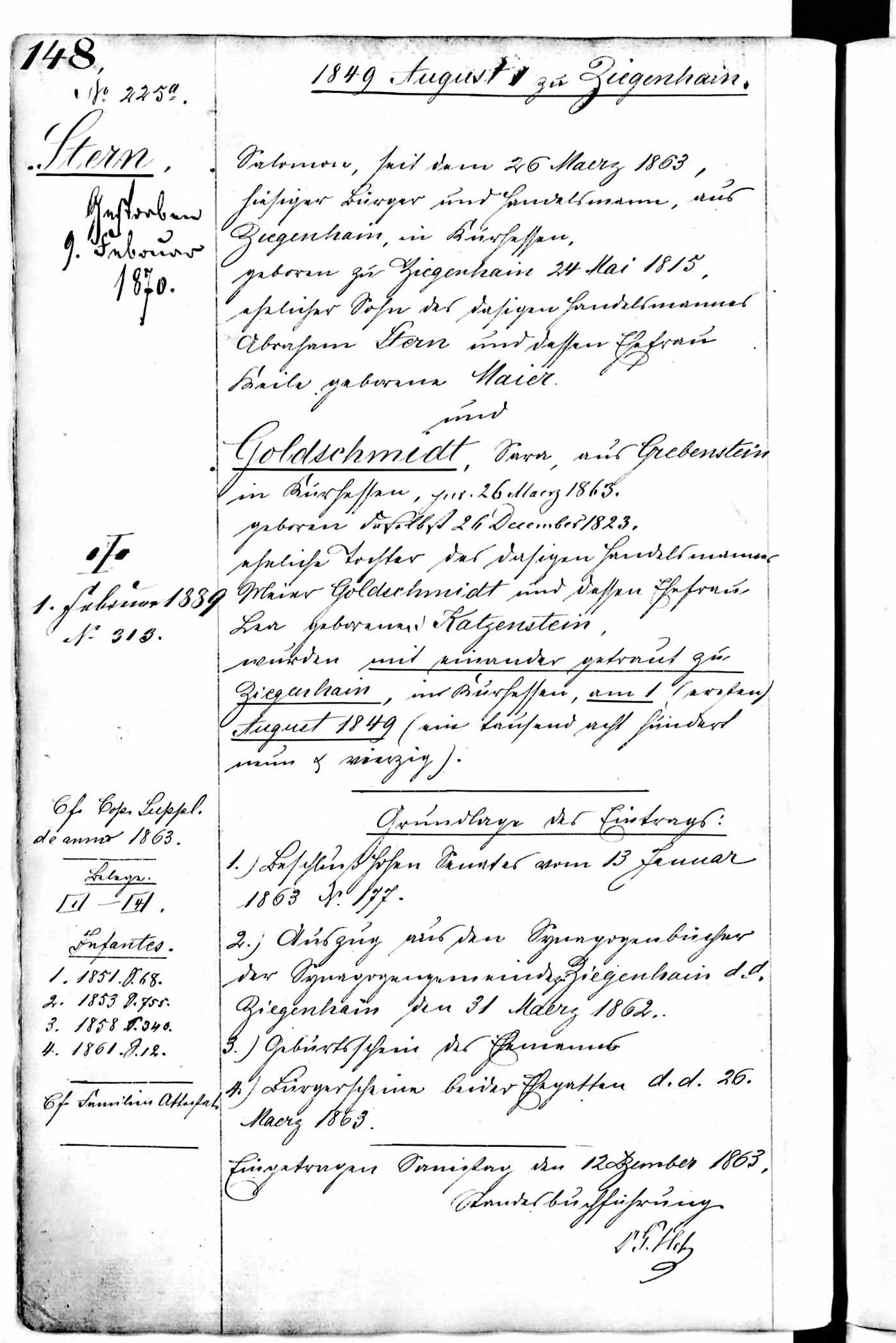
Sarah Goldschmidt was born on December 26, 1823, in Grebenstein, Germany. After her mother died when Sarah was 16, Sarah helped to care for her younger siblings. Her younger brother Selig talked about her cooking for the family and described her as “our good and noble sister.” Sarah, or Sarchen, whom Selig also described as “our angel of a sister,” married Salomon Stern on August 1, 1849. Salomon was born on May 24, 1815, in Ziegenhain, Germany, to Abraham Stern and Keile Maier.

Marriage record of Sarah Goldschmidt and Salomon Stern, Certificate Number: 225a
Hessisches Hauptstaatsarchiv; Wiesbaden, Deutschland
Ancestry.com. Hesse, Germany, Marriages, 1849-1930

Sarah and Salomon had four children. Their daughter Lina was born on January 11, 1851, in Ziegenhain. She presumably was named for Sarah’s mother, Lea.

Birth record of Lina Stern, Hessisches Hauptstaatsarchiv; Wiesbaden, Deutschland; Bestand: 903; Signatur: 903_8797, Ancestry.com. Hesse, Germany, Births, 1851-1901

A second daughter Keile, named for Salomon’s mother and sometimes known as Caroline, was born on July 11, 1853, in Ziegenhain.

Birth record of Keile Stern, Hessisches Hauptstaatsarchiv; Wiesbaden, Deutschland; Bestand: 903; Signatur: 903_8803, Ancestry.com. Hesse, Germany, Births, 1851-1901

Then came Abraham, also born in Ziegenhain, on May 17, 1858. I assume he was named for Salomon’s father Abraham.

Birth record of Abraham Stern, Hessisches Hauptstaatsarchiv; Wiesbaden, Deutschland; Bestand: 903; Signatur: 903_8812, Ancestry.com. Hesse, Germany, Births, 1851-1901

Finally, a fourth child was born on January 7, 1861, named Mayer. He was born in Frankfurt, so the family must have relocated between 1858 and 1861.

Birth record of Mayer Stern, Hessisches Hauptstaatsarchiv; Wiesbaden, Deutschland; Bestand: 903; Signatur: 903_8818, Ancestry.com. Hesse, Germany, Births, 1851-1901

Unfortunately, Sarah and her children suffered a great loss when Salomon Stern died on February 9, 1870, in Frankfurt. He was only 54, and his children were still quite young. Mayer was nine, Abraham, not yet twelve, Keile seventeen, and Lina was nineteen.

Death record of Salomon Stern, Personenstandsregister Sterberegister; Bestand: 903; Signatur: 10269, Ancestry.com. Hesse, Germany, Deaths, 1851-1958

Lina was already married when her father died. She had married Levi Brinkmann on November 20, 1868, in Frankfurt, when she was only seventeen years old. Levi was the son of Suschen Brinkmann and Goldchen Plock and was born on October 29, 1841, in Wanfried, Germany. Thus, Levi was ten years older than Lina and 27 when they married. As far as I can tell, they had no children.

Marriage record of Lina Stern and Levi Brinkmann, Hessisches Hauptstaatsarchiv; Wiesbaden, Deutschland, Ancestry.com. Hesse, Germany, Marriages, 1849-1930

Sarah’s second child Keile married Abraham Loewenthal on March 8, 1872, in Frankfurt. She was eighteen years old. Abraham was the son of Isaac Loewenthal and Sarah Maier, born in Schierstein, Germany, on February 17, 1842. He was thirty when he married Keile.

Marriage record of Keile Stern and Abraham Loewenthal, Hessisches Hauptstaatsarchiv; Wiesbaden, Deutschland, Ancestry.com. Hesse, Germany, Marriages, 1849-1930

They had five children. Selma was born on February 6, 1873, in Wiesbaden, Germany.1Their second child was Julius, born August 24, 1874, also in Wiesbaden.2 A third child Helene was born February 20, 1877, but in Frankfurt, so Keile and Abraham must have relocated by that time.

Birth record of Helene Loewenthal, Hessisches Hauptstaatsarchiv; Wiesbaden, Deutschland; Bestand: 903; Laufende Nummer: 143, Ancestry.com. Hesse, Germany, Births, 1851-1901

Siegfried came next; he was born on May 12, 1879, in Frankfurt.

Birth record of Siegfriend Loewenthal, Hessisches Hauptstaatsarchiv; Wiesbaden, Deutschland; Bestand: 903; Signatur: 903_8929, Ancestry.com. Hesse, Germany, Births, 1851-1901

And finally, Martha was born to Keile Stern and Abraham Loewenthal in Frankfurt on August 15, 1882.

Birth record of Martha Loewenthal, Hessisches Hauptstaatsarchiv; Wiesbaden, Deutschland; Bestand: 903; Signatur: 903_8970
Ancestry.com. Hesse, Germany, Births, 1851-1901

Abraham Stern, Sarah Goldschmidt and Salomon Stern’s third child, married his first cousin Johanna Goldschmidt on June 24, 1887, in Bornheim, Germany. Johanna was the daughter of Selig Goldschmidt, Sarah Goldschmidt’s younger brother, and Clementine Fuld. She was born in Frankfurt on December 18, 1867, making her nine years younger than her husband and cousin Abraham and not quite twenty years old when she married.

Marriage record of Abraham Stern and Johanna Goldschmidt, Hessisches Hauptstaatsarchiv; Wiesbaden, Deutschland; Signatur: 9460
Ancestry.com. Hesse, Germany, Marriages, 1849-1930

Abraham and Johanna had four children. These children were not just siblings to each other, but also second cousins since their parents were first cousins.

Siegfried Salomon Stern (named for his paternal grandfather) was born on September 17, 1888, in Frankfurt.

Birth record of Siegfried Salomon Stern, Hessisches Hauptstaatsarchiv; Wiesbaden, Deutschland; Bestand: 903; Signatur: 903_9047
Ancestry.com. Hesse, Germany, Births, 1851-1901

Clementine was Abraham and Johanna’s second child. She was born on August 31, 1889, in Frankfurt.3 She was named for her maternal grandmother Clementine Fuld Goldschmidt, who had died in 1888.4

Two years later, Johanna and Abraham had a third child, Sittah Sarah, born July 12, 1891, in Frankfurt.5

Sittah Sarah must have been named for her paternal grandmother Sarah Goldschmidt Stern, who died on February 1, 1889, in Frankfurt, at the age of 65. At her death Sarah was survived by her four children and eight grandchildren as well as all but two of her siblings. She had outlived her husband Abraham by nineteen years.

Death record of Sarah Goldschmidt Stern, Personenstandsregister Sterberegister; Bestand: 903; Signatur: 10420, Ancestry.com. Hesse, Germany, Deaths, 1851-1958

But Sarah’s family continued to grow. On June 5, 1894, Sarah’s ninth grandchild Alice Lea Stern was born to her son Abraham Stern and his wife (and Sarah’s niece) Johanna Goldschmidt.

Birth record of Alice Lea Stern, Hessisches Hauptstaatsarchiv; Wiesbaden, Deutschland; Bestand: 903; Signatur: 903_9136, Ancestry.com. Hesse, Germany, Births, 1851-1901

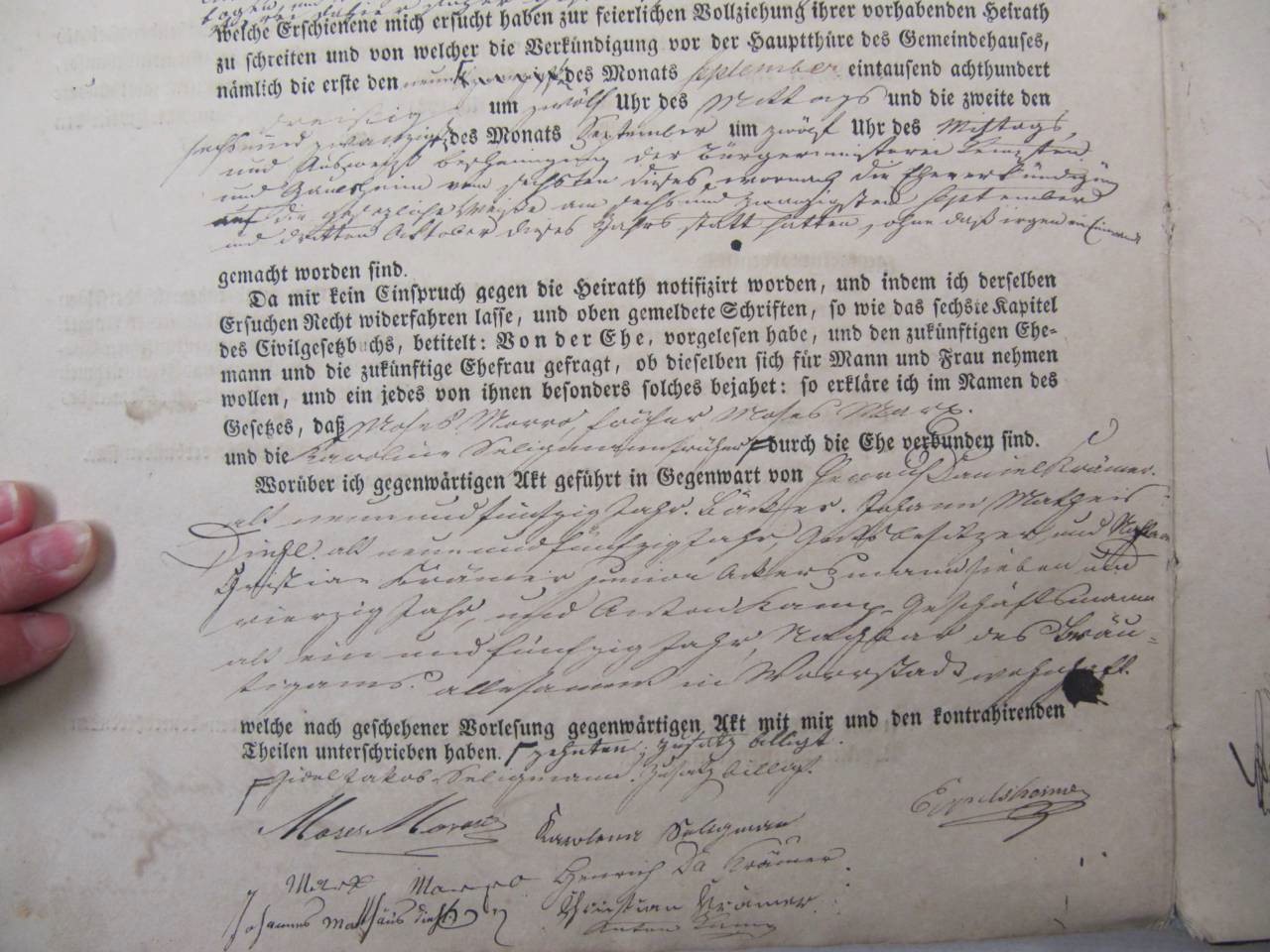
Sarah Goldschmidt and Salomon Stern’s youngest child Mayer had married Gella Hirsch on March 5, 1886, in Bornheim, Germany. Gella was the daughter of Marcus Hirsch and Hannchen Schwabacher, and she was born on February 17, 1864, in Frankfurt.

Marriage record of Mayer Stern and Gella Hirsch, Hessisches Hauptstaatsarchiv; Wiesbaden, Deutschland; Signatur: 9449
Ancestry.com. Hesse, Germany, Marriages, 1849-1930

Mayer and Gella had two children. Elsa Sara Stern was born January 4, 1891, in Frankfurt. She was presumably named in part for her paternal grandmother Sarah Goldschmidt Stern.

BIrth record of Elsa Sara Stern, Hessisches Hauptstaatsarchiv; Wiesbaden, Deutschland; Bestand: 903; Signatur: 903_9085,  Ancestry.com. Hesse, Germany, Births, 1851-1901

Four years later Mayer and Gella’s son Marcus (named for his maternal grandfather) was born in Frankfurt on January 28, 1895. He was Sarah Goldschmidt Stern’s eleventh grandchild.

Birth record of Markus Kurt Stern, Hessisches Hauptstaatsarchiv; Wiesbaden, Deutschland; Bestand: 903; Signatur: 903_9149, Ancestry.com. Hesse, Germany, Births, 1851-1901

As you may have noticed, Sarah Goldschmidt Stern and all of her children were living in Frankfurt, Germany, by the late 19th century. That is not surprising because Frankfurt had at that time the second largest Jewish community in Germany. In fact, Jewish life in Frankfurt had a long history, not all of it very pleasant.

According to one source:

The history of Frankfurt’s Jewish population dates back to approximately 1150. …. Sadly, even Emperor Frederick II’s official charter could not stop the first Frankfurt pogrom from occurring in 1241.

The next major conflict occurred in 1349, when Frankfurt’s Jewish population was blamed for an outbreak of the plague. When a fire broke out in the cathedral, a rumour was started that it had been laid by Jews, which once more brought upon them the people’s wrath. More than 200 Frankfurt Jews were murdered in the civil unrest that followed.

In 1462, Frankfurt’s Jews were forced to move into a ghetto at the edge of town. For the next 350 years, approximately 2,200 Jews resided there, crammed into some 160 houses situated along a 330-metre stretch of the city wall. The lives of the ghetto’s inhabitants were further hamstrung by a variety of restrictive city ordinances. …

This former compulsion [to live in the ghetto] was officially annulled in 1811.

In 1804, a general-education school named the “Philanthropin” was founded in Frankfurt, becoming a prominent centre of liberal Judaism. In 1850, Orthodox Jews established what later became known as the Jewish Religious Community. Despite these achievements, Frankfurt’s Jews still did not enjoy the same basic civil rights as the city’s Christian population. Only in 1864 did they achieve full equality, which enabled the Jewish community to grow and prosper.

In 1882, the Börneplatz Synagogue was consecrated, followed by the consecration of the Synagogue Friedberger Anlage in 1907 and the Westend Synagogue in 1910. Consisting of approximately 30,000 members, Frankfurt’s Jewish community was at the time the second largest in Germany. …

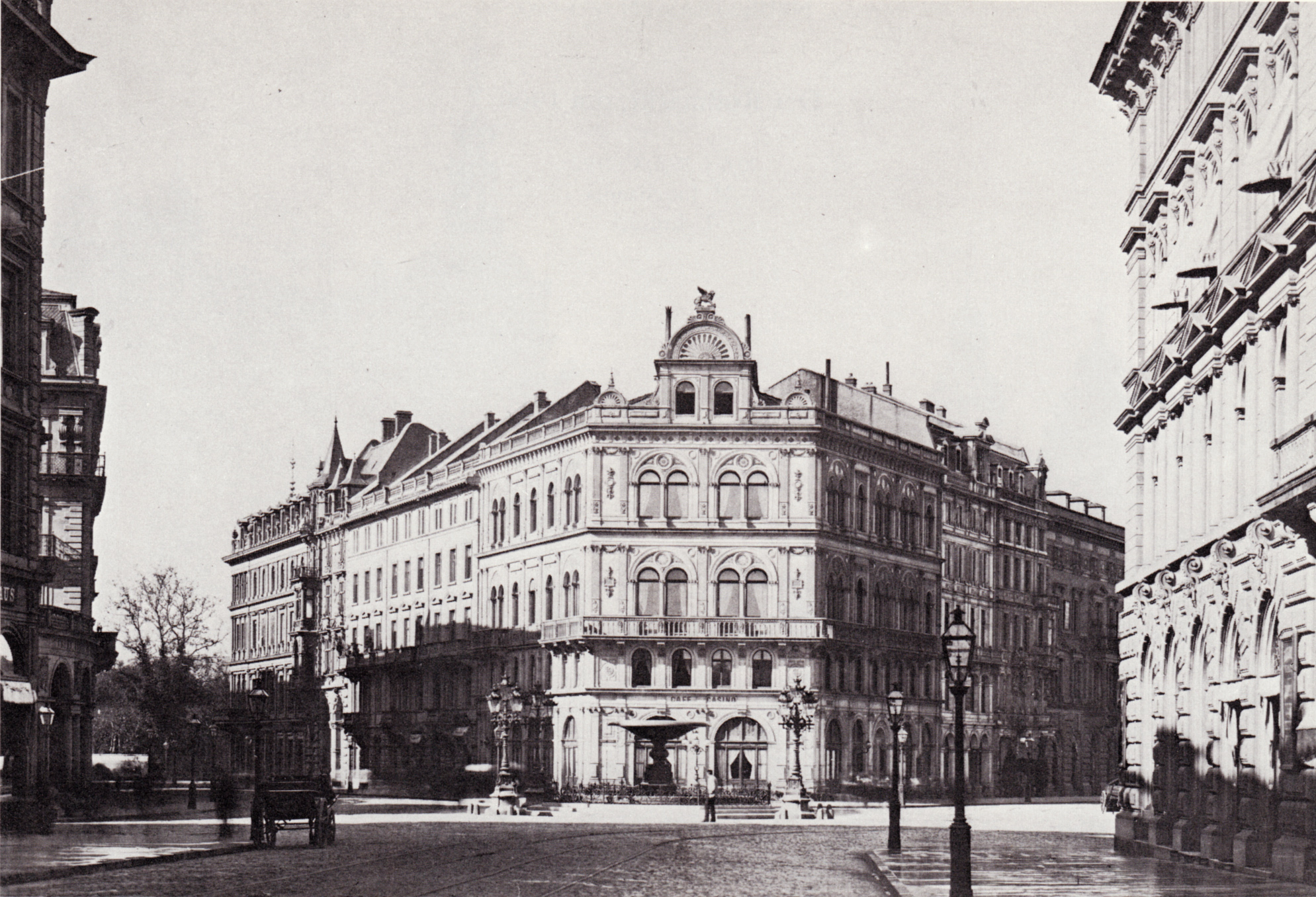
Frankfurt would therefore have been a good place for Jews to relocate during the 1880s and 1890s, and Sarah’s family took advantage of that opportunity. These photographs show the bustling and beautiful city it was at that time.

Alte Oper (“Old Opera”) of Frankfurt am Main, ca. 1880, found at https://commons.wikimedia.org/wiki/File:Oper1880.jpg

Sarah Goldschmidt Stern, the “good and noble” “angel of a sister,” was survived by her four children, Lina, Keile, Abraham, and Mayer, and by eleven grandchildren. What would become of those children and grandchildren in the 20th century? That is the subject for my next series of posts.

Children of Sarah Goldschmidt and Salomon Stern and Their Spouses


  1.  Certificate Number: 1044, Hessisches Hauptstaatsarchiv; Wiesbaden, Deutschland; Signatur: 9490, Ancestry.com. Hesse, Germany, Marriages, 1849-1930 
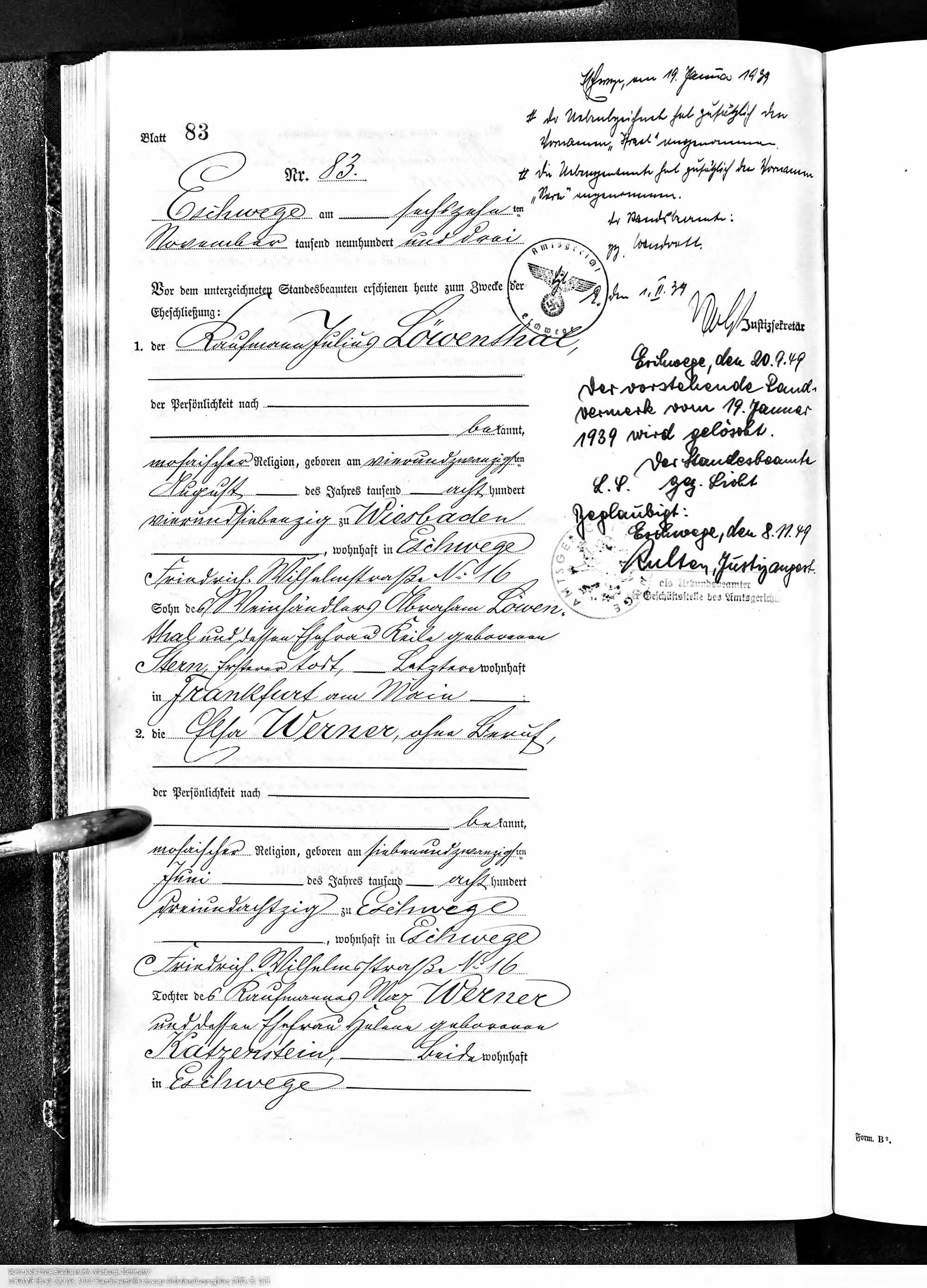
  2. Certificate Number: 83, Hessisches Hauptstaatsarchiv; Wiesbaden, Deutschland; Bestand: 923, Ancestry.com. Hesse, Germany, Marriages, 1849-1930 
  3.  Certificate Number: 295, Hessisches Hauptstaatsarchiv; Wiesbaden, Deutschland; Bestand: 903, Ancestry.com. Hesse, Germany, Marriages, 1849-1930 
  4.  Certificate Number: 628, Personenstandsregister Sterberegister; Bestand: 903; Signatur: 10411, Ancestry.com. Hesse, Germany, Deaths, 1851-1958 
  5.  Certificate Number: 721, Hessisches Hauptstaatsarchiv; Wiesbaden, Deutschland,
    Ancestry.com. Hesse, Germany, Marriages, 1849-1930 

My Vogel Cousins: From Germany to Argentina

Before I return to the family of Meyer Goldschmidt, I have two more posts to share relating to other family members.

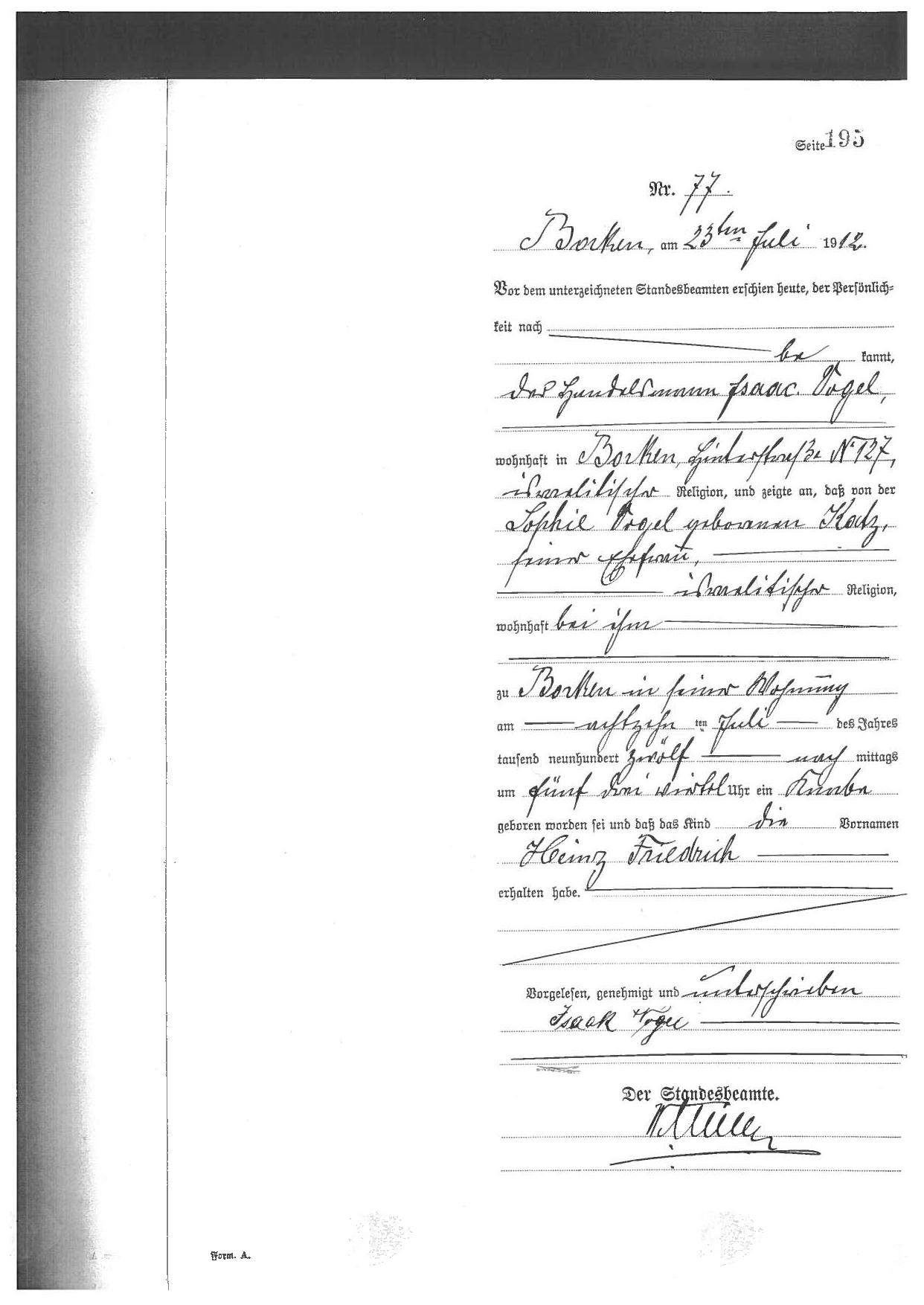
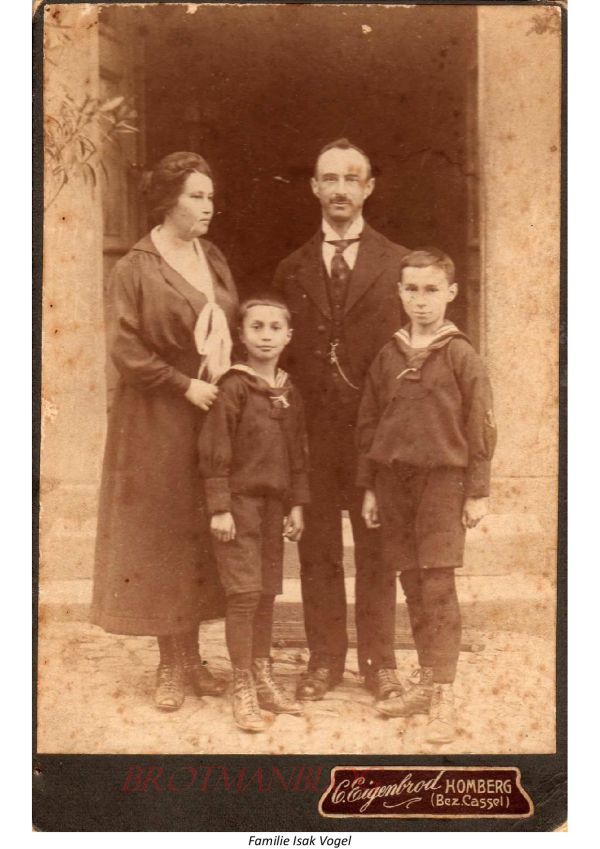
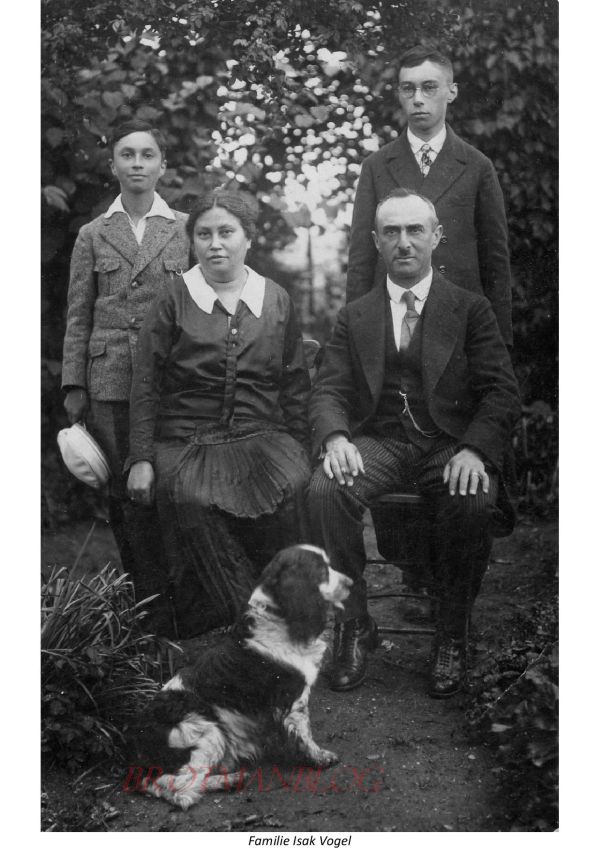
Today I want to share some wonderful photographs I received from my fourth cousin, once removed, Patricia, the daughter of Heinz Vogel, granddaughter of Sophie Katz and Isaak Vogel, great-granddaughter of Rosa Katzenstein and Salomon Feist Katz.

On September 10, 2019, I wrote about this family and told the story of the escape of Sophie and Isaak and their sons Heinz and Carl to Argentina from Nazi Germany in the 1930s. It was due to the generosity of Patricia and also Carl Vogel’s daughter that I was able to share details of the Vogel’s story and how they rebuilt their lives in Buenos Aires as well as many wonderful photographs.

In November, Patricia shared several more wonderful family photographs.

This is a photograph of Rosa Katzenstein in 1887 when she was 28 and married to Salomon Feist Katz for six years. (I’ve edited these photographs a little to improve clarity.) Rosa was my great-grandmother Hilda Katzenstein’s second cousin, once removed. I see a resemblance to Hilda. What do you think?

Rosa Katzenstein Katz, 1887

Hilda Katzenstein Schoenthal

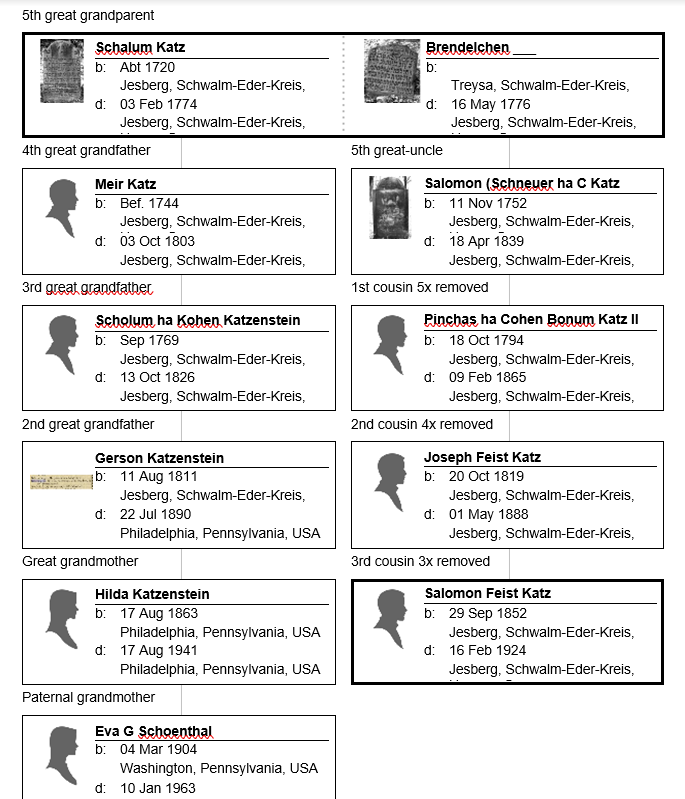
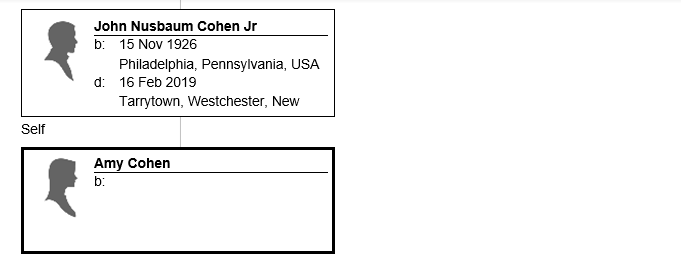
Taken that same year is this photograph of Salomon, who was 35 at that time. Salomon was also my cousin (and Rosa’s cousin). He was my third cousin, three times removed, through our shared ancestors, Schalum and Brendelchen Katz, my fifth great-grandparents. He was Hilda’s third cousin.

Salomon Feist Katz, 1887

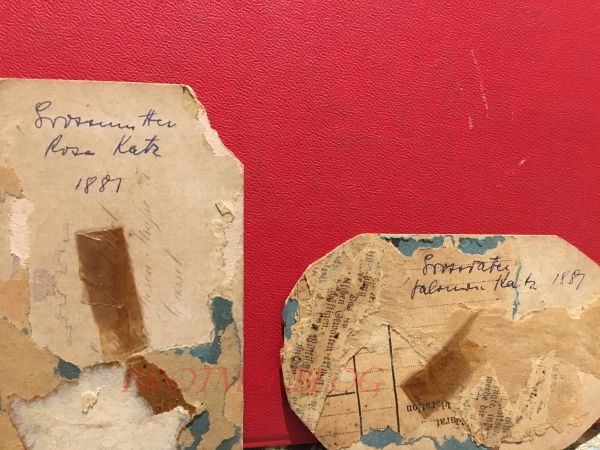
Patricia also sent me images of what was on the reverse of these photographs. Can anyone read the words above their names?

UPDATE: Thank you to Cathy Meder-Dempsey for transcribing the top words as Grossmutter (grandmother) and Grossvater (grandfather).

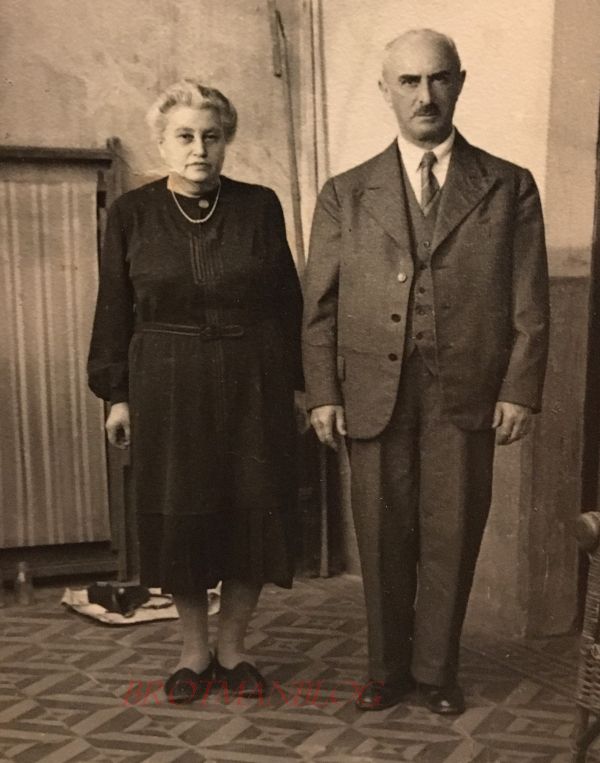
This photograph of Rosa and Salomon’s daughter Sophie Katz and her husband Isaak Vogel was taken in July, 1948, after they had immigrated to Argentina; the inscription on the reverse appears below it. Can someone decipher what it says? The second line says “63(?) Geburtstag 10 Jul 1948.”  Sophie was born on July 10, 1885, so this would have been her 63rd birthday. She and Isaak don’t look very happy, however.

UPDATE: Thank you again to Cathy Meder-Dempsey for transcribing the first word in the top line as aufgenommen, meaning “taken.” She wasn’t certain whether the next word was “bei,’ indicating where the photo was taken, or “von,” indicating who took the photo. And the third word was not legible.

SECOND UPDATE: Thank you to Eric, who commented below and was able to read that last word. It says Aufgenommen bei meinem 63rd geburtstag or Taken at my 63rd birthday. Thanks, Eric!

Sophie Katz and Isaak Vogel, 1948

Finally, Patricia shared a photograph taken at Sophie and Isaak’s 50th anniversary celebration on June 9, 1959. That adorable little girl in the center of the photograph is Patricia herself.

In the front row from left to right are Sophie Katz Vogel, Isaak Vogel, and Rosa Hamburger, Carl Vogel’s mother-in-law. Standing behind them from left to right is Carl Vogel, Gertrud Lippman Vogel (Heinz Vogel’s wife), Heinz Vogel, and Beate Hamburger Vogel (Carl’s wife).

When I look at this photograph and see the love and the smiles that permeate it and compare it to the stern expressions on the faces of Sophie and Isaak in 1948, it makes me think of how hard their adjustment to Argentina must have been, but also how fortunate they must have felt to have left Germany behind and to have made a whole new life for themselves in their new homeland.

I am so grateful to Patricia for sharing these with me.


My Cousin’s Case before the US Supreme Court: Philipp v. Germany

My second Goldschmidt update involves the descendants of Selig Goldschmidt, specifically his great-great-grandson, my fifth cousin, Alan Philipp.

Right now there is a case pending before the United States Supreme Court that was brought by Alan Philipp and two other plaintiffs. They brought a lawsuit against the Federal Republic of Germany and the Stiftung Preussischer Kulturbesitz (“SPK”), or in English, the Prussian Cultural Foundation.

The SPK is described on its website as “the largest employer in the cultural sector in Germany. It is a federal foundation and is shaped by the federal structure of Germany. The federal government and all sixteen federal states support and finance it jointly.” It was formed in 1957 after “the final dissolution of the state of Prussia ten years earlier. As a result, the question of ownership of its important public collections had to be reorganized. These collections were given to the foundation as property by the establishment law.” (translations by Google Translate)

Among those properties that were transferred by the government to the SPK was a very valuable collection of medieval works of art known as the Welfenschatz or in English, the Guelph Treasure. The Welfenschatz had been acquired in 1929 by three art collectors who had formed a consortium (“the Consortium”) to acquire art.

One of those art collectors was the firm of J&S Goldschmidt, founded in the mid-19th century by my cousins Jacob Meier and Selig Goldschmidt; another was Zacharias Hackenbroch, the grandson-in-law of Selig Goldschmidt, the son-in-law of Recha Goldschmidt, and husband of Clementine Schwarzschild. Alan Philipp shared with me a photograph of three of the investors, his grandfather Zacharias Hackenbroch, his cousin Julius Falk Goldschmidt, and Saemy Rosenberg:

Zacharias M. Hackenbroch, Julius Falk Goldschmidt, and Saemy Rosenberg. Courtesy of Alan Philipp

According to the allegations made by the plaintiffs, heirs to the Consortium, in 1935 the Consortium was coerced by economic duress, fraud, and bad faith to sell the Welfenschatz to the Nazis for about a third of its value   After unsuccessfully pursuing their claim for compensation first in Germany, the plaintiffs sued both the Federal Republic of Germany and the SPK in the US District Court for the District of Columbia for either the return of the Welfenschatz, which is currently located in the collection of the SPK in Germany, or for damages equivalent to the current value of the collection, claiming that the property had been wrongfully misappropriated from the Consortium in 1935.

Germany and the SPK moved to dismiss the lawsuit, arguing in part that the United States courts did not have jurisdiction over the plaintiffs’ claims against a foreign state. Before getting too far into the weeds of the legal issues and all their complexities, let me stop here to explain just a few procedural matters.

There has not been a trial in this case. The defendants moved to dismiss the case on the basis of the plaintiff’s pleadings alone; a court can dismiss a lawsuit if it finds that the plaintiffs have no basis for a legal claim even if they can eventually prove every fact they have alleged in their pleadings. So for purposes of this case—at all three levels of the federal court system, the District Court, the Court of Appeals, and the Supreme Court—the courts are assuming the truth of the facts claimed in the plaintiff’s complaint. The only issues the lower courts have determined and the only issues the Supreme Court will decide is whether this case should be dismissed because the American federal courts do not have jurisdiction over these claims even if the plaintiffs can eventually prove the truth of their allegations.

So what were those allegations? The District Court for the District of Columbia summarized them in their opinion (the paragraph numbers are references to the plaintiff’s complaint):

Plaintiffs’ position is that the 1935 sale between the Consortium and the State of Prussia, a political subdivision of the German Weimar Republic and later the Third Reich, was coerced as part of the Nazi persecution of the Jewish sellers of the Welfenschatz and, as such, the Court shall briefly summarize the allegations in the complaint that Plaintiffs rely on in support of this position. Id. ¶ 22. Specifically, Plaintiffs allege the 1935 transaction was spearheaded by Nazi-leaders Hermann Goering and Adolf Hitler, who were involved in explicit correspondence to “save the Welfenschatz” for the German Reich. Id. ¶¶ 2, 9. Further, the 1935 sale resulted in a payment of 4.25 million RM, which Plaintiffs assert demonstrates the lack of an arms’-length transaction because it was barely 35% of the market value of the Welfenschatz. Id. ¶¶ 4, 12.  Further, the money exchanged was never fully accessible to the Consortium because it was split and partly paid into a blocked account, and was subject to “flight taxes” that Jews had to pay in order to escape. Id. ¶¶ 4, 12. Moreover, in November of 1935, Goering presented the Welfenschatz as a personal “surprise gift” to Hitler during a ceremony. Id. ¶¶ 13, 179.

Philipp v. Fed. Republic of Ger., 248 F. Supp. 3d 59, 65 (D.D.C. 2017)

The District Court’s opinion then listed the plaintiff’s allegations describing some of the specific steps the Nazis took to coerce and defraud the Consortium into selling them the Welfenschatz, knowing the enormous economic pressure they were under as a result of the Nazi persecution of Jews at that time.

The defendants moved to dismiss on numerous grounds, but the ones that are still being pressed at the Supreme Court boil down to two arguments:  one, that the US courts have no jurisdiction to adjudicate the claims based on a federal statute, the Federal Sovereign Immunity Act (“FSIA”), and two, that US courts should not allow such a claim out of respect for the laws and procedures of a foreign country under principles of comity.

For lawyers, these issues are fascinating. But this is not a blog about legal matters, and there are many resources out there for those who are interested in all the ins and outs of the issues presented. (See the list below for a few.) I just want to say a little more about the issues involving the FSIA.

The FSIA generally grants immunity from liability to foreign states, preventing lawsuits against those states and their agents (in this case SPK) in American courts. But there are exceptions provided in the statute; the plaintiffs are relying on one of those exceptions as the basis of the court’s jurisdiction over their claims, the so-called “expropriation exception.” It provides that a party can proceed against a foreign state where their claim is one “in which rights in property taken in violation of international law are in issue and that property or any property exchanged for such property is present in the United States in connection with a commercial activity carried on in the United States by the foreign state….” 28 U.S.C. § 1605(a)(3).

The defendants raised several arguments against the application of this exception to the plaintiffs’ claims, but I want to focus on just one of those arguments—whether or not this was a taking of the Consortium’s property that violated international law. The plaintiffs argued, relying on an earlier decision of the Court of Appeals of the District of Columbia, that when a taking of property bears a “sufficient connection” to genocide, the taking is itself a violation of international law.

The District Court agreed, focusing on the plaintiffs’ allegations that “the coerced sale of the Welfenschatz was accomplished to deprive the Consortium of their ability to earn a living and the motivation for the taking was to deprive the Consortium of resources needed to survive as a people in furtherance of the genocide of the German Jews during the Holocaust.” Philipp v. Fed. Republic of Ger., 248 F. Supp. 3d 59, 71 (D.D.C. 2017) The District Court also concluded that the plaintiffs had satisfied the commercial nexus requirement of the expropriation exception and that therefore the case should not be dismissed.

A work from the Guelph Treasure
Reliquary of the arm of Saint Blaise (Herzog Anton Ulrich Museum, Dankwarderode Castle). User:Brunswyk, CC BY-SA 3.0 <http://creativecommons.org/licenses/by-sa/3.0/&gt;, via Wikimedia Commons

The defendants appealed this decision to the Court of Appeals of the District of Columbia, and the Court of Appeals agreed with the District Court on the issue of whether there was a taking of property in violation of international law, reasoning in part:

Congress has twice made clear that it considers Nazi art-looting part of the Holocaust. In enacting the Holocaust Victims Redress Act, which encouraged nations to return Nazi-seized assets, Congress “f[ound]” that “[t]he Nazis’ policy of looting art was a critical element and incentive in their campaign of genocide against individuals of Jewish … heritage.” Holocaust Victims Recovery Act, Pub. L. No. 105-158, § 201, 112 Stat. 15, 15 (1998). And in the Holocaust Expropriated Art Recovery Act (HEAR Act), which extended statutes of limitation for Nazi art-looting claims, Congress again “f[ound]” that “the Nazis confiscated or otherwise misappropriated hundreds of thousands of works of art and other property throughout Europe as part of their genocidal campaign against the Jewish people and other persecuted groups.” Holocaust Expropriated Art Recovery Act of 2016, Pub. L. No. 114-308, § 2, 130 Stat. 1524, 1524 (emphasis added)

Philipp v. Fed. Republic of Germany, 894 F.3d 406, 411-12 (D.C. Cir. 2018)

The Court of Appeals, however, disagreed with the District Court with respect to the application of the expropriation exception to Germany based on the second requirement of the exception: that for a claim against a foreign state to fit within the exception, the property that was confiscated must be located in the United States, which was not the case here with the Welfenschatz. Thus, the appellate court dismissed the claim against Germany itself.

With respect to the claim against the SPK, the appellate court concluded that the requirements of the statute were different with respect to an instrumentality of a foreign state and that because there was a “sufficient commercial nexus” between the SPK, an instrumentality of Germany, and the United States, the case against the SPK could go forward even though the disputed property was in Germany, not the United States.

A work from the Welfenschatz in the Bode Museum in Germany
User:FA2010, Public domain, via Wikimedia Commons

It will be very interesting to see how the Supreme Court rules in this case. The issues go beyond this one case, of course. Sadly, genocide has occurred and continues to occur in all parts of the world, and those who have been damaged—whose property has been stolen, as was the case with so much of the art owned by German Jews—may want to seek recourse in American courts.

Foreign policy concerns and the principles of comity lie behind the arguments of the defendants that these matters should be pursued in the country where the wrongful acts occurred. One argument made by the defendants was that if claims against a country by a national of that country can be brought in other countries, foreign courts could end up litigating claims by US nationals against the US, e.g., claims brought by Japanese-Americans who were interned during World War II against the US might be litigated outside the US or claims brought against the US by African-Americans for reparations for slavery could be litigated in another country.

The plaintiffs distinguish those cases by pointing out that Nazi Germany stripped their ancestors of their citizenship as part of their persecution of Jews and that therefore they were no longer nationals of Germany but stateless. Thus, these are not claims against Germany or its agents by German nationals. They also argue that the Holocaust has been treated as unique by both American law and international law, and thus special treatment needs to be provided for those seeking redress for harms done as part of the Holocaust.

I listened to the oral arguments made by the lawyers before the Supreme Court on December 7, and although I thought that the defendant’s lawyer was persuasive with regard to the meaning and scope of the statutory language, the plaintiffs’ arguments have the stronger moral position. I will be watching carefully to see whether the heirs of my Goldschmidt cousins are able to pursue their claims and ultimately obtain compensation for the harm that was done to their ancestors almost 90 years ago.

For those who want to learn more about the case, I suggest the following resources:

I have included links to the lower court opinions in the body of the text of the blog.

Here is a link to a recording of the oral arguments made before the Supreme Court on December 7, 2020.

The Scotus Blog has links to the briefs filed by the parties and by amicus curiae.

The Art Newspaper has a recent article about the case.

The New York Times has a good summary of the case.

This is a short piece written by the plaintiffs’ lawyer Nicholas O’Donnell of Sullivan & Worcester.

For more in-depth analysis of the FSIA and the international law regarding Nazi appropriation of art, see the following law review articles about FSIA:

Vivian Grosswald Currana, “THE FOREIGN SOVEREIGN IMMUNITIES ACT’S EVOLVING GENOCIDE EXCEPTION, ” UCLA Journal of International Law and Foreign Affairs, Spring, 2019

Michael J. Birnkrant, “THE FAILURE OF SOFT LAW TO PROVIDE AN EQUITABLE FRAMEWORK FOR RESTITUTION OF NAZI-LOOTED ART, ” Washington University Global Studies Law Review, 2019

Ugboaja, Ikenna (2020) “Exhaustion of Local Remedies and the FSIA Takings Exception: The Case for Deferring to the Executive’s Recommendation,” University of Chicago Law Review: Vol. 87 : Iss. 7 , Article 5.
Available at: https://chicagounbound.uchicago.edu/uclrev/vol87/iss7/5


Meyer Goldschmidt: A Man with a Pure Soul

After Meyer Goldschmidt’s wife Lea died in 1839 in Grebenstein, Germany, Meyer and his children worked together to support each other. At that time the oldest daughter Ella was about seventeen and the youngest child Falk was only three.  The two sons, Selig and Jacob, were still young boys, but went to work to help the family, and Ella ran a millinery business from their home.1

But Ella eventually decided that she had to leave Grebenstein and seek a better life in the United States. In remembering her decision to leave, her brother Selig wrote that “Ella, who had received many compliments for her beauty while she was learning her trade in Cassel had, perhaps, become a little more selfish.”2

Selig continued:3

After she had run her own little business for about a year, during which time she probably encountered many difficulties, she realized that she would have no future in Grebenstein. Conditions were bad indeed for all of us; so she quickly decided, I believe even against our father’s wishes, to emigrate to America, together with several cousins. For me it was a great shock at that time. I borrowed as much money as I could from school friends in order to help her with her travel expenses. I think it only amounted to two and a half Groschen. After she had been gone for about one hour, I told myself I had to see her just once more. I ran after for two hours, weeping softly, but did not meet her again. 

Selig’s description of his emotions about her leaving moved me and brought home the reality of the impact these departures had on a family.

Ella Goldschmidt was the only one of Meyer Goldschmidt’s six surviving children to leave Germany and settle permanently in the US. According to the 1900 US census, Ella immigrated in 1849, but that cannot be right because she married Albert Sigmund, another German immigrant, on April 26, 1846, in Baltimore, Maryland:

Marriage record of Albert Sigmund and “Helena Goldsmith.” Maryland County Marriages, 1658-1940,” database, FamilySearch (https://familysearch.org/ark:/61903/1:1:F4JC-GYH : 16 March 2018), Albert Sigmond and Helena Goldsmith, 25 Apr 1846; citing Baltimore, , Maryland, United States, clerk of the circuit court from various counties; FHL microfilm 13,694.

I will be devoting many posts to Ella and her life in the US, but for now let’s return to Grebenstein and the rest of Meyer’s children.

Selig wrote that once Ella left, times were challenging for the rest of the family.4

Our dear father was very weak and sickly. His constant prayer was “G-d Almighty do not let me die before I have repaid my debts.” This constant prayer gave us an added incentive to work day and night with all our energy. The just and noble man did not realise how the future prosperity of his children would spring forth from hidden roots. 

But Meyer’s financial burdens were reduced as the children became adults and married and moved away. Sarah, or Sarchen, whom Selig described as “our angel of a sister,” married Salomon Stern on August 1, 1849. Salomon was born on May 24, 1815, in Ziegenhain, Germany, to Abraham Stern and Keile Maier.

In 1852, Falk Goldschmidt, Meyer’s youngest son, who was only sixteen at the time, traveled to the US5 and in 1860 was living with his older sister Ella and her family.6 Falk did return to Germany, however, by 1870, as we will see in a later post.

Meyer’s youngest daughter Malchen married in June, 1853, according to David Baron’s research. Malchen married Juda Callman Katzenstein of Eschwege, Germany. He was born there in 1824, the son of Callman Katzenstein and Jettchen Katzenstein. As Selig wrote in the Selig Goldschmidt book, after marrying Juda, Malchen moved to live with him in Eschwege.5

Her brother Jacob married Jettchen Cahn one month later in Frankfurt. She was the daughter of Aaron Simon Cahn and Minna Gamburg, and Jettchen was born on April 13, 1830, in Frankfurt.

Marriage record of Jacob Goldschmidt and Jettchen Cahn, Hessisches Hauptstaatsarchiv; Wiesbaden, Deutschland, Ancestry.com. Hesse, Germany, Marriages, 1849-1930

Selig wrote that after Malchen married and moved to Eschwege, the family sold everything they had in Grebenstein, and Meyer moved to Eschwege to live with Malchen and Juda. Selig noted that they did this because Selig and his brother Jacob were traveling often for business and not able to be in Grebenstein to care for their father. Selig described the outpouring of love Meyer received when he moved away from his long-time home in Grebenstein:6

Poor and rich came to the station to see him off, and when the train departed, the sound of sobbing and weeping could be heard. Wealthy neighbours had offered to give him whatever he wanted if he would stay there. However, we did not wish him to stay in Grebenstein all by himself. 

Selig was the next child to marry. On May 27, 1857, he married Clementine Fuld in Frankfurt. She was born in Frankfurt on January 8, 1837, to Herz Fuld and Caroline Schuster.

Marriage record of Selig Goldschmidt and Clementine Fuld, Certificate Number: 30
Hessisches Hauptstaatsarchiv; Wiesbaden, Deutschland, Ancestry.com. Hesse, Germany, Marriages, 1849-1930

After marrying, Selig and Clementine settled in Frankfurt and soon moved Meyer to Frankfurt to live with them. Selig wrote:6

I was determined to let him live with me as soon as I married, in order to brighten the days of his old age and give him joy, with G-d’s help, and in order to compensate him for all the suffering he had endured. I was enabled to do this, thanks to my good and noble wife who loved and admired by dearest father so sincerely. Clementine arranged a beautiful and comfortable room for him.  He moved in with us in Frankfurt and we, as well as he, were extremely happy together. 

Meyer was not destined to stay in Frankfurt for very long. Selig told the heartwarming story of why his father returned to Eschwege. Meyer had befriended and taken care of a blind man while living in that town, and the man wrote to Meyer, asking him to return to Eschwege. The man said that Meyer had given him comfort and restored his spirit and that without him, he was lost. Meyer was determined to move back to Eschwege so that he could help this man who needed him and asked for his help. He felt it was the most important thing he could do at that point in his life.7

But sadly Meyer did not live much longer himself. He died on November 5, 1868, in Eschwege. He was 74 years old, according to his death certificate, and was deeply mourned.

Meyer Goldschmidt death record, HHStAW Fonds 365 No 146, p. 36

His children set up a foundation to honor their parents, Meyer and Lea, and his congregation in Eschwege wrote this about Meyer in their obituary for him:8

The deceased had gained the love, respect and admiration of all members of the congregation through his exemplary way of life, his generosity and his sincere Jewish religious dedication. Hence, all of us endeavored to bring him relief on his sickbed, to cheer him up with friendly advice and, finally, to provide the last rites.

The editors of the Selig Goldschmidt book, Meyer’s descendants, wrote this about their ancestor:9

Pure was the soul of Meyer Goldschmdit when he passed away to follow the soul of his departed wife. In spite of adverse circumstances his mind had managed to attain the tranquil and unshakable repose of genuine Jewish wisdom. He realized that the pursuit of earthly comforts and physical pleasures are not the main content and aim of life. Only the acquisition of the goods which G-d desires, namely the fulfillment of the Mitzvos can bring lasting peace of mind. Thus, the existence of the village dweller had gradually become enriched and ennobled, until his life drew to a worthy end with an almost heroic act of Jewish humane love. 

From Selig Goldschmidt: Picture of A Life, p. 15

UPDATE: One reader asked for a translation of the headstone, and Leah of the Tracing the Tribe group kindly provided this translation:

An upright man who enlightened/educated the poor
“He left behind him a legacy of blessings (?)
“He established a good thing for the poor, H”H (HaRav HaGaon)
“K”H Meir, son of K”H Yaakov
”When his days were full
“He returned to his palace? at a ripe old age
“On the even of Shabbat, the 25th, and he was buried
“In an ‘auspicious hour’/with a good name on Day 1 (Sunday), the 30th
“Of MarChesvan, on the first day of Rosh Chodesh
“[Kislev?] . . .”

Meyer Goldschmidt was clearly a good and well-loved man by his family and his community. His children and descendants carried on this legacy in Germany and in the United States, as we will see as I now examine the lives of each of them, starting with Meyer and Lea’s oldest child, Ella Goldschmidt Sigmund.


  1. “The Story of A Ring,” Selig Goldschmidt: Picture of A Life (1996, Elmar Printers Ltd. and Bezalel Bookbinders, Jerusalem, Israel)(limited edition of 300 copies), p.19-21 
  2. “The Story of A Ring,” Selig Goldschmidt: Picture of A Life (1996, Elmar Printers Ltd. and Bezalel Bookbinders, Jerusalem, Israel)(limited edition of 300 copies), p. 21 
  3. “The Story of A Ring,” Selig Goldschmidt: Picture of A Life (1996, Elmar Printers Ltd. and Bezalel Bookbinders, Jerusalem, Israel)(limited edition of 300 copies), pp.21-22. 
  4. “The Story of A Ring,” Selig Goldschmidt: Picture of A Life (1996, Elmar Printers Ltd. and Bezalel Bookbinders, Jerusalem, Israel)(limited edition of 300 copies), p.22. 
  5. Juda Callman Katzenstein death record, Certificate Number: 175, Personenstandsregister Sterberegister; Bestand: 923; Laufende Nummer: 1941, Ancestry.com. Hesse, Germany, Deaths, 1851-1958. Selig Goldschmidt: Picture of A Life,(1996, Elmar Printers Ltd. and Bezalel Bookbinders, Jerusalem, Israel)(limited edition of 300 copies)  p, 22. 
  6. “The Story of A Ring,” Selig Goldschmidt: Picture of A Life (1996, Elmar Printers Ltd. and Bezalel Bookbinders, Jerusalem, Israel)(limited edition of 300 copies), p.23. 
  7. Ibid. 
  8. “Obituary,” Selig Goldschmidt: Picture of A Life (1996, Elmar Printers Ltd. and Bezalel Bookbinders, Jerusalem, Israel)(limited edition of 300 copies), p.15. The use of the term “last rites” should not be confused with the Catholic tradition of giving last rites; under Jewish law there are certain rules and practices for the treatment of the deceased’s body between the time of death and burial. That must be what the obituary meant by “last rites.” 
  9. “Of Noble Origins,” Selig Goldschmidt: Picture of A Life (1996, Elmar Printers Ltd. and Bezalel Bookbinders, Jerusalem, Israel)(limited edition of 300 copies), p.10. 

Returning to Goldschmidt Research: A Dearth of Records, but A Wealth of Information

After a long break focused on photographs shared by some of my generous cousins, I am now returning to posting about my research of my Goldschmidt/Goldsmith family, the descendants of my four-times great-grandparents Jacob Falcke Goldschmidt and Eva Reuben Seligmann.

They had five children: Seligmann, my three-times great-grandfather; Levi; Meyer; Jette; and Simon. In addition, Jacob had been married twice before marrying Eva and had two children with those wives, Elieser Falcke Goldschmidt and Jude Jacobs, my half-four-times great-uncles. I have already written about Seligmann, Lehman, and Simon and their descendants.1

Now I will turn to the fourth brother, Meyer Goldschmidt. Although I had many secondary sources providing information about Meyer and his family, it was very difficult to find any primary sources, as discussed below. I was very fortunate, however, to connect with a distant cousin in the Netherlands, and he sent me a book published in Israel by Meyer Goldschmidt’s descendants in 1996, Selig Goldschmidt: A Picture of A Life, hereinafter referred to as the Selig Goldschmidt book.2

The book includes remembrances, letters, obituaries, and images that Meyer’s descendants collected and translated to English in order to preserve and honor the memory of Meyer’s son Selig Goldschmidt. It sheds light not only on Selig, but also on his parents, his siblings, and his children.

I also benefited greatly from the research and support of David Baron, husband of my cousin Roger, a descendant of both Meyer and Seligmann Goldschmidt.

There are many trees on Ancestry and other secondary sources that say that Meyer Goldschmidt was born in Oberlistingen on June 10, 1787, but none of them has a primary source for that date. Meyer’s death record says he was 74 when he died on November 5, 1858. That would mean he was born in 1784, not 1787.

Meyer Goldschmidt death record, HHStAW Fonds 365 No 146, p. 36

Unfortunately, I cannot find a birth or marriage record for Meyer, so I do not know whether the trees are accurate or whether the death record is accurate. This photograph from the Selig Goldschmidt book includes the birth date found on those family trees:

Meyer Goldschmidt on p. 7, Selig Goldschmidt: Picture of A Life (1996, Elmar Printers Ltd. and Bezalel Bookbinders, Jerusalem, Israel)(limited edition of 300 copies)

Since I have not located a marriage record for Meyer, I do not know when or where he married, but I do know who he married—Lea Katzenstein. I also have no birth records for Lea, but Ancestry trees and other sources show her birth date as March 20, 1794, in Grebenstein, Germany, and her parents as Jesajas ha Cohen Katzenstein and Edel Ganz.

I presume that Meyer and Lea were married by 1823 because their daughter Sarah was born on December 26, 1823, according to her marriage record.

Marriage record of Sarah Goldschmidt and Solomon Stern, Certificate Number: 225a
Hessisches Hauptstaatsarchiv; Wiesbaden, Deutschland, Ancestry.com. Hesse, Germany, Marriages, 1849-1930

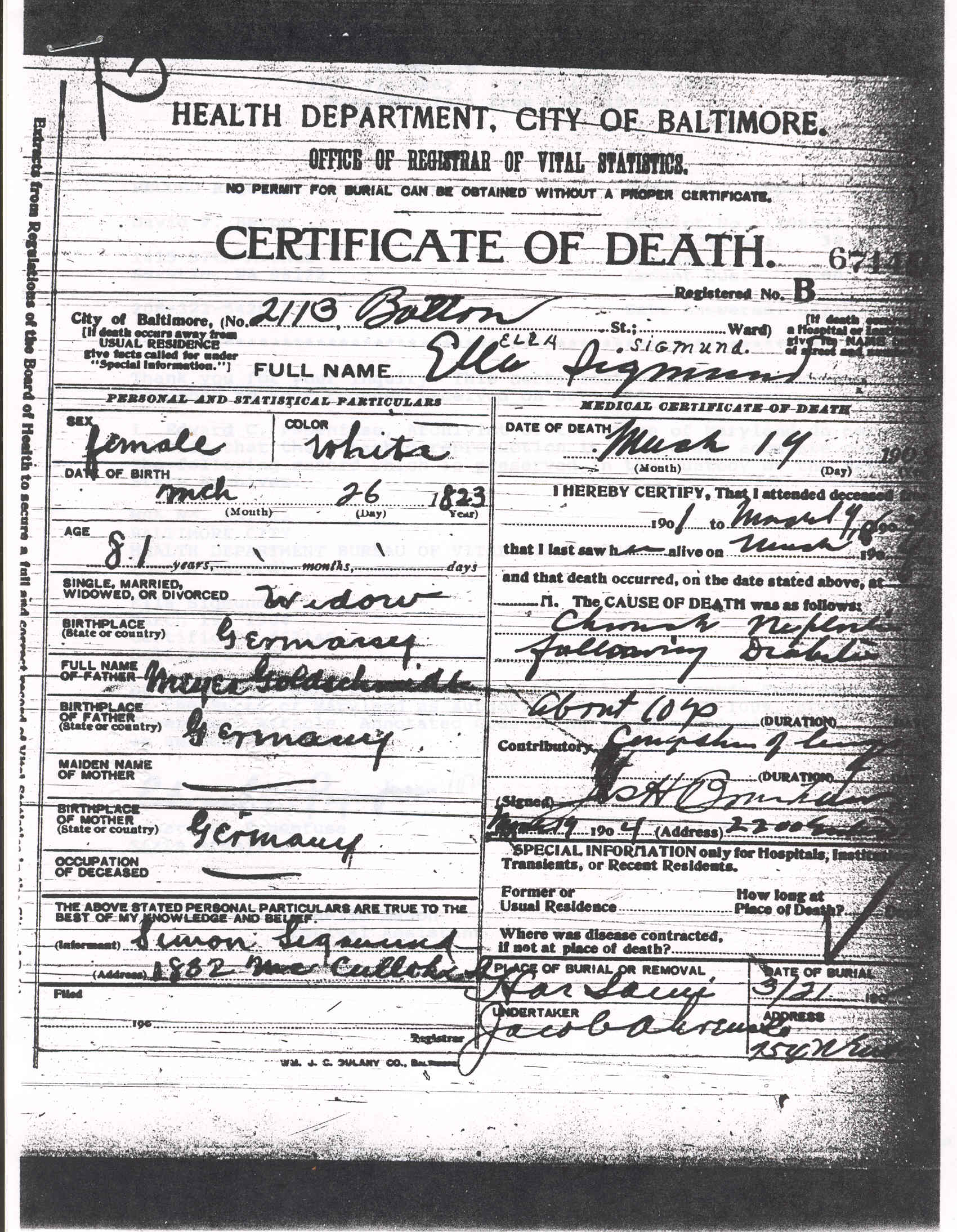
Another daughter, Ella, was possibly born that same year. Ancestry trees and other sources report that Ella was born March 26, 1823. That date apparently came from her death record:

Ella Goldschmidt Sigmund death certificate from David Baron

But unless her sister Sarah was conceived the day after Ella was born and was born several months prematurely, that seems impossible. I think Ella was more likely born in 1822. According to obituaries written about Ella when she died on March 19, 1904, and her death certificate, she was 81 years old when she died. That would mean that she was born between March 20, 1822, and March 19, 1823.3

At any rate, we can assume that Meyer and Ella were married by 1823, if not before.  They had seven children: Ella (1822?), Sarah (1823), Malchen (about 1827), Selig (sometimes spelled Seelig) (1828), Joseph (1830?), and Falk (1836). According to David Baron’s Goldschmidt family tree, Joseph died a month before his sixth birthday on November 27, 1836, five months after Falk was born. I am still working on finding records for some of these children and will report on what I find once I do, if I do. But given the depth of David’s research, I don’t think such records exist. All of us are relying on older family trees that include these dates.

Despite this dearth of records, I can tell quite a bit about the lives of Meyer, Lea, and their children based on the Selig Goldschmidt book and other later sources.

Three years after giving birth to her last child Falk at age 42, Lea Katzenstein Goldschmidt died on September 28, 1839. She was 45 years old and left behind her husband Meyer and six children under the age of eighteen.

Lea Katzenstein Goldschmidt death record, Sterberegister der Juden von Grebenstein 1827-1882 (HHStAW Abt. 365 Nr. 377)AutorHessisches Hauptstaatsarchiv, Wiesbaden, p. 34

In the Selig Goldschmidt book, there are some translated remembrances written by Selig in 1887 about his mother Lea. Apparently the family had run into some hard times after Meyer suffered a prolonged illness and was confined to bed and unable to work for fourteen weeks. This took a toll on Lea. Selig wrote:4

My mother, who now rests with G-d, was an ideal woman, wife, and mother. She was beloved in the whole of our district, the benefactress and the support of many poor families. Everyone received ready comfort from her. Even when we were so poor that she could no longer help, people would still seek her advice and share their burdens with her.

I was only nine years old when she died. When I heard the loud sighs and groans of innumerable mourners who wept and cried out, “What shall we do, how shall we manage now that our benefactress is buried?,” I was roused from my childish grief. I asked myself how had she been able to help the needy? We are so poor ourselves that we have barely enough bread and potatoes to eat. I was a wild and carefree boy, but it was probably at this juncture that a turning point occurred in my life.

After her death, the family worked together  to provide for each other.5

Jakob and I had begun to work properly even though I was just ten years and Jakob twelve. Thus, we managed to add a little oil and fried onions to our boiled potatoes. That was quite amusing. Our good and noble sister Sarah fried small slices of onion in a little oil. This was then mixed with hot water and one had to fish out the onion. A big pot stood in the center of the table and each of us dipped his peeled potato into it. He who caught a slice of onion in this way was indeed the lucky one.

Behind our little house we had a small garden which my sister Ella tended. … My sister Ella learned millinery and ran a small millinery shop in our house. …[A]ll of us were working very diligently in order to support our dear father and little brothers and sisters.

These simple paragraphs describing the life of the family of Meyer and Lea Goldschmidt paint a picture of a tight-knit and loving family that managed to deal together with poverty and the tragic loss of their mother. I may not have all the dates and records, but I do have a sense of the values and life of Meyer Goldschmidt and his family.

More to come…


  1. For Jette, Elieser, and Jude, I have been fortunate to find the research of others, but no primary sources. I have added the names and dates to my Ancestry tree, but I do not have enough reliable information about them or their families yet to write about them on the blog. Maybe someday I will learn more, but for now I have decided that I will wait to see if any more can be learned about these distant relatives and their descendants before trying to write about them. 
  2. Selig Goldschmidt: Picture of A Life (1996, Elmar Printers Ltd. and Bezalel Bookbinders, Jerusalem, Israel)(limited edition of 300 copies) 
  3. US census records are also inconsistent with respect to Ella’s birth year. The 1870 census says she was then 47, giving her a birth year of 1823. But the 1880 census reports her age as 55, meaning she was born in 1825. And the 1900 census records her birth date as 1833. I think Ella’s birth date was not known by her family and perhaps even by Ella herself. 
  4.  “The Story of A Ring,” Selig Goldschmidt: Picture of A Life (1996, Elmar Printers Ltd. and Bezalel Bookbinders, Jerusalem, Israel)(limited edition of 300 copies), p. 19.If  Selig was nine when his mother died in 1839, then he was born in 1830, not 1828. The 1828 birth date came from his marriage record, however, so perhaps he did not remember his age at the time his mother died. 
  5. Ibid., pp. 20-21. 

Sophie Katz Vogel and Her Family: A Brick Wall Falls in My Katzenstein Family

Back in October 2017, I wrote about a brick wall I could not break down involving the children of my cousin Rosa Katzenstein. Rosa was my second cousin, twice removed. She was the granddaughter of Jacob Katzenstein, the older brother of my great-great-grandfather Gerson Katzenstein.

Rosa was the oldest child of Mina and Wolf Katzenstein, born on June 19, 1859, in Frankenau, Germany.

Rosa Katzenstein birth record arcinsys
HHStAW Fonds 365 No 174, p. 7

She married her third cousin, once removed, Salomon Feist Katz, son of Joseph Feist Katz and Brendel Katz of Jesberg. Rosa and Salomon were married on June 28, 1881, in Jesberg. They had four daughters, one of whom died as a child, but three survived to adulthood: Sara, Sophie, and Recha.

Marriage record of Rosa Katzenstein and Salomon Feist Katz
Hessisches Hauptstaatsarchiv; Wiesbaden, Deutschland; Collection: Personenstandsregister Heiratsregister; Signatur: 920; Laufende Nummer: 3836

I had a great deal of trouble learning what happened to two of those daughters, Sara and Sophie. I knew that Sara had married Otto Loew and had two children and that Sophie had married Isaac Vogel, with whom she’d had two sons, Heinz and Carl, but that was all I could find. Then, with incredible help from my friend Aaron Knappstein, I learned that Sara and Sophie as well as their sister Recha had all left Germany in the 1930s and escaped to Argentina.

But I did not know what had happened to the two sons of Sophie Katz Vogel, Carl and Heinz. Now, thanks to more wonderful research done by Aaron Knappstein, I not only know more about their story, I actually have photographs of the family and am in touch with two new cousins.

In April, 2019, Aaron received an email with a packet of information and photographs from Ingo Sieloff, the director of the Borken museum. Back in 2009, Carl Vogel’s daughter had exchanged emails with Heinrich Broz, then the archivist for the town of Borken, and had sent him photographs and other documents and a history of her family. Mr. Sieloff sent all of this to Aaron, and  Aaron sent them on to me. Last week I took a chance and sent Carl’s daughter an email using the email address she’d had in 2009. That same day she responded and shared it with Heinz’s daughter, and now I have two new cousins with whom to share and exchange family information.

Here is more of the story of Sophie Katz and Isaac Vogel. Most of the information in this post came from my correspondence with their granddaughters and the documents and photographs they shared with me.

Sophie Katz married Isaac Vogel on June 9, 1909:

Sophie Katz marriage to Isaak Vogel
Hessisches Hauptstaatsarchiv; Wiesbaden, Deutschland; Collection: Personenstandsregister Heiratsregister; Signatur: 915; Laufende Nummer: 5624

Their son Carl was born on March 30, 1910, in Borken, Germany:

Birth record of Carl Vogel

His brother Heinz was born two years later on July 18, 1912, also in Borken:

Birth record of Heinz Vogel. Courtesy of the Vogel family

During World War I Isaac Vogel served in the Germany military, fighting in France, and then was a city councilor in Borken in the 1920s.

Isaac Vogel (right). Courtesy of the Vogel family

Isaac Vogel, seated far right. Courtesy of the Vogel family

Isaac worked with his brother Moritz as a cattle trader. It was a business that Isaac and Moritz had taken over from their father Ephraim. It was a small business, but enough to support two families adequately.

Here are three photos of Carl and Heinz and their parents taken between about 1910 to about 1924 in Borken, Germany:

Heinz and Carl Vogel, c. 1910. Courtesy of the Vogel family

Sophie, Heinz, Isaac, and Carl Vogel, c. 1917. Courtesy of the Vogel family

Vogel family, c. 1924. Courtesy of the Vogel family

According to Ingo Sieloff,  the Vogel home in Borken was located at Hintergasse 125 and included a house and a stable; the house was 105 square meters or about 1130 square feet in area. It appears to be larger than that in this photograph:

Hintergasse 125, Borken. Courtesy of the Vogel family

I don’t know when this photograph was taken or the identities of the people standing in front.

As a child, Carl Vogel was an avid reader and a good student, and his parents decided to send him to grammar school in Kassel. During the week he lived with his uncle Moritz Vogel. Carl graduated from high school and then studied at the Philosophical Faculty of Friedrich Wilhelm University in Berlin. He also attended lectures at Rabbinerseminar and worked as a religion teacher.

These three photographs are labeled “Schule,” one with year 1921. I can find Carl in the Gymnasium photograph below (the third one); he is the young man standing fourth from the left in the back row. I assume that either Carl or Heinz is somewhere in the other two photos. Can you find them? I have guesses, but am not sure.

Courtesy of the Vogel family

Courtesy of the Vogel family

Courtesy of the Vogel family

Heinz Vogel was also a very talented boy, but his parents could not afford to send both boys to high school. Instead, Heinz completed his apprenticeship as a retail merchant in Kassel at the Tietz department store.

Until 1933, the family lived a normal life. They saw themselves as Jews and as good Germans. They lived a quiet life, although there were occasional verbal anti-Semitic attacks .  But once the Nazis came to power, the Vogel cattle business suffered because farmers were not allowed to do business with Jews. Heinz Vogel also found his livelihood affected; although he was considered the best salesman in the store, he was released from his job. He then completed an apprenticeship in a practical trade in Frankfurt to prepare for emigration.

Carl read Hitler’s book “Mein Kampf” and recognized that the family needed to leave Germany. Sophie’s sister Recha Katz Goldschmidt had already left  for Argentina by 1932 after her husband Julius was beaten by the Nazis.

Carl and Heinz prepared to emigrate to Palestine, but then decided to go to Argentina since they already had relatives living there. Heinz and Carl first emigrated in 1935, and one year later their parents Isaac and Sophie and Sophie’s mother Rosa Katzenstein Katz followed. They sold their home in Borken for 9113 Reichsmarks. One source says that there were 2.5 Reichsmarks to a US dollar during World War II, so the price of the house would have been about $3,645 in US currency or about $48,000 in today’s dollars, according to this inflation calculator. They settled in Buenos Aires.

In Argentina, Carl and Heinz had to start their lives all over. But the family adapted well to their life in Argentina. The philanthropic association Asociación Filantrópica Israelita or Jüdischer Hillfsverein helped the newcomers adjust to their new country. In Buenos Aires, Isaac and Sophie continued to have a traditional Jewish home and went regularly to the liberal synagogue founded by German Jews; services were conducted in German and Hebrew and in later years, also in Spanish. Isaac and Sophie never learned Spanish, but it did not matter because they were living amidst other German Jews who had escaped from the Nazis. Isaac also tutored boys for their bar mitzvahs.

In 1943 Carl Vogel married Beate Hamburger from Frankfurt; Carl was very active and well known in the Jewish community and served as a deputy rabbi and as a bar mitzvah tutor. He also taught German and Latin. Beate also was a teacher; she gave private instruction in German and English. Carl and Beate had two children.

Heinz Vogel married Gertrud Lippman from Ludwigshafen in 1943. They had one child. Heinz started work in Argentina as an industrial worker in the meat business. Then he became a white collar worker in a big Argentina-owned multinational firm called Bunge & Born. For his job he was required to travel all over the world, including a six-month stay in India in 1954. He became the General Manager of the Jute department and traveled many times to India, Pakistan, and Bangladesh.

Although Heinz lacked the formal education his brother Carl had received in Germany, his daughter described him as a “very cultured and interesting person.” She said that her parents lived a secular life and had friends from many different backgrounds; their connection to the synagogue was limited to Yom Kippur and lifecycle events for family and friends. Heinz’s daughter also told me that Heinz was very proud to be an Argentine citizen and that when he received a diploma from the Argentine government on the fiftieth anniversary of his becoming a citizen, he was very emotional.

Isaac Vogel died on April 16, 1960, in Buenos Aires;1 his wife Sophie died five years later on May 5, 1965.2  Carl died in 1981, and Heinz in 2005.

I feel so fortunate to have found the granddaughters of Sophie and Isaac and to have learned so much more about the courage and determination of Sophie, Isaac, Carl, and Heinz, who all started their lives over in a new place after being forced to escape from Nazi Germany in the 1930s.


A Morreau Family Update: In Memory of Patrick Morreau 1934-2019

When we were in London, I was very fortunate to meet two of my Seligmann cousins, Annette Morreau, my fourth cousin, once removed, and Mark Morreau, my fifth cousin; I wrote about our meeting here. Since then, Mark and I have stayed in touch and shared some of our research into our shared family.

Before I delve into what I’ve learned from Mark, let me first explain how we are connected. Mark and I are both descended from our four-times great-grandparents Jacob Seligmann and Martha Mayer, Mark through their daughter Caroline, me through their son Moritz, my third great-grandfather.

Caroline Seligmann married Moses Morreau on October 8, 1830 in Worrstadt, Germany:

Marriage record of Caroline Seligmann and Moses Morreau October 8, 1930
Worrstadt Marriage Record, 1830-10

P. 2 of Marriage record of Caroline Seligmann and Moses Morreau

They had two children, Levi (1831) and Klara (1838), about whom I wrote here. Levi Morreau married Emilia Levi and had five children, including Markus, who was born in Worrstadt on August 27, 1859:

Markus Morreau birth record, August 27, 1859
Worrstadt birth records, 1859-36

Here is a photograph of Emilia Levi Morreau, the mother of Markus Morreau:

Emilia Levi Morreau, courtesy of Mark Morreau

Markus married Alice Weinmann, and they had three children all born in England. Their first child Cecil, Mark’s grandfather, was born in April, 1905.1 Cecil married Cicely Josephine O’Flanagan in 1933 in Manchester, England,2 and they had three children, including Mark’s father Patrick, born in 1934.3

When I met Mark, his father Patrick was scheduled for surgery within a few weeks after our meeting on June 1, 2019. Patrick made it through the surgery, but then unexpectedly died not long afterwards on June 30, 2019. He was 85. I was heartbroken for Mark and his family and very sad that I had missed the opportunity to meet Patrick myself, especially after Mark shared some of his stories with me. I am grateful, however, to have met Mark and also our cousin Annette, and very glad that Mark was able to share with Patrick some of what we had discussed and to ask a few more questions about the family history.

So in memory of and in honor of Patrick Morreau, let me tell some of that history and those stories.

I will start with Mark’s great-grandfather Markus Morreau. As mentioned above, Markus was one of five children of Levi and Emilia (Levi) Morreau. He had four younger siblings: Albert, Adolf (who died as a child), Bertha, and Alice. I’ve written about them all here and here. In fact, my discovery of the Morreau cousins really started when my cousin Shyanne Morreau found my blog and we together put the various pieces together. Shyanne is descended from Albert Morreau, who left Germany for the United States in 1883 when he was 22 and settled in Cleveland. Albert’s older brother Markus also left Germany as a young man and was living in Withington, a suburb of Manchester, England in 1881; by then he had adopted the more English spelling of his name, Marcus. 4

Here is a photograph of Marcus taken in 1880 when he was 21. It appears it was taken in Frankfurt, either before he emigrated to England or during a visit back to Germany:

Marcus Morreau, aged 21. Courtesy of Mark Morreau

I don’t have a photograph of Albert as a young man, but this photo from his 1915 passport with his wife Leonora shows the family resemblance:

“United States Passport Applications, 1795-1925,” database with images, FamilySearch (https://familysearch.org/ark:/61903/1:1:QVJP-423K : 4 September 2015), Albert Morreau, 1915; citing Passport Application, Ohio, United States, source certificate #49162, Passport Applications, January 2, 1906 – March 31, 1925, 234, NARA microfilm publications M1490 and M1372 (Washington D.C.: National Archives and Records Administration, n.d.); FHL microfilm 1,514,173.

Marcus was living in Manchester when he became a naturalized British citizen in 1892.

UK Naturalization Certificate for Marcus Morreau
The National Archives; Kew, Surrey, England; Duplicate Certificates of Naturalisation, Declarations of British Nationality, and Declarations of Alienage; Class: HO 334; Piece: 19

Two of the questions that Mark and I had were why Marcus and Albert left Germany in the 1870s and 1880s and why one went to England and the other to America.  As for the first part of that question, the answer seems answered in part by what was happening in Germany in the 1870s and 1880s. According to several sources, Germany was substantially affected by the worldwide depression that began in 1873. Britannica.com reports that:

The prices for agricultural and industrial goods fell precipitously; for six successive years the net national product declined. A sharp decline in profits and investment opportunities persisted until the mid-1890s. About 20 percent of the recently founded corporations went bankrupt.

In agriculture, the deeply indebted Junker elite now faced severe competition as surplus American and Russian grain flooded the German market. Among the more immediate consequences of the crash was a burst of emigration from the depressed provinces of rural Prussia. During the 1870s some 600,000 people departed for North and South America; this number more than doubled in the 1880s.

Lynn Abrams, a scholar writing about this same period, noted that one of the other consequences of the depression of 1873 was an increase in anti-Semitism:5

The Depression, which did not recede until 1879, had profound consequences. The period beginning in 1873 saw the organization of economic interest groups, nationalism of a rather chauvinistic nature, militarism and modern anti-semitism.The Depression caused the landed and industrial interests to mobilize behind the policy of protective tariffs in order to retain their economic and political base. Thus, they succeeded in maintaining their power and the political status quo.

Ironically, the unification of Germany under Bismarck in 1871 led to some increased rights for Jews, but also increased anti-Semitism, as the Center for Israel Education described on its website:

In July 1869, Prussian King Wilhelm I promulgated the North German Confederation Constitution, which gave Jews civil and political rights in twenty-two German states.  This Constitution was adopted by the new German empire upon its establishment on April 14, 1871.  On April 22, 1871, the Jews in all of Germany were finally given emancipation when the Constitution was extended to Bavaria. 

The process of Jewish emancipation led to many changes in both Jewish and non-Jewish society.  Some Jews continued religious identification with non-Orthodox Judaism, seeking to remain Jewish but more like their Christian peers; some converted to Christianity because the Emancipation of 1871 still prevented Jews from gaining access to certain high profile social positions; others simply assimilated.  Emancipation also led to new and more virulent forms of anti-Semitism, a term that was coined in 1879 in a pamphlet by Wilhelm Marr. Marr became the father of virulent racial anti-Semitism, singling out  Jews as inferior because of their racial impurity.

Another website, Jewish History Online, further elaborated on the increased anti-Semitism that occurred in the 1870s and thereafter:

With the onset of the economic crisis of the early 1870s known as “Gründerkrach”, the atmosphere in the newly founded German Kaiserreich started to change. Reich Chancellor Bismarck reacted with a protectionist economic policy and changed his political course to join the conservative camp. As supporters of liberalism and Social Democracy, the Jews now found themselves on the side of the political enemy. They were accused of being responsible for the economic crisis and the ever more pressing “social question.”

There were thus multiple reasons why Marcus and Albert Morreau would have left Germany during this time period—to seek better economic opportunities and to escape anti-Semitism.

As for why one went to England and the other America, we can only speculate. Perhaps they were hedging their bets as to which country would give them more opportunities. Maybe they didn’t get along and wanted to put an ocean between them.  Or maybe they each just found a specific job opportunity that led them to settle in two different countries.

More to come…


  1. Inferred County: Lancashire, Volume: 8c, Page: 718, Source Information
    FreeBMD. England & Wales, Civil Registration Birth Index, 1837-1915 
  2.  Inferred County: Lancashire, Spouse: O’flanagan, Volume Number: 8d
    Page Number: 648, General Register Office; United Kingdom; Volume: 8d; Page: 648,
    Ancestry.com. England & Wales, Civil Registration Marriage Index, 1916-2005 
  3.  Registration district: Watford, Inferred County: Hertfordshire, Mother’s Maiden Name: O’Flanagan, Volume Number: 3a, Page Number: 1485, General Register Office; United Kingdom; Reference: Volume 3a, Page 1485, Ancestry.com. England & Wales, Civil Registration Birth Index, 1916-2007 
  4. Marcus Morreau, 1881 England Census, Class: RG11; Piece: 3892; Folio: 79; Page: 37; GSU roll: 1341930, Enumeration District: 12a, Ancestry.com and The Church of Jesus Christ of Latter-day Saints. 
  5. Lynn Abrams, Bismarck and The German Empire 1871-1918 ( Routledge, 1995), found at https://pdfs.semanticscholar.org/3c20/c71ec7760438fd5651738e40dea8a81a8c19.pdf