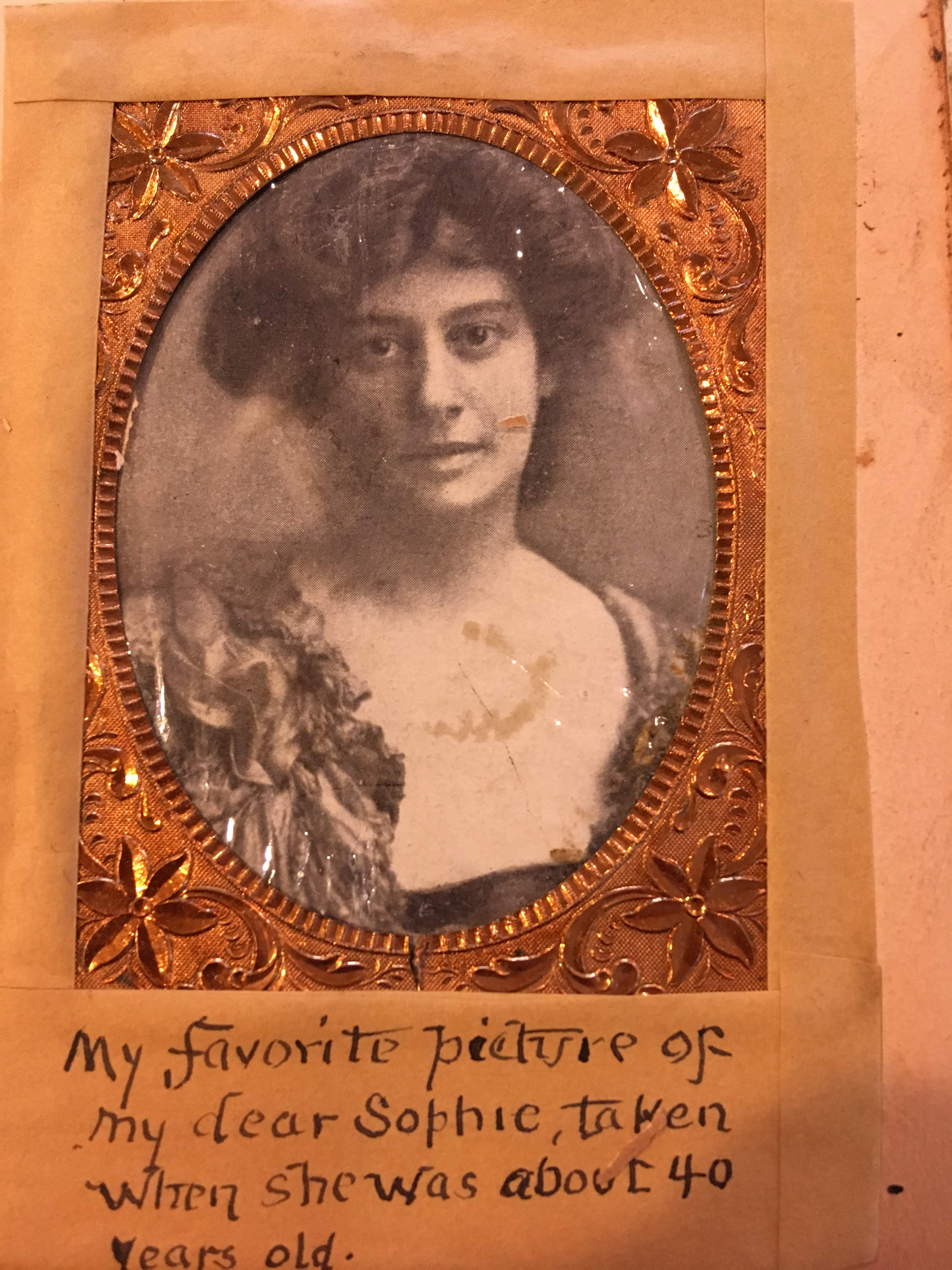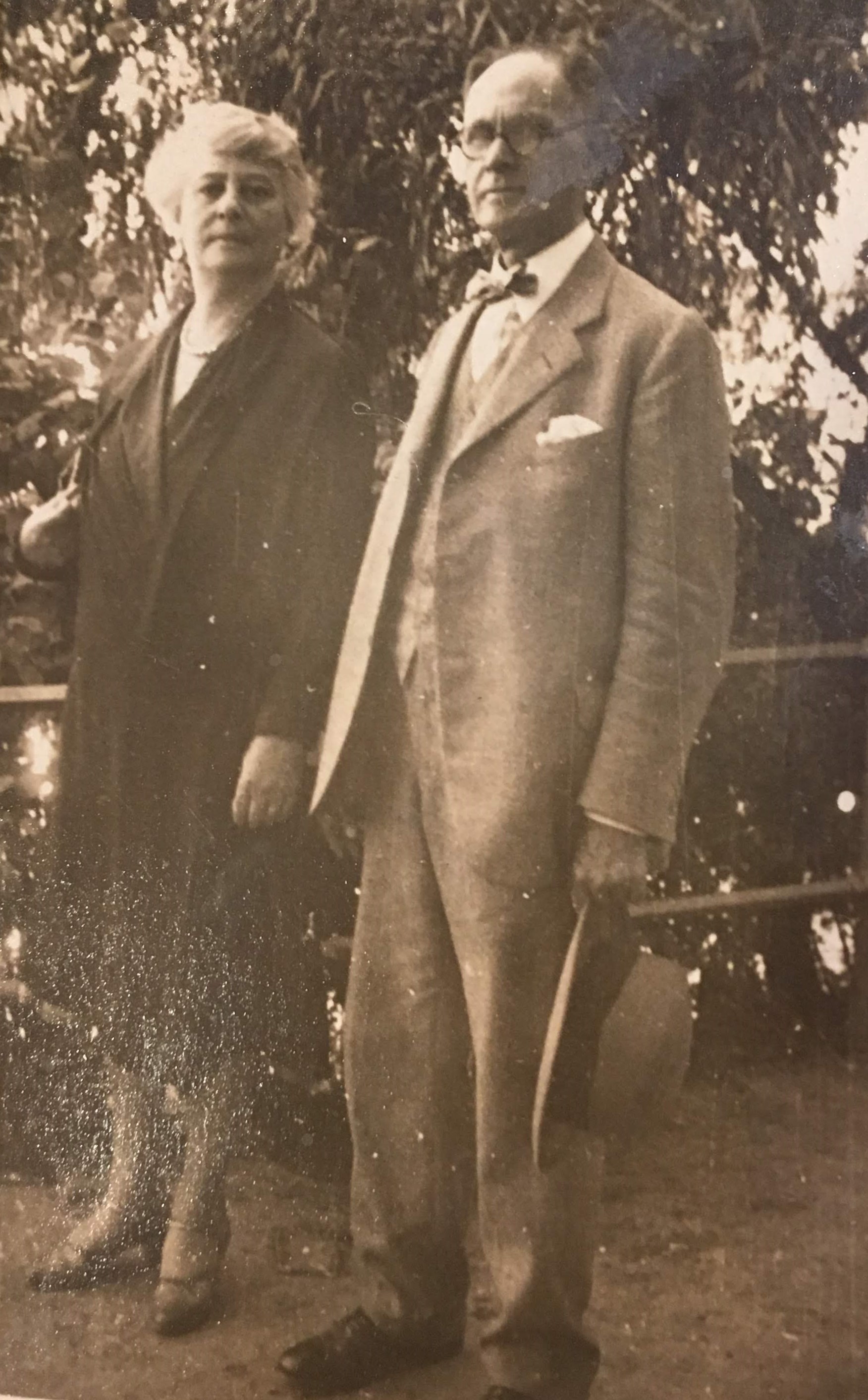
Milton Goldsmith’s Poetry

There are only two more pages from Milton Goldsmith’s family album to share. Each has only one item on it. But there is still much more to share from his other two albums.

Milton included this article about the celebration in Larchmont, New York, of his 90th birthday. It provides a detailed summary of Milton’s life.

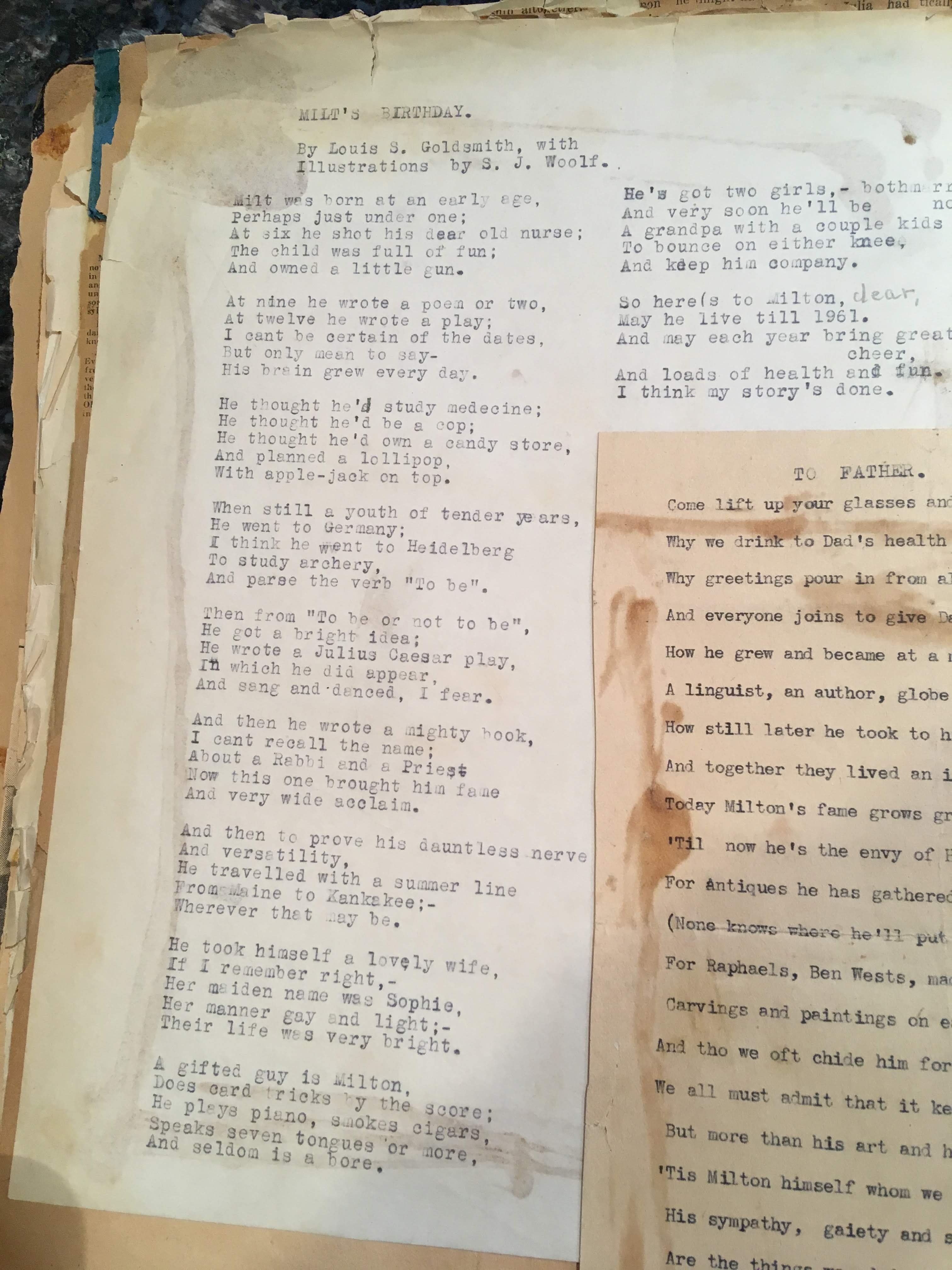
The last page includes this poem Milton wrote on the occasion of his 95th birthday. As you can see, Milton was still very sharp at the age of 95; the poem is funny, touching, and erudite:

Although the poem says “more” at the bottom, I do not see the second page of this poem in the album. I love Milton’s humor and his continuing love of life as expressed in this poem.

Milton Goldsmith died a year later on September 21, 1957, at the age of 96. He left behind not only his family and this family album, but a body of work—books for children and for adults, poetry, and plays—and a huge collection of letters, photographs, poems, and other memorabilia.

Sue shared two other albums with me. I have scanned what I can from the other albums and will now share some of what I’ve scanned. One of these albums contained many of Milton’s poems and other writings. Most of these were love poems written at various stages of Milton’s life before he was married. Others commemorate special occasions. I have selected just a few to share.

I particularly like this one, a self-portrait in words. If you compare it to the poem Milton wrote when he was 95, you can see that neither his style nor his joie de vivre had changed much over the seventy or so years that passed between writing this poem and writing the one above.

Another poem from this era, written in 1883 when Milton was twenty-two and his father Abraham was 51, was dedicated to his father. It’s another poem that I found very touching.

The final poem that I selected to share is this one, written in 1898 by Milton  to Sophie, whom he would marry the following year:

The love and longing expressed in this poem is initially disguised by a long description of Christmas, but eventually Milton’s true feelings came out. I do wonder what he was doing in Fort Wayne!

I wish I could scan and share more of Milton’s poetry, but the number of poems is overwhelming. The best I can do is help Sue work on having all of these albums preserved in the Jewish archives in Philadelphia where Milton was born and raised and where so many of his poems were written.

In my next two posts, the final ones for Milton, I will share some of the photographs and other materials that I found in the third album Sue shared with me.


Why Is This Ketubah Here? Milton Goldsmith’s Family Album, Part XIX

This page from Milton Goldsmith’s family album is puzzling.

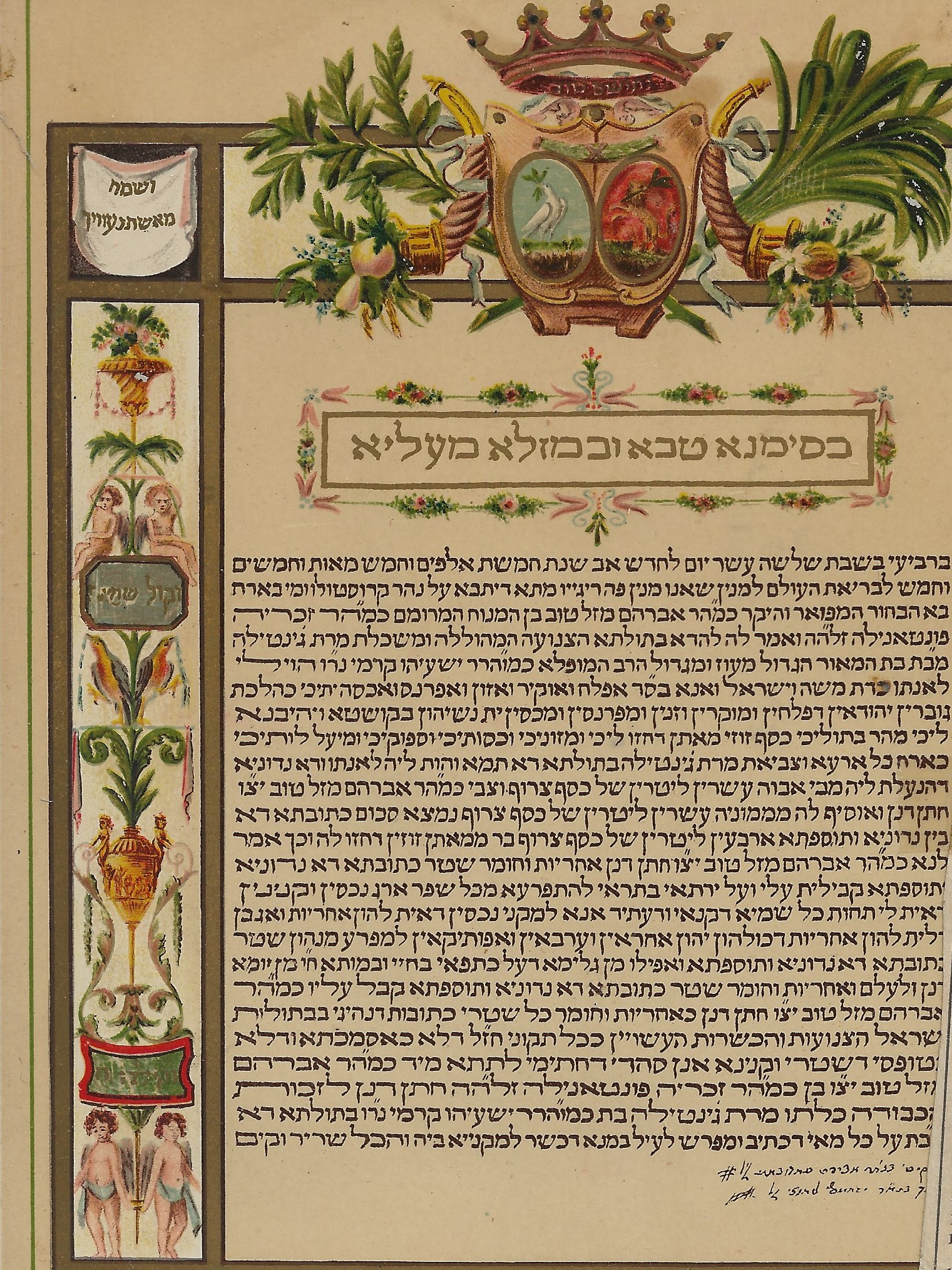
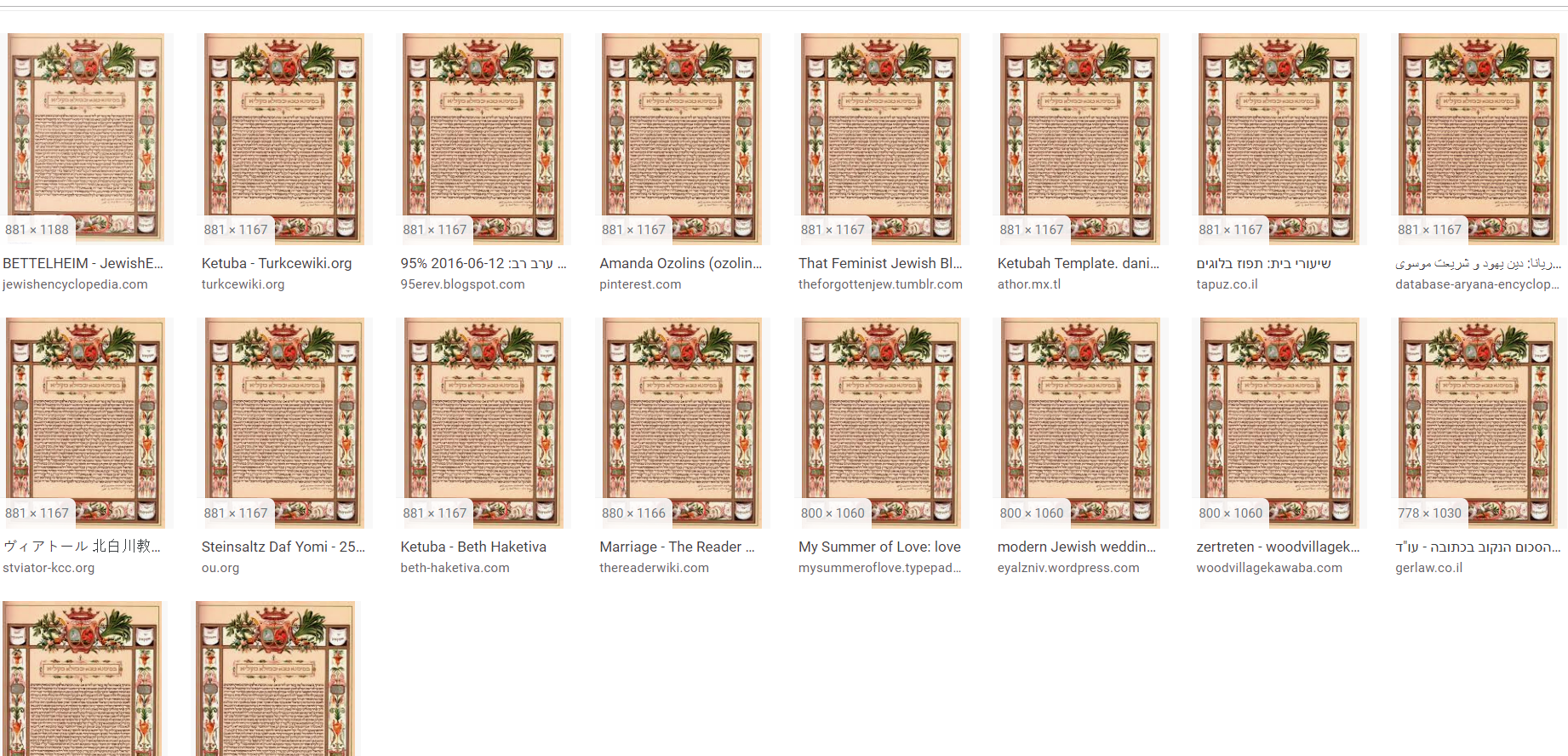
It includes an image of a ketubah, a Jewish wedding contract.

I assumed when I saw this that this was a ketubah for one of the members of Milton Goldsmith’s family. Because I couldn’t translate the Hebrew, I posted the image on the Tracing the Tribe Facebook group, asking for help. Much to my surprise, the group members concluded that this was a ketubah dated 1795 for a couple from Italy and was quite obviously not for one of my relatives. In fact, one TTT group member found another image of the exact same ketubah—with the same handwritten note at the bottom—online.

When I did a Google Images search for the image, I found numerous postings of the same image.

The image is used in many websites as an example of a ketubah. But I could not find any explanation of the source, history, or location of the original version of this ketubah.

So why would Milton have included this image? I have no idea. The only possible clue is the obituary that appears on this page and is the only other item on this page. It’s an obituary for Julius Goldschmidt, whom Milton referred to as a “beloved cousin.”

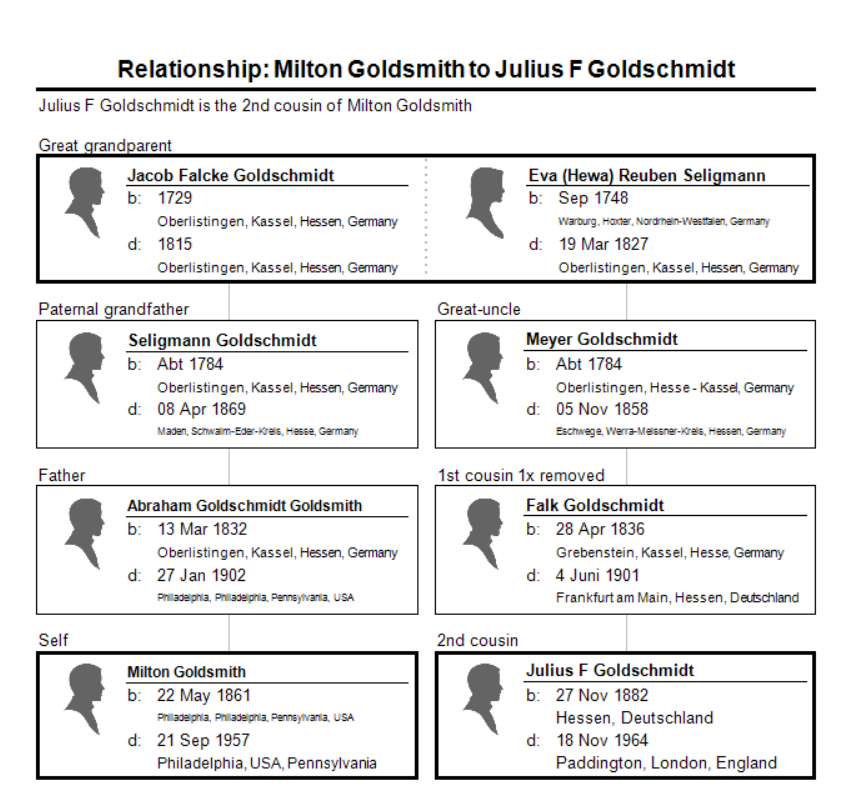
Who was Julius Goldschmidt? He was the grandson of Meyer Goldschmidt and son of Falk Goldschmidt, whom I’ve written about here and here. That made him Milton Goldsmith’s second cousin:

But Julius was born in Frankfurt, Germany, far from Philadelphia where Milton was born and raised. He also was 21 years younger than Milton, as Julius was born in 1882. As his obituary points out, he left Germany for London in 1935 when he was 53 years old and lived there until he died on November 18, 1964. He was a well-regarded art dealer. How did Milton know him well enough to think of him as a “beloved cousin?” I assume that the two must have met when Milton traveled to Europe or Julius traveled to the US. I will write more about Julius when I return to Meyer Goldschmidt’s family.

The question remains, however, as to why Milton included the ketubah image on this page. Had his cousin Julius discovered or purchased this ketubah? Was there any connection at all, or was this just a random placement of these two items on a page in Milton’s family album? The mystery lingers.

The Things You Can’t Learn from Genealogy Records Alone: Milton Goldsmith’s Family Album, Part XVIII

A few years after Milton Goldsmith’s mother died in 1874, his father Abraham remarried, as I have written about here. With his second wife Frances Spanier, Abraham had four more children, Milton’s half-siblings. Milton dedicated four more pages in his family album to these siblings. From Milton’s biographies I learned a great deal more about each of these siblings than I’d been able to learn from traditional research.

Alfred was the oldest, and he became a well-known rare book dealer in New York City, as discussed here. What I didn’t know until reading Milton’s biography of his brother was that Alfred had at first enrolled in dental school. In addition to the biography Milton wrote about his brother Alfred, this page includes a photograph presumably of Alfred and two women who are not identified and a brief news story about Alfred.

Alfred Goldsmith and two women

The article below reveals a bit about Alfred’s personality. Apparently he was quite a literary snob and refused to stock books in his store that he considered “trash.” Good for him for having standards!

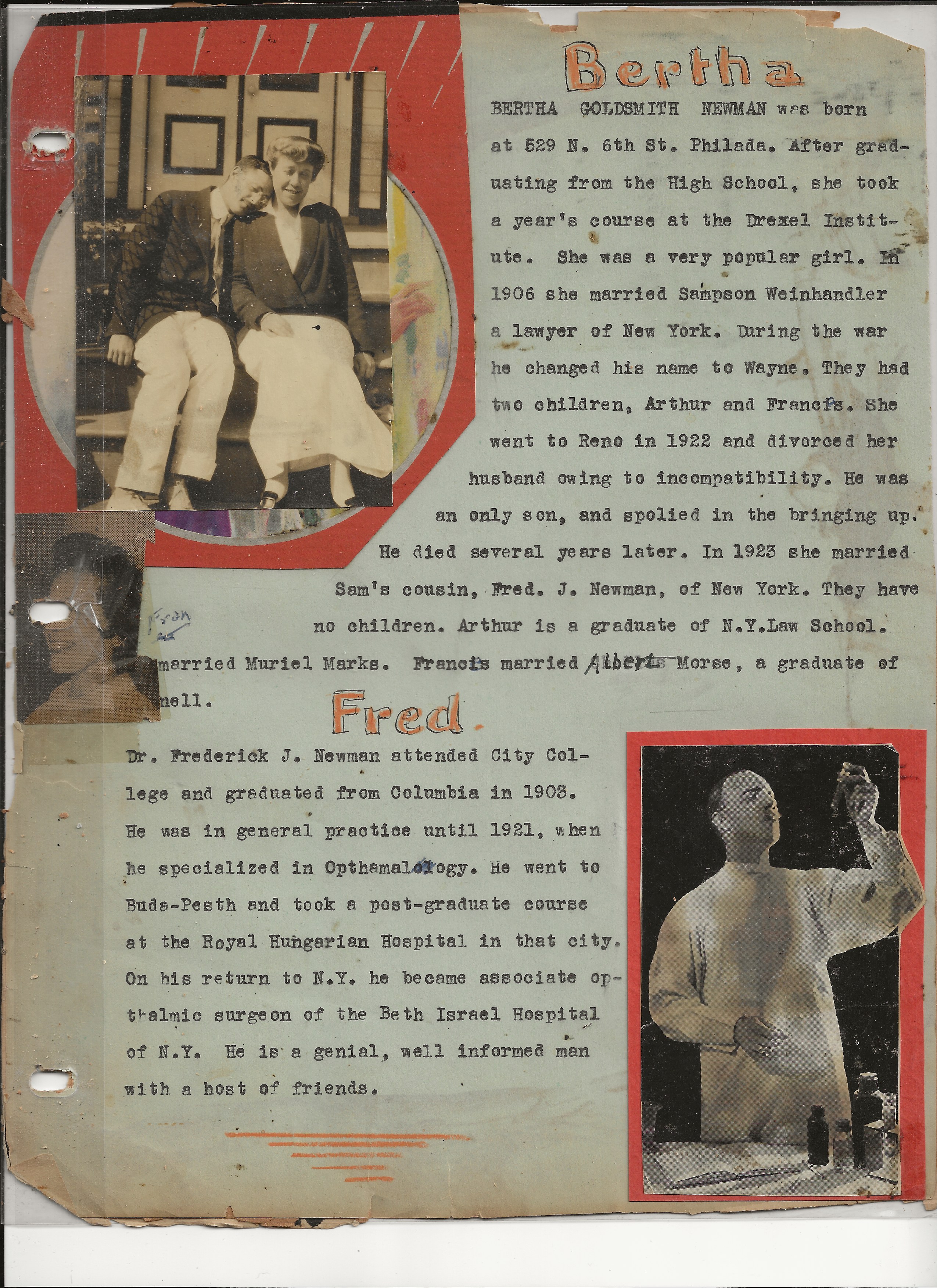
Bertha was the next child born to Abraham and Frances. Milton focused on her two marriages in his biography of Bertha. As I wrote about here, Bertha first married Sampson Weinhandler and then married his first cousin Frederick Newman. Milton’s insights into both men added an additional dimension to what I had learned through my research:

Imagine Bertha traveling all the way to Reno to divorce Sampson for incompatibility. Milton described him as “spoiled.” I sure wish Milton had described how Sampson and his family responded to Bertha’s marriage to his cousin Frederick the following year. Milton obviously much preferred Frederick to Sampson, describing the former as “a genial, well-informed man with a host of friends.”

I am not sure whether this photograph is of Bertha and Sampson or Bertha and Frederick, but given Milton’s description of Sampson, I am going to assume this is Sampson.

Bertha Goldsmith and one of her husbands, probably Sampson Weinhandler/Wayne.

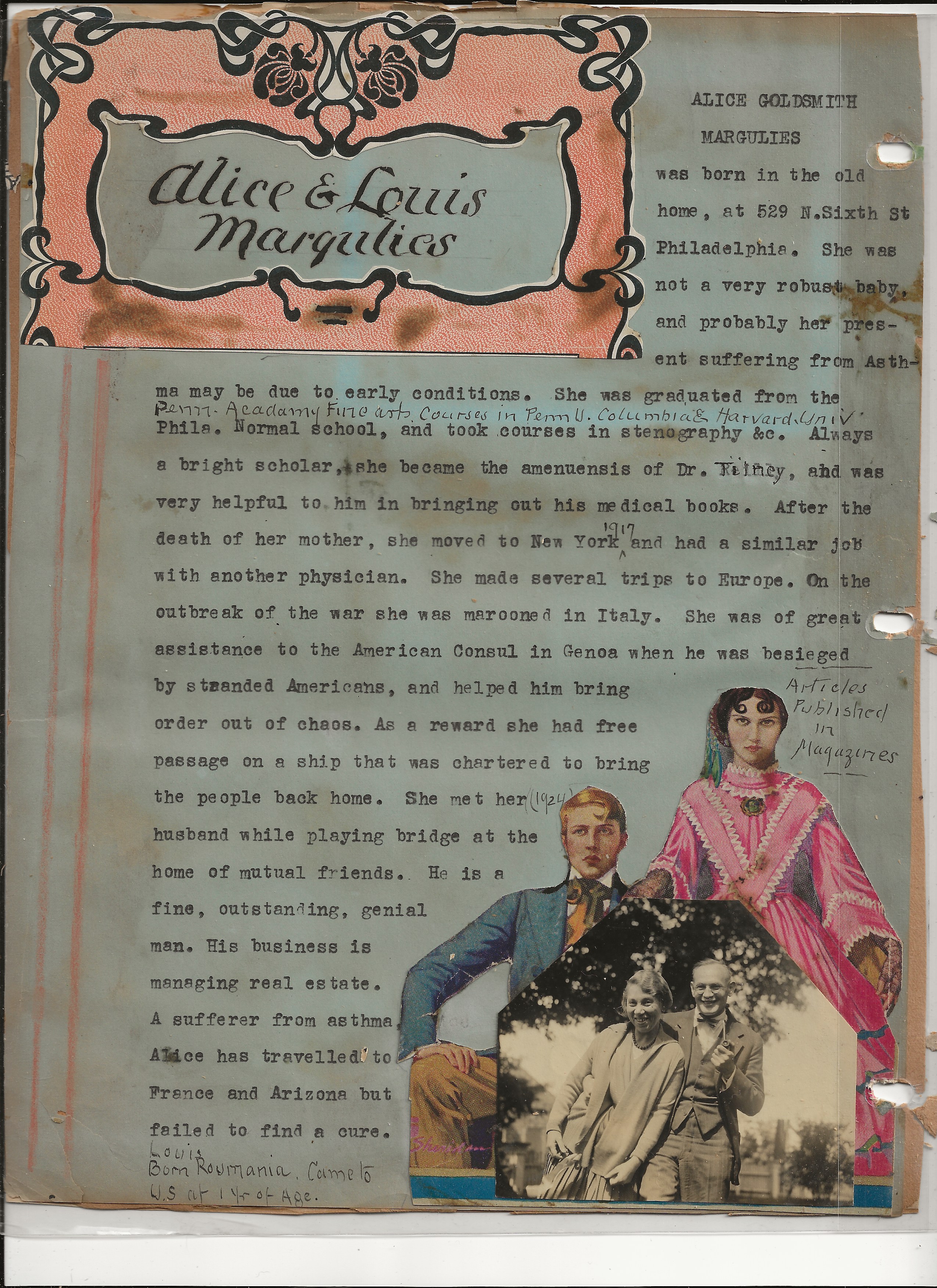
The third child born to Abraham and Frances was their daughter Alice. Milton’s biography of Alice is quite fascinating and revealed far more about Alice than I’d been able to learn through my research. In fact, Alice had been a very elusive subject, rarely appearing on census records or elsewhere.

Now that I’ve read Milton’s story about her, I understand better why I had so much difficulty learning about her. She traveled extensively and was stranded in Italy at the start of World War I. She helped the American Consul in Genoa deal with other stranded travelers and was rewarded with a free trip back to the US.

Alice was an educated and scholarly woman who took courses at the University of Pennsylvania, Columbia, and Harvard and had a career with two different doctors, one in Philadelphia and one in New York. I searched for a Dr. Tinley, but had no luck locating him. I also learned how Alice had met her husband playing bridge with mutual friends. She was 43 when she married Louis Margulies, whom Milton described as “a fine, outstanding, genial man” whose business was real estate and who had immigrated from Romania at the age of 14. I love this photograph of them—they look so happy.

Alice Goldsmith and Louis Margulies

Finally, Milton included a page for his youngest sibling, Louis Goldsmith. Like his sister Alice, Louis traveled extensively and married later in life (he was 53). He was very successful in the advertising business, handling the Palm Beach Cloth account.

What I had not already learned about Louis was that he had worked at Friedberger Mills and almost died after an operation for an injury to his hand. He then worked with his brothers Milton and Edwin at the Snellenburg Company in Philadelphia where he learned the art of advertising before he moved to New York to become “a very capable advertising man.” Milton described his youngest sibling Louis as “very much a recluse in his habits, living at the Plaza Hotel, and is very generous.” He also was a very snazzy dresser, as my father would have said.

Louis Goldsmith

Louis Goldsmith

It’s wonderful to have photographs of nine of the ten children of my three-times great-uncle Abraham Goldsmith1 and more details about their lives from someone who knew and loved them well, their brother Milton.

This is Part XVIII of an ongoing series of posts based on the family album of Milton Goldsmith, generously shared with me by his granddaughter Sue. See Part I, Part II, Part IIIPart IVPart V,  Part VI, Part VII , Part VIII,  Part IX,  Part X, Part XI, Part XII Part XIII , Part XIV , Part XV, Part XVI,  and Part XVII at the links.


  1. Only Hilda is missing; she died as a teenager. 

Milton Goldsmith’s Album, Part XVII: The Contrasting Lives of His Sisters Rose and Estella

In his family album, Milton devoted several pages to his sisters Rose and Estella. Their life stories show a contrast between the more traditional path of wife and mother taken by Rose and the untraditional path chosen by Estella and give us insights into how women lived in the late 19th and early 20th centuries.

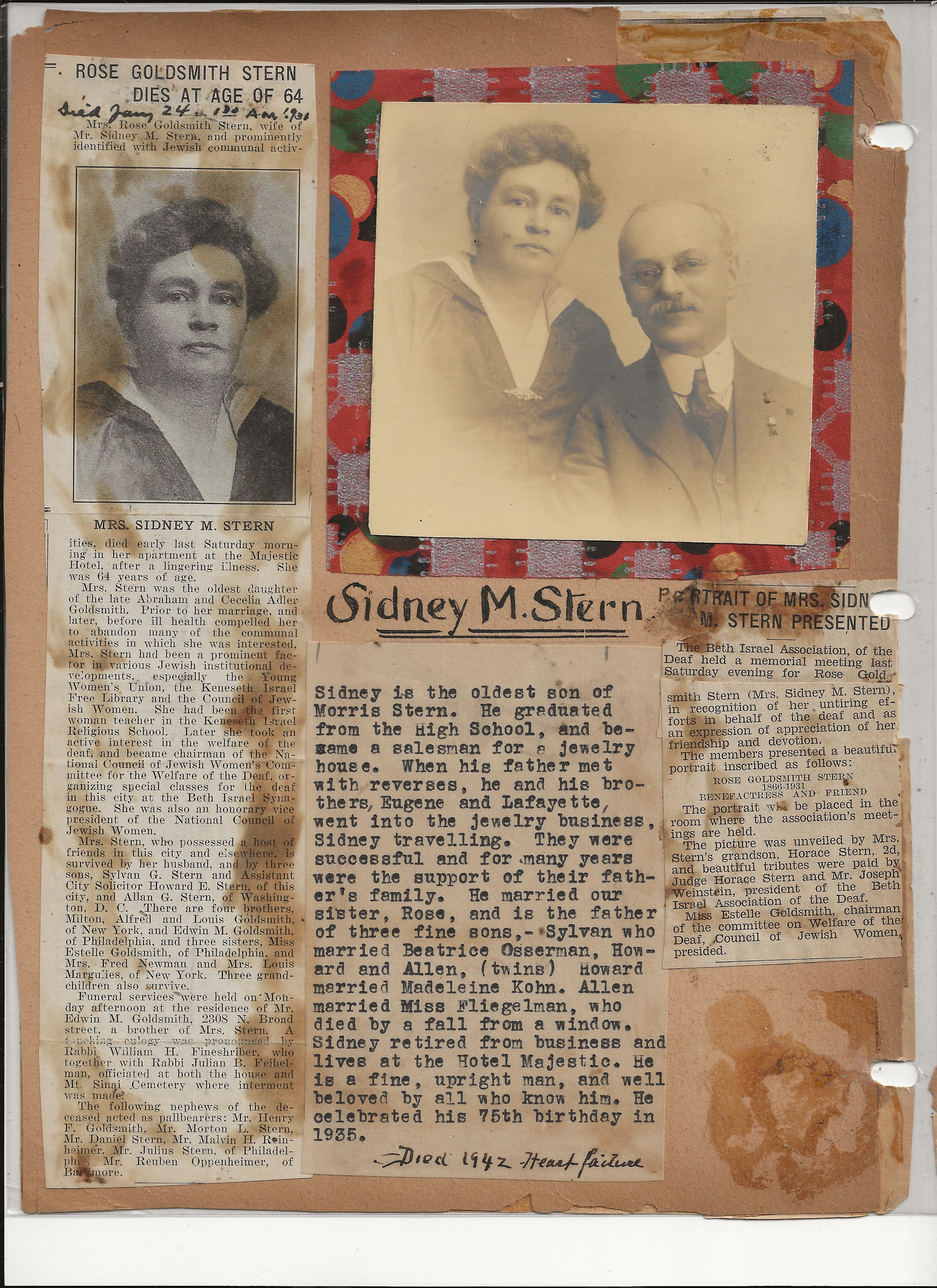
Rose was five years younger than Milton, born in 1866. She married Sidney Morris Stern in 1892 and had three sons. Here is the page Milton dedicated to his sister Rose and her husband Sidney.

It includes a biography of Sidney written by Milton that fills in some background to Sidney’s life that I had not previously known.

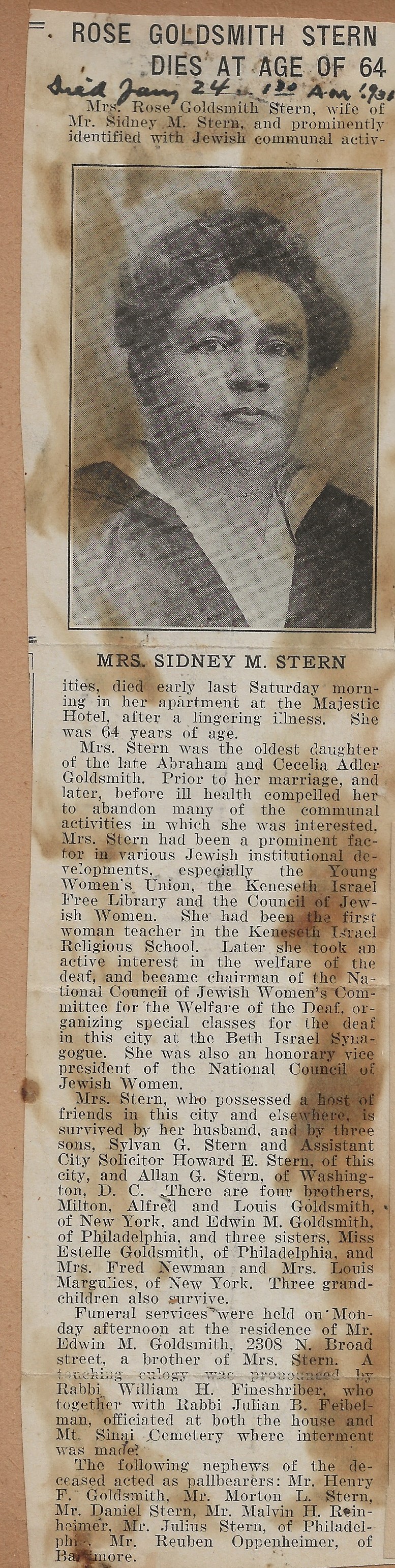
There is also an obituary for Rose, who died in 1931 at the age of 64.

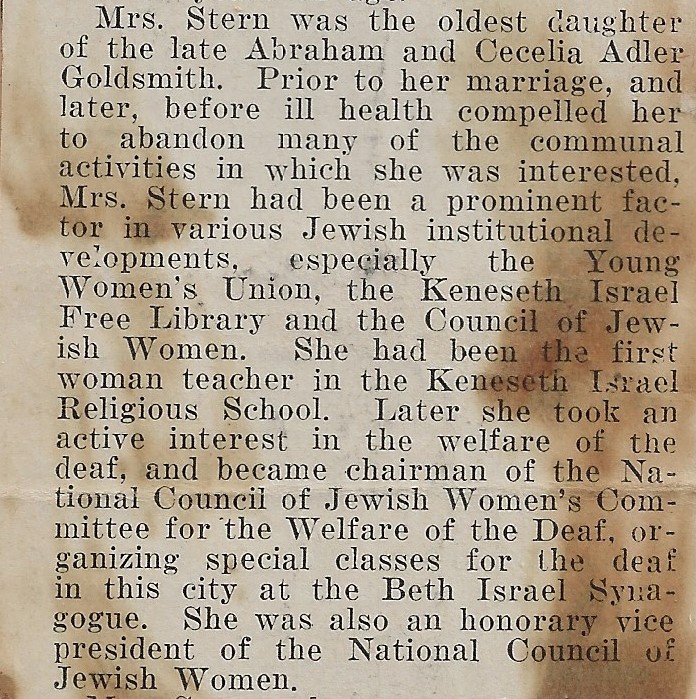
Here is a closer view of the biographical information in her obituary:

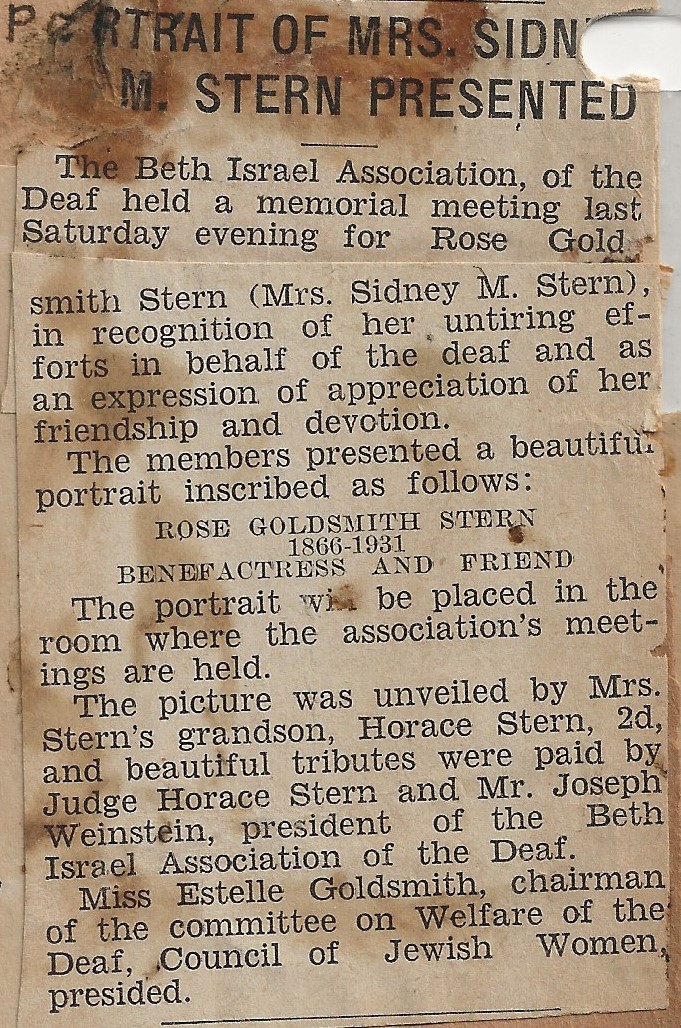
The Beth Israel Association of the Deaf honored Rose for her volunteer efforts on behalf of the deaf and presented a portrait to hang in her honor at their meeting place. It’s a shame that we don’t have a photograph of the portrait.

But my favorite part of this page is the photograph of Rose and Sidney, which I edited a bit to enhance the clarity of the photograph, as I have with several of the photographs below:


In one of the other albums, I found this lovely photograph of Rose on her graduation day:

Rose lived a comfortable and meaningful life, raising three sons and making a difference in the lives of many through her various volunteer activities.

As noted above, whereas Rose lived a fairly traditional life for a woman of her times, her younger sister Estella chose a road less traveled. Milton created two pages for his youngest full sister Estella (also known as Estelle and Stella). Here is the first:

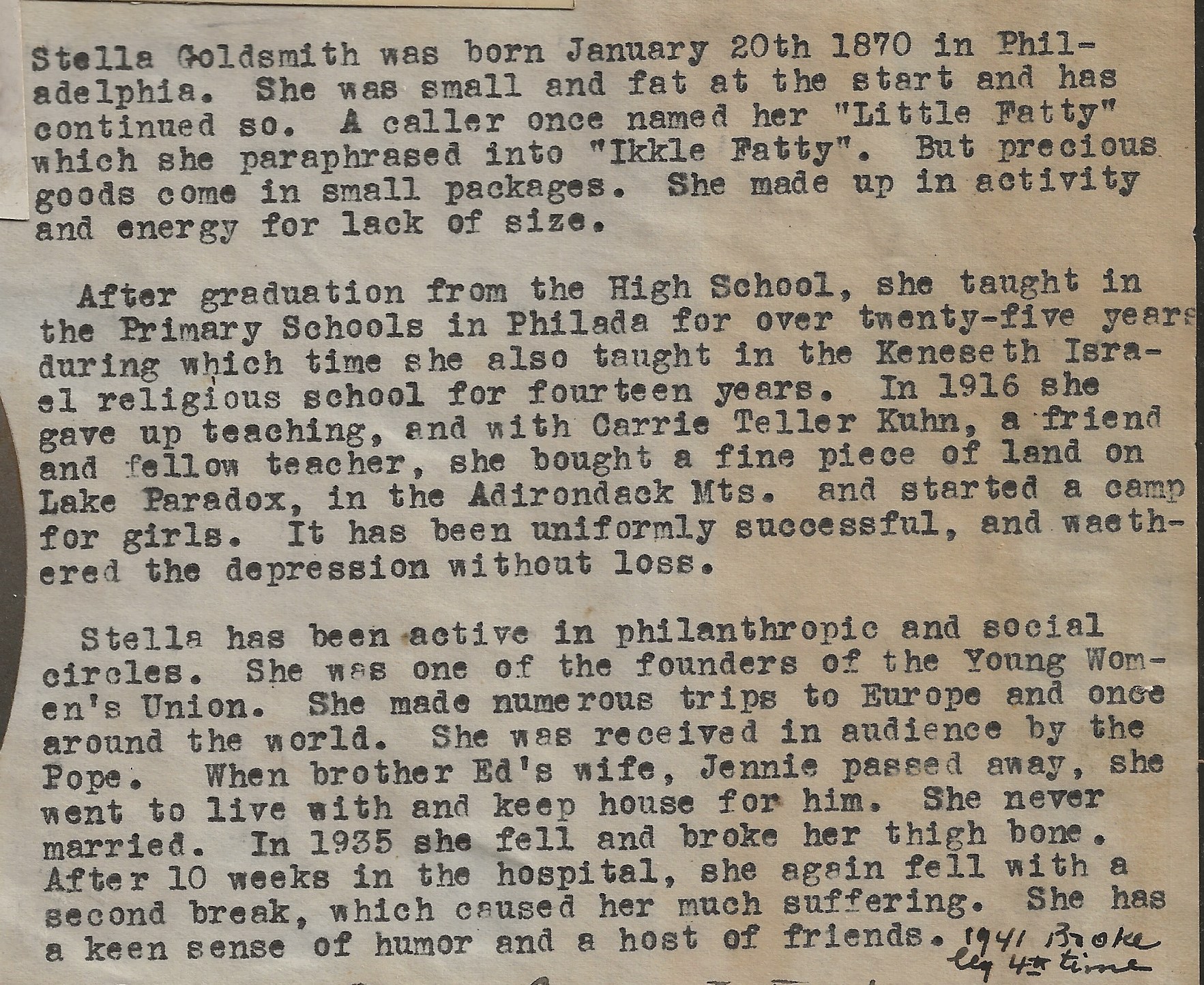
Milton wrote a sweet biography of Stella that mentions not only her work as a teacher but also the camp she created for girls in the Adirondacks.

The page includes several photographs of the camp as well as two photographs of Stella, who does not look at all fat, despite Milton’s description in the biography.


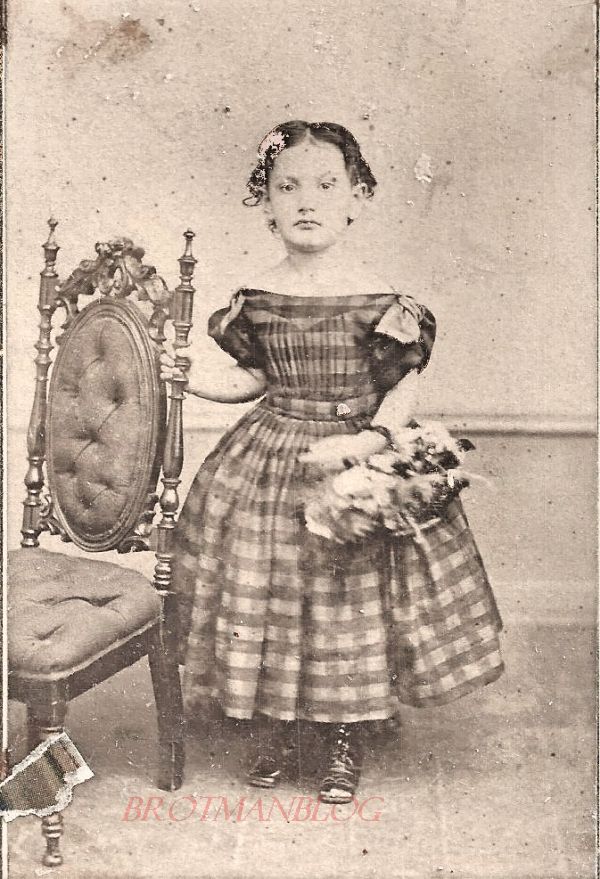
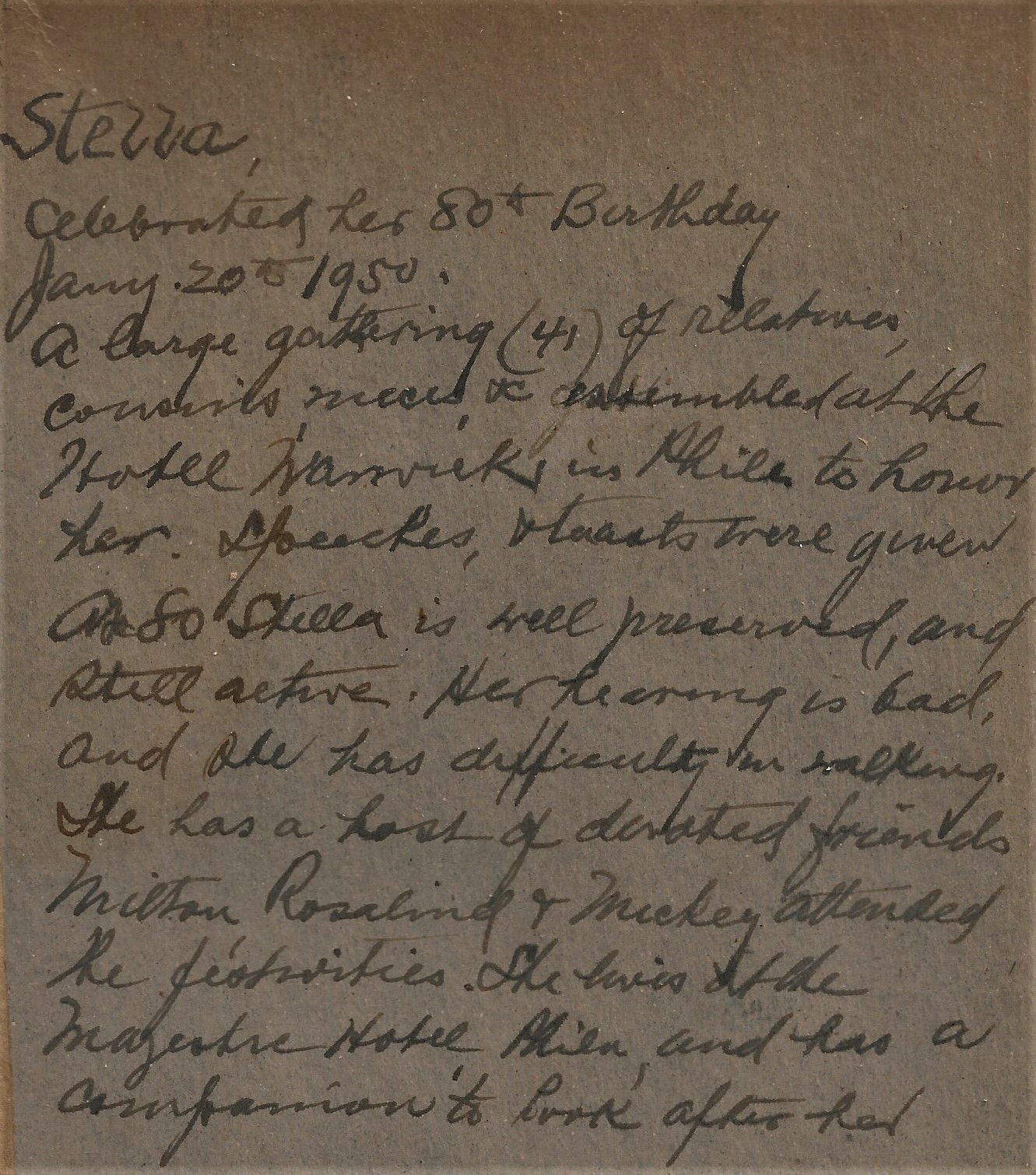
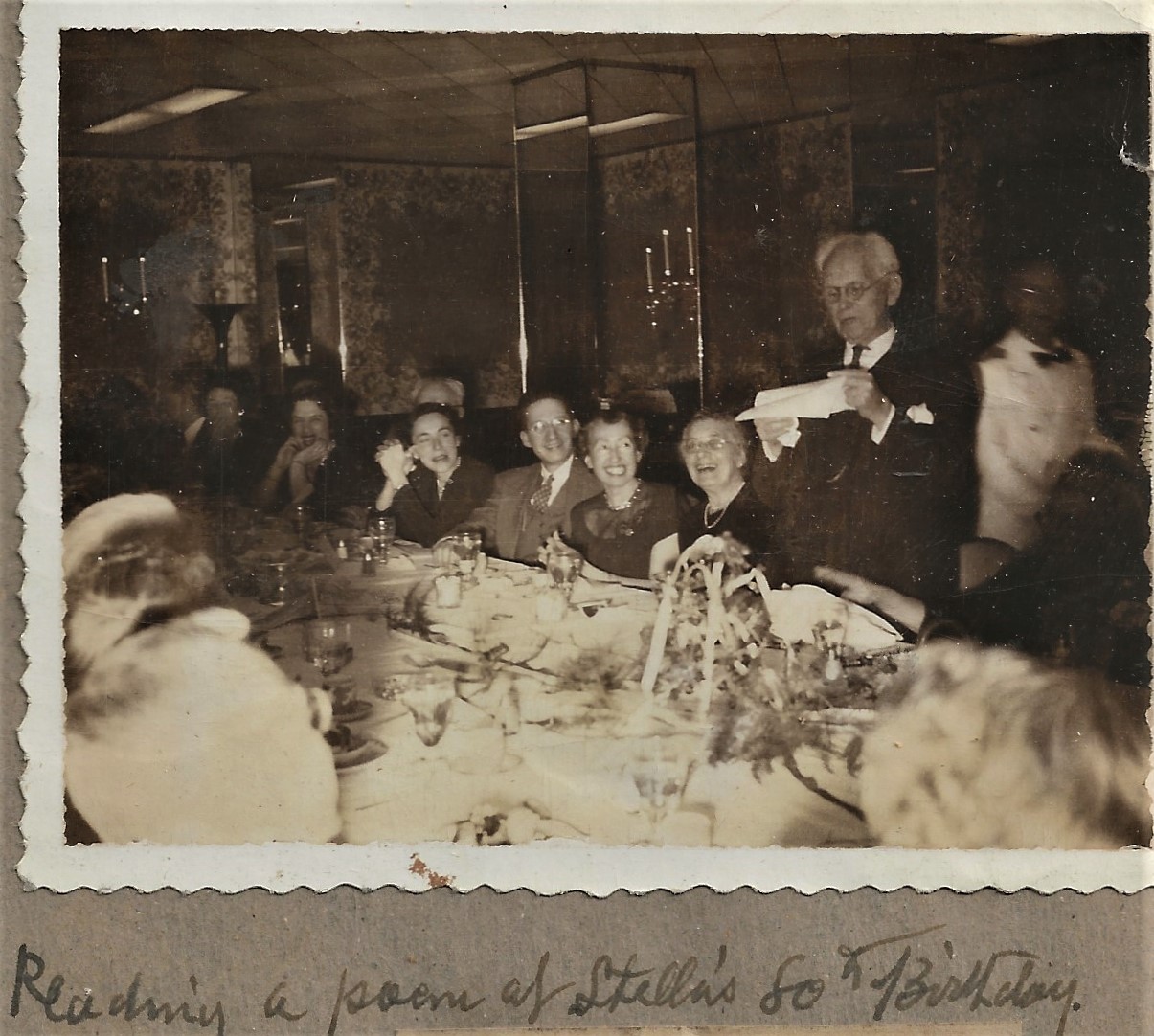
The second page dedicated to Stella has a childhood photograph of her, a handwritten description of her 80th birthday celebration as well as a photograph of that celebration, and her obituary.


Here is the note describing the 80th birthday party and the photograph. I assume that is Milton reading a poem he wrote for his little sister and that sitting to his right is “Stella” herself.

Stella, Celebrated her 80th birthday, Jan’y 20, 1950. A large gathering (41) of relations, cousins, nieces, &c assembled at the Hotel Warwick in Phila to honor her. Speeches, toasts were given. At 80, Stella is well preserved and still active. Her hearing is bad, and she has difficulty in walking. She has a host of devoted friends. Milton, Rosalind & Mickey attended the festivities. She lives at the Majestic Hotel, Phila, and has a companion to look afer her.

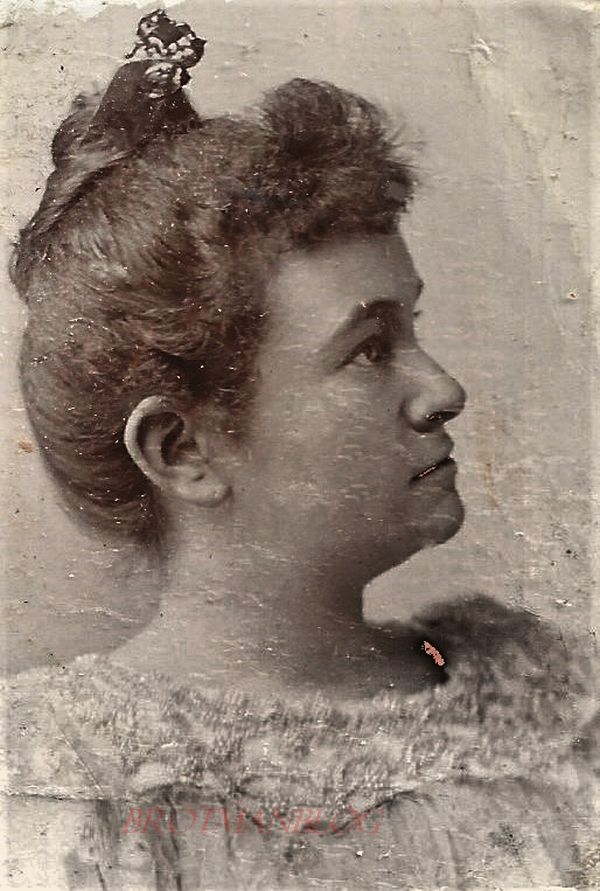
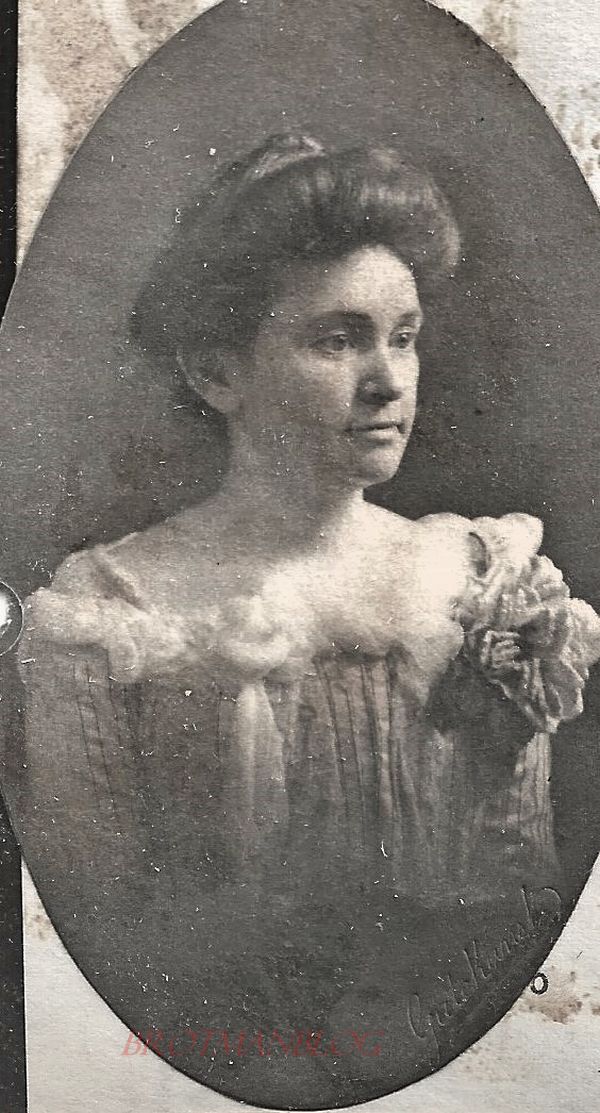
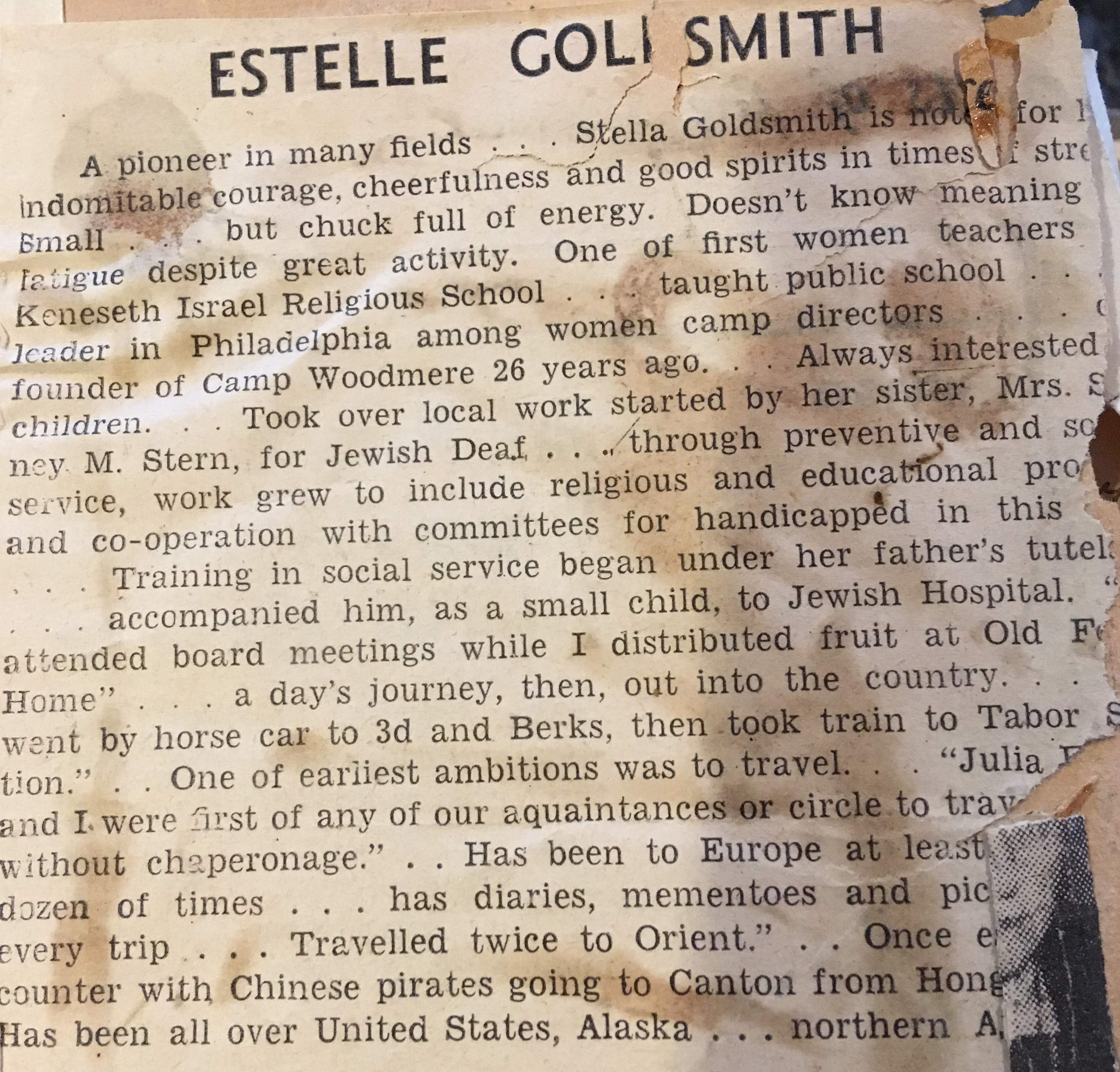
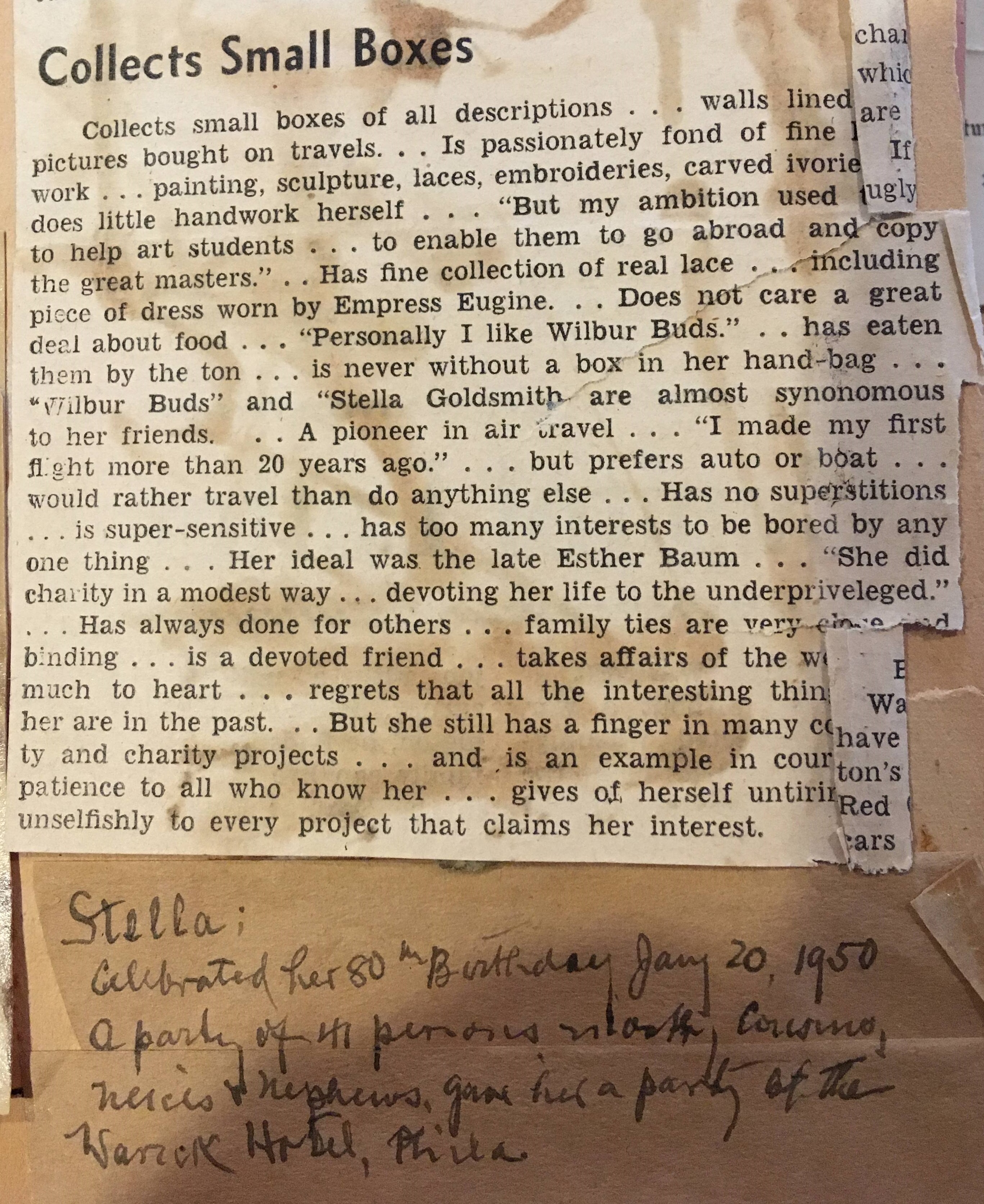
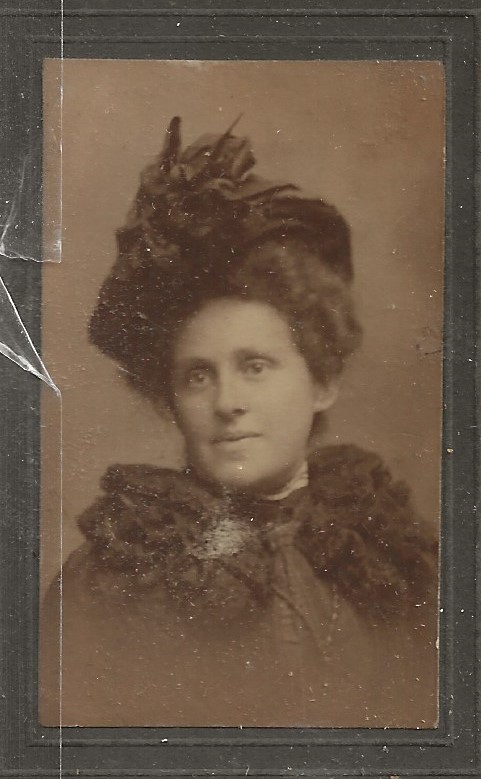
Although Milton focused on Estelle’s career and volunteer activity, there was much, much more to tell about her life. I located an additional photograph of Estelle in one of the other albums and these clippings from a news article about her. You have to read that article. It belies the old myth that a single woman is an “old maid” to be pitied.


What an incredibly exciting and interesting life Estelle lived! She traveled all over the world, including to China, India, Egypt, and what was then Palestine, now Israel. She met the Pope, climbed mountains, rode an elephant and a camel, and observed Yom Kippur at the Western Wall in Jerusalem. She was a woman of many interests and with many friends. Hers was no ordinary life.

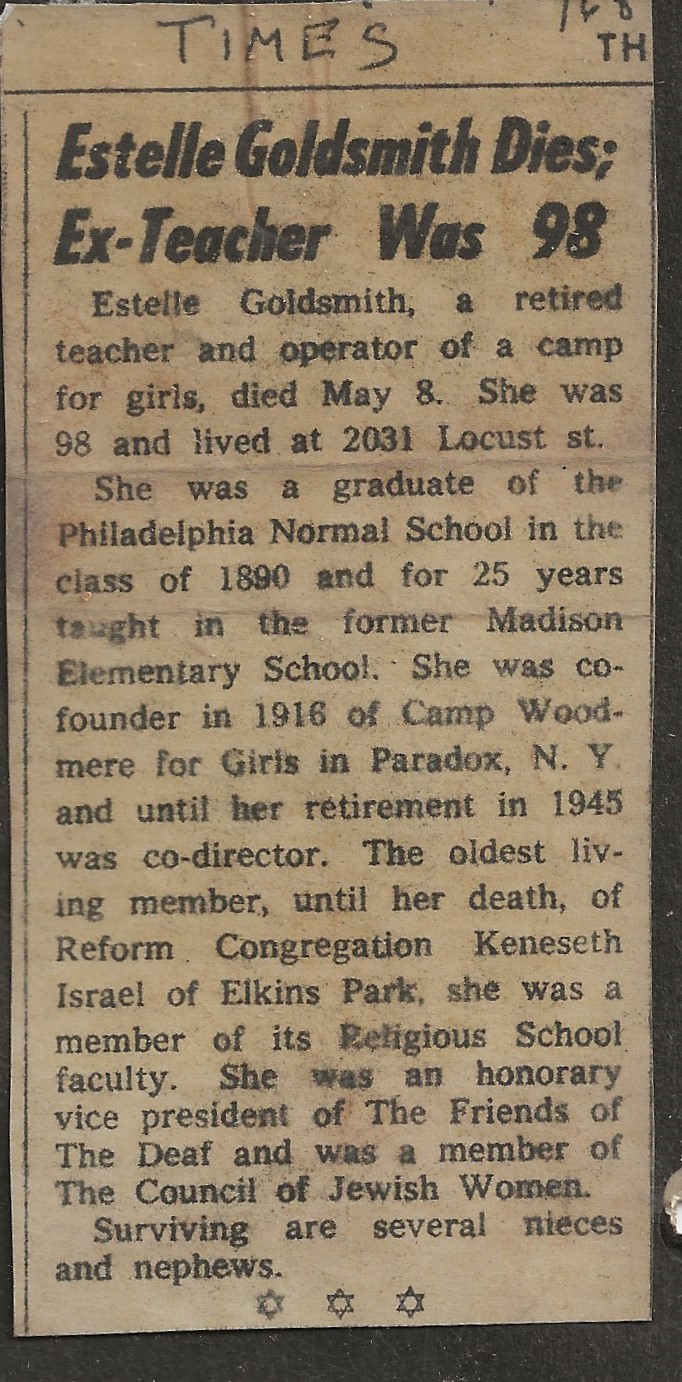
And finally, here is Stella’s obituary.

What is intriguing about the inclusion of this obituary is that Stella did not die until 1968, eleven years after Milton’s death in 1957. Who added this to the album? It had to be one of her many nieces and nephews and probably one of Milton’s daughters. But it is, as far as I can tell, the only thing added to the album after Milton’s death.

I am so grateful to my cousin Milton for preserving for posterity so much of the Goldsmith family history so that the stories of Rose and Estelle and the different choices they made can live on forever.

This is Part XVII of an ongoing series of posts based on the family album of Milton Goldsmith, generously shared with me by his granddaughter Sue. See Part I, Part II, Part IIIPart IVPart V,  Part VI, Part VII , Part VIII,  Part IX,  Part X, Part XI, Part XII Part XIII , Part XIV , Part XV  and Part XVI at the links.


Milton Goldsmith’s Album, Part XVI: His Beloved Sister and Fellow Author, Emily

Most of the remaining pages of the Milton Goldsmith’s album are devoted to his many siblings and their spouses. For example, this page includes photographs of and news clippings about Milton’s sister Emily, who was also a writer, and her husband Felix Gerson, who was a writer and one of the founders of the Philadelphia Jewish Exponent.

I want to highlight the photographs of Emily and Felix, as seeing the faces of those about whom I have written is always a thrill for me:

Emily Goldsmith as a child

Emily Goldsmith Gerson

Emily and Felix Gerson

I will also quote a bit from the news article about Emily. Unfortunately I don’t know when or where it was published.

Mrs. Gerson was most widely recognized as a writer for children. In addition to writing books and editing pages for children, she is the author of a number of playlets, published in pamphlet form, for holiday entertainments in Jewish religious schools. In the last few years adult stories from her pen have appeared frequently in Jewish papers and magazines…

Yet, perhaps in the Young Readers’ Department of the Jewish Exponent, which she originated in 1892, Mrs. Gerson came closest to the hearts of her little readers. The children themselves had a hand in building up this department, and feel that it really belongs to them. They write prize poems and stories, articles and jokes; they give entertainment for charity and send the proceeds to Mrs. Gerson in prettily worded notes; and they contribute about a thousand dollars every year to the Country Week Fund in the department for sending poor Jewish children to the country during the summer.

This page also includes an obituary of Emily’s husband Felix, who died in 1945, almost thirty years after Emily’s death.

The page that follows in Milton’s album includes a biography of Felix Gerson, written presumably by Milton:

Finally, the page below includes several obituaries of Emily, who died in 1917 when she was only 49 years old.

There is also an article about the farm that was named in her honor and used as a summer retreat for poor Jewish children from Philadelphia as well as another photograph of her.

Here are some excerpts from this article and one more photograph of Milton’s beloved sister Emily:

Emily Goldsmith Gereson

In one of the other albums, I found this additional photograph of Felix.

These pages demonstrate how proud Milton was of his sister Emily and how devastated he must have been when she died in 1917.

This is Part XVI of an ongoing series of posts based on the family album of Milton Goldsmith, generously shared with me by his granddaughter Sue. See Part I, Part II, Part IIIPart IVPart V,  Part VI, Part VII , Part VIII,  Part IX,  Part X, Part XI, Part XII Part XIII , Part XIV and Part XV at the links.

Milton Goldsmith’s Family Album, Part XV: Childhood Memories

Last spring I began a series of posts1 that were devoted to a family album created by my first cousin, three times removed (my great-grandmother Hilda Schoenthal Katzenstein’s first cousin), Milton Goldsmith. Milton became a well-known author of both adult and children’s books and is perhaps best known for his novel, Rabbi and Priest, which was adapted into a play, The Little Brother, and produced on Broadway as well as many other places. I wrote extensively about Milton and his works on the blog here, here, and here, for example.

Milton’s granddaughter, my cousin Sue, kindly scanned numerous pages from Milton’s family album and shared them with me. The last page I received from her last spring was about Milton’s brother Edwin. Sue told me that there were many more pages and that instead of scanning them, she thought it would be better to loan me the album so I could select what I wanted to scan.

In October, Sue traveled to Massachusetts to visit other family members (unrelated to me) and came to my house with three or four shopping bags filled with albums that were stuffed with photographs, letters, poems, and other documents about her grandfather Milton and his family. I was overwhelmed, to say the least. Some of the letters were written by Milton’s father Abraham—my three-times great-uncle—in the 1870s and 1880s. These are letters handwritten in the old German script; I cannot read them, but I hope eventually to scan them and to ask someone familiar with that script to help translate them for me. I have to return all these albums to Sue, so I need to find the time to scan. And there is a ton to scan and not much time to do it. But I will do my best.

I have scanned the rest of the family album compiled by Milton Goldsmith and some of the pages in the other albums, and I want to share some of those pages on the blog and continue the project I began last spring. I want to start with some of the pages devoted to Milton’s recollections of his childhood.

As discussed in earlier posts, Milton was the first-born child of Abraham Goldsmith and Cecelia Adler; he was born on May 22, 1861, in Philadelphia, where he lived for his entire childhood until marrying Sophie Hyman in 1899 and then moving to New York City. Milton’s mother Cecelia died when he was thirteen years old, and his father remarried two years later. Altogether, Milton had nine younger siblings—five full siblings and four half siblings.

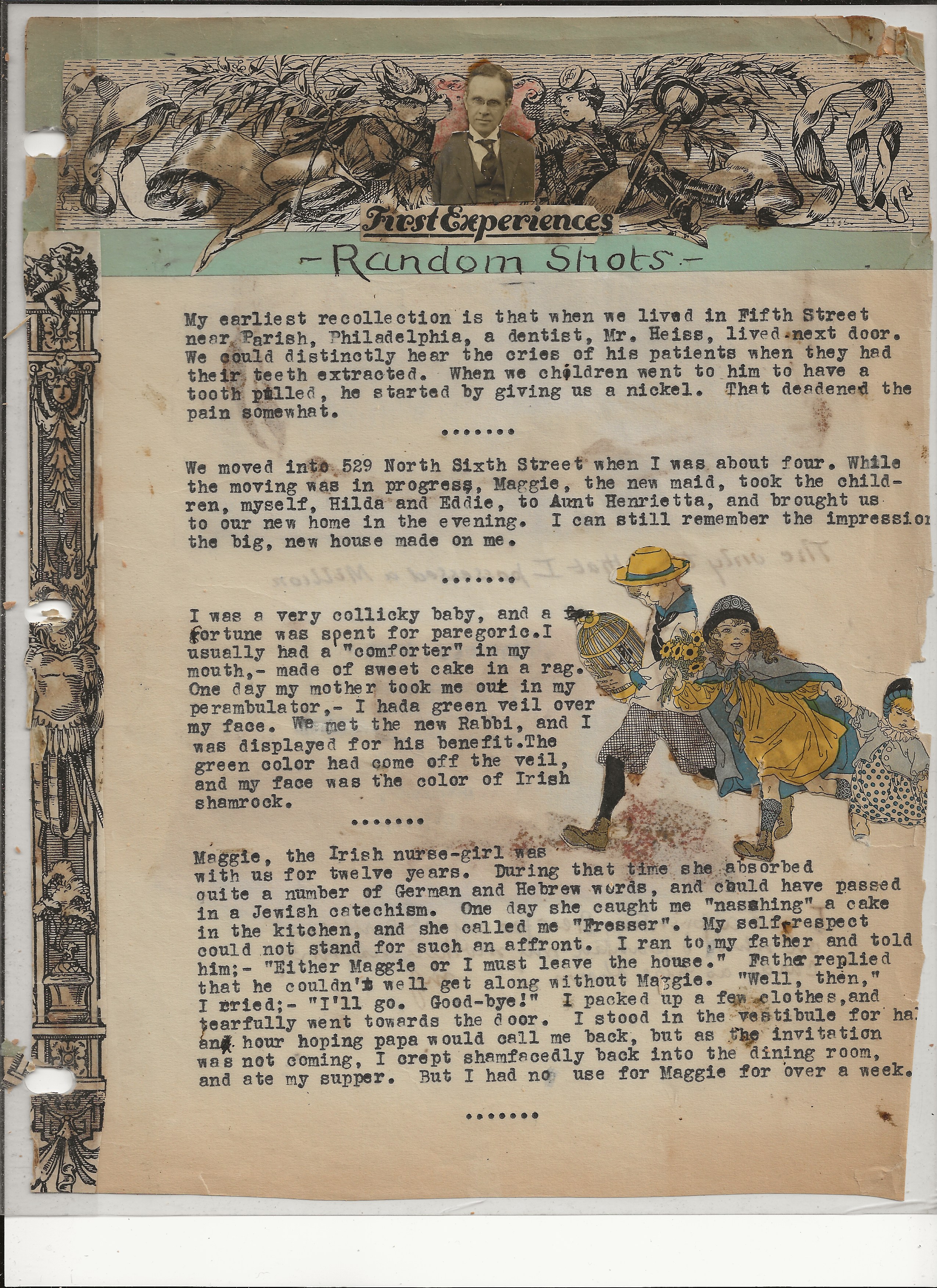
The page depicted below, labeled “First Experiences—Random Shots,” describes some of Milton’s earliest memories—the cries of the patients of the dentist next door, the move to a new home when he was four years old, and the amusing story of how a veil covering his face as a baby combined with the moisture from his “pacifier” and caused his face to turn green. (You may have to click on the photos or zoom in on your screen to read these entries.)

As I read about using a cake-filled cloth to pacify a baby, I couldn’t help but think about the scary dentist next door who must have benefited from those sugar-filled pacifiers.

The final anecdote on this page requires some explanation. Milton talks about being insulted when he is caught eating cake by the family nurse, Maggie, and called a “Fresser.” In German, the verb “to eat” has two different versions. Human beings “essen,” and animals “fressen.” So Maggie was basically calling Milton an animal because of the way he was eating.

Milton shared several anecdotes involving his younger brother Edwin, who grew up to be a successful inventor, as I wrote about here. Edwin was the third oldest child in the family and three years younger than Milton.  You may recall that Edwin’s birth record indicated that he was a girl, a source of some amusement to his big brother Milton. Here is that record; he is the first entry on the page and yes, he was labeled a girl, obviously by mistake:

Despite the teasing, it appears that Milton and Edwin were quite close. Milton wrote about the theatrical performances he and his brother Edwin put on for the neighborhood children. It seems that even as a young boy, Milton had a creative imagination and a love of stories and theater.

Milton and Edwin were involved in several misadventures, as this page describes:

You can see in these anecdotes that Milton was very fond of his younger brother.

There is, however, evidence of more teasing in Milton’s third story about wanting to be a doctor and using a skeleton to scare his brother.

I found it interesting that Milton had at one time aspired to be a doctor. After all, the “other” Milton Goldsmith, his second cousin, did grow up to be a doctor. Given Milton’s success as an author, I doubt he had any regrets about not pursuing the medical profession. On the other hand, Milton’s interest in magic apparently stayed with him for the rest of his life, as reported in his obituary.

The Philadelphia Jewish Exponent, October 4, 1957, p.43.

These delightful recollections reveal another side to Milton—the fun-loving, innocent little boy who loved his family. Despite losing his mother at a young age, Milton obviously looked back on his childhood as a very happy time.

This is Part XV of an ongoing series of posts based on the family album of Milton Goldsmith, generously shared with me by his granddaughter Sue. See Part I, Part II, Part IIIPart IVPart V,  Part VI, Part VII , Part VIII,  Part IX,  Part X, Part XI, Part XII,  Part XIII and Part XIV at the links.


  1. See the links at the bottom of this post. 

Albert Cahn’s Adult Life: More Questions Than Answers

As seen in my last post, the first nineteen years of Albert Cahn’s life were decidedly challenging. He lost both parents before he was five and was raised by his cousin Mollie Sigmund Goldman. He ran away from home twice—once to join the Navy and then to join the Army. He then deserted the Army and was sentenced to ten years hard labor in September 1918, but was granted clemency due to poor health and was released from prison on March 4, 1919.

What happened to him next? There are as many questions as answers about that, I’m afraid. Perhaps some of you can help answer them.
I could not find Albert on the 1920 census. He is not listed in Mollie’s household or in the households of any of his other Baltimore relatives.  I also could not find his cousin, Mollie’s daughter Adele Goldman Weil, or her family anywhere on the 1920 census, so perhaps Albert had returned to Cleveland and was living with the Weils and they somehow were missed by the enumerator. I even had the Weil’s address—2512 Edgehill Road in Cleveland Heights—but there was no census listing for that address or any address with a house number in the 2500s on Edgehill Road.

Thanks to the Social Security Application and Claims Index, I was eventually able to find an Albert F. Cahn listed as the father of two men, Earl Cahn1 and Ronald Vernon Cahn,2 whose mother was Rose (sometimes listed as Rosie) Vrana.  Of course, I couldn’t be sure this was the same Albert F. Cahn, but I hoped that if I kept searching, I’d find some evidence to prove or disprove that this was my cousin Albert.

I found the family first on the 1925 New York State census, where Albert was listed as a salesman, living in Manhattan on Pinehurst Avenue near the George Washington Bridge, with Rose, Earl and Ronald.

Albert F Cahn and family, 1925 NYS census, New York State Archives; Albany, New York; State Population Census Schedules, 1925; Election District: 31; Assembly District: 23; City: New York; County: New York; Page: 16, Description District: A·D· 23 E·D· 31, Ancestry.com. New York, State Census, 1925

I could not find the family on the 1930 census at all, but I did find Albert, Rose, and Ronald Cahn on the 1940 census, living in Manhattan on 68th Street; Albert was an electrical supplies salesman. I was now more persuaded that this was the correct Albert F. Cahn since he was the right age (40) and was born in Maryland. His son Earl was living and working as an attendant at the Central Islip State Hospital in Islip, New York, a town on Long Island.3

Albert F Cahn and family, 1940 US census, Census Place: New York, New York, New York; Roll: m-t0627-02638; Page: 3A; Enumeration District: 31-614
Ancestry.com. 1940 United States Federal Census

But I had no marriage record for Albert or any other records for him after his 1919 discharge from the Army except the 1925 New York State census and the 1940 US census. Where was he in 1920? And where was his family in 1930?

I looked more closely at what I could find for Rose Vrana Cahn and for the two sons, Earl and Ronald. Rose was born October 30, 1894, in East Islip, New York, the daughter of Joseph Vrana and Josephine Shimsa.4 She grew up in Islip, where her father was a gardener.5 In 1920 Rose was working and living at the Central Islip Hospital, the same place where her son Earl would be employed twenty years later.6 And on December 18, 1920, a Rose Vrana married someone named James H. Wilson in Islip.7

But according to the Social Security records, Rose gave birth to Earl Cahn in Boston on December 24, 1921,8: a year after her marriage to James H. Wilson. At first I thought that Albert Cahn had adopted an alias, but James H. Wilson proved to be a separate person.  So somehow Rose had a child in Boston with Albert Cahn twelve months after marrying James H. Wilson in Islip, New York.

There was an Albert F. “Cahan” living in Boston in the 1921 directory, listed as a salesman, and an Albert F. Cahn, a salesman, living at the same address in Boston in the 1922 directory.9 But there is no listing in Boston before 1921 or after 1922 for Albert Cahn. I did, however, find this record showing an Albert F. Cahn briefly working as an attendant at a state institution in Binghamton, New York, for a week in September, 1921.

New York State Archives; Albany, NY, USA; New York State Dept. of Civil Service, State Employee History Cards, 1894-1954; Series: 15029, Ancestry.com. New York, State Employment Cards and Peddlers’ Licenses, 1840-1966

So had Rose and Albert run off to Binghamton and then to Boston during 1921? I have no idea. I am just grasping for straws. Maybe it’s not even the same Alfred F. Cahn in Binghamton. Is it just coincidence that Rose and then later Earl worked as attendants in a state hospital in New York State and that Albert F. Cahn also worked as a state hospital attendant, albeit briefly, in New York State? Did Rose and Albert meet while working together at one of these hospitals? I don’t know.

Rose and Albert’s second child, Ronald, was born in New York City on January 3, 1923, 10 so by that date  the Cahns had returned to New York, and we saw that in 1925 they were living in New York.  But I cannot find one record for Albert or Rose or their two sons after the 1925 New York State census until the 1940 US census. Where were they? I have searched every database I can think of with no luck, including newspaper databases, census records, directories, and Google. Nothing.

But, as seen above, Albert, Rose, and Ronald were living together in New York City in 1940, and Earl was living in Islip, which had been Rose’s hometown. Earl was still working at the Central Islip State Hospital when he registered for the World War II draft. He enlisted in the US Marine Corps on April 15, 1942, and served as a pharmacist for the duration of World War II.11

Earl Cahn, World War 2 draft registration, Ancestry.com. U.S. WWII Draft Cards Young Men, 1940-1947

Earl’s younger brother Ronald also served during World War II. He enlisted into the Air Corps on July 9, 1941, and served until January 5, 1946.12 Interestingly, Ronald still had to register for the draft after being discharged from the military:

Ronald Cahn, World War 2 draft registration, The National Archives in St. Louis, Missouri; St. Louis, Missouri; WWII Draft Registration Cards for Indiana, 10/16/1940-03/31/1947; Record Group: Records of the Selective Service System, 147; Box: 114
Ancestry.com. U.S. WWII Draft Cards Young Men, 1940-1947

As indicated on Ronald’s draft registration, his mother was still living in New York City at 225 West 68th Street, the same address Earl listed for Albert on his draft registration and the same address where the family was located on the 1940 census. Was Albert still there in 1946 when Ronald registered? Why is there no listing for Albert in any New York directory during these years? I am befuddled.

Albert Cahn died in March 1974 and was residing in Flushing, Queens, New York, at the time.13 His wife Rosie died January 4, 1990, in Patchogue, New York, not far from Islip where she was born and raised and where her two sons ended up living.14 Ronald died in Islip on April 24, 1995,15 and his brother Earl died in Islip on November 1, 2005.16

Interestingly, both Ronald and Earl were buried at Calverton National Cemetery, the federal military cemetery on Long Island.17 Both had served honorably in World War II. One has to wonder what they thought of their father’s military record and what their father thought of theirs.

Thus ends the story of Alfred Cahn, at least as far I can find it. If anyone has any suggestions for how I can fill the many gaps (1919-1925, 1926-1940, and 1942-1974), please help! Albert’s early life was filled with so much turmoil and tragedy that I would very much like to know more about his adult life.

This is also the final chapter in the story of Ella Goldschmidt Sigmund, so I now can return to her siblings in Germany and tell the story of the other children of my four-times great-uncle, Meyer Goldschmidt.

But first some updates on another member of the Goldschmidt family.


  1. Father: Albert F Cahn, Mother: Rose Vrana, SSN: 066141497, EARL CAHN, Ancestry.com. U.S., Social Security Applications and Claims Index, 1936-2007. 
  2. Father: Albert F Cahn, Mother: Rose Viana, SSN: 072147550,  RONALD VERNON CAHN, Ancestry.com. U.S., Social Security Applications and Claims Index, 1936-2007 
  3. Earl Cahn, 1940 US census, Census Place: Islip, Suffolk, New York; Roll: m-t0627-02787; Page: 36A; Enumeration District: 52-129B, Ancestry.com. 1940 United States Federal Census 
  4.  Name: Rosie Vrana, Birth Date: 30 Oct 1894, Birth Place: East Islip, New York, USA, Certificate Number: 46459, New York State Department of Health; Albany, NY, USA; New York State Birth Index, Ancestry.com. New York State, Birth Index, 1881-1942. Father: Joseph Vrana, Mother: Josephine Shimsa, SSN: 053524750, Death Certificate Number: 001971, Ancestry.com. U.S., Social Security Applications and Claims Index, 1936-2007 
  5. Vrana family, 1910 US census, Census Place: Islip, Suffolk, New York; Roll: T624_1082; Page: 9B; Enumeration District: 1371; FHL microfilm: 1375095, Ancestry.com. 1910 United States Federal Census 
  6. Rose Vrana, 1920 US census, Census Place: Islip, Suffolk, New York; Roll: T625_1269; Page: 24A; Enumeration District: 128, Ancestry.com. 1920 United States Federal Census 
  7.  Name: Rose Vrana, Marriage Date: 18 Dec 1920, Marriage Place: Islip, New York, USA, Spouse: James H Wilson, Certificate Number: 43940, New York State Department of Health; Albany, NY, USA; New York State Marriage Index, Ancestry.com. New York State, Marriage Index, 1881-1967 
  8. Father: Albert F Cahn, Mother: Rose Viana, SSN: 066141497, EARL CAHN, Ancestry.com. U.S., Social Security Applications and Claims Index, 1936-2000. 
  9. Boston, Massachusetts, City Directory, 1921, 1922, Ancestry.com. U.S. City Directories, 1822-1995 
  10. Father: Albert F Cahn, Mother: Rose Viana, SSN: 072147550,  RONALD VERNON CAHN, Ancestry.com. U.S., Social Security Applications and Claims Index, 1936-2007 
  11. Name: Earl A Cahn, Muster Date: Oct 1942, Rank: Pharmacist Mate Third Class
    Station: Hqco, 2Dbn,9Thmar,Reinf,Advech,3Rdmardiv,Camp Joseph, Pendleton,Oceanside,Calif., Ancestry.com. U.S. Marine Corps Muster Rolls, 1798-1958. Ancestry.com. U.S., Department of Veterans Affairs BIRLS Death File, 1850-2010 
  12. Ancestry.com. U.S., World War II Army Enlistment Records, 1938-1946. Ancestry.com. U.S., Department of Veterans Affairs BIRLS Death File, 1850-2010 
  13. Name: Albert Cahn, Social Security Number: 215-10-3029, Birth Date: 16 Nov 1899, Issue year: Before 1951, Issue State: Maryland, Last Residence: 11366, Flushing, Queens, New York, USA, Death Date: Mar 1974, Social Security Administration; Washington D.C., USA; Social Security Death Index, Master File, Ancestry.com. U.S., Social Security Death Index, 1935-2014 
  14. SSN: 053524750, Death Certificate Number: 001971, Ancestry.com. U.S., Social Security Applications and Claims Index, 1936-2007 
  15. Name: Ronald V Cahn, Service Info.: SGT US ARMY AIR CORPS WORLD WAR II, Birth Date: 3 Jan 1923, Death Date: 24 Apr 1995, Service Start Date: 9 Jul 1941
    Interment Date: 27 Apr 1995, Cemetery: Calverton National Cemetery
    Cemetery Address: 210 Princeton Boulevard Rt 25 Calverton, NY 11933
    Buried At: Section 66 Site 5856, National Cemetery Administration. U.S. Veterans’ Gravesites, ca.1775-2006. 
  16. Name: Earl A Cahn, Service Info.: PHM1 US NAVY WORLD WAR II
    Birth Date: 24 Dec 1921, Death Date: 1 Nov 2005, Cemetery: Calverton National Cemetery, Cemetery Address: 210 Princeton Boulevard Rt 25 Calverton, NY 11933
    Buried At: Section 29 Site 2618, National Cemetery Administration. U.S. Veterans’ Gravesites, ca.1775-2006 
  17. See footnotes 15 and 16, above. 

My Cousin’s Case before the US Supreme Court: Philipp v. Germany

My second Goldschmidt update involves the descendants of Selig Goldschmidt, specifically his great-great-grandson, my fifth cousin, Alan Philipp.

Right now there is a case pending before the United States Supreme Court that was brought by Alan Philipp and two other plaintiffs. They brought a lawsuit against the Federal Republic of Germany and the Stiftung Preussischer Kulturbesitz (“SPK”), or in English, the Prussian Cultural Foundation.

The SPK is described on its website as “the largest employer in the cultural sector in Germany. It is a federal foundation and is shaped by the federal structure of Germany. The federal government and all sixteen federal states support and finance it jointly.” It was formed in 1957 after “the final dissolution of the state of Prussia ten years earlier. As a result, the question of ownership of its important public collections had to be reorganized. These collections were given to the foundation as property by the establishment law.” (translations by Google Translate)

Among those properties that were transferred by the government to the SPK was a very valuable collection of medieval works of art known as the Welfenschatz or in English, the Guelph Treasure. The Welfenschatz had been acquired in 1929 by three art collectors who had formed a consortium (“the Consortium”) to acquire art.

One of those art collectors was the firm of J&S Goldschmidt, founded in the mid-19th century by my cousins Jacob Meier and Selig Goldschmidt; another was Zacharias Hackenbroch, the grandson-in-law of Selig Goldschmidt, the son-in-law of Recha Goldschmidt, and husband of Clementine Schwarzschild. Alan Philipp shared with me a photograph of three of the investors, his grandfather Zacharias Hackenbroch, his cousin Julius Falk Goldschmidt, and Saemy Rosenberg:

Zacharias M. Hackenbroch, Julius Falk Goldschmidt, and Saemy Rosenberg. Courtesy of Alan Philipp

According to the allegations made by the plaintiffs, heirs to the Consortium, in 1935 the Consortium was coerced by economic duress, fraud, and bad faith to sell the Welfenschatz to the Nazis for about a third of its value   After unsuccessfully pursuing their claim for compensation first in Germany, the plaintiffs sued both the Federal Republic of Germany and the SPK in the US District Court for the District of Columbia for either the return of the Welfenschatz, which is currently located in the collection of the SPK in Germany, or for damages equivalent to the current value of the collection, claiming that the property had been wrongfully misappropriated from the Consortium in 1935.

Germany and the SPK moved to dismiss the lawsuit, arguing in part that the United States courts did not have jurisdiction over the plaintiffs’ claims against a foreign state. Before getting too far into the weeds of the legal issues and all their complexities, let me stop here to explain just a few procedural matters.

There has not been a trial in this case. The defendants moved to dismiss the case on the basis of the plaintiff’s pleadings alone; a court can dismiss a lawsuit if it finds that the plaintiffs have no basis for a legal claim even if they can eventually prove every fact they have alleged in their pleadings. So for purposes of this case—at all three levels of the federal court system, the District Court, the Court of Appeals, and the Supreme Court—the courts are assuming the truth of the facts claimed in the plaintiff’s complaint. The only issues the lower courts have determined and the only issues the Supreme Court will decide is whether this case should be dismissed because the American federal courts do not have jurisdiction over these claims even if the plaintiffs can eventually prove the truth of their allegations.

So what were those allegations? The District Court for the District of Columbia summarized them in their opinion (the paragraph numbers are references to the plaintiff’s complaint):

Plaintiffs’ position is that the 1935 sale between the Consortium and the State of Prussia, a political subdivision of the German Weimar Republic and later the Third Reich, was coerced as part of the Nazi persecution of the Jewish sellers of the Welfenschatz and, as such, the Court shall briefly summarize the allegations in the complaint that Plaintiffs rely on in support of this position. Id. ¶ 22. Specifically, Plaintiffs allege the 1935 transaction was spearheaded by Nazi-leaders Hermann Goering and Adolf Hitler, who were involved in explicit correspondence to “save the Welfenschatz” for the German Reich. Id. ¶¶ 2, 9. Further, the 1935 sale resulted in a payment of 4.25 million RM, which Plaintiffs assert demonstrates the lack of an arms’-length transaction because it was barely 35% of the market value of the Welfenschatz. Id. ¶¶ 4, 12.  Further, the money exchanged was never fully accessible to the Consortium because it was split and partly paid into a blocked account, and was subject to “flight taxes” that Jews had to pay in order to escape. Id. ¶¶ 4, 12. Moreover, in November of 1935, Goering presented the Welfenschatz as a personal “surprise gift” to Hitler during a ceremony. Id. ¶¶ 13, 179.

Philipp v. Fed. Republic of Ger., 248 F. Supp. 3d 59, 65 (D.D.C. 2017)

The District Court’s opinion then listed the plaintiff’s allegations describing some of the specific steps the Nazis took to coerce and defraud the Consortium into selling them the Welfenschatz, knowing the enormous economic pressure they were under as a result of the Nazi persecution of Jews at that time.

The defendants moved to dismiss on numerous grounds, but the ones that are still being pressed at the Supreme Court boil down to two arguments:  one, that the US courts have no jurisdiction to adjudicate the claims based on a federal statute, the Federal Sovereign Immunity Act (“FSIA”), and two, that US courts should not allow such a claim out of respect for the laws and procedures of a foreign country under principles of comity.

For lawyers, these issues are fascinating. But this is not a blog about legal matters, and there are many resources out there for those who are interested in all the ins and outs of the issues presented. (See the list below for a few.) I just want to say a little more about the issues involving the FSIA.

The FSIA generally grants immunity from liability to foreign states, preventing lawsuits against those states and their agents (in this case SPK) in American courts. But there are exceptions provided in the statute; the plaintiffs are relying on one of those exceptions as the basis of the court’s jurisdiction over their claims, the so-called “expropriation exception.” It provides that a party can proceed against a foreign state where their claim is one “in which rights in property taken in violation of international law are in issue and that property or any property exchanged for such property is present in the United States in connection with a commercial activity carried on in the United States by the foreign state….” 28 U.S.C. § 1605(a)(3).

The defendants raised several arguments against the application of this exception to the plaintiffs’ claims, but I want to focus on just one of those arguments—whether or not this was a taking of the Consortium’s property that violated international law. The plaintiffs argued, relying on an earlier decision of the Court of Appeals of the District of Columbia, that when a taking of property bears a “sufficient connection” to genocide, the taking is itself a violation of international law.

The District Court agreed, focusing on the plaintiffs’ allegations that “the coerced sale of the Welfenschatz was accomplished to deprive the Consortium of their ability to earn a living and the motivation for the taking was to deprive the Consortium of resources needed to survive as a people in furtherance of the genocide of the German Jews during the Holocaust.” Philipp v. Fed. Republic of Ger., 248 F. Supp. 3d 59, 71 (D.D.C. 2017) The District Court also concluded that the plaintiffs had satisfied the commercial nexus requirement of the expropriation exception and that therefore the case should not be dismissed.

A work from the Guelph Treasure
Reliquary of the arm of Saint Blaise (Herzog Anton Ulrich Museum, Dankwarderode Castle). User:Brunswyk, CC BY-SA 3.0 <http://creativecommons.org/licenses/by-sa/3.0/&gt;, via Wikimedia Commons

The defendants appealed this decision to the Court of Appeals of the District of Columbia, and the Court of Appeals agreed with the District Court on the issue of whether there was a taking of property in violation of international law, reasoning in part:

Congress has twice made clear that it considers Nazi art-looting part of the Holocaust. In enacting the Holocaust Victims Redress Act, which encouraged nations to return Nazi-seized assets, Congress “f[ound]” that “[t]he Nazis’ policy of looting art was a critical element and incentive in their campaign of genocide against individuals of Jewish … heritage.” Holocaust Victims Recovery Act, Pub. L. No. 105-158, § 201, 112 Stat. 15, 15 (1998). And in the Holocaust Expropriated Art Recovery Act (HEAR Act), which extended statutes of limitation for Nazi art-looting claims, Congress again “f[ound]” that “the Nazis confiscated or otherwise misappropriated hundreds of thousands of works of art and other property throughout Europe as part of their genocidal campaign against the Jewish people and other persecuted groups.” Holocaust Expropriated Art Recovery Act of 2016, Pub. L. No. 114-308, § 2, 130 Stat. 1524, 1524 (emphasis added)

Philipp v. Fed. Republic of Germany, 894 F.3d 406, 411-12 (D.C. Cir. 2018)

The Court of Appeals, however, disagreed with the District Court with respect to the application of the expropriation exception to Germany based on the second requirement of the exception: that for a claim against a foreign state to fit within the exception, the property that was confiscated must be located in the United States, which was not the case here with the Welfenschatz. Thus, the appellate court dismissed the claim against Germany itself.

With respect to the claim against the SPK, the appellate court concluded that the requirements of the statute were different with respect to an instrumentality of a foreign state and that because there was a “sufficient commercial nexus” between the SPK, an instrumentality of Germany, and the United States, the case against the SPK could go forward even though the disputed property was in Germany, not the United States.

A work from the Welfenschatz in the Bode Museum in Germany
User:FA2010, Public domain, via Wikimedia Commons

It will be very interesting to see how the Supreme Court rules in this case. The issues go beyond this one case, of course. Sadly, genocide has occurred and continues to occur in all parts of the world, and those who have been damaged—whose property has been stolen, as was the case with so much of the art owned by German Jews—may want to seek recourse in American courts.

Foreign policy concerns and the principles of comity lie behind the arguments of the defendants that these matters should be pursued in the country where the wrongful acts occurred. One argument made by the defendants was that if claims against a country by a national of that country can be brought in other countries, foreign courts could end up litigating claims by US nationals against the US, e.g., claims brought by Japanese-Americans who were interned during World War II against the US might be litigated outside the US or claims brought against the US by African-Americans for reparations for slavery could be litigated in another country.

The plaintiffs distinguish those cases by pointing out that Nazi Germany stripped their ancestors of their citizenship as part of their persecution of Jews and that therefore they were no longer nationals of Germany but stateless. Thus, these are not claims against Germany or its agents by German nationals. They also argue that the Holocaust has been treated as unique by both American law and international law, and thus special treatment needs to be provided for those seeking redress for harms done as part of the Holocaust.

I listened to the oral arguments made by the lawyers before the Supreme Court on December 7, and although I thought that the defendant’s lawyer was persuasive with regard to the meaning and scope of the statutory language, the plaintiffs’ arguments have the stronger moral position. I will be watching carefully to see whether the heirs of my Goldschmidt cousins are able to pursue their claims and ultimately obtain compensation for the harm that was done to their ancestors almost 90 years ago.

For those who want to learn more about the case, I suggest the following resources:

I have included links to the lower court opinions in the body of the text of the blog.

Here is a link to a recording of the oral arguments made before the Supreme Court on December 7, 2020.

The Scotus Blog has links to the briefs filed by the parties and by amicus curiae.

The Art Newspaper has a recent article about the case.

The New York Times has a good summary of the case.

This is a short piece written by the plaintiffs’ lawyer Nicholas O’Donnell of Sullivan & Worcester.

For more in-depth analysis of the FSIA and the international law regarding Nazi appropriation of art, see the following law review articles about FSIA:

Vivian Grosswald Currana, “THE FOREIGN SOVEREIGN IMMUNITIES ACT’S EVOLVING GENOCIDE EXCEPTION, ” UCLA Journal of International Law and Foreign Affairs, Spring, 2019

Michael J. Birnkrant, “THE FAILURE OF SOFT LAW TO PROVIDE AN EQUITABLE FRAMEWORK FOR RESTITUTION OF NAZI-LOOTED ART, ” Washington University Global Studies Law Review, 2019

Ugboaja, Ikenna (2020) “Exhaustion of Local Remedies and the FSIA Takings Exception: The Case for Deferring to the Executive’s Recommendation,” University of Chicago Law Review: Vol. 87 : Iss. 7 , Article 5.
Available at: https://chicagounbound.uchicago.edu/uclrev/vol87/iss7/5


The Court-Martial of Albert F. Cahn

I want to start 2020 with a story that is in many ways one of the most disturbing and challenging stories I’ve researched. It’s a story about bullying and military (in)justice and the folly of youth.

Felix Albert Cahn, who was known as Albert, was my fourth cousin, once removed.

Remembering the tragic start to Albert’s life makes his story especially poignant. To recap what I’ve already written about him:

Felix Albert Cahn was the son of May Sigmund and Gerson Cahn. May was the biological daughter of Lena Sigmund and Solomon Sigmund. Her mother Lena died when May was a year old.  Solomon, May’s biological father, seems to have disappeared from her life after Lena died. So May was effectively an orphan from the time she was a toddler, and was raised and seemingly adopted by her grandparents, Ella Goldschmidt and Albert Sigmund.

May married Gerson Cahn on April 24, 1898, and their son Albert was born on November 6, 1899 in Baltimore.  His father Gerson died on November 23, 1903, and his mother May died just four months later on March 18, 1904. Albert was only four years old and had lost both his parents. Albert, like his mother, was orphaned as a young child.

Marriage record of Gerson Cahn and May Sigmund, http://guide.msa.maryland.gov/pages/viewer.aspx?page=marriage#goToPage

In 1910 when Albert was ten, he was living with his biological first cousin and adoptive aunt, Mollie Sigmund Goldman, and her family. Albert engaged in charitable work, collecting money for sick children, when he was thirteen, and he was confirmed at Har Sinai Temple in Baltimore when he was fourteen. He seemed to be growing up just fine.

Harry Goldman and family, 1910 US census, Census Place: Baltimore Ward 15, Baltimore (Independent City), Maryland; Roll: T624_558; Page: 5A; Enumeration District: 0250; FHL microfilm: 1374571
Ancestry.com. 1910 United States Federal Census

Then Albert entered the military. According to a volume compiled in 1933, Maryland In the World War, 1917-1919: Military And Naval Service Records, Albert was inducted into the US Army on June 20, 1917, when he was seventeen. He was promoted to private, first class, on August 3, 1917, and was serving with the Ambulance Corps, but not overseas. Then on December 13, 1917, he went absent without leave and was found guilty of desertion. He was sent to prison at Fort Jay in New York City on August 20, 1918, and was dishonorably discharged from the army on March 14, 1919.1

The only additional information I could initially find about Albert’s military record was this brief news item that was published on September 27, 1918, in the Brooklyn Daily Eagle:

Brooklyn Daily Eagle, September 27, 1918, p. 19

I was quite disturbed by this news story and the report in the Maryland in the World War book, and I was determined to learn more about Albert’s case. I sent a request to the National Archives National Personnel Records Center and received this reply:

Thus, it appeared that there was no file about Albert Cahn’s military record that survived the 1973 fire at the National Archives.  I then decided to see if there was a record of Albert’s court-martial that existed separately from his military records. I wrote again to the National Archives asking if there would be a transcript of a court-martial from 1919. And sure enough there was.

The file is 35 pages long, and I won’t reproduce it here in its entirety, but if you are interested, you can find it here; CahnAlbertF_1760263_GCM  I will summarize most of it and share some of the pages. The pages in the citations refer to the page numbers in the file I received from NARA.

Albert was charged with desertion, to which he pled not guilty, as articulated here:

Court Martial file of Albert F. Cahn, p. 14

There were only three witnesses at the trial. The first witness was Harry Goldman, Mollie Sigmund’s husband. Harry described Mollie as Albert’s guardian and as “his mother’s niece,” that is, May Sigmund Cahn, Albert’s mother, was Mollie’s niece (as well as her adoptive sister). (p. 15) Mollie herself was the second witness, and finally Albert testified on his own behalf. Rather than recount the testimony in the order it was given, I thought it would be more helpful to tell Albert’s story in chronological order as described by the three witnesses.

Harry testified that after Albert’s father Gerson Cahn died, Albert’s mother May asked her aunt/adoptive sister Molly if she and Albert could temporarily live with Molly’s family. Then May died a few months after moving in to Molly’s home, leaving Albert an orphan. Harry testified that Albert’s grandfather had no interest in Albert, and Harry and Molly’s children persuaded them to take care of Albert on a permanent basis. Thus, Albert had been living with Harry and Molly since he was four years old. Harry agreed that his relationship with Albert was like that of father and son. (p. 18) Molly’s testimony corroborated these facts. (p.21)

File of Court-Martial of Albert F Cahn, p. 18

I was puzzled by the reference to Albert’s grandfather since Harry did not identify which grandfather he meant when he said that the grandfather had taken no interest in Albert. Was that Gerson Cahn’s father, Felix? He was living in Baltimore in 1904 when Albert was orphaned and in his sixties with grown children. Or did Harry mean Albert’s maternal grandfather, Solomon Sigmund, who seemed to disappear from the family after Lena died in 1875? I suppose neither grandfather was interested in taking care of young Albert.

Being orphaned at such a young age and being abandoned by his grandparents must have had some psychological effect on Albert. Molly’s description of Albert’s personality should probably be seen in that light. She testified:

File of Court-Martial of Albert F. Cahn, p.22

Molly further testified that Albert had not gone to high school or into business and that his employment record was very spotty—that he’d left eight to ten jobs without justification. She agreed that he was “very” excitable and eccentric. But she also testified that Albert was “always extremely honest.” And she agreed that his behavior was “due to lack of serious thought—boyishness.” (p. 23)

Harry testified that in December, 1916, when Albert would have been just turning seventeen, he ran away from home with a friend and ended up in Great Lakes, Illinois, where he (and the friend) enlisted in the Navy without consent from his guardians. After his friend died from spinal meningitis, Albert wrote to Harry and Molly, indicating that he wanted to get out of the Navy. Harry intervened with the Navy, knowing that Albert was underage when he enlisted, and Albert was discharged. (p. 19) Albert himself corroborated these facts in his own testimony. (p. 27)

According to Harry, Albert then went to Cleveland, where Harry and Molly’s daughter Adele was living with her family. In contrast, Albert testified that he returned to Baltimore and stayed home until a little before the “war broke out” (I assume he meant the United States’ entry into World War I in April 1917). In any event, both Albert and Harry testified that sometime in the spring of 1917, Albert ran away again, this time to Kalamazoo, Michigan, where he enlisted again on June 20, 1917, this time in the Army. He was still not eighteen years old. (pp.19, 27)

He was first stationed at Fort Oglethorpe in Georgia and then at Camp Dix in New Jersey. (p. 19) Harry testified that Albert would come to visit them in Baltimore when he had a furlough and that he seemed to be getting along fine. But Albert’s testimony revealed that things did not go well after some time at Camp Dix.

Court-Martial File, Albert F Cahn, p. 27

Harry testified at length about his efforts to convince Albert to return to the Army. Both Harry and Molly testified that they had not heard from Albert after December 1917 until August 1918 when Harry persuaded Albert to return to Camp Dix. (pp. 15-20)

Albert’s attorney argued in his closing statement that “this fellow is nothing but a mere child and has never really considered his status in the army at all, his military status. … I really think he did not consider the consequences of his act in going away from here.” (p. 29)

The court was not convinced and on September 16, 1918, found Albert guilty of the charge of desertion and issued the following sentence: “To be dishonorably discharged the service, to forfeit all pay and allowance due or to become due, and to be confined at hard labor, at such place as the reviewing authority may direct for twenty (20) years.” (p. 29)

I don’t know anything about military justice, but sentencing a young man–a teenager–for twenty years hard labor because he ran off after being bullied by his fellow soldiers seemed awfully harsh. I realize that desertion is a very serious offense, but Albert was not in a war zone, no one was endangered by his desertion, and he had had a hard life. Some mercy could have been shown.

Eight days later, on September 24, 1918, Major General Scott reduced the sentence to ten years hard labor and designated Fort Jay in New York as the place of confinement.

File of Court-Martial of Albert F Cahn, p. 31

But Albert did not serve even a year of that sentence. On February 13, 1919, Harry Goldman submitted a request for clemency supported by affidavits from a doctor and from Molly regarding Albert’s poor condition .

Court-martial file of Albert F Cahn, p. 2

Unfortunately, there were no copies of those affidavits in the file. But Harry’s request was granted, and Albert was released from imprisonment on March 4, 1919.

Court-martial file of Albert F. Cahn, p. 3

Court-martial file of Albert F Cahn, p. 1

Thus, in the end Albert served less than six months. What did Albert F. Cahn do after his release? What was the rest of his life like? Did he learn from this experience? Did he mature? That is a story for another post.


  1. Maryland. War records commission, Karl Singewald, and Stuart Symington Janney. Maryland In the World War, 1917-1919: Military And Naval Service Records. Baltimore: Maryland War Records commission, 1933, p. 303. 

Holiday Wishes

I will be taking a short break from blogging until early 2020. So let me wish all of my family, friends, and loyal readers a wonderful holiday season. Whether you celebrate Hanukkah, or Christmas, or Kwanzaa, or all of them, or something else, or nothing at all, we all need ways to find light and hope in the darkest time of the year, a year that for many of us has been a dark year. I will not miss 2019. May 2020 bring light, love, and hope around the world and to all of you.

On that note, I will once again share one of my favorite quotations.