A Few New Tidbits about Moritz and Babetta, My Great-great-great-grandparents

I am working on a blog post about the descendants of the last child of Marx and Sarah Seligmann, Mary Seligman Kornfeld, but am awaiting some documents before I can post it.  So I am going to digress in this post from that line and return to my three-times great-grandfather, Moritz Seligmann (who was, of course, an older brother to Marx Seligmann).  When my cousin Wolfgang sent me the handwritten family tree he and his mother found in their magic suitcase, he had originally not included the pages about Moritz, thinking I had all the information I needed about Moritz and his children.  I asked him to send them to me anyway so that I would have the full document, even if there was no new information.

But in fact there was some new information or at least information that corroborated or clarified assumptions I had made based on inference, anecdotes, and other documents.


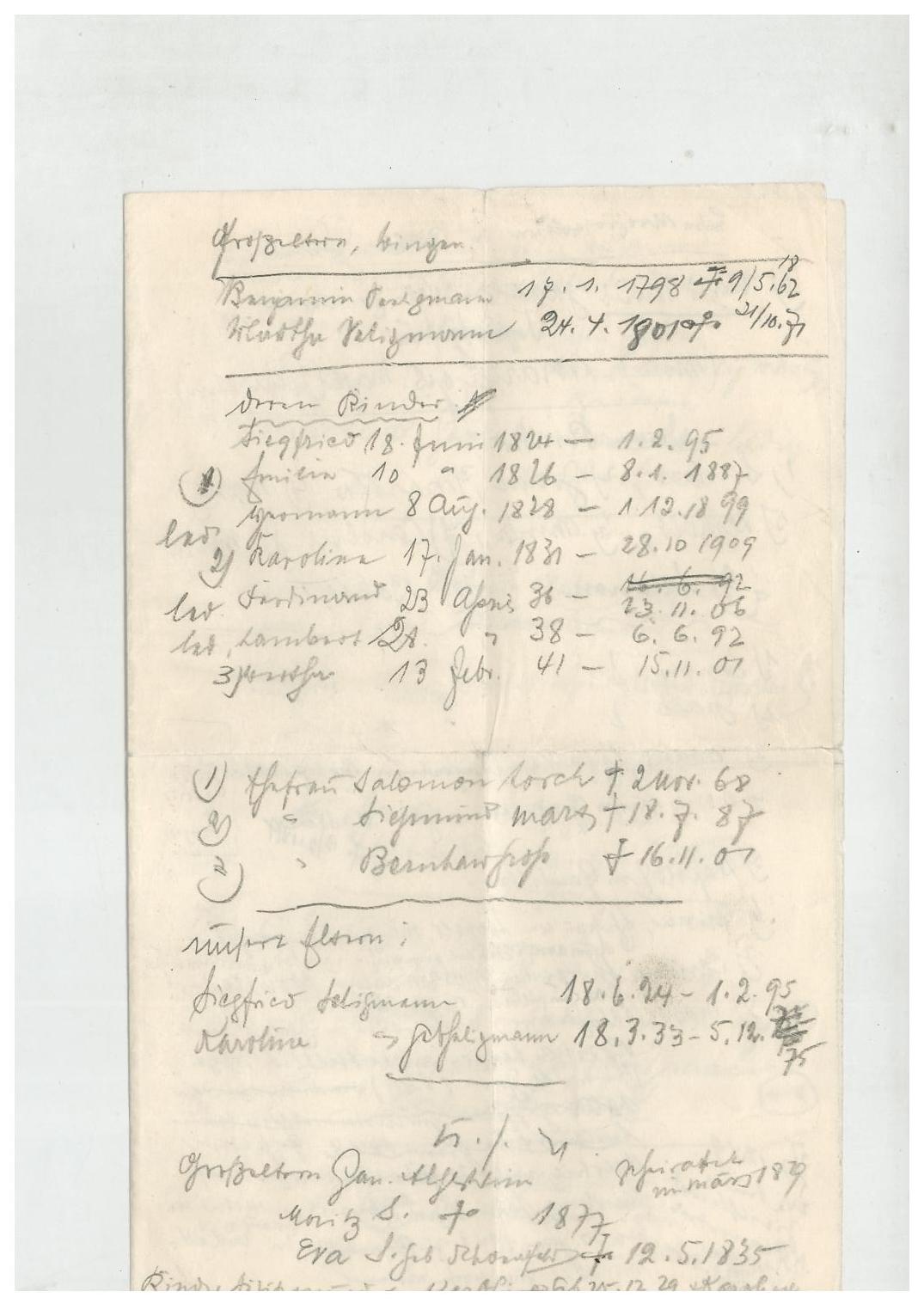
The first page names Moritz and his first wife, Eva Schoenfeld.

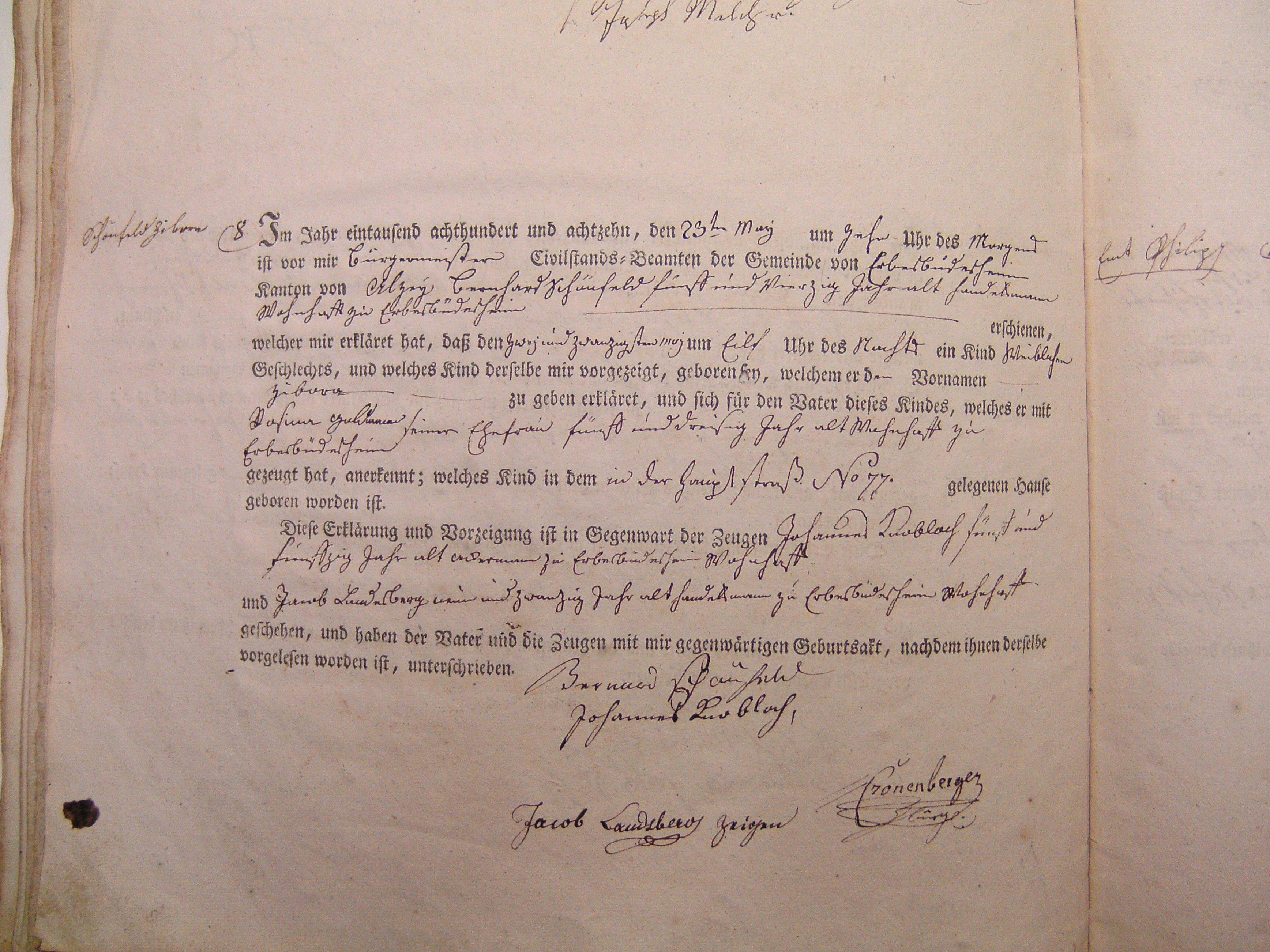
Handwritten notes about Moritz 1


The next page lists the children of Moritz and Eva Schoenfeld.  I had wondered what had caused Eva’s death and also what had happened to their son Benjamin.  This page answered both questions.  Benjamin died shortly after his birth as did his mother, so I assume it was related to childbirth.

This page also provided confirmation and new information about when the other children died.

Handwritten notes about Moritz 2


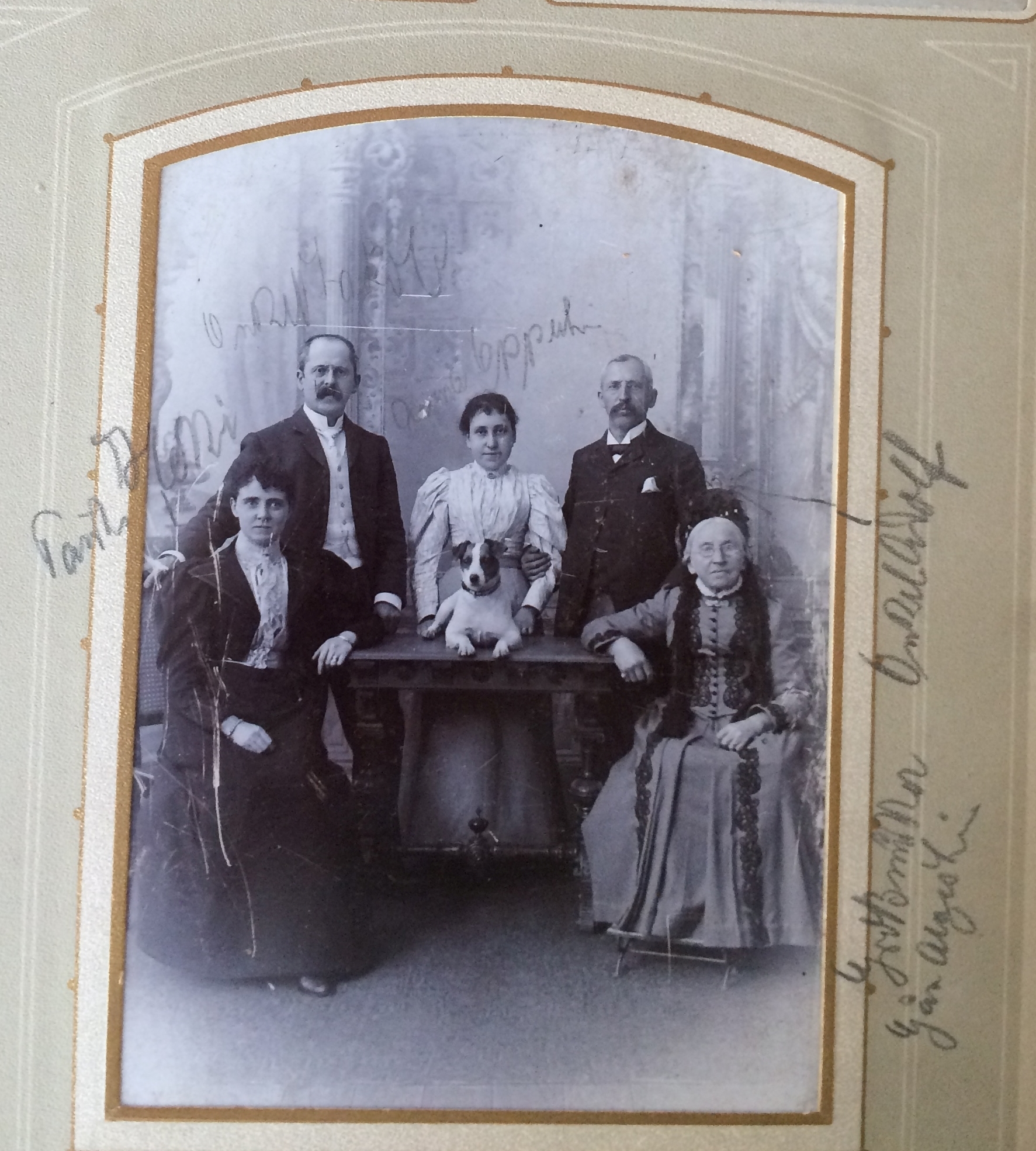
On the third page, the writer identified Babetta Schoenfeld as the second wife of Moritz Seligmann and lists their children.  There were several bits of important new information here. One is the date of Babetta’s death: January 15, 1899.  It also states that she was 89 years old.  This information helps to confirm that the photograph of the family group with the elderly woman was in fact a photograph of my three-times great-grandmother Babetta.

Handwritten notes about Moritz 3

The other bit of interesting information on this page is in the list of children.  The last child listed is Jacob, and it indicates that he was in England.  This is further corroboration of the fact that Moritz’s brother James Seligman who immigrated to England was in fact named Jacob at birth and is most likely the Onkel Jakob in the family photograph with Babetta, below.

Uncle Adolf and Grandmother Gau Algesheim

In addition, from this page I was able to learn when several of the other children of Moritz and Babetta had died.

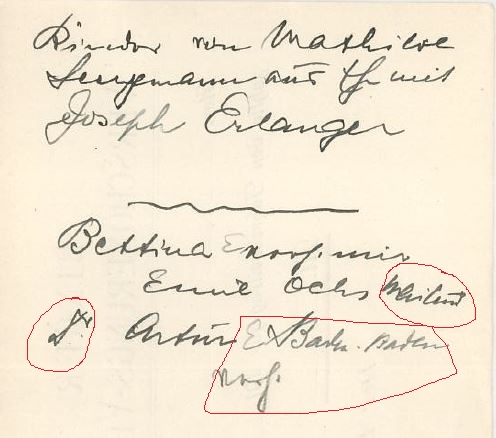
The remaining pages cover some of the children of Moritz: Pauline, Hieronymous, August, and Mathilde.  Although I did not find any really new information on these pages, they do provide additional confirmation of the information I already had as well as some dates I did not have.  Unfortunately, some of the writing is not legible, and so I cannot determine what those additional words say.  If anyone can read them, let me know.  I’ve circled the words I cannot read.

Handwritten notes about Moritz 4 to be translated

UPDATE:  My friend Dorothee in Germany tells me that the words after Joseph and Moritz indicate that they were both married and also both divorced.  Thank you, Dorothee!  My friend Ralph added to this, saying the words to the far right of Joseph say, “Son and daughter.” Unfortunately, I have no records for Joseph’s children.  Ralph also said that to the right of Martha, it says in part “Floersheimer,” which was her married name.  Thank you, Ralph!


Handwritten notes about Moritz 5 and 6 Handwritten notes about Moritz 7 to be translated

UPDATE:  Dorothee says that the symbol before Artur means “doctor” and the words after Artur say “in Baden-Baden, married.”  Thank you again, Dorothee!  Ralph added that the word next to Emil Ochs could be Mailand (Milan), which would make sense since Bettina entered Switzerland from Italy, as I wrote here.  Thank you again, Ralph!


Brick Walls Everywhere


Embed from Getty Images

I’ve run into some tough brick walls in my research, but never as many as I have with the descendants of Charlotte Seligman, the third child of Marx and Sarah Seligman. It’s been one frustration after another, searching for her children and grandchildren.

As noted in my earlier post, Charlotte (or Lottie) married Max Schlesinger in 1874, and they had four children: Harriet (1875), Arthur (1876), Lillie (1877), and Louis (1884).  Max was in the tie manufacturing business. Lillie and Louis were still living at home in 1900.

By 1900, Harriet (or Hattie) had married George Cain and had had one child, originally named Edith, but then renamed Lucie in memory of George’s sister.  The following year Harriet and George had a second daughter named Ethel.

I could not locate Arthur at all on the 1900 census, nor have I found him on any other record aside from the 1880 census and the NYC birth record index.  There is one possible military enlistment record for him dated March 4, 1895, but I can’t even be sure it is the same Arthur Schlesinger from the record.

On December 14, 1904, Max and Charlotte’s third child Lillie married Solomon Sondheim. Solomon, or Sol, was born in New Hampshire in 1867, making him ten years older than Lillie.  His father, a German immigrant, was in the dry goods business.  After living in New Hampshire, Sol had lived in Buffalo, New York, and then Bradford, Pennsylvania.  By 1900 when he was 33, Sol was working as a salesman and living in New York City as a boarder in what appears to be a large boarding house at 589 Second Avenue.  After marrying, Lillie and Sol were living on East 116th Street, and Sol listed his occupation on the 1905 NY census as a merchant.

In searching to learn more about Sol Sondheim, I found numerous articles about the suicide of his brother Philip.   From these articles, I learned that Sol’s father had been a wealthy man, leaving quite a large estate to be divided among his four children (which apparently Philip squandered through gambling).

New_York_Times_December_9_1900_page_1 Philip Sondheim

Sondheim suicide from Herald

Boston Herald December 13, 1900 p. 8

As for the rest of the family of Charlotte and Max Schlesinger, the 1905 NY census just presented me with problems. First, I cannot find Hattie and George Cain at all on the 1905 census (and Arthur still was missing).  What’s even more confusing, Charlotte Schlesinger is listed twice on the 1905 census (both with the date June 1, 1905, preprinted on the page).  On one page, Charlotte and Max were living at 231 West 116th Street, and Max was still working in manufacturing (presumably ties).

Max and Charlotte Schlesinger 1905 NY census New York State Archives; Albany, New York; State Population Census Schedules, 1905; Election District: A.D. 21 E.D. 39; City: Manhattan; County: New York; Page: 24

Max and Charlotte Schlesinger 1905 NY census New York State Archives; Albany, New York; State Population Census Schedules, 1905; Election District: A.D. 21 E.D. 39; City: Manhattan; County: New York; Page: 24

On another page of the 1905 census, Charlotte is listed with her son Louis and his wife Alice, living at 1838 Seventh Avenue.  Louis was only 21, and Alice was only 19.

Louis Schlesinger 1905 census New York State Archives; Albany, New York; State Population Census Schedules, 1905; Election District: A.D. 21 E.D. 35; City: Manhattan; County: New York; Page: 38

Louis Schlesinger 1905 census
New York State Archives; Albany, New York; State Population Census Schedules, 1905; Election District: A.D. 21 E.D. 35; City: Manhattan; County: New York; Page: 38

I assume Max died sometime between the first census listing and the second, but I cannot find any record for Max’s death.  There is no listing in the NYC death index, no obituary, nothing that explains what happened to him. Moreover, the NYC marriage index has Louis marrying Alice Stacke on April 26, 1906, a year after the 1905 census. Is it possible that this second census entry was filled in and filed a year late? Or perhaps it is more likely the marriage certificate was filed a year late.  Or they weren’t legally married until April 1906?

According to the 1910 US census, Louis and Alice were still living with Charlotte, now listed as a widow (the NY 1905 census had not asked about marital status).  They were living at 200 West 136th Street, and Louis was working as a clothing salesman.  Harriet and George Cain and their two daughters were living at 2308 Seventh Avenue, and George was the secretary of a bank.  Lillie and Sol Sondheim were living on West 122nd Street, and Sol was a traveling salesman.  Arthur remained missing.

On June 4, 1914, Harriet’s husband George Cain died.  I could not find a death record for him, but did find this death notice in the June 5, 1914, New York Times.

New York Times, June 4, 1914

New York Times, June 5, 1914

Since there is no listing for George Cain in the NYC death index, I assume George died someplace outside of New York City.  He left behind two young daughters, just 14 and 13, as well as his wife Harriet.  On the 1915 NY census, Harriet was living with her two daughters Lucie and Ethel as well as her mother Charlotte at 2308 Seventh Avenue.  No one in the household was employed outside the home.

Harriet Schlesinger Cain 1915 NY census New York State Archives; Albany, New York; State Population Census Schedules, 1915; Election District: 23; Assembly District: 21; City: New York; County: New York; Page: 11

Harriet Schlesinger Cain 1915 NY census
New York State Archives; Albany, New York; State Population Census Schedules, 1915; Election District: 23; Assembly District: 21; City: New York; County: New York; Page: 11

In 1920, Harriet was living with Lucie and Ethel, now 19 and 18, at 465 Central Park West.  Harriet’s occupation was reported as “renting rooms” at home, and there was one lodger listed in the household, but her name was crossed out.  Lucie was working in the bonding department of a security company, and Ethel was not employed.

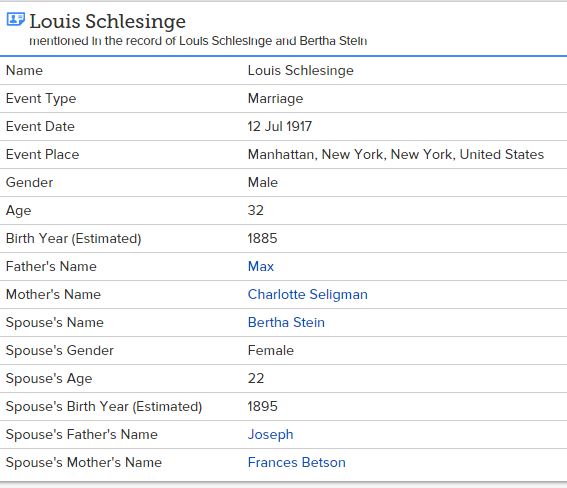
I cannot find either Louis Schlesinger or Lillie Schlesinger Sondheim on the 1915 NY census.  (These people are just incredibly elusive, no matter how I search.) But between 1910 and 1920, much had changed for both of them.  First, on July 12, 1917, Louis married a second time, this time to Bertha Stein.

New York, New York City Marriage Records, 1829-1940," database, FamilySearch (https://familysearch.org/ark:/61903/1:1:24HM-6GL : accessed 4 August 2015), Louis Schlesinge and Bertha Stein, 12 Jul 1917; citing Marriage, Manhattan, New York, New York, United States, New York City Municipal Archives, New York; FHL microfilm .

New York, New York City Marriage Records, 1829-1940,” database, FamilySearch (https://familysearch.org/ark:/61903/1:1:24HM-6GL : accessed 4 August 2015), Louis Schlesinge and Bertha Stein, 12 Jul 1917; citing Marriage, Manhattan, New York, New York, United States, New York City Municipal Archives, New York; FHL microfilm .


I would have thought this was a different Louis, except that the marriage record reveals his parents’ names as Charlotte Seligman and Max Schlesinger.  What had happened to Alice, his first wife? I don’t know.  There is no death record for her, but neither was there one for George Cain or for Max Schlesinger.  There are a number of later records for women named Alice Schlesinger, but none is obviously the right one.  If she remarried, I haven’t found her.

At any rate, Louis and Bertha Schlesinger had a child on June 14, 1918, less than a year after marrying.  They named him Arthur, which makes me believe that Louis’ older brother Arthur had died.  According to his draft registration for World War I, Louis was the financial secretary for the Joe Morris Music Publishing Company, and he, Bertha, and their son Arthur were living at 301 St. Nicholas Avenue in New York City.  Their residence remained the same on the 1920 census.

Louis Schlesinger World War I draft registration Registration State: New York; Registration County: New York; Roll: 1786672; Draft Board: 139


As for Lillie, her life also changed dramatically between 1910 and 1920.  Her husband Sol died on March 12, 1919, while he was in Chicago; I assume he was traveling there as part of his job as a salesman as he died at a hotel.  He died from heart and kidney disease.  He was 52 years old.

Sondheim, Sol. death

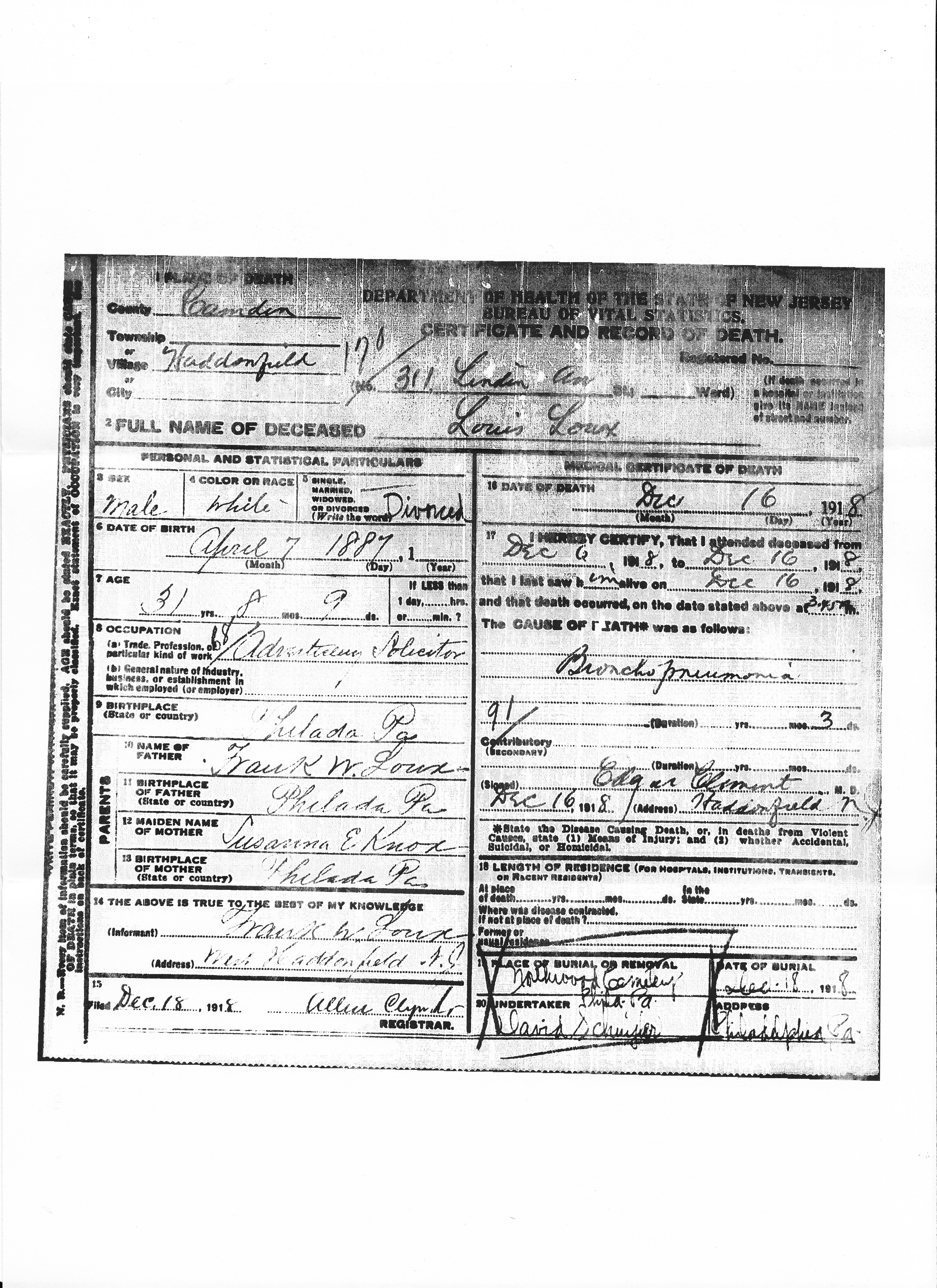
Six months later Lillie married William Lindsay on September 24, 1919.  William was born in Philadelphia, the son of Joseph Lindsay and Mary Thomson, who were born in Scotland and Ireland, respectively. William grew up in Philadelphia, where his father was a shirt manufacturer.  In 1920, William was working as an advertising solicitor for a trade magazine, and he and Lillie were living on 112th Street.

Thus, between 1910 and 1920, three of the children of Charlotte Seligman and Max Schlesinger had had  major marital status changes in their lives.  Harriet had become a widow; Lillie also had become a widow and then remarried; and Louis had either become a widower or had his marriage end, and he had remarried.  Meanwhile, their mother Charlotte was living on her own at 2040 Seventh Avenue.  Charlotte died three years later on January 19, 1923, when she was 69 years old.

I cannot find Harriet on the 1925 NY census, but according to a directory listing, she was still living at 465 Central Park West in 1925.  Her younger daughter Ethel had married Milton Robitchek on June 29, 1922, when she was 21, and had a daughter Georgia in 1928.  By 1930, however, Ethel was divorced, and she and two year old Georgia were living with Harriet on West End Avenue.  Ethel was a public school teacher. (I can’t seem to find Milton Robitchek at all after the 1922 marriage record. How could someone with such an unusual name just disappear?)

Harriet Schlesinger Cain 1930 US census Year: 1930; Census Place: Manhattan, New York, New York; Roll: 1557; Page: 12B; Enumeration District: 0465; Image: 685.0; FHL microfilm: 2341292

Harriet Schlesinger Cain 1930 US census
Year: 1930; Census Place: Manhattan, New York, New York; Roll: 1557; Page: 12B; Enumeration District: 0465; Image: 685.0; FHL microfilm: 2341292


Harriet’s older daughter Lucie was living on her own on Clinton Street in Brooklyn, according to the 1930 census, which reported that her occupation was “child placing” for an accountant.  I have no clue what that means.

In 1940, Harriet was still living with her daughter Ethel, now on East 68th Street, and with her granddaughter Georgia, now twelve.  Ethel was still working as a teacher.  Lucie was still living on her own in Brooklyn, and her occupation now clearly states that she was a public accountant.   I have not found any later records for Harriet, Lucie, Ethel, or Georgia.  I have searched as many ways as I can, but have found no documents, no news stories, no obituaries.

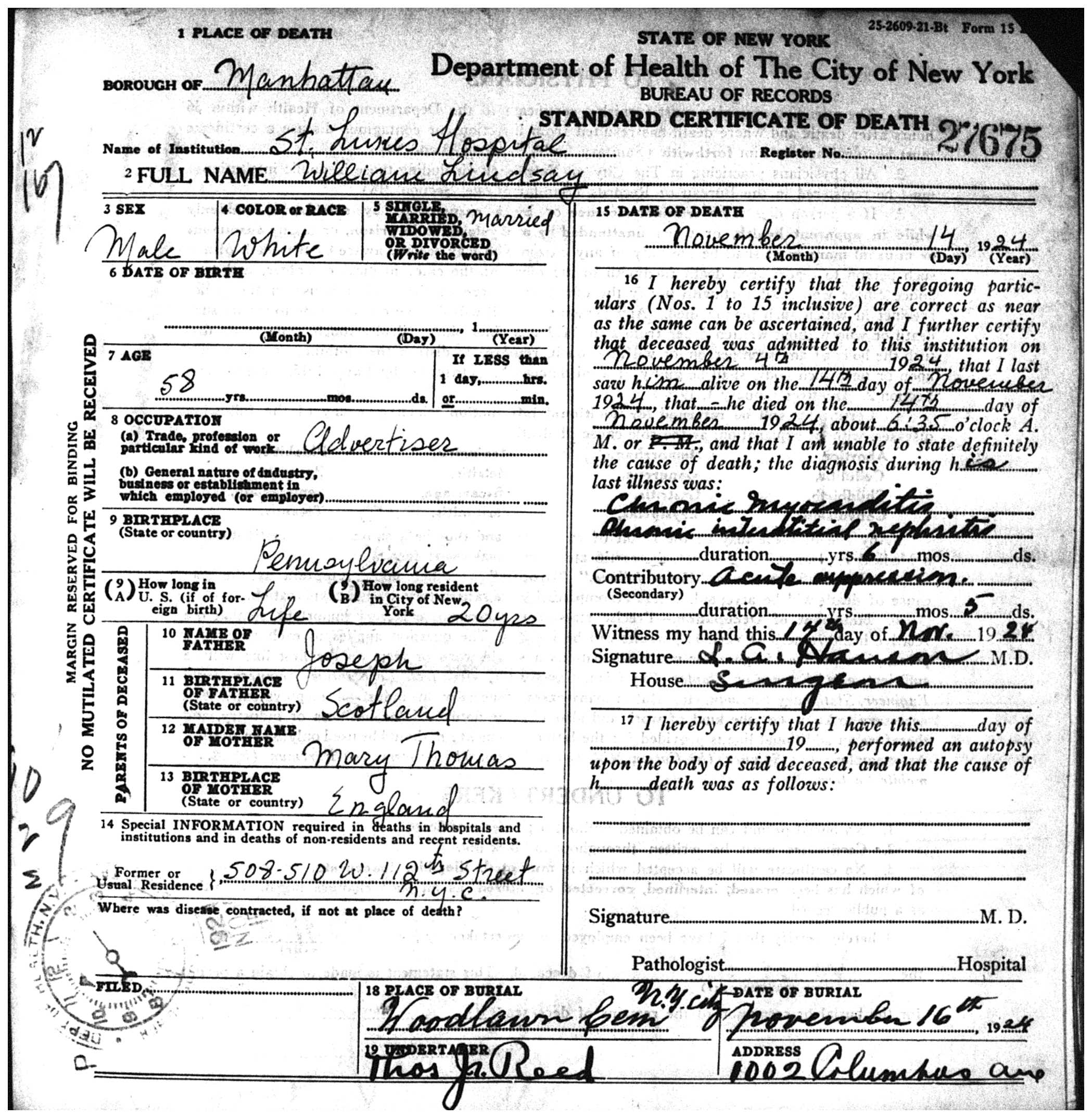
As for Harriet’s sister Lillie, she became a widow again on November 14, 1924, when her husband William Lindsay died at age 58.  Like Harriet’s first husband Sol, William died of both heart and kidney disease.

Lindsay, William death page 1

I’ve had no luck finding Lillie on either the 1925 NY census or the 1930 US census, but did find her on the 1940 census.  She was 62 years old, living at the Wyndham Hotel, and not employed.  That is the last record I have for Lillie.

Finally, there is Charlotte and Max’s youngest child Louis Schlesinger.  In 1925, he was still married to Bertha, and they were still living on St. Nicholas Avenue with their son Arthur, now six years old.  Louis was still employed in music publishing.  Although the family had moved to West 180th Street by 1930, all else remained the same (though everyone was five years older, of course).

But then the big mystery for me surrounding Louis and his family surfaced in the 1940 census.  Now Louis, Bertha, and Arthur are living on West 164th Street, but there are two more children living with them: Henry, listed as their son, 17 years old, and Matilda, listed as their daughter, 12 years old.  Where did these two children come from? If they were in fact Louis and Bertha’s children, they should have been listed with them on the 1930 census, but they were not.  Had they been adopted after 1930? They both had the surname Schlesinger, at least on the census record.  I don’t know, and what’s even more mystifying, I cannot find either of them on any later record or document.  I would think Henry would have served in World War II, but I cannot find any record that would match him, if his name in fact was Henry Schlesinger.

Louis Schlesinger 1940 US census Year: 1940; Census Place: New York, New York, New York; Roll: T627_2677; Page: 8B; Enumeration District: 31-2144

Louis Schlesinger 1940 US census
Year: 1940; Census Place: New York, New York, New York; Roll: T627_2677; Page: 8B; Enumeration District: 31-2144

At any rate, in 1940 Louis was still in music sales, and his son Arthur, now 21, was a clerk in an advertising firm.  On his draft registration for World War II, Louis reported that he was a music salesman and the president of Lewis Music Company.

Arthur Schlesinger, Louis and Bertha’s son, died on February 20, 1943.  He was 24 years old.  His death certificate does not report the cause of death, but it does indicate that he had been under a doctor’s care since October, 1942.  He had been working as a clerk in federal court.

Schlesinger, Arthur 1943 death page 1


That, unfortunately, is the last record I have for Louis Schlesinger and his family.  As with his siblings Harriet, Arthur, and Lillie, I do not know when he died.  I don’t know when his wife Bertha died, what happened to his first wife Alice, or what happened to the two children who were living with him as his children in 1940, Henry and Matilda.

Since I cannot find out what happened to Ethel Cain Robitchek’s daughter Georgia either, I don’t know whether there are any living descendants of Charlotte Seligman and her husband Max Schlesinger.  Harriet’s other daughter Lucie did not marry.  Lillie had no children.  Louis’s son Arthur died at a young age.  But what I did learn about Charlotte and her family is that this was a family where many marriages ended early either due to divorce or death.  Lillie was widowed twice.  Harriet was left a widow at a young age with her two young daughters.  Her daughter Ethel’s marriage was over by the time Ethel’s daughter Georgia was only two.  And Louis married twice, though I don’t know if the first ended because his first wife died or because they divorced.

So many unanswered questions.  I am hoping that with further digging, some answers will turn up, but for now I must say that searching for the family of Charlotte Seligman has made me feel like a very poor researcher and a very frustrated genealogist!  If any of you out there reading have any suggestions on how I might find more about these people, please let me know.


Embed from Getty Images


And The Suitcase Just Keeps on Giving!

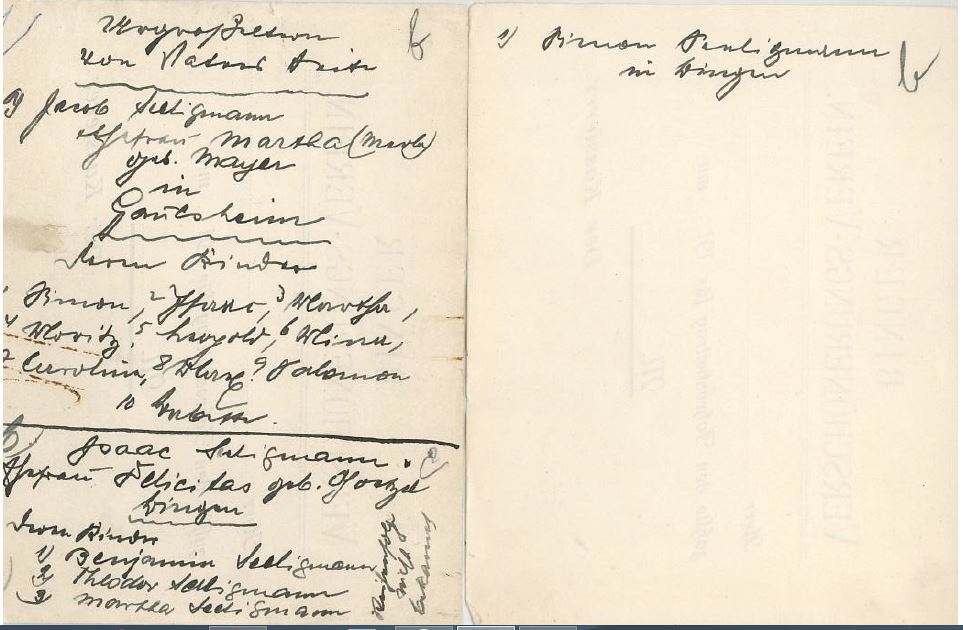
As I mentioned briefly in my last post, as I was finishing up my write-up about the handwritten family tree we are calling Emil’s tree, Wolfgang’s mother discovered another handwritten tree. It appears to be written by someone else, but I don’t know who. It covers only the ten children of Jacob Seligmann and Marta/Martha Mayer and their grandchildren so is not as wide or deep in scope as the first one, but it contains some useful extra tidbits that have helped me locate more family members.  (Each page has a letter “b” written in the upper right hand corner.  I have no idea what that means, unless to show these page were about one particular line in the family.)

tree 2 cover and page 1

tree 2 pages 2 and 3

tree 2 page 5


The cover page lists the children of Jacob and Mart(h)a and also the children of Isaac Seeligmann and Felicia Goetzel, that is, the two sets of Emil’s great-grandparents.  Page 1 simply has Simon Seligmann’s name and that he was from Bingen, and Page 2 just has Isaac Seligmann (son of Jacob and Marta) and that he lived in Gensingen, a town near Bingen.  Martha Seligmann and her children with her husband Benjamin Seeligmann are listed on Page 3. Page 4 (to be posted) covers the family of Moritz Seligmann, my three-times great-grandfather, and the family of Leopold Seligmann is on Page 5.   So far all this information is consistent with what was on Emil’s tree and does not add anything very important.

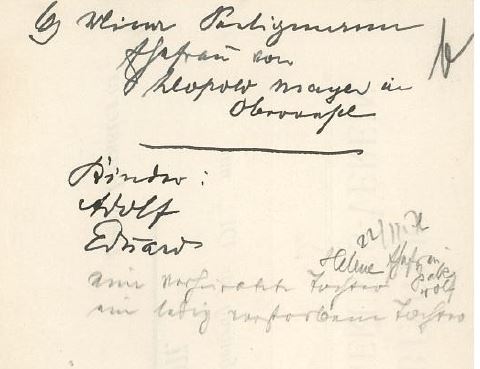
On Page 6, however, there is some new information about the family of Mina Seligmann.  The first tree reported, as in this one, that she married Leopold Mayer of Oberursel and had a son Adolf Eduard.  Here it is clear that there were two sons, Adolf and Eduard, and also two daughters: Helene, who married Jakob or Jak (or maybe Isak?) Wolf, and an unnamed daughter who died and was not married.

tree 2 page 6

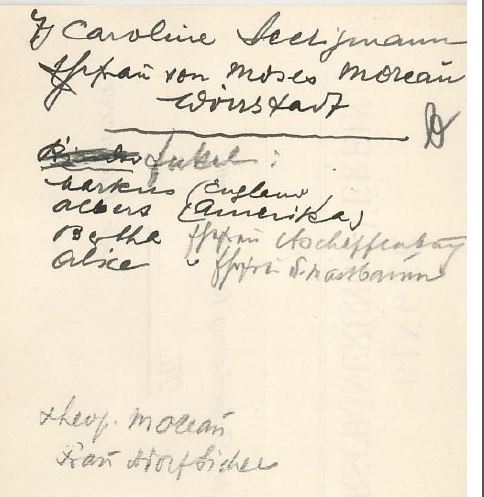
Page 7 also contains some new information.  This page is devoted to Caroline Seligmann, who married Moses Moreau from Worrstadt, another town not very far from Bingen.  Underneath are four names that the creator of this tree originally labeled as the children of Caroline and Moses, but then crossed out and wrote “grandchildren.”  The names are the same as those on the earlier tree—Markus, Albert, Bertha, and Alice.  Next to Markus it says “England,” and next to Albert it says “Amerika.”  I searched for both with the surname Moreau, but so far have had no luck.  Perhaps, however, they were the sons of a daughter of Caroline and Moses Moreau and had their father’s surname and not Moreau.  For Bertha, the notation says that she was the wife of Aschaffenburg (which Wolfgang told me is also a town in Bavaria), and for Alice it says that she was the wife of D. Mastbaum.  But why are the grandchildren listed and not the children? And what are the two names at the very bottom?

tree 2 page 7

The page that has provided me with the most new information is Page 8.  In my last post I talked about the confusing passage at the end of the tree’s notes on Marx Seligmann.  Someone had gone to America later—but who? Was it the children, the ex-wife, or Marx himself?  Well, this new tree provides more clues and led me to more answers.

tree 2 page 8

The first part of Page 8 repeats the information about Marx’s marriage and divorce from Rosina Loeser, and then on the bottom of the page, according to my wonderful helpers in the German Genealogy group on Facebook, it says that Marx (or Max) remarried in New York and that his son married someone named Coppel, and that they had a daughter who married a film agent, but when I went to search for Marx Seligmann in New York, I found this marriage record:

Charlotte Seligmann marriage record

“New York, New York City Marriage Records, 1829-1940,” database, FamilySearch (https://familysearch.org/ark:/61903/1:1:2492-DVZ : accessed 8 July 2015), Max Schlesinger and Charlotte Seligmann, 17 Jun 1874; citing Marriage, Manhattan, New York, New York, United States, New York City Municipal Archives, New York; FHL microfilm .


Although this record indicates that Marx Seligmann himself was married Sara Koppel, not a son of Marx, it can’t be just coincidence that someone named Marx Seligmann had a wife named Koppel.  Also, Marx and Sara did have a daughter, Charlotte, and she married someone named Max Schlesinger.  I don’t think, however, that he was a film agent.

If this second family tree is accurate and I am making correct assumptions that this is in fact the same Marx Seligmann who was a son of Jacob Seligmann and Marta Mayer and thus my four-times great-uncle, then this new tree just opened up a huge door to learn about more Seligmann cousins living in the United States.  In my next post, I will write about what I’ve learned about Marx and his descendants.

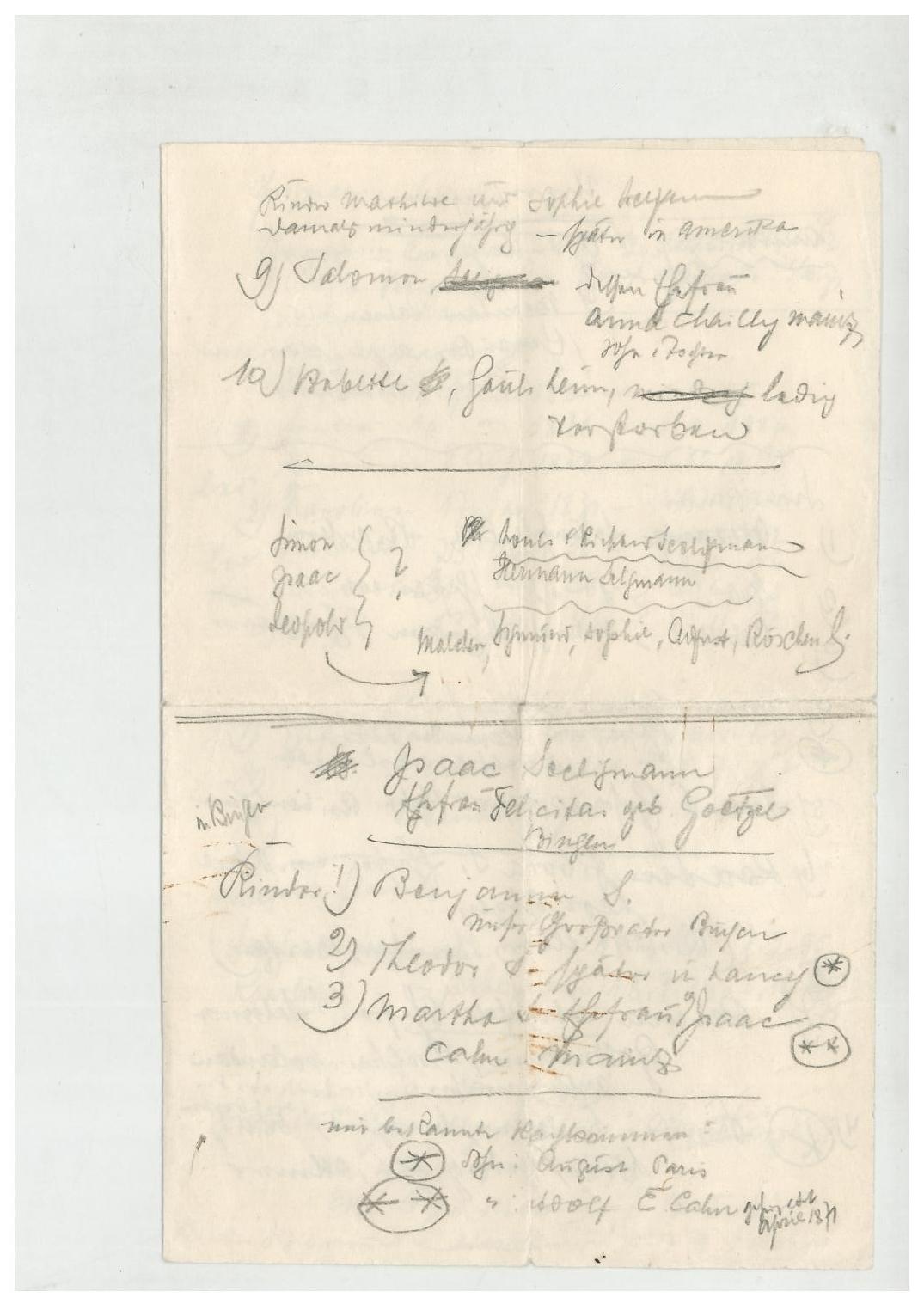
For now, to finish the second family tree, Pages 9 and 10 add no information about Salomon Seligmann and Babette Seligmann that was not already included on Emil’s tree.  The only thing I can’t decipher here are the faintly written words at the bottom of page 9.

tree 2 pages 9 and 10


Thus, once again I have been blessed with a treasure from that suitcase in Germany.  What if Wolfgang had not found my blog and contacted me? I would know nothing about all these people.  Sometimes you just have to be thankful for good luck.


More Hidden Treasure from Wolfgang’s Magic Suitcase

http://www.wpclipart.com/money/. Per the licen...

http://www.wpclipart.com/money/. Per the license: These images are public domain. License . (Photo credit: Wikipedia)

I have had many exciting finds through the course of my search for my family history: wonderful photographs and letters, newspaper articles, government documents, birth and marriage and death certificates, and so on.  But for me some of the most special finds have been the family trees prepared by other members of my extended family, like the family tree prepared by my Aunt Elaine.  These trees are special not only for the information they convey, but also because they tie me to someone else who cared about the family history and wanted it preserved for posterity.

So you can imagine how excited I was when my cousin Wolfgang sent me a four page family tree prepared at least 75 years ago by one of our Seligmann cousins in Germany.  We know that this tree was prepared by a child of Karoline Seligmann, the daughter of my three-times great-grandfather Moritz Seligmann and his first wife, Eva Schoenfeld because the tree refers to Karoline Seligmann and her husband Siegfried Seligmann as “our parents.” Karoline (sometimes spelled Caroline or Carolina) and Siegfried had five sons and two daughters: Heinrich, Eva, Wilhelm, Emil, Eugen, Rosa, and Carl.  Two of the sons died in infancy, Wilhelm and Carl, , and one I cannot account for beyond his birth, Heinrich. Emil, Eugen, and Eva all died during the Holocaust.  Only one child survived the Holocaust, their daughter Rosa, who immigrated to the US in 1940.  I discussed Karoline’s children here.  I don’t know which child created this tree.

Wolfgang thought Emil was the most likely author of the tree, so for simplicity purposes I will refer to it as Emil’s tree and to its author as Emil.  (The last date given on the tree is 1909, and unfortunately it stops with the generation of Karoline and Siegfried and does not include their children.)  Although I cannot be sure which of the surviving children—Emil, Eva, Eugen, or Rosa—was my fellow genealogist, I am extremely grateful to whoever created this tree because it provides me with one more generation of my Seligmann and Schoenfeld relatives—the siblings of my three-times great-grandfather, Moritz Seligmann, and the siblings of my three-times great-grandmother, Babetta Schoenfeld (Eva’s sister).  It, of course, also raises new questions and new pathways for research.

Starting with page 1 of the tree:

Page 1 of Emil's tree

Page 1 of Emil’s tree

It says at the top, “Our great-grandparents in Gaulsheim: a) fathers side: Jacob Seeligmann, his wife: (Merle) Marta nee Mayer (Gaulsheim).”  I found it interesting that the early spelling of the family name was Seeligmann.  Marta (Martha) Mayer’s name is consistent with the record I obtained for the marriage of their son Moritz to Eva Schoenfeld.  Jacob and Marta were my four-times great-grandparents.  According to prior records I’d obtained, they were both born around 1773.

According to Emil’s tree, Jacob and Marta had ten children. Until seeing this tree, I had only found three: my three-times great-grandfather Moritz and two other sons, Leopold and Isaac.  I had found Leopold and Isaac on the Steinheim Institute website, but not the other seven children.  According to the Emil tree, they were Simon, Martha, Mina, Caroline, Marx, Salomon, and Babette.

The next section of the first page and the second page provide information for the ten children of Jacob and Marta.  For Simon and Isaac, it seemed that Emil had no information, except that Simon was living in Bingen. The entry for Leopold simply says “in Gaulsheim.”    But then on the second page of the tree (see below), Emil returned to Simon, Isaac, and Leopold and listed what appears to be the names of their children.  It looks like he thought Simon had two sons, Louis and Richard, and Isaac had a son named Hermann.  Leopold’s children were Malchen, Sigmund, Sophie, August, and Roschen.

Page 2 of Emil's tree

Page 2 of Emil’s tree

This, however, is not consistent with what I found on the Steinheim website.   According to the Steinheim website, Isaac was born in 1795 and died in 1860.  He seems to have lived in Gaulsheim all his life.  The Steinheim site states that Isaac married Rosine Blad and that they had five children: Pauline, Magdalena, Henriette, Ludwig (Louis), and Richard. My best guess is that Ludwig and Richard are the same people who Emil listed as Louis and Richard.  I don’t know whether Emil is correct or the Steinheim site is correct as to whether they were Simon’s sons or Isaac’s sons.  I also don’t know where Hermann fits into the family.  Was he really Simon’s son and Emil had it backwards?  I don’t know.

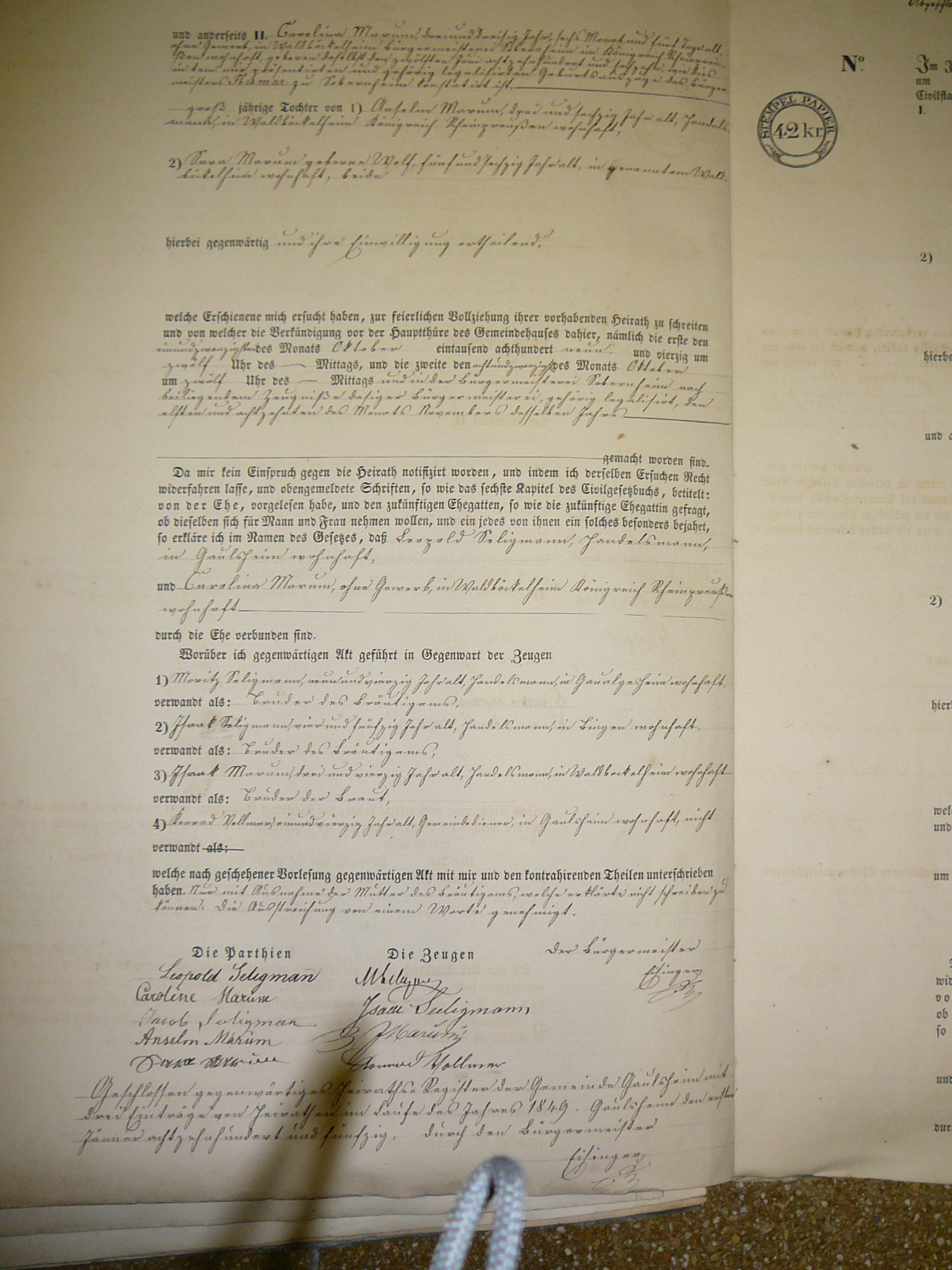
There is also some inconsistency between Emil’s facts for Leopold and the information on the Steinheim website.  The Steinheim site lists Leopold’s wife as Caroline Marum, and I found a marriage record for them dated December 17, 1849.

Marriage Record of Leopold Seligmann and Caroline Marum

Marriage Record of Leopold Seligmann and Caroline Marum

Leopold Seligmann marriage record

According to the Steinheim site, they had five children: Amalie, Rosalie (Roschen?), Sophia, August, and Therese.  Emil did not have Therese or Amalie, but had instead Malchen and Sigmund. I don’t know which information is more accurate.

For Jacob and Marta’s daughter Martha, Emil wrote that she married Benjamin Seeligmann. To the right of Martha’s name is a box that says, “Our grandparents in Bingen.” Then next, for our mutual ancestor Moritz, Emil wrote “our grandfather in Gau-Algesheim.”  There is a date underneath that looks like 13-2-1877; I believe that must be his date of death.  But how could Martha and Moritz, sister and brother, both be Emil’s grandparents? Well, that will become clear later on.

For Mina, it says that she was the wife of Leopold Mayer of Oberursel and that they had one child, Adolf Eduard, who died and was never married. I wonder if this Mayer was a relative of Mina’s mother Marta Mayer.  The next child of Jacob and Marta, Caroline, married Moses Moreau (?) of Worrstadt, and they had four children whose names are written underneath; the first I cannot decipher (maybe Markus?), but the other three are Albert, Bertha, and Alice.

The last entry on the first page is a long one for Marx Seligmann.  With the help of the kind people in the German Genealogy group on Facebook, I was able to get a sense of what happened to Marx.  He married Rosina Loeser on June 11, 1838.  They were legally separated in June 1848, and he agreed to pay support for the children.  They were divorced in February, 1849.

On page 2 of the Emil tree, Emil continued with the facts about Marx Seligmann.

Page 2 of Emil's tree

Page 2 of Emil’s tree

This is the hardest part of the document for me to understand, despite help from Wolfgang and the German Genealogy group.  At the top are listed the names of the two daughters of Marx and Rosina: Mathilde and Sophie. But what does it say underneath?  All my German helpers agreed that is says, “Underage ??? in Amerika.”  One thought it said “Wife in Amerika,” another thought it said “Later in Amerika.”  Who went to America?  And when did they go? I have started looking, but so far have not had any luck.

(As I was finishing this post, Wolfgang sent me another handwritten version of this tree with more information about Marx and a few others.  I need to finish deciphering that one and then will update with more information.)

Emil wrote that Salomon had a wife named Anna Chailly of Mainz and a son and daughter, whose names are not listed here.  I found an entry in the Mainz Family Register database on ancestry.com for Salomon and his family, and his children were named Emilie, Mathilde, Siegmund, and Jacob.  Jacob married Dora Rosenberg in 1887, and they had a daughter named Anna Dora, born in 1890.  I have not yet found any further information for the other three children of Salomon and Anna.

Finally, for Babette, the tree recorded that she had died unmarried and had lived in Gaulsheim.

That completed Emil’s entries for the children of Jacob Seeligmann and Marta Mayer.  He then drew a horizontal line across the page as if to start a new section.  Under that line he wrote, “Isaac Seeligmann and his wife Felicitas nee Goetzel of Bingen.”   I was totally confused when I saw this; was this the same Isaac Seligmann, the son of Jacob and Marta, about whom Emil had written already?  Underneath the names of this Isaac and Felicitas was a list of their children, and they were not the same names that I had found on the Steinheim site, discussed above, for Jacob and Marta’s son Isaac.  Instead, the following names were listed: Benjamin, Theodor, and Martha.  Who were these people?

According to my German Genealogy helpers, under Benjamin’s name it says, “Our grandfather from Bingen.” Suddenly something clicked.  This was the Benjamin Seeligmann who married Martha Seligmann, the daughter of Jacob and Marta and the sister of Moritz.  Remember that Martha and Benjamin had also been named as Emil’s grandparents.  This section of the tree is reporting on Emil’s other great-grandparents, the other Isaac Seligmann and his wife Felicitas Goetzel, and their children.

Was this Isaac Seeligmann related to Jacob Seeligmann, my four-times-great-grandfather?  They all lived in the Bingen-Gaulsheim area.  I’ve yet to find any documentation linking the two different Seligmann families, but my hunch is that they were in fact cousins if not brothers, meaning that Benjamin Seeligmann might have married a cousin, Martha Seligmann.

Emil then reported on his grandfather Benjamin’s siblings.  Theodor was living in Nancy (in France, presumably), and he had a son August who lived in Paris.  Martha married Isaac Cahn of Mainz, and they had a son Adolf Cahn.

That brings me to the third page of Emil’s tree.

Page 3 of Emil's tree

Page 3 of Emil’s tree

This page is primarily devoted to Emil’s grandparents Benjamin Seeligmann and Martha Seligmann.  He provides their birth and death dates and then the names of their seven children: Siegfried, Emilie, Hermann, Karoline, Ferdinand, Lambert, and Bertha.  Under their names, Emil reported on who some of them married, including his father Siegfried, who married Karoline Seligmann.  Suddenly the rest of the tree made sense to me.

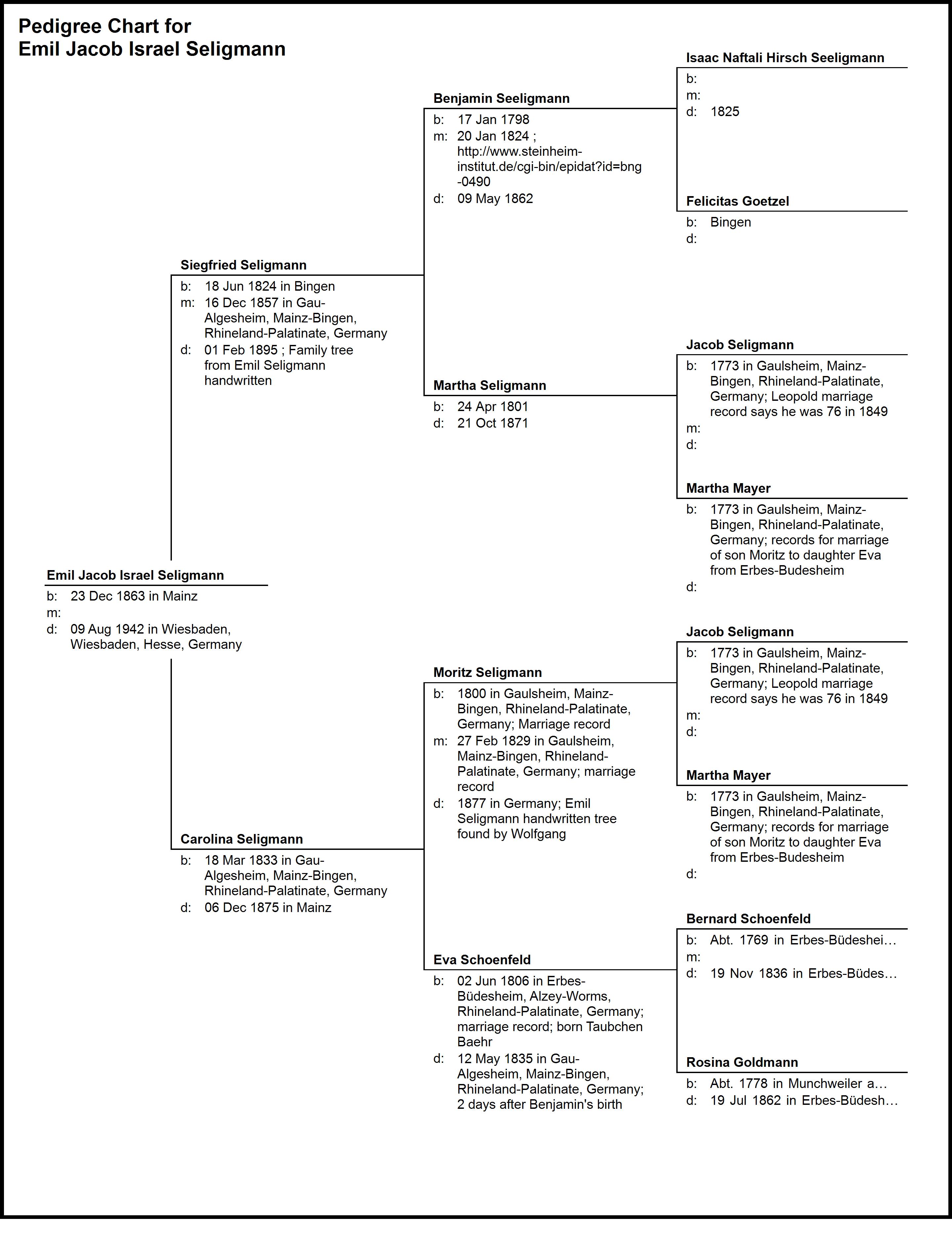
Emil’s father Siegfried was the son of Martha Seligmann; his mother Karoline was the daughter of Moritz Seligmann.  Moritz and Martha were siblings, so Siegfried and Karoline were first cousins.  Thus, Emil’s paternal grandmother Martha and his maternal grandfather Moritz were sister and brother.  Now if in fact Benjamin Seeligmann, Martha’s husband, was also a cousin, there is truly a remarkable amount of inbreeding there.  Here is a family chart that will (I hope) help to visualize these relationships:

Pedigree Chart for Emil Seligmann

Pedigree Chart for Emil Seligmann


The last entry on the third page provided me with the death dates for Moritz Seligmann and Eva Schoenfeld, information I had not had before.

Finally on page four Emil discusses his maternal great-grandparents, a) the family of Jacob Seligmann of Bingen, already discussed under his paternal great-grandparents; and b) the family of his grandmother Eva Schoenfeld, sister of my three-times great-grandmother Babetta Schoenfeld, the sister who married Moritz Seligmann after Eva died in 1835.

Page 4 of Emil's tree

Page 4 of Emil’s tree

As I already knew, Eva and Babetta were the daughters of Bernard Schoenfeld and Rosa Goldmann of Erbes-Budesheim.  I also had records of the names and births of most of their children.  Emil’s list confirmed these and added one more for whom I did not have a record, Alexander.  The children as listed on Emil’s tree are Alexander, Eva and Babetta (described as the first and second wives of Moritz Seligmann of Gau-Algesheim), Maria Anna (wife of Alexander Levi of Kirchheimbolanden), Sara (wife of Leokov (?) Kahn of Bubenheim), Zibora (wife of Karl Levi of Alzey and mother of Albert, Bernhard, and Berta), and Rebecca (wife of Salomon Goldmann of Kirchheimbolanden).  Then at the bottom Emil listed the children of Maria Anna and Alexander Levi: Fridolin, Leonhard, Judith, Lina, Hedwig, Elise, and Ottmar.

I was recently contacted through Wolfgang by one of the grandchildren of Zibora Schoenfeld Levi and am hoping to learn even more about my Schoenfeld ancestors.

What a treasure trove this tree is!  Such a gift from one of my predecessors as a family historian—someone who died during the Holocaust and who left behind evidence not only of his ancestors’ lives, but of his own.  Now it is my job to try and fill in the details and continue the story.


Too Many Missing Pieces: Part II

In my last post, I wrote about the list of English James Seligmann’s heirs that my cousin Wolfgang found in his family’s papers.  There were 21 principals named as heirs on that document, and I had discussed all the easily identified ones and some of those that were more difficult to figure out.  I had discussed Numbers 1, 2, 6-13, 15, 16, 19-21.  That left Numbers 3-5,  14, 17, and 18.  Here again is the list of heirs:

heirs list p 1

Heirs List p 2

So let’s start with Number 3, Johanna Bielefeld, the one whom Elsa Oppenheimer had claimed was not a daughter of Hieronymus Seligmann in her July, 1984 letter.

Elsa Oppenheimer 1984 letter-page-001

Elsa Oppenheimer 1984 letter-page-002

Perhaps Elsa was wrong; after all, she was wrong about Adolph Seligman not being the child of Moritz and Babetta, as discussed last time.  Or maybe Johanna was the daughter of Benjamin Seligmann.  I am not sure yet, but I do know that she was born in Gau-Algesheim.  Wolfgang found this registration card for her, dated January 12, 1939, issued by the police in Mainz.  It gives her birth name as Seligmann, her birth date as March 15, 1881, and her birthplace as Gau-Algesheim.  I have written to my contact in Gau-Algesheim, asking him to see if he can find a birth record for Johanna so I can determine who her parents were.  Notice also the large J on her card, indicating that she was Jewish.

Here is the companion card for her husband Alfred Bielefeld:

The list of heirs provided the names of Johanna and Alfred’s children, Hans and Lili (or Lily).  It indicated that Johanna had died as had Hans, he in 1948.  Then it provided a married name for Lili, Mrs. Fred Hecht, and an address on West 97th Street in New York City.  Searching for Hans Bielefeld brought me to someone with that name on the 1940 census, living in Cleveland, Ohio. He was working as an insurance agent, was 37 years old, and had been residing in Mainz, Germany, in 1935.

Year: 1940; Census Place: Cleveland, Cuyahoga, Ohio; Roll: T627_3221; Page: 5A; Enumeration District: 92-451

Year: 1940; Census Place: Cleveland, Cuyahoga, Ohio; Roll: T627_3221; Page: 5A; Enumeration District: 92-451

Further searching found an index listing in the Ohio Deaths database on Ancestry for Hans Bielefeld, indicating he had died on September 13, 1948, the same year of death given on the list of heirs document.  On Fold3.com, I then found naturalization papers for Hans Ludwig Bielefeld, indicating that he was divorced, that he was born on July 1, 1902 in Maine (sic), Germany, and that he had arrived in the US on the SS Gerolstein on July 14, 1938.

Publication Number: M1995 Publication Title: Naturalization Petition and Record Books for the US District Court for the Northern District of Ohio, Eastern Division, Cleveland, 1907-1946 Content Source: NARA National Archives Catalog ID: 1127790 National Archives Catalog Title: Naturalization Petitions, compiled 1867 - 1967 Record Group: 21 Partner: NARA State: Ohio Court: Northern District, Eastern Division Catalog Keywords: Petitions Naturalization Immigration Citizenship Fold3 Publication Year: 2008

Publication Number: M1995
Publication Title: Naturalization Petition and Record Books for the US District Court for the Northern District of Ohio, Eastern Division, Cleveland, 1907-1946
Content Source: NARA
National Archives Catalog ID: 1127790
National Archives Catalog Title: Naturalization Petitions, compiled 1867 – 1967
Record Group: 21
Partner: NARA
State: Ohio
Court: Northern District, Eastern Division
Catalog Keywords: Petitions Naturalization Immigration Citizenship
Fold3 Publication Year: 2008


That led me to a passenger manifest for the SS Gerolstein, where I found Hans listed as a divorced merchant from Mainz.  It seemed like this could be the son of Johanna Seligmann Bielefeld, but I couldn’t be sure.

So I searched for his sister Lili.  I first searched for her as Lili Hecht, but had no luck, so I searched for Lili Bielefeld and found her first on an English ship manifest dated September 18, 1940, from Liverpool bound for Montreal, Quebec.  Lili was listed as 36, having last resided in London, but born in Germany.  Her occupation was given as a domestic.  The age, birthplace and name seemed correct, so I considered it likely that this was the right person.

Ancestry.com. UK, Outward Passenger Lists, 1890-1960 [database on-line]. Provo, UT, USA: Ancestry.com Operations, Inc., 2012.

Ancestry.com. UK, Outward Passenger Lists, 1890-1960 [database on-line]. Provo, UT, USA: Ancestry.com Operations, Inc., 2012.

Then I found her listed with the same information on a US manifest for passengers entering the United States from Canada.  But since Lili did not arrive until September, 1940, she is not listed on the 1940 census, making it extremely difficult to find her in the online databases on Ancestry.  There were a number of Fred Hechts, but how would I know if any of them were married to Lili?

So I turned to Google and entered “Lili Bielenfeld Fred Hecht,” and once again I hit the jackpot.  Like Fred and Ilse Michel, Fred Hecht and Lili Bielenfeld have papers in the collection at the Leo Baeck Institute entitled “Hecht and Gottschalk Family Collection; AR 5605.”  In the biographical note included with this collection, I learned that Fred Hecht came from a German Jewish family with a long history.  I will quote here only the sections relevant to Fred, Lili and Hans:

Jakob and Therese Hecht had a son, Siegfried Max Hecht (alternatively Fritz, later Fred, 1892-1970). Siegfried Hecht became a merchant and served in the German military during World War I. Siegfried and his wife Emma née Cahn divorced in 1939, and he immigrated to the United States in 1940, where he took on the name Fred. He settled in New York City and became a jewelry salesman. In December of 1944, he and Lili née Bielefeld (1904-1977) were married.

The Bielefeld family can be traced back to the late 18th century. The family lived in Karlsruhe, Mainz, and Mannheim until the 1930s, when some members immigrated to the United States. Lili Hecht née Bielefeld was the daughter of Alfred Bielefeld, a wine merchant, and Johanna Bielefeld née Seligmann. Despite efforts to procure passage to the U.S., both Alfred and Johanna perished in the Holocaust. Alfred died in Theresienstadt, and Johanna was deported from Theresienstadt to Auschwitz, where she perished.

Lili Hecht née Bielefeld’s brother Hans Ludwig Bielefeld (1902-1948) was a merchant. He married Lilli née Kiritz in 1933, and the couple divorced in 1936. Hans Ludwig immigrated to the United States under the sponsorship of his cousin, Irma Rosenfeld, and settled in Cleveland, Ohio, where he worked in insurance. After his death, his sister Lili Hecht née Bielefeld was the sole heir to the Bielefeld family property, which she claimed in the 1960s alongside restitution for her parents’ deaths.

Thus, from these papers and this biographical note, I was able to find out a great deal about what had happened to Johanna Seligmann Bielefeld, her husband, and her two children, Hans and Lili.  I will write more about them in a separate post once I have a chance to examine the LBI collection more carefully and obtain translations where necessary.

Number 4 on the list, Bettina Arnfeld, was more difficult to locate, but I found a Bettina Elizabeth Arnfeld listed on FindAGrave  with the notation, “Body Lost or Destroyed.” Her birthdate was given as March 17, 1875.  This may have been the “Elizabeth” whom Elsa claimed was not a child of Hieronymus Seligmann.  I then looked for and found Bettina Elizabeth Arnfeld in the Yad Vashem Database.  The entries there confirmed that her birth name was Seligmann, that she was born on March 17, 1875, and that she had resided in Muelheim Ruhr in Germany at the time she was deported.  She was exterminated at Thieresenstadt on January 23, 1943.

The list of heirs indicated that Bettina had a son, Heinz Arnfeld, living on 22 Gloucester Square in London, and he was not difficult to locate.  I found several entries for Heinz and Liselotte Arnfeld at that address in London, England, Electoral Registers on Ancestry.  I also found Heinz and Liselotte listed in the England & Wales Marriage Index on Ancestry.  They were married in Doncaster, Yorkshire West Riding in 1945. Heinz is also listed as a survivor of the Holocaust in the Shārit ha-plātah database on JewishGen.

Heinz died in 1961 and left his estate to Liselotte; she died in 1988. I do not know whether they had any children.  Since they were married in 1945 when Liselotte was 37, it does not seem likely.

That brings me to Numbers 17 and 18 on the list, putting Numbers 5 and 14 aside for now.  Who were Eva Hansu and Rosa Reisz?  If these were nieces of English James Seligmann, then they had married and changed their surnames, so how could I find them?  Since they were listed right after Emil and Eugen, sons of Carolina Seligmann and Siegfried Seligmann, I went back to the list of Carolina’s children and realized that she had daughters named Eva and Rosa.  Thus, I assumed that Eva became Eva Hansu and Rosa became Rosa Reisz.

I had good luck searching for Rosa Seligmann Reisz.  I knew her daughter’s name was Hedwig Neter from the list of heirs, and that seemed unusual enough that I decided to search for it first.  Sure enough the name came up on a passenger’s manifest dated August 31, 1940, for the ship Cameronia departing from Glasgow, Scotland, for New York.  Sailing with Hedwig was her husband Emil Neter and her mother Rosa Reis.  Emil was a 61 year old manufacturer, Hedwig a 48 year old housewife, and Rosa was 73 without occupation.  They all had last been residing in London and said the US was their intended permanent residence.

Ancestry.com. UK, Outward Passenger Lists, 1890-1960 [database on-line]. Provo, UT, USA: Ancestry.com Operations, Inc., 2012.

Ancestry.com. UK, Outward Passenger Lists, 1890-1960 [database on-line]. Provo, UT, USA: Ancestry.com Operations, Inc., 2012.

According to FindAGrave, Rosa Seligmann Reis died on January 29, 1958, and is buried at Hauptfriedhof in Mannheim, Germany.  Her son-in-law Emil Neter died on July 8, 1971, in Washington, DC, and is also buried at Hauptfriedhof in Mannheim, as is her daughter Hedwig Reis Neter, who died on May 28, 1979, in Washington.  I found it very interesting that after living in the United States all those years, Rosa, Emil, and Hedwig chose as their burial place the country they had escaped so many years before.  A little more searching turned up Hedwig’s birth certificate and a family record from 1891, both of which revealed that Rosa’s husband’s name was Ludwig Reis, son of Callman Reis, a merchant.

Ancestry.com. Mannheim, Germany, Births, 1870-1900 [database on-line]. Provo, UT, USA: Ancestry.com Operations, Inc., 2014. Original data: Personenstandsregister: Geburtsregister Standesamt Mannheim und Vororte 1876-1900, Stadtarchiv Mannheim, Mannheim. Deutschland.

Hedwig Reis Birth Certificiate Ancestry.com. Mannheim, Germany, Births, 1870-1900 [database on-line]. Provo, UT, USA: Ancestry.com Operations, Inc., 2014.
Original data: Personenstandsregister: Geburtsregister Standesamt Mannheim und Vororte 1876-1900, Stadtarchiv Mannheim, Mannheim. Deutschland.

Ancestry.com. Mannheim, Germany, Family Registers, 1760-1900 [database on-line]. Provo, UT, USA: Ancestry.com Operations, Inc., 2014. Original data: Polizeipräsidium Mannheim Familienbögen, 1800-1900. Digital images. Stadtarchiv Mannheim — Institut für Stadtgeschichte, Mannheim, Germany

Ancestry.com. Mannheim, Germany, Family Registers, 1760-1900 [database on-line]. Provo, UT, USA: Ancestry.com Operations, Inc., 2014.
Original data: Polizeipräsidium Mannheim Familienbögen, 1800-1900. Digital images. Stadtarchiv Mannheim — Institut für Stadtgeschichte, Mannheim, Germany

Searching at Hauptfriedhof on FindAGrave, I found that Ludwig had died in 1928 and had been buried at Hauptfriedhof.  It seems that Rosa and her daughter Hedwig wanted to be buried where Ludwig had been buried years before.  With the help of Matthias Steinke in the German Genealogy group on Facebook, I was able to locate the headstone for all four of them at the  Stadtarchiv Mannheim website.


At first I couldn’t find anything about Eva Hansu, Number 17.  I couldn’t find her husband’s first name, and although the heirs’ list gives her daughter’s married name as Alice Kauffman of France, I had not been able to find her either.  Then after Matthias introduced me to the Stadtarchiv Mannheim website where he had found the headstones for Rosa and her family, I decided to search for all people with the birth name Seligmann and found Eva as Eva Seligmann Hanau, not Eva Hansu as I had mistakenly read it on the list of heirs.  It provided the same birth date I’d already found for Eva, March 18, 1861, and it reported her date of death as March 18, 1939.  Her husband was Lion Hanau, born May 24, 1854, in Altforweiler, Germany, and he died February 7, 1921.  The archive also included photographs of their headstone.

As for their daughter, now that I had the correct spelling of her birth name Hanau, I was able to find her marriage certificate for her marriage to Ernst Kaufmann on August 10, 1911.

Marriage cert of Alice Hanau and Ernst Kaufmann

Marriage cert of Hanau Kaufmann p 2

Ancestry.com. Mannheim, Germany, Marriages, 1870-1920 [database on-line]. Provo, UT, USA: Ancestry.com Operations, Inc., 2014. Original data: Personenstandsregister: Heiratsregister Standesamt Mannheim und Vororte, Stadtarchiv Mannheim, Mannheim. Deutschland.

I do not know what happened to either Alice or Ernst during or after the war.

So that leaves me with only two names on the list of heirs for whom I as yet have no answers: Anna Wolf, Number 5, and Bettina Ochs, Number 14.  Anna Wolf is listed as a fraulein, so that is her birth name, not a married name.  It says that Johanna Bielfeld was her aunt, so presumably Anna’s mother was a sister of Johanna.  If, in fact, Johanna was a child of Hieronymus Seligmann, she had two sisters, Mathilde and  Auguste and perhaps Bettina.  I don’t have any information about them aside from what was listed in Elsa’s letter, posted above.  More work to be done.

And Number 14, Bettina Ochs, is even more of a puzzle.  I’d have assumed that Ochs was her married name, Seligmann her birth name.  But the note on the document mentions a brother as her next of kin, and his name was Arthur Erlanger.  That would suggest that Bettina Ochs was born Bettina Erlanger, not Seligmann.  So how is she related? Who was her husband? Which one is the blood relative of English James Seligmann?  I found one listing on JewishGen.org for Bettina Ochs-Erlanger with a secondary name as Bettina Oberdorfer.  She was born May 7, 1870, and her nationality was Italian, consistent with the Milan address provided on the heirs list.  She was listed in the Switzerland, Jewish Arrivals, 1938-1945 database; I can’t see the original document, but the index indicates that she arrived in Switzerland on August 5, 1944.

It’s amazing how much information I could mine from this one little document.  Unfortunately, although I should have gotten great satisfaction from finding so many people and so much information, I ended up feeling very sad and very drained as I added all these names of my cousins to the list of those killed in the Holocaust.  It is beginning to overwhelm me.  So much loss, so much evil.  Incomprehensible.

More in the DNA Wars

Lately I have been drowning in DNA.  I am trying to figure out how to interpret the DNA results I have and make use of them in searching for my ancestors.  Specifically, my Brotman ancestors.  As I look forward to visiting Poland in May and seeing Tarnobrzeg, I more and more want to be able to find something that actually corroborates my conclusion that that was the general area where my great-grandparents Joseph and Bessie Brotman lived.  I was hoping that perhaps with DNA results, I’d find another clue, another cousin, who knew something I didn’t know.

Animation of the structure of a section of DNA...

Animation of the structure of a section of DNA. The bases lie horizontally between the two spiraling strands. (Photo credit: Wikipedia)

So I dove into the DNA.  When I last wrote about the DNA tests, I talked about the fact that the autosomal DNA results supported the story my aunt had told about Joseph Brotman and his brother who had moved to New Jersey where they named the town for him, i.e., Brotmanville.  Moses Brotman’s granddaughter Elaine tested as a likely second cousin to my mother, just as she would be if Moses and Joseph were brothers.  I am still waiting for results of an autosomal DNA test of Larry, who is a great-grandson of Moses Brotman, for further support (I hope) for that conclusion.  But sadly the Brotmanville Brotmans are also not clear on where Moses lived or was born in Galicia.  Family stories suggest Preszyml, which isn’t too far from Tarnobrzeg (about 90 miles), but there is no paper record to support that story either.  They also do not have any records or stories about the parents or siblings of Moses Brotman.

But the DNA results also produced an unknown likely second cousin for my mother named Frieda.  Frieda’s niece and I have been in touch, and we have narrowed down the possibilities of the connection.  We believe that the connection is through Frieda’s mother whose name was Sabina Brot.  We think that Sabina’s father might have been Bessie Brotman’s brother. Here is a chart that helps to visualize the potential relationships:

second revision family chart for blog


Again, there is no paper trail, but this is how we reached that tentative conclusion:

First, not only did my mother test as a second cousin to Frieda, but my brother tested as a second to fourth cousin to Frieda.  But Elaine, the granddaughter of Moses, tested as a third to fifth cousin to Frieda, meaning that Frieda shared more DNA with my mother and my brother than she did with Elaine. Since Elaine would be more closely related to Joseph than she would be to Bessie,[1] I inferred that Frieda was more likely connected to my mother through Bessie, not Joseph.  (Keep in mind that Joseph and Bessie were supposedly first cousins, so even Elaine could share some DNA with Bessie from Bessie and Joseph’s mutual grandparents, Elaine’s great-great-grandparents.)

At the suggestion of Frieda’s niece, I then ordered an mtDNA test on my mother’s kit to see if she and Frieda were in the same haplogroup.  As defined by the International Society of Genetic Genealogy (ISOGG), “A haplogroup is a genetic population group of people who share a common ancestor on the patrilineal or matrilineal line.”     Mitochondrial DNA (mtDNA) is only passed by mothers to their children.  Although sons inherit mtDNA from their mothers, they do not pass it down to their children.  Thus, mtDNA is a way of testing the maternal line—from mothers to daughters and so on.  If Frieda and my mother were not in the same haplogroup, we would be able to infer that the connection had not come from Frieda’s grandmother as a sister of Bessie, but more likely from Frieda’s grandfather.  As it turned out, my mother was not in the same haplogroup as Frieda, meaning Frieda’s mother (Sabina)’s mother was not the connection to my mother’s mother’s mother.  Thus, we concluded that if my mother and Frieda are second cousins, it was most likely that Bessie, my mother’s grandmother, and Frieda’s grandfather were siblings.

If only Frieda knew the name of her grandfather or the town where he lived, we could make some progress.  But unfortunately, Frieda’s family knows almost nothing about the background of Sabina Brot or her parents, so we are once again at an impasse.  Frieda’s niece believes Sabina lived in Radomysl nad Sanem, a town not far at all from Tarnobrzeg.

I put aside the DNA at that point, figuring I’d done what I could do.  I emailed a few other “matches” on FamilyTreeDNA, and I received a few responses.  But no one had any helpful information or anything that seemed like a possible link to my family.

Then I decided to try and get more out of the results.  I asked a lot of questions in various Facebook genealogy groups, read a lot of blogs and websites, but was still without a clue.  I tried a program called DNAgedcom, which has a tool known as ADSA that allows you to see who else matches your kit on a specific chromosome and who else matches with that person.  It is a great tool, but unfortunately DNAgedcom is not yet equipped to handle the large number of matches that most Ashkenazi Jews will generate through autosomal DNA testing.

As I’ve learned, and as I’ve seen in my own family on several lines, Ashkenazi Jews are an endogamous population, meaning that they tended to marry within their own community and even within their own families.  Thus, a typical Ashkenazi Jew will share some bits of DNA with thousands of other Ashkenazi Jews.  My mother had thousands of matches, but most of them are so distantly related as to be irrelevant.  As was recently stated in one report, some researchers believe that all Ashkenazi Jews are descended from several hundred Jews who lived about 600 years ago.  So we are, in fact, all one big tribe.

That’s all well and good until you want to use DNA to find closer relatives.  For DNAgedcom, it was just too much data.  Their website estimates that a typical download will take about 30 minutes.  My mother’s data was still downloading after SIX hours, and it wasn’t nearly done.  In fact, it crashed and never completely downloaded.

Then people told me to try GEDmatch, another website for interpreting DNA results.  I sent the data to GEDmatch for my mother, brother, Bruce, and Elaine, and Frieda’s niece sent Frieda’s data.  Then I had no clue what to do with GEDmatch.  Like DNAgedcom, it’s a free site run by wonderful people who are interested in genealogical uses of DNA.  But free means you can’t complain when things aren’t clear or you can’t figure something out.  I was totally perplexed by GEDmatch.  Lots of numbers, lots of charts.  But what did they all mean?  And how could I use them to interpret the DNA results or find new matches?

Here’s a portion of one page of many showing (with identifying information deleted) some of my mother’s matches on GEDmatch:

GEDmatch sample for blog

Yeah, right? What does all THAT mean?

Back to the Facebook groups I went, and this time I found three incredible women, Julie, Leah, and Lana, who volunteered to help me figure out how to use the DNA results and the various tools available.  Together they have backgrounds in biology and IT and math.  We created our own space on Facebook to work together.  Well, mostly they worked, and I learned.  Am still learning.  They are amazing.  We have spent hours and hours online together despite the fact that we are spread across two continents and many times zones.

What I have learned?  To begin with, I now understand how DNA is affected during the process of meiosis, that is, the creation of gametes, i.e., sperm and egg.  I won’t show off here, though I do wonder what my high school biology was teaching us since I never learned this.  The bottom line is that DNA changes during meiosis when segments of the chromosomes “cross over” and then randomly sort themselves before the cell splits into ultimately four new cells, each with a unique selection of DNA on the chromosomes contained therein.  As a result, two children with the exact same parents will not have identical DNA since the sperm and egg that created the first sibling will have different DNA than the sperm and egg that created the second sibling.  (This may explain why my brother has the science brain and I, quite obviously, do not. I am sure he and others will gladly point out anything that is not correct about this description.)

Here’s a cute video that I found helpful:

Why is any of that relevant to using DNA for genealogy? Because it means that even siblings will share varying amounts of DNA and different DNA.  It’s not only that every generation has new parents mixing into their offspring’s DNA; it’s also that each parent shares different DNA with each child.  And with each generation there are more crossovers, more sortings, and thus more differences.   So when two people share a fairly large amount of overall DNA and also some large segments of DNA, it is quite reliable as an indication of a familial relationship.  Given all the crossovers and mixing and new DNA with every generation, it’s not likely that two people would share a lot of DNA unless they were related.

I won’t go into all the statistics and terminology.  That’s not my goal here.  I just wanted to explain why I’ve found these three women so helpful. I like to understand things, not just accept numbers without an explanation.  And it didn’t stop with the science.  My mentors then helped me figure out how to use GEDmatch to “triangulate.”  No, not like Bill Clinton.  In using DNA in genealogy, it helps to find out who shares DNA with you on a particular location on a particular chromosome. Then you need to figure out who among those people also share with each other.  Thus, if A, B, and C share with me on Chromosome 12 at a given location for a certain segment, but A and B do not share with C, I know that C shares with me from a different parent than A and B.  But I don’t know whether A and B share with the DNA I got from my mother or the DNA I got from my father.

Another thing I learned: I knew that chromosomes came in pairs, one from each parent for each of the 23 pairs of chromosomes.  But I didn’t know that the testing companies don’t really distinguish one side from the other.  They test two strands from each pair of chromosomes (one from each chromosome in that pair), but the two are jumbled together on the companies’ depictions of what is on that Chromosome 12 I mentioned above.  What that means is that when I look at their depiction of a chromosome and see matches, I’ve no idea which parent’s strand that match pairs up with.

Human metaphase chromosomes were subjected to ...

Human metaphase chromosomes were subjected to fluorescence in situ hybridization with a probe to the Alu Sequence (green signals)and counterstained for DNA (red). (Photo credit: Wikipedia)

For example, if you look at my brother’s chromosomes with my mother’s as a match, it looks like she matches all his DNA. All that orange is where she matches his DNA on his chromosomes.  But in fact, that’s just half of his DNA.  The DNA from my father isn’t reflected.  All we are seeing is that my mother gave my brother half of his DNA.

Mom DNA on Ira's Chromosomes


In this case, we know that this is DNA from his mother because, well, I know she’s his mother.  But when I look at someone else on my brother’s chromosomes, I don’t know if that person is matching the strand from my mother or my father unless I triangulate the three kits.

Here’s a more typical chromosome browser display with various matches:

typical browser results

Each color represents a different person who shares some DNA with my brother, and as you can see, there are some places where two colors overlap, like on the 21st chromosome.  How do I know whether those people share DNA with my brother that comes from my mother or from my father?  How do I know if those two overlapping people are related or just one shares my father’s DNA on the location and the other shares my mother’s DNA at that location?  Triangulation.  We have to figure out if those two people also share DNA with each other at that location and also whether they share with my mother at that particular location.  And that’s what Leah, Lana, and Julie taught me to do.

Where has that gotten me? Well, we found that on Chromosome 21 my mother and Frieda had a large segment overlap with three other people.  I then triangulated and found that all of them also matched Frieda and each other at that location on Chromosome 21.  That means that they are all somehow related: Frieda, my mother, and A, B, and C all share a common ancestor who passed on this rather large segment that they all share.  I don’t know for sure whether my mother got that segment from her mother or father, but since we have reason to believe that my mother and Frieda are connected through my great-grandmother’s Bessie’s family, it would seem that A, B, and C are also somehow related to my mother and Frieda through that family line.

So I emailed A, B, and C.  I’ve heard back from two of them, but with nothing that’s very helpful.  The little information each had showed nothing to explain this DNA connection.  There are no common surnames and no common geographic locations.  These two didn’t even have roots in Galicia that they knew of.  Huh? Now what?

Good question.  We are still tweaking the numbers, scouring other chromosomes, hoping something will provide a breakthrough.  But at the moment I hold out limited hope that we will find someone who can connect all the pieces.  It’s just too far back in a place where very few records survive and where surnames only started 200 years ago.  Maybe A, B, and C had relatives who adopted different surnames, not Brot or Brotman.  Maybe their great-great-grandfather moved to Ukraine or Lithuania or Latvia or mine moved away from there.  We can speculate all we want, and the DNA doesn’t lie.  But we may never, ever find the answer to how we are related.

So I have no better information today about where my great-grandparents lived or the names of their siblings or the names of earlier generations.  But I know a lot more about DNA and about the tools out there for using it, thanks to Lana, Julie, and Leah.

***********************************

I will be taking a short break from the laptop—SPRING BREAK!  (Now that I am retired, it’s not really my spring break, but years and years of celebrating it still has its effects.)  See you soon.

For anyone who wants a broader introduction to DNA and chromosomes, Steve Morse (of stevemorse.org) wrote a very clear laymen’s overview of the topic here.


[1] Although Bruce, another great-grandchild of Joseph and Bessie, also tested as a third to fifth to Frieda, he shared more DNA with her than Elaine did, although he shared less than my brother did.  In theory at least, Bruce and Ira should test as the same distance from Frieda, if she is related to us through Bessie. But DNA does not always pass on in equal segments, or so I’ve learned.   Bruce might have more from Joseph’s side through his parents and grandparents than from Bessie’s side and my mother might have more.

My Cousin Wolfgang and The Lessons of History: Will We Ever Learn Those Lessons?

When I started this blog back in October, 2013, I never anticipated that it would help family members find me.  But that has proven to be an incredible unexpected benefit of publishing this blog.  This is one of those stories.

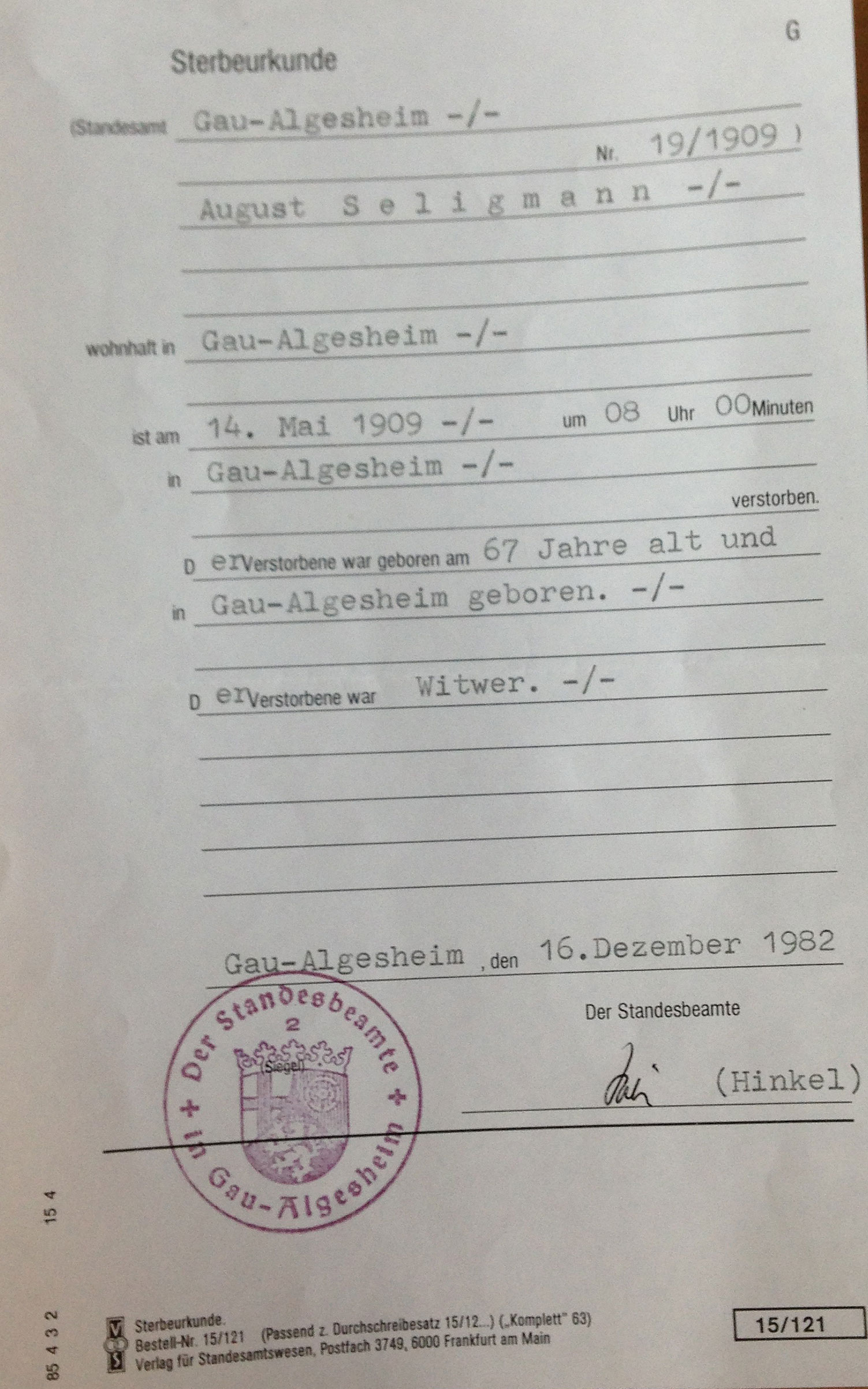
Several weeks ago, I received a comment on the blog from a man named Wolfgang Seligmann, saying he was the son of Walter Seligmann, that he lived near Gau-Algesheim, and that he had found my blog while doing some research on his family.  He asked me to email him, which I did immediately, and we have since exchanged many emails and learned that we are third cousins, once removed:  his great-great-grandparents were Moritz Seligmann and Babetta Schoenfeld, my great-great-great-grandparents.  His great-grandfather August was the brother of Sigmund, Adolph and Bernard Seligman, the three who had settled in Santa Fe in the mid-19th century.   Wolfgang sent me a copy of August’s death certificate.

August Seligmann death certificate

August Seligmann death certificate

(Translations in this post courtesy of Wolfgang Seligmann except where noted: Registry-Office Gau-Algesheim: August Seligmann, living in Gau-Algesheim died the 14th of May 1909 at 8 a.m. in Gau-Algesheim. He was 67 years old and born in Gau-Algesheim. He was a widower.)

Our families had probably not been in touch since Bernard died in 1902 (or perhaps when Adolph died in 1920).  And now through the miracle of the internet and Google, Wolfgang had found my blog with his family’s names in it and had contacted me.  What would our mutual ancestors think of that?  It even seems miraculous to me, and I live in the 21st century.

Fortunately, Wolfgang’s English is excellent (since my knowledge of German is…well, about five words), and so we have been able to exchange some information about our families, and I have learned some answers to questions I had about the Seligmanns who stayed in Germany.  With Wolfgang’s permission, I would like to share some of those stories.

Wolfgang’s grandfather was Julius Seligmann, the second child and oldest son of August Seligmann and his wife Rosa Bergmann.  Julius was born in 1877 in Gau-Algesheim.  As I wrote about here, Julius was one of the Seligmanns written about in Ludwig Hellriegel’s book about the Jews of Gau-Algesheim.  He had been a merchant in the town.  On December 1, 1922, Julius had married a Catholic woman named Magdalena Kleisinger, who was born in Gau-Algesheim on July 9, 1882, and had himself converted to Catholicism.  Julius and Magdalena had two sons, Walter, who was born February 10, 1925, and Herbert, born July 27, 1927.  Julius and his family had left Gau-Algesheim for Bingen in 1939 after closing the store in 1935.

I had wondered why Julius had closed the store and then relocated to Bingen, and I asked Wolfgang what he knew about his grandfather’s life.  According to Wolfgang, his father Walter and uncle Herbert did not like to talk about the past, but Wolfgang knew that when Julius married and converted to Catholicism, his Jewish family was very upset and did not want to associate with him any longer.  In fact, Julius was forced to pay his siblings a substantial amount of money for some reason relating to his store in Gau-Algesheim, and that payment caused him and his family a great deal of financial hardship.  According to Wolfgang, Julius no longer had enough money to pay for his own home, and thus he and his family moved to Bingen in 1939 where they lived with Magdalena’s family or friends for some time.

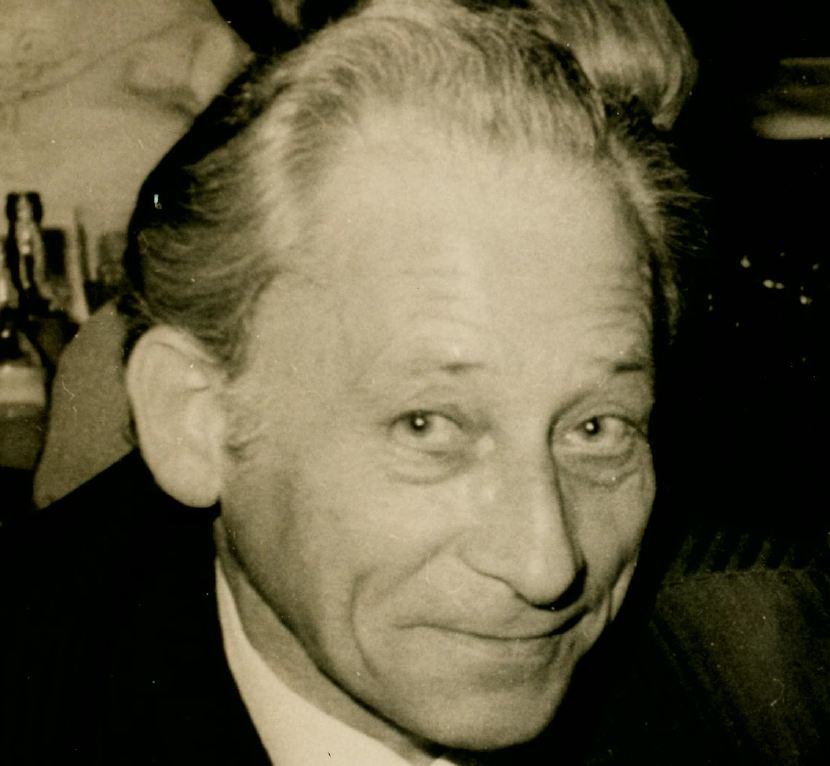
Julius and Magdalena Seligmann

Julius and Magdalena Seligmann 1960s  Courtesy of Wolfgang Seligmann

The Hellriegel book also made some puzzling (to me) references to the military records of Wolfgang’s father and uncle, saying that they had been “allowed” to enlist in the army, but then were soon after dismissed.  Wolfgang explained that the German authorities did not know how to treat Catholic citizens with Jewish roots.  Wolfgang said that his father Walter had trained to be a pharmacist, but the Nazis would not allow him to work with anything poisonous.  In addition,  his father was not permitted to be in the army; instead  he was ordered by the authorities to work on the Siegfried Line, which was  originally built as a defensive line by the Germans during World War I.  In August 1944, Hitler ordered that it be strengthened and rebuilt, and according to Wikipedia, “20,000 forced labourers and members of the Reichsarbeitsdienst (Reich Labour Service), most of whom were 14–16-year-old boys, attempted to re-equip the line for defence purposes.”  Walter Seligmann was one of those forced laborers.

Map of the Siegfried line.

Map of the Siegfried line. (Photo credit: Wikipedia)

Here is a photograph of Walter Seligmann, Wolfgang’s father:

Walter Seligmann  Photo courtesy of Wolfgang Seligmann

Walter Seligmann Photo courtesy of Wolfgang Seligmann

As for Wolfgang’s uncle Herbert, he was sent by the local police to the army, but the army would not accept him.  He was dismissed and sent back to Bingen, where he was required to work in a warehouse until the war ended.

Herbert Seligmann courtesy of Christoph Seligmann

Herbert Seligmann courtesy of Christoph Seligmann

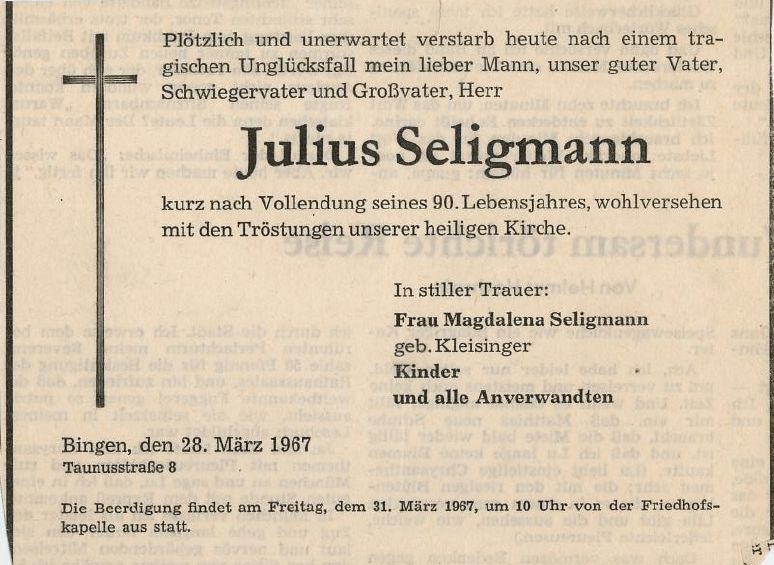
Julius Seligmann died in 1967, and his wife Magdalena died the following year.  Walter Seligmann died in 1993, and his brother Herbert died in 2001.

Julius Seligmann death notice

Julius Seligmann death notice

Magdalena Seligmann death notice

There are some very bitter ironies in these stories.  Julius and his family were not accepted by his Jewish family because they were Catholic, but the Nazis did not accept them either because they had Jewish roots.  As I commented to Wolfgang, prejudice of any sort is so destructive and unacceptable.  His family experienced it from two different directions.

Not that the two examples here can be equated in any way.  Although all prejudice is wrong, prejudice that leads to genocide is utterly reprehensible, an evil beyond comprehension for anyone who has a moral compass.  I have already written about my own personal horror and pain when I realized that I had family who had been murdered by the Nazis.  Wolfgang told me more about some of those who lost their lives to Hitler and his evil forces.

One victim was his great-uncle Moritz Seligmann (the grandson of Moritz Seligmann, my 3x-great-grandfather, and a son of August Seligmann).  My information about his fate comes from two websites that Wolfgang shared with me. According to these two sites, Moritz Seligmann, Julius’ younger brother, was born on June 25, 1881.  He fought in World War I for Germany, spent two years in captivity, and was honored with the Hindenburg Cross or Cross of Honor for his service.  Despite this, in the aftermath of Kristallnacht, on November 11, 1938, Moritz was arrested in Konigstein, where he had been living since 1925.  He was sent to the concentration camp at Buchenwald.

German Cross of Honour 1914-1918

German Cross of Honour 1914-1918 (Photo credit: Wikipedia)

Moritz wrote to the authorities in Konigstein, pointing out that he was the recipient of the Hindenburg Cross.  He was released from Buchenwald in December on the condition that he emigrate by March 31, 1939.  He was required to report to the police in Konigstein twice a week until then, and if he had not emigrated by the deadline, he was to be arrested.  On March 28, 1939, however, the Gestapo lifted the emigration order and the reporting requirement in light of Moritz’s service during World War I.

Here is a copy of the Gestapo letter, lifting the emigration order.  I found this a particularly chilling document to see.

Gestapo letter re Moritz Seligmann

Wolfgang helped me translate this letter as follows: Frankfort, March 20, 1939. Concerning: the “Aktionsjude” Moritz Seligmann born June 25, 1881, Gau-Algesheim, residing in Konigstein.  Seligmann has provided proof that he was a soldier in the World War as a combatant.  Therefore the reporting obligation and emigration order is lifted for him. I would ask the emigration (?) to supervise and notify us here.

As explained to me by Wolfgang and by Wikipedia,  the “Aktionsjude” referred to 26,000 Jews who were deported in the aftermath of Kristallnacht, as was Moritz Seligmann, as part of an effort to frighten other Jews to leave Germany.  Unfortunately, not enough of them did.

Despite the lifting of the order to emigrate, Moritz had hoped to immigrate to the US.  For various bureaucratic reasons described here, he was unable to get clearance to emigrate.  On June 10, 1942, he was picked up by the Nazis and transported somewhere to the east.  Exactly where and when he died is not known.

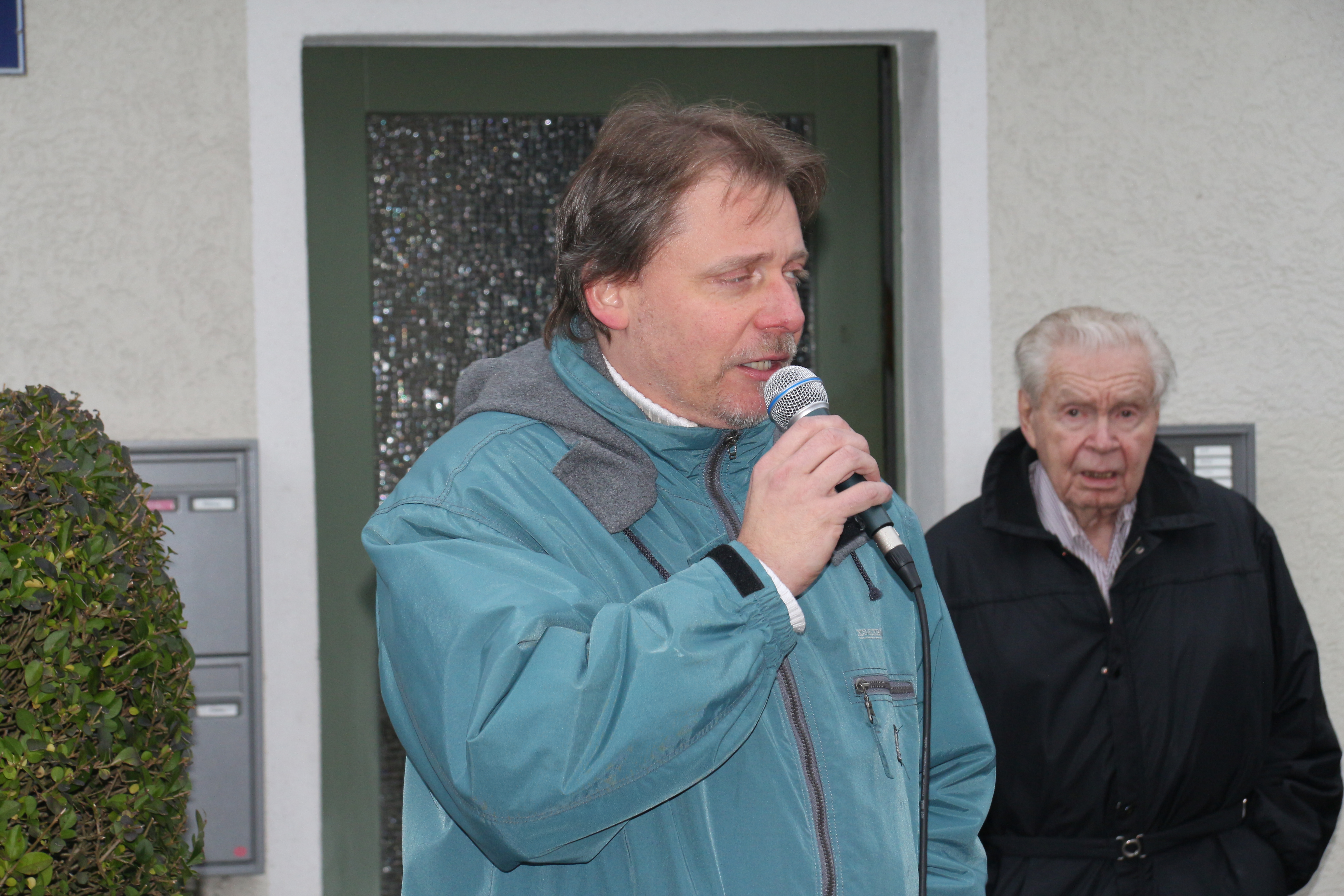
Wolfgang and his family, after researching the fate of Moritz, informed the town of Konigstein of their findings, and the town agreed to place a “stolperstein” in memory of Moritz Seligmann near his home in Konigstein.  A stolperstein (literally, a stumbling blog) is a memorial stone embedded in the ground to memorialize a victim of the Holocaust.  Here is a photograph of Wolfgang at the ceremony when Moritz Seligmann’s stolperstein was installed in Konigstein.

Wolfgang Seligmann

Wolfgang Seligmann  Courtesy of Wolfgang Seligmann

Behind him is a man who knew Moritz and remembered when Moritz was initially arrested in 1938, clinging to his Hindenburg Cross, believing it would save him from the murderous forces of the Nazis.  It may have stalled his murder, but it did not save him.

Wolfgang also told me about the fate of another sibling of his grandfather Julius, his younger sister Anna.  Anna, born in Gau-Algesheim in 1889, had married Hugo Goldmann, and they had a daughter Ruth, born in 1924 in Neunkirchen, a town about 80 miles southwest of Gau-Algesheim, where Anna and Hugo had settled. Between 1939 and 1940, many people from this area near the border with France were evacuated to locations in central Germany, and Anna, Hugo, and Ruth ended up in Halle, Germany, 350 miles to the northeast of Neunkirchen.  On June 1, 1942, they were all deported from Halle to the Sobibor concentration camp where they were all killed.  Click on each name to see the memorial pages established by the town of Halle in memory of Anna, Hugo, and Ruth.

Finally, Wolfgang told me about another member of the family.  Moritz Seligmann (the elder) had had a daughter Caroline with his first wife, Eva Schoenfeld.  Caroline was the half-sister of my great-great-grandfather Bernard. She had married a man named Siegfried Seligmann, perhaps a cousin.  Their son, Emil, died in Wiesbaden on August 9, 1942, when he was 78 years old.

Death record of Emil Seligmann, husband of Carolina Seligmann

Death record of Emil Seligmann, husband of Carolina Seligmann

(Wiesbaden: The Emil Jakob Israel Seligmann, without profession, “israelitisch”  [presumably meaning Jewish], living in Wiesbaden, Gothestraße Nr. 5, died on 9th of August 1942 in his Apartment. He  was born on 23th of December 1863 in Mainz.

Father: Siegfried Seligmann, deceased.  Mother: Karoline Seligmann, nee Seligmann, deceased.  He was widower of Anna Maria Angelika born as Illien. The death was announced by Emil Seligmann, his son, living Goethestraße Nr.5.

The stamp in the left hand margin says:  Wiesbaden, 31th of May 1949.  The “Zwangsvorname”Israel is deleted.  Zwangsvorname translates as “forced first name,” meaning that the name Israel had been required by the Nazis, I assume as a way to identify him as Jewish.

Emil had a son, also named Emil, who died in Buchenwald, as this record attests.

Emil Seligmann-KZ (1)

(To: Miss Christine Seligmann, Wiesbaden, Goethestr. Nr. 5,1

From: Special registry-office in Arolsen-Waldeck, department Buchenwald

Subject: death-certification for Emil-Jakob Seligmann, Your letter from the 1. of March 1950

Based on the documents of the International Tracing Service in Arolsen it is proved, that your brother died on 14th of February 1945 in the Concentration Camp Buchenwald. )

I imagine that this is not the end of the list of the Seligmanns who were murdered during the Holocaust, and I imagine that there are also many other family members I never knew about who were killed by the Nazis, whether they were named Schoenfeld, Nussbaum, Dreyfuss, Goldschlager, Rosenzweig, Cohen, or Brotman or something else.  I just haven’t found them yet.

Wolfgang and I plan to keep on exchanging stories, pictures, documents, and other information.  We have also already talked about meeting someday and walking in the footsteps of our mutual ancestors.  What an honor it will be to be with him as we share our family’s story.

The Schoenfelds and Erbes-Budesheim: Part II

In my last post, I wrote about Erbes-Budesheim, the German town where my Schoenfeld ancestors lived, where my 3x-great-grandmother was born, and where my 4x- and 5x-great-grandparents lived.   From the records I was able to obtain, I know that my 4x-great-grandparents Bernhard Schoenfeld and Rosina Goldmann were married and living in Erbes-Budesheim by 1804 when their first child Benedict Baehr was born.

As explained to me by Gerd Braun, the man in Erbes-Budesheim who sent me the documents,  when the French took over control of the region, one thing that they did in 1808 was order the Jewish residents to adopt surnames akin to those used by the Christian population.  Before that, Jews used patronymics.  Thus, before 1808, Bernhard Schoenfeld was named Baer (ben) Salomon[1] and Rosina was Rosina (bat) Benjamin.  The two children born before 1808 were named Benedict (ben) Baer and Taubchen (bat) Baer.  Taubchen was renamed Eva Schoenfeld after 1808.

Here is the birth record for Benedict.  (All the records before 1816 are in French, and my high school French classes came in handy.)  The translations for all of the documents below are in italics.

Benedict Baer birth record 1804

Benedict Baer birth record 1804

Act of birth of Benedict Baer born the 15th of Frimaire[2] at 10 in the morning, the legitimate son of Baer Salomon, merchant, living in Erbesbudesheim, and of Rosine nee Benjamin of Munchweiler.  The sex of the child has been recognized as masculine.  [Witnesses and signatures]

Benedict died just eight months later.

Benedict Baer death record 1805

Benedict Baer death record 1805

Act of death of Benedict Baer, died the 17th of Messidor[3] at 7 in the evening, eight months old, born in Erbesbudesheim and living in Erbesbudesheim.  Son of Baer Salomon and Roes nee Benjamin.  On the declaration made by Baer Salomon, his father, resident of Erbesbudesheim and a merchant, and Francois Colin, resident of Erbesbudeshem, a barber and a neighbor.

A year later, Taubechen (who became Eva) was born:

Birth record of Taubchen Baer/Eva Schoenfeld 1806

Birth record of Taubchen Baer/Eva Schoenfeld 1806

Act of birth:  In the year 1806 on the 2d of June in the afternoon appeared before the mayor of Erbesbudesheim… Baehr Salomon, a merchant, 34 years old, living in Erbesbudesheim, No. 66, and presented to us a female child of him and his legal wife Rosine nee Benjamin born the 2d of June at 5 in the morning and also stated that he wanted to give the child the name Taubchen.  [Witnesses and signatures.]

The children born after 1808 were given the name Schoenfeld, including my 3-x great-grandmother, Babetta.  You will see that on this record, Bernard and Rosine are referred to with surnames.

Babete Schoenfeld birth record 1806

Babete Schoenfeld birth record 1806

In the year 1810, the 28th of February, at nine in the morning, Bernard Schoenfeld, 37 years old, a merchant, and a resident of Erbesbudesheim,appeared before Andre Cronenberger, Mayor of Erbesbudesheim and presented a female child born the 28th of February in the morning of himself and Rosine nee Goldmann, his wife, and also declared that he wanted to give the child the name of Babet. [Witnesses and signatures]

In addition, I received records for other children of Bernard and Rosina Schoenfeld, ancestors I’d not known about before.  The first two are in French, but the last two are in German because they occurred when the region was back under German control.  The two in French follow the format and content of those above and evidence the births of a daughter Marianne, born June 29, 1812, and a daughter Rebecque, born July 20, 1814.

Birth record of Marianna Schoenfled 1812

Birth record of Marianna Schoenfled 1812

Birth record of Rebecque Schoenfeld 1814

Birth record of Rebecque Schoenfeld 1814

The last two are in German.  Thank you to Matthias Steinke for the translations. The first record is for the birth of another daughter, Zibora, in 1818.


Birtn record of Zibora Schoenfeld 1818

Birtn record of Zibora Schoenfeld 1818

In the year 1818, the 23rd of May came to me, the mayor and official for the civil registration of the comunity of Erbesbuedesheim, county of Alzey, Bernhard Schoenfeld, 45 years old, merchant, residing in Erbesbuedesheim, who reported, that at the 22nd of May at 11 o´clock in the night a child of female sex, which he showed me, was born and whom he intends to give the first name Zibora, and which he declared to have fathered with his wife Rosina Goldmann, 35 old, residing in Erbesbuedesheim.  The child was born in the Hauptstr. nr. 77. This declaration and presentation happened in presence of the witnesses Johannes Knobloch, 55 years old, farmer, in Erbesbuedesheim residing and Jacob Landesberg, 29 years old, farmer, in Erbesbuedesheim  residing, and have the father and the witnesses signed his birth-record and it was read to them. Signatures

The last child of Bernard and Rosine for whom I have a record was their daughter Saara, born in 1820:
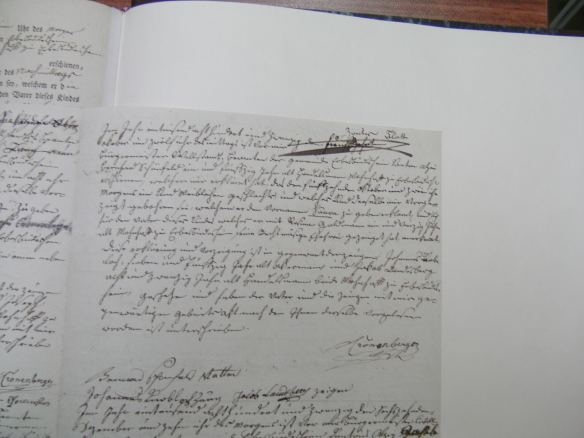
Birth Record of Saara Schoenfeld 1820

Birth Record of Saara Schoenfeld 1820

In the year 1820 the fifteenth of October at twelve o´clock midday came to me, mayor and official for the civil registration of the comunity Erbes-Buedesheim Bernhard Schoenfeld, 51 years old, merchant, residing in Erbes-Buedesheim, who reported, that at the fifteenth October at two o´clock in the morning a child of female sex, whom he showed me, was born and whom he intends to give the name Saara, and he also reported, that he fathered the child with Rosina Goldmann, 41 years old, residing in Erbes-Buedesheim, his legal wife. This declaration and showing happened in presence of the witness Johannes Knobloch, 57 years old, farmer, and Jakob Landsberg, 28 years old, merchant, both residing in Erbes-Buedesheim, and have the father and the witnesses with me this present birth-certificate after it was read to them, signed. Signatures

In the midst of all these births, there was also a death.  On February 16, 1813, Salomon Schoenfeld, father of Bernard Schoenfeld, died at age 63 (or is that soixant treize meaning 73?).  His occupation was given as “cultivateur,” or cultivator, which I assume means that he was a farmer.  The witnesses to his death included Benoit Schoenfeld, his son, age 23, a “propietaire”  or owner, but no indication of what he owned.  This must have been a younger brother of Bernard since in 1813 Bernard would have been at least 40 years old.  (His age seems to vary from birth record to birth record.)

Death Record of Salomon Schoenfeld 1813

Death Record of Salomon Schoenfeld 1813


There is also a record for the birth of the child of an Isaac Schoenfeld and a Barbe Goldmann who is probably also a family member, though I am not sure what the exact connection was between these Goldmanns and Schoenfelds and Bernhard and Rosina, my 4x great-grandparents. But the number of marriages between a Schoenfeld man and a Goldmann woman are somewhat revealing.  Here is a third such marriage, this one between Rebeka (Rebecque) Schoenfeld, the daughter of Bernhard and Rosina,  and Salomon Goldmann.  Is it any surprise that Ashkenazi Jews come up with thousands of matches when DNA testing is done?  We are all interrelated at so many different levels.

Marriage Record for Rebecque/Rebkah Schoenfeld and Salomon Goldmann

Marriage Record for Rebecque/Rebkah Schoenfeld and Salomon Goldmann


In the year 1834 on the fifteenth October at ten o´clock pre midday came to me, Andreas Cronenberger mayor and official for the civil registration of the comunity Erbes-Buedesheim, county of Alzey:

Salomon Goldmann, 42 years old, merchant, residing in Kirchheimbolanden, Rhein-county, Bavaria, born in …thal, like it was presented to me by a certificate of the district-court Kirchheimbolanden from the 24th of December 1807, which was certified by the district-court in Mainz, the adult son of 1. Joseph Goldmann, 75 years old, during his lifetime a merchant in Kirchheimbolanden, deceased there the 8th of  November, 1800 (some parts here were cut off) 2. Friederike Goldmann, widow, nee Goldmann, 62 years old, without profession residing in Kirchheimbolanden and here present and giving her confirmation and who declared to be unable to write.

And on the other hand, Rebeka Schoenfeld (Schönfeld), 20 years old, born in Erbebudesheim in 1814, like I have seen in the present birth-register of the year 1814, without profession, in Erbes-Buedsheim residing.

Minor daughter of 1. Bernhard Schoenfeld, 62 years old, merchant and owner of a manor, in Erbes-Buedesheim residing. 2. Rosina Schoenfeld nee Goldmann, 55 years old, without profession, in Erbes-Buedesheim residing, both are present and giving their confirmation.

The appearing people asked me to do the marriage. The proclamation was published at the main-door of the comunity-building the September 24, 1834 at noon and the second the September 26 at noon in Erbes-Buedesheim and in Kirchheimbolanden the 14th of September the first time and the 21st of September of the same year the second time was made.

Due to the case, that no objections against this marriage appeared, and after reading the sixth chapter of the civil-rights-lawbook which is titled „about the marriage“ I asked them whether they want to marry each other. Both confirmed this question and I declared that Salomon Goldmann, widower from Kirchheimbolanden and the maiden Rebeka Schoenfeld of Erbes-Buedesheim are from now on connected by the matrimony.

About this act this certificate was made in presence of the following witnesses:

Georg Peter Erbach, 54 years old, member of the regional council and manor-owner in Erbes-Buedesheim, a neighbour of the bride, not related.  Johannes Klippel, 45 years old, farmer in Erbes-Buedesheim, not related, a neighbour of the bride, Christoph Zopf, 49 years old, farmer in Erbes-Buedesheim, not related, a neighbour of the bride,  Johannes Härter, 82 years old, comunity-servant in Erbes-Buedesheim, not related, a neighbour of the bride. After happened reading have all parts this document with me signed. Signatures

I have a couple of observations about this marriage certificate.  First, the groom was a widower and 24 years older than the bride.  Also, Rebeka was younger than her sister Babete or Babetta, my 3x-great-grandmother, yet married before her, even though this would appear to have been an arranged marriage.  Did Babetta object to marrying Salomon? Or did Salomon choose Rebeka over her older sister?

Also, I was struck by the fact that Bernard was described not just as a merchant, as he had been in the records of his children’s births, but as the owner of a manor.  Perhaps this explains why my Schoenfeld relatives were living in this small village with almost no Jewish residents.  Bernard must have  been quite successful to be a manor owner.

Two years after this wedding, Bernard Schoenfeld died.
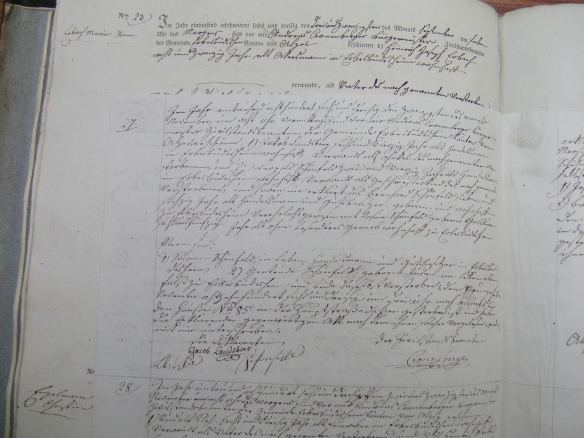
Death record of Bernard Schoenfeld 1836

Death record of Bernard Schoenfeld 1836

In the year 1836 November 20th, at eight o´clock pre midday came to me, Andreas Cronenberger, mayor and official for the civil registration of the comunity Erbes-Buedesheim, county of Alzey, 1. the Jakob Landsberg, 46 years old, merchant in Erbes-Buedesheim residing, related as uncle of the below named deceased, and 2. Leopold Schoenfeld, 42 years old, merchant, in Erbes-Buedesheim residing, related as sibling of the below named deceased, and have reported to me that Bernhard Schoenfeld, 67 years old, merchant and manor-owner, born and residing in Erbes-Bueresheim, married to Rosina Schoenfeld, nee Goldmann ,56 years old, without profession, residing in Erbes-Buedesheim. Parents were: Salomon Schoenfeld, during lifetime merchant and manor-owner in  Erbes-Buedesheim, 2. Gertrude Schoenfeld nee Judah, during lifetime also residing in Erbes-Buedesheim.

Died November 1836 at three o´clock past midday in house nr 85 in the Hauptstrasse (Mainstreet) here is deceased and have the here present this certificate after it was read to them with me undersigned.

In this record, Bernard’s father Salomon is described as a merchant and manor owner, not a cultivator.  I am not sure how to reconcile that with the earlier record of Salomon’s death. The above record also reveals two more relatives: Leopold Schoenfeld, another brother of Bernard, and Jakob Landsberg, an uncle.  But Jakob Landsberg was over 20 years younger than Bernard.  Perhaps he was a nephew?  Leopold Schoenfeld’s headstone appeared in the video I posted in the last post.  Here’s a screenshot from that video:

Leopold Schoenfeld headstone

Leopold Schoenfeld headstone

Just a few months after Bernard Schoenfeld died, his daughter Babete, my 3-x great-grandmother, married Moritz Seligmann on February 14, 1837.

Marriage record of Babete Schoenfeld and Moritz Seligmann 1837

Marriage record of Babete Schoenfeld and Moritz Seligmann 1837

In the year 1837 the 14th of the month February, at three o´clock past midday to me, Peter Cronenberger, mayor and official for the civil registration of the comunity Erbes-Buedesheim, county of Alzey came:

Moritz Seligmann, 38 years old, widower of Eva Seligmann, nee Schoenfeld, deceased in Gaulsheim the 12th of May 1835 as it is written in the death-register of the comunity Gaulsheim of the year 1835, merchant, in Gau Algesheim residing, like it is in the birth-records of the community Gau Algesheim to find, adult son of 1. Jacob Seligmann, 63 years old, merchant, in Gaulsheim residing, 2. Martha Seligmann nee Mayer, 63 years old, in Gaulsheim residing, both not present, but giving their permission to this marriage according a notary-certificate of the notary Wieger in Gaulsheim from the 6th of February, 1837,

and on the other hand, Babete Schoenfeld, 26 years old, without profession, in Erbes-Buedesheim residing, born the February 28, 1810, like it is stated in the birth-register of the comunity Erbes-Buedesheim of the year 1810, adult daughter of 1. Bernhard Schoenfeld, during lifetime merchant, in Erbes-Buedesheim residing, deceased 19th of November 1836, as it is stated in the death-register of the comunity Erbes-Buedesheim, 2. Rosina Schoenfeld, nee Goldmann , 56 years old, in Erbes-Buedesheim residing, last named here present and consenting to the marriage. ….

Due to the case, that no objections against this marriage appeared, and after reading the sixth chapter of the civil-rights-lawbook which is titled ‘about the marriage,“ I asked them whether they want to marry each other. Both confirmed this question and I declared that Moritz Seligmann, merchant in Gau Algesheim residing and Babete Schoenfeld, without profession in Erbes-Buedesheim residing, are from now on legally connected by the matrimony.

About this act I made this certificate in the presence of the following witnesses: [Witnesses and signatures]

This marriage record answered a question that I had had about the two sisters both marrying Moritz Seligmann.  According to this record, Eva Schoenfeld had died on May 12, 1835.  Eva died in the aftermath of giving birth to her fourth child, Benjamin, who was born on May 10, 1835.

Her sister Babetta (as it was later spelled) became the instant mother of Eva’s four children, who then ranged in age from Benjamin, not yet two years old, to eight year old Sigmund, who would be the first to come to the US and settle in Santa Fe.  Babetta not only had these four children to care for; she must also have become  pregnant almost immediately after the wedding because my great-great-grandfather Bernard Seligman, obviously named for Babetta’s father Bernard Schoenfeld who had died the year before, was born on November 23, 1837, just nine months and nine days after the marriage.

The last record I received from Erbes-Budesheim was the death record for Rosina Goldmann Schoenfeld, dated July 19, 1862.  She was 84 years old.  She was my 4-x great-grandmother.  All I know about her is where she was born, her father’s name, her husband’s name, and the names of her children and some of her grandchildren.  I know that she lost one child at eight months old, an adult daughter in the aftermath of childbirth, and her husband almost thirty years before she died.  It’s not a lot, but it is remarkable to me that I know even that much about a woman who was born in the 18th century in Germany.
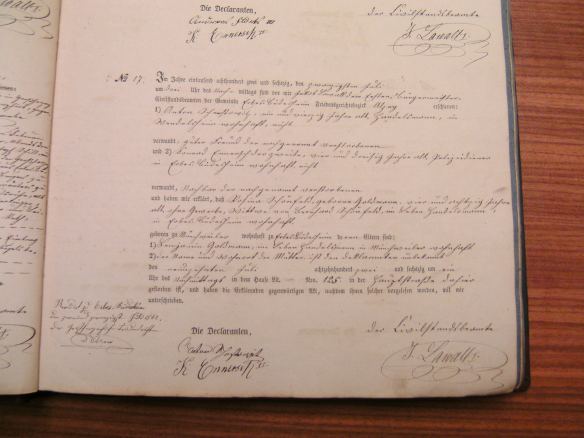
Death record of Rosina Goldmann Schoenfeld 1862

Death record of Rosina Goldmann Schoenfeld 1862

So what have I learned about my Schoenfeld ancestors and their lives in Erbes-Budesheim from all these documents?  First, they must have been one of only a very few Jewish families in Erbes-Budesheim if the total Jewish population was just 23 people.  Second, they must have been fairly comfortable living in that small town, living as merchants and manor owners.   But there was no future for their family in the town.  Bernard Schoenfeld and Rosina Goldmann had only daughters who survived to adulthood.   To find marriage partners for their daughters, Bernard and Rosina had to look outside of Erbes-Budesheim.  Their 20 year old daughter Rebeka Schoenfeld married a 44 year old widower from a town in Bavaria, about ten miles from Erbes-Budesheim.  Their daughter Eva married Moritz Seligmann and moved to Gau-Algesheim.  Then their daughter Babetta,  my 3-x great-grandmother, married Moritz after her sister died.  These young women must have had no choice but to marry and move away from Erbes-Budesheim.  No wonder the town’s Jewish population never grew and eventually declined and disappeared.

But the cemetery still exists, and Erbes-Budesheim is one more town to add to my list of ancestral towns I’d like to visit one day.


[1] Gerd Braun did not use the Hebrew terms “ben” or “bat” for son or daughter of, but simply referred to them as, for example, Baehr Salomon.  I am assuming, however, based on Jewish practice, that the second name would have been the father’s first name.  Thus, Baehr Salomon is really Baehr son of (ben) Salomon.

[2] According to Wikipedia,  Frimaire “was the third month in the French Republican Calendar. The month was named after the French word frimas, which means frost. Frimaire was the third month of the autumn quarter (mois d’automne). It started between November 21 and November 23. It ended between December 20 and December 22. It follows the Brumaire and precedes the Nivôse.”  Benedict was thus born about December 6.

[3] Messidor in the French Republic Calendar was equivalent to June 19 to July 18.  The 17th would be equivalent to July 6.

The First Chapter: The Dreyfuss Family

Yeah, I know.  My last post said it was the FINAL chapter of the Dreyfuss family.  How could this one be the first?

Way back on November 18, 2014, I wrote, “More on the Dreyfuss family in a later post.”  Then I proceeded to write about the Nusbaum family and the Dreyfuss family together.  Since two Dreyfuss sisters (Jeanette and Mathilde) had married two Nusbaum brothers (John and Maxwell), it just made sense to follow the stories of the three Dreyfuss sisters (Jeanette, Mathilde and Caroline) along with the stories of the Nusbaum siblings.  But what I never got back to doing was what I had promised back on November 18.  I never got back to the beginning of the Dreyfuss story as I moved forward from the 1840s in America through to the 20th century.  So although my last post was called the “Final Chapter” of the Dreyfuss family, I need to go back and write the first chapter before I can complete the story (as far as I currently know it).

So I need to step backwards in time—both in my time and in the times of the Dreyfuss family before 1840.  Back in the fall when I was researching the family of John Nusbaum, I had a wonderful resource in the family bible owned by my father.  My father had photocopied several pages of handwritten entries for births, deaths, and marriages from the bible , and most of those entries related to the Nusbaum family.  From studying the page for marriages, I learned that John Nusbaum, my three-times great-grandfather, had married Jeanette Dreyfus (as it was spelled there).  And that was the first time I knew the birth name of my three-times great-grandmother.  On the page for births, the second entry after the one for John Nusbaum was one for Jeanette Nusbaum, giving her birth date and her place of birth.  It took me a while to figure out what it said because of the handwriting, but eventually I was able to decipher it and learned that Jeanette was born in “Hechingen in Wurttemberg, Prussia,” as it is inscribed in the bible.

But there was no other Dreyfus(s) on any of the pages in the bible, and I was at that point in time focused on the Nusbaum line.  It wasn’t until weeks later that I realized that the bible’s death entry for Mathilde Pollock was not an entry for a sister of John Nusbaum, but an entry for a sister of Jeanette Dreyfuss (who happened to marry a brother of John Nusbaum) and that the entry for Caroline Wiler was also not a sister of John Nusbaum but another Dreyfuss sister. The big clue was finding 65 year old Mary Dreyfuss  on the 1850 census living with Caroline and Moses Wiler: a head-slapping moment when it occurred to me that it was Jeanette who was keeping the family bible and that, of course, she would record her sisters as well as her husband’s siblings in the family bible.

And then in mid-November I went on JewishGen’s Family Finder page and found Ralph Baer, who was also researching the Dreyfuss family from Hechingen.  I have mentioned Ralph before in the context of the Nusbaum/Dreyfuss family and his generous help with research and translation, but what I had forgotten to write about in my telling of the story of the Nusbaum/Dreyfuss family in the US was what Ralph had helped me learn about my Dreyfuss roots in Hechingen, Germany.

Hechingen, Germany

Hechingen, Germany (Photo credit: Wikipedia)

First, a little about Hechingen.  Today it is in the German state of Baden-Wurttemburg, located about 56 miles north of the Swiss border in southern Germany.  It is about 40 miles from Stuttgart, the state capital.  Although inhabited long before, the city was founded as the capital city of the Counts of Hohenzollern in 1255.  It remained during the Middle Ages a provincial and agricultural community.  During the 16th century, it became a center for art, architecture and music.  Even after the Reformation, it remained a largely Catholic community.  Throughout its pre-19th century history, Hechingen was subjected to many sieges and attacks by other German states as well as by Sweden.

de: Burg Hohenzollern bei Hechingen, Baden-Wür...

de: Burg Hohenzollern bei Hechingen, Baden-Württemberg, Deutschland en:Castle Hohenzollern near Hechingen, Germany (Photo credit: Wikipedia)

According to the Jewish Virtual Library, “There was a small Jewish settlement in Hechingen in the early 16th century, and a house was bought for use as a synagogue by the community of 10 families in 1546. In 1592 the burghers refused to conduct any commercial or financial transactions with Jews, who therefore left the town. There is no trace of Jewish settlement in the town during the next century. In 1701 Prince Frederick William I gave letters of protection lasting 10 years to six Jewish families in the neighboring villages; soon there were Jews living in the city as well. By 1737 there were 30 households, and a synagogue was built in 1761 which existed until 1870.”

The Jewish community blossomed in Hechingen in the late 18th and early 19th century through the efforts of a woman named Chaile Raphael Kaulla.  Her father was a successful entrepreneur and banker, and he provided Chaile with a good education.   She even learned German, not something girls were usually taught in those times.   When her father died, Chaile, being much older than her oldest brother, took over her father’s business; she managed the business very successfully while also raising six children.  Her husband, a Talmudic scholar, did not work.  Chaile and her brother Jacob developed a very good relationship with the authorities in Hechingen and became the leaders of the Jewish community there.  Here is more about Chaile from the Jewish Women’s Archive:

Chaile developed an aristocratic lifestyle, owning an elegant house and a horse-drawn carriage, but she continued to live according to Jewish law. She never forgot the mitzvot and cared for the Jewish community together with her brother, using her connections to the prince. The Kaulla family had their own private synagogue and rabbi. Both sister and brother gave generously to the Jewish as well as to the Christian poor and founded a hostel for needy and migrating Jews in Hechingen. In 1803, they donated a Bet Midrash, a Talmud school, with three rabbinical scholars whom they supported, together with their students and an important library.


The 19th century was a time of economic and industrial growth for the town of Hechingen and for its Jewish residents.  Wikipedia states that “By 1850, Hechingen had started to industrialize, primarily with Jewish enterprises. By 1871 the city had become one of the most important economic centres in the region, with textiles and machine shops among the major industries.”  According to the Jewish Virtual Library, the Jewish community in Hechingen was “prosperous and owned most of the local industries.” The Jewish population reached 809 people in 1842, which was about a quarter of the total population of the town.  This was also around the time that my three-times great-grandmother Jeanette and her sisters and mother would have left, which might seem strange, given how favorable the conditions there seemed to have been.

The Alemannia-Judaica, however, reports that there were some anti-Semitic “disturbances” in the 1840s, and the Dreyfuss sisters were not the only ones to leave.  By 1880, the Jewish population had dropped to 340; by the 1930s it had dropped to only 101.  Like so many other Europeans, Jews and non-Jews, the lure of opportunities elsewhere must have been irresistible.  The Dreyfuss sisters were wise to leave Hechingen because it was no more immune to the destruction and genocide of the Nazis than any other place during the Holocaust.  The synagogue was heavily damaged on Kristallnacht in November, 1938, and most of the Jewish men were sent to Dachau.  In the aftermath, 53 Jews emigrated successfully; the remaining 32 Jewish residents of Hechingen were sent to concentration camps where all but one were murdered by the Nazis.

According to another source, “In 1991, the synagogue building was rebuilt as a cultural center, housing an exhibition on Hechingen’s Jewish history. A new Jewish community was founded in Hechingen in 2003.”  More pictures can be found here.


Where did my ancestors fit into this story of Hechingen? I was very, very lucky to find Ralph Baer on the JewishGen Family Finder because Ralph had already done extensive research on all the Hechingen Dreyfuss families years before I stumbled onto the name in the old family bible.  Even though he had not been able to find a connection between his Dreyfuss ancestors and mine, he had included my line in his tree when he’d done his research years ago.  Thus, my first email from Ralph in response to my inquiry as to his Hechingen Dreyfuss family included the following names:

A)3. Samuel (Sanwil) DREYFUß (ZELLER) 25 May 1776 Hechingen – 3 July 1859
Hechingen, married about 1805 to Miriam (Marianna) Samson BERNHEIM 17 May
1787 – 1841

A)31. Jeanette DREYFUß 20 May 1817 Hechingen, married to … NUßBAUM

A)32. Moses DREYFUß 10 February 1819 Hechingen

A)33. Goldel (Golde, Auguste) DREYFUß 16 October 1822 Hechingen,
married to … WEILER

A)34. Mathilde (Magdalena) DREYFUß 30 March 1825 Hechingen, married
to … POLLAK

A)35. Samson DREYFUß about 1827 Hechingen

A)36. Auguste DREYFUß about 1829 Hechingen[1]

There were my 3x-great-grandparents right at line 31, and there at line 33 was Caroline (born Golde) “Weiler” and at line 34 Mathilde “Pollak.”  I knew immediately that Ralph had found the three Dreyfuss sisters listed in my family bible.  Not only did the names line up, but so did the birth dates.  Thus, I now also knew that Jeanette, Caroline, and Mathilde were the daughters of Samuel Dreyfuss Zeller (later documents, as I found, indicated he had changed his surname to Zeller) and Miriam (Marianna) Samson Bernheim, that is, the Mary Dreyfuss I had found on the 1850 census living with her daughter Caroline in Pennsylvania.  (The death date of 1841 given for Miriam Ralph and I later discovered was not correct. I have not, however, found a death record for Miriam, though with two grandchildren named Miriam, one (Miriam Nusbaum, daughter of John Nusbaum and Jeanette Dreyfuss) in 1858, and one in 1859 (Miriam Pollock, daughter of Mathilde Dreyfuss and Moses Pollock, it would appear that Miriam died before 1858.)  In addition, I now had evidence of three other siblings: Moses, Samson, and Auguste.

But, of course, I wanted to see the actual records where Ralph had long ago found my relatives while researching his own.  With his patient assistance, I was able to locate a number of records relating to my Dreyfuss ancestors.  Fortunately, many of the Jewish vital records from the Baden-Wurttemburg region are digitized and available on line, and Ralph walked me step by step through the process of researching those archives and then helped me translate what I had found.  Once again, I struggled with the German script, but with Ralph’s help, I was able to find a number of relevant records.

I am now including the links to them here with a transcription of what is on each record so that I have a record later when I once again have trouble reading the script.  If you are interested in seeing the underlying documents, just click on the links.  The JPG versions were too blurry to read, so I am only posting links to the PDF versions, with two exceptions that were more legible.

Dreyfuss births (1)  Birth Registry for Hechingen 1800-1905

Line 132 Moses Dreyfuss                             Father Samuel                  Mother Miriam geb Bernheim

Line 186 Golde (Augusta) Dreyfuss           Father Samuel                 Mother Miriam geb Bernheim

Line 223 Mathilde Dreyfuss                                                 SAME


Dreyfuss Family on Archives film 240 bild 31  (Census 1831)

Dreyfuss family on archives film 240 film 31

#192 Samuel Dreyfuss 56 and Marianna 44. Six children: Jeanette 14, Magdalena 6, Golde 10, Moses 12, Samson 4, and Auguste 2.


Golde Auguste Caroline Dreyfuss birth record

First line:    October 16, 1822      Golde (Augusta)         Samuel Dreyfuss               Miriam geb Bernheim


Mathilde Dreyfuss birth record

Sixth line:  March 30 1825          Mathilde                       Samuel Dreyfuss                  Miriam geb Bernheim


Meier Dreyfuss brother of Samuel  Death Record

Parents               Samson Dreyfuss and Jeanette


Moses Dreyfuss birth record

Seventh line:  February 10, 1819    Moses Dreyfuss          Samuel Dreyfuss               Miriam geb Bernheim


Moses Zeller ne Dreyfuss death record Hechingen

Son of Samuel Zeller and Marie geb Bernheimer


Samuel Dreyfuss and family on Hechingen Family Records

Ralph helped me decipher this; otherwise, it would have meant nothing to me:  The name DREYFUSS is underlined with Samuel next to it. Below Samuel is written Zeller.  Below that it says Eltern (parents) Samson, and below that Jeanette(Scheile). To the right is geb. (born) and below that get. (married). The birth date for Samuel is on the right 1776 25 Mai. Between that is written “63 alt geworden” (became 63 years old, his age at the time of the compilation). For marriage it says angebl. (apparently) 1805 with also something in Hebrew. Samuel’s wife is on the right: Miriam, daughter of Samson Bern…and Golde. It also mentions a sister name Sussen right below that. The birth date for Miriam is listed as 17 Merz (March) 1787.  On the bottom are the children. The first one on the left is r Jeanette. In parentheses after her name is NUSSBAUM and below that 20 years old. To the left it states ca. 1817 20 Mai. Also listed are Moses, Mathilde Madel (Pollak), and Auguste (Golde) Weiler with birthdates.  (This was obviously compiled after 1851 since all three sisters are married and Mathilde is already married to Moses Pollock, whom she did not marry until after Maxwell Nusbaum died in 1851.)

Samuel Dreyfuss death record bild 143  (second on page)


Samuel Zeller death p 1 Samuel Zeller death p 2

Bottom of both pages: Samuel Zeller  Hechingen      Samson Dreyfuss and Jeanette    Alterschwaeche (old age)


There are some missing records.  I do not have a separate birth record for Jeanette.  Nor can I find a death record for her mother, my 4x-great-grandmother Miriam Bernheim.  I cannot find any records for the two youngest of the siblings, Samson and Auguste.  I also do not understand why there are two children with the name Auguste.  Perhaps one was a child of a family member who died? There is also a huge gap between the recorded marriage date for Samuel Dreyfuss and Miriam Bernheim of 1806 and the birth date of their oldest child, Jeanette, in 1817.  Did Samuel and Miriam have other children who died, or is their marriage date incorrect?  Samuel would have been 41 in 1817, Miriam would have been 30.  Both Samuel and Miriam had fathers named Samson.  Were both alive in 1819 when Moses was born? If not, it seems odd that their first son would not have been named Samson, unless there had been an earlier born son named Samson who had died.

I don’t know the answers to these questions, but I have answers to so many more questions than I ever expected, thanks to Ralph.  I know the names of my 4x-great-grandparents, Samuel Dreyfuss Zeller and Miriam Bernheim, and the names of my 5x-great-grandparents, Samson and Jeanette Dreyfuss and Samson and Golde Bernheim.  I have the names of the three other siblings of my 3-x great-grandmother Jeanette: Moses, Samson, and Auguste.  And I am not yet done looking for more about my Dreyfuss ancestors and now, my Bernheim ancestors as well.

Once again, I am deeply grateful to Ralph Baer.  Without him, none of this would have been possible.


[1] Together Ralph and I filled in many of the blanks here, enabling both of us to have a more complete record.

Life’s Injustices

The last two posts and the research surrounding them have really been draining.  The sad stories of Minnie Simon and Daniel Meyers in particular were hard to read about and to write about.  And sadly the next decade for the descendants of Caroline Dreyfuss and Moses Wiler is no more uplifting.  In fact, in some ways it’s even worse than the first decade of the 20th century.  But rather than put it off, I want to get it done. Today I will post about the children of Eliza Wiler and Moses Simon; next I will post about the children of Fanny Wiler and Joseph Levy and the children of Clara Wiler and Daniel Meyers. Then maybe I can post some cartoons or funny pictures or pictures of kittens.  Anything but death, disease, and despair.

The four surviving children of Eliza Wiler and Leman Simon continued to have far more than their fair share of tragedy in the 1910s.  First, on April 20, 1915, the youngest child Leon died from tuberculosis.  He had been at the Mont Alto Sanitarium in Quincy, Pennsylvania for over a year.  He was only 36 years old.  Having just watched the PBS program about tuberculosis, “The Forgotten Plague,” on February 10, I have a whole new appreciation for the suffering this disease caused.  People could live for years with the disease, coughing, wasting away, and being sent to live in a sanitarium surrounded by others also suffering from these symptoms.  I now better understand how many people were affected by TB and how lucky we all are that medical science eventually figured out not only how to treat it, but also how to prevent it.

Title: Mont Alto State Sanatorium, high in the mountains of Mont Alto State Forest Park, located in Franklin County, Pa., on Route 997, between Chambersburg and Waynesboro   Created/Published: John Myerly Company, Hagerstown, Md.

Title: Mont Alto State Sanatorium, high in the mountains of Mont Alto State Forest Park, located in Franklin County, Pa., on Route 997, between Chambersburg and Waynesboro
Created/Published: John Myerly Company, Hagerstown, Md.

There are a number of strange things about Leon’s death certificate.  First, notice that it says Leon was widowed.  I have no record that he ever married, and since as I pointed out in my last post, I can’t find Leon on the 1910 census, I don’t know whether he married before or after the 1910 census.  In addition, if he was widowed, it means his wife also died very young.

Leon Simon death cert

Ancestry.com. Pennsylvania, Death Certificates, 1906-1963 [database on-line]. Provo, UT, USA: Ancestry.com Operations, Inc., 2014.

 The second strange thing is the name of the informant: Leon Simon.  Certainly Leon could not have signed his own death certificate.  I checked to see if there was another Leon Simon in the extended family who might have signed, and there was Leon (Dinkelspiel) Simon, the son of Moses Simon and Paulina Dinkelspiel, who was after all Leon (Wiler) Simon’s first cousin.  But that Leon was fifteen years older and lived in Baltimore.  I found it strange that he would be signing the death certificate when Leon the deceased had so many closer relatives living right in Philadelphia.

Leon Simon informant

Then I looked more closely and realized that the handwriting on the signature of the informant matched the handwriting of the local registrar, Wilson Reynolds.  The rest of the handwriting on the certificate matches that of the doctor, William McKelvey, who provided the cause of death.  I am not sure what to make of this except that perhaps Leon had provided all the information about his family to the sanitarium at some earlier point and that the doctor had then filled it out and the registrar just “rubber stamped” it by signing both Leon’s name and his own.

The final interesting piece of information on this certificate is the address provided as Leon’s last address before entering the sanitarium: 2513 South 18th Street.  You may remember that I also had trouble locating Leon’s brother Joseph on the 1910 census because there were so many men with that name in Philadelphia.   Using this address I found Joseph L. Simon living at that same address both on the 1910 and in the 1920 census reports as well as in the 1918 Philadelphia directory.  It is also the address that Joseph gave on the funeral bill for his brother Leon’s funeral in 1915.

Leon Simon funeral bill

On the two census reports, Joseph was married and living with his wife, Mary, who was nineteen years younger than he was.  The 1910 census reports that Joseph and Mary had been married for eight years, meaning they married in 1902. I’ve yet to find a marriage certificate.  Joseph was working as an accountant for a trust company (Providence Life & Trust Co, according to the funeral bill).

Provident Building, 401-09 Chestnut Street, Philadelphia, PA (1888-90, demolished 1945) in 1910. Library of Congress, Prints & Photographs Division, PA,51-PHILA,256A-1

Provident Building, 401-09 Chestnut Street, Philadelphia, PA (1888-90, demolished 1945) in 1910. Library of Congress, Prints & Photographs Division, PA,51-PHILA,256A-1


Mary was born in Virginia, as were both of her parents.  The only part of the 1910 census report that bothers me is that it says that Joseph’s father (Leman) was born in Pennsylvania; he was born in Germany.  It says that Joseph’s mother (Eliza) was born in Virginia; she was born in Pennsylvania.  But overall, it seems that this is definitely my Joseph Simon.  The address on Leon’s death certificate and funeral bill seem quite persuasive evidence of that conclusion.

The 1920 census did not help matters though.  On that census, Joseph’s parents are both listed as born in Virginia.  Very strange.  Could Mary have thought he was a Virginian like she was?  If he married her in 1902 as indicated on the 1910 census, Leman Simon was still alive.  I can’t imagine that a German immigrant sounded like a Virginian even after being in Pennsylvania for almost fifty years. Nevertheless, because they were still living at 2513 South 18th Street, I still believe that this is the right Joseph and Mary Simon.

And then Joseph and Mary disappear.  There are many, many Joseph and Mary Simons listed in directories in many, many places during this time period, yet the 1930 census does not have one  couple that fits my Joseph Simon even as closely as the 1910 and 1920 census reports.  This was the closest fit I could find for Joseph.

JOseph Simon 1930 census

Year: 1930; Census Place: Philadelphia, Philadelphia, Pennsylvania; Roll: 2102; Page: 20A; Enumeration District: 0572; Image: 389.0; FHL microfilm: 2341836

On this census the birth places of Joseph’s parents are correct: Germany and Pennsylvania.  The age is correct.  But the middle initial looks more like an H than an L.  There is no occupation, so that is no help.  Joseph’s marital status is given as single, and he is living at a lodger at what seems to be a very large boarding house.  I think this is Joseph.  If so, what happened to Mary?  Did she die? Did she leave him? I don’t know.  The trail has run dry.  It also ran dry on Joseph.  I cannot find him on the 1940 census nor have I found a record of his death.  He remains an elusive subject.

As for Flora Simon, she had been widowed back in 1901 when Nathan Strouse died, and she had remarried in 1903.  But that marriage did not last.  Although Flora was living with her second husband Albert Heulings in 1910, by 1917 he was married to another woman, Evelyn Cotton, according to both the Cook County, Illinois Marriage Index and his draft registration for World War I.

On the 1920 census, Flora was listed as divorced and living with her son Lester, now 31 years old.  Flora was working as the “keeper of an apartment house,” and Lester was in the advertising business.  There were also three lodgers plus Flora’s sister Nellie. Why was Nellie living with her sister? What had happened to her husband Louis? That’s when I looked and found the death certificate for Florrie Loux, a child I had not known about until I saw the 1920 census and looked for where Louis Loux might have been.

And that’s where the story really turns tragic.

I mentioned in my last post that I couldn’t find Nellie and Louis on the 1910 census and would not have known about their daughter if I had not found her death certificate.

Ancestry.com. Pennsylvania, Death Certificates, 1906-1963 [database on-line]. Provo, UT, USA: Ancestry.com Operations, Inc., 2014. Original data: Pennsylvania (State). Death certificates, 1906–1963. Series 11.90 (1,905 cartons). Records of the Pennsylvania Department of Health, Record Group 11. Pennsylvania Historical and Museum Commission, Harrisburg, Pennsylvania.

Ancestry.com. Pennsylvania, Death Certificates, 1906-1963 [database on-line]. Provo, UT, USA: Ancestry.com Operations, Inc., 2014.
Original data: Pennsylvania (State). Death certificates, 1906–1963. Series 11.90 (1,905 cartons). Records of the Pennsylvania Department of Health, Record Group 11. Pennsylvania Historical and Museum Commission, Harrisburg, Pennsylvania.

Florrie had died on September 21, 1918 from burns accidentally caused by matches.  A seven year old child.  There is nothing I can say to describe the horror I felt when I saw that death certificate.

Three months later her father Louis B. Loux died from broncho pneumonia on December 15, 1918.

Philadelphia Inquirer December 17, 1918, p. 19

Philadelphia Inquirer December 17, 1918, p. 19

From his World War I draft registration, I know that in 1917 Louis had been working in Philadelphia doing advertising sales for the German Daily Gazette.  The home address he had provided for his 1917 draft registration, however,  was 311 Linden Street, Haddonfield, New Jersey.  The death notice for Louis indicated that that was his parents’ residential address in 1918.  But Florrie’s death certificate indicated that she and Louis both had been living at 128 North 10th Street in Philadelphia when she died.  I was able to obtain the information contained in the death certificate for Louis (I am still waiting the actual document), and it reports that he was divorced at the time of his death.  I cannot tell from these records whether Louis and Nellie had divorced before or after the death of their daughter.

UPDATE:  Here is the death certificate for Louis Loux.

Death certificates_0003_NEW

Think about it: between 1910 and 1920, Leon Simon had died from tuberculosis; Flora Simon, already widowed once, saw another marriage end; Joseph Simon was married, but sometime after 1920, his marriage seems also to have ended either by death or divorce; and Nellie Simon lost both her young daughter and her ex-husband in the space of a few months in 1918.  All this followed a decade where Leon, Flora, Joseph and Nellie had lost both of their parents and their sister Minnie.

Now you can see why I need something to lift my spirits.  Fortunately, as I will cover in my next post,  things were not as bad for the children of Fanny Wiler Levy or the children of Clara Wiler Meyers.  Not as bad.