Sophie Katz Vogel and Her Family: A Brick Wall Falls in My Katzenstein Family

Back in October 2017, I wrote about a brick wall I could not break down involving the children of my cousin Rosa Katzenstein. Rosa was my second cousin, twice removed. She was the granddaughter of Jacob Katzenstein, the older brother of my great-great-grandfather Gerson Katzenstein.

Rosa was the oldest child of Mina and Wolf Katzenstein, born on June 19, 1859, in Frankenau, Germany.

Rosa Katzenstein birth record arcinsys
HHStAW Fonds 365 No 174, p. 7

She married her third cousin, once removed, Salomon Feist Katz, son of Joseph Feist Katz and Brendel Katz of Jesberg. Rosa and Salomon were married on June 28, 1881, in Jesberg. They had four daughters, one of whom died as a child, but three survived to adulthood: Sara, Sophie, and Recha.

Marriage record of Rosa Katzenstein and Salomon Feist Katz
Hessisches Hauptstaatsarchiv; Wiesbaden, Deutschland; Collection: Personenstandsregister Heiratsregister; Signatur: 920; Laufende Nummer: 3836

I had a great deal of trouble learning what happened to two of those daughters, Sara and Sophie. I knew that Sara had married Otto Loew and had two children and that Sophie had married Isaac Vogel, with whom she’d had two sons, Heinz and Carl, but that was all I could find. Then, with incredible help from my friend Aaron Knappstein, I learned that Sara and Sophie as well as their sister Recha had all left Germany in the 1930s and escaped to Argentina.

But I did not know what had happened to the two sons of Sophie Katz Vogel, Carl and Heinz. Now, thanks to more wonderful research done by Aaron Knappstein, I not only know more about their story, I actually have photographs of the family and am in touch with two new cousins.

In April, 2019, Aaron received an email with a packet of information and photographs from Ingo Sieloff, the director of the Borken museum. Back in 2009, Carl Vogel’s daughter had exchanged emails with Heinrich Broz, then the archivist for the town of Borken, and had sent him photographs and other documents and a history of her family. Mr. Sieloff sent all of this to Aaron, and  Aaron sent them on to me. Last week I took a chance and sent Carl’s daughter an email using the email address she’d had in 2009. That same day she responded and shared it with Heinz’s daughter, and now I have two new cousins with whom to share and exchange family information.

Here is more of the story of Sophie Katz and Isaac Vogel. Most of the information in this post came from my correspondence with their granddaughters and the documents and photographs they shared with me.

Sophie Katz married Isaac Vogel on June 9, 1909:

Sophie Katz marriage to Isaak Vogel
Hessisches Hauptstaatsarchiv; Wiesbaden, Deutschland; Collection: Personenstandsregister Heiratsregister; Signatur: 915; Laufende Nummer: 5624

Their son Carl was born on March 30, 1910, in Borken, Germany:

Birth record of Carl Vogel

His brother Heinz was born two years later on July 18, 1912, also in Borken:
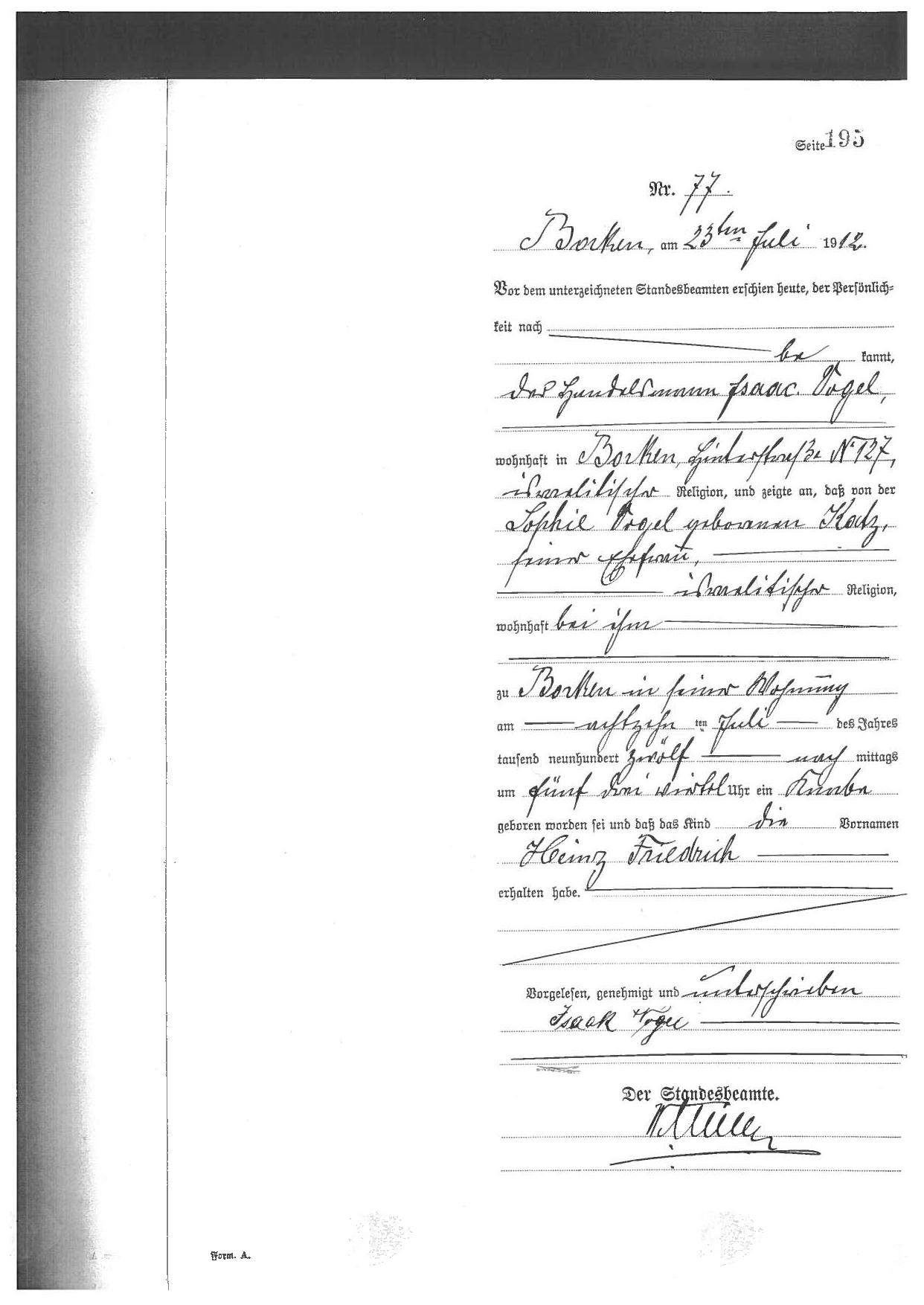
Birth record of Heinz Vogel. Courtesy of the Vogel family

During World War I Isaac Vogel served in the Germany military, fighting in France, and then was a city councilor in Borken in the 1920s.

Isaac Vogel (right). Courtesy of the Vogel family

Isaac Vogel, seated far right. Courtesy of the Vogel family

Isaac worked with his brother Moritz as a cattle trader. It was a business that Isaac and Moritz had taken over from their father Ephraim. It was a small business, but enough to support two families adequately.

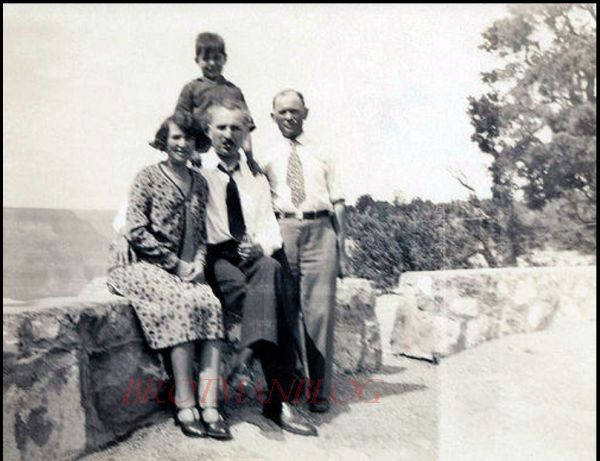
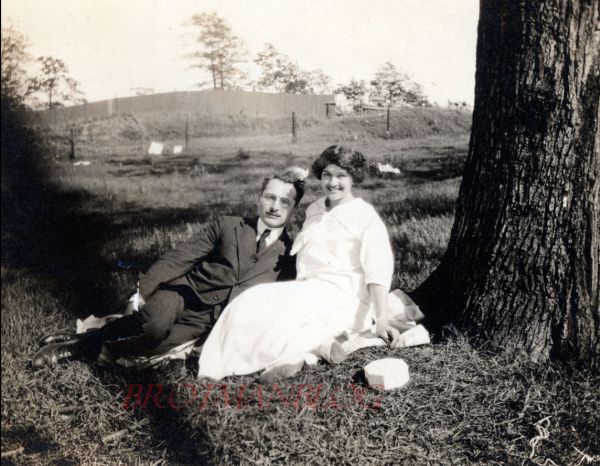
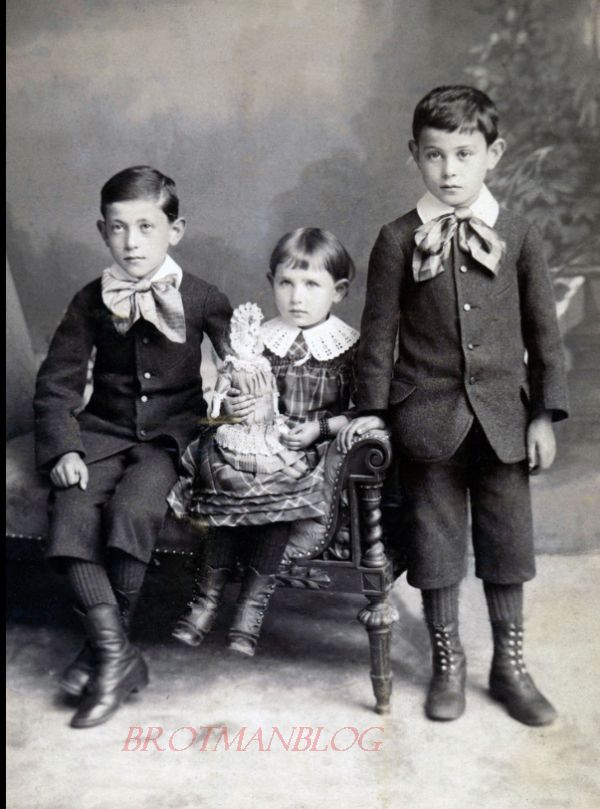
Here are three photos of Carl and Heinz and their parents taken between about 1910 to about 1924 in Borken, Germany:

Heinz and Carl Vogel, c. 1910. Courtesy of the Vogel family
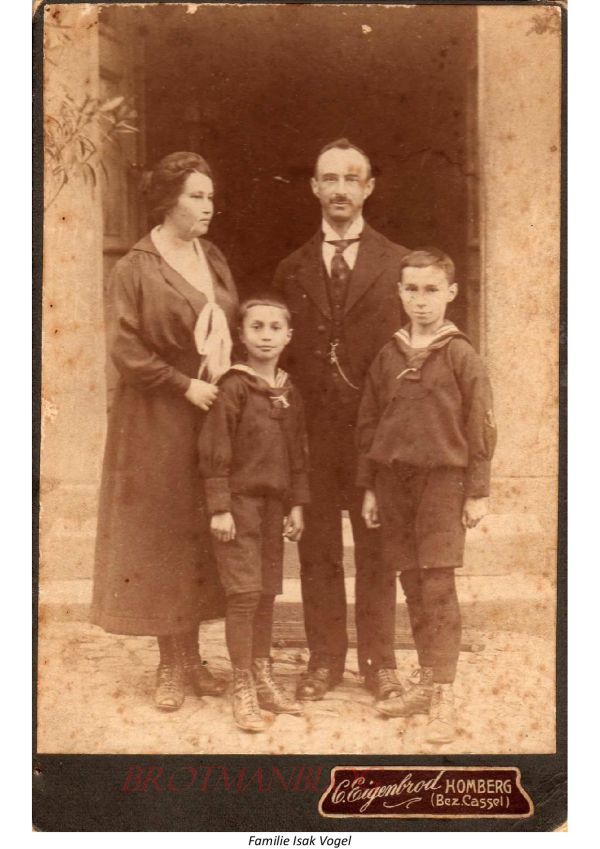
Sophie, Heinz, Isaac, and Carl Vogel, c. 1917. Courtesy of the Vogel family
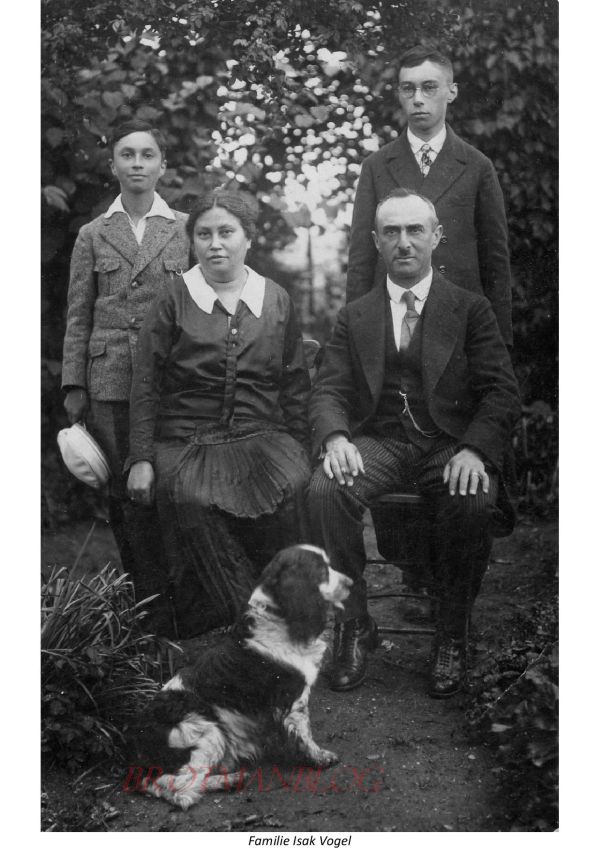
Vogel family, c. 1924. Courtesy of the Vogel family

According to Ingo Sieloff,  the Vogel home in Borken was located at Hintergasse 125 and included a house and a stable; the house was 105 square meters or about 1130 square feet in area. It appears to be larger than that in this photograph:

Hintergasse 125, Borken. Courtesy of the Vogel family

I don’t know when this photograph was taken or the identities of the people standing in front.

As a child, Carl Vogel was an avid reader and a good student, and his parents decided to send him to grammar school in Kassel. During the week he lived with his uncle Moritz Vogel. Carl graduated from high school and then studied at the Philosophical Faculty of Friedrich Wilhelm University in Berlin. He also attended lectures at Rabbinerseminar and worked as a religion teacher.

These three photographs are labeled “Schule,” one with year 1921. I can find Carl in the Gymnasium photograph below (the third one); he is the young man standing fourth from the left in the back row. I assume that either Carl or Heinz is somewhere in the other two photos. Can you find them? I have guesses, but am not sure.

Courtesy of the Vogel family

Courtesy of the Vogel family

Courtesy of the Vogel family

Heinz Vogel was also a very talented boy, but his parents could not afford to send both boys to high school. Instead, Heinz completed his apprenticeship as a retail merchant in Kassel at the Tietz department store.

Until 1933, the family lived a normal life. They saw themselves as Jews and as good Germans. They lived a quiet life, although there were occasional verbal anti-Semitic attacks .  But once the Nazis came to power, the Vogel cattle business suffered because farmers were not allowed to do business with Jews. Heinz Vogel also found his livelihood affected; although he was considered the best salesman in the store, he was released from his job. He then completed an apprenticeship in a practical trade in Frankfurt to prepare for emigration.

Carl read Hitler’s book “Mein Kampf” and recognized that the family needed to leave Germany. Sophie’s sister Recha Katz Goldschmidt had already left  for Argentina by 1932 after her husband Julius was beaten by the Nazis.

Carl and Heinz prepared to emigrate to Palestine, but then decided to go to Argentina since they already had relatives living there. Heinz and Carl first emigrated in 1935, and one year later their parents Isaac and Sophie and Sophie’s mother Rosa Katzenstein Katz followed. They sold their home in Borken for 9113 Reichsmarks. One source says that there were 2.5 Reichsmarks to a US dollar during World War II, so the price of the house would have been about $3,645 in US currency or about $48,000 in today’s dollars, according to this inflation calculator. They settled in Buenos Aires.

In Argentina, Carl and Heinz had to start their lives all over. But the family adapted well to their life in Argentina. The philanthropic association Asociación Filantrópica Israelita or Jüdischer Hillfsverein helped the newcomers adjust to their new country. In Buenos Aires, Isaac and Sophie continued to have a traditional Jewish home and went regularly to the liberal synagogue founded by German Jews; services were conducted in German and Hebrew and in later years, also in Spanish. Isaac and Sophie never learned Spanish, but it did not matter because they were living amidst other German Jews who had escaped from the Nazis. Isaac also tutored boys for their bar mitzvahs.

In 1943 Carl Vogel married Beate Hamburger from Frankfurt; Carl was very active and well known in the Jewish community and served as a deputy rabbi and as a bar mitzvah tutor. He also taught German and Latin. Beate also was a teacher; she gave private instruction in German and English. Carl and Beate had two children.

Heinz Vogel married Gertrud Lippman from Ludwigshafen in 1943. They had one child. Heinz started work in Argentina as an industrial worker in the meat business. Then he became a white collar worker in a big Argentina-owned multinational firm called Bunge & Born. For his job he was required to travel all over the world, including a six-month stay in India in 1954. He became the General Manager of the Jute department and traveled many times to India, Pakistan, and Bangladesh.

Although Heinz lacked the formal education his brother Carl had received in Germany, his daughter described him as a “very cultured and interesting person.” She said that her parents lived a secular life and had friends from many different backgrounds; their connection to the synagogue was limited to Yom Kippur and lifecycle events for family and friends. Heinz’s daughter also told me that Heinz was very proud to be an Argentine citizen and that when he received a diploma from the Argentine government on the fiftieth anniversary of his becoming a citizen, he was very emotional.

Isaac Vogel died on April 16, 1960, in Buenos Aires;1 his wife Sophie died five years later on May 5, 1965.2  Carl died in 1981, and Heinz in 2005.

I feel so fortunate to have found the granddaughters of Sophie and Isaac and to have learned so much more about the courage and determination of Sophie, Isaac, Carl, and Heinz, who all started their lives over in a new place after being forced to escape from Nazi Germany in the 1930s.



An Update on My Dannenberg Cousins

I now have blogged about Seligmann Goldschmidt and Hincka Alexander, my three-times great-grandparents, and all their children, grandchildren, and great-grandchildren. I also have blogged about two of Seligmann’s brothers, Lehmann and Simon, and their families. Seligmann had one other full brother, Meyer, a full sister, Jette, and two half-siblings, Elieser and Jude. I will turn to Meyer next. I have not yet found any primary or even secondary sources for Jette, Elieser and Jude and their families—just the family trees of others—so I may not blog about them. Time will tell. Maybe I will find more to add to those trees.

But before I turn to Meyer Goldschmidt and his family, I have some other things to write about. In the many months that I’ve been working on my Goldschmidt/Goldsmith family, I’ve also been in touch with a number of cousins who have provided me with additional photographs of and documents about other relatives. Being the somewhat-compulsive person that I am, I didn’t want to break the chronology of the Goldschmidt story, so I kept folders and notes for all those new items and decided I’d return to them once I found a place to take a break in the Goldschmidt/Goldsmith story. So the next couple of weeks will be devoted to these new materials. Then I will return to Meyer Goldschmidt.

To start, I want to share some photographs I received back in March and April from my fourth cousin Arlene, who is also a great-great-great-granddaughter of Seligmann Goldschmidt and Hincka Alexander. Arlene is descended from their daughter Sarah Goldschmidt Mansbach, sister of my great-great-grandmother Eva Goldschmidt Katzenstein. (For more background on the individuals named in this post, please follow the links from their names.)

Arlene’s great-grandmother was Hannah Mansbach, who was my great-grandmother Hilda Katzenstein’s first cousin. Hannah married Gerson Dannenberg. I wrote about the Dannenberg family here. Arlene is the granddaughter of Hannah’s son Arthur M. Dannenberg, Sr., and she is the daughter of his son, Arthur M. Dannenberg, Jr.

Arlene shared these images of two wonderful photographs of her great-grandparents Hannah Mansbach and Gerson Dannenberg:

Gerson Dannenberg. Courtesy of Arlene Dannenberg Bowes

Hannah Mansbach Dannenberg. Courtesy of Arlene Dannenberg Bowes

Both are signed at the bottom by Elias Goldensky 39 (which I assume is the year the photographs were taken when Hannah would have been 81 and Gerson 77; Hannah died in 1940, Gerson in 1943). Elias Goldensky was a very well-known professional portrait photographer in Philadelphia whose works were exhibited world-wide and who even photographed Franklin Roosevelt in the White House in 1932.1

I think I even see a slight resemblance between Hannah and my great-grandmother Hilda, her first cousin, especially around the mouth and nose.  What do you think?

Hilda Katzenstein Schoenthal

In addition, Arlene sent me this image of a photograph of a Passover gathering of the extended Dannenberg-Loeb family in 1937. Most of those depicted are not my blood relatives, but are the family of Arthur M. Dannenberg, Sr.’s wife, Marion Loeb. But Arthur M. Dannenberg, Sr,, and his two sons, Arthur M. Dannenberg, Jr., and James Dannenberg, are included in this photograph, as labeled at the bottom. James stands to the far left in the top row, Arthur Jr. to the far right in the top row, and their father, the much-beloved pediatrician whom I wrote about here, Dr. Arthur M. Dannenberg, Sr., is the tall gentleman standing third from the left in the top row.

Passover, 1937. The Dannenberg-Loeb family. Courtesy of Arlene Dannenberg Bowes

Arlene commented on my blog back in March 2019 that her father, Arthur, Jr., had also become a physician and that he had devoted his career to researching tuberculosis, a cause that was important to him because his mother Marion’s first husband, Milton Stein, had died from TB while Milton and Marion were on their honeymoon in 1915, as I wrote about here. In fact, Arthur was not a true “junior” as his middle name was Milton (for Milton Stein), not Mansbach, his father’s middle name.

Arthur M. Dannenberg, Jr. 1965. Photograph by Julian Hart Fisher. Courtesy of Arlene Dannenberg Bowes.

Arthur M. Dannenberg, Jr., died on June 15, 2018. The American Association of Immunologists published a lovely tribute written by Ellen J. Mackenzie, Dean of the Bloomberg School of Public Health at Johns Hopkins University, where Arthur has spent much of his career as a professor and researcher. The entire tribute can be found here. I will post just a few excerpts from Dr. Mackenzie’s tribute to Arthur Milton Dannenberg, Jr.:

Art’s research explored cellular pathways to preventing and treating tuberculosis, and he was passionate about finding new vaccines against the disease. He was affiliated with the Johns Hopkins Vaccine Initiative as well as the Johns Hopkins Center for Tuberculosis Research, which established a student achievement award in his honor.

His work made a lasting contribution to our understanding of a disease that still, despite significant progress in saving lives through diagnosis and treatment, remains one of the top 10 leading causes of death worldwide.

A graduate of Swarthmore College, Art obtained his medical degree from Harvard in 1947. He continued his studies at the University of Pennsylvania, where, in 1952, he received a Ph.D. in microbiology and immunology, followed by a postdoctoral fellowship in experimental pathology.

….

All of us who worked with Art over the years were impressed by his tireless pursuit and devotion to unraveling the mysteries of one of the most important infections plaguing humans throughout history – tuberculosis. We will sorely miss his enthusiasm and devotion to medical research and to educating the next generation of scientists.

My deep gratitude to my cousin Arlene for sharing these photographs and stories with me. It is always wonderful to see the faces of my cousins and learn more about them.


  1. “Elias Goldensky, Photographer, Dies,” The Philadelphia Inquirer, March 11, 1943, p. 11. 

The Magic of Color

Val Erde of the Colouring the Past blog recently sent out an invitation to bloggers to try her colorization services for free. I’d seen what she did for Luanne of The Family Kalamazoo and so was intrigued by her offer. Under the terms of her invitation, she would select an appropriate black and white photograph, and if I approved of her choice, she would colorize it.

Val selected a wonderful photograph of my great-aunt Betty Goldschlager Feuerstein, my grandfather’s little sister. I asked Betty’s grandchildren if they were comfortable with having the photograph colorized, and those who responded were also intrigued. When I received Val’s finished work and shared it with them, the granddaughters all were thrilled and said that Val had brought their grandmother back to life. Unfortunately I never met Betty, but I also can see what a great job Val did.

Here is the original and Val’s rendition in color:

Betty Goldschlager Feuerstein

betty-goldschlager 1st Draft

Colorized by Val Erde 2019

Pretty remarkable, isn’t it? Val will be available to respond to any questions or comments posted in connection with this post.

Milton’s Family Album, Part XIII: The Creative Talent of Milton Goldsmith Himself

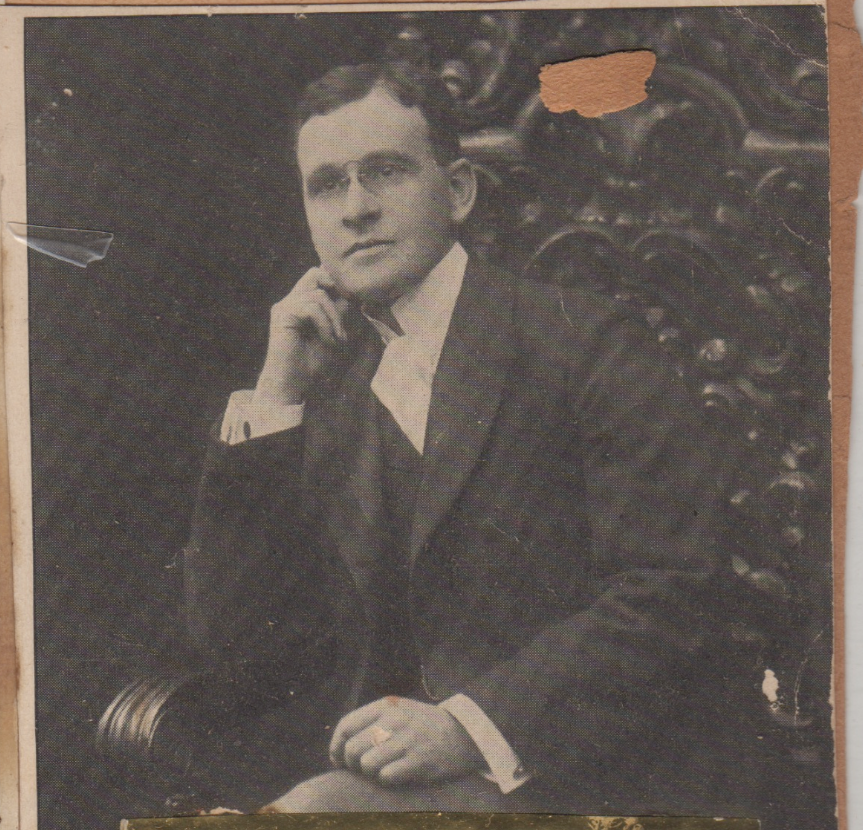
Milton Goldsmith devoted the next three pages of his family album to himself and to his wife Sophie. The first page includes photographs and two biographies of Milton.

I wonder how they made this photograph of Milton taken from numerous angles—anyone know how they did this?

UPDATE! According to Ava Cohn, aka Sherlock Cohn the Photo Genealogist, these photographs were done with a folding mirror and were quite common. In fact, Ava shared another one as did another Facebook reader who saw my post.

I don’t know where this biography of Milton was published or when, though it was written no earlier than 1891 as it refers to the publication of his book, Rabbi and Priest, in that year. The biography also appears to have been written while he was still living and working in Philadelphia and before he moved to New York City and married Sophie Hyman in 1899. So it was written some time in the 1890s.

I would think that this photograph of Milton was taken about the same time as the publication of that biography, sometime in the 1890s when he was in his thirties:

This entry about him in Who’s Who was written many years later as it references some of his later publications, including his play, The Little Brother, which was published in 1918.

What I really love about this Who’s Who entry are the insights into Milton’s appearance and personality—that he had blue eyes, a fair complexion, and graying hair, that he was cheerful and optimistic, and that he was a moderate drinker and did not smoke. Most of the other biographical and professional information I had already gleaned from other sources. (There are a fair number of blog posts about Milton’s life and career, e.g., here, and here and here and here and here.)

Speaking of The Little Brother, the next page in Milton’s album is a copy of the program from a performance of that play in 1918:

I had previously written about this play and Tyrone Power’s starring role in it.

Finally, the third page compiled three reviews of a play (undated) in which Milton’s wife Sophie had an important role. The play, The Flight of the Duchess, by Henry Hanby Hay, was an adaptation of a “poetic romance” by Robert Browning and performed by the local Browning Society, a amateur group.

In the article on the left side of the page, the reviewer did not like either the play or the performers, but did praise Sophie’s acting, saying, “Mrs. Goldsmith’s reading of her lines was marked by a distinction and sense that had been welcomed in her associates….”

The second review, at the middle bottom of the page, was overall much kinder and also praised Sophie’s performance as “a striking piece of work.” And the third review, on the right side of the page, was more mixed, but again praised Sophie, saying that “The chief individual honors of performance fell to Mrs. Milton Goldsmith.”

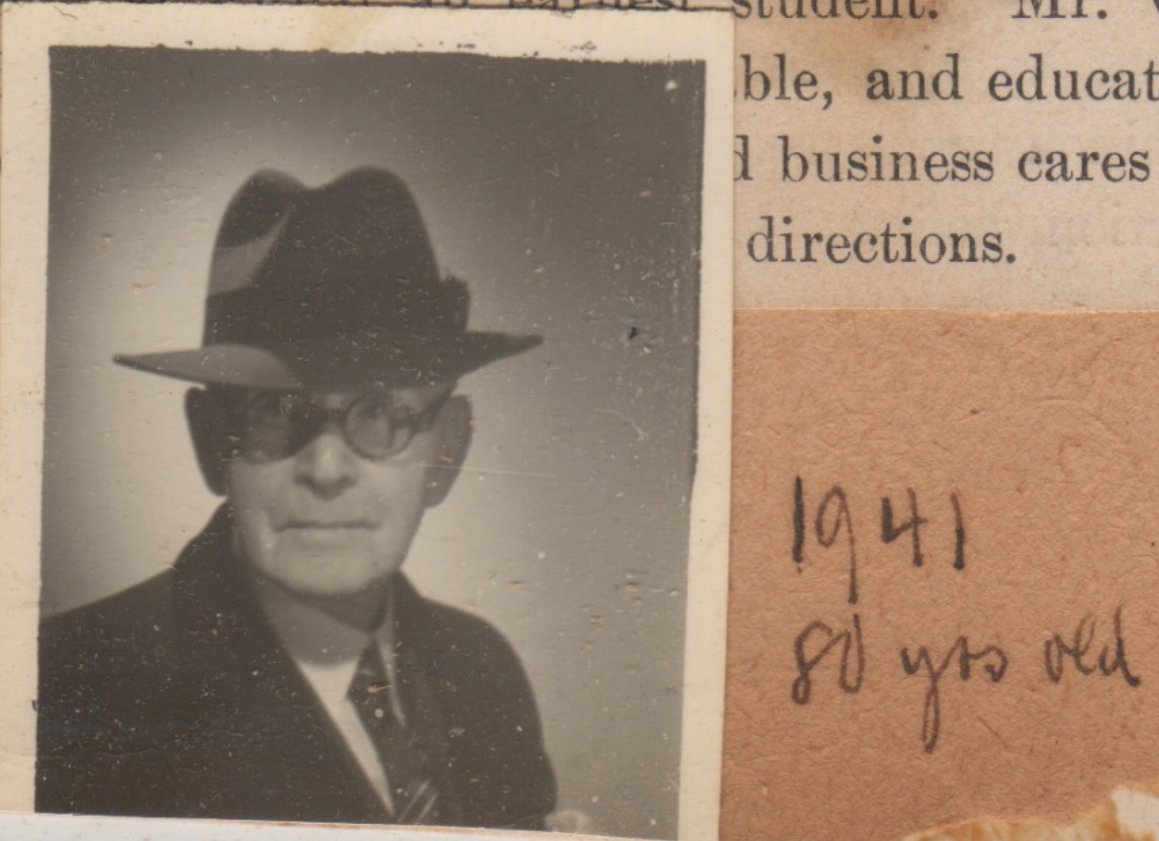
These three pages about Milton and his wife Sophie are appropriate reminders of their many talents. Here is one final photograph of Milton, taken in 1941 when he was eighty years old:

This is Part XIII of an ongoing series of posts based on the family album of Milton Goldsmith, generously shared with me by his granddaughter Sue. See Part I, Part II, Part IIIPart IVPart V,  Part VI, Part VII , Part VIII,  Part IX,  Part X, Part XI and Part XII at the links.

Milton Goldsmith’s Family Album, Part VI: His Parents, Abraham and Cecelia

This is Part VI of an ongoing series of posts based on the family album of Milton Goldsmith, so generously shared with me by his granddaughter Sue. See Part I, Part II, Part III, Part IV and Part V at the links.

Now that we have seen the pages Milton devoted to his maternal and paternal grandparents, we can turn our attention to those devoted to his parents, Abraham Goldsmith and Cecelia Adler.

First, there is this page:Although they are not labeled, the paired photographs at the bottom must be Cecelia Adler and Abraham Goldsmith. I know this because the photograph on the upper right is one I’ve seen before—I received it from my cousin Julian Reinheimer over a year ago,  labeled as Julian’s great-grandfather, Abraham Goldsmith. So I know that the upper photograph is Abraham, and he is certainly the same man as the man in the photograph at the lower right.

Abraham Goldsmith, courtesy of Julian Reinheimer

I also know that the woman on the left is Cecelia because Julian also sent me this photograph of his great-grandmother Cecelia, and she is the same woman as the woman on the left in the photograph above:

Cecelia Adler, courtesy of Julian Reinheimer

Could the two framed photographs be their wedding photographs?

Cecelia was only nineteen in 1858 when they married, Abraham was six years older or twenty-five. Somehow they look older than that in these photographs, but I am terrible at determining age in these old photographs when people dressed so formally and posed so stiffly without smiling. It’s obvious, however, that these two photographs were taken at the same studio and likely at the same time, given that the same table appears in both. I wonder if there was a date on the reverse, but it is not worth trying to remove the photograph from the album to check.

According to Milton, his grandfather Samuel Adler was not successful in business, but Cecelia certainly is dressed very well in this photograph and is wearing what appears to be a large cameo pendant, similar or perhaps the same as the one in the photograph I received from Julian, seen above. Was this taken after she married Abraham, who was in fact very successful in business? Which photograph appears to be earlier?

Cecelia Adler Goldsmith, courtesy of Sue Jacobson

Finally, there is the photograph labeled “The Homestead in Oberlistingen.” This must have been the house where Abraham and his family lived before he and almost all his siblings immigrated to the United States beginning in the 1840s. So who is the woman standing on the stairs in front of the house? My first hope was that this was Hinka Alexander Goldschmidt, my three-times great-grandmother and Abraham Goldsmith’s mother, Milton’s paternal grandmother.

But then I realized this could not be Hinka. She died in 1860. This looks like a casual snapshop, and thus not something that could have been taken in those early days of photography. In fact, according to the Smithsonian:

Photography emerged in the early 19th century, but well into the 1880s it was a difficult, ponderous thing to do. The reigning forms of photography recorded onto chemically treated plates and paper. Taking a picture required the subjects to sit still for a half minute or more—“torture,” as the social critic Walter Benjamin recalled. Families trooped into studios to get portraits taken, but they were a study in stiffness: everyone sitting ramrod straight, afraid to move—or even to change their expression—for fear of blurring the photo.….Things changed dramatically in 1888 when George Eastman introduced the Kodak camera. A small hand-held box, it cost only $25—about the price of a higher-end iPad in today’s money, which put it in the range of the well-off middle class. And it offered simplicity…

So much to my disappointment, I concluded that this was not Hinka, but some other woman posing on the front steps of what had been the Goldschmidt home in Oberlistingen.

Milton did not write much about Hinka, mentioning her only to say that several girls in the family were named for her (including my great-grandmother Hilda Katzenstein Schoenthal, who was the daughter of Eva Goldschmidt Katzenstein and granddaughter of Hinka Alexander Goldschmidt). Milton obviously never met his grandmother Hinka, who never left Germany and died a year before Milton was born. And unlike the heroic war stories passed down about his grandfather Seligmann Goldschmidt, there were likely no such stories shared about his grandmother. Like women of those times, her life was not in the public sphere, but in the home. So all we know about her is when she was born, who she married, what children were born to her and raised by her, and when she died.

It’s thus not surprising that my heart wanted that to be a photograph of Hinka standing in front of her home, but alas, my brain knew otherwise. I do, however, have this photograph or drawing of Hinka, provided by David Baron and Roger Cibella, who is also her descendant:

Hinka Alexander Goldschmidt. Courtesy of David Baron and Roger Cibella

My Father

With much love and sadness, I share that my father passed away this weekend after 92 years of a life well lived. He was a man of great intellect, incredible curiosity, a passion for art, architecture, and music, and a lifelong commitment to progressive values—peace, justice, and human rights. He loved cats and dogs and the beaches of Cape Cod. But above all else, he was a man who passionately loved his family, especially my mother, whom he adored for 67 years of marriage.

Those of you who follow my blog may have seen the occasional comments my dad left on the blog. He was a devoted reader of the blog and supportive of and fascinated in the family history I was uncovering. He also was a constant source of information about his family and, most importantly, the inspiration for all the research I have done about all my paternal lines (which is probably 80-90% of what I’ve done since I have had much more luck finding information about my father’s side than my mother’s side). I will miss him deeply and will undoubtedly share more about him as time goes on.

For now I am taking a short break from blogging, but I will return soon because I know he would have wanted me to continue telling the stories of his many relatives.

Here are just a few photos.

My father at 9 months old

John Nusbaum Cohen, Jr.

In the Navy

Florence and John Cohen 1951

My father with Nate June 2010


Cohen and Company Photograph: Is That My Grandfather?

Hello, everyone! I have returned from my break and am ready to dive back into my exploration of my Goldschmidt/Goldsmith relatives. But before I do, I want to share my second experience working with “Sherlock Cohn, the Photo Genealogist” aka Ava Cohn.

In the course of my genealogy research, many cousins have shared photographs with me, and fortunately almost all the time they can identify the people in the photographs. But occasionally I have received photographs with unidentified people in them, and sometimes those photographs just stay in my head and bother me. Who are those people? How can I figure out who they are?

This is one of those photographs, a photograph that belonged to my late cousin Marjorie Cohen, my father’s first cousin, the daughter of Stanley Cohen, my grandfather’s brother. The only person I was fairly confident I could identify in the photograph was Marjorie’s father Stanley, the man on the far left in the photograph.

Cohen & Company photograph

Here is a photograph on Stanley taken just a few years later when he was serving in World War I. You can see the resemblance to the man on the left.

Stanley Cohen World War I

The group photograph was taken in Philadelphia in front of the Cohen & Company Money Loan store, which was part of the pawnshop business started by my great-great-grandfather Jacob Cohen in Philadelphia in the 1850s and then carried on by many of his sons, including my great-grandfather Emanuel Cohen, who ran this particular store. I wondered whether these five men were also grandsons of Jacob Cohen. I was particularly curious about whether my grandfather John Cohen was one of the men standing in front of the store.

When I connected this summer with my second cousin Marcy, the granddaughter of my grandfather’s other brother, Maurice Cohen, she sent me some photographs of Maurice and of Maurice’s sons, Buddy and Maurice, Jr.

Emanuel (Buddy), Maurice Sr., and Maurice, Jr.

My great-uncle Maurice Cohen, Sr.

I also had photographs of my great-grandfather Emanuel Cohen, my great-uncle Stanley, and my grandfather John. Having had fabulous success with Ava Cohn, aka Sherlock Cohn, the Photo Genealogist, in the past, I decided to have Ava analyze these photographs to see if she could identify the people in the Cohen & Company photograph.

Emanuel Cohen, my great-grandfather

Eva Schoenthal and John Cohen, 1923

John and Eva Cohen
c. 1930

John Nusbaum Cohen c. 1894

Ava’s work is remarkable. Her attention to detail and the research she did to try and answer my questions is incredibly professional and thorough. Although she could not definitively identify all the people in the photograph, she certainly narrowed down the possibilities and made some very helpful and persuasive comments and suggestions. With her permission, I am going to summarize and excerpt from her report.

First, Ava analyzed whether the date that I’d been told was on the back of the photograph—April 1913—was accurate.  She based her analysis in part on the type and content of the photograph:

…the scan appears to me to be a brown color, indicating a platinum print (sepia color) used generally from 1880-1930. Platinum prints often fade and there is some fading of this photograph. However, after 1920 most photographs were gelatin silver prints that had crisper black and whites than the platinum prints, another indication that this photograph was taken before 1920. … The photograph was taken outside. Since one of the men is wearing a sweater, it is appropriate to say that the photograph was taken in a cooler month, but obviously not winter. This is consistent with the presumed date of April, 1913. 

Ava then analyzed the clothing worn by the people in the photograph, labeling them A through E from left to right:

  1. Person A is wearing a coat sweater with V-neckline, knit cuffs, two patch pockets and six buttons. This dates from the 1911-1912 period.
  2. All the men are wearing shirts with detached collars from around 1908 and skinny ties that were popular in 1912.
  3. Person B is wearing a high cut vest also with 6 buttons, a style found in ads from 1912.
  4. Persons C and E are wearing jackets that are slightly fitted at the waistline. Person D is wearing an older jacket that is less fitted.  The slightly fitted waist style of men’s jackets was popular from 1912-1915. Also in that time period men’s jackets had 1, 2 or 3 buttons as can be seen on the men’s jackets in the photograph.
  5. Person D is holding a soft felt Optimo shape Panama hat from about 1912.
  6. Persons A, B, D and E have their hair combed back in a pompadour style with no part. Men wore their hair in this manner in the 1912-1913 period. Person C has a variation of this style with a side part.

From these observations, Ava concluded that the date of April 1913 on the photograph was likely accurate.

Then using that date and her estimation of the age of the five individuals in the photograph, Ava deduced the likely birth year of each of the five:

A: 24 years old. Born circa 1889.

B: 15 years old. Born circa 1898.

C: 24-26 years old. Born circa 1887-1889.

D: 18-19 years old. Born circa 1894-1895

E: 25 years old. Born circa 1888.

As noted above, I was already reasonably certain based on other photographs that Person A was my great-uncle Stanley Cohen, Marjorie’s father, who was in fact born in 1889. Ava’s analysis further confirmed that conclusion by relying on the physical descriptions of Stanley in his draft registrations for World War I and World War II. The World War II registration indicated that Stanley was 5’9” tall, and from that fact Ava was able to compare him to the other men in the photograph to reach some conclusions about their heights.

Using this information as well as information from draft registrations, census records, directories, and other sources, Ava reached the following hypotheses about the other four people in the photograph:

B: Simon LB Cohen, born 1898.

C: Samuel S. Cohen, born 1887.

D: John Nusbaum Cohen, born 1895.

E: Morris N. Cohen, born 1887.

For person B, Ava noted that Simon LB Cohen was the only grandson of my great-great-grandfather Jacob Cohen who would have been that young (roughly 15) in 1913. I would love for that to be Simon because I know so much about what happened to him just a few years after this photograph was taken. Simon served valiantly in World War I, was seriously injured and presumed (mistakenly) killed in action, and was awarded the Croix de Guerre for his bravery. He died as a young man in 1934, perhaps as a consequence of his time in the war.

Croix de Guerre awarded to Simon LB Cohen in 1918

But we can’t be sure that this boy was even related to the Cohens (or that anyone in the photograph other than Stanley was). Perhaps they are just a bunch of friends. But if we assume that they are all Cohens and all grandsons of Jacob Cohen, then Simon LB Cohen is a likely candidate to be person B. Since there are no draft registration descriptions of Simon nor any photographs, it is impossible to know for sure whether this is Simon in the photograph.

I was also very intrigued by Ava’s hypothesis that persons C and E  could be the twin brothers, Morris and Samuel Cohen, sons of my great-grandfather’s older brother Joseph Cohen and grandsons of my great-great-grandfather Jacob Cohen. Morris and Samuel were born on August 22, 1887, in Cape May, New Jersey, but in 1910 they were living with their parents in Philadelphia, both working as salesmen in a department store, according to the 1910 census. Ava thought that although they were not identical, they did look like brothers and appeared to be about the same age—24 to 26 years old.

Ava’s analysis seemed very convincing, so I was motivated to search for descendants of Morris Cohen and Samuel Cohen to see if they had any photographs of the twin brothers. With the help of a good friend who knew one of Samuel’s grandchildren, I was able to make a connection. Unfortunately the grandchildren’s memory and photographs of their grandfather Samuel (displayed below) did not confirm that he was either Person C nor Person E in the photograph so I am back to square one in identifying those two men.

Samuel Cohen. Courtesy of his grandchildren

Samuel Cohen, courtesy of his grandchildren

But it was Person D I was most interested in, as I hoped he was my grandfather John Cohen, who would have been almost seventeen and a half in April 1913 and thus close to the age of Ava’s estimated age of Person D. Also, Ava pointed out that on his 1921 passport application, my grandfather’s height was reported to be 5’6” and that his World War I draft registration described him as short; certainly Person D is a shorter man than Persons A, C and E. Those two factors pointed to Person D being my grandfather.

John Cohen Sr. World War I draft registration

John N Cohen passport application page 2

But comparing Person D to the photographs of my grandfather created doubts for Ava (and myself) as to whether Person D was my grandfather. My grandfather had very distinctive eyes—very deep set and slanted down; Person D is squinting, making it hard to see his eyes, so it is hard to tell if they are the same as my grandfather’s eyes. Ava also pointed out that Person D has a widow’s peak whereas there does not appear to be a widow’s peak in the photographs of my grandfather.

Here is a closeup of Person D and then several of my grandfather—in 1921,1923 and 1930. In addition, Ava believes (and I agree) that the man holding a baby in the fifth photograph is probably my grandfather.  I know we see what we want to see, but the more I study these, the more I think Person D might be my grandfather. The loss of the widow’s peak could be from his obviously receding hairline. Look at the difference between 1921 and 1923. In 1930 he is wearing a hat—perhaps to hide his balding?

One other thing I noticed in the photographs of my grandfather—he had attached earlobes. Unfortunately when I zoom into the Cohen & Company photo, it’s hard to tell whether Person D also has attached earlobes.


John Cohen in 1921

John Cohen in 1923

John Cohen, 1930

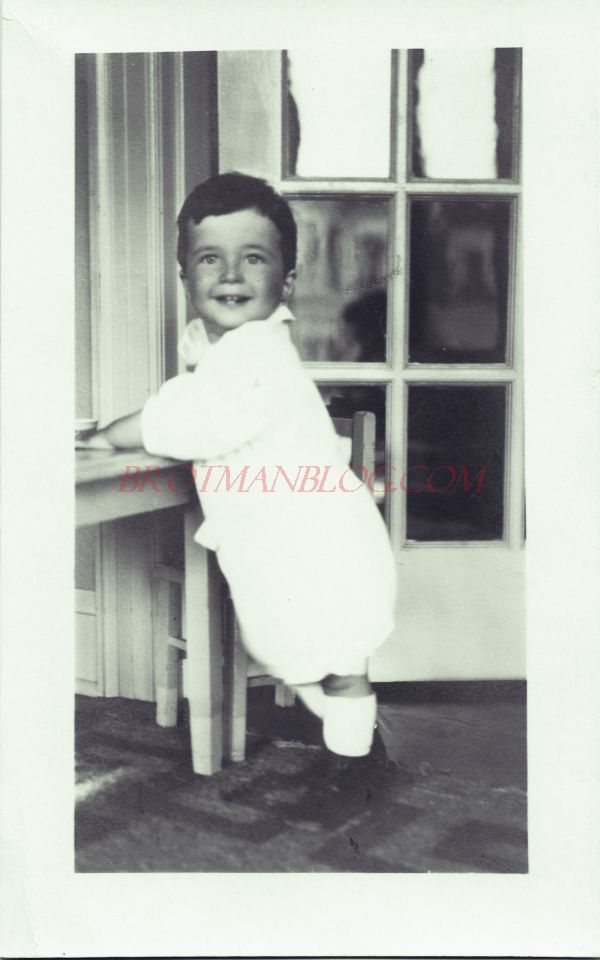
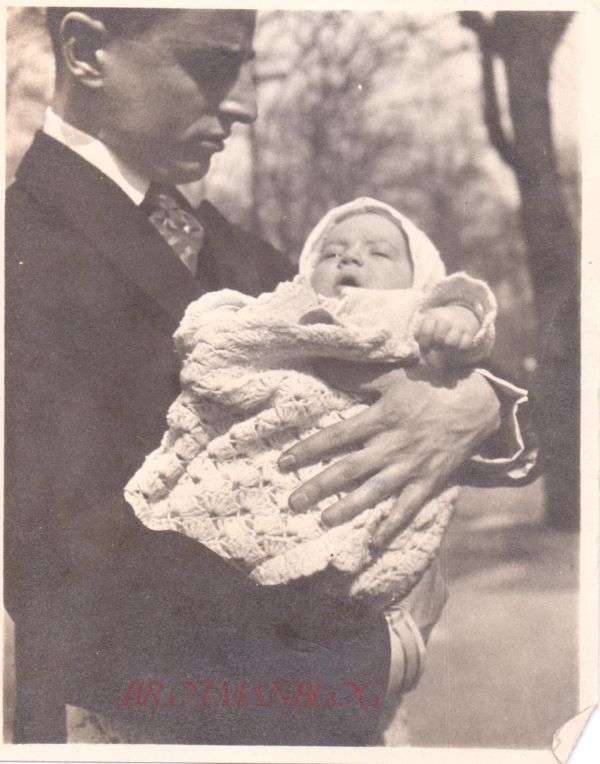
Could this be my grandfather John Cohen? And who is the baby?

I now believe that Person D is my grandfather, but I know that that’s what I am hoping for so I don’t trust my judgement. Ava was not certain, but thought it was possible.

What do you think?

Although it was not possible for Ava to identify all of the people in the group photograph, she certainly narrowed the field and provided solid and convincing reasons for her conclusions. Thank you, Ava, for a wonderful job on this extremely difficult project!


Life of Frieda Bensew Loewenherz, Part III: 1919-1975

By the end of 1918, World War I had ended, and Frieda Bensew and Emanuel Loewenherz had married in Chicago. Soon thereafter there were troubles at KW, the battery company where they had met in 1913:

The man who was heading the company, supposedly an old friend of Manek whom we trusted, in fact idolized, turned out to be an embezzler. Not alone did he cheat the firm out of huge sums, but also my hard earned savings which I had given him, believing his promises of a speedy return. Besides Manek had signed notes for him and it took a long time to pay these off. But it was not the money but the great disappointment in a man, a close associate for years who took such an advantage of us, his true friends.

Manek had a heart to heart talk with Mr. Paepcke, in case this gentleman should harbor any doubt about him, in which case he would resign. But Mr. Paepcke not only expressed his full confidence but made Manek the head of the company, which he built up to a very successful enterprise -earning the respect of all associates and the community. We worked hard and there were many obstacles to overcome, but Manek met the challenge with perseverance. His kindness and generosity knew no bounds as well as his understanding, from the lowest laborer to the chairman of the Board.

KW Battery letterhead. Courtesy of Franz Loewenherz

Thus, as my mother would say, from bad came good. The loss of the money and the betrayal by their friend led to Emanuel’s promotion to president of KW and a long and successful career there.

Frieda and Emanuel’s son Walter was born on August 6, 1920, and when Walter was 20 months old, Frieda took him to Europe to meet her family as well as Emanuel’s family, whom she herself had never met.

Frieda Loewenherz and her infant son Walter, 1920.
Courtesy of Franz Loewenherz

Frieda and Walter Loewenherz traveling to Europe 1922. Courtesy of Franz Loewenherz

Uncle Julius [Mansbach, who had met her at the ship in Hamburg] took me all the way home to my parents in Melsungen. I can’t describe our emotions, they remain unforgettable! As I write this, more than 48 years later, I am reliving those days and weeks. Alas, the end was sad. My dear, gentle mother passed away, quietly and peacefully. My father, sister and everybody else who knew her said that her desire to see me and baby kept her alive and the fact that this wish was granted her alleviated my pain.

Breine Mansbach Bensew died on May 31, 1922, in Melsungen; she was 77 years old.1

After some weeks in Melsungen mourning with her family, Frieda took Walter to Vienna where she met for the first time Emanuel’s mother Charlotte and brothers Henryk and Josef, Henryk’s wife Rosa and their son Richard, and Josef’s wife Sofie and children Ada and Siegmund. After a wonderful visit with them, she and Walter visited her uncle Julius Mansbach and his wife Frieda (her cousin) and their son Alfred. She then returned to Chicago and her happy life with her husband.

In the years that followed, Frieda and Emanuel settled into family life in Chicago, continuing their trips to Europe and to the West to see family. Here they are in Denver in 1926 with Frieda’s brother Julius Bensev:

Julius Bensev and Loewenherz family in Denver 1926. Courtesy of Franz Loewenherz

In 1929, they bought a house in Winnetka, Illinois, that would become the long-time family home.

Loewenherz home in Winnetka. Courtesy of Franz Loewenherz

Two months after moving in, Frieda’s cousin Alfred Mansbach, son of her uncle Julius and her cousin Frieda, came from Germany and moved into their home.

Walter was in 4th grade in Greeley School and we sent Alfred, although he was 19 and had finished the “Gymnasium” (High School) in Germany, to New Trier High school for one semester, to get an idea of our schools and help his English. The following year he entered Northwestern University as freshman.

Then in 1932, Emanuel’s nephew Siegmund, Josef’s son, moved into their home:

In 1932 Siegmund came to us from Vienna. By then Alfred had moved to Chicago and was working and also taking courses in air conditioning – an industry in its infancy. Siegmund went to Northwestern University School of Music and also to English classes.

In 1934, the family made another trip to Europe—to France and Italy as well as Vienna. Here are Frieda and Emanuel in Venice:

Frieda and Emanuel Loewenherz in Venice, 1934
Courtesy of Franz Loewenherz

But Hitler had taken power in Germany, and there were serious concerns about his intentions.

It was the spring of 1934 and Hitler had been in power in Germany a whole year. Manek was very apprehensive but [his brother] Josef did not think he would ever attack Austria. – How right Manek was – he pleaded then with the folks to get out of the country, to no avail. Grandma Charlotte could not even think of it- at her age. Josef was still convinced that Hitler would leave Austria alone – how the picture changed in a few years.

The family traveled on to Danzig and to Germany:

The next day we were welcomed at the Danzig Station by [Emanuel’s brother] Henryk. There we saw the first Bravo-shirts — I almost felt sick to my stomach. Danzig was already under the influence of Hitler, with Hitler youth, marching and Nazis in the higher echelons – Henryk lived in Oliva which was Polish a short train ride away. We were happy to be together but that cloud of Nazism hung over us like a dark shadow.

Dr. Greg from Cologne came to see us there … to persuade us to come to Cologne and be his guests. I was frank to state that I felt uneasy about it and feared that he might get into difficulties for having Jewish guests. He answered, “Nobody is going to dictate to me whom I can invite.” So we promised to come. -The days passed pleasantly – we did not fathom then that it would be our last visit together– We made a stopover at Berlin and visited my nephew Alfred [Stern, son of Frieda’s sister Roschen] and his wife Rita. It seems all we saw was uniforms and Nazi banners. – We were glad to leave although Cologne was not much better.

Since Frieda mentioned her nephew Alfred but not her sister Roschen, I have to wonder whether Roschen was no longer living by the spring of 1934. It remains the one big unsolved mystery of my Bensew relatives—the fate of Roschen Bensew Stern.

Three years later, Frieda lost her beloved uncle, Julius Mansbach, who had returned with his wife Frieda to the US just a few years before to join their son Alfred in Chicago.

In the spring of 1937 we planned to go to New Orleans for Walter’s Easter vacation. We did sightseeing for 2 days, then a telegram arrived from Alfred that his father had passed away suddenly. The shock was awful – He and Frieda had seen us off at the station and had all kinds of plans for our return. We took the freight train back to Chicago – Frieda [Bensew Mansbach] was numb with grief and I just could not accept the thought never to hear Uncle Julius’ voice again. He was so gay when we left, had all kinds of little packages for me “to open on the train,” he loved surprises – I don’t want to dwell on this sad time.

Meanwhile, things in Europe were getting more and more ominous.

Conditions in Germany were getting worse for the Jews and we made out many affidavits for family members. The first to come was [Emanuel’s nephew] Richard  in July 1937 – he had finished his studies at medical school and was interning in Vienna for a short while before.–He-stayed with us until he got an internship at a hospital in Chicago.

In March 1938, catastrophe struck Austria; Hitler marched into Vienna! The persecution of the Jews cannot be described. Josef together with all the leading members of the community was jailed for weeks. It became imperative to get Siegmund out as quickly as possible, perhaps with Ada. [Josef’s children] [Siegmond arrived in] July… Ada arrived in the U.S. in August. ….

In August 1939 Hitler invaded Poland and occupied it. Luckily, Micha [son of Emanuel’s brother Henryk] who was born in Danzig, could get a visa and he left the end of August. While en route, the war in Poland broke out but he was safe and arrived in New York on Sept. 3.- Manek and Walter met him, a 13 year old [boy] … It was a new experience to have another adolescent in the house and under such circumstances. We knew how hard it was for his parents to part with him and we did everything to make him feel at home. Since he did not speak English, it was fortunate that we could make his adjustment easier by speaking German to him and Walter was a real big brother to him.

Emanuel and Frieda had done everything to rescue the Loewenherz relatives in Europe and had largely succeeded. The children of Josef and Henryk were all safe—Siegmund, Ada, Richard, and Micha (who became Michael in the US).

But tragically they could not rescue Emanuel’s brother Henryk and his wife Rosa:

Many people fled without visas in small boats to Denmark which was so close and Denmark was most hospitable to Jews and hid them from the Nazis. But Henryk wanted to have official permission and our efforts, as well as Josef’s from Vienna were without success. And then came their notice that they were leaving for Cracow- From then on news were scarce, a card now and then. Finally, when we received permission from the British Consulate for a transit visa to England, it did not reach them any more – they had left Cracow- destination unknown.

Emanuel’s other brother Josef and his wife Sofie were still in Vienna, trying to get out. Then in December 1941, the US entered World War II.

Our lives were changed. Manek worked harder as war orders had to be filled, and restrictions in the economic appeared soon, although there was no food shortage. We could not communicate with the folks in Vienna. In January or perhaps later (I am not certain about the exact date) we were at war with Germany too) and the gigantic war machine was in full swing with all the heartaches, anxieties and hopes for an early peace– Everybody worked for the Red Cross- I knitted day and night, helmets, gloves with trigger fingers, scarves, sweaters, etc. ….

Walter knew he was going to be drafted. Meanwhile he continued school, hoping to finish. He had become friends with Bea, also at Northwestern U. in the School of Education. It was not too long until the friendship ripened and the outcome was their engagement after Bea graduated in June. Walter graduated in August. We were happy about it, although we knew that Walter would soon be drafted. It happened in Sept. and he was sent for basic training to Fort Lawton, Oklahoma. … We had, in addition the worry about the folks in Vienna.

Walter and Emanuel Loewenherz c. 1942. Courtesy of Franz Loewenherz

On top of all this stress, or maybe because of it, Emanuel suffered a serious heart attack in December, 1942. Fortunately he recovered, though he and Frieda could not attend Walter and Bea’s wedding in Oklahoma on March 20, 1943.

One had to accept this too – we were happy and grateful for Manek’s recovery and it was only a short time when Walter was ordered to the Officer’s Training School outside of Washington. Bea rented a room in Washington and did research work on her Master’s thesis. In June Walter was made 2nd Lieut. in G2 (Intelligence) and received a week’s leave which they spent in Winnetka. His first assignment was at the Brooklyn Army Base and they were fortunate to get an apartment there. … As he was specially trained because of his knowledge of German we figured that he would be sent to Europe, but he was sent to the Pacific in October.

Frieda, Emanuel, Bea, and Walter Loewenherz in NY before he was sent to the Pacific. Courtesy of Franz Loewenherz

The war ended in Europe in April, 1945, and then in the Pacific that August.  It was then that they learned the tragic fate of Emanuel’s brother Henryk and his wife Rosa:

What we dreaded was true – they were sent to the extermination camp.

According to the Yad Vashem database, Henryk and Rosa were murdered at Auschwitz in 1942.

But Frieda was overjoyed to learn that somehow Josef and his wife Sofie had survived the war. (She did not go into details about how they managed to escape from the Nazi death machine.) Josef and Sofie came to the US and were reunited with their children, who were now grown adults.

After the war, life returned to peacetime conditions, and in the years that followed, Frieda and Emanuel were blessed with many grandchildren and a meaningful and joyful life. Walter worked with his father at KW, eventually taking over the company and freeing Emanuel and Frieda with more time to travel in retirement.

Frieda and Emanuel Loewenherz 1962. Courtesy of Franz Loewenherz

Frieda Loewenherz 1963. Courtesy of Franz Loewenherz

Frieda was heartbroken when her beloved Manek died on December 22, 1963.

My world had crumbled and I did not know how to cope with what was left – then I did realize that Manek would want me to go on, as he so often emphasized in our conversations in our happy days. We used to discuss life from every angle and every phase of it and I admired his philosophy and his clear, human outlook. But above all was his deep love which I shared for over 45 years – how many people are that fortunate? And that helps me to go on, it is something precious and all my own.

Frieda did go on and enjoyed her extended family for another twelve years. She died on December 17, 1975, at the age of 89.2 Here is one final photograph of my cousin Frieda, one that I think reflects all her beauty, inside and out:

Frieda Bensew Loewenherz. Courtesy of Franz Loewenherz

Reflecting back on her life after reading this memoir several times now, I continue to be moved to tears and feel goosebumps as I do. Frieda and Emanuel lived an incredible life together.  Theirs was a true love story.

But they were much more than that.  Their love was not limited to love for each other, but for their entire extended family—the Mansbachs, the Bensevs, and the Loewenherzs. They made sure to stay connected to them all despite all the distances and obstacles. And they did what they could to rescue their family members in Europe and opened their home over and over again to those beloved family members. Despite all the evil they saw—the discrimination they personally faced during World War I and the hateful destruction of Jewish life in Europe under the Nazis—they remained positive, life-affirming, and loving.


All excerpts from Frieda Loewenherz’s memoir and all the photographs in this post are published with the permission of Franz Loewenherz, her great-grandson. My deep gratitude to Franz for his generosity.


  1. Personenstandsregister Sterberegister; Bestand: 920; Laufende Nummer: 4684,
    Ancestry.com. Hesse, Germany, Deaths, 1851-1958 
  2. Ancestry.com. Florida Death Index, 1877-1998 

Life of Frieda Bensew Loewenherz, Part II: 1913-1918

In my last post, I shared some excerpts from my cousin Frieda Bensew Loewenherz’s memoir, covering the years from her childhood in Germany, her immigration to the US in 1907, and her life in the US up through 1912. We left off with Frieda’s decision to take a new job, a decision that changed her life. Here is how she described her new workplace:

It was an importing firm, headed by an Austrian, Dr. Sokal, a brilliant man, Dr. of chemistry. . . . My work was interesting especially since a new project was to be worked out. It entailed the representation of a German firm in Cologne manufacturing accumulation plates for lead batteries and the import of them. I carried on the German correspondence, translating into English formulas, etc. and finally the contract.

But perhaps of more interest to her than her work was the man she met at her new job:

After a few weeks a new member of the firm arrived from Europe where he had been traveling and visiting his family in Leinberg and Vienna, etc. He was an engineer, Mr. Emanuel Loewenherz. Little did I think at our first meeting that I had met my destiny!

For a while their outward relationship was “strictly business,” but it seems that from the beginning their feelings were more personal than that.

In those days there was much more formality. We were both European born and reared and the rules were even more strict. Nobody could help being impressed by Mr. L’s bearings, his impeccable manners and old world politeness. And he was startlingly handsome! He was a graduate of the technical University of Berlin, widely travelled and very cultured as was his background. Before going to Europe he had been for many years with the Western Electric Co., also held important positions in New York. Little me was awed by this cosmopolitan man of the world! Now and then we had little conversations not related to business and I thought that would be as far as it would ever go….

Emanuel Loewenherz. Courtesy of Franz Loewenherz

And then things changed:

But in the spring of 1914 when I was again planning to see my parents and was given a leave of absence, Mr. L. invited me to dinner as a “”farewell party” at the Bismarck Hotel where he was at home, the owners being his friends. I was so excited I could not eat! The excellent dishes, the wines, ordered by a real connoisseur practically remained untouched by me. But we had a fine evening and I was walking on air!

My friend Clara A. and two other girls who were traveling with me had the usual send off at the station, friends, relatives, a regular delegation. “He” arrived with a great bunch of red roses and created quite a sensation. He was also the only one who did not kiss me goodbye — One of the girls whispered to me: “Frieda, red roses, that means something!” All I answered was “don’t be silly.”  I think I even meant it at that time- I was so unsophisticated! And then, on the boat, there was a special delivery letter awaiting me and a little later, a beautiful fruit basket was delivered to my cabin. I was speechless – Of course, I wrote him a warm letter of thanks, but rather formal – it was the trend of the times.

Frieda then went off and spent the summer of 1914 in Germany with her parents and was pursued by at least two other men. But her summer of family and fun was darkened by the threat of pending war. She wrote:

It was June 28, we were sitting at a table of a sidewalk cafe when suddenly [newspaper] “extras” appeared. We grabbed one — the headline said: “Austrian heir to the throne, Prince Ferdinand and wife, assassinated at Seraguro[Sarajevo]!” The shock was terrific, and we knew at once that this would mean war — there was, of course, hope it could be averted….the war clouds grew darker each day — the German press told us very little and only from their angle. Propaganda against Russia was vicious. And then came partial mobilization – and with it the spy craze, suspicion and all ugliness. The railroad, bridges, etc. were guarded by civilians pressed into service and rumors flew around day and night. On July 28 war started by Austria against Russia was declared and on August 2nd England declared war against Germany–World War I was on! Germans were a war loving people, their enthusiasm was boundless, they thought the war would be over that Christmas and, of course, they would be victorious.

My brother [Julius Bensev] and I had our own thoughts and personal concern: how to get back to America! We had return passage on the Hamburg America Line and the British blockade was tight. Our parents were worried for our sakes — we worried about them. Anxious weeks followed: We spent much time at the railroad station, to watch the mobilization. The military trains, westward and eastward bound, rolled in day and night, only about 15 minutes apart….The local women and young girls would meet the trains offering all kinds of food – this happened at every stop. Meanwhile the young men of my hometown had all left — each knowing where to report to his unit — I waved to many as they rode by, some never to return.

This month of August also brought in the first trains of wounded and prisoners of war. Of course the papers only reported the wonderful victories and, as if it were the most logical thing to do, the invasion of Belgium. There was no radio or TV in those days, and the papers brought only the German version, and only the censored.

At last we got word that it was feasible to reach Holland from where we hoped to get passage to the United States. To say goodbye to our parents was even worse this time under prevailing circumstances and they were very worried about our safety.

After several delays and obstacles, Julius and Frieda were able to board a ship from Amsterdam to New York, crowded with many others seeking to leave Europe.

It took us ten days to reach New York — it is hard to describe my emotions when I saw the statue of Liberty! There were tears of joy and I was not ashamed of mine.

After a visit with her relatives in Philadelphia, Frieda returned home to Chicago and to work and to Emanuel Loewenherz:

I did not do much work the first few days, and I must confess that I was rather excited at seeing “Mr. L” again! As he stated much much later when we had become friends that he was concerned when and how I would be able to get out of Germany. …. Our personal relationship kept growing although still rather formal. It was the trend of times and our upbringing! ….

We eventually addressed each other by our first names but with the prefix “Mr.” and “Miss”: how times have changed — I was so careful not to show my feelings and interpreted his as just being friendly. I blushed so easily in those days! During the day it was, of course, all business but when we went out which we did quite often, to dinner, plays, and concerts, I thrilled at the sight of him — but held myself in check and would not for the world reveal my feelings. I knew he was not indifferent either! His looks and attitude spoke volumes and we became better and more intimate friends.

We had a great many interesting discussions and occasional differences which added spice to our friendship. He later confessed that he led deliberately up to those to tease me and to see how well I could control myself! I had a flair for poetry and often after a particularly stimulating evening I would write a little note in verse to him. And so the years passed, filled also with anxiety about our families in Vienna and Germany.

Emanuel Loewenherz at KW Battery. Courtesy of Franz Loewenherz

But things became more difficult for Frieda and Emanuel and many, many others when the US entered the war against Germany and Austria in the spring of 1917:

It is impossible for me to describe the conditions here, hatred of the “Huns” or as the French called the Germans “Boches”– The history books have recorded all and I will contain myself to relating personal events. As “enemy aliens” we were both under suspicion. The amateurish American Protective League did in their zeal more harm than good. My room was ransacked while I was at the U.S. Dept. being questioned about my father’s activities, etc. My “Crime” consisted of getting an occasional note from a friend in Denmark who was in touch with my parents and my answers to them relayed by her. Just a few words to know they were alive. Finally I was released and returned to the office.

Manek [Emanuel’s nickname] was even worse off, he was being shadowed and every so often when he came back to the office after a business call he would tell me about the man following him. Finally he went to see Mr. Herman Paepcke who had financed the KW (and where I went every week for the payroll). He was one of the most prominent German-Americans in Chicago, a veteran of the Franco-Prussian war of 1870-71. A very cultured, fine man with whom I had many interesting conversations. In fact he would have liked me to be his secretary but for understandable reasons I wanted to stay with KW. Mr. Paepcke arranged a meeting of a member of the Amer. Protective League with Manek at his office and things were explained in a most satisfactory way. Manek’s feelings were completely against Germany from the start of the war and the suspicions that he was a “spy” ridiculous. Mr. P. ended the interview by saying “aren’t we all Americans?” And: “Mr Loewenherz, you shall not be molested any more” –

Although I had learned about the anti-German discrimination that existed in this country during and after World War I, reading about it from the perspective of someone who experienced it directly—a young woman who had been living in the US for ten years and whose brothers had already become US citizens—was much more disturbing than reading about it in history books.

Despite those dark experiences, Frieda and Emanuel’s romance continued and deepened.

So things went on with us in a more normal way. Of course we did not speak German on the street or public places, only when we were absolutely sure that we could not be overheard. And there were things that we felt we could only express in that language. It became more and more intimate! I knew I was madly in love with him and felt that he was not indifferent. (Anything but — his looks and actions, yes, and his kisses when he took me home after an evening date expressed his feelings only too well). As he told me later he was in love with me long before I had any inkling but was not ready to declare himself. We were both mature people and our friendship was not based on Saturday night dates, we faced every day life in all its aspects together, war having a special meaning. Love can conquer all and it did!

On February 5, 1918, the fifth anniversary of their first meeting at KW, they became engaged to marry, and on May 4, 1918, they were married.

Emanuel and Frieda Loewenherz. Courtesy of Franz Loewenherz

Here is Frieda’s alien registration card dated sometime after she married Emanuel as well as a permit issued to her allowing her to live and work in Chicago but with the restriction that she was prohibited from the water front zone:

Courtesy of Franz Loewenherz

Courtesy of Franz Loewenherz

Emanuel became a US citizen in December, 1918, and as his wife Frieda automatically also became a US citizen. The war had ended a month before, and life returned to normal for the newlyweds.

But life would again become more complicated, as we will see in the final post based on Frieda’s memoir.


All excerpts from Frieda Loewenherz’s memoir and all the photographs in this post are published with the permission of Franz Loewenherz, her great-grandson. My deep gratitude to Franz for his generosity.

The Life of Frieda Bensew Loewenherz, Part I: 1885-1912

In the last post I published before Thanksgiving, I wrote about the two daughters of Breine Mansbach and Jacob Bensew, Roschen and Frieda. They were my grandmother’s second cousins, my second cousins, twice removed. They were the great-granddaughters of Seligmann Goldschmidt and Hinka Alexander, my three-times great-grandparents.

After publishing that post on November 16, I received a wonderful treasure trove of pictures and documents and information from Frieda Bensew’s great-grandson, Franz Loewenherz, my fourth cousin, once removed. Among those shared items was an almost 60 page memoir written by Frieda in 1970 when she was in her eighties (with an addendum written in 1972).

Reading that memoir moved me to tears—not because Frieda had a hard or sad life. To the contrary. She wrote about a life filled primarily with love and happiness—parents who adored her, a marriage filled with deep love, an adoring son and his family, and an extended family that she cared for and about and who cared for and about her. Of course, there were heartbreaking losses and difficult challenges, but throughout her memoir, Frieda’s love of live and her gratitude for all she was given came shining through.

With the permission of her great-grandson Franz, I want to share some of this memoir and also photographs of Frieda, her husband Emanuel Loewenherz, and their son Walter.  Not only is this a touching life story, it has value not only for what it reveals of family history but for its insights into the times in which Frieda lived.

As noted in my earlier post, Frieda was the youngest child of Breine Mansbach and Jacob Bensew, born February 21, 1886, in Melsungen, Germany.1 Here are two photographs of Frieda as a young child, one with her brothers Max and Heine and one alone:

Heine, Frieda, and Max Bensew, c. 1890. Courtesy of Franz Loewenherz

Frieda Bensew c. 1890. Courtesy of Franz Loewenherz

Her memoir gives a sense of her happy childhood in Melsungen:

[Melsungen] was situated in a valley on the river Fulda, surrounded by beautiful woods. A climb of 15 minutes from my home would take me into the thick of them. Oak, Linden and Pine exuded that spicy fragrance remembered for all time. Of course in the summer when school was out this was my favorite outing. But I had also some duties to perform, not just picnic, and that was berry picking! With my friends I would start out in the morning, provided with sandwiches and a pail. It was blueberry time and our ambition was to come home with a full pail. Sitting under trees in a blueberry patch, with the sun filtering down, bees humming around us, we often had a very extended lunch hour! Our dessert were berries eaten right from the bushes. We had to hurry to finish our work as we had to be home before sundown, picking wild flowers on the way. My mother would be pleased with the crop to be used for cake, preserves and jelly. She was not so pleased with the condition of my white undies, full of squashed blueberry stains!!

Winter’s great recreation was ice skating on the river. The ice was so clear, it looked green and one could see the plant life beneath it, moving according to the current. The surface was like glass and I took many tumbles! In those days there were no snow or skating outfits. I wore woolen petticoats, long knitted black wool stockings, flannel pants. When I got home my petticoats and dress usually would stand out like a ballerina’s lampshade – frozen stiff! My mother would receive me with a warm drink and a piece of black bread after getting into dry clothes and warming myself at the stove. There were many simple pleasures, another sledding down a hill or when my father would take me along in the sleigh drawn by our horse, with hot bricks at our feet. The floor of the sleigh covered thick with straw. When we stopped at a village inn, my father would let me take a sip of his grag!

Frieda Bensew c. 1898
Courtesy of Franz Loewenherz

Frieda seemed to have a special relationship with her uncle, Julius Mansbach, her mother Breine’s brother who had, like all of Breine’s siblings, immigrated to the United States. But Julius returned to Germany and visited Frieda when she was fourteen years old or in about 1900.

My happiest recollections are, from the time I was 14 when my Uncle Julius, my mother’s youngest brother, came to visit us from America. He took me along on so many day trips to historical places, one of them the famous Wartburg, where Martin Luther was imprisoned and where he translated the Bible. And, of course, it is the setting of Wagner’s opera “Tannhaeuser.” I learned history on authentic grounds. With my uncle I saw my first American circus! Barnum and Bailey, with Buffalo Bill and his wild-west show were touring Germany then and we saw the performance in Kassel. The clowns told their jokes in English, naturally, and my uncle would translate them to me. The three ring performances left me breathless, as did the riding skill of the Indians. This was an unforgettable summer. I was so grateful to my uncle, not alone for providing so many pleasures of various kinds for me but he also was the one who taught me quite a few English expressions and the first rudiments of the language.

Frieda’s ongoing relationship with Julius as well as her uncle Louis Mansbach and grandmother Sarah Goldschmidt Mansbach as well as her use of English can be seen in the postcard she sent on September 21, 1902. The photograph is of Frieda and, I believe, her uncle Julius, probably taken while he was visiting the family in Melsungen.

Courtesy of Franz Loewenherz

Some wonderful people in the Jekkes Engaged Worldwide in Social Networking group on Facebook helped me transcribe and translate the German parts of the card:

On the right side: Dated 21-9-02 (September 21, 1902) from Melsungen:

Dearest Grandmama [Sarah Goldschmidt Mansbach] and Uncle Julius [Mansbach],

Unsere Karte von Cassel aus habt Ihr bei dieser Zeit hoffentlich erhalten, morgen ist es wieder ein heisser+ nasser Tag, wo Willi + Heine uns verlassen. Was denkt Ihr vom nebenstehendem Bild? Ist es nicht beautiful? Ende dieser Woche erwarte ich sicher einen grossen Brief von dir, sowie die Ansichtskarte.

(Translated: I hope you have received our card from Cassel by this time. Tomorrow will again be a hot and wet day when Willi + Heine leave us. What do you think of the picture on the other side? Isn’t it beautiful? At the end of the week I expect a long letter from you as well as the picture postcard.)

With best love and kisses, your Fritz

I believe Fritz was Frieda’s nickname.

Underneath Frieda’s message in a different handwriting is this note from her brothers Willi and Heine:

Meine Lieben haltet den Jontef Cholent warm.

Translation: My dears, keep the holiday Cholent warm.

Willi & Heine

I believe that Willi and Heine were sailing to the US, Willi to return having lived in the US since 1885 and Heine coming for the first time: his naturalization card states that he arrived on September 30, 1902.2;I had to smile when I checked and saw that Rosh Hashanah that year started on the next night, October 1. So Willi and Heine must have spent the holidays with the family in Philadelphia. (For those who do not know, cholent is traditional Jewish dish—a stew that usually has meat and vegetables. Here is a typical recipe.)

Along the margin of the right side of the card, Frieda wrote:

Hast du die K. abgeliefert? Wenn nicht, bekommst du keine wieder von mir.

Translation: Did you deliver the K? [card, I assume] If not, you won’t get another from me.

The left side is mostly in English; at the top it says “Best regards to Uncle Louis, Aunt Cora, and Rebecca.” This would be referring to her mother’s brother Louis Mansbach and his family.

Under the picture it says: “Im “Fidelio” war es grossartig [“Fidelio was fabulous]. If you, dear uncle, come again, I will sing the “Arien” [arias] for you. Don’t stay long! Otherwise you are well.” I assume this was directed to her dear uncle Julius Mansbach.

Frieda received a good education at a school in Kassel and had a passion for music and art. And, as she wrote, she wanted to see the world, in particular, America. By the time she was 21 in 1907, all her brothers had immigrated to America, and she also decided to move across the world from her birth place:

It was only natural that I wanted to go to America. Most of our family lived here, from three generations back. My grandparents [Sarah Goldschmidt and Abraham Mansbach] had come to Philadelphia where most of their children lived and some in the west, in Colorado. My mother [Breine] was the only one who remained in Germany as she had a family and my father refused to leave. When the time came for me to investigate, I did so with the promise of my parents that they would follow after I had familiarized myself with my new surroundings. My disappointment was great when my father declared he changed his mind. They did not wish me to return, however, insisting that I had a right to my own life. That is how loving and understanding and unselfish they were.

This paragraph touched me deeply— thinking of Frieda’s courage and determination and her parents’ respect for it. And yet I also could feel how torn both she and they must have been about this separation.

And so, as I wrote before, Frieda left home in 1907 when she was 21 and joined her brothers and other family in the US. First, she settled in Denver where some of her brothers as well other Mansbach cousins were living, and once again she demonstrated her determination and independence:

After a few months of visits with my family in Denver I had acquired quite a vocabulary and felt able to enter an American School of business. There I studied besides English, correspondence, shorthand and light bookkeeping and typing. I knew German shorthand, and the switch was not easy. It required extreme concentration as, in addition, I did not know business language and form either. Well, I made it and kept step with my class, all American born. I finished even ahead of time and got my first job shortly after. And what was the requirement? German shorthand! The irony of it all! 90% of the dictation was in German and 10% in English.

From what I gathered in the memoir and from what I know from the 1910 census, this job was in Chicago, and as we saw, in 1910, Frieda’s brothers Julius, Max, and Heine were also living in Chicago. Frieda wrote about these days as a single young woman in Chicago with great joy—describing activities and trips she took with her friends and also a trip to Philadelphia to see her relatives. This trip probably took place in 1912 because Frieda notes that her cousin Reta Dannenberg was engaged, and Reta was married in December 1912:3

My Aunt Hannah [Mansbach Dannenberg] and Uncle and their three children made our visit of a few days most enjoyable, Rita the oldest was engaged, Arthur a medical student at the U. of Penn. And Katrinka, the youngest, showed us the sights. We had a lot of fun! Then on to New York. My uncle Julius-who was in this country on business from Germany (he had returned there a few years before with his wife, my cousin Frieda on account of her parents’ wishes) entertained us royally.

In this one paragraph I learned three things. First, that Frieda and presumably the other Bensews were very much in touch with their mother’s Mansbach relatives in the US. Secondly, that the Frieda Bensew who married Julius Mansbach was in fact related to this Frieda Bensew and her family (though I still don’t know how). And thirdly, I learned why Julius Mansbach had returned to live in Germany—to satisfy the wishes of his in-laws.

Frieda Bensew as a young woman. Date unknown. Courtesy of Franz Loewenherz

From New York, Frieda and a friend named Rose sailed to Germany where they spent the summer of 1912. Frieda was delighted to be with her parents and sister Roschen, but the separation at the end of that visit was difficult. Frieda wrote:

And then came the time to say good bye again. It was not easy – My parents were so kind and understanding.They realized that I had outgrown my old environment and that my opportunities for a fuller life were so much better in America, the land which I loved and do to this day. Perhaps, being foreign born, gave me even a deeper appreciation of the freedom and privileges so many seem to take for granted. My parents and I were grateful for the time we spent together and kept up a brave front at parting.

She stopped in Philadelphia on her way home and was invited to stay for her cousin Reta’s wedding that coming December. She had a wonderful long visit there, and then after the wedding she received a letter from her brother Julius about a new job opportunity in Chicago, so she left to start her new job. That decision was life-changing, as we will see in the next post.


All excerpts from Frieda Loewenherz’s memoir and all the photographs in this post are published with the permission of Franz Loewenherz, her great-grandson. My deep gratitude to Franz for his generosity.


  1.  Hessisches Hauptstaatsarchiv; Wiesbaden, Deutschland; Bestand: 920; Laufende Nummer: 4574, Ancestry.com. Hesse, Germany, Births, 1851-1901 
  2.  “Illinois, Northern District Naturalization Index, 1840-1950,” database with images, FamilySearch (https://familysearch.org/ark:/61903/3:1:939N-FGS7-2?cc=1838804&wc=M6TM-Q6X%3A165129401 : 20 May 2014), B-524 to B-550 Gustov Joseph > image 983 of 6652; citing NARA microfilm publication M1285 (Washington, D.C.: National Archives and Records Administration, n.d.). 
  3. Ancestry.com. Philadelphia, Pennsylvania, Marriage Index, 1885-1951, Marriage Year: 1912, Marriage License Number: 289763