The Memoirs of Lotte’s Sister Doris: Another Perspective on Life in Hitler’s Germany

Many of you enjoyed the memoirs and other writings of my cousin Lotte Furst, which are posted here, here, here, and here.  You will recall that Lotte and her family lived in Mannheim, Germany, and were living a comfortable life in a good home; Lotte’s father was a doctor, and her mother was the granddaughter of Hieronymous Seligmann, younger brother of my great-great-grandfather Bernard Seligman.  When the Nazis came to power, Lotte’s life changed forever.  After suffering through years of anti-Semitism and deprivation of their rights, her family finally decided to leave Germany and came to the United States.  Lotte’s writings described in vivid terms her perspective on all of this as she experienced it as a young girl and then as a young woman.

I recently learned that Lotte’s older sister Doris also wrote a memoir.  Doris was four years older than Lotte, and thus I was curious as to how her perspective was like or different from that of her younger sister.  When Hitler came to power in 1933, Doris was seventeen and thus would have had a more adult-like view of things.  Doris died in 2007, and her daughter Ruth was kind enough to share her mother’s memoirs with me.  Much of it is quite personal, so I am going to focus on those sections that provide insights into the larger questions: what was life like before Hitler came to power, how did it change when he did, and what led to the decision to leave Germany? [All material quoted from Doris Gruenewald’s writings is protected by copyright and may not be used without the permission of her children.]

By Snapshots Of The Past (Parade Place and Kaufhaus Karlsruhe Baden Germany) [CC BY-SA 2.0 (http://creativecommons.org/licenses/by-sa/2.0)], via Wikimedia Commons

By Snapshots Of The Past (Parade Place and Kaufhaus Karlsruhe Baden Germany) [CC BY-SA 2.0 (http://creativecommons.org/licenses/by-sa/2.0)%5D, via Wikimedia Commons

Doris was born in October 1916 in Mannheim; Germany was in the midst of World War I, and her father, Joseph Wiener, was drafted into the German army as a medical officer soon after she was born.  Her mother, Annie Winter Wiener, went with Doris to live with her parents, Samuel and Laura (Seligmann) Winter in Neunkirchen, where Samuel owned a women’s clothing business.  Annie’s brother Ernst had recently been killed while serving in the German army after volunteering against his parents’ wishes.  Doris wrote:

He had been the apple of their eyes and his death dealt a terrible blow to both.  My grandmother wore only black from then on, and my grandfather’s health began to deteriorate.  They also lost their sizable fortune, having bought war bonds as their patriotic duty, which at the end of the war were not worth anything anymore.  My grandfather’s business was dissolved and then reestablished on a much smaller scale.
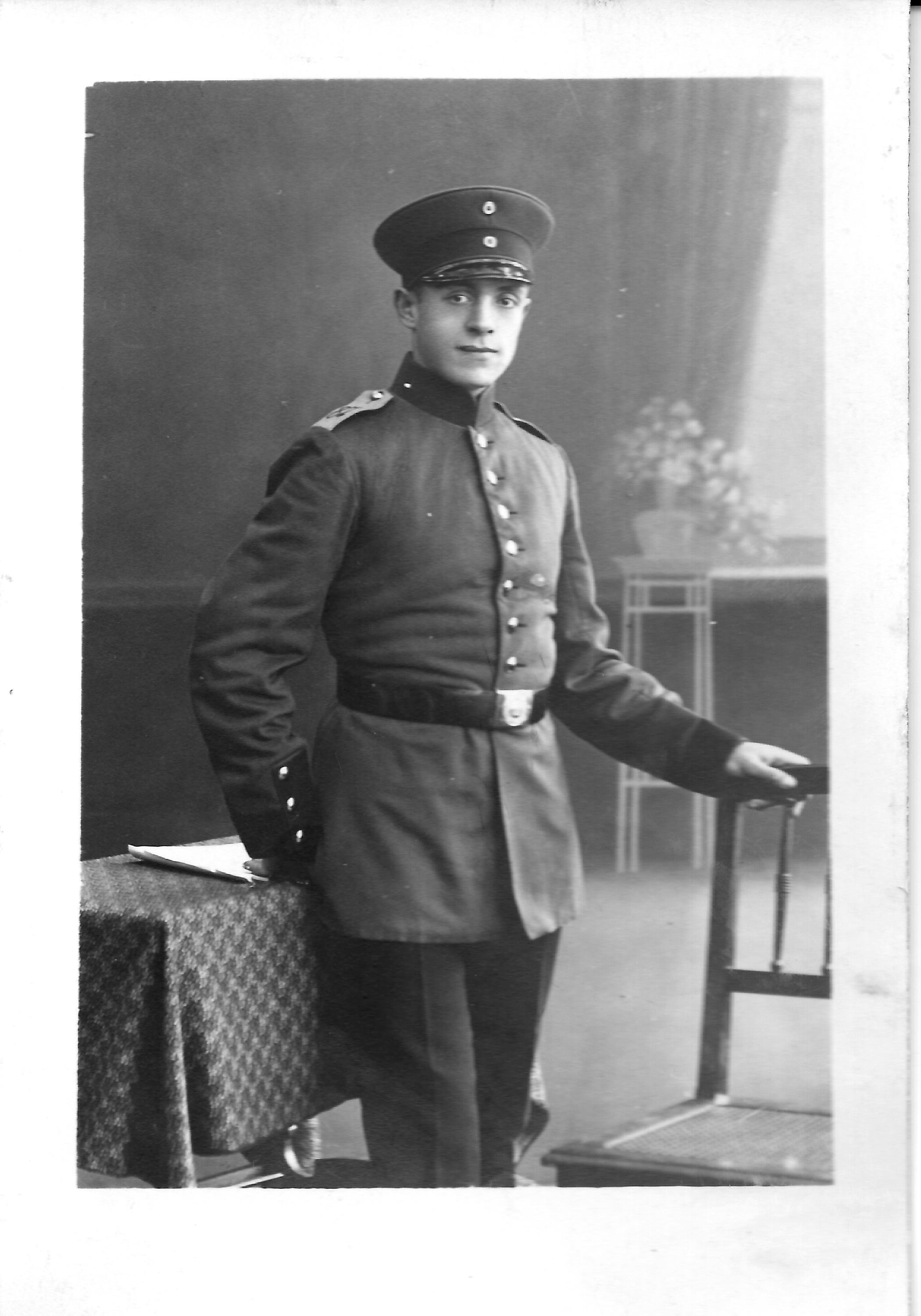
Ernst Winter Courtesy of Lotte Furst

Ernst Winter
Courtesy of Lotte Furst

Doris compared her grandparents’ home in Neunkirchen with her own home in Mannheim:

The house in Neunkirchen had a large garden in back of it, most of which was rented out.  The smallest part, directly behind the house, was used for growing some vegetables and flowers.  I remember loving to play in the garden and watching earthworms after a rain as well as other living creatures.  In Mannheim there was little opportunity for this kind of nature watching as we lived in a built-up urban area with little greenery, other than a well laid out park some distance from our apartment.

Neunkirchen

Neunkirchen

For several years while the French occupied parts of Germany after World War I, several family members housed French soldiers, and the neighborhood school Doris would have attended was also being used by the French military.  Thus, she had to go to a school somewhat further from her home for those years.  Like her sister Lotte, Doris pursued a highly academic path in school and was one of only six girls out of thirty students in her Gymnasium classes and then the only girl in her class when she reached the final years of her pre-university level education.

This excerpt provides a sense of the family’s lifestyle:

My parents employed a cook and a housemaid, and when my sister and I were still young, a “Kinderfraulein” who used to be an untrained young woman with an interest in children.  In other words, not quite a “governess.”  My father had help in his office and for some time also employed a driver after he developed a painful condition in his left arm, due to having to reach outside the car for shifting gears.  …. 

We had a Bechstein Grand piano in our living room. This instrument had been given to my mother as a young girl. She had really wanted to study music on a professional basis. But her parents felt that “proper” young ladies did not take up that kind of profession and did not allow her to pursue her wish. Instead, they bought her the Bechstein and let her have piano lessons.

I began taking piano lessons at age seven, with a teacher considered among the best in Mannheim. My mother, although an accomplished pianist, no longer played much. But occasionally, she and my father, who had learned to play the violin in his youth, would play duets together. That always was a special treat.

By Annaivanova (Own work) [CC BY-SA 3.0 (http://creativecommons.org/licenses/by-sa/3.0)], via Wikimedia Commons

By Annaivanova (Own work) [CC BY-SA 3.0 (http://creativecommons.org/licenses/by-sa/3.0)%5D, via Wikimedia Commons

I was particularly interested in what Doris wrote about the role of Judaism in the family’s life.

I grew up through the years with some awareness that we were Jewish, without knowing what significance that had then and later. Neither my parents nor my grandparents when I knew them observed any religious tenets. However, I was told that in past years my grandfather had been the head of the Jewish Congregation in Neunkirchen. My grandmother, who was president of the local Red Cross chapter for some time, used to fast on Yom Kippur. She reluctantly told me, when I kept asking her, that she had promised her dying mother to keep that tradition. As for me, I was kept home on the Jewish High Holy Days. My family did not attend any services.  …. 

At eight years of age I happened to be visiting my grandparents at the time of Passover. They had been invited by friends to a large Seder. Unfortunately, nobody thought of explaining to me what that was all about. My grandparents may have assumed that I knew, but I did not. I understood nothing of what was being read in Hebrew or spoken in German. I was utterly bored! Furthermore, when the ceremony asked for tasting the so-called bitter herbs, I bit off a piece of the horseradish on my plate and soon experienced the consequences of that act!

Unfortunately, I think far too many children, here in the US and elsewhere in the world, have that experience at seders.

The family was, however, required to provide some religious instruction because of the school system’s requirements:

There having been no separation of Church and State, religious instruction was part of the official curriculum. The students were separated one period per week according to their denominations. Most were Protestants, some were Catholics, and a few were Jewish. Since the number of Jewish children was so small, and in the case of my first-grade placement non-existent, my parents were required for that year to hire a private instructor in order to comply with the legal requirement. Thus, there suddenly appeared a not very clean looking young man with a greasy book, from which he proceeded to read and attempt to teach me-at six years of age-the Hebrew text. My recollection is that he came to our house only a very few times. I do not know how the religious instruction requirement was fulfilled after that disaster.

When, at fourth grade level, I changed schools, religion was taught by a little old man, a retired rabbi, who was very nice and even made some of what he taught rather interesting. But I developed no feeling for or interest in it at all, as it was totally divorced from the rest of my life.

Then, as Lotte also described, their father decided to withdraw from the Jewish community:

When I was fourteen, my father had some kind of a dispute with the Jewish Community, which was the official agency for collecting taxes. These taxes were legally mandated as a percentage of one’s general income tax obligation. I nearer knew exactly what the problem was, except that it had something to do with the amount owed, to which my father was apparently objecting. The Rabbi came to our house to straighten the matter out. Apparently he was not successful as subsequent events proved. (This rabbi became my brother-in-law at a much later time. He knew that I was far removed from religious observance, but he was always very tolerant and friendly to me.)

Whatever the problem had been, my father decided to leave the Jewish Congregation. Since I was already fourteen years old, I was required to state my personal intention. As I had no ties to the Jewish community, that was no problem for me. From then on I was without any religious affiliation, called “konfessionslos.” In practical terms it meant that I no longer had to attend religious instruction at school. I used the weekly free hour to visit the Art Gallery opposite the school building and saw a lot of very interesting, good art works.
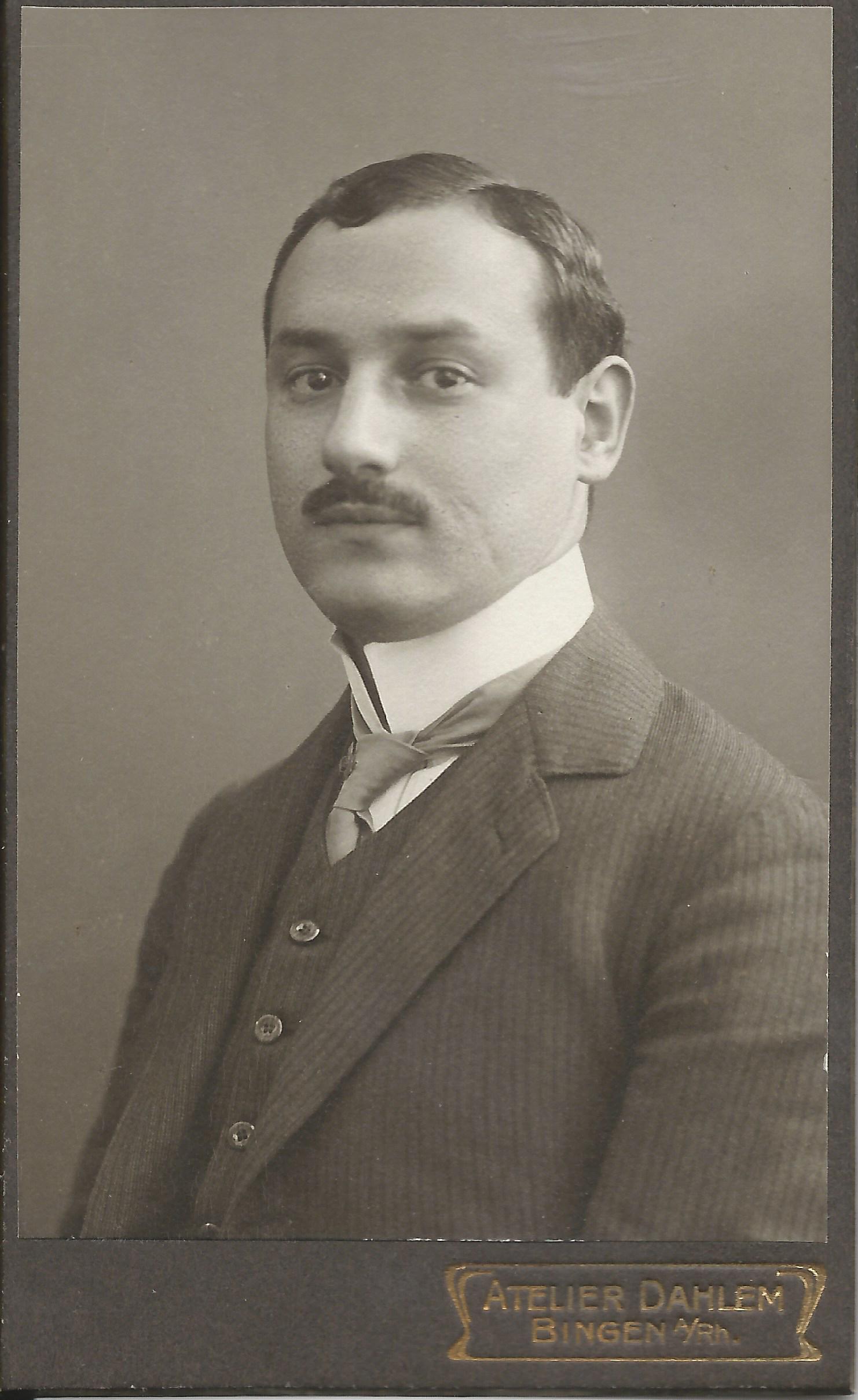
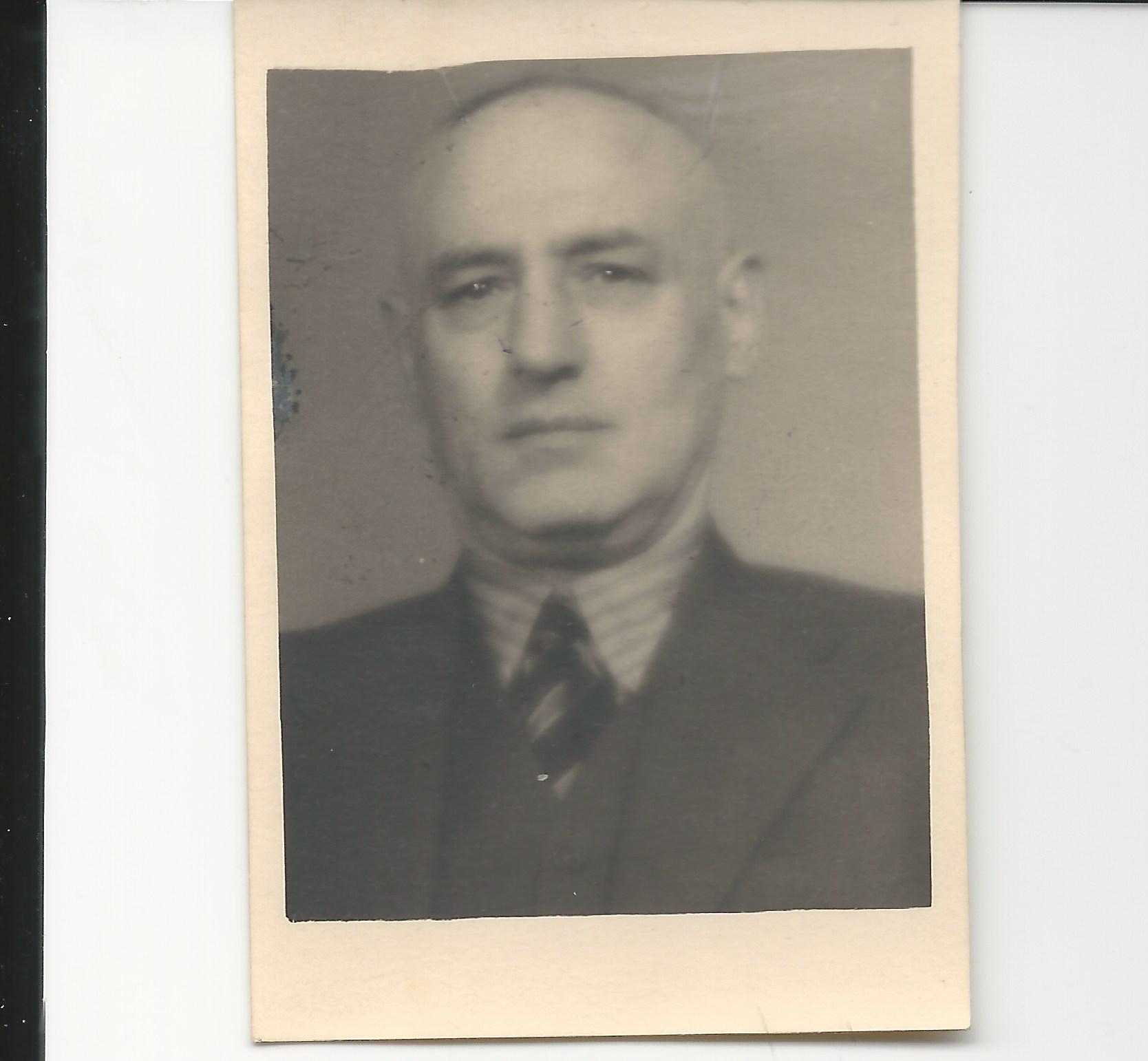
Dr. Joseph Wiener

Dr. Joseph Wiener  Courtesy of Lotte Furst

Of course, the family’s withdrawal from the Jewish community and lack of religious involvement did not make any difference in the eyes of the Nazis once they came to power.  Doris wrote:

Between 1932 and 1935 I had a valid German passport, used during those years primarily for trips to the Saar to visit my grandparents and take the then permitted two hundred German marks to be deposited outside Germany. In those years the Saar was still under the administration of a French post-World-War I governing authority. My grandmother took care of such transactions. By the time I needed a new passport, the Nazis had decided that a big “J” had to be stamped on any so-called non-Aryan, meaning Jewish, person’s passport. Word had gotten around that one of the clerks in the passport office in Mannheim would issue a “clean” document without the dreaded J, for suitable consideration. I went to that office, saw the clerk in question, and for the small sum of five marks was issued a regular passport without the J. I still have this passport as a memento.

When the Nazis assumed power in 1933, we as a family re-joined the Jewish Congregation as a matter of honor. Not that it would have made any difference had we not done so as the Nazis classified people not necessarily by religion but by their so-called racial identity.

German Jewish passports could be used to leave...

An example of German Jewish passport. (Photo credit: Wikipedia)

As Doris approached the end of her time in the local schools in the 1930s, she was both the only girl and the only Jew in her class.  She wrote that things did not change dramatically at school despite the political changes around them, but she did describe one troubling incident:

I entered the classroom in the morning, as usual. Upon approaching my desk, I saw that someone had pasted a viciously antisemitic sticker from the “Sturmer,” a rabidly anti-Jewish paper, on my desk. By that time, one of my classmates had begun wearing the SS uniform. I more or less assumed that he was the culprit, which in the end turned out not to have been the case. However, at that moment I decided not to confront him or anyone else. I sat down at another desk and waited for the right time to act. This came with the second period when the “Klassenlehrer”-the equivalent of our Home Room teacher-was due for his hour. … I waited for this teacher outside the classroom and told him my reason for doing so, adding that I knew there was nothing I could do about official policy and insults, but that I was not willing to put up with personal attacks.

This teacher, who, incidentally, had been an officer in World War I and had lost an arm, rose to the occasion. He and I entered the classroom together, and he immediately asked who had done this deed. Somewhat to my surprise, and perhaps his too, not one of the students admitted having put the sticker on my desk. There was nothing further he could have done: I do not remember whether he spoke to the class, but his earlier behavior had given ample proof of his opinion. … The incident occurred about one week before the final exam, the Abitur. It cast a pall over that important event.


Embed from Getty Images

Imagine being the only girl and the only Jew in the class and standing up for herself that way.  What courage it must have taken to do this.  What if her teacher had not been sympathetic?  Despite this stressful incident, Doris successfully passed the Abitur.  Although Doris was entitled to enroll in the university based on her father’s military service during World War I, Jews were prohibited from enrolling in either law school or medical school.  Instead, Doris decided to audit a few courses while awaiting a visa to leave Germany.  She wrote:

I had known for some time that I had to get out of Germany as there was no future there for me, and I was willing to take whichever came first [she had applied for both a US visa and a certificate to immigrate to Palestine]. However, I admit that I was relieved when the American visa materialized first.

The American Consulate closest to Mannheim was located in Stuttgart. In due course I was summoned for an interview with the American consular officials. I was in a somewhat unusual position in that my father had learned of a legal means of transferring money abroad, which was then discounted at the rate of fifty percent. The permissible amount was sufficient to enable me to show the U.S. Consulate that I had the requisite five thousand dollars for obtaining an immigration visa to the U.S. In this way I did not have to await my application number to come up in regular order, which would have taken a great deal more tame. I got my visa rather quickly. By that time I had also received a so-called Affidavit of Support from one of my grandmother’s cousins, whose father had emigrated in the nineteenth century and had settled in Cleveland, Ohio. This cousin was in very good financial circumstances and readily responded to our request for an affidavit.  …

I was very interested in determining who this cousin might have been.  If she was Laura Seligmann Winter’s cousin, she might have also been a cousin of mine, depending on whether she was a paternal cousin or not.  The only clues I had from Doris’ memoir were her married name (Irma Rosenfeld), her residence in Cleveland, her children: a son who was in his 20s in 1937, a daughter who was married, and another daughter who was a student at Vassar.

I found one Irma Rosenfeld living in Cleveland at that time who had two daughters and a son and was married to a man named Mortimer Centennial Rosenfeld (I assume the middle name was inspired by the fact that Mortimer was born in 1876, the centennial of the Declaration of Independence).  I sent Lotte the photo from that Irma’s passport application, but Lotte was unable to confirm from the photograph that it was the right Irma Rosenfeld.

Irma Rosenfeld and daughter passport photo 1924 Ancestry.com. U.S. Passport Applications, 1795-1925 [database on-line]. Provo, UT, USA: Ancestry.com Operations, Inc., 2007. Original data: Selected Passports. National Archives, Washington, D.C.

Irma Rosenfeld and daughter passport photo 1924
Ancestry.com. U.S. Passport Applications, 1795-1925 [database on-line]. Provo, UT, USA: Ancestry.com Operations, Inc., 2007.
Original data: Selected Passports. National Archives, Washington, D.C.
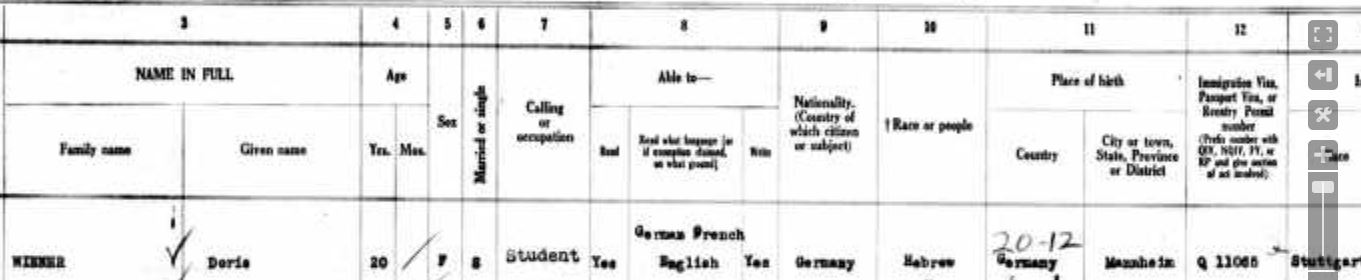
After reading Doris’ memoir, I went back to all the documents I had for her and examined more closely the passenger manifest for her trip to the US in 1937.  I had not seen the second page of it my first time through, but this time I noticed that it not only named Irma Rosenfeld; it had her street address in Cleveland.  It only took a glance at the 1940 US census for me to confirm that I had in fact found the correct Irma.

Doris Wiener 1937 ship manifest

Doris Wiener 1937 ship manifest part one

 p2 Ancestry.com. New York, Passenger Lists, 1820-1957 [database on-line]. Provo, UT, USA: Ancestry.com Operations, Inc., 2010. Original data: Passenger Lists of Vessels Arriving at New York, New York, 1820-1897.

p2
Ancestry.com. New York, Passenger Lists, 1820-1957 [database on-line]. Provo, UT, USA: Ancestry.com Operations, Inc., 2010.
Original data: Passenger Lists of Vessels Arriving at New York, New York, 1820-1897.

A little more research revealed that Irma’s birth name had been Irma Levi, daughter of Isaac Levi and Fanny Loeb.  Since Doris and Lotte’s great-grandfather (and my three-times great-uncle) Hieronymous Seligmann had married a woman named Anna Levi, I believe that that is the connection between Doris and Irma.  Anna Levi was a contemporary of Isaac Levi; perhaps they were siblings, and thus Irma Rosenfeld would have been a first cousin, twice removed, of Doris and Lotte, their grandmother Laura’s first cousin.  Obviously, the family had stayed in touch with these American cousins, and even though Irma was American-born and had never met Doris before, she reached out to help her escape the Nazi regime.

Continuing now with Doris and her emigration from Germany:

Necessary preliminaries having been taken care of and good-byes having been said, it was time to arrange for the journey to America. We bought a ticket for me on the SS Washington, a twenty-thousand ton ocean-going passenger boat, and also obtained railroad tickets for me and my mother who wanted to accompany me to Cherbourg, the place of embarkation. …

In Cherbourg I said good-bye to my mother, for whom the separation was very hard, more so than for me. For one thing, I was looking toward something new. But perhaps more importantly, I had unwittingly insulated myself to some degree from the impact of events. This condition lasted for a long time and to some extent gave me some emotional protection….

In contrast to so many, I confess that I had an easy time. Not only was the way for coming to America smoothed. My parents also were well able to pay for my ticket and whatever other expenses arose in connection with my leaving. I was twenty years old at that time.  …
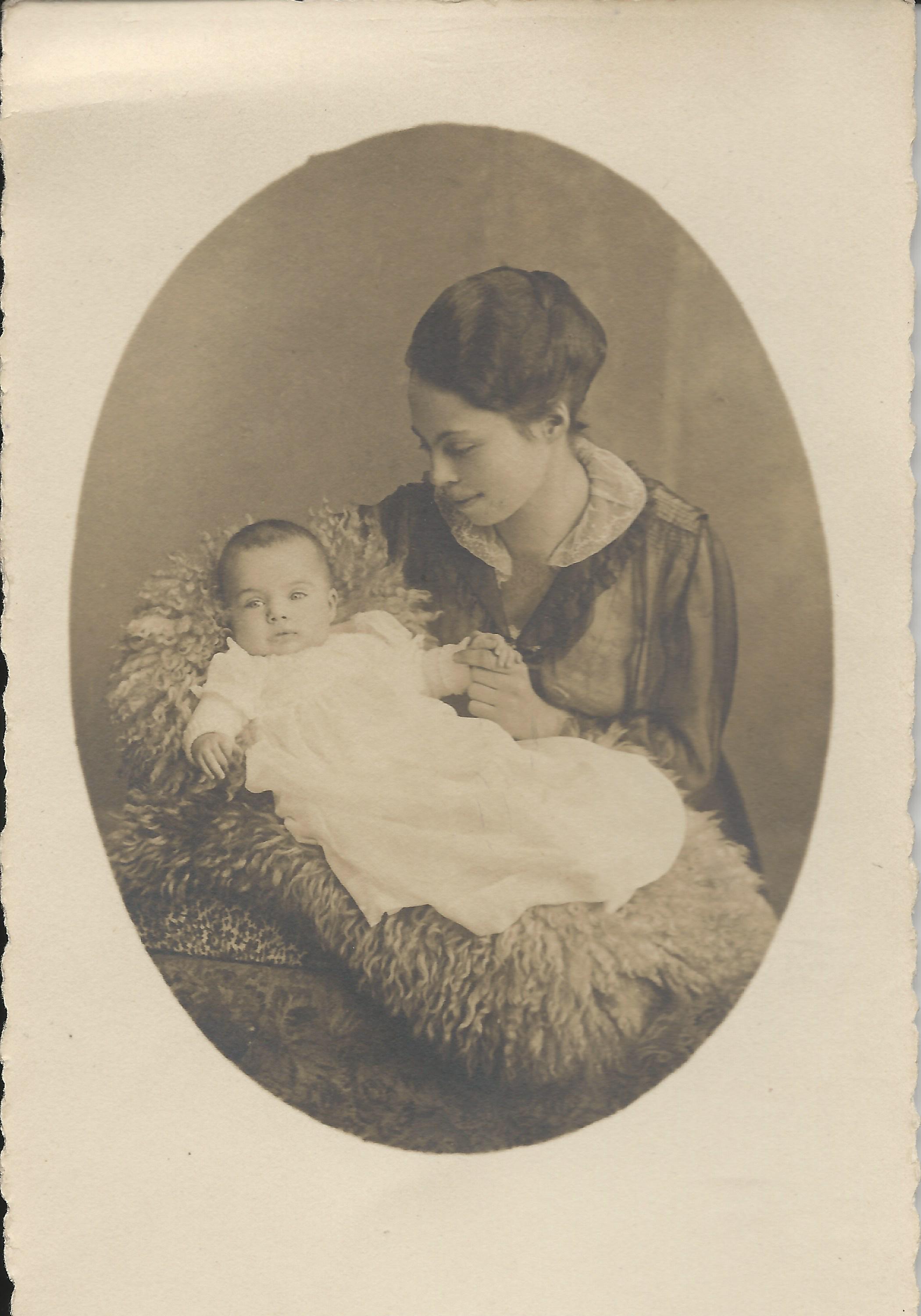
Aenne Wiener and Doris

Doris Wiener and her mother Courtesy of Lotte Furst

Doris explained why her parents and sister did not come with her:

The question has often been asked why my parents and sister did not come at the same time. Like a great many people, my father kept believing that the Hitler episode was just that, and he refused for a long time to see the situation realistically. Not so my mother. She was instrumental in organizing their own as well as her parents’ emigration to Luxembourg, and later their own to America.

Doris wrote that she arrived in New York in 1937 with $400.  Her parents had arranged for friends to meet her at the boat, and Doris stayed with them for a week before moving to her own apartment on the top floor of a building at 96th Street and Central Park West.  Doris also described a visit to Cleveland to see her grandmother’s cousin, Irma Rosenfeld, the woman who had provided the affidavit in support of Doris’ visa, as discussed above. “The slightly more than four weeks I spent with the Rosenfelds were very pleasant, with visits to their country club and other social activities.”  But Doris preferred to remain in New York City.

After returning to New York, Doris soon found employment in a dentist’s office and also soon met her future husband, Ernst Gruenewald.  They were married in May 1938.  Her mother Annie came to New York for the wedding, not only to witness the wedding but also “to gain insight into the international situation uninfluenced by German propaganda.”

My mother had intended to stay in America for about six weeks. But as she listened to the broadcasts available to us, she became increasingly agitated and decided to cut her visit short in order to initiate their emigration from Luxembourg to the United States. She had always been a very intelligent woman capable of making important decisions, many of which were advantageous. She returned to Luxembourg and was able to convince my father that this was the right thing to do. They arrived in the U.S. in April 1939, three weeks after the birth of our first child and about half a year before the outbreak of World War II.

Her grandparents, as we know from Lotte’s memoirs, did not fare as well:

During my childhood I had spent a good deal of time with them in Neunkirchen and was very fond of my grandmother. I knew her only from her mid-forties on, when in my eyes she was an old lady. She was a very reserved but warm person and managed their life very competently. My grandfather was a short, slim man who from the time I knew him as a person, was not well. …  My grandparents had applied for a visa to the United States before the outbreak of World War II, but failed to be granted immigrant status. In retrospect, I am convinced that my grandfather’s condition was the reason, as they had enough money to qualify for a visa. My parents also could have vouched for them. My grandfather ended up in Theresienstadt, where he died of pneumonia, as we were told after the war. My grandmother had suffered a fatal heart attack while still living in Luxembourg.

Doris and her husband Ernst and their family ended up relocating from New York to Chicago for a business opportunity a few years after her parents and Lotte arrived .  During the 1950s, Doris went back to school and obtained her bachelor’s degree while also raising her children; in 1961 she received a masters’ degree in psychology as well.  She then went on to get a Ph.D. in psychology, specializing in neuropsychology, which was itself still a relatively new field.  After obtaining her degree, she worked at Michael Reese Hospital in the Adult Inpatient department where she eventually became the director. Sadly, after twenty years there, she found herself forced out on the basis of their mandatory retirement age.  She had just turned seventy.

By Zol87 from Chicago, Illinois, USA (Michael Reese Hospital) [CC BY-SA 2.0 (http://creativecommons.org/licenses/by-sa/2.0)], via Wikimedia Commons

By Zol87 from Chicago, Illinois, USA (Michael Reese Hospital) [CC BY-SA 2.0 (http://creativecommons.org/licenses/by-sa/2.0)%5D, via Wikimedia Commons

In 1987 Doris and Ernst moved to California, where the winters were milder and where her sister Lotte was living.  Doris had obtained a California license before moving and was able to continue to practice as a psychologist when they moved, but did so only for a short period before retiring.  Ernst died in 1989, and Doris died almost twenty years later in 2007.

It was fascinating to me to read Doris’ memoirs after reading Lotte’s; both sisters wrote so clearly and so powerfully about their lives.  I can see that they had much in common: great intelligence, dedication to hard work and to family, astute powers of observation, and a love of language.  Doris struck me as the more thick-skinned of the two sisters, often talking about her independence and emotional distance from others, even as a young child.  Doris wrote about being somewhat of a loner and keeping her thoughts and feelings to herself.  I would imagine that those qualities served her well as she endured her teen years in Hitler’s Germany and a voyage alone to America in 1937 as well as her adjustment to life in America.

Overall, I am struck by how strong these two women were, both as children in Germany, as new immigrants to the US, and as women experiencing all the changes that came in the years after World War II.    I’d like to think some of that is the Seligmann DNA that we share, but I doubt that I would have been as resilient and brave as they had to be, if I had had to endure the challenges and hardships they did.


Lotte’s Story: A Post-Script

The response I received to the writings of my cousin Lotte was overwhelming.  People were very moved by her life story and by her writing. (You can find her story here, here, and here.)  Lotte has generously shared some additional writings and photographs about her family and her life, which I will share with you, with her consent.  (All of Lotte’s writings are protected by copyright and may not be reproduced without her permission.)

First, a reminder of how I am related to Lotte:

Lotte to me


For those who have not read the first installment of Lotte’s story, a brief recap:  Lotte grew up in Mannheim, Germany, with her parents, Joseph and Aennie (Winter) Wiener and her older sister Doris.  Her father Joseph was a doctor in Mannheim, and her family was living a comfortable life there.  Lotte was an excellent student and was enjoying a good life until the Nazis came to power in 1933.

Aenne Wiener and Doris

Aenne and Doris Wiener c. 1916

Joseph Wiener earlier picture

Dr. Joseph Wiener

Her grandparents, Laura (Seligmann) and Samuel Oscar Winter lived not too far away in Neunkirchen, where her grandfather was in business with his brother-in-law, Laura’s brother Jakob Seligmann.  Lotte described what it was like to visit her grandparents:

MY GRANDPARENTS’ HOUSE

Neunkirchen

It was a foregone conclusion that I spent most of my Christmas and Easter and also a couple of summer vacations at my grandparents’ house. I never was asked whether I wanted to go there. If so, the answer would have been “yes”. I liked them.

They lived in Neunkirchen in the Saarland, an area of coal mining and steel production administered by the League of Nations at that time. Their three-story attached row house was at Moltkestrasse 23, a nice residential neighborhood. A buzzer would open the front door after which another door with a glass panel opened to a short corridor. To the right on the first floor, called parterre, there was a fairly large carpeted and well-furnished salon and a quite formal dining room. Both rooms were dark and hardly ever used. The smelled a bit dank and musty. But to the left of the dining room a glass-beaded curtain opened to a long, enclosed, bright veranda where my grandmother kept a number of house plants including some she called amaryllis, her pride and joy. And yes, there was a rope-operated dumb-waiter from the kitchen above to the dining room. I used to love pulling those ropes and playing with it.

A toilet with a small hand basin and a spindle full of squares of cut newspaper, hardly to be called toilet tissue, was located half-way up the stairway  to the middle floor, the actual living quarters. The living room was fairly bright and not anywhere as elegant as the downstairs salon. The main attraction were my grandfather’s rocking chair and the blue and white KKL (Jewish National Fund) box filled with a number of coins. I liked to manipulate them out with a knitting needle. Of course I replaced them immediately. I knew the money was for a far-away country called Palestine.

Gilabrand at en.wikipedia [CC BY 3.0 (http://creativecommons.org/licenses/by/3.0)], from Wikimedia Commons

Gilabrand at en.wikipedia [CC BY 3.0 (http://creativecommons.org/licenses/by/3.0)%5D, from Wikimedia Commons

Next to the living room was the fairly spacious master bedroom, dark and gloomy and actually taboo for me. But the bathroom was bright and big and quite an attraction for me because I could come in while my grandfather was still brushing his teeth and whistling while doing so. He used to announce that he was the only person with that capacity because he had false teeth. Oh, and of course the kitchen was on that floor but I did not spend much time in it and don’t remember the details, except that it opened up to a balcony where we would sometimes eat. On those occasions we had to constantly wipe off the ever-present soot that came from the coal mines.

The landing half-way up to the third floor featured an ice box. Not much food was stored in it. Certainly nothing kept there tasted fresh. We had to watch out for the sound of drip-drip-dripping water which meant the molten ice had filled the basin below it almost to capacity.

I slept in the first of the three bedrooms on the third floor, up a creaky stairway. It was pretty dark too with a large bed and a dresser. It also smelled pretty musty and the bed springs were making all kinds of noises. A large limp rag doll with a porcelain head and eyes that would open and close greeted me on the bed. It was the ugliest thing I can remember, but my grandmother thought I would like to play with it since it had been my mother’s. I hated it and tucked it away in a drawer very quickly. Early in the morning I could hear the crowing of roosters. Kickeri-kee they went. Kickeri-kee. On Sunday mornings that sound was joined by the ringing of several church bells. After all, Neunkirchen means nine churches. It did not wake me since I was not asleep any more but had to stay upstairs until I could get into the bathroom. On the way downstairs I was greeted by the aroma of freshly brewed coffee.

Two more rooms were located on that floor. One was a large storage room, mostly unused. The other was the former bedroom of my uncle, my mother’s brother, who was killed early in World War I. I was not allowed to enter that room. Probably it was locked. I believe it was kept exactly the way my uncle had left it. My grandparents never talked about it but never got over it. My grandmother only wore black or grey clothes.

Of course the house also featured a basement. There were at least two parts to it, one a coal cellar, unpleasant with a dusty smell all of its own, and a fruit cellar. That was a delightful place. I loved to go downstairs and inhale the aroma of apples, yeast cakes, apple pies and other goodies which were stored in the cool basement room.

The house really was quite gloomy and I probably was bored during my visits. But I never felt unhappy there. That was the way it was. And my grandparents certainly loved my visits and I loved them for it.

Her writing is so vivid that I can easily picture this large and dark house that she visited as a small child.  It’s incredible to me how clearly she remembers this house and these visits.

Samuel, Laura, and Anna Winter and Jakob Seligmann

Lotte’s grandparents Samuel and Laura Winter, her mother Anna (Winter) Wiener, and her great-uncle Jakob Seligmann


Lotte also has painted a wonderful portrait in words of her great-uncle Jakob Seligmann, depicted above, far right:

Onkel Jakob

He was a good-looking man. Portly and erect. He had a rosy complexion, a well cared-for short white beard, short white hair surrounding his mostly bold pate, an aquiline nose. Portly, I said. His belly protruded just enough to display a heavy golden watch on a chain. That was Onkel Jakob, my grandmother’s brother and thus my mother’s uncle. He was my grandfather’s business partner.

He was very fastidious. His shoes were always shined and a crisp handkerchief was tucked in his left upper coat pocket. He spoke clearly and slowly in a baritone voice. He showed up at the office at exactly the same time every day. On Sundays at 10 o’clock he walked to the train station, about 20 minutes from where he lived, in order to check the correct time and reset his watch if necessary. He wanted to make sure his gold watch, so prominently displayed on his belly, was correct. Once the watch was set, he might pick me up at my grandparent’s house in Neunkirchen. He took me and perhaps my sister too for a walk in the nearby woods, right behind my grandparent’s store. Sometimes Herr Eisenbeis, the owner of the building, would join us. He was a hunter and carried a long rifle. He actually was looking for deer in the birch woods. I never saw him shooting any but I did see a number of deer. Herr Eisenbeis was stocky and short. He was dressed in a green hunter’s outfit. He spoke in staccato sentences and was very abrupt and very Prussian. I did not like him very much.

But back to Onkel Jakob. I did like him and I also liked Tante Anna, his wife, who was quite beautiful and a wonderful cook. She served different kinds of food from those my grandmother made because she was not Jewish and was born in Hamburg in northern Germany. She had a brother in Kalamazoo. I remember because that name sounded very funny.

Onkel Jakob’s life seemed to be run strictly by the rules. He was pedantic, to say the least. But something went utterly against those rules. He never brought Tante Anna to my grandparent’s house. Somehow I found out that she was not welcome there because she was a shikse and because she had been Onkel Jakob’s housekeeper for many years and that they had only recently been married. It was not fair. She was a good woman who went with Onkel Jakob when he had to leave Neunkirchen to move to Luxembourg during the Hitler years. She was the one who kept in touch with my mother as long as she could after World War II broke out. Through her we learned that my grandmother collapsed on the doorsteps and died when the Nazis marched in. That my grandfather had been deported. And that Onkel Jakob had died before the same fate could happen to him. That both he and my grandmother were buried in the Jewish cemetery in Luxembourg for which she supplied the address. She finally moved back to Hamburg where she had some family. After that we did not hear from her again.

I remember Onkel Jakob as a very pedantic man. But along with him I also remember Tante Anna who was a kind and good woman.

As she wrote in Part II of her story, her grandparents and her great-uncle all moved to Luxembourg around 1935 to escape the Nazis.  They were, however, unable to come to the United States when Lotte and her parents left in 1939, and all three died during the Holocaust.  There is a memorial stone for the three of them in Luxembourg.

Winter stone


Fortunately, Lotte, her sister, and her parents were able to move first from Germany to Luxembourg and then to the United States in 1939 where Lotte successfully completed nursing school.


Lotte

Lotte

I was curious about what had happened to her father Joseph Wiener after he came to the US.  He’d been a doctor in Germany, and I asked Lotte whether he had been able to continue practicing medicine after coming to the US to escape the Nazis.  She shared this essay:

FACING DIFFICULTIES

Imagine having to learn a new language, having to take difficult tests in it, living in a completely new environment and under completely different circumstances, and making the best of it, all at the age of 56 which was considered “getting there” agewise at the time? That’s what happened to my father.

Under duress he had to give up his medical practice in Germany. Other than his native German he knew a little French and of course had studied Latin and Greek in highschool. In Luxembourg where we lived for a year he had no way of working in his profession. Knowing that it was just an interim stop he began to study English. “1000 Words of English” was his first textbook. It was over-simplified and actually quite hilarious. “Do you like this girl?” was the beginning of one of the dialogues. “I not only like her, I love her” it went on. “She has millions of dollars”. That kind of thing really was not adequate , but he learned. My mother who did speak English fairly well taught him some more. And then we left for America.

He felt very strange but he knew he had to make the best of it. He learned that he would have to take the New York State Boards in order to practice medicine. Anatomy, physiology, pharmacology, psychology, the whole works. He plowed right into it. The English language came “as you go” so to speak. He might have taken a course or two, I don’t quite remember. His pronunciation was not great, but then neither was mine.

Meanwhile I started nursing school. Since I had a few of the same courses, though in drastically abridged form, I helped him some whenever I had a chance to get home. He really worked hard at it. He also found time to play the stock market, thanks to two very good advisors whom he knew from before. Whatever little money my parents had managed to smuggle or take out of Germany needed to be augmented in order provide for a decent living. He had no illusions about the income from his medical practice, whenever that would materialize. But the war had started, the market was going up, and as I said, he had some very good advisors who went for safety and not for speculation.

After studying for almost two years my father applied for the State Boards. Miraculously he passed almost all of the difficult courses. All except one in a course called “Hygiene”. The Board, consisting of physicians eager to keep out the new competition g by German immigrants, could not in good conscience let him pass. So he had to take a refresher course and an additional exam, fortunately just in the one subject.

Now he would be able to hang out his shingle. My parents moved from apartment B61, on the sixth floor of the Park Chateau building at 8409 Talbot Street,  Kew Gardens, to a spacious five-room one on the ground floor in the A building. My sister, her husband and their little girl, who had been sharing the upstairs apartment with my parents, moved to their own place a  convenient distance away. My father bought second-hand equipment for his office. He posted a sign reading “Joseph Wiener, M.D. Physician” or something like that at the front of the building. I must explain that it was and probably still is quite customary for New York physicians to practice out of their living accommodations. No need to rent a special office space.

I remember the “Field of Dreams” movie with the theme “when you build it, they will come”. Well my father opened his office and a few patients came. Not too many, but at least it was a start. By now he was 58 or 59 years old and not too anxious to establish a large practice. He definitely did not to drive a car any more. His clients would have to live in walking distance. That worked out just fine. The neighborhood with its small homes and working-class occupants which started right behind the Park Chateau building turned out to be just what he needed. They did not come in droves. Just enough to keep him happily satisfied. He charged $3.00 for an office visit. Sometimes he did not charge anything. He made house calls by walking there. He joined the local AMA chapter and enjoyed going to their meetings. I suppose he was glad to get away from home once in a while. He also looked forward to what they called “collation” on the invitations. It took a while to figure out that meant refreshments. For several summers he worked  as the physician at a summer camp in the Catskills. The kids and also heir parents loved him and respected him. He had a great time there.

But then his health gave out. His arteriosclerotic heart grew weary. It took a few years before it went into failure. A few critical episodes followed. And yet he was determined to face this fact. Released after an early April stay in an oxygen tent at the local hospital, he proceeded to file his income tax. He knew his house was in order. He knew my mother was well provided for. And then he went to sleep. No longer did he have to face any difficulties.

Joseph Wiener MD

Dr. Joseph Wiener

You can see the sadness in Joseph’s eyes (as well as his strength) in this later photograph as compared to the one above that was taken in the pre-Hitler era.

I also asked Lotte about her own adjustment—in particular, how she was able to do so well in her studies, given that English was not even her first language.  She shared with me this essay:

MOTHER TONGUE

It is obvious. The moment I open my mouth, people recognize my accent. “Charming”, they may say. “Annoying”, it seems to me. I can’t hear it myself, except when I listen to my own phone message. “That’s me?” It sure does not sound like it. It sounds like a stranger.

Whether I like it or not, German is my mother tongue. That’s what I spoke exclusively until I was seventeen. That’s what my schooling and much of my thinking are based on. That’s what influenced my formative years. But that’s not what I spoke for many years. After all, I left Germany under the pressure of the Hitler years. When I left, I was sure I would never look back, never return again and never want to be involved with anything German. I had to start a new life. And when I met my husband who was from Vienna which after all is not Germany, we hardly ever spoke German. It was during the war, and the language was not welcome. Besides, in Austria they use a number of different terms for everyday common things, and we would begin to argue who was right. So we dropped it and just spoke English.

Learning English was not difficult for me. For a while I took English as an elective in high school.At age sixteen I took some private lessons at a Berlitz School where you are immersed in the foreign language. My courses included conversation, shorthand  and commercial correspondence. With my German and a strong background in French it came easily. The study of Latin and Greek was very handy to understand grammar and vocabulary. But the pronunciation! German is a phonetic language while English is not. That caused – and causes – some trouble. While I pride myself in being completely fluent in English, I still may pronounce certain words the way I think they should be pronounced, the way I can sound them out. That is especially true with proper names many of which have been anglicized, for no good reason so it seems. Why for example should Verdi be pronounced “Voedy” when in Italian it is VERDI, or “Aphrodite” sound like “Aphrodaite” while the I in Greek is just that: “EE”? Well, so much for that.

I do think and figure almost exclusively in English. But sometimes an old German adage creeps in. And oh how many such words can be found in that language. There is a saying of wisdom for just about everything. And certain words simply cannot be translated – they are idiomatic. Just like the Yiddish schlemiel, or chutzpah. There is no English word for that.

I can still converse fairly fluently in my erstwhile mother tongue. People who did not know about my background would comment that for an American I spoke very good German. Little did they know. But when it comes to writing it becomes more difficult. For many years I had a lively correspondence with one of my high school friends who did not speak English. Often I would have to beat around the bush, so to speak, and find some alternate, perhaps awkward way to describe what I wanted to say. And reading German books or communications. Those convoluted intertwined interminably long sentences. English is much more direct.

Somehow I cannot think of English as being my mother tongue. It is not, although it is what I use almost exclusively. Somewhere, deep in the crevices of my brain my German background prevails. Sometimes it comes to the fore. After all, that is my mother tongue.

There is no question that Lotte has mastered the English language; very few of us for whom English is our mother tongue can express ourselves as well as she does in her adopted language.

Once again, I was and continue to be struck by how determined and how positive Lotte was as a young woman and how she has remained so to this day.  These more recent photographs of her show her indomitable spirit in her smile and in the light in her eyes.

Uli and Lotte 1988

Lotte and her husband Uli 1988

Lotte Furst in 2006

Lotte in 2006


My Ever-growing Seligmann Family Tree

Of all my family lines, I have had the best luck with my Seligmann line. First, early on I found my cousin Pete, Arthur Seligman’s grandson, who had a wealth of information about the New Mexico Seligmans.  Then I was lucky to find people in Germany who provided me with the copies of vital records for Moritz Seligmann and his family as well as a book about the Jews of Gau-Algesheim.  From those sources, I learned the names of many of my German ancestors.

Then my cousin Wolfgang found my blog, and he has provided me with invaluable information and documents as well as his continuing help in deciphering and translating what he found in his cousin’s suitcase.  From there I was able to find my cousin Suzanne, who has provided me not only with more information and more documents but also with priceless photographs of many of my Seligmann relatives.

And now I have connected with two more cousins: George, an American descendant of Hieronymous Seligmann, a brother of my great-great-grandfather Bernard, and Davita, a descendant of Adolph Seligman, also my great-great-grandfather’s brother, who also settled in Santa Fe..  And from George and Davita I hope to learn even more about the family.

Right before I left and then while I was away, Wolfgang and Suzanne sent a bunch of new documents and new photographs that I want to share.  I am not even sure where to begin.  I think I will start with the newly discovered Westminster Bank document revealing the names of all the children of Hieronymous Seligmann; it answered some of the questions left open by my posts about the list of heirs to the estate of English James Seligman.

Westminster Bank family tree for Hieronymous Seligmann

Westminster Bank family tree for Hieronymous Seligmann

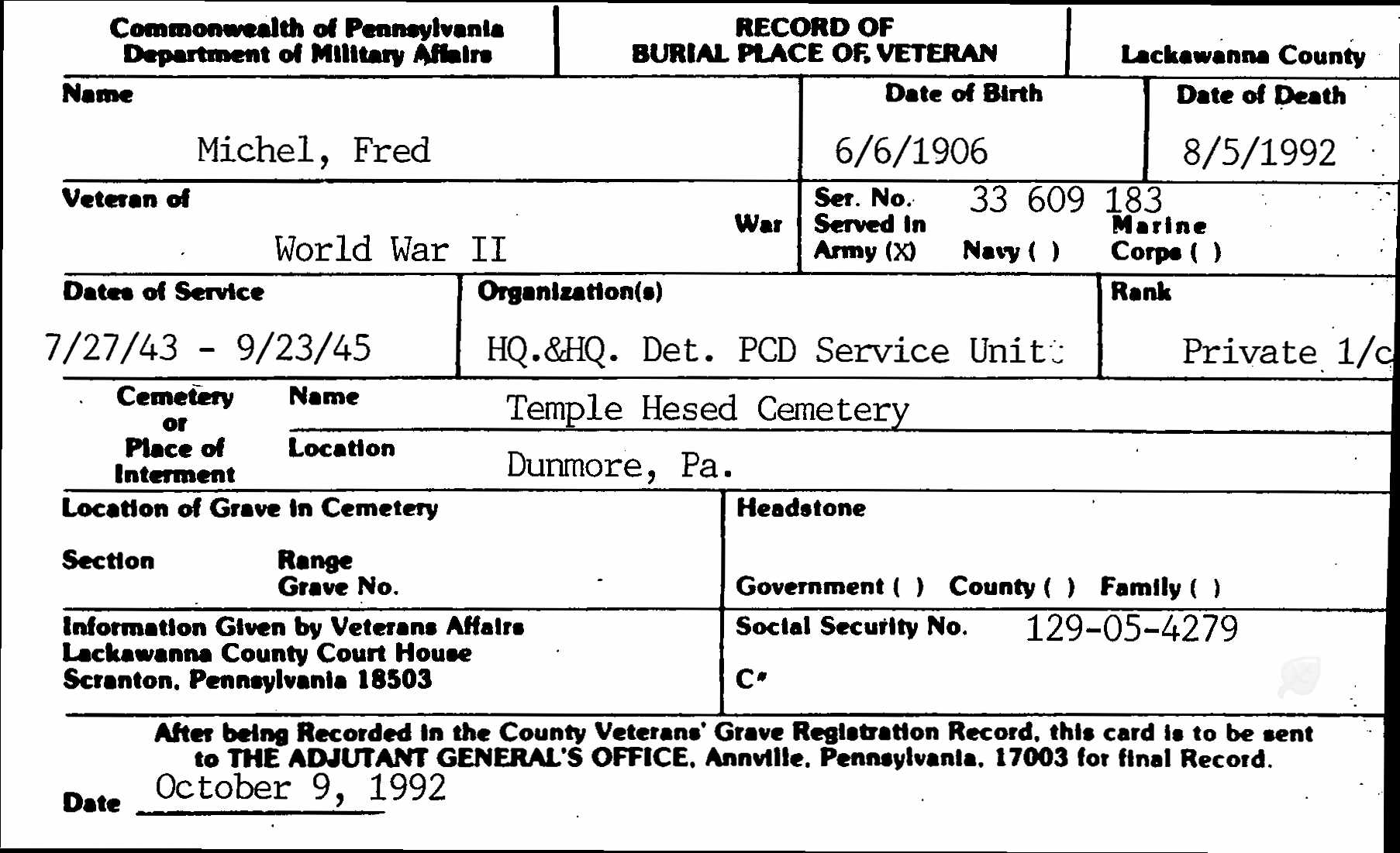
This must have been the family tree that Elsa Oppenheimer had found erroneous as described in her letter of July 9, 1984.  She had asserted that Hieronymous did not have a daughter named Johanna or Elizabeth (Bettina, on the tree), as the Bank’s tree indicated.  But Elsa also said that Moritz did not have a son named Adolph, and she was wrong about that.  I now think she was also wrong about Johanna and Bettina.  How do I know she was wrong?  Because there are pictures of both of these women in the photograph album that belonged to their cousin, Fred Michel.

First, here is a picture of Johanna Seligmann Bielefeld from the Michel album.  Despite Elsa’s protestations, Johanna was clearly the daughter of one of the Seligmann sons, and there is no reason to think that she was not a sibling of Jack, Rosina Laura, and Mathilde, as indicated on the Bank tree, and thus a daughter of Hieronymous.

Johanna Bielefeld nee Seligmann

Johanna Bielefeld nee Seligmann

As I posted earlier, Johanna married Alfred Bielefeld, and they had two children, Hans and Lily, both of whom immigrated to the United States.  Alfred and Johanna were both deported to Terezin, where Alfred died.  With the help of the archivist at Terezin, I was able to locate Alfred’s death certificate.

Albert Bielefeld death certificate from Terezin

Alfred Bielefeld death certificate from Terezin

From what I can interpret here, Alfred died from myocardial deterioration and cellulitis.  Johanna did not die at Terezin, but was later transported to Auschwitz, where she was killed.

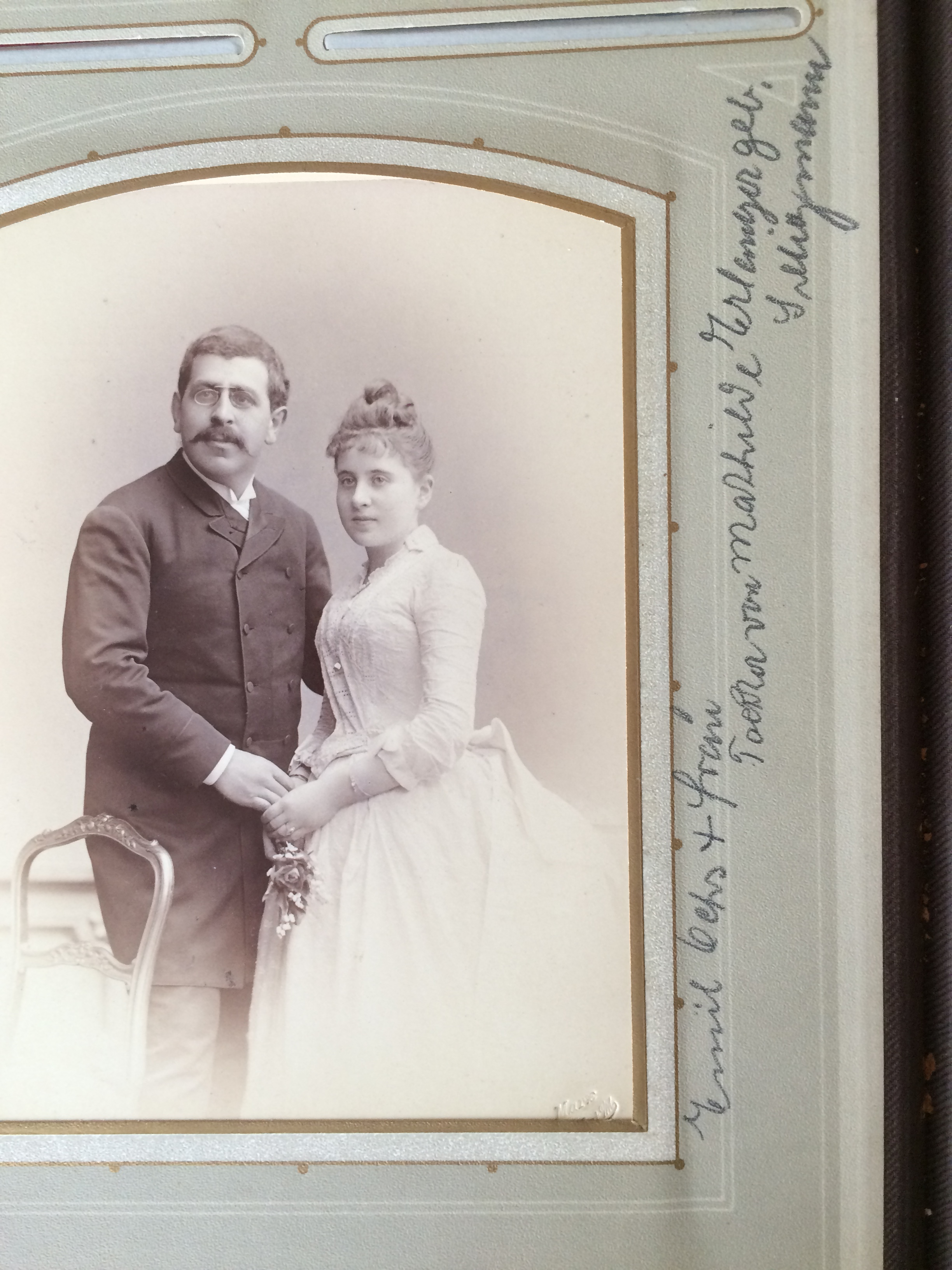
As for Bettina, this beautiful photograph appears in the Michel photo album.

Bettina Arnfeld nee Seligmann

Bettina Arnfeld nee Seligmann

Wolfgang located a page in German for the stolperstein placed in her memory in Muelheim-Ruhr.

Stolperstein for Bettina Seligmann Arnfeld

Stolperstein for Bettina Seligmann Arnfeld   By RalfHuels (Own work) [CC BY-SA 4.0 (http://creativecommons.org/licenses/by-sa/4.0)%5D, via Wikimedia Commons

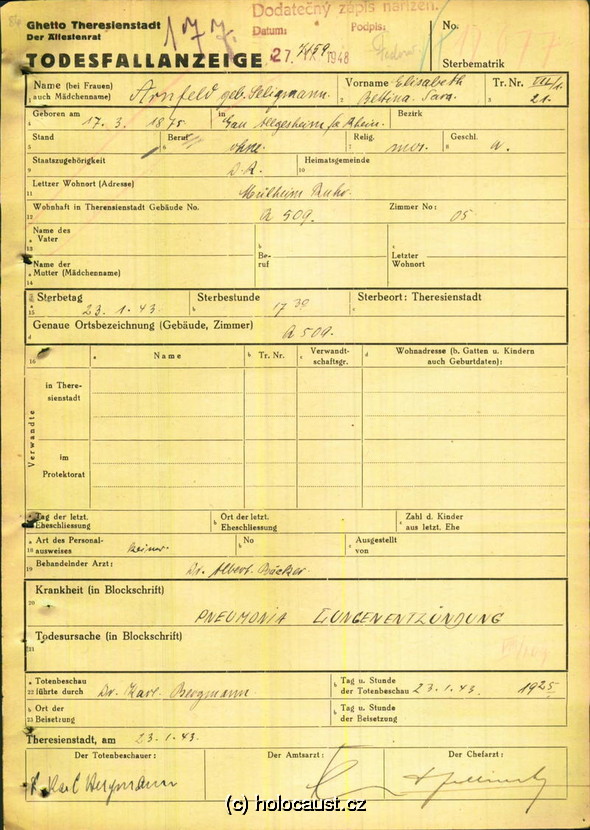
According to this page, Bettina was born in Gau-Algesheim on March 17, 1875, the daughter of Hieronymous Seligmann and Anna Levi.  She attended school in Bingen and married Adolf Arnfeld in 1900.  Adolf was in the fabric and clothing business in Mulheim-Ruhr, and he and Bettina were living there when their son Heinz was born in 1902.  Adolf died in 1927, and Bettina was still living in Mulheim when she was deported to Terezin on July 21, 1942.  She died six months later at Terezin from pneumonia.  Here is yet another chilling death certificate issued by the Nazis.

Bettina Seligmann Arnfeld death certificate from Terezin

Bettina Seligmann Arnfeld death certificate from Terezin

Unfortunately, I was not able to locate these death records while at Terezin so was unable to locate the specific gravesite where Albert Bielefeld and Bettina Arnfeld were buried.

Bettina’s biography also discussed her son Heinz.  After initially working for his father’s company, Heinz became an attorney and worked as a clerk in the court system until dismissed in 1933 under the anti-Semitic laws adopted by the Nazis.  He was imprisoned for a period of time in 1938 at Dachau (mostly likely in the aftermath of Kristallnacht), but was released.  He immigrated to England in 1939, where he married Liselotte Schondorff in 1945.  Heinz died in England on May 4, 1961.  I have not located any descendants.

Based on the photographs and the other information and documentation, I think it is quite evident that both Johanna and Bettina were the daughters of Hieronymous Seligmann, the younger brother of Bernard Seligman, my three-times great-grandfather.

There were two other names I was not certain about when I wrote about the list of heirs to the estate of English James Seligmann: Anna Wolf and Bettina Ochs.  I think I now have answers for those as well, with the help of Wolfgang and the photographs from Suzanne.

The list of heirs to English James Seligman’s estate had listed Anna Wolf right below Johanna Bielefeld and Bettina Arnfeld and referred to Johanna as her aunt.  It also indicated that Anna had died in December 1935 in Mulheim-Ruhr, the town where Bettina had lived.

heirs list p 1

On the Hieronymous family tree from the Westminster Bank, depicted above, one of his daughters, Mathilde Wolf, is listed as having a daughter Anna, who died in 1935. This certainly seems to indicate that the Anna Wolf on the list of heirs was the daughter of Mathilde, sister to both Johanna and Bettina.  That assumption is further supported by this photograph of what appears to be a stock certificate with the name Mathilde Wolf geb. (born) Seligmann written upon it.  I don’t know what happened to Mathilde or her husband or why she herself is not listed as an heir instead of her daughter Anna.

Mathilde Wolf geb Seligmann

There are several photographs of unidentified couples from the Michel album.  Perhaps one of these is Mathilde Seligmann Wolf and her husband; perhaps one is a photograph of Bettina Seligmann Arnfeld and her husband.  I don’t know.  I will post some of these in a subsequent post and ask for help from all of you.

As for Bettina Ochs, I had been quite perplexed by her name on the list of James Seligman’s heirs.  As I wrote, she is listed as Frau Bettina Ochs from Milan, Italy.  Ochs thus appeared to be her married name, so I had thought her birth name must have been Seligmann or Oppenheimer, but the list names her brother as Arthur Erlanger, suggesting that Bettina’s birth name was Erlanger.  So who was she, and how was she related to the Seligmanns?

Heirs List p 2

I was stumped.

Until I saw this photograph:

Emil Ochs and wife, daughter of Mathilde Erlanger geb Seligmann

Emil Ochs and wife, daughter of Mathilde Erlanger geb Seligmann

It says “Emil Ochs and wife, daughter of Mathilde Erlanger nee Seligmann.” So Bettina Ochs was the daughter of a Mathilde Seligmann, who had married someone named Erlanger.  But which Mathilde Seligmann?

Thanks to Wolfgang, I now have an answer.  Wolfgang found a page on Geni.com, another genealogy website, for Mathilde Erlanger nee Seligmann, which identified her as the daughter of Moritz and Babetta Seligmann. I looked back at my notes for the children of Moritz and Babetta, and sure enough there was a daughter named Mathilde for whom I had had no information beyond her birth date of January 31, 1845, which came from the records I’d obtained from Gau-Algesheim.  Now from the Geni page, the list of heirs, and the photograph, I know her married name and the names of her children, Bettina and Arthur, and I know Bettina’s husband’s name, Emil.  Unfortunately, however, I do not know what happened to Mathilde, her husband, Arthur or Bettina and Emil.  I don’t know why Bettina was listed as living in Milan or why she had an English lawyer, according to the list of heirs.  I don’t know why her brother was only listed as a secondary heir.

The only other record I have for Bettina so far is from the JewishGen database labeled “Switzerland, Jewish Arrivals 1938-1945,” which includes a listing for “Bettina Ochs-Erlanger (Bettina Oberdorfer).”  That listing says her nationality was Italian and that she arrived in Switzerland on August 5, 1944.  Where did she go from there?  Why is she also listed as Oberdorfer? What happened to Emil?  I don’t know.

So as always, some questions have been answered, leading to more to be answered.  Next post I will look at some of the other photographs from the album of Fred Michel.

Impressions of Vienna and Some Concluding Thoughts on our Trip

To be honest, Vienna was not originally on our itinerary.  We wanted to go to Prague and Budapest and, of course, Poland, and we felt that given the number of days we could travel that that was already an ambitious itinerary.  But we could not find non-stop flights even out of NYC to any of those places, and we hate layovers, so we decided to fly in and out of Vienna.  It may not make sense to those of you who are regular jetsetters, but getting me on a plane is a big enough accomplishment; making me change planes might send me…flying?

Anyway, we were going to fly in and out of Vienna so we added a day to our trip.  It seemed crazy not to spend at least 24 hours in one of the world’s great cities, even though we knew that 24 hours would not be enough to scratch the surface of what there is to see there.  It would take some intense prioritizing and great organization to pack even a few top sights into our day.

We actually ended up with a day and a half, as our train from Budapest to Vienna arrived around 2:15 pm, and we were able to check into our hotel (Radisson Blu) quickly and be on our way.  The hotel was extremely well-situated for us to see many of the important sites just a short walking distance away.  It’s not the Boscolo, but it is a very clean, contemporary, and small boutique hotel.

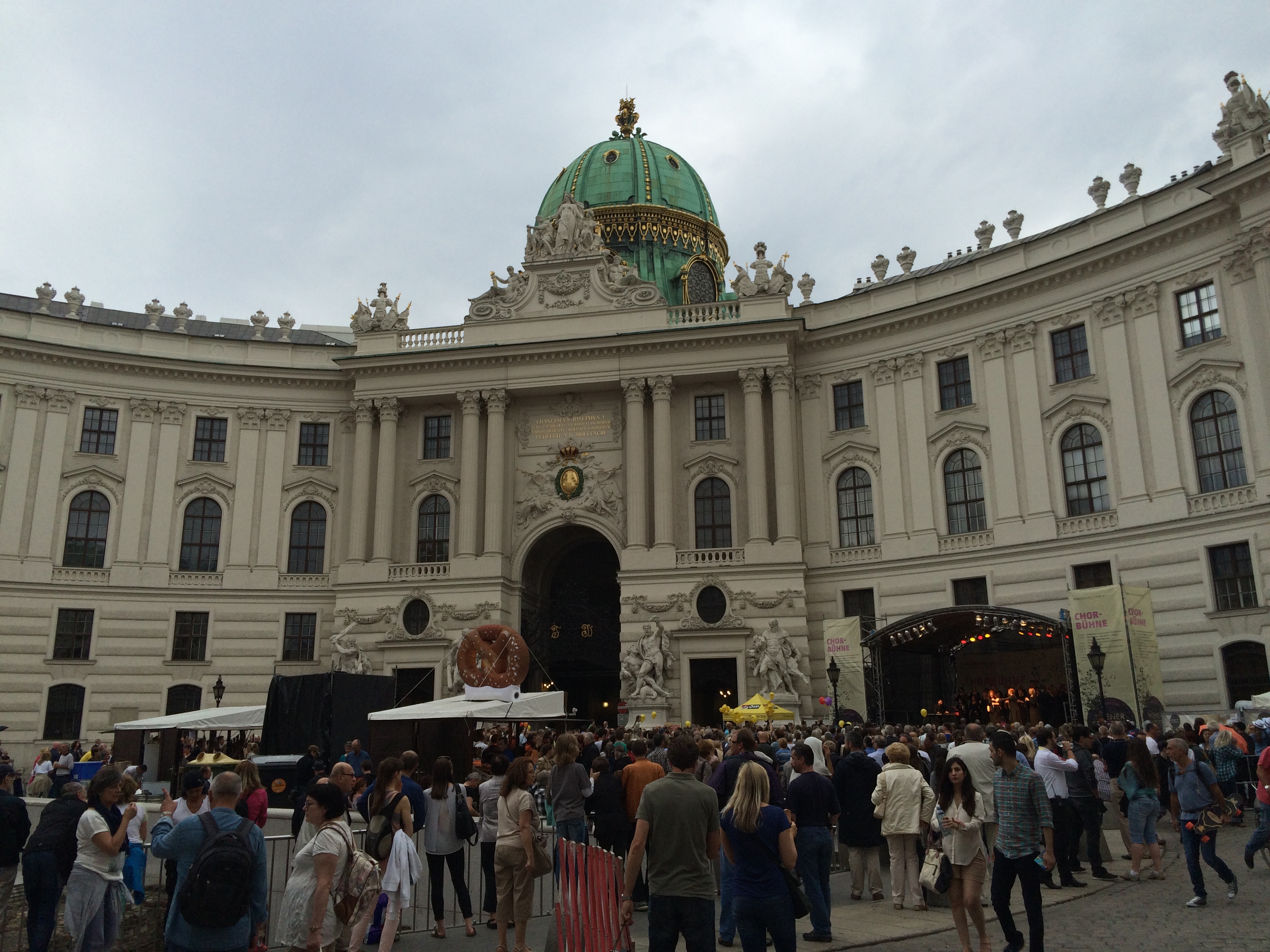
Just two blocks down the street was the Hofburg Palace where the Habsurgs lived in Vienna.  An outdoor music festival was going on that day, and there were crowds gathered to listen to the music—young choral groups performing primarily American music.  A bit incongruous—standing in front of an Austrian royal palace, listening to a group singing, “When the Saints Go Marching In.”  Our global world at work.

Hofburg Palace

Hofburg Palace

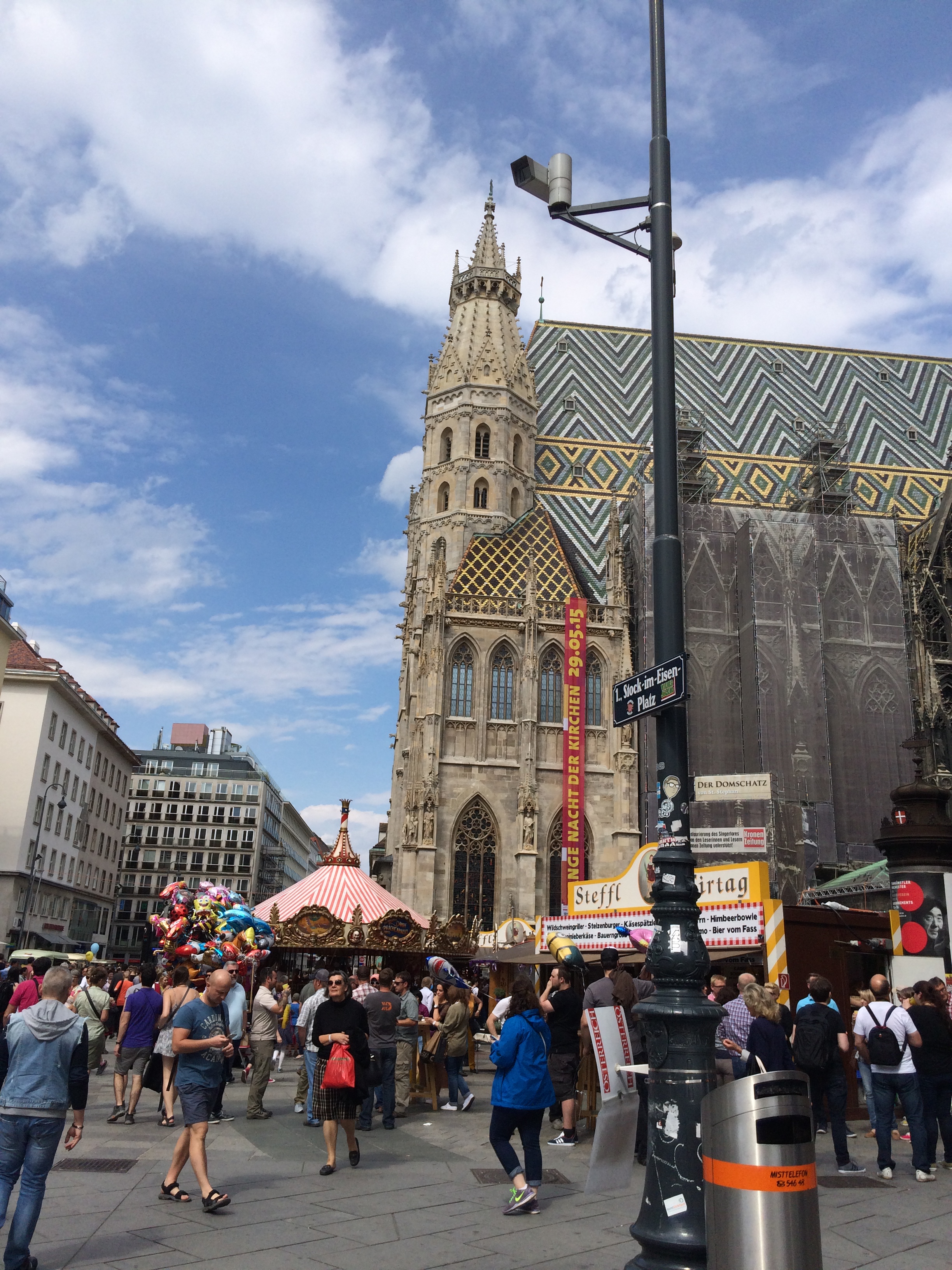
We wandered through the streets, passing many chic stores on Kohlmarket, and reached Graben, where there is a huge square lined with cafes and more fancy shops.  We stopped to see St. Stephen’s Cathedral and the all glass Haus Haus across the street.  Unlike the Hilton in Buda, this modern structure somehow blended in with the older buildings surrounding it.

IMG_2895 IMG_2896 IMG_2897 IMG_2898

We just had to stop and have some Viennese pastry, right?  It’s mandatory, I think. If one must drink beer in Prague, one must eat pastry in Vienna.  It was very much worth the unnecessary calories.  Vienna’s streets were packed with tourists, and there was lots of good people-watching to do from the café.

But we had miles to go in order to see at least some of the city, so off we marched towards the Opera House.  Like the Opera House in Budapest, it was a stately and beautiful building.  We opted not to do the tour inside this time, preferring to use our time to visit one of the art museums.

IMG_2907

It was already late in the afternoon, and we realized that we only had an hour until closing time, so we opted for the smaller Leopold Museum rather than the tremendous Kunsthistorische museum.  We were very glad that we did.  The museum focuses on the works of Gustav Klimt and Oskar Kokoschka as well as that of some of their less well-known contemporaries, and it does a masterful job of teaching about their art, their lives, and the politics and psychology that lie behind their art.  The room dedicated to the influence of Sigmund Freud was particularly well-done; a plaque with a quote from Freud hung near each painting, leaving it to the viewer to see the connection between the words and the art.

IMG_2909

We stayed until the museum closed and then wandered back to our hotel, not even realizing how close it was.  (We had basically walked a full circle from one side of the center of the city to the other and back without realizing it and were essentially behind the Hofburg Palace when we exited the museum quarter.)  We were amazed by how much we had seen in the few short hours since we’d arrived in Vienna.

The next day was jam-packed on my itinerary, but I quickly realized that there was no way we would get to the Schonbrunn Palace, even though I had pre-purchased tickets to go there.  It’s about 20 minutes outside of the city center, and since we were seeing the Hofburg Palace that morning, we decided that if you’ve seen one palace, you’ve seen them all. (Where is Spiro Agnew when you need him?)  Eliminating the Schonbrunn from the agenda loosened up our day considerably.

The Hofburg Palace was worth seeing; it tells the story of Emperor Franz Joseph and his wife Empress Elizabeth, commonly known as Sisi.  In particular, it tells the story of Sisi, who grew up as a young and independent child and married the emperor somewhat reluctantly, knowing that she would lose her freedom by doing so.  Eventually she became very unhappy living such a restricted life, and after one of her children died, she became severely depressed.  Although she contemplated suicide, in the end she was assassinated in Geneva by an Italian anarchist.  Her life story is well-told in the first several rooms in the palace.  After that, you then can see many of the lavish rooms where the emperor and empress lived and entertained in the palace.

After the palace tour, we went to see the performance of the Lipizzaner stallions at the Spanish Riding School.  This was another event that, like the baths in Budapest, several people said we could not miss.  We had standing room tickets, and the place was packed.  Within five minutes of the show starting, I almost left.  The first “act” involved some newer horses, and it was clear that at least one of them was not at all happy performing.  I couldn’t watch as the horse bucked and resisted his trainer’s attempts to control him.  We did stay for the next hour, and although the rest of the show involved more experienced horses, I just couldn’t shake the idea that these animals were being forced to do something they were not intended to do.  The horses are gorgeous, and if you love horses, you will either love this event or you will hate it.  I still am not sure how I feel about it. (We were not allowed to take photos, so I’ve inserted one from the internet.)


Embed from Getty Images

After lunch, I went to see the jewels at the Imperial Treasury while Harvey went to finalize our boarding passes for our flight the next morning.  The jewels were amazing.  I will let the pictures reveal what I saw.

IMG_2917

This opal was the size of a large pear. My Aunt Elaine would have loved it.

IMG_2920 IMG_2922 IMG_2927

The last thing we wanted to do before leaving Vienna was see some evidence of the Jewish world that once existed there.  Vienna had a large and thriving Jewish population before the Holocaust, including many famous artists, writers, musicians, and, of course, Freud.  Yet unlike Prague or Krakow or Budapest, there is almost nothing left in what was once the oldest Jewish section of the city to let you know that there once was a vibrant Jewish community there.  In that place, called Judenplatz, there are two reminders of the Jewish community: a museum which contains the remains of a medieval synagogue and a Holocaust memorial sculpture.  The museum’s exhibit is fascinating.  You can actually walk through the remains and see where the bima was, where the ark was, where the men sat to pray.

As for the Holocaust sculpture, it stands in the center of the square, and it is a large cube placed in the center of a larger platform.  On the sides of the cube are engraved the names of all the concentration and death camps.  I think it is supposed to evoke the sense of being locked inside, given the locked door on the exterior.  What was very disturbing about the memorial was the fact that there were many people sitting on the platform, idly eating ice cream and chatting, seemingly oblivious to the purpose of the sculpture.


The memorial to the 65,000 murdered Austrian J...

The memorial to the 65,000 murdered Austrian Jews in the Holocaust at Judenplatz in Vienna. (Photo credit: Wikipedia)

That perhaps is itself a metaphor for the Austrian attitude towards the Holocaust for many years after the war: denial.  As we learned at the main building of Jewish museum, it was not until fifty years after the war that Austrian officials apologized for their country’s role in the Holocaust.  They refused to acknowledge their complicity with the Nazis in the persecution and eventual murders of their Jewish citizens.  What had been a large and wealthy and intellectual community had been almost entirely wiped out.  Today there is some revival of Jewish life in Vienna, mostly made up of immigrants from the former Soviet Union.

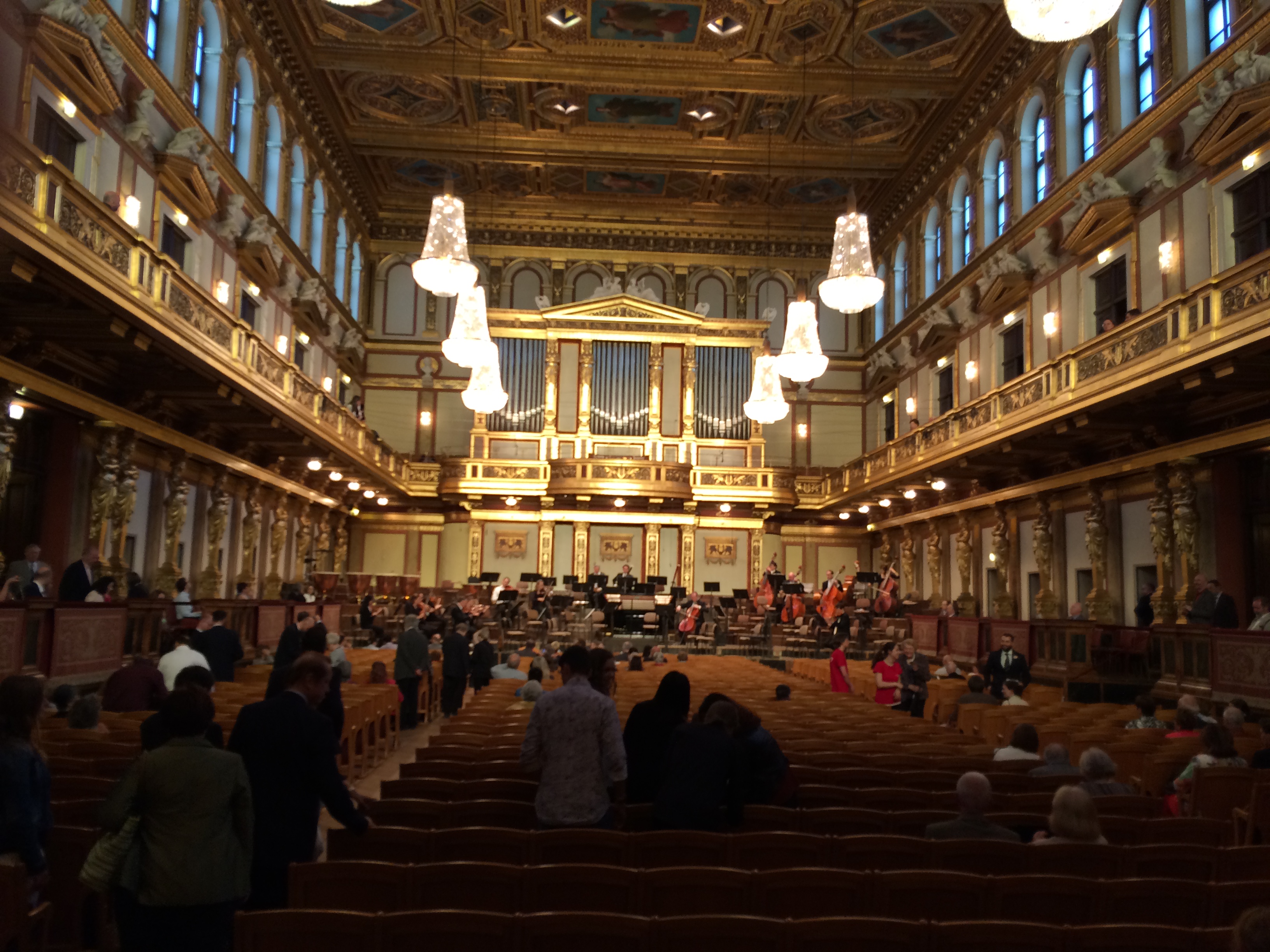
We ended our trip going to the Musikverein, a great music hall in Vienna, where we heard Haydn, Poulenc, and Sibelius.  The sounds were as clear as could be, and the music was just wonderful.

IMG_2935

Musikverein Concert Hall

Although we saw so much of great beauty in Vienna—the buildings, the pastries, the jewels, the art, and the music, our visit to Judenplatz and to the Jewish museums put an overall damper on my feelings for Vienna.  Perhaps I am not being fair; we were there for such a short time, and perhaps a longer visit would have provided me with more perspective.  We had no guides in Vienna, just our handy Rick Steve’s guidebook and TripAdviser. I understand that there are a number of stolpersteins in the Second District where the Jewish community was located right before World War II.  We did not get there nor did we see where the current synagogues are located or talk to anyone familiar with the city and its history as we had in the other cities.  I am sure there is more than what we saw in such a short time—an important lesson to keep in mind in visiting any place.  You can’t see it all in a short visit as a tourist.

****

Thus ends my travelogue of our trip to Central Europe.  Some concluding thoughts:

  1. The best way to learn about the history, values, and people of another country is to go there and walk where they walk. If you do, be sure to find a way to talk to someone who lives in that place.  Guidebooks are great, group tours may be fine—but nothing beats developing a personal relationship with someone who knows that city like you know your home town and your history. Talk to them about their families, their personal history, and you will learn so much more than you ever could from a book or recorded tour.
  2. Take notes, take pictures. Memories vanish very quickly.  In writing this, I had to go back to my books, notes, photographs, and, yes, the internet, to be sure I had the right name for the right place and the right numbers and dates.
  3. Travel the way you want to travel.  I know many people prefer to travel on organized tours or at least with a group of friends.  Call us anti-social, but we have learned that traveling with others means compromising our own priorities.  We don’t get to travel as often as we’d like, and when we do, we want to go where we want to go, eat when and where we want to eat, and see and hear what we want to see and hear.  It’s really not that hard to research and plan your own trip.  Just my opinion, of course.  I fully understand that for other people, traveling with others is more comfortable and more fun.  Like I said, travel the way you want to travel.
  4. There is both incredible beauty in the world and incredible evil. Human beings have created incredibly awe-inspiring buildings, music, and art.  Each place we visited was a testament to man’s ability to create beauty.  Sadly, each place was also a testament to man’s ability to do incredible evil.  We tried always to let the beauty remind us that for the most part, human beings are good.
  5. If you know where your ancestors lived, go there, even if it’s a small town in the middle of nowhere where no traces are left of your ancestors or their community. I understand that some people have too many feelings of anger about the past to do this, but if you don’t feel that way and can go, go there.  You will be forever changed.

Thank you to all who have followed me through this telling of our trip.  I will now return to a focus on genealogy, but I felt a real need to write about this trip for so many reasons, not the least of which is to keep a record for me about what I saw and what I felt.  It is not an experience I ever want to forget.


Walking in the Shadows of My Brotman Great-Grandparents

My third day in Poland was undoubtedly the highlight of the trip for me.  Visiting the town where my great-grandparents lived was the initial motivation for going to Central Europe in the first place.  The stops in Prague, Budapest, and Vienna were the icing on the cake, but the cake was Poland and, more specifically, Tarnobrzeg.  (I finally learned how to pronounce it, thanks to our guide Tomasz: TarNOBjeg.)  I had high and emotional expectations; they were exceeded by the reality.

First, some background.  When I first started doing genealogy research, I had no idea where my maternal grandmother’s family had lived in Europe other than they were Galitzianers—from Galicia.  My mother had no idea what town in Galicia had been their home, and for a long time the only location given on the records I could find was Austria, which made sense since Galicia was part of the Austria-Hungary Empire when the Brotmans lived there.

Then a few pieces came together—first, I obtained my great-uncle Hyman Brotman’s naturalization application giving his home town as Jeekief, which is a decent phonetic spelling of Dzikow, once a separate village but later incorporated into Tarnobrzeg, a much larger town.  Then I found a ship manifest for Yossel Brod, most likely my great-grandfather, from Tarnobchiek, another phonetic spelling, this time of Tarnobrzeg.  The ship manifests for my great-uncles Abraham and David Brotman gave their home town at Grebow, a small village less than ten miles from Tarnobrzeg.  It seemed clear to me that Tarnobrzeg was the area where my Brotman ancestors had lived in Galicia.  And I had to go there.

SelectedU.S.NaturalizationRecords-OriginalDocuments1790-1974ForHermanBrotman

Hyman Brotman’s Naturalization Application (Click twice to zoom in.)


David and Abe Brodmann on the Portia 1889

David and Abe Brodmann on the Portia 1889


Joseph Brotman ship manifest

Joseph Brotman ship manifest

I had originally hoped that there might be some records left in Tarnobrzeg that had not yet been digitized and put on line by JewishGen, Gesher Galicia, or JRI Poland, but our guide Tomasz warned me that he believed that whatever records still existed had in fact been found already and that we would not find any more in the town.  I adjusted my expectations accordingly, and I decided to enjoy the trip for the experience of being there rather than as a research opportunity.

Tomasz picked us up at our hotel at 9 am that morning, and we got to meet my recently found cousin Phyllis for the first time.  Phyllis and I had connected through DNA testing, which showed us as third cousins and showed her aunt Frieda and my mother as second cousins.  By comparing our family trees we had reached the conclusion that the likely connection was through my great-grandmother Bessie Brot Brotman and her grandmother Sabina Brot, whose father we believe was my great-grandmother’s brother.  Sabina’s home town in Galicia was Radomysl nad Sanem, another town about ten miles from Tarnobrzeg, which we would also visit that day.  The common surname and the proximity of residences seemed to support our hypothesis.  We quickly connected in person, chatting excitedly about our research, our travels, and our hopes for that day.

IMG_2705 cousins

As we drove from Krakow to Tarnobrzeg, Tomasz spoke about the history of Jews in Poland. By the 19th century Jews made up 10% of the population of Poland, and they lived all over the country—in the cities and in small towns and in villages.  The land we drove through was mostly rural even today, and Tomasz said that Jews were often invited by the kings or the aristocracy to live in the towns to support the local economy; Jews had the education and the skills to provide bookkeeping, trade, banking, and other economic necessities to the farmers who lived in these regions.  In Tarnobrzeg it was the Tarnowski family that owned the land and invited the Jews to come live there.


Castle of the Tarnowski family in Tarnobrzeg

Castle of the Tarnowski family in Tarnobrzeg


IMG_2697

When I asked him about the level of religious observance of the Jewish residents who lived in places like Tarnobrzeg, Tomasz said that there was a diverse range of religious observance—-from Hasidim to more traditional Orthodox to more liberal Jews and to secular Jews. Other sources point out that Tarnobrzeg was an important Hasidic center with well-regarded Hasidic leaders and rabbis.

Tomasz also spoke about the fact that Tarnobrzeg was one of the leading Jewish population and industrial centers in Galicia outside of Krakow.  The main industry aside from agriculture was the production of sulfur, a product that it still important to the local economy of the region.  Tarnobrzeg is located where two rivers meet—the Vistula (which also runs through Krakow) and the San, and thus was an important trade location.  It also is very close to what was once the border with the Russian Empire, and when Russia obtained that land, families were often separated, some living in Austria-Hungary, some in the Russian Empire.  In the 19th century when my great-grandparents lived there, the population of Tarnobrzeg was more than 75% Jewish.  There were about 2800 Jews living there in the 1880s when my great-grandparents decided to leave.

I asked Tomasz why people like my great-grandparents would ever have left a place like Tarnobrzeg, where Jews were doing well and treated well and were more than a majority of the town’s residents.  He said that in the late 19th century, there was both an economic crisis in Poland and a significant increase in the population. (There was also a great deal of anti-Semitism in Poland, as other sources describe.)  Jews and non-Jews left for greater economic opportunities.  When I pondered how a family would be able to tear themselves away from their home, both emotionally and financially, Tomasz explained that there were emigration agents facilitating these departures.  They would circulate brochures touting the advantages of going to America, and the fact that many others were leaving made it easier for a family like mine to make a similar choice.  I asked how they would actually leave, and Tomasz said there was a train that came to Tarnobrzeg that would take them to one of the port cities, like Gdansk or Hamburg, where they would catch a ship for America.  It would be costly, but the potential benefits made it all seem worth the risk.

Finally we arrived in Tarnobrzeg itself.  It was not exactly what I expected, as it is a large town, not a little shtetl, and it is a thriving town—lots of people, lots of stores, lots of cars.  Not a quiet little romantic village out of Fiddler on the Roof at all.  There was even a Lego store right on the main square.


Lego store on main square in Tarnobrzeg

Lego store on main square in Tarnobrzeg

But once we got out of the car and started to walk around, I felt some almost eerie connection—that this was a place where my great-grandparents had walked, had shopped, had worked.  Many of the buildings that surround the square were there back in the 1870s and 1880s when my great-grandparents and their children lived there.  Maybe one of those buildings contained a shop where my great-grandfather worked (on that ship manifest his occupation was given as “kaufmann” or merchant).  Maybe my family lived in one of them.


Main square in Tarnobrzeg

Main square in Tarnobrzeg


IMG_2657 old buildings on square in Tarnobrzeg


I stood in that square, imagining it 150 years ago as a place filled with families like my own, Jewish families of all sorts, living in a safe and comfortable way in a safe and comfortable place. I could imagine my great-uncle Chaim who became Hyman and then Herman and my great-aunt Tema who became Tillie, just small children, holding their mother’s hands as they walked through that square.   I could block out the Lego store and the ugly modern supermarket and see just the old buildings as they might have looked in the 1880s.


IMG_2663 Tomasz our guide in Tarnobrzeg

Our guide Tomasz Cebulski leading the way in Tarnobrzeg


IMG_2658 square in Tarnobrzeg IMG_2662 street in Tarnobrzeg IMG_2664 my ancestral town

Tomasz took us to the building which was once the synagogue. According to the official Tarnobrzeg website, it was heavily damaged by the Nazis and used to store grain.  It was renovated in the 1970s into a public library, and there is almost no sign today that it was ever a synagogue building.  The windows were changed, and inside where there was once a prayer hall and aron kodesh are now stacks filled with books.  When we asked in the library whether they had any photographs or books or records about the synagogue or the former Jewish community, all they could find was one copy of a brochure that had only been created a few years ago.

IMG_2659 where the prayer hall stood, now a library

Space where the prayer hall once was in the Tarnobrzeg synagogue

IMG_2661 former synagogue building

Exterior of building where the synagogue entrance had been


Tarnobrzeg Synagogue

Tarnobrzeg Synagogue (Photo credit: Wikipedia)

Here are some photographs of the building when it was a synagogue:

The only visible sign that the building was built as a synagogue is a small plaque on the exterior of the building in a location that almost no one could ever see or read if they were not looking for it.  We had to walk around the building through the lawn to get this photograph. The only small comfort was that the building was being used for books and education, not for commerce or worse.

IMG_2660 marker on library marking it as location of synagogue

Memorial plaque on the former synagogue building


Tomasz also pointed out that the first Jewish cemetery was located just a block away, but was now a parking lot for the shopping area that now exists there.  According to this video prepared in 2008, the Nazis destroyed the synagogue and used the headstones to pave a road. (I suggest downloading the hi-def version and watching it; it will give you a better sense of the town and its history.)

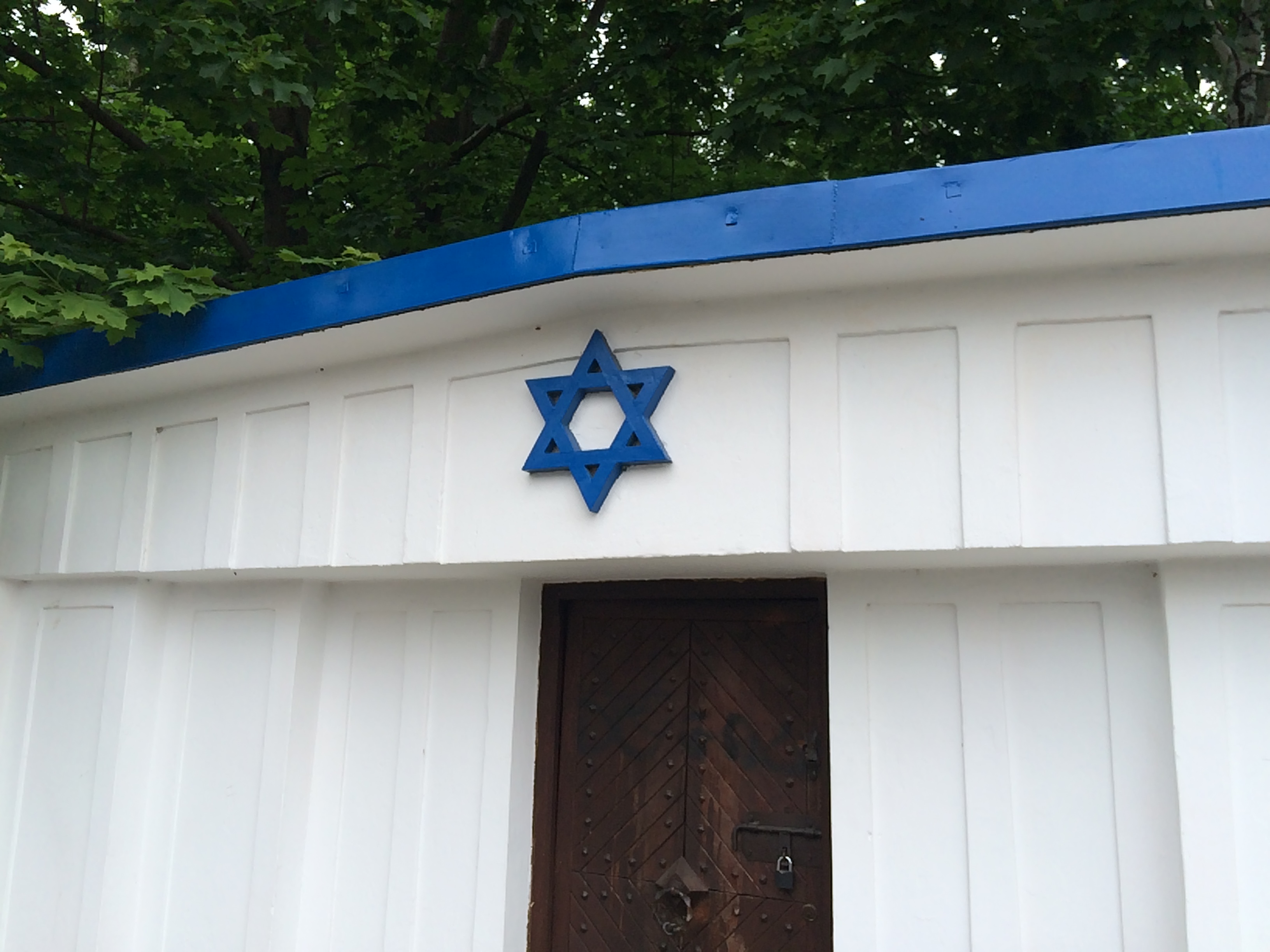
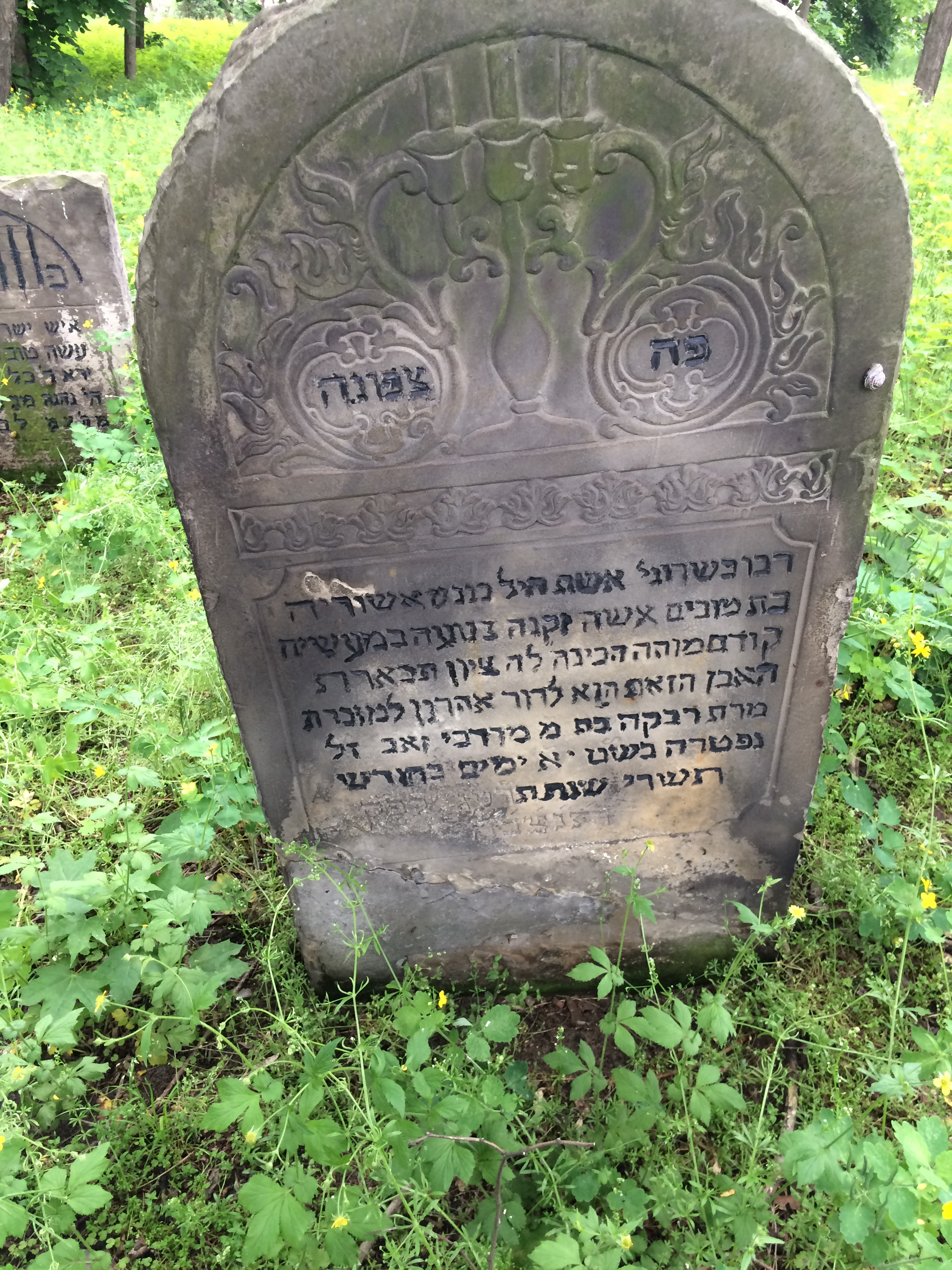
We then drove to the other Jewish cemetery in Tarnobrzeg, which was opened in the 20th century and  where there is still an ohel with a Star of David.  Sadly, the cemetery is not maintained at all, and there are just a handful of headstones still standing, most covered with weeds and snails.  I took photographs of as many as I could and now hope to get these translated.

IMG_2665 ohel for cemetery Tarnobrzeg IMG_2666 cemetery in Tarnobrzeg cemetery IMG_2668 IMG_2669 IMG_2670 IMG_2671 IMG_2672 IMG_2673 birdhouse in the cemetery IMG_2674 cemetery

After visiting the cemetery, we went to a small museum Tomasz knew about, where we met with an incredibly helpful woman who did not speak any English, but when Tomasz explained why I was there, she was very excited and anxious to help.  She provided us with some books with drawings and  photographs of Tarnobrzeg before World War II.

IMG_2677 images from books at the museum in Dzykow IMG_2678 IMG_2679 IMG_2685

The woman at the museum also explained where Dzikow had been located before it merged into Tarnobrzeg, so we drove there and saw some very old homes, built almost like log cabins.  I was enchanted and wondered whether one of these buildings had once been my great-grandparents’ home.

IMG_2690 IMG_2692 IMG_2693

As we left Tarnobrzeg, Tomasz told us what had happened to the Jews there during the Holocaust. Many were shot and killed just outside of town and buried there.  Many others were taken to the San River and shot, their bodies falling into the water.  The rest were eventually transported to a concentration camp or a death camp.  If any survived, they have not returned to Tarnobrzeg.  There are no known Jews living there today.  What would my great-grandparents, both of whom died before the Holocaust, have thought if they returned to their hometown today? It would no longer be the place they knew in almost any way, except for the old buildings that survive.

Nazis rounding up the Jews of Tarnobrzeg 1939

Nazis rounding up the Jews of Tarnobrzeg near the San River 1939


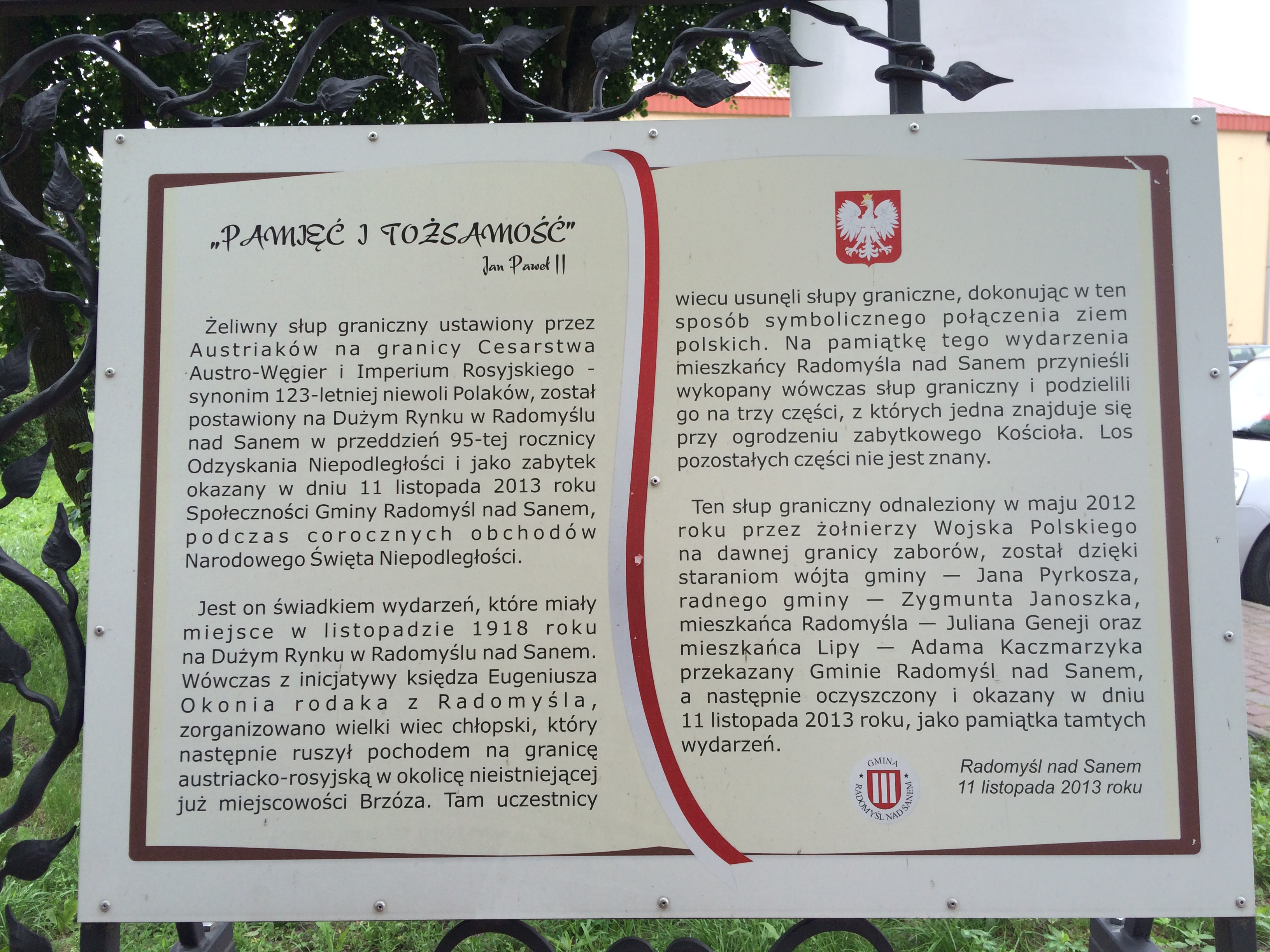
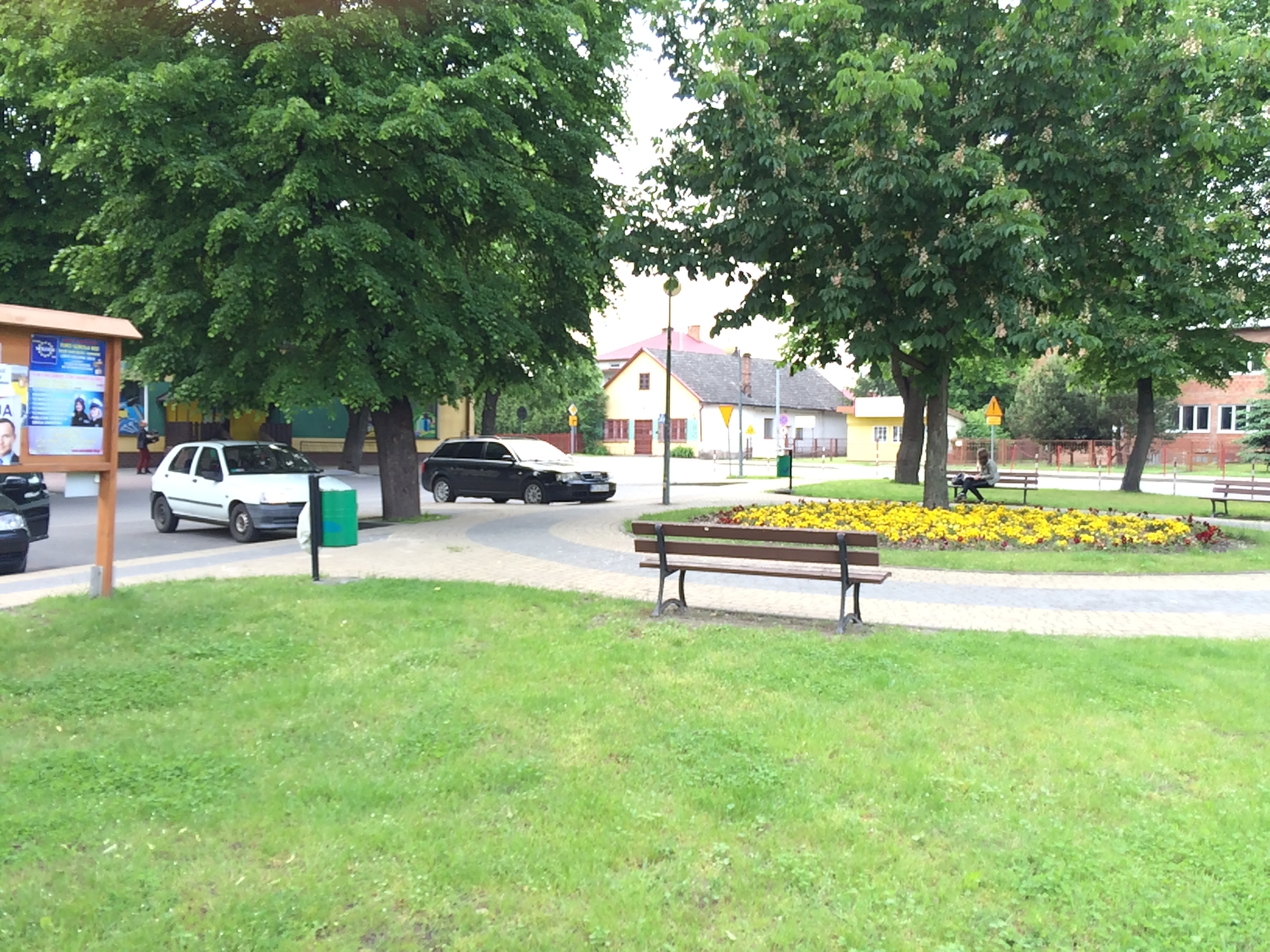
I could have stayed and wandered around Tarnobrzeg for hours, but we had two more stops to make: Radomysl nad Sanem and Grebow.  We headed first to Radomysl nad Sanem, where Phyllis’ grandmother had lived. It is on the other side of the San River and is a very small little town with a small town square and municipal building and perhaps fifty homes, if that many.  Its Jewish population before World War II was less than 400 people, and the village was mostly Jewish.  We drove from one end of the town to the other, and it took only a few minutes.  Even more so than in Tarnobrzeg, there is no sign that there were ever Jews there.  Phyllis was able to obtain some brochures about the town from the library there, but nothing that discussed the former Jewish community.

IMG_2698 Radomysl nad Sanem where Sabina Brot lived IMG_2699 IMG_2700 IMG_2701 IMG_2703


Our last stop was a quick one in Grebow, a town even smaller than Radomysl nad Sanem where there was not even a library we could visit.  I don’t know whether this was where Abraham and David Brotman were born or simply where they were living at the time they emigrated.  Perhaps they had moved here for greater opportunities than they could find in Tarnobrzeg.  I don’t know.  It’s such a tiny village that all I can do is imagine them living there and then wonder what they must have thought when they landed in a place as large and crowded and dirty as late 19th century New York City’s Lower East Side.

IMG_2706 tiny town of Grebow IMG_2707 Grebow IMG_2709 public building Grebow IMG_2710


We then headed back to Krakow.  I was exhausted and emotionally drained and filled with thoughts and feelings.  We were taking another night train that night, this time to Budapest.  As we ate a quick dinner at our hotel, I found myself overwhelmed with emotion in a way that surprised me.  My eyes filled with tears—tears for the people who had been killed, tears for my great-grandparents who had left this country for better things, tears of gratitude that they had done that, and tears of sadness that I was leaving a place that part of me truly felt was my homeland.


Too Many Missing Pieces: Part II

In my last post, I wrote about the list of English James Seligmann’s heirs that my cousin Wolfgang found in his family’s papers.  There were 21 principals named as heirs on that document, and I had discussed all the easily identified ones and some of those that were more difficult to figure out.  I had discussed Numbers 1, 2, 6-13, 15, 16, 19-21.  That left Numbers 3-5,  14, 17, and 18.  Here again is the list of heirs:

heirs list p 1

Heirs List p 2

So let’s start with Number 3, Johanna Bielefeld, the one whom Elsa Oppenheimer had claimed was not a daughter of Hieronymus Seligmann in her July, 1984 letter.

Elsa Oppenheimer 1984 letter-page-001

Elsa Oppenheimer 1984 letter-page-002

Perhaps Elsa was wrong; after all, she was wrong about Adolph Seligman not being the child of Moritz and Babetta, as discussed last time.  Or maybe Johanna was the daughter of Benjamin Seligmann.  I am not sure yet, but I do know that she was born in Gau-Algesheim.  Wolfgang found this registration card for her, dated January 12, 1939, issued by the police in Mainz.  It gives her birth name as Seligmann, her birth date as March 15, 1881, and her birthplace as Gau-Algesheim.  I have written to my contact in Gau-Algesheim, asking him to see if he can find a birth record for Johanna so I can determine who her parents were.  Notice also the large J on her card, indicating that she was Jewish.

Here is the companion card for her husband Alfred Bielefeld:

The list of heirs provided the names of Johanna and Alfred’s children, Hans and Lili (or Lily).  It indicated that Johanna had died as had Hans, he in 1948.  Then it provided a married name for Lili, Mrs. Fred Hecht, and an address on West 97th Street in New York City.  Searching for Hans Bielefeld brought me to someone with that name on the 1940 census, living in Cleveland, Ohio. He was working as an insurance agent, was 37 years old, and had been residing in Mainz, Germany, in 1935.

Year: 1940; Census Place: Cleveland, Cuyahoga, Ohio; Roll: T627_3221; Page: 5A; Enumeration District: 92-451

Year: 1940; Census Place: Cleveland, Cuyahoga, Ohio; Roll: T627_3221; Page: 5A; Enumeration District: 92-451

Further searching found an index listing in the Ohio Deaths database on Ancestry for Hans Bielefeld, indicating he had died on September 13, 1948, the same year of death given on the list of heirs document.  On Fold3.com, I then found naturalization papers for Hans Ludwig Bielefeld, indicating that he was divorced, that he was born on July 1, 1902 in Maine (sic), Germany, and that he had arrived in the US on the SS Gerolstein on July 14, 1938.

Publication Number: M1995 Publication Title: Naturalization Petition and Record Books for the US District Court for the Northern District of Ohio, Eastern Division, Cleveland, 1907-1946 Content Source: NARA National Archives Catalog ID: 1127790 National Archives Catalog Title: Naturalization Petitions, compiled 1867 - 1967 Record Group: 21 Partner: NARA State: Ohio Court: Northern District, Eastern Division Catalog Keywords: Petitions Naturalization Immigration Citizenship Fold3 Publication Year: 2008

Publication Number: M1995
Publication Title: Naturalization Petition and Record Books for the US District Court for the Northern District of Ohio, Eastern Division, Cleveland, 1907-1946
Content Source: NARA
National Archives Catalog ID: 1127790
National Archives Catalog Title: Naturalization Petitions, compiled 1867 – 1967
Record Group: 21
Partner: NARA
State: Ohio
Court: Northern District, Eastern Division
Catalog Keywords: Petitions Naturalization Immigration Citizenship
Fold3 Publication Year: 2008


That led me to a passenger manifest for the SS Gerolstein, where I found Hans listed as a divorced merchant from Mainz.  It seemed like this could be the son of Johanna Seligmann Bielefeld, but I couldn’t be sure.

So I searched for his sister Lili.  I first searched for her as Lili Hecht, but had no luck, so I searched for Lili Bielefeld and found her first on an English ship manifest dated September 18, 1940, from Liverpool bound for Montreal, Quebec.  Lili was listed as 36, having last resided in London, but born in Germany.  Her occupation was given as a domestic.  The age, birthplace and name seemed correct, so I considered it likely that this was the right person.

Ancestry.com. UK, Outward Passenger Lists, 1890-1960 [database on-line]. Provo, UT, USA: Ancestry.com Operations, Inc., 2012.

Ancestry.com. UK, Outward Passenger Lists, 1890-1960 [database on-line]. Provo, UT, USA: Ancestry.com Operations, Inc., 2012.

Then I found her listed with the same information on a US manifest for passengers entering the United States from Canada.  But since Lili did not arrive until September, 1940, she is not listed on the 1940 census, making it extremely difficult to find her in the online databases on Ancestry.  There were a number of Fred Hechts, but how would I know if any of them were married to Lili?

So I turned to Google and entered “Lili Bielenfeld Fred Hecht,” and once again I hit the jackpot.  Like Fred and Ilse Michel, Fred Hecht and Lili Bielenfeld have papers in the collection at the Leo Baeck Institute entitled “Hecht and Gottschalk Family Collection; AR 5605.”  In the biographical note included with this collection, I learned that Fred Hecht came from a German Jewish family with a long history.  I will quote here only the sections relevant to Fred, Lili and Hans:

Jakob and Therese Hecht had a son, Siegfried Max Hecht (alternatively Fritz, later Fred, 1892-1970). Siegfried Hecht became a merchant and served in the German military during World War I. Siegfried and his wife Emma née Cahn divorced in 1939, and he immigrated to the United States in 1940, where he took on the name Fred. He settled in New York City and became a jewelry salesman. In December of 1944, he and Lili née Bielefeld (1904-1977) were married.

The Bielefeld family can be traced back to the late 18th century. The family lived in Karlsruhe, Mainz, and Mannheim until the 1930s, when some members immigrated to the United States. Lili Hecht née Bielefeld was the daughter of Alfred Bielefeld, a wine merchant, and Johanna Bielefeld née Seligmann. Despite efforts to procure passage to the U.S., both Alfred and Johanna perished in the Holocaust. Alfred died in Theresienstadt, and Johanna was deported from Theresienstadt to Auschwitz, where she perished.

Lili Hecht née Bielefeld’s brother Hans Ludwig Bielefeld (1902-1948) was a merchant. He married Lilli née Kiritz in 1933, and the couple divorced in 1936. Hans Ludwig immigrated to the United States under the sponsorship of his cousin, Irma Rosenfeld, and settled in Cleveland, Ohio, where he worked in insurance. After his death, his sister Lili Hecht née Bielefeld was the sole heir to the Bielefeld family property, which she claimed in the 1960s alongside restitution for her parents’ deaths.

Thus, from these papers and this biographical note, I was able to find out a great deal about what had happened to Johanna Seligmann Bielefeld, her husband, and her two children, Hans and Lili.  I will write more about them in a separate post once I have a chance to examine the LBI collection more carefully and obtain translations where necessary.

Number 4 on the list, Bettina Arnfeld, was more difficult to locate, but I found a Bettina Elizabeth Arnfeld listed on FindAGrave  with the notation, “Body Lost or Destroyed.” Her birthdate was given as March 17, 1875.  This may have been the “Elizabeth” whom Elsa claimed was not a child of Hieronymus Seligmann.  I then looked for and found Bettina Elizabeth Arnfeld in the Yad Vashem Database.  The entries there confirmed that her birth name was Seligmann, that she was born on March 17, 1875, and that she had resided in Muelheim Ruhr in Germany at the time she was deported.  She was exterminated at Thieresenstadt on January 23, 1943.

The list of heirs indicated that Bettina had a son, Heinz Arnfeld, living on 22 Gloucester Square in London, and he was not difficult to locate.  I found several entries for Heinz and Liselotte Arnfeld at that address in London, England, Electoral Registers on Ancestry.  I also found Heinz and Liselotte listed in the England & Wales Marriage Index on Ancestry.  They were married in Doncaster, Yorkshire West Riding in 1945. Heinz is also listed as a survivor of the Holocaust in the Shārit ha-plātah database on JewishGen.

Heinz died in 1961 and left his estate to Liselotte; she died in 1988. I do not know whether they had any children.  Since they were married in 1945 when Liselotte was 37, it does not seem likely.

That brings me to Numbers 17 and 18 on the list, putting Numbers 5 and 14 aside for now.  Who were Eva Hansu and Rosa Reisz?  If these were nieces of English James Seligmann, then they had married and changed their surnames, so how could I find them?  Since they were listed right after Emil and Eugen, sons of Carolina Seligmann and Siegfried Seligmann, I went back to the list of Carolina’s children and realized that she had daughters named Eva and Rosa.  Thus, I assumed that Eva became Eva Hansu and Rosa became Rosa Reisz.

I had good luck searching for Rosa Seligmann Reisz.  I knew her daughter’s name was Hedwig Neter from the list of heirs, and that seemed unusual enough that I decided to search for it first.  Sure enough the name came up on a passenger’s manifest dated August 31, 1940, for the ship Cameronia departing from Glasgow, Scotland, for New York.  Sailing with Hedwig was her husband Emil Neter and her mother Rosa Reis.  Emil was a 61 year old manufacturer, Hedwig a 48 year old housewife, and Rosa was 73 without occupation.  They all had last been residing in London and said the US was their intended permanent residence.

Ancestry.com. UK, Outward Passenger Lists, 1890-1960 [database on-line]. Provo, UT, USA: Ancestry.com Operations, Inc., 2012.

Ancestry.com. UK, Outward Passenger Lists, 1890-1960 [database on-line]. Provo, UT, USA: Ancestry.com Operations, Inc., 2012.

According to FindAGrave, Rosa Seligmann Reis died on January 29, 1958, and is buried at Hauptfriedhof in Mannheim, Germany.  Her son-in-law Emil Neter died on July 8, 1971, in Washington, DC, and is also buried at Hauptfriedhof in Mannheim, as is her daughter Hedwig Reis Neter, who died on May 28, 1979, in Washington.  I found it very interesting that after living in the United States all those years, Rosa, Emil, and Hedwig chose as their burial place the country they had escaped so many years before.  A little more searching turned up Hedwig’s birth certificate and a family record from 1891, both of which revealed that Rosa’s husband’s name was Ludwig Reis, son of Callman Reis, a merchant.

Ancestry.com. Mannheim, Germany, Births, 1870-1900 [database on-line]. Provo, UT, USA: Ancestry.com Operations, Inc., 2014. Original data: Personenstandsregister: Geburtsregister Standesamt Mannheim und Vororte 1876-1900, Stadtarchiv Mannheim, Mannheim. Deutschland.

Hedwig Reis Birth Certificiate Ancestry.com. Mannheim, Germany, Births, 1870-1900 [database on-line]. Provo, UT, USA: Ancestry.com Operations, Inc., 2014.
Original data: Personenstandsregister: Geburtsregister Standesamt Mannheim und Vororte 1876-1900, Stadtarchiv Mannheim, Mannheim. Deutschland.

Ancestry.com. Mannheim, Germany, Family Registers, 1760-1900 [database on-line]. Provo, UT, USA: Ancestry.com Operations, Inc., 2014. Original data: Polizeipräsidium Mannheim Familienbögen, 1800-1900. Digital images. Stadtarchiv Mannheim — Institut für Stadtgeschichte, Mannheim, Germany

Ancestry.com. Mannheim, Germany, Family Registers, 1760-1900 [database on-line]. Provo, UT, USA: Ancestry.com Operations, Inc., 2014.
Original data: Polizeipräsidium Mannheim Familienbögen, 1800-1900. Digital images. Stadtarchiv Mannheim — Institut für Stadtgeschichte, Mannheim, Germany

Searching at Hauptfriedhof on FindAGrave, I found that Ludwig had died in 1928 and had been buried at Hauptfriedhof.  It seems that Rosa and her daughter Hedwig wanted to be buried where Ludwig had been buried years before.  With the help of Matthias Steinke in the German Genealogy group on Facebook, I was able to locate the headstone for all four of them at the  Stadtarchiv Mannheim website.


At first I couldn’t find anything about Eva Hansu, Number 17.  I couldn’t find her husband’s first name, and although the heirs’ list gives her daughter’s married name as Alice Kauffman of France, I had not been able to find her either.  Then after Matthias introduced me to the Stadtarchiv Mannheim website where he had found the headstones for Rosa and her family, I decided to search for all people with the birth name Seligmann and found Eva as Eva Seligmann Hanau, not Eva Hansu as I had mistakenly read it on the list of heirs.  It provided the same birth date I’d already found for Eva, March 18, 1861, and it reported her date of death as March 18, 1939.  Her husband was Lion Hanau, born May 24, 1854, in Altforweiler, Germany, and he died February 7, 1921.  The archive also included photographs of their headstone.

As for their daughter, now that I had the correct spelling of her birth name Hanau, I was able to find her marriage certificate for her marriage to Ernst Kaufmann on August 10, 1911.

Marriage cert of Alice Hanau and Ernst Kaufmann

Marriage cert of Hanau Kaufmann p 2

Ancestry.com. Mannheim, Germany, Marriages, 1870-1920 [database on-line]. Provo, UT, USA: Ancestry.com Operations, Inc., 2014. Original data: Personenstandsregister: Heiratsregister Standesamt Mannheim und Vororte, Stadtarchiv Mannheim, Mannheim. Deutschland.

I do not know what happened to either Alice or Ernst during or after the war.

So that leaves me with only two names on the list of heirs for whom I as yet have no answers: Anna Wolf, Number 5, and Bettina Ochs, Number 14.  Anna Wolf is listed as a fraulein, so that is her birth name, not a married name.  It says that Johanna Bielfeld was her aunt, so presumably Anna’s mother was a sister of Johanna.  If, in fact, Johanna was a child of Hieronymus Seligmann, she had two sisters, Mathilde and  Auguste and perhaps Bettina.  I don’t have any information about them aside from what was listed in Elsa’s letter, posted above.  More work to be done.

And Number 14, Bettina Ochs, is even more of a puzzle.  I’d have assumed that Ochs was her married name, Seligmann her birth name.  But the note on the document mentions a brother as her next of kin, and his name was Arthur Erlanger.  That would suggest that Bettina Ochs was born Bettina Erlanger, not Seligmann.  So how is she related? Who was her husband? Which one is the blood relative of English James Seligmann?  I found one listing on JewishGen.org for Bettina Ochs-Erlanger with a secondary name as Bettina Oberdorfer.  She was born May 7, 1870, and her nationality was Italian, consistent with the Milan address provided on the heirs list.  She was listed in the Switzerland, Jewish Arrivals, 1938-1945 database; I can’t see the original document, but the index indicates that she arrived in Switzerland on August 5, 1944.

It’s amazing how much information I could mine from this one little document.  Unfortunately, although I should have gotten great satisfaction from finding so many people and so much information, I ended up feeling very sad and very drained as I added all these names of my cousins to the list of those killed in the Holocaust.  It is beginning to overwhelm me.  So much loss, so much evil.  Incomprehensible.

Two Who Got Away

Way back on November 22, 2014, I wrote very briefly about a cousin named Fred Michel.   He was mentioned in Ludwig Hellriegel’s book about the Jews of Gau-Algesheim as the son of Frances (Franziska) Seligmann and Max (Adolf?) Michel. Frances was the daughter of August Seligmann.  Since August Seligmann was my great-great-grandfather Bernard Seligman’s brother, his grandson Fred Michel would be my second cousin, twice removed.  According to Hellriegel’s book, Fred had escaped to the United States in 1937 after his mother died in 1933.  That was all I knew, and the name Fred Michel was common enough in the US that I had no way of narrowing it down to the right person based on the name alone.

Well, one email from my cousin Wolfgang opened up an entirely new door of research for me.  In his email, Wolfgang mentioned Fred Michel, the nephew of his grandfather Julius.  In that email, Wolfgang said that Fred had settled in Scranton, Pennsylvania.  From that one additional bit of information, I was able to find Fred and his wife Ilse on the 1940 census in Scranton living as boarders in the household of other German immigrants.  I also found them in several Scranton directories.

Year: 1940; Census Place: Scranton, Lackawanna, Pennsylvania; Roll: T627_3685; Page: 7A; Enumeration District: 71-106

Year: 1940; Census Place: Scranton, Lackawanna, Pennsylvania; Roll: T627_3685; Page: 7A; Enumeration District: 71-106

I also found Fred’s enlistment record in the US army in July 1943 on the Ancestry index.   That led me to his Veteran’s Burial Card, showing that he had served from July 1943 until September 1945 and that he had died on August 5, 1992, and was buried at Temple Hesed cemetery in Scranton.

Pennsylvania Historical and Museum Commission; Harrisburg, Pennsylvania; Pennsylvania Veterans Burial Cards, 1929-1990; Archive Collection Number: Series 2-4; Folder Number: 655

Pennsylvania Historical and Museum Commission; Harrisburg, Pennsylvania; Pennsylvania Veterans Burial Cards, 1929-1990; Archive Collection Number: Series 2-4; Folder Number: 655

Since I also had learned that his wife’s name was Ilse, I researched what I could about Ilse.  She was also born in Germany, and at least according to the 1940 census, she’d been living in Frankfort, Germany in 1935.  I found various public records indicating that Ilse and Fred were still living in Scranton as of 1989, and I also found Ilse on the Social Security Death Index, indicating that she had died on July 22, 2002.

But I wanted to know more, and so I googled their names, Fred and Ilse Michel, with Scranton, and I found a gold mine.  Fred and Ilse donated their papers to the Leo Baeck Institute, and the papers have been digitized and are available online.   This is the description provided for the Michel papers, known as the Ilse and Fritz Michel Family Collection, AR 25502, at the Leo Baeck Institute:

“This collection contains personal and official documents pertaining to the family’s immigration to the United States and their situation in Germany as the political climate deteriorated. Included are a large amount of personal letters, supplemented by various other documents from government and military offices, some genealogical and tracing certificates, as well as other various material.”

In addition, the Leo Baeck Institute provided this biographical note for Ilse and Fred Michel:

Fritz (Fred) Michel (1902-1992) was born in Bingen am Rhein, Germany, the son of Adolf Michel and Franziska Michel, née Seligmann. Fred Michel’s wife, Ilse Hess (1911-2003), was born in Leipzig, daughter of Hermann Hess and Helene Hess, née Hirschfeld (1866-1943). Hermann Hess died in 1922 in Frankfurt am Main. After having been denied immigration to the U.S., Ilse’s mother Helene was deported to Theresienstadt in 1942, where she died in 1943.

Fritz (Fred) Michel emigrated from Frankfurt am Main to the U.S. via Antwerp, Belgium, in 1937. In the U.S. he changed his name to Fred. Ilse emigrated a year after that, via Hamburg, in 1938. Upon immigration Fred and Ilse remained separated for about two years, working in various areas in the state of New York, before they eventually settled in Scranton, Pennsylvania, in 1939, where they were married in 1940. There, Ilse started up a millinery business, while Fred maintained a position as bartender. They became naturalized citizens in 1943. The same year Fritz joined the U.S. army and served until 1945. They remained in Scranton for the rest of their lives.

There is truly a treasure trove in the collection—letters, documents, passports, photographs.  Many of the letters are in German, and I am hoping to find some way to translate them.  I also want to obtain permission to post some of the documents included in the collection if I can.

For now I can highlight some of the facts I was able to learn from the documents that are in English. Before coming to the United States in 1937, Fred had worked for Bamberger and Hertz, a men’s clothing store with several locations in Germany; Fred had worked for them in Cologne, Frankfort, and Munich between 1931 and 1936. On the website for the Jewish Museum in Berlin,  I found an article and photograph about Bamberger and Hertz and the effect Nazism had on the business.  The photograph depicts Nazi storm troopers posting leaflets on the store windows, warning people not to patronize this Jewish-owned business.


The article reports:

After the April Boycott sales declined at all the stores. The Saarbrücken branch closed in 1934 and a buyer was found for the Frankfurt store in 1935. The branches in Cologne, Stuttgart and Leipzig were forcibly sold or dissolved in 1938. In October of the same year Siegfried Bamberger managed to sell the Munich business to his trusted long-time employee Johann Hirmer. Although the transaction aroused the Nazis’ suspicions, it was carried out within the bounds of the law.

It is thus not surprising that Fred Michel would have left his home and his long-time employer in 1937.

According to Fred’s application for naturalization as a US citizen, he arrived in the United States on September 24, 1937, aboard the SS Koenigstein, departing from Antwerp, Belgium, and traveling tourist class. He had been examined by US immigration officials in Stuttgart before departing.

Of great interest to me was that Fred listed his sponsor as James Seligman of 324 Hillside Drive in Santa Fe, New MexicoJames Seligman.  This must have been my great-grandmother Eva Seligman’s younger brother James.  How did Fred Michel know him? To me, this makes it evident that my great-grandmother’s family was very much in touch with their relatives still in Germany when Hitler came to power.  What were they thinking about Hitler and the Nazis? How did James get involved with helping Fred?  Perhaps one of those letters in German will reveal more.[1]

James Seligman in Swarthmore register 1920

After arriving in the United States, Fred first lived in New York City and worked at a business called Burrus and Burrus for a year.  He then worked at the Hebrew National Orphan House in Yonkers, New York.  After that, he worked for a furniture company in Canonsburg, Pennsylvania, for a year, and then finally settled in Scranton in June, 1939. He worked in a couple of dress shops and then as a bartender at various clubs up to the time of his citizenship application in 1942.

Washington Avenue, Scranton, Pennsylvania, Uni...

Washington Avenue, Scranton, Pennsylvania, United States. (Photo credit: Wikipedia)

Fred and Ilse were married by a rabbi on January 16, 1940, in Scranton.  As of September, 1942, when they applied for citizenship, Fred and Ilse did not have any children.  After studying at night school, Fred became a naturalized citizen in June, 1943, shortly before he enlisted in the Army, as described above.  According to Fred’s honorable discharge papers from the Army in 1945, he served in Panama during World War II and received a Good Conduct medal, an American Theater Medal, and a World War II Victory medal.  He was responsible for handling secret documents, correspondence, and publications during the war.

World War II Victory Medal.

World War II Victory Medal. (Photo credit: Wikipedia)

Ilse became a naturalized citizen in December, 1943.  She had arrived in New York in April, 1938, after being examined by US immigration in Stuttgart.  She had lived in Woodmere, Long Island, New York, and Mt. Vernon, New York, and New York City before settling in Scranton in December, 1939.  She had worked as a bank teller and for various millinery houses during that time.  Like Fred, she had attended night school to become a US citizen.

After the war, Fred and Ilse attempted to learn what had happened to their family members back home.  Since most of these documents are in German and need to be translated, I will report on their heart-breaking efforts once I can be sure I am reading the documents correctly.

I don’t know from the collection much about Fred and Ilse’s life after the war.  I did find a Letter to the Editor of Life Magazine in the July 20, 1962, issue; it reveals some of the obstacles Fred had to overcome as a young boy and also some of his own nostalgia for his native country, even after all the horrors of the Holocaust:

Wolfgang has a number of letters written by Fred to Walter Seligmann, Wolfgang’s uncle, and he is going to translate those for me.  Wolfgang also sent me a copy of a letter that Fred received from the National Westminster Bank in England in December, 1982, regarding the estate of the other James Seligman, brother of Bernard and August and the other children of Moritz Seligmann and Babetta Schoenfeld.  Like Pete’s family and Wolfgang’s family, Fred received notification of his rights to inherit some of James estate.

Bank to Fred 1

Bank to Fred 2 Bank to Fred 3

I don’t know whether or not Fred ever obtained his share of the estate.  He died ten years after receiving this letter. From Fred’s death certificate, I learned that he had been a quality control officer for a clothing manufacturer.  He and Ilse were members of Temple Hesed in Scranton, and both are buried in its cemetery.

I  have written to the Leo Baeck Institute and am hoping they can help me as well as give me permission to post some of the documents included in the collection.  From what I have read, I only know the surface of what is obviously a much deeper story, a story of two people who escaped and survived, tearing themselves away from their homeland and their family just in time.  What was it like for them to leave? What did they know of what was happening in Germany once they left? How did they adjust to living in the United States? How were they received?

There are so many questions, and I am hoping that the materials I cannot yet read in the collection will answer some of them.


[1] This is also the same James Seligman whose son was Morton Tinslar Seligman, the Navy Commander whose career I described extensively here, here, and here.

Passover 2015: The American Jewish Story

Handmade shmura matzo used at the Passover Sed...

Handmade shmura matzo used at the Passover Seder especially for the mitzvot of eating matzo and afikoman. (Photo credit: Wikipedia)

A year ago I was feeling disconnected from Passover until I heard my grandson tell us the story of Passover in a way that made it feel new and exciting and different all over again.  This year his little brother will experience his first seder, though at only ten months, that experience will likely be short and quite unfocused.  Just a lot of really noisy people sitting around a table eating food that he neither can nor would want to eat.  But it’s a new reminder that every generation and every child experiences Passover as a new experience, allowing all of us who are jaded and detached to be able to relive our own early experiences with this special holiday.

Last year I entered into Passover thinking about my mother’s ancestors, the Brotmans, the Goldschlagers, and the Rosenzweigs.  I focused on their exodus from the oppression and poverty and anti-Semitism of Galicia and Romania and their courage and the desire for freedom that led them to leave all they knew to cross the continent and then the ocean and come to New York City, where they again lived in poverty but with greater hopes for a life of freedom and economic opportunity.  And they attained their goals if not in that first generation, certainly by the third and fourth generations.

Poor Jews taking home free matzohs, New York

Poor Jews taking home free matzohs, New York (Photo credit: Wikipedia)

For the last year now, I have been researching, studying and writing about my father’s paternal relatives.  It has taken just about a full year to cover the Cohens, the Jacobs (with whom I actually need to do more work), the Seligmans, the Schoenfelds, the Nusbaums, and the Dreyfusses.  Soon I will start my father’s maternal relatives—the Schoenthals and Katzensteins and whatever other surnames pop up along the way.  Researching my father’s families has been so different from my mother’s, and I can go so much further back.  I can’t get back much before 1840 with my mother’s family and have absolutely no records before 1885 or so for any of them.  Although I have a number of Romanian records for my Rosenzweig and Goldschlager relatives, I have no records at all from Europe for my great-grandparents Joseph and Bessie Brotman, despite hours and hours of searching and even DNA testing.

In contrast, my father’s ancestors have provided me with a rich opportunity to learn about Jews in Amsterdam, London, and especially the towns of Gau-Algesheim, Erbes-Budesheim, Bingen, and Schopfloch, Germany.  I have been able to find records all the way back to 1800 or so for almost every line.  I’ve had amazing help along the way on both sides of the Atlantic, and I’ve even learned a little German to boot.  My father’s families were pawnbrokers and peddlers and clothing merchants; they were pioneers and politicians and war heroes.


http://www.gettyimages.com/detail/182866324
Harrisburg Market Square with Leo Nusbaum store

Harrisburg Market Square with Leo Nusbaum store

They came to the United States in the 1840s and 1850s, and most of them suffered terrible heartbreaks, economic struggles, and early deaths.  Most of them settled in Philadelphia and other parts of Pennsylvania and New Jersey, but there were those who went to places that I’d never think a Jewish immigrant would go: Iowa, Texas, Illinois, Michigan, California, and, of course, New Mexico.  Many married outside the Jewish community and assimilated into American culture far more so than my mother’s relatives.  Ultimately, the Cohens/Jacobs and Seligmans/Schoenfelds and Nusbaums/Dreyfusses were successful; they found the American dream, and they embraced it.

But there is a very sad underside to this story of American success.  It’s the story of those who did not leave Europe.  For the first time in my life I confronted the reality that the Holocaust did not just happen to other families, to other Jews.  Not that I have not been deeply affected by the Holocaust all my life; ever since I read Anne Frank’s diary as a child, I’ve identified with and cried for all those who were murdered by the Nazis.  But I never knew that I had relatives left behind in Germany who were part of that slaughter.  I am still finding more, and I will write about them soon.  The list of names of my cousins who died in the Holocaust grows longer and longer, and I realize more than ever how grateful I should be to Bernard Seligman, John and Jeanette (Dreyfuss) Nusbaum, and Jacob and Sarah (Jacobs) Cohen for leaving Europe and taking a chance on the new country across the ocean.

memorial plaque gau aldesheim

So this year for Passover I will be thinking about that first major migration of Jews from Europe to America.  I will be feeling thankful for the risks my ancestors took, and I will be feeling the loss of not only all those who were killed in the Holocaust, but the loss of all the children and grandchildren who would have been born but for those deaths.

And overall I will be celebrating family, freedom, and faith—faith that the world can be a better place and that human beings can be their best selves and live good and meaningful lives.  May all of you have a wonderful weekend—be it Passover or Easter or perhaps just another weekend in April for you.   Celebrate all the good things in life in whatever way you can.


Embed from Getty Images

My Cousin Wolfgang and The Lessons of History: Will We Ever Learn Those Lessons?

When I started this blog back in October, 2013, I never anticipated that it would help family members find me.  But that has proven to be an incredible unexpected benefit of publishing this blog.  This is one of those stories.

Several weeks ago, I received a comment on the blog from a man named Wolfgang Seligmann, saying he was the son of Walter Seligmann, that he lived near Gau-Algesheim, and that he had found my blog while doing some research on his family.  He asked me to email him, which I did immediately, and we have since exchanged many emails and learned that we are third cousins, once removed:  his great-great-grandparents were Moritz Seligmann and Babetta Schoenfeld, my great-great-great-grandparents.  His great-grandfather August was the brother of Sigmund, Adolph and Bernard Seligman, the three who had settled in Santa Fe in the mid-19th century.   Wolfgang sent me a copy of August’s death certificate.

August Seligmann death certificate

August Seligmann death certificate

(Translations in this post courtesy of Wolfgang Seligmann except where noted: Registry-Office Gau-Algesheim: August Seligmann, living in Gau-Algesheim died the 14th of May 1909 at 8 a.m. in Gau-Algesheim. He was 67 years old and born in Gau-Algesheim. He was a widower.)

Our families had probably not been in touch since Bernard died in 1902 (or perhaps when Adolph died in 1920).  And now through the miracle of the internet and Google, Wolfgang had found my blog with his family’s names in it and had contacted me.  What would our mutual ancestors think of that?  It even seems miraculous to me, and I live in the 21st century.

Fortunately, Wolfgang’s English is excellent (since my knowledge of German is…well, about five words), and so we have been able to exchange some information about our families, and I have learned some answers to questions I had about the Seligmanns who stayed in Germany.  With Wolfgang’s permission, I would like to share some of those stories.

Wolfgang’s grandfather was Julius Seligmann, the second child and oldest son of August Seligmann and his wife Rosa Bergmann.  Julius was born in 1877 in Gau-Algesheim.  As I wrote about here, Julius was one of the Seligmanns written about in Ludwig Hellriegel’s book about the Jews of Gau-Algesheim.  He had been a merchant in the town.  On December 1, 1922, Julius had married a Catholic woman named Magdalena Kleisinger, who was born in Gau-Algesheim on July 9, 1882, and had himself converted to Catholicism.  Julius and Magdalena had two sons, Walter, who was born February 10, 1925, and Herbert, born July 27, 1927.  Julius and his family had left Gau-Algesheim for Bingen in 1939 after closing the store in 1935.

I had wondered why Julius had closed the store and then relocated to Bingen, and I asked Wolfgang what he knew about his grandfather’s life.  According to Wolfgang, his father Walter and uncle Herbert did not like to talk about the past, but Wolfgang knew that when Julius married and converted to Catholicism, his Jewish family was very upset and did not want to associate with him any longer.  In fact, Julius was forced to pay his siblings a substantial amount of money for some reason relating to his store in Gau-Algesheim, and that payment caused him and his family a great deal of financial hardship.  According to Wolfgang, Julius no longer had enough money to pay for his own home, and thus he and his family moved to Bingen in 1939 where they lived with Magdalena’s family or friends for some time.

Julius and Magdalena Seligmann

Julius and Magdalena Seligmann 1960s  Courtesy of Wolfgang Seligmann

The Hellriegel book also made some puzzling (to me) references to the military records of Wolfgang’s father and uncle, saying that they had been “allowed” to enlist in the army, but then were soon after dismissed.  Wolfgang explained that the German authorities did not know how to treat Catholic citizens with Jewish roots.  Wolfgang said that his father Walter had trained to be a pharmacist, but the Nazis would not allow him to work with anything poisonous.  In addition,  his father was not permitted to be in the army; instead  he was ordered by the authorities to work on the Siegfried Line, which was  originally built as a defensive line by the Germans during World War I.  In August 1944, Hitler ordered that it be strengthened and rebuilt, and according to Wikipedia, “20,000 forced labourers and members of the Reichsarbeitsdienst (Reich Labour Service), most of whom were 14–16-year-old boys, attempted to re-equip the line for defence purposes.”  Walter Seligmann was one of those forced laborers.

Map of the Siegfried line.

Map of the Siegfried line. (Photo credit: Wikipedia)

Here is a photograph of Walter Seligmann, Wolfgang’s father:

Walter Seligmann  Photo courtesy of Wolfgang Seligmann

Walter Seligmann Photo courtesy of Wolfgang Seligmann

As for Wolfgang’s uncle Herbert, he was sent by the local police to the army, but the army would not accept him.  He was dismissed and sent back to Bingen, where he was required to work in a warehouse until the war ended.

Herbert Seligmann courtesy of Christoph Seligmann

Herbert Seligmann courtesy of Christoph Seligmann

Julius Seligmann died in 1967, and his wife Magdalena died the following year.  Walter Seligmann died in 1993, and his brother Herbert died in 2001.

Julius Seligmann death notice

Julius Seligmann death notice

Magdalena Seligmann death notice

There are some very bitter ironies in these stories.  Julius and his family were not accepted by his Jewish family because they were Catholic, but the Nazis did not accept them either because they had Jewish roots.  As I commented to Wolfgang, prejudice of any sort is so destructive and unacceptable.  His family experienced it from two different directions.

Not that the two examples here can be equated in any way.  Although all prejudice is wrong, prejudice that leads to genocide is utterly reprehensible, an evil beyond comprehension for anyone who has a moral compass.  I have already written about my own personal horror and pain when I realized that I had family who had been murdered by the Nazis.  Wolfgang told me more about some of those who lost their lives to Hitler and his evil forces.

One victim was his great-uncle Moritz Seligmann (the grandson of Moritz Seligmann, my 3x-great-grandfather, and a son of August Seligmann).  My information about his fate comes from two websites that Wolfgang shared with me. According to these two sites, Moritz Seligmann, Julius’ younger brother, was born on June 25, 1881.  He fought in World War I for Germany, spent two years in captivity, and was honored with the Hindenburg Cross or Cross of Honor for his service.  Despite this, in the aftermath of Kristallnacht, on November 11, 1938, Moritz was arrested in Konigstein, where he had been living since 1925.  He was sent to the concentration camp at Buchenwald.

German Cross of Honour 1914-1918

German Cross of Honour 1914-1918 (Photo credit: Wikipedia)

Moritz wrote to the authorities in Konigstein, pointing out that he was the recipient of the Hindenburg Cross.  He was released from Buchenwald in December on the condition that he emigrate by March 31, 1939.  He was required to report to the police in Konigstein twice a week until then, and if he had not emigrated by the deadline, he was to be arrested.  On March 28, 1939, however, the Gestapo lifted the emigration order and the reporting requirement in light of Moritz’s service during World War I.

Here is a copy of the Gestapo letter, lifting the emigration order.  I found this a particularly chilling document to see.

Gestapo letter re Moritz Seligmann

Wolfgang helped me translate this letter as follows: Frankfort, March 20, 1939. Concerning: the “Aktionsjude” Moritz Seligmann born June 25, 1881, Gau-Algesheim, residing in Konigstein.  Seligmann has provided proof that he was a soldier in the World War as a combatant.  Therefore the reporting obligation and emigration order is lifted for him. I would ask the emigration (?) to supervise and notify us here.

As explained to me by Wolfgang and by Wikipedia,  the “Aktionsjude” referred to 26,000 Jews who were deported in the aftermath of Kristallnacht, as was Moritz Seligmann, as part of an effort to frighten other Jews to leave Germany.  Unfortunately, not enough of them did.

Despite the lifting of the order to emigrate, Moritz had hoped to immigrate to the US.  For various bureaucratic reasons described here, he was unable to get clearance to emigrate.  On June 10, 1942, he was picked up by the Nazis and transported somewhere to the east.  Exactly where and when he died is not known.

Wolfgang and his family, after researching the fate of Moritz, informed the town of Konigstein of their findings, and the town agreed to place a “stolperstein” in memory of Moritz Seligmann near his home in Konigstein.  A stolperstein (literally, a stumbling blog) is a memorial stone embedded in the ground to memorialize a victim of the Holocaust.  Here is a photograph of Wolfgang at the ceremony when Moritz Seligmann’s stolperstein was installed in Konigstein.

Wolfgang Seligmann

Wolfgang Seligmann  Courtesy of Wolfgang Seligmann

Behind him is a man who knew Moritz and remembered when Moritz was initially arrested in 1938, clinging to his Hindenburg Cross, believing it would save him from the murderous forces of the Nazis.  It may have stalled his murder, but it did not save him.

Wolfgang also told me about the fate of another sibling of his grandfather Julius, his younger sister Anna.  Anna, born in Gau-Algesheim in 1889, had married Hugo Goldmann, and they had a daughter Ruth, born in 1924 in Neunkirchen, a town about 80 miles southwest of Gau-Algesheim, where Anna and Hugo had settled. Between 1939 and 1940, many people from this area near the border with France were evacuated to locations in central Germany, and Anna, Hugo, and Ruth ended up in Halle, Germany, 350 miles to the northeast of Neunkirchen.  On June 1, 1942, they were all deported from Halle to the Sobibor concentration camp where they were all killed.  Click on each name to see the memorial pages established by the town of Halle in memory of Anna, Hugo, and Ruth.

Finally, Wolfgang told me about another member of the family.  Moritz Seligmann (the elder) had had a daughter Caroline with his first wife, Eva Schoenfeld.  Caroline was the half-sister of my great-great-grandfather Bernard. She had married a man named Siegfried Seligmann, perhaps a cousin.  Their son, Emil, died in Wiesbaden on August 9, 1942, when he was 78 years old.

Death record of Emil Seligmann, husband of Carolina Seligmann

Death record of Emil Seligmann, husband of Carolina Seligmann

(Wiesbaden: The Emil Jakob Israel Seligmann, without profession, “israelitisch”  [presumably meaning Jewish], living in Wiesbaden, Gothestraße Nr. 5, died on 9th of August 1942 in his Apartment. He  was born on 23th of December 1863 in Mainz.

Father: Siegfried Seligmann, deceased.  Mother: Karoline Seligmann, nee Seligmann, deceased.  He was widower of Anna Maria Angelika born as Illien. The death was announced by Emil Seligmann, his son, living Goethestraße Nr.5.

The stamp in the left hand margin says:  Wiesbaden, 31th of May 1949.  The “Zwangsvorname”Israel is deleted.  Zwangsvorname translates as “forced first name,” meaning that the name Israel had been required by the Nazis, I assume as a way to identify him as Jewish.

Emil had a son, also named Emil, who died in Buchenwald, as this record attests.

Emil Seligmann-KZ (1)

(To: Miss Christine Seligmann, Wiesbaden, Goethestr. Nr. 5,1

From: Special registry-office in Arolsen-Waldeck, department Buchenwald

Subject: death-certification for Emil-Jakob Seligmann, Your letter from the 1. of March 1950

Based on the documents of the International Tracing Service in Arolsen it is proved, that your brother died on 14th of February 1945 in the Concentration Camp Buchenwald. )

I imagine that this is not the end of the list of the Seligmanns who were murdered during the Holocaust, and I imagine that there are also many other family members I never knew about who were killed by the Nazis, whether they were named Schoenfeld, Nussbaum, Dreyfuss, Goldschlager, Rosenzweig, Cohen, or Brotman or something else.  I just haven’t found them yet.

Wolfgang and I plan to keep on exchanging stories, pictures, documents, and other information.  We have also already talked about meeting someday and walking in the footsteps of our mutual ancestors.  What an honor it will be to be with him as we share our family’s story.

New Seligmann Discoveries: Erbes-Budesheim and the Schoenfelds, Part I

While you all may have thought that for the last several months I was obsessed with Nusbaums and Dreyfusses (and I guess I was), there were several other things happening in my genealogy life (not to mention my actual life) that I haven’t had a chance to blog about yet.  One of the biggest things was the discovery of documents and information about another line of my family, the Schoenfelds, and another ancestral town, Erbes-Budesheim.

Erbes-Büdesheim in January 2006

Erbes-Büdesheim in January 2006 (Photo credit: Wikipedia)

Who are the Schoenfelds?  Moritz Seligmann, my 3-x great-grandfather from Gau Algesheim, married two Schoenfeld sisters (not at the same time, of course).  First, he married Eva Schoenfeld and had four children with her, and then he married her younger sister, Babetta, my 3-x great-grandmother, the mother of Bernard Seligman, my great-great-grandfather.  Moritz and Babetta had seven children together in addition to the four born to Eva.

Because the birth names of women often disappear, it is all too easy to overlook the family names and lines that end when a woman changes her name to that of her husband.  Although I was always aware of the family names of Goldschlager, Brotman, Cohen, Nusbaum, and Seligman (as well as those from my paternal grandmother’s side, not yet covered on the blog), I had no awareness of a family connection to the names Rosenzweig, Dreyfuss, Jacobs, and Schoenfeld.  Discovering the Schoenfeld name, like discovering those others, was an exciting revelation and addition to my extended family tree.

So how did this happen?  As I wrote back on December 1, Ludwig Hellriegel’s book about the Jews of Gau Algesheim revealed that Moritz Seligmann was born in Gaulsheim and had moved to Gau Algesheim as an adult.  That discovery had led me to the Arbeitskreis Jüdisches Bingen and a woman named Beate Goetz.  Beate sent me the marriage record for Moritz Seligmann and Eva Schoenfeld, which revealed that Eva was the daughter of Bernhard Schoenfeld and Rosina Goldmann from Erbes-Budesheim.  (Now I also know another maternal name—Goldmann.)

Marriage record for Moritz Seligmann and Eva Schoenfeld February 27, 1829 Gaulsheim, Germany

Marriage record for Moritz Seligmann and Eva Schoenfeld February 27, 1829 Gaulsheim, Germany

From there I contacted the registry in Erbes-Budesheim to ask about records for my Schoenfeld ancestors, and within a short period of time, I received several emails from a man named Gerd Braun with an incredible treasure trove of information and records about my Schoenfeld ancestors.

But first, a little about Erbes-Budesheim.  Erbes-Budseheim is a municipality in the Alzey-Worms district of the Rhineland-Palatine state in Germany.  It is located about 25 miles south of Gaulsheim where Moritz Seligmann was born and grew up and about 27 miles south of Gau Algesheim where Moritz and his family eventually settled.  The closest major city is Frankfort, about 46 miles away.

Erbes-Büdesheim in AZ

Erbes-Büdesheim in AZ (Photo credit: Wikipedia)

The town has an ancient history, dating back to the Stone Age, according to Wikipedia.  Like many regions in Germany, it was subject to various wars and conquerors throughout much of its history.  During the Napoleonic era in the late 18th, early 19th century, Erbes-Budesheim and the entire Alzey region were annexed as part of France; after 1815 it was under the control of the Grand Duchy of Hesse.

Although originally a Catholic community, after the Reformation Erbes-Budesheim became a predominantly Protestant community.  Some sources say that there was a small Jewish community in Erbes-Budesheim as early as the 16th century, but as of 1701, there were only 15 Jews (two families) living in the town.  A third family lived there in 1733, but even as late as 1824 and throughout the entire 19th century, the population did not exceed 23 people.  The Jews in Erbes-Budesheim for much of that history joined with Jews from neighboring communities for prayer, education, and burial.

By 1849, however, one Jewish resident named Strauss had dedicated the first floor of his home for prayer services, and it was furnished with the essential elements for a synagogue: Torah scrolls, an ark, a yad, and a shofar, for example.  Perhaps this is where my 4-x great-grandfather Bernhard Schoenfeld went to daven [pray] when he and his family lived in Erbes-Budesheim.

Strauss home where the Erbes-Budesheim Synagogue was located  http://www.alemannia-judaica.de/erbes_buedesheim_synagoge.htm

Strauss home where the Erbes-Budesheim Synagogue was located
http://www.alemannia-judaica.de/erbes_buedesheim_synagoge.htm


There is also a Jewish cemetery in Erbes-Budesheim.

On this video you can some headstones with the name Schoenfeld from the Erbes-Budesheim cemetery.

By 1939, there were only eight Jews left in the town, and it would appear from the allemannia-judaica website that none of these survived the Holocaust.

Thus, Erbes-Budesheim was never a place where a substantial Jewish community existed, and it makes me wonder what would have brought my ancestors there.  Why would anyone want to be one of a handful of Jews in a community?  In my next post, I will consider that question and share the documents I received from Erbes-Budesheim.