A Mystery Photo

In August, I received a wonderful collection of photographs from my cousin Marilyn, the great-granddaughter of Henry Goldsmith and the granddaughter of Helen Goldsmith; I’ve written about Henry and about Helen in several places, including here, here, here, and here. Marilyn and I are both the four-times great-granddaughters of Fradchen Schoenthal. We are also both descendants of Jacob Falke Goldschmidt, the father of my three-times great-grandfather, Seligmann Goldschmidt and Marilyn’s great-great-grandfather Simon Goldsmith.

The next set of posts will feature the photographs Marilyn sent, most of which are of her grandmother Helen and some of Helen’s siblings and of Helen’s sons Edgar and Malcolm and their children. Some of these photographs were labeled, some were not. And even where labeled, sometimes those labels left more questions. All of these photographs are posted courtesy of my cousin Marilyn.

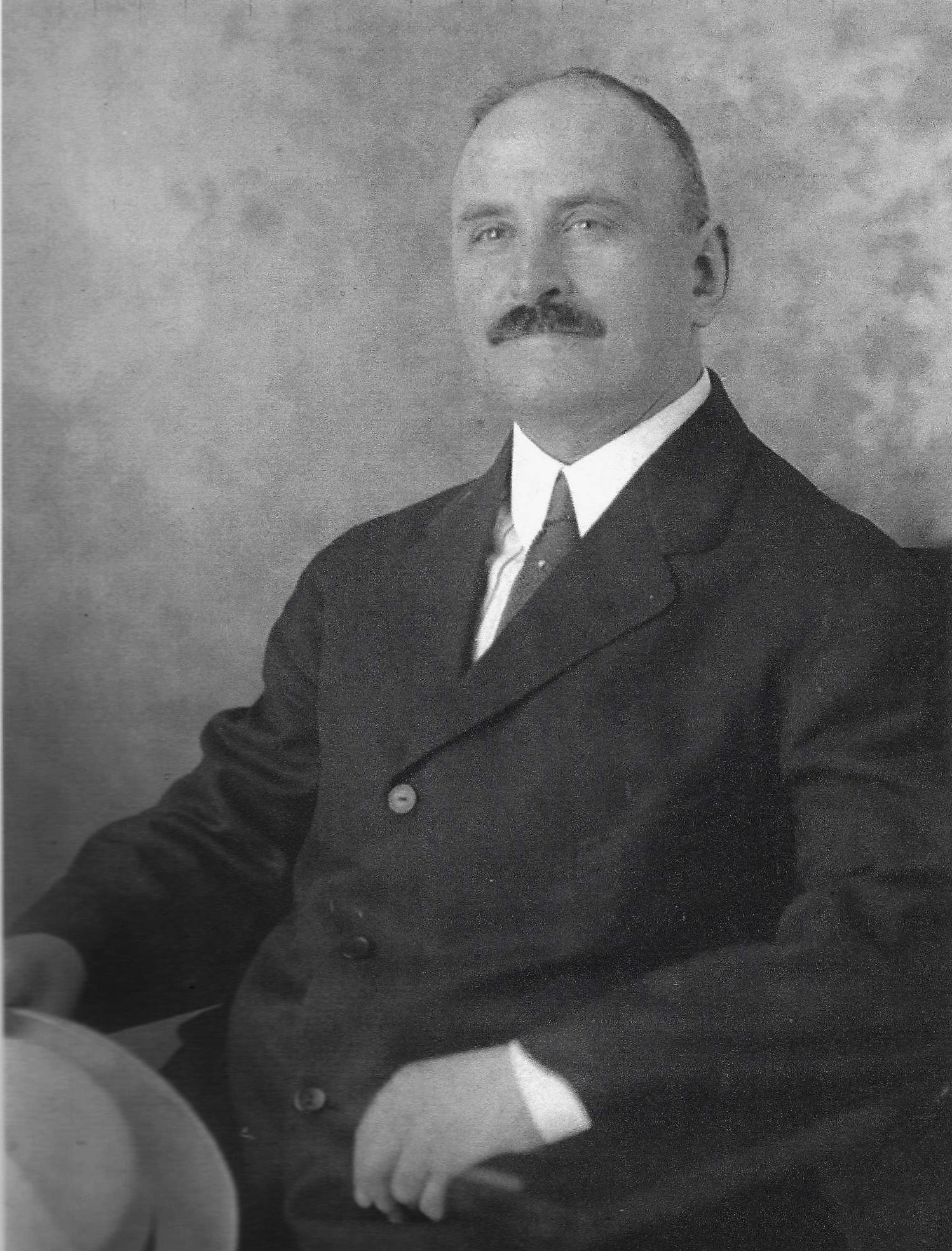
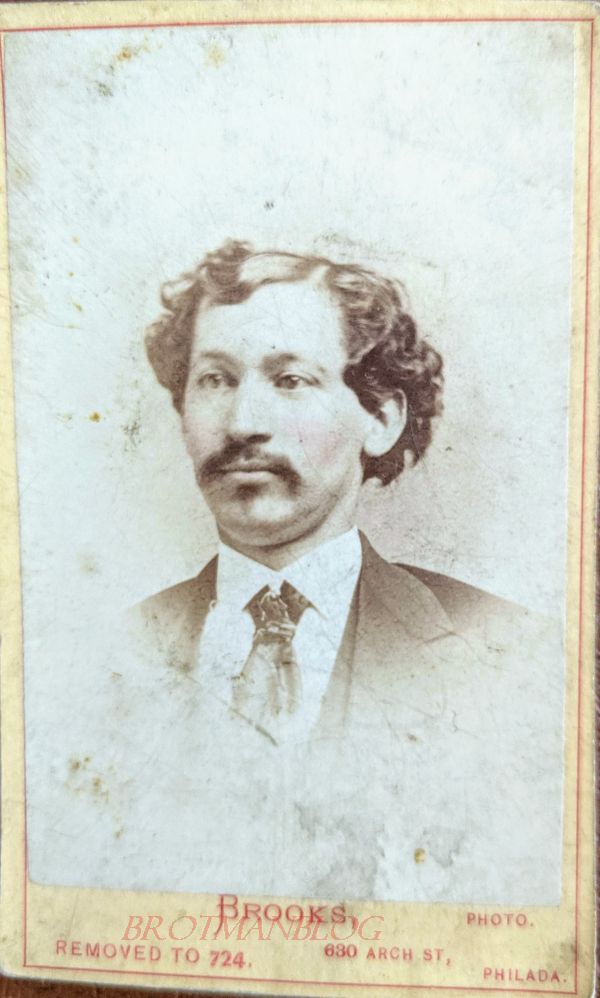
For example, this photograph, which is the oldest photograph in the collection.

On the reverse of this photograph was the following label:

But the more I studied this photograph, the more I became convinced that that label was incorrect. The photograph was taken in Philadelphia by a photographer named Brooks located at 600 or 724 Arch Street. I searched Philadelphia directories on Ancestry and was able to find a photographer named Thomas Brooks located at 630 Arch Street in several directories from the 1870s.1 Portrait photography as an art and business did not really even start until the 1850s.

Simon Goldsmith was born in 1795 and came to the US in 1845 when he was already fifty years old. By the 1870s, he was in his seventies. The man in the photograph does not look like he is in his fifties, let alone his seventies. His skin is smooth with no wrinkles or age lines. He appears to be at most in his forties, but probably even younger.

So who is that man? My first guess, given the source of the photograph and the collection in which it appears, was that it was Henry Goldsmith, Simon’s son. Henry was born in 1847, and in the 1870s when Thomas Brooks was operating a photography business on Arch Street in Philadelphia, Henry would have been somewhere between 23 and 33, and the man in that photograph could be in that age range.

Henry, however, was living in Connellsville, Pennsylvania, in the 1870s, not in Philadelphia. In fact, Henry never lived in Philadelphia. I thought perhaps when he married Sarah Jaffa in 1871, they married in Philadelphia, but the 1870 census shows Sarah living with her brother Samuel Jaffa in Pittsburgh,2 so she wasn’t in Philadelphia either.

Moreover, I am quite certain that it was Henry’s daughter Helen who wrote the words on the back of this photograph. There are several other photographs labeled in the same handwriting in the collection that are quite obviously labeled by Helen. For example, look at these two examples:

If Helen labeled the photograph of the man she assumed was her grandfather Simon, wouldn’t she have known if it were instead a photograph of her father Henry? I’d think so. So the more I study these photographs, the more I doubt this was a photograph of either Simon Goldsmith or his son Henry.

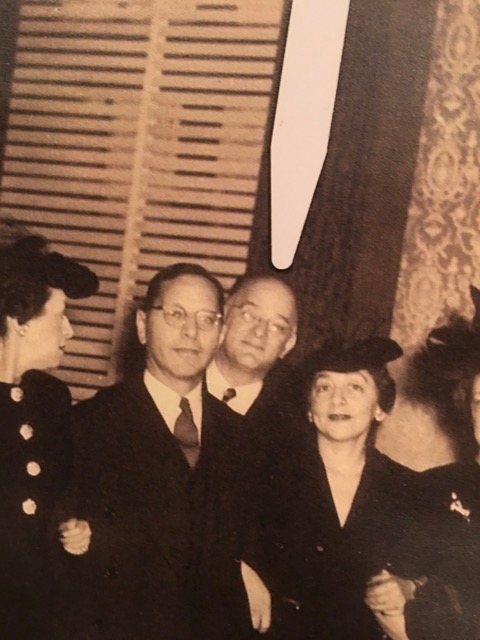
So who was he? I see a slight resemblance to Sol Jaffa, Helen’s uncle, as seen in this photograph to be analyzed in a later post. But wouldn’t Helen have known that it was Sol when she labeled the photograph? He and Helen are holding hands in this photograph, so she obviously knew him well. Did her uncle look so much different as an older man that she couldn’t see the resemblance?


The mystery lingers…

More of the collection from Marilyn to come.


  1. E.g., Gopsill´s Philadelphia Business Directory, 1870, Ancestry.com. U.S. City Directories, 1822-1995; Philadelphia, Pennsylvania, City Directory, 1874, Ancestry.com. U.S. City Directories, 1822-1995 
  2. Sarah Jaffa, 1870 US census, Year: 1870; Census Place: Pittsburgh Ward 2, Allegheny, Pennsylvania; Roll: M593_1295; Page: 441A; Family History Library Film: 552794, Ancestry.com. 1870 United States Federal Census 

A Schoenthal Update: More Photos from My Cousin Sally

Back on July 30, 2019, I posted some wonderful photographs that I’d received from my cousin Sally of her grandmother Etta Wolfe Wise and her family. Etta was my grandmother Eva Schoenthal Cohen’s first cousin. Sally recently located three additional photographs of Etta, her husband Max Wise, and their six children. She has graciously shared those photographs with me.

First is a photograph of Etta and Max and all of their children taken in 1934. Etta stands in the foreground with her youngest child, Warren (14) to her left and her second youngest child, Bob (15), to her right.  From left to right in the rear are Max, Jr. (17), Max, Sr., Richard (19), Florence (23), and Irving (22).

Courtesy of Sally Wise Myers

The second photograph must have been taken some years later. In the foreground are Florence Wise and her mother Etta Wolfe Wise (in polka dots). The other women are not known.

Courtesy of Sally Wise Myers

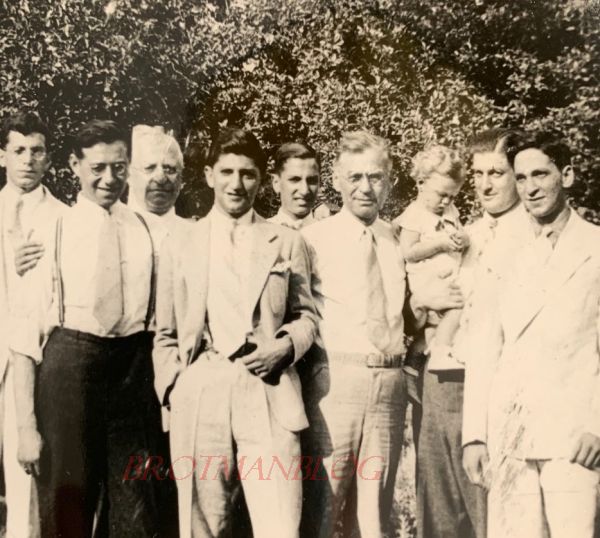
Finally, the third photograph includes the four sons of Max and Etta Wise as well as several unidentified men and a child. Irving Wise is to the far left; Richard Wise is at the far right. Max, Jr, stands in the center with his thumb hooked into his belt. In the center of the back row behind Max Jr.’s left shoulder is his brother Bob. The others Sally could not identify.1

I wonder whether this photo and the one above of all women were taken at the same event. Perhaps it was the wedding of one of the Wise children or a cousin?

Courtesy of Sally Wise Myers

Thank you once again to my cousin Sally for sharing these family photographs.


  1. Sally at first thought that the man next to Max, Jr. was his father Max, Sr., but since Max, Sr. died in 1934 and since this photograph was clearly taken a number of years after the one dated 1934 above based on the ages of the sons, that could not be Max, Sr. In addition, comparing this man to the other photo of Max, he appears much smaller with a different shaped head. 

The Family of Marcus Morreau and Alice Weinmann

Although I still don’t know exactly when Marcus Morreau married Alice Weinmann, I have narrowed it down to the years from 1896 to 1900 based on the information I found on FindMyPast. It also appears that they were married in Calais, France, perhaps at the British consulate there. I won’t know more until I see a copy of their marriage certificate.

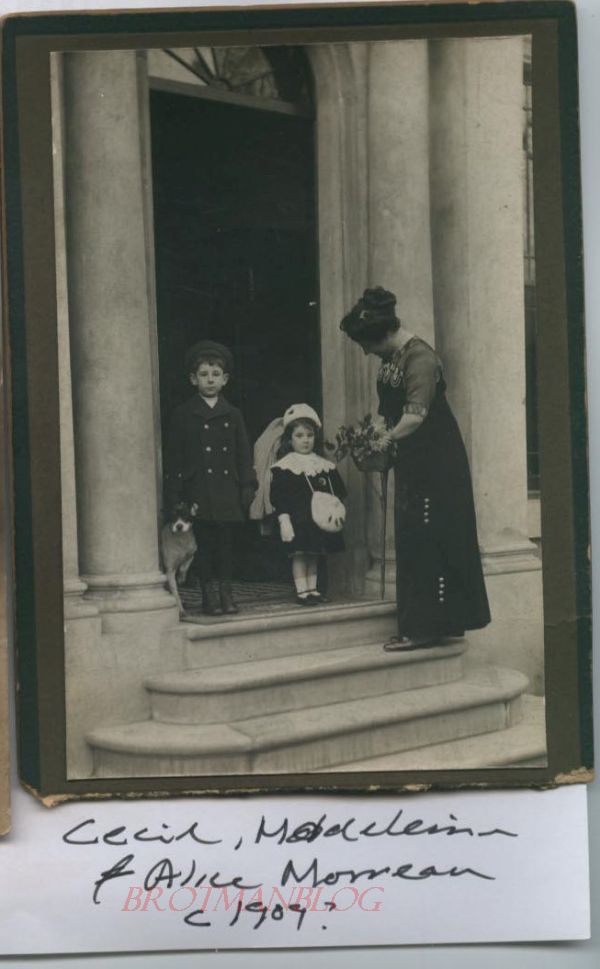
But what I do know is that Marcus and Alice had three children, all born in England. First born was Rene Leopold Morreau on October 14, 1902, in Chorlton, Lancashire.1 Then came Cecil in the spring of 1905,2 and finally Madeline in the fall of 1908.3

My cousin Mark, Marcus and Alice’s great-grandson, shared some wonderful photographs of the Morreau family. Here are some photographs of the three beautiful children of Marcus and Alice Morreau when they were very young:

Cecil, Alice, and Rene Morreau, 1905, Courtesy of Mark Morreau

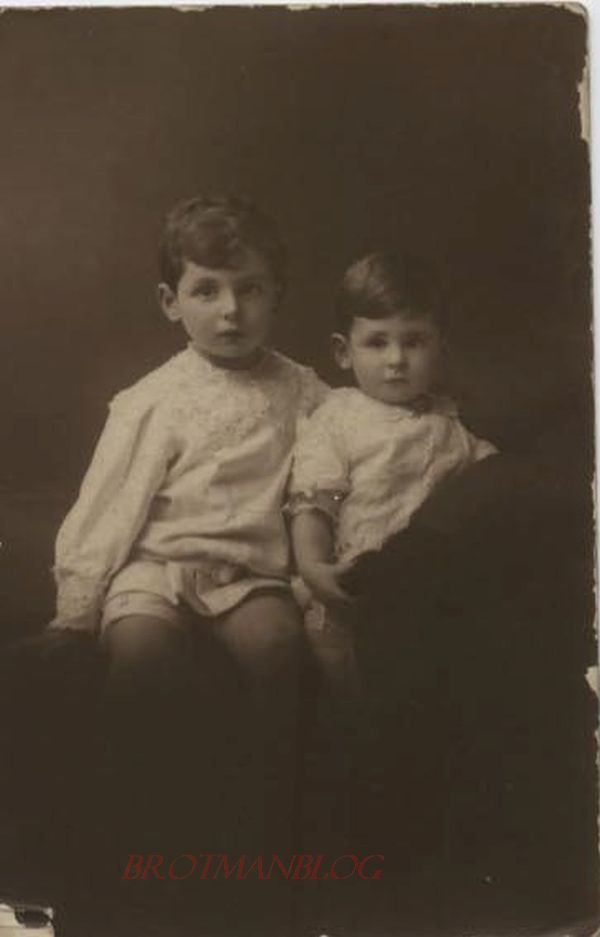
Rene and Cecil Morreau 1906, courtesy of Mark Morreau

Cecil Morreau 1907, courtesy of Mark Morreau

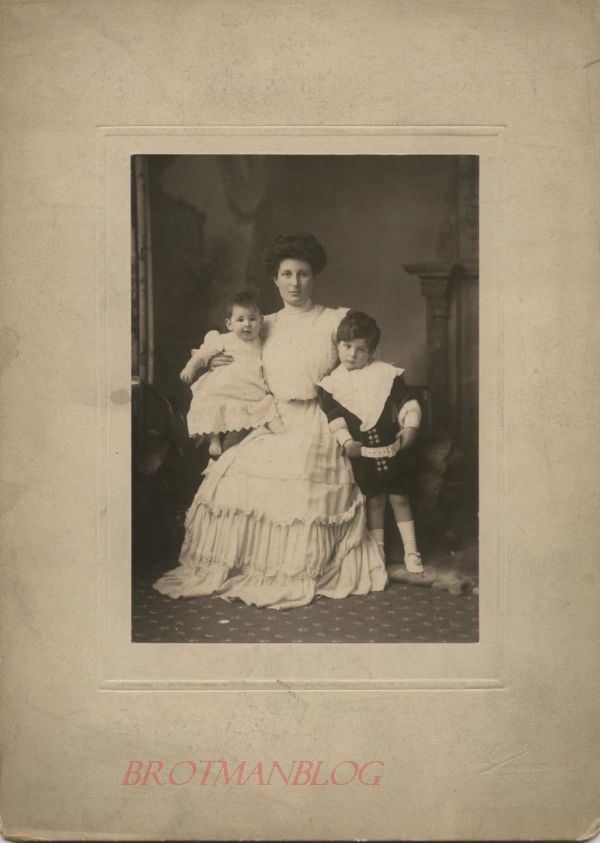
Cecil, Madeline, and Alice Morreau, c. 1909, courtesy of Mark Morreau

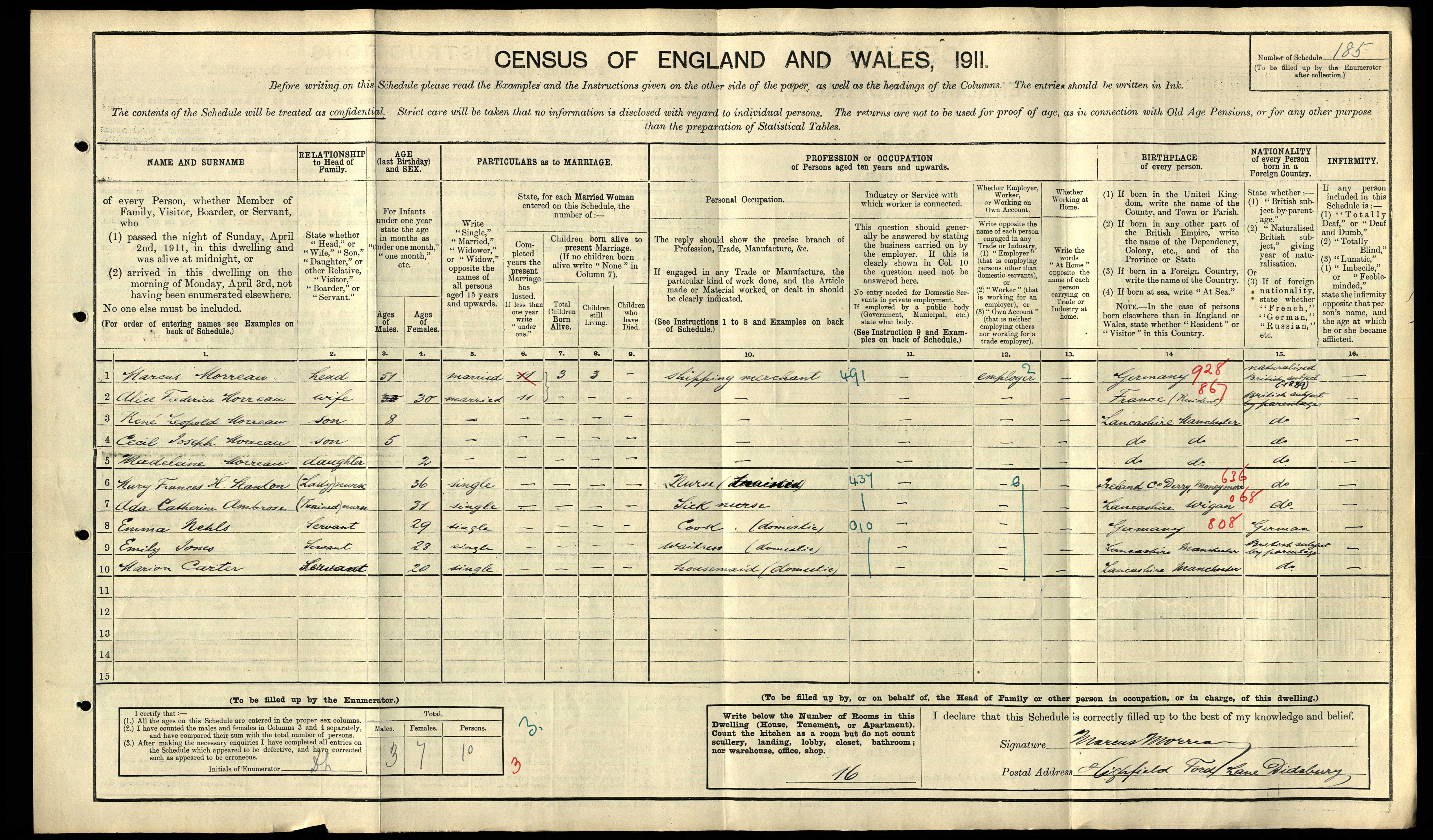
Marcus must have already been quite a successful shipping merchant because in 1911, he and Alice were living in Didsbury in South Manchester, England, with their three children, two nurses, and three servants—a cook, a waitress, and a maid.

Marcus Morreau and family, 1911 English census, Class: RG14; Piece: 23658
Enumeration District: 01, Ancestry.com. 1911 England Census

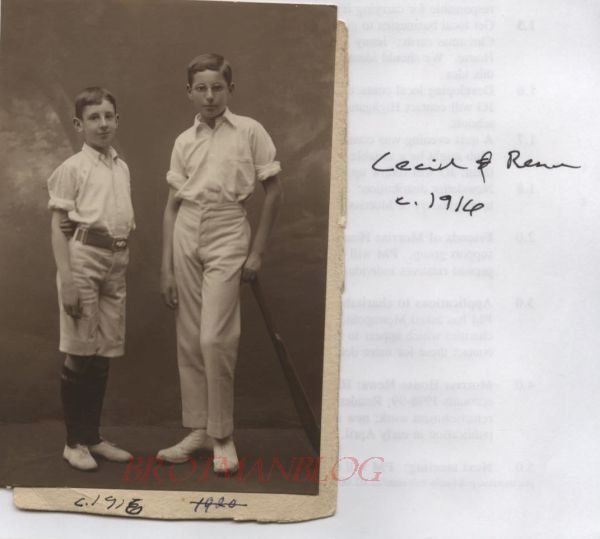
The children continued to grow, as seen in these photographs taken in about 1916:

Cecil and Rene Morreau, c. 1916. Courtesy of Mark Morreau

Rene, Madeline, and Cecil Morreau, c. 1916

Rene Morreau, Joseph Weinmann, Cecil Morreau,  May 1916

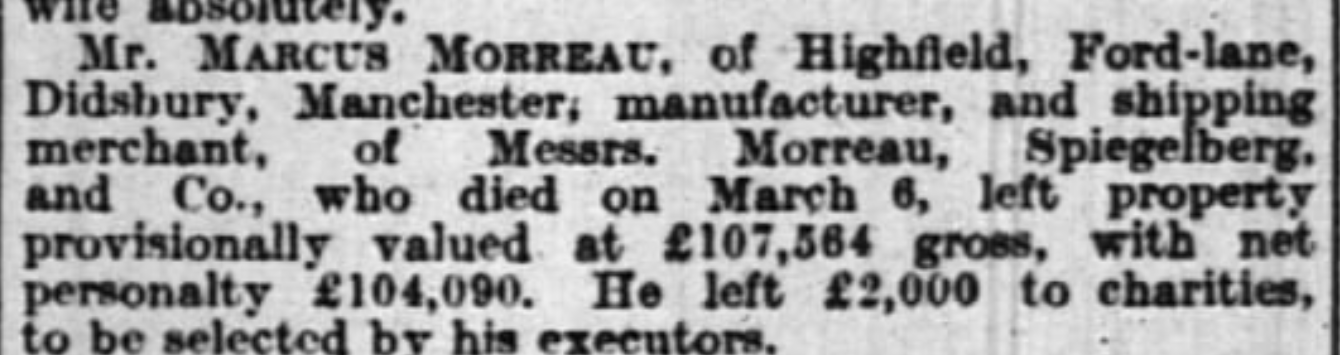
Then Marcus died at the age of 60 on March 6, 1920, in Conway, Wales.4 His children were still teenagers living at home, and his wife Alice was a widow at the age of forty. I could not locate an obituary, but did find this news article regarding the estate left behind by Marcus Morreau.

The Times, London, Greater London, England, 03 Nov 1920, Wed • Page 18

In today’s currency, that amount would be worth over £4,248,616.60, according to one inflation calculator, or over five million dollars in US currency.

Cecil was the first of Marcus and Alice’s children to marry. He married Cicely Josephine O’Flanagan in 1933 when he was 28 years old.5 (I can only imagine how much confusion there must have been with a Cecil married to a Cicely.) Cicely was born on November 7, 1907, in Manchester, the daughter of Martin O’Flanagan.6 Cecil and Cicely had three children between 1934 and 1938. According to his granddaughter Jo, Cecil was a graduate of Cambridge University where he played hockey and trained to be an architect.

Then tragically Cecil died from a burst appendix on March 2, 1939.7 He was only 34 years old and left behind three children under the age of ten and his widow Cicely, who was only 32. Just as Cecil had lost his father when he was still young, Cecil’s children lost their father when they were even younger children.

According to Cecil and Cicely’s granddaughter Jo, after Cecil’s death, Cicely moved with her three young children to Ireland to be with family friends; Jo said that Cicely and Cecil had planned the move in the event that there was a war, and so she followed through with that plan. Cicely remarried  in 1950,8 and she and her second husband, Henry “Harry” Collett, eventually returned to England, where she died on March 2, 1995.9

The other two children of Marcus and Alice lived longer lives than their brother Cecil. Rene married Beryl Scawen Blunt on January 21, 1937.10 Beryl was born November 27, 1911, to Arthur Scawen Blunt and Ada Hudson.11 Rene and Beryl had two children and lived into their seventies. Rene was 79 when he died on March 1, 1982, 12 and Beryl was 75 when she died on September 23, 1987.13

Madeline Morreau, the youngest child of Marcus and Alice, married Emanuel Phillip Nathan on June 19, 1941, in Kensington, England. 14 Emanuel was the son of Phillip Nathan of Johannesburg, South Africa, and as far as I can tell, it appears that Madeline and Phillip settled in Johannesburg after they married.

Marriage announcement for Madeline Morreau and Emanuel Nathan, First Letter of Surname: N
Ancestry.com. England, Andrews Newspaper Index Cards, 1790-1976This collection was indexed by Ancestry World Archives Project contributors. Original data: Andrews Collection. Institute of Heraldic and Genealogical Studies, Canterbury, Kent, England.

Alice Weinmann Morreau died in Guldford, England, in December, 1971, at the age of 91.15 Her granddaughter Annette shared with me the family story of how Alice died, as told by Alice’s companion—Alice was at the top of her stairs with Elgar’s ‘Nimrod’ playing on the radio; she commented on the beauty of the music and then collapsed.

Madeline Morreau Nathan lost her husband Emanuel two years later in 1973.16 Madeline outlived the rest of her family, surviving to age 88 when she died in South Africa in 1996.17

How fortunate I am to have made these connections with my Morreau cousins and to be able to learn more about the family and to see these wonderful photographs. Thank you, Mark, Annette, and Jo.


  1. England & Wales Deaths 1837-2007 First name(s) RENE LEOPOLD Last name MORREAU Gender Male Birth day   14 Birth month  10 Birth year 1902 Age  – Death quarter  1 Death year 1982 District Bexley County Kent Volume 11 Page 0502 Country England Record set England & Wales Deaths 1837-2007 Category  Birth, Marriage, Death & Parish Records Subcategory Civil Deaths & Burials Collections from Great Britain, England 
  2. England & Wales Births 1837-2006, First name(s) CECIL JOSEPH, Last name MORREAU, Birth year 1905, Birth quarter 2, District Chorlton, County              Lancashire, Country England, Volume 8C, Page 718, Record set England & Wales Births 1837-2006, Category Birth, Marriage, Death & Parish Records, Subcategory Civil Births, Collections from Great Britain, England 
  3. Madeleine R J Morreau, Registration Year:  1908, Registration Quarter: Oct-Nov-Dec, Registration district:  Chorlton, Inferred County: Lancashire, Volume:   8c, Page: 660, FreeBMD. England & Wales, Civil Registration Birth Index, 1837-1915 
  4. Name: Marcus Morreau, Death Date: 6 Mar 1920, Death Place: Manchester, England, Probate Date: 29 Oct 1920, Probate Registry: London, England, Ancestry.com. England & Wales, National Probate Calendar (Index of Wills and Administrations), 1858-1995 
  5. First name(s) CECIL J, Last name MORREAU, Marriage quarter 3, Marriage year 1933, Spouse’s last name O’flanagan, District Manchester South, County Lancashire
    Country England, Volume 8D, Volume as transcribed 8D, Page number 648, Record set England & Wales Marriages 1837-2005, Category Birth, Marriage, Death & Parish Records, Subcategory Civil Marriage & Divorce, Collections from Great Britain, England 
  6. Cicely Josephine Collett, Death Age: 87, Birth Date: 7 Nov 1907, Registration Date: Apr 1995, Registration district: Ipswich, Inferred County: Suffolk, Register Number: A14B, District and Subdistrict: 7471A, Entry Number: 257, General Register Office; United Kingdom, Ancestry.com. England & Wales, Civil Registration Death Index, 1916-2007 
  7. Name: Cecil Joseph Morreau, Death Date: 2 Mar 1939, Death Place: Guildford, Surrey, England, Probate Date: 7 Jun 1939, Probate Registry: London, England, Ancestry.com. England & Wales, National Probate Calendar (Index of Wills and Administrations), 1858-1995 
  8.  Name: Cicely J Morreau, Registration Date: Oct 1950,Registration Quarter: Oct-Nov-Dec, Registration district: Marylebone, Inferred County: Middlesex, Spouse: Henry B Collett, Volume Number: 5d, Page Number: 605, General Register Office; United Kingdom; Volume: 5d; Page: 605, Ancestry.com. England & Wales, Civil Registration Marriage Index, 1916-2005 
  9.  Name: Cicely Josephine Collett, Death Age: 87, Birth Date: 7 Nov 1907, Registration Date: Apr 1995, Registration district: Ipswich, Inferred County: Suffolk
    Register Number: A14B, District and Subdistrict: 7471A, Entry Number: 257,
    General Register Office; United Kingdom, Ancestry.com. England & Wales, Civil Registration Death Index, 1916-2007 
  10.  Name: Rene L Morreau, Registration Date: Jan 1937, Registration Quarter: Jan-Feb-Mar, Registration district: Westminster, Inferred County: Middlesex, Spouse: Beryl S Blunt, Volume Number: 1a, Page Number: 870, General Register Office; United Kingdom; Volume: 1a; Page: 870, Ancestry.com. England & Wales, Civil Registration Marriage Index, 1916-2005 
  11. First name(s) BERYL S Last name BLUNT Birth year 1911 Birth quarter 4 Registration month – Mother’s maiden name Hudson District Canterbury County Kent Country England Volume 2A Page 1734 Record set England & Wales Births 1837-2006 Category Birth, Marriage, Death & Parish Records Subcategory Civil Births Collections from Great Britain, England 
  12.  Rene Leopold Morreau, Death Age: 79, Birth Date: 14 Oct 1902, Registration Date: Jan 1982, Registration Quarter: Jan-Feb-Mar, Registration district: Bexley
    Inferred County: Greater London, Volume: 11, Page: 0502, General Register Office; United Kingdom; Volume: 11; Page: 0502, Ancestry.com. England & Wales, Civil Registration Death Index, 1916-2007 
  13. Name: Beryl Scawen Morreau, Death Age: 75, Birth Date: 27 Nov 1911
    Registration Date: Sep 1987, Registration district: Lambeth, Inferred County: Greater London, Volume: 14, Page: 317, General Register Office; United Kingdom; Volume: 14; Page: 317, Ancestry.com. England & Wales, Civil Registration Death Index, 1916-2007 
  14.  Name: Madeleine R J Morreau, Registration Date: Apr 1941, Registration Quarter: Apr-May-Jun, Registration district: Kensington, Inferred County: London
    Spouse: Emanuel P Nathan, Volume Number: 1a, Page Number: 430, General Register Office; United Kingdom; Volume: 1a; Page: 430, Ancestry.com. England & Wales, Civil Registration Marriage Index, 1916-2005 
  15. Alice Frederique Morreau, Death Age: 91, Birth Date: 15 Jun 1880, Registration Quarter: Oct-Nov-Dec, Registration district: Surrey South Western Inferred County: Surrey, Volume: 5g, Page: 1177. General Register Office; United Kingdom; Volume: 5g; Page: 1177, Ancestry.com. England & Wales, Civil Registration Death Index, 1916-2007 
  16. Emanuel Philip Nathan, Death Year: 1973, Death Country: South Africa
    Title: Transvaal Estates Death Index (Master of the Supreme Court, Pretoria)
    Source: National Archives, Pretoria, Reference Number: 11990/73, Ancestry.com. Transvaal Province, South Africa, Estates Death Notice Index, 1855-1976 
  17. Source: Mark Morreau, Madeline’s great-nephew. 

Seligman Update, II: James Seligman, Vintner and Hotelier

My second Seligmann update is about James Seligman, who was born Jakob Seligmann in Gau-Algesheim, Germany in about 1853; he died in Birmingham, England on March 11, 1930.1

Birmingham Daily Gazette, March 14, 1930, p. 3

James Seligman was the son of Moritz Seligmann and Babette Schoenfeld and the younger brother of my great-great-grandfather Bernard and Wolfgang’s great-grandfather August. I wrote a post about James and his life back on December 8, 2017, describing his life and business in England and Scotland. James went to England as a young man to represent Seligman Brothers, the wine business that he was in with his brothers August and Hieronymous. In 1890, the partnership with his brothers was dissolved, and James continued the wine business on his own in England and then Scotland as Seligman & Co. He also became involved in the hotel business in both Scotland and England. A good portion of the information and images in that earlier post came from Wolfgang.

London Gazette, March 20, 1891

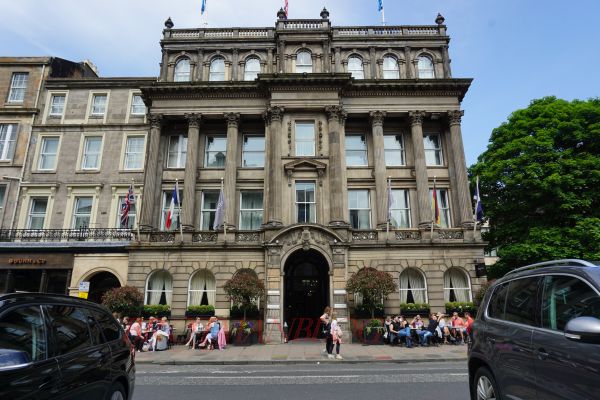
In looking through old emails recently, I realized that I had never posted some of the photographs that Wolfgang later sent me of one of James Seligman’s hotels, the George Hotel in Edinburgh, Scotland. I also had forgotten to post some of the photographs my cousin-by-marriage Shirley had sent me of the Grand Hotel in Birmingham, England, where James had been the managing director.  My apologies to Wolfgang, Shirley, and my three-times great-uncle James Seligman for somehow letting these wonderful images slip through the cracks.

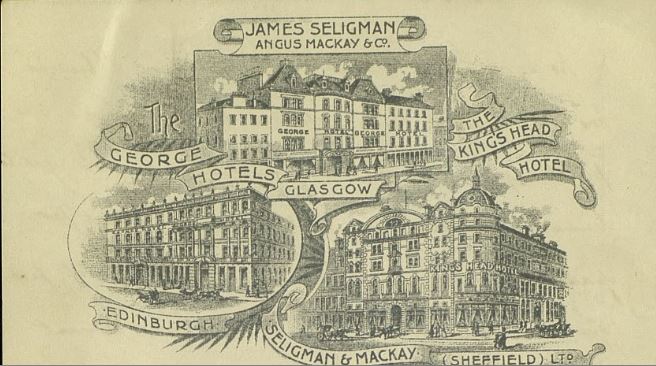
Here are the photographs and other images that Wolfgang sent of the George Hotel in Edinburgh and some stationery letterhead that Wolfgang found on the internet showing the hotels owned in 1911 by James Seligman and August Mackay.

It looks like a gracious old hotel with a beautiful lobby. It is still in business and just had extensive renovations done. If I ever get to Edinburgh, this is where I will stay.

Shirley’s photographs are of the Grand Hotel in Birmingham where James was the managing director. It also is a grand and gracious old hotel:

I was able to learn a lot more about this hotel from its website:

The Grand Hotel first occupied part of the building constructed by Isaac Horton, on Colmore Row and Church Street between 1877 and 1879, with 100 bedrooms and a first floor reception. It was let to Arthur Field, a hotel operator from Newcastle-upon-Tyne, and opened on 1st February 1879…. For the next 74 years the hotel was operated by Hortons. During this time it played host to royalty, politicians and film stars as well as staging many dinners, concerts and dances in the Grosvenor Suite. The room had many admirers including Sir John Betjeman who described it as “a unique, simply stunning, masterpiece.” The list of those attending functions at or staying in the hotel included King George VI, the Duke of Windsor, Winston Churchill, Neville Chamberlain, Charlie Chaplin, James Cagney and Joe Louis to name but a few.

Maybe some of those people stayed in the hotel while James Seligman was the managing director.  According to its website, the Grand Hotel is currently in the process of substantial renovations. Maybe someday I will get to stay there also.

As for the wine business, Seligman & Co stayed in business long after James’ death. In fact, Wolfgang found an obituary for a man named David Smith who was also in the wine business and who had been a director of Seligman & Co. in Birmingham as late as 1989. Shirley took a photograph of the location that once housed the Seligman & Co. wine business in Birmingham.

Thank you to Wolfgang and Shirley for their help in telling the story of James Seligman.


  1.  General Register Office; United Kingdom; Volume: 6d; Page: 198, Ancestry.com. England & Wales, Civil Registration Death Index, 1916-2007 

Another Cousin Discovered: The Granddaughter of Etta Wolfe Wise, My Third Cousin Sally

For me, genetic genealogy has been disappointing as a tool for finding new ancestors and breaking down brickwalls, but it has occasionally been useful for confirming what I already knew through traditional research. For example, in March I contacted a DNA match named Sally who came up as a fourth cousin on Ancestry, and after contacting her and checking my tree and hers, we realized that we were both the great-great-granddaughters of Levi Schoenthal and Henrietta Hamberg.  That is, Sally is in fact my third cousin, even closer than the DNA estimate on Ancestry.

Sally is descended from Levi and Henrietta’s daughter Amalie Schoenthal, and I am descended through their son Isidore Schoenthal. Sally and I exchanged family stories and information and photographs, and she generously agreed to let me share those stories and photographs on the blog. As you will see, there are some apparent family resemblances traceable to our shared Schoenthal ancestry.

As I’ve already written about on the blog, Sally’s great-grandmother (and my great-great-aunt) Amalie Schoenthal married Elias Wolfe. Their daughter Etta Wolfe was Sally’s grandmother. Etta was my grandmother Eva Schoenthal Cohen’s first cousin.

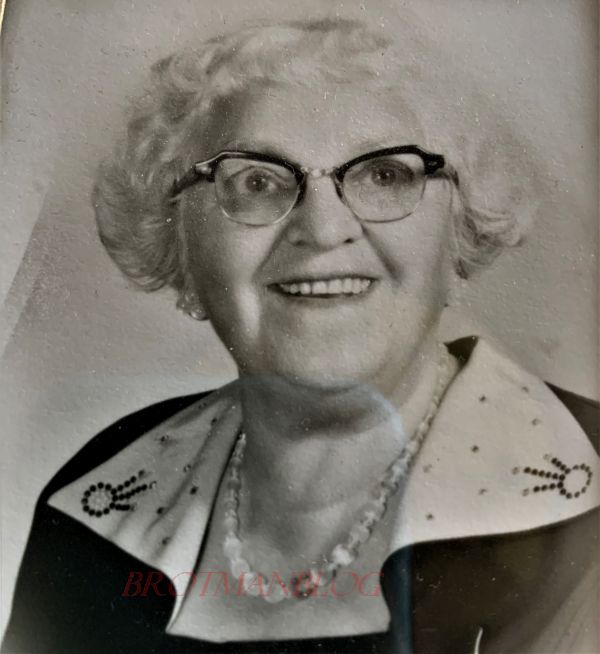
Sally has no photographs of her great-grandparents, but shared with me photographs of her grandmother Etta, all taken when she was a grandmother.  I will start with this one as it is the clearest photograph of her and shows much of her personality, as described to me by Sally. Sally knew Etta well because she died when Sally was eight years old. She remembers her grandmother lovingly and described her as easy-going and soft spoken and as someone who always enjoyed family trips and outings. Sally remembers that when she was just four or five, her grandmother would share shrimp cocktails with her. Can’t you see that sweetness in her face in this photo?

Etta Wolfe Wise, Courtesy of her Granddaughter Sally

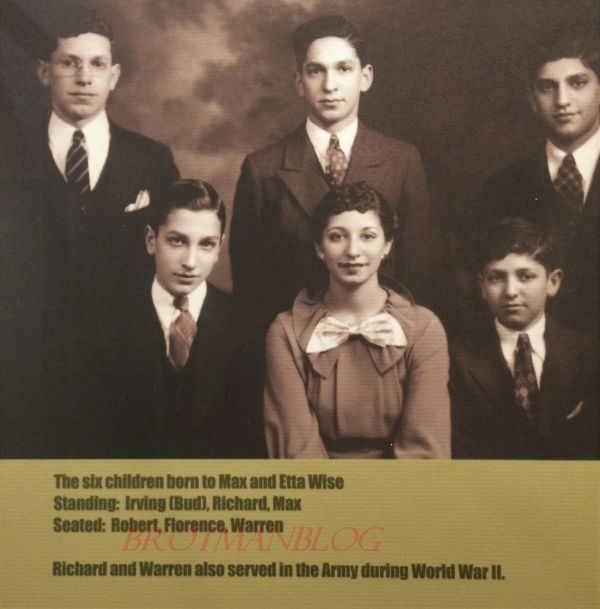
Etta Wolfe married Maximilian Wise in 1910 in Pittsburgh, as noted here on the blog. Etta and Max had six children, a daughter Florence and then five boys, Irving, Richard, Max Jr., Robert, and Warren. Sally’s father Robert was their fifth child and fourth son. Here are two pictures of Max and Etta’s children.

Courtesy of Sally Wise Myers

Irving, Richard, Max, Jr. Robert, and Warren Wise.  Courtesy of Sally Wise Myers

Sally told me that Etta and Max converted from Judaism to Christian Science because they believed that their daughter Florence’s clubfoot was cured by Christian Science. Unfortunately, according to Sally, several other members of the family were not so fortunate with their faith in Christian Science and died fairly young after refusing traditional medical care.

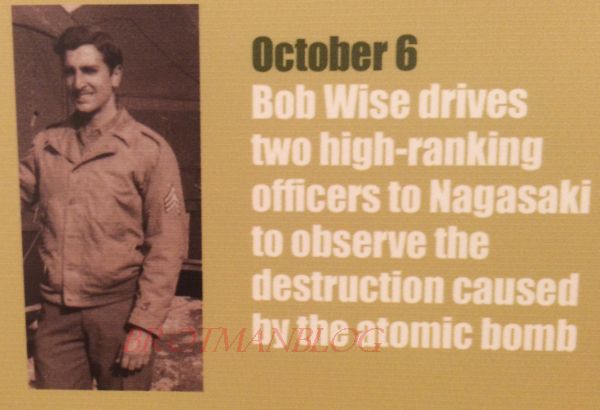
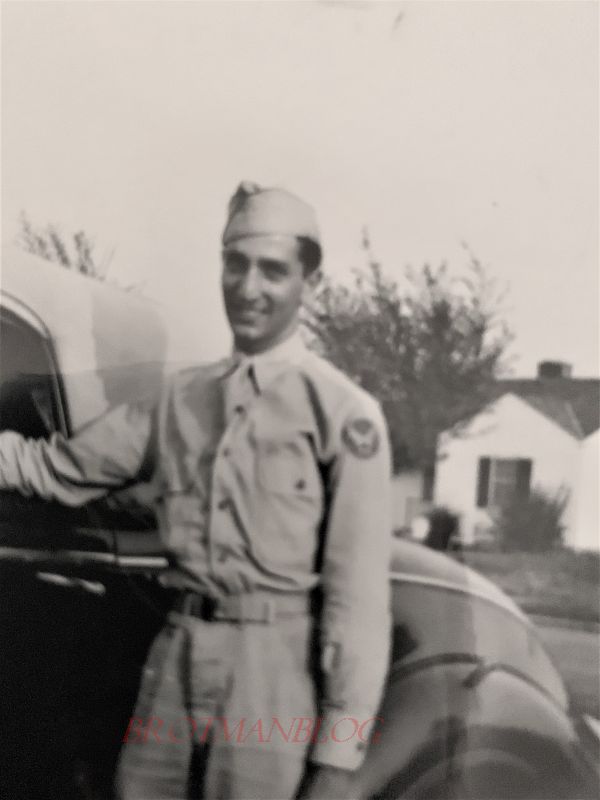
Sally’s father Robert Wise enlisted in the Army on April 19, 1943, and served until February 20, 1946.1 Sally told me that her father was an Army Staff Sergeant Engineer, Aviation Battalion, and was stationed most of his time in the service during World War II in the South Pacific, building an airport and serving in combat.  After the atomic bomb was dropped on Nagasaki in August 1945, Bob drove two generals in his Jeep to see the devastation there and photographed what he saw. He also was at the airport when the Japanese planes landed for the signing of the peace treaty; he climbed over a wall and took pictures of the two planes. Unfortunately, Sally does not have access to those historically important photographs.

Bob Wise’s army experience was part of an exhibit about local veterans who served in World War II that was curated by the Middletown (Ohio) Historical Society and shown at the Fine Arts Center in Middletown in 2015.  These photographs of Robert were part of that exhibit, as was the one above of the six children of Max and Etta:

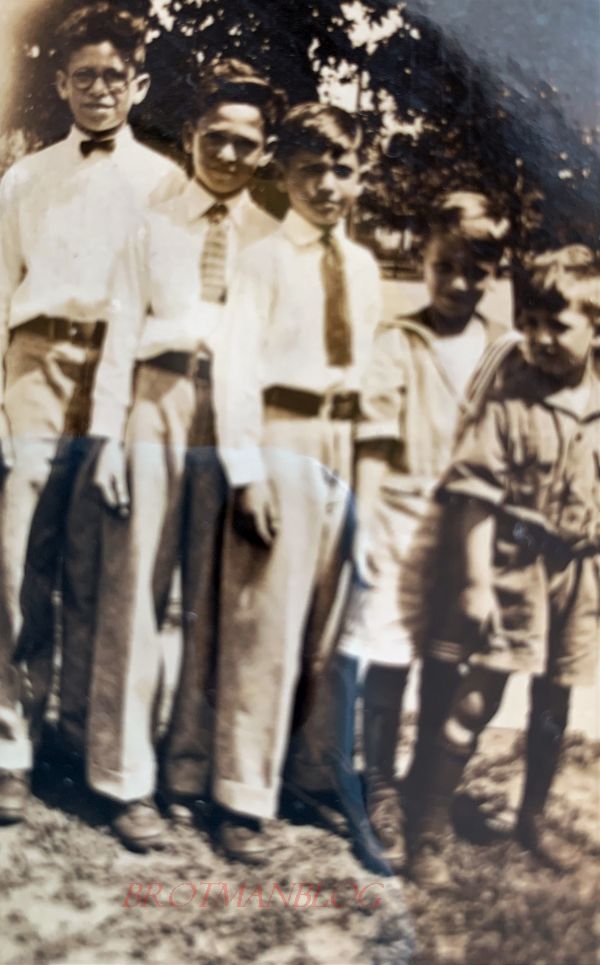
Robert Wise as a young boy in Middetown. Courtesy of Sally Wise Myers

Courtesy of Sally Wise Myers

Sally also shared these additional photographs of her father taken during his service in World War II:

Robert Wise. Courtesy of Sally Wise Myers

Robert Wise. Courtesy of Sally Wise Myers

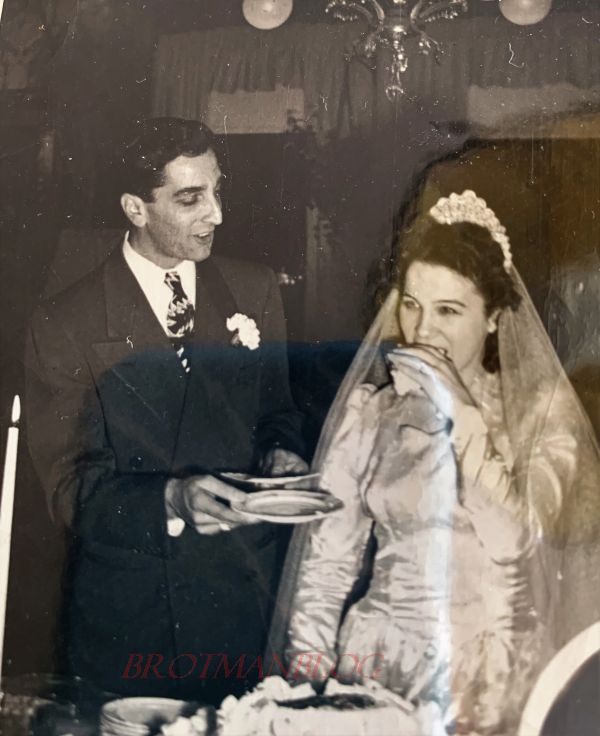
After the war, Robert married Mildred Myers on January 10, 1948, in Ohio. Sally sent me this photograph from their wedding:

Courtesy of Sally Wise Myers

The next few photographs made me sit back with amazement at some of the family resemblances. Here are photographs of my father, his mother Eva Schoenthal Cohen, and his grandfather Isidore Schoenthal and then some of the photographs of Bob Wise and Sally.

Isidore Schoenthal

Eva Schoenthal and John Cohen, Sr. 1923

John Cohen, Jr.

Bob Wise and Sally. Courtesy of Sally Wise Myers

The family of Bob Wise. Courtesy of Sally Wise Myers

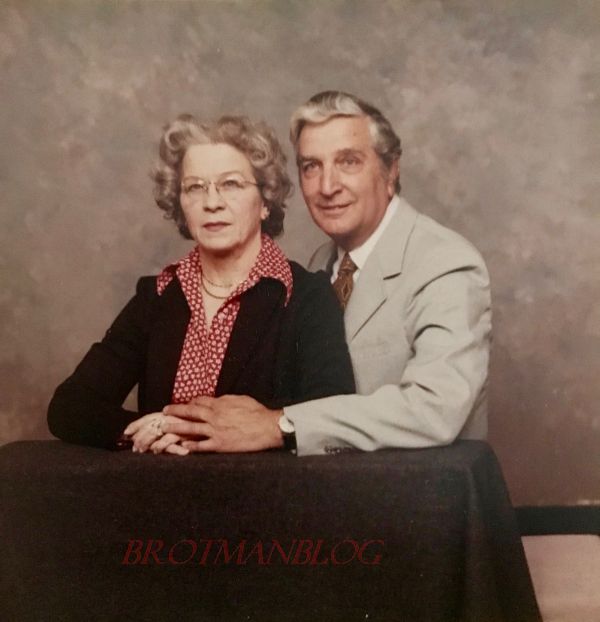
Mildred and Bob WIse, 1982. Courtesy of Sally Wise Myers

Look at the eyes. Do you see the resemblances that Sally and I see? Or are we just seeing what we want to see?

Finally, two photographs of Etta Wolfe and Max Wise’s descendants—their children and their grandchildren. What a legacy!

The grandchildren and children of Etta Wolfe Wise. Front Row includes Florence Wise Keuthan. The second row, lefet to right, is Bob Wise, Mary Stephenson Wise (Max, Jr’s wife), and Millie Lunford Wise (Richard’s wife). Last row, left to right, is Mildren Myers Wise (Bob’s wife) , Max Wise Jr.,e Fred Keuthan (husband of Florence Wise, Richard Wise and Irving Wise. Courtesy of Sally Wise Myers (The grandchildren are not named for privacy reasons).

Etta Wolfe Wise and all of her grandchildren. Courtesy of Sally Wise Myers.

Thank you, Sally, for sharing the stories and photographs with me. I am so glad we found each other.


  1. Ancestry.com. U.S., World War II Army Enlistment Records, 1938-1946; SSN: 277015114, Branch 1: AAC, Enlistment Date 1: 26 Apr 1943, Release Date 1: 20 Feb 1946, Ancestry.com. U.S., Department of Veterans Affairs BIRLS Death File, 1850-2010 

The Magic of Color

Val Erde of the Colouring the Past blog recently sent out an invitation to bloggers to try her colorization services for free. I’d seen what she did for Luanne of The Family Kalamazoo and so was intrigued by her offer. Under the terms of her invitation, she would select an appropriate black and white photograph, and if I approved of her choice, she would colorize it.

Val selected a wonderful photograph of my great-aunt Betty Goldschlager Feuerstein, my grandfather’s little sister. I asked Betty’s grandchildren if they were comfortable with having the photograph colorized, and those who responded were also intrigued. When I received Val’s finished work and shared it with them, the granddaughters all were thrilled and said that Val had brought their grandmother back to life. Unfortunately I never met Betty, but I also can see what a great job Val did.

Here is the original and Val’s rendition in color:

Betty Goldschlager Feuerstein

betty-goldschlager 1st Draft

Colorized by Val Erde 2019

Pretty remarkable, isn’t it? Val will be available to respond to any questions or comments posted in connection with this post.

England, Part IV: Visiting My Ancestors’ Neighborhood

One of the reasons I wanted to revisit London on this trip to England was that when we first visited London in 1995, I had no idea that I had ancestors who once lived there. I did not start doing family history research until 2012, and sometime thereafter I learned that my three-times great-grandfather Hart Levy Cohen was born in Amsterdam, but had immigrated to England and settled in London by 1799. He married my three-times great-grandmother Rachel Jacobs at the Great Synagogue in London in 1812, and together they had five children born in London, including my great-great-grandfather Jacob Cohen, who was born in 1824. By 1851, however, Hart and all his children had left London and settled in Philadelphia. 1

But from at least 1799 until 1851, I had direct ancestors living in London, and I wanted to know more about where they lived and what their community was like. I’d done some research several years back about the area and about the treatment of Dutch Jews, known as Chuts, so I knew that the neighborhood ranged from poor to middle class in those days and that Dutch Jews like my three-times great-grandparents were often treated as outsiders in the community.2

I was fortunate to find Isabelle Seddons, a historian who does walking tours of London including the former Jewish neighborhoods of Whitechapel and Spitalfields. I knew that the Cohens had lived on New Goulston Street in 1841 and at Number 8, Landers Buildings on Middlesex Street, in 1851, both addresses located in Spitalfields in the Whitechapel district of London. I gave Isabelle the information I had, and we arranged to meet at 2 pm on May 30 at the Whitechapel Gallery in London.

What made the tour even better is that my friend and cousin-by-marriage Shirley and her husband Ron were able to join us. Shirley and I had connected years back when I was trying to sort out the three Selinger brothers who married three of my Cohen relatives and Shirley was trying to learn more about her Selinger ancestors. I was quite excited that we would finally get to meet in person. Shirley kindly brought me a copy of an 1875 map of the neighborhood showing New Goulston and Middlesex Streets.

The four of us on the tour

Shirley and I standing in front of the pub where we and our husbands shared some beers and some stories after the tour

Here’s a current map of the area we visited.


Isabelle started the tour with an overview of the Jewish history of the area. She pointed out that during World War II, the neighborhood was heavily bombed by the Nazis because of the ports that were (and are) located nearby. Thus, many if not most of the original buildings are gone, as can be seen from this photograph and from others.

According to Isabelle, the Whitechapel-Spitalfields area was predominantly Jewish from the 18th century until World War II, when the neighborhood was evacuated because of the bombing. After World War II, the Jews did not return to this area of London, and a new wave of immigrants settled in the area. Today it is primarily a Bengali neighborhood where mosques have replaced synagogues.

This building was originally a church, then later a synagogue, and now a mosque. See https://historicengland.org.uk/listing/the-list/list-entry/1240697

The area was always poor, though some of the Jewish merchants were better off than most of the residents. As Hart Cohen and his sons were china merchants and living on a street that Charles Booth designated on his historic poverty map of London as less poverty stricken than others, I assume they were among those who were somewhat better off. Nevertheless they left London by 1851.

The largest influx of Jews came in the late 19th century from Eastern Europe, long after my Cohen ancestors had emigrated. They came in huge numbers and lived in terrible conditions, and much of what is left in the area that reflects its Jewish past dates from that era of immigration and afterwards, not from the early 19th century when my family lived there.

Isabelle took us to see the archway built in the late 19th century as part of a housing project supported and promoted by the Rothschild family and other wealthy English Jews to provide the poverty-stricken Jews living in the area with decent housing. It was called the Four Percent Industrial Dwellings Company because the investors were promised a four percent return on their investment.  The housing units were destroyed during the war, but the arch remains as a reminder of this early attempt at urban renewal.

One Jewish entrepreneur had what today would seem like an excellent business idea.  He wanted to create an indoor market where various vendors could sell their wares—food, clothing, household goods—all in one covered space. In today’s world where places like Covent Garden Market and Faneuil Hall Marketplace thrive as well as all the shopping malls that exist throughout the US, such an idea would seem to be a no-brainer and an instant success. But in those times people—vendors and shoppers—rejected the idea, and the owner converted his building into a textile factory. Today it houses graduate departments of Glasgow Caledonian University offering advanced degrees in, among many other areas, in International Fashion Marketing and Luxury Brand Marketing.

Most of the Jews made their living in the late nineteenth century as tailors or working at a nearby matchstick factory, and working conditions were terrible. In 1888 the matchstick workers went on strike after organizing themselves at Hanbury Hall, a building originally built as a Huguenot chapel in 1719. The hall became a center for union and radical activity during the late 19th century. Today it operates as a café and venue for social events.

Hanbury Hall

The poverty of the Jewish residents of the area was also reflected in this building, which was built as a soup kitchen for poor Jews, as the engraved inscription indicates, and still operates as a soup kitchen today for the newer poor immigrants in the area.

Soup Kitchen for the Jewish Poor

But there are still some signs that this was once a Jewish neighborhood, such as these old store signs:

And this Star of David at the top of a drainpipe. This is the Christ Church primary school on Brick Lane, one of the major thoroughfares in the area. It was founded in 1708 as a parish school, but when the building on Brick Lane was built in 1874, most of the children in the neighborhood who attended the school were Jewish. According to Isabelle, the Star of David was added to reflect the school’s tolerance and openness to students of all backgrounds.

Christ Church Primary School with Star of David on the drain pipe

We saw another Star of David with what appears to be the scales of justice inside it so perhaps this was once a lawyer’s office.

UPDATE: A member of the Tracing The Tribe group on Facebook provided me with this information about the Star of David below: “The interesting Magen David at 88 Whitehall is not on scales but is actually shown as supported by two lions of Judah wielding sabres. Beneath is a pair of medallions, decorated with Menorahs. It was designed by Arthur Szyk in the mid 1930s. It is a staple of every Jewish London tour and there is actually a more ornate but similar design also by Szyk located inside.”

And we found an old mezuzah painted over a doorway at this house:

The relief sculptures above the windows and door on this building reflect that this was at one time a Jewish bakery:

Once a Jewish bakery

There is also still one active synagogue in the neighborhood, the Sandy’s Row Synagogue. Although the synagogue was not housed in this building until 1867 after my ancestors had left the area, this could be the congregation that my ancestors joined as it was founded by Dutch Jewish immigrants to the area.

But Hart Cohen and Rachel Jacobs were married at the Great Synagogue in 1812, and their son Jacob, my great-great-grandfather, and my great-great-grandmother Sarah Jacobs were also married at the Great Synagogue in 1844. Unfortunately, the Great Synagogue was destroyed by the Nazis and no longer exists though Isabelle did show us where it once stood.

Where the Great Synagogue once stood

I asked Isabelle how a synagogue could survive today in this community, and she explained that there are a number of Orthodox Jews who work in downtown London who come to the synagogue for daily minyans before and after work.

We also heard the story of Jacob Adler, an actor and violinist who played in the Yiddish theater. His former home was marked with a plaque of a violin in the sidewalk. Adler had immigrated to London from Odessa where he had already had a career in theater. After Yiddish theater was banned in Russia in the 1880s, he came to London and within a short time had established his own theatrical club on what was then Prince Street in the Spitalfields neighborhood. His theater was quite popular until a fire broke out and the audience panicked. In the stampede to exit the building, seventeen people were killed. After that Adler lost his audience and so immigrated to the US, where he became a well-known actor on the Yiddish stage in New York.

The last few stops on our tour were of the streets near and where my three-times great-grandparents lived between 1841 and 1851, according to the census records and other records: New Goulston Street and Middlesex Street. The Landers Buildings identified  on Rachel Jacobs’ death certificate in 1851 no longer exist, and Isabelle had no luck finding where they were located or what they were, though we do know they were somewhere on Middlesex Street. Both streets are located in the area where Dutch Jews once lived and where the principal market for the neighborhood was located on Petticoat Lane. As you can see in the photograph below, it still is the setting for an open air market.

Petticoat Lane

These other photographs are my attempts to capture a sense of where my ancestors once lived. I don’t know whether any of these buildings were even there in 1841. But 180 years ago or so, my Cohen ancestors walked, lived, and worked on these streets:

And like so many neighborhoods in cities in the United States, this once poor neighborhood is today being gentrified by young people who want to live close to where they work in downtown London. In many of the photographs you can see the skyscrapers of the financial district looming behind the streets of Whitechapel and Spitalfields. Isabelle told us that this house is now worth four million pounds:

So this neighborhood that was for almost two hundred years a Jewish neighborhood and then a Bengali neighborhood is now becoming a chic place for millennials and others looking to live close to work.

Signs of gentrification

Will they tear down what remains of the evidence that the area was once Jewish? Will the Stars of David and Jewish signs and other reminders disappear as yet another upscale community of coffee shops and expensive restaurants takes over? I hope not, and if so, I am glad I got to see this area before that happens.


  1. My three-times great-grandmother Rachel died in London on January 9, 1851, and Hart and the two children still living with him in England came to the US shortly after her death. I still haven’t found out where she was buried. 
  2. See my earlier blog posts here and here

Milton Goldsmith’s Family Album, Part VI: His Parents, Abraham and Cecelia

This is Part VI of an ongoing series of posts based on the family album of Milton Goldsmith, so generously shared with me by his granddaughter Sue. See Part I, Part II, Part III, Part IV and Part V at the links.

Now that we have seen the pages Milton devoted to his maternal and paternal grandparents, we can turn our attention to those devoted to his parents, Abraham Goldsmith and Cecelia Adler.

First, there is this page:Although they are not labeled, the paired photographs at the bottom must be Cecelia Adler and Abraham Goldsmith. I know this because the photograph on the upper right is one I’ve seen before—I received it from my cousin Julian Reinheimer over a year ago,  labeled as Julian’s great-grandfather, Abraham Goldsmith. So I know that the upper photograph is Abraham, and he is certainly the same man as the man in the photograph at the lower right.

Abraham Goldsmith, courtesy of Julian Reinheimer

I also know that the woman on the left is Cecelia because Julian also sent me this photograph of his great-grandmother Cecelia, and she is the same woman as the woman on the left in the photograph above:

Cecelia Adler, courtesy of Julian Reinheimer

Could the two framed photographs be their wedding photographs?

Cecelia was only nineteen in 1858 when they married, Abraham was six years older or twenty-five. Somehow they look older than that in these photographs, but I am terrible at determining age in these old photographs when people dressed so formally and posed so stiffly without smiling. It’s obvious, however, that these two photographs were taken at the same studio and likely at the same time, given that the same table appears in both. I wonder if there was a date on the reverse, but it is not worth trying to remove the photograph from the album to check.

According to Milton, his grandfather Samuel Adler was not successful in business, but Cecelia certainly is dressed very well in this photograph and is wearing what appears to be a large cameo pendant, similar or perhaps the same as the one in the photograph I received from Julian, seen above. Was this taken after she married Abraham, who was in fact very successful in business? Which photograph appears to be earlier?

Cecelia Adler Goldsmith, courtesy of Sue Jacobson

Finally, there is the photograph labeled “The Homestead in Oberlistingen.” This must have been the house where Abraham and his family lived before he and almost all his siblings immigrated to the United States beginning in the 1840s. So who is the woman standing on the stairs in front of the house? My first hope was that this was Hinka Alexander Goldschmidt, my three-times great-grandmother and Abraham Goldsmith’s mother, Milton’s paternal grandmother.

But then I realized this could not be Hinka. She died in 1860. This looks like a casual snapshop, and thus not something that could have been taken in those early days of photography. In fact, according to the Smithsonian:

Photography emerged in the early 19th century, but well into the 1880s it was a difficult, ponderous thing to do. The reigning forms of photography recorded onto chemically treated plates and paper. Taking a picture required the subjects to sit still for a half minute or more—“torture,” as the social critic Walter Benjamin recalled. Families trooped into studios to get portraits taken, but they were a study in stiffness: everyone sitting ramrod straight, afraid to move—or even to change their expression—for fear of blurring the photo.….Things changed dramatically in 1888 when George Eastman introduced the Kodak camera. A small hand-held box, it cost only $25—about the price of a higher-end iPad in today’s money, which put it in the range of the well-off middle class. And it offered simplicity…

So much to my disappointment, I concluded that this was not Hinka, but some other woman posing on the front steps of what had been the Goldschmidt home in Oberlistingen.

Milton did not write much about Hinka, mentioning her only to say that several girls in the family were named for her (including my great-grandmother Hilda Katzenstein Schoenthal, who was the daughter of Eva Goldschmidt Katzenstein and granddaughter of Hinka Alexander Goldschmidt). Milton obviously never met his grandmother Hinka, who never left Germany and died a year before Milton was born. And unlike the heroic war stories passed down about his grandfather Seligmann Goldschmidt, there were likely no such stories shared about his grandmother. Like women of those times, her life was not in the public sphere, but in the home. So all we know about her is when she was born, who she married, what children were born to her and raised by her, and when she died.

It’s thus not surprising that my heart wanted that to be a photograph of Hinka standing in front of her home, but alas, my brain knew otherwise. I do, however, have this photograph or drawing of Hinka, provided by David Baron and Roger Cibella, who is also her descendant:

Hinka Alexander Goldschmidt. Courtesy of David Baron and Roger Cibella

Cohen and Company Photograph: Is That My Grandfather?

Hello, everyone! I have returned from my break and am ready to dive back into my exploration of my Goldschmidt/Goldsmith relatives. But before I do, I want to share my second experience working with “Sherlock Cohn, the Photo Genealogist” aka Ava Cohn.

In the course of my genealogy research, many cousins have shared photographs with me, and fortunately almost all the time they can identify the people in the photographs. But occasionally I have received photographs with unidentified people in them, and sometimes those photographs just stay in my head and bother me. Who are those people? How can I figure out who they are?

This is one of those photographs, a photograph that belonged to my late cousin Marjorie Cohen, my father’s first cousin, the daughter of Stanley Cohen, my grandfather’s brother. The only person I was fairly confident I could identify in the photograph was Marjorie’s father Stanley, the man on the far left in the photograph.

Cohen & Company photograph

Here is a photograph on Stanley taken just a few years later when he was serving in World War I. You can see the resemblance to the man on the left.

Stanley Cohen World War I

The group photograph was taken in Philadelphia in front of the Cohen & Company Money Loan store, which was part of the pawnshop business started by my great-great-grandfather Jacob Cohen in Philadelphia in the 1850s and then carried on by many of his sons, including my great-grandfather Emanuel Cohen, who ran this particular store. I wondered whether these five men were also grandsons of Jacob Cohen. I was particularly curious about whether my grandfather John Cohen was one of the men standing in front of the store.

When I connected this summer with my second cousin Marcy, the granddaughter of my grandfather’s other brother, Maurice Cohen, she sent me some photographs of Maurice and of Maurice’s sons, Buddy and Maurice, Jr.

Emanuel (Buddy), Maurice Sr., and Maurice, Jr.

My great-uncle Maurice Cohen, Sr.

I also had photographs of my great-grandfather Emanuel Cohen, my great-uncle Stanley, and my grandfather John. Having had fabulous success with Ava Cohn, aka Sherlock Cohn, the Photo Genealogist, in the past, I decided to have Ava analyze these photographs to see if she could identify the people in the Cohen & Company photograph.

Emanuel Cohen, my great-grandfather

Eva Schoenthal and John Cohen, 1923

John and Eva Cohen
c. 1930

John Nusbaum Cohen c. 1894

Ava’s work is remarkable. Her attention to detail and the research she did to try and answer my questions is incredibly professional and thorough. Although she could not definitively identify all the people in the photograph, she certainly narrowed down the possibilities and made some very helpful and persuasive comments and suggestions. With her permission, I am going to summarize and excerpt from her report.

First, Ava analyzed whether the date that I’d been told was on the back of the photograph—April 1913—was accurate.  She based her analysis in part on the type and content of the photograph:

…the scan appears to me to be a brown color, indicating a platinum print (sepia color) used generally from 1880-1930. Platinum prints often fade and there is some fading of this photograph. However, after 1920 most photographs were gelatin silver prints that had crisper black and whites than the platinum prints, another indication that this photograph was taken before 1920. … The photograph was taken outside. Since one of the men is wearing a sweater, it is appropriate to say that the photograph was taken in a cooler month, but obviously not winter. This is consistent with the presumed date of April, 1913. 

Ava then analyzed the clothing worn by the people in the photograph, labeling them A through E from left to right:

  1. Person A is wearing a coat sweater with V-neckline, knit cuffs, two patch pockets and six buttons. This dates from the 1911-1912 period.
  2. All the men are wearing shirts with detached collars from around 1908 and skinny ties that were popular in 1912.
  3. Person B is wearing a high cut vest also with 6 buttons, a style found in ads from 1912.
  4. Persons C and E are wearing jackets that are slightly fitted at the waistline. Person D is wearing an older jacket that is less fitted.  The slightly fitted waist style of men’s jackets was popular from 1912-1915. Also in that time period men’s jackets had 1, 2 or 3 buttons as can be seen on the men’s jackets in the photograph.
  5. Person D is holding a soft felt Optimo shape Panama hat from about 1912.
  6. Persons A, B, D and E have their hair combed back in a pompadour style with no part. Men wore their hair in this manner in the 1912-1913 period. Person C has a variation of this style with a side part.

From these observations, Ava concluded that the date of April 1913 on the photograph was likely accurate.

Then using that date and her estimation of the age of the five individuals in the photograph, Ava deduced the likely birth year of each of the five:

A: 24 years old. Born circa 1889.

B: 15 years old. Born circa 1898.

C: 24-26 years old. Born circa 1887-1889.

D: 18-19 years old. Born circa 1894-1895

E: 25 years old. Born circa 1888.

As noted above, I was already reasonably certain based on other photographs that Person A was my great-uncle Stanley Cohen, Marjorie’s father, who was in fact born in 1889. Ava’s analysis further confirmed that conclusion by relying on the physical descriptions of Stanley in his draft registrations for World War I and World War II. The World War II registration indicated that Stanley was 5’9” tall, and from that fact Ava was able to compare him to the other men in the photograph to reach some conclusions about their heights.

Using this information as well as information from draft registrations, census records, directories, and other sources, Ava reached the following hypotheses about the other four people in the photograph:

B: Simon LB Cohen, born 1898.

C: Samuel S. Cohen, born 1887.

D: John Nusbaum Cohen, born 1895.

E: Morris N. Cohen, born 1887.

For person B, Ava noted that Simon LB Cohen was the only grandson of my great-great-grandfather Jacob Cohen who would have been that young (roughly 15) in 1913. I would love for that to be Simon because I know so much about what happened to him just a few years after this photograph was taken. Simon served valiantly in World War I, was seriously injured and presumed (mistakenly) killed in action, and was awarded the Croix de Guerre for his bravery. He died as a young man in 1934, perhaps as a consequence of his time in the war.

Croix de Guerre awarded to Simon LB Cohen in 1918

But we can’t be sure that this boy was even related to the Cohens (or that anyone in the photograph other than Stanley was). Perhaps they are just a bunch of friends. But if we assume that they are all Cohens and all grandsons of Jacob Cohen, then Simon LB Cohen is a likely candidate to be person B. Since there are no draft registration descriptions of Simon nor any photographs, it is impossible to know for sure whether this is Simon in the photograph.

I was also very intrigued by Ava’s hypothesis that persons C and E  could be the twin brothers, Morris and Samuel Cohen, sons of my great-grandfather’s older brother Joseph Cohen and grandsons of my great-great-grandfather Jacob Cohen. Morris and Samuel were born on August 22, 1887, in Cape May, New Jersey, but in 1910 they were living with their parents in Philadelphia, both working as salesmen in a department store, according to the 1910 census. Ava thought that although they were not identical, they did look like brothers and appeared to be about the same age—24 to 26 years old.

Ava’s analysis seemed very convincing, so I was motivated to search for descendants of Morris Cohen and Samuel Cohen to see if they had any photographs of the twin brothers. With the help of a good friend who knew one of Samuel’s grandchildren, I was able to make a connection. Unfortunately the grandchildren’s memory and photographs of their grandfather Samuel (displayed below) did not confirm that he was either Person C nor Person E in the photograph so I am back to square one in identifying those two men.

Samuel Cohen. Courtesy of his grandchildren

Samuel Cohen, courtesy of his grandchildren

But it was Person D I was most interested in, as I hoped he was my grandfather John Cohen, who would have been almost seventeen and a half in April 1913 and thus close to the age of Ava’s estimated age of Person D. Also, Ava pointed out that on his 1921 passport application, my grandfather’s height was reported to be 5’6” and that his World War I draft registration described him as short; certainly Person D is a shorter man than Persons A, C and E. Those two factors pointed to Person D being my grandfather.

John Cohen Sr. World War I draft registration

John N Cohen passport application page 2

But comparing Person D to the photographs of my grandfather created doubts for Ava (and myself) as to whether Person D was my grandfather. My grandfather had very distinctive eyes—very deep set and slanted down; Person D is squinting, making it hard to see his eyes, so it is hard to tell if they are the same as my grandfather’s eyes. Ava also pointed out that Person D has a widow’s peak whereas there does not appear to be a widow’s peak in the photographs of my grandfather.

Here is a closeup of Person D and then several of my grandfather—in 1921,1923 and 1930. In addition, Ava believes (and I agree) that the man holding a baby in the fifth photograph is probably my grandfather.  I know we see what we want to see, but the more I study these, the more I think Person D might be my grandfather. The loss of the widow’s peak could be from his obviously receding hairline. Look at the difference between 1921 and 1923. In 1930 he is wearing a hat—perhaps to hide his balding?

One other thing I noticed in the photographs of my grandfather—he had attached earlobes. Unfortunately when I zoom into the Cohen & Company photo, it’s hard to tell whether Person D also has attached earlobes.


John Cohen in 1921

John Cohen in 1923

John Cohen, 1930

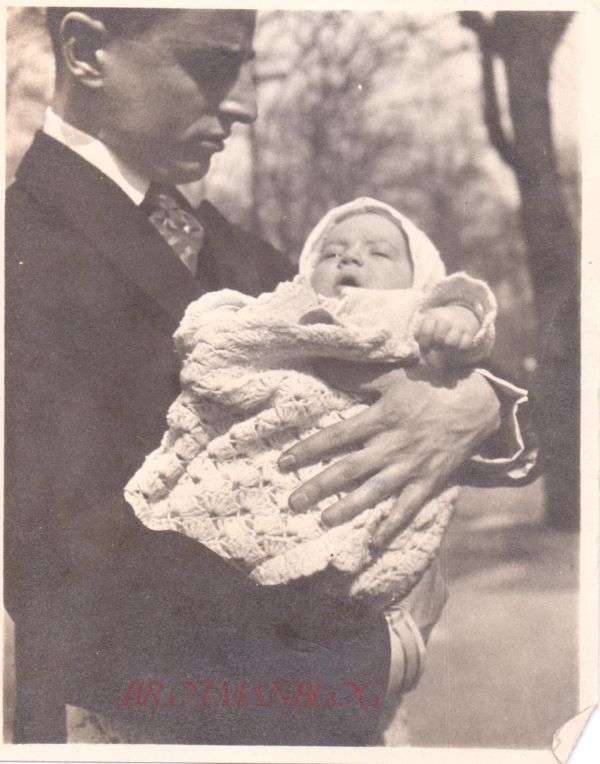
Could this be my grandfather John Cohen? And who is the baby?

I now believe that Person D is my grandfather, but I know that that’s what I am hoping for so I don’t trust my judgement. Ava was not certain, but thought it was possible.

What do you think?

Although it was not possible for Ava to identify all of the people in the group photograph, she certainly narrowed the field and provided solid and convincing reasons for her conclusions. Thank you, Ava, for a wonderful job on this extremely difficult project!


The Life of Frieda Bensew Loewenherz, Part I: 1885-1912

In the last post I published before Thanksgiving, I wrote about the two daughters of Breine Mansbach and Jacob Bensew, Roschen and Frieda. They were my grandmother’s second cousins, my second cousins, twice removed. They were the great-granddaughters of Seligmann Goldschmidt and Hinka Alexander, my three-times great-grandparents.

After publishing that post on November 16, I received a wonderful treasure trove of pictures and documents and information from Frieda Bensew’s great-grandson, Franz Loewenherz, my fourth cousin, once removed. Among those shared items was an almost 60 page memoir written by Frieda in 1970 when she was in her eighties (with an addendum written in 1972).

Reading that memoir moved me to tears—not because Frieda had a hard or sad life. To the contrary. She wrote about a life filled primarily with love and happiness—parents who adored her, a marriage filled with deep love, an adoring son and his family, and an extended family that she cared for and about and who cared for and about her. Of course, there were heartbreaking losses and difficult challenges, but throughout her memoir, Frieda’s love of live and her gratitude for all she was given came shining through.

With the permission of her great-grandson Franz, I want to share some of this memoir and also photographs of Frieda, her husband Emanuel Loewenherz, and their son Walter.  Not only is this a touching life story, it has value not only for what it reveals of family history but for its insights into the times in which Frieda lived.

As noted in my earlier post, Frieda was the youngest child of Breine Mansbach and Jacob Bensew, born February 21, 1886, in Melsungen, Germany.1 Here are two photographs of Frieda as a young child, one with her brothers Max and Heine and one alone:

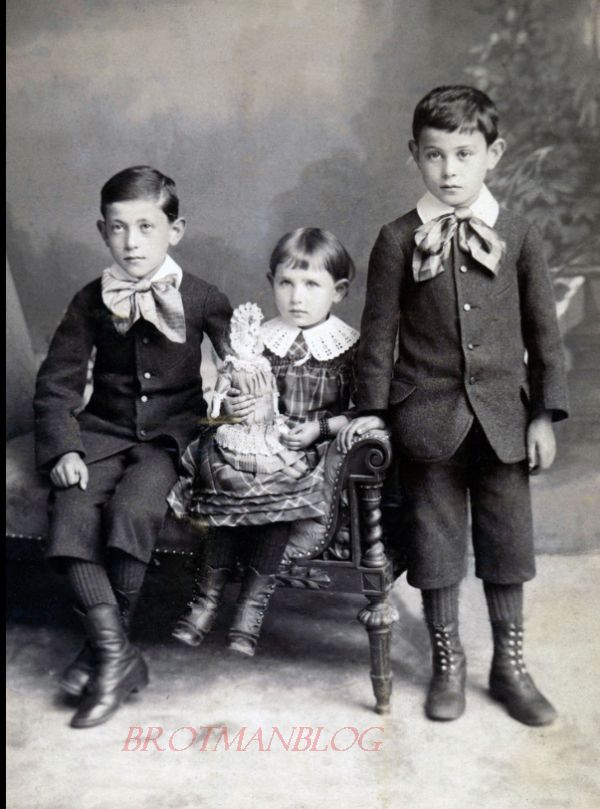
Heine, Frieda, and Max Bensew, c. 1890. Courtesy of Franz Loewenherz

Frieda Bensew c. 1890. Courtesy of Franz Loewenherz

Her memoir gives a sense of her happy childhood in Melsungen:

[Melsungen] was situated in a valley on the river Fulda, surrounded by beautiful woods. A climb of 15 minutes from my home would take me into the thick of them. Oak, Linden and Pine exuded that spicy fragrance remembered for all time. Of course in the summer when school was out this was my favorite outing. But I had also some duties to perform, not just picnic, and that was berry picking! With my friends I would start out in the morning, provided with sandwiches and a pail. It was blueberry time and our ambition was to come home with a full pail. Sitting under trees in a blueberry patch, with the sun filtering down, bees humming around us, we often had a very extended lunch hour! Our dessert were berries eaten right from the bushes. We had to hurry to finish our work as we had to be home before sundown, picking wild flowers on the way. My mother would be pleased with the crop to be used for cake, preserves and jelly. She was not so pleased with the condition of my white undies, full of squashed blueberry stains!!

Winter’s great recreation was ice skating on the river. The ice was so clear, it looked green and one could see the plant life beneath it, moving according to the current. The surface was like glass and I took many tumbles! In those days there were no snow or skating outfits. I wore woolen petticoats, long knitted black wool stockings, flannel pants. When I got home my petticoats and dress usually would stand out like a ballerina’s lampshade – frozen stiff! My mother would receive me with a warm drink and a piece of black bread after getting into dry clothes and warming myself at the stove. There were many simple pleasures, another sledding down a hill or when my father would take me along in the sleigh drawn by our horse, with hot bricks at our feet. The floor of the sleigh covered thick with straw. When we stopped at a village inn, my father would let me take a sip of his grag!

Frieda Bensew c. 1898
Courtesy of Franz Loewenherz

Frieda seemed to have a special relationship with her uncle, Julius Mansbach, her mother Breine’s brother who had, like all of Breine’s siblings, immigrated to the United States. But Julius returned to Germany and visited Frieda when she was fourteen years old or in about 1900.

My happiest recollections are, from the time I was 14 when my Uncle Julius, my mother’s youngest brother, came to visit us from America. He took me along on so many day trips to historical places, one of them the famous Wartburg, where Martin Luther was imprisoned and where he translated the Bible. And, of course, it is the setting of Wagner’s opera “Tannhaeuser.” I learned history on authentic grounds. With my uncle I saw my first American circus! Barnum and Bailey, with Buffalo Bill and his wild-west show were touring Germany then and we saw the performance in Kassel. The clowns told their jokes in English, naturally, and my uncle would translate them to me. The three ring performances left me breathless, as did the riding skill of the Indians. This was an unforgettable summer. I was so grateful to my uncle, not alone for providing so many pleasures of various kinds for me but he also was the one who taught me quite a few English expressions and the first rudiments of the language.

Frieda’s ongoing relationship with Julius as well as her uncle Louis Mansbach and grandmother Sarah Goldschmidt Mansbach as well as her use of English can be seen in the postcard she sent on September 21, 1902. The photograph is of Frieda and, I believe, her uncle Julius, probably taken while he was visiting the family in Melsungen.

Courtesy of Franz Loewenherz

Some wonderful people in the Jekkes Engaged Worldwide in Social Networking group on Facebook helped me transcribe and translate the German parts of the card:

On the right side: Dated 21-9-02 (September 21, 1902) from Melsungen:

Dearest Grandmama [Sarah Goldschmidt Mansbach] and Uncle Julius [Mansbach],

Unsere Karte von Cassel aus habt Ihr bei dieser Zeit hoffentlich erhalten, morgen ist es wieder ein heisser+ nasser Tag, wo Willi + Heine uns verlassen. Was denkt Ihr vom nebenstehendem Bild? Ist es nicht beautiful? Ende dieser Woche erwarte ich sicher einen grossen Brief von dir, sowie die Ansichtskarte.

(Translated: I hope you have received our card from Cassel by this time. Tomorrow will again be a hot and wet day when Willi + Heine leave us. What do you think of the picture on the other side? Isn’t it beautiful? At the end of the week I expect a long letter from you as well as the picture postcard.)

With best love and kisses, your Fritz

I believe Fritz was Frieda’s nickname.

Underneath Frieda’s message in a different handwriting is this note from her brothers Willi and Heine:

Meine Lieben haltet den Jontef Cholent warm.

Translation: My dears, keep the holiday Cholent warm.

Willi & Heine

I believe that Willi and Heine were sailing to the US, Willi to return having lived in the US since 1885 and Heine coming for the first time: his naturalization card states that he arrived on September 30, 1902.2;I had to smile when I checked and saw that Rosh Hashanah that year started on the next night, October 1. So Willi and Heine must have spent the holidays with the family in Philadelphia. (For those who do not know, cholent is traditional Jewish dish—a stew that usually has meat and vegetables. Here is a typical recipe.)

Along the margin of the right side of the card, Frieda wrote:

Hast du die K. abgeliefert? Wenn nicht, bekommst du keine wieder von mir.

Translation: Did you deliver the K? [card, I assume] If not, you won’t get another from me.

The left side is mostly in English; at the top it says “Best regards to Uncle Louis, Aunt Cora, and Rebecca.” This would be referring to her mother’s brother Louis Mansbach and his family.

Under the picture it says: “Im “Fidelio” war es grossartig [“Fidelio was fabulous]. If you, dear uncle, come again, I will sing the “Arien” [arias] for you. Don’t stay long! Otherwise you are well.” I assume this was directed to her dear uncle Julius Mansbach.

Frieda received a good education at a school in Kassel and had a passion for music and art. And, as she wrote, she wanted to see the world, in particular, America. By the time she was 21 in 1907, all her brothers had immigrated to America, and she also decided to move across the world from her birth place:

It was only natural that I wanted to go to America. Most of our family lived here, from three generations back. My grandparents [Sarah Goldschmidt and Abraham Mansbach] had come to Philadelphia where most of their children lived and some in the west, in Colorado. My mother [Breine] was the only one who remained in Germany as she had a family and my father refused to leave. When the time came for me to investigate, I did so with the promise of my parents that they would follow after I had familiarized myself with my new surroundings. My disappointment was great when my father declared he changed his mind. They did not wish me to return, however, insisting that I had a right to my own life. That is how loving and understanding and unselfish they were.

This paragraph touched me deeply— thinking of Frieda’s courage and determination and her parents’ respect for it. And yet I also could feel how torn both she and they must have been about this separation.

And so, as I wrote before, Frieda left home in 1907 when she was 21 and joined her brothers and other family in the US. First, she settled in Denver where some of her brothers as well other Mansbach cousins were living, and once again she demonstrated her determination and independence:

After a few months of visits with my family in Denver I had acquired quite a vocabulary and felt able to enter an American School of business. There I studied besides English, correspondence, shorthand and light bookkeeping and typing. I knew German shorthand, and the switch was not easy. It required extreme concentration as, in addition, I did not know business language and form either. Well, I made it and kept step with my class, all American born. I finished even ahead of time and got my first job shortly after. And what was the requirement? German shorthand! The irony of it all! 90% of the dictation was in German and 10% in English.

From what I gathered in the memoir and from what I know from the 1910 census, this job was in Chicago, and as we saw, in 1910, Frieda’s brothers Julius, Max, and Heine were also living in Chicago. Frieda wrote about these days as a single young woman in Chicago with great joy—describing activities and trips she took with her friends and also a trip to Philadelphia to see her relatives. This trip probably took place in 1912 because Frieda notes that her cousin Reta Dannenberg was engaged, and Reta was married in December 1912:3

My Aunt Hannah [Mansbach Dannenberg] and Uncle and their three children made our visit of a few days most enjoyable, Rita the oldest was engaged, Arthur a medical student at the U. of Penn. And Katrinka, the youngest, showed us the sights. We had a lot of fun! Then on to New York. My uncle Julius-who was in this country on business from Germany (he had returned there a few years before with his wife, my cousin Frieda on account of her parents’ wishes) entertained us royally.

In this one paragraph I learned three things. First, that Frieda and presumably the other Bensews were very much in touch with their mother’s Mansbach relatives in the US. Secondly, that the Frieda Bensew who married Julius Mansbach was in fact related to this Frieda Bensew and her family (though I still don’t know how). And thirdly, I learned why Julius Mansbach had returned to live in Germany—to satisfy the wishes of his in-laws.
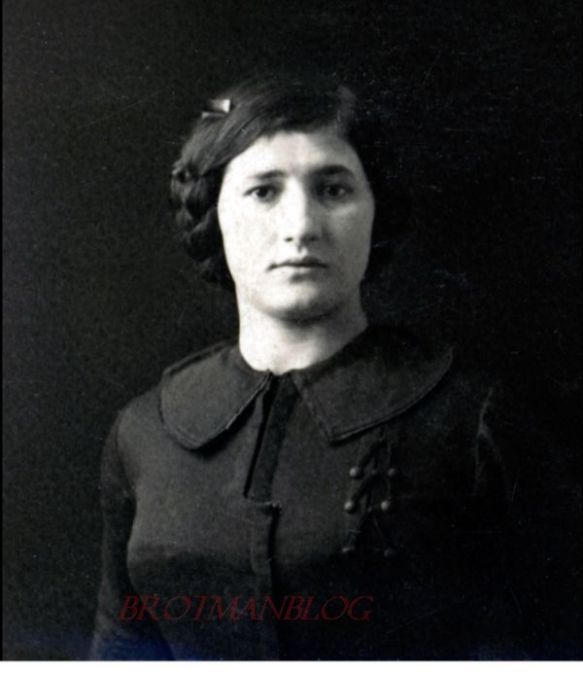
Frieda Bensew as a young woman. Date unknown. Courtesy of Franz Loewenherz

From New York, Frieda and a friend named Rose sailed to Germany where they spent the summer of 1912. Frieda was delighted to be with her parents and sister Roschen, but the separation at the end of that visit was difficult. Frieda wrote:

And then came the time to say good bye again. It was not easy – My parents were so kind and understanding.They realized that I had outgrown my old environment and that my opportunities for a fuller life were so much better in America, the land which I loved and do to this day. Perhaps, being foreign born, gave me even a deeper appreciation of the freedom and privileges so many seem to take for granted. My parents and I were grateful for the time we spent together and kept up a brave front at parting.

She stopped in Philadelphia on her way home and was invited to stay for her cousin Reta’s wedding that coming December. She had a wonderful long visit there, and then after the wedding she received a letter from her brother Julius about a new job opportunity in Chicago, so she left to start her new job. That decision was life-changing, as we will see in the next post.


All excerpts from Frieda Loewenherz’s memoir and all the photographs in this post are published with the permission of Franz Loewenherz, her great-grandson. My deep gratitude to Franz for his generosity.



  1.  Hessisches Hauptstaatsarchiv; Wiesbaden, Deutschland; Bestand: 920; Laufende Nummer: 4574, Ancestry.com. Hesse, Germany, Births, 1851-1901 
  2.  “Illinois, Northern District Naturalization Index, 1840-1950,” database with images, FamilySearch (https://familysearch.org/ark:/61903/3:1:939N-FGS7-2?cc=1838804&wc=M6TM-Q6X%3A165129401 : 20 May 2014), B-524 to B-550 Gustov Joseph > image 983 of 6652; citing NARA microfilm publication M1285 (Washington, D.C.: National Archives and Records Administration, n.d.). 
  3. Ancestry.com. Philadelphia, Pennsylvania, Marriage Index, 1885-1951, Marriage Year: 1912, Marriage License Number: 289763