Of Rabbit Holes and Twisted Trees and the Curse of Endogamy

Now that I have emerged from the Mansbach rabbit hole I dove into weeks ago, I can return to the story of my direct ancestors, Gerson Katzenstein and Eva Goldschmidt and their children, including my great-grandmother Hilda Katzenstein.  As I wrote previously, Gerson was one of eight children of Scholum Katzenstein, including four full siblings, two of whom died as children, and three half-siblings, one of whom died as a child. As best I can tell Gerson was the only one of the eight to leave Germany and come to the United States.

Gerson and Eva were married in Oberlistingen in June 1847, and then settled in Gerson’s home town of Jesberg, where they had three children: Scholum (1848, named for Gerson’s father), Jacob (1851), and Brendina (1853, named for Gerson’s mother, Breine Blumenfeld).

marriage-record-of-gerson-katzenstein-and-eva-goldschmidt

Marriage record of Gerson Katzenstein and Eva Goldschmidt HHStAW fonds 365 No 673, Arcinsys Hessen

Gerson and Eva immigrated to the US in 1856 with Scholum, Jacob, and Brendina. A fourth child Perry was born a few months after they had settled in Philadelphia. In 1858, they had a fifth child, Hannah, and in 1860 they were all living in Philadelphia where Gerson was working as a salesman.  As noted in an earlier post, there were three others living in the household, Abraham “Anspach,” who I believe was actually Abraham Mansbach (III), David Frank, a bookkeeper, and Marley Mansbach, who I believe was Abraham Mansbach’s cousin and only related to Gerson through his sister Hannchen’s marriage into the Mansbach family.

Gerson Katzenstein in the 1856 Philadelphia directory

Gerson Katzenstein in the 1856 Philadelphia directory

Gerson Katzenstein and family 1860 US census Year: 1860; Census Place: Philadelphia Ward 13, Philadelphia, Pennsylvania; Roll: M653_1163; Page: 519; Image: 105; Family History Library Film: 805163

Gerson Katzenstein and family 1860 US census
Year: 1860; Census Place: Philadelphia Ward 13, Philadelphia, Pennsylvania; Roll: M653_1163; Page: 519; Image: 105; Family History Library Film: 805163

On August 17, 1863, Gerson and Eva had their sixth and final child, my great-grandmother Hilda.

The family suffered a terrible loss on December 17, 1866, when their eight year old daughter Hannah died from scarlet fever.  She was buried at Adath Jeshurun cemetery in Philadelphia. I have to wonder what impact that had on the family, especially little three year old Hilda, who must have been very frightened and confused.

Hannah Katzenstein death certificate "Pennsylvania, Philadelphia City Death Certificates, 1803-1915," database with images, FamilySearch (https://familysearch.org/ark:/61903/3:1:S3HY-DTXQ-JWY?cc=1320976&wc=9FRX-W38%3A1073285701 : 16 May 2014), > image 316 of 1079; Philadelphia City Archives and Historical Society of Pennsylvania, Philadelphia.

Hannah Katzenstein death certificate
“Pennsylvania, Philadelphia City Death Certificates, 1803-1915,” database with images, FamilySearch (https://familysearch.org/ark:/61903/3:1:S3HY-DTXQ-JWY?cc=1320976&wc=9FRX-W38%3A1073285701 : 16 May 2014), > image 316 of 1079; Philadelphia City Archives and Historical Society of Pennsylvania, Philadelphia.

In 1870, Gerson and Eva were living with their five surviving children.  Scholum was listed as Joseph and was 22; Jacob was 18, Brendina 15, Perry 14, and Hilda was seven.  The 1870 census was taken twice because there were felt to be errors in the first enumeration.  For the Katzenstein family, the first enumeration is barely legible and is missing some of the children, but indicates that Gerson was working as a clerk in a store.  The second enumeration is quite clear and includes all the children, but has no information about occupations.

gerson-katzenstein-1870-census-2

Gerson Katzenstein on 1870 census, first enumeration Year: 1870; Census Place: Philadelphia Ward 16 District 48, Philadelphia, Pennsylvania

gerson-katzenstein-1870-census-1

Gerson Katzenstein and family 1870 census, second enumeration Year: 1870; Census Place: Philadelphia Ward 16 Dist 48 (2nd Enum), Philadelphia, Pennsylvania; Roll: M593_1429; Page: 708B; Image: 258; Family History Library Film: 552928

Brendina Katzenstein, the oldest daughter and third child of Gerson and Eva, was the first to marry.  According to the 1900 census, she married Jacob Schlesinger in 1871 when she was only eighteen years old.  It took some serious digging and the help of the German Genealogy Facebook group to find some background on Jacob.  First, from his death notice, I saw that he was born in “Epplagan” in Germany.

jacob-schlesinger-death-notice

Nick in the German Genealogy group figured out that that was Eppingen.  I then searched the Landesarchiv for Baden Wurttemburg and found Jacob’s birth record, which Nick helped me translate:

Jacob Schlesinger birth record from Eppingen

Jacob Schlesinger birth record from Eppingen,  Landesarchiv Baden-Wurtenberg, 390 Nr. 1320, 1 Band Gliederungssymbol Eppingen, israelitische Gemeinde: Standesbuch 1811-1870 Bild 235

The child was born on March 3rd, 1843 and named Jacob. The father was Jacob (?) Schlesinger, a schützbürger (see note below) and hand[e]lsmann (merchant) and his wife Guste? born Sülzberger.

[UPDATE: Thanks to Dorothee Lottmann-Kaeseler for explaining the word “schutzburger” and providing a cite with this explanation: The “Law on the Situation of the Jews” (“Gesetz über die Verhältnisse der Juden”) from 1809 recognized the Jewish religious community as a church. Constitutionally, Jews were to be treated as free citizens. Their position in the municipalities did not change however, they remained only “protected citizens” (“Schutzbürger”) who did not have the right to be elected to a local council and did not have rights of usage of the common land.]

Nick wasn’t sure whether Jacob’s father’s name was Jacob, and I was skeptical of the fact that his father would also have been a Jacob.  Looking at the record itself, it certainly looks like “Jacob” was crossed out and something else was written over it.  Perhaps the scribe who entered the record confused the child’s name and the father’s name.

Although I could not find Jacob Schlesinger on any US census record before 1880, I was able to locate him in a number of Philadelphia directories where he was living at the same address with men named Abraham, Israel, and Myer Schlesinger, all of whom, like Jacob, were working as butchers.  I assumed these were his relatives, and so I searched for information about them.

I found a passenger manifest that shows an Israel Schlesinger and his family arriving in the US in 1860; along with Israel was his wife Gustel or Gurtel, sons Maier (26) and Abraham (11), and two daughters, Fanny (20) and Malchen (15).  There was no son named Jacob on this manifest.

Family of Israel Schlesinger 1860 ship manifest Year: 1860; Arrival: New York, New York; Microfilm Serial: M237, 1820-1897; Microfilm Roll: Roll 205; Line: 1; List Number: 918 Description Ship or Roll Number : Roll 205 Source Information Ancestry.com. New York, Passenger Lists, 1820-1957

Family of Israel Schlesinger 1860 ship manifest
Year: 1860; Arrival: New York, New York; Microfilm Serial: M237, 1820-1897; Microfilm Roll: Roll 205; Line: 1; List Number: 918
Description
Ship or Roll Number : Roll 205
Source Information
Ancestry.com. New York, Passenger Lists, 1820-1957

Then I found another manifest listing a fourteen year old named Jacob Schlesinger arriving in 1857 with what appears to be an older sibling named Hagar.  Since my Jacob Schlesinger reported on the 1910 census that he’d arrived in 1857 (and in 1855 according to the 1900 census) and he would have been fourteen in 1857, I assumed that this was the right Jacob.  Further research uncovered a Hagar Schlesinger, a woman of the right age, who was living in Philadelphia in 1885, so she was probably his sister.

Jacob and Hagar Schlesinger 1857 ship manifest Year: 1857; Arrival: New York, New York; Microfilm Serial: M237, 1820-1897; Microfilm Roll: Roll 173; Line: 1; List Number: 497

Jacob and Hagar Schlesinger 1857 ship manifest
Year: 1857; Arrival: New York, New York; Microfilm Serial: M237, 1820-1897; Microfilm Roll: Roll 173; Line: 1; List Number: 497

But I still had no proof that this Jacob was the son of Israel Schlesinger.  He could have been just a nephew or a cousin.  So I searched for a birth record for one of Israel’s sons and found this one for Myer, as translated by Nick:

Myer Schlesinger birth record landesarchiv_baden-wuerttemberg_generallandesarchiv_karlsruhe_390_nr-_1320_bild_174_4-1128670-174.jpg

Myer Schlesinger birth record
landesarchiv_baden-wuerttemberg_generallandesarchiv_karlsruhe_390_nr-_1320_bild_174_4-1128670-174.jpg

The child was born June 4th, 1834, named Mozes and the parents are Israel Schlesinger and Geitel Si?lzberger.

Myer was also the son of Geitel Sulzberger and Israel (not Jacob) Schlesinger.  Looking back at Jacob’s birth record, it does seem that “Israel” was written over “Jacob” and that thus Jacob’s father was also Israel Schlesinger.  I also found a birth record for Hagar Schlesinger; she also was the daughter of Israel and Geitel.

Thus, I feel fairly comfortable concluding that my Jacob Schlesinger was a son of Israel Schlesinger from Eppingen, especially since he and Israel were living at the same address in 1865, according to the Philadelphia directory for that year. In addition, Jacob, like Israel, Myer, and Abraham, was a butcher in Philadelphia, as seen in numerous entries in the Philadelphia city directories as well as census reports.

Brendina and Jacob Schlesinger had three children listed on the 1880 census: Heloise (5), Solomon (4), and Alfred (1). Jacob was still working as a butcher.  Brendina and Jacob would have a fourth child, Sidney, in 1880, and a fifth, Aimee, born in 1887.

Jacob and Brendina Schlesinger and family 1880 census Year: 1880; Census Place: Philadelphia, Philadelphia, Pennsylvania; Roll: 1176; Family History Film: 1255176; Page: 156A; Enumeration District: 301; Image: 0314

Jacob and Brendina Schlesinger and family
1880 census
Year: 1880; Census Place: Philadelphia, Philadelphia, Pennsylvania; Roll: 1176; Family History Film: 1255176; Page: 156A; Enumeration District: 301; Image: 0314


The 1870s were also active years for Brendina’s three brothers. The oldest brother, Scholum Joseph, had lived in many places since coming with his family to the US.  An 1896 profile of him reported that he had left his family for Leavenworth, Kansas, when he was fourteen to learn how to be a cigar maker, but since he did not arrive until he was eighteen in 1856, that seems more myth than truth.  The profile goes on to state that after being in Kansas for a number of years, he returned to Philadelphia, but eventually gave up the cigar trade because of health concerns.  The article continues by saying that he then “went to Winchester, VA., and took a clerkship, remaining for five years. Thence he went to Uhrichsville, Ohio, thence to New Castle and on the nineteenth of April 1871, he came to Washington [Pennsylvania].”  “The Saturday Evening Supper Table,” Washington, Pennsylvania, June 27, 1896, found here (my cousin Roger Cibella’s genealogy website).

The U.S. and Canada, Passenger and Immigration Lists Index, 1500s-1900s, database on Ancestry, confirms that by 1873, Scholum, also known as S.J. or Joseph Katzenstein, had moved to Washington, Pennsylvania.  That is, he moved to the small town in western Pennsylvania where his mother’s uncle Simon Goldschmidt and his children were living at that time.  Readers with excellent memories may recall that Simon Goldschmidt was married to Fanny Schoenthal, my great-grandfather Isidore Schoenthal’s sister. By 1881 Isidore was also living in Washington, Pennsylvania.

S.J.’s move to Washington, Pennsylvania, may have had long lasting repercussions for my family, as I am fairly confident that he was the one who engineered the introduction of his younger sister, my great-grandmother Hilda, to Isidore Schoenthal, my great-grandfather.

The Daily Republican (Monongahela, Pennsylvania) 11 Aug 1887, Thu • Page 4

The Daily Republican
(Monongahela, Pennsylvania)
11 Aug 1887, Thu • Page 4

S.J Katzenstein married Henrietta Sigmund in 1875.  Henrietta was born in 1851 in Baltimore to Ella Goldschmidt and Albert Sigmund. That added yet another twist to my family tree because Ella Goldschmidt was the daughter of Meyer Goldschmidt whose brothers were Seligmann Goldschmidt, father of Eva Goldschmidt Katzenstein, and Simon Goldschmidt, husband of Fanny Schoenthal.  In other words, Eva Goldschmidt Katzenstein was Ella Goldschmidt Sigmund’s first cousin, meaning that S.J. Katzenstein married his maternal second cousin, Henrietta Sigmund.

ella-goldschmidt-to-eva-goldschmidt

But let me stay focused on the Katzensteins rather than diving into the Goldschmidt rabbit hole.

S.J. and Henrietta, who was also known as Dot or Dottie, had a daughter Moynelle in 1879.  S.J., who is listed as Joseph on the 1880 census, was working as a clothing merchant in Washington, Pennsylvania. He and Henrietta would have five more children: Milton (1881), Howard (1882), Ivan (1884), Earl (1885), and Vernon (1892).

S. Joseph Katzenstein and family 1880 census Year: 1880; Census Place: Washington, Washington, Pennsylvania; Roll: 1202; Family History Film: 1255202; Page: 577A; Enumeration District: 270

S. Joseph Katzenstein and family 1880 census
Year: 1880; Census Place: Washington, Washington, Pennsylvania; Roll: 1202; Family History Film: 1255202; Page: 577A; Enumeration District: 270

S.J. was not the only child of Gerson and Eva Katzenstein to leave Philadelphia for western Pennsylvania in the 1870s.  In 1878, Perry Katzenstein, the third brother, was listed in the Pittsburgh directory as a clerk; the following year his brother Jacob joined him.  Both were living at 25 Second Avenue and working as salesmen.  Although I cannot find either of them on the 1880 census, both were listed in the 1881 Pittsburgh directory, still working as salesmen and still living together, though now at 188 Wylie Avenue. (Perry also appears in the 1880 directory, but Jacob does not.)

As for their parents and little sister Hilda, they were still living in Philadelphia in 1880.  Gerson continued to work as a clerk in a store.  Living with them, in addition to a number of boarders, was Louis Mansbach, listed as Gerson’s nephew, age 31, and born in “Prussia.” At first I thought this was Louis Mansbach, son of H.H. Mansbach, who would have been Gerson’s great-nephew.  But that Louis Mansbach was far too young and born in the US. So who was this Louis Mansbach?

Year: 1880; Census Place: Philadelphia, Philadelphia, Pennsylvania; Roll: 1173; Family History Film: 1255173; Page: 274B; Enumeration District: 219; Image: 0561

Year: 1880; Census Place: Philadelphia, Philadelphia, Pennsylvania; Roll: 1173; Family History Film: 1255173; Page: 274B; Enumeration District: 219; Image: 0561

Well, remember that post where I was trying to sort out all the different men named Abraham Mansbach? One of them, whom I called Abraham II, was the son of Leiser Mansbach and grandson of Abraham Mansbach I.  Abraham II was the brother of Marum Mansbach who married Hannchen Katzenstein, Gerson Katzenstein’s half-sister.  And Abraham II had a son in 1849 who was named for his grandfather: Leiser Mansbach II. He was therefore the nephew of Marum Mansbach and Hannchen Katzenstein.  Leiser became Louis, and he was living with Gerson and Eva Katzenstein in 1880, working as a veterinary surgeon.

And so you might be thinking, “Well, he wasn’t Gerson’s nephew.  He was Gerson’s brother-in-law’s nephew.” And you might be thinking, “Perhaps Gerson was just being liberal in using the term ‘nephew.’”

But, alas, it’s not that simple. Once again there is a twist in the tree.  Louis Mansbach’s mother was Sarah Goldschmidt, Eva Goldschmidt’s sister.  So Louis Mansbach was in fact Eva Goldschmidt Katzenstein’s nephew as well as Gerson’s brother-in-law’s nephew.

leiser-mansbach-to-gerson-katzenstein


And on that confusing note, I am going to go get a breath of fresh air and curse the endogamy gods who make using DNA results so utterly pointless in my family research.

 

Ernest Lion’s The Fountain at the Crossroad: An Unforgettable Book

I am very excited to announce that Ernest Lion’s memoir, The Fountain at the Crossroad, has now been published and is available on Amazon.com both as a paperback ($10.50) and an ebook ($2.99). [UPDATE: the Kindle version is now available!] It has been my honor and privilege to bring this book to the public with the permission and assistance of Ernest’s son Tom.  I did this because I found the book unforgettable and because I don’t want Ernest or his life to be forgotten.  Tom and I are not deriving any financial gain from sales of the book. All net proceeds received from sales of the book will be donated to the United States Holocaust Memorial Museum in memory of Ernest Lion.

I have written about some aspects of Ernest’s life on the blog as he was married to my cousin, Liesel Mosbach, granddaughter of Rosalie Schoenthal, my grandfather’s sister.  Ernest and Liesel were deported from Germany to Auschwitz in early 1943; Liesel was murdered there, but Ernest survived.

The story of what he endured and how he survived is moving and horrifying.  His determination and courage in the face of unimaginable suffering is a story of what it means to be human when you are surrounded by inhumanity. And Ernest’s escape from the Nazis kept me on the edge of my seat even though I knew that he would survive.

But the book is not only about Ernest’s experience during the Holocaust.  It also tells the story of his childhood growing up with his parents in Germany and of his early adulthood when he dreamed of being an actor.  In addition, Ernest wrote about his life after the war—how he rebuilt his life in the US, starting all over, scarred by his experiences, but nevertheless determined to have a full and meaningful life.

Ernest only started talking about his Holocaust experiences late in his life, and then he was persuaded to write his memoirs.  In doing so, he relived much of the pain, but also reached a very poignant conclusion about the value of his own life.

If you have an interest in history, in World War II, in the Holocaust, in fact, if you have an interest in human beings and what they are made of, you should read this book. You can find it here.

Sliding Doors

Back in April, I wrote about the family of Rosalie Schoenthal, my great-grandfather’s sister, the one who stayed in Germany to marry Willy Heymann.  Most of what I knew of their fate I learned from the memoir written by Ernest Lion, the man who married Rosalie and Willy’s granddaughter, Liesel Mosbach.  Liesel, her sister, her parents, and her aunt, were all victims of the Holocaust. Ernest Lion memorialized them all in his heartbreaking memoir, The Fountain at the Crossroad.

As I mentioned in a subsequent post written for Yom Hashoah in May, I was so moved by Ernest’s story that I tracked down his son Tom to ask about getting it published so that it could be more widely read.  Since then, I have been working with Tom to edit and format the memoir for publication.  (We’ve run into a few obstacles, but that’s a story for another day.)  I am hoping that sometime soon the book will be available for distribution. When it is, I will post the relevant information on the blog.

But none of this would be possible without the help of another of my cousins by marriage, Sharon.  Sharon is married to the great-grandson of Simon Schoenthal, who was also my great-grandfather’s brother as well as Rosalie Schoenthal Heymann’s brother.  And Sharon, who writes the blog The Heart and Craft of Life Writing, has a great deal of knowledge not only about writing, but also about getting your writing published.  Sharon and her husband were the ones who shared with me the remarkable memoir written by Hettie Schoenthal Stein.  So when I decided to try and get Ernest Lion’s book into a publishable format, I turned to Sharon for help.

Sharon spent hours through email and Skype instructing me on how to turn a typed manuscript into a format that is not only more readable, but also professional looking.  She has been incredibly patient with me, as all this was new to me, and the old brain isn’t quite as flexible as it once was.  I cannot possibly express how grateful I am to her for her help.

One of the last things we worked on was inserting photographs into the memoir, and as she was doing this, Sharon was struck by the resemblance she saw between Liesel Mosbach Lion, Ernest’s first wife and our mutual cousin, and Sharon’s mother-in-law, Blanche Stein Lippincott.  She sent me a photograph of Blanche and her family that I had not previously seen.

ezzie-blanche-parvin-1940

Blanche Stein Lippincott and her family 1940 Courtesy of the Lippincott family

And here is a photograph of Liesel Mosbach and Ernest Lion that I obtained from Ernest’s son to put into his book:

wedding-ernest-liesel-dec-18-1940-600-dpi

Liesel Mosbach and Ernest Lion Courtesy of the Lion Family


The resemblance is striking.  Blanche and Liesel were second cousins, but from these two photographs, they could have been sisters.

jpg-blanche-to-liesel


But what different lives and fates they had, and the expressions on their faces in these two photographs reflect those differences. While Blanche looks healthy and happy, Liesel looks drawn and sad, even on her wedding day.

Blanche was born in 1912 in Tucson, Arizona, and grew up living on the American frontier in the 1910s and 1920s.  Her mother Hattie and her aunt Gertrude had ventured out west after growing up in Philadelphia and Atlantic City.  They did later return to the East, as I’ve written, and Blanche spent the rest of her life living in New Jersey.  She married in 1937 and raised two children with her husband Ezra.  Blanche lived a long and happy life, making it to almost 101 years old before dying in 2013.  Her mother Hettie had made it to 103.

Blanche Stein Lippincott with her great-granddaughter 1996

Blanche Stein Lippincott with her great-granddaughter 1996

In contrast, Liesel lived a short and tragic life.  She was born in 1921 in Germany, where her father Julius Mosbach owned a fruit and vegetable stand. The family was probably living a comfortable enough life until Hitler came to power.  When Liesel married Ernest Lion on December 18, 1939, conditions for Jews were terrible in Germany, and the young couple had no idea what the future would bring.

There would, in fact, be no future. As a result of the Nazi oppression and the loss of his business, Julius Mosbach suffered a nervous breakdown; in 1941, he was sent to an institution where instead of being treated, he was murdered by the Nazis. In 1942, Liesel’s mother, sister, and aunt, and Ernest’s father were all deported and eventually killed in a Nazi concentration camp.  In 1943, Liesel and Ernest were deported to Auschwitz, where Liesel was killed.  Ernest survived and eventually escaped; he became the voice for the whole family.

Thus, Blanche and Liesel, second cousins who looked like sisters, had far different lives and fates.  I can’t help but think, what if Rosalie and Willie had come to the US like almost all of Rosalie’s siblings? What if Liesel and her sister Grete had grown up in Pennsylvania or anywhere else in the United States?

As the president of our synagogue reminded us on Rosh Hashanah, we cannot control where we are born, when we are born, or to whom we are born.  Some of us are blessed with good luck in all of those things while others are not.  We should never take that for granted.

Letters from Frank: A Soldier in World War I

In my last post I posted and transcribed three letters written to Francis Oestreicher aka Frank Striker by various relatives between 1907 and 1939.  In this post I want to share the letters that Frank wrote home while he was serving in World War I.  These letters were all written in the fall of 1918, beginning before Frank was sent overseas and ending with one in December, 1918, a month or so after the war had ended.

Frank Striker WW1

Francis Oestreicher in World War I

As with the last post, I have tried to keep the transcriptions true to the text of the letters, only making some punctuation changes and some spelling changes and adding paragraphing to make them more easily read.

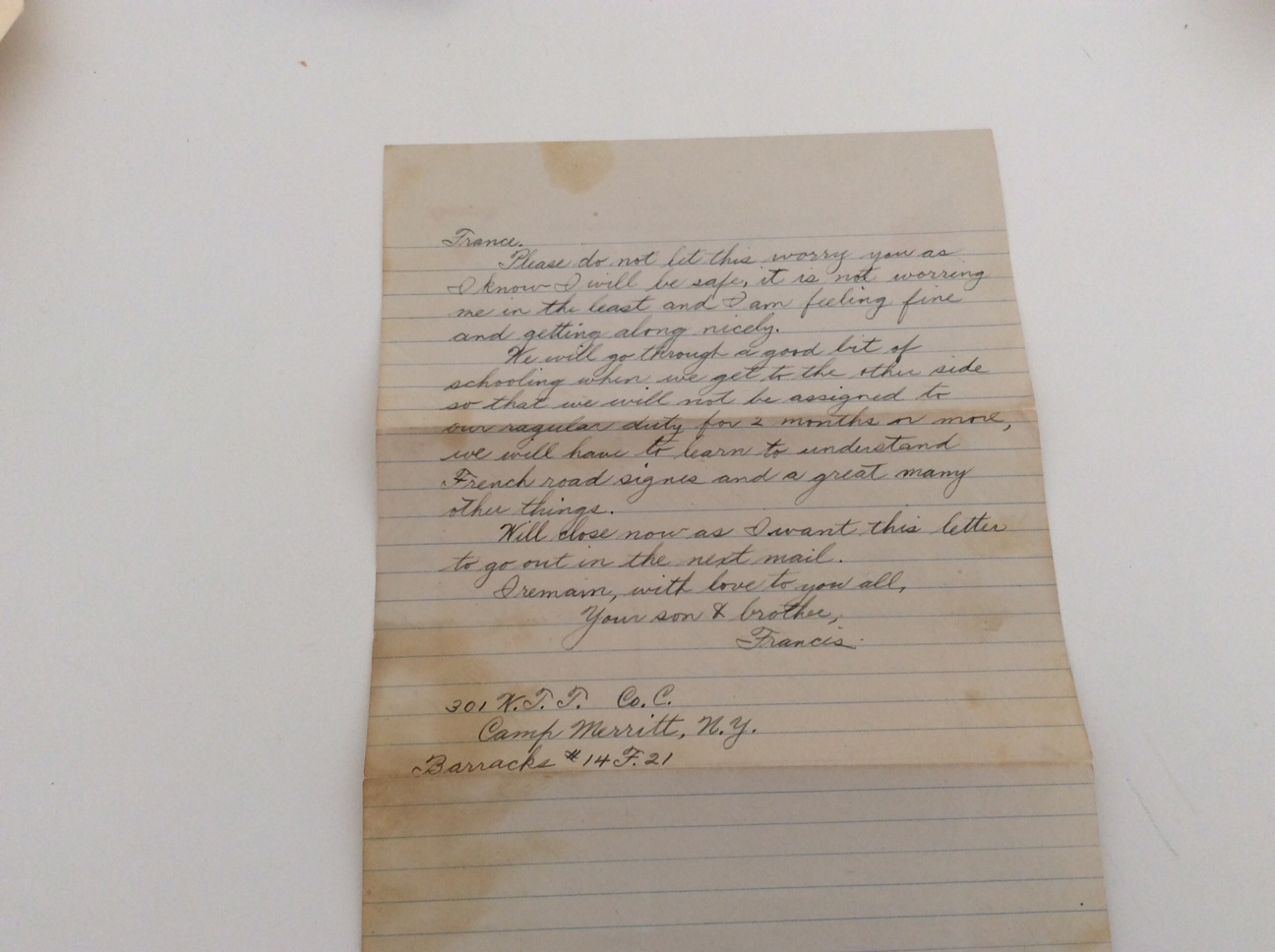
The first letter was written from Camp Meritt, New Jersey, on September 20, 1918.

IMG_1847 IMG_1848


Camp Meritt, NJ September 20, 1918

Dear Mother, Father & Sister,

As you can see by the heading, I am now located at Camp Merrit. This accounts for my not having written yesterday. We left Camp Holabird yesterday morning and arrived here to[o] late last night to write.  We are located about 15 miles from New York and the camp is more like a park than anything else. It is layed out beautifully and is made to accomidate 70,000 men, all of whom sleep in barracks. There are no tents here.

Am going to try to get a pass to go to New York Sunday, but I doubt it if they will give me one, as they are very anxious to keep us together.

I suppose it will not come as a surprise when I tell you that we are prepairing to go across, we do not know just what day, but it may be to-morrow and it may not be for 2 weeks or more, so please do not worry if you do not hear from me for 3 or 4 weeks.  It often takes this long or longer for mail to come across. Our trucks are already in France.

Please do not let this worry you as I know I will be safe. It is not worrying me in the least and I am feeling fine and getting along nicely.

We will go through a good bit of schooling when we get to the other side so that we will not be assigned to our regular duty for 2 months or more. We will have to learn to understand French road signs and a great many other things.

Will close now as I want this letter to go out in the next mail.

I remain, with love to you all,

Your son & brother,

Francis

I love the tone of this letter—a young man trying to reassure his parents that he is and will be fine.  How can he possibly say he knows he will be safe? I had to laugh at the idea that his parents would not worry when their child was going off to fight in a war that had already seen a tremendous number of fatalities. But so far Frank hadn’t seen anything but American army camps.

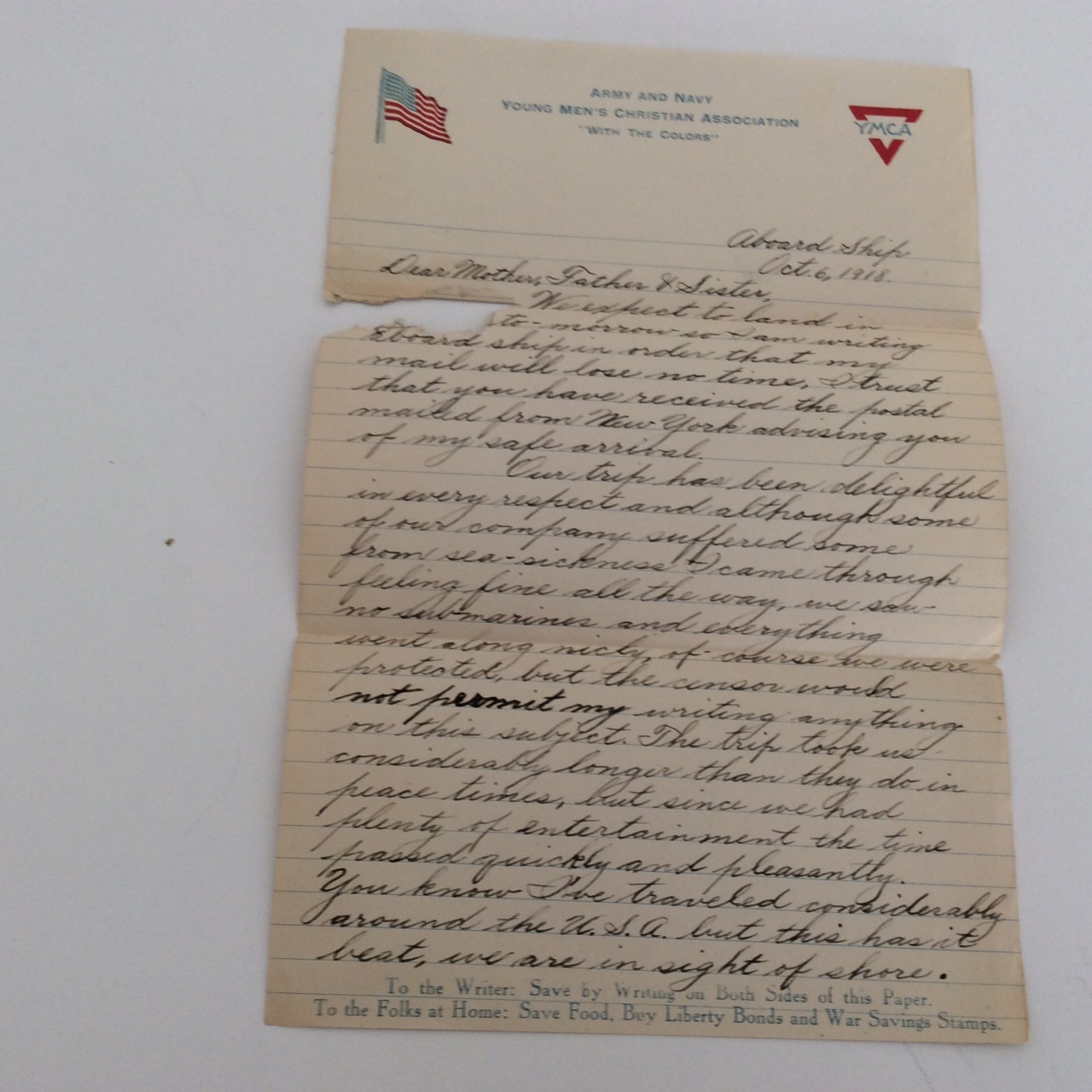
The second letter was written while Frank was sailing to Europe with the army:

IMG_1821


Aboard ship October 6, 1918

Dear Mother, Father, & Sister,

We expect to land in [place name torn off] tomorrow so I am writing aboard ship in order that my mail will lose no time.  I trust that you have received the postal mailed from New York advising you of my safe arrival.

Our trip has been delightful in every respect and although some of our company suffered some from sea-sickness, I came through feeling fine all the way. We saw no submarines and everything went along nicely.  Of course we were protected, but the censor would not permit my writing anything on this subject.  The trip took us considerably longer than they do in peace times, but since we had plenty of entertainment the time passed quickly and pleasantly.  You know I’ve traveled considerably around the U.S.A. but this has it beat, we are in sight of shore.

[Letter ends there; not sure if there was more as there is no signature.]

Once again, Frank is being reassuring.  He writes as if he’s on a cruise, traveling to Europe, except for the hints about censorship and submarines.  Was he really feeling as calm as his letter claims?

There are no letters between this one and the end of the war on November 11, 1918.  I don’t know whether that means Frank didn’t write any letters during that time or just that they have not been preserved or located.

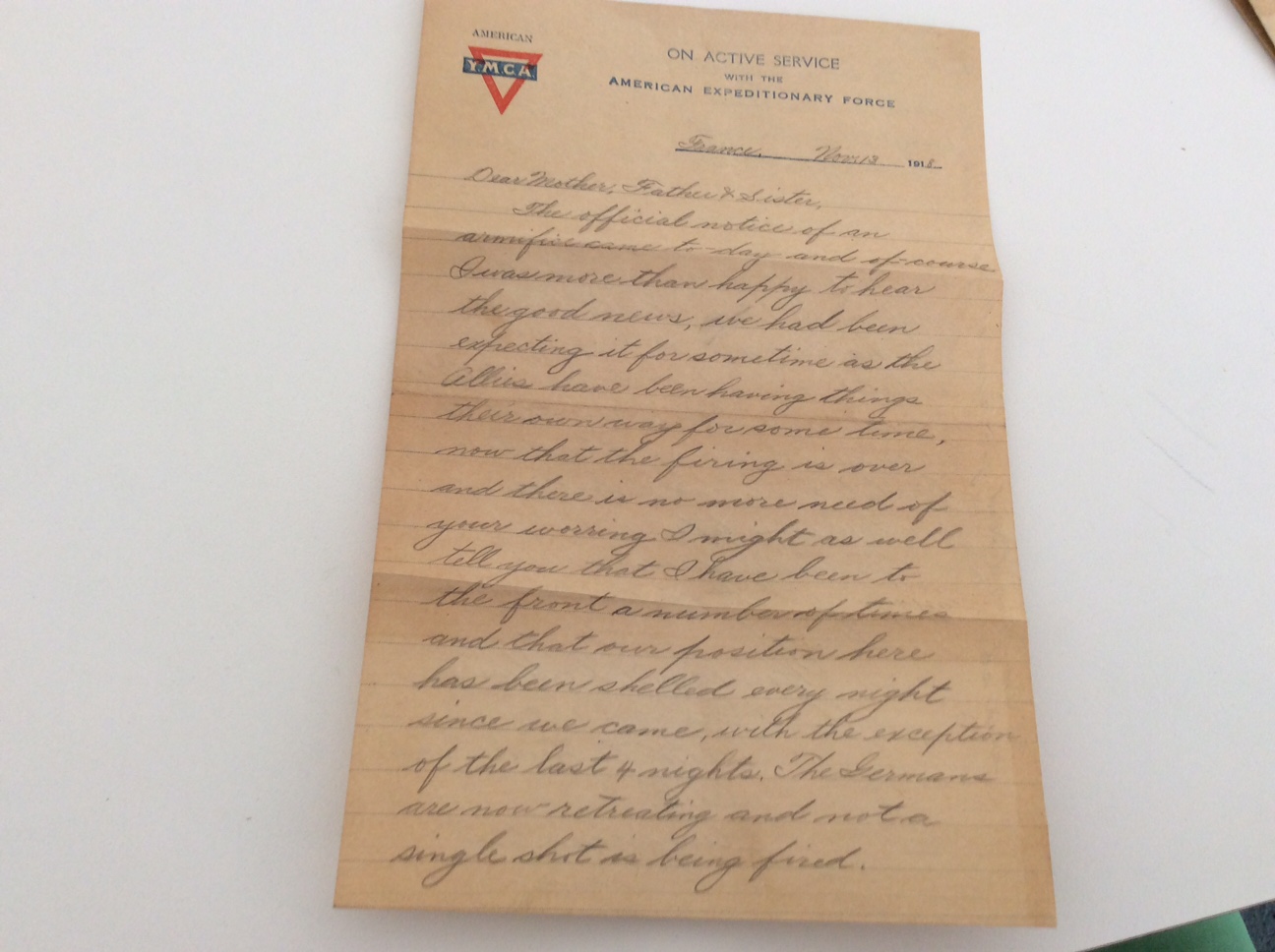
The next letter was written two days after the armistice:

Frank November 13 letter 1

Frank November 13 1918 letter 2


France  November 13, 1918

Dear Mother, Father & Sister,

The official notice of an armistice came to-day and of course I was more than happy to hear the good news.  We had been expecting it for sometime as the Allies have been having things their own way for some time. Now that the firing is over and there is no more need of your worring, I might as well tell you that I have been to the front a number of times and that our position here has been shelled every night since we came, with the exception of the last 4 nights.  The Germans are now retreating and not a single shot is being fired.

The only subject the boys talk about now is coming home and I do hope that it will not be long until we are homeward bound.

We are using some English trucks and our routine is the same every day.  I believe I have the softest snap on this side of the pond. The hardest job I have is to entertain myself.  I believe I told you in my last letter that I was in charge of the detail located here and I live a gentleman’s life.

Trusting you are all enjoying the best of health, I am

Lovingly

Your son and brother

Francis

PS I am going to send you a camouflaged German helmet as a souvenir.

The tone of this letter is markedly different from the first two.  One would expect a soldier to be excited and upbeat that the war had ended.  But this letter seems more somber.  Although Frank says he now living a gentleman’s life and just waiting to come home, his brief allusions to the war—being shelled every night—make it clear that he has seen more than he is mentioning.  Somehow he seems to have changed from that young man excited to be traveling overseas to a young man eager to get home and away from the war.

The next letter came four days later.

Frank November 13 1918 letter 1 Frank November 18 letter 2

November 17, 1918

Dear Mother, Father, and Sister,

Was very much surprised to-day to receive a letter addressed to Camp Lee and dated July 28th.  Although a bit stale I was very glad to receive it.

There is not much new to write.  Our duties are the same as they have been and we are getting along nicely.  Instead of war talk now the principal discussion these days are when are we going home.  There are many rumors as to what our company will do.  Some say we are to go to Germany, others say we will soon be homeward bound, but the truth is yet to be learned.

The cold weather is beginning to set in, but you never need worry as I have clothing gelore.  I have a heavy overcoat, sweater and gum boots that I have never worn also heavy wollen socks.

Yesterday I saw the first lot of prisoners to be returned from Germany.  They were a lot of Italians who had been in Germany 2 years.  Believe me they were glad to have there freedom

I can imagine the celebrations that took place in the states when peace was signed, but at the front all was silent.  In the night some bright lights flashed.

I trust that it will not be long now until I will be siting around the table with you as we used too.

Please give my love to dear Aunt Jennie and family, Uncle Morris, and Mr Lebenwalter.

Must close now with love to you all,

I remain

Lovingly

Francis B. Oestreicher

Frank obviously was longing to be home.  And again the tone is more somber.  His line contrasting what he expects the celebrations were like back home to the silence at the front is telling.  There was no celebrating by those who had fought in the war.  They just wanted to go home.

Eleven days later he wrote this letter:

Frank November 28 1918 letter 1

Frank November 28 letter 1918 2

Frank November 28 1918 letter 3


France, November 28, 1918

Dear Mother, Father & Sister,

These last few days we have not had a thing to do so I spent most of my time roaming around the country.  The YMCA gave me several hundred Christmas cards and I distributed some of them among the members of our Co. and I sent more than 50 to my customers.

Last week I was called back and joined the rest of my company.  I believe I wrote to you shortly after my arrival in France that was away from the Co. on detached service.

The part of France which I am in was full of soldiers and the roads were jammed with traffic a few weeks ago, but now there are very few soldiers around here and the only trucks we see are our own water tanks.  A few civilians are now coming back.  I was speaking to an old Frenchman this morning.  He is about 60 years old.  He pointed to a few standing walls and said it was his home.  His fields are turn [torn?] up with shell holes and trenches.

There are some German prisoners around here. One of them told me they have not had soap in Germany for 2 years and that they could not even buy a handkerchief without a note from a city official.

The censorship regulations are the same as they have been, but I think that within a short time the censorship will be lifted and I will be able to tell you where I am located.  At present I can only state that I am in the most notable line of defence the Germans ever built. Am also within 20 miles of the strongest fortified city in France, a city which the Germans have tried to take since the beginning of the war but never succeeded.

We are living in barracks which the Germans built and our meals are very good.  There is a YMCA located a very short distance from here and we can buy candy and chocolate.  We can also get newspapers and writing paper.

So far the weather has been fine.  It has been warm and fairly dry.

Have not received mail from you since I wrote to you last, but the mail comes in bunches, and I am expecting mail from you within a few days.

Knowing of nothing else that would interest you, will close, hoping you are all enjoying the best of health, I remain,

Lovingly

Your son and brother

Francis

Two images stand out for me here: the Frenchman surveying his destroyed home and fields and the German soldier revealing the desperate economic situation in Germany. How interesting that Frank conversed with someone who just weeks before had been the enemy.  And he sounds somewhat sympathetic to the conditions endured by that enemy.

It’s also interesting that Frank was now allowed to reveal more details about his location. That location was made much more clear in the letter that follows.

Frank December 8 1918 letter 1 Frank December 8 1918 letter 2 Frank December 8 1918 letter 3


France December 8, 1918

Dear Mother, Father, & Sister,

The censor is partly lifted now and I am able to write things that would not have passed a week ago.  We are now permitted to relate our experiences and to mention the names of the towns and cities.   We arrived in Liverpool, England on October 8th and traveled through England by rail to South-hampton.  From there we took a boat to Cherbourg, France, where we arrived on October 11th.  On October 13th we boarded a train on which we remained 4 days and finally we landed at Clermont which is located about 15 miles west of Verdun. At the time of our arrival here the front was 15 miles north.  On October 25 was sent on detatched service with some others in our Co. and we located at Montfucon which is about 22 miles north of Clairmont.  At the time of our arrival at Montfucon the trenches were a very short distance and we were able to get a fair idea of what modern war really is.

The day before yesterday we came back to Clairmont where the battalion headquarters are located and from all appearances I will remain with the Co. until we land in America.

Have not received any mail from you for about 2 weeks, but I know it is because of poor mail service.  I am not worried about you and you need not worry about me.  I also will ask you not to send me anything, either money, eatables or clothes, as I have everything I need.

Our chief thought these days is the thought of going home, but we receive very little information on this subject.  We are not doing any work and we have a good chance of being in the U.S.A. in Feb or possibly even in January.  However I cannot kick as we have it very good here.  There is an excellent band occupying an adjurning building so we have lots of music.  We also can buy candy and cakes at the Salvation Army.

Regarding the weather must say it is just like spring. We have not had one cold day yet.

Trusting you are all enjoying the best of health and wishing you dear father a very prosperous Chrismas business, I remain

Lovingly

Your son and brother,

Francis

PS Dear Mother, It seems a bit early to congratulate you for your birthday, but considering the slowness of the mail this letter may reach you after your birthday.  I wish to extend my heartiest wishes for a very happy birthday and trust that you will enjoy many more birthdays in good health and happiness. [Sarah’s birthday was January 8.]

Francis

I looked on a map to try and determine where Frank was located based on this letter.  I knew he had been involved in the Meuse Argonne offensive, so that also helped.  I believe “Clairmont” is Clermont-en-Argonne and “Montfuscon” is Montfaucon-d’Argonne.  On this map you can see Verdun, the “most fortified city in France,” as Frank described it in his earlier letter, and the cemetery at Meuse-Argonne where those killed in that offensive are buried.


Even though the censorship was reduced and Frank could reveal where he had been, he still does not discuss what he saw during the fighting or how he felt.  He makes reference to “getting a fair idea of what modern war is,” but he doesn’t share what that was like.  I wonder if he ever did. But it is clear that he is anxious to get home and hopes to be there by January or February, at the latest.

Frank’s military dates as revealed on this postcard, however, indicate that he did not in fact get back to the US until July.  I wonder what they had him doing for the next six months.

Frank postcard with military service dates

That is the last of the letters written by Frank that I received from Steve. I don’t know whether Frank wrote more.  I imagine he did.   Perhaps more letters will show up.  But even these six letters written over a short period of time reveal in subtle ways the experiences Frank lived through between September 20, 1918, and December 8, 1918.

Frank Striker WW1 medal


Letters to Frank: A Close Family Revealed

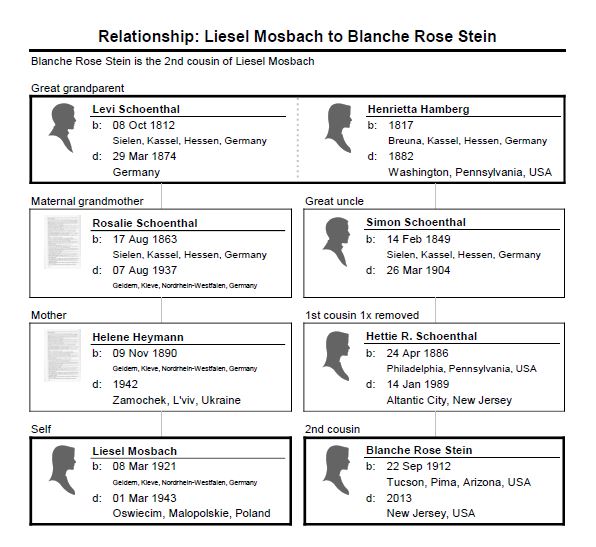
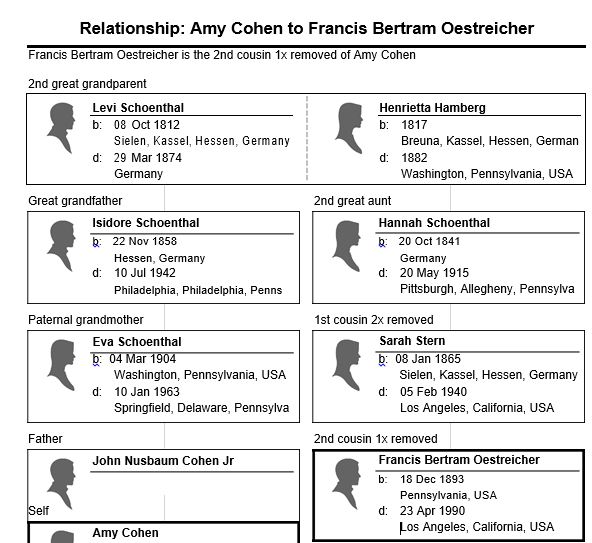
As I mentioned here, included with all the photographs that my cousin Steve scanned and sent to me were a number of letters.  I posted the letter written by Gerald Oestreicher to his family during World War II, and I mentioned that there were also letters written by Gerald’s uncle, Francis Oestreicher, when he was serving during World War I.  Frank was my father’s second cousin, both being the great-grandchildren of Levi Schoenthal and Henriette Hamberg. Thus, he was my second cousin, once removed:

Frank Striker to me relationship chart


There were also some letters written to Frank, as he was known after the war.  In this post I will share the letters written to Frank. The next post will contain the letters written by Frank during World War I.  I’ve transcribed all the letters as close to their original spelling and punctuation as I could, but made some changes just for purposes of readability.  No words were deleted or changed; nothing was added, except where I’ve put my own comments in brackets.

What struck me as meaningful about these letters is what they reveal about the close connections among the Schoenthal siblings—the ten children of my great-great-grandparents Levi Schoenthal and Henriette Hamberg.  These three letters date from 1907 to 1939, and each one shows that this large and extended family knew and cared about each other.

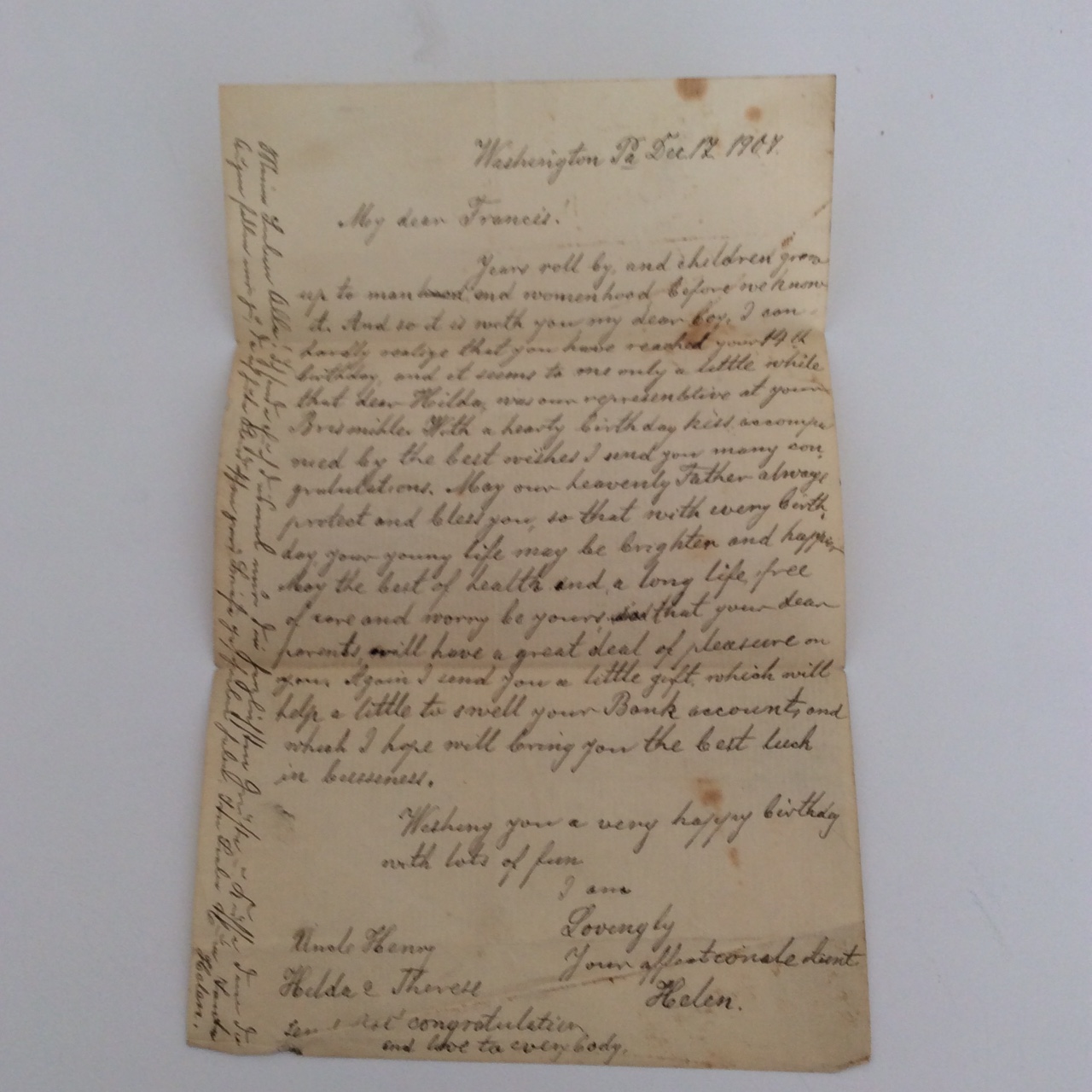
The oldest letter was a letter written by Frank’s great-aunt Helen Lilienfeld Schoenthal, the wife of my great-great-uncle, Henry Schoenthal.  Helen wrote this letter from Washington, Pennsylvania in 1907, to Frank, grandson of her sister-in-law Hannah Schoenthal.

Letter from Helen Lilienfeld Schoenthal dated December 12, 1907 from Washington, PA

IMG_1830

My dear Francis,

Years roll by, and children grow up to man and womenhood before we know it. And so it is with you my dear boy.  I can hardly realize that you have reached your 14th birthday, and it seems to me only a little while that dear Hilda was our representative at your Bris mihle.  With a hearty birthday kiss accompanied by the best wishes I send you many congratulations.  May our heavenly Father always protect and bless you, so that with every birthday your young life may be brighter and happier.  May the best of health and a long life free of care and worry be yours that your dear parents will have a great deal of pleasure on you.  Again I send you a little gift which help a little to swell your Bank account and which I hope will bring you the best luck in business.

Wishing you a very happy birthday with lots of fun.  I am

Lovingly

Your affectionate Aunt Helen

Uncle Henry, Hilda and Therese send their congratulations and love to everybody.

There is also a message written by Helen in German along the margin that I could not read, but with the help of my friend Matthias Steinke in transcribing and translating the old German script, I now know what it says:

My dear all! I am sending you this time only the heartiest greetings and kisses because my eyes close already automatically, because this evening I wrote already a couple of letters. In Love, your aunt, Helen 

Isn’t it interesting that in 1907 after being in the US for 35 years and clearly fluent in English,  Helen reverted to German (and German script) to write to Frank’s parents, Gustav and Sarah Stern Oestreicher? Both Sarah and Gustav were native German speakers, but both also had been in the US for a very long time. I wonder if Frank could read German or was as puzzled as I was by the German script scrawled on the margin of his birthday letter.

Aunt Helen--maybe Lilienfeld Schoenthal

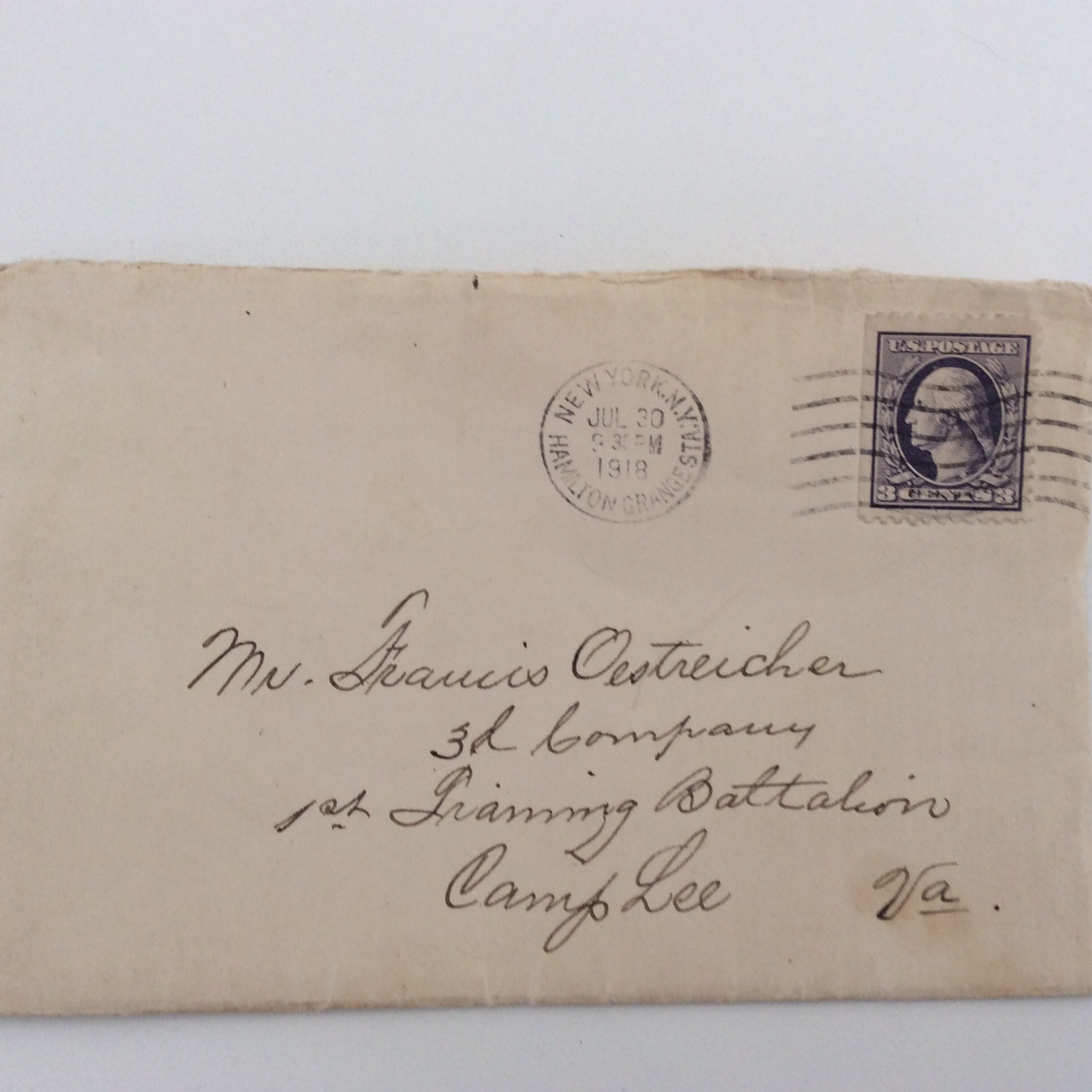
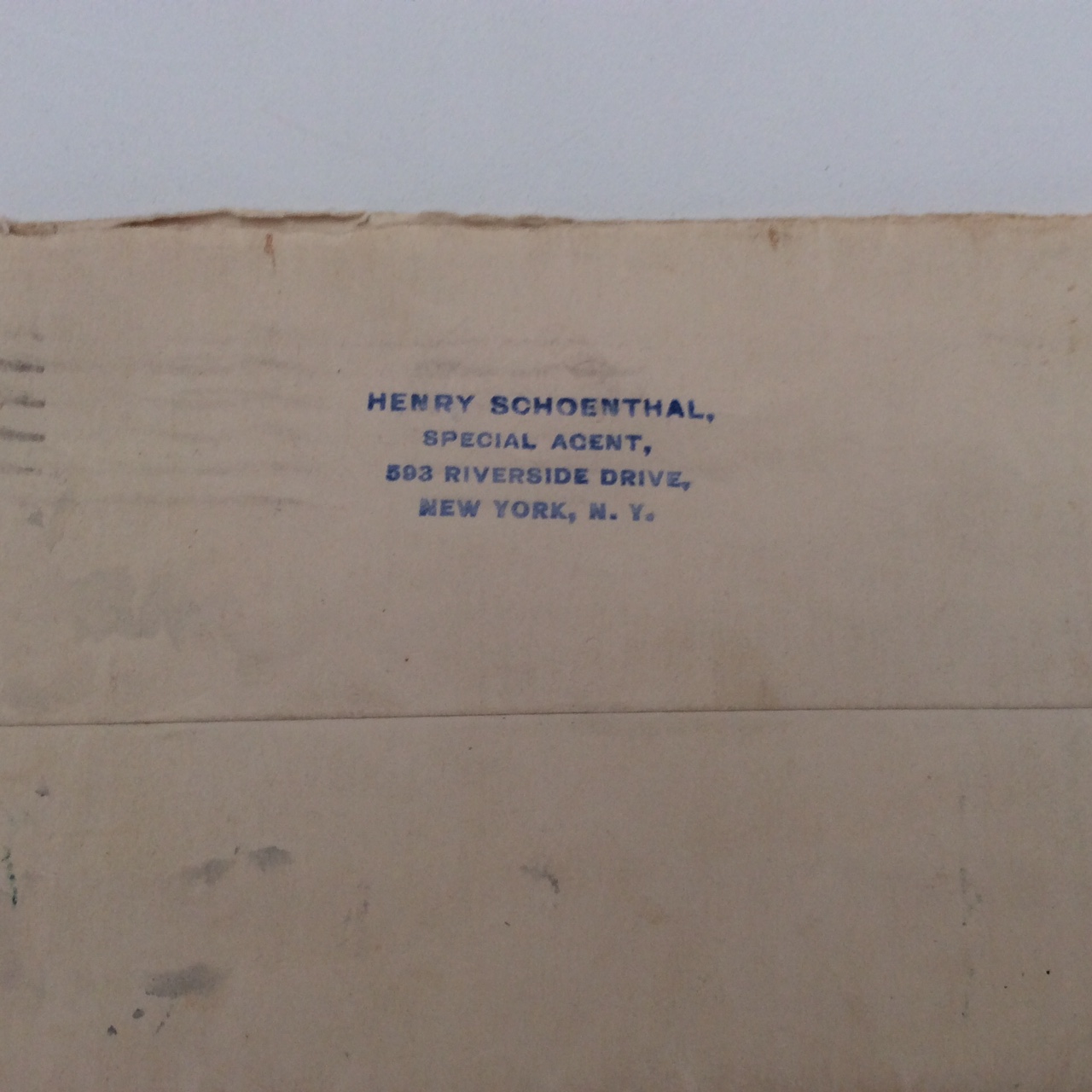
The second letter was written a little over ten years later in July, 1918 when Frank had joined the army, but before he was shipped overseas.  It is also from his great-aunt Helen, with a short addendum by his great-uncle Henry Schoenthal.

Once again, it is evident that Helen and Henry were closely connected to Frank, a child of their niece Sarah Stern, grandson of Henry’s sister Hannah.  I was touched by how much affection there was for this young man, their great-grandnephew.  The letter is also interesting because it talks about Henry and Helen’s own children, their daughter Hilda, their son Lee (born Lionel) and his wife Irma, and Henry and Helen’s granddaughter Florence, who was only thirteen when this letter was written.  Helen did not use any paragraph breaks, but I’ve added some to make the text more easily read.

Letter from Helen Lilienfeld Schoenthal and Henry Schoenthal dated July 30 1918 written from NYC

IMG_1816 IMG_1817 IMG_1818 IMG_1819

IMG_1820


My dear Francis,

I was just thinking to write to your dear parents and ask for your address, when we were agreeably surprised on last Sunday, when your dear brother Sidney came to see us, stayed for supper and until late in the evening.  And so we are able to write to you, as Sidney was glad to give us your ad: for every soldier likes to get letters from some one, and if it is not from a sweetheart, this letter comes from your old Uncle and Aunt, who always loved you. 

I suppose your ears were ringing last Sunday, for Sidney and we talked about you a great deal, and we were glad to hear that you liked soldiers life and also the camp.  Are any boys with you from Pittsburg who you know? And how is the weather in your section?

We have terrible hot spell here since over a week, and I feel the heat very much.  But I am so thankful that we live on such nice open place near the Hudson and get all the fresh air that is going.  There is a good deal of suffering on the East side I know. 

Uncle and I are alone since the 19th of July. Irma & Lee went to the Adirondex Mountains to stay two weeks, as Lee had not been feeling well and needed a rest badly.  They choose this place so that they could be near Florence who is at a girls camp named camp Woodmere.  It is owned by Misses Goldsmith and Kuhn from Philadelphia.  They have 54 girls there and it an ideal place.  Florence is crazy about and Irma & Lee are also very much taken with the place and how beautiful it is managed.  They have all sorts of sports there.  Florence is a good swimmer and also can now [?] and take long hikes. 

We expect Irma and Lee back next Saturday and the following Saturday Hilda will arrive here and spend her vacation with us. I am looking forward to her coming with great joy, and we will try and make her stay very pleasant.  She can take many nice boat trips which she likes so much.  Sidney will come up again next week when Irma & Lee is here. 

I am making a nice lunch cloth for Helen’s engagement present, but I am taking my time making it as I have to be very careful with my eyes. [I assume Helen was Frank’s sister Helen, who married in 1920.] We also had a long letter from dear Meyer [their younger son] last week. 

Now dear Francis, be bright and cheerful and take good care of yourself.  Our good God will be with you wherever you are, and He will bring peace to every heart and all the countrys before long. 

With loads of love and a hearty and write soon to your affectionate Aunt Helen.

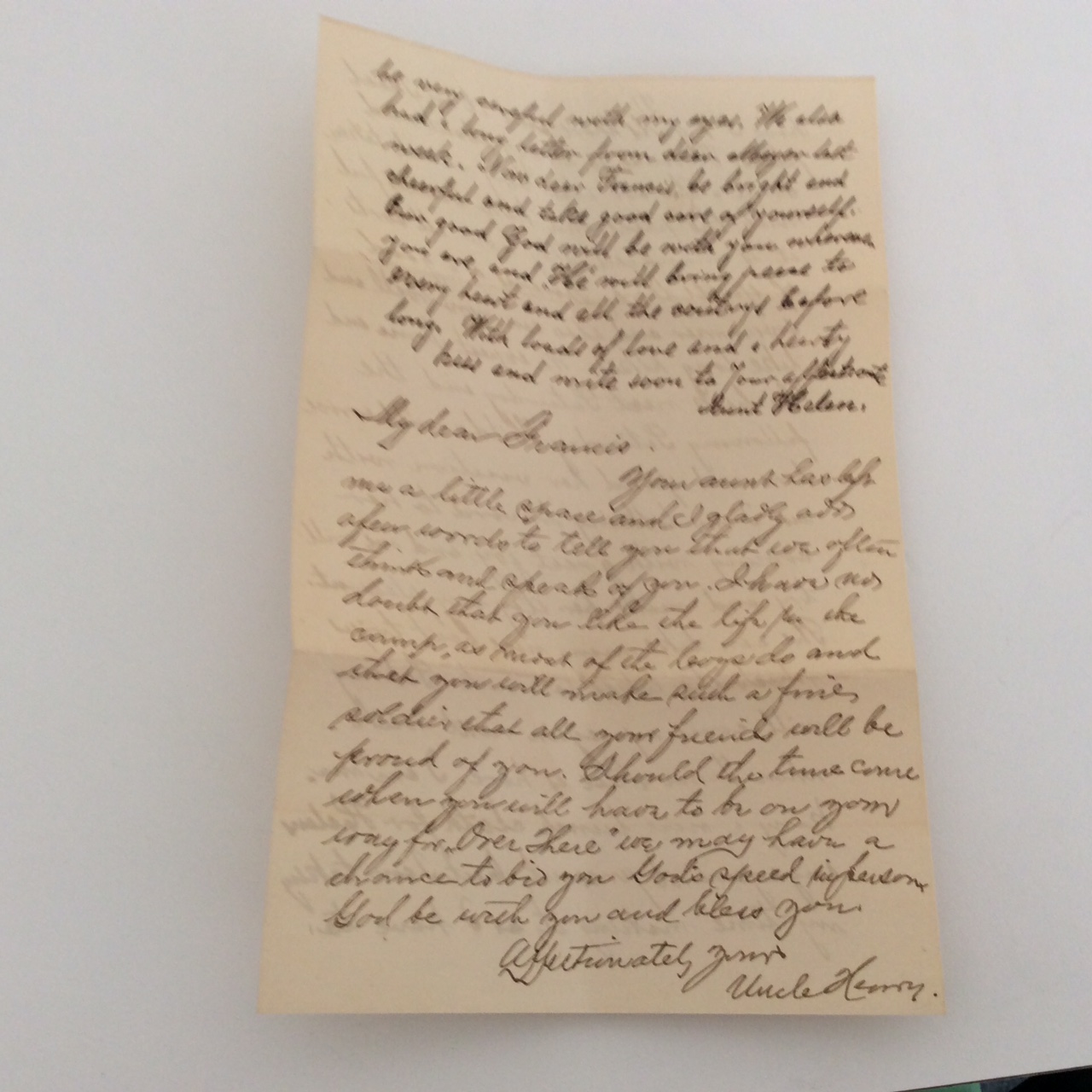
 My dear Francis

Your aunt has left me a little space and I gladly add a few words to tell you that we often think and speak of you.  I have no doubt that you like the life in the camp, as most of the boys do and that you will make such a fine soldier that all your friends will be proud of you.  Should the time come when you have to be on your way for “Over There” we may have a chance to bid you God’s speed in person. God be with you and bless you.

Affectionately yours,

Uncle Henry

I read this letter as an attempt by his aunt and uncle to give him their blessing before he went off to war without making him too nervous about what he was about to face.  Frank’s own letters, as we will see, reflect a similar impulse, only he is reassuring those at home that he is and will be okay.

The last letter for this post was written many years later by Frank’s father, Gustav Oestreicher.  It was written in 1939 after Gustav and Sarah had moved to California, as had their daughter Helen.  I am not certain whether Frank was living in Minneapolis or just visiting; the letter is addressed to him at a hotel, and from the content of the letter, I can infer that Frank had recently been to Chicago. I assume he was on the road in his capacity as a traveling salesman.

A little background to help identify the people named in the letter:  First, Gustav mentions the Good family.  He must be referring to Edith Stern and Leo Good and their son Bernard; Edith was Sarah Stern Oestreicher’s younger sister, thus Gustav’s sister-in-law.  In 1939, the Good family was living in Chicago.

Gustav then mentions a Lionel and his brothers and sister and another sister Hilda. At first I thought this referred to the children of Henry and Helen Schoenthal, as they had a son named Lionel, a son Meyer, and a daughter Hilda. But after reading through the letter more carefully, I realized that he was referring to Lionel Heymann, the oldest child of Rosalie Schoenthal and Willy Heymann, about whom I wrote here.  Rosalie was the youngest Schoenthal sibling, sister of Hannah Schoenthal, who was Gustave’s mother-in-law. So Rosalie was Sarah Stern’s aunt.

Here’s why I think Gustav is talking about Lionel Heymann, not Lionel Schoenthal. For one thing, Henry and Helen Schoenthal’s son Lionel was called Lee at this point, not Lionel.  And at the time this letter was written, Lionel Heymann (the photographer) was living in Chicago as were his brothers Walter and Max, so if Frank had seen the Good family, he must have been in Chicago. (I am not sure why Gustav writes that he hoped Frank might see Lionel’s “bros.& sister” since there was no sister at that time living in the US, but perhaps he was referring to Max’s wife Frieda.)

Also, Gustav mentions a sister Hilda who was still in Germany. Henry Schoenthal’s daughter Hilda was not living in Germany, but in Washington, DC, in 1939.  But Lionel Heymann had a sister Hilda who was still in Germany in 1939.  I have written about what happened to Hilda Heymann as well as her sister Helene, who married Julius Mosbach and had two daughters, Liesel and Gretel.  All were killed in the Holocaust.  That fact makes Gustav’s comment even more chilling.  I put those comments in bold below.

I do not know who the Fannie mentioned towards the end of the letter could be.

Letter from Gustav Oestreicher to his son Frank [edited for readability only]

IMG_1990 IMG_1992 IMG_1993

September 16, 1939 from Los Angeles

My dear Francis,

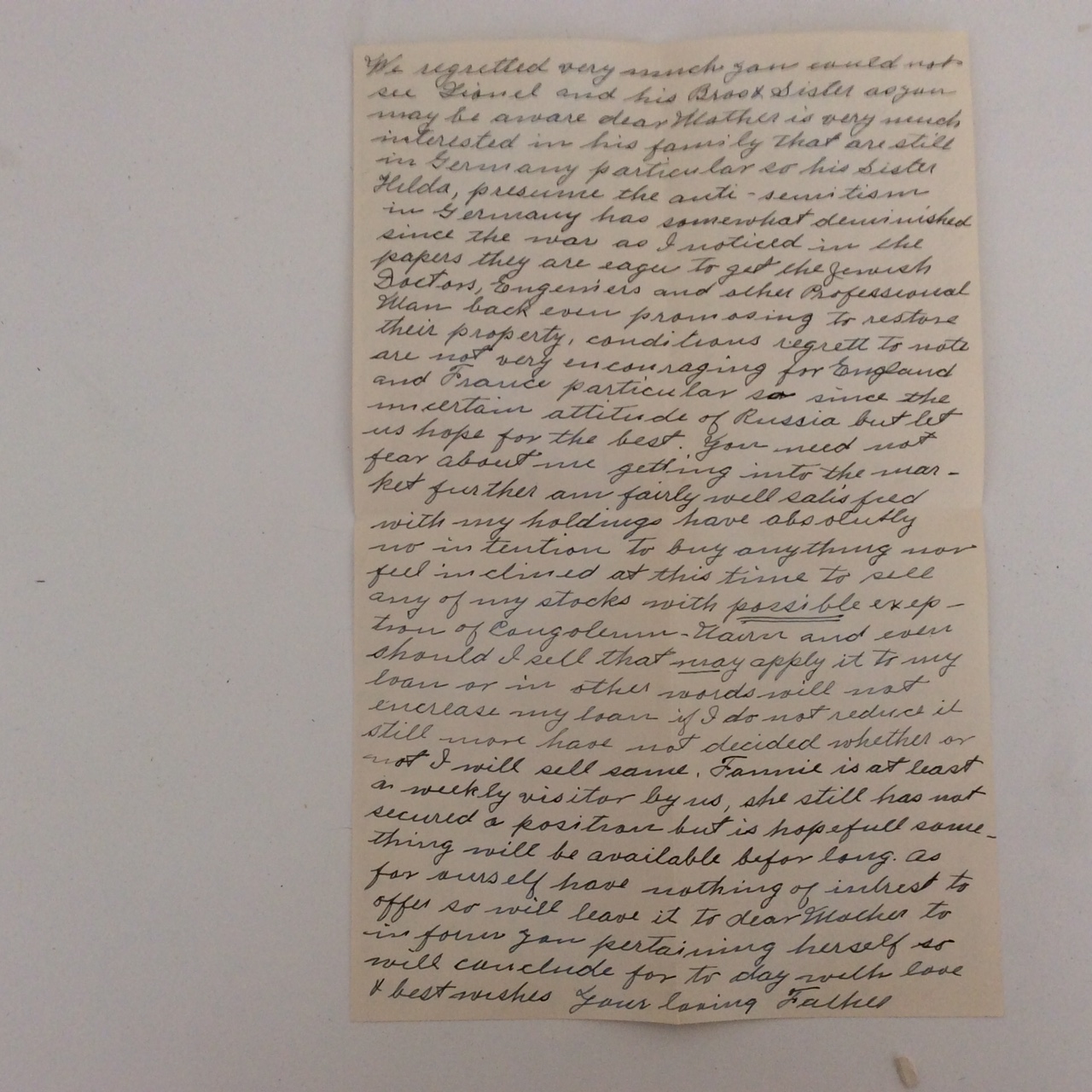
Although late, [I] will begin my letter extending to you my best wishes for a healthy, happy and prosperous new year. [Obviously a reference to Rosh Hashanah, given the September date.] You ought to know you enjoy our good wishes at all times so hope you will pardon the expression of it at a rather late date. As usual we were happy to learn the contents of your recent letter.  It pleased us to learn you enjoyed your visit with the Good family as well as that all of them are getting along nicely.  You evidently misinformed them about our anniversary as we rec’d a very nice letter from them congratulating us for our golden wedding anniversary which will not be until next year. [Gustav and Sara were married in 1940.]

We regretted very much you could not see Lionel and his Bros. & Sister again. [You] May be aware dear Mother is very much interested in his family that are still in Germany particular so his Sister Hilda. [We]  presume the anti-semitism in Germany has somewhat diminished since the war as I noticed in the papers they are eager to get the Jewish Doctors, Engineers and other Professional Man back even promising to restore their property.  Conditions regrett to note are not very encouraging for England and France particular so since the uncertain attitude of Russia but let us hope for the best.

You need not fear about me getting into the market further. Am fairly well satisfied with my holdings. Have absolutely no intention to buy anything nor feel inclined at this time to sell any of my stocks with possible exception of Congoleum-Narin and even should I sell that, may apply it to my loan or in other words will not increase my loan if I do not reduce still more.  Have not decided whether or not I will sell same. 

Fannie is at least a weekly visitor by us.  She still has not secured a position but is hopefull some thing will be available before long.  As for ourselves have nothing of interest to offer so will leave it to dear Mother to inform you pertaining herself so will conclude for to day with love and best wishes. 

Your loving Father

As with the earlier letters from Helen Lilienfeld Schoenthal, this letter reveals the close connections among the many Schoenthal siblings and their children.  I’ve often wondered what the family knew about the two siblings who had stayed in Germany: Jakob Schoenthal and Rosalie Schoenthal.  From Gustav’s letter it is apparent that the family was in touch at least to some extent with those family members who had not immigrated.  They knew that the three Heymann brothers were in Chicago, and they knew that some family members were still in Germany.

Gustav’s hope that anti-Semitism was diminishing in Germany once the war started is so terribly painful to read, knowing what was going to happen not only to Hilda, her sister, and her nieces, but to six million other Jews living in Europe.

Realizing how connected the family was to each other as late as 1939 makes me wonder what happened.  Why didn’t my father even know about all his Schoenthal second cousins like Frank and his siblings? Did my grandmother Eva Schoenthal know any of these people? My guess is that because my great-grandparents moved from western Pennsylvania to Denver when my grandmother was just a small child, not even four years old, she did not grow up with the benefit of knowing all those cousins in western Pennsylvania.  Perhaps if she had, I would not have had to search to find my Oestreicher cousins.  Perhaps we would have always known about each other.

Like Manna from Heaven

Last Monday I posted about my third cousin, Betty Oestreicher Jacob, who passed away on July 19, 2016.  Betty and I were related through our mutual great-great-grandparents, Levi Schoenthal and Henriette Hamberg.  Her great-grandmother Hannah Schoenthal and my great-grandfather Isidore Schoenthal were sister and brother.  Betty’s grandparents were Sarah Stern, Hannah’s daughter, and Gustav Oestreicher.  Her parents were Sidney (Oestreicher) Striker and Esther Siff

At the time I posted about Betty’s passing, I had only one photograph of Betty and none of her grandparents, parents, or siblings.  But within hours of publishing my post, I received a comment on the blog and then emails from Betty’s nephew, Steve, the son of her brother Gerald.  And Steve generously shared with me numerous photos of all those people and then some. Now I can place faces to the names of the people I have researched and written about.  And what gorgeous photos these are.

In this post, I will share some photographs of Sarah Stern and Gustav Oestreicher and their three children, Sidney, Frank, and Helen.  In a later post, I will share the photos of Sidney’s children, Gerald, Betty, and Elaine.  All are courtesy of Steve Striker, who so generously spent his time scanning and emailing these to me and answering my many questions.

First, here are some photographs of Sarah Stern Oestreicher, my grandmother Eva Schoenthal’s first cousin.  I’ve written about Sarah’s life here.

Sarah Stern as a child edited

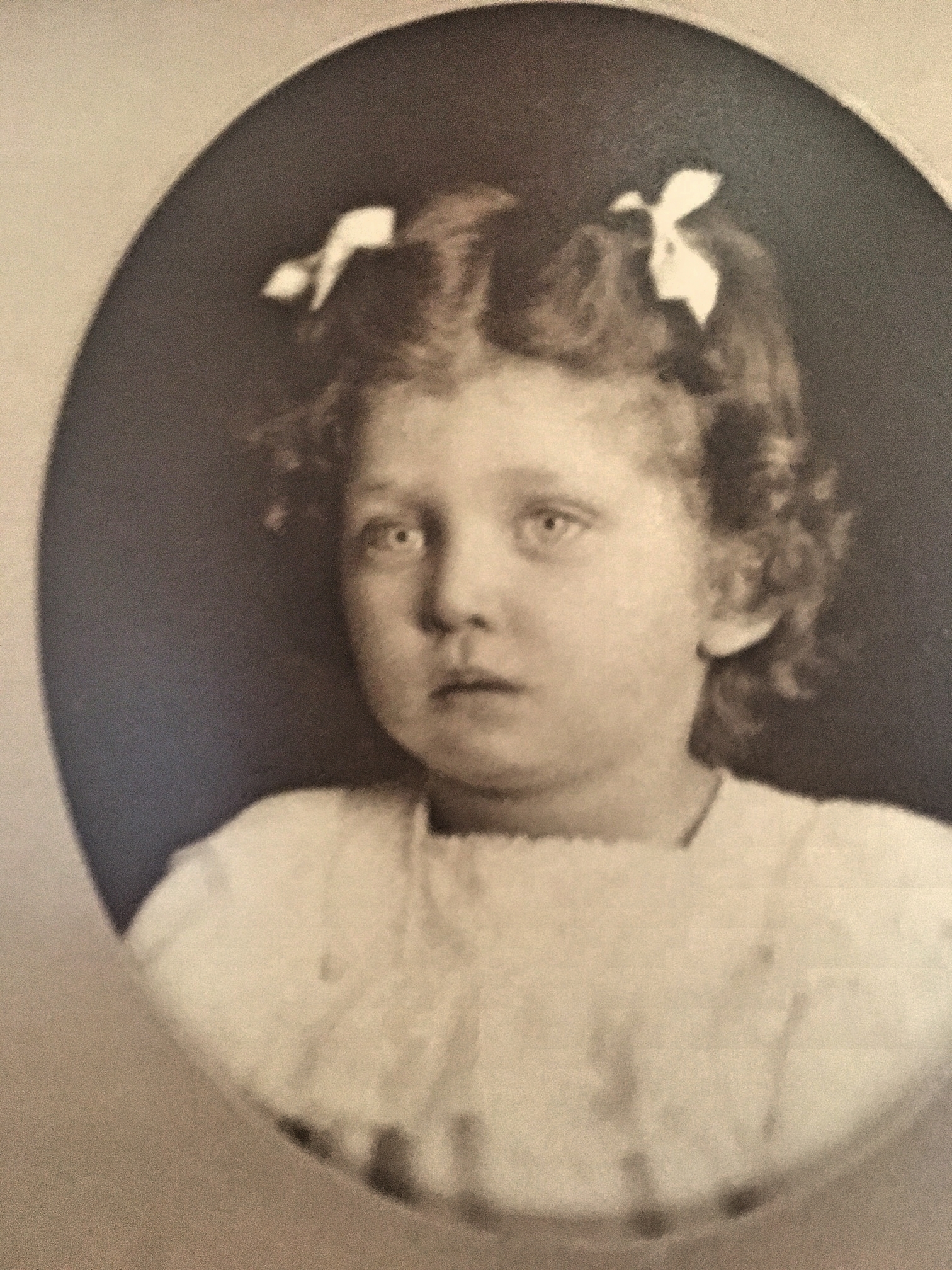
Sarah Stern as a young child in Germany, probably before her mother married Solomon Stern in 1874. Sarah was born in 1865, so this picture was probably taken between 1870 and 1872.

The photograph below of Sarah was taken in Pittsburgh.  She emigrated to the US by herself around 1884 when she was nineteen years old.

Sarah Stern

Sarah Stern

I assume the photograph below was taken sometime later than the one above, but I am not sure. Does Sarah look older or younger in this photograph? The hairstyle in the one above seems more “contemporary,” but Sarah’s face seems softer and somewhat younger than in the one immediately below.

Sarah Stern Oestreicher

Sarah Stern Oestreicher


A while back I had posted the next photograph, which I’d received from my cousin Maxine Stein, and she and I had wondered whether the woman on the left was Sarah Stern, her grandmother’s sister.  Now I am quite certain that it is in fact Sarah.  What do you think? Is the woman on the far left of the photograph the same woman as the one in the photo directly above?


Jennie Stern Arnold, center, and perhaps Sarah Stern Ostreicher on the right and Edith Stern Good on the right

Jennie Stern Arnold, center, and perhaps Sarah Stern Ostreicher on the left and Edith Stern Good on the right

Sarah married Gustav Oestreicher, the man she met while he was staying at her mother’s boarding house in Pittsburgh in about 1890. Gustav, an immigrant from Austria, was working as an artist and photographer in 1900.

Gustav Oestreicher

Gustav Oestreicher

What a dashing man he was!

Here are Sarah and Gustav’s three children, Sidney (1891), Francis (Frank) (1893), and Helen (1895).  You can see that the children inherited their father’s piercing light-colored eyes.  I would guess that these were taken in the late 1890s, perhaps 1898 or 1899, from the ages of the children.  They were also probably taken at the same time as the photos above of Gustav and Sarah, as all five photos were mounted together in a frame.  Perhaps Gustav himself took these photos.

Sidney Oestreicher

Sidney Oestreicher

Frank Oestreicher as a boy

Helen Oestreicher

This photo of Gustav and Sarah was taken in 1915, when their children were already grown.  By this time Gustav was no longer working as an artist, but was a merchant in Pittsburgh.
Gustav and Sarah Stern Oestreicher

Here is a photograph of the Oestreicher store in Pittsburgh:

Oestreicher store

Here’s a photo of Gustav and Sarah and their three children in about 1910, I’d guess, given the ages of the children. Unfortunately, Sidney’s head was cut off either in the photo itself or in the scan.

Rear: Frank, Helen, Gerald (with head cut off) Front: Gustav and Sarah Oestreicher

Rear: Frank, Helen, Sidney (with head cut off)
Front: Gustav and Sarah Oestreicher

Sidney Oestreicher (later Striker) married Esther Siff on November 16, 1915, in Chicago. Sidney was working as a traveling salesman, and as his daughter Betty told me, he met Esther at a dance in Chicago while there on business.  Esther’s father was also a traveling salesman. (I have more pictures of Sidney and Esther, but will share them in my next post.)

Sidney and Esther 1915

The second son, Francis, better known as Frank, served his country in World War I. (Sidney was exempt as he had a wife and young child.)  The postcard below shows Frank’s dates of service:

Frank postcard with military service dates

He was gone for just over a year—from June 25, 1918, when he left for camp, until July 17, 1919, when he arrived home.  He had gone overseas on September 24, 1918.  As I wrote about here, Frank served in the Meuse Argonne Offensive, one of the most important if not the most important battle in World War I. He was a member of Company C of the 301 Water Tank Train in the American Expeditionary Forces.

According to Richard Rubin’s book, The Last of the Doughboys:The Forgotten Generation and Their Forgotten World War (Houghton Mifflin Harcourt, 2013), p.220, a water tank train was actually a caravan of white trucks used to carry water to the front.  According to his honorable discharge papers, Frank served as a private, which Rubin’s book suggests meant he was likely an assistant driver of one of the trucks.

I found this photograph online depicting Company C of the 301 Water Tank Train.  I wonder if Frank is in the photograph:

Company C, 301 Water Tank Train, H. E. Edwards, Capt. M. J. C. U. S. A., Arthur Armstrong Paler papers, Box 1, World War I Photographs http://bentley.umich.edu/legacy-support/ww1/military-life.php

Company C, 301 Water Tank Train,
H. E. Edwards, Capt. M. J. C. U. S. A., Arthur
Armstrong Paler papers, Box 1, World War I
Photographs
http://bentley.umich.edu/legacy-support/ww1/military-life.php

Francis Oestreicher (Frank Striker) discharge papers

Francis Oestreicher (Frank Striker) discharge papers

As you can see below, he was awarded a Victory medal for his service. (Steve has also sent me some of the letters Frank wrote home during World War I; I will post those separately once I have a chance to review and transcribe them.)

Frank Striker WW1

Francis Oestreicher, later known as Frank Striker

Frank Striker WW1 medal

Frank Striker’s Victory Medal for service in World War I

Gustav and Sarah’s third child was their daughter Helen. Here she is in 1917 when she was 22 years old.

Helen Oestreicher 1917

Helen Oestreicher 1917

As I wrote earlier, Helen married Robert Steel Kann in 1920, but he died a year later at age 26.  Sometime before 1929, she married Aaron Mitchell Siegel, known as Mickie, and they had a daughter Betty.

Helen Oestreicher Kann Siegel and her family

Helen Oestreicher Kann Siegel and her family

I was tickled to see this item in Steve’s collection:

invitation to Henry Schoenthal 50th anniv party

As you can see, it is an invitation to the 50th wedding anniversary celebration in 1922 for Henry Schoenthal and Helen Lilienfeld, about whom I’ve written extensively.  Henry Schoenthal, my great-great-uncle, was Sarah Stern Oestreicher’s uncle, brother of her mother Hannah Schoenthal Stern.

Steve sent me this photo labeled Aunt Helen by his uncle Frank, and I wonder whether this is Helen Lilienfeld Schoenthal, who would have been Frank’s great-aunt.  Frank received a long letter from his great-aunt Helen and great-uncle Henry while he was serving in Europe; the tone and content of that letter suggest that Helen and Henry Schoenthal had a very close relationship with the Oestreicher family. (I will post the letter in a separate post.)

Aunt Helen--maybe Lilienfeld Schoenthal

Frank returned to Pittsburgh after the war and worked as a salesman in the family dry goods store. After the family store went bankrupt in 1933, the Oestreicher family began its migration west to California. Although neither Steve nor his cousin Ron was sure of who first went to California or why, the 1940 census indicates that by 1935 at least Helen and her family and Gustav and Sarah had settled there.  I was not able to locate Frank on the 1930 or the 1940 census,nor do I have any address for him between 1920 and 1942, but his World War II draft registration indicates that by then he was definitely living in California along with his parents and his sister Helen.  Sidney and his family did not move west until the 1940s.

Here is a photograph of the Oestreicher family in Los Angeles in 1936.

Oestreicher family edited 1936

I found this letter written by Sarah Stern Oestreicher to her son Frank in 1933 to be very touching in its religious tone and its affection for her son.  Perhaps it was written around the time that family members were planning to move to California.  From the text of the letter, it appears that Frank had just visited, perhaps before he was leaving to move out west or his parents were.

IMG_9375

IMG_9376

Letter from Sarah Stern Oestreicher to her son Frank, dated January 11, 1933

My dear Francis!

Always remember that The present is under God’s guidance, the future in His keeping. God is guiding, directing, controlling and suplying His children with all good.  His Love and [?] is with you always. Thanking you for all your kindness and the pleasure of having you with us will be the the most pleasant memmories to us.

With my love I remain your devoted Mother. January 11—1933

Here is a photo of Frank in 1940.

Frank Striker 3

One of Steve’s favorite stories about Frank is that he offered to take photographs at Steve’s bar mitzvah, only to discover there was no film left in the camera.  There is only this one photo taken by Frank that day.

IMG_1979

Although Steve has many photographs with Frank with women throughout the years, Frank never married. He died in Los Angeles on April 23, 1990, at the age of 96.  His sister Helen died in 1989 when she was 94.

I am so grateful to my cousin Steve for sharing these amazing photographs with me and allowing me to post them on my blog. There is just nothing better than a photograph to help bring to life the people whose lives I’ve researched.

More photos and stories about the Oestreicher family in my next post.


Don’t Wait to Make Those Calls: My Cousin Betty

This is a post I started back in May before my trip to Colorado and Santa Fe.  I had planned to finish it when I got back, but was distracted and put it aside.  Now I must finish it.  Unfortunately, it no longer has the happy ending it originally had.

As I wrote a few months ago, my newly found third cousin Maxine Schulherr Stein, the great-granddaughter of Hannah Schoenthal Stern (my great-grandfather Isidor Schoenthal’s sister), had lost touch with her second cousins Betty and Elaine, also great-granddaughters of Hannah Schoenthal Stern.

relationship of Maxine Schulherr to Betty Oestreicher

Betty and Elaine’s grandmother Sarah Stern and her husband Gustav Oestreicher had had three children: Sidney, born in 1891; Francis (known as Frank), born in 1893; and Helen, born in 1895.  They’d all lived in the Pittsburgh area at first, but as Sarah and Gustav’s children became adults, they’d eventually left the Pittsburgh area.

Helen had moved to California by 1935 where she and her husband Aaron Siegel and their daughter Betty lived in Los Angeles.  Frank also was living in Los Angeles by 1942.  It was Sidney Oestreicher and his family whom Maxine knew best. She knew that Sidney was married to Esther Siff, and they had had three children: Gerald, Florence Betty (known as Betty), and Elaine.

But Sidney Oestreicher also had left the Pittsburgh area when he moved to New York in the 1940s.  The family had left their youngest child Elaine behind with Maxine’s family so that she could finish the school year in Pittsburgh, according to Maxine.

By the 1950s, all of the members of Sidney Oestreicher’s family had moved to California to be closer to the other members of the family.  Given the distance and the limited modes of communication back then, the family members back in Pittsburgh eventually lost touch with the California branch of the family.   When I spoke with Maxine, she asked me to help her locate the cousins she’d known as a child.

Hattie Martin Maxine Alan Henrietta Stein Alan's mother

Hattie Arnold Schulherr, Martin Schulherr, Maxine Schulherr Stein, Alan Stein, Henrietta Stein

I knew from my own research that Gerald Oestreicher (who, like his father Sidney and his uncle Frank, changed his surname to Striker) had married Faye Krakower and had had two children.  Gerald died in 2014 and Faye in 2015.   But finding Gerald’s sisters Betty and Elaine had proven to be more difficult, as is generally the case with women.

Fortunately, I found one very important clue that helped me find both Betty and Elaine for Maxine (and for me).

Betty Oestreicher engagement announcement

I thus knew that Betty had married a man named Julius H. Jacob.  And from various other records for Julius, I knew that they had lived in the NYC area for some time and that they, like the other Oestreichers/Strikers, had eventually moved to California.  But I had not been able to find their current residence.

Newly motivated by Maxine’s request, I looked again at the engagement announcement and saw that Julius was described as the brother of Mr. and Mrs. Jacob Spear.  Who was that? I inferred that Julius was the brother of Mrs. Spear, not Mr. Spear, given the different surnames, and decided to see what I could find about the Spears.  I found Jacob Spear and his wife Else (presumably born with the surname Jacob) on the 1940 census, but more importantly, I found them both on several family trees on Ancestry.

Although I am generally skeptical of Ancestry trees, one of those trees belonged to a genealogy researcher whose work I trust: Jennifer Spier-Stern.  I contacted Jennifer, and after we exchanged more information and verified the connection between Julius Jacob and Elsie Jacob, Jennifer was able to put me in touch with the son of Jacob Spear and Else Jacob, John.  John is the nephew therefore of Julius Jacob, husband of my cousin Betty Oestreicher.  Not only did John know the whereabouts of his aunt Betty—he had contact information for her son Ron.  And he pointed out that the upcoming weekend would be her 97th birthday.  Now that gave me the chills!

I emailed Ron, and we exchanged several emails.  And Ron gave me the phone numbers for both his mother Betty and his aunt Elaine, who is also still living in California.  In May I had the great pleasure of speaking to two more of my third cousins, Betty Oestreicher Jacob and Elaine Oestreicher Wallace. The following information came from a combination of my conversations with Betty and Elaine and the emails and conversations I had with my cousin Ron.

Betty was remarkably lucid for a 97 year old woman, and she was delighted to answer my questions and reminisce about her family and her life.  Elaine also was warm and excited to share her stories with me.  I had hoped that one of them would have stories about their grandmother, Sarah Stern, who was the first child of Hannah Schoenthal and who had come without her family to the US when she was nineteen years old.  Unfortunately, as was so often the case, both Betty and Elaine said that their grandmother Sarah did not speak about her childhood or about the move to the United States.

I did learn, however, from Betty that Sarah met her future husband, Gustav Oestreicher, when he was staying at the boarding house in Pittsburgh run by her mother, Hannah Schoenthal, my great-grandfather’s oldest sibling.

Betty also told me that her grandmother Sarah suffered from migraines, and after they married, Gustav and she moved to Atlantic City because he thought it would be better for her health.  Sarah also converted to Christian Science, and although Betty and her family remained Jewish, Betty would often accompany her grandmother Sarah to church when she visited her in Atlantic City.

Ron shared with me a particular memory his mother Betty shared with him:

“Once, Sarah and Gustav purchased 300 ice cream cones for children at an orphanage/home for crippled children, and my mother and uncle (Jerry) got to ride along in the truck to deliver them.  Apparently, my mother was the apple of Gustav’s eye.”

I also asked Betty how her father Sidney met her mother Esther Siff, who lived in Chicago.  Betty explained that her father was a traveling salesman, working for a ladies’ lingerie company called Adelson’s.  While traveling to Chicago for work, he attended a dance where he met Esther Siff.  Sidney and Esther lived in Chicago for the early years of their marriage, and their first two children, Gerald and Betty, were born there.  By 1930, however, the family had moved back to Pittsburgh, where their youngest child Elaine was born.

betty-oestreicher-jacob-1940s-ft-devens

Betty Oestreicher Jacob. 1940s Courtesy of Ron Jacob

Betty said that her immediate family moved to New York in the 1940s for her father’s job.  She had married Julius Jacob by that time, and after spending some time in Massachusetts where Julius was stationed at Fort Devens during the war, they ended up moving to New York where Julius worked for Spear & Company.  In 1954 or so, they returned to Pittsburgh, where Julius continued to work for Spear & Company, but the company was not doing well at that point.

In 1956, the family moved to Los Angeles where Julius took a job with Broadway Department Stores.  Betty’s brother Gerald was already living there at that time as was her aunt Helen and uncle Frank.  Sidney and Esther soon followed their children to Los Angeles. Elaine arrived a few years later after her divorce from her first husband, Jerry Kruger. Sadly, Esther Siff Oestreicher/Striker died on her 68th birthday, March 11, 1961.

Thus, by the 1960s, all the members of the Oestreicher family were living in the Los Angeles area: the three children of Sarah Stern and Gustav Oestreicher, Sidney, Frank, and Helen, and all of their children, including Sidney’s three children, Gerald, Betty, and Elaine.

Ron shared with me his memories of his great-uncle Frank and his grandfather Sidney:

“My Uncle Frank, who I adored, was a lifelong bachelor.  He was also quite the world traveler and I was always fascinated to hear of the places he had been.  Spending a fair amount of time traveling by ship, he became quite an accomplished dancer and tennis table player.  (I believe he had trophies for both.)  When we got a ping pong table, he had fun annihilating me.  To be fair, my grandfather, Sidney, taught me how to play gin rummy (for points) and he also had the grandest smile every time he beat me.  Both men were true gentlemen, and they were loving, caring men and enjoyed spending time with us kids.  My grandfather died when he was 94 and my uncle died when he was 96.” 

Ron also sent me this picture of Faye Krakower Striker, his uncle Gerald’s wife:

faye-krakower-striker-professional-photo


Faye had quite an interesting life as a singer before marrying Gerald in 1946.  The following is an excerpt from the eulogy given at her funeral in 2015.

JPG Eulogy of Faye Striker

Even with all this information, I realized when I got off the phone with Betty that I still had more questions about her childhood and adolescence in Pittsburgh.  Did she know the other Schoenthal cousins? What was life like? Were they active in the Jewish community? There were many more things I wanted to discuss with her.

I had planned to call Betty and Elaine again after those initial conversations. But then I left for our trip to Colorado and New Mexico, and when I returned, I was distracted by a number of other matters, and I failed to follow up.

I recently learned that Betty’s health deteriorated while I was away, and sadly she passed away on July 19, 2016.  She had had a good long life with very few health issues, according to her son Ron.  And although I know that anyone who lives 97 years has had a remarkable journey, I am kicking myself for not making that second call.  Betty had been so excited to share her memories with me, and there were so many more questions to ask and stories to hear.

Life is unpredictable, and we can’t assume anything or take anything for granted.

May my cousin Betty rest in peace, and may her family find comfort in all their memories.


Ray, Arizona: Home of Gertrude and Hettie Schoenthal

Some of you may remember that about six months ago I wrote about Gertrude and Hettie Schoenthal, two of the daughters of Simon Schoenthal, brother of my great-grandfather Isidore.  Gertrude had married Jacob Miller in 1898 and moved to Arizona. Jacob and his brothers were merchants in the Tucson area. Gertrude’s younger sister Hettie followed her out there around 1906, where she met her husband Henry Stein and eventually settled as well.

Eventually both the Millers and the Steins moved to the small mining town of Ray, Arizona, where they lived for several years before returning to Atlantic City, where most of the members Schoenthal family were still living.   Hettie and her son Walter Stein wrote wonderfully descriptive memoirs of their rough and tumble pioneer life in Ray, Arizona.  I quoted extensively from their writings in this blog post.

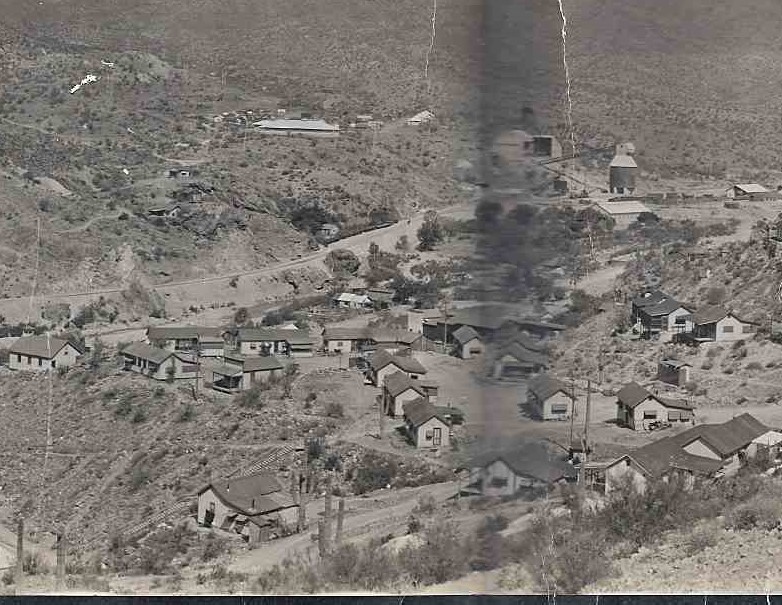
A week ago I was Skyping with Sharon Lippincott, who is married to Ezra Lippincott, grandson of Hettie Schoenthal, and Sharon and Ezra were excited to share with me a photograph that their daughter-in-law had found somewhere on the internet.  It is a panoramic view of Ray, Arizona, taken in the time that Hettie and her sister Gertrude were living there.  In fact, you can see the Miller Brothers store in the photo if you zoom in to the right side of the picture.  Just click, and then click again to zoom in to the photograph to see it more clearly.

Ray Arizona Panarama from Internet

Here’s a closeup of the section showing the Miller store:

Ray Arizona Panarama from Internet (2)

Both Hettie and Walter described their first house in Ray.  Walter wrote:

Our first house was placed on the side of a hill with one door. The back of the house was against the hill. To reach the house you walked up steps that also took care of other householders on the hill. I cannot remember the location of the outhouse. I do remember to bathe, water was heated on the stove and then poured into a galvanized tub that had been placed on the floor.

Hettie’s description is similar:

I will tell you a little about the house. It was up on a hill, just four rooms no bath or toilet. It was terrible. I did not think I could live there, but we did. Your grandfather and a helper built a room and we bought a tub. The pipes had to be on top of the ground. Well, the sun was so hot we had to draw the water and let it stand for hours before bathing.

Can you locate the house in the photograph above?  The houses are all to the far right in the panoramic photograph, and I have a guess as to which one was the home of Hettie Schoenthal and Henry Stein and their children.  Which one do you think it was?  (Look first before looking at my guess at the bottom of this post.)


In my head I am humming the Final Jeopardy theme song.


Here’s my guess:

Ray Arizona Panarama from Internet (3)

See the house in the left foreground with the huge cactus in front?  I think that’s it.  It’s built into the hill, and there is a staircase behind that leads to the other houses.  It looks like the outhouse was right in front of the house.

What do you think?

My thanks to Ezra and Sharon Lippincott and their daughter-in-law Carrie for sharing the photograph with me.

The Family of Amalia Hamberg Baer, the Administratrix

Back in May, I wrote about the sad saga of Charles Hamberg and his son Samuel Hamberg.  Charles, my great-grandfather Isidore Schoenthal’s first cousin, had lost two wives—one was murdered, one died quite young.  He had then committed suicide, leaving his nine year old son Samuel an orphan.  Charles’ estate was administered by another cousin, Amalia Hamberg Baer, who at the time was living in western Pennsylvania where my great-grandfather and many other Hamberg relatives were then living.

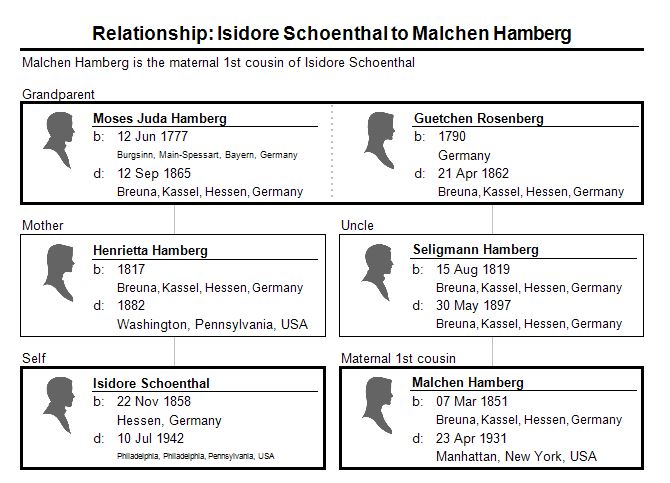
In fact, Amalia (born Malchen) was a first cousin to Isidore Schoenthal, my great-grandfather:

corrected relationship isidore schoenthal to malchen hamberg


She had come to the US from Breuna, Germany, in 1871, and had married Jacob Baer in 1873, according to the 1900 census. (For more on how I linked Amalia Hamberg to Jacob Baer, see my earlier post.)  Jacob was born in the Rhein Pfalz[1] region of Germany in about 1851 and had immigrated to the US in 1867, according to several census records.  From entries in the Pittsburgh city directories, he appears to have settled in the Pittsburgh area.

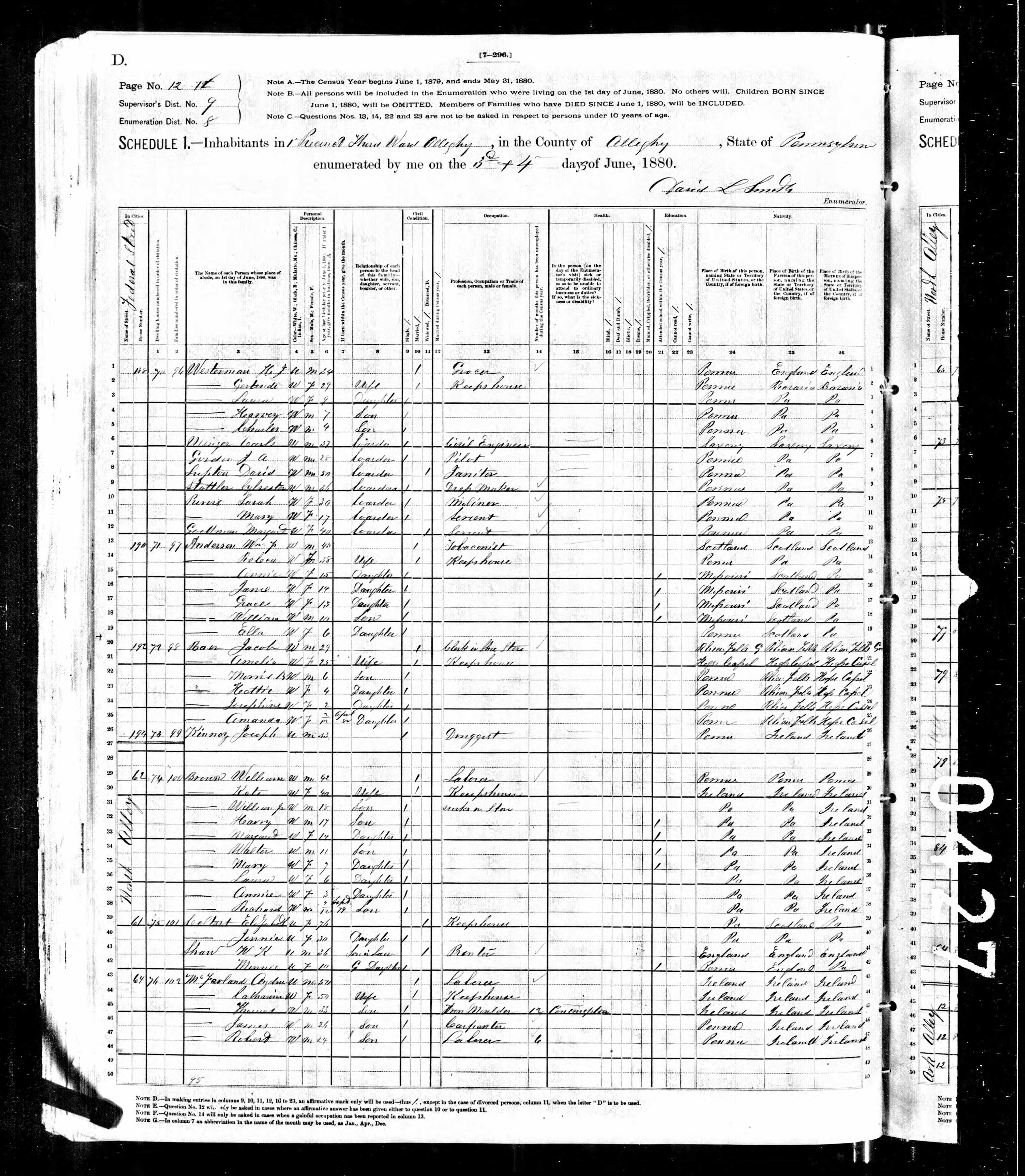
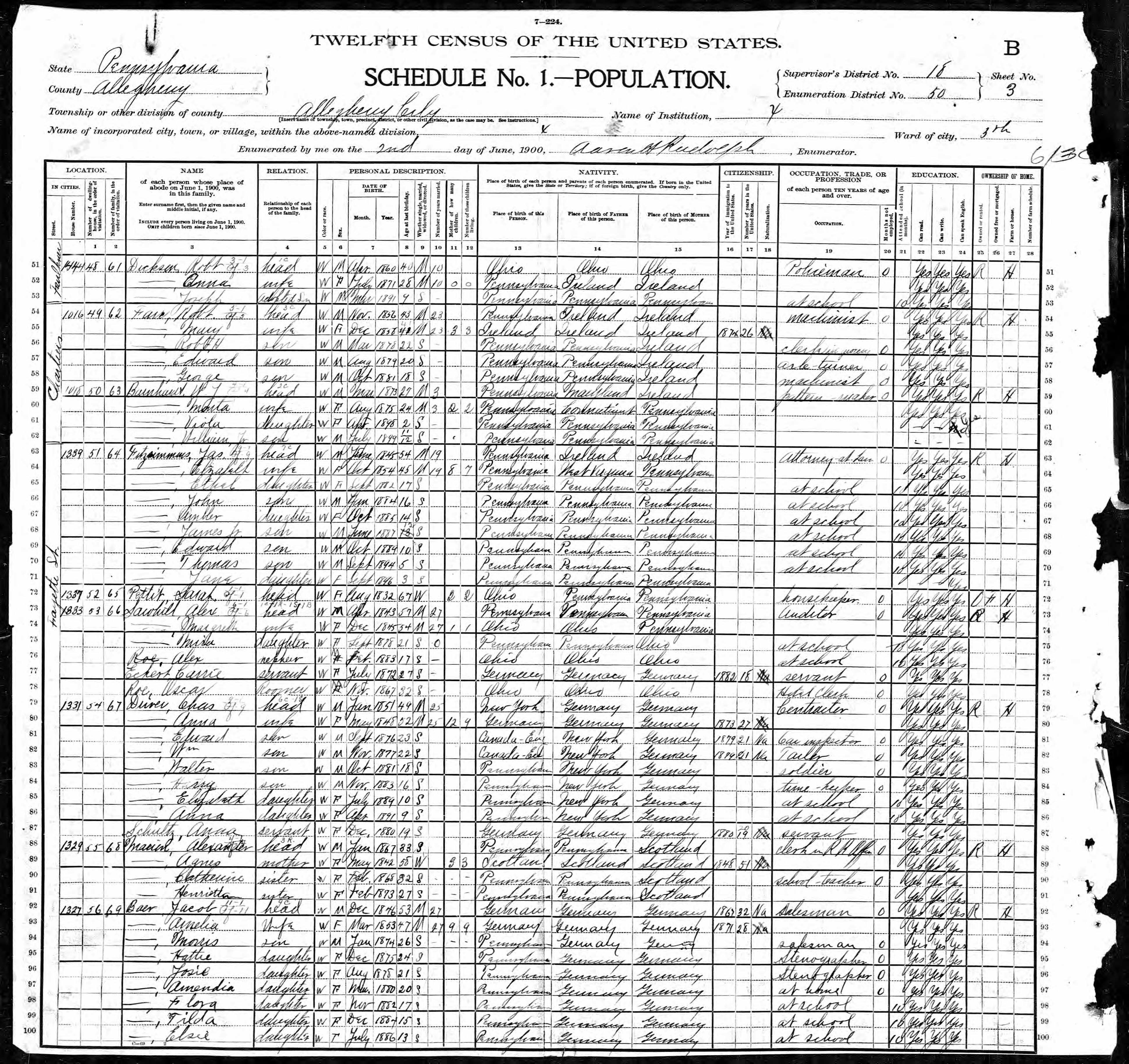
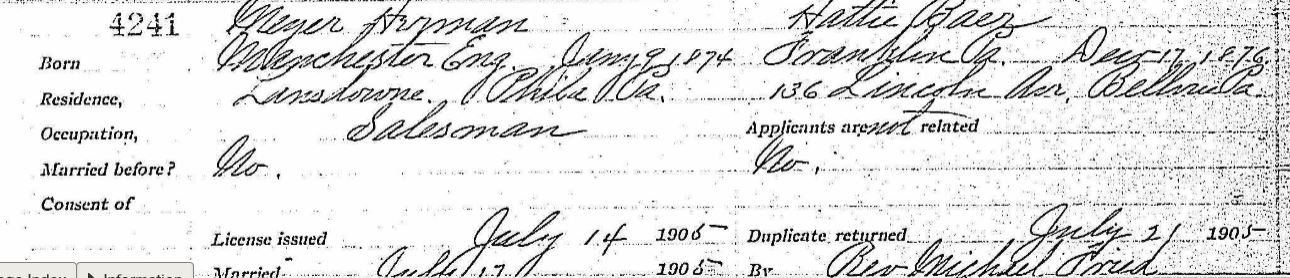
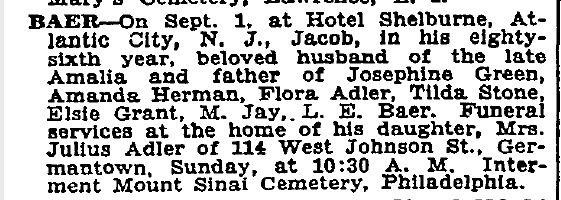
In 1880, Jacob and Amalia were living in Allegheny, Pennsylvania (now part of Pittsburgh), and Jacob was working as a clerk in a shoe store.  They already had four children: Maurice Jay (1874), Hattie (1876), Josephine (1878), Amanda (1880).

Jacob and Amalia Hamberg Baer 1880 US census Year: 1880; Census Place: Allegheny, Allegheny, Pennsylvania; Roll: 1086; Family History Film: 1255086; Page: 198D; Enumeration District: 008; Image: 0402

Jacob and Amalia Hamberg Baer 1880 US census
Year: 1880; Census Place: Allegheny, Allegheny, Pennsylvania; Roll: 1086; Family History Film: 1255086; Page: 198D; Enumeration District: 008; Image: 0402


Between 1880 and 1891, they would have five more children: Flora (1882), Tilda (1884), Elsie Victoria (1886), Alfred (1889), and Lawrence (1891). (The birth years for the daughters as reported in various records are all over the place as they kept making themselves younger as the years went on, so I am relying on the 1880 and 1900 census records when they were still probably young enough not to lie about their ages.)  During those years, Jacob was listed as a salesman in the Pittsburgh city directories.

In 1900, Jacob and Amalia were still living in Allegheny with all nine of their children.  Jacob continued to work as a salesman, as did their son Maurice (Morris here, now 26).  Hattie (24) and Josephine (Josie here, now 21) were working as stenographers.  The rest of the children were not employed.

Amalia Baer 1900 census p 1

Jacob and Amalia Hamberg Baer 1900 census Year: 1900; Census Place: Allegheny Ward 5, Allegheny, Pennsylvania; Roll: 1356; Enumeration District: 0050; FHL microfilm: 1241356

Jacob and Amalia Hamberg Baer 1900 census
Year: 1900; Census Place: Allegheny Ward 5, Allegheny, Pennsylvania; Roll: 1356; Enumeration District: 0050; FHL microfilm: 1241356


In the next decade many of the children began to move on to their own lives.  In fact, even before 1900, Maurice, the oldest child, had ventured quite far from Pittsburgh.  As I will write about in a post to follow this one, Maurice moved to Attleboro, Massachusetts,[2] and established a very successful jewelry business in which four of the siblings’ families would be involved, that is, Maurice, Tilda, Elsie, and Lawrence.  This post will focus on the other five siblings—Hattie, Josephine, Flora, Amanda, and Alfred—and their parents, Amalia and Jacob.

On July 17, 1905, Hattie Baer, the second child who was then 29, married Meyer Herman, a clothing salesman living in Philadelphia who was born in Manchester, England.

Marriage record of Hattie Baer and Meyer Herman Pennsylvania, County Marriages, 1885-1950," database with images, FamilySearch (https://familysearch.org/pal:/MM9.3.1/TH-1951-21130-27078-9?cc=1589502 : accessed 12 May 2016), 004264779 > image 383 of 454; county courthouses, Pennsylvania.

Marriage record of Hattie Baer and Meyer Herman
Pennsylvania, County Marriages, 1885-1950,” database with images, FamilySearch (https://familysearch.org/pal:/MM9.3.1/TH-1951-21130-27078-9?cc=1589502 : accessed 12 May 2016), 004264779 > image 383 of 454; county courthouses, Pennsylvania.

They settled in Philadelphia, where they had two sons, Justin Baer Herman, born in April, 1907, and Richard B. Herman, born in July, 1910.  Then tragically, Hattie died on October 15, 1910, of a perforated bowel and peritonitis.  She was only 33 years old when she died, and she left behind a three year old toddler and a two and a half month old infant son.

Hattie Baer Herman death certificate Ancestry.com. Pennsylvania, Death Certificates, 1906-1963 [database on-line]. Provo, UT, USA: Ancestry.com Operations, Inc., 2014. Original data: Pennsylvania (State). Death certificates, 1906–1963. Series 11.90 (1,905 cartons). Records of the Pennsylvania Department of Health, Record Group 11. Pennsylvania Historical and Museum Commission, Harrisburg, Pennsylvania.

Hattie Baer Herman death certificate
Ancestry.com. Pennsylvania, Death Certificates, 1906-1963 [database on-line]. Provo, UT, USA: Ancestry.com Operations, Inc., 2014.
Original data: Pennsylvania (State). Death certificates, 1906–1963. Series 11.90 (1,905 cartons). Records of the Pennsylvania Department of Health, Record Group 11. Pennsylvania Historical and Museum Commission, Harrisburg, Pennsylvania.

Five years later in 1915, Hattie’s younger sister Amanda married her brother-in-law Meyer Herman in Philadelphia and took on the responsibility for raising her two nephews, Justin and Richard, then just eight and five years old.  In 1920, Meyer was still a clothing salesman, and the family continued to live in Philadelphia.

Meyer and Amanda Baer Herman 1920 census Year: 1920; Census Place: Philadelphia Ward 22, Philadelphia, Pennsylvania; Roll: T625_1623; Page: 8A; Enumeration District: 591; Image: 961

Meyer and Amanda Baer Herman 1920 census
Year: 1920; Census Place: Philadelphia Ward 22, Philadelphia, Pennsylvania; Roll: T625_1623; Page: 8A; Enumeration District: 591; Image: 961

Ten years later in 1930, Meyer had moved from being a salesman to being the owner of a clothing manufacturing business.  The two sons were also working; Justin, now 23, was a newspaper editor, and Richard, now 19, was selling real estate.  Both were still living at home with Meyer and Amanda in Philadelphia.

Herman and Amanda Baer Herman 1930 census Year: 1930; Census Place: Philadelphia, Philadelphia, Pennsylvania; Roll: 2104; Page: 23A; Enumeration District: 0627; Image: 902.0; FHL microfilm: 2341838

Herman and Amanda Baer Herman 1930 census
Year: 1930; Census Place: Philadelphia, Philadelphia, Pennsylvania; Roll: 2104; Page: 23A; Enumeration District: 0627; Image: 902.0; FHL microfilm: 2341838

Meanwhile, the third child of Amalia and Jacob Baer, Josephine, had married Morris Alon Green on January 2, 1906.  Morris was a Pittsburgh native, born there on February 17, 1875, the son of Abraham Green, an immigrant from Holland, and Jeanette Bloomberg, born in Germany.  In 1900, Morris was living with his parents in Pittsburgh and working as a bookkeeper.

Marriage record of Morris Green and Josephine Baer Pennsylvania, County Marriages, 1885-1950," database with images, FamilySearch (https://familysearch.org/pal:/MM9.3.1/TH-1942-20622-18713-16?cc=1589502 : accessed 10 June 2016), 004811570 > image 334 of 449; county courthouses, Pennsylvania.

Marriage record of Morris Green and Josephine Baer
Pennsylvania, County Marriages, 1885-1950,” database with images, FamilySearch (https://familysearch.org/pal:/MM9.3.1/TH-1942-20622-18713-16?cc=1589502 : accessed 10 June 2016), 004811570 > image 334 of 449; county courthouses, Pennsylvania.

Josephine and Morris settled in Pittsburgh where their son Alan Baer Green was born on October 30, 1906.  In 1910, the Greens were living in Pittsburgh as boarders in the household of another family, and Morris was working as a claims agent.

Morris and Josephine Baer Green on 1910 census Year: 1910; Census Place: Pittsburgh Ward 8, Allegheny, Pennsylvania; Roll: T624_1301; Page: 2A; Enumeration District: 0379; FHL microfilm: 1375314

Morris and Josephine Baer Green on 1910 census
Year: 1910; Census Place: Pittsburgh Ward 8, Allegheny, Pennsylvania; Roll: T624_1301; Page: 2A; Enumeration District: 0379; FHL microfilm: 1375314

The next several years must have been successful ones for Morris because by 1918, he was the general agent and executive of the Crucible Steel Company and by 1920 he and Josephine and their son Alan were living in their own (rented) home with a nurse and servant residing with them.

Morris A Green, World War I draft registration Registration State: Pennsylvania; Registration County: Allegheny; Roll: 1909239; Draft Board: 11

Morris A Green, World War I draft registration
Registration State: Pennsylvania; Registration County: Allegheny; Roll: 1909239; Draft Board: 11

By 1925, Josephine and Morris had left western Pennsylvania for New York City, where they were living at the Hotel Alexander at 150 West 103rd Street.  Their son Alan is not listed as living with them; perhaps he was away at college as he would have been nineteen at that time.  In 1930, Alan was living with his parents in Manhattan, working in advertising.  His father Morris listed his occupation/industry as “financial.”

Morris and Josephine Baer Green and Alan Baer Green, 1930 census Year: 1930; Census Place: Manhattan, New York, New York; Roll: 1556; Page: 19A; Enumeration District: 0443; Image: 762.0; FHL microfilm: 2341291

Morris and Josephine Baer Green and Alan Baer Green, 1930 census
Year: 1930; Census Place: Manhattan, New York, New York; Roll: 1556; Page: 19A; Enumeration District: 0443; Image: 762.0; FHL microfilm: 2341291

The fifth child of Amalia and Jacob was Flora.  In 1907, she is listed in the Pittsburgh city directory as a teacher, residing in Bellevue, a town near Pittsburgh. In 1910, when she was 28 (although listed as 24 on the 1910 census), she was still single and living with her parents and not employed outside the home.

Jacob and Amalia Schoenthal Baer and family 1910 census Year: 1910; Census Place: Pittsburgh Ward 14, Allegheny, Pennsylvania; Roll: T624_1304; Page: 6B; Enumeration District: 0468; FHL microfilm: 1375317

Jacob and Amalia Schoenthal Baer and family 1910 census
Year: 1910; Census Place: Pittsburgh Ward 14, Allegheny, Pennsylvania; Roll: T624_1304; Page: 6B; Enumeration District: 0468; FHL microfilm: 1375317


In 1915, she married Julius Adler.  Julius was the son of Simon Adler, a German immigrant who in 1880 was living in Memphis, Tennessee, working in a shoe store.  Julius’ mother Elizabeth was a native of Missouri; she married Simon in 1881, and they had four children born in Memphis between 1882 and 1887, when their youngest son Julius was born.  By 1900, the family had relocated to Philadelphia.

According to his obituary, Julius graduated from the University of Pennsylvania with a degree in engineering in 1908.  In 1910, he was teaching at the University of Washington in Seattle.  But by 1915 he had returned to Philadelphia, where he married Flora Baer.  In 1917, they were living in Harrisburg, Pennsylvania, where Julius was working as a civil engineer for the state highway department.  They would have three children, Stanley, Jerrold, and Amy, born between 1917 and 1920.

Julius Adler, World War I draft registration Registration State: Pennsylvania; Registration County: Dauphin; Roll: 1893237; Draft Board: 3

Julius Adler, World War I draft registration
Registration State: Pennsylvania; Registration County: Dauphin; Roll: 1893237; Draft Board: 3

In 1920, the family had returned to Philadelphia, where Julius was now employed as a technical engineer for an oil company.  According to his obituary, during the 1920s, Julius was working as the deputy chief of the Philadelphia highway department and was involved in supervising the construction of the Benjamin Franklin Bridge, the bridge that spans the Delaware River connecting Philadelphia to Camden, New Jersey (originally called the Delaware River Bridge).  In 1930, Julius and Flora and their two sons continued to live in Philadelphia, Julius working as a civil engineer.

Benjamin Franklin Bridge linking Camden, NJ wi...

Benjamin Franklin Bridge linking Camden, NJ with Philadelphia, PA – Taken from the 22nd floor of Waterfront Square (Photo credit: Wikipedia)

Alfred, the second youngest child of Amalia and Jacob, was the only other child not involved with the Attleboro jewelry business.  In 1900, he was living with his family in Pittsburgh, but he is not listed with them in 1910, when he would have been 21 years old.  There is an Alfred H. Baer listed in the 1907 Pittsburgh directory, working as a clerk, but I am not sure that that is the same person.  According to his registration for the draft in World War I, Alfred was living in a sanitarium and “mentally incapacitated for work of any kind.”

Alfred Baer ww1 draft reg

Alfred Baer, World War I draft registration Registration State: Pennsylvania; Registration County: Philadelphia; Roll: 1907636; Draft Board: 17

Five years later, at age 34, Alfred died on December 13, 1923.  He was buried where his sister Hattie was buried and where later his parents, his sister Flora, and his brother Maurice would be buried at Mt. Sinai cemetery in Philadelphia. I was unable to locate a death certificate, so I do not know the cause of death.  According to his burial record, he was residing in Stamford, Connecticut, at the time of his death.

Thus, by 1930, Amalia (Hamberg) and Jacob Baer had lost two of their children, Hattie and Alfred. Their other children were doing quite well.  Amanda and Flora had moved to Philadelphia with their husbands and children, and Josephine was living in New York City with her husband and son.  The other four children were also living away from Pittsburgh, as we will see in the next post.

Even Jacob and Amalia had left Pittsburgh by that time.  In fact, sometime between 1918 and 1922, they had moved to Atlantic City.  In 1922, they were listed in the Atlantic City directory, living at The Amsterdam in Atlantic City.  The following year on March 27, 1923, their children honored their parents on the occasion of their 50th wedding anniversary with a dinner at the Esplanade Hotel in New York City.

Jacob and Amalia Baer anniversary party


In 1930 Jacob and Amalia, now 83 and 79 (although the 1930 census says 77), were living at 250 West 103rd Street in New York City, with Jacob listed as the head of household for what appears to be a small hotel; there are 28 guests listed as living with them.  Their daughter Josephine was living not too far away at 666 West End Avenue.

Amalia Baer, born Malchen Hamberg in Breuna, Germany, died on April 23, 1931, in New York City.  She was 80 years old.  She was buried in Mt. Sinai cemetery in Philadelphia where the two children who predeceased her, Hattie and Alfred, were buried.  A year later her husband Jacob died on September 1, 1932.  He was 85 years old, and he was buried with his wife and children in Mt. Sinai cemetery.  His death notice ran in the September 3, 1932 issue of The New York Times:

NY Times, September 3, 1932

NY Times, September 3, 1932

In my next post, I will write about the four children of Amalia and Jacob who were involved in the jewelry business in Attleboro, Massachusetts.  Then in a subsequent post I will report on what later happened to the children and the grandchildren of Jacob and Amalia (Hamberg) Baer.


[1] Thank you to Michael Palmer and Cathy Meder-Dempsey of the German Genealogy group on Facebook for helping me decipher Jacob’s birthplace.

[2] I am not sure why Maurice is listed as living in Pittsburgh on the 1900 census as several reports indicate he had established the business in Attleboro before then.  Perhaps he was still traveling back and forth between Pennsylvania and Massachusetts at that time.

Update: Baby Rose Schoenthal—Did She Ever Exist? Do I Stop Looking for Her?

I need your advice.  I’ve hit a brick wall, and this time, I am not sure I should try and go further.  Please let me know what you think.

Some of you may recall the mystery of Baby Rose Schoenthal, the daughter of Jacob Schoenthal and his wife Florence who appeared on the 1930 census in Atlantic City as their fifteen month old child, but then disappeared.  She was not on the 1940 census; there was no death record for her in Pennsylvania or New Jersey, and she was not buried with Jacob and Florence or with her grandparents.  She was not named as a survivor in Jacob’s will.

Atlantic City Press February 18, 1976 p 16

Atlantic City Press February 18, 1976 p 16

I was left concluding that either she had been adopted and thus had taken on a new name or had never even existed.  I haven’t yet tried searching for adoption records because it does not appear that I have legal standing to do that, given that I am not Rose, her child, her parents, or any other close relative. I also am not sure where I should search: New Jersey, Pennsylvania, or any of the other states in the country where a child might have been adopted. And even more to the point, petitions to unseal adoption records are intended to reveal the birth name of an adoptee.  I can’t find any way to search for records of a birth child who was adopted if I don’t know the adoptive name.

I did, however, request a search of New Jersey’s birth records for 1928 and 1929, hoping that a birth certificate for a Rose Schoenthal would appear.  I now have received the report back from New Jersey, and they had no birth certificate for a Rose Schoenthal born between January 1, 1928, and December 31, 1929.  What does that mean? Well, it means either Rose was never born and the census report is just wrong.  Or it means she was adopted and the birth certificate was changed to her adoptive name.

Which seems more likely? Since the census record is so specific—says she was 1 and 3/12, born in New Jersey, and gives her full name, Rose Maxine Schoenthal—I am inclined to think it was accurate (unless Jacob and Florence had an imaginary child a la Who’s Afraid of Virginia Woolf?).

Jacob Schoenthal and family 1930 US census Year: 1930; Census Place: Atlantic City, Atlantic, New Jersey; Roll: 1308; Page: 10B; Enumeration District: 0003; Image: 129.0; FHL microfilm: 2341043

Jacob Schoenthal and family 1930 US census
Year: 1930; Census Place: Atlantic City, Atlantic, New Jersey; Roll: 1308; Page: 10B; Enumeration District: 0003; Image: 129.0; FHL microfilm: 2341043

So that brings me back to the adoption possibility.  Now I need to figure out how to search for an adoption when you know the birth name but not the adoptive name.  I also have to consider whether I should try to find an adoption record. Rose could very well still be alive; she’d only be 86 or so.  It feels inappropriate for me to invade her privacy, if she is in fact alive.  I am inclined to let this one go.

What do you think? Should I leave well enough alone? Or should I pursue this further?