My Cousins Karoline, Franziska, and Rosa: Unanswered Questions, Tragic Endings

The second, third and sixth children of Meier Blumenfeld and Sarah Strauss, Karoline, Franziska, and Johanna are three about whom I know very little, but I will report what I do know and hope that eventually I will discover more information. (I will discuss the fourth child Rosa and fifth child Sophie out of order in the next post.)

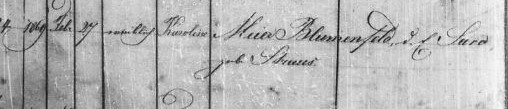
Karoline Blumenfeld was born on February 27, 1869, in Momberg.

Arcinsys Archives of Hessen, HHStAW Fonds 365 No 608, p. 6

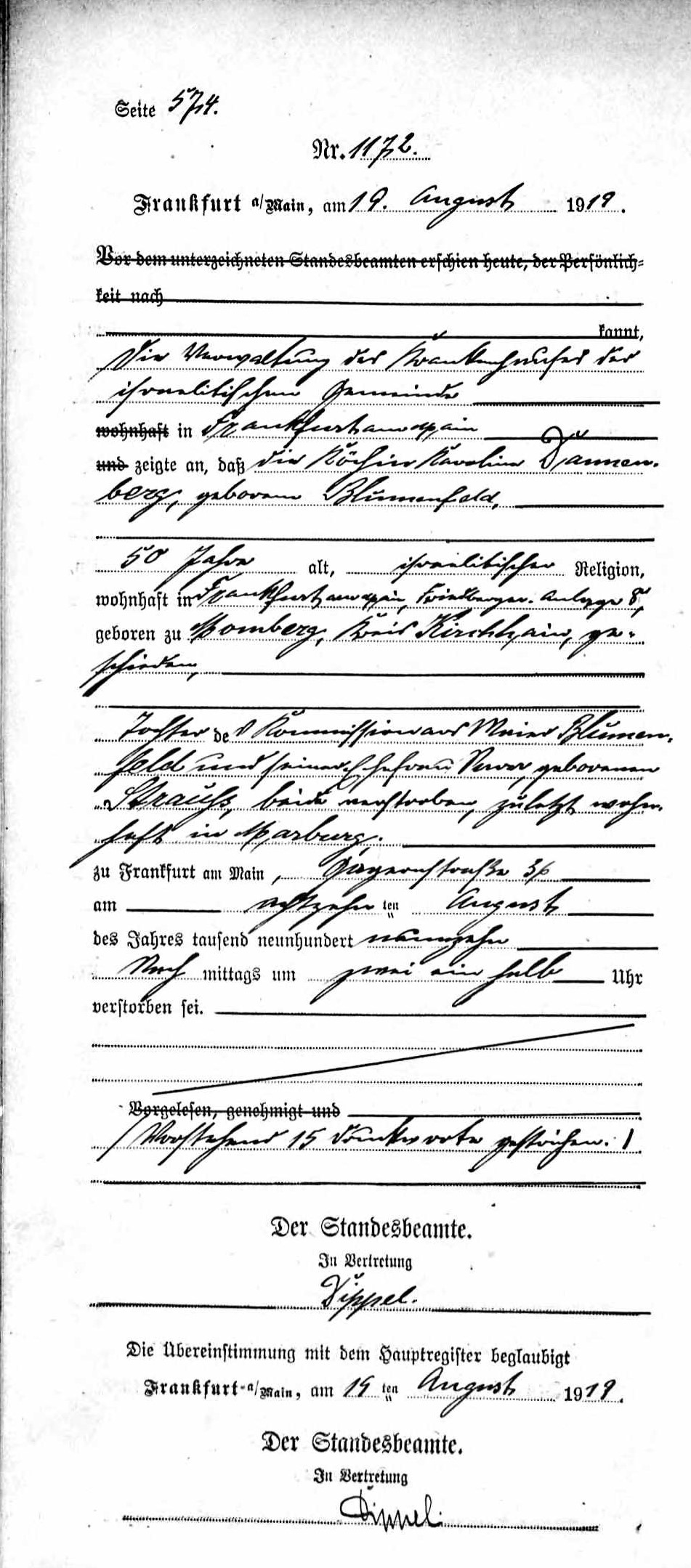
She must have married a man named Dannenberg because her death record shows her surname as Dannenberg. That death record is unfortunately the only other record I have for Karoline. I cannot find a marriage record, even after searching on Ancestry and JewishGen and on two databases of vital records for the Hesse region. One profile on Geni and several Ancestry trees report that her husband’s name was Sally Dannenberg, but there are no sources given to corroborate that information.

Karoline died on August 18, 1919, in Frankfurt at the age of fifty. Sadly, that is all I could learn about her life. I don’t know when she married or whether they had children.

Personenstandsregister Sterberegister; Bestand: 903; Signatur: 10823
Year Range: 1919, Ancestry.com. Hesse, Germany, Deaths, 1851-1958

Meier and Sarah’s third child Franziska was born on November 3, 1870, in Momberg.

Arcinsys Archives of Hessen, HHStAW Fonds 365 No 608, p. 7

She married Aron Oppenheim on October 10, 1905, in Marburg, Germany. Aron was fifteen years older than Franziska; he was born on February 5, 1855, in Rhina, Germany, to Salomon Oppenheim and Ester Klebe. He had been previously married to Hannchen Klebe, with whom he’d had a number of children. Franziska was thirty-four when they married, and Aron was fifty. I could not find any record of children born to Franziska and Aron.

Franziska Blumenfeld, Gender: weiblich (Female), Age: 34, Birth Date: 3 Nov 1870
Marriage Date: 10 Okt 1905 (10 Oct 1905), Marriage Place: Marburg, Hessen (Hesse), Deutschland (Germany), Civil Registration Office: Marburg, Father: Meine Blumenfeld, Mother: Sarchen Blumenfeld, Spouse: Aron Oppenheim, Certificate Number: 101, Hessisches Hauptstaatsarchiv; Wiesbaden, Deutschland; Bestand: 915; Laufende Nummer: 5620, Ancestry.com. Hesse, Germany, Marriages, 1849-1930

Aron died on June 7, 1921, in Halle, Germany. He was 66 years old.1 Franziska survived him, but tragically she was sent to the Therienstadt Concentration Camp by the Nazis on August 18, 1942, from Frankfurt where she was then living. She died there a month later on September 28, 1942. She was 71 years old.

Meier and Sarah’s sixth child, Johanna, like Karoline and Franziska, is a sibling about whom I know very little. Johanna was born on December 22, 1878, in Marburg, Germany.

Johanna Blumenfeld birth record, Hessisches Hauptstaatsarchiv; Wiesbaden, Deutschland; Bestand: 915; Laufende Nummer: 5557 Description Year Range: 1878 Source Information Ancestry.com. Hesse, Germany, Births, 1851-1901

Tragically, the only other record I have for Johanna is her record with Yad Vashem. According to that record, Johanna was deported on October 20, 1941, from her home in Frankfurt to the Litzmannstadt Ghetto in Poland, where she was murdered on March 15, 1942. I had never heard of the Litzmannstadt Ghetto before seeing this listing at Yad Vashem, but learned it was another name for the Lodz Ghetto, which I had known about. You can read more about it here. Johanna was 63 when she was killed.

Thus, two of Meier and Sarah (Strauss) Blumenfeld’s daughters were murdered by the Nazis, Franziska and Johanna. As far as I know, neither of them had children nor did their sister Karoline. They thus have no living descendants.

Fortunately, the remaining three siblings—Rosa, Sophie, and Hugo—left Germany long before the rise of Hitler and have stories that do not end tragically. Their stories come next.


  1.  Aron Oppenheim, Age: 66, Birth Date: abt 1855, Death Date: 7 Jun 1921
    Death Place: Halle-Nord, Sachsen-Anhalt (Saxony-Anhalt), Deutschland (Germany)
    Civil Registration Office: Halle-Nord, Spouse: Franziska Oppenheim, Certificate Number: 417, Stadtarchiv Halle (Saale); Halle (Saale), Deutschland; Personenstandsregister Sterberegister; Bestand: A 2.1; Signatur: A 2.1 3_S_1921_1,
    Ancestry.com. Halle (Saale), Germany, Deaths, 1874-1957 

Abraham Blumenfeld II’s Granddaughter Dina and Her Sons Ernst and Otto Blum

Tackling the Blumenfeld branch of my family tree will be a long process, given that the limb I am starting on—the limb based on my four-times great-uncle Moses Blumenfeld and his children—is already such a long limb. As we saw, Moses had only three children—Abraham II, Isaak, and Gelle. But Abraham II had eight children, seven of whom lived to adulthood.

And his first child Meier had nine, seven of whom lived to adulthood, as seen on this chart.

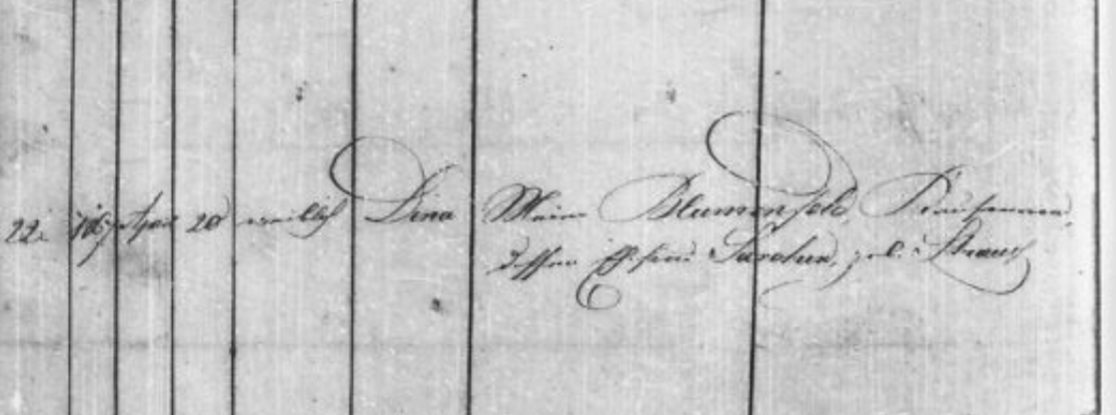
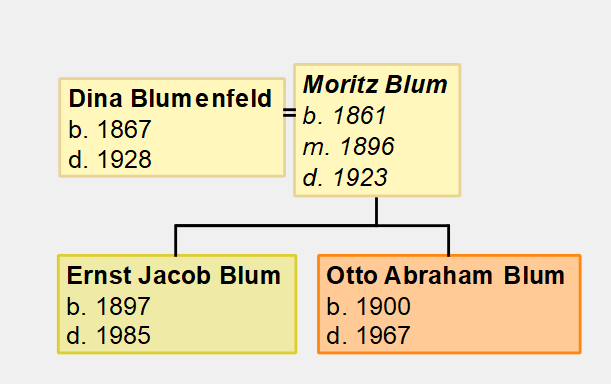
As discussed in my prior post, Meier was born on December 11, 1840 in Momberg and married Sarah Strauss, his first cousin, on January 10, 1866, in Amoeneburg. The first child of their eight children was Dina, who was born on April 20, 1867, in Momberg.

Arcinsys Archives of Hessen, HHStAW Fonds 365 No 608, p. 6

She married Moritz Blum on November 2, 1896, in Marburg, Germany. Moritz was born in Battenfeld, Germany, on December 14, 1861, to David Blum and Roschen Herstein. He was a merchant.

Hessisches Hauptstaatsarchiv; Wiesbaden, Deutschland; Bestand: 915; Laufende Nummer: 5609
Year Range: 1896, Ancestry.com. Hesse, Germany, Marriages, 1849-1930

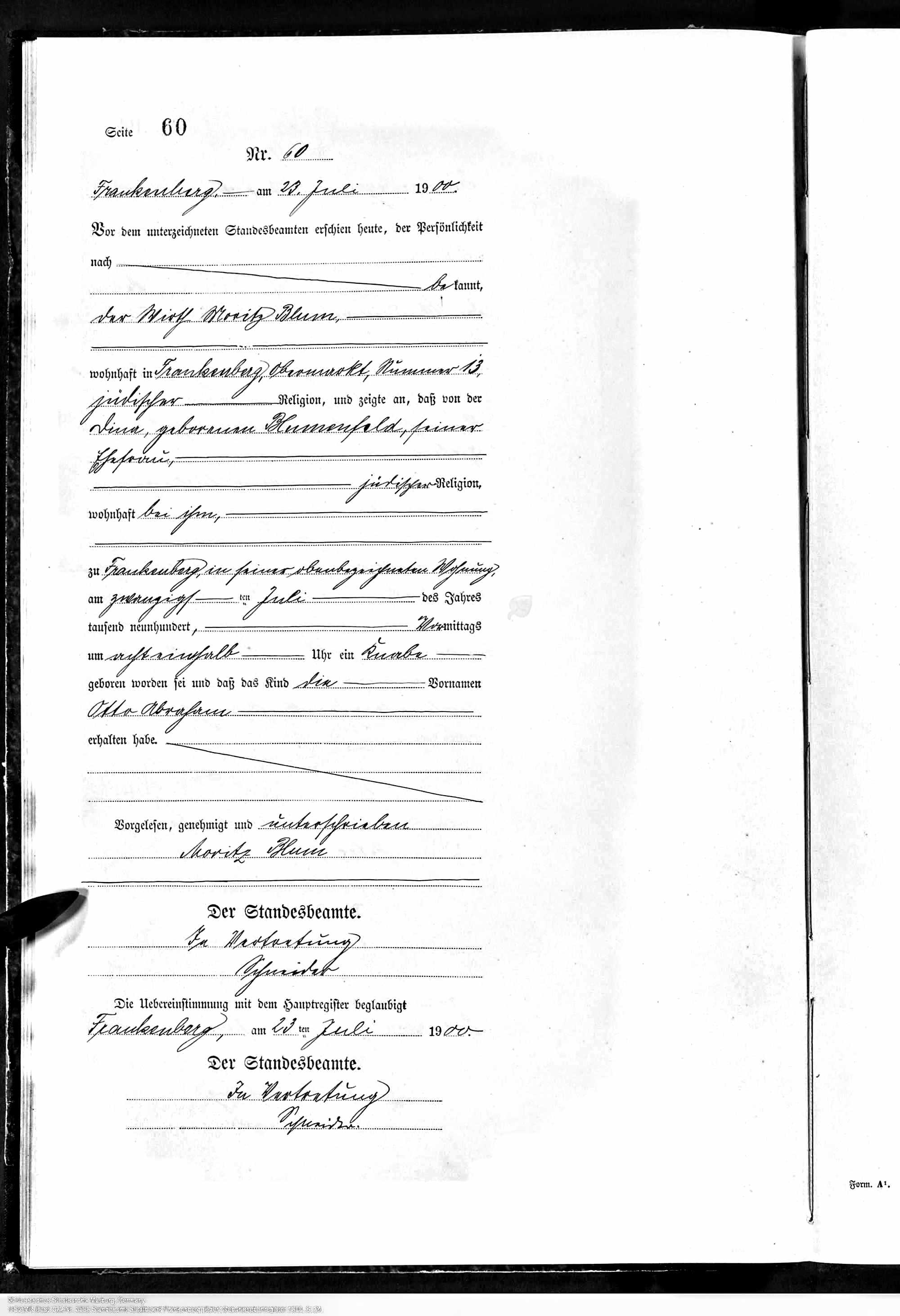
Dina and Moritz had two children. Ernst Jacob Blum was born in Frankenburg, Germany, on November 10, 1897, and his brother Otto Blum was born on July 20, 1900, in Frankenburg.

Ernst Blum birth record, Hessisches Hauptstaatsarchiv; Wiesbaden, Deutschland; Signatur: 3586
Year Range: 1897, Ancestry.com. Hesse, Germany, Births, 1851-1901

Otto Blum birth record, Hessisches Hauptstaatsarchiv; Wiesbaden, Deutschland; Signatur: 3589
Year Range: 1900, Ancestry.com. Hesse, Germany, Births, 1851-1901

Moritz Blum died when he was 61 on February 17, 1923, in Frankenburg.1

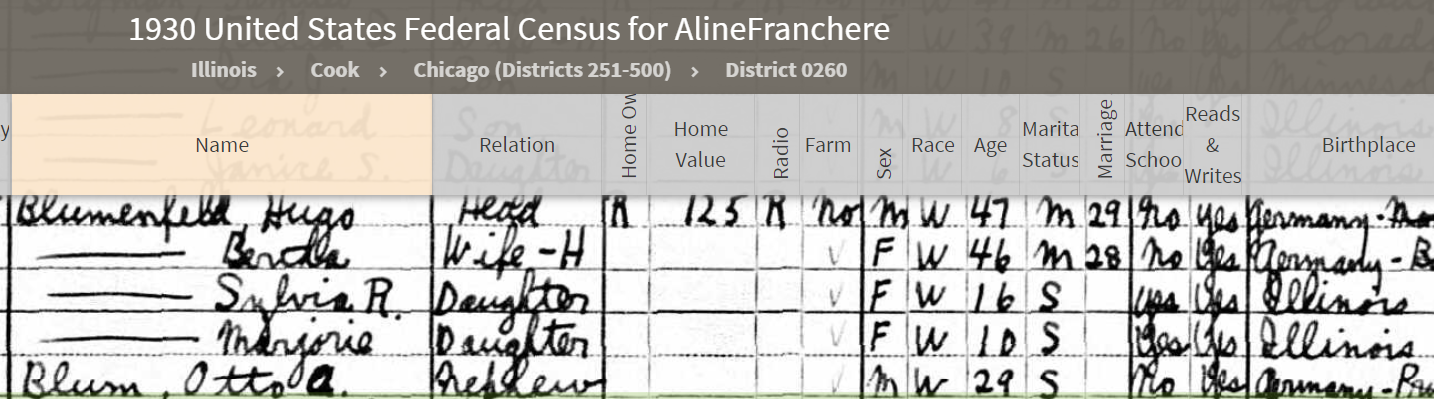
Three years later Dina and Moritz’s younger son Otto left for the United States. He arrived in the US on November 1, 1926. According to the ship manifest, he was a clerk and was heading to Chicago where his uncle Hugo Blumenfeld, Dina’s younger brother, was then living.2 Indeed the 1930 US census finds him living with Hugo and his family in Chicago where Otto was working as a clerk in a mail order factory.

Otto Blum on 1930 US census with Hugo Blumenfeld, Year: 1930; Census Place: Chicago, Cook, Illinois; Page: 27B; Enumeration District: 0260; FHL microfilm: 2340159, Ancestry.com. 1930 United States Federal Census

Meanwhile, back in Germany, Otto’s older brother Ernst Jacob had married Erna Bachrach on January 25, 1925, in Marburg.3 Erna was the daughter of Solomon Bachrach and Frederike Heilbrunn and was born in Frielendorf, Germany, on May 19, 1901.4 In 1926 their first child was born in Frankenburg, and a second child was born three years later.

Unfortunately Dina did not live to see the birth of this second grandchild. She died in Frankenburg on May 21, 1928, when she was 61.

Personenstandsregister Sterberegister; Signatur: 3706
Year Range: 1928, Ancestry.com. Hesse, Germany, Deaths, 1851-1958

Dina also did not live to endure the Nazi persecution of the Jews that began a few years after her death. Fortunately, her son Otto was already in the United States, and in 1936, Ernst and his family also immigrated to escape the Nazis. Like his brother Otto, Ernst was headed for Chicago. He listed his uncle Ignaz Herzka as the person he was going to on the ship manifest. Ignaz Herzka was married to Rosa Blumenfeld, younger sister of Ernst’s (and Otto’s) mother Dina. Ernst reported that he was a merchant on the ship manifest.5

Ernst and his family settled in Chicago where in 1940 he was working as a salesman.6 His brother Otto is not listed in his household on the 1940 census, but by 1942 he was living at the same address as his brother Ernst, 5340 Cornell Avenue in Chicago. Otto was working for his uncle Ignaz Herzka who was a tailor. Ernst was working for a company called Hillman’s in Chicago. His 1942 petition for naturalization stated that he was working as a food clerk.

Ernst Blum, World War II draft registration, National Archives at St. Louis; St. Louis, Missouri; WWII Draft Registration Cards for Illinois, 10/16/1940-03/31/1947; Record Group: Records of the Selective Service System, 147; Box: 151, Ancestry.com. U.S., World War II Draft Cards Young Men, 1940-1947

Otto Blum, World War II draft registration, National Archives at St. Louis; St. Louis, Missouri; WWII Draft Registration Cards for Illinois, 10/16/1940-03/31/1947; Record Group: Records of the Selective Service System, 147; Box: 151, Ancestry.com. U.S., World War II Draft Cards Young Men, 1940-1947

Ernst Blum petition for naturalization, National Archives at Chicago; Chicago, Illinois; ARC Title: Petitions for Naturalization, 1906-1991; Record Group Title: Records of District Courts of the United States, 1685-2009; Record Group Number: RG 21,  Petitions, V· 1032-1034, No· 254210-254835, 1942, Ancestry.com. Illinois, U.S., Federal Naturalization Records, 1856-1991

Otto served in the US Army during World War II from October 16, 1942, until June 23, 1943. He was a private in the 976th Field Artillery Battalion, fighting against his native country and against Hitler.7 It does not appear that Ernst served during the war.

After the war Otto married Mary Shields on February 11, 1949, in Chicago.8 She was born in Indiana on February 23, 1904. I do not know her father’s name, but her mother was Mary Jane (Medda) Shields. Mary had been previously married to Irving Bartlett with whom she’d had one child.9 Otto and Mary did not have children together.

Otto Blum died on October 9, 1967, in Chicago; he was 61.10 He was survived by his widow Mary, who died sixteen years later on April 6, 1983, at 79.11

Ernst Jacob Blum also survived his younger brother Otto. He died October 2, 1985 at the age of 87 in Chicago.12 His wife Erna had predeceased him; she was 70 when she died on October 11, 1971, in Chicago.13 They were survived by one of their daughters and their grandchildren.

Thus, Dina Blumenfeld Blum was fortunate that her sons left Germany in time to survive the Holocaust, and she has living descendants today because of that.

Next, Dina’s younger sisters Karoline, about whom I know very little, and Franziska and Johanna, who were not as fortunate as Dina’s family when it came to the Holocaust.


  1.  Moriz Blum, Gender: männlich (Male), Age: 61, Birth Date: abt 1862
    Death Date: 17 Feb 1923, Death Place: Stadtbezirk-Frankenberg, Hessen (Hesse), Deutschland (Germany), Civil Registration Office: Stadtbezirk-Frankenberg, Spouse: Dina, Certificate Number: 10, Personenstandsregister Sterberegister; Signatur: 3701,
    Ancestry.com. Hesse, Germany, Deaths, 1851-1958 
  2. Otto Blum, ship manifest, Year: 1926; Arrival: New York, New York, USA; Microfilm Serial: T715, 1897-1957; Line: 8; Page Number: 42, Ship or Roll Number: Deutschland,
    Ancestry.com. New York, U.S., Arriving Passenger and Crew Lists (including Castle Garden and Ellis Island), 1820-1957 
  3. Erna Blum, Declaration of Intention, National Archives at Chicago; Chicago, Illinois; ARC Title: Petitions for Naturalization, 1906-1991; Record Group Title: Records of District Courts of the United States, 1685-2009; Record Group Number: RG 21,
    Ancestry.com. Illinois, U.S., Federal Naturalization Records, 1856-1991 
  4. Arcinsys Archives of Hessen, HHStAW Fonds 365 No 191, p. 54. 
  5.  Ernst Blum, Gender: Male, Ethnicity/ Nationality: German;Hebrew (German), Marital status: Married, Age: 38, Birth Date: abt 1898, Birth Place: Germany
    Other Birth Place: Frankenberg, Last Known Residence: Frankenberg, Germany
    Place of Origin: Germany,Departure Port: Hamburg, Germany, Arrival Date: 29 May 1936, Arrival Port: New York, New York, USA, Final Destination: Chicago, Illinois
    Years in US: Permanently, Citizenship Intention: Yes, Height: 5 Feet, 10 Inches
    Hair Color: Dark Blonde, Eye Color: Brown, Complexion: Fair, Money in Possession: $50, Person in Old Country: Salomon Bachrach, Person in Old Country Relationship: Son-In-Law, Person in Old Country Residence: Frielendorf, Person in US: Ignatz Hertzka, Person in US Relationship: Uncle, Ship Name: Hamburg, Year: 1936; Arrival: New York, New York, USA; Microfilm Serial: T715, 1897-1957; Line: 9; Page Number: 64, Ancestry.com. New York, U.S., Arriving Passenger and Crew Lists (including Castle Garden and Ellis Island), 1820-1957 
  6. Ernst Blum and family, 1940 US census, Year: 1940; Census Place: Chicago, Cook, Illinois; Roll: m-t0627-00929; Page: 3A; Enumeration District: 103-262, Ancestry.com. 1940 United States Federal Census 
  7. Otto Blum, Rank: PVT, Birth Date: 20 Jul 1900, Service Number: 36617489
    Service Branch: Army, Unit: Hq Battery 976th Field Artillery Battalion, Enlistment Date: 16 Oct 1942, Discharge Date: 23 Jun 1943, Death Date: 9 Oct 1967, Cemetery: Oak Woods, Cemetery Location: Chicago, Illinois, USA, National Archives at St. Louis, MO; St. Louis, MO, USA; Applications for Headstones, 1/1/1925 – 6/30/1970; NAID: NAID 596118; Record Group Number: 92; Record Group Title: Records of the Office of the Quartermaster General, Ancestry.com. U.S., Headstone Applications for Military Veterans, 1925-1970 
  8. Otto Blum Marriage Date 11 Feb 1949 Spouse Mary BartlettMarriage Location Cook County, IL Marriage license{4D14C476-31B6-41F4-AF45-4CAA7C27AE2D} File Number 2071238 Archive collection name Cook County Genealogy Records (Marriages) Archive repository location Chicago, IL Archive repository name Cook County Clerk, Ancestry.com. Cook County, Illinois Marriage Index, 1930-1960 
  9. Mary E Fogarty, Spouse Name: Irving G Bartlett, Marriage Date: 3 Jun 1924
    Marriage County: Tippecanoe, Birth Date: 23 Feb 1903, Age: 21, Tippecanoe County, Indiana; Index to Marriage Record Jan. 1, 1921 to Dec. 31,, W. P. A. Original Record Located: County Clerk’s O; Book: M-39; Page: 558, Ancestry.com. Indiana, U.S., Marriage Index, 1800-1941. Mary E. Shields, [Mary E. Bartlett], Gender: Female
    Registration Year: 1929, Spouse: Irving Bartlett, Child: Mary Jane Bartlett, Certificate Number: 52941, Roll Number: 022, Agency: Indiana State Dept. of Health, Volume Range: 106 – 110, Ancestry.com. Indiana, U.S., Birth Certificates, 1907-1940 
  10. Otto Blum, Death Date: 9 Oct 1967, Death Location: Cook County, IL
    File Number: 672811, Archive collection name: Cook County Genealogy Records (Deaths), Archive repository location: Chicago, IL, Archive repository name: Cook County Clerk, Ancestry.com. Cook County, Illinois Death Index, 1908-1988 
  11. Obituary for Mary E. Blum, News-Press, Fort Myers, Florida
    08 Apr 1983, Fri • Page 30 
  12. Ernst Blum, Death Date: 2 Oct 1985, Death Location: Cook County, IL
    File Number: 6019403, Archive collection name: Cook County Genealogy Records (Deaths), Archive repository location: Chicago, IL, Archive repository name: Cook County Clerk, Ancestry.com. Cook County, Illinois Death Index, 1908-1988 
  13. Erna Blum, Death Date: 11 Oct 1971, Death Location: Cook County, IL
    File Number: 628510, Archive collection name: Cook County Genealogy Records (Deaths), Archive repository location: Chicago, IL, Archive repository name: Cook County Clerk, Ancestry.com. Cook County, Illinois Death Index, 1908-1988 

Children Orphaned by the 1918 Flu Epidemic: The Family of Clementine Goldschmidt Sondheimer, Part II

In the last post we saw that after Clementine Goldschmidt Sondheimer died in 1918 and then her husband Nathan Sondheimer died in 1933, there were three children left orphaned: Manfred, Erich, and Augusta. They were still just teenagers at the time. But fortunately for them their grandmother Selma Cramer Goldschmidt and their extended family in Frankfurt cared for them as did their stepmother Anna.

All three were able to escape from Nazi Germany in time. We saw that  Augusta ended up in the US in early 1939 and lived with her stepmother Anna and her aunt Selma Ettlinger Oppenheimer until she married Walter Levy in 1942.

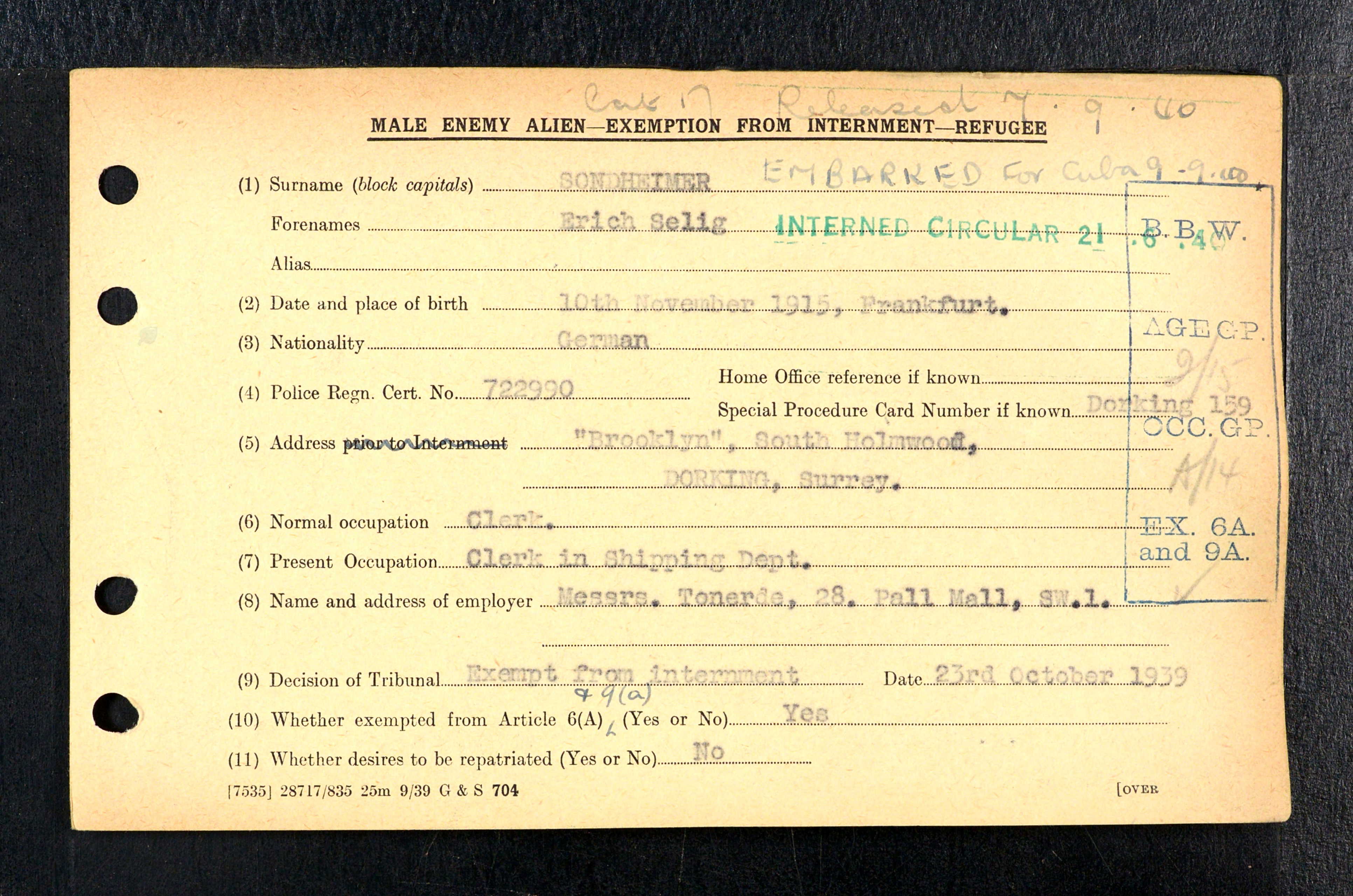
As for Augusta’s older brothers, Manfred and Erich, by 1939, they were living in England, according to the 1939 England and Wales Register. The Sondheimer brothers were living in Surrey with a couple named Friedrich and Ruth Hirsch, who were not much older than they were; Friedrich was a metal broker. Manfred was working as the secretary and Erich as a clerk for a company identified as Messrs. Tonerde on their enemy alien registration cards (see images below). That was the same company where their cousin Ernst Bodenheimer was employed.

Manfred and Erich Sondheimer, The National Archives; Kew, London, England; 1939 Register; Reference: RG 101/1938C, Enumeration District: DNEA, Ancestry.com. 1939 England and Wales Register

Manfred married another Frankfurt native, Ruth Blumenthal, on June 16, 1940, in the Hendon district of London; Ruth was born on June 4, 1920, to Samuel Blumenthal and Gutta Spangenthal. She had come to London after finishing school in Germany.1 Their daughter, my fifth cousin Daniela, kindly shared a scan of their marriage registration:

Marriage certificate of Manfred Sondheimer and Ruth Blumenthal

Both Manfred and Erich were eventually interned as enemy aliens on the Isle of Man. Here is Manfred’s enemy alien registration card showing that he was then living in Surrey and working for Messrs. Tonerde. Although he was originally found to be exempt from internment, he was later interned on the Isle of Man, where he was put in charge of one of the barracks,2 and released on September 8, 1940.

Manfred Sondheimer enemy alien registration, The National Archives; Kew, London, England; HO 396 WW2 Internees (Aliens) Index Cards 1939-1947; Reference Number: HO 396/240
Piece Number Description: 240: Dead Index (Wives of Germans etc) 1941-1947: Siderer-Steppacher, Ancestry.com. UK, World War II Alien Internees, 1939-1945

Manfred’s brother Erich Selig Sondheimer also was interned on the Isle of Man. According to his enemy alien registration card, he was living with his brother Manfred in Surrey at the time of  registration and was also working for Messrs. Tonerde. But he also was later sent to the internment camp where he was the chauffeur to the commander of the camp.3 Eric was  released from the camp on September 7, 1940, the day before his brother Manfred.

Erich S Sondheimer enemy alien registration, The National Archives; Kew, London, England; HO 396 WW2 Internees (Aliens) Index Cards 1939-1947; Reference Number: HO 396/240
Piece Number Description: 240: Dead Index (Wives of Germans etc) 1941-1947: Siderer-Steppacher, Ancestry.com. UK, World War II Alien Internees, 1939-1945

On September 9, 1940, Ruth and Manfred and Erich all left England for Cuba. They had decided they would go wherever they first got a visa, and although Ruth would have preferred to go to Palestine where her parents and sister were living, the visa for Cuba came through first.4

On the same ship were their cousins Ernst and Clementine (Eisemann) Bodenheimer, who had also been interned on the Isle of Man. According to their daughter Daniela, Ruth and Manfred had a religious wedding ceremony aboard the ship to solemnize the civil ceremony they had had in London in June.5

Ernst and Clementine Bodenheimer, Manfred and Ruth Sondheimer, Erich Sondheimer, ship manifest, Ancestry.com. UK and Ireland, Outward Passenger Lists, 1890-1960

On February 17, 1941, Manfred and Ruth arrived in Miami, Florida, from Cuba. Manfred reported that the person they were going to at their destination was Anna Sondheimer in New York City. Manfred stated that he was a merchant who last permanently resided in London. He could speak five languages: German, English, French, Dutch, and Hebrew.

Manfred Sondheimer, Ancestry.com. Miami, Florida, U.S., Index to Alien Arrivals by Airplane, 1930-1942

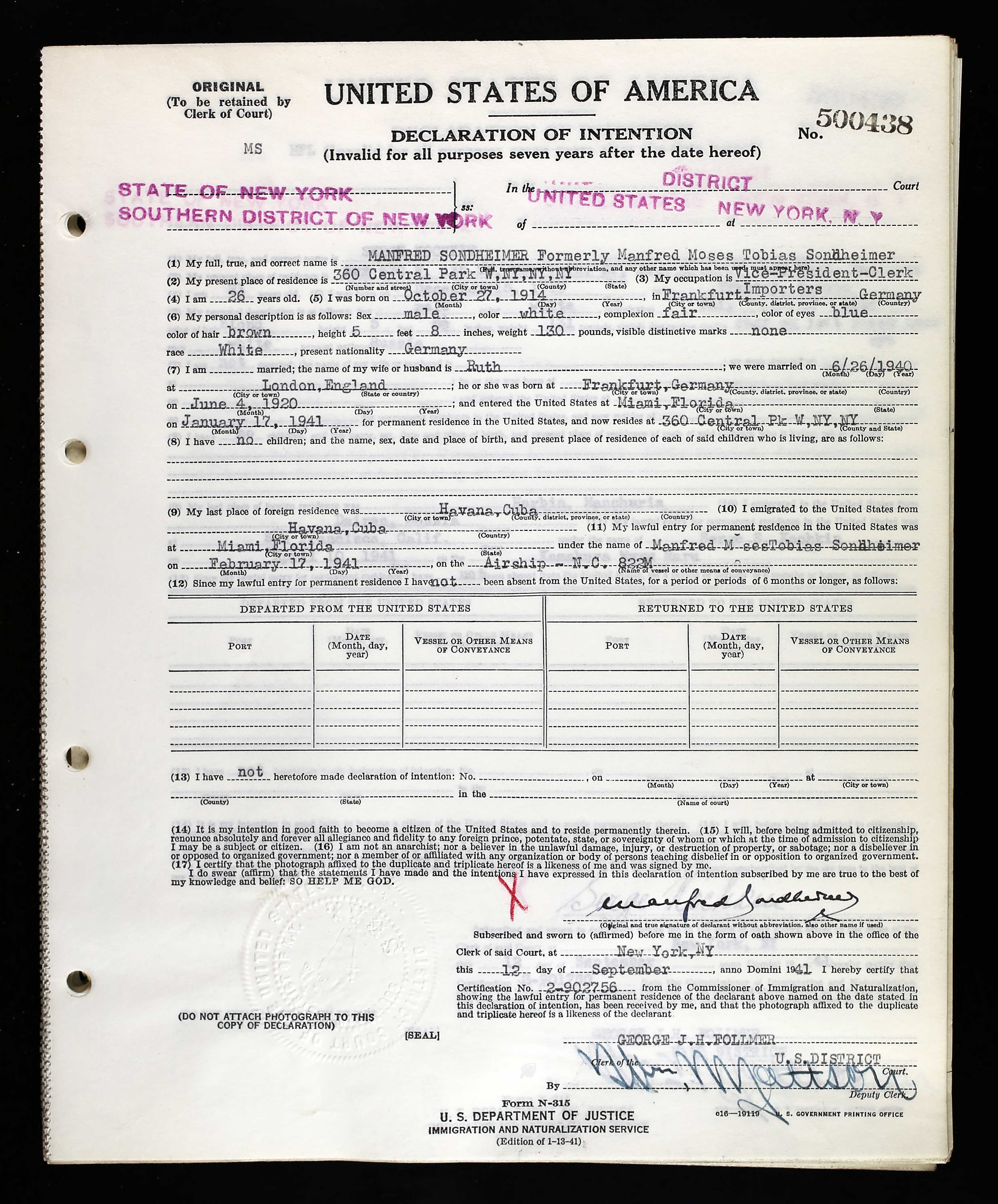
By the time Manfred filed his declaration of intention to become a US citizen on September 12, 1941, he and Ruth were living in New York City. Manfred listed his occupation as the vice-president/secretary of an importing business.
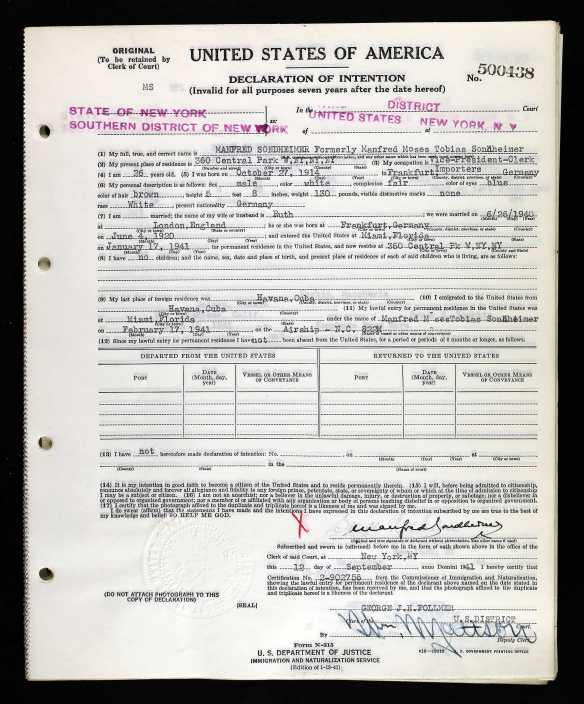
Manfred Sondheimer, Declaration of Intention, The National Archives at Philadelphia; Philadelphia, Pennsylvania; NAI Title: Declarations of Intention for Citizenship, 1/19/1842 – 10/29/1959; NAI Number: 4713410; Record Group Title: Records of District Courts of the United States, 1685-2009; Record Group Number: 21, Description: (Roll 630) Declarations of Intention for Citizenship, 1842-1959 (No 500201-501100), Ancestry.com. New York, U.S., State and Federal Naturalization Records, 1794-1943

On his World War II draft registration, he identified that company as Campro, Inc. Manfred and Ruth had two children born in New York after the war, their son Adrian and their daughter Daniela, who has generously shared so much of her family’s story with me.

Manfred Sondheimer World War 2 draft registration, Ancestry.com. U.S., World War II Draft Cards Young Men, 1940-1947

Manfred’s marriage to Ruth Blumenthal ended in divorce in 1966, and in 1968, he married another Ruth—Ruth Darmstadter Grunebaum.6 He became the vice-president of the Hugo Neu Company, a business that, as described on its website, “is a privately held company with deep experience in investing, building and managing businesses in recycling, real estate and related industries.” Manfred worked there for fifty years. One of his favorite charities was the Bibleland Museum in Jerusalem, and he worked hard to provide support and to obtain support from others for that institution.7

Manfred died on January 8, 2006, at the age of 91. He was survived by his children and grandchildren as well as his brother Erich. Those descendants have carried on the Goldschmidt commitment to Jewish education as both of Manfred’s children and all of his grandchildren have attended or are attending Jewish day school.8

Instead of going directly to the US from Cuba like his brother Manfred, Erich Sondheimer agreed to stay in Cuba so that another relative, one of his Sondheimer cousins, could leave for the US. Because he was unable to get a visa to the US, Erich ended up living for some years in Ecuador,9 where he married his wife Joan Charlotte Salomon on October 26, 1943. She was born in Berlin on March 31, 1912, to Herman and Gertrud Salomon.10

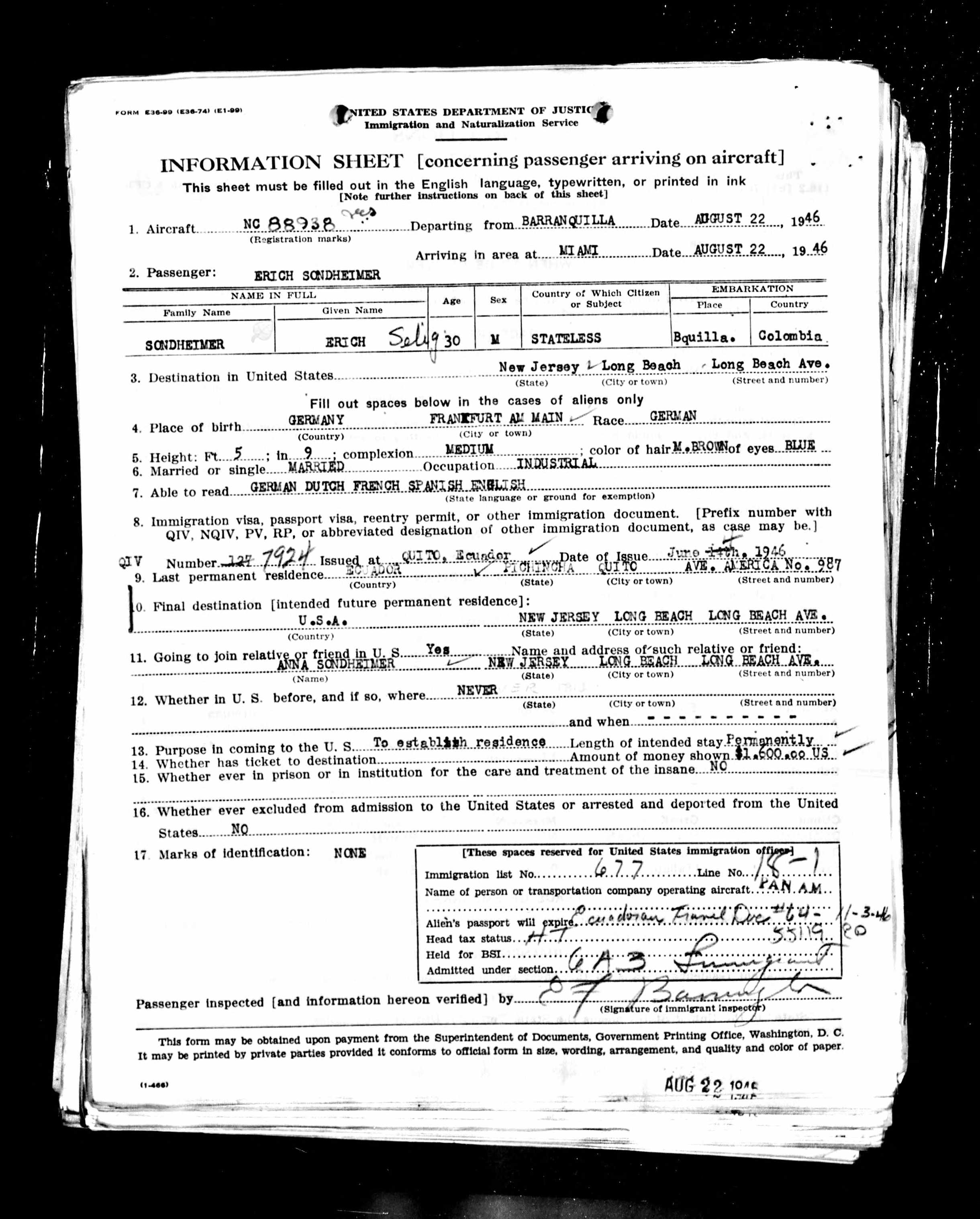
Erich and Joan immigrated to the US on August 22, 1946, arriving in Miami, Florida. On an information sheet filed with INS upon his arrival, Erich indicated that they were heading to Long Beach, New Jersey, where Anna Sondheimer, his stepmother, was living. (This is probably a mistake and should have been Long Beach, New York, according to Erich’s niece Daniela.) Erich described his occupation as “industrial” and noted that he, like his brother Manfred, was able to read five languages: German, Dutch, French, Spanish, and English.

Erich Sondheimer, The National Archives at Washington, D.C.; Washington, D.C.; Series Title: Passenger and Crew Manifests of Airplanes Arriving at Miami, Florida; NAI Number: 2788537; Record Group Title: Records of the Immigration and Naturalization Service, 1787 – 2004; Record Group Number: 85, Roll Number: 133, Ancestry.com. Florida, U.S., Arriving and Departing Passenger and Crew Lists, 1898-1963

Erich (later spelled Eric in the US) and Joan settled in New York and made several trips to South America as well as other destinations over the years. They did not have children. Joan died November 22, 2009; she was 97 years old.11 Eric died March 8, 2010, less than four months after Joan. He was 94.12

Eric worked for many years for the Melanol Corporation, an oil trading business, but his niece Daniela said that his real passion was his volunteer work for an organization called Selfhelp Community Services that Selma Ettlinger Sondheimer was also involved in developing.13 Selfhelp describes itself on its website as follows:

Selfhelp Community Services was founded in 1936 to help those fleeing Nazi Germany maintain their independence and dignity as they struggled to forge new lives in America. Today, Selfhelp is one of the largest and most respected not-for-profit human service agencies in the New York metropolitan area, with 46 programs offering services throughout Manhattan, Brooklyn, Queens, the Bronx, Nassau and Suffolk Counties, and Westchester. Selfhelp provides a broad set of services to more than 20,000 elderly, frail, and vulnerable New Yorkers each year, while remaining the largest provider of comprehensive services to Holocaust survivors in North America.

In a death notice published in The New York Times on March 9, 2010, Selfhelp paid tribute to Eric Sondheimer and his long and dedicated service to their organization:14

Selfhelp Community Services deeply mourns the passing of the esteemed elder statesman of our Board, Eric S. Sondheimer. For over fifty years, Mr. Sondheimer demonstrated an unwavering commitment to Selfhelp’s historic mission of supporting life with dignity to survivors of the Holocaust. His passion for independent living is evidenced by Selfhelp’s six residences, built under his guidance and direction, which house 1,000 seniors. Mr. Sondheimer will be lovingly remembered as a true gentleman whose exceptional kindness and wit was matched only by his insightful wisdom and vision. He left an extraordinary legacy for which he will always be remembered.

Thank you to my fifth cousin Daniela for sharing her family stories and photographs, including these two of her Sondheimer family. First, a photograph of Ruth Blumenthal Sondheimer, Daniela’s mother, Selma Ettlinger Sondheimer, the widow of Nathan Sondheimer’s brother Fritz, and Joan Charlotte Salomon Sondheimer, Erich Sondheimer’s wife:

Ruth Blumenthal Sondheimer, Selma Ettlinger Sondheimer, Joan Charlotte Sondheimer. Courtesy of the family

This last photograph is of four of the Sondheimer siblings and their spouses. It includes Manfred and Eric Sondheimer’s half-siblings, Fred (previously known as Fritz) and Marion. Their sister Augusta had already died when this photo was taken.

Robert Couturier, Joan Charlotte Sondheimer, Fred Sondheimer, Marion Sondheimer Couturier, Ruth Grunenbaum Sondheimer, Manfred Sondheimer, Eric Sondheimer. Courtesy of the family.

Reading about Manfred and Eric and their sister Augusta and how successful and well-loved they all were was reassuring and uplifting. Here were three children who lost their mother as preschoolers and their father as teens and then had to escape from Nazi Germany. Eric and Manfred were both interned as enemy aliens on the Isle of Man. Both brothers then escaped to Cuba because they couldn’t get into the US as quickly due to visa issues and quotas. And then finally they both settled in New York and lived very long and productive lives.

Once again I am inspired by the resilience of the human spirit and the ability of people to survive terrible losses and displacement and yet go on to find joy and meaning in life.



  1. Ruth Blumenthal Sondheimer, Gender: Female, Race: White, Birth Date: 4 Jun 1920, Birth Place: Frankfurt, Federal Republic of Germany, Death Date: 27 Oct 1996
    Father: Samuel Blumenthal, Mother: Gutta Spagenthal, SSN: 060405088, Ancestry.com. U.S., Social Security Applications and Claims Index, 1936-2007. Conversation with Daniela Sondheimer Klein, December 1, 2020. Volume Number: 3a
    Page Number: 2220, General Register Office; United Kingdom; Volume: 3a; Page: 2220, Ancestry.com. England & Wales, Civil Registration Marriage Index, 1916-2005 
  2. Conversation with Daniela Sondheimer Klein, December 1, 2020. 
  3. Ibid. 
  4. Ibid. 
  5. Ibid. 
  6. Divorce documents provided by Daniela Sondheimer Klein. Ruth Grunebaum
    Gender: Female, Marriage License Date: 1968, Marriage License Place: Manhattan, New York City, New York, USA, Spouse: Manfred Sondheimer, License Number: 2434,
    New York City Municipal Archives; New York, New York; Borough: Manhattan, Ancestry.com. New York, New York, U.S., Marriage License Indexes, 1907-2018 
  7. Death notices for Manfred Oppenheimer, The New York Times, Jan. 10, 2006, Section C, Page 17. Conversation with Daniela Sondheimer Klein, December 1, 2020. 
  8. Conversation with Daniela Sondheimer Klein, December 1, 2020. Manfred Sondheimer, Social Security Number: 051-18-3476, Birth Date: 27 Oct 1914, Issue Year: Before 1951, Issue State: New York, Last Residence: 10024, New York, New York, New York, Death Date: 8 Jan 2006, Social Security Administration; Washington D.C., USA; Social Security Death Index, Master File, Ancestry.com. U.S., Social Security Death Index, 1935-2014 
  9. Conversation with Daniela Sondheimer Klein, December 1, 2020. 
  10. David Baron and Roger Cibella, Goldschmidt Family Report. Joan Charlotte Sondheimer, Birth Date: 31 Mar 1912, Age: 39, Naturalization Date: 25 Feb 1952
    Residence: New York, New York, Title and Location of Court: New York Southern District, Ancestry.com. New York, U.S., Index to Petitions for Naturalization filed in New York City, 1792-1989 
  11. Joan Sondheimer, Social Security Number: 094-24-2094, Birth Date: 31 Mar 1912
    Issue Year: Before 1951, Issue State: New York, Last Residence: 10024, New York, New York, New York, Death Date: 22 Nov 2009, Social Security Administration; Washington D.C., USA; Social Security Death Index, Master File, Ancestry.com. U.S., Social Security Death Index, 1935-2014 
  12.  Eric Sondheimer, Social Security Number: 070-24-6828, Birth Date: 10 Nov 1915
    Issue Year: Before 1951, Issue State: New York, Last Residence: 10024, New York, New York, New York, Death Date: 8 Mar 2010, Social Security Administration; Washington D.C., USA; Social Security Death Index, Master File, Ancestry.com. U.S., Social Security Death Index, 1935-2014 
  13. Conversation with Daniela Sondheimer Klein, December 1, 2020. 
  14. Death notice for Eric Sondheimer, The New York Times, March 9, 2010. 

Children Orphaned by the 1918 Flu Epidemic: The Family of Clementine Goldschmidt Sondheimer, Part I

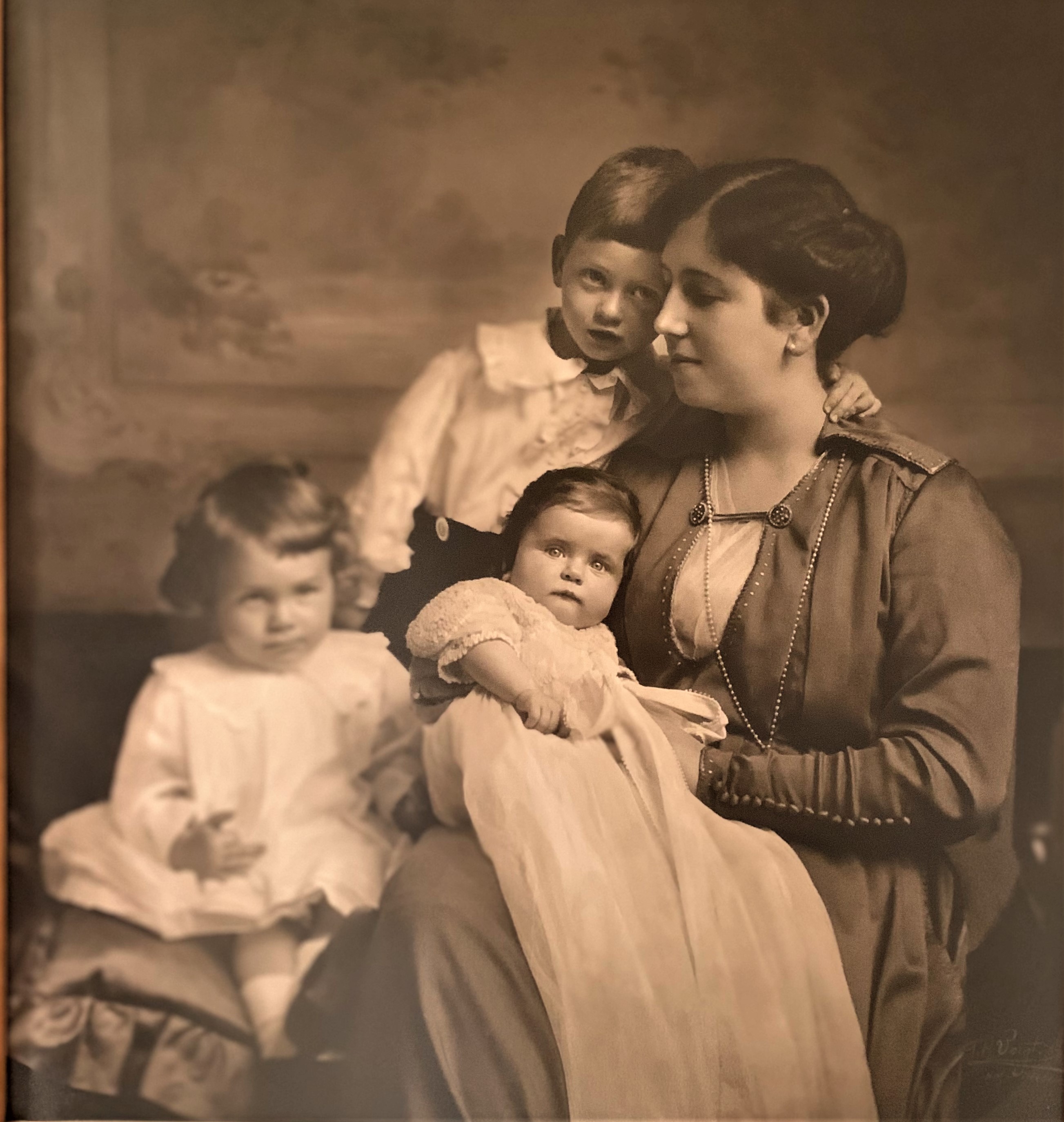
As mentioned in an earlier post, Meyer Selig and Selma (Cramer) Goldschmidt’s daughter Clementine married Nathan Sondheimer in 1913 and had three children: Manfred born in 1914, Erich in 1915, and Auguste in 1918. I was very fortunate to connect with Clementine’s granddaughter Daniela, daughter of Manfred Sondheimer, who generously shared with me family stories and photographs, including this wonderful photograph of the three Sondheimer children with their mother.1

Erich, Manfred, Auguste, and Clementine Goldschmidt Sondheimer, c. 1917. Courtesy of the family

Tragically, Clementine died on October 29, 1918, leaving behind three young children, Manfred, (four years old), Erich (three), and Auguste (one), and her husband Nathan Sondheimer. Clementine was only 25 years old and was a victim of the 1918 flu epidemic like her cousin Rosa Cramer Oppenheimer and millions of others. According to Clementine’s granddaughter Daniela, Clementine was pregnant with her fourth child at the time of her death.

Clementine Goldschmidt Sondheimer death record, Personenstandsregister Sterberegister; Bestand: 903; Signatur: 10793, Ancestry.com. Hesse, Germany, Deaths, 1851-1958

Daniela shared with me that after their mother died, her father Manfred and his siblings were raised in large part by their maternal grandmother, Selma Cramer Goldschmidt, the wife of Meyer Selig Goldschmidt, who himself died in 1922. The entire Goldschmidt extended family was extremely close and lived near each other, so there was a great deal of support for Clementine’s three young children. That was especially important when Auguste came down with tuberculosis and was extremely ill and in and out of sanitoria. Fortunately she eventually recovered and regained her strength.2

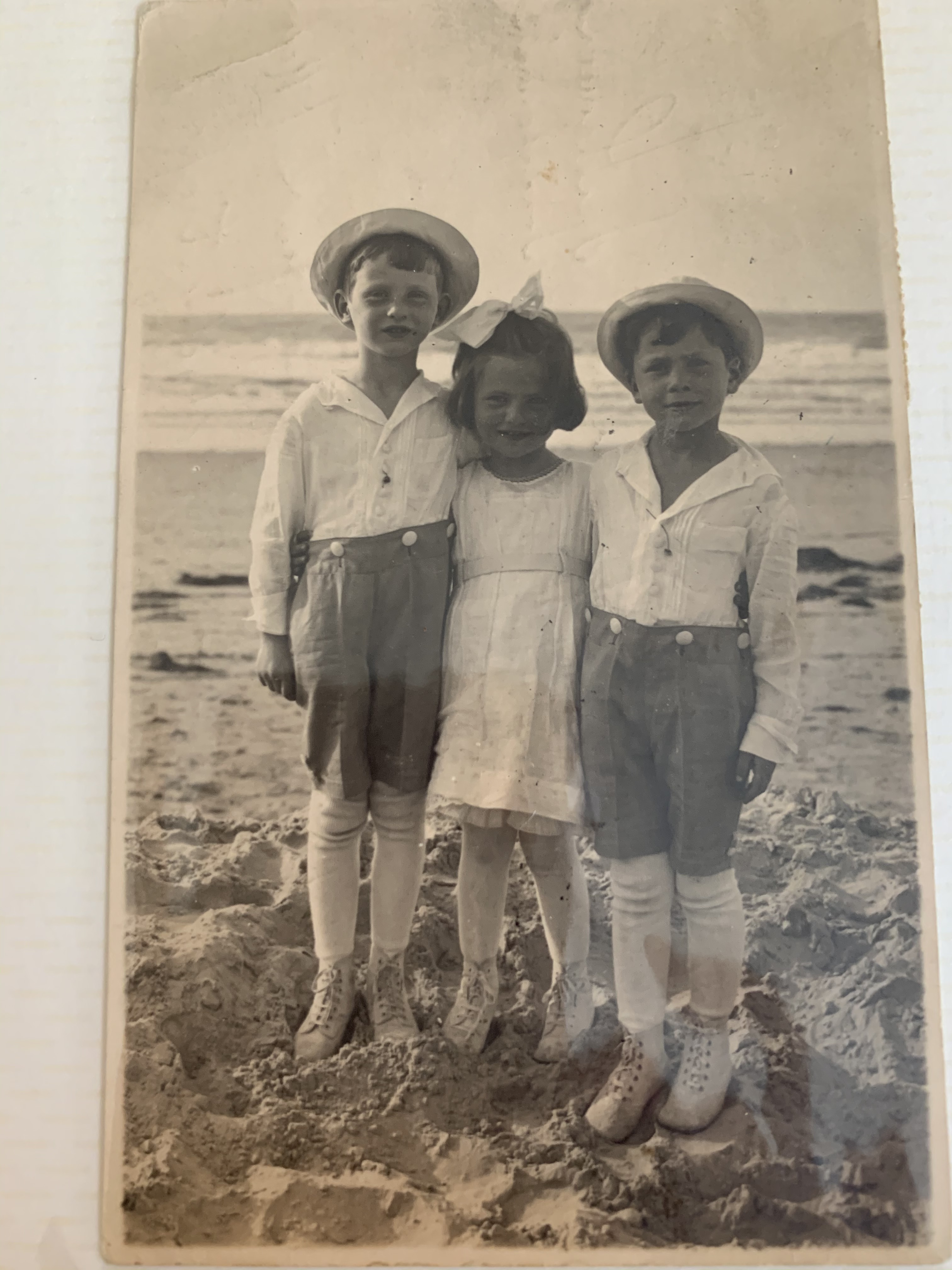
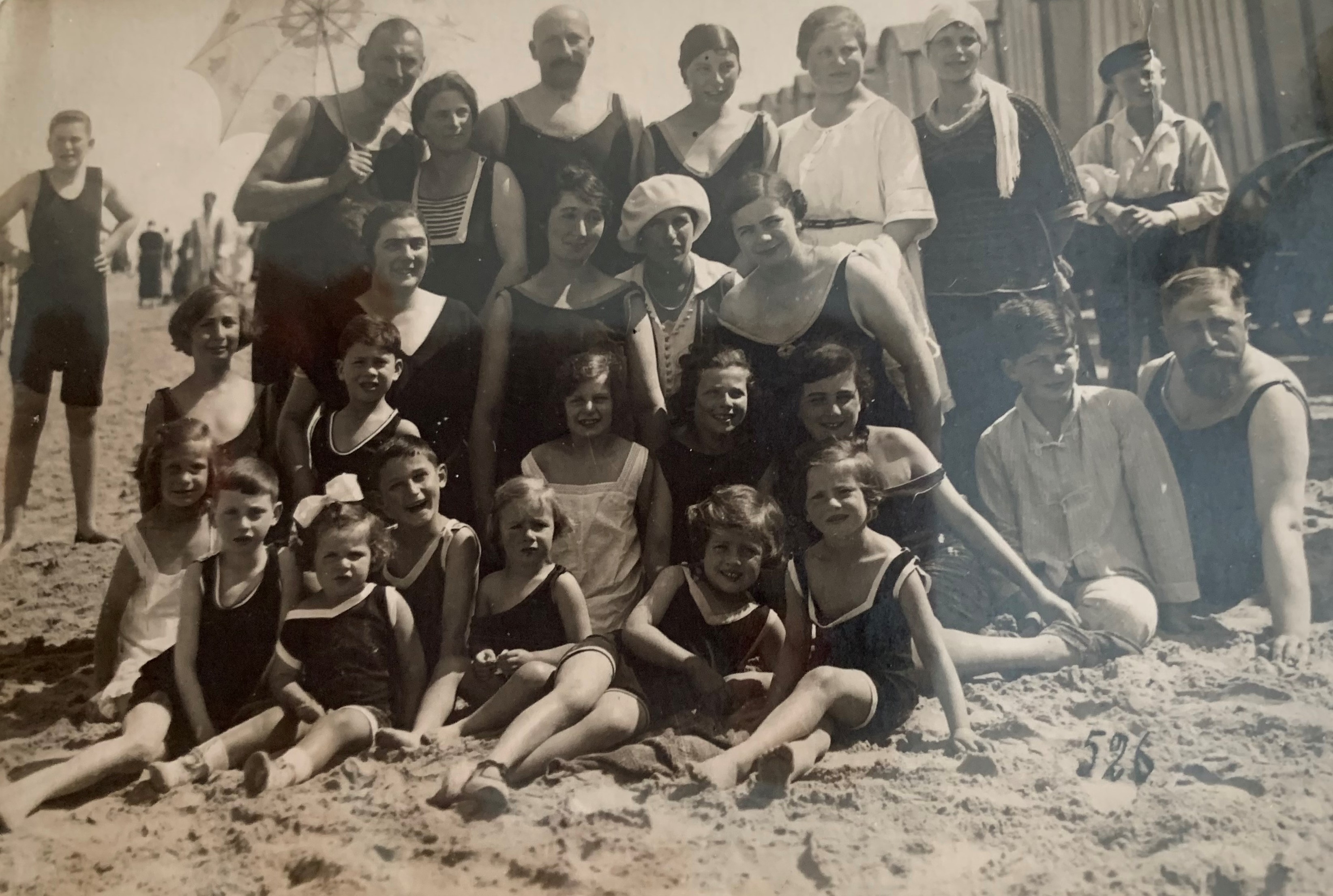
Here are three more photographs of the Sondheimer children, two of just the three of them and one with the extended family:

Manfred, Auguste, and Erich Sondheimer, c. 1921 Courtesy of the family

Manfred, Erich, and Auguste Sondheimer, c. 1923 Courtesy of the family

Members of the extended Goldschmidt and Sondheimer families at the North Sea, c. 1927. At far right in the first row is Nathan Sondheimer. To his right is Manfred and then Auguste with Erich behind them. Courtesy of the family

In 1928, ten years after Clementine’s death, her widower Nathan Sondheimer remarried, and he had two more children with his second wife, Anna Ettlinger, a doctor who graduated from the University of Heidelberg, according to my cousin Daniela. Anna was born in Karlsruhe, Germany, on May 28, 1894, to Kaufmann Ettlinger and Dora Frankel.3 She was likely a distant cousin of Nathan through his mother Auguste Ettlinger as both were originally from Karlsruhe, Germany. I traced them both back four generations without finding a direction connection, but I assume there is one there.

Nathan Sondheimer and Anna Ettlinger marriage record, Hessisches Hauptstaatsarchiv; Wiesbaden, Deutschland; Bestand: 903, Ancestry.com. Hesse, Germany, Marriages, 1849-1930

Then just five years after he married Anna, Nathan died on May 13, 1933, in Washington, DC. According to his granddaughter Daniela, Nathan had traveled to Washington to promote his business. While there he secured a life insurance policy. Then, without warning, he died suddenly of a heart attack at the age of 54.4

Nathan and Clementine’s three children were now teenaged orphans. Manfred was eighteen, Erich was seventeen, and Auguste was fifteen. Clementine’s children had lost both of their parents before reaching adulthood just as had happened to the children of her cousin Rosa Cramer Oppenheimer. It also left Nathan’s second wife Anna a widow with their two little children, Fritz and Marion, both under the age of five.

Fortunately, Nathan had successfuly secured that life insurance policy just days before his death, and the proceeds proved to be enough to get his body back to Germany for burial in Frankfurt and to get his widow Anna and his five children out of Germany.

According to the website of the Holocaust Museum of Los Angeles, Anna Ettlinger Sondheimer fled Nazi Germany in 1935 and smuggled eighteen sapphires out of the country by sewing them into the clothing of the family. Some of those sapphires are now in the museum’s collection.

It appears that Anna and her two children Fritz and Marion escaped to Holland. A ship manifest shows her sailing to the US with her sister Kate Ettlinger in June 1938; Anna listed her last permanent residence as The Hague, Holland, and indicated she intended to stay in the US permanently.5 Then in September 1938, she sailed from the US to England, listing her last residence as the US.

Anna Sondheimer, ship manifest, The National Archives of the UK; Kew, Surrey, England; Board of Trade: Commercial and Statistical Department and successors: Inwards Passenger Lists.; Class: BT26; Piece: 1165, Ancestry.com. UK and Ireland, Incoming Passenger Lists, 1878-1960

On February 11, 1939, Anna returned to the US with Fritz and Marion and her mother, who had all been living in Holland. Anna and her children listed as the person they were going to in the US an A. Sondheimer—identified as Anna’s daughter and the sister of her two children, living at 1359 51st Street in Brooklyn, New York. (See the third image below.)

Anna Sondheimer, ship manifest, with children and mother, Year: 1939; Arrival: New York, New York, USA; Microfilm Serial: T715, 1897-1957; Line: 29; Page Number: 33 Source Information Ancestry.com. New York, U.S., Arriving Passenger and Crew Lists (including Castle Garden and Ellis Island),

I first assumed that A. Sondheimer was Auguste Sondheimer, who was Anna’s stepdaughter and her children’s half-sister. But I found two manifests—one an outgoing manifest from England, the other an arrival manifest in New York—showing that Auguste sailed from England to New York in August 1939, six months after Anna’s arrival back to the US in February. Auguste was  accompanied by  Selma Sondheimer, who was the widow of Fritz Sondheimer, Nathan Sondheimer’s brother. Both of those manifests show that Auguste had been living in England, not in Brooklyn. They also reveal that Auguste was a photographer.6

I searched for any other A. Sondheimer who could have been living in Brooklyn at that time. Nathan did have two brothers who came to the US. One, Arthur, had died in New York in 1905;7 the other, Albert, arrived in the US in April 1939, so months after Anna’s arrival.8

And then the lightbulb went on. The “A. Sondheimer” they were going to in Brooklyn was Anna Ettlinger Sondheimer herself. Anna listed her last residence as Brooklyn on that February 1939 manifest. The poor shipping company clerk who entered the data must have been so confused. Look at how he crossed out the relationships in the first column for the person left behind, another A. Sondheimer, this one probably Albert Sondheimer, Nathan’s brother. And he also listed the A. Sondheimer they were going to as the daughter of both Anna’s mother and of Anna herself.

In any event, the 1940 US census shows that Augusta (spelled here with a A at the end, not an E) was then living in New York City with Anna, Fritz, Marion, Anna’s mother Dora Rudlia Frankel Ettlinger, and Anna’s sister-in-law Selma Ettlinger Sondheimer, the widow of Nathan’s brother Fritz and Nathan’s first cousin. Anna was practicing medicine.

Augusta Sondheimer, 1940 US census, Year: 1940; Census Place: New York, New York, New York; Roll: m-t0627-02638; Page: 3B; Enumeration District: 31-626, Ancestry.com. 1940 United States Federal Census

Auguste married Walter James Levy in New York in April, 1942.9 Walter was also a refugee from Germany; he was born in Hamburg on March 21, 1911, to Moses Levy and Bertha Lindenberger.10 Walter arrived in the US on March 19, 1941, and filed his declaration of intention to become a US citizen on August 6, 1941, listing his occupation as statistician and his last residence as England.11 He also by that time had registered for the World War II draft, listing his occupation as writer, statistician, economist. Most interestingly, he listed as his contact person a “friend,” Augusta Sondheimer. They were both living at 41 Central Park West in New York City. Less than a year later, they were married.

Walter Levy, World War II draft registration, Ancestry.com. U.S., World War II Draft Cards Young Men, 1940-1947

During the war, they moved to Washington, DC, where Walter ran the petroleum section of the Office of Strategic Services, the forerunner of the Central Intelligence Agency. According to Walter’s obituary in The New York Times:

After the war, he guided the petroleum sector of the Marshall Plan. In 1948 he became chief of the petroleum, oil and lubricant division of the Economic Cooperation Administration, which administered the plan to mend Europe’s shattered economies and provide the political stability for democratic institutions to thrive. He filled that job until 1949 and continued to advise the E.C.A. until it ended its mission two years later.

During the 1940s, Walter and Augusta (as she later spelled it in the US) had two children, Robert and Susan. They returned to New York where Walter established his own international consulting business, Walter J. Levy Consultants Corporation, where he “helped renegotiate oil leases between states that wanted to tap their own resources effectively and companies that feared outright nationalization.”12

Augusta Sondheimer Levy died on September 19, 1981, in Westport, Connecticut; she was 64 years old.13 Her son Robert died only twelve years later on April 20, 1993; he was only 47.14 Walter Levy died at age 86 on December 10, 1997, in New York; he was described as “the dean of United States oil economists” in his obituaries.15 Sadly, Augusta and Walter’s remaining child also died relatively young; Susan Levy died on November 15, 2003, Altamonte Springs, California; she was 54.16 All four family members are buried at the Riverside Cemetery in Saddle Brook, New Jersey, where many other Sondheimer relatives are also buried. As neither Robert or Susan had children, there are no living descendants of Augusta Sondheimer Levy.

But Augusta survived the loss of her mother, her father, and then her homeland. Her name and her story should not be forgotten.

What about Augusta’s older brothers, Manfred and Erich?

To be continued.


  1. My fifth cousin Daniela Sondheimer Klein and I exchanged numerous emails in November and December and also spoke by Zoom on December 1, 2020. All references to matters in this post that I was told by Daniela came from those emails and that conversation. 
  2. See also Arnold S. Oppenheimer, The Story of My Life (2007, Jerusalem), pp. 15-18. 
  3. Anna Ettinger, Gender: weiblich (Female), Birth Date: 28 Mai 1894 (28 May 1894)
    Birth Place: Karlsruhe, Baden (Baden-Württemberg), Deutschland (Germany), Civil Registration Office: Karlsruhe, Father: Kaufmann Ettinger, Mother: Dora Frünkel, Certificate Number: 968, Signatur: 3_B_A_I_47, Bestand: 3/B, Title: Enthält: Einträge Nr. 938 – 1875, Date: 1894, Lange: 20, Laufende Nummer: A/I/47, Zahlung Gesamter Bestand: 47, Ancestry.com. Karlsruhe, Germany, Births, 1870-1904. Conversation with Daniela Sondheimer Klein, December 1, 2020. 
  4.   Nathan Sondheimer, Gender: männlich (Male), Nationality: Deutsch Juden, Record Type: Inventory, Last Residence: Frankfurt am Main, Residence Place: Frankfurt am Main, Death Date: 13 Mai 1933 (13 May 1933), Notes: Inventories of personal estates of foreigners and especially German Jews, Reference Number: 02010101 oS, Document ID: 70367447, Arolsen Archives, Digital Archive; Bad Arolsen, Germany; Lists of Persecutees 2.1.1.1, Ancestry.com. Free Access: Europe, Registration of Foreigners and German Persecutees, 1939-1947. Conversation with Daniela Sondheimer Klein, December 1, 2020. 
  5. Anna Sondheimer, ship manifest, Year: 1938; Arrival: New York, New York, USA; Microfilm Serial: T715, 1897-1957; Line: 1; Page Number: 2, Ancestry.com. New York, U.S., Arriving Passenger and Crew Lists (including Castle Garden and Ellis Island), 
  6. Auguste and Selma Sondheimer, ship manifests, Ancestry.com. UK and Ireland, Outward Passenger Lists, 1890-1960, and Year: 1939; Arrival: New York, New York, USA; Microfilm Serial: T715, 1897-1957; Line: 5; Page Number: 149, Ship or Roll Number: Champlain, Ancestry.com. New York, U.S., Arriving Passenger and Crew Lists (including Castle Garden and Ellis Island), 1820-1957 
  7. New York, New York City Municipal Deaths, 1795-1949″, database, FamilySearch (https://www.familysearch.org/ark:/61903/1:1:27BT-FK8 : 3 June 2020), Arthur Sondheimer, 1905. 
  8. Albert Sondheimer, ship manifest, Year: 1939; Arrival: New York, New York, USA; Microfilm Serial: T715, 1897-1957; Line: 15; Page Number: 26, Ancestry.com. New York, U.S., Arriving Passenger and Crew Lists (including Castle Garden and Ellis Island), 
  9.  Auguste Sondheimer, Gender: Female, Marriage License Date: 10 Apr 1942, Marriage License Place: Manhattan, New York City, New York, USA, Spouse: Walter Levy, License Number: 7458, New York City Municipal Archives; New York, New York; Borough: Manhattan; Volume Number: 3, Ancestry.com. New York, New York, U.S., Marriage License Indexes, 1907-2018 
  10. Walter James Levy, [Walter J Levy], Gender: Male, Race: White, Birth Date: 21 Mar 1911, Birth Place: Hamburg, Federal Republic of Germany, Death Date: 10 Dec 1997, Claim Date: 17 Dec 1975, Father: Moses Levi, Mother: Bertha Lindenberger
    SSN: 110240194, Ancestry.com. U.S., Social Security Applications and Claims Index, 1936-2007 
  11. Walter J Levy, Declaration Number: 496713, Box Number: 370, The National Archives at Philadelphia; Philadelphia, Pennsylvania; NAI Title: Declarations of Intention for Citizenship, 1/19/1842 – 10/29/1959; NAI Number: 4713410; Record Group Title: Records of District Courts of the United States, 1685-2009; Record Group Number: 21,
    Ancestry.com. New York, U.S., State and Federal Naturalization Records, 1794-1943 
  12. “Walter James Levy, 86, Oil Consultant, Dies,” The New York Times, December 15, 1997, Section B, p. 7. 
  13. State File #: 19446, Connecticut Department of Health. Connecticut Death Index, 1949-2012 
  14. Walter James Levy, [Walter J Levy], Gender: Male, Race: White, Birth Date: 21 Mar 1911, Birth Place: Hamburg, Federal Republic of Germany, Death Date: 10 Dec 1997, Claim Date: 17 Dec 1975, Father: Moses Levi, Mother: Bertha Lindenberger
    SSN: 110240194, Ancestry.com. U.S., Social Security Applications and Claims Index, 1936-2007. “Walter James Levy, 86, Oil Consultant, Dies,” The New York Times, December 15, 1997, Section B, p. 7. 
  15. https://www.findagrave.com/memorial/80079636/robert-levy 
  16. Susan Beatrice Levy, Gender: Female, Birth Date: 23 Sep 1949, Birth Place: New York City, New York, Death Date: 1 Nov 2003, SSN: 065384544, Ancestry.com. U.S., Social Security Applications and Claims Index, 1936-2007 

A Survivor’s Story

Regina Goldschmidt Rosenberger, the daughter of Julius Goldschmidt, granddaughter of Jacob Meier Goldschmidt, and great-granddaughter of Meyer Goldschmidt, was my third cousin, twice removed, and I first wrote about her here and here, but now need to update those posts.

The earlier post established that Regina was born in Frankfurt on March 7, 1900, and married Siegfried Rosenberger on March 10, 1921, in Frankfurt, and had two children in the 1920s. In my second post about Regina, I wrote:

I don’t know a great deal about what happened to Regina, her husband Siegfried Rosenberger, and their two children during the Holocaust. It appears that at least until 1937 they were still living in Frankfurt and that after the war, according to Roger Cibella and David Baron, their two children were both married in the Netherlands and had children born there. Eventually they all immigrated to Canada where Regina died in February 1992…

And that was all I knew. Until a couple of weeks ago when I received an email from a sixth cousin named Mark Isenberg. I had first heard from Mark a few years back when he contacted David and Roger regarding his research establishing that his paternal four-times great-grandfather Joseph Falk Neuwahl and Roger’s and my four-times great-grandfather Jacob Falk Goldschmidt were probably brothers.

This time Mark was writing about his relationship to Siegfried Rosenberger, husband of Regina Goldschmidt. Siegfried was Mark’s third cousin, once removed, on his maternal side. Mark had seen my blog post quoted above and kindly alerted me to the fact that Siegfried and Regina’s daughter Ruth had done an interview with the Shoah Foundation in 1997. I’ve now watched the two and a half hours of her testimony and can report in much greater detail what happened to Regina, Siegfried, and their two daughters Ruth and Margo during the Holocaust. All the information below except where otherwise noted comes from that testimony of Ruth Rosenberger Steinert.1

Ruth Rosenberger was born in Frankfurt on December 6, 1922. Her sister Margo was born almost exactly two years later on December 19, 1924. Ruth described their childhood in Frankfurt in idyllic terms. They lived in a very large apartment with a nanny, cook, and other servants, and were surrounded by their Goldschmidt grandparents, aunt, uncle, and cousins, having regular shabbat dinners with the extended family as well as holidays. Their father Siegfried was a successful stockbroker. He was very proud of being a German and of his service to Germany in World War I, for which he was awarded the Iron Cross.  Their mother Regina lived a good life, playing tennis daily, socializing with friends, and overseeing the household staff. The family was very observant, and Ruth and Margo went to an Orthodox day school in Frankfurt. Watching Ruth talk about her childhood was very moving; she so well expressed how safe and loved she felt.

Khal Adath Jeshurun synagogue in Frankfurt, the synagogue attended by the Goldschmidt family. https://www.kajinc.org/about/history

Everything was destroyed once the Nazis came to power. Ruth said that until 1936, she and her sister were fairly unaware of what was happening because the adults did not talk about the Nazis in front of the children. She knew that there were restrictions, mentioning as an example that they were not allowed to sit on the park benches, but she nevertheless felt safe.

But after 1936, it became impossible to hide what was happening from the children. Her father lost his stockbroker business because Jews were no longer allowed to engage in business. Ruth talked about how devastated her father was when they came and stripped away the telephones he needed for the business. The nanny, cook, and other servants had to leave the household because non-Jews were no longer allowed to work for Jews. Their mother Regina became terribly depressed.

Fortunately, Siegfried was able to secure another job with an international metals company called Lissauer. The position required him to travel to France and to Holland and enabled the family to continue to live fairly comfortably. As Ruth described it, this job ultimately saved their lives. Siegfried would never have left Germany despite all the oppression and fear. But in September 1938 while traveling for work in Paris, he was unable to return to Germany. Finally he agreed that the family should leave Germany, and through his business connections, he was able to obtain papers for them to immigrate to the Netherlands.

Ruth, not yet sixteen years old, took charge of packing and getting them ready to leave. They took a train to Paris, and Ruth put on lipstick so that she would look older. When they got to the French-German border at Emmerich, the German border guards gave them trouble with their papers, but fortunately a cousin was able to straighten matters out, and the next day they arrived in Paris. They remained in Paris for a few days, and then the whole family spent about ten days at the beach in the Netherlands. Ruth remembered it as a wonderful time and one of the very last times all four of them were together as a family.

Siegfried returned to Paris for work and would travel back and forth to Amsterdam. Regina and her daughters were living in a very nice apartment on the canal in Amsterdam. Margo attended high school, and Ruth spent a year at an art academy, learning design.  For a year life was fairly normal.

As one uncle had said to the family when they arrived in Paris, they had, however, gone from “the rain into the storm” because war was brewing, and no place was really safe. After the war started in September 1939 and then Holland and France were occupied by the Nazis in the spring of 1940, Siegfried could no longer travel to Amsterdam. From that point on, things went downhill.

Ruth recalled standing on a corner in Amsterdam with a crowd of other people from the neighborhood as the Germans marched into Amsterdam.

Nazi troops and supporters in front of De Bijenkorf, Dam Square, Amsterdam, The Netherlands, 1941 (crop of original 1941 public domain photo). 47thPennVols, CC0, via Wikimedia Commons

But even on that dark day, the family found a silver lining. A man named Benot Hess was also standing on that corner and engaged Regina and daughters in conversation. Hess was married to a non-Jewish Swedish woman, and because Sweden was neutral during the war, he was given some extra protection based on that marriage. Hess and his wife became close friends with the Rosenberger women—like family, according to Ruth. He made sure that they had enough money by helping Ruth obtain work, sewing and then manufacturing travel kits and other items. The products sold well, giving the family an economic cushion.

By 1942, however, conditions worsened. Jews were required to wear the yellow stars with Jood to mark them as Jews. Ruth said that they lived in a constant state of angst for all their waking hours. Eventually they were forced to move into what Ruth described as a ghetto where all Jews were forced to live, and SS men on trucks barreled through the neighborhood every night, coming to arrest people and take them to Westerbork, the detention camp outside of Amsterdam.

At that point, they had to make a choice: stay and see what would happen or go into hiding. Ruth favored going into hiding, but her mother was not willing, and Margo did not want to leave their mother. For some time they remained safe from deportation as both Ruth and Margo had positions assigned by the Judenrat (the Jewish council) that kept them protected. Once the SS came to their apartment, and Ruth managed to convince them that they were not Jewish. She claimed that because of her light hair and coloring and straight nose, she was able to fool them.

But when the SS arrived a second time, Ruth was not successful, and in March 1943, Regina Goldschmidt Rosenberger was arrested and taken to Westerbork. Ruth described it as the worst moment in her life, watching her mother being taken away. She said that at that time they did not know about the death camps, only about what were being referred to as work camps. Soon thereafter Margo lost her position with the Judenrat and was also taken to Westerbork where she joined her mother.

Ruth contacted her father to see if he could arrange false identification papers for her, which he was able to accomplish, and Ruth went to Bussum, a town in Holland, and hid with a family there for the duration of the war. She was almost caught once when the SS came to look for hidden Jews, but again was smart enough and lucky enough to convince them that she was not Jewish.

Meanwhile, Regina and Margo had been taken from Westerbork to Terezin. Once again, Benot Hess came to their rescue. He also was imprisoned at Terezin, and when he learned that Regina and Margo were to be placed on the next train to Auschwitz, he intervened, using the Honduran passports that Siegfried had obtained for them, and Regina and Margo were taken off the list.

Jewish prisoners’ cell, Terezin (c) A Cohen 2015

When the war ended in Europe in April 1945, Ruth was reunited with her mother and sister, and they all moved to Bussum. Margo married her fiancé, Robert Engel, who had been at Westerbork throughout the war period, and Ruth met and married Otto Steinert. In 1950, Otto was offered a job in Canada through the family’s connections to another family, and Ruth and Otto and soon thereafter Regina, Margo, and her husband all moved to Canada.

Siegfried was never reunited with the family. He remained in Paris, where he died not long after the war. Regina Goldschmidt Rosenberger lived a long life, dying in Canada in February 1992 when she was almost 92 years old.

Her two daughters also lived long lives. Ruth Rosenberger Steinert died at the age of 93 on December 22, 2013, in Montreal. Her sister Margo Rosenberger Engel died just this past June 30, 2020, in Toronto; she was 95. They are survived by their children and grandchildren and great-grandchildren.

Watching Ruth’s testimony was a moving, inspiring, and heartbreaking experience. Despite everything she had experienced—all the losses, the fear, the separation, the loneliness—she remained a strong, optimistic, and loving woman who spoke about her parents, her husband, her sister, her children and grandchildren with so much affection and warmth. She was not going to be defeated by what happened around her—not while it was happening and not afterwards. How blessed we are to have this testimony to remember what happened and to inspire us all.


  1. Steinert, Ruth. Interview 35432. Visual History Archive, USC Shoah Foundation, 1997. Accessed 1 October 2020. 

Was Moritz Oppenheimer Forced by the Nazis to Divorce His Wife and Declare Bankruptcy?

I have written several posts about my cousin, Moritz Oppenheimer, the nephew of my great-great-grandfather Bernard Seligman. Moritz was an extremely successful business owner and also racehorse breeder and owner who ended up committing suicide as a result of the persecution he experienced by the Nazis.

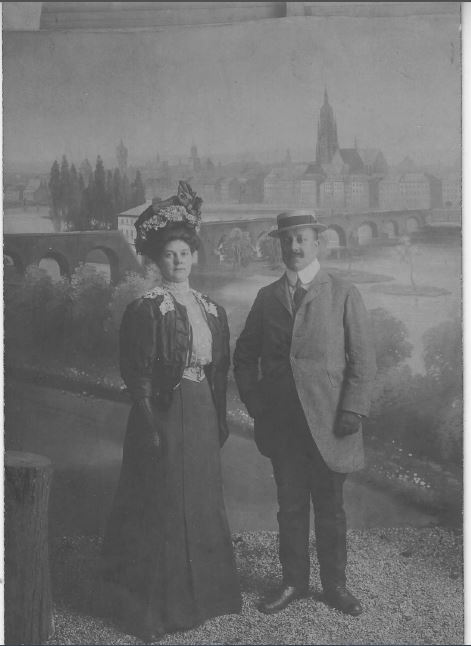
Emma Neuhoff and Moritz James Oppenheimer
photo courtesy of Angelika Oppenheimer

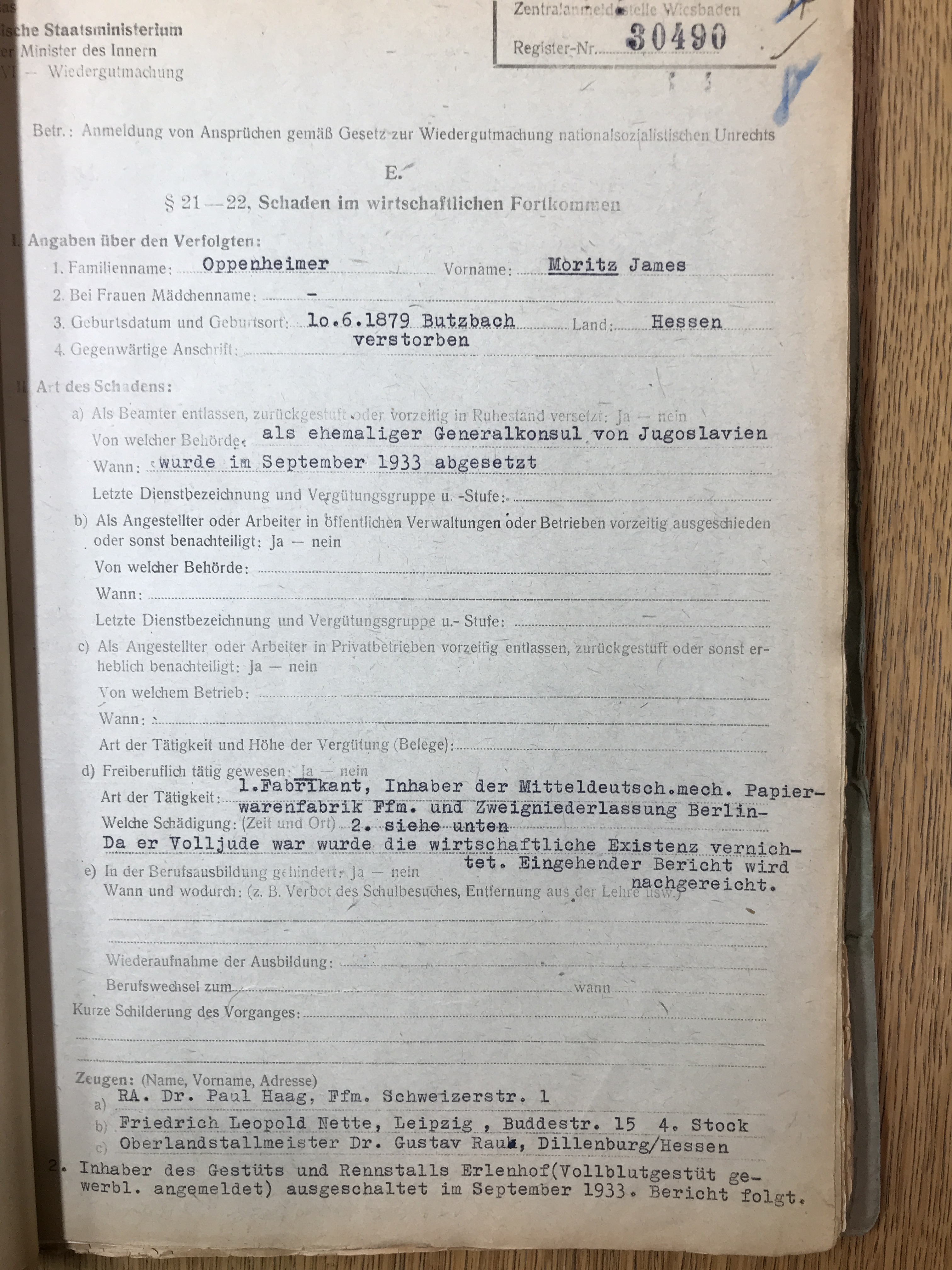
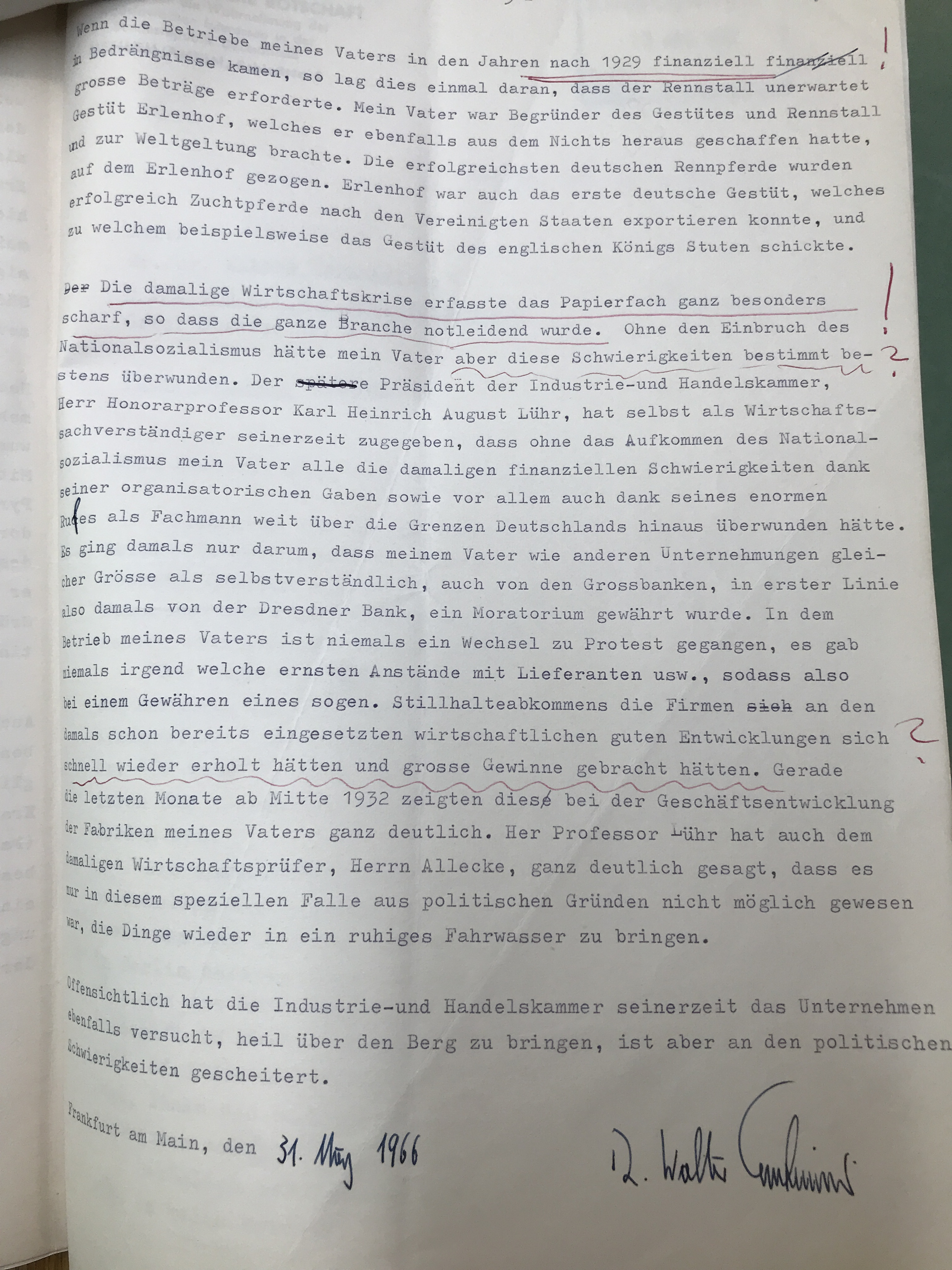
My cousin Wolfgang Seligmann recently discovered additional information about Moritz and his family, including an application filed in 1966 in Wiesbaden by Moritz Oppenheimer’s widow Emma Neuhoff, seeking compensation for the harm done to her husband and the financial losses suffered.

Emma Neuhoff Oppenheimer 1966 application for reparations

In reviewing those documents (with invaluable help from Wolfgang), I focused on two questions that had been raised by readers who commented on my earlier posts about Moritz Oppenheimer. First, were Moritz and his non-Jewish wife Emma forced to divorce by the Nazis in 1936, or did they choose to divorce? Second, was Moritz forced into bankruptcy by the Nazis in 1933, or were his businesses already failing before the Nazis came to power?

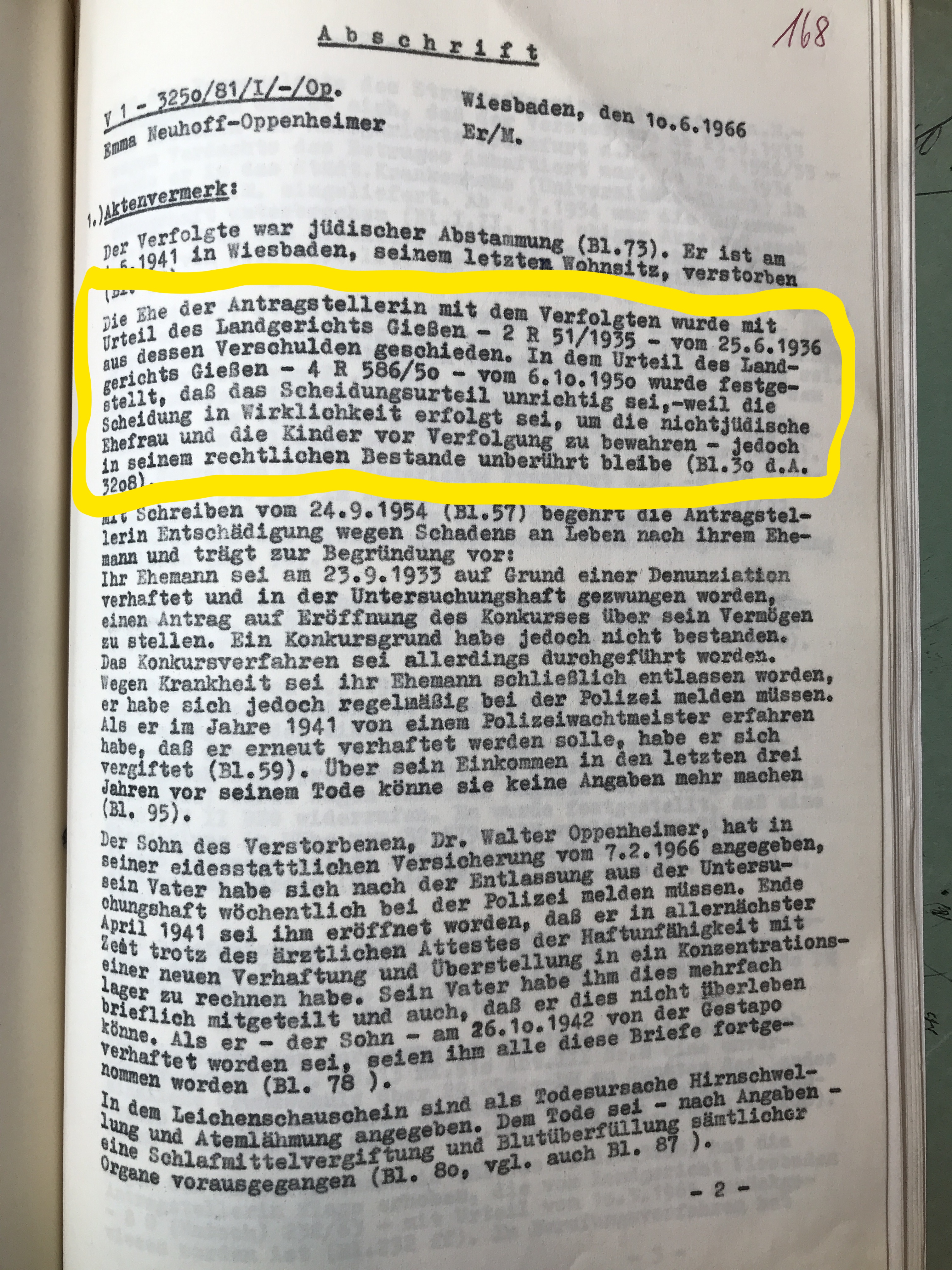
The first question is addressed by the court in its opinion approving the settlement between Emma and the government. The court recognized that Emma and Moritz had only divorced to protect Emma and their two children, who were not Jewish.

Court notes on divorce of Emma and Moritz Oppenheimer in decision approving settlement of Oppenheimer 1966 reparations claim

I used DeepL to translate this language and for the other translations in this post:

The marriage of the applicant with the persecuted person was divorced by judgment of the regional court Giessen 2 R 51/1935 of June 25, 1936 through his fault. In the judgment of the regional court Giessen 4 R 585/50 dated 6 October 1950 it was determined that the divorce judgment was incorrect because the divorce had actually taken place in order to protect the non-Jewish wife and children from persecution — but its legal validity remained unaffected.

With respect to Emma’s application for compensation, the court concluded that even if Emma was no longer legally married to Moritz at the time of his death and thus not technically his widow, she was nevertheless entitled to pursue her claim for compensation for the harm done to her husband and her family.

The applicant is entitled to claim. It can be left open whether she is the widow of the deceased, … or this is treated as a blameless divorced wife.

Thus, Emma and Moritz chose to divorce to protect Emma and their two children. It was a decision based on love, not a lack of it.  Although the Nazis did not require the Oppenheimers to divorce, the circumstances the Nazis created compelled the couple to divorce.

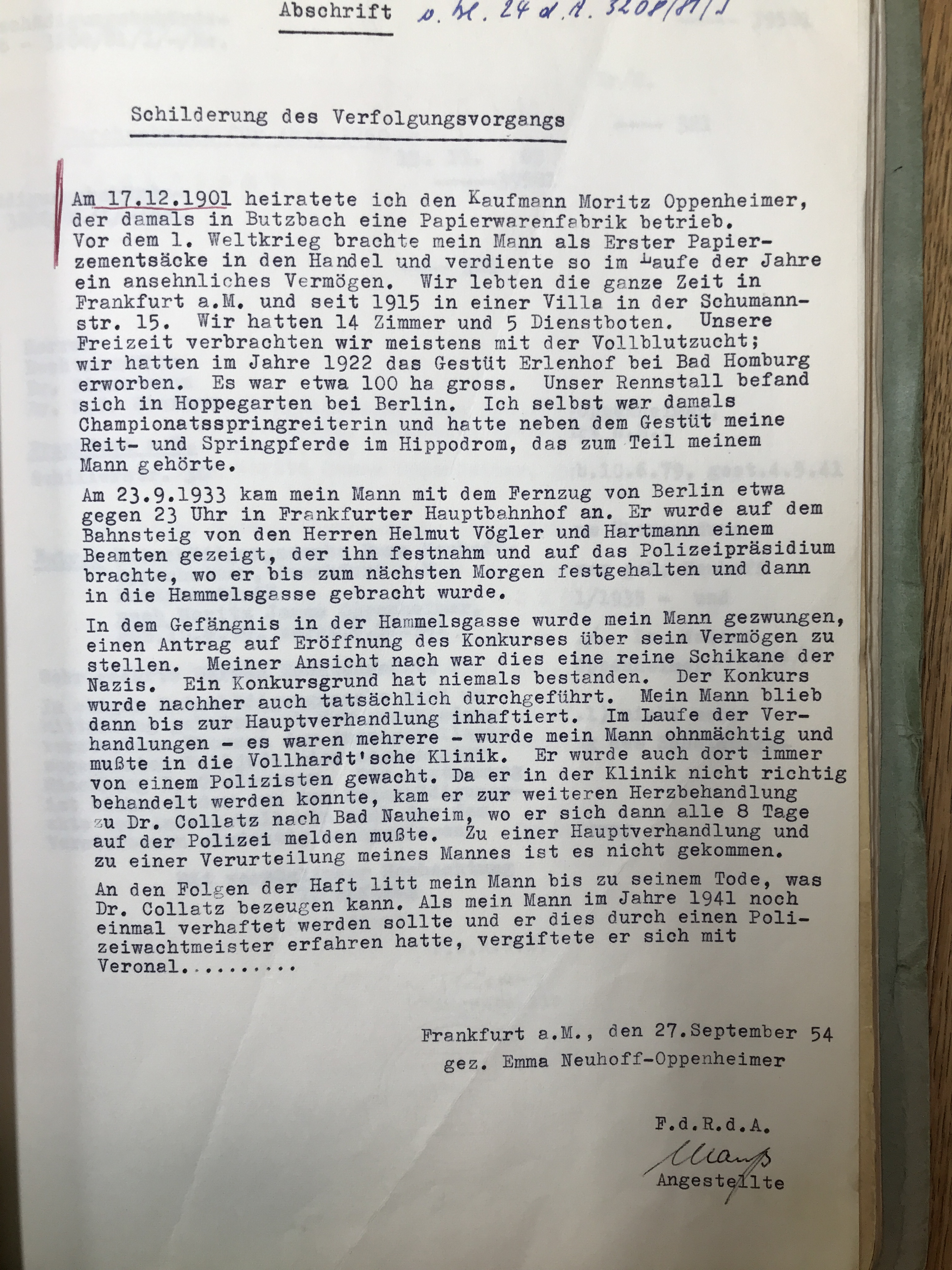
The question regarding the bankruptcy is more complicated. Emma contended that Moritz was forced into bankruptcy by the Nazis when he was arrested in September, 1933, the first of many arrests that eventually drove him to suicide in 1941, as has been described in earlier posts. Emma wrote in the third paragraph of her statement in support of her application for compensation in 1966:

Emma Neuhoff Oppenheimer statement filed in support of her 1966 application for reparations

In the prison in Hammelgasse, my husband was forced to file for bankruptcy on his property. In my opinion, this was pure Nazi harassment. There was never a reason for bankruptcy. The bankruptcy was actually carried out afterwards.

But a man named August Hartmann filed an accusation against Moritz with the Nazi party in which he claimed that Moritz had defrauded a family from Frankfurt out of almost one and a half million Reich Marks;  these fraud claims were never fully litigated because Moritz died before that could happen. Hartmann also claimed that the businesses owned by Moritz were heavily in debt and that Moritz was a flight risk.

Statement of August Hartmann regarding claims against Moritz Oppenheimer

Here is the DeepL translation of Hartmann’s statement:

The well-known industrialist and racing stable owner Consul Moritz Oppenheimer has lived for many years only on credit fraud. In the years 1931 and 1932 he swindled a very respectable Frankfurt family out of the round sum of one and three-quarter million Reichsmark in cash under false pretences. This case is all the more blatant because this amount of money came from assets confiscated during the war in America. That was only released at the end of 1929 and taken to Germany by the family, out of national interest in making this large amount of money available to the ailing German economy.  Despite the fact that this fraudulently damaged creditor has known for half a year now how the finances of Consul Oppenheimer are, he has now refrained from taking radical steps which were in his personal interest, in order not to make more than 250 German workers unemployed. But because of the great expenses of Mr. Consul O., for example maintenance of the Erlenhof Stud Farm, which requires a monthly subsidy of about 15,000, financial conditions have deteriorated to such an extent that bankruptcy is only a question of time, the strong suspicion arises that this Jew wants to run off to a foreign country where he in all probability has stashed a considerable fortune.

It was this letter from August Hartmann that led to the arrest of Moritz Oppenheimer in September 1933 and then to his alleged forced bankruptcy. Thus, Moritz may have been pushed into bankruptcy proceedings, but if Hartmann’s letter is true, Moritz was already in serious financial trouble.

Moritz’s son Walter Oppenheimer, in his affidavit in 1966, admitted that his father had incurred a great deal of debt by 1929, but argued that he would have been able to overcome these financial reversals but for the Nazis. He wrote in part (and translated as best I could, with help from DeepL and Google Translate):

Portion of the letter Walter Oppenheimer filed in support of 1966 reparations claim

If my father’s business got into financial difficulties in the years after 1929, it was because the racing stable required unexpectedly large sums. My father was the founder of the stud and racing stable Erlenhof, which he had also created out of nothing and brought to world fame. The most successful German racehorses were bred at Erlenhof. Erlenhof was also the first German stud farm which was able to export breeding horses to the United States, and to which, for example, the stud farm of the English king sent mares.

The economic crisis at that time hit the paper trade particularly hard, so that the whole industry was in dire straits. But without the advent of National Socialism, my father could have certainly overcome these difficulties perfectly. The President of the Chamber of Industry and Commerce, Honorary Professor Karl Heinrich August Luhr, himself an economic expert of his time, admitted that without the advent of National Socialism, my father could have overcome all the financial difficulties of the time far beyond the borders of Germany, thanks to his organizational gifts and, above all, thanks to his enormous expertise. … So that if a so-called standstill agreement was maintained, the companies could have recovered quickly from the good economic developments that had already begun and had brought large profits. Especially the last months from the middle of 1932 onwards showed this very clearly in the business development of my father’s factories. Professor Luhr also told Mr. Allecke, who was an accountant at the time, very clearly that it was only for political reasons that it became impossible to put things back on a level playing field.

Where the truth lies is impossible to determine. It certainly appears that Moritz was having serious financial troubles before 1933, but were they serious enough to require bankruptcy? Would the business have recovered if he had not been arrested and persecuted by the Nazis? If he had been given more time, could he have turned around his companies’ financial situation?

In the end, the 1966 court approved a settlement that provided Emma with some compensation for the loss of her husband and the suffering he endured as well as for her own economic losses. It was less than what she wanted, but it did recognize that despite the divorce, she was entitled to compensation, implicitly recognizing that they had not freely chosen to divorce. But the settlement did not compensate her for the failure of her husband’s businesses.

Almost twenty years later in 1984, the descendants of Moritz and Emma Oppenheimer filed another claim, this time with the District President in Darmstadt, seeking compensation for the economic damage sustained to the business of Moritz Oppenheimer, according to another set of documents that Wolfgang discovered in the Wiesbaden archives. As Wolfgang explained to me, the Germany government adopted new laws over time that updated the process for obtaining reparations by those who suffered harm because of the Nazis. This new claim was presented under a statute called Bundesentschadeugungsgesetz-Schlussgesetz or Federal Compensation Act-Final Act.

1984 decision on the application for reparations by the heirs of Moritz and Emma Oppenheimer

As with the claim filed back in 1966, this claim for compensation for the financial losses suffered by Moritz’s business was rejected. The district president found that Moritz would not have been able to sell the stables or racehorses to cover his business losses, given the economic conditions of that period and the extent of his business liabiltiies.  Thus, he concluded that the economic damage was not the result of Nazi persecution. In addition, the district president concluded that Moritz’s medical condition disabled him from seeking other employment, not the Nazis, so there would be no compensation for lost income from such potential employment.

Of course, Moritz’s medical condition could very well have been and probably was caused by or at least exacerbated by his arrest and persecution. And no one can know with absolute certainty that he would not have been able to rescue his business but for that arrest and persecution. But at least two different decision-making bodies concluded otherwise and rejected the family’s claims.

The Tragedy of Bennie Cohen, Betty Schnadig Cohen’s Grandson

Betty Schnadig and Bernard Arie Cohen and two of their four children were murdered in the Nazi concentration camps. Their oldest child Arnold survived, but his story is also terribly tragic. Thank you once again to my cousin Betty, Arnold’s daughter, for sharing their story and the family photographs posted here.

Arnold was a traveling salesman, and he married Saartje Odenwald in Groningen, Holland, on October 18, 1936.1

Wedding of Saartje Odenwald and Arnold Cohen, 1936. Courtesy of Betty de Liever

Their son, Bernard Arie, known as Bennie, was born a year later on November 15, 1937, in Den Bosch, where Arnold and Saartje had settled after marrying. Den Bosch is about 150 miles southwest of Groningen. Bennie was named in honor of his paternal grandfather, who was, however, still living at that time. Here are some photographs of Arnold, Saartje, and Bennie:

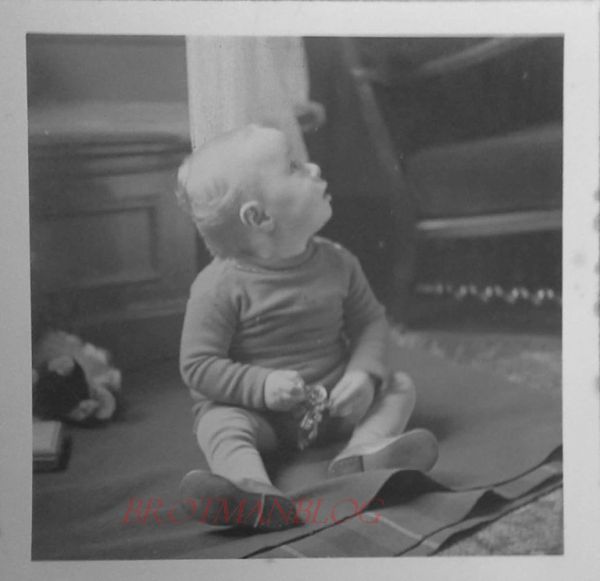
Bernard Arie “Bennie” Cohen. Courtesy of Betty de Liever

Bernard Arie “Bennie” Cohen Courtesy of Betty de Liever

Saartje, Bennie, and Arnold Cohen. Courtesy of Betty de Liever

When I started to search for what happened to Arnold and his family during the Holocaust, I was perplexed. Arnold and his wife Saartje both survived, but their son Bennie did not. He was only six years old. How could it be that he was murdered at Auschwitz and both his parents survived?

Researching that question led me to a truly devastating story that is recorded on the Stolpersteine website devoted to this family. Arnold and Saartje knew a couple who were active in the Resistance movement, Piet Toxopeus and Ellen Dwars, who arranged for a man named Geevers to take little Bennie into hiding. Geevers took three thousand guilders from the Cohens, but never in fact took Bennie into his home. Somehow instead Bennie ended up in a town called Dordrecht with a woman named Els van As, who took many Jews into her house to hide them from the Nazis. Dordrecht is 40 miles west of Den Bosch, and Bennie’s parents had no idea that that was where he had been taken.

Meanwhile, Piet and Ellen hid Arnold and Saartje in Bennekom. That placed them about 57 miles northeast of Dordrecht where their son was being hidden. In August 1942, Arnold and Saartje were then placed with an older couple, the Laars, in Ede, a town near Bennekom, where they stayed safely until after the war.

But their son Bennie was not as fortunate, as told in the Stolpersteine website:

It happened on Monday evening, October 25, 1943: the insensitive police officer Herman Gerard Feodor Wolsink from Dordrecht pulled 5-year-old Bennie Cohen into the horror of the war.

Here and there in Dordrecht, Jewish hunters had been working all day long at addresses where people might be in hiding…..In the house of the Van As family on the Vlietweg, they find a radio set and a money box with twenty thousand guilders in it. …. The Jew hunters suspect that a Jewish child is also hiding at this address. The Hague detective Cornelis Johannes Kaptein therefore orders Wolsink to take a closer look at the children who are sleeping in the attic. And then this happens, according to a maternity nurse who lived in rooms with the Van As family, and who told it after the war.

Bennie was impressed to always say his name was De Koning, and not Cohen. When Wolsink asked the boy for his name, he said: “Bennie de Koning.”

“Wolsink then asked,” said the nurse, “what his mother’s name was and then the poor child said: ‘Saartje’. To which Wolsink said: “Haha, a Jew after all!” Then he pulled down the little boy’s pajama bottoms and said, “It’s a Jew.” This child had to come along then. 

About 3.5 months later this child was dead: deported to Auschwitz via camp Westerbork and exterminated there on 11 February 1944. His life had already ended at the age of six.

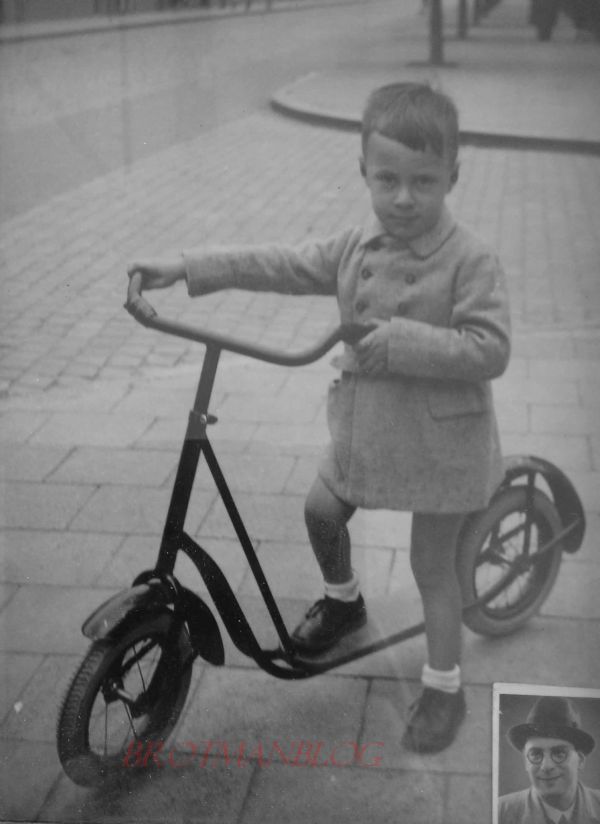
I ask you to look at these photographs of this beautiful little boy. How could anyone do this to anyone, let alone a six year old child?

Bernard “Bennie” Arie Cohen. Courtesy of Betty de Liever

Bernard “Bennie” Arie Cohen Courtesy of Betty de Liever

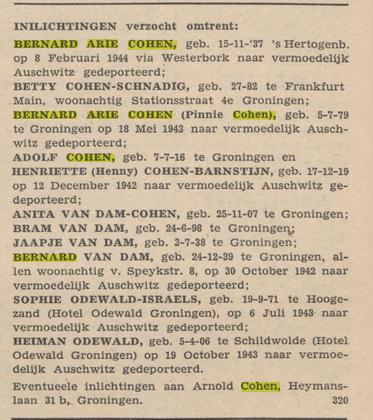
On November 9, 1945, Arnold Cohen posted this heartbreaking notice in the Nieuw Israelietisch Weekblad, asking for information about his missing family members, including his son, his parents, his siblings, his nephews, and his in-laws, all of whom had been murdered by the Nazis:

Nieuw Israelietisch weekblad, November 9, 1945, found at https://tinyurl.com/yy2fyql6
09-11-1945

Arnold and Saartje somehow found the strength to go on. They had two daughters born after the war, and Arnold became a wholesaler of paper products in Groningen. Arnold died on December 15, 1967,2 and his wife Saartje on April 19, 1978.3 It’s hard to imagine how anyone finds hope after what they experienced, but having more children is certainly evidence that Arnold and Saartje believed that goodness and love can still exist and can prevail in this world.

De Telegraaf
December 16, 1967, found at https://tinyurl.com/y69tkn89

Thank you again to Bert de Jong and Rob Ruijs for all their help and especially to my cousin Betty for sharing these precious photographs and her family’s heartbreaking story. Betty lost her grandparents, her aunts and uncles and cousins, and her brother Bennie in the Holocaust.


  1. Arnold Cohen, Gender: Mannelijk (Male), Age: 32, Birth Date: abt 1904, Marriage Date: 15 okt 1936 (15 Oct 1936), Marriage Place: Groningen, Father: Bernard Arie Cohen, Mother: Betty Schnadig, Spouse: Saartje Odewald, BS Marriage, Ancestry.com. Netherlands, Civil Marriage Index, 1795-1950. Original data: BS Huwelijk. WieWasWie. https://www.wiewaswie.nl/: accessed 24 May 2016. 
  2. Arnold Cohen, Age: 63, Birth Date: abt 1904, Birth Place: Groningen, Death Date: 15 dec 1967, Death Place: Groningen, Father: Bernard Arie Cohen, Mother: Betty Schnadig, AlleGroningers; Den Haag, Nederland; Burgerlijke stand (overlijdensakten),Ancestry.com. Netherlands, Death Index, 1795-1969. Original data: BS Overlijden. WieWasWie. https://www.wiewaswie.nl/: accessed 24 May 2016. 
  3. Death notice, Nieuw Israelietisch weekblad, April 21, 1978, found at https://tinyurl.com/yxdljtf7 

Betty Schnadig Cohen’s Heartbreaking Story, Part I

As we saw, Betty Schnadig married Bernard Arie Cohen from Holland, and they had four children born in Groningen in Holland: Arnold, Anita, Simona Hedda, and Adolf. Bernard Arie Cohen was a merchant in the rag, scrap metal, and paper business in Groningen.

I was very fortunate to connect with my fifth cousin Betty, Betty Schnadig Cohen’s granddaughter and namesake, who kindly shared the family photographs I’ve included in this blog post. Thank you also once again to Bert de Jong and also to Rob Ruijs who found many of the notices from Dutch newspapers and introduced me to the Delpher.nl website for Dutch research.

Here, for example, is a May 7, 1903, wedding announcement for Betty and Bernard, thanking everyone for their kind wishes.

Nieuwsblad van het Noorden 07-05-1903 (May 7, 1903), 
found at https://tinyurl.com/y6enc386

In this photograph, Betty and Bernard are dressed in costume to celebrate Purim:

Betty Schnadig and Bernard Arie Cohen. Courtesy of Betty de Liever

This adorable little boy in the sailor outfit is their first-born child, Arnold, probably taken in Groningen when he was about three or four, or in about 1908:

Arnold Cohen c. 1908 Courtesy of Betty de Liever

This is a newspaper notice announcing Arnold’s bar mitzvah in February, 1917.

Centraal blad voor Israëlieten in Nederland
02-02-1917
found at https://tinyurl.com/y6fl8gsa

This is a lovely photograph of all  four children probably taken in the early 1920s.

Arnold, Anita, Adolf, and Simona Cohen. Courtesy of Betty de Liever

And here is an announcement of Adolf Cohen’s bar mitzvah in 1929:

Nieuw Israelietisch weekblad
August 9, 1929 found at https://tinyurl.com/y66damno

The family that celebrated these joyous occasions was destroyed just fifteen years after Adolf’s bar mitzvah.

According to a Stolpersteine website devoted to the Cohen family, when World War II started in 1939, Bernard very quickly realized the dangers ahead. After a swastika was painted on the front of their home in Groningen along with the word “Jood,” he knew they had to go into hiding.

House of Bernard and Betty Cohen in Groningen. Courtesy of Betty de Liever

But their efforts to hide were not ultimately successful. Betty Schnadig and Bernard Arie Cohen did not survive; they were arrested on November 11, 1942, and sent to the detention camp at Westerbork, from which they were then deported to Sobibor on May 18, 1943, and immediately gassed to death upon arrival.

Betty Schnadig Cohen. Courtesy of Betty de Liever

Bernard Arie Cohen. Courtesy of Betty de Liever

Of their four children, only two survived. One was their older daughter Simona Hedda. I located a card for her in the Arolsen Archives showing she was registered with the Judenrat in Amsterdam. The card has very little information other than Simona’s name, birth date, and address, and it’s not dated, but it appears that Simona was living in Amsterdam during the Nazi occupation of the Netherlands.

1 Incarceration Documents / 1.2 Miscellaneous / 1.2.4 Various Organizations /
1.2.4.2 Index cards from the Judenrat (Jewish council) file in Amsterdam /
Reference Code 124200009/ ITS Digital Archive, Arolsen Archives

Somehow Simona avoided deportation and survived the war. On August 29, 1946, in Groningen, Simona married Jan de Jong, who was born on March 22, 1914, in Ooststellingwerf. Simona (apparently known as Mona) and Jan had a son Bernard de Jong (presumably named for Simona’s father) born November 4, 1948, but he died two and half months later on January 12, 1949.1 Sadly, Simona’s marriage to Jan did not long survive the loss of their child. They were divorced on April 28, 1950, in Groningen.

Thank you so much to Rob Ruijs, who found most of this information about Simona and her family, including these two newspaper notices for the birth and death of Simona and Jan’s infant son Bernard.

De waarheid 08-11-1948

Thanks to Rob, I also know that Simona moved to Amsterdam after her divorce and worked for the city, eventually becoming the bureau chief. She died on February 5, 2005, in Amsterdam at the age of 93. As far as I can tell, she did not remarry or have more children. Simona was blessed with a long life.

UPDATE: Another reader, N. Aronson, found Simona’s Amsterdam residency card, which showed that she lived in Groningen until 1953, then in Nunspeet, and then in 1954 she moved to Amsterdam. Thank you!!

But Betty and Bernard’s other daughter Anita Cohen did not survive. She married Abraham Jacob van Dam on December 23, 1935, in Groningen, Netherlands.2 Abraham was born in Groningen on June 24, 1898, the son of Jakob van Dam and Netje Kisch.3 Abraham and Anita had two children, a son Jacob Abraham van Dam, born on July 3, 1938, and a son Bernard, born December 24, 1939. The photo below depicts Anita and her two little sons probably in 1941.

Jakob van Dam, Bernard van Dam, and Anita Cohen van Dam c. 1941. Courtesy of Betty de Liever

Anita, Abraham, and those two little boys in this photograph were murdered by the Nazis.

Just stop and think about that. Little Jacob van Dam was four years old, his brother Bernard not yet three. They and their mother Anita were murdered at Auschwitz on November 2, 1942. Their father Abraham survived until March 31, 1944, when he also died at the hands of the Nazis. Although it always takes my breath away when I discover yet another family member who was killed in the Holocaust, finding the Pages of Testimony for my cousins Jacob and Bernard, sweet innocent little boys, just sent me reeling.

Betty Schnadig and Bernard Cohen’s son Adolf married Henriette Sara Barnstijn on March 12, 1942.4 They both were murdered at Auschwitz before their first anniversary. Henriette was killed on December 15, 1942; Adolf was killed two months after his new bride on February 28, 1943. Henriette was 22, Adolf was 26.

Thus, Betty Schnadig and Bernard Arie Cohen and two of their children, Anita and Adolf, were murdered by the Nazis as were Anita and Adolf’s spouses and Anita’s two little boys. Betty and Bernard’s first born child Arnold survived, but not without tragedy. His story merits a separate post.


  1.  Bernard de Jong, Age: 2/12, Birth Date: abt 1948, Birth Place: Groningen
    Death Date: 12 jan 1949, Death Place: Groningen, Father: Jan de Jong, Mother: Simona Hedda Cohen, AlleGroningers; Den Haag, Nederland; Burgerlijke stand (overlijdensakten), Ancestry.com. Netherlands, Death Index, 1795-1969. Original data: BS Overlijden. WieWasWie. https://www.wiewaswie.nl/: accessed 24 May 2016. 
  2.  Anita Cohen, Gender: Vrouwelijk (Female), Age: 28, Birth Date: abt 1907
    Marriage Date: 23 dec 1935, Marriage Place: Groningen, Father: Bernard Arie Cohen
    Mother: Bettij Schnadig, Spouse: Abraham Jakob van Dam, BS Marriage,
    Ancestry.com. Netherlands, Civil Marriage Index, 1795-1950. Original data: BS Huwelijk. WieWasWie. https://www.wiewaswie.nl/: accessed 24 May 2016. 
  3.  Abraham Jakob van Dam, Gender: Mannelijk (Male), Age: 37
    Birth Date: abt 1898, Marriage Date: 23 dec 1935, Marriage Place: Groningen
    Father: Jakob van Dam, Mother: Netje Kisch, Spouse: Anita Cohen
    BS Marriage, Ancestry.com. Netherlands, Civil Marriage Index, 1795-1950. Original data: BS Huwelijk. WieWasWie. https://www.wiewaswie.nl/: accessed 24 May 2016. 
  4.  Adolf Cohen, Gender: Mannelijk (Male), Age: 25, Birth Date: abt 1917
    Marriage Date: 12 mrt 1942 (12 Mar 1942), Marriage Place: Groningen, Father: Bernard Arie Cohen, Mother: Betty Schnadig, Spouse: Henriëtte Sara Barnstijn
    BS Marriage, Ancestry.com. Netherlands, Civil Marriage Index, 1795-1950. Original data: BS Huwelijk. WieWasWie. https://www.wiewaswie.nl/: accessed 24 May 2016. 

Fredericke Katzenstein Goldmann’s Daughter Meta: A Family Destroyed

Fredericke Katzenstein Goldmann’s older daughter Clementine died in April 1942, just months before her husband Alexander Joel was deported to the concentration camp at Terezin, where he died in December 1942. But their daughters all survived the Holocaust as did their grandchildren.

Clementine’s younger sister Meta was not even that fortunate. She and her husband Adolf Hammerschlag and daughter Lieselotte were all murdered at Auschwitz. The page devoted to their Stolpersteine in Hamburg provides this biographical information:

[Adolph Hammerschlag], his wife Meta, and their daughters Lieselotte (*10 August 1910) and Irmgard (4 March 1915) lived in Göttingen, where he was a wealthy businessman, the co-owner of the grain company Bachmann Bros. …. Since profits fell rapidly after 1933, Hammerschlag moved the offices of his company to his private residence in Göttingen .… In the following years the political situation brought the company to a standstill.

Adolph Hammerschlag was arrested during the November Pogrom in 1938, and his company was “Aryanized” on 21 November. It was taken over by a grain merchant from Göttingen who was one of the first members of the Nazi Party.

After his release, Adolph Hammerschlag and his wife fled to Hamburg to his sister, Mrs. Alexander Joel, [sic: Mrs. Alexander Joel was Adolph’s sister-in-law, not his sister]…. The formerly wealthy couple was now destitute. ….[They were deported to Auschwitz on July 11, 1942, and murdered there.]

Hammerschlag’s daughter Lieselotte Blum and her husband had lived in Brussels since 1939. They were deported to Auschwitz in 1942. His daughter Irmgard married Heinz Baehr in September 1936. The couple was able to emigrate to Haifa in Palestine.

Thus, only Meta’s younger daughter Irmgard survived. The immigration documents for her and her husband Heinz show that they arrived in Palestine in 1937 and became naturalized citizens in 1939.

Irmgard’s husband Heinz died in 1947, according to Geni; he was only 33 years old. Irmgard remarried later, but I don’t know if she had any children with either husband. Irmgard died in Haifa in 1977, according to My Heritage. She was 62.

Thus, Fredericke Katzenstein Goldmann not only lost her husband Leopold and her son Karl before she died—both of her daughters, Clementine and Meta, and their husbands and one of her granddaughters died during the Holocaust. But her four other grandchildren survived as did their children.

Sometimes the randomness of who survived and who did not just overwhelms me.

Fredericke Katzenstein Goldmann, Part II: Her Daughter Clementine

When Fredericke Katzenstein Goldmann died in 1924, she was survived by her two daughters, Clementine and Meta, and one granddaughter, Clementine’s first child. By 1933, when the Nazis took power in Germany, there were five granddaughters to survive Fredericke—Clementine’s three daughters and Meta’s two daughters. The story of their fate during the Nazi era is not an easy one to tell. This post will focus on Clementine’s family.

Clementine and her husband Alexander Joel stayed in Germany during the Nazi era until it was too late. Clementine died in Hamburg on April 22, 1942. She was 65 years old.

Clementine Goldmann Joel death record, Year Range and Volume: 1942 Band 01
Ancestry.com. Hamburg, Germany, Deaths, 1874-1950. Original data:Best. 332-5 Standesämter, Personenstandsregister, Sterberegister, 1876-1950, Staatsarchiv Hamburg, Hamburg, Deutschland.

Her husband Alexander Joel was deported to the concentration camp at Terezin on July 17, 1942, and died there on December 21, 1942. He was 71 years old.

Alexander Joel death record, Personenstandsregister Sterberegister; Bestand: 926; Signatur: 607
Year Range: 1956, Ancestry.com. Hesse, Germany, Deaths, 1851-1958.

When I look at those dates, I find it troubling that Clementine’s death coincided fairly closely with the timing of Alexander’s deportation. I find myself speculating about the cause of Clementine’s death. Did she know they were about to be deported? Did she know what was coming and decide to deny the Nazis a chance to kill her? Or was it just coincidence–illness or stress causing her death shortly before her husband’s deportation and death?

UPDATE: Thank you so much to Cathy Meder-Dempsey of Opening Doors in Brick Walls for pointing out to me that in fact the death record above does give Clementine’s cause of death—coronary embolism and coronary artery disease. Cathy also wondered whether Clementine’s death and the fact that Alexander had to report that he was unemployed and had a Jewish identity card precipitated his deportation shortly thereafter.

COMMENT: Elizabeth Foote pointed out in the comments that this record shows Alexander Joel’s wife as Selma Koopman. For reasons explained in my response to this comment (see below), I think this record (which is dated 1956, after the war and 14 years after Alexander’s death) erroneously listed Selma Koopman as his wife. Selma Koopman was married to a different Alexander Joel. In addition, I found naturalization records for Alexander Robert Joel, married to Selma, showing that they immigrated to the US in 1934 and that Alexander died in Cook County, Illinois, in 1955, so obviously the death record above was for the Alexander Joel married to my cousin Clementine.
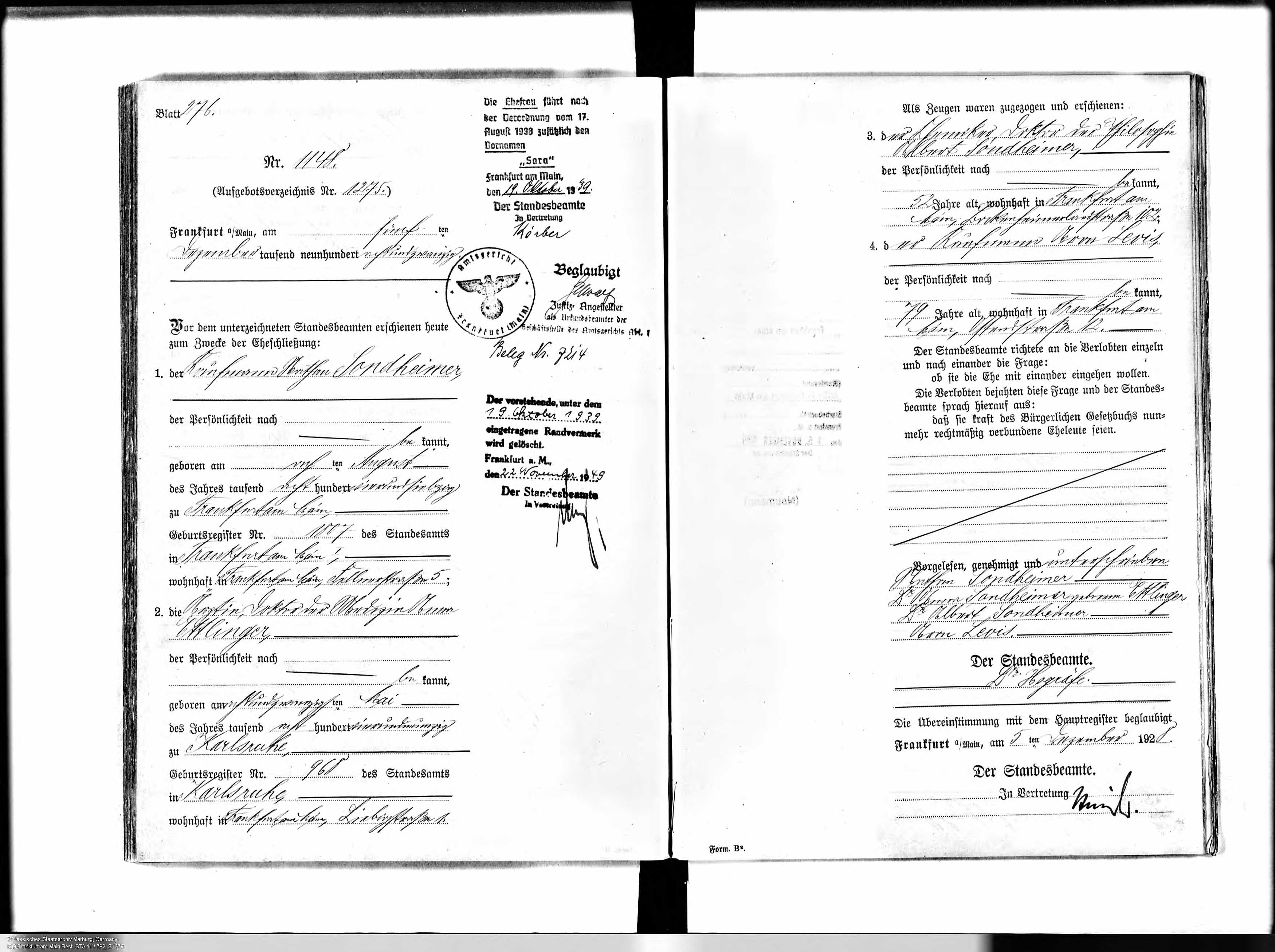
Fortunately, all three of Alexander and Clementine’s daughters survived the Nazi era. Their oldest daughter Edda Joel and her husband Hermann Wolf ended up in Mexico, but I don’t know whether they were there during or only after the war. All I know is that they were both living there when they died in 1945 and 1955, respectively. According to Edda’s death record from Mexico, she was “francesa,” or French, which leads me to believe that she and her family lived in France for some period of time before immigrating to Mexico.

Esther Edda Joel Wolf death record, Archivo de Registro Civil de Distrito Federal (Civil Registry Archives); Federal District, Mexico, Year: 1945, Ancestry.com. Federal District, Mexico, Civil Registration Deaths, 1861-1987

The death record also reports that Edda died from a massive pulmonary embolism and endocarditis and that she was buried in Israel (logar de inhumacion). She was only 44 years old when she died. Had the deaths of her parents and the stress of escaping with her family from Germany contributed to her early death? I don’t know.

Her husband Hermann died ten years later at the age of 57. From the death record, I learned that he had remarried and his widow was Carmen Hebert and that his son Fernando was originally from France, which is consistent with what I inferred from Edda’s death record.

Hermann Wolf Tannenberg death record, Archivo de Registro Civil de Distrito Federal (Civil Registry Archives); Federal District, Mexico, Ancestry.com. Federal District, Mexico, Civil Registration Deaths, 1861-1987

My deep gratitude to Steve Mordecai of Tracing the Tribe who spent a lot of time translating Hermann’s death record from Spanish to English, as quoted below:

In the City of Mexico, Federal District, at 12:00 noon, on the 14th of March 1955, before me, Dr. Fidel Guillen, Head of the office of Civil Registration, presents, Mr. Luis Vidales, of this area, a single man of 50 years, funeral employee, living in Ave Hidalgo 13, in this City; and presents for insertion a document related to the death of an adult, Hermann Wolf Tannenberg, the which was archived in accordance with the law and in part condercente (?) Says: “Mimeco (?) 178. In the City of Cuernavaca, at 18 eighteen hours of the day 13 thirteen of March 1955, nineteen hundred fifty-five, before me, citizen Filipe Rivera Crespo, judge of the Registration of the Civil State, appeared one Mr Fernando Wolf, age 32, thirty-two, a married, businessman or (Merchant), originally of France, and neighbor (or living outside) of Mexico, Federal District, traveling in this City and presented a certificate, archived, which says: “He that medically certifies, legally authorized to exercise his profession: “ an individual male, in the house number 7, of the street de Balsas –Cause of death: Principal illness Myocardial Infarction – Cuernavaca moz (?), 13 March 1955.-Signature of the Medic: Guillermo Vega Campos. – Residence: Degollado 28 – Complementary (?) Data – Day and hour of death 12:45 Sunday 13 March 1955, a male – Hermann Wolf Tannenberg -residence: Balsas #7. – Age 58 – place of birth, Hanover, Germany. Nationality Mexican, occupation – businessman (merchant) – civil status- married – name of father: Mauricio Wolf – mother Clare Tannenberg, (both) deceased. Name of spouse Carmen Hebert, living. – signature of the medic: Guillermo Vega Campos – at the request of the family(?)…. saw to the transfer of the cadaver to the City of Mexico, to be interred (?) Carried out this act in accordance with the family’s instructions (?) Signed: Felipe Rivera Crespo – F. Wolf – J Ferrrer. G (?) – Trio (?)” – Expedited bolete (?) to the Pantean Jardin de Villa Obergon, according to order 3061, of this date, (girade?) by the office of (Pante…?) Departament of the Federal District. Witnessed by Jose Martinez and Valente Lufran, ages 31 and 33. Of the same origen, occupation, civil status and residence of those appearing. Reading this act they ratify and confirm. Given (signed) Luis Vidal, J. Martinez and V. Lufran. [Emphasis added.]

Hermann and Edda were survived by their two sons, Fernando Werner Moshe Wolf, who died in Mexico in 1997, and Pierre Kurt Wolf, who immigrated to the United States and settled in Florida, where he died in 1979.1

Clementine’s second daughter Lizzie Joel Haas and her husband Siegfried and their two daughters also immigrated from Germany in time to escape the concentration camps. They arrived in the US on March 12, 1940, and were heading to a cousin, Hermann Youngheim of El Reno, Oklahoma.

Siegfried and Lizzie Haas, ship manifest, Ship or Roll Number: Westernland
Ancestry.com. New York, Passenger and Crew Lists (including Castle Garden and Ellis Island), 1820-1957

When I saw the name Youngheim and the Oklahoma address, it struck me that there might be a connection between Hermann Youngheim and my Katz relatives in Oklahoma who were the descendants of Meier Katz and Sprinzchen Jungheim of Jesberg, Germany. And sure enough, Herman Youngheim was the nephew of Sprinzchen Jungheim Katz. And in addition, Herman Youngheim was the son of Fanny Marx Jungheim, the sister of Fredericke Marx Haas, mother of Siegfried Haas.

So Herman was Siegfried’s first cousin and must have helped Siegfried, Lizzie and their daughters escape from Germany. Siegfried changed his name to Fred in the US, and by 1942 the family was living in Indianapolis, Indiana, as seen on Fred Haas’ draft registration for World War II.

Fred Haas, World War II draft registration, The National Archives at St. Louis; St. Louis, Missouri; Record Group Title: Records of the Selective Service System; Record Group Number: 147
Ancestry.com. U.S., World War II Draft Registration Cards, 1942

Lizzie died at age 55 in Indianapolis on February 6, 1958.

Lizzie Joel Haas death certificate, Indiana Archives and Records Administration; Indianapolis, IN, USA; Death Certificates; Year: 1958; Roll: 03, Roll Number: 03, Ancestry.com. Indiana, Death Certificates, 1899-2011

Her husband Fred later moved to Florida, where he died on July 27, 1971, at the age of 75.2 They were survived by their daughters and grandchildren.

The youngest Joel sister, Ille, also survived the Holocaust. I don’t have any primary sources for Ille. According to My Heritage, Ille and her husband Walter Cunow lived in Switzerland where Walter died in 1987 and Ille in 1994 and were survived by their two children. Unfortunately I have no further details or sources.

Thus, although Clementine Goldmann and her husband Alexander Joel did not survive the Holocaust, their three daughters all somehow managed to survive, and there are living descendants today to carry on their legacy.

As for Clementine’s younger sister Meta and her husband Adolf Hammerschlag and daughters Lieselotte and Irmgard, their story has more tragic endings, as you will see in my next post.


  1. Pierre Kurt Wolf, Birth Date: 30 Sep 1924, Birth Place: Saarbrucken, Federal Republic of Germany, Death Date: Jun 1979, Father: Hermann W Tannenberg
    Ancestry.com. U.S., Social Security Applications and Claims Index, 1936-2007 
  2. Fred Haas, Social Security Number: 314-12-6142, Birth Date: 6 Feb 1896
    Issue Year: Before 1951, Issue State: Indiana, Last Residence: 33134, Miami, Miami-Dade, Florida, USA, Death Date: Jul 1971, Social Security Administration; Washington D.C., USA; Social Security Death Index, Master File, Ancestry.com. U.S., Social Security Death Index, 1935-2014; https://www.findagrave.com/memorial/180016722/fred-haas