Helene Goldschmidt Tedesco and Her Family: Hiding from the Nazis in France

When Selig Goldschmidt died on January 13, 1896, he was survived by his six children and eighteen grandchildren. In his will, he had wished them happiness and love and hoped they would live good lives, following the faith and practices of Judaism and giving back to their communities.

For the first thirty years of the twentieth century, his hopes for his children were largely fulfilled. Then everything changed. In the next series of posts I will look at each of the children of Selig and Clementine (Fuld) Goldschmidt and their lives in the 20th century, starting with their oldest child, Helene Goldschmidt Tedesco.

As we saw, Helene Goldschmidt, the oldest child of Selig Goldschmidt and Clementine Fuld, married Leon Tedesco on June 9, 1876, in Frankfurt.  I was very fortunate to find and connect with Helene’s great-great-grandson Lionel, and he has generously shared with me many wonderful photographs as well as the story of his family including information about his 3x-great-grandfather, Leon’s father, Giacomo (Jacob) Tedesco.

Leon’s father Giacomo Tedesco was born in Venice, Italy, on August 27, 1799, and in 1833 he married Therese Cerf, a Parisian, and started a small art supplies store in Paris.  Giacomo provided art supplies to artists in exchange for some of their art work. From that collection, he created what grew to be the famous and extremely successful Tedesco Freres gallery. Giacomo was also a very committed Jew who helped build a modern mikvah in Paris, contributed to the development of a synagogue, founded the first kosher butcher shop in Paris, and served as a mohel.

After Giacomo died in 1870, his sons Leon and Arthur took over the business of the gallery. Leon became a close friend of the artist Jean-Baptiste-Camille Corot, the famous French landscape painter and printmaker who was considered “the leading painter of the Barbizon school of France in the mid-nineteenth century.” The National Gallery in Washington, DC, has several works that came from the Tedesco Freres collection, including this work of Corot:

Jean-Baptiste-Camille Corot, Madame Stumpf and Her Daughter, 1872. Courtesy of the National Gallery

Helene and Leon’s son Giacomo was born in Paris on July 28, 1879, and was obviously named for his recently deceased grandfather. Giacomo, the grandson, married Henriette Lang on February 9, 1901, in Paris; she was the daughter of Louis Lang and Louise Blum and was born in Paris on January 31, 1882.1 Giacomo worked with his family in the art gallery. He and Henriette had two daughters, Irene, born December 23, 1902, and Odette, born July 16, 1907.2

Here is an absolutely gorgeous photograph of young Odette with her mother Henriette:

Odette and Henriette Lang Tedesco
Courtesy of the Family

This wonderful photograph is of Leon Tedesco, his granddaughter Odette, her mother Henriette Lang Tedesco, and her grandmother, Helene Goldschmidt Tedesco.

Front: Leon Tedesco, Odette Tedesco, Helene Goldschmidt Tedesco. Rear: Henriette Lang Tedesco. Courtesy of the family

Helene and Leon’s son Giacomo served in the French armed forces during World War I. It must have been strange to be on the opposite side of the war from his Goldschmidt family living in Frankfurt.

Giacomo Tedesco during World War I
Courtesy of the family

Odette married Mathieu Charles Weil on October 24, 1929. Mathieu was born in Strasbourg, France, on August 21, 1894, to Isidore Weil and Jeanne Levy.3 Lionel shared this beautiful photograph from their wedding day:

Odette Tedesco and Mathieu Weil on their wedding day
Courtesy of the family

Leon Tedesco died on August 7, 1932, at the age of 79.4 Lionel described his great-great-grandfather as “a strong and handsome man who looked like the King of Belgium.” This photograph of Leon with Helene certainly reflects Lionel’s description:
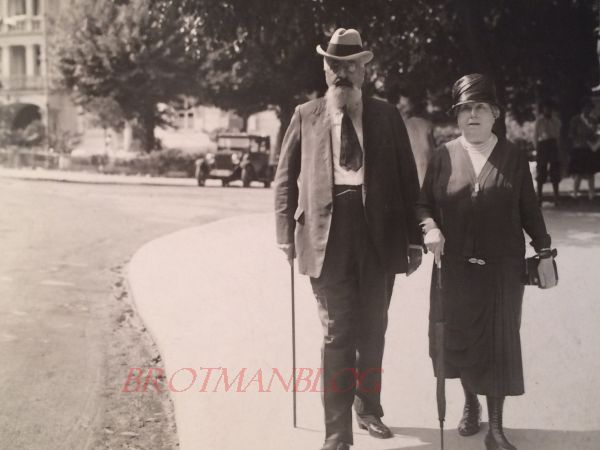
Leon was survived by his wife Helene, his son Giacomo, his two granddaughters and his great-granddaughter. All of them then had to face the Nazi era.

According to Lionel, the Tedesco family left Paris after the invasion of France by the Nazis in 1940. The family lost everything they had—which was substantial as Leon Tedesco’s art business had been extremely successful. Not only did they lose the business, they also lost most of the valuable art and antiques they’d owned.

Helene Goldschmidt Tedesco died in Marseille, France, on August 21, 1942; she was 84 years old. Her  granddaughter Irene Tedesco died on November 12, 1942, in Oberhoffen, France, in the Alsace region. Lionel had no information regarding Irene’s cause of death, except to say that she had apparently had some health challenges since birth.5

The rest of the family survived the Holocaust and the war years by being safely hidden.  Nadine, Lionel’s mother, still remembers that between the age of 9 and 14, after fleeing from Paris, she lived and went to school in many locations in southern France: Annet, Bordeaux, Arcachon, Salles, Sariac, Cassis, Marseille, Grenoble, Villars de Lans, and Autran. Most of the time she lived with her parents and her grandmother Henriette. Her grandfather Giacomo was hiding elsewhere in France. During the war, Nadine used two different names to hide her identity as a Jewish girl: Nicole Varnier and Mady Mercier.

Mathieu Weil joined the resistance movement and is depicted in this photograph with others who were fighting against the Nazis:

Mathieu Weil, third from right, as part of the French Resistance Courtesy of the family

At one point the family was hiding in the Vercors region with a woman named Charlotte Bayle, who had known the Tedesco family for six generations. When Mathieu Weil, Odette’s husband, was very ill with typhoid, the Gestapo came to Charlotte’s door looking for him. Charlotte lied and said he had left three days ago when in fact he was lying in bed in the next room. The whole family left immediately. Lionel credits Charlotte Bayle with saving the lives of his mother, grandparents, and great-grandmother. Here is a photograph of Charlotte Bayle with Odette Tedesco Weil:
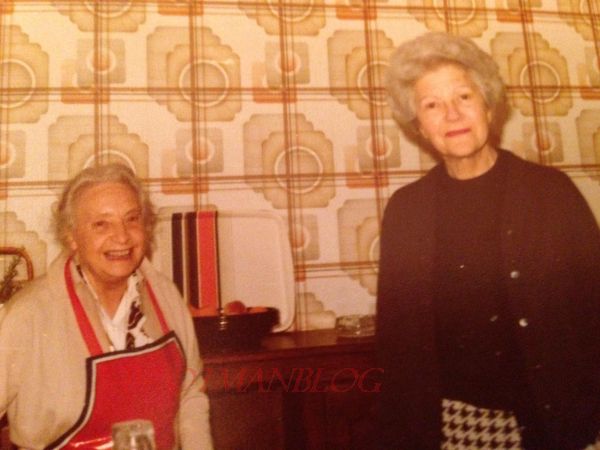
Charlotte Bayle and Odette Tedesco Weil
Courtesy of the family

After the war the family returned to Paris and began to rebuild their lives. Giacomo Tedesco died in Paris on June 29, 1950; he was seventy years old. Giacomo’s wife Henriette Lang Tedesco died on March 3, 1961, in Paris.6

Although Lionel did not know his great-grandparents Giacomo and Henriette, he knew his grandmother Odette very well. He described her as a very fine and elegant woman. He also said that although the family had been very religious before the war, their level of observance faded in the aftermath of the war. But their commitment to Judaism always remained strong and central to their lives. Odette died on July 16, 1987;7 she was predeceased by her husband Mathieu Weil on August 20, 1972.8 Both died in Paris.

Odette Tedesco Weil
Courtesy of the Family

Thank you so much to my fifth cousin Lionel and his mother Nadine for sharing these wonderful photographs and the story of his family.


  1. Giacomo Jacob Tedesco, Marriage Bann Date: 9 févr. 1902 (9 Feb 1902)
    Father’s Name: Léon Tedesco, Mother’s Name: Hélène Goldschmidt, Spouse’s Name: Henriette Lang, Ancestry.com. Paris, France & Vicinity Marriage Banns, 1860-1902 
  2.  Odette Tedesco, Gender: femme (Female), Death Age: 80, Birth Date: 16 juil. 1907 (16 Jul 1907), Birth Place: Paris-16e-Arrondissement, Paris, Death Date: 16 juil. 1987 (16 Jul 1987), Death Place: Paris-16E-Arrondissement, Paris, France, Certificate Number: 1005, Institut National de la Statistique et des Etudes Economiques (Insee); Paris, France; Fichier des personnes décédées; Roll #: deces-1987.txt, Ancestry.com. Web: France, Death Records, 1970-2018. Irene’s birth date came from the work of David Baron and Roger Cibella. 
  3. Mathieu Charles Weil, Gender: homme (Male), Death Age: 77, Birth Date: 21 août 1894 (21 Aug 1894), Birth Place: Strasbourg, Bas-Rhin, Death Date: 20 août 1972 (20 Aug 1972), Death Place: Paris-16E-Arrondissement, Paris, France
    Certificate Number: 1230, Institut National de la Statistique et des Etudes Economiques (Insee); Paris, France; Fichier des personnes décédées; Roll #: deces-1972.txt, Ancestry.com. Web: France, Death Records, 1970-2018 
  4. Name: Leon Tedesco, Death Date: 7 Aug 1932, Death Place: Paris, France
    Probate Date: 8 Jun 1933, Probate Registry: London, England, Ancestry.com. England & Wales, National Probate Calendar (Index of Wills and Administrations), 1858-1995 
  5. These dates come from the work of David Baron and Roger Cibella and are also seen on the Geni profiles for Helene and Irene. 
  6. These dates come from Baron and Cibella and also from Geni. 
  7. Odette Tedesco, Gender: femme (Female), Death Age: 80, Birth Date: 16 juil. 1907 (16 Jul 1907), Birth Place: Paris-16e-Arrondissement, Paris, Death Date: 16 juil. 1987 (16 Jul 1987), Death Place: Paris-16E-Arrondissement, Paris, France, Certificate Number: 1005, Institut National de la Statistique et des Etudes Economiques (Insee); Paris, France; Fichier des personnes décédées; Roll #: deces-1987.txt, Ancestry.com. Web: France, Death Records, 1970-2018 
  8. Mathieu Charles Weil, Gender: homme (Male), Death Age: 77, Birth Date: 21 août 1894 (21 Aug 1894), Birth Place: Strasbourg, Bas-Rhin, Death Date: 20 août 1972 (20 Aug 1972), Death Place: Paris-16E-Arrondissement, Paris, France
    Certificate Number: 1230, Institut National de la Statistique et des Etudes Economiques (Insee); Paris, France; Fichier des personnes décédées; Roll #: deces-1972.txt, Ancestry.com. Web: France, Death Records, 1970-2018 

A Survivor’s Story

Regina Goldschmidt Rosenberger, the daughter of Julius Goldschmidt, granddaughter of Jacob Meier Goldschmidt, and great-granddaughter of Meyer Goldschmidt, was my third cousin, twice removed, and I first wrote about her here and here, but now need to update those posts.

The earlier post established that Regina was born in Frankfurt on March 7, 1900, and married Siegfried Rosenberger on March 10, 1921, in Frankfurt, and had two children in the 1920s. In my second post about Regina, I wrote:

I don’t know a great deal about what happened to Regina, her husband Siegfried Rosenberger, and their two children during the Holocaust. It appears that at least until 1937 they were still living in Frankfurt and that after the war, according to Roger Cibella and David Baron, their two children were both married in the Netherlands and had children born there. Eventually they all immigrated to Canada where Regina died in February 1992…

And that was all I knew. Until a couple of weeks ago when I received an email from a sixth cousin named Mark Isenberg. I had first heard from Mark a few years back when he contacted David and Roger regarding his research establishing that his paternal four-times great-grandfather Joseph Falk Neuwahl and Roger’s and my four-times great-grandfather Jacob Falk Goldschmidt were probably brothers.

This time Mark was writing about his relationship to Siegfried Rosenberger, husband of Regina Goldschmidt. Siegfried was Mark’s third cousin, once removed, on his maternal side. Mark had seen my blog post quoted above and kindly alerted me to the fact that Siegfried and Regina’s daughter Ruth had done an interview with the Shoah Foundation in 1997. I’ve now watched the two and a half hours of her testimony and can report in much greater detail what happened to Regina, Siegfried, and their two daughters Ruth and Margo during the Holocaust. All the information below except where otherwise noted comes from that testimony of Ruth Rosenberger Steinert.1

Ruth Rosenberger was born in Frankfurt on December 6, 1922. Her sister Margo was born almost exactly two years later on December 19, 1924. Ruth described their childhood in Frankfurt in idyllic terms. They lived in a very large apartment with a nanny, cook, and other servants, and were surrounded by their Goldschmidt grandparents, aunt, uncle, and cousins, having regular shabbat dinners with the extended family as well as holidays. Their father Siegfried was a successful stockbroker. He was very proud of being a German and of his service to Germany in World War I, for which he was awarded the Iron Cross.  Their mother Regina lived a good life, playing tennis daily, socializing with friends, and overseeing the household staff. The family was very observant, and Ruth and Margo went to an Orthodox day school in Frankfurt. Watching Ruth talk about her childhood was very moving; she so well expressed how safe and loved she felt.

Khal Adath Jeshurun synagogue in Frankfurt, the synagogue attended by the Goldschmidt family. https://www.kajinc.org/about/history

Everything was destroyed once the Nazis came to power. Ruth said that until 1936, she and her sister were fairly unaware of what was happening because the adults did not talk about the Nazis in front of the children. She knew that there were restrictions, mentioning as an example that they were not allowed to sit on the park benches, but she nevertheless felt safe.

But after 1936, it became impossible to hide what was happening from the children. Her father lost his stockbroker business because Jews were no longer allowed to engage in business. Ruth talked about how devastated her father was when they came and stripped away the telephones he needed for the business. The nanny, cook, and other servants had to leave the household because non-Jews were no longer allowed to work for Jews. Their mother Regina became terribly depressed.

Fortunately, Siegfried was able to secure another job with an international metals company called Lissauer. The position required him to travel to France and to Holland and enabled the family to continue to live fairly comfortably. As Ruth described it, this job ultimately saved their lives. Siegfried would never have left Germany despite all the oppression and fear. But in September 1938 while traveling for work in Paris, he was unable to return to Germany. Finally he agreed that the family should leave Germany, and through his business connections, he was able to obtain papers for them to immigrate to the Netherlands.

Ruth, not yet sixteen years old, took charge of packing and getting them ready to leave. They took a train to Paris, and Ruth put on lipstick so that she would look older. When they got to the French-German border at Emmerich, the German border guards gave them trouble with their papers, but fortunately a cousin was able to straighten matters out, and the next day they arrived in Paris. They remained in Paris for a few days, and then the whole family spent about ten days at the beach in the Netherlands. Ruth remembered it as a wonderful time and one of the very last times all four of them were together as a family.

Siegfried returned to Paris for work and would travel back and forth to Amsterdam. Regina and her daughters were living in a very nice apartment on the canal in Amsterdam. Margo attended high school, and Ruth spent a year at an art academy, learning design.  For a year life was fairly normal.

As one uncle had said to the family when they arrived in Paris, they had, however, gone from “the rain into the storm” because war was brewing, and no place was really safe. After the war started in September 1939 and then Holland and France were occupied by the Nazis in the spring of 1940, Siegfried could no longer travel to Amsterdam. From that point on, things went downhill.

Ruth recalled standing on a corner in Amsterdam with a crowd of other people from the neighborhood as the Germans marched into Amsterdam.

Nazi troops and supporters in front of De Bijenkorf, Dam Square, Amsterdam, The Netherlands, 1941 (crop of original 1941 public domain photo). 47thPennVols, CC0, via Wikimedia Commons

But even on that dark day, the family found a silver lining. A man named Benot Hess was also standing on that corner and engaged Regina and daughters in conversation. Hess was married to a non-Jewish Swedish woman, and because Sweden was neutral during the war, he was given some extra protection based on that marriage. Hess and his wife became close friends with the Rosenberger women—like family, according to Ruth. He made sure that they had enough money by helping Ruth obtain work, sewing and then manufacturing travel kits and other items. The products sold well, giving the family an economic cushion.

By 1942, however, conditions worsened. Jews were required to wear the yellow stars with Jood to mark them as Jews. Ruth said that they lived in a constant state of angst for all their waking hours. Eventually they were forced to move into what Ruth described as a ghetto where all Jews were forced to live, and SS men on trucks barreled through the neighborhood every night, coming to arrest people and take them to Westerbork, the detention camp outside of Amsterdam.

At that point, they had to make a choice: stay and see what would happen or go into hiding. Ruth favored going into hiding, but her mother was not willing, and Margo did not want to leave their mother. For some time they remained safe from deportation as both Ruth and Margo had positions assigned by the Judenrat (the Jewish council) that kept them protected. Once the SS came to their apartment, and Ruth managed to convince them that they were not Jewish. She claimed that because of her light hair and coloring and straight nose, she was able to fool them.

But when the SS arrived a second time, Ruth was not successful, and in March 1943, Regina Goldschmidt Rosenberger was arrested and taken to Westerbork. Ruth described it as the worst moment in her life, watching her mother being taken away. She said that at that time they did not know about the death camps, only about what were being referred to as work camps. Soon thereafter Margo lost her position with the Judenrat and was also taken to Westerbork where she joined her mother.

Ruth contacted her father to see if he could arrange false identification papers for her, which he was able to accomplish, and Ruth went to Bussum, a town in Holland, and hid with a family there for the duration of the war. She was almost caught once when the SS came to look for hidden Jews, but again was smart enough and lucky enough to convince them that she was not Jewish.

Meanwhile, Regina and Margo had been taken from Westerbork to Terezin. Once again, Benot Hess came to their rescue. He also was imprisoned at Terezin, and when he learned that Regina and Margo were to be placed on the next train to Auschwitz, he intervened, using the Honduran passports that Siegfried had obtained for them, and Regina and Margo were taken off the list.

Jewish prisoners’ cell, Terezin (c) A Cohen 2015

When the war ended in Europe in April 1945, Ruth was reunited with her mother and sister, and they all moved to Bussum. Margo married her fiancé, Robert Engel, who had been at Westerbork throughout the war period, and Ruth met and married Otto Steinert. In 1950, Otto was offered a job in Canada through the family’s connections to another family, and Ruth and Otto and soon thereafter Regina, Margo, and her husband all moved to Canada.

Siegfried was never reunited with the family. He remained in Paris, where he died not long after the war. Regina Goldschmidt Rosenberger lived a long life, dying in Canada in February 1992 when she was almost 92 years old.

Her two daughters also lived long lives. Ruth Rosenberger Steinert died at the age of 93 on December 22, 2013, in Montreal. Her sister Margo Rosenberger Engel died just this past June 30, 2020, in Toronto; she was 95. They are survived by their children and grandchildren and great-grandchildren.

Watching Ruth’s testimony was a moving, inspiring, and heartbreaking experience. Despite everything she had experienced—all the losses, the fear, the separation, the loneliness—she remained a strong, optimistic, and loving woman who spoke about her parents, her husband, her sister, her children and grandchildren with so much affection and warmth. She was not going to be defeated by what happened around her—not while it was happening and not afterwards. How blessed we are to have this testimony to remember what happened and to inspire us all.


  1. Steinert, Ruth. Interview 35432. Visual History Archive, USC Shoah Foundation, 1997. Accessed 1 October 2020. 

The “Disappearance” of Arthur Cohen, My Grandfather’s First Cousin

Way back in July, 2014, I wrote about my great-grandfather Emanuel Cohen’s youngest sibling, his brother Abraham, the thirteenth child of my great-great-grandparents Jacob Cohen and Sarah Jacobs. What I reported was that Abraham, born in Philadelphia on March 29, 1866, had married Sallie McGonigal in 1886, and they had five children, but three of those children died in childhood. Only two children survived—their son Leslie, their second child, and their son Arthur, their fifth and youngest child. There were almost twenty years between the two boys: Leslie was born in 1889, Arthur in 1907.  They lost their mother Sallie to the dreadful flu epidemic on March 14, 1919.

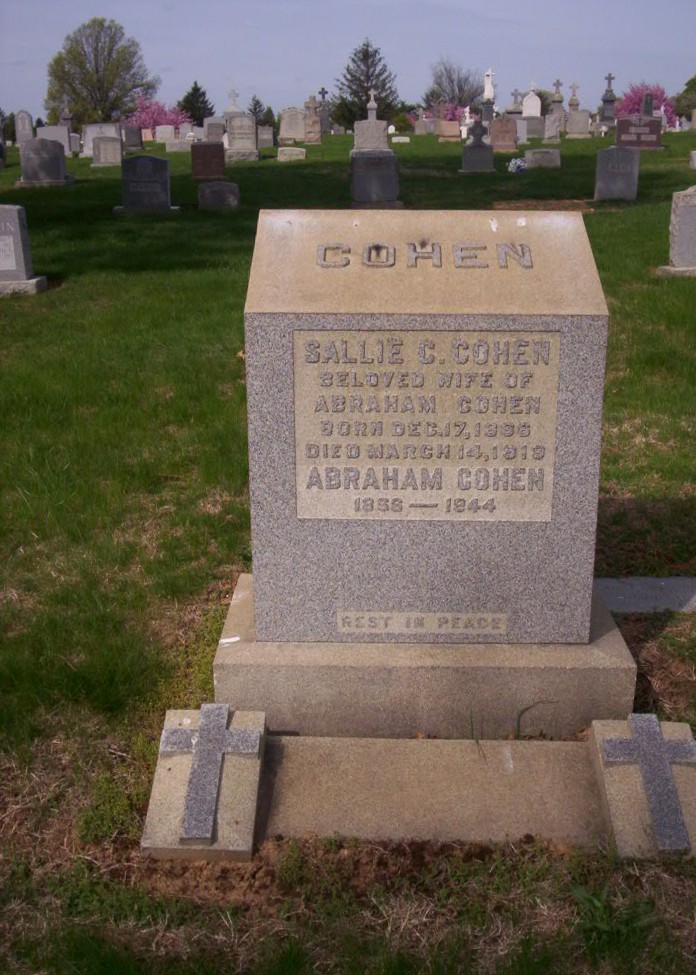
Gravestone for Sallie and Abraham Cohen, courtesy of Michael DeVane

Abraham Cohen remarried in 1920, and I was able to trace Abraham and his son Leslie up through their deaths, as described here.

But Arthur’s story was unfinished. The last record I had for him was the 1930 census when he was living with his father Abraham and stepmother Elizabeth in Philadelphia and working in a gas station. He was 23 at the time. After that, he disappeared. I could find other Arthur Cohens who matched in some ways, but not in others. Thus, I was unable to find anything after 1930 that was definitely about my Arthur Cohen.

Abe Cohen and family, 1930 US census, Year: 1930; Census Place: Philadelphia, Philadelphia, Pennsylvania; Page: 13A; Enumeration District: 0505; FHL microfilm: 2341874
Ancestry.com. 1930 United States Federal Censu

Until, that is, about a month ago when I received a comment on the blog from someone named Michael DeVane, who wrote, “I came across your blog while searching for information on Abraham Cohen, my grandfather. My father was Arthur Cohen. You really helped me fill in some of the missing information on my family. If you want to reach out to me, I will gladly help fill in some missing information to our family tree.” I immediately wrote back to Michael, and we arranged to chat by telephone a few days later.

To prepare for the conversation, I went back to all the research I’d done about Abraham and his family. One thing puzzled me. If Michael’s father was Arthur Cohen, why was his surname DeVane? Well, that clue led me to find more information, and then my conversation with Michael confirmed what I’d uncovered and added more insights. There was a very good reason that I’d not been able to find Arthur Cohen after 1930. By 1931, he’d changed his name to Arthur DeVane.

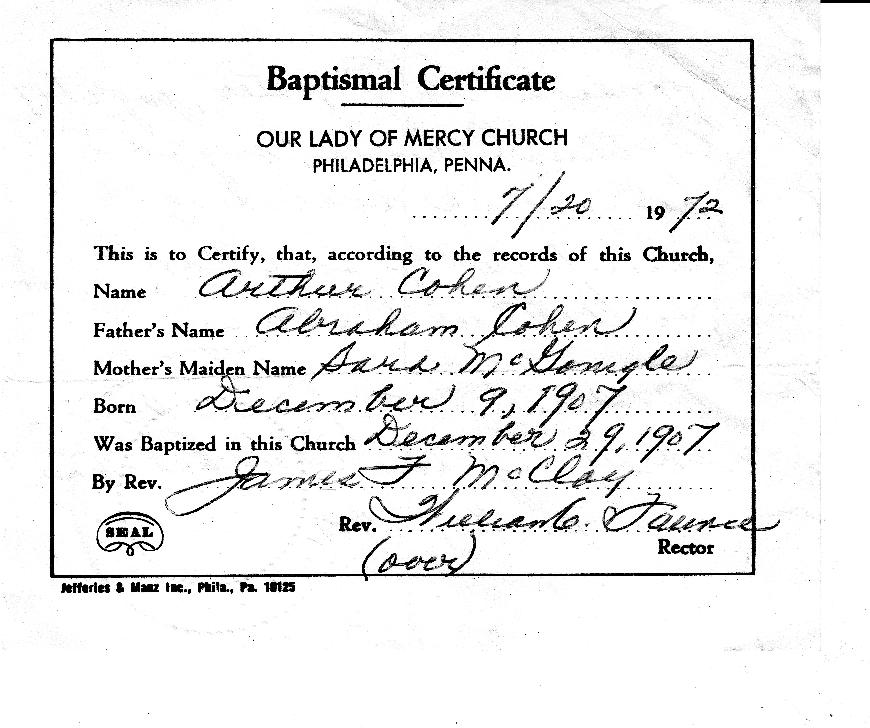
Once I knew that Arthur had in fact changed his name to DeVane, I located a marriage in the Philadelphia marriage index for Arthur DeVane and Ruth Bussard dated 1931. 1 Michael found in his family records the following document that confirmed that this marriage record was indeed for his father, born Arthur Cohen. It is his father’s baptismal certificate under the name Arthur Cohen with his parents identified.

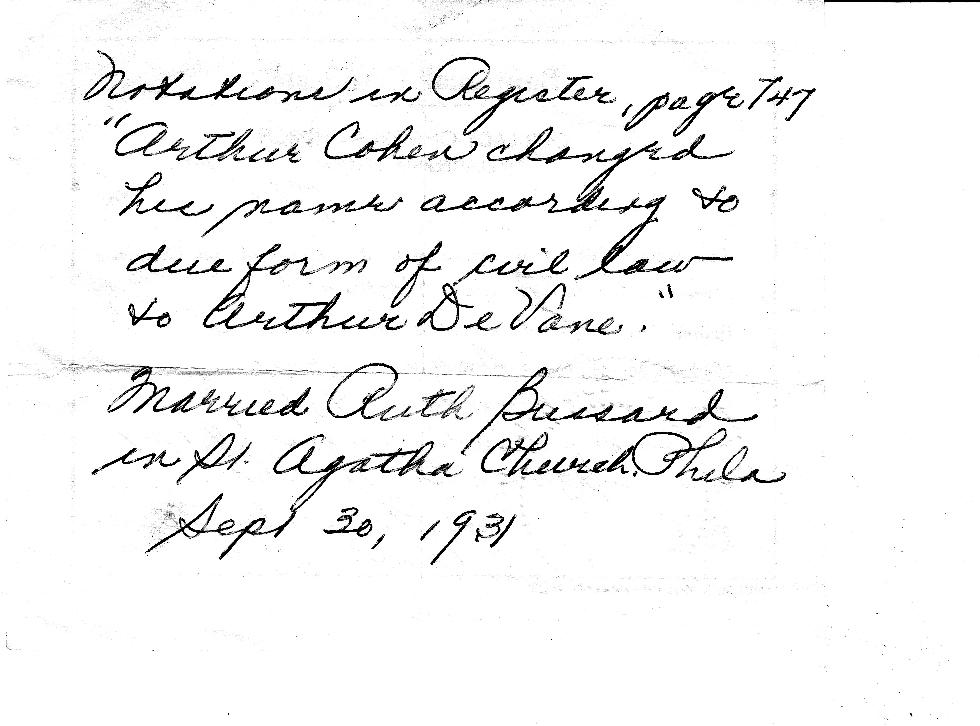
On the reverse, it notes that Arthur changed his name to DeVane and that he married Ruth Bussard on September 30, 1931, at St. Agnes Church in Philadelphia. Michael thought he might contact the church authorities to see if the record for the name change can be located.

Michael had understood that his father changed his name from Cohen to avoid anti-Semitism, but now we both wonder whether it also had to do with the marriage to Ruth Bussard. Perhaps she didn’t want to take on such an obviously Jewish name. As you can see from the headstone above, both of Arthur’s parents identified as Catholic and are buried in a Catholic cemetery, so Arthur was neither raised Jewish nor identified himself as Jewish.

In any event, the marriage to Ruth did not last. In September 1939, Ruth filed for divorce, and in February 1940, divorce was granted.2 Ruth remarried later that year.3

On the 1940 census, Arthur was living as a lodger with a family, listing his marital status as single and his occupation as a signal man for the railroad.4

On January 8, 1942, Arthur DeVane enlisted in the US armed services and served during World War II until September 5, 1945, including almost two and a half years serving overseas.5 During that time, while stationed in England , he met his second wife, Nellie Keep. Nellie was born April 1, 1917, in Oxford, England to Edward Keep and Nellie Massey. She and Arthur were married in New Hampshire on December 18, 1947. Like Arthur, Nellie had been previously married and divorced.

Marriage record of Arthur Devane and Nellie Keep, New England Historical Genealogical Society; New Hampshire Bureau of Vital Records, Concord, New Hampshire, Ancestry,com. New Hampshire, Marriage and Divorce Records, 1659-1947

The record for their marriage is interesting. Arthur reported that his father’s name was Leslie DeVane, not Abraham Cohen, the true name of his father. He also reported that his father had been a jeweler, when in truth, like so many of my Cohen relatives, Abraham had been a pawnbroker. Michael wasn’t sure whether Arthur did this to hide his background from his new wife or for some other reason, but Nellie did at some point know the truth of Arthur’s family background because she revealed it to Michael.

Part of the family lore is that Arthur had hoped to take over his father’s pawnbroker business, but that his father Abraham lost the business when his second wife Elizabeth died in 1939 and her family acquired it and apparently pushed Abraham out. That is why, as noted in my earlier post, Abraham’s death certificate in 1944 listed his occupation as elevator operator—a job he’d had to take after losing his business.

Abraham Cohen death certificate.

That meant Arthur also lost the business. Instead, Arthur ended up rejoining the military and spent most of his career serving his country in the US Air Force, as has his son Michael. Arthur was stationed over the years in England, Massachusetts, and New Jersey. He retired as a master sergeant in the Air Force after twenty years of service.

Arthur DeVane, born Arthur Cohen, died on April 16, 1976, in Burlington, New Jersey. He was sixty-eight years old.6  He was survived by his wife Nellie, who died in 2005, 7 and their three children and their grandchildren.

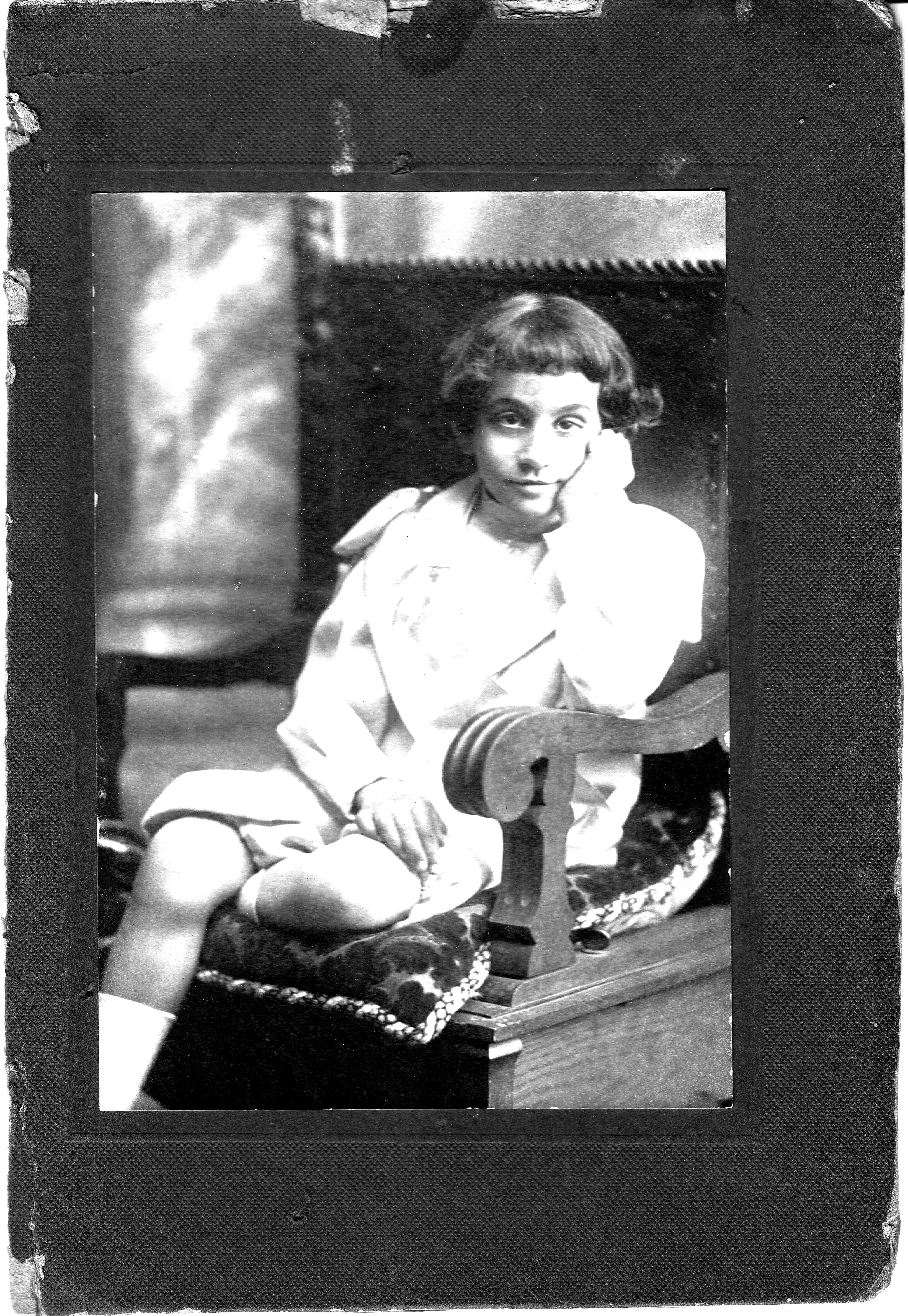
Michael kindly shared with me the following photograph of his father as a boy.

Arthur Cohen (later DeVane). Courtesy of Michael DeVane

I saw some similarity between young Arthur and his first cousin, once removed, my grandfather John Nusbaum Cohen, Sr., as a little boy, but it could just be the haircut.

John Cohen Sr as a baby

Michael also shared the following photograph of his father Arthur in 1948:

Arthur DeVane, 1948. Courtesy of Michael DeVane

I don’t see many resemblances here to either my father or my grandfather, except perhaps around the mouth and the large forehead.

John N. Cohen, Sr., 1921

John N. Cohen, Jr. c. 1945

I am so grateful to my cousin Michael, my father’s second cousin, for finding me and sharing his father’s story and photographs with me.


  1. Arthur J DeVane, Gender: Male, Spouse: Ruth H Bussard, Spouse Gender: Female
    Marriage Place: Philadelphia, Pennsylvania, United States, Marriage Year: 1931
    Marriage License Number: 606549, Digital GSU Number: 4141671, Ancestry.com. Philadelphia, Pennsylvania, Marriage Index, 1885-1951 
  2. The Philadelphia Inquirer – 27 Feb 1940 – Page 11, found at https://www.newspapers.com/clip/59928918/divorce-granted/?xid=637&_ga=2.20757178.305149426.1602707833-2106877110.1599576721 
  3. Ruth Devane, Gender: Female, Spouse: Marturano, Spouse Gender: Male
    Marriage Place: Philadelphia, Pennsylvania, United States, Marriage Year: 1940
    Marriage License Number: 716706, Digital GSU Number: 4141873, Ancestry.com. Philadelphia, Pennsylvania, Marriage Index, 1885-1951 
  4.  Year: 1940; Census Place: Philadelphia, Philadelphia, Pennsylvania; Roll: m-t0627-03723; Page: 61B; Enumeration District: 51-1118, Ancestry.com. 1940 United States Federal Census 
  5. Arthur J DeVane, Birth Date: 9 Dec 1907, Birth Place: Philadelphia, Philadelphia, Pennsylvania, USA, Gender: Male, Residence Date: 2 May 1950, Residence Place: Upper Darby, Delaware, Pennsylvania, USA, Ancestry.com. Pennsylvania, World War II Veteran Compensation Application Files, 1950-1966 
  6. Arthur Devane, Social Security Number: 182-10-8245, Birth Date: 9 Dec 1907
    Issue Year: Before 1951, Issue State: Pennsylvania, Last Residence: 08016, Burlington, Burlington, New Jersey, USA, Death Date: Apr 1976, Social Security Administration; Washington D.C., USA; Social Security Death Index, Master File, Ancestry.com. U.S., Social Security Death Index, 1935-2014 
  7.  Nellie A Devane, Social Security Number: 144-38-3406, Birth Date: 1 Apr 1917
    Issue Year: 1963, Issue State: New Jersey, Death Date: 26 Jun 2005, Social Security Administration; Washington D.C., USA; Social Security Death Index, Master File, Ancestry.com. U.S., Social Security Death Index, 1935-2014 

Meier Katzenstein: The One Who Left Home

Having discussed the three daughters of Amalie Goldschmidt and Juda Katzenstein—Helene, Fredericke, and Henriette—and their families, we now finally reach their last child and only son, Meier Katzenstein.1  And his story is far different from that of his sisters, all of whom lived almost all their lives in Germany, not far from where they were born in Eschwege, and whose descendants either were killed by or escaped from the Nazis.

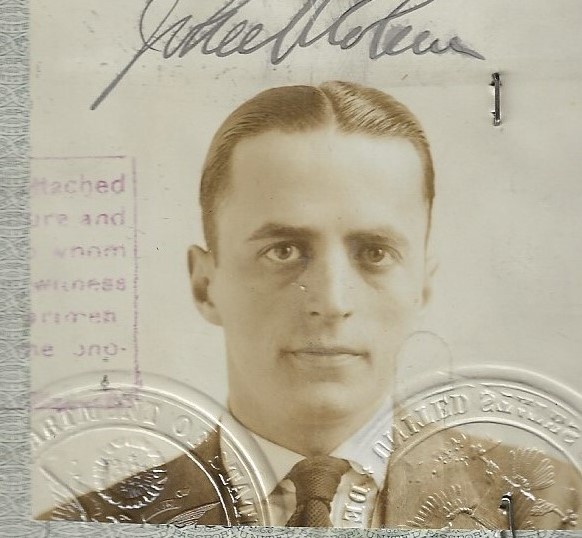
Meier was born on August 6, 1860, in Eschwege, as we have seen, but in 1888 he immigrated to the United States, changing the path of his life as well as that of his descendants. According to his passport application (depicted below), he arrived in New York on October 10, 1888, and settled there.

Meier Katzenstein, 1903 passport application, National Archives and Records Administration (NARA); Washington D.C.; Roll #: 623; Volume #: Roll 623 – 13 May 1903-18 May 1903
Ancestry.com. U.S. Passport Applications, 1795-1925

I love the physical description of Meier on his application: five foot seven inches tall, high forehead, light blue eyes, straight nose, small mouth, round chin, blond hair, florid complexion, and a round face. He sounds quite adorable.

Meier married Emma Bacharach in New York on October 27, 1891.2 Emma, the daughter of Jakob Bacharach and Sophia Pfann, was also a recent immigrant. She was born in Mainz, Germany, on July 5, 1869,3 and came to the US on November 5, 1889, accompanied by someone named Isaac Bachrach who was 48 years old. I’ve not been able to identify Isaac’s connection to Emma, but presumably he was an uncle or cousin.4

Emma and Meier had one child, a daughter Sophia (presumably named for Emma’s mother Sophia Pfann), born on August 19, 1892, in New York.5 Emma must have taken little Sophia back to Germany during her first year to meet her family because I found a ship manifest showing them sailing together from Hamburg to New York in the summer of 1893.

Sophia and Emma Katzenstein, ship manifest, Staatsarchiv Hamburg; Hamburg, Deutschland; Hamburger Passagierlisten; Volume: 373-7 I, VIII A 1 Band 085; Page: 958; Microfilm No.: K_1750, Month: Direkt Band 085 (1 Jul 1893 – 31 Aug 1893), Staatsarchiv Hamburg. Hamburg Passenger Lists, 1850-1934

Meier became a naturalized citizen of the United States on May 4, 1894.

“New York Naturalization Index (Soundex), 1792-1906,” database with images, FamilySearch (https://familysearch.org/ark:/61903/3:1:3QSQ-G937-NSGK-M?cc=2043782&wc=SFCB-HZ9%3A1399296801 : 4 February 2015), Roll 128, K324-K400 (Kutzelmann, Adam J-Klee, Johannes) > image 348 of 5224; citing NARA microfilm publication M1674 (Washington, D.C.: National Archives and Records Administration, n.d.).

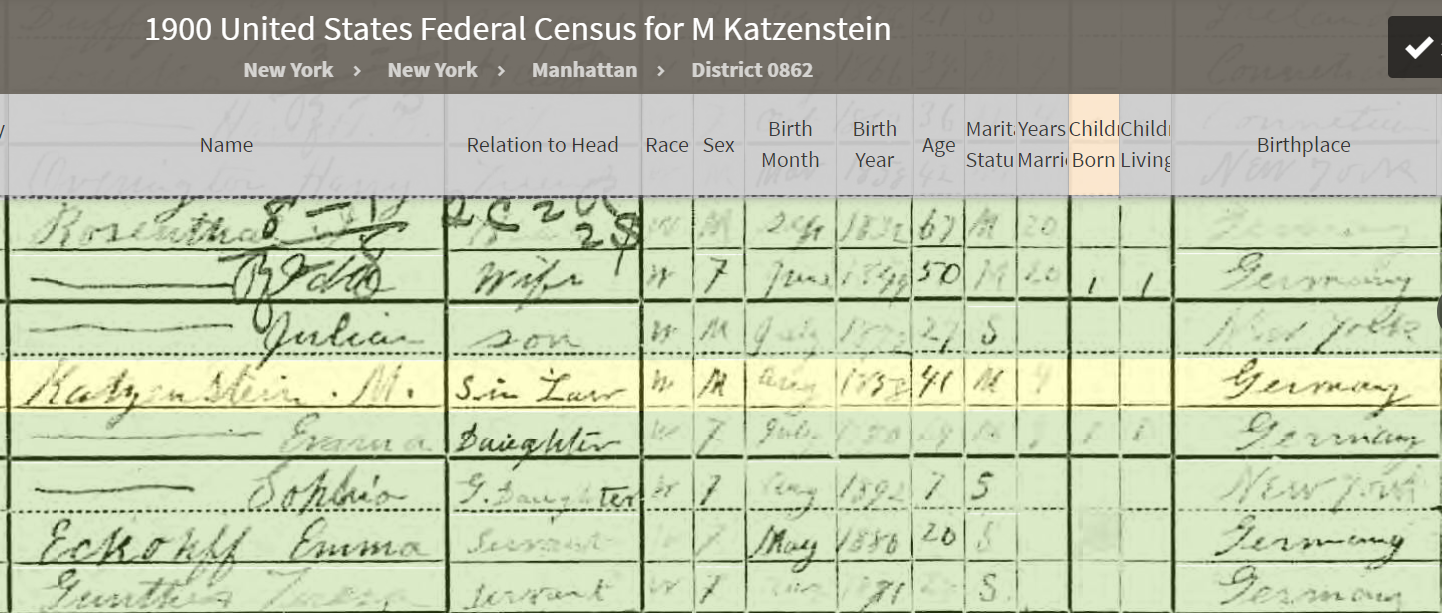
In 1900, Meier, Emma, and Sophia were living in New York City with another family. The head of household was Rosenthal (first name not legible); living with him was his wife Ida Rosenthal and their son Julian Rosenthal, two servants, and Meier, Emma, and Sophia.

Meier Katzenstein, 1900 US census, Year: 1900; Census Place: Manhattan, New York, New York; Page: 7; Enumeration District: 0862; FHL microfilm: 1241119, Enumeration District: 0862; Description: City of New York, 31st Assembly Dist; 22nd Election District (pt) bounded by E 129th, Park Ave, E 126th, Madison Ave, Ancestry.com. 1900 United States Federal Census

I was thrown off by this census record because it identifies Emma as the daughter, Sophia as the granddaughter, and Meier as the son-in-law of the head of household.  If Emma’s birth name was Bacharach and her parents were Jakob and Sophia, how could she be the daughter of Ida Rosenthal and her husband? It took a couple of hours to sort out that Ida Rosenthal was born Ida Pfann and was the sister of Sophia Pfann, Emma’s mother. Thus, Emma was Ida Rosenthal’s niece, not her daughter.

Meier’s occupation on the 1900 census is extremely hard to read as it is very faint, but I think I can discern the word “Sales” and perhaps “Linens,” the same occupation listed above for Emma’s cousin Julian Rosenthal. His passport application in 1903, depicted above, is more specific. He listed his occupation there as “manufacturer and importer of embroideries.”

By 1910, Meier and his wife and daughter had their own home in Manhattan, and Meier’s occupation this time is easily read as Manager, Fancy Linens. They also had a servant living with them.

Meier Katzenstein, 1910 US census, Year: 1910; Census Place: Manhattan Ward 12, New York, New York; Roll: T624_1024; Page: 3A; Enumeration District: 0622; FHL microfilm: 1375037
Ancestry.com. 1910 United States Federal Census

The family did some traveling in 1911—to Hong Kong and to Hawaii. Meier must have been doing well in his business, having a servant and traveling to exotic locations.6

His daughter and only child Sophia Katzenstein married Elias Lustig on February 19, 1914, in New York.7 Like Sophia, Elias was a native of New York City, born there on May 31, 1890, and the son of David and Rachel Lustig.8 Elias and Sophia’s first child David Miles Lustig was born on August 22, 1916, in New York.9

Unfortunately, Meier Katzenstein did not live to see the birth of his grandson; on February 20, 1916, at the age of 55, he died in New York City, just six months before his grandson’s birth. My guess is that his grandson’s middle name Miles was in Meier’s memory.10

In his will, Meier left everything to his wife Emma and then to his daughter Sophia in the event Emma did not survive him. Interestingly, he provided that in the event that Emma predeceased him and Sophia was still a minor, his “brother-in-law Max Werner of Eschwege” was to be her guardian. Max was married to Meier’s older sister Helene Katzenstein Werner. But why would Meier have appointed someone living in Germany to be the guardian of his daughter in New York? Imagine how Sophia’s life would have been different if in fact her parents had both died before she reached adulthood and she had moved to Germany?

Meier Katzenstein’s will, Record of Wills, 1665-1916; Index to Wills, 1662-1923 (New York County); Author: New York. Surrogate’s Court (New York County); Probate Place: New York, New York, Notes: Wills, 1021-1023, 1915-1916, Ancestry.com. New York, Wills and Probate Records, 1659-1999

Of course, it all was irrelevant since Emma did not predecease Meier, and Sophia was already an adult when Meier died. In 1920, Emma was living with Sophia and Elias and their son David Miles (listed here as Miles) in New York City. Elias was working as a merchant. 11 In 1921, Sophia and Elias had a second child.

I could not find Emma on the 1930 or 1940 census, but in 1930 Sophia and Elias were living in Queens in 1930 with their children, and Elias was the owner of a hat factory.12 Sometime thereafter, the marriage between Sophia and Elias ended, and in 1936 she married Saul Baron, with whom she and her children were living in New York in 1940. Saul was an attorney in private practice.13

Emma Bacharach Katzenstein died on February 18, 1941, in New York; she was 71.14

Meier Katzenstein’s choice to leave Germany for the United States back in 1888 spared his family the tragedies endured by so many of his relatives back in Europe during the Holocaust, but in one way the actions of Hitler still indirectly inflicted tragedy on his descendants. His grandson David Miles Lustig, named in his memory, was killed during World War II. While returning from a mission over China in early 1945, his plane was shot down, and David drowned in a small river after bailing out of the plane. He was 28 years old and a graduate of Princeton University.15

His mother Sophia Katzenstein Lustig Baron died just nine years later at the age of 58 on November 9, 1950.16  She was survived by her husband Saul Baron, her daughter and grandchild.


Having now covered all the children of Amalie Goldschmidt Katzenstein, I have a few updates to other relatives to write about before turning to Amalie’s younger brothers, Selig and Falk Goldschmidt, the last two children of my 4x-great-uncle, Meyer Goldschmidt.


  1. The spellings of his name vary on different documents between Meyer and Meier,  but I’ve opted to use Meier. 
  2. “New York, New York City Marriage Records, 1829-1940,” database, FamilySearch (https://familysearch.org/ark:/61903/1:1:24HL-R32 : 10 February 2018), Meier Katzenstein and Emma Bacharach, 27 Oct 1891; citing Marriage, Manhattan, New York, New York, United States, New York City Municipal Archives, New York; FHL microfilm 1,452,198. 
  3. Emma Bacharach birth record, Stadtarchiv Mainz; Mainz, Deutschland; Zivilstandsregister, 1798-1875; Signatur: 50 / 72, Year Range: 1869, Ancestry.com. Mainz, Germany, Births, Marriages and Deaths, 1798-1875 
  4. Emma Bacharach, passenger manifest, Year: 1889; Arrival: New York, New York, USA; Microfilm Serial: M237, 1820-1897; Line: 15; List Number: 1524, Ancestry.com. New York, Passenger and Crew Lists (including Castle Garden and Ellis Island), 1820-1957 
  5. New York, New York City Births, 1846-1909,” database, FamilySearch (https://familysearch.org/ark:/61903/1:1:2W9D-B77 : 11 February 2018), Sophia Katzenstein, 19 Aug 1892; citing Manhattan, New York, New York, United States, reference cn 32010 New York Municipal Archives, New York; FHL microfilm 1,322,266. 
  6.  National Archives and Records Administration (NARA); Washington, D.C.; Passenger Lists of Vessels Arriving at Honolulu, Hawaii, compiled 02/13/1900 – 12/30/1953; National Archives Microfilm Publication: A3422; Roll: 031; Record Group Title: Records of the Immigration and Naturalization Service, 1787 – 2004; Record Group Number: RG 85, Ancestry.com. Honolulu, Hawaii, Passenger and Crew Lists, 1900-1959. 
  7.  Sophie Katzenstein, Gender: Female, Marriage License Date: 9 Feb 1914, Marriage License Place: Manhattan, New York City, New York, USA, Spouse: Elias Lustig, License Number: 4135, New York City Municipal Archives; New York, New York; Borough: Manhattan, Ancestry.com. New York, New York, Marriage License Indexes, 1907-2018; Sophie Katzenstein, Gender: Female, Marriage Date: 19 Feb 1914, Marriage Place: Manhattan, New York, USA, Spouse: Elias S Lustig, Certificate Number: 5033, Ancestry.com. New York, New York, Extracted Marriage Index, 1866-1937 
  8.  Elias Lustig, Marital status: Married, Birth Date: 31 May 1890, Birth Place: New York, USA, Street Address: 601 W 162, Residence Place: Manhattan, New York, New York, USA, Registration State: New York; Registration County: New York; Roll: 1786806; Draft Board: 147, Ancestry.com. U.S., World War I Draft Registration Cards, 1917-1918 
  9. David Miles Lustig, Birth Date: 22 Aug 1916, Birth Place: New York City, New York
    Registration Date: 16 Oct 1940, Registration Place: New York City, New York, New York
    Next of Kin: Elias Lustig, Ancestry.com. U.S., World War II Draft Cards Young Men, 1940-1947 
  10. Meier Katzenstein, Age: 57, Birth Year: abt 1859, Death Date: 20 Feb 1916
    Death Place: Manhattan, New York, USA, Certificate Number: 5960, Ancestry.com. New York, New York, Extracted Death Index, 1862-1948 
  11. Elias Lustig and family, 1920 US census, Year: 1920; Census Place: Manhattan Assembly District 23, New York, New York; Roll: T625_1226; Page: 41B; Enumeration District: 1489, Enumeration District: 1489; Ancestry.com. 1920 United States Federal Census 
  12. Elias Lustig and family, 1930 US census, Year: 1930; Census Place: Queens, Queens, New York; Page: 5B; Enumeration District: 0296; FHL microfilm: 2341330,
    Ancestry.com. 1930 United States Federal Census 
  13.  Sophie K Lustig, Gender: Female, Marriage License Date: 22 May 1936, Marriage License Place: Manhattan, New York City, New York, USA, Spouse: Saul J Baron
    License Number: 10611, New York City Municipal Archives; New York, New York; Borough: Manhattan; Volume Number: 5, Ancestry.com. New York, New York, Marriage License Indexes, 1907-2018. Saul Baron and family, 1940 US census, Year: 1940; Census Place: New York, New York, New York; Roll: m-t0627-02656; Page: 5B; Enumeration District: 31-1351, Ancestry.com. 1940 United States Federal Census 
  14.  New York City Department of Records & Information Services; New York City, New York; New York City Death Certificates; Borough: Manhattan; Year: 1941, Ancestry.com. New York, New York, Index to Death Certificates, 1862-1948 
  15. David Miles Lustig obituary, Daily News, New York, New York
    07 Mar 1945, Wed • Page 352 
  16. Sophie Baron, Age: 58, Birth Date: abt 1892, Death Date: 9 Nov 1950
    Death Place: Manhattan, New York, New York, USA, Certificate Number: 23658
    Ancestry.com. New York, New York, Death Index, 1949-1965 

The Memoir of Julius Loewenthal, Part V: Leaving Germany

This is the final chapter in the memoir of my cousin Julius Loewenthal. We saw in the prior chapter how his life began to fall apart after the Nazis took control of Germany and their persecution of the Jews began in 1933. Then the family suffered a great personal tragedy in October 1937 when Julius and Elsa’s daughter Ruth and her husband Leonhard Fulda were killed in a terrible car accident after traveling to Switzerland to find a sanitorium for Herbert Loewenthal, who was struggling with mental illness and was soon after confined to a sanitorium in Zurich.

In this last section of his memoir, Julius writes about the decision to leave Germany and their ultimate departure in December 1938.


Eventually the life of the German Jew became impossible. No longer could we travel. Our passports were taken away. Thus, we finally decided to sell the business. It was a very difficult decision. Our life blood and that of our ancestors was sentimentally involved in this enterprise, its buildings, its history.

If my departure from my desk after 45 years was difficult and slow, my departure from my homeland, however, was made brutally swift and final by the following events. During the night from the 9th to the 10th of November [1938], approximately 30 Nazi Storm Troopers broke into our home in Eschwege. They destroyed everything they could get their hands on. Furniture was broken. Upholstery was cut to shreds, china was broken, even paintings of internationally known artists were cut up. Even the marble window sills were broken in two.  My wife and our servant…had taken refuge in the upstairs bedroom as I was out of town on this night. They [the Nazis] broke into the bedroom, and my wife and [servant] took refuge on the outside balcony where they remained all night because had they been discovered, they would have been killed. It was a very cold and lonely frightful night.

I was reached by phone and came back to Eschwege to find my home in shambles and my wife frightened to the marrow of her bones. On the evening of my return, the Gestapo arrived at my home and told me that on order from higher authority, my life and that of my wife was not in danger. At that time I did not understand in full the meaning of this communication because it was not until later that I found out that nearly all the members of the Jewish congregation were arrested on that day, brutally mistreated, and shipped to the Concentration Camp at Buchenwald. Many, very many, never came back. I, however, had a guardian angel, as I was to find out later.

At night we drove to the Schlosshotel in Kassel where we were accepted and could stay, as in those days no Hotel accepted Jews anymore. We remained there two nights and obtained the necessary papers to emigrate from Germany….

It was the unbelievable energy and presence of mind of my dear wife that brought us through these hours, as it was she who arranged for the damaged silver and furniture to be repaired, arranged the travel papers, and supervised the packing of that which was possible to be taken with us. Thus, we were later able to sell a lot of these items in the USA in order to obtain some money and survive. …

During the second night of our stay in the Hotel in Kassel, the Hotel was checked by the Gestapo. We were not bothered this time, but preferred to move to Frankfurt where no Hotel accepted us. We took refuge in the empty Apartment of my niece Lotte Posen, my brother Siegfried’s daughter. Her husband had been arrested, and she had moved to her parents.

We had arrived on Friday afternoon, and our cousin Sitta Mainz sent us some fish and bread to eat; it was very nice of her. On Saturday morning my niece Lotte came to me and told me I could no longer stay in her Apartment as I resembled her father too much. My wife was at the English Consulate. What could I do? In spite of it being Shabbos, I took a taxi and drove to the English Consul in order to meet my wife. She became very upset when she saw me with my luggage, but she managed to take us to my cousin Selma Frankel, who took us with much love and cooperation and helped us in a very difficult situation. …

We returned once more to Eschwege for the final packing for just a few days and then back to Frankfurt where we stayed at the house of my aunt Hana Stern. [This must refer to Johanna Goldschmidt, wife of Abraham Stern, who was the brother of Julius’ mother Kiele Stern. Johanna was also, however, Kiele Stern’s first cousin, as Kiele’s mother Sarah Goldschmidt was the sister of Johanna’s father Selig Goldschmidt.] The house was occupied by her son-in-law who fled for his life in the middle of the night. [This must refer to Siegfried Oppenheimer, the husband of Alice Stern, as I wrote about here.] It was a terrible feeling as everyone around you took steps to save his naked life. Still living in the house upstairs lived the other son-in-law of my aunt, Albert Mainz [husband of Sitta Stern]. We had a last supper together, and the following morning we travelled to Stuttgart to ask at the American Consul for our visa. When we returned that same night, Albert Mainz and family also had fled. Our fright increased; we were very shaken and terrified. We decided to cross the Border that night. This move was long overdue.

We had just obtained the necessary railroad tickets and travel papers when 3 Gestapo Agents arrived and confiscated all my wife’s jewelry, even though we had received permission on a prior occasion to retain the same and take it with us. Now what? It was my last possession as I knew that none of the money I had left in the Bank would ever be transferred.

At that terrible moment I made a dangerous decision, unheard of in those days and beyond imagination. I called the head of the Internal Revenue for the State of Hessen, the top authority in the State, and requested his intervention. … My guardian angel who had protected me in the past so visibly also protected me now, and the Gestapo Agents were ordered to return the jewelry, which they did with much reluctance. Of course, this individual knew me as the seat of his Bureau was in Kassel and knew very well who I was, as in the past we were the largest taxpayers in the county of Eschwege.

We took the train to Holland. At the Border, the town of Emmrich, the passport control came through. After they had inspected us, the customs inspectors came through. In this sleeping car only people who were emigrating into Holland were travelling. All had to open their luggage and all had to surrender their jewelry and watches. When the inspectors came to me, they read my name and passed on. I did not have to open my bags nor did I have to surrender anything. My wife and myself looked at each other. We could not believe it. Fright was still deep in our bones. In a few minutes we were in Holland and finally able to sleep again. Our guardian angel was indeed a guardian to us.

It was the 8th of December, a dark and rainy day, but a happy day. We were only allowed to take with us 10 Marks in Dutch currency. Thus, I who had left Millions behind was happy to find a room on the third floor of a Pension where we could rest as now we were in a free land, and we were able to eat meat again. We were saved, but unfortunately without our Grandchild Margot. She eventually was brought out by her Grandfather Fulda, who even then still liked it in Germany. At this writing she is still in Amsterdam. I hope and with God’s help I will see her again. …

Thus, our lives’ work, our homes, our fortunes, absolutely everything went to nothing. I cannot express in this writing the feelings in my heart of how they have influenced my views on life itself. However, let me say that this is a Jewish destiny, which has not swayed me one iota in my faith in the Lord of our forefathers.


Julius Loewenthal and his wife Elsa left Holland for England and then immigrated to New York City in May, 1939, where their daughter Hilda and son-in-law Max Stern lived. When Julius wrote this memoir in 1940, his son Garry Warner was enlisted in the British Army. Garry immigrated to New York City a year after the end of World War II.

Garry Warner-Loewenthal, born Karl Werner Loewenthal.
Courtesy of Joanne Warner-Loewenthal

Julius died of a heart attack in Manhattan on November 26, 1946, at the age of 72. I assume he knew before he died that his beloved granddaughter Margot had been murdered by the Nazis at Sobibor along with her other grandparents. Elsa died in 1961, also in New York City.

According to Garry’s notes after his translation of the memoir, the firm of L.S Brinkmann, the knitwear company owned by Levi Brinkmann and later by Julius and his brother-in-law/second cousin Moritz Werner, was re-established after the war by Moritz and Garry and resumed business in 1949. It was once again a very successful business for many years, closing down in 1974.

Garry also commented on the fate of his brother Herbert, who was a patient in a sanitorium in Zurich during the war. He was released in 1953 and cared for by a Swiss guardian. He worked and was well liked and respected in the community. He was “an extremely intelligent and cultured person, a man of many abilities, the least of which was to become a painter.” Herbert died of a heart attack in Zurich in 1962. Garry and his wife and five year old daughter were in Europe at that time and on their way to visit him when he died.

According to his daughter Joanne, Garry continued to work in the knitwear business until 1969. He then moved to West Palm Beach, Florida. He died March 1, 2005, when he was 87. I am so grateful to him for translating his father’s memoir and to Joanne for sharing it with me.

Garry Warner-Loewenthal
Courtesy of Joanne Warner-Loewenthal

These are stories that must be shared. We must never, ever forget what these people endured or their courage and resilience in carrying on after surviving Nazi Germany and the Holocaust.


Charles Bloch Redux: A Lesson in French Genealogy Research

A few weeks ago I published my second post about Charles Bloch, searching for information about the time he spent in France during World War II. Charles was married to Amalie Meyer, granddaughter of Meyer Goldschmidt, my four-times great-uncle. He wasn’t related to me except by marriage, but I can’t seem to let go of his story. So this is my third Charles Bloch post. And there will be one more.

All I knew at the time of that second post was that Charles was still in Germany as of December, 1938, when he was released from the Buchenwald concentration camp, and that he arrived in the US from Toulouse, France, in 1946. I knew that his wife, Amalie Meyer Bloch, and his daughter Ilse Bloch, had both left Germany and were in the US by 1941, at which time Amalie reported on her declaration of intention that her husband Charles was in France.  But despite receiving additional documents from the International Tracing Service, I still didn’t know when Charles arrived in France or where or how he spent those war years.

I received a few suggestions from readers for additional research, but the most significant help came from a member of Tracing the Tribe named Danny Breslow. Danny has expertise in French genealogy research and was incredibly generous with his time helping me to find information.

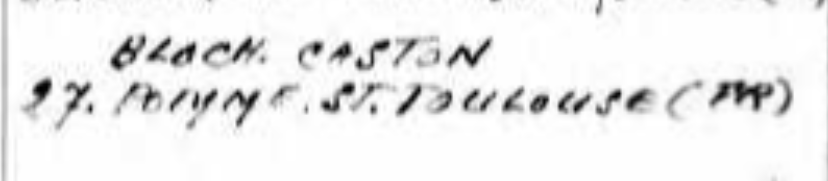
First, he noticed something I should have noticed. On Charles’ ship manifest coming to the US in 1946, he listed as the person left behind in his former place of residence a person named Gaston Bloch, residing at 27 “Pomme St.” in Toulouse.

Charles Bloch, passenger manifest p. 2, Year: 1946; Arrival: New York, New York, USA; Microfilm Serial: T715, 1897-1957; Line: 1; Page Number: 40, Ship or Roll Number: Fort Royal
Ancestry.com. New York, Passenger and Crew Lists (including Castle Garden and Ellis Island), 1820-1957

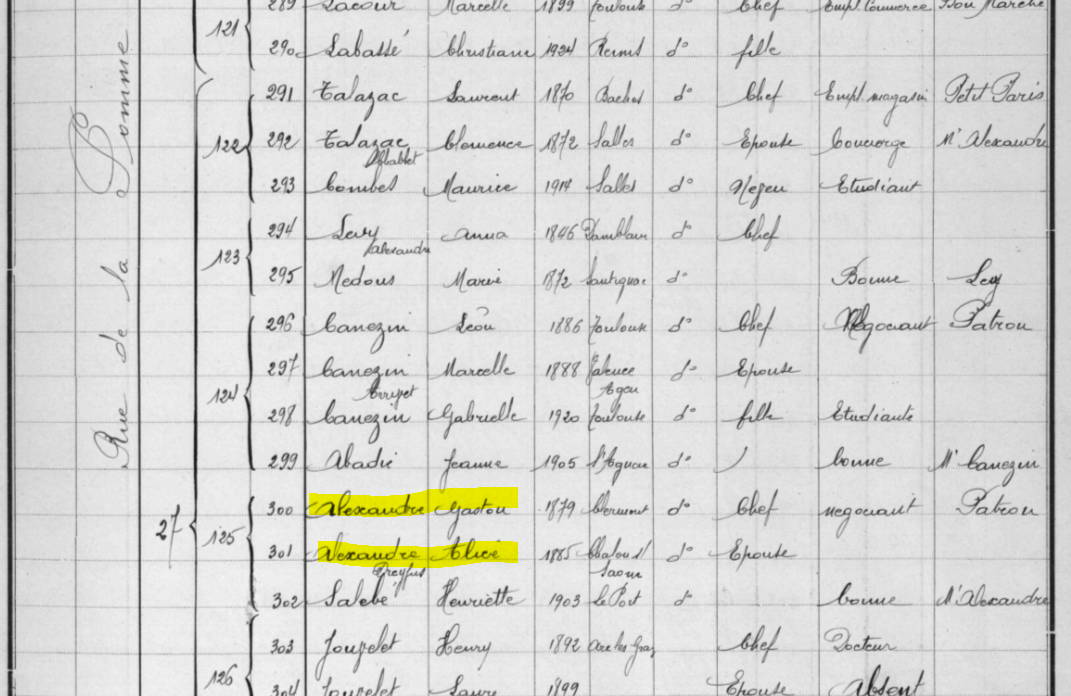
Danny then searched the 1936 Toulouse census (the most recent one available online) and discovered that in 1936, a couple named Gaston and Alice Alexandre lived at 27 Rue de la Pomme in Toulouse.

City of Toulouse, Municipal Archives, Call Number 1 F94, p. 301 (1936)

Could Charles have mistakenly referred to Gaston Alexandre as Gaston Bloch? Possibly, but not necessarily, as you will see.

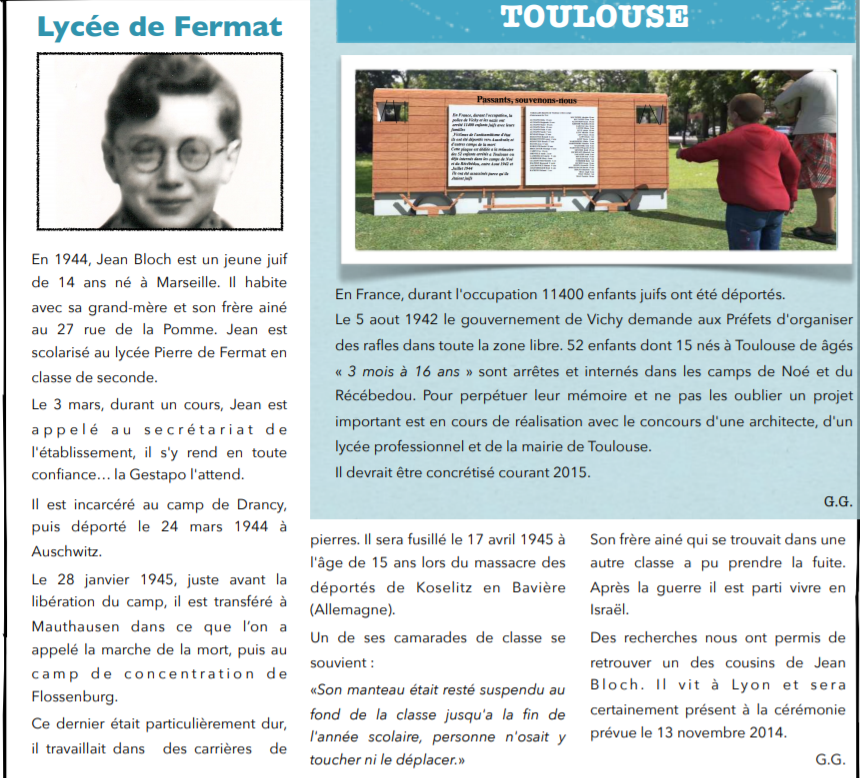
Danny discovered that a boy named Jean Bloch had also lived at 27 Rue de la Pomme in Toulouse. He was born in Marseilles, and according to an article Danny found in a French publication about the Jewish children of Toulouse, Jean Bloch was living in Toulouse with his grandmother and his older brother in 1944. Jean was only fourteen when he was arrested by the Nazis and sent to the concentration camp at Drancy and then to Auschwitz on March 24, 1944. He survived Auschwitz, but was later killed on a death march on April 17, 1945.

TOULOUSE-MÉMOIRE DES ENFANTS JUIFS DÉPORTÉS, September 2014

A profile on Geni managed by Jean Bloch’s nephew’s wife Hanna revealed that Jean Bloch was the son of Lucie Alexandre and Georges Bloch and that Lucie Alexandre was the daughter of Gaston and Alice Alexandre. Thus, young Jean Bloch had a grandfather named Gaston. Was this the “Gaston Bloch” living at 27 Rue de la Pomme that Charles Bloch named on his manifest? Connecting those dots proved challenging.

Danny and I tried to find some link between the lineage of Georges Bloch, whose in-laws lived at 27 Rue de la Pomme, and the lineage of Charles Bloch. According to Geni, Georges Bloch, Jean’s father, was the son of Albert Fortun Salomon Bloch, who in turn was the son of Joseph Bloch.1

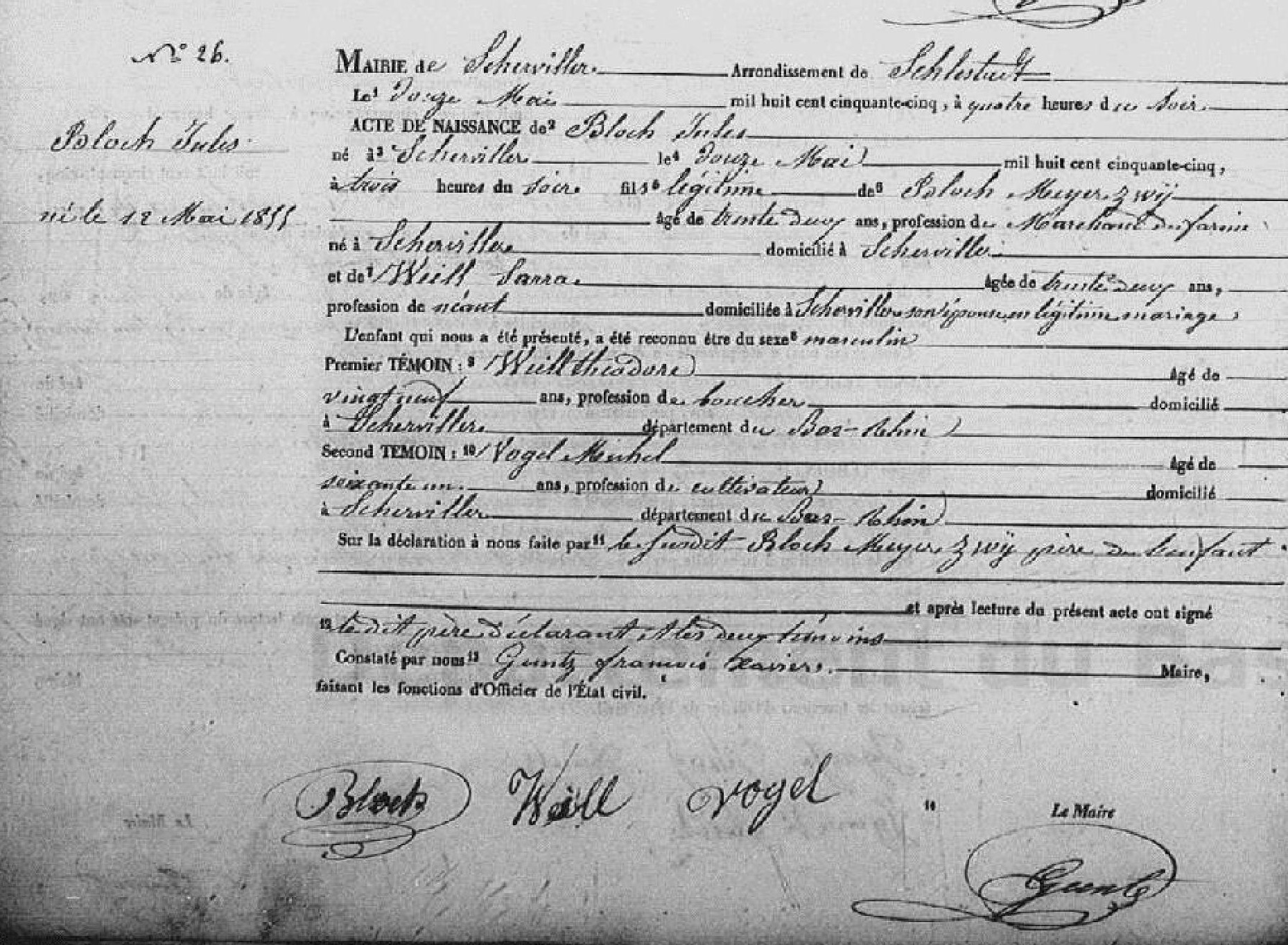
Danny’s knowledge of French genealogy came in handy as he located a birth record for Jules Bloch, Charles Bloch’s father, showing he was born in Scherwiller, France, in 1855. (That explained why Charles was identified as French on the ITS documents even though he was born in Frankfurt; his father was French-born.)

Birth record of Jules Bloch, 1885, Scherwiller – Etat civil – Registre de naissances 1855 – 4 E 445/5  found at http://archives.bas-rhin.fr/detail-document/ETAT-CIVIL-C441-P1-R241585#visio/page:ETAT-CIVIL-C441-P1-R241585-3028132

As seen on Jules Bloch’s birth record, he was the son of Meyer Bloch and Sarra Weill. I’ve tried to dig back further to see if I could find a tie between the Scherwiller Blochs and the Marseilles Blochs, but without success. With Danny’s help and my discovery of a Scherwiller Bloch family tree on Ancestry, a tree that is well sourced, we were able to trace Charles Bloch’s lineage back to the 1700s without finding a link to the Marseille Bloch family.

I also contacted Hanna, the manager of that Geni profile of Jean Bloch and  the daughter-in-law of Jean Bloch’s brother Michel; Michel had survived the war and immigrated to Israel. Hanna did not know of any connection to Charles Bloch and pointed out that there had been another Bloch family also living at 27 Rue de la Pomme who were not related to the Alexandre family. I’ve yet to find any records for that family though.

In addition, Danny discovered that a young Jewish woman named Nicole Bloch Klein, a resistance activist in France, also once lived at 27 Rue de la Pomme in Toulouse. Perhaps Bloch was a common enough name and 27 Rue de la Pomme was a big enough building that it’s purely coincidental that Charles Bloch ended up knowing people living in that building who also happened to be named Bloch?

I went back to look at the 1936 census again and counted five households living at 27 Rue de la Pomme that year. I don’t know what the odds are that, ten years later in 1946 when Charles Bloch reported a Gaston Bloch living at that address, there would have been another family named Bloch, unrelated to the family of Jean Bloch, living at that address.

So I cannot prove that there was a familial tie between Georges Bloch, the son-in-law of Gaston and Alice Alexandre of 27 Rue de la Pomme, and Charles Bloch, who listed the same address on his ship manifest. And I still don’t know how Charles survived the war. Who did he live with? How did he avoid deportation? Why did he wait a year after the war ended before joining his wife and daughter in the United States?

I still don’t know. But, in the course of researching the Bloch family, I discovered another interesting twist in the family tree.

To be continued…


  1. There were no records on Geni to support this, but since the profile is managed by a close family member, I assume that it is reliable. 

Helmina Goldschmidt Rapp, Part II: Leaving Germany with Alice Rapp Stern

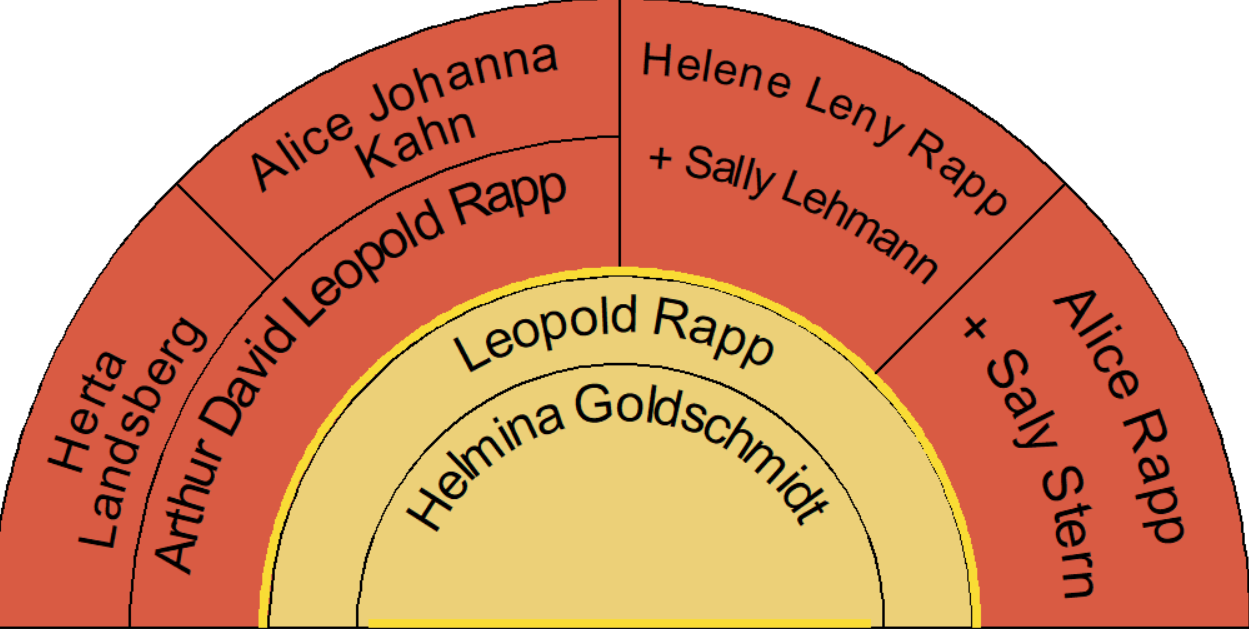
As we saw, Jacob Meier Goldschmidt’s youngest child Helmina was widowed as a young woman and raised her three children alone from an early age. By the 1920s all three of those children were married and had children of their own.

When the Nazis came to power, Helmina and her family were among the fortunate ones who left Germany before it was too late. Today’s post will look at Helmina and her youngest child Alice and their escape from Germany.

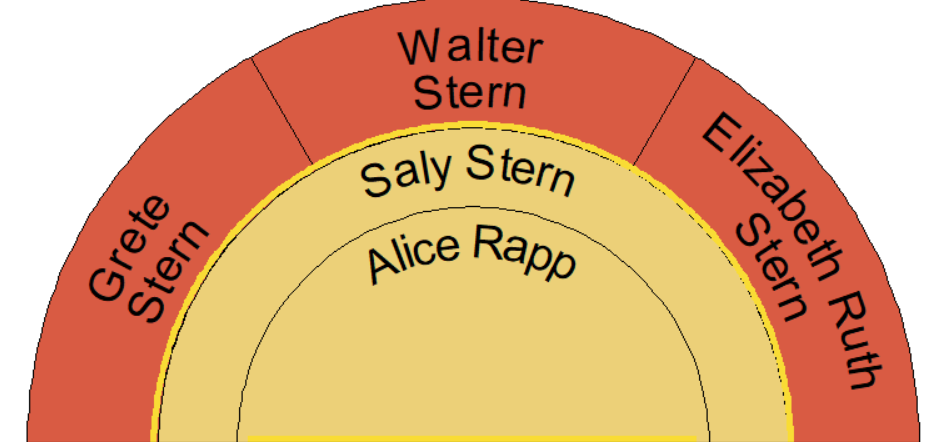
By 1939, Helmina, her daughter Alice and son-in-law Saly and their daughter Grete were living in Harrow, Middlesex, England. Saly reported on the 1939 England and Wales Register that he was a refugee and thus not allowed to do business. Grete was a secretary for a leather goods manufacturer. All four family members were living in one household along with a housemaid.

The National Archives; Kew, London, England; 1939 Register; Reference: RG 101/799H
Enumeration District: BIHB, Ancestry.com. 1939 England and Wales Register

Alice and Saly Stern’s son Walter Stern had instead immigrated to the United States. According to his declaration of intention to become a US citizen, he arrived from Germany to New York on May 16, 1938, and was working as a shipping clerk when he filed his declaration on August 2, 1938.  He was living on Wadsworth Avenue in New York City in the Washington Heights neighborhood where so many German Jewish refugees settled in the 1930s and 1940s. (In yet another small world coincidence, my husband lived on Wadsworth Avenue in his early childhood, although his parents were not German Jewish refugees.)

The National Archives at Philadelphia; Philadelphia, Pennsylvania; NAI Title: Declarations of Intention for Citizenship, 1/19/1842 – 10/29/1959; NAI Number: 4713410; Record Group Title: Records of District Courts of the United States, 1685-2009; Record Group Number: 21
Description: (Roll 539) Declarations of Intention for Citizenship, 1842-1959 (No 417601-418600)
Ancestry.com. New York, State and Federal Naturalization Records, 1794-1943

Although I cannot find any record showing that Alice and Saly’s daughter Elizabeth was with them in England, I believe she must have been living there because on March 27, 1940, Alice, Saly, and Elizabeth all joined Walter in the United States. Strangely, this ship manifest shows all three sailing to New York, but Saly is listed separately and with a different English address.

Ancestry.com. UK and Ireland, Outward Passenger Lists, 1890-1960

On their US ship manifest, Alice and her daughter Elizabeth are again listed together, but Saly is listed on a different page. They all, however, were on the same ship arriving at the same time. And Alice’s declaration of intention shows that she and Saly arrived together and were residing together in New York on Ft. Washington Avenue, in the Washington Heights neighborhood where Walter had been residing in 1938.

Alice Stern, declaration of intention, The National Archives at Philadelphia; Philadelphia, Pennsylvania; NAI Title: Declarations of Intention for Citizenship, 1/19/1842 – 10/29/1959; NAI Number: 4713410; Record Group Title: Records of District Courts of the United States, 1685-2009; Record Group Number: 21,  (Roll 590) Declarations of Intention for Citizenship, 1842-1959 (No 463201-464100), Ancestry.com. New York, State and Federal Naturalization Records, 1794-1943

But the ship manifests for Alice, Elizabeth, and Saly report that by the time of their arrival in the spring of 1940, Walter was living in Washington DC.

However, when Walter registered for the World War II draft in October 1940, he was back living in New York. His registration card has three New York City addresses, all crossed out, but lists his father Saly as his contact person, residing on Ft. Washington Avenue.

Walter Stern, World War II draft registration, Ancestry.com. U.S. WWII Draft Cards Young Men, 1940-1947

Saly Stern’s draft registration, filed on April 26, 1942, two years after that of Walter, shows that he was then self-employed as a salesman and living at 612 West 188th Street in New York with his wife Alice.

Saly Stern, World War II draft registration, The National Archives at St. Louis; St. Louis, Missouri; Record Group Title: Records of the Selective Service System; Record Group Number: 147
Ancestry.com. U.S., World War II Draft Registration Cards, 1942

The following year their younger daughter Elizabeth Stern married Gerhard Hirsch, another German Jewish refugee, on March 28, 1943, in New York. Gerhard was born on September 24, 1908, in Berlin, and immigrated to the US in 1938.1

Meanwhile, Saly and Alice’s older daughter Grete Stern remained in England, as Alice reported on her naturalization papers, as did Alice’s mother Helmina Goldschmidt Rapp. Helmina died in England in July 1941, not long after her children in England had all left for the US.  She was 77 years old.2

Saly Stern died in New York on December 7, 1946.3 He was 69 years old. He had lived long enough to see most of his family settle safely in the US, except for his daughter Grete, who’d remained in England. Unfortunately he did not live to see Grete’s wedding. In 1948, Grete Stern married Kurt Lissauer, who was also a German Jewish refugee. He was born in Luebeck, Germany, on January 10, 1909. They were married in England.4

Elizabeth Stern’s marriage to Gerhard Hirsch did not last very long. She remarried in 1973 when she was 54; her second husband was Paul Dannheisser, a widower who was also a refugee from Germany.

Alice Rapp Stern outlived her husband by almost thirty years. She died in New York on January 28, 1974, at the age of 83.5 She was survived by her three children, Grete, Walter, and Elizabeth, all of whom died within a year of each other. Grete and Walter both died in October 1996; Grete was 85,6 Walter was almost 79.7 Their younger sister Elizabeth died just four months later on February 13, 1997.8 She had just turned 78. None of the three siblings had children, so there are no descendants.

The next post will tell the story of Alice Rapp Stern’s brother and Helmina Goldschmidt Rapp’s son, Arthur David Leopold Rapp, and his family.


  1.  Elizabeth Stern, Marriage License Date: 24 Mar 1943
    Marriage License Place: Manhattan, New York City, New York, USA
    Spouse: Gerhard Hirsch, License Number: 5751, New York City Municipal Archives; New York, New York; Borough: Manhattan; Volume Number: 3, Source Information
    Ancestry.com. New York, New York, Marriage License Indexes, 1907-2018. Also, Elizabeth’s declaration of intention, “New York, Southern District, U.S District Court Naturalization Records, 1824-1946,” database with images, FamilySearch (https://familysearch.org/ark:/61903/3:1:3QS7-99HD-2S59?cc=2060123&wc=M5P7-PTY%3A351618501 : 14 August 2019), Petitions for naturalization and petition evidence 1945 box 1026, no 515801-516050 > image 728 of 983; citing NARA microfilm publication M1972, Southern District of New York Petitions for Naturalization, 1897-1944. Records of District Courts of the United States, 1685 – 2009, RG 21. National Archives at New York. 
  2.  Helmina Rapp, Death Age: 78, Birth Date: abt 1863, Registration Date: Jul 1941
    Registration Quarter: Jul-Aug-Sep, Registration district: Hendon, Inferred County: Middlesex, Volume: 3a, Page: 656, General Register Office; United Kingdom; Volume: 3a; Page: 656, Ancestry.com. England & Wales, Civil Registration Death Index, 1916-2007 
  3.  Saly Stern, Marital status: Married, Age: 69, Birth Date: 26 Nov 1877, Birth Place: Germany, Residence Street Address: 612 W 188 St, Residence Place: New York
    Death Date: 7 Dec 1946, Death Street Address: 612 W 188th St, Death Place: New York City, Manhattan, New York, USA, Occupation: Clerk Stock’s, Father’s Birth Place: Germany, Mother’s Birth Place: Germany, Father: Marcus Stern, Mother: Francisca Stern, Spouse: Alice, Informant: Alice Stern, Informant Relationship: Wife
    Executor: Alice Stern, Executor Relationship: Wife, Certificate Number: 25862
    New York City Department of Records & Information Services; New York City, New York; New York City Death Certificates; Borough: Manhattan; Year: 1946, Ancestry.com. New York, New York, Index to Death Certificates, 1862-1948 
  4. Greta Stern, Registration Date: Apr 1948, Registration Quarter: Apr-May-Jun
    Registration district: Hendon, Inferred County: Middlesex, Spouse: Kurt Lissauer
    Volume Number: 5e, Page Number: 1260, General Register Office; United Kingdom; Volume: 5e; Page: 1260, Ancestry.com. England & Wales, Civil Registration Marriage Index, 1916-2005. Kurt Lissauer, Enemy Alien Registration, The National Archives; Kew, London, England; HO 396 WW2 Internees (Aliens) Index Cards 1939-1947; Reference Number: HO 396/56, Piece Number Description: 056: Internees at Liberty in UK 1939-1942: Lir-Lov, Ancestry.com. UK, WWII Alien Internees, 1939-1945 
  5.  Alice Stern, Social Security Number: 051-18-8391, Birth Date: 4 Oct 1890
    Issue Year: Before 1951, Issue State: New York,Last Residence: 10040, New York, New York, New York, USA, Death Date: Jan 1974, Social Security Administration; Washington D.C., USA; Social Security Death Index, Master File, Ancestry.com. U.S., Social Security Death Index, 1935-2014 
  6.  Grete Lissauer, Death Age: 85, Birth Date: 16 Sep 1911, Registration Date: Oct 1996, Registration district: Hendon, Inferred County: Greater London, Register Number: A41C, District and Subdistrict: 2351A, Entry Number: 108, General Register Office; United Kingdom, Ancestry.com. England & Wales, Civil Registration Death Index, 1916-2007 
  7. Walter Stern, Gender: Male, Birth Date: 1918, Death Date: 9 Oct 1996
    Claim Date: 2 Dec 1970, SSN: 056162574, Death Certificate Number: 350302
    Ancestry.com. U.S., Social Security Applications and Claims Index, 1936-2007 
  8. Elizabeth Ruth Stern, [Elizabeth Ruthhenrietta Hirsch], [Elizabeth Dannheisser]
    Gender: Female, Race: White, Birth Date: 21 Jan 1919, Birth Place: Frankfurt A, Federal Republic of Germany, Death Date: 13 Feb 1997, Father: Sally Stern
    Mother: Alice Rapp, SSN: 127144714, Ancestry.com. U.S., Social Security Applications and Claims Index, 1936-2007 

Anna Segher’s The Seventh Cross: A Story of Moral Choices

Back on May 1, I wrote about my cousin Netti Reiling, who under the pseudonym Anna Seghers became a well-known leftist intellectual, activist, and author. I wrote about her best-known book, The Seventh Cross, published both in German and in English while she and her family were living in Mexico in 1942. Two years later it was made into a film starring Spencer Tracy, Hume Cronyn, Jessica Tandy, and others.

I’ve just finished reading the book. It took me quite a while to read in part because I seem to read in short spurts these days, often when I am sleepy. It also was a difficult book to read—both in terms of the painfulness of the subject matter and in the way it was written. But when I got to the second half, I couldn’t put it down as it turned from a slow-moving set of character studies to a suspenseful escape and chase.

It is an extremely well-written book. Seghers takes you into the minds of her characters so that you see their psychological development as well as their actions. The basic plot is simple: a man named George along with six others escapes from a German prison camp where political prisoners are kept, and the Gestapo and SS chase them down. Various people living in the nearby towns get involved in different ways with the escape and the chase. I won’t spoil the story more than that, but it’s not really the story that is Segher’s dominant focus. Rather, her focus is on how this story affects and, in some ways, reveals and changes the inner thinking and moral choices of the numerous characters.

The structure of the book is what makes it difficult to read at first. Seghers introduces numerous characters without linking them to each other or to the main character, George. Both the number of characters and the fact that the reader has no idea why they matter to the story made the first half of the book a struggle for me. I couldn’t keep the characters straight. Who was Ernst the shepherd and why did I care about him? Why do I care about this boy named Fritz and his girlfriend? What role does Franz have in this whole story? Who are all these various Nazis working at the prison camp? And so on. Perhaps if I’d read the book faster and not just one short segment at a time, I’d more quickly would have seen the forest and not just each individual tree. But at the pace I was reading, I’d forget who Franz or Fritz or Ernst was and have to flip back a few chapters to refresh my memory.

But once I reached the middle of the book and was able to read more quickly, I realized what a brilliant work this is and well worth the struggle to get to know the various characters. Seghers’ ability to get into the heads of the characters and see how they struggle to choose between their own safety and what they know is right is masterful. As you read, you wonder whether Fritz and Franz and all the others will do what’s needed to be done to help George or to save themselves. That’s what makes the book suspenseful. It’s not a typical crime or war story where the suspense lies in finding clues or in watching the bad guys get closer to the good guy while the good guy uses his brain to find a new way to get away. No, the suspense lies inside the minds of the characters and their personal moral codes. Frankly, I still have no idea what role Ernst the shepherd has in the story. Maybe someone who’s read the book will have an explanation. But overall each character does in the end become three-dimensional and integral to the overall story.

One thing that I did find odd about the book is that aside from one very brief mention of the mistreatment of a Jewish man, Seghers does not at all address the Nazi persecution and slaughter of Jews; she does not refer to the Nuremberg Laws or the concentration camps or Kristallnacht. Seghers was, after all, Jewish. Yet she wrote a book about Nazi Germany that is only about political prisoners, not about the way the Nazis treated Jews. Did she do that to reach a broader audience? Or did she perhaps recognize that although ordinary Germans might assist a fellow German who escaped from a camp for political prisoners, they would not have had made the same choices if it had been a Jewish person who’d escaped from a concentration camp?

I’ve not yet seen the film, and unfortunately it’s not available on any streaming service. I could buy a DVD from Amazon, but alas—I no longer have a DVD player. Damn modern technology! Do I invest in a DVD player just to watch one movie? I am debating it. But usually I find that movies based on books are not nearly as good as the books themselves, and it was my cousin Netti’s writing that I was most interested in.

As I wrote about in my post about Netti/Anna, The New York Times review of the movie, which was overall a very positive review, made one unusual comment at the end.1 I will quote it again here:

Without in the least overlooking the bestiality of the Nazi brutes nor the miserable self-surrender of German citizens to their black regime, this film … visions a burning zeal for freedom in some German rebels and a core of decency in common folk. …[T]he basic theme…is that in men—even in Germans—there is an instinct for good that cannot be destroyed.….

The big reservation which this writer holds with regard to this film is that regarding the discretion of its theme at this particular time. Without any question, it creates a human sympathy for the people of a nation with whom we are at war and it tends, as have others, to load Germany’s crimes on Nazi backs. Obviously this film can make sentiment for a “soft” peace. It looks as though we are getting a dandy “thriller” at a pretty high price.

It is true that the book (and apparently the film) portrays many of the characters in ways that reveal their basic morality although it also certainly portrays those who worked at and led the prison camp as inhumane and lacking in moral decency and many of the minor characters as spineless and complicit with the Nazis. But I can understand why in 1944 when the US was fighting Germany in World War II a reviewer might have objected to a film that portrayed any German in a flattering light.

But with the perspective of hindsight, that seems less objectionable. Seghers was at heart an optimist about human nature and perhaps she needed some hope in 1942 that many ordinary Germans would make the right choices and act morally. She had fled from Germany and then from France, seen her husband arrested and then released, and would ultimately learn that her own mother, Hedwig Fuld Reiling, had been murdered by the Nazis. She was not naïve; she was not sympathetic to the Nazis or those who supported their cause or their actions. She was just a human being holding out hope that other human beings would do the right thing. Sadly, not enough of them did. Most Germans were too afraid to resist the Nazis or had been coopted and persuaded to adopt the Nazi cause, and thus far too many people were not saved from their murderous captors.

But Seghers’ point was that when good and brave people do stand up for what is right, evil can be defeated. We need that lesson today in 2020 as much as people did in 1942.

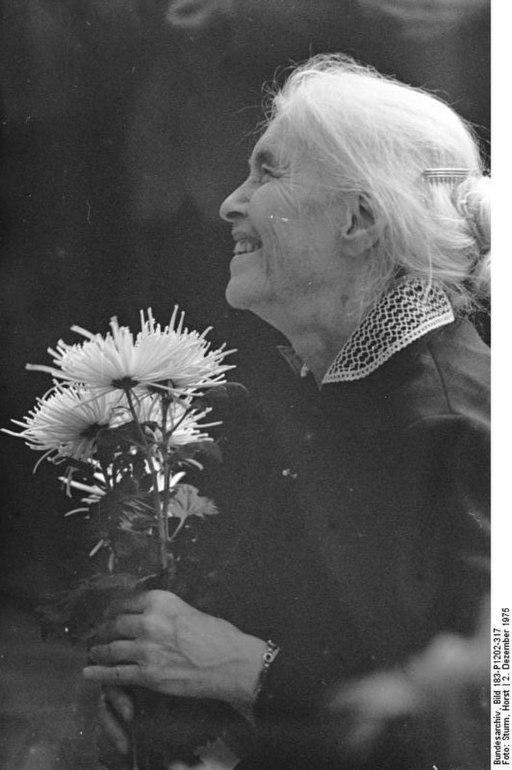
Anna Seghers (Netti Reiling) Bundesarchiv, Bild 183-P1202-317 / Sturm, Horst / CC-BY-SA 3.0 / CC BY-SA 3.0 DE (https://creativecommons.org/licenses/by-sa/3.0/de/deed.en)


  1. Bosley Crowther, “The Seventh Cross, Anti-Nazi Drama, with Spencer Tracy, at Capitol,” The New York Times, September 29, 1944, p. 18. 

A Photo Essay of the Family of Selma Loewenthal Schwabacher

Another cousin who found my blog during these pandemic days is my fifth cousin, once removed, Carrie Schwabacher. She is the granddaughter of Gerhard Schwabacher, the great-granddaughter of Selma Loewenthal Schwabacher, great-great-granddaughter of Kiele Stern Loewenthal, three times great granddaughter of Sarah Goldschmidt Stern, and four-times great-granddaughter of Meyer Goldschmidt.

Carrie kindly shared with me these wonderful photographs as well as some heartwarming stories about her family. They start with her great-great-grandmother, Kiele (Caroline) Stern Loewenthal, the daughter of Sarah Goldschmidt and Salomon Stern, wife of Abraham Loewenthal. I wrote about Kiele here and here.

Kiele Stern Loewenthal.
Courtesy of her family

Here is a lovely photograph of Kiele and Abraham Loewenthal’s daughter, Selma, as a young woman; I see a strong resemblance to her mother.

Selma Loewenthal
Courtesy of her family

Selma married Nathan Schwabacher:

Nathan Schwabacher Courtesy of the Schwabacher family

And they had three children. Their daughter Alice was the oldest:

Alice Schwabacher Courtesy of the Schwabacher family

Alice was followed by Julius Alfred Schwabacher:

Julius Alfred Schwabacher Courtesy of the Schwabacher family

Gerhard Schwabacher, Carrie’s grandfather, was Selma and Nathan’s youngest child:

Gerhard Schwabacher
Courtesy of the family

The two sons look remarkably similar to each other and to their father Nathan.

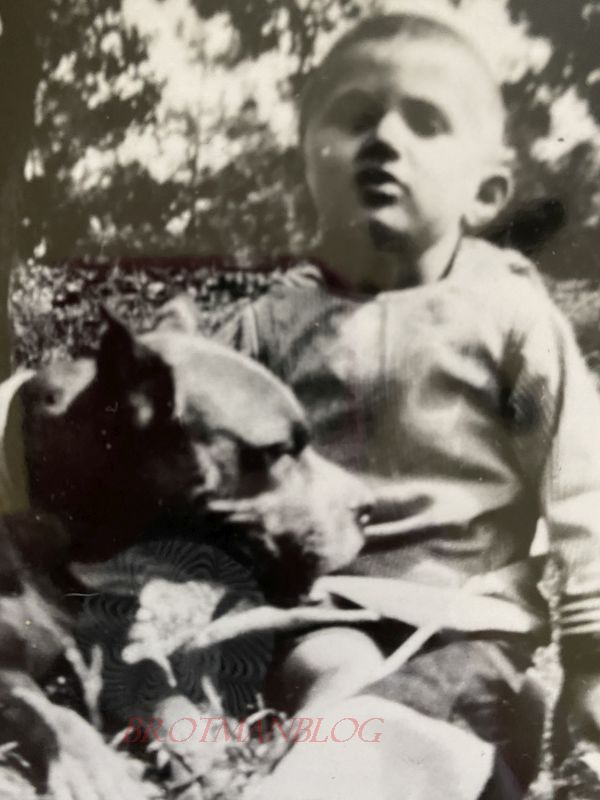
Alice Schwabacher married David Weinstein (later Wenten) and had one child, Wolfgang, depicted here as a young boy with his dog:

Wolfgang Weinstein and dog

Julius Schwabacher married Margaret Wuertenberg and had one child, Eva Lore, the adorable little girl shown here:

Eva Lore Schwabacher
Courtesy of the family

This photograph of Selma Loewenthal Schwabacher and her brother Julius Loewenthal is undated, but must have been taken before 1936 when Julius left for the United States. Selma died in 1937 in Berlin.

Selma Loewenthal Schwabacher and brother Julius Loewenthal
Courtesy of the family

Here is a closer one of Selma, probably taken around the same time:

The remaining photographs that Carrie shared with me appear to have been taken after the family immigrated to the United States. Their full story has been told here, so I won’t tell it again, but will share these photographs of the Schwabacher family in their new country and some of Carrie’s memories of her extended family.

She has wonderful memories of her grandparents, as she shared with me: “I have such great memories of my grand parents even though they died when I was 7. Christmas was a very special time – like a scene from the Nutcracker. As children, we celebrated Hanukkah, Christmas and Epiphany ( my mom’s side of the family is Russian Orthodox). We got presents for months, or it seemed like it.” She also wrote that her Opa, Gerhard Schwabacher, always gave each of his grandchildren a quarter every time he saw them.

Other holidays were spent with her great-uncle Julius Schwabacher, who became Fred Wenten in the US, and his wife Else in Proctor, Vermont: Fred and Elsa owned an Inn in Proctor Vt. The entire family spent a few holidays there as well. The toasts would go on for so long that someone would finally say “let the children eat their fruit cocktails before they fall asleep”. And then, dinner would start.”

Here’s a photograph of Fred Wenten in the US:

Fred Wenten (born Julius Alfred Schwabacher)
Courtesy of the family

Fred’s daughter Eva Lore was also a favorite of Carrie. Eva Lore married Henry Corton in 1951. Carrie wrote this about them:

“Henry was a fabulous dancer and would sometimes break into buck and wing ( tap dancing) in the kitchen even when he was old. We visited then often when they lived in Jamaica, Queens. We always went out for walks. We met Bella Abzug at the Cloisters in NY. He was very fond of Pavorotti and considered him a “distant cousin“. It got him back stage at the Met many times. Eva and Henri took us to Ringling Bro’s. And Barnum & Bailey Circus and the Ice Capades when we were little. We visited Eva Lore in LaGuna Hills, helped her pack and move to Baltimore, and took her to her first McDonalds meal. The “Apple Strudel “ was her favorite. Apple Pie. Even at 79, she was booking her own travel on her computer. They never had children, but spoiled us.”

Here are some of the photographs of Eva Lore and Henry that Carrie shared with me:

Eva Lore Schwabacher and Henry Corton Courtesy of the family

Eva Lore Schwabacher Corton Courtesy of the family

Eva Lore Schwabacher Corton Courtesy of the family

Eva Lore and Henry Corton Courtesy of the family

Carrie also has warm memories of her great-aunt Alice Schwabacher Weinstein (Wenten in the US):

“We went to visit Tanta Alice for the holidays every year in Washington Heights, NY. I always wanted to take a nap, because I loved the big square Feather pillows on the bed. She always had such great treats for us, German delicacies. She was extremely socially active. Wolf would remark that he had to make an appointment just to visit his mother. We had her 90 th birthday party at window on the worlds – top of the World Trade Center. It was incredible to meet so many people originally named Schwabacher.”

This photograph shows Alice with her son Wolfgang and his wife Ruth.

Alice Schwabacher Wenten Kingsley, Wolfgang Wenten, Ruth Pollinger Wenten
Courtesy of the family

Finally, this is a photograph of the three Schwabacher siblings and their spouses taken in the US:

Arthur Kingsley, Alice Schwabacher Kingsley, Julius (Fred Wenten) Schwabacher, Else Wenten, Alice Ferron Schwabacher, Gerhard Schwabacher
Courtesy of the family

I am extremely grateful to my cousin Carrie for sharing her memories and these photographs. She really has brought to life this strong and loving family who escaped from Germany and started a wonderful new life in the United States.

Hermann Gutmann Becomes Dennis Goodman: An Oral History, Part II

By the spring of 1940, Hermann Gutmann was seventeen years old and had been in England and separated from his parents since the fall of 1936.  He had completed his secondary education and had been working at a leather factory in Lancashire in the north of England since February 1940 and moved to London that May.1

On July 2, 1940, at 6 am he heard a knock on his door. The police told him to pack his bags and come with them to the police station. He protested, but to no avail, and along with many other German Jewish “enemy aliens,” he was taken to a camp, Huyton Camp, and housed in a tent with other young refugees from Nazi Germany. All those who were under eighteen, including Hermann, were told they were being taken out of England. He again protested and was told by the commanding officer that those leaving England would have the best chance of survival because England was likely to lose the war.

As the internees boarded the HMT Dunera on July 10, 1940, all their personal possessions were taken and never returned. The Jewish internees were placed in the hold in the rear of the ship and kept there by barbed wire fencing. They were only allowed up on the deck for thirty minutes a day for exercise where they were barefooted and often stepping on the broken beer bottles left behind by the guards, whom Hermann described as “football hooligans.” The internees slept on the hard floor and had open toilet stalls that he described as “awful.”  Hermann described the morale of the younger internees as fairly good, but said that those who were older had a much harder time and that there were even a few suicides during their voyage. There were also Nazi and Italian internees on the ship, but they were kept in a different location.

HMT Dunera. Not stated in the AWM record / Public domain

The internees had no idea where they were going until they arrived in Australia on September 6, 1940. Once in Australia, they were sent to New South Wales and housed at the Hay Internment Camp. There were about two thousand internees kept there, many of whom had been successful professionals—doctors, lawyers, professors, and so on. They formed their own government and even printed their own money. Hermann distributed newspapers and even started a Boy Scout group that was officially recognized by the London headquarters of the Boy Scouts.

They lived in huts, about forty to a hut, and conditions were good. Hermann noted several times that as a young man (he was seventeen), he was not as uncomfortable as those who were older, and he didn’t mind some of the living conditions. When asked whether he now resented having been interned during this time, he said no—that he understood it was done without much thought based on fear when the war started and that it was an awful waste of time and money, but that he did not feel any resentment towards the British for their actions.

In the fall of 1941, Hermann volunteered to join the British military as a means of getting out of the internment camp. He left Austrialia on October 13, 1941, and arrived back in England on November 28, 1941, just over a week before Pearl Harbor. He and other Jewish refugees were given no choice as to where to serve and were assigned to the Pioneer Corps, a corps assigned “light engineering tasks [that] included building anti-aircraft emplacements on the Home Front, working on the Mulberry harbours for D-Day, and serving during beach assaults in France and Italy. Pioneers also carried stretchers, built airfields, repaired railways, and moved stores and supplies.”

Pioneer Corps clearing rubble, Ministry of Information Photo Division Photographer / Public domain

It was during this time that his commanding officer asked him to change his name to something less German-sounding. Hermann chose the name Dennis John Goodman, his first name for a friend who had been killed in the war and Goodman as an Anglicized version of Gutmann. In the interview, he commented that he now regretted that he never returned to his birth name Hermann Gutmann as it had a very long history in his family.

Dennis was not content being in the Pioneer Corps because he wanted to be fighting the Nazis. In 1943, British policy changed, and Jewish German refugees like Dennis were allowed to serve more directly in combat. Dennis joined a tank unit and was on the beach at Normandy three days after D-Day, that is, on June 9, 1944. He ended up fighting in France, Belgium, the Netherlands, and finally in Germany. He was involved in many difficult and dangerous battles, made more dangerous by the fact that the English tanks were outmatched by the German Tiger Tanks they were facing. He experienced some very close encounters with death or capture by the Germans.

The interviewer asked him how he felt when he entered Germany, his country of birth, and fought on German soil. Dennis commented that “by that time I felt more English than German” and that he had no difficulty facing his former countrymen in battle. When the war ended, he was in Berlin for the British Victory Parade on July 21, 1945.

British Victory Parade in Berlin, National Archives and Records Administration / Public domain

By that time he already knew about the concentration camps.  He was given compassionate leave to go to Amsterdam to learn what had happened to his parents and learned of the deportation to and murder at Sobibor. In the interview, Dennis mentioned that at that time he learned that his grandmother had been hidden in the northern part of Holland and had survived.

I checked to see which grandmother, and it had to be his maternal grandmother, Hedwig Goldschmidt, because his paternal grandmother had died in 1932. I have no wartime records for Hedwig after March 15, 1938, when she was a passenger coming to England from Amsterdam.2 I initially thought that meant that she had moved to England at that time, but it appears from Hermann’s information that she had returned to Amsterdam, perhaps after visiting him in England.

Dennis remained in Germany after the war and joined the Review and Interrogation staff in Neuengamme, near Hamburg, where he was involved in interrogating Nazis about war crimes. He was struck by the ordinariness of the people who committed these crimes and their weak excuses for what they did. He also found some of them very arrogant. Several times during the interview, Dennis made the point that it was well known throughout Germany that Jews were being persecuted and that those who afterwards claimed that they hadn’t been aware of what was happening were either lying or repressing what they’d known.

In 1947, Dennis was discharged from the military and returned to England. He married a Polish-born Holocaust survivor after the war and had three children. I don’t know much about his life after the war, but did find several immigration documents from Brazil, starting in 1949, suggesting he might have been involved in international business or perhaps visiting family members who had immigrated to Brazil.

Ancestry.com. Rio de Janeiro, Brazil, Immigration Cards, 1900-1965. Original data: “Rio de Janeiro Brazil, Immigration Cards, 1900-1965”. FamilySearch, Salt Lake City, Utah, 2013.

Dennis John Goodman, born Hermann Gutmann, died in England in 2007. He had lived an extraordinary life, leaving his parents and homeland as a thirteen year old boy, being interned for over a year in Australia as an “enemy alien,” and then fighting valiantly against the Nazis for several years including post-war interrogation of war criminals. His parents had been murdered at Sobibor. He had every right to be an angry, resentful man.

But listening to his voice in the oral history interview, I detected no resentment towards his adopted country, despite the internment. Certainly he harbored anger with the Nazis for what they did to his parents and all the Jews in Europe and continuing bewilderment over the German citizenry’s acquiescence to it all. But I did not come away from the interview thinking of him as bitter or defeated; instead I heard a then 72 year old man who looked back on his life with pride in his ability to endure and succeed against all odds and in his strength and independence even as a young man. His story will stay with me forever.


  1. These facts come almost entirely from the oral history interview of Dennis Goodman, aka Hermann Gutmann, found on the Imperial War Museum website. Some of the dates in this post were found in an article written by his daughter, Naomi Levy, and published in the AJR [Association of Jewish Refugees] Journal of December 2018, on page 11, and found here
  2.  Hedwig Goldschmidt, Arrival Age: 61, Birth Date: abt 1877, Port of Departure: New York, New York, United States, Arrival Date: 15 Mar 1938, Port of Arrival: Plymouth, England, Ports of Voyage: New York, Ship Name: Washington, Shipping Line: United States Line, Official Number: 232210, The National Archives of the UK; Kew, Surrey, England; Board of Trade: Commercial and Statistical Department and successors: Inwards Passenger Lists.; Class: BT26; Piece: 1158, Ancestry.com. UK and Ireland, Incoming Passenger Lists, 1878-1960