Flora Goldschmidt Schwarzschild’s Family: One Branch Flourished, the Other Extinguished

For Selig and Clementine Goldschmidt’s second daughter Flora Goldschmidt Schwarzchild, the twentieth century started with a sad loss when her husband Emil Schwarzchild died on June 17, 1902, at the age of 45.1

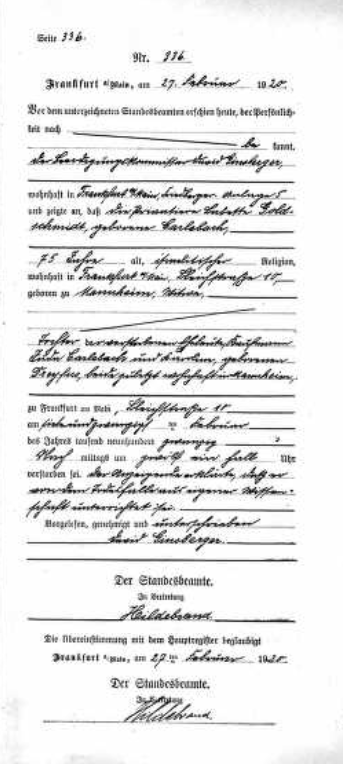
Their daughter Helene Schwarzschild married Joseph Offenbacher the following year on August 28, 1903. Joseph, the son of Lazard Ismael Offenbacher and Karoline Oppenheimer, was born on July 3, 1877, in Paris. The couple settled in Frankfurt.

Helene Schwarzschild Offenbacher marriage record, Hessisches Hauptstaatsarchiv; Wiesbaden, Deutschland; Bestand: 903, Ancestry.com. Hesse, Germany, Marriages, 1849-1930

Helene and Joseph Offenbacher had five children. Paul Offenbacher was born in 1905 and died just five years later on January 13, 1910, in Frankfurt.

Paul Lazard Offenbacher death record, Personenstandsregister Sterberegister; Bestand: 903; Signatur: 10664, Ancestry.com. Hesse, Germany, Deaths, 1851-1958

Emil was born June 11, 1909, in Frankfurt.2 Then came Erich, born in Frankfurt on May 2, 1912.3 Another son, Erwin, was born December 30, 1915, also in Frankfurt.4 And finally Helene and Joseph had a daughter, Irmgard, born in Frankfurt on January 30, 1918.5

Helene Schwarzchild Offenbacher’s older brother Siegfried married five years after she did. He married Bertha Birnbaum on August 7, 1908. She was born on March 7, 1886, in Frankfurt, to Heinemann and Fanny Birnbaum.

Siegfried Schwarzschild marriage record, Hessisches Hauptstaatsarchiv; Wiesbaden, Deutschland; Bestand: 903, Ancestry.com. Hesse, Germany, Marriages, 1849-1930

They had one child, a son Emil Schwarzschild, born July 16, 1909.6

Flora Goldschmidt Schwarzchild thus had five living grandchildren when she died at 63 on June 17, 1922, in Frankfurt.

Flora Goldschmidt Schwarzschild death record, Personenstandsregister Sterberegister; Bestand: 903; Signatur: 10858, Ancestry.com. Hesse, Germany, Deaths, 1851-1958

Sadly, her son Siegfried only survived her by nine years, dying at the age of fifty on February 26, 1929, in Frankfurt.

Siegfried Schwarzschild death record, Personenstandsregister Sterberegister; Bestand: 903; Signatur: 10964, Ancestry.com. Hesse, Germany, Deaths, 1851-1958

Siegfried’s family continued to be plagued with tragedy after he died. Both Siegfried’s widow Bertha and his son Emil Schwarzschild were murdered by the Nazis. Both had escaped from Germany to the Netherlands, where Emil married Judith Bartels in 1938.7 Judith was born in Amsterdam on June 29, 1911, the daughter of Salomon Bartels and Rebecca Hamburger.

According to Yad Vashem, Emil was killed on August 16, 1942, and Judith on September 30, 1942, both at Auschwitz. Emil’s mother Bertha also was killed at Auschwitz. She died on February 26, 1943.  There are thus no living descendants of Siegfried Schwarzschild; his line was extinguished by the Nazis.

Fortunately, Helene Schwarzschild Offenbacher and her family fared far better than the family of her brother Siegfried. They all survived the Holocaust.

Helene and Joseph Offenbacher’s third son Erwin was living in the Netherlands beginning in January 24, 1934 and was issued a Dutch passport in 1938. According to his Dutch passport and his application for Palestinian citizenship, he then immigrated to Palestine on March 23, 1940. He married Hadassah Bacharach in Rishon L’tzion on June 14, 1942, and they had two children born in Israel.

Documents from the Palestinian Immigration File of Erwin Offenbacher from the Israel Archives, found at https://www.archives.gov.il/archives/Archive/0b07170680034dc1/File/0b07170680cc494e

I don’t have any other sources about Erwin, but an entry in Geni submitted by one of his nieces indicates that he died in Tel Aviv on May 30, 2010. He was 94.

Joseph and Helene’s youngest child and only daughter Irmgard also immigrated to Palestine. I could not locate an immigration file for her, but according to Baron and Cibella’s report, she married Carl Benjamin in Tel Aviv in 1938. Unfortunately, I couldn’t find any sources about Carl or their marriage, but I did find a mention of Carl on a website listing a book being auctioned. The book, entitled Photographs of the Ruins of the Atlit Fortress, is a handmade book of photographs taken by Erwin Offenbacher of the Atlit Fortress, a site in Israel. The description of the book indicates that Carl Benjamin wrote the introduction and bound the book. It also says, “The writer of the introduction, Carl (Ya’akov) Benjamin (1911-1976), born in Köln, immigrated to Palestine during the 1930s. Benjamin was married for a while to Offenbacher’s sister, Lina Irmgard (Devorah).”

Erich Offenbacher, the second oldest child of Helene and Joseph Offenbacher, arrived in the US on September 4, 1934, according to his declaration of intention to become a US citizen filed in Pennsylvania on November 22, 1934. He was then residing in Philadelphia where he was a student.

Erich Offenbacher declaration of intention, The National Archives at Philadelphia; Philadelphia, Pennsylvania,  Declarations 1001-1500 (Original), Ancestry.com. Pennsylvania, U.S., Federal Naturalization Records, 1795-1931

Eric, as he later spelled his name, married Gertrude Stern on July 15, 1938, in New York City.8 She was born in Salmunster, Germany, on December 9, 1912, the daughter of Levy Stern and Rosa Neuhaus. When he filed his petition for naturalization in 1940, Eric reported that he was a dentist living in New York, so he must have been a dental student in Philadelphia in 1934 when he filed his declaration of intention.

Eric Offenbacher, petition for naturalization, National Archives and Records Administration; Washington, DC; NAI Title: Index to Petitions for Naturalizations Filed in Federal, State, and Local Courts in New York City, 1792-1906; NAI Number: 5700802; Record Group Title: Records of District Courts of the United States, 1685-2009; Record Group Number: RG 21
Description: (Roll 1237) Petition No· 344551 – Petition No· 345024
Ancestry.com. New York, U.S., State and Federal Naturalization Records, 1794-1943

On the 1940 census, Eric and Gertrude were living in Manhattan and Eric was in private practice as a dentist.9 They would have four children born in the 1940s and 1950s.

Eric’s parents Helene (Schwarzschild) and Joseph Offenbacher arrived in New York on March 28, 1940, and by May, 1940, had declared their intention to become US citizens. On their May, 1940, declarations, they listed the location of their four surviving children. Emil was at that time living in Paris, France; Eric was in New York City, and Erwin and Irmgard were in Palestine.

Helene Schwarzschild Offenbacher declaration of intention, The National Archives at Philadelphia; Philadelphia, Pennsylvania; NAI Title: Declarations of Intention for Citizenship, 1/19/1842 – 10/29/1959; NAI Number: 4713410; Record Group Title: Records of District Courts of the United States, 1685-2009; Record Group Number: 21, Description: (Roll 589) Declarations of Intention for Citizenship, 1842-1959 (No 462401-463200), Ancestry.com. New York, U.S., State and Federal Naturalization Records, 1794-1943

Helene and Joseph are listed on the 1940 US census, living in New York City, in a guest house. Joseph listed his occupation as a metals merchant.10

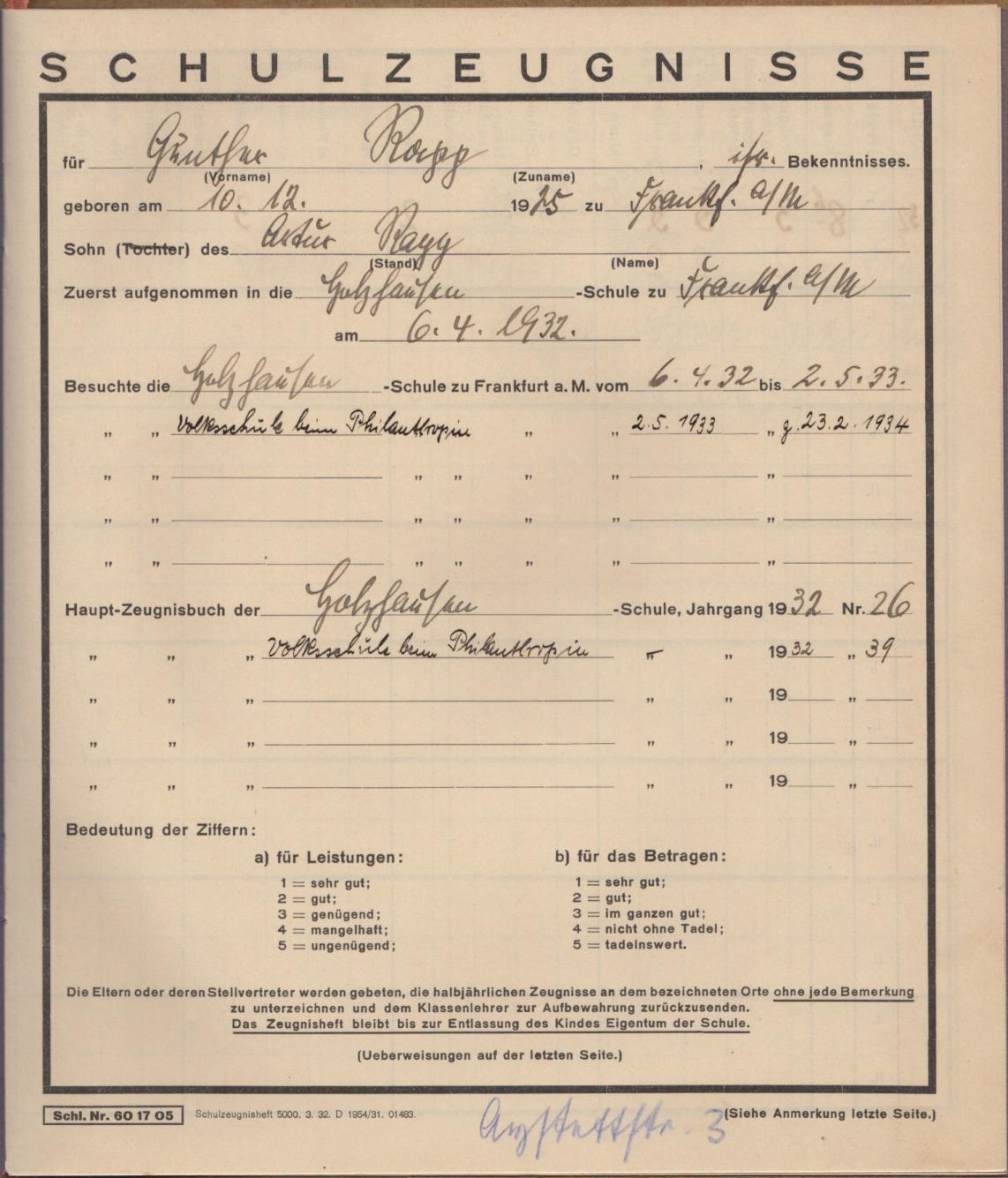
Their oldest child Emil Offenbacher, who had been in Paris when Joseph and Helene filed their declaration of intention, arrived in the US from Cuba on March 30, 1941. He had married Anna Rapp in Paris on August 23, 1934; she was also a native of Frankfurt, born there on February 25, 1912. 11 Emil was already a successful and well-known book dealer when he arrived in the US. According to a biographical profile of him on the website of the International League of Antiquarian Booksellers, he originally followed his father into the banking world, but in 1931 he started working in an antiquarian bookstore in Munich and then launched his own business in Frankfurt. When the Nazis took power in 1933, he and his wife Anna soon escaped to Paris where they waited for a visa to so they could immigrate to the US.

Emil and Anna had two small children who immigrated with them to the US in 1941. Interestingly, Emil’s parents were sailing with them from Cuba. Perhaps they had gone to help them move with their children.

Emil Offenbacher and family, ship manifiest, Year: 1941; Arrival: New York, New York, USA; Microfilm Serial: T715, 1897-1957; Line: 5; Page Number: 190, Ship or Roll Number: Talamanca
Ancestry.com. New York, U.S., Arriving Passenger and Crew Lists (including Castle Garden and Ellis Island), 1820-1957

Emil reported on his August 1941 declaration of intention that he was a book dealer. He started his business anew in the US, eventually moving to Kew Gardens, Queens, where he ran his antiquarian book business for the rest of his life.

Emil Offenbacher, declaration of intention, The National Archives at Philadelphia; Philadelphia, Pennsylvania; NAI Title: Declarations of Intention for Citizenship, 1/19/1842 – 10/29/1959; NAI Number: 4713410; Record Group Title: Records of District Courts of the United States, 1685-2009; Record Group Number: 21, Description: (Roll 626) Declarations of Intention for Citizenship, 1842-1959 (No 496501-497400), Ancestry.com. New York, U.S., State and Federal Naturalization Records, 1794-1943

Helene and Joseph’s daughter Irmgard, who adopted the name Deborah, immigrated to the US in 1947. She had suffered from health issues, and her mother came to Palestine in 1946 and was granted an extension of her visitor’s visa so that she could wait and travel back to the US with Deborah.12 According to her death notice in The New York Times, Deborah became a professor of sociology at Brooklyn College. She died in New York on April 5, 2004. She was 86.13

Joseph Offenbacher died in New York on June 26, 1945; he was 67.14 Helene Schwarzschild Offenbacher died nine years later on September 30, 1954; she was 72.15

Emil Offenbacher died from lung cancer in Bennington, Vermont, on August 16, 1990. He was 81.16 He was survived by his wife Anna, who died in 2004, and his two children.

According to his obituary in the Seattle Times,17 Eric Offenbacher practiced dentistry in New York for forty years before retiring to Seattle in 1979, where one of his children resided. He was also “a famed musicologist” with a special interest in Mozart. Eric died at the age of 96 in Seattle on January 5, 2009. His wife Gertrude had died on October 18, 2006, in Seattle when she was 93.18 They were survived by their children, grandchildren, and great-grandchildren.

Flora Goldschmidt Schwarzschild today has many living descendants in Israel and in the United States through her daughter Helene Schwarzschild Offenbacher. But her son Siegfried has none because of the Nazis.


  1.  Emil Schwarzschild, Gender: männlich (Male). Age: 45
    Birth Date: abt 1857, Death Date: 10 Jan 1902, Death Place: Frankfurt am Main, Hessen (Hesse), Deutschland (Germany), Civil Registration Office: Frankfurt am Main
    Father: Emanuel Schwarzschild, Mother: Rafel Frenkel, Certificate Number: 99
    Personenstandsregister Sterberegister; Bestand: 903; Signatur: 10559,
    Ancestry.com. Hesse, Germany, Deaths, 1851-1958 
  2.  Emil Offenbacher, Birth Date: 11 Jun 1909, Birth Place: Frankfurt am Main
    National Archives and Records Administration (NARA); Washington, DC; Name Index of Jews Whose German Nationality Was Annulled by the Nazi Regime (Berlin Documents Center); Record Group: 242, National Archives Collection of Foreign Records Seized, 1675 – 1958; Record Group ARC ID: 569; Publication Number: T355; Roll: 7, Mosbacher, Eduard – Schafranek, Bruno, Ancestry.com. Germany, Index of Jews Whose German Nationality was Annulled by Nazi Regime, 1935-1944 
  3.  Erich Offenbacher, Birth Date: 2 Mai 1912, Birth Place: Frankfurt am Main
    National Archives and Records Administration (NARA); Washington, DC; Name Index of Jews Whose German Nationality Was Annulled by the Nazi Regime (Berlin Documents Center); Record Group: 242, National Archives Collection of Foreign Records Seized, 1675 – 1958; Record Group ARC ID: 569; Publication Number: T355; Roll: 7, Mosbacher, Eduard – Schafranek, Bruno, Ancestry.com. Germany, Index of Jews Whose German Nationality was Annulled by Nazi Regime, 1935-1944 
  4.  Erwin Offenbacher, Birth Date: 30 Dez 1915, Birth Place: Frankfurt am Main
    National Archives and Records Administration (NARA); Washington, DC; Name Index of Jews Whose German Nationality Was Annulled by the Nazi Regime (Berlin Documents Center); Record Group: 242, National Archives Collection of Foreign Records Seized, 1675 – 1958; Record Group ARC ID: 569; Publication Number: T355; Roll: 7, Mosbacher, Eduard – Schafranek, Bruno, Ancestry.com. Germany, Index of Jews Whose German Nationality was Annulled by Nazi Regime, 1935-1944 
  5. Irmgard Offenbacher, Birth Date: 20 Jan 1918, Birth Place: Frankfurt am Main
    National Archives and Records Administration (NARA); Washington, DC; Name Index of Jews Whose German Nationality Was Annulled by the Nazi Regime (Berlin Documents Center); Record Group: 242, National Archives Collection of Foreign Records Seized, 1675 – 1958; Record Group ARC ID: 569; Publication Number: T355; Roll: 7, Mosbacher, Eduard – Schafranek, Bruno, Ancestry.com. Germany, Index of Jews Whose German Nationality was Annulled by Nazi Regime, 1935-1944 
  6. Yad Vashem entry found at https://yvng.yadvashem.org/nameDetails.html?language=en&itemId=11630997&ind=0 
  7. Family report of David Baron and Roger Cibella. 
  8.  Eric Offenbacher, Gender: Male, Marriage License Date: 12 Jul 1938
    Marriage License Place: Manhattan, New York City, New York, USA, Spouse: Gertrude Stern, License Number: 14185, New York City Municipal Archives; New York, New York; Borough: Manhattan; Volume Number: 6, Ancestry.com. New York, New York, U.S., Marriage License Indexes, 1907-2018 
  9. Eric and Gertrude Offenbacher, 1940 US census, Year: 1940; Census Place: New York, New York, New York; Roll: m-t0627-02655; Page: 1B; Enumeration District: 31-1332, Ancestry.com. 1940 United States Federal Census 
  10. Joseph and Lena Offenbacher, 1940 US census, Year: 1940; Census Place: New York, New York, New York; Roll: m-t0627-02655; Page: 81A; Enumeration District: 31-1333, Ancestry.com. 1940 United States Federal Census 
  11. Anna Offenbacher, declaration of intention, The National Archives at Philadelphia; Philadelphia, Pennsylvania; NAI Title: Declarations of Intention for Citizenship, 1/19/1842 – 10/29/1959; NAI Number: 4713410; Record Group Title: Records of District Courts of the United States, 1685-2009; Record Group Number: 21, Description: (Roll 626) Declarations of Intention for Citizenship, 1842-1959 (No 496501-497400), Ancestry.com. New York, U.S., State and Federal Naturalization Records, 1794-1943 
  12. Helene Offenbacher, Palestinian Immigration file, found at https://www.archives.gov.il/en/archives/Archive/0b0717068002258e/File/0b07170685704ee5 
  13. Death Notice, Deborah I. Offenbacher, The New York Times, April 9, 2004, Section B, Page 8 of the National edition. 
  14. Joseph Offenbacher, Age: 67, Birth Year: abt 1878, Death Date: 26 Jun 1945
    Death Place: Manhattan, New York, USA, Certificate Number: 14386, Ancestry.com. New York, New York, U.S., Extracted Death Index, 1862-1948 
  15. Baron and Cibella Family Report. 
  16.  Emil Offenbacher, Gender: Male, Race: White, Age: 81, Birth Date: 11 Jun 1909
    Birth Place: Frankfurt, Germany, Residence Place: Kew Gardens, Death Date: 16 Aug 1990, Death Place: Bennington, Vermont, USA, Cause of Death: Natural, Metastatic Lung Carcinoma, Date Filed: 17 Aug 1990, Father: Joseph Offenbacher, Mother: Helena Offenbacher, Spouse: Anne Rapp, Vermont State Archives and Records Administration; Montpelier, Vermont, USA; User Box Number: PR-01616; Roll Number: S-31664; Archive Number: PR-2081, Ancestry.com. Vermont, U.S., Death Records, 1909-2008 
  17. The Seattle Times, January 6, 2009, found at https://www.seattletimes.com/entertainment/dr-eric-offenbacher-mozart-scholar-96/ 
  18. Gertrude Stern Offenbacher, Birth Date: 9 Dec 1912, Birth Place: Salmuenster, Federal Republic of Germany, Death Date: 18 Oct 2006, Father: Levy Stern
    Mother: Rosa Neuhaus, SSN: 155369180, Ancestry.com. U.S., Social Security Applications and Claims Index, 1936-2007 

Helene Goldschmidt Tedesco and Her Family: Hiding from the Nazis in France

When Selig Goldschmidt died on January 13, 1896, he was survived by his six children and eighteen grandchildren. In his will, he had wished them happiness and love and hoped they would live good lives, following the faith and practices of Judaism and giving back to their communities.

For the first thirty years of the twentieth century, his hopes for his children were largely fulfilled. Then everything changed. In the next series of posts I will look at each of the children of Selig and Clementine (Fuld) Goldschmidt and their lives in the 20th century, starting with their oldest child, Helene Goldschmidt Tedesco.

As we saw, Helene Goldschmidt, the oldest child of Selig Goldschmidt and Clementine Fuld, married Leon Tedesco on June 9, 1876, in Frankfurt.  I was very fortunate to find and connect with Helene’s great-great-grandson Lionel, and he has generously shared with me many wonderful photographs as well as the story of his family including information about his 3x-great-grandfather, Leon’s father, Giacomo (Jacob) Tedesco.

Leon’s father Giacomo Tedesco was born in Venice, Italy, on August 27, 1799, and in 1833 he married Therese Cerf, a Parisian, and started a small art supplies store in Paris.  Giacomo provided art supplies to artists in exchange for some of their art work. From that collection, he created what grew to be the famous and extremely successful Tedesco Freres gallery. Giacomo was also a very committed Jew who helped build a modern mikvah in Paris, contributed to the development of a synagogue, founded the first kosher butcher shop in Paris, and served as a mohel.

After Giacomo died in 1870, his sons Leon and Arthur took over the business of the gallery. Leon became a close friend of the artist Jean-Baptiste-Camille Corot, the famous French landscape painter and printmaker who was considered “the leading painter of the Barbizon school of France in the mid-nineteenth century.” The National Gallery in Washington, DC, has several works that came from the Tedesco Freres collection, including this work of Corot:

Jean-Baptiste-Camille Corot, Madame Stumpf and Her Daughter, 1872. Courtesy of the National Gallery

Helene and Leon’s son Giacomo was born in Paris on July 28, 1879, and was obviously named for his recently deceased grandfather. Giacomo, the grandson, married Henriette Lang on February 9, 1901, in Paris; she was the daughter of Louis Lang and Louise Blum and was born in Paris on January 31, 1882.1 Giacomo worked with his family in the art gallery. He and Henriette had two daughters, Irene, born December 23, 1902, and Odette, born July 16, 1907.2

Here is an absolutely gorgeous photograph of young Odette with her mother Henriette:

Odette and Henriette Lang Tedesco
Courtesy of the Family

This wonderful photograph is of Leon Tedesco, his granddaughter Odette, her mother Henriette Lang Tedesco, and her grandmother, Helene Goldschmidt Tedesco.

Front: Leon Tedesco, Odette Tedesco, Helene Goldschmidt Tedesco. Rear: Henriette Lang Tedesco. Courtesy of the family

Helene and Leon’s son Giacomo served in the French armed forces during World War I. It must have been strange to be on the opposite side of the war from his Goldschmidt family living in Frankfurt.

Giacomo Tedesco during World War I
Courtesy of the family

Odette married Mathieu Charles Weil on October 24, 1929. Mathieu was born in Strasbourg, France, on August 21, 1894, to Isidore Weil and Jeanne Levy.3 Lionel shared this beautiful photograph from their wedding day:

Odette Tedesco and Mathieu Weil on their wedding day
Courtesy of the family

Leon Tedesco died on August 7, 1932, at the age of 79.4 Lionel described his great-great-grandfather as “a strong and handsome man who looked like the King of Belgium.” This photograph of Leon with Helene certainly reflects Lionel’s description:

Leon was survived by his wife Helene, his son Giacomo, his two granddaughters and his great-granddaughter. All of them then had to face the Nazi era.

According to Lionel, the Tedesco family left Paris after the invasion of France by the Nazis in 1940. The family lost everything they had—which was substantial as Leon Tedesco’s art business had been extremely successful. Not only did they lose the business, they also lost most of the valuable art and antiques they’d owned.

Helene Goldschmidt Tedesco died in Marseille, France, on August 21, 1942; she was 84 years old. Her  granddaughter Irene Tedesco died on November 12, 1942, in Oberhoffen, France, in the Alsace region. Lionel had no information regarding Irene’s cause of death, except to say that she had apparently had some health challenges since birth.5

The rest of the family survived the Holocaust and the war years by being safely hidden.  Nadine, Lionel’s mother, still remembers that between the age of 9 and 14, after fleeing from Paris, she lived and went to school in many locations in southern France: Annet, Bordeaux, Arcachon, Salles, Sariac, Cassis, Marseille, Grenoble, Villars de Lans, and Autran. Most of the time she lived with her parents and her grandmother Henriette. Her grandfather Giacomo was hiding elsewhere in France. During the war, Nadine used two different names to hide her identity as a Jewish girl: Nicole Varnier and Mady Mercier.

Mathieu Weil joined the resistance movement and is depicted in this photograph with others who were fighting against the Nazis:

Mathieu Weil, third from right, as part of the French Resistance Courtesy of the family

At one point the family was hiding in the Vercors region with a woman named Charlotte Bayle, who had known the Tedesco family for six generations. When Mathieu Weil, Odette’s husband, was very ill with typhoid, the Gestapo came to Charlotte’s door looking for him. Charlotte lied and said he had left three days ago when in fact he was lying in bed in the next room. The whole family left immediately. Lionel credits Charlotte Bayle with saving the lives of his mother, grandparents, and great-grandmother. Here is a photograph of Charlotte Bayle with Odette Tedesco Weil:

Charlotte Bayle and Odette Tedesco Weil
Courtesy of the family

After the war the family returned to Paris and began to rebuild their lives. Giacomo Tedesco died in Paris on June 29, 1950; he was seventy years old. Giacomo’s wife Henriette Lang Tedesco died on March 3, 1961, in Paris.6

Although Lionel did not know his great-grandparents Giacomo and Henriette, he knew his grandmother Odette very well. He described her as a very fine and elegant woman. He also said that although the family had been very religious before the war, their level of observance faded in the aftermath of the war. But their commitment to Judaism always remained strong and central to their lives. Odette died on July 16, 1987;7 she was predeceased by her husband Mathieu Weil on August 20, 1972.8 Both died in Paris.

Odette Tedesco Weil
Courtesy of the Family

Thank you so much to my fifth cousin Lionel and his mother Nadine for sharing these wonderful photographs and the story of his family.


  1. Giacomo Jacob Tedesco, Marriage Bann Date: 9 févr. 1902 (9 Feb 1902)
    Father’s Name: Léon Tedesco, Mother’s Name: Hélène Goldschmidt, Spouse’s Name: Henriette Lang, Ancestry.com. Paris, France & Vicinity Marriage Banns, 1860-1902 
  2.  Odette Tedesco, Gender: femme (Female), Death Age: 80, Birth Date: 16 juil. 1907 (16 Jul 1907), Birth Place: Paris-16e-Arrondissement, Paris, Death Date: 16 juil. 1987 (16 Jul 1987), Death Place: Paris-16E-Arrondissement, Paris, France, Certificate Number: 1005, Institut National de la Statistique et des Etudes Economiques (Insee); Paris, France; Fichier des personnes décédées; Roll #: deces-1987.txt, Ancestry.com. Web: France, Death Records, 1970-2018. Irene’s birth date came from the work of David Baron and Roger Cibella. 
  3. Mathieu Charles Weil, Gender: homme (Male), Death Age: 77, Birth Date: 21 août 1894 (21 Aug 1894), Birth Place: Strasbourg, Bas-Rhin, Death Date: 20 août 1972 (20 Aug 1972), Death Place: Paris-16E-Arrondissement, Paris, France
    Certificate Number: 1230, Institut National de la Statistique et des Etudes Economiques (Insee); Paris, France; Fichier des personnes décédées; Roll #: deces-1972.txt, Ancestry.com. Web: France, Death Records, 1970-2018 
  4. Name: Leon Tedesco, Death Date: 7 Aug 1932, Death Place: Paris, France
    Probate Date: 8 Jun 1933, Probate Registry: London, England, Ancestry.com. England & Wales, National Probate Calendar (Index of Wills and Administrations), 1858-1995 
  5. These dates come from the work of David Baron and Roger Cibella and are also seen on the Geni profiles for Helene and Irene. 
  6. These dates come from Baron and Cibella and also from Geni. 
  7. Odette Tedesco, Gender: femme (Female), Death Age: 80, Birth Date: 16 juil. 1907 (16 Jul 1907), Birth Place: Paris-16e-Arrondissement, Paris, Death Date: 16 juil. 1987 (16 Jul 1987), Death Place: Paris-16E-Arrondissement, Paris, France, Certificate Number: 1005, Institut National de la Statistique et des Etudes Economiques (Insee); Paris, France; Fichier des personnes décédées; Roll #: deces-1987.txt, Ancestry.com. Web: France, Death Records, 1970-2018 
  8. Mathieu Charles Weil, Gender: homme (Male), Death Age: 77, Birth Date: 21 août 1894 (21 Aug 1894), Birth Place: Strasbourg, Bas-Rhin, Death Date: 20 août 1972 (20 Aug 1972), Death Place: Paris-16E-Arrondissement, Paris, France
    Certificate Number: 1230, Institut National de la Statistique et des Etudes Economiques (Insee); Paris, France; Fichier des personnes décédées; Roll #: deces-1972.txt, Ancestry.com. Web: France, Death Records, 1970-2018 

Selig Goldschmidt’s Only Son, Meyer Selig Goldschmidt, and His Family: Part I

I am approaching the end of the story of Selig Goldschmidt as I now turn to Selig and Clementine Fuld Goldschmidt’s only son, Meyer Selig Goldschmidt, his wife Selma Cramer, and their four children: Harry, Arthur, Clementine, and Alice, and their lives in the 20th century.

As we saw, Meyer Selig was born on October 6, 1865, and married Selma Cramer on March 24, 1889. Their children were born between 1890 and 1896. Meyer Selig was his father’s chief biographer and the one who collected and collated the letters and tributes that became the Selig Goldschmidt book.

Thank you to my cousin Alan Philipp who sent me this photograph of Meyer Selig Goldschmidt.

Meyer Selig Goldschmidt. Courtesy of Alan Philipp

Meyer and Selma’s oldest son Harry married Fanny Steindecker in Paris on January 21, 1913.1 She was the daughter of David Steindecker and Therese Bing and was born in Paris on December 11, 1891.2 Harry and Fanny had one child, a son Walter Selig Goldschmidt born in Frankfurt on February 3, 1915.3

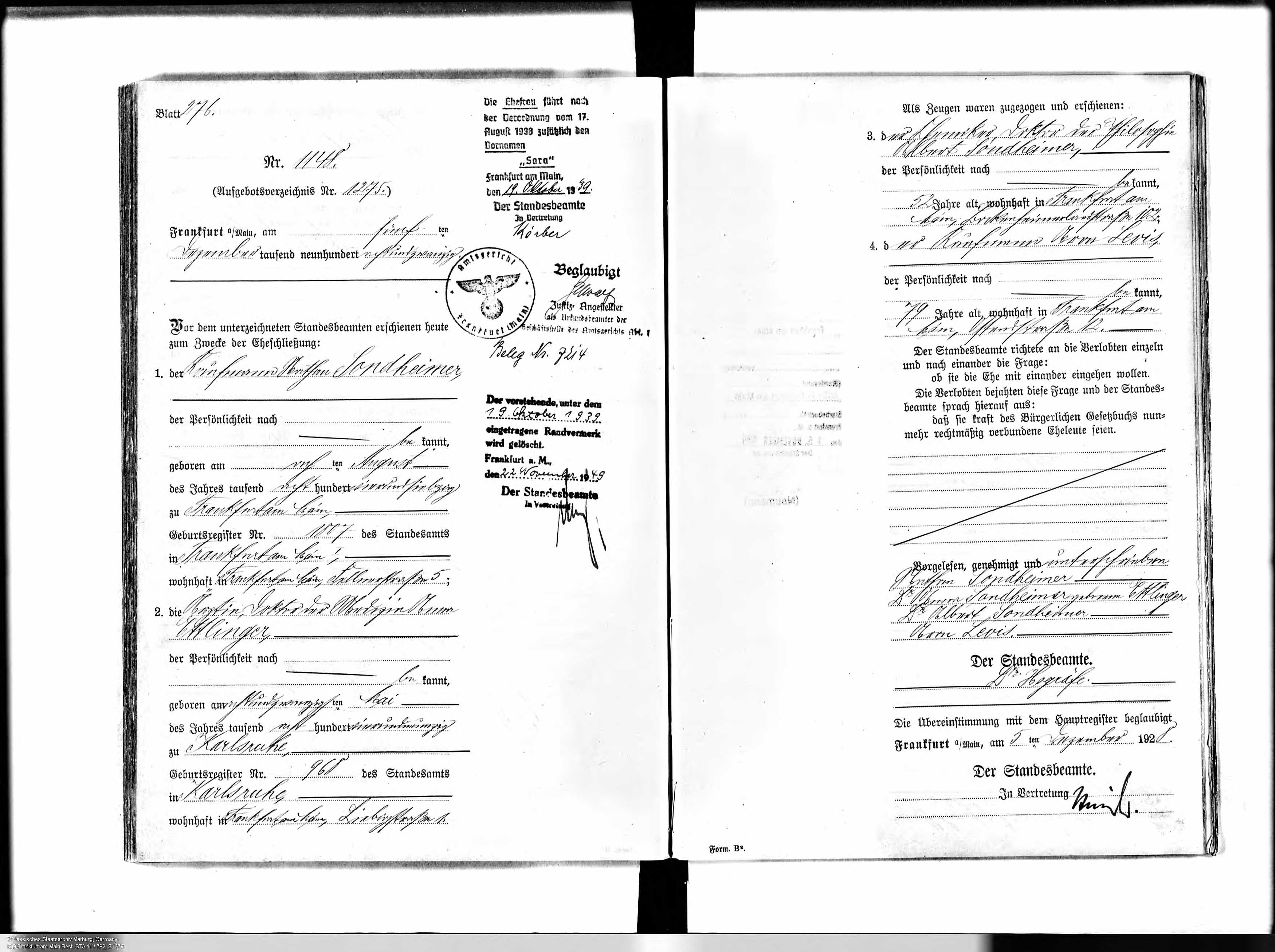
The next to marry was Meyer’s daughter Clementine. She married Nathan Sondheimer on December 15, 1913, in Frankfurt. He was the son of Moses Tobias Sondheimer and Augusta Ettlinger and was born in Frankfurt on August 27, 1874.

Clementine Goldschmidt and Nathan Sondheimer marriage record, Hessisches Hauptstaatsarchiv; Wiesbaden, Deutschland; Bestand: 903, Ancestry.com. Hesse, Germany, Marriages, 1849-1930

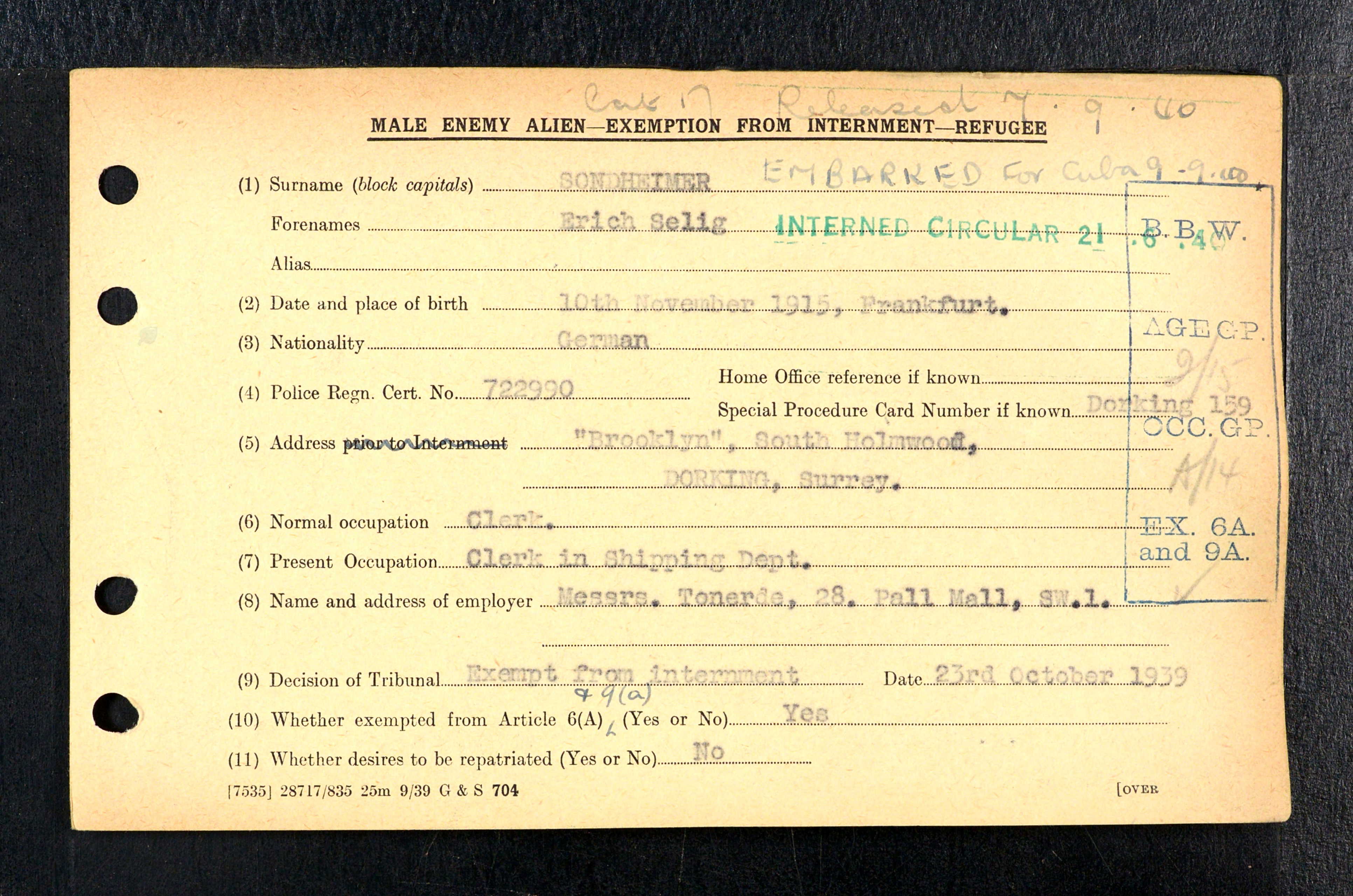
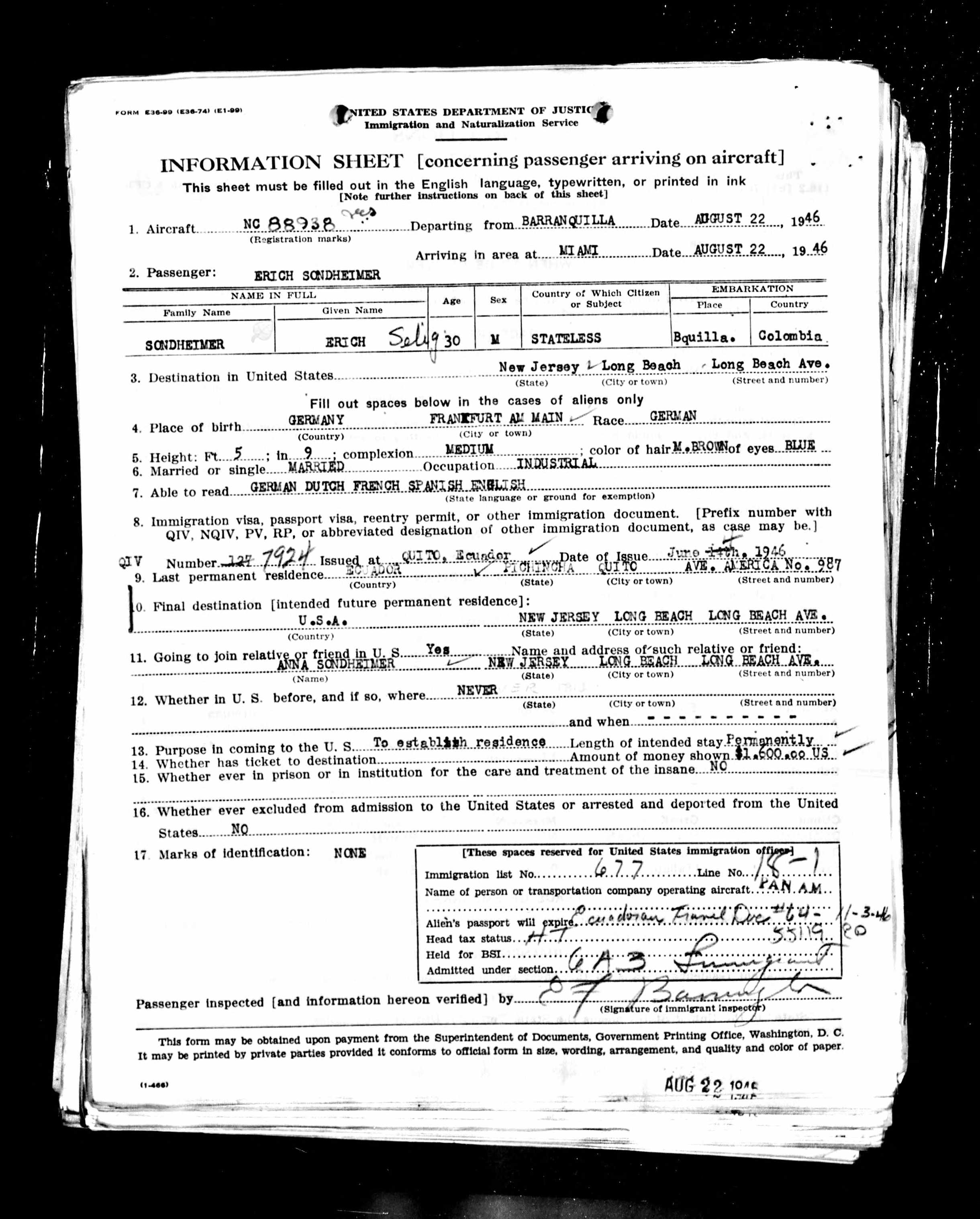
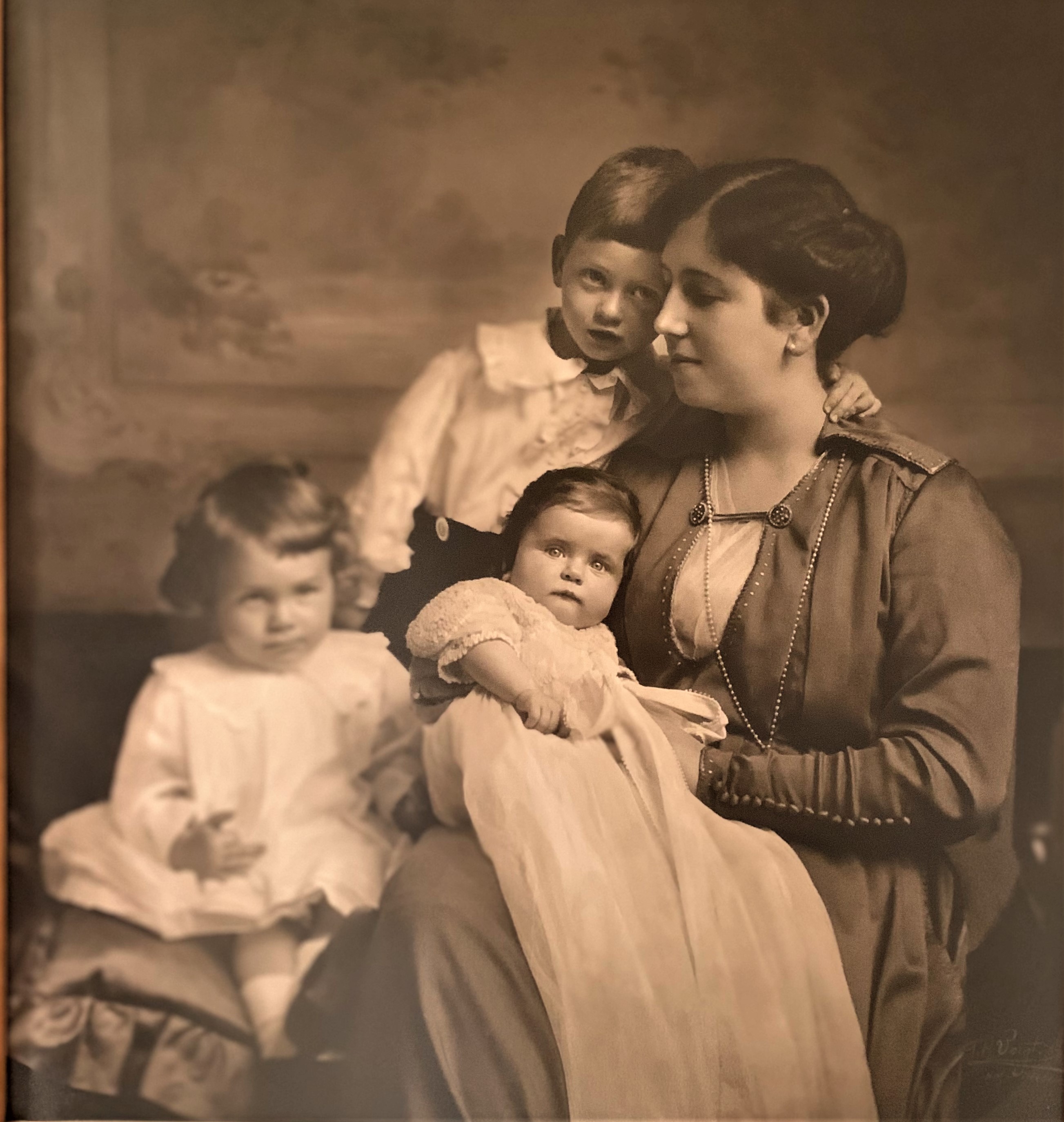
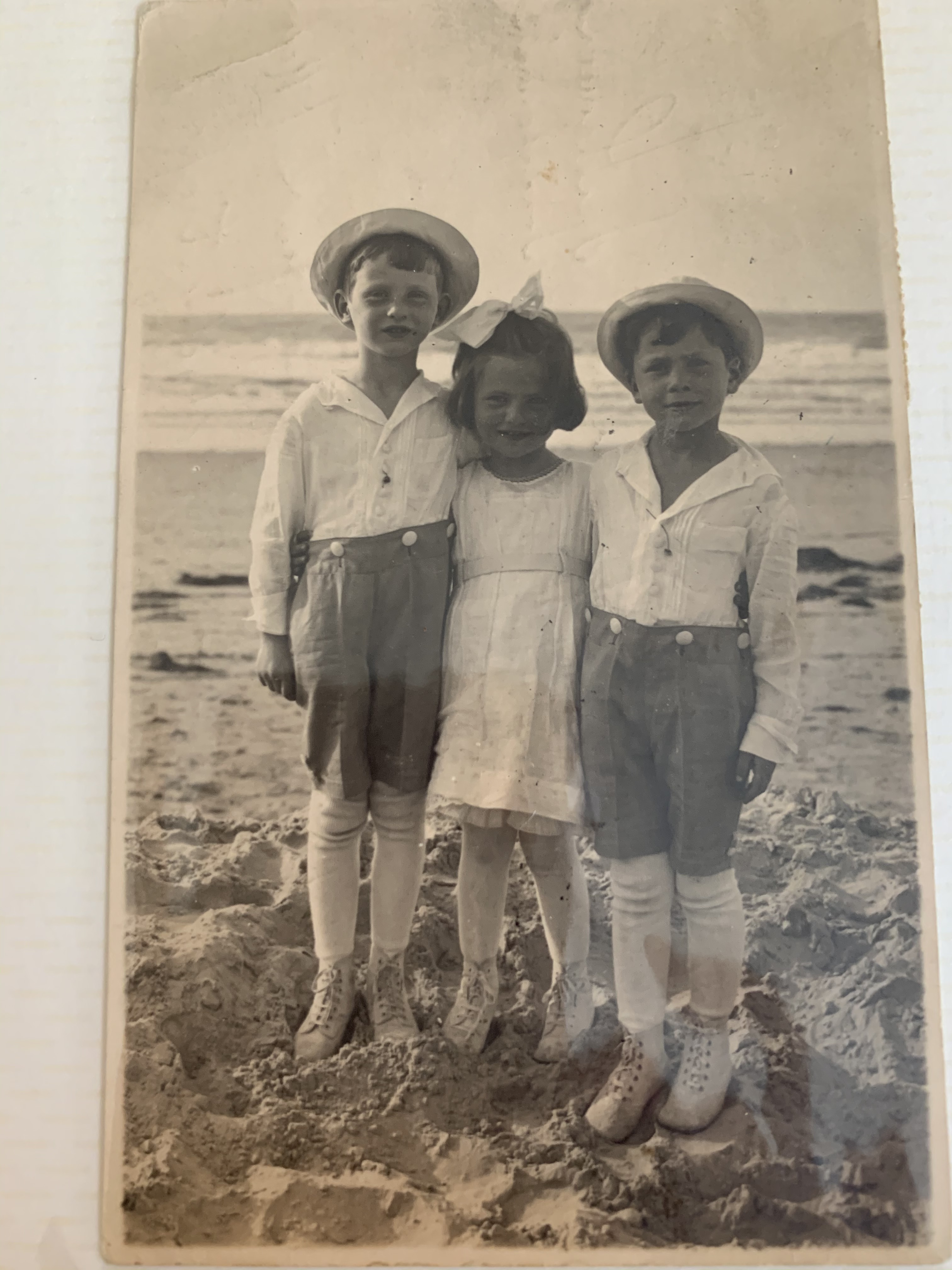
Clementine and Nathan had three children. Manfred Sondheimer was born on October 27, 1914, in Frankfurt.4 His brother Erich Selig Sondheimer was born November 10, 1915, in Frankfurt,5 and Auguste Sondheimer was born January 31, 1917, in Frankfurt.6

Then tragically Clementine died from the 1918 flu epidemic at the age of 25 on October 29, 1918, leaving those three children—all four years old and younger—without their mother. The rest of Clementine’s family’s story will follow in posts to be published next week.

Clementine Goldschmidt Sondheimer death record, Personenstandsregister Sterberegister; Bestand: 903; Signatur: 10793, Ancestry.com. Hesse, Germany, Deaths, 1851-1958

Meyer Selig Goldschmidt’s youngest child Alice Goldschmidt married Heinrich Eisemann on May 23, 1919, in Frankfurt. Heinrich was born in Frankfurt on August 5, 1890, to Michael Eisemann and Nanette Altmann.

Alice Goldschmidt Eisemann marriage record, Hessisches Hauptstaatsarchiv; Wiesbaden, Deutschland; Bestand: 903, Ancestry.com. Hesse, Germany, Marriages, 1849-1930

Alice and Heinrich had six children born between 1920 and 1930. Thank you to my cousin Chaim, a descendant of Alice and Heinrich, who sent me the link for this YouTube video of old home movies of the Eisemann family in Frankfurt. It shows just how comfortable and “normal” their lives were before the Holocaust.

Meyer Selig Goldschmidt died in 1922 and was survived by his wife Selma Cramer Goldschmidt and three of their four children, their daughter Clementine having died in 1918.

Meyer Selig Goldschmidt death record, Certificate Number: 1204
Personenstandsregister Sterberegister; Bestand: 903; Signatur: 10867
Ancestry.com. Hesse, Germany, Deaths, 1851-1958

Two years after Meyer Selig’s death his younger son Arthur married Martha Mitterhauser Widmer in Berlin on April 25, 1924. Martha was born on April 2, 1896 in Koln, Germany. She had previously been married to Hans Widmer.7 (Martha’s parents are not listed on either marriage record.)

Arthur Goldschmidt and Martha Widmer marriage record, Landesarchiv Berlin; Berlin, Deutschland; Personenstandsregister Heiratsregister; Laufendenummer: 458
Register Year or Type: 1924 (Zweitregister), Ancestry.com. Berlin, Germany, Marriages, 1874-1936

Selma Cramer Goldschmidt and her three surviving children and their spouses and children all survived the Holocaust. Selma escaped to England, though I cannot pin down when. She registered as an enemy alien on December 15, 1939, and was exempted from internment. On the 1939 England and Wales Register, she is listed as living with a servant in London.8

Selma Cramer Goldschmidt enemy alien registration, The National Archives; Kew, London, England; HO 396 WW2 Internees (Aliens) Index Cards 1939-1947; Reference Number: HO 396/28, Piece Number Description: 028: Internees at Liberty in UK 1939-1942: Goldm-Golds
Ancestry.com. UK, World War II Alien Internees, 1939-1945

Selma died in the fall of 1955 in London. She was 87.9 (I will have more to say about Selma in a subsequent post about the children of her daughter Clementine Goldschmidt Sondheimer.) She was survived by three of her children—Harry, Arthur, and Alice—and many grandchildren. Their stories will continue in the posts to follow.


  1. David Baron and Roger Cibella, Goldschmidt Family Report 
  2. Fanny Steindecker, Gender: Female, Birth Date: 11 Dec 1891, Birth Place: Paris, France, Death Date: 15 Nov 1987, Father: David Steindecker, Mother: Therese Bing
    SSN: 105363121, Ancestry.com. U.S., Social Security Applications and Claims Index, 1936-2007 
  3.  Walter Goldschmidt, Gender: Male, Declaration Age: 27, Record Type: Declaration
    Birth Date: 3 Feb 1915, Birth Place: Frankfurt, Main, Germany, Arrival Date: 18 Feb 1942, Arrival Place: Newsport News, Virginia, USA, Declaration Date: 21 Aug 1942
    Declaration Place: New York, Court: U.S. District Court for the Southern District of New York, Declaration Number: 528268, Box Number: 404, The National Archives at Philadelphia; Philadelphia, Pennsylvania; NAI Title: Declarations of Intention for Citizenship, 1/19/1842 – 10/29/1959; NAI Number: 4713410; Record Group Title: Records of District Courts of the United States, 1685-2009; Record Group Number: 21,
    Ancestry.com. New York, U.S., State and Federal Naturalization Records, 1794-1943 
  4. Manfred Sondheimer, Gender: Male, Race: White, Birth Date: 27 Oct 1914
    Birth Place: Frankfort Am, Federal Republic of Germany, Death Date: 8 Jan 2006
    Father: Nathan Sondheimer, Mother: Clementine Goldschmidt, SSN: 051183476
    Ancestry.com. U.S., Social Security Applications and Claims Index, 1936-2007 
  5.  Erich Selig Sondheimer, Race: White, Age: 31, Birth Date: 10 Nov 1915, Birth Place: Frankfurt, Germany, Registration Date: 22 Nov 1946, Registration Place: New York City, New York, Employer: Petro Tar and Chemical Corporation, Weight: 141
    Ancestry.com. U.S., World War II Draft Cards Young Men, 1940-1947 
  6.  Auguste Sondheimer, Birth Date: 31 Jan 1917, Birth Place: Frankfurt am Main
    Last Residence: Frankfurt am Main, National Archives and Records Administration (NARA); Washington, DC; Name Index of Jews Whose German Nationality Was Annulled by the Nazi Regime (Berlin Documents Center); Record Group: 242, National Archives Collection of Foreign Records Seized, 1675 – 1958; Record Group ARC ID: 569; Publication Number: T355; Roll: 8, Schafranek, Lizzi – Stern, Moritz, Ancestry.com. Germany, Index of Jews Whose German Nationality was Annulled by Nazi Regime, 1935-1944 
  7. Marriage of Martha Mittelhauser and Hans Widmer, Certificate Number: 25, Landesarchiv Berlin; Berlin, Deutschland; Personenstandsregister Heiratsregister; Laufendenummer: 255, Ancestry.com. Berlin, Germany, Marriages, 1874-1936 
  8. Selma Goldschmidt, The National Archives; Kew, London, England; 1939 Register; Reference: RG 101/564E, Description Enumeration District: AWAE, Ancestry.com. 1939 England and Wales Register. 
  9. Selma S Goldschmidt, Death Age: 87, Birth Date: abt 1868
    Registration Quarter: Oct-Nov-Dec 1955, Registration District: Paddington
    Inferred County: London, Volume: 5d, Page: 159, General Register Office; United Kingdom; Volume: 5d; Page: 159, Ancestry.com. England & Wales, Civil Registration Death Index, 1916-2007 

Selig Goldschmidt, Part IV: Tributes to the Man—Family Man, Entrepeneur, Philanthropist, and Patron of the Arts

Selig Goldschmidt

What made Selig Goldschmidt such an adored figure in the Frankfurt Jewish community? When he died in January 1894, there were many obituaries and tributes singing his praises and mourning his death. Many of these were collected by his son Meyer and then translated by later generations in 1996 and published in Israel in the book I’ve been referring to as the Selig Goldschmidt book.1

One characteristic of Selig was his benevolence and generosity to individuals in need and to charitable organizations. There are many letters in the book describing various donations he made or asking him for help. For example, he and his wife Clementine donated 20,000 Marks to establish an orphanage for Jewish girls in 1882.2 When he died, the letters and obituaries all mentioned his philanthropy.

Selig was also generous in his support of the arts. Much of his generosity was made possible because of the remarkable success of his arts and antiques business. There is not a great deal of detail about the business in the Selig Goldschmidt book, but some of the tributes to Selig provide insights. One man wrote a tribute that was published in the Frankfurt newspaper Finanzerhold as part of its obituary for Selig:3

Mr. Selig Goldschmidt, together with his brother Jakob who long predeceased him, founded the prestigious art business, J&S Goldschmidt which, from modest beginnings, rose to a dominant position in the world of art.

…The importance of the current art and antique trade with its close contacts with arts and crafts… is today well known and appreciated. This is due, in no small measure, to the merits of the departed. Forty years ago interest in art treasures of the past was still nebulous. Often these lay hidden, covered in dust, in most unlikely corners. It was then the task of intelligent dealers to track down such treasures, recover them from their hiding places and turn them into models for imitating the former arts and crafts industry to benefit the living generation.  It was not often easy to do justice to this task. Often it meant waging a campaign against the ignorance and limited understanding of the owner as well as against forgery. This required firm knowledge of the trade, energy, sensitivity and understanding—in short, genius. These qualities can be ascribed to the deceased to a high degree, and they earned him rare success. However, this success did not dazzle him, when—much as his reputation, and that of his firm, grew—whatever lasting reward acquired by his efforts in furthering the high aspirations of the art market, he remained the modest businessman and friend of humanity. He never put the materialistic side of his profession above its ideals.

Among Selig’s most famous clients were members of the Rothschild family. Baron Edmund de Rothschild sent a condolence note to Selig’s family. In its obituary of Selig, the Frankfurter General Anzeiger mentioned that Baron Mayer Carl von Rothschild was one of Selig’s loyal clients, thanks to Selig’s “highly developed understanding of art.”  Another obituary mentioned that “Rothschild only wanted the most rare and the most beautiful, so that the buying demanded the highest circumspection and skill. In this respect the high level of knowledge, which the deceased had acquired on his own, was quite remarkable.” 4

Selig’s firm not only acquired and dealt with secular works of art and antiques; they also specialized in Judaica, and the book about Selig includes many photographs of the Judaica he collected and traded. That is not surprising, given what an observant Jewish life Selig lived. In his letters to his children and grandchildren as well as to others, he almost always mentioned his gratitude to God and the importance of Jewish values. His letters frequently mention Shabbat and Jewish holidays, including Yom Kippur, Sukkot, Hanukah, and others. His support of his synagogue and of Jewish educational institutions was based not just on his charitable instincts but on his commitment to tzedakah (charity) and tikkun olam (healing the world).

These values were expressed by Selig explicitly in his Last Will and Testament dated July 1889. Unlike most wills, Selig did not merely identify how his assets should be distributed. He also wrote to his children about the way he hoped they would live their lives after he was gone. Today we would call this an ethical will, but back then I think this must have been quite unusual.

Selig wrote, in part:5

May G-d always be with you and bless you with all that is good and noble….Do not be too sad and upset when I have been called to rest with my forefathers, but thank G-d who has allowed me till now to fulfill my mission on earth so well. … Above all, my dear and good children, I beg of you to remain firm and strong in the faith of our fathers. Cling firmly to the laws of G-d and you will have the surest and safest guidance for your entire life. At the same time, don’t be over pious, do not condemn a person who does not share your views. Above all, keep your firm brotherly and sisterly friendship. Help each other with advice and action, and never forget those relatives who need your help.

He then wrote about how he grew up poor and was grateful for the financial security he attained as an adult because it allowed him to take care of them all as well as other relatives and to provide charity for others.  His requests of his children were that they take care of their grandmother, Caroline Schuster Fuld, for the rest of her life and that they continue to support the institutions that he and Clementine had supported including the Jewish schools.  After listing the specific bequests (not included in the book), Selig’s will concluded with these words:6

My purpose here on earth is now fulfilled, thanks to G-d’s kindness. If now it would please the Almighty to unite me again with my Clementine, I would call eagerly, here I am. I can calmly leave the beloved circle of my dear children, sons-in-law, daughters-in-law and grandchildren, since I am quite sure that you will bless our memory by attempting to complete with your noble efforts and Divine help, what we have always endeavored to do.

Now, my good children and grandchildren live cheerfully and happily. May Almighty G-d bless you and make you happy, just as you will strive to make each other and those around you happy. Then you will enjoy a long and happy life, just as your grateful and ever loving father, father-in-law and grandfather has done up to the present day.

That was quite a loving and hopeful legacy that Selig wished for his descendants. In the posts to come, we will learn whether their lives lived up to his hopes and dreams for them.


  1. Selig Goldschmidt: Picture of A Life (1996, Elmar Printers Ltd. and Bezalel Bookbinders, Jerusalem, Israel)(limited edition of 300 copies) 
  2. Selig Goldschmidt: Picture of A Life (1996, Elmar Printers Ltd. and Bezalel Bookbinders, Jerusalem, Israel)(limited edition of 300 copies), p. 107. 
  3. Selig Goldschmidt: Picture of A Life (1996, Elmar Printers Ltd. and Bezalel Bookbinders, Jerusalem, Israel)(limited edition of 300 copies), p. 152. 
  4. Selig Goldschmidt: Picture of A Life (1996, Elmar Printers Ltd. and Bezalel Bookbinders, Jerusalem, Israel)(limited edition of 300 copies), pp. 149, 151. 
  5. Selig Goldschmidt: Picture of A Life (1996, Elmar Printers Ltd. and Bezalel Bookbinders, Jerusalem, Israel)(limited edition of 300 copies), p. 119. 
  6. Selig Goldschmidt: Picture of A Life (1996, Elmar Printers Ltd. and Bezalel Bookbinders, Jerusalem, Israel)(limited edition of 300 copies), pp. 122-123. 

Selig Goldschmidt, Part III, 1888-1896: The Deaths of Clementine and Selig

By 1888, Selig Goldschmidt and his wife Clementine Fuld were living a good life. Their five daughters were all married, and there were numerous grandchildren filling their family’s life with lots of love and shared experiences. Selig’s business was thriving, and as we saw from the excerpts from the Selig Goldschmidt book, Selig was adored not only by his family but also by his community.

And then on March 6, 1888, Selig lost his beloved wife Clementine. She was only 51 years old, and her death was unexpected and sudden.

Clementine Fuld Goldschmidt death record, Personenstandsregister Sterberegister; Bestand: 903; Signatur: 10411, Ancestry.com. Hesse, Germany, Deaths, 1851-1958

In a eulogy delivered by Professor A. Sulzbach in honor of Clementine, after extolling her many virtues—her modesty despite her wealth, her commitment to charity and to helping children and others in need, and her compassion, he stated:1

Another comfort to us at this time is the knowledge that her life was a happy one. She was fortunate to live at the side of a beloved husband, highly appreciated by his fellow citizens, among a flourishing group of children who adored her, and she was spared the worries that so frequently disturb the happiness of man.

After loyally fulfilling all her duties, she passed away before life could disappoint her with its grievous and distressing changes. She passed away immediately after one of the greatest Mitzvoth which a woman of middle age, a grandmother, rarely has an opportunity to perform. She had intended to go out, but as an affectionate daughter, did not like to leave the house without wishing her mother a very good night. It was to be her last parting greeting in life. She was then called away. 

Her son Meyer also wrote words of praise in his mother’s honor:2

A year before my wedding, occurred the death of my unforgettable and beloved mother who was universally admired. The radiant sun of our happiness changed to deepest darkness. A life full of love, tenderness, unity and harmony of outlook was terminated. For us this was like being hurled from the brightest summit of life into the darkest depth. 

Further insight into the character of Clementine Fuld Goldschmidt was provided by her husband Selig’s decision to turn down an offer by their synagogue to dedicate a ner tamid, an eternal light, in Clementine’s memory. Instead, Selig donated 7800 Marks to the synagogue and asked that they establish a scholarship for three students at the high school in Clementine’s name. He wrote:3

In her lifetime, my late wife, with her characteristic modesty, rejected all public expressions of gratitude for her efforts and endeavors. Therefore, it would surely be even now her wish to refuse the distinction intended for her. 

This portrait of Clementine appears in the Selig Goldschmidt book:

Less than six months after Clementine’s death, her daughter Recha Goldschmidt Schwarzschild had a third child, born August 30, 1888, in Frankfurt. They named her Clementine for her grandmother, the first of many descendants to be named in her memory.

Clementine Schwarzschild birth record, Hessisches Hauptstaatsarchiv; Wiesbaden, Deutschland; Bestand: 903; Signatur: 903_9047, Ancestry.com. Hesse, Germany, Births, 1851-1901

In August 1888, in a letter that Selig wrote to the children of his daughter Hedwig Goldschmidt Cramer, he described a vacation he was having with his son Meyer Selig, his daughter Helene, her husband Leon, and their son Giacomo in Ostend, Belgium:4

My dearly beloved good Rosa, my good and obedient Max, my good and wild Sally, and my good and beautiful Lena,

My dear good children, I have a strong desire to see you. …It is a pity that you cannot be with us because here in Ostend starts the big ocean where we bathe every day. There is plenty of sand on its shores where children can play nice games. They build houses and castles in the sand, which are later swept away by the water. It is great fun for young children. When I come here again another time, you must come too with your parents.

I loved this letter because it showed that Selig was very much involved in the lives of his married daughters and their children and that despite his loss, he was finding joy with his family.

Just over a year after Clementine’s death, Clementine and Selig’s only son Meyer Selig Goldschmidt was married on March 24, 1889. He married Selma Suzette Cramer, the daughter of Salomon Cramer and Therese Oppenheimer and the first cousin of Hirsch Hermann Cramer, the husband of Meyer’s sister Hedwig. Selma was born on May 24, 1868, in Furth, Germany.

Meyer Selig Goldschmidt marriage record, Hessisches Hauptstaatsarchiv; Wiesbaden, Deutschland; Signatur: 9477, Ancestry.com. Hesse, Germany, Marriages, 1849-1930

Meyer and Selma moved into Selig’s home at his request. Meyer wrote:5

My father greatly appreciated the spiritual and mental qualities of my beloved wife, while she surrounded him with utmost devotion and childlike admiration and affection….It gave us great joy and satisfaction to see how our dear father revived and once again enjoyed a happy life, almost as he did when our good mother was still with us. 

Meyer and Selma’s first child Harry was born on May 24, 1890, in Frankfurt.

Harry Goldschmidt birth record, Hessisches Hauptstaatsarchiv; Wiesbaden, Deutschland; Bestand: 903; Signatur: 903_9074, Ancestry.com. Hesse, Germany, Births, 1851-1901

Meyer shared this sweet incident that occurred when Harry was a baby.  The baby’s room was next to Selig’s room, and concerned that the baby’s crying would disturb Selig’s sleep, Meyer and Selma offered to move him to another room. But Selig refused to let them do it. According to Meyer, Selig’s response was, “If I am awakened at night by the crying of the child, I enjoy listening to it. For me that is the most beautiful music imaginable.”6

Meyer and Selma’s second child Arthur was born on October 3, 1891, in Frankfurt.

Arthur Goldschmidt birth record, Hessisches Hauptstaatsarchiv; Wiesbaden, Deutschland; Bestand: 903; Signatur: 903_9091
Ancestry.com. Hesse, Germany, Births, 1851-1901

Their third child Clementine, obviously another grandchild named for Selig’s wife, was born on October 5, 1893, in Frankfurt.

Clementine Goldschmidt birth record, Hessisches Hauptstaatsarchiv; Wiesbaden, Deutschland; Bestand: 903; Signatur: 903_9123, Ancestry.com. Hesse, Germany, Births, 1851-1901

The extended family suffered another terrible loss when Hedwig Goldschmidt Cramer’s youngest daughter Caroline died on July 16, 1893. She was only seven years old.

Caroline Cramer death record, Personenstandsregister Sterberegister; Bestand: 903; Signatur: 10464, Ancestry.com. Hesse, Germany, Deaths, 1851-1958

Just  three months later, Hedwig gave birth to her fifth child, Herbert, born on October 30, 1893. So she was six months pregnant with Herbert when she lost Caroline.

Herbert Cramer birth record, Hessisches Hauptstaatsarchiv; Wiesbaden, Deutschland; Bestand: 903; Signatur: 903_9124
Ancestry.com. Hesse, Germany, Births, 1851-1901

The last-born grandchild of Selig and Clementine Goldschmidt was Meyer and Selma’s daughter Alice, who was born on July 9, 1896, in Frankfurt.

Alice Goldschmidt birth record, Hessisches Hauptstaatsarchiv; Wiesbaden, Deutschland; Bestand: 903; Signatur: 903_9170, Ancestry.com. Hesse, Germany, Births, 1851-1901

Unfortunately, Selig Goldschmidt did not live to see the birth of his last grandchild Alice. He died six months before on January 13, 1896, in Frankfurt. He was sixty-seven years old and was survived by his six children and eighteen of his twenty grandchildren, Martha Schwarzchild and Caroline Cramer having predeceased him as had his wife Clementine.

Selig Goldschmidt death record, Personenstandsregister Sterberegister; Bestand: 903; Signatur: 10493
Ancestry.com. Hesse, Germany, Deaths, 1851-1958

Selig Goldschmidt was greatly loved and revered by his children and by his community. The book dedicated to his memory by his son Meyer and then translated and published by his later descendants includes many tributes and obituaries devoted to Selig Goldschmidt. I cannot include them all, but will attempt to provide an overview that reveals why this man was so respected and adored in my next post.

Gravestones of Selig and Clementine Goldschmidt
Courtesy of Rafi Stern


  1. Selig Goldschmidt: Picture of A Life (1996, Elmar Printers Ltd. and Bezalel Bookbinders, Jerusalem, Israel)(limited edition of 300 copies), p. 129. 
  2. Selig Goldschmidt: Picture of A Life (1996, Elmar Printers Ltd. and Bezalel Bookbinders, Jerusalem, Israel)(limited edition of 300 copies), p. 6. 
  3. Selig Goldschmidt: Picture of A Life (1996, Elmar Printers Ltd. and Bezalel Bookbinders, Jerusalem, Israel)(limited edition of 300 copies), p. 87. 
  4. Selig Goldschmidt: Picture of A Life (1996, Elmar Printers Ltd. and Bezalel Bookbinders, Jerusalem, Israel)(limited edition of 300 copies), p. 47 
  5. Selig Goldschmidt: Picture of A Life (1996, Elmar Printers Ltd. and Bezalel Bookbinders, Jerusalem, Israel)(limited edition of 300 copies), p. 6 
  6. Selig Goldschmidt: Picture of A Life (1996, Elmar Printers Ltd. and Bezalel Bookbinders, Jerusalem, Israel)(limited edition of 300 copies). p. 7. 

Selig Goldschmidt, Part II, 1867-1887: Weddings and Grandchildren

By 1867, Selig and Clementine (Fuld) Goldschmidt had six children, five girls and one boy, and were living comfortably in Frankfurt, Germany, where Selig owned a successful art and antique business.

Selig was adored by his family and also by many in the Frankfurt community, as his son Meyer Selig Goldschmidt wrote in the preface to the Selig Goldschmidt book:1

My father had a tall, wonderful figure and a distinguished bearing. He was full of energy and creativity. His participation was sought everywhere. Be it our community, business activities, public organization or for the benefit of an individual, he attended every cause with great warmth and without losing his cheerful manner and inner calm. His actions personified his frequent quote, “If you want to be happy, try to make others happy and glad.” Both in the home and outside he was the focal point—honoured, respected and loved. Wherever he went he was soon surrounded by friends and admirers, happy to join his circle.

In a later chapter in the Selig Goldschmidt book, “The Emerging Personality,” Meyer further elaborated on his father’s personality:2

A flourishing wit and a refreshing sense of humour developed in him and made him the natural centre of any pleasant social gathering. Above all, for his close family this cheerfulness became a true comfort and refuge. His ability to pacify, to heal and reduce any pain and to sympathise with all suffering, whether due to serious and oppressive anguish of adults, or insignificant troubles which appeared overwhelming in children. At all times he showed himself as a brave and cheerful master of worldly matters and fateful events.

Meyer’s words describe a man who was a much-adored father, and his role in the lives of his children did not end when they married. He then took on caring about their spouses and the grandchildren who followed as well as the widow and children of his brother Jacob. That is reflected in the many letters Selig wrote to his children after they had left home and started families of their own.

By the beginning of 1888, all of Selig and Clementine’s daughters were married and had children. Helene, the oldest child, was the first to marry. She married Leon Tedesco on June 9, 1876, in Frankfurt. Leon was born in Paris, France, on February 1, 1853, to Jacob  Tedesco and Therese Cerf. He was, like the Goldschmidts, an art dealer, his family owning Tedesco Freres, a famous and important art gallery in Paris. 

Helene Goldschmidt marriage record, roll: 31067_04G024
Ancestry.com. Paris, France & Vicinity Marriage Banns, 1860-1902

Helene Goldschmidt marriage record, Certificate Number: 578
Hessisches Hauptstaatsarchiv; Wiesbaden, Deutschland
Ancestry.com. Hesse, Germany, Marriages, 1849-1930

Helene and Leon would have one child, a son Giacomo born in Paris on July 28, 1879.3

Flora Goldschmidt was the next to marry; she married Emil Schwarzchild on March 22, 1878, in Bornheim, Germany, a district of Frankfurt. Emil was also a native of Frankfurt, born there on March 16, 1856, to Emanuel Schwarzschild and Rasel Frenkel.

Flora Goldschmidt marriage record, Hessisches Hauptstaatsarchiv; Wiesbaden, Deutschland Description Year Range: 1878 Source Information Ancestry.com. Hesse, Germany, Marriages, 1849-1930

Flora and Emil’s first child Siegfried was born January 21, 1879, in Frankfurt.

Siegfried Schwarzschild birth record, Hessisches Hauptstaatsarchiv; Wiesbaden, Deutschland; Bestand: 903; Signatur: 903_8927
Ancestry.com. Hesse, Germany, Births, 1851-1901

Their second child Helene Schwarzschild was born April 20, 1882, in Frankfurt.

Helene Schwarzschild birth record, Hessisches Hauptstaatsarchiv; Wiesbaden, Deutschland; Bestand: 903; Signatur: 903_8968
Ancestry.com. Hesse, Germany, Births, 1851-1901

For a while I thought they’d only had those two children. But then I found a letter in the Selig Goldschmidt book that suggested there was a third child. On August 14, 1882, Selig wrote to Flora and Emil from Marienbad which ends, “Kiss Siegfried, Helenchen, and Rosa for me, as well as all relatives and friends.” 4 Siegfried was three, Helene a few  months old. But who was Rosa?

I searched for other children of Flora and Emil, and sadly I did find one, but she could not have been the Rosa mentioned in Selig’s letter because her name was Martha, and she wasn’t born until December 21, 1886, four years after Selig wrote the letter. Tragically, Martha died at age two on June 6, 1889, in Frankfurt.

Martha Schwarzschild death record, Personenstandsregister Sterberegister; Bestand: 903; Signatur: 10422, Ancestry.com. Hesse, Germany, Deaths, 1851-1958

So who was Rosa? Perhaps she was Hedwig’s daughter Rosa, who was born, as we will now see, on March 16, 1881. Or perhaps she was just another Rosa who happened to be with Flora and Emil at that time. Maybe Selig was referring to Flora’s mother-in-law, Rasel Frenkel Schwarzschild? I don’t know.

One other possible clue is in another letter written by Selig, this one on February 25, 1883, from Paris, where he was visiting Helene, Leon, and Giacomo Tedesco. It’s a letter to his daughter Hedwig and her husband (here referred to as Hermann, otherwise known as Hirsch), wishing Hedwig a happy birthday. In that letter, Selig wrote, “I hope that dear Flora and Emanuel have found comfort. I have often thought of them and felt for them, but whatever G-d does is good.” 5 I assume that he is referring to his daughter Flora and that Emanuel must be a reference to Emil, perhaps his Hebrew name. And it certainly sounds like Flora and Emil/Emanuel suffered a loss. Had the child Rosa referred to in the August 1882 letter died between that date and February 25, 1883?

If so, I have not been able to locate either a birth or a death record for that child.

Selig and Clementine’s third daughter Hedwig married Hirsch (Hermann) Cramer on March 5, 1880, in Bornheim, Germany. Hirsch was the son of Jakob Cramer and Karoline Fuerth and was born in Thundorf, Germany, on October 12, 1852.

Hedwig Goldschmidt marriage record, Hessisches Hauptstaatsarchiv; Wiesbaden, Deutschland, Ancestry.com. Hesse, Germany, Marriages, 1849-1930

Hedwig and Hirsch had five children, four before 1888. Rosa was born in Frankfurt on March 16, 1881.

Rosa Cramer birth record, Hessisches Hauptstaatsarchiv; Wiesbaden, Deutschland; Bestand: 903; Signatur: 903_8954
Ancestry.com. Hesse, Germany, Births, 1851-1901

Max (Meier) was born on September 4, 1882, in Frankfurt.

Max Cramer birth record, Hessisches Hauptstaatsarchiv; Wiesbaden, Deutschland; Bestand: 903; Signatur: 903_8970
Ancestry.com. Hesse, Germany, Births, 1851-1901

Salomon (Sally) was born June 22, 1884, in Frankfurt.

Sally Cramer birth record, Hessisches Hauptstaatsarchiv; Wiesbaden, Deutschland; Bestand: 903; Signatur: 903_8994
Ancestry.com. Hesse, Germany, Births, 1851-1901

Caroline (known as Lena) was born June 8, 1886, in Frankfurt.

Caroline Cramer birth record, Hessisches Hauptstaatsarchiv; Wiesbaden, Deutschland; Bestand: 903; Signatur: 903_9018
Ancestry.com. Hesse, Germany, Births, 1851-1901

The fourth daughter of Selig and Clementine, Recha, married Alfred Schwarzchild on October 21, 1881, in Bornheim. Alfred was born in Frankfurt on May 14, 1858, to Isaac Schwarzchild and Rosalie Kulp. One question I’ve not been able to answer is whether Alfred was related to his brother-in-law Emil, husband of Recha’s sister Flora. They had different fathers and different grandfathers and different great-grandfathers, so if they were related they were at best third cousins.

UPDATE: Thank you to my cousin Alan Philipp, who had a Schwarzschild family tree and traced both Emil and Alfred to their mutual great-great-grandfather Jakob Schwarzschild, making Emil and Alfred third cousins. I’d been unable to get back to Alfred’s great-great-grandfather, and that proved to be the mutual ancestor for them both.

Recha Goldschmidt marriage record, Hessisches Hauptstaatsarchiv; Wiesbaden, Deutschland, Ancestry.com. Hesse, Germany, Marriages, 1849-1930

Recha and Alfred had two sons by 1888. Jacob Alfred Schwarzschild was born on February 12, 1885, in Frankfurt.

Jacob Alfred Schwarzschild birth record, Hessisches Hauptstaatsarchiv; Wiesbaden, Deutschland; Bestand: 903; Signatur: 903_9003, Ancestry.com. Hesse, Germany, Births, 1851-1901

His brother Robert Meier Schwarzschild was born August 7, 1886, in Frankfurt.

Robert Meier Schwarzschild birth record, Hessisches Hauptstaatsarchiv; Wiesbaden, Deutschland; Bestand: 903; Signatur: 903_9019
Ancestry.com. Hesse, Germany, Births, 1851-1901

Johanna, the fifth and youngest daughter of Selig and Clementine, married her first cousin Abraham Stern on June 24, 1887, as discussed here, and they had five children, also already discussed.

Thus, by the beginning of 1888, all five of Selig and Clementine’s daughters were married and had children. Selig and Clementine had been blessed with numerous grandchildren from their five daughters.

But then on March 22, 1888, the family suffered a major loss. More on that in my next post.


  1. “Preface,” Selig Goldschmidt: Picture of A Life (1996, Elmar Printers Ltd. and Bezalel Bookbinders, Jerusalem, Israel)(limited edition of 300 copies), pp. 4-5. Selig had lost his brother and business partner Jacob Meier Goldschmidt on January 20, 1864, when Jacob died at age 39, as I wrote about here
  2. “The Emerging Personality,” Selig Goldschmidt: Picture of A Life (1996, Elmar Printers Ltd. and Bezalel Bookbinders, Jerusalem, Israel)(limited edition of 300 copies), p. 26. 
  3. David Baron and Roger Cibella, Goldschmidt Family Report. 
  4. Selig Goldschmidt: Picture of A Life (1996, Elmar Printers Ltd. and Bezalel Bookbinders, Jerusalem, Israel)(limited edition of 300 copies), p. 41. 
  5. Selig Goldschmidt: Picture of A Life (1996, Elmar Printers Ltd. and Bezalel Bookbinders, Jerusalem, Israel)(limited edition of 300 copies), p. 42. 

Selig Goldschmidt, Part I: Loving Son, Husband, and Father

If you have a really, really good memory and have been reading this blog for over a year, you may remember that back in October 2019—before COVID!—I wrote my first blog post about my 4x-great-uncle, Meyer Goldschmidt, and relied heavily as a source of information about Meyer and his family on a book created in honor of his son Selig Goldschmidt.

The book, Selig Goldschmidt: A Picture of A Life,  was published in Israel by Selig’s descendants in 1996 (hereinafter referred to as the Selig Goldschmidt book),1 and it includes remembrances, letters, and obituaries that were originally compiled by Selig’s son Meyer and that were then translated from German to English by the later generation in order to preserve and honor the memory of Selig Goldschmidt.

Last year I relied on the Selig Goldschmidt book to tell the story of Selig’s parents, Meyer Goldschmidt and Lea Katzenstein, and about the childhood of Selig and his siblings, but now I am returning to the book to focus more exclusively on what it reveals about Selig himself as he grew from a child and spent his adult life in Frankfurt, Germany.

First, some background. Selig was born on March 16, 1828, in Grebenstein, Germany, the fifth child and second son of his parents Meyer and Lea. (I have already written about the first four: Ella, Sarah, Jacob, and Amalie.)

Selig Goldschmidt birth record, Arcinsys Hessen, HHStAW, 365, 375 Jüdische Personenstandsregister von Grebenstein: Geburtsregister der Juden von Grebenstein, p. 36

As described in the book, the family was quite poor when Selig was a child, and his father Meyer suffered from poor health, exacerbating the precariousness of their financial position. Then Selig’s mother Lea Katzenstein Goldschmidt died on September 28, 1839 (after having given birth to two more sons after Selig, Joseph, who died when he was six in 1836, and Falk, who was born in 1836). Selig was only eleven years old, and as I wrote about here, he and his siblings had to take on a lot of responsibility for each other and for the youngest sibling, Falk, who was only three.

Once the older siblings began to marry and have households of their own, the financial pressure was reduced. After the youngest sister Amalie married Juda Katzenstein in 1853 and her father Meyer moved with them to Eschwege, Selig and his brother Jacob sold the family home in Grebenstein and moved to Frankfurt,2 where the two brothers established the firm J&S Goldschmidt, which grew to be one of the most famous and successful art and antique dealerships in Germany and perhaps in Europe. More on that to come. But it’s important to remember that Selig and his siblings grew up in poverty before building their business to what must have been unimaginable success.

According to the civil record below, on May 27, 1857, Selig married Clementine Fuld in Frankfurt. She was born in Frankfurt on January 8, 1837, to Herz Fuld and Caroline Schuster, and, as I noted in my prior post, she was the sister of Salomon Fuld, who would later marry Selig’s niece Helene Goldschmidt, daughter of Selig’s brother Jacob Meier Goldschmidt.

Marriage of Selig Goldschmidt and Clementine Fuld, Certificate Number: 30
Hessisches Hauptstaatsarchiv; Wiesbaden, Deutschland
Ancestry.com. Hesse, Germany, Marriages, 1849-1930

However, it appears that Selig and Clementine had been married under religious law nine months earlier. The Selig Goldschmidt book includes a facsimile of their ketubah as well as a translation in English of their marriage contract, and it indicated that they were married on August 20, 1856.3

A letter written by Selig to Clementine on August 31, 1856, reveals that this was a love match; it also suggests how busy Selig was and how often he had to travel for work. Selig, who was away on business in Dinkelspiel at that time, wrote in part:4

Dearest Clementine

I have received your most welcome letter just after my arrival here. [He then described how he spent Shabbos in Dinkelspiel.]… The afternoon passed pleasantly in conversation until after the evening service in the synagogue when I was alone once again. I missed you very much, dear Clementine, and would have gladly paid a lot of money in exchange for half an hour’s conversation with you, if that could have been instantly arranged. Since that was impossible, I did the same as Friday night and went to bed at eight o’clock. I dreamed I was with you, dear Clementine, and I had such a pleasant talk with you and was so happy to be near you that the time passed very quickly. [Selig then wrote that he would be delayed returning to Frankfurt because of business.] … However, early in the following week, please G-d, the happy day of our reunion will arrive. Then, dear Clementine, we will enjoy ourselves and chat enough to compensate for everything we have missed. Yet that joy can only last for two or three days because then I must set out on my journey to Leipzig. Thus man’s happiness is always limited, just as his existence is only brief. However, of what use is such nonsense? After all, that is part of my occupation and you yourself have told me not to neglect my business. We must utilize properly the short time allotted to us, for such is life! If only one would use this time assigned to oneself well, surely the whole world would be a happier place. …

Dear Clementine, please accept sincere greetings and kisses from your affectionate and faithful

               Selig

Selig and Clementine had six children—five daughters and one son, all born in Frankfurt. First born was Helene, born on February 28, 1858.

Helene Goldschmidt birth record, Hessisches Hauptstaatsarchiv; Wiesbaden, Deutschland; Bestand: 903; Signatur: 903_8812, Ancestry.com. Hesse, Germany, Births, 1851-1901

A year later Flora was born on March 17, 1859.

Flora Goldschmidt birth record, Hessisches Hauptstaatsarchiv; Wiesbaden, Deutschland; Bestand: 903; Signatur: 903_8814, Ancestry.com. Hesse, Germany, Births, 1851-1901

Hedwig was born two years later on February 27, 1861.

Hedwig Goldschmidt birth record, Hessisches Hauptstaatsarchiv; Wiesbaden, Deutschland; Bestand: 903; Signatur: 903_8818
Ancestry.com. Hesse, Germany, Births, 1851-1901

And Recha followed two years after Hedwig. She was born on June 11, 1863.

Recha Goldschmidt birth record, Hessisches Hauptstaatsarchiv; Wiesbaden, Deutschland; Bestand: 903; Signatur: 903_8824
Ancestry.com. Hesse, Germany, Births, 1851-1901

Selig and Clementine’s only son Meyer Selig Goldschmidt was born on October 6, 1865. He was obviously named for his grandfather Meyer.

Meyer Selig Goldschmidt birth record, Hessisches Hauptstaatsarchiv; Wiesbaden, Deutschland; Bestand: 903; Signatur: 903_8830
Ancestry.com. Hesse, Germany, Births, 1851-1901

The last child, Johanna, was born on December 18, 1867. Johanna grew up to marry her first cousin Abraham Stern, the son of Selig’s sister Sarah, and her story has already been told in great detail when I wrote about Abraham and their family so I will not tell it again.

Johanna Goldschmidt birth record, Hessisches Hauptstaatsarchiv; Wiesbaden, Deutschland; Bestand: 903; Signatur: 903_8837
Ancestry.com. Hesse, Germany, Births, 1851-1901

In the preface to the Selig Goldschmidt book, Selig’s son Meyer described what his childhood was like and how the family was bound in love:5

The ideals of children, grandchildren and the wider family circle were all in tune; thus an incomparable, blissful harmony prevailed in our family. It was constantly sustained by love, affection and enthusiasm for all that is noble and good which emanated from the head of our family. Before meals on Friday evening in winter and on Shabbos evenings after the meal, a large number of the more distant family would assemble in our home. There were so many people that it is difficult to understand, in view of the relatively small size of the rooms, how comfortable and happy everyone felt. It may have been due to a certain simplicity which was deliberately cultivated there. In the main room a big bowl of fruit stood on the table at which we sat, and anyone who wished could help himself.

Imagine if all children were as blessed as the six children of Selig Goldschmidt and Clementine Fuld and able to grow up surrounded by so much joy and love.

This portrait of Selig and Clementine’s children appears on page 37 of the Selig Goldschmidt book. It appears to have been taken in 1872 based on the ages of the children (the daughters are identified by their married names).

Selig Goldschmidt’s children


  1. Selig Goldschmidt: Picture of A Life (1996, Elmar Printers Ltd. and Bezalel Bookbinders, Jerusalem, Israel)(limited edition of 300 copies) 
  2. “The Story of A Ring,” Selig Goldschmidt: Picture of A Life (1996, Elmar Printers Ltd. and Bezalel Bookbinders, Jerusalem, Israel)(limited edition of 300 copies), p.22 
  3. “The Man,” Selig Goldschmidt: Picture of A Life (1996, Elmar Printers Ltd. and Bezalel Bookbinders, Jerusalem, Israel)(limited edition of 300 copies), pp. 34-39 
  4. “The Man,” Selig Goldschmidt: Picture of A Life (1996, Elmar Printers Ltd. and Bezalel Bookbinders, Jerusalem, Israel)(limited edition of 300 copies), pp. 32-33. 
  5. “Preface,” Selig Goldschmidt: Picture of A Life (1996, Elmar Printers Ltd. and Bezalel Bookbinders, Jerusalem, Israel)(limited edition of 300 copies), pp. 4-5. 

A Survivor’s Story

Regina Goldschmidt Rosenberger, the daughter of Julius Goldschmidt, granddaughter of Jacob Meier Goldschmidt, and great-granddaughter of Meyer Goldschmidt, was my third cousin, twice removed, and I first wrote about her here and here, but now need to update those posts.

The earlier post established that Regina was born in Frankfurt on March 7, 1900, and married Siegfried Rosenberger on March 10, 1921, in Frankfurt, and had two children in the 1920s. In my second post about Regina, I wrote:

I don’t know a great deal about what happened to Regina, her husband Siegfried Rosenberger, and their two children during the Holocaust. It appears that at least until 1937 they were still living in Frankfurt and that after the war, according to Roger Cibella and David Baron, their two children were both married in the Netherlands and had children born there. Eventually they all immigrated to Canada where Regina died in February 1992…

And that was all I knew. Until a couple of weeks ago when I received an email from a sixth cousin named Mark Isenberg. I had first heard from Mark a few years back when he contacted David and Roger regarding his research establishing that his paternal four-times great-grandfather Joseph Falk Neuwahl and Roger’s and my four-times great-grandfather Jacob Falk Goldschmidt were probably brothers.

This time Mark was writing about his relationship to Siegfried Rosenberger, husband of Regina Goldschmidt. Siegfried was Mark’s third cousin, once removed, on his maternal side. Mark had seen my blog post quoted above and kindly alerted me to the fact that Siegfried and Regina’s daughter Ruth had done an interview with the Shoah Foundation in 1997. I’ve now watched the two and a half hours of her testimony and can report in much greater detail what happened to Regina, Siegfried, and their two daughters Ruth and Margo during the Holocaust. All the information below except where otherwise noted comes from that testimony of Ruth Rosenberger Steinert.1

Ruth Rosenberger was born in Frankfurt on December 6, 1922. Her sister Margo was born almost exactly two years later on December 19, 1924. Ruth described their childhood in Frankfurt in idyllic terms. They lived in a very large apartment with a nanny, cook, and other servants, and were surrounded by their Goldschmidt grandparents, aunt, uncle, and cousins, having regular shabbat dinners with the extended family as well as holidays. Their father Siegfried was a successful stockbroker. He was very proud of being a German and of his service to Germany in World War I, for which he was awarded the Iron Cross.  Their mother Regina lived a good life, playing tennis daily, socializing with friends, and overseeing the household staff. The family was very observant, and Ruth and Margo went to an Orthodox day school in Frankfurt. Watching Ruth talk about her childhood was very moving; she so well expressed how safe and loved she felt.

Khal Adath Jeshurun synagogue in Frankfurt, the synagogue attended by the Goldschmidt family. https://www.kajinc.org/about/history

Everything was destroyed once the Nazis came to power. Ruth said that until 1936, she and her sister were fairly unaware of what was happening because the adults did not talk about the Nazis in front of the children. She knew that there were restrictions, mentioning as an example that they were not allowed to sit on the park benches, but she nevertheless felt safe.

But after 1936, it became impossible to hide what was happening from the children. Her father lost his stockbroker business because Jews were no longer allowed to engage in business. Ruth talked about how devastated her father was when they came and stripped away the telephones he needed for the business. The nanny, cook, and other servants had to leave the household because non-Jews were no longer allowed to work for Jews. Their mother Regina became terribly depressed.

Fortunately, Siegfried was able to secure another job with an international metals company called Lissauer. The position required him to travel to France and to Holland and enabled the family to continue to live fairly comfortably. As Ruth described it, this job ultimately saved their lives. Siegfried would never have left Germany despite all the oppression and fear. But in September 1938 while traveling for work in Paris, he was unable to return to Germany. Finally he agreed that the family should leave Germany, and through his business connections, he was able to obtain papers for them to immigrate to the Netherlands.

Ruth, not yet sixteen years old, took charge of packing and getting them ready to leave. They took a train to Paris, and Ruth put on lipstick so that she would look older. When they got to the French-German border at Emmerich, the German border guards gave them trouble with their papers, but fortunately a cousin was able to straighten matters out, and the next day they arrived in Paris. They remained in Paris for a few days, and then the whole family spent about ten days at the beach in the Netherlands. Ruth remembered it as a wonderful time and one of the very last times all four of them were together as a family.

Siegfried returned to Paris for work and would travel back and forth to Amsterdam. Regina and her daughters were living in a very nice apartment on the canal in Amsterdam. Margo attended high school, and Ruth spent a year at an art academy, learning design.  For a year life was fairly normal.

As one uncle had said to the family when they arrived in Paris, they had, however, gone from “the rain into the storm” because war was brewing, and no place was really safe. After the war started in September 1939 and then Holland and France were occupied by the Nazis in the spring of 1940, Siegfried could no longer travel to Amsterdam. From that point on, things went downhill.

Ruth recalled standing on a corner in Amsterdam with a crowd of other people from the neighborhood as the Germans marched into Amsterdam.

Nazi troops and supporters in front of De Bijenkorf, Dam Square, Amsterdam, The Netherlands, 1941 (crop of original 1941 public domain photo). 47thPennVols, CC0, via Wikimedia Commons

But even on that dark day, the family found a silver lining. A man named Benot Hess was also standing on that corner and engaged Regina and daughters in conversation. Hess was married to a non-Jewish Swedish woman, and because Sweden was neutral during the war, he was given some extra protection based on that marriage. Hess and his wife became close friends with the Rosenberger women—like family, according to Ruth. He made sure that they had enough money by helping Ruth obtain work, sewing and then manufacturing travel kits and other items. The products sold well, giving the family an economic cushion.

By 1942, however, conditions worsened. Jews were required to wear the yellow stars with Jood to mark them as Jews. Ruth said that they lived in a constant state of angst for all their waking hours. Eventually they were forced to move into what Ruth described as a ghetto where all Jews were forced to live, and SS men on trucks barreled through the neighborhood every night, coming to arrest people and take them to Westerbork, the detention camp outside of Amsterdam.

At that point, they had to make a choice: stay and see what would happen or go into hiding. Ruth favored going into hiding, but her mother was not willing, and Margo did not want to leave their mother. For some time they remained safe from deportation as both Ruth and Margo had positions assigned by the Judenrat (the Jewish council) that kept them protected. Once the SS came to their apartment, and Ruth managed to convince them that they were not Jewish. She claimed that because of her light hair and coloring and straight nose, she was able to fool them.

But when the SS arrived a second time, Ruth was not successful, and in March 1943, Regina Goldschmidt Rosenberger was arrested and taken to Westerbork. Ruth described it as the worst moment in her life, watching her mother being taken away. She said that at that time they did not know about the death camps, only about what were being referred to as work camps. Soon thereafter Margo lost her position with the Judenrat and was also taken to Westerbork where she joined her mother.
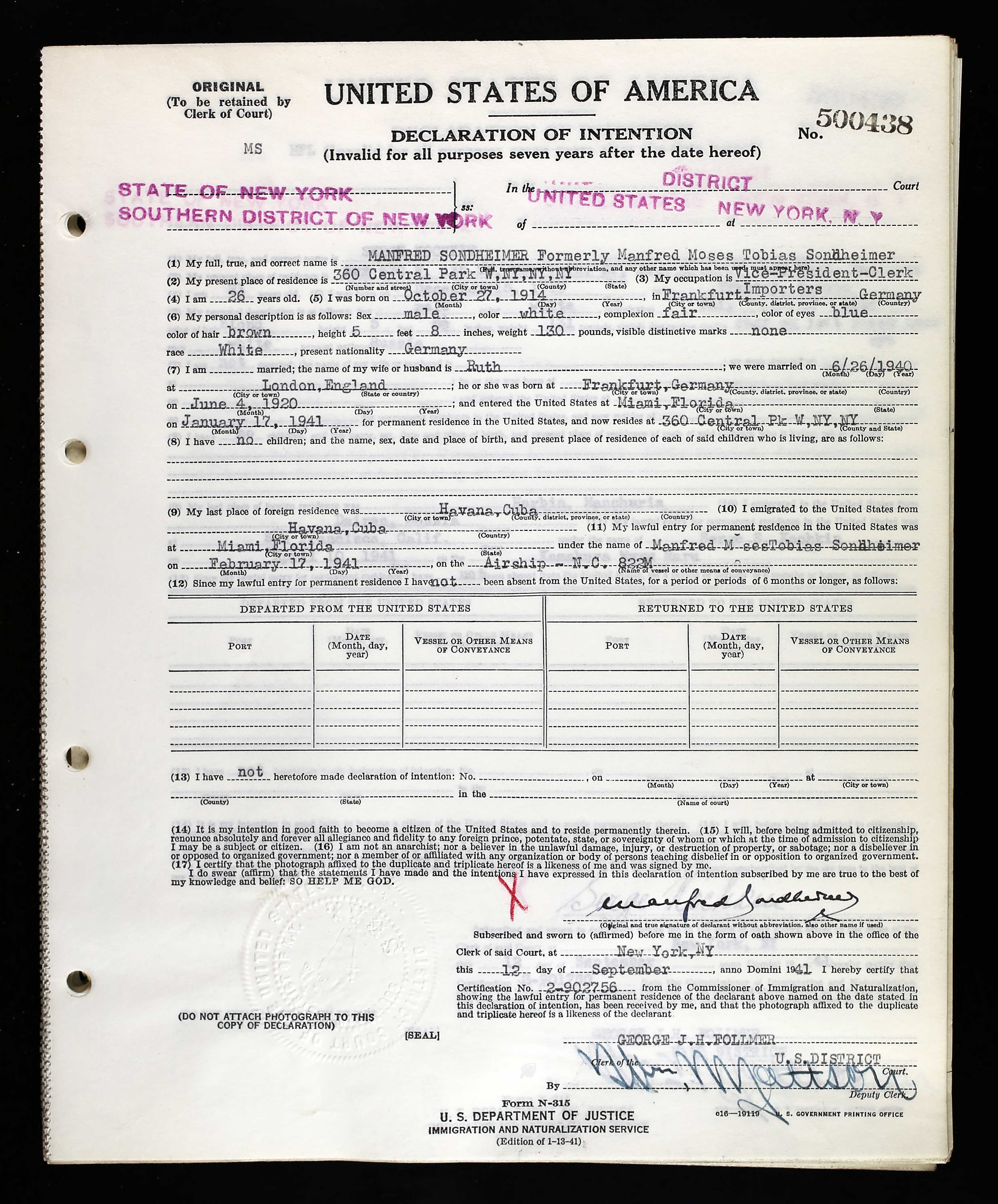
Ruth contacted her father to see if he could arrange false identification papers for her, which he was able to accomplish, and Ruth went to Bussum, a town in Holland, and hid with a family there for the duration of the war. She was almost caught once when the SS came to look for hidden Jews, but again was smart enough and lucky enough to convince them that she was not Jewish.

Meanwhile, Regina and Margo had been taken from Westerbork to Terezin. Once again, Benot Hess came to their rescue. He also was imprisoned at Terezin, and when he learned that Regina and Margo were to be placed on the next train to Auschwitz, he intervened, using the Honduran passports that Siegfried had obtained for them, and Regina and Margo were taken off the list.

Jewish prisoners’ cell, Terezin (c) A Cohen 2015

When the war ended in Europe in April 1945, Ruth was reunited with her mother and sister, and they all moved to Bussum. Margo married her fiancé, Robert Engel, who had been at Westerbork throughout the war period, and Ruth met and married Otto Steinert. In 1950, Otto was offered a job in Canada through the family’s connections to another family, and Ruth and Otto and soon thereafter Regina, Margo, and her husband all moved to Canada.

Siegfried was never reunited with the family. He remained in Paris, where he died not long after the war. Regina Goldschmidt Rosenberger lived a long life, dying in Canada in February 1992 when she was almost 92 years old.

Her two daughters also lived long lives. Ruth Rosenberger Steinert died at the age of 93 on December 22, 2013, in Montreal. Her sister Margo Rosenberger Engel died just this past June 30, 2020, in Toronto; she was 95. They are survived by their children and grandchildren and great-grandchildren.

Watching Ruth’s testimony was a moving, inspiring, and heartbreaking experience. Despite everything she had experienced—all the losses, the fear, the separation, the loneliness—she remained a strong, optimistic, and loving woman who spoke about her parents, her husband, her sister, her children and grandchildren with so much affection and warmth. She was not going to be defeated by what happened around her—not while it was happening and not afterwards. How blessed we are to have this testimony to remember what happened and to inspire us all.


  1. Steinert, Ruth. Interview 35432. Visual History Archive, USC Shoah Foundation, 1997. Accessed 1 October 2020. 

Was Moritz Oppenheimer Forced by the Nazis to Divorce His Wife and Declare Bankruptcy?

I have written several posts about my cousin, Moritz Oppenheimer, the nephew of my great-great-grandfather Bernard Seligman. Moritz was an extremely successful business owner and also racehorse breeder and owner who ended up committing suicide as a result of the persecution he experienced by the Nazis.

Emma Neuhoff and Moritz James Oppenheimer
photo courtesy of Angelika Oppenheimer

My cousin Wolfgang Seligmann recently discovered additional information about Moritz and his family, including an application filed in 1966 in Wiesbaden by Moritz Oppenheimer’s widow Emma Neuhoff, seeking compensation for the harm done to her husband and the financial losses suffered.

Emma Neuhoff Oppenheimer 1966 application for reparations

In reviewing those documents (with invaluable help from Wolfgang), I focused on two questions that had been raised by readers who commented on my earlier posts about Moritz Oppenheimer. First, were Moritz and his non-Jewish wife Emma forced to divorce by the Nazis in 1936, or did they choose to divorce? Second, was Moritz forced into bankruptcy by the Nazis in 1933, or were his businesses already failing before the Nazis came to power?

The first question is addressed by the court in its opinion approving the settlement between Emma and the government. The court recognized that Emma and Moritz had only divorced to protect Emma and their two children, who were not Jewish.

Court notes on divorce of Emma and Moritz Oppenheimer in decision approving settlement of Oppenheimer 1966 reparations claim

I used DeepL to translate this language and for the other translations in this post:

The marriage of the applicant with the persecuted person was divorced by judgment of the regional court Giessen 2 R 51/1935 of June 25, 1936 through his fault. In the judgment of the regional court Giessen 4 R 585/50 dated 6 October 1950 it was determined that the divorce judgment was incorrect because the divorce had actually taken place in order to protect the non-Jewish wife and children from persecution — but its legal validity remained unaffected.

With respect to Emma’s application for compensation, the court concluded that even if Emma was no longer legally married to Moritz at the time of his death and thus not technically his widow, she was nevertheless entitled to pursue her claim for compensation for the harm done to her husband and her family.

The applicant is entitled to claim. It can be left open whether she is the widow of the deceased, … or this is treated as a blameless divorced wife.

Thus, Emma and Moritz chose to divorce to protect Emma and their two children. It was a decision based on love, not a lack of it.  Although the Nazis did not require the Oppenheimers to divorce, the circumstances the Nazis created compelled the couple to divorce.

The question regarding the bankruptcy is more complicated. Emma contended that Moritz was forced into bankruptcy by the Nazis when he was arrested in September, 1933, the first of many arrests that eventually drove him to suicide in 1941, as has been described in earlier posts. Emma wrote in the third paragraph of her statement in support of her application for compensation in 1966:

Emma Neuhoff Oppenheimer statement filed in support of her 1966 application for reparations

In the prison in Hammelgasse, my husband was forced to file for bankruptcy on his property. In my opinion, this was pure Nazi harassment. There was never a reason for bankruptcy. The bankruptcy was actually carried out afterwards.

But a man named August Hartmann filed an accusation against Moritz with the Nazi party in which he claimed that Moritz had defrauded a family from Frankfurt out of almost one and a half million Reich Marks;  these fraud claims were never fully litigated because Moritz died before that could happen. Hartmann also claimed that the businesses owned by Moritz were heavily in debt and that Moritz was a flight risk.

Statement of August Hartmann regarding claims against Moritz Oppenheimer

Here is the DeepL translation of Hartmann’s statement:

The well-known industrialist and racing stable owner Consul Moritz Oppenheimer has lived for many years only on credit fraud. In the years 1931 and 1932 he swindled a very respectable Frankfurt family out of the round sum of one and three-quarter million Reichsmark in cash under false pretences. This case is all the more blatant because this amount of money came from assets confiscated during the war in America. That was only released at the end of 1929 and taken to Germany by the family, out of national interest in making this large amount of money available to the ailing German economy.  Despite the fact that this fraudulently damaged creditor has known for half a year now how the finances of Consul Oppenheimer are, he has now refrained from taking radical steps which were in his personal interest, in order not to make more than 250 German workers unemployed. But because of the great expenses of Mr. Consul O., for example maintenance of the Erlenhof Stud Farm, which requires a monthly subsidy of about 15,000, financial conditions have deteriorated to such an extent that bankruptcy is only a question of time, the strong suspicion arises that this Jew wants to run off to a foreign country where he in all probability has stashed a considerable fortune.

It was this letter from August Hartmann that led to the arrest of Moritz Oppenheimer in September 1933 and then to his alleged forced bankruptcy. Thus, Moritz may have been pushed into bankruptcy proceedings, but if Hartmann’s letter is true, Moritz was already in serious financial trouble.

Moritz’s son Walter Oppenheimer, in his affidavit in 1966, admitted that his father had incurred a great deal of debt by 1929, but argued that he would have been able to overcome these financial reversals but for the Nazis. He wrote in part (and translated as best I could, with help from DeepL and Google Translate):

Portion of the letter Walter Oppenheimer filed in support of 1966 reparations claim

If my father’s business got into financial difficulties in the years after 1929, it was because the racing stable required unexpectedly large sums. My father was the founder of the stud and racing stable Erlenhof, which he had also created out of nothing and brought to world fame. The most successful German racehorses were bred at Erlenhof. Erlenhof was also the first German stud farm which was able to export breeding horses to the United States, and to which, for example, the stud farm of the English king sent mares.

The economic crisis at that time hit the paper trade particularly hard, so that the whole industry was in dire straits. But without the advent of National Socialism, my father could have certainly overcome these difficulties perfectly. The President of the Chamber of Industry and Commerce, Honorary Professor Karl Heinrich August Luhr, himself an economic expert of his time, admitted that without the advent of National Socialism, my father could have overcome all the financial difficulties of the time far beyond the borders of Germany, thanks to his organizational gifts and, above all, thanks to his enormous expertise. … So that if a so-called standstill agreement was maintained, the companies could have recovered quickly from the good economic developments that had already begun and had brought large profits. Especially the last months from the middle of 1932 onwards showed this very clearly in the business development of my father’s factories. Professor Luhr also told Mr. Allecke, who was an accountant at the time, very clearly that it was only for political reasons that it became impossible to put things back on a level playing field.

Where the truth lies is impossible to determine. It certainly appears that Moritz was having serious financial troubles before 1933, but were they serious enough to require bankruptcy? Would the business have recovered if he had not been arrested and persecuted by the Nazis? If he had been given more time, could he have turned around his companies’ financial situation?

In the end, the 1966 court approved a settlement that provided Emma with some compensation for the loss of her husband and the suffering he endured as well as for her own economic losses. It was less than what she wanted, but it did recognize that despite the divorce, she was entitled to compensation, implicitly recognizing that they had not freely chosen to divorce. But the settlement did not compensate her for the failure of her husband’s businesses.

Almost twenty years later in 1984, the descendants of Moritz and Emma Oppenheimer filed another claim, this time with the District President in Darmstadt, seeking compensation for the economic damage sustained to the business of Moritz Oppenheimer, according to another set of documents that Wolfgang discovered in the Wiesbaden archives. As Wolfgang explained to me, the Germany government adopted new laws over time that updated the process for obtaining reparations by those who suffered harm because of the Nazis. This new claim was presented under a statute called Bundesentschadeugungsgesetz-Schlussgesetz or Federal Compensation Act-Final Act.

1984 decision on the application for reparations by the heirs of Moritz and Emma Oppenheimer

As with the claim filed back in 1966, this claim for compensation for the financial losses suffered by Moritz’s business was rejected. The district president found that Moritz would not have been able to sell the stables or racehorses to cover his business losses, given the economic conditions of that period and the extent of his business liabiltiies.  Thus, he concluded that the economic damage was not the result of Nazi persecution. In addition, the district president concluded that Moritz’s medical condition disabled him from seeking other employment, not the Nazis, so there would be no compensation for lost income from such potential employment.

Of course, Moritz’s medical condition could very well have been and probably was caused by or at least exacerbated by his arrest and persecution. And no one can know with absolute certainty that he would not have been able to rescue his business but for that arrest and persecution. But at least two different decision-making bodies concluded otherwise and rejected the family’s claims.

The Cohen Family Photograph: Who Are These People?

Ordinarily finding a large collection of photographs would be cause for much celebration, but when almost none of those photographs is labeled, it can be cause for much frustration.

That is the case with the collection of photographs my cousin Ken inherited from his great-grandparents, Lilian Katz and Isaac S. Cohen. Isaac S. Cohen was my grandfather’s first cousin. Isaac’s father Joseph Cohen was my great-grandfather Emanuel Cohen’s older brother. Thus, Ken and I are third cousins, once removed, both descended from Jacob Cohen and Sarah Jacobs, my great-great-grandparents. (All photos in this post are courtesy of my cousin Ken except where noted.)

Fortunately, some of the photographs in Ken’s collection were labeled. Most important to me was this photograph labeled “Cohen Family.” Ken and I assumed that the couple sitting second and third from the left  in the front row are Joseph Cohen and his wife Caroline Snellenburg Cohen, parents of Isaac S. Cohen, and that Isaac was one of the other men in the photograph.

Joseph Cohen and Family c. 1915-1917

“Cohen Family” Courtesy of Ken Newbury

To help us identify the people in the photograph, I once again retained the services of Ava Cohn a/k/a Sherlock Cohn, the Photogenealogist. She concluded that the Cohen Family photograph was likely taken around 1915-1916 based on the clothing. Joseph Cohen would have been 67 in 1915, and the man who is sitting second from the left in the front row could be in that age range.

The other three men in the Cohen Family photograph all resemble each other, but who are they? Here are closeups of those three. You can see that they all have similar hairlines, long noses, and similar mouths and ears. To me, they look like brothers, although the third looks much younger than the first two, who have graying hair.

My hunch was that these three men were three of Joseph Cohen’s five sons who were still living in 1915. In 1915 the five living sons were Jacob, who would have been 43, Isaac, who would have been 41, Nathan, who would have been 39, and Samuel and Morris (the twins), who would have been 28.

I found a passport photograph of Jacob Cohen taken in 1922 when he was 51, and I do not see a resemblance to the men in the photograph. He has more hair and a different shaped head. Ava agreed that Jacob is not in the Cohen Family photograph.

So that leaves Isaac, Nathan, and the two twins Samuel and Morris. Since the photograph was in Isaac’s possession, Ken and I assumed that Isaac was in the photograph, and we knew what Isaac looked like from other photographs in Ken’s collection.

For example, this photograph is of Isaac S. Cohen and Lilian Katz and their son Jac, Ken’s grandfather, who was born in April 1907. Ava estimated that this photograph was taken in about 1908, when Isaac would have been about 34.

Isaac, Jack, and Lillian Cohen, c. 1908

Isaac, Jac, and Lillian Cohen, c. 1908

Ava opined that Jac was about nine years old in this photograph of Isaac, Lillian and Jac, meaning it was taken in about 1916.

Isaac S., Jac, and Lillian Katz Cohen. c. 1917

Jac is also in this photograph, sitting at the piano, and Ava thought he  was about six or seven when it was taken, meaning it dates to about 1913. A closeup of Isaac from this photograph appears below it.

Isaac S Cohen, c. 1913

These two profile shots were snipped from two other photographs also taken around the same time. One was from a large photograph of men promoting the sale of war bonds for World War I; the other from a photograph that Ava dated as about 1915  of Isaac with Lillian and Jac and Lillian’s father Leo Katz.

Here’s a lineup of three of the photographs of Isaac and the closeup of the man on the left in the second row in the Cohen Family photograph. Based on all the above photographs, Ava concluded that the man on the left in the second row of the Cohen Family photograph was Isaac S. Cohen, Ken’s great-grandfather.

But who are the other two men in the family photo? Ava did not have enough information to reach a conclusion on that question. I have no photographs of Joseph’s son Nathan, so we have no way to identify him in the photograph. And I have no photographs of Morris, one of the twins, so cannot identify him either.

I was able to obtain two photographs of Samuel Cohen from his grandson Sam, but they were taken when Samuel was older. Even so, Ava and I both concluded that Samuel Cohen had ears that were closer to his head than any of the men in the Cohen Family photograph as well as a different shaped nose and thus was not in this photograph.

So without photographs of Joseph’s other sons, it’s impossible to make any identifcation of the other two men in the Cohen Family photograph.

And what about the women in the photograph? Assuming that Caroline Snellenburg Cohen is sitting next to Joseph, who are the other four women? They certainly appear to be much younger than Caroline. Joseph and Caroline Cohen had four daughters, and Ava thought it was likely that the four women are their daughters. In 1915 Bertha would have been 42, Sallye 38, Fannie 33, and Julia 31. The woman seated on the far right is the spitting image of Caroline. I’d be shocked if she was not her daughter.  So this could be a photograph of Joseph and Caroline, their four daughters, and three of their five sons. But we can’t be certain.

The other mystery is….who was cut out of the photograph?  Ava focused on the sleeves and the size of the hands and concluded that it was a woman. But who could she have been?

One possibility is that it was Lillian Katz, Isaac S. Cohen’s wife. Why, you ask, would she have been cut out of the picture?

Well, it appears that sometime between 1915, when they were living together in Atlantic City, and 1919, Isaac and Lillian separated and then filed for divorce in Allegheny County, Pennsylvania, in April 1919. They were divorced on February 20, 1920, on grounds of desertion. In 1920 Lillian was living with her parents in Pittsburgh with her son Jac (incorrectly listed here as John) and listed as divorced, and Isaac was living in Philadelphia with his sister Julia and her husband.1

Lillian Katz Cohen, 1920 US census, Census Place: Pittsburgh Ward 14, Allegheny, Pennsylvania; Roll: T625_1522; Page: 20B; Enumeration District: 550
Ancestry.com. 1920 United States Federal Census

Isaac Cohen 1920 US census, Census Place: Philadelphia Ward 38, Philadelphia, Pennsylvania; Roll: T625_1635; Page: 7A; Enumeration District: 1328
Ancestry.com. 1920 United States Federal Census

Ken told me that  when his grandfather Jac was a boy, he was run over by a trolley car while sledding; as a result, he lost an arm. We have the hospital record from Jac’s accident, and it’s dated January 6, 1917.  Ken wondered whether the injury to their son caused a rift between Isaac and Lillian, as sadly often happens when a child is seriously sick or injured and upset parents find it difficult to deal with the tragedy.

But the story has a happy ending. On August 12, 1921, Isaac and Lillian applied for a marriage license in Philadelphia and were remarried:

And records suggest that they remained married for the rest of their lives.

But maybe someone cut Lillian out of the family picture during the brief period when she and Isaac were divorced. It would seem odd that Lillian saved a photograph from which she had been removed, but stranger things have happened. But as Ava said, we really have no idea who was cut out or why. It’s just speculation.

In the end, we still have many questions but at least a few answers about the Cohen Family photograph. It’s a good reminder that I really should do my descendants a favor and go label all those photos from my own life.

Thank you to my cousin Ken for sharing the photographs and to Ava Cohn, aka Sherlock Cohn the Photogenealogist for her invaluable insights and her determination to get this right!


  1. Isaac listed his marital status as married; the divorce didn’t take effect until February 20, 1920, and the census was enumerated on January 17, 1920. Obviously Lillian was already considering herself divorced.