So, as I was saying in my last post, we left Schopfloch on May 11 looking forward to our last three days in Germany. We were heading to Heidelberg with a very limited agenda. We had only two commitments over the three days: lunch the following day with Ulrike Michel, the wife of my 4th cousin, once removed, Torsten Michel, and a walking tour of Worms on May 13. The rest of our time was open. We were just going to explore the city of Heidelberg on our own, drink beer, eat good German bread, enjoy the river and the sights, and relax. We had about a two hour drive to Heidelberg where we planned to return our rental car to Hertz by 6 pm and take a cab to our hotel in the old part of the city.
As we drove out of Schopfloch, we were quite relaxed, and our British GPS lady was in charge of directions. We reached the end of the slow road that brought us out of Schopfloch and stopped to make a left onto a busier road, Bundestrasse 25. Harvey looked both ways, saw no cars coming, and pulled onto the road, turning left. We had already made the turn and were proceeding straight on the road when we were hit from behind.
We were, of course, stunned. How could we get hit from behind after completing the turn onto the road? Fortunately we were not hurt, and once we got out of the car, we knew that no one in the car that hit us was hurt either. The other driver, a German man perhaps our age or a little older, spoke a little English and was very nice and calm and said we had to call the police. We waited at least twenty minutes for the police to arrive.
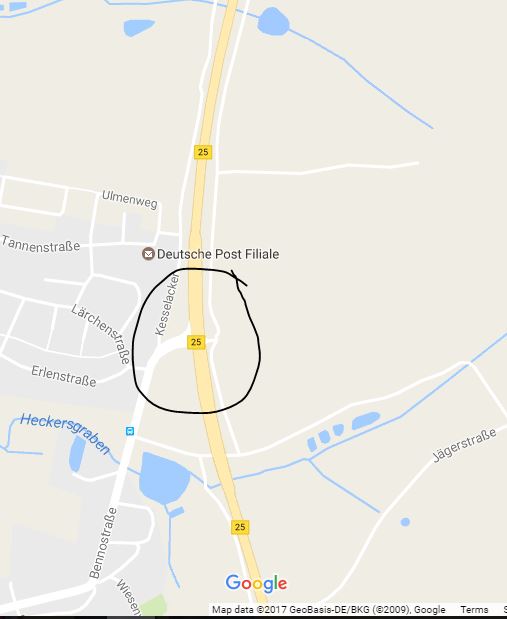
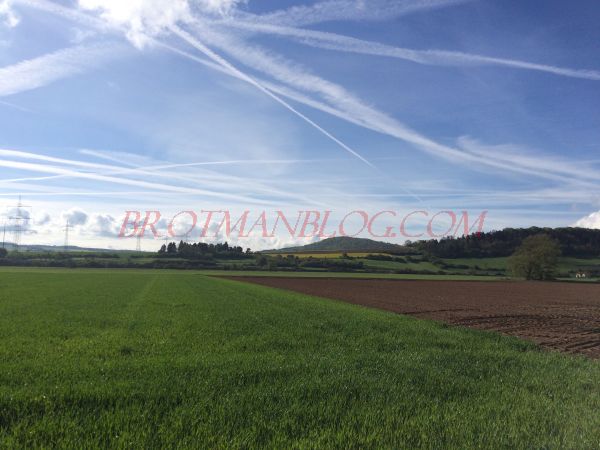
Site of the accident
Two policemen arrived—young men who spoke English fluently and who were extremely friendly and pleasant. They spent several minutes first talking to the other driver—in German, so we had no idea what was said. Then they approached Harvey and told him, without asking him what happened, that he had failed to yield and had violated the traffic law, and there was a penalty of 150 Euros.
We were flabbergasted. How could we be at fault when we were hit from behind? And we had definitely not only yielded at the intersection—-we had made a full stop because we wanted to be sure we knew where we were going. But it was clear that there was no point in arguing with the policemen and the other driver.
The police told us to follow them back to the station in Dinkelsbuhl (about eight miles out of our way), where Harvey signed papers in German that were not explained to him and paid the fine. Meanwhile, I was trying to get Hertz on the phone to find out what we needed to do to be sure our insurance contract covered the damage. We had taken out full insurance as part of the rental agreement, so we weren’t worried about the damage to the car, but we did want to be sure that we followed the right protocol.
But no one answered the phone at the Heidelberg office; no one answered the phone on the Hertz emergency line. We called Hertz in the US, and they had no answers. So we were both now exasperated, annoyed, and frustrated. So much for being relaxed!
Fortunately, the rest of our trip to Heidelberg went smoothly. We arrived in Heidelberg probably around 6:30, 6:45. The Hertz office was closed, so we left the car, the police report, and the keys, hoping that we had done all we needed to do. And we put it all behind us, determined to enjoy those last three days.[1]
And we did. Our taxi dropped us off at the Hotel Villa Marstall, a small European-style hotel right on the Neckar River. Our room was beautiful with a lovely view looking over the river. The receptionist downstairs suggested a sushi place for dinner, and it was just perfect. Casual, good Japanese beer, great sushi. We were able to move beyond the stress of the accident.
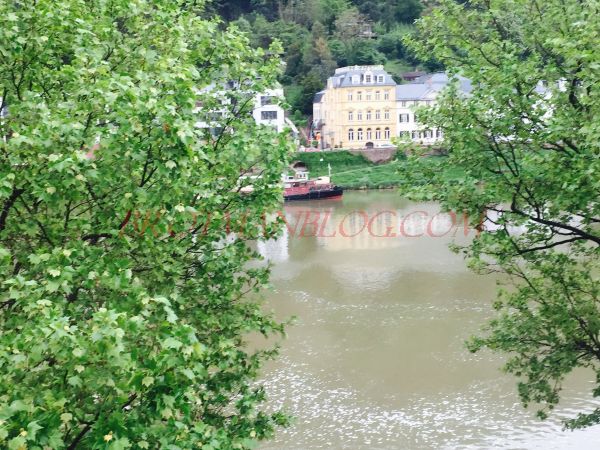
Views from our room at the Hotel Villa Marstall


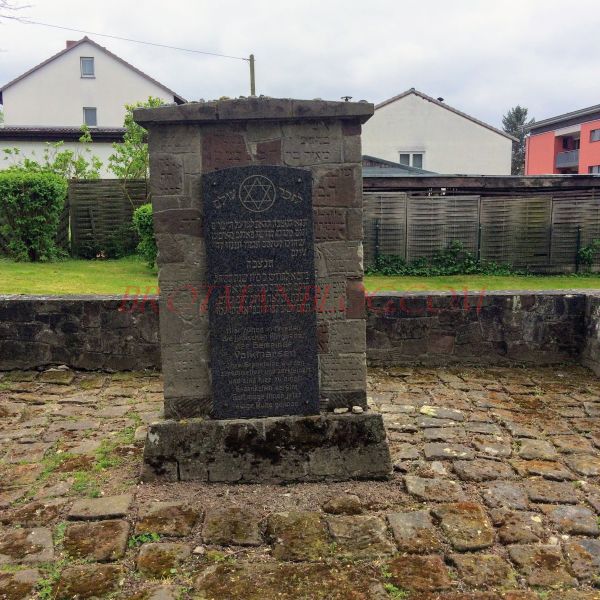
As we walked back to our hotel after dinner, I noticed a few people standing on an open plaza right in front of the door to our hotel. There was a stone block that they were reading at the end of the plaza, and as I looked at it from a distance, I noticed that there was Hebrew lettering. I walked over and read that the plaza marked the location of the former Heidelberg synagogue, which was, like so many hundreds of others in Germany, destroyed on Kristallnacht. The next morning when we left the hotel, we saw that the perimeter of the former synagogue had been outlined in white marble stones placed into the plaza.

Marker for former Heidelberg cemetery
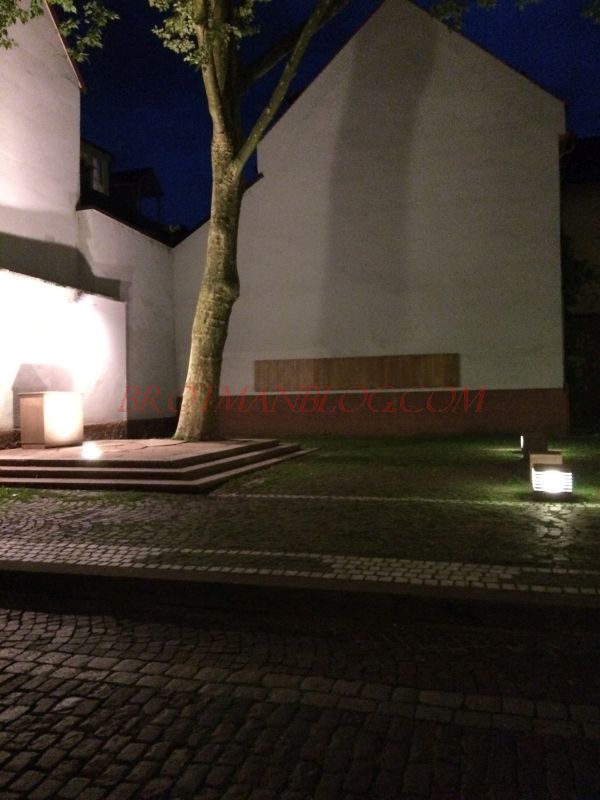
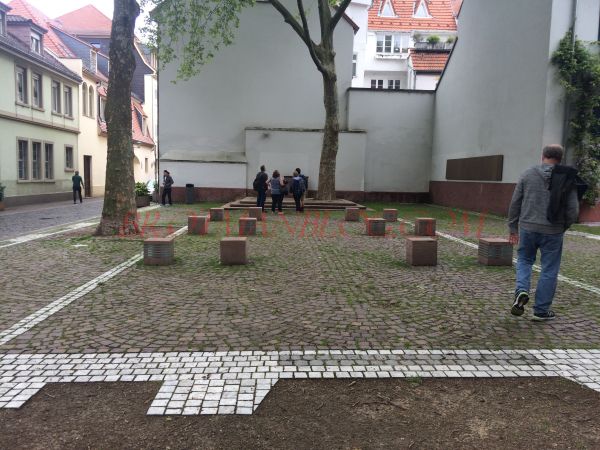
As you can see from the two images below (plaques at the site of the former synagogue), Jews had a long history in Heidelberg:

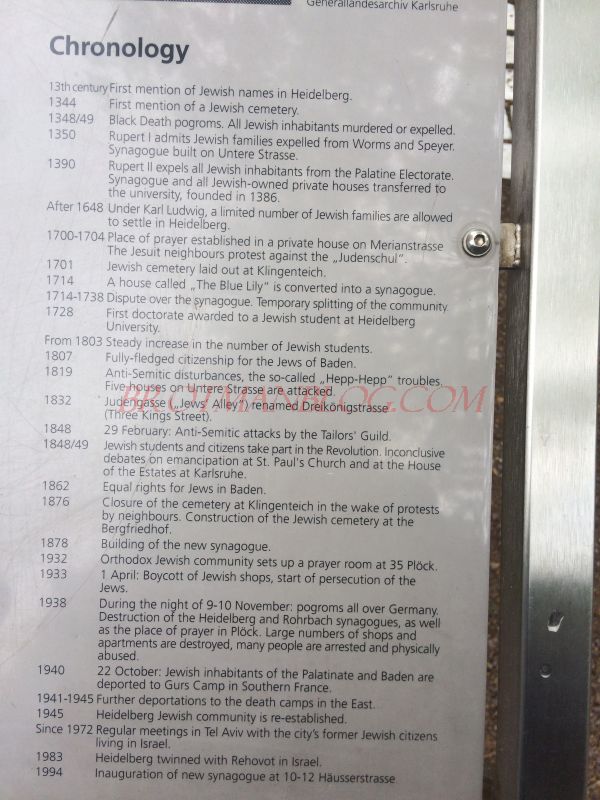 As in every place we visited in Germany, there are markers to remind everyone that there was once a Jewish community here and that it had been destroyed. We had picked the hotel without knowing anything about the location of the former synagogue. It felt rather eerie and yet comforting that we were staying right next to it. It was also comforting to know that there is now a new synagogue in Heidelberg.
We spent our first morning in this gorgeous city doing a self-guided walking tour of the Altstadt, the old city. First we walked through Universitatplatz, the part of the old city where there are many buildings of the University of Heidelberg. The university was founded in 1386, making it the oldest university in Germany; today there are 30,000 students studying at the university. As in Wurzburg, the student population gives the city a young and vibrant feel.

Reading the map
The university’s church is Peterskirche (St. Peter’s); it is even older than the university as it was built in the late 12th century and expanded in the 14th century. It has been the university church since 1896.

Peterskirche in the distance
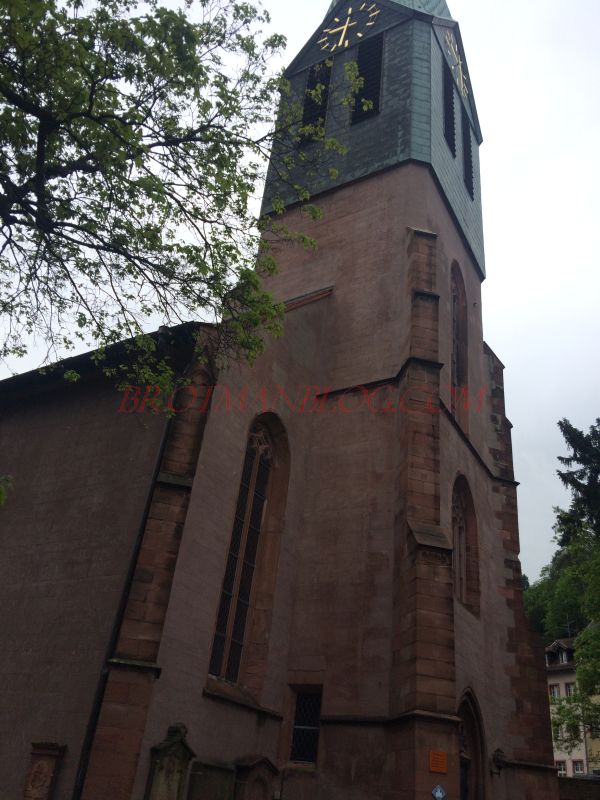
Peterskirche in Heidelberg


Perhaps the most impressive and eye-catching university building we saw was the library; it is truly magnificent. It was built between 1901 and 1905.
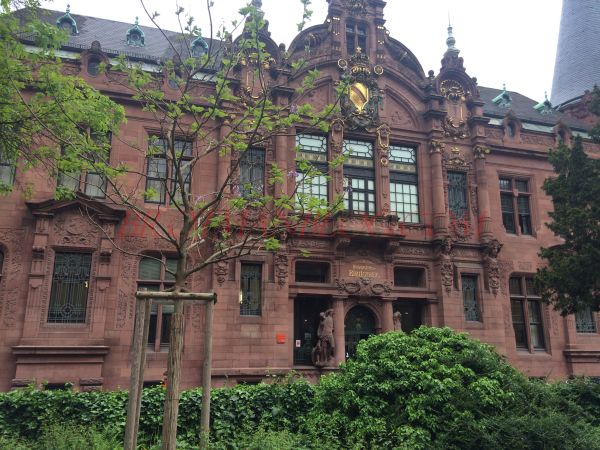
University library

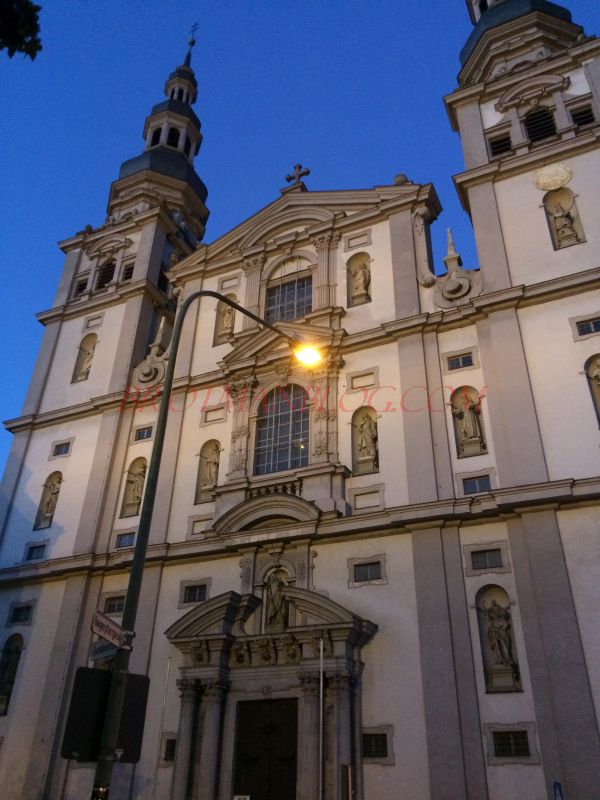
Across from the library was the Jesuit Church with its striking white interior. It was built in the 18th century, with a tower added in the 19th.
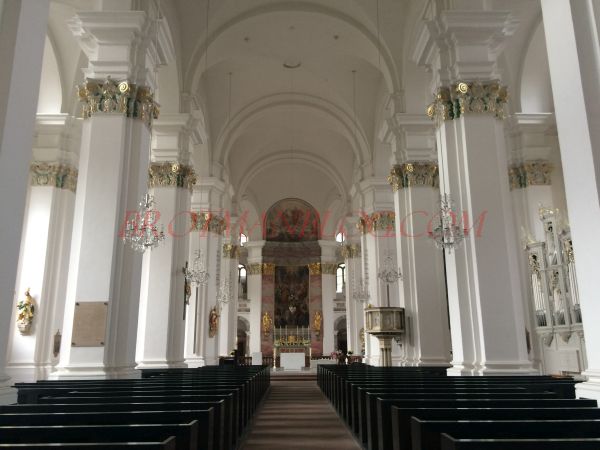
Jesuit Church interior

Jesuit Church exterior
We then walked through the old city, passing other university buildings and along narrow winding streets to the main market square in Heidelberg. The Church of the Holy Spirit, which was started in the 14th century but took 150 years to complete, dominates the square. The market square itself is framed by the former homes of wealthy merchants, whose wealth is quite apparent from the large and elaborate homes. Today these are mostly hotels, restaurants, and stores.

Church of the Holy Spirit

Former merchant’s home

Another former merchant’s home

Market square
And as in almost every place we visited, there were stolpersteine:

We strolled further through the old city and then headed back to our hotel to meet Ulrike for lunch. As I noted above, Ulrike’s husband Torsten is my fourth cousin, once removed. His great-great-grandmother was Ziborah Schoenfeld, sister of Babetta Schoenfeld, my three-times great-grandmother. Babetta married Moritz Seligmann of Gau-Algesheim, my three-times great-grandfather. Babetta and Ziborah were daughters of Bernard Schoenfeld and Rosina Goldmann, my four-times great-grandparents. They grew up in Erbes-Budesheim, a small town just 40 kilometers from Gau-Algesheim. (One of my few regrets about the trip was not getting to Erbes-Budesheim, but time just ran out.)
Ulrike was the genealogist in the Michel family, and she and I had been in touch several years ago, but had then fallen out of touch. I had emailed her right before the trip, and she was excited to meet me and drove to Heidelberg to have lunch with us. We had a lovely lunch together, and Ulrike shared with us her recent discovery of her husband’s cousins on the Michel side (not my side) in Israel. She was very excited about meeting these people, and it was a wonderful genealogy success story.
After lunch we invited Ulrike to join us for a walk up Philosopher’s Way on the other side of the river. Philosopher’s Way is a path (actually a paved road in large part) that winds up the hills where it is said faculty and students from the University of Heidelberg would stroll while contemplating scholarly matters. There is a snake path that is usually open to climb to (or from) the path, but it was closed for safety reasons while we were there.
So instead Ulrike, Harvey and I walked along the river, crossed over at a bridge, and then found the entrance to Philosopher’s Way and started climbing. And it was steep and long. Longer and steeper than we had expected. But we were determined to get to the top. And when we did, we were rewarded with spectacular views of Heidelberg across the river.

Walking up Philosopher’s Way with Ulrike

At the top of Philosopher’s Way

View of Heidelberg from the top of Philosopher’s Way
Soon after we reached the top, it started raining. It had been sunny and beautiful, and none of us was prepared for rain. We stood under a tree for a bit, but then decided we had to keep moving despite the rain. But we weren’t sure which way to go—retrace our steps or go forward and find another way down? We (well, Ulrike) asked several people who kept telling us that if we went further, there was a way down that would bring us closer to the location of our hotel across the river. So we went ahead.
But the “other way down” never appeared, and finally Harvey said we should just turn back. Ulrike was determined to find the other route down, but we were growing increasingly skeptical of its existence. So we divided up—Ulrike moving on, Harvey and I turning back from where we’d come.
A few minutes after dividing up, the rain intensified. Harvey and I stopped at a little covered pavilion on the side of the path to wait for the rain to let up. Within another few minutes, my cell phone rang. It was Ulrike—she had decided to turn around after learning that the “other way down” would bring her even further from the bridge across the river.
We waited for her, all having a good laugh at our misadventures on the so-called Philosophers Way. I don’t think any of us had one serious intellectual thought throughout our entire walk! But it was worth the climb, and the extra time we got to spend with Ulrike was wonderful.

Going back down
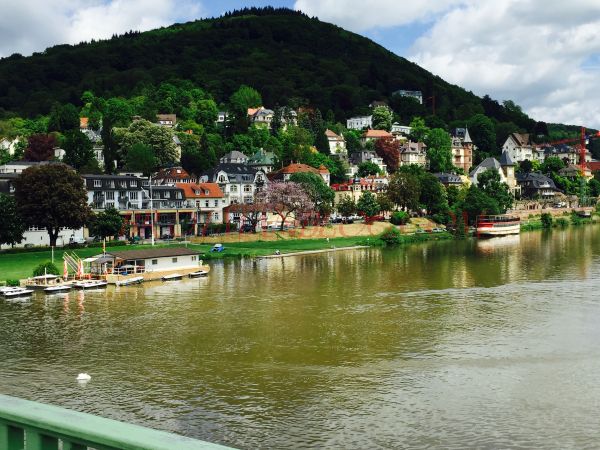

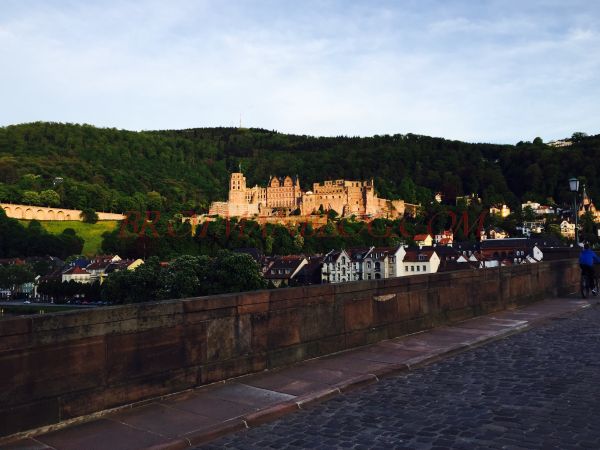

Once back near our hotel, we said goodbye to our new friend and cousin. It had been a full and interesting and fun day. Heidelberg was exceeding our expectations as a good final stop on our journey through Germany. We had two days left—one in Worms and then a final day in Heidelberg.
[1][1] As it turns out, we are still dealing with Hertz on this matter. VERY annoying…





































































 Brotmanblog: A Family Journey