Selig Goldschmidt, Part II, 1867-1887: Weddings and Grandchildren

By 1867, Selig and Clementine (Fuld) Goldschmidt had six children, five girls and one boy, and were living comfortably in Frankfurt, Germany, where Selig owned a successful art and antique business.

Selig was adored by his family and also by many in the Frankfurt community, as his son Meyer Selig Goldschmidt wrote in the preface to the Selig Goldschmidt book:1

My father had a tall, wonderful figure and a distinguished bearing. He was full of energy and creativity. His participation was sought everywhere. Be it our community, business activities, public organization or for the benefit of an individual, he attended every cause with great warmth and without losing his cheerful manner and inner calm. His actions personified his frequent quote, “If you want to be happy, try to make others happy and glad.” Both in the home and outside he was the focal point—honoured, respected and loved. Wherever he went he was soon surrounded by friends and admirers, happy to join his circle.

In a later chapter in the Selig Goldschmidt book, “The Emerging Personality,” Meyer further elaborated on his father’s personality:2

A flourishing wit and a refreshing sense of humour developed in him and made him the natural centre of any pleasant social gathering. Above all, for his close family this cheerfulness became a true comfort and refuge. His ability to pacify, to heal and reduce any pain and to sympathise with all suffering, whether due to serious and oppressive anguish of adults, or insignificant troubles which appeared overwhelming in children. At all times he showed himself as a brave and cheerful master of worldly matters and fateful events.

Meyer’s words describe a man who was a much-adored father, and his role in the lives of his children did not end when they married. He then took on caring about their spouses and the grandchildren who followed as well as the widow and children of his brother Jacob. That is reflected in the many letters Selig wrote to his children after they had left home and started families of their own.

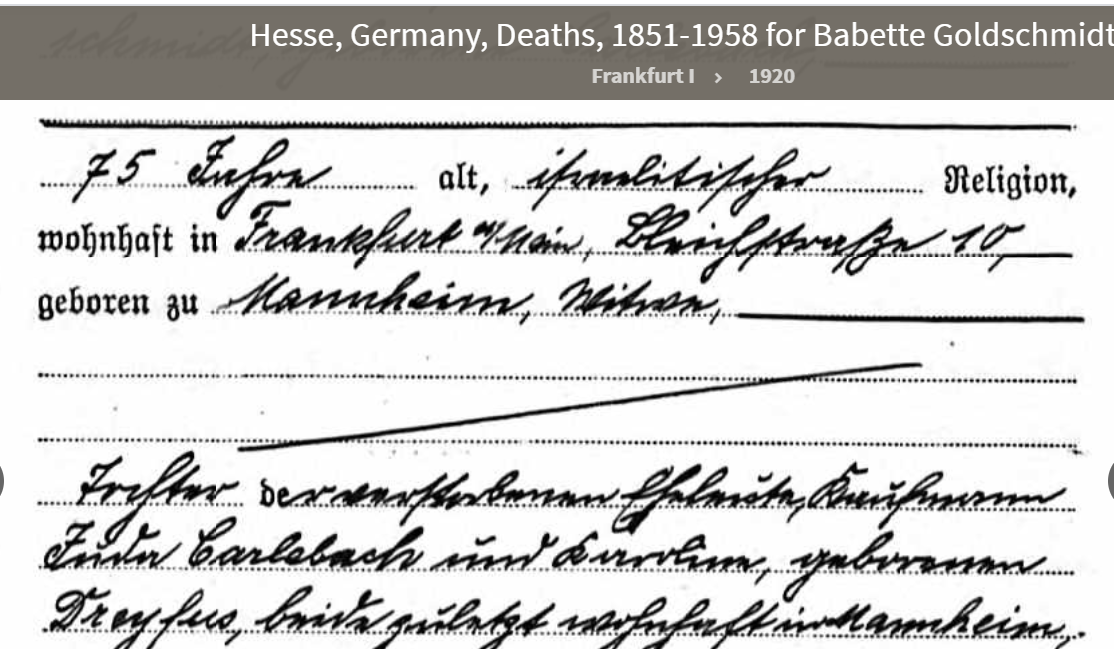
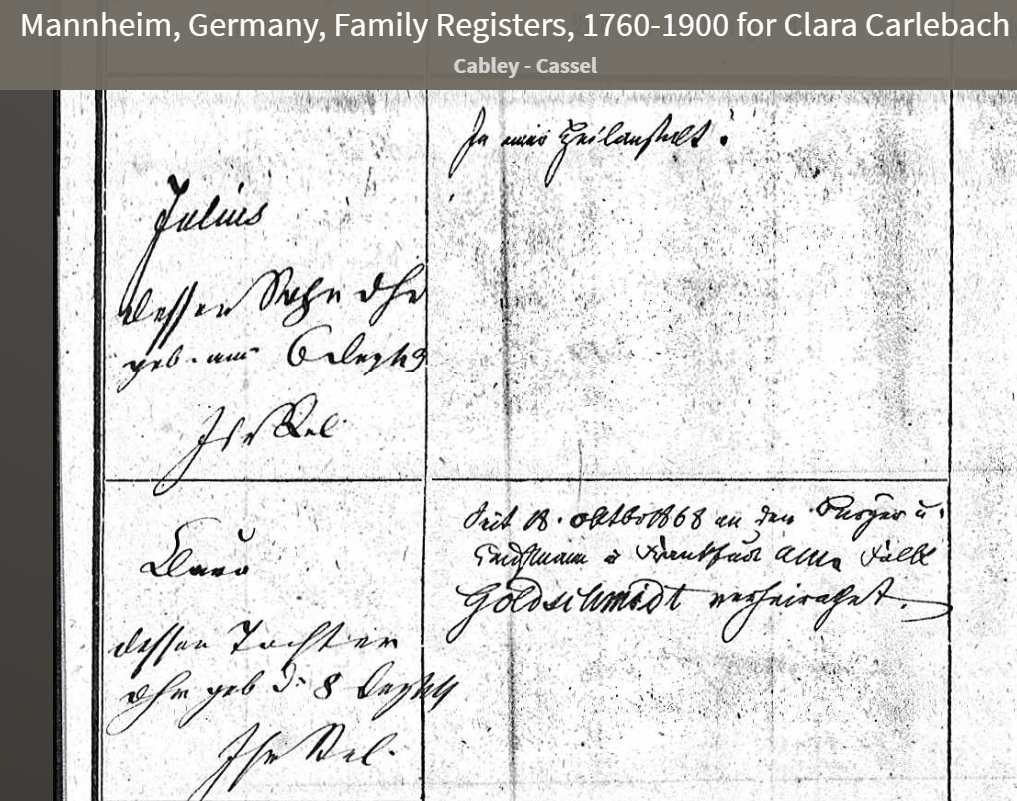
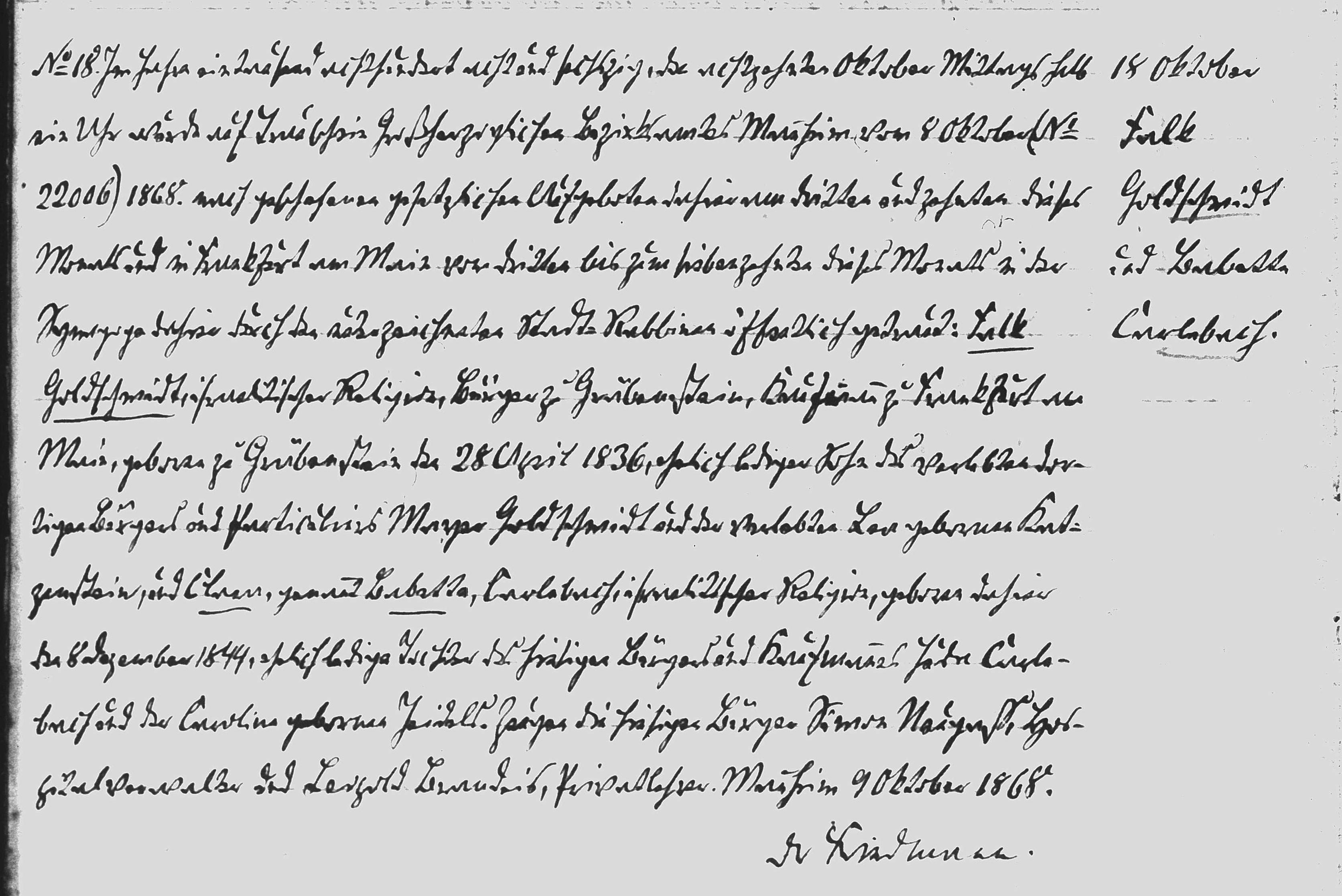
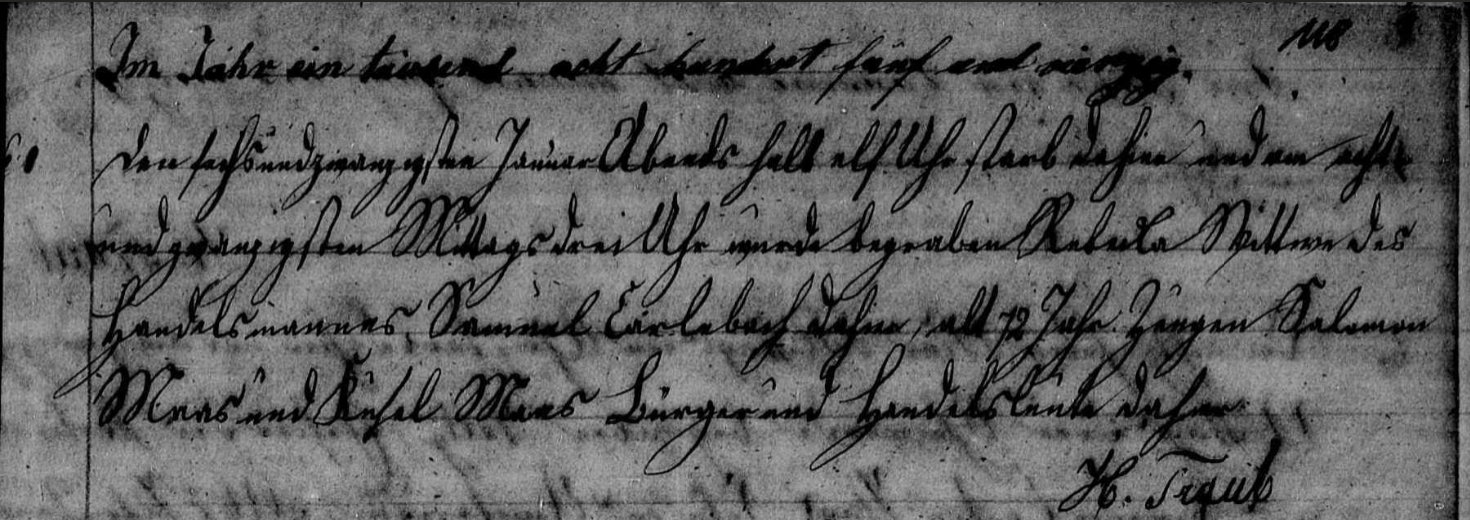
By the beginning of 1888, all of Selig and Clementine’s daughters were married and had children. Helene, the oldest child, was the first to marry. She married Leon Tedesco on June 9, 1876, in Frankfurt. Leon was born in Paris, France, on February 1, 1853, to Jacob  Tedesco and Therese Cerf. He was, like the Goldschmidts, an art dealer, his family owning Tedesco Freres, a famous and important art gallery in Paris. 

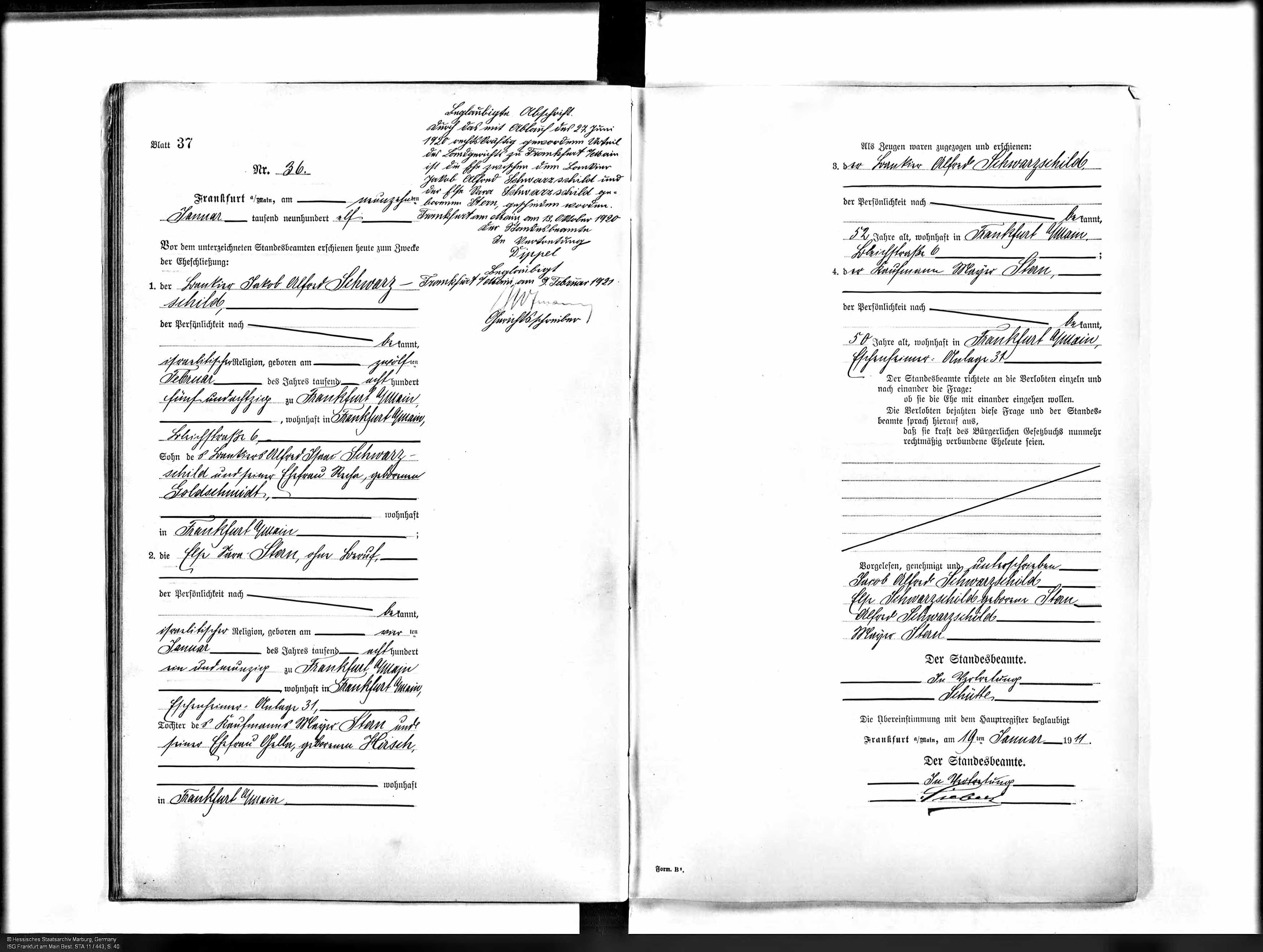
Helene Goldschmidt marriage record, roll: 31067_04G024
Ancestry.com. Paris, France & Vicinity Marriage Banns, 1860-1902

Helene Goldschmidt marriage record, Certificate Number: 578
Hessisches Hauptstaatsarchiv; Wiesbaden, Deutschland
Ancestry.com. Hesse, Germany, Marriages, 1849-1930

Helene and Leon would have one child, a son Giacomo born in Paris on July 28, 1879.3

Flora Goldschmidt was the next to marry; she married Emil Schwarzchild on March 22, 1878, in Bornheim, Germany, a district of Frankfurt. Emil was also a native of Frankfurt, born there on March 16, 1856, to Emanuel Schwarzschild and Rasel Frenkel.

Flora Goldschmidt marriage record, Hessisches Hauptstaatsarchiv; Wiesbaden, Deutschland Description Year Range: 1878 Source Information Ancestry.com. Hesse, Germany, Marriages, 1849-1930

Flora and Emil’s first child Siegfried was born January 21, 1879, in Frankfurt.

Siegfried Schwarzschild birth record, Hessisches Hauptstaatsarchiv; Wiesbaden, Deutschland; Bestand: 903; Signatur: 903_8927
Ancestry.com. Hesse, Germany, Births, 1851-1901

Their second child Helene Schwarzschild was born April 20, 1882, in Frankfurt.

Helene Schwarzschild birth record, Hessisches Hauptstaatsarchiv; Wiesbaden, Deutschland; Bestand: 903; Signatur: 903_8968
Ancestry.com. Hesse, Germany, Births, 1851-1901

For a while I thought they’d only had those two children. But then I found a letter in the Selig Goldschmidt book that suggested there was a third child. On August 14, 1882, Selig wrote to Flora and Emil from Marienbad which ends, “Kiss Siegfried, Helenchen, and Rosa for me, as well as all relatives and friends.” 4 Siegfried was three, Helene a few  months old. But who was Rosa?

I searched for other children of Flora and Emil, and sadly I did find one, but she could not have been the Rosa mentioned in Selig’s letter because her name was Martha, and she wasn’t born until December 21, 1886, four years after Selig wrote the letter. Tragically, Martha died at age two on June 6, 1889, in Frankfurt.

Martha Schwarzschild death record, Personenstandsregister Sterberegister; Bestand: 903; Signatur: 10422, Ancestry.com. Hesse, Germany, Deaths, 1851-1958

So who was Rosa? Perhaps she was Hedwig’s daughter Rosa, who was born, as we will now see, on March 16, 1881. Or perhaps she was just another Rosa who happened to be with Flora and Emil at that time. Maybe Selig was referring to Flora’s mother-in-law, Rasel Frenkel Schwarzschild? I don’t know.

One other possible clue is in another letter written by Selig, this one on February 25, 1883, from Paris, where he was visiting Helene, Leon, and Giacomo Tedesco. It’s a letter to his daughter Hedwig and her husband (here referred to as Hermann, otherwise known as Hirsch), wishing Hedwig a happy birthday. In that letter, Selig wrote, “I hope that dear Flora and Emanuel have found comfort. I have often thought of them and felt for them, but whatever G-d does is good.” 5 I assume that he is referring to his daughter Flora and that Emanuel must be a reference to Emil, perhaps his Hebrew name. And it certainly sounds like Flora and Emil/Emanuel suffered a loss. Had the child Rosa referred to in the August 1882 letter died between that date and February 25, 1883?

If so, I have not been able to locate either a birth or a death record for that child.

Selig and Clementine’s third daughter Hedwig married Hirsch (Hermann) Cramer on March 5, 1880, in Bornheim, Germany. Hirsch was the son of Jakob Cramer and Karoline Fuerth and was born in Thundorf, Germany, on October 12, 1852.

Hedwig Goldschmidt marriage record, Hessisches Hauptstaatsarchiv; Wiesbaden, Deutschland, Ancestry.com. Hesse, Germany, Marriages, 1849-1930

Hedwig and Hirsch had five children, four before 1888. Rosa was born in Frankfurt on March 16, 1881.

Rosa Cramer birth record, Hessisches Hauptstaatsarchiv; Wiesbaden, Deutschland; Bestand: 903; Signatur: 903_8954
Ancestry.com. Hesse, Germany, Births, 1851-1901

Max (Meier) was born on September 4, 1882, in Frankfurt.

Max Cramer birth record, Hessisches Hauptstaatsarchiv; Wiesbaden, Deutschland; Bestand: 903; Signatur: 903_8970
Ancestry.com. Hesse, Germany, Births, 1851-1901

Salomon (Sally) was born June 22, 1884, in Frankfurt.

Sally Cramer birth record, Hessisches Hauptstaatsarchiv; Wiesbaden, Deutschland; Bestand: 903; Signatur: 903_8994
Ancestry.com. Hesse, Germany, Births, 1851-1901

Caroline (known as Lena) was born June 8, 1886, in Frankfurt.

Caroline Cramer birth record, Hessisches Hauptstaatsarchiv; Wiesbaden, Deutschland; Bestand: 903; Signatur: 903_9018
Ancestry.com. Hesse, Germany, Births, 1851-1901

The fourth daughter of Selig and Clementine, Recha, married Alfred Schwarzchild on October 21, 1881, in Bornheim. Alfred was born in Frankfurt on May 14, 1858, to Isaac Schwarzchild and Rosalie Kulp. One question I’ve not been able to answer is whether Alfred was related to his brother-in-law Emil, husband of Recha’s sister Flora. They had different fathers and different grandfathers and different great-grandfathers, so if they were related they were at best third cousins.

UPDATE: Thank you to my cousin Alan Philipp, who had a Schwarzschild family tree and traced both Emil and Alfred to their mutual great-great-grandfather Jakob Schwarzschild, making Emil and Alfred third cousins. I’d been unable to get back to Alfred’s great-great-grandfather, and that proved to be the mutual ancestor for them both.

Recha Goldschmidt marriage record, Hessisches Hauptstaatsarchiv; Wiesbaden, Deutschland, Ancestry.com. Hesse, Germany, Marriages, 1849-1930

Recha and Alfred had two sons by 1888. Jacob Alfred Schwarzschild was born on February 12, 1885, in Frankfurt.

Jacob Alfred Schwarzschild birth record, Hessisches Hauptstaatsarchiv; Wiesbaden, Deutschland; Bestand: 903; Signatur: 903_9003, Ancestry.com. Hesse, Germany, Births, 1851-1901

His brother Robert Meier Schwarzschild was born August 7, 1886, in Frankfurt.

Robert Meier Schwarzschild birth record, Hessisches Hauptstaatsarchiv; Wiesbaden, Deutschland; Bestand: 903; Signatur: 903_9019
Ancestry.com. Hesse, Germany, Births, 1851-1901

Johanna, the fifth and youngest daughter of Selig and Clementine, married her first cousin Abraham Stern on June 24, 1887, as discussed here, and they had five children, also already discussed.

Thus, by the beginning of 1888, all five of Selig and Clementine’s daughters were married and had children. Selig and Clementine had been blessed with numerous grandchildren from their five daughters.

But then on March 22, 1888, the family suffered a major loss. More on that in my next post.


  1. “Preface,” Selig Goldschmidt: Picture of A Life (1996, Elmar Printers Ltd. and Bezalel Bookbinders, Jerusalem, Israel)(limited edition of 300 copies), pp. 4-5. Selig had lost his brother and business partner Jacob Meier Goldschmidt on January 20, 1864, when Jacob died at age 39, as I wrote about here
  2. “The Emerging Personality,” Selig Goldschmidt: Picture of A Life (1996, Elmar Printers Ltd. and Bezalel Bookbinders, Jerusalem, Israel)(limited edition of 300 copies), p. 26. 
  3. David Baron and Roger Cibella, Goldschmidt Family Report. 
  4. Selig Goldschmidt: Picture of A Life (1996, Elmar Printers Ltd. and Bezalel Bookbinders, Jerusalem, Israel)(limited edition of 300 copies), p. 41. 
  5. Selig Goldschmidt: Picture of A Life (1996, Elmar Printers Ltd. and Bezalel Bookbinders, Jerusalem, Israel)(limited edition of 300 copies), p. 42. 

Selig Goldschmidt, Part I: Loving Son, Husband, and Father

If you have a really, really good memory and have been reading this blog for over a year, you may remember that back in October 2019—before COVID!—I wrote my first blog post about my 4x-great-uncle, Meyer Goldschmidt, and relied heavily as a source of information about Meyer and his family on a book created in honor of his son Selig Goldschmidt.

The book, Selig Goldschmidt: A Picture of A Life,  was published in Israel by Selig’s descendants in 1996 (hereinafter referred to as the Selig Goldschmidt book),1 and it includes remembrances, letters, and obituaries that were originally compiled by Selig’s son Meyer and that were then translated from German to English by the later generation in order to preserve and honor the memory of Selig Goldschmidt.

Last year I relied on the Selig Goldschmidt book to tell the story of Selig’s parents, Meyer Goldschmidt and Lea Katzenstein, and about the childhood of Selig and his siblings, but now I am returning to the book to focus more exclusively on what it reveals about Selig himself as he grew from a child and spent his adult life in Frankfurt, Germany.

First, some background. Selig was born on March 16, 1828, in Grebenstein, Germany, the fifth child and second son of his parents Meyer and Lea. (I have already written about the first four: Ella, Sarah, Jacob, and Amalie.)

Selig Goldschmidt birth record, Arcinsys Hessen, HHStAW, 365, 375 Jüdische Personenstandsregister von Grebenstein: Geburtsregister der Juden von Grebenstein, p. 36

As described in the book, the family was quite poor when Selig was a child, and his father Meyer suffered from poor health, exacerbating the precariousness of their financial position. Then Selig’s mother Lea Katzenstein Goldschmidt died on September 28, 1839 (after having given birth to two more sons after Selig, Joseph, who died when he was six in 1836, and Falk, who was born in 1836). Selig was only eleven years old, and as I wrote about here, he and his siblings had to take on a lot of responsibility for each other and for the youngest sibling, Falk, who was only three.

Once the older siblings began to marry and have households of their own, the financial pressure was reduced. After the youngest sister Amalie married Juda Katzenstein in 1853 and her father Meyer moved with them to Eschwege, Selig and his brother Jacob sold the family home in Grebenstein and moved to Frankfurt,2 where the two brothers established the firm J&S Goldschmidt, which grew to be one of the most famous and successful art and antique dealerships in Germany and perhaps in Europe. More on that to come. But it’s important to remember that Selig and his siblings grew up in poverty before building their business to what must have been unimaginable success.

According to the civil record below, on May 27, 1857, Selig married Clementine Fuld in Frankfurt. She was born in Frankfurt on January 8, 1837, to Herz Fuld and Caroline Schuster, and, as I noted in my prior post, she was the sister of Salomon Fuld, who would later marry Selig’s niece Helene Goldschmidt, daughter of Selig’s brother Jacob Meier Goldschmidt.

Marriage of Selig Goldschmidt and Clementine Fuld, Certificate Number: 30
Hessisches Hauptstaatsarchiv; Wiesbaden, Deutschland
Ancestry.com. Hesse, Germany, Marriages, 1849-1930

However, it appears that Selig and Clementine had been married under religious law nine months earlier. The Selig Goldschmidt book includes a facsimile of their ketubah as well as a translation in English of their marriage contract, and it indicated that they were married on August 20, 1856.3

A letter written by Selig to Clementine on August 31, 1856, reveals that this was a love match; it also suggests how busy Selig was and how often he had to travel for work. Selig, who was away on business in Dinkelspiel at that time, wrote in part:4

Dearest Clementine

I have received your most welcome letter just after my arrival here. [He then described how he spent Shabbos in Dinkelspiel.]… The afternoon passed pleasantly in conversation until after the evening service in the synagogue when I was alone once again. I missed you very much, dear Clementine, and would have gladly paid a lot of money in exchange for half an hour’s conversation with you, if that could have been instantly arranged. Since that was impossible, I did the same as Friday night and went to bed at eight o’clock. I dreamed I was with you, dear Clementine, and I had such a pleasant talk with you and was so happy to be near you that the time passed very quickly. [Selig then wrote that he would be delayed returning to Frankfurt because of business.] … However, early in the following week, please G-d, the happy day of our reunion will arrive. Then, dear Clementine, we will enjoy ourselves and chat enough to compensate for everything we have missed. Yet that joy can only last for two or three days because then I must set out on my journey to Leipzig. Thus man’s happiness is always limited, just as his existence is only brief. However, of what use is such nonsense? After all, that is part of my occupation and you yourself have told me not to neglect my business. We must utilize properly the short time allotted to us, for such is life! If only one would use this time assigned to oneself well, surely the whole world would be a happier place. …

Dear Clementine, please accept sincere greetings and kisses from your affectionate and faithful

               Selig

Selig and Clementine had six children—five daughters and one son, all born in Frankfurt. First born was Helene, born on February 28, 1858.

Helene Goldschmidt birth record, Hessisches Hauptstaatsarchiv; Wiesbaden, Deutschland; Bestand: 903; Signatur: 903_8812, Ancestry.com. Hesse, Germany, Births, 1851-1901

A year later Flora was born on March 17, 1859.

Flora Goldschmidt birth record, Hessisches Hauptstaatsarchiv; Wiesbaden, Deutschland; Bestand: 903; Signatur: 903_8814, Ancestry.com. Hesse, Germany, Births, 1851-1901

Hedwig was born two years later on February 27, 1861.

Hedwig Goldschmidt birth record, Hessisches Hauptstaatsarchiv; Wiesbaden, Deutschland; Bestand: 903; Signatur: 903_8818
Ancestry.com. Hesse, Germany, Births, 1851-1901

And Recha followed two years after Hedwig. She was born on June 11, 1863.

Recha Goldschmidt birth record, Hessisches Hauptstaatsarchiv; Wiesbaden, Deutschland; Bestand: 903; Signatur: 903_8824
Ancestry.com. Hesse, Germany, Births, 1851-1901

Selig and Clementine’s only son Meyer Selig Goldschmidt was born on October 6, 1865. He was obviously named for his grandfather Meyer.

Meyer Selig Goldschmidt birth record, Hessisches Hauptstaatsarchiv; Wiesbaden, Deutschland; Bestand: 903; Signatur: 903_8830
Ancestry.com. Hesse, Germany, Births, 1851-1901

The last child, Johanna, was born on December 18, 1867. Johanna grew up to marry her first cousin Abraham Stern, the son of Selig’s sister Sarah, and her story has already been told in great detail when I wrote about Abraham and their family so I will not tell it again.

Johanna Goldschmidt birth record, Hessisches Hauptstaatsarchiv; Wiesbaden, Deutschland; Bestand: 903; Signatur: 903_8837
Ancestry.com. Hesse, Germany, Births, 1851-1901

In the preface to the Selig Goldschmidt book, Selig’s son Meyer described what his childhood was like and how the family was bound in love:5

The ideals of children, grandchildren and the wider family circle were all in tune; thus an incomparable, blissful harmony prevailed in our family. It was constantly sustained by love, affection and enthusiasm for all that is noble and good which emanated from the head of our family. Before meals on Friday evening in winter and on Shabbos evenings after the meal, a large number of the more distant family would assemble in our home. There were so many people that it is difficult to understand, in view of the relatively small size of the rooms, how comfortable and happy everyone felt. It may have been due to a certain simplicity which was deliberately cultivated there. In the main room a big bowl of fruit stood on the table at which we sat, and anyone who wished could help himself.

Imagine if all children were as blessed as the six children of Selig Goldschmidt and Clementine Fuld and able to grow up surrounded by so much joy and love.

This portrait of Selig and Clementine’s children appears on page 37 of the Selig Goldschmidt book. It appears to have been taken in 1872 based on the ages of the children (the daughters are identified by their married names).

Selig Goldschmidt’s children


  1. Selig Goldschmidt: Picture of A Life (1996, Elmar Printers Ltd. and Bezalel Bookbinders, Jerusalem, Israel)(limited edition of 300 copies) 
  2. “The Story of A Ring,” Selig Goldschmidt: Picture of A Life (1996, Elmar Printers Ltd. and Bezalel Bookbinders, Jerusalem, Israel)(limited edition of 300 copies), p.22 
  3. “The Man,” Selig Goldschmidt: Picture of A Life (1996, Elmar Printers Ltd. and Bezalel Bookbinders, Jerusalem, Israel)(limited edition of 300 copies), pp. 34-39 
  4. “The Man,” Selig Goldschmidt: Picture of A Life (1996, Elmar Printers Ltd. and Bezalel Bookbinders, Jerusalem, Israel)(limited edition of 300 copies), pp. 32-33. 
  5. “Preface,” Selig Goldschmidt: Picture of A Life (1996, Elmar Printers Ltd. and Bezalel Bookbinders, Jerusalem, Israel)(limited edition of 300 copies), pp. 4-5. 

Was Moritz Oppenheimer Forced by the Nazis to Divorce His Wife and Declare Bankruptcy?

I have written several posts about my cousin, Moritz Oppenheimer, the nephew of my great-great-grandfather Bernard Seligman. Moritz was an extremely successful business owner and also racehorse breeder and owner who ended up committing suicide as a result of the persecution he experienced by the Nazis.

Emma Neuhoff and Moritz James Oppenheimer
photo courtesy of Angelika Oppenheimer

My cousin Wolfgang Seligmann recently discovered additional information about Moritz and his family, including an application filed in 1966 in Wiesbaden by Moritz Oppenheimer’s widow Emma Neuhoff, seeking compensation for the harm done to her husband and the financial losses suffered.

Emma Neuhoff Oppenheimer 1966 application for reparations

In reviewing those documents (with invaluable help from Wolfgang), I focused on two questions that had been raised by readers who commented on my earlier posts about Moritz Oppenheimer. First, were Moritz and his non-Jewish wife Emma forced to divorce by the Nazis in 1936, or did they choose to divorce? Second, was Moritz forced into bankruptcy by the Nazis in 1933, or were his businesses already failing before the Nazis came to power?

The first question is addressed by the court in its opinion approving the settlement between Emma and the government. The court recognized that Emma and Moritz had only divorced to protect Emma and their two children, who were not Jewish.

Court notes on divorce of Emma and Moritz Oppenheimer in decision approving settlement of Oppenheimer 1966 reparations claim

I used DeepL to translate this language and for the other translations in this post:

The marriage of the applicant with the persecuted person was divorced by judgment of the regional court Giessen 2 R 51/1935 of June 25, 1936 through his fault. In the judgment of the regional court Giessen 4 R 585/50 dated 6 October 1950 it was determined that the divorce judgment was incorrect because the divorce had actually taken place in order to protect the non-Jewish wife and children from persecution — but its legal validity remained unaffected.

With respect to Emma’s application for compensation, the court concluded that even if Emma was no longer legally married to Moritz at the time of his death and thus not technically his widow, she was nevertheless entitled to pursue her claim for compensation for the harm done to her husband and her family.

The applicant is entitled to claim. It can be left open whether she is the widow of the deceased, … or this is treated as a blameless divorced wife.

Thus, Emma and Moritz chose to divorce to protect Emma and their two children. It was a decision based on love, not a lack of it.  Although the Nazis did not require the Oppenheimers to divorce, the circumstances the Nazis created compelled the couple to divorce.

The question regarding the bankruptcy is more complicated. Emma contended that Moritz was forced into bankruptcy by the Nazis when he was arrested in September, 1933, the first of many arrests that eventually drove him to suicide in 1941, as has been described in earlier posts. Emma wrote in the third paragraph of her statement in support of her application for compensation in 1966:

Emma Neuhoff Oppenheimer statement filed in support of her 1966 application for reparations

In the prison in Hammelgasse, my husband was forced to file for bankruptcy on his property. In my opinion, this was pure Nazi harassment. There was never a reason for bankruptcy. The bankruptcy was actually carried out afterwards.

But a man named August Hartmann filed an accusation against Moritz with the Nazi party in which he claimed that Moritz had defrauded a family from Frankfurt out of almost one and a half million Reich Marks;  these fraud claims were never fully litigated because Moritz died before that could happen. Hartmann also claimed that the businesses owned by Moritz were heavily in debt and that Moritz was a flight risk.

Statement of August Hartmann regarding claims against Moritz Oppenheimer

Here is the DeepL translation of Hartmann’s statement:

The well-known industrialist and racing stable owner Consul Moritz Oppenheimer has lived for many years only on credit fraud. In the years 1931 and 1932 he swindled a very respectable Frankfurt family out of the round sum of one and three-quarter million Reichsmark in cash under false pretences. This case is all the more blatant because this amount of money came from assets confiscated during the war in America. That was only released at the end of 1929 and taken to Germany by the family, out of national interest in making this large amount of money available to the ailing German economy.  Despite the fact that this fraudulently damaged creditor has known for half a year now how the finances of Consul Oppenheimer are, he has now refrained from taking radical steps which were in his personal interest, in order not to make more than 250 German workers unemployed. But because of the great expenses of Mr. Consul O., for example maintenance of the Erlenhof Stud Farm, which requires a monthly subsidy of about 15,000, financial conditions have deteriorated to such an extent that bankruptcy is only a question of time, the strong suspicion arises that this Jew wants to run off to a foreign country where he in all probability has stashed a considerable fortune.

It was this letter from August Hartmann that led to the arrest of Moritz Oppenheimer in September 1933 and then to his alleged forced bankruptcy. Thus, Moritz may have been pushed into bankruptcy proceedings, but if Hartmann’s letter is true, Moritz was already in serious financial trouble.

Moritz’s son Walter Oppenheimer, in his affidavit in 1966, admitted that his father had incurred a great deal of debt by 1929, but argued that he would have been able to overcome these financial reversals but for the Nazis. He wrote in part (and translated as best I could, with help from DeepL and Google Translate):

Portion of the letter Walter Oppenheimer filed in support of 1966 reparations claim

If my father’s business got into financial difficulties in the years after 1929, it was because the racing stable required unexpectedly large sums. My father was the founder of the stud and racing stable Erlenhof, which he had also created out of nothing and brought to world fame. The most successful German racehorses were bred at Erlenhof. Erlenhof was also the first German stud farm which was able to export breeding horses to the United States, and to which, for example, the stud farm of the English king sent mares.

The economic crisis at that time hit the paper trade particularly hard, so that the whole industry was in dire straits. But without the advent of National Socialism, my father could have certainly overcome these difficulties perfectly. The President of the Chamber of Industry and Commerce, Honorary Professor Karl Heinrich August Luhr, himself an economic expert of his time, admitted that without the advent of National Socialism, my father could have overcome all the financial difficulties of the time far beyond the borders of Germany, thanks to his organizational gifts and, above all, thanks to his enormous expertise. … So that if a so-called standstill agreement was maintained, the companies could have recovered quickly from the good economic developments that had already begun and had brought large profits. Especially the last months from the middle of 1932 onwards showed this very clearly in the business development of my father’s factories. Professor Luhr also told Mr. Allecke, who was an accountant at the time, very clearly that it was only for political reasons that it became impossible to put things back on a level playing field.

Where the truth lies is impossible to determine. It certainly appears that Moritz was having serious financial troubles before 1933, but were they serious enough to require bankruptcy? Would the business have recovered if he had not been arrested and persecuted by the Nazis? If he had been given more time, could he have turned around his companies’ financial situation?

In the end, the 1966 court approved a settlement that provided Emma with some compensation for the loss of her husband and the suffering he endured as well as for her own economic losses. It was less than what she wanted, but it did recognize that despite the divorce, she was entitled to compensation, implicitly recognizing that they had not freely chosen to divorce. But the settlement did not compensate her for the failure of her husband’s businesses.

Almost twenty years later in 1984, the descendants of Moritz and Emma Oppenheimer filed another claim, this time with the District President in Darmstadt, seeking compensation for the economic damage sustained to the business of Moritz Oppenheimer, according to another set of documents that Wolfgang discovered in the Wiesbaden archives. As Wolfgang explained to me, the Germany government adopted new laws over time that updated the process for obtaining reparations by those who suffered harm because of the Nazis. This new claim was presented under a statute called Bundesentschadeugungsgesetz-Schlussgesetz or Federal Compensation Act-Final Act.

1984 decision on the application for reparations by the heirs of Moritz and Emma Oppenheimer

As with the claim filed back in 1966, this claim for compensation for the financial losses suffered by Moritz’s business was rejected. The district president found that Moritz would not have been able to sell the stables or racehorses to cover his business losses, given the economic conditions of that period and the extent of his business liabiltiies.  Thus, he concluded that the economic damage was not the result of Nazi persecution. In addition, the district president concluded that Moritz’s medical condition disabled him from seeking other employment, not the Nazis, so there would be no compensation for lost income from such potential employment.

Of course, Moritz’s medical condition could very well have been and probably was caused by or at least exacerbated by his arrest and persecution. And no one can know with absolute certainty that he would not have been able to rescue his business but for that arrest and persecution. But at least two different decision-making bodies concluded otherwise and rejected the family’s claims.

Meier Katzenstein: The One Who Left Home

Having discussed the three daughters of Amalie Goldschmidt and Juda Katzenstein—Helene, Fredericke, and Henriette—and their families, we now finally reach their last child and only son, Meier Katzenstein.1  And his story is far different from that of his sisters, all of whom lived almost all their lives in Germany, not far from where they were born in Eschwege, and whose descendants either were killed by or escaped from the Nazis.

Meier was born on August 6, 1860, in Eschwege, as we have seen, but in 1888 he immigrated to the United States, changing the path of his life as well as that of his descendants. According to his passport application (depicted below), he arrived in New York on October 10, 1888, and settled there.

Meier Katzenstein, 1903 passport application, National Archives and Records Administration (NARA); Washington D.C.; Roll #: 623; Volume #: Roll 623 – 13 May 1903-18 May 1903
Ancestry.com. U.S. Passport Applications, 1795-1925

I love the physical description of Meier on his application: five foot seven inches tall, high forehead, light blue eyes, straight nose, small mouth, round chin, blond hair, florid complexion, and a round face. He sounds quite adorable.

Meier married Emma Bacharach in New York on October 27, 1891.2 Emma, the daughter of Jakob Bacharach and Sophia Pfann, was also a recent immigrant. She was born in Mainz, Germany, on July 5, 1869,3 and came to the US on November 5, 1889, accompanied by someone named Isaac Bachrach who was 48 years old. I’ve not been able to identify Isaac’s connection to Emma, but presumably he was an uncle or cousin.4

Emma and Meier had one child, a daughter Sophia (presumably named for Emma’s mother Sophia Pfann), born on August 19, 1892, in New York.5 Emma must have taken little Sophia back to Germany during her first year to meet her family because I found a ship manifest showing them sailing together from Hamburg to New York in the summer of 1893.

Sophia and Emma Katzenstein, ship manifest, Staatsarchiv Hamburg; Hamburg, Deutschland; Hamburger Passagierlisten; Volume: 373-7 I, VIII A 1 Band 085; Page: 958; Microfilm No.: K_1750, Month: Direkt Band 085 (1 Jul 1893 – 31 Aug 1893), Staatsarchiv Hamburg. Hamburg Passenger Lists, 1850-1934

Meier became a naturalized citizen of the United States on May 4, 1894.

“New York Naturalization Index (Soundex), 1792-1906,” database with images, FamilySearch (https://familysearch.org/ark:/61903/3:1:3QSQ-G937-NSGK-M?cc=2043782&wc=SFCB-HZ9%3A1399296801 : 4 February 2015), Roll 128, K324-K400 (Kutzelmann, Adam J-Klee, Johannes) > image 348 of 5224; citing NARA microfilm publication M1674 (Washington, D.C.: National Archives and Records Administration, n.d.).

In 1900, Meier, Emma, and Sophia were living in New York City with another family. The head of household was Rosenthal (first name not legible); living with him was his wife Ida Rosenthal and their son Julian Rosenthal, two servants, and Meier, Emma, and Sophia.

Meier Katzenstein, 1900 US census, Year: 1900; Census Place: Manhattan, New York, New York; Page: 7; Enumeration District: 0862; FHL microfilm: 1241119, Enumeration District: 0862; Description: City of New York, 31st Assembly Dist; 22nd Election District (pt) bounded by E 129th, Park Ave, E 126th, Madison Ave, Ancestry.com. 1900 United States Federal Census

I was thrown off by this census record because it identifies Emma as the daughter, Sophia as the granddaughter, and Meier as the son-in-law of the head of household.  If Emma’s birth name was Bacharach and her parents were Jakob and Sophia, how could she be the daughter of Ida Rosenthal and her husband? It took a couple of hours to sort out that Ida Rosenthal was born Ida Pfann and was the sister of Sophia Pfann, Emma’s mother. Thus, Emma was Ida Rosenthal’s niece, not her daughter.

Meier’s occupation on the 1900 census is extremely hard to read as it is very faint, but I think I can discern the word “Sales” and perhaps “Linens,” the same occupation listed above for Emma’s cousin Julian Rosenthal. His passport application in 1903, depicted above, is more specific. He listed his occupation there as “manufacturer and importer of embroideries.”

By 1910, Meier and his wife and daughter had their own home in Manhattan, and Meier’s occupation this time is easily read as Manager, Fancy Linens. They also had a servant living with them.

Meier Katzenstein, 1910 US census, Year: 1910; Census Place: Manhattan Ward 12, New York, New York; Roll: T624_1024; Page: 3A; Enumeration District: 0622; FHL microfilm: 1375037
Ancestry.com. 1910 United States Federal Census

The family did some traveling in 1911—to Hong Kong and to Hawaii. Meier must have been doing well in his business, having a servant and traveling to exotic locations.6

His daughter and only child Sophia Katzenstein married Elias Lustig on February 19, 1914, in New York.7 Like Sophia, Elias was a native of New York City, born there on May 31, 1890, and the son of David and Rachel Lustig.8 Elias and Sophia’s first child David Miles Lustig was born on August 22, 1916, in New York.9

Unfortunately, Meier Katzenstein did not live to see the birth of his grandson; on February 20, 1916, at the age of 55, he died in New York City, just six months before his grandson’s birth. My guess is that his grandson’s middle name Miles was in Meier’s memory.10

In his will, Meier left everything to his wife Emma and then to his daughter Sophia in the event Emma did not survive him. Interestingly, he provided that in the event that Emma predeceased him and Sophia was still a minor, his “brother-in-law Max Werner of Eschwege” was to be her guardian. Max was married to Meier’s older sister Helene Katzenstein Werner. But why would Meier have appointed someone living in Germany to be the guardian of his daughter in New York? Imagine how Sophia’s life would have been different if in fact her parents had both died before she reached adulthood and she had moved to Germany?

Meier Katzenstein’s will, Record of Wills, 1665-1916; Index to Wills, 1662-1923 (New York County); Author: New York. Surrogate’s Court (New York County); Probate Place: New York, New York, Notes: Wills, 1021-1023, 1915-1916, Ancestry.com. New York, Wills and Probate Records, 1659-1999

Of course, it all was irrelevant since Emma did not predecease Meier, and Sophia was already an adult when Meier died. In 1920, Emma was living with Sophia and Elias and their son David Miles (listed here as Miles) in New York City. Elias was working as a merchant. 11 In 1921, Sophia and Elias had a second child.

I could not find Emma on the 1930 or 1940 census, but in 1930 Sophia and Elias were living in Queens in 1930 with their children, and Elias was the owner of a hat factory.12 Sometime thereafter, the marriage between Sophia and Elias ended, and in 1936 she married Saul Baron, with whom she and her children were living in New York in 1940. Saul was an attorney in private practice.13

Emma Bacharach Katzenstein died on February 18, 1941, in New York; she was 71.14

Meier Katzenstein’s choice to leave Germany for the United States back in 1888 spared his family the tragedies endured by so many of his relatives back in Europe during the Holocaust, but in one way the actions of Hitler still indirectly inflicted tragedy on his descendants. His grandson David Miles Lustig, named in his memory, was killed during World War II. While returning from a mission over China in early 1945, his plane was shot down, and David drowned in a small river after bailing out of the plane. He was 28 years old and a graduate of Princeton University.15

His mother Sophia Katzenstein Lustig Baron died just nine years later at the age of 58 on November 9, 1950.16  She was survived by her husband Saul Baron, her daughter and grandchild.


Having now covered all the children of Amalie Goldschmidt Katzenstein, I have a few updates to other relatives to write about before turning to Amalie’s younger brothers, Selig and Falk Goldschmidt, the last two children of my 4x-great-uncle, Meyer Goldschmidt.


  1. The spellings of his name vary on different documents between Meyer and Meier,  but I’ve opted to use Meier. 
  2. “New York, New York City Marriage Records, 1829-1940,” database, FamilySearch (https://familysearch.org/ark:/61903/1:1:24HL-R32 : 10 February 2018), Meier Katzenstein and Emma Bacharach, 27 Oct 1891; citing Marriage, Manhattan, New York, New York, United States, New York City Municipal Archives, New York; FHL microfilm 1,452,198. 
  3. Emma Bacharach birth record, Stadtarchiv Mainz; Mainz, Deutschland; Zivilstandsregister, 1798-1875; Signatur: 50 / 72, Year Range: 1869, Ancestry.com. Mainz, Germany, Births, Marriages and Deaths, 1798-1875 
  4. Emma Bacharach, passenger manifest, Year: 1889; Arrival: New York, New York, USA; Microfilm Serial: M237, 1820-1897; Line: 15; List Number: 1524, Ancestry.com. New York, Passenger and Crew Lists (including Castle Garden and Ellis Island), 1820-1957 
  5. New York, New York City Births, 1846-1909,” database, FamilySearch (https://familysearch.org/ark:/61903/1:1:2W9D-B77 : 11 February 2018), Sophia Katzenstein, 19 Aug 1892; citing Manhattan, New York, New York, United States, reference cn 32010 New York Municipal Archives, New York; FHL microfilm 1,322,266. 
  6.  National Archives and Records Administration (NARA); Washington, D.C.; Passenger Lists of Vessels Arriving at Honolulu, Hawaii, compiled 02/13/1900 – 12/30/1953; National Archives Microfilm Publication: A3422; Roll: 031; Record Group Title: Records of the Immigration and Naturalization Service, 1787 – 2004; Record Group Number: RG 85, Ancestry.com. Honolulu, Hawaii, Passenger and Crew Lists, 1900-1959. 
  7.  Sophie Katzenstein, Gender: Female, Marriage License Date: 9 Feb 1914, Marriage License Place: Manhattan, New York City, New York, USA, Spouse: Elias Lustig, License Number: 4135, New York City Municipal Archives; New York, New York; Borough: Manhattan, Ancestry.com. New York, New York, Marriage License Indexes, 1907-2018; Sophie Katzenstein, Gender: Female, Marriage Date: 19 Feb 1914, Marriage Place: Manhattan, New York, USA, Spouse: Elias S Lustig, Certificate Number: 5033, Ancestry.com. New York, New York, Extracted Marriage Index, 1866-1937 
  8.  Elias Lustig, Marital status: Married, Birth Date: 31 May 1890, Birth Place: New York, USA, Street Address: 601 W 162, Residence Place: Manhattan, New York, New York, USA, Registration State: New York; Registration County: New York; Roll: 1786806; Draft Board: 147, Ancestry.com. U.S., World War I Draft Registration Cards, 1917-1918 
  9. David Miles Lustig, Birth Date: 22 Aug 1916, Birth Place: New York City, New York
    Registration Date: 16 Oct 1940, Registration Place: New York City, New York, New York
    Next of Kin: Elias Lustig, Ancestry.com. U.S., World War II Draft Cards Young Men, 1940-1947 
  10. Meier Katzenstein, Age: 57, Birth Year: abt 1859, Death Date: 20 Feb 1916
    Death Place: Manhattan, New York, USA, Certificate Number: 5960, Ancestry.com. New York, New York, Extracted Death Index, 1862-1948 
  11. Elias Lustig and family, 1920 US census, Year: 1920; Census Place: Manhattan Assembly District 23, New York, New York; Roll: T625_1226; Page: 41B; Enumeration District: 1489, Enumeration District: 1489; Ancestry.com. 1920 United States Federal Census 
  12. Elias Lustig and family, 1930 US census, Year: 1930; Census Place: Queens, Queens, New York; Page: 5B; Enumeration District: 0296; FHL microfilm: 2341330,
    Ancestry.com. 1930 United States Federal Census 
  13.  Sophie K Lustig, Gender: Female, Marriage License Date: 22 May 1936, Marriage License Place: Manhattan, New York City, New York, USA, Spouse: Saul J Baron
    License Number: 10611, New York City Municipal Archives; New York, New York; Borough: Manhattan; Volume Number: 5, Ancestry.com. New York, New York, Marriage License Indexes, 1907-2018. Saul Baron and family, 1940 US census, Year: 1940; Census Place: New York, New York, New York; Roll: m-t0627-02656; Page: 5B; Enumeration District: 31-1351, Ancestry.com. 1940 United States Federal Census 
  14.  New York City Department of Records & Information Services; New York City, New York; New York City Death Certificates; Borough: Manhattan; Year: 1941, Ancestry.com. New York, New York, Index to Death Certificates, 1862-1948 
  15. David Miles Lustig obituary, Daily News, New York, New York
    07 Mar 1945, Wed • Page 352 
  16. Sophie Baron, Age: 58, Birth Date: abt 1892, Death Date: 9 Nov 1950
    Death Place: Manhattan, New York, New York, USA, Certificate Number: 23658
    Ancestry.com. New York, New York, Death Index, 1949-1965 

Tragedy and Escape: The Story of Helene Schnadig Cohn and Her Children

We saw in the last post that Henriette Katzenstein Schnadig’s youngest child Elsa survived the Holocaust as did her husband Salomon Cats and their two sons. Elsa’s two older sisters Helene and Betty were not as fortunate.

Elsa’s sister Helene Schnadig and her husband Emil Cohn were both murdered by the Nazis. According to their residency registration cards at the Amsterdam archives, Helene and Emil moved from Hamburg to Hilversum in the Netherlands on January 2, 1939, and then to Rotterdam on September 11, 1939, ten days after the start of World War II. They then returned to Hilversum on November 9, 1940. Eventually they returned to Amsterdam on July 17, 1942.

Source reference Archive cards , archive number 30238 , inventory number 721 Municipality : Amsterdam Period : 1939-1960, https://archief.amsterdam/indexen/persons?ss=%7B%22q%22:%22schnadig%22%7D, Amsterdam Archives Gemeente Amsterdam Stadsarchiev

According to a Judenrat card found in the Arolsen Archives, Emil and Helene were taken to the detention camp at Westerbork on January 8, 1943. From there they were taken to the concentration camp in Terezin, Czechoslovakia, on January 20, 1944. Then on October 28, 1944, they were taken from Terezin to the death camp at Auschwitz, where they were murdered. Emil was 74, Helene 63.

1 Incarceration Documents / 1.1 Camps and Ghettos / 1.1.42 Theresienstadt Ghetto /
1.1.42.2 Card File Theresienstadt / 4966533/ITS Digital Archive, Arolsen Archives

Miraculously, however, Helene and Emil Cohn’s four children all survived, although my information about them is somewhat limited. Meta, their oldest child, was married to Salomon Pregers, who was born in Rotterdam on October 8, 1885, son of Salomon Pregers and Isabelle Therese de Groot.1 Meta and Salomon were married in Hamburg on May 14, 1926, according to their Amsterdam residency card.

Source reference Archive cards , archive number 30238 , inventory number 159 Municipality : Amsterdam Period : 1939-1960, https://archief.amsterdam/indexen/persons?ss=%7B%22q%22:%22meta%20cohn%22%7D, Amsterdam Archives Gemeente Amsterdam Stadsarchiev

That residency card indicates that Salomon and Meta came from Hamburg to Hilversum on June 3, 1926, a few weeks after their wedding. They remained in the Netherlands, eventually moving to Amsterdam in February 1943, not long after Meta’s parents were taken to Westerbork.

Salomon and Meta were registered with the Judenrat in Amsterdam, as reflected on these three cards. It appears that Salomon had been a teacher at a Jewish school. I can’t decipher much more than that.

1 Incarceration Documents / 1.2 Miscellaneous / 1.2.4 Various Organizations / 1.2.4.2 Index cards from the Judenrat (Jewish council) file in Amsterdam / Reference Code 124200008/ITS Digital Archive, Arolsen Archives

1 Incarceration Documents / 1.2 Miscellaneous / 1.2.4 Various Organizations / 1.2.4.2 Index cards from the Judenrat (Jewish council) file in Amsterdam / Reference Code 124200008/ITS Digital Archive, Arolsen Archives

1 Incarceration Documents / 1.2 Miscellaneous / 1.2.4 Various Organizations / 1.2.4.2 Index cards from the Judenrat (Jewish council) file in Amsterdam / Reference Code 124200008/ITS Digital Archive, Arolsen Archives

UPDATE: Bert de Jong pointed out that both these cards have the designation “gesperrt,” meaning that Meta and Salomon had been marked as exempt from deportation by the Judenrat, Salomon because of his former occupation as a teacher and his education, and Meta based on her husband’s exemption.

UPDATE from Rob Ruijs: Rob examined these three cards very carefully and provided some analysis. One interesting observation he made about Salomon Pregers was that he may have grown up in poverty and achieved success through higher education.  Rob also deciphered much of that third card with three entries for February 2, 1943. It appears that Salomon (and presumably Meta) were moving between Amsterdam and the town of Den Bosch, which is about an hour south of Amsterdam or that there was some confusion about where they were living.

The Amsterdam residency cards above indicate that both Meta and Salomon left for Germany (Duitschland) in March 1945. I would think that means they were deported then since I cannot imagine that any Jew would have gone to Germany willingly in March, 1945, but I have no record of any deportation, and I know that they survived the war.  Meta was listed as a person searching for relatives in an article in the June 15, 1945, issue of Aufbau. The words at the top translate as:

“The following list which we have received from the ITA [the International Tracing Agency] only reveals a part of the Jews found in Holland after the final liberation who are looking for relatives. In cases in which a closer address of the searcher is not given, they can be reached through the Red Cross.”

Meta Cohn Pregers in Aufbau June 15, 1945, p. 25, http://archive.org/stream/aufbau111945germ#page/n387/mode/1up

Although Meta and Salomon thus survived the war, it was not for very many years. Meta Cohn Pregers died on March 21, 1952, in Hilversum.2 Her husband Salomon Pregers died a month later on April 22, 1952, in Hilversum.3 He was 66 when he died, Meta was only 51. I have been unable to find a record of any children.

UPDATE: Thanks to Rob Ruijs for alerting me to the fact that there were death notices for Meta and Salomon that I could find on Delpher.nl. Given that neither death notice mentioned children, it appears that they did not have any.

New Israelite weekly
28-03-1952

New Israelite weekly
April 25, 1952

Meta’s younger brother Siegbert immigrated to Brazil in 1939; he arrived with his four-year-old daughter Ursula. I could not locate a woman traveling with him who might have been his wife, nor I have I yet found any further records for Siegbert or Ursula.

Siegbert Cohn, Digital GS Number: 004542471, Ancestry.com. Rio de Janeiro, Brazil, Immigration Cards, 1900-1965

The third child of Helene and Emil Cohn, their daughter Hertha Johanna, married James Horwitz, a kosher butcher, on February 21, 1928, in Hamburg. James was born on November 10, 1895, in Hamburg, the son of Hermann Horwitz and Johanna Tannenberg.4 James and Hertha immigrated to Rotterdam inthe Netherlands from Berlin on March 15, 1939, and to Amsterdam in March of 1940.

Source reference Archive cards , archive number 30238 , inventory number 367 Municipality : Amsterdam Period : 1939-1960, https://archief.amsterdam/indexen/persons?ss=%7B%22q%22:%22james%20horwitz%22%7D, Amsterdam Archives Gemeente Amsterdam Stadsarchiev

On July 17, 1940, they were both taken to the detention camp in Westerbork. According to entries in the Terezin Memorial database, both James and Hertha were deported to the Terezin concentration camp on September 4, 1944. James was then taken from Terezin to Auschwitz on September 29, 1944, but Hertha was not. The Terezin Memorial entry indicates that she was liberated from Terezin and survived.

1 Incarceration Documents / 1.1 Camps and Ghettos / 1.1.42 Theresienstadt Ghetto /
1.1.42.2 Card File Theresienstadt /Ghetto Theresienstadt Card File
Reference Code 11422001/ITS Digital Archive, Arolsen Archives

As for James’ fate, the records conflict. Some say he was killed at the death camp in Mauthausen in Austria on April 6, 1945.5 One nephew filed a Page of Testimony saying he was shot near Berlin in March 1945 as the camp inmates were being marched out of Auschwitz.  In either event, James Horwitz was murdered by the Nazis in the spring of 1945 right before the war ended.

In 1957, Hertha was living in Rotterdam when she traveled to Brazil, presumably to visit her brother Siegbert. She listed her marital status as “casada” or married, and the surname Van Thijn was added to her name, so Hertha must have remarried after the war. That is the only information I’ve found about her at this point.

UPDATE: Thank you to Rob Ruijs for reminding me to check Delpher.nl where I found a death notice for Salomon van Thijn published by H. J. van Thijn-Cohen, obviously Hertha. The death notice reads in part, “With sadness I announce the passing of my beloved caring husband Salomon van Thijn in his 87th year, March 18, 1982.” This death notice does not mention children or refer to Salomon as a father so I assume they, like Meta and Salomon Pregers, did not have children.

NRC Handelsblad
20-03-1982

Digital GS Number: 004916498, Ancestry.com. Rio de Janeiro, Brazil, Immigration Cards, 1900-1965

Lissy Sitta Cohn, the fourth and youngest of the Cohn siblings, ended up in England during the war. In 1939 she was living in Birmingham, working as a domestic servant.

Lissy Cohn, The National Archives; Kew, London, England; 1939 Register; Reference: RG 101/5600D, Enumeration District: QBUI, Ancestry.com. 1939 England and Wales Register

Lissy Cohn, enemy alien registration, The National Archives; Kew, London, England; HO 396 WW2 Internees (Aliens) Index Cards 1939-1947; Reference Number: HO 396/14
Piece Number Description: 014: Internees at Liberty in UK 1939-1942: Cohn-Cz
Ancestry.com. UK, World War II Alien Internees, 1939-1945

She may have returned to Germany after the war because in 1946 she immigrated to Brazil and listed her last residence as Hamburg and her nationality as Alema or German. However, her passport was issued from London. She indicated that her intention was to stay in Brazil permanently and that she was a nurse (enfermeira). As with her siblings, I have no further details about Lissy’s life.

Digital GS Number: 004542185
Source Information
Ancestry.com. Rio de Janeiro, Brazil, Immigration Cards, 1900-1965

Thus, although the Nazis murdered Helene Schnadig and Emil Cohn, they did not murder any of their four children. But the stories of those four children are not entirely complete. I do not know whether there are living descendants of Helene and Emil, so there is still much work to be done.


  1.  Salomon Pregers, Birth Date: 1885, Birth Place: Rotterdam, Father: Salomon Pregers, Mother: Isabelle Therese de Groot, Stadsarchief Rotterdam; Den Haag, Nederland; BS Birth, Ancestry.com. Netherlands, Birth Index, 1784-1917. Original data: BS Geboorte. WieWasWie. https://www.wiewaswie.nl/: accessed 24 May 2016. Child:
    Salomon Pregers, Mother: Isabelle Therese de Groot Father: Salomon Pregers
    Date of birth: 8-10-1885, Birthplace:  Rotterdam Access number: 999-01 Civil Registry Rotterdam, birth certificates, Inventory number: 1885D, Folio number: d045v Deed number: 1885.3822 
  2.  Meta Cohn, Age: 50, Birth Date: abt 1902, Birth Place: Hamburg, Death Date: 21 mrt 1952 (21 Mar 1952), Death Place: Hilversum, Father: Emil Cohn, Mother: Helene Schnadig, Noord-Hollands Archief; Den Haag, Nederland; Burgerlijke stand (overlijdensakten), Ancestry.com. Netherlands, Death Index, 1795-1969. Original data: BS Overlijden. WieWasWie. https://www.wiewaswie.nl/: accessed 24 May 2016. 
  3.  Salomon Pregers, Age: 66, Birth Date: abt 1886, Birth Place: Rotterdam, Death Date: 22 apr 1952, Death Place: Hilversum, Father: Salomon Pregers, Mother: Isabella Therese de Groot, Noord-Hollands Archief; Den Haag, Nederland; Burgerlijke stand (overlijdensakten), Ancestry.com. Netherlands, Death Index, 1795-1969. Original data: BS Overlijden. WieWasWie. https://www.wiewaswie.nl/: accessed 24 May 2016. 
  4. James Horwitz birth record, Year Range and Volume: 1895 Band 06, Ancestry.com. Hamburg, Germany, Births, 1874-1901. Original data:Best. 332-5 Standesämter, Personenstandsregister, Sterberegister, 1876-1950, Staatsarchiv Hamburg, Hamburg, Deutschland. 
  5. James Israel Horwitz, Birth Date: 10 Nov 1895, Birth Place: Hamburg, Mauthaus #: 134330, Nationality: staatenlos (Stateless), Arrest Reason: Jude (Jew), Night and Fog: No, Profession: Fleischer (Butcher), Death Date: 6 Apr 1945, Arrival Date: 26-Feb-45
    Source: AMM E/13/12/9; Y/36;Mauthausen Gedenkstätte. Austria, Mauthausen/Gusen Concentration Camp Death Record Books , 1938-1945. The National Archives at College Park; College Park, Maryland; Microfilm: A3355; ARC: 596972; Title: Lists and Registers of German Concentration Camp Inmates, 1946 – 1958; Record Group: 242; Record Group Title: National Archives Collection of Foreign Records Seized, 1675 – 1958, Record Description: Records on Prisoners, Gat-Ji, Source Information
    Ancestry.com. Germany, Concentration Camp Records, 1946-1958. Also, some records at Yad Vashem show that James Horwitz was at Mauthausen. His Stolpersteine in Berlin also says that he died at Mauthausen. 

Henriette Katzenstein Schnadig, Part I: Two Dutch Sons-in-Law

The third surviving daughter of Amalie Goldschmidt and Juda Katzenstein was Henriette. As we saw, she was born on February 13, 1858, in Eschwege, and married Simon Schnadig on August 20, 1877, in Eschwege. Henriette and Simon had four children—Julius, Helene, Betty, and Elsa—-but only three survived to adulthood.

Their son Julius only lived two years. He was born on May 13, 1878, in Frankfurt, where Henriette and Simon were then living, and died in Frankfurt on August 13, 1880.

Julius Schnadig birth record, Hessisches Hauptstaatsarchiv; Wiesbaden, Deutschland; Bestand: 903; Signatur: 903_8917, Year Range: 1878, Ancestry.com. Hesse, Germany, Births, 1851-1901

Julius Schnadig death record, Certificate Number: 1961
Personenstandsregister Sterberegister; Bestand: 903; Signatur: 10336
Ancestry.com. Hesse, Germany, Deaths, 1851-1958

Ten months later Henriette gave birth to their second child, Helene, born in Frankfurt on June 26, 1881.

Helene Schnadig birth record, Hessisches Hauptstaatsarchiv; Wiesbaden, Deutschland; Bestand: 903; Signatur: 903_8956, Year Range: 1881, Ancestry.com. Hesse, Germany, Births, 1851-1901

I found it odd that Henriette named her daughter Helene since that was the name of her older sister, who was definitely still living in 1881, and I cannot find any other close relative of Henriette or Simon with that first name. Perhaps the Hebrew names were different.

Betty Schnadig, the second daughter, was born August 27, 1882, in Frankfurt.

Betty Schnadig birth record, Hessisches Hauptstaatsarchiv; Wiesbaden, Deutschland; Bestand: 903; Signatur: 903_8970, Year Range: 1882, Ancestry.com. Hesse, Germany, Births, 1851-1901

Henriette and Simon’s third daughter Elsa was born in Frankfurt on January 14, 1890, seven and a half years after Betty, making me wonder whether Henriette and Simon had other babies or pregnancies that did not survive.

Elsa Schnadig birth record, Hessisches Hauptstaatsarchiv; Wiesbaden, Deutschland; Bestand: 903; Signatur: 903_9071, Year Range: 1890, Ancestry.com. Hesse, Germany, Births, 1851-1901

The oldest daughter Helene Schnadig married Emil Cohn on May 28, 1900, in Frankfurt. She was only eighteen, and Emil was thirty. He was born in Hamburg on February 4, 1870, to Simon Cohn and Malvine Josaphat.

Helene Schnadig and Emil Cohn marriage record, Hessisches Hauptstaatsarchiv; Wiesbaden, Deutschland; Bestand: 903, Year Range: 1900, Ancestry.com. Hesse, Germany, Marriages, 1849-1930

Helene and Emil had four children, all born in Hamburg. Meta was born on April 3, 1901.

Meta Cohn birth record, Year Range and Volume: 1901 Band 03
Ancestry.com. Hamburg, Germany, Births, 1874-1901. Original data:Best. 332-5 Standesämter, Personenstandsregister, Sterberegister, 1876-1950, Staatsarchiv Hamburg, Hamburg, Deutschland.

Siegbert was born April 23, 1905;1 Hertha Johanna was born September 1, 1906;2 and Lissy Sitta was born July 21, 1910.3

Betty Schnadig, the middle sister, married Bernard Arie Cohen on April 21, 1903, in Darmstadt, where Betty’s parents Henriette and Simon Schnadig were living at that time. He was born January 5, 1879, in Groningen, Holland, and was the son of Arie Cohen and Amalia Breslour. Since Groningen, located in the very northernmost part of the Netherlands, is over 300 miles from Darmstadt and in an entirely different country, I wonder how Betty and Bernard connected.

Betty Schnadig and Bernard Arie Cohen marriage record, Hessisches Hauptstaatsarchiv; Wiesbaden, Deutschland; Bestand: 901; Laufende Nummer: 223, Year Range: 1903
Ancestry.com. Hesse, Germany, Marriages, 1849-1930

Betty and Bernard had four children. Arnold was born February 2, 1904, in Groningen, Holland, where Betty and Bernard had settled and where all their children were born.4 Anita was born on November 25, 1907;5 the third child Simona Hedda was born January 16, 1912,6 and the youngest child Adolf was born July 17, 1916.7

Elsa Schnadig, the youngest child of Henriette Katzenstein and Simon Schnadig, also married a Dutch man. She married Salomon Aron Cats, the son of Aron Salomon Cats and Louisa Frieser; he was born on June 3, 1882, in Rotterdam, in the Netherlands. Elsa and Salomon were married on August 9, 1909, in Offenbach am Main, where her parents were then living.

Elsa Schnadig and Salomon Cats marriage record, Hessisches Hauptstaatsarchiv; Wiesbaden, Deutschland; Bestand: 918; Laufende Nummer: 517, Year Range: 1909, Ancestry.com. Hesse, Germany, Marriages, 1849-1930

So between 1900 when their oldest daughter Helene was married in Frankfurt and 1909 when Elsa was married, Simon and Helene had moved from Frankfurt to Darmstadt to Offenbach. I wonder why since in those days people seemed to stay in one place for many years if not their entire lives.

Elsa and Salomon had two sons. Marcel was born on February 25, 1916, in Schaerbeek, Belgium, and Harry was born August 20, 1919, in Amsterdam, where the family was then living as seen on this family register from the Amsterdam archives.

Family register of Salomon Cats and Elsa Schnadig, Archive cards , archive number 30238 , inventory number 152 Municipality : Amsterdam Period : 1939-1960, Other information
Resident registration card, Web Address https://archief.amsterdam/indexen/persons?ss=%7B%22q%22:%22marcel%20cats%22%7D, Amsterdam Archives Gemeente Amsterdam Stadsarchiev

I want to express my deep gratitude to Bert de Jong of the Tracing the Tribe group on Facebook for his generous efforts in finding this Dutch record and many other Dutch records for the family of Salomon Cats and Elsa Schnadig. I would never have known of these records without his help.

If you look closely at the above record (click to zoom in), you will see that Elsa’s mother Henriette was also living with Elsa and her family in Amsterdam for some time. The record depicted below is from a registry of foreign residents and shows more specifically when Henriette spent time in Amsterdam. It appears that she was there for a period in 1917-1919 and then returned to Germany in June 1919. There is no mention of Simon so it appears he was not with her while she was living in Amsterdam.

Source reference Reproduction parts , archive number 5416 , inventory number 213 Municipality : Amsterdam Period : 1930 Web Address https://archief.amsterdam/indexen/persons?ss=%7B%22q%22:%22schnadig%22%7D  Amstserdam Archives Gemeente Amsterdam Stadsarchiev

Thus, two of Simon and Henriette’s children, Betty and Elsa, married Dutch men and relocated from Germany to the Netherlands long before the Nazi era.

Simon Schnadig died on May 7, 1920, at the age of seventy in Brussels, Belgium.8 I don’t know whether Simon and Henriette had moved once again, this time to Brussels, or whether he just happened to die there while traveling either to visit one of his daughters in Holland or on business. If Simon had relocated to Brussels, Henriette must have moved back to Hamburg either before or after Simon died because she was living in Hamburg when she died on May 27, 1924, at the age of 66. Her son-in-law Emil Cohn was the informant on her death record.

Henriette Katzenstein Schnadig, death record, Year Range and Volume: 1924 Band 01
Ancestry.com. Hamburg, Germany, Deaths, 1874-1950

Simon Schnadig and Henriette Katzenstein were survived by their three daughters and ten grandchildren. Unfortunately, those descendants faced tragic times ahead during the Nazi era, as we will see in the posts to follow.


  1. Siegbert Armin Israel Cohn, Gender: Male, Marital status: Married, Birth Date: 23 abr 1905 (23 Apr 1905), Birth Place: Hamburgo, Arrival Date: 1939, Arrival Place: Rio de Janeiro, Rio de Janeiro, Brazil, Father: Emil Cohn, Mother: Helene Cohn, Traveling With Children: Yes, FHL Film Number: 004542471, Ancestry.com. Rio de Janeiro, Brazil, Immigration Cards, 1900-1965 
  2. Hertha Johanna Cohn, Amsterdam Archives Gemeente Amsterdam Stadsarchiev, Source reference Archive cards , archive number 30238 , inventory number 159 Municipality : Amsterdam Period : 1939-1960, Web Address
    https://archief.amsterdam/indexen/persons?ss=%7B%22q%22:%22hertha%20cohn%22%7D 
  3. Lissy Sitty Cohn, The National Archives; Kew, London, England; HO 396 WW2 Internees (Aliens) Index Cards 1939-1947; Reference Number: HO 396/14, Piece Number Description: 014: Internees at Liberty in UK 1939-1942: Cohn-Cz, Ancestry.com. UK, World War II Alien Internees, 1939-1945 
  4.  Arnold Cohen, Birth Date: 2 feb 1904, Birth Place: Groningen, Father: Bernard Arie Cohen, Mother: Bettij Schnadig, AlleGroningers; Den Haag, Nederland; BS Birth, Ancestry.com. Netherlands, Birth Index, 1784-1917 
  5.  Anita Cohen, Birth Date: 25 nov 1907, Birth Place: Groningen, Residence Year: 1907, Father: Bernard Arie Cohen, Mother: Betty Schnadig, AlleGroningers; Den Haag, Nederland; BS Birth, Ancestry.com. Netherlands, Birth Index, 1784-1917 
  6.  Simona Hedda Cohen, Residence Age: 0, Birth Date: 16 jan 1912, Birth Place: Groningen, Residence Year: 1912, Father: Bernard Arie Cohen, Mother: Bettij Schnadig, AlleGroningers; Den Haag, Nederland; BS Birth, Ancestry.com. Netherlands, Birth Index, 1784-1917 
  7.  Adolf Cohen, Birth Date: 17 jul 1916, Birth Place: Groningen, Father: Bernard Arie Cohen, Mother: Betty Schnadig, AlleGroningers; Den Haag, Nederland; BS Birth,
    Ancestry.com. Netherlands, Birth Index, 1784-1917 
  8. https://www.genealogieonline.nl/stamboom-bouweriks-neervoort-frenk/I29524.php 

Fredericke Katzenstein Goldmann’s Daughter Meta: A Family Destroyed

Fredericke Katzenstein Goldmann’s older daughter Clementine died in April 1942, just months before her husband Alexander Joel was deported to the concentration camp at Terezin, where he died in December 1942. But their daughters all survived the Holocaust as did their grandchildren.

Clementine’s younger sister Meta was not even that fortunate. She and her husband Adolf Hammerschlag and daughter Lieselotte were all murdered at Auschwitz. The page devoted to their Stolpersteine in Hamburg provides this biographical information:

[Adolph Hammerschlag], his wife Meta, and their daughters Lieselotte (*10 August 1910) and Irmgard (4 March 1915) lived in Göttingen, where he was a wealthy businessman, the co-owner of the grain company Bachmann Bros. …. Since profits fell rapidly after 1933, Hammerschlag moved the offices of his company to his private residence in Göttingen .… In the following years the political situation brought the company to a standstill.

Adolph Hammerschlag was arrested during the November Pogrom in 1938, and his company was “Aryanized” on 21 November. It was taken over by a grain merchant from Göttingen who was one of the first members of the Nazi Party.

After his release, Adolph Hammerschlag and his wife fled to Hamburg to his sister, Mrs. Alexander Joel, [sic: Mrs. Alexander Joel was Adolph’s sister-in-law, not his sister]…. The formerly wealthy couple was now destitute. ….[They were deported to Auschwitz on July 11, 1942, and murdered there.]

Hammerschlag’s daughter Lieselotte Blum and her husband had lived in Brussels since 1939. They were deported to Auschwitz in 1942. His daughter Irmgard married Heinz Baehr in September 1936. The couple was able to emigrate to Haifa in Palestine.

Thus, only Meta’s younger daughter Irmgard survived. The immigration documents for her and her husband Heinz show that they arrived in Palestine in 1937 and became naturalized citizens in 1939.

Irmgard’s husband Heinz died in 1947, according to Geni; he was only 33 years old. Irmgard remarried later, but I don’t know if she had any children with either husband. Irmgard died in Haifa in 1977, according to My Heritage. She was 62.

Thus, Fredericke Katzenstein Goldmann not only lost her husband Leopold and her son Karl before she died—both of her daughters, Clementine and Meta, and their husbands and one of her granddaughters died during the Holocaust. But her four other grandchildren survived as did their children.

Sometimes the randomness of who survived and who did not just overwhelms me.

Fredericke Katzenstein Goldmann, Part II: Her Daughter Clementine

When Fredericke Katzenstein Goldmann died in 1924, she was survived by her two daughters, Clementine and Meta, and one granddaughter, Clementine’s first child. By 1933, when the Nazis took power in Germany, there were five granddaughters to survive Fredericke—Clementine’s three daughters and Meta’s two daughters. The story of their fate during the Nazi era is not an easy one to tell. This post will focus on Clementine’s family.

Clementine and her husband Alexander Joel stayed in Germany during the Nazi era until it was too late. Clementine died in Hamburg on April 22, 1942. She was 65 years old.

Clementine Goldmann Joel death record, Year Range and Volume: 1942 Band 01
Ancestry.com. Hamburg, Germany, Deaths, 1874-1950. Original data:Best. 332-5 Standesämter, Personenstandsregister, Sterberegister, 1876-1950, Staatsarchiv Hamburg, Hamburg, Deutschland.

Her husband Alexander Joel was deported to the concentration camp at Terezin on July 17, 1942, and died there on December 21, 1942. He was 71 years old.

Alexander Joel death record, Personenstandsregister Sterberegister; Bestand: 926; Signatur: 607
Year Range: 1956, Ancestry.com. Hesse, Germany, Deaths, 1851-1958.

When I look at those dates, I find it troubling that Clementine’s death coincided fairly closely with the timing of Alexander’s deportation. I find myself speculating about the cause of Clementine’s death. Did she know they were about to be deported? Did she know what was coming and decide to deny the Nazis a chance to kill her? Or was it just coincidence–illness or stress causing her death shortly before her husband’s deportation and death?

UPDATE: Thank you so much to Cathy Meder-Dempsey of Opening Doors in Brick Walls for pointing out to me that in fact the death record above does give Clementine’s cause of death—coronary embolism and coronary artery disease. Cathy also wondered whether Clementine’s death and the fact that Alexander had to report that he was unemployed and had a Jewish identity card precipitated his deportation shortly thereafter.

COMMENT: Elizabeth Foote pointed out in the comments that this record shows Alexander Joel’s wife as Selma Koopman. For reasons explained in my response to this comment (see below), I think this record (which is dated 1956, after the war and 14 years after Alexander’s death) erroneously listed Selma Koopman as his wife. Selma Koopman was married to a different Alexander Joel. In addition, I found naturalization records for Alexander Robert Joel, married to Selma, showing that they immigrated to the US in 1934 and that Alexander died in Cook County, Illinois, in 1955, so obviously the death record above was for the Alexander Joel married to my cousin Clementine.

Fortunately, all three of Alexander and Clementine’s daughters survived the Nazi era. Their oldest daughter Edda Joel and her husband Hermann Wolf ended up in Mexico, but I don’t know whether they were there during or only after the war. All I know is that they were both living there when they died in 1945 and 1955, respectively. According to Edda’s death record from Mexico, she was “francesa,” or French, which leads me to believe that she and her family lived in France for some period of time before immigrating to Mexico.

Esther Edda Joel Wolf death record, Archivo de Registro Civil de Distrito Federal (Civil Registry Archives); Federal District, Mexico, Year: 1945, Ancestry.com. Federal District, Mexico, Civil Registration Deaths, 1861-1987

The death record also reports that Edda died from a massive pulmonary embolism and endocarditis and that she was buried in Israel (logar de inhumacion). She was only 44 years old when she died. Had the deaths of her parents and the stress of escaping with her family from Germany contributed to her early death? I don’t know.

Her husband Hermann died ten years later at the age of 57. From the death record, I learned that he had remarried and his widow was Carmen Hebert and that his son Fernando was originally from France, which is consistent with what I inferred from Edda’s death record.

Hermann Wolf Tannenberg death record, Archivo de Registro Civil de Distrito Federal (Civil Registry Archives); Federal District, Mexico, Ancestry.com. Federal District, Mexico, Civil Registration Deaths, 1861-1987

My deep gratitude to Steve Mordecai of Tracing the Tribe who spent a lot of time translating Hermann’s death record from Spanish to English, as quoted below:

In the City of Mexico, Federal District, at 12:00 noon, on the 14th of March 1955, before me, Dr. Fidel Guillen, Head of the office of Civil Registration, presents, Mr. Luis Vidales, of this area, a single man of 50 years, funeral employee, living in Ave Hidalgo 13, in this City; and presents for insertion a document related to the death of an adult, Hermann Wolf Tannenberg, the which was archived in accordance with the law and in part condercente (?) Says: “Mimeco (?) 178. In the City of Cuernavaca, at 18 eighteen hours of the day 13 thirteen of March 1955, nineteen hundred fifty-five, before me, citizen Filipe Rivera Crespo, judge of the Registration of the Civil State, appeared one Mr Fernando Wolf, age 32, thirty-two, a married, businessman or (Merchant), originally of France, and neighbor (or living outside) of Mexico, Federal District, traveling in this City and presented a certificate, archived, which says: “He that medically certifies, legally authorized to exercise his profession: “ an individual male, in the house number 7, of the street de Balsas –Cause of death: Principal illness Myocardial Infarction – Cuernavaca moz (?), 13 March 1955.-Signature of the Medic: Guillermo Vega Campos. – Residence: Degollado 28 – Complementary (?) Data – Day and hour of death 12:45 Sunday 13 March 1955, a male – Hermann Wolf Tannenberg -residence: Balsas #7. – Age 58 – place of birth, Hanover, Germany. Nationality Mexican, occupation – businessman (merchant) – civil status- married – name of father: Mauricio Wolf – mother Clare Tannenberg, (both) deceased. Name of spouse Carmen Hebert, living. – signature of the medic: Guillermo Vega Campos – at the request of the family(?)…. saw to the transfer of the cadaver to the City of Mexico, to be interred (?) Carried out this act in accordance with the family’s instructions (?) Signed: Felipe Rivera Crespo – F. Wolf – J Ferrrer. G (?) – Trio (?)” – Expedited bolete (?) to the Pantean Jardin de Villa Obergon, according to order 3061, of this date, (girade?) by the office of (Pante…?) Departament of the Federal District. Witnessed by Jose Martinez and Valente Lufran, ages 31 and 33. Of the same origen, occupation, civil status and residence of those appearing. Reading this act they ratify and confirm. Given (signed) Luis Vidal, J. Martinez and V. Lufran. [Emphasis added.]

Hermann and Edda were survived by their two sons, Fernando Werner Moshe Wolf, who died in Mexico in 1997, and Pierre Kurt Wolf, who immigrated to the United States and settled in Florida, where he died in 1979.1

Clementine’s second daughter Lizzie Joel Haas and her husband Siegfried and their two daughters also immigrated from Germany in time to escape the concentration camps. They arrived in the US on March 12, 1940, and were heading to a cousin, Hermann Youngheim of El Reno, Oklahoma.

Siegfried and Lizzie Haas, ship manifest, Ship or Roll Number: Westernland
Ancestry.com. New York, Passenger and Crew Lists (including Castle Garden and Ellis Island), 1820-1957

When I saw the name Youngheim and the Oklahoma address, it struck me that there might be a connection between Hermann Youngheim and my Katz relatives in Oklahoma who were the descendants of Meier Katz and Sprinzchen Jungheim of Jesberg, Germany. And sure enough, Herman Youngheim was the nephew of Sprinzchen Jungheim Katz. And in addition, Herman Youngheim was the son of Fanny Marx Jungheim, the sister of Fredericke Marx Haas, mother of Siegfried Haas.

So Herman was Siegfried’s first cousin and must have helped Siegfried, Lizzie and their daughters escape from Germany. Siegfried changed his name to Fred in the US, and by 1942 the family was living in Indianapolis, Indiana, as seen on Fred Haas’ draft registration for World War II.

Fred Haas, World War II draft registration, The National Archives at St. Louis; St. Louis, Missouri; Record Group Title: Records of the Selective Service System; Record Group Number: 147
Ancestry.com. U.S., World War II Draft Registration Cards, 1942

Lizzie died at age 55 in Indianapolis on February 6, 1958.

Lizzie Joel Haas death certificate, Indiana Archives and Records Administration; Indianapolis, IN, USA; Death Certificates; Year: 1958; Roll: 03, Roll Number: 03, Ancestry.com. Indiana, Death Certificates, 1899-2011

Her husband Fred later moved to Florida, where he died on July 27, 1971, at the age of 75.2 They were survived by their daughters and grandchildren.

The youngest Joel sister, Ille, also survived the Holocaust. I don’t have any primary sources for Ille. According to My Heritage, Ille and her husband Walter Cunow lived in Switzerland where Walter died in 1987 and Ille in 1994 and were survived by their two children. Unfortunately I have no further details or sources.

Thus, although Clementine Goldmann and her husband Alexander Joel did not survive the Holocaust, their three daughters all somehow managed to survive, and there are living descendants today to carry on their legacy.

As for Clementine’s younger sister Meta and her husband Adolf Hammerschlag and daughters Lieselotte and Irmgard, their story has more tragic endings, as you will see in my next post.


  1. Pierre Kurt Wolf, Birth Date: 30 Sep 1924, Birth Place: Saarbrucken, Federal Republic of Germany, Death Date: Jun 1979, Father: Hermann W Tannenberg
    Ancestry.com. U.S., Social Security Applications and Claims Index, 1936-2007 
  2. Fred Haas, Social Security Number: 314-12-6142, Birth Date: 6 Feb 1896
    Issue Year: Before 1951, Issue State: Indiana, Last Residence: 33134, Miami, Miami-Dade, Florida, USA, Death Date: Jul 1971, Social Security Administration; Washington D.C., USA; Social Security Death Index, Master File, Ancestry.com. U.S., Social Security Death Index, 1935-2014; https://www.findagrave.com/memorial/180016722/fred-haas 

Fredericke Katzenstein Goldmann, Part I: Her Daughters and Granddaughters

Having told as much as I’ve learned about Helene Katzenstein Werner and her descendants, I will now move on to Amalie Goldschmidt and Juda Katzenstein’s second child Fredericke, born July 13, 1855, in Eschwege. As we saw, she married Leopold Goldmann, also a native of Eschwege, in Eschwege on November 16, 1875.  They settled in Eschwege, where their three children Clementine, Karl, and Meta were born.

Clementine was born on November 9, 1876, just a week short of Fredericke and Leopold’s first anniversary.

Clementine Goldmann, birth record, Hessisches Hauptstaatsarchiv; Wiesbaden, Deutschland; Bestand: 923; Laufende Nummer: 1829, Year Range: 1876, Ancestry.com. Hesse, Germany, Births, 1851-1901

Karl was born July 24, 1878.

Karl Goldmann, birth record, Hessisches Hauptstaatsarchiv; Wiesbaden, Deutschland; Bestand: 923; Laufende Nummer: 1832, Year Range: 1878, Ancestry.com. Hesse, Germany, Births, 1851-1901

And Meta was born September 9, 1884.

Meta Goldmann, birth record, Hessisches Hauptstaatsarchiv; Wiesbaden, Deutschland; Bestand: 923; Laufende Nummer: 1838, Year Range: 1884, Ancestry.com. Hesse, Germany, Births, 1851-1901

(For those who get confused by all the names, here is a family tree chart you can click on to see the relationships.)

Clementine married Alexander Joel in Eschwege on November 8, 1898, the day before her twenty-second birthday. He was born on July 20, 1871, in Hamburg, to Aron Ephraim Joel and Rika Koch.

Marriage record of Clementine Goldmann and Alexander Joel, Hessisches Hauptstaatsarchiv; Wiesbaden, Deutschland; Bestand: 923; Laufende Nummer: 1883, Year Range: 1898, Ancestry.com. Hesse, Germany, Marriages, 1849-1930

Then, just two months after Clementine’s wedding, her father Leopold died on January 12, 1899, in Eschwege. He was fifty years old and left behind his wife Fredericke, who was 43, and their three children Clementine, Karl, and Meta.

Leopold Goldmann, death record, Personenstandsregister Sterberegister; Bestand: 923; Laufende Nummer: 1944, Year Range: 1899, Ancestry.com. Hesse, Germany, Deaths, 1851-1958

Clementine and Alexander Joel had three daughters. Esther Edda Joel (known as Edda and hereinafter referred to by that name) was born in Hamburg on May 27, 1901.

Esther Edda Joel, birth record, Year Range and Volume: 1901 Band 03
Ancestry.com. Hamburg, Germany, Births, 1874-1901. Original data:Best. 332-5 Standesämter, Personenstandsregister, Sterberegister, 1876-1950, Staatsarchiv Hamburg, Hamburg, Deutschland.

Lizzie Joel was born August 22, 1902, in Hamburg.1 And Ille Joel was born in 1904, also in Hamburg.2

Clementine’s younger sister Meta married Adolf Hammerschlag on November 13, 1908, in Eschwege. Adolf was born June 23, 1877, in Minden, Germany, near Hannover. His parents were Simon Hammerschlag and Sarchen Katz.

Marriage record of Meta Goldmann and Adolf Hammerschlag, Hessisches Hauptstaatsarchiv; Wiesbaden, Deutschland; Bestand: 923, Year Range: 1908, Ancestry.com. Hesse, Germany, Marriages, 1849-1930

Meta and Adolf had two daughters, Lieselotte, born August 10, 1910, in Gottingen, Germany,3 and Irmgard, born March 4, 1915, in Gottingen.4

Clementine and Meta’s brother Karl did not marry and died when he was only 36 on January 30, 1914, in Eschwege. I wish I knew why he died so young.

Karl Goldmann death record, Personenstandsregister Sterberegister; Bestand: 923; Laufende Nummer: 1960, Year Range: 1915, Ancestry.com. Hesse, Germany, Deaths, 1851-1958

In the 1920s, the daughters of Clementine Goldmann and Alexander Joel began to marry. Although I don’t have marriage records, I assume that Clementine’s daughter Edda Joel married Hermann Wolf in the early 1920s because they reportedly had two sons born before 1925, Fernand Moshe Werner and Pierre Kurt, at least one of whom was born in Saarbrucken, a city at the border between France and Germany.5 According to his death record, Hermann was the son of “Mauricio” Wolf and Clare Tannenberg, but since, as we will see, he died in Mexico, I assume that his father’s name was more likely Moritz than Mauricio. Hermann was born in Hannover in 1897.6

Edda Joel’s sister Lizzie also must have married in the 1920s as she also had two children born in that decade, Vera in 1925 and Ruth in 1928.7 Lizzie married Siegfried Haas, who was born in Mardorf, Germany, on February 6, 1896, to Adolf Haas and Fredericke Marx.8

The youngest Joel sister, Ille, also married in the 1920s, I assume, as she had two children in the 1920s. Her husband was Walter Cunow, and unfortunately I have no primary sources for either Ille or Walter, only profiles on My Heritage and Geni that do not provide sources. However, one of the profile managers for their profiles and for those of Ille’s sisters may be a relatively close relative, whom I have contacted but not yet heard back from. At any rate, according to My Heritage, Walter Cunow was born on February 2, 1899, in Berlin to Martin Cunow and Helene Friedenberg.9

Fredericke lived to see at least some of her granddaughters marry and the birth of her first great-grandchild. She was 68 when she died on February 4, 1924.

Fredericke Katzenstein Goldmann death record, Year Range and Volume: 1924 Band 01
Ancestry.com. Hamburg, Germany, Deaths, 1874-1950. Original data:Best. 332-5 Standesämter, Personenstandsregister, Sterberegister, 1876-1950, Staatsarchiv Hamburg, Hamburg, Deutschland.

Fredericke Katzenstein Goldmann had outlived her husband Leopold by 25 years and her son Karl by ten years. She was survived by her two daughters, Clementine and Meta, her five granddaughters, and that first great-grandchild with the others born after her death. As we will see, she was blessed in some ways to have died before the Nazis took control of Germany in the 1930s.


  1.  Lizzie Haas, [Lizzie Joel] , Gender: Female, Age: 55, Marital status: Married, Birth Date: 22 Aug 1902, Birth Place: Hamburg, Germany, Death Date: 6 Feb 1958, Death Place: Indianapolis, Marion, Indiana, USA, Father: Alexander Joel, Mother: Blementine Joel, Indiana Archives and Records Administration; Indianapolis, IN, USA; Death Certificates; Year: 1958; Roll: 03, Ancestry.com. Indiana, Death Certificates, 1899-2011 
  2. Profile on My Heritage found at https://www.myheritage.com/research/record-1-400415261-19-501023/sprinze-philippine-ilse-cunow-nee-joel-in-myheritage-family-trees 
  3. Yad Vashem entry, found at https://yvng.yadvashem.org/nameDetails.html?language=en&itemId=11476670&ind=1 
  4. Stolpersteine family biography, found at https://www.stolpersteine-hamburg.de/en.php?MAIN_ID=7&BIO_ID=90 
  5. My Heritage profile, found at https://www.myheritage.com/person-19501021_400415261_400415261/edda-esther-joel-wolf; Pierre Kurt Wolf
    Birth Date: 30 Sep 1924, Birth Place: Saarbrucken, Federal Republic of Germany
    Death Date: Jun 1979, Father: Hermann W Tannenberg, Mother: Edda E Joel
    SSN: 262757686, Ancestry.com. U.S., Social Security Applications and Claims Index, 1936-2007 
  6. Hermann Wolf Tannenberg death record, Archivo de Registro Civil de Distrito Federal (Civil Registry Archives); Federal District, Mexico, Ancestry.com. Federal District, Mexico, Civil Registration Deaths, 1861-1987 
  7. See Vera Haas, Birth Date: 4 Feb 1925, Birth Place: Hamburg, Federal Republic of Germany, Death Date: 29 Apr 2007, Father: Fred Haas, Mother: Lizzie Joel
    SSN: 311221178, Ancestry.com. U.S., Social Security Applications and Claims Index, 1936-200; Ruth Friedericke Haas, Birth Date: 21 Sep 1928, Birth Place: Hamburg, Federal Republic of Germany, Death Date: 8 May 1998, Father: Fred Haas, Mother: Lizzie Joel, SSN: 307322906, Ancestry.com. U.S., Social Security Applications and Claims Index, 1936-2007 
  8.  Hessisches Hauptstaatsarchiv; Wiesbaden, Deutschland; Bestand: 915; Laufende Nummer: 5891, Year Range: 1896, Ancestry.com. Hesse, Germany, Births, 1851-1901 
  9. My Heritage profile, found at https://www.myheritage.com/research/record-1-400415261-19-501023/sprinze-philippine-ilse-cunow-nee-joel-in-myheritage-family-trees 

Unanswered Questions: Rosa Werner Wormser and Moritz Werner

Although I was able to learn a fair amount about two of the children of Helene Katzenstein and Max Werner, Elsa Werner Loewenthal and Henriette Werner Cohen, it was much more difficult to find information about their other two children, Rosa Werner Wormser and Moritz Werner. I can only report what I’ve learned, primarily from secondary sources, and hope that perhaps by publishing this, someone who knows more about these relatives of mine will find this and provide me with more information and sources. This may be my worst sourced post ever!

Rosa Werner, as we saw, married Josef Wormser in Eschwege in 1908.  According to entries on My Heritage, Rosa and Joseph had four children, Esther (1909), Raphael (1911), Julius (1914), and Helene (1917), all born in Zurich, Switzerland, where Rosa and Joseph had relocated after marrying. It also appears that Rosa and Josef remained in Zurich during the Nazi era and survived, but I have no records of their lives there during that time. According to the information on My Heritage, Josef died in 1940 in Zurich, Rosa thirteen years later in 1953, also in Zurich.

As for their children, three of the four immigrated to Palestine/Israel. I have seen documents1 showing that Esther Wormser immigrated to Palestine, where she married Max Leo Koplowitz, who had immigrated there as early as March 28, 1932, and became a naturalized citizen of Palestine on November 19, 1937. Max was born on March 29, 1907, in Strasbourg when it was under German control before World War I (later and currently part of France). He was an agricultural worker in Palestine. According to a document in his immigration file, he and Esther Wormser married on May 21, 1939, in Petach-Tikvah, and she became a Palestinian citizen by virtue of her marriage to Max Koplowitz.

UPDATE: Thank you to Cathy Meder-Dempsey of Opening Doors in Brick Walls for finding the Strassbourg birth record for Max Koplowitz, which can be located here.

I do not have any further information yet for Esther, although David Baron and Roger Cibella reported that she and Max had two sons born in the 1940s. Max died October 26, 2006, in Israel, according to his gravestone at BillionGraves.com. There was no date or place of death reported for Esther.

BillionGraves.com
Grave record for ישראל מקס קופלוביץ (1907 – 2006), BillionGraves Record 19495247 כפר הרא”ה, Central District, Israel

Update: Thank you to Aaron Knappstein who located Esther’s grave memorial on Billion Graves. She died on 8 Iyar 5739 or May 5, 1979, in Israel.

BillionGraves.com
Grave record for אסתר קופלוביץ (), BillionGraves Record 18779827 כפר הרא”ה, Central District, Israel

Raphael Wormser also immigrated to Israel at some point. My Heritage reports that he married Greta Aufsasser in 1954. According to his gravestone at BillionGraves, he died August 5, 1973.

BillionGraves.com
Grave record for רפאל וורמסר (), BillionGraves Record 12700234 Holon, Central District, Israel

As for Helene Wormser, My Heritage shows that she married Dr. Herman Halberstadt and that they had two children; in addition, My Heritage reports that she died in Jerusalem, but did not provide a date of death.

Update: Thanks again to Aaron Knappstein, who found this entry at Gravez, showing that Helene Wormser Halberstadt died on June 22, 2007, in Israel.

The only Wormser child who did not immigrate to Palestine/Israel was Julius. He remained in Zurich where he married Betty Loewenthal and had several children, according to Baron/Cibella. Julius died in Zurich on May 11, 1989, according to My Heritage.

Thus, my information about the Wormser family is quite thin and based almost completely on My Heritage profiles. I’ve sent a message to the manager of those profiles, but have not heard anything back.

That brings me to Helene Katzenstein and Max Werner’s youngest surviving child, Moritz. We saw that Moritz married Jenny Kahn in Frankfurt in 1918 and that they had a son, Max, born in 1922. The only records I have for Moritz and Jenny after their marriage record are the 1939 England and Wales Register and their exemptions from being deemed enemy aliens in England. Thus, they had immigrated to England by 1939. Unfortunately part of the of the right margin of the 1939 Register is not visible, but it looks like Moritz was the director of London Win(dow?) Display Ltd.

Moritz and Jenny Werner,The National Archives; Kew, London, England; 1939 Register; Reference: RG 101/828B, Enumeration District: BKER, Ancestry.com

He was exempted from being interned as an enemy alien; on this form he described his occupation as the company director of manufacturing company.

The National Archives; Kew, London, England; HO 396 WW2 Internees (Aliens) Index Cards 1939-1947; Reference Number: HO 396/101, Piece Number Description: 101: Internees at Liberty in UK 1939-1942: Wem-Wid, Ancestry.com. UK, World War II Alien Internees, 1939-1945

Here is Jenny’s exemption documentation:

The National Archives; Kew, London, England; HO 396 WW2 Internees (Aliens) Index Cards 1939-1947; Reference Number: HO 396/101, Piece Number Description: 101: Internees at Liberty in UK 1939-1942: Wem-Wid, Ancestry.com. UK, World War II Alien Internees, 1939-1945

This quotation, found on Moritz Werner’s Geni profile and translated by DeepL, from a book written by Anna Maria Zimmer, Juden in Eschwege:Entwicklung und Zerstörung der jüdischen Gemeinde, von den Anfängen bis zur Gegenwart (1993), p. 272, provides some touching details about Moritz Werner and his life during and after the Nazi era:

Moritz Werner was – like his father Max Werner – a partner and manager of the important textile factory Brinkmann since 1916. Because of the National Socialist persecution, Moritz Werner was forced to sell the company and flee to England.

His son Max Heinz Werner recalls this:

“In mid 1938 the purchase was perfected. A Catholic named Rhode from Kassel, who produced goods for the armaments industry, had bought L.S. Brinkmann. After the war, when Rhode was terminally ill, he developed feelings of remorse and tracked down my father Moritz in England. Mr. Rhode asked for a visit and my father and he made a contract, i.e. my father bought the company back – that was at a time when there was no official reparation! In 1949 the takeover was perfected. …

When my father celebrated his 25th anniversary with the company in 1931, the staff donated a bronze plate with a dedication and two knitting hands for him. During the forced sale [1939] the plate suddenly disappeared.

In 1949, when my father was sitting in his office again for the first time, there was a knock at the door and a small delegation of employees came in… They struggled to carry a box containing this bronze plate. Before taking over the company, these employees had fastened the plate in the chimney with strong wires and thus hidden it.”

My Heritage reports that Moritz died in Lugano, Switzerland, on April 27, 1966, and that Jenny died in Chile (no date provided). When had Moritz and Jenny moved from England? Why did he die in Switzerland, she in Chile? So many unanswered questions.

I cannot find their son Max on either the 1939 Register or on an enemy alien registration. Max would have been a teenager at the time. Where could he have been? All I could find for Max was an entry in the England & Wales, Marriage Index on Ancestry for his marriage in 1947 to Clara Amalia Reiss,2 and I know nothing more about Clara or Max except what I found on My Heritage and on David Baron and Roger Cibella’s family report: that Clara was born in Vienna on September 27, 1920, that she and Max had two children, that Clara died on April 6, 2011, and that Max died eight months later on December 9, 2011. According to their profiles on My Heritage, both Max and Clara are buried in Jerusalem.

UPDATE: My cousin Joanne Warner-Loewenthal shared a link with me about Max Werner, her cousin. It reports that he graduated from the University of Leeds in England and became a naturalized English citizen. After the war, however, he returned to Germany to become a director of the LS Brinkmann knitwear company in Eschwege. He also developed an interest in race cars and in photographing racing, as described here.


  1. A month or so ago I saw Max’s immigration file on the Israel Archives and saved the link, but did not download the documents, figuring I’d come back later. Then the Archives shut down for several weeks. They’ve since come back online, but Max’s file is now listed as “not yet scanned.” Fortunately, I took notes on what is in that file, and when it becomes available, I will update this post. 
  2.  Max H Werner, Registration Quarter: Jan-Feb-Mar, Registration District: Hendon
    Inferred County: Middlesex, Spouse: Amalia K Reiss. Volume Number: 5f, Page Number: 529, General Register Office; United Kingdom; Volume: 5f; Page: 529,
    Ancestry.com. England & Wales, Civil Registration Marriage Index, 1916-2005