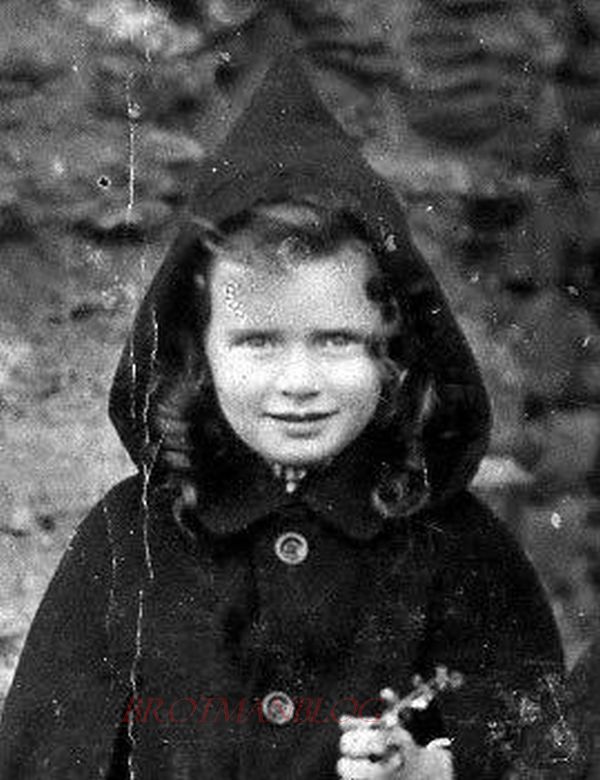
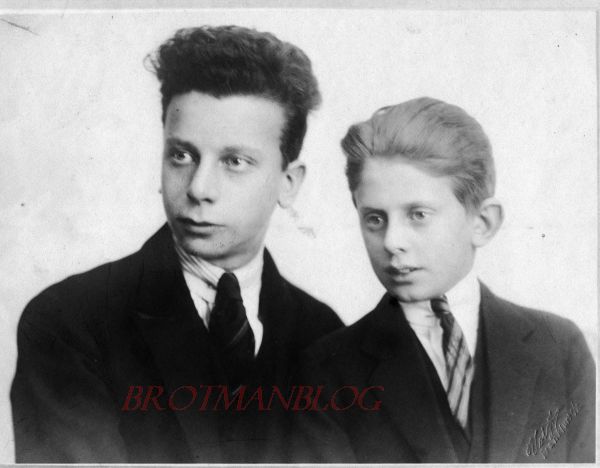
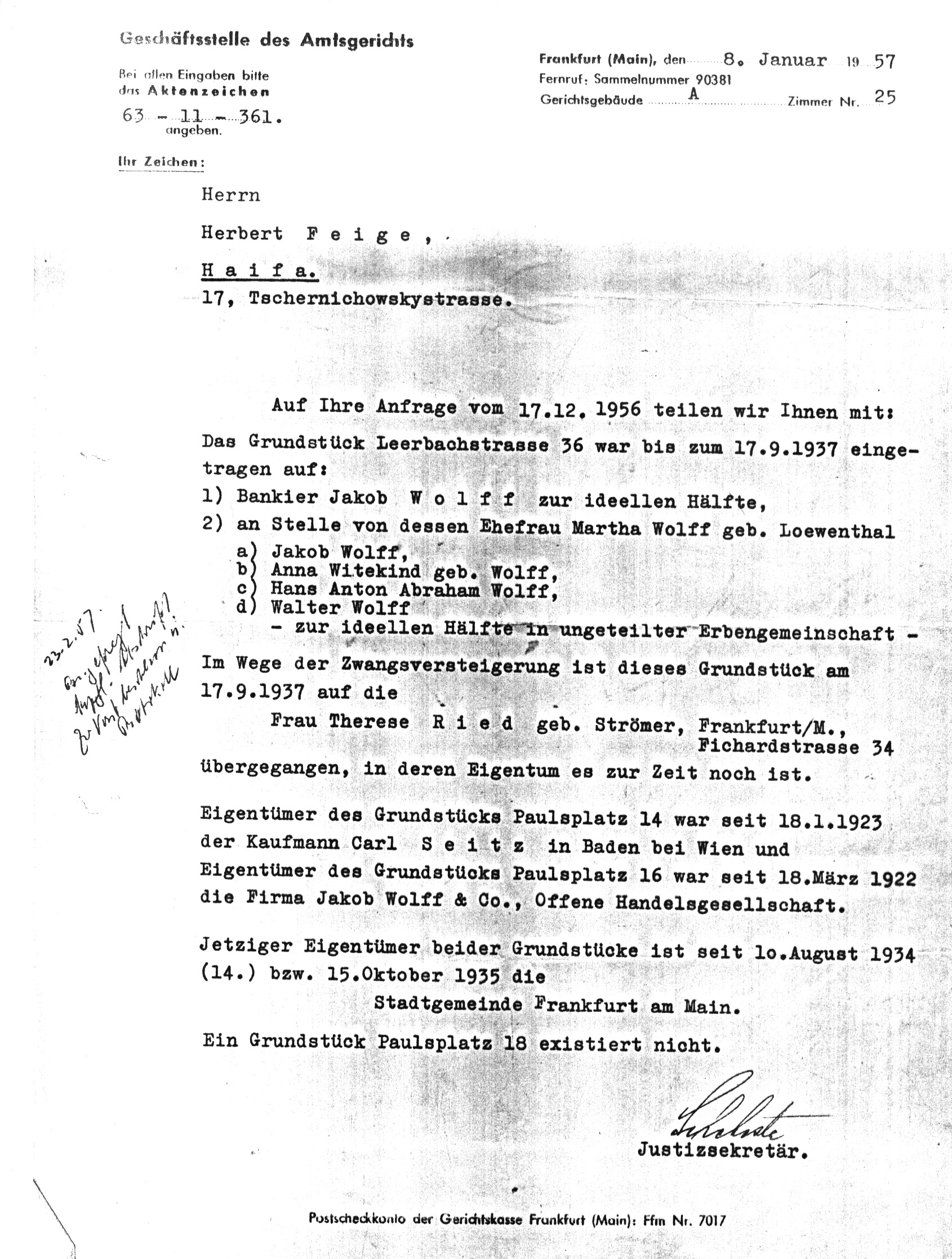
Helmina Goldschmidt Rapp, Part II: Leaving Germany with Alice Rapp Stern

As we saw, Jacob Meier Goldschmidt’s youngest child Helmina was widowed as a young woman and raised her three children alone from an early age. By the 1920s all three of those children were married and had children of their own.
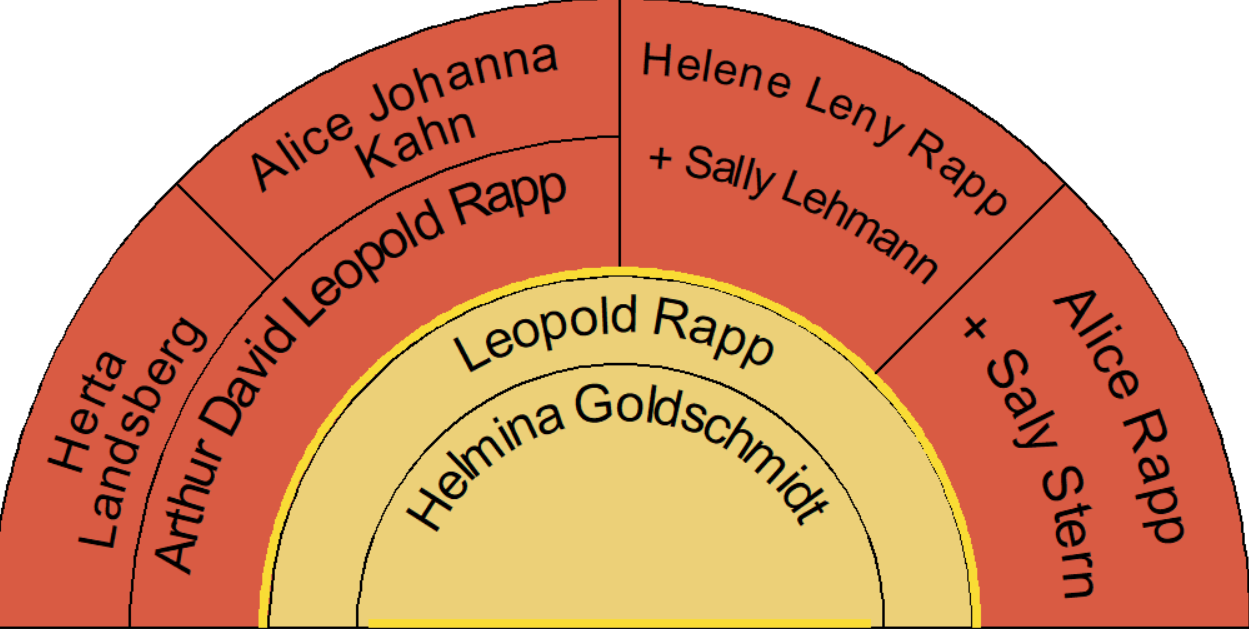
When the Nazis came to power, Helmina and her family were among the fortunate ones who left Germany before it was too late. Today’s post will look at Helmina and her youngest child Alice and their escape from Germany.
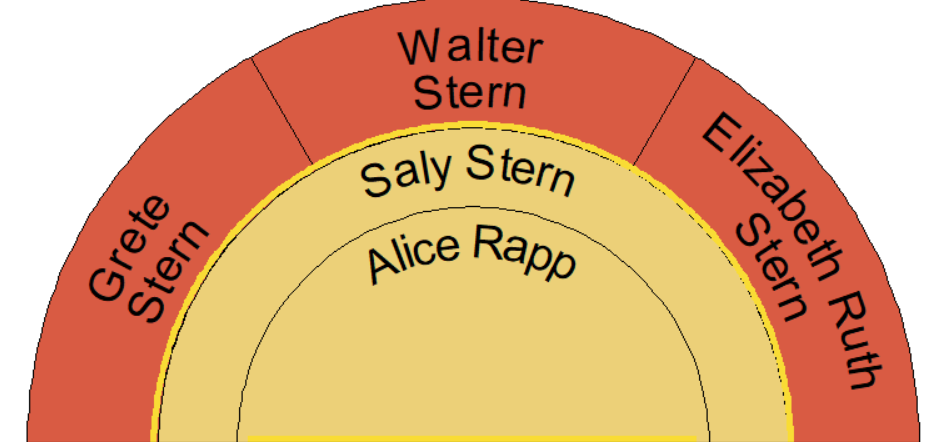
By 1939, Helmina, her daughter Alice and son-in-law Saly and their daughter Grete were living in Harrow, Middlesex, England. Saly reported on the 1939 England and Wales Register that he was a refugee and thus not allowed to do business. Grete was a secretary for a leather goods manufacturer. All four family members were living in one household along with a housemaid.

The National Archives; Kew, London, England; 1939 Register; Reference: RG 101/799H
Enumeration District: BIHB, Ancestry.com. 1939 England and Wales Register

Alice and Saly Stern’s son Walter Stern had instead immigrated to the United States. According to his declaration of intention to become a US citizen, he arrived from Germany to New York on May 16, 1938, and was working as a shipping clerk when he filed his declaration on August 2, 1938.  He was living on Wadsworth Avenue in New York City in the Washington Heights neighborhood where so many German Jewish refugees settled in the 1930s and 1940s. (In yet another small world coincidence, my husband lived on Wadsworth Avenue in his early childhood, although his parents were not German Jewish refugees.)

The National Archives at Philadelphia; Philadelphia, Pennsylvania; NAI Title: Declarations of Intention for Citizenship, 1/19/1842 – 10/29/1959; NAI Number: 4713410; Record Group Title: Records of District Courts of the United States, 1685-2009; Record Group Number: 21
Description: (Roll 539) Declarations of Intention for Citizenship, 1842-1959 (No 417601-418600)
Ancestry.com. New York, State and Federal Naturalization Records, 1794-1943

Although I cannot find any record showing that Alice and Saly’s daughter Elizabeth was with them in England, I believe she must have been living there because on March 27, 1940, Alice, Saly, and Elizabeth all joined Walter in the United States. Strangely, this ship manifest shows all three sailing to New York, but Saly is listed separately and with a different English address.

Ancestry.com. UK and Ireland, Outward Passenger Lists, 1890-1960

On their US ship manifest, Alice and her daughter Elizabeth are again listed together, but Saly is listed on a different page. They all, however, were on the same ship arriving at the same time. And Alice’s declaration of intention shows that she and Saly arrived together and were residing together in New York on Ft. Washington Avenue, in the Washington Heights neighborhood where Walter had been residing in 1938.

Alice Stern, declaration of intention, The National Archives at Philadelphia; Philadelphia, Pennsylvania; NAI Title: Declarations of Intention for Citizenship, 1/19/1842 – 10/29/1959; NAI Number: 4713410; Record Group Title: Records of District Courts of the United States, 1685-2009; Record Group Number: 21,  (Roll 590) Declarations of Intention for Citizenship, 1842-1959 (No 463201-464100), Ancestry.com. New York, State and Federal Naturalization Records, 1794-1943

But the ship manifests for Alice, Elizabeth, and Saly report that by the time of their arrival in the spring of 1940, Walter was living in Washington DC.


However, when Walter registered for the World War II draft in October 1940, he was back living in New York. His registration card has three New York City addresses, all crossed out, but lists his father Saly as his contact person, residing on Ft. Washington Avenue.

Walter Stern, World War II draft registration, Ancestry.com. U.S. WWII Draft Cards Young Men, 1940-1947

Saly Stern’s draft registration, filed on April 26, 1942, two years after that of Walter, shows that he was then self-employed as a salesman and living at 612 West 188th Street in New York with his wife Alice.

Saly Stern, World War II draft registration, The National Archives at St. Louis; St. Louis, Missouri; Record Group Title: Records of the Selective Service System; Record Group Number: 147
Ancestry.com. U.S., World War II Draft Registration Cards, 1942

The following year their younger daughter Elizabeth Stern married Gerhard Hirsch, another German Jewish refugee, on March 28, 1943, in New York. Gerhard was born on September 24, 1908, in Berlin, and immigrated to the US in 1938.1

Meanwhile, Saly and Alice’s older daughter Grete Stern remained in England, as Alice reported on her naturalization papers, as did Alice’s mother Helmina Goldschmidt Rapp. Helmina died in England in July 1941, not long after her children in England had all left for the US.  She was 77 years old.2

Saly Stern died in New York on December 7, 1946.3 He was 69 years old. He had lived long enough to see most of his family settle safely in the US, except for his daughter Grete, who’d remained in England. Unfortunately he did not live to see Grete’s wedding. In 1948, Grete Stern married Kurt Lissauer, who was also a German Jewish refugee. He was born in Luebeck, Germany, on January 10, 1909. They were married in England.4

Elizabeth Stern’s marriage to Gerhard Hirsch did not last very long. She remarried in 1973 when she was 54; her second husband was Paul Dannheisser, a widower who was also a refugee from Germany.

Alice Rapp Stern outlived her husband by almost thirty years. She died in New York on January 28, 1974, at the age of 83.5 She was survived by her three children, Grete, Walter, and Elizabeth, all of whom died within a year of each other. Grete and Walter both died in October 1996; Grete was 85,6 Walter was almost 79.7 Their younger sister Elizabeth died just four months later on February 13, 1997.8 She had just turned 78. None of the three siblings had children, so there are no descendants.

The next post will tell the story of Alice Rapp Stern’s brother and Helmina Goldschmidt Rapp’s son, Arthur David Leopold Rapp, and his family.


  1.  Elizabeth Stern, Marriage License Date: 24 Mar 1943
    Marriage License Place: Manhattan, New York City, New York, USA
    Spouse: Gerhard Hirsch, License Number: 5751, New York City Municipal Archives; New York, New York; Borough: Manhattan; Volume Number: 3, Source Information
    Ancestry.com. New York, New York, Marriage License Indexes, 1907-2018. Also, Elizabeth’s declaration of intention, “New York, Southern District, U.S District Court Naturalization Records, 1824-1946,” database with images, FamilySearch (https://familysearch.org/ark:/61903/3:1:3QS7-99HD-2S59?cc=2060123&wc=M5P7-PTY%3A351618501 : 14 August 2019), Petitions for naturalization and petition evidence 1945 box 1026, no 515801-516050 > image 728 of 983; citing NARA microfilm publication M1972, Southern District of New York Petitions for Naturalization, 1897-1944. Records of District Courts of the United States, 1685 – 2009, RG 21. National Archives at New York. 
  2.  Helmina Rapp, Death Age: 78, Birth Date: abt 1863, Registration Date: Jul 1941
    Registration Quarter: Jul-Aug-Sep, Registration district: Hendon, Inferred County: Middlesex, Volume: 3a, Page: 656, General Register Office; United Kingdom; Volume: 3a; Page: 656, Ancestry.com. England & Wales, Civil Registration Death Index, 1916-2007 
  3.  Saly Stern, Marital status: Married, Age: 69, Birth Date: 26 Nov 1877, Birth Place: Germany, Residence Street Address: 612 W 188 St, Residence Place: New York
    Death Date: 7 Dec 1946, Death Street Address: 612 W 188th St, Death Place: New York City, Manhattan, New York, USA, Occupation: Clerk Stock’s, Father’s Birth Place: Germany, Mother’s Birth Place: Germany, Father: Marcus Stern, Mother: Francisca Stern, Spouse: Alice, Informant: Alice Stern, Informant Relationship: Wife
    Executor: Alice Stern, Executor Relationship: Wife, Certificate Number: 25862
    New York City Department of Records & Information Services; New York City, New York; New York City Death Certificates; Borough: Manhattan; Year: 1946, Ancestry.com. New York, New York, Index to Death Certificates, 1862-1948 
  4. Greta Stern, Registration Date: Apr 1948, Registration Quarter: Apr-May-Jun
    Registration district: Hendon, Inferred County: Middlesex, Spouse: Kurt Lissauer
    Volume Number: 5e, Page Number: 1260, General Register Office; United Kingdom; Volume: 5e; Page: 1260, Ancestry.com. England & Wales, Civil Registration Marriage Index, 1916-2005. Kurt Lissauer, Enemy Alien Registration, The National Archives; Kew, London, England; HO 396 WW2 Internees (Aliens) Index Cards 1939-1947; Reference Number: HO 396/56, Piece Number Description: 056: Internees at Liberty in UK 1939-1942: Lir-Lov, Ancestry.com. UK, WWII Alien Internees, 1939-1945 
  5.  Alice Stern, Social Security Number: 051-18-8391, Birth Date: 4 Oct 1890
    Issue Year: Before 1951, Issue State: New York,Last Residence: 10040, New York, New York, New York, USA, Death Date: Jan 1974, Social Security Administration; Washington D.C., USA; Social Security Death Index, Master File, Ancestry.com. U.S., Social Security Death Index, 1935-2014 
  6.  Grete Lissauer, Death Age: 85, Birth Date: 16 Sep 1911, Registration Date: Oct 1996, Registration district: Hendon, Inferred County: Greater London, Register Number: A41C, District and Subdistrict: 2351A, Entry Number: 108, General Register Office; United Kingdom, Ancestry.com. England & Wales, Civil Registration Death Index, 1916-2007 
  7. Walter Stern, Gender: Male, Birth Date: 1918, Death Date: 9 Oct 1996
    Claim Date: 2 Dec 1970, SSN: 056162574, Death Certificate Number: 350302
    Ancestry.com. U.S., Social Security Applications and Claims Index, 1936-2007 
  8. Elizabeth Ruth Stern, [Elizabeth Ruthhenrietta Hirsch], [Elizabeth Dannheisser]
    Gender: Female, Race: White, Birth Date: 21 Jan 1919, Birth Place: Frankfurt A, Federal Republic of Germany, Death Date: 13 Feb 1997, Father: Sally Stern
    Mother: Alice Rapp, SSN: 127144714, Ancestry.com. U.S., Social Security Applications and Claims Index, 1936-2007 

Helmina Goldschmidt Rapp, Part I: Another Young Widow

For the past month I’ve been writing updates  to earlier posts, mostly about my Goldschmidt relatives but also a few from my Seligmann relatives. I am finally ready to return to the Goldschmidts with new research, starting with the youngest of the five children of Jacob Meier Goldschmidt and Jettchen Cahn, Helmina Goldschmidt.

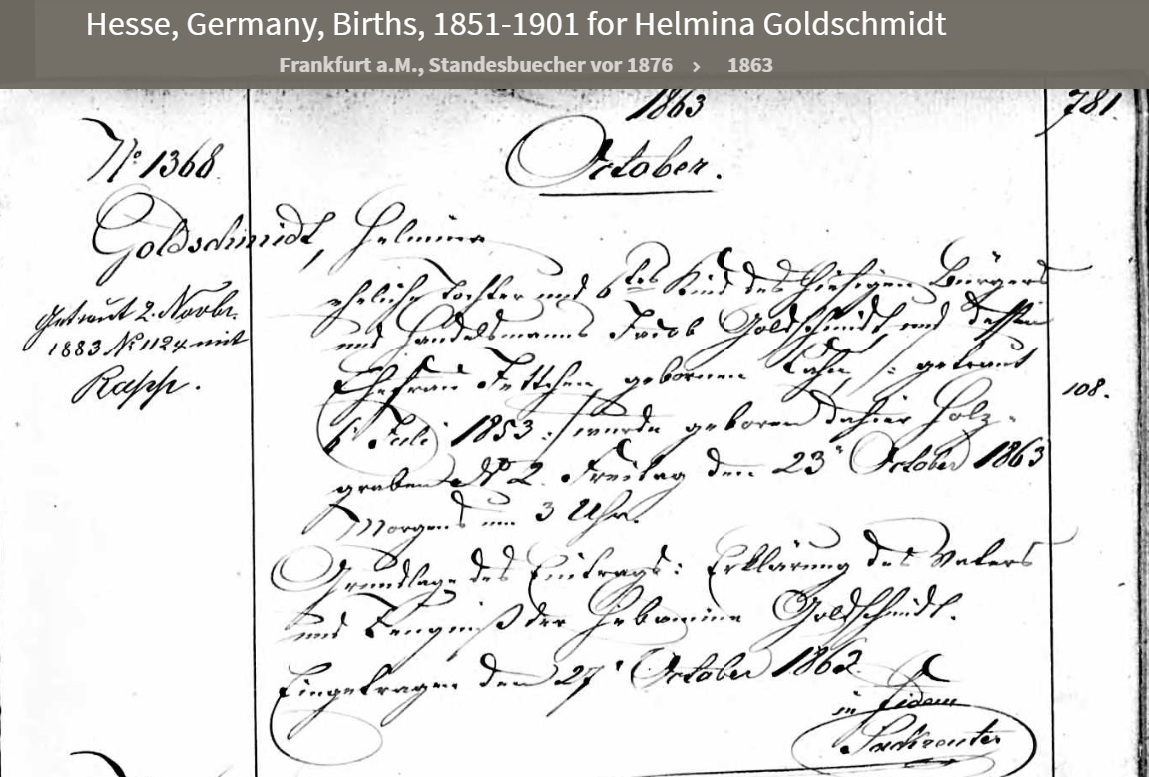
Helmina was born on October 23, 1863, in Frankfurt, Germany.

Helmina Goldschmidt birth record. Hessisches Hauptstaatsarchiv; Wiesbaden, Deutschland; Bestand: 903; Signatur: 903_8824, Description Year Range: 1863, Ancestry.com. Hesse, Germany, Births, 1851-1901

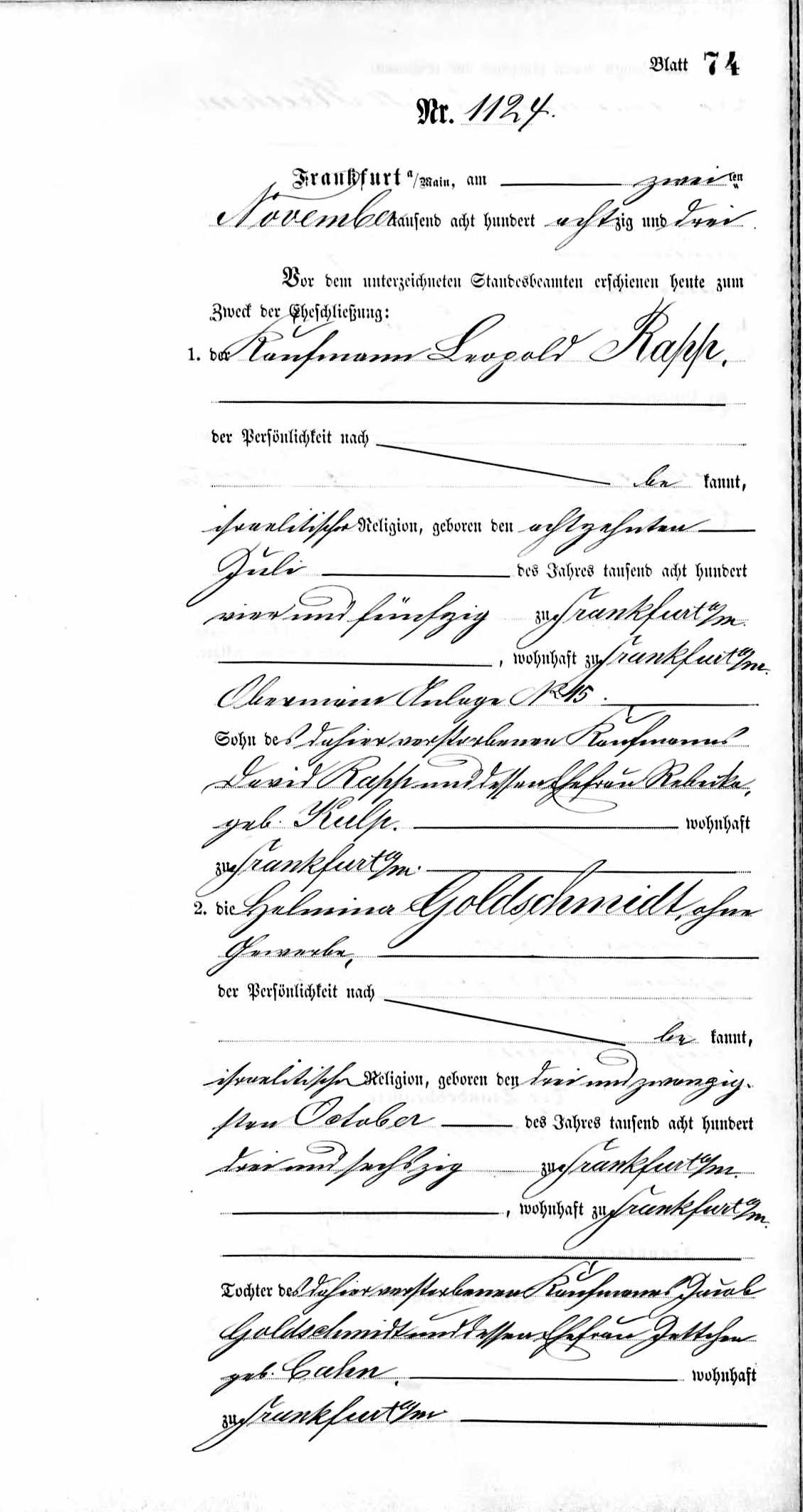
She married Leopold Rapp on November 2, 1883, in Niederrad-und-Oberrad, Germany. Leopold was the son of David Rapp and Rebecka Kulp and was born in Frankfurt on July 18, 1854.

Helmina Goldschmidt and Leopold Rapp, marriage record. Hessisches Hauptstaatsarchiv; Wiesbaden, Deutschland; Signatur: 9427,  1883, Ancestry.com. Hesse, Germany, Marriages, 1849-1930

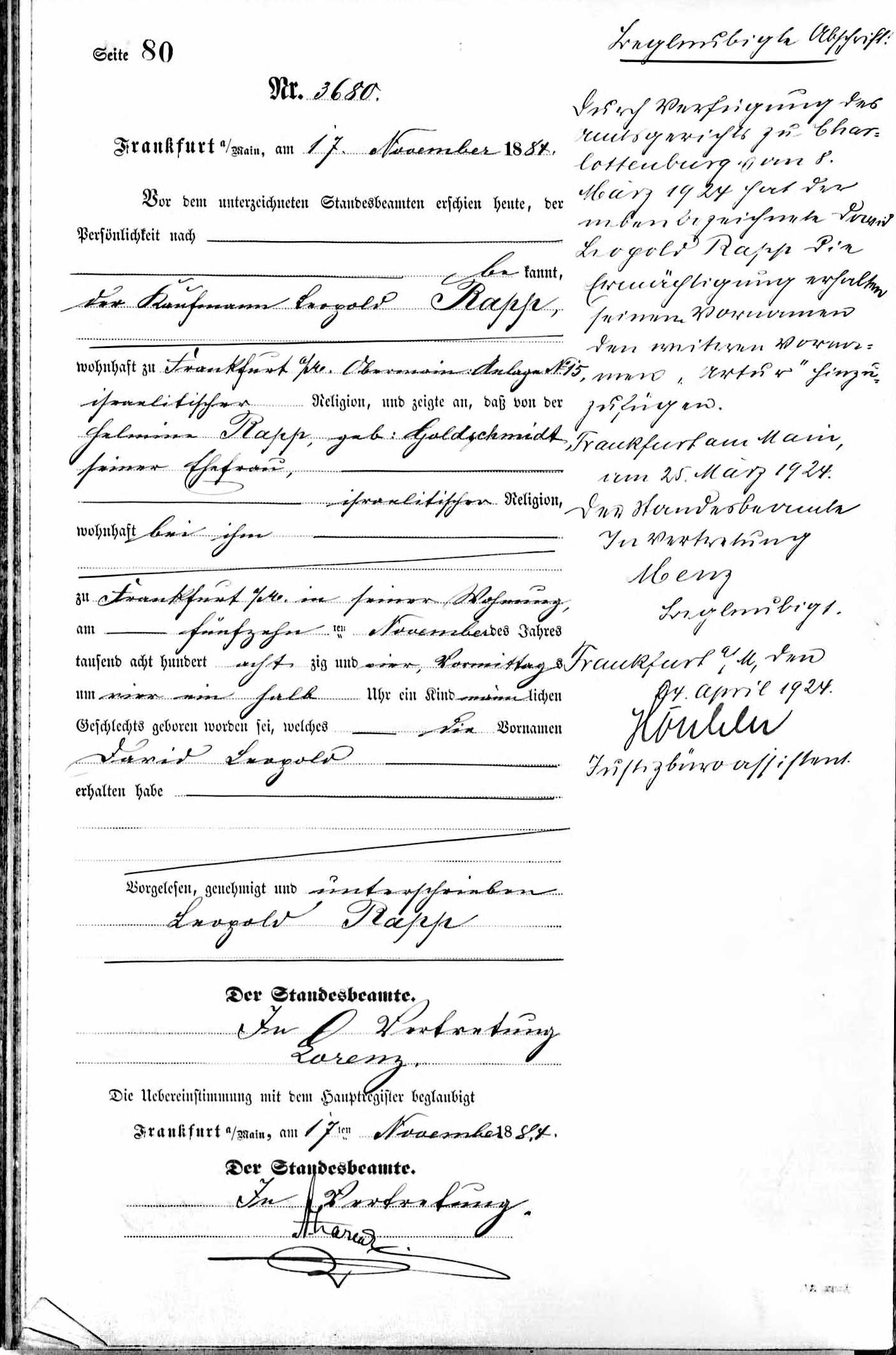
Helmina and Leopold had three children.  David Leopold Rapp (later known as Arthur Rapp) was born on November 15, 1884, in Frankfurt.

Arthur David Leopold Rapp birth record, Hessisches Hauptstaatsarchiv; Wiesbaden, Deutschland; Bestand: 903; Signatur: 903_8997, Year Range: 1884, Ancestry.com. Hesse, Germany, Births, 1851-1901

Helene Rapp was born on August 25, 1887, in Frankfurt.

Helene Rapp birth record. Hessisches Hauptstaatsarchiv; Wiesbaden, Deutschland; Bestand: 903; Signatur: 903_9032, Description, Year Range: 1887, Ancestry.com. Hesse, Germany, Births, 1851-1901

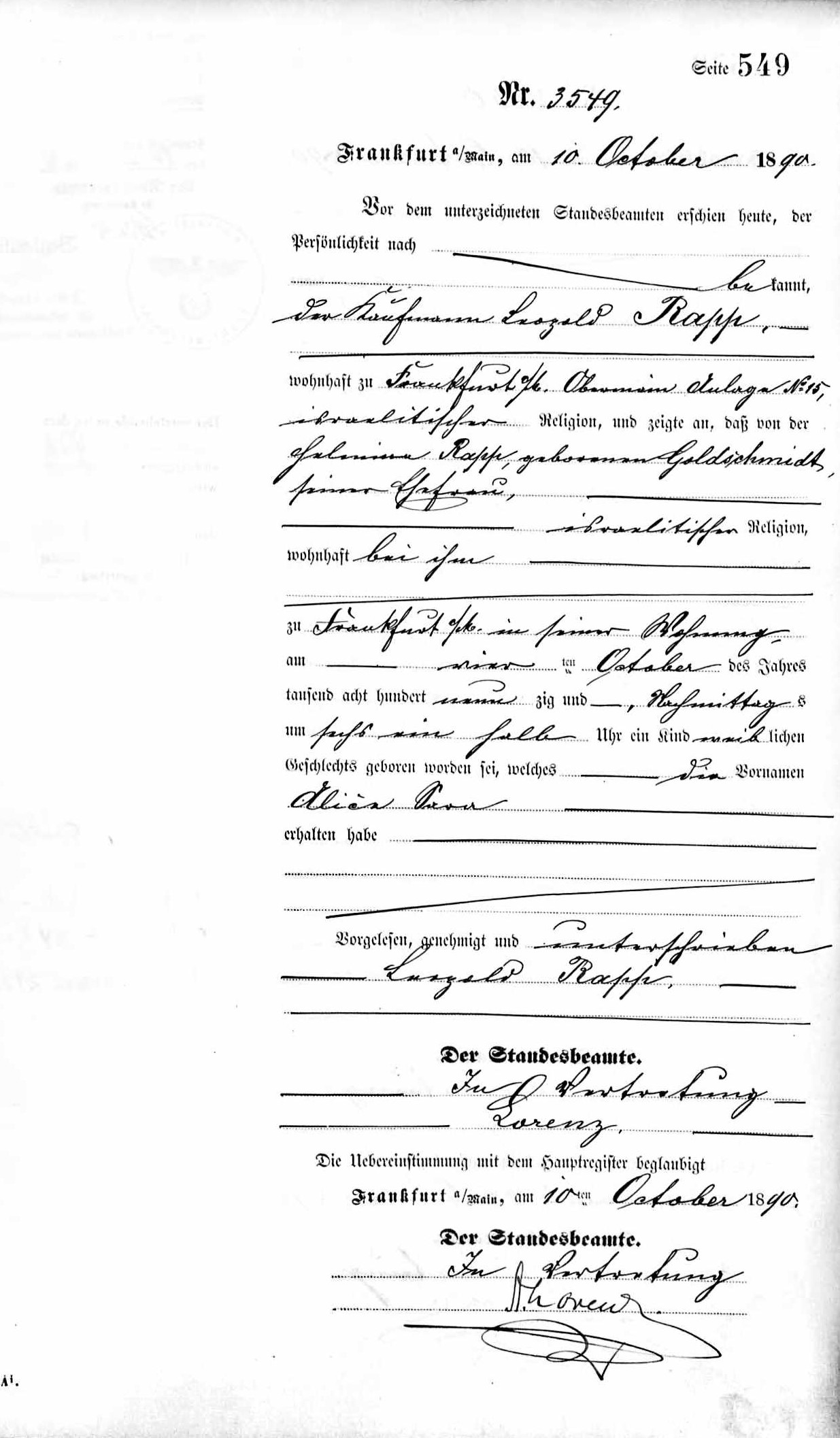
And Alice Rapp was born in Frankfurt on October 4, 1890.

Alice Rapp birth record, Hessisches Hauptstaatsarchiv; Wiesbaden, Deutschland; Bestand: 903; Signatur: 903_9076, Description, Year Range: 1890, Ancestry.com. Hesse, Germany, Births, 1851-1901

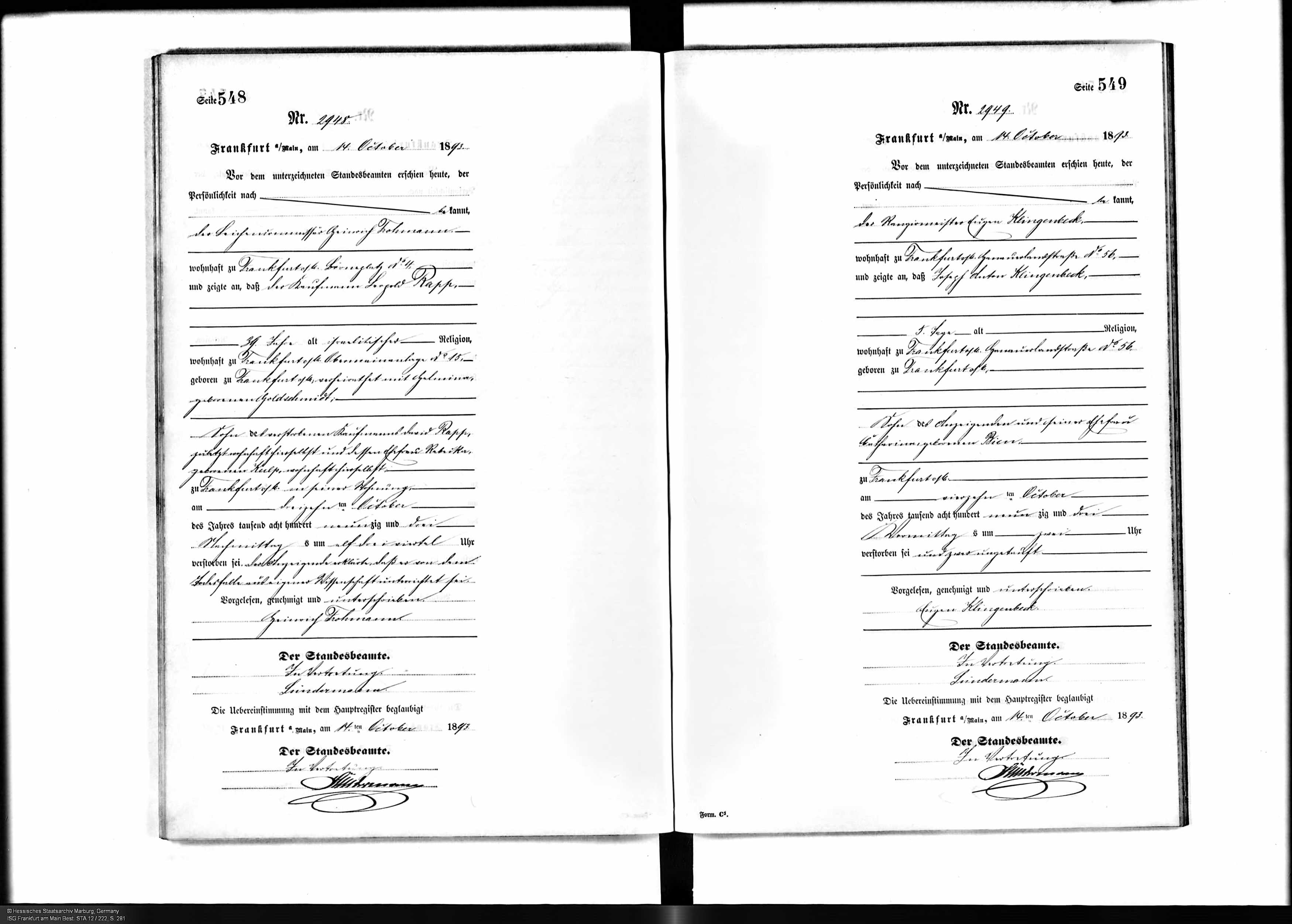
Unfortunately, Leopold Rapp died just three years after the birth of their last child. He died on October 13, 1893, in Frankfurt, leaving Helmina a widow with three very young children. Arthur was turning nine, Helene was seven, and Alice was three.

Leopold Rapp death record, Personenstandsregister Sterberegister; Bestand: 903; Signatur: 10465
Description, Year Range: 1893, Ancestry.com. Hesse, Germany, Deaths, 1851-1958

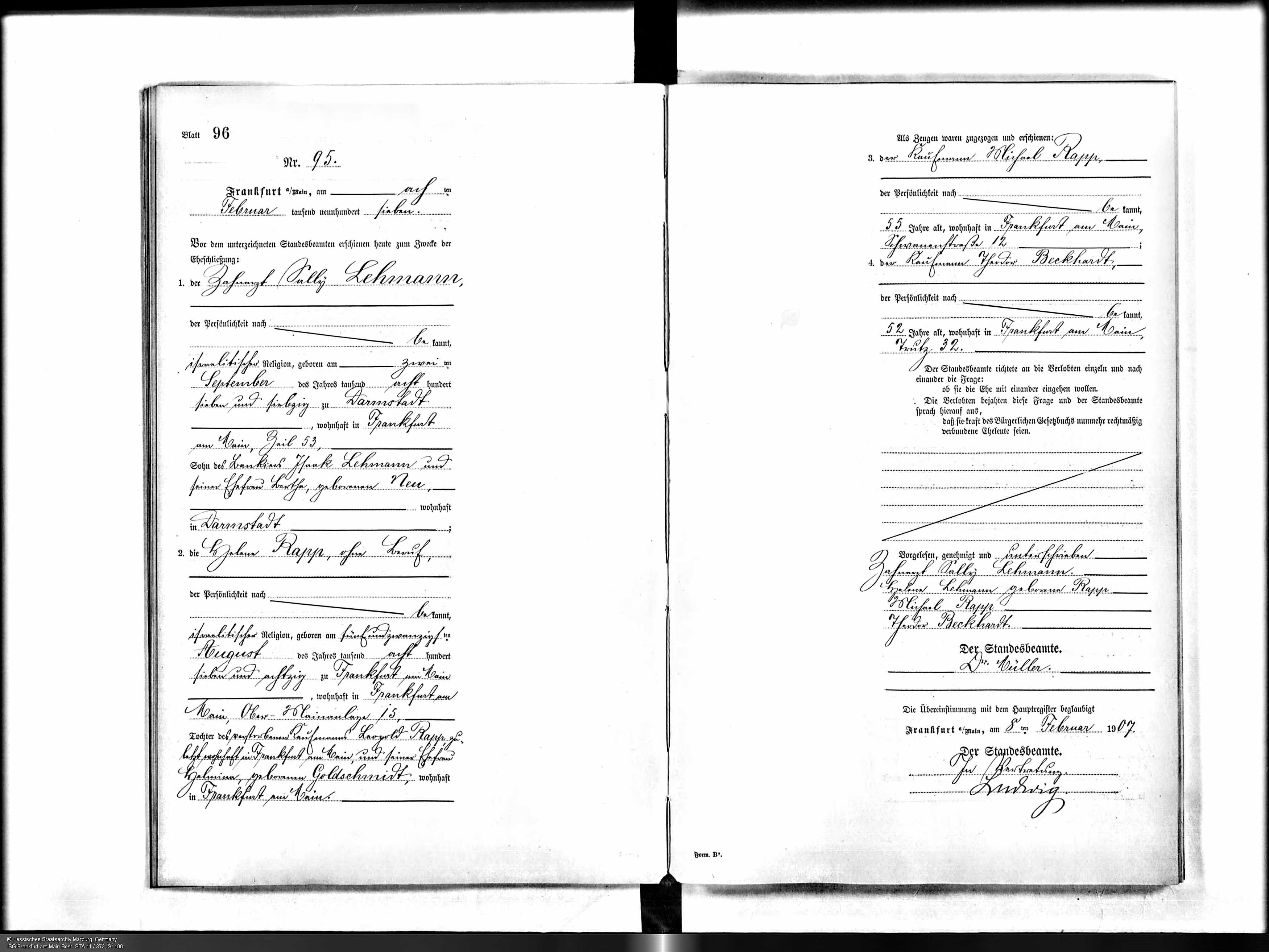
Helene Rapp married when she was only nineteen. On February 8, 1907, she married Sally Lehmann in Frankfurt. Sally was the son of Isaak Lehman and Bertha Neu and was born in Darmstadt on September 2, 1877.

Marriage record of Helene Rapp and Sally Lehmann, Hessisches Hauptstaatsarchiv; Wiesbaden, Deutschland; Bestand: 903, Year Range: 1907, Ancestry.com. Hesse, Germany, Marriages, 1849-1930

They had three children. Ludwig Lehmann was born February 9, 1908, in Frankfurt.1 His sister Felise was born four years later in 1912, but died as a child on May 5, 1918, in Frankfurt. A third child, Else Berta was born January 8, 1922.2

Felise Lehmann death record, Personenstandsregister Sterberegister; Bestand: 903; Signatur: 10805, Year Range: 1918, Ancestry.com. Hesse, Germany, Deaths, 1851-1958

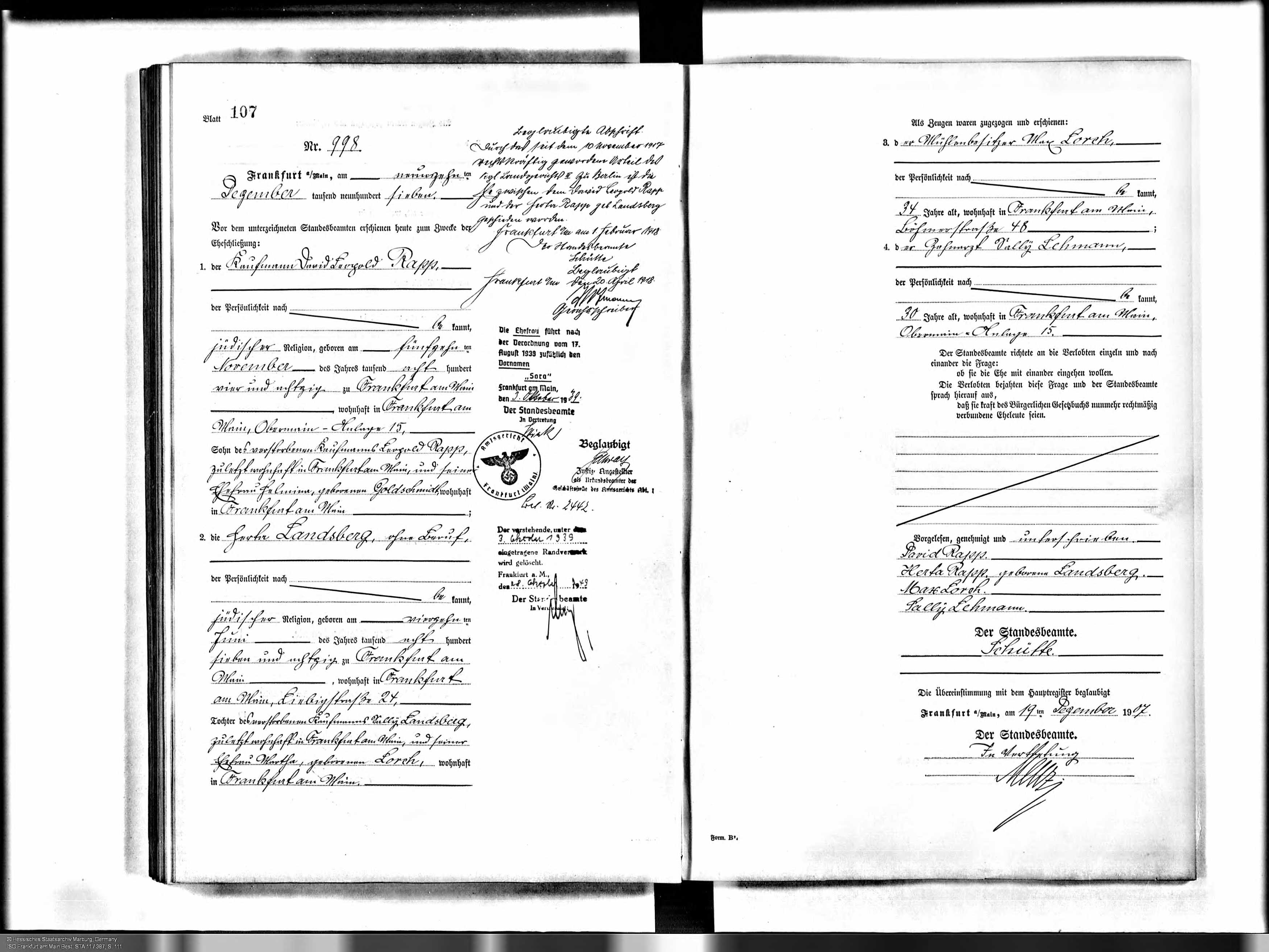
Helene’s older brother David Leopold Rapp also married in 1907. He married Herta Landsberg on December 19, 1907, in Frankfurt. Herta was the daughter of Sally Landsberg and Martha Lorch and was born in Frankfurt on June 14, 1887.

Marriage of David Leopold Rapp to Herta Landsberg, Hessisches Hauptstaatsarchiv; Wiesbaden, Deutschland; Bestand: 903, Year Range: 1907, Ancestry.com. Hesse, Germany, Marriages, 1849-1930

Arthur and Herta had one child, Henriette “Rita” Rapp, born on September 21, 1908, in Frankfurt.3

Arthur and Herta’s marriage did not last; they were divorced on November 10, 1917, as seen on the notation on their marriage record above, and Arthur later married Alice Johanna Kahn in Frankfurt on May 6, 1921. She was the daughter of Markus Kahn and Emilie Kahn and was born in Frankfurt on February 24, 1895.

Marriage of David Leopold Rapp to Alice Kahn, Hessisches Hauptstaatsarchiv; Wiesbaden, Deutschland; Bestand: 903, Year Range: 1921, Ancestry.com. Hesse, Germany, Marriages, 1849-1930

The notation on both David’s birth record and his marriage record to Alice was translated for me by Cathy Meder-Dempsey; it provides that as of March 8, 1924, David Leopold Rapp had received authorization to add the additional first name Arthur to his name. He was thereafter referred to as Arthur and will also be so on the blog.

Arthur and Alice Rapp had two sons. Helmut Leopold Rapp was born on February 11, 1923, in Berlin.4 His brother Gunther Rapp was born in Frankfurt on December 10, 1925.5

Finally, the youngest child of Helmina Goldschmidt and Leopold Rapp, Alice, was married on September 23, 1910, in Frankfurt to Saly Stern, the son of Markus Stern and Franziska Oppenheimer. Saly was born on November 26, 1877, in Frankfurt.

Marriage record of Alice Rapp and Saly Stern, Hessisches Hauptstaatsarchiv; Wiesbaden, Deutschland; Bestand: 903, Year Range: 1910, Ancestry.com. Hesse, Germany, Marriages, 1849-1930

Alice and Saly had three children. Grete was born on September 16, 1911 in Frankfurt.6 Walter was born December 3, 1917, in Frankfurt,7 and Elizabeth Ruth Stern was born on January 21, 1919, in Frankfurt.8

Helmina Goldschmidt Rapp had thus managed to raise all three of her children to adulthood, and by the 1920s, all three were married and raising children of their own and living in Frankfurt. Obviously, everything changed in the 1930s with the rise of the Nazis.


  1. E.g., Louis Ludwig Lehman, [Yehuda Ludwig Lehman] , Birth Date: 9 Feb 1908
    Age: 58, Naturalization Date: 27 Jun 1966, Residence: New York, New York
    Title and Location of Court: New York Southern District. Ancestry.com. New York, Index to Petitions for Naturalization filed in New York City, 1792-1989 
  2. Else Berta Spitzer, Birth Date: 8 Jan 1922, Age: 36, Naturalization Date: 5 Jan 1959, Residence: New York, New York, Title and Location of Court: New York Southern District, Ancestry.com. New York, Index to Petitions for Naturalization filed in New York City, 1792-1989 
  3. Henriette Rapp marriage record, Landesarchiv Berlin; Berlin, Deutschland; Personenstandsregister Heiratsregister; Laufendenummer: 189, Description
    Register Year or Type: 1929 (Erstregister), Ancestry.com. Berlin, Germany, Marriages, 1874-1936 
  4. Helmut Harold Rapp declaration of intention, The National Archives at Philadelphia; Philadelphia, Pennsylvania; NAI Title: Declarations of Intention for Citizenship, 1/19/1842 – 10/29/1959; NAI Number: 4713410; Record Group Title: Records of District Courts of the United States, 1685-2009; Record Group Number: 21, (Roll 626) Declarations of Intention for Citizenship, 1842-1959 (No 496501-497400),
    Ancestry.com. New York, State and Federal Naturalization Records, 1794-1943 
  5. Gordon Rapp, World War II draft registration, The National Archives in St. Louis, Missouri; St. Louis, Missouri; WWII Draft Registration Cards for New Jersey, 10/16/1940-03/31/1947; Record Group: Records of the Selective Service System, 147; Box: 539, Ancestry.com. U.S. WWII Draft Cards Young Men, 1940-1947 
  6.  Grete Stern, Gender: Female, Nationality: German, Birth Date: 16 Sep 1911
    Birth Place: Frankfurt, Germany, The National Archives; Kew, London, England; HO 396 WW2 Internees (Aliens) Index Cards 1939-1947; Reference Number: HO 396/89, Ancestry.com. UK, WWII Alien Internees, 1939-1945 
  7. Walter Stern, World War II draft registration, U.S. WWII Draft Cards Young Men, 1940-1947 
  8. Elizabeth Ruth Stern, Birth Date: 21 Jan 1919, Birth Place: Frankfurt A, Federal Republic of Germany, Death Date: 13 Feb 1997, Father: Sally Stern, Mother: Alice Rapp, SSN: 127144714, Ancestry.com. U.S., Social Security Applications and Claims Index, 1936-2007 

Gaps in the Story: How Did Amalie and Charles Bloch Escape from Nazi Germany?

Back in May, I wrote about Amalie Meyer Bloch, the granddaughter of Jacob Meier Goldschmidt and Jettchen Cahn, daughter of Regina Goldschmidt and Aaron Meyer. One question that lingered was how Amalie and her daughter Ilse ended up separated from Amalie’s husband Charles Bloch.

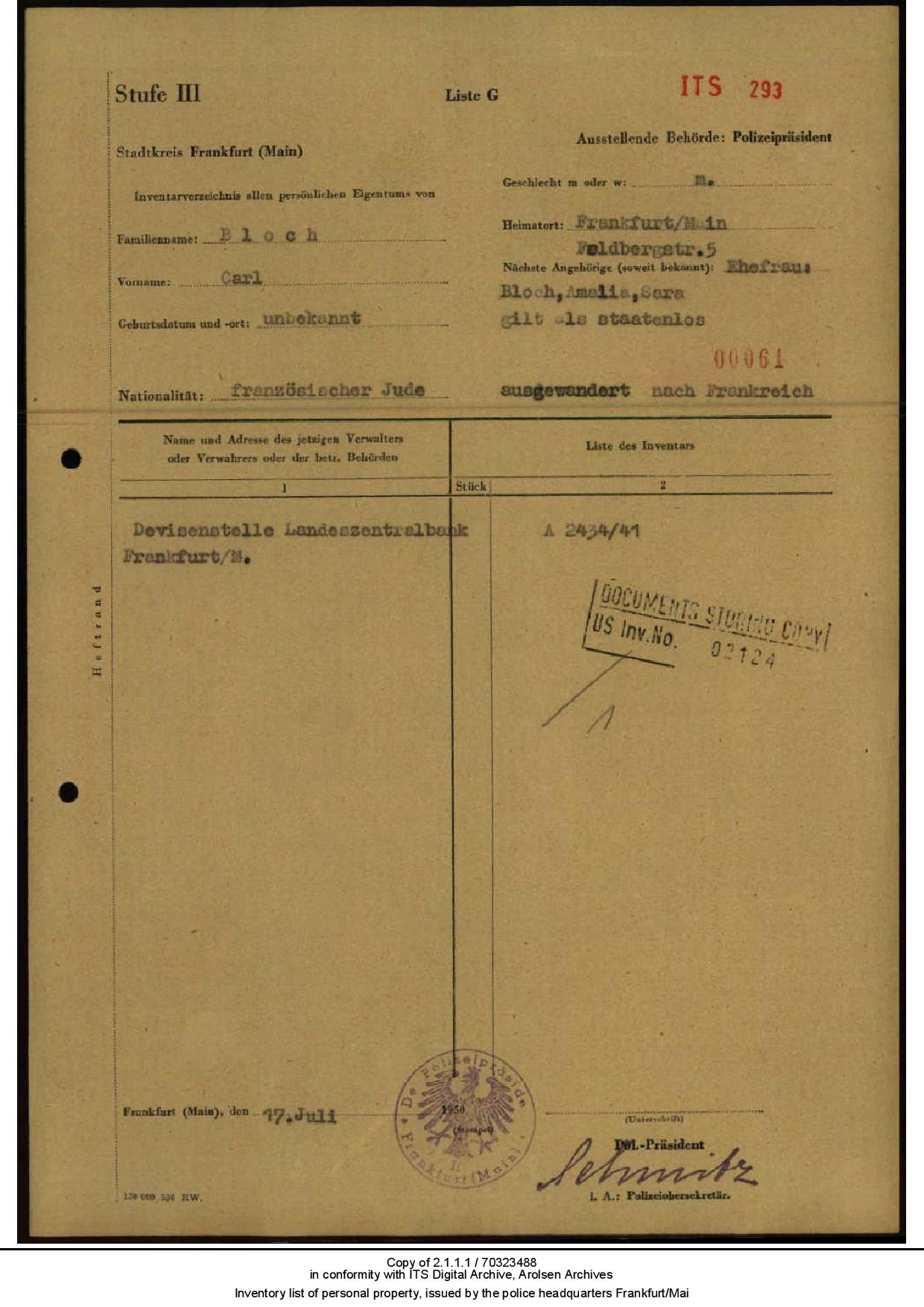
I knew from one of the Arolsen Archives document available through Ancestry that Charles had gone to Paris, and I knew that he eventually rejoined Amalie and Ilse in the US in 1946, reporting that his last address had been in Toulouse, France. But what I didn’t know was when Charles had gone to Paris and where he was in France during the war after Germany’s invasion of France in 1940.

Arolsen Archives, Digital Archive; Bad Arolsen, Germany; Lists of Persecutees 2.1.1.1; Series: 2.1.1.1, Reference Code: 02010101 oS, Ancestry.com. Europe, Registration of Foreigners and German Persecutees, 1939-1947

Barb276, one of my readers, suggested that I contact the ITS (International Tracing Service) and file a request for more information about Charles since not all of their documents are available through the Arolsen Archives. I did as she suggested back in May and was told that it would take ten months to complete the investigation and report back. I prepared myself for a long wait.

You can imagine my surprise when just a week or so ago I received a report back from ITS with more documents about Charles. Those documents don’t really answer my questions, unfortunately, but they did reveal one more piece of the puzzle.

Charles was one of the thousands of Jewish men who were rounded up during and after Kristallnacht in November 1938 and sent to the Buchenwald concentration camp. He was released in December 1938.

My working hypothesis is that upon his release, he left Germany for France. One of the ITS documents, a property inventory prepared after the war in 1950, described Charles as a “französischer Jude,” a French Jew. I wasn’t sure what to make of that since Charles was also documented as German-born—born in Frankfurt in 1881. That same document also states that Amalie is “gilt als staatenlos,” considered stateless. So maybe the reference to Charles as a French Jew meant that he had become a citizen of France after immigrating there.

It would make sense that Charles would leave Germany in early 1939 after his experience at Buchenwald. As seen in my earlier post, his daughter Ilse had gone to England by 1939. But it seems that Amalie was not in England or France at that point. On her November 27, 1941, declaration of intention to become a US citizen, Amalie reported that Charles was at that time residing in France, Ilse was residing in New York, and that Amalie herself had last resided in Lisbon, Portugal.

Amalie Meyer Bloch, declaration of intent, The National Archives at Philadelphia; Philadelphia, Pennsylvania; NAI Title: Declarations of Intention for Citizenship, 1/19/1842 – 10/29/1959; NAI Number: 4713410; Record Group Title: Records of District Courts of the United States, 1685-2009; Record Group Number: 21
Description: (Roll 641) Declarations of Intention for Citizenship, 1842-1959 (No 510101-511000)
Ancestry.com. New York, State and Federal Naturalization Records, 1794-1943

My hunch is that Amalie stayed behind in Germany longer than her husband and daughter and then somehow escaped to Portugal after the war started. But I could be wrong. My other hunch is that Charles escaped from Paris after the Nazis invaded and somehow survived the war in southern Vichy-controlled France, finally arriving in the US a year after the war. Although I don’t know more about Charles’ time there, I did find a Jewish Telegraphic Agency news release dated April 29, 1941, reporting that Jewish refugees had been expelled from Toulouse. I’ve no idea, however, how that impacted Charles Bloch.

Unfortunately, the ITS documents do not reveal anything about Charles’ time in France during or after the war. Nor do I have any more information about how Amalie ended up in Portugal or when. And since they have no living descendants, I fear I can only rely on my hunches and speculation to fill in these gaps.


Four Years of Learning German

Just about four years ago in the summer of 2016, I decided to learn German. It’s been an interesting and mostly enjoyable challenge. First, I used the app Duolingo for almost a year. I learned a fair amount of German vocabulary. I was disciplined and practiced every day. It was fun.

But then I tried to read some simple texts written in German, and I realized Duolingo was fine for vocabulary building, but it wasn’t enough if I really want to read, write, and speak German.  We were going to Germany in the spring of 2017 and I wanted to be able to speak to the people in their own language, so I bought a few German textbooks to learn how to conjugate verbs and some other basic grammar.

But that also wasn’t enough. That became glaringly obvious when I tried to speak German on our trip. I couldn’t string together a grammatically correct sentence, and often I would get blank stares when I tried to ask a simple question in a German store or restaurant. And if someone answered me in German? I had no idea what they were saying. So in the fall of 2017, I signed up for a German class offered by a local adult education program.

That course was good for grammar. Lots of grammar. Lots and lots of grammar. Rules, rules, rules. But no conversation and no opportunities to read texts or ask questions. So I formed a German conversation group with people from the class. That’s been lots of fun, but I remain the worst German speaker in the group. My reading has improved, my writing is coming along (with help from Google Translate), but it still is very hard for me to speak or understand spoken German. Mark Twain was right. Learning German is not for the faint of heart.

Mark Twain By Mathew Brady [Public domain], via Wikimedia Commons

Why am I writing about this now, you may wonder?

Well, I’ve had reason recently to reminisce about why I started learning German. Why did I want to learn German? Of course, it was related to genealogy. My paternal roots in Germany are deep and wide. Knowing German would therefore be helpful. But to be honest, most of what I need to know for genealogy purposes can be reduced to some very basic terms: geboren (born), heiratet (married), gestorben (died). Really, you don’t need to know much more than that to read German vital records for basic information. And even knowing those terms won’t help much unless you can also read German script. Which I can’t.

No, it wasn’t a desire to read German vital records or even longer letters or texts that motivated me to learn German. It was rather a particular book that I very much wanted to read: Die Alte und Die Neu Welt, written by my cousin Mathilde Gross Mayer in 1951, as I discussed here.

Mathilde was born in Bingen, Germany, in April 1869. Mathilde’s grandmother Martha Seligmann and my three-time great-grandfather Moritz Seligmann were sister and brother, so we were second cousins, three times removed, both being direct descendants of Jacob Seligmann and Martha Mayer. Mathilde left Germany in 1937 to escape from Nazi persecution when she was almost 68 years old and a grandmother; she lived over thirty years in the United States after leaving Germany, dying in September, 1969, when she was a hundred years old.  I was fascinated by her life and wanted to read her book. So I started learning German.

But despite studying for four years and having a fairly decent basic German vocabulary, every time I picked up Mathilde’s book, I got frustrated. I still had to look up so many words that I could not just read this book. It was exhausting and too time consuming. Using Google Translate to translate one letter is one thing, but a whole book? So I gave up.

And then? Then my cousin Elizabeth found me this spring. Elizabeth is Mathilde Mayer’s great-granddaughter. She found my blog and contacted me. We exchanged a number of emails, finding many common interests and places in our lives as well as our shared family roots. And in the course of those emails Elizabeth shared with me that she had an ENGLISH version of Mathilde’s book in pdf format. And that she would send it to me. Which she did.

So one day a couple of weeks ago I sat at my computer and read Mathilde’s book in English. And I am so glad that I did rather than ruining it by trying to read it in German. It is just a wonderfully touching book—full of colorful portraits of many of my Seligmann cousins and warm and loving anecdotes about Mathilde’s life growing up in Bingen and then raising a family in Bingen. She shares the tragedies and challenges her family suffered as well as many of their joys and successes. I never would have been able to get the feel for her personality if I’d suffered through reading her book in German.

Sure, if I were fluent in German, that would have been even better—to read it as she wrote it. But to butcher it by reading it all chopped up would have been a terrible mistake. Elizabeth has asked me not to share the book on the blog, and so, of course, I am respecting her wishes. But I am so grateful that she shared the English version with me. Mathilde’s story will now always be with me.

So do I regret four years of struggling to learn German? Not one bit! I will continue studying it as best I can, and maybe someday I will actually be able to read Mathilde’s story in her native tongue.


How The Nazis Destroyed My Cousin Moritz Oppenheimer

Last time I shared the documents my cousin Wolfgang Seligmann found at the Wiesbaden archives about our mutual cousin Martha Oppenheimer Florsheimer. Today I want to share the documents Wolfgang found about Martha’s brother Moritz James Oppenheimer. Martha and Moritz were my great-grandmother Eva Seligman Cohen’s first cousins; they were the children of Pauline Seligmann, the sister of my great-great-grandfather Bernard Seligman.

As I’ve previously written, Moritz Oppenheimer was born on June 10, 1879, in Butzbach, Germany. Sometime before 1902, Moritz married Emma Katherina Neuhoff, who was not Jewish. Moritz and Emma had two children: Paula (1902) and Walter (1904). Moritz owned a paper factory in Frankfurt before the war as well as a large and very successful horse stud farm where thoroughbred horses were raised and sold. As his granddaughter Angelika reported to me, Moritz was a member of the board of directors of several companies throughout Germany. He was a very successful and wealthy man.

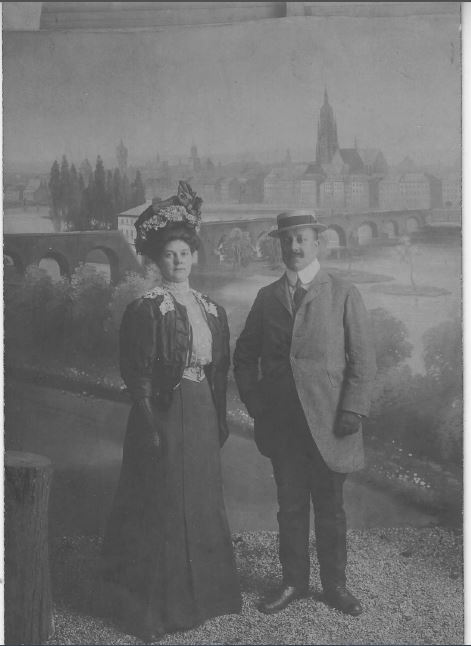
Emma Neuhoff and Moritz James Oppenheimer
photo courtesy of Angelika Oppenheimer

Moritz was arrested in the autumn of 1933. His marriage to Emma was dissolved because mixed marriages were not legal under the Nazi regime. Then his assets including his horse farm were confiscated and put into the hands of an administrator, who sold them at far below their market value. According to his son Walter, Moritz had been in good health up to this time, but these actions caused him to become quite ill. After being visited by Gestapo, he reportedly took his own life on May 4, 1941.

Wolfgang found three documents that illustrate just how desperate Moritz’s situation was. I am deeply grateful to Cathy Meder-Dempsey of the blog, Opening Doors in Brick Walls, who translated all three of these documents.

The first is a letter written by Moritz in early 1941 regarding his taxes for the year 1940.

Letter by Moritz James Oppenheimer 1941

Transcribing and translating this letter presented some real challenges because, as you can see, the first several letters of the first word on the left side of the letter were not visible, but somehow Cathy was able to make sense of it all.

Here is her transcription and her translation of the letter:

[…] 10.6.1879 in Butzbach (Hessen)

[…]kenkarte H 0240/39

An das Finanzamt Wiesbaden

Im Jahre 1933 wurde über mein Vermögen das Konkurs

[verfahren] eröffnet (Frankfurt a. Main)

[Ich] besitze weder irgend welches Vermögen noch Wertgegen-

[stande], noch Möbel, Wäsche, etc.

Im Jahre 1934 wurde ich in Folge schwerer Erkrankung,

[…Er]weiterung und Verlagerung, Wasserbildung, Angina pektoris

[…auf]störungen, Kopfbeschwerden etc. nach Bad-Nanheim

[…] Dort war ich bis vergangenes Jahr in ärztlicher

behandlung und Aufsicht.

[…] schwerer Gelenkrheumatismus hinzutrat, kam ich

[ein art]ztliche Verordnung nach Wiesbaden zur Kur.

[Einko]mmen aus irgend welchen Möglichkeiten habe ich

[nicht]. Ich wohne möbliert.

[…]welche Neuanschaffungen habe nicht seit 1933 in Folge

meiner Mittellosigkeit nicht gemacht.

[Meine]Lebensunterhalt sowie Arzt, Apotheke, Zimmer und Kur

hatte ich aus Unterstützungen von ?200 Mk (monatlich)

[nur] von Verwandten gegeben werden.

[Diese] Zuwendungen stammen aus bereits versteuerten

[…]gen, Einkünfte meiner Verwandten.

Nach wie vor bin ich schwer erkrankt

[Meine] Ehe was Mischehe, Frau Arierin. Meine Kinder sind

[…]ft, konfirmiert und gelten nicht als Juden.

[…] ich eine andere Steuerklärung abgeben müssen,

[…] um Zusendung eines Formulares.

Moritz Israel Oppenheimer

Weisbaden

Pagenstecherstrasse 4 (?? Marx)

Zur Abgabe einer (Einkommen) Eink. Erklarung

fur 1940 aufgefordert.

Translation:

To the tax office in Wiesbaden

In 1933, bankruptcy was declared on my assets (Frankfurt a. Main). I have neither assets nor other things of value, furniture, laundry, etc. In 1934, as a result of serious illness, (enlargement and relocation – ??), water retention, angina pectoris, (other) disorders, headache etc. I was sent to Bad-Nanheim. Until last year I was there under medical treatment and supervision. As severe rheumatoid arthritis set in, I received medical orders to take a cure in Wiesbaden. I don’t have any income possibilities and live in a furnished place. No new acquisitions have been made since 1933 as I am penniless. My livelihood as well as doctor, pharmacy, room and spa expenses have been supported with [?] 200 Mk (monthly) from my relatives. This support came from already taxed income of my relatives. I am still seriously ill.

My marriage was a mixed marriage, my wife was Aryan. My children are ____, confirmed and are not considered Jews. [I assume that the word that we cannot see was Mischling.]

I have to file another tax return, and request a form be sent.

Signature and address

Notation in pencil: He was asked to submit a declaration of income for the year 1940.

Cathy thought he was writing to get the correct tax form for someone in his financial position.

Although I had read his son Walter’s description of Moritz’s financial and medical condition, reading this letter written by Moritz himself was just heartbreaking. Here was a man who had found incredible success in business brought down to being very sick and penniless.

The second document I received from Wolfgang was a letter written by Walter Oppenheimer, Moritz’s son.

Letter by Walter Oppenheimer 1941

Cathy translated the typed section, written by Walter, as follows:

In an immediate polite reply to your letter of the 15th of this month that I received only today, I inform you that my father died on May 4th, 1941. Who the legal heirs are now I am not able to tell you as the two children, my sister and I, refused the inheritance in a publicly certified declaration before the local court.

Heil Hitler!

Walter Georg Oppenheimer

I was very disturbed to see that Walter had used “Heil Hitler” in this letter, but Cathy explained that that was to be expected in a letter to officials during Hitler’s reign. Nevertheless, it made the hair on my arms stand to see a relative of mine use that expression.

I wondered why Walter and his sister Paula would have refused the inheritance, and Cathy suggested that it was a means of avoiding taking on their father’s debts since there were apparently no assets to inherit.

The handwritten notes on the bottom of the letter appear to have been made by some official commenting on the status of Moritz’s inheritance, as transcribed and translated by Cathy:

Anfrage beim Amtsgericht Frankfurt am Main

wer Nachlassverwalter ist, und

wer die gesetzlichen Erben sind,

nachdem die Kinder ausgeschlagen

haben.

Translation:

Inquiry to the district court Frankfurt am Main

who is administrator, and who are the legal heirs, after the children refused inheritance.


An das Amtsgericht ffm (Frankfurt am Main)

Der fruher dort wohnhaft gewesene Moritz Israel Oppenheimer

geb. am 10.6.1879 ist hier am 4.5.41 verstorben.

Der Sohn des selbend Dr. Walter Georg Oppenheimer ffm. Schumannstr. 47 wohnhaft, hat mitgeteilt daß seine Schwester und er ? haben.

Ich bitte nur ____ von 2 zu 4 Wochen.

Translation

To the district court Frankfurt am Main

Moritz Israel Oppenheimer, who previously lived there, born on June 10, 1879 died here on May 4, 1941. The son of the same, Dr. Walter Georg Oppenheimer, a resident of Frankfurt am Main, Schumannstrasse 47, announced that his sister and he (symbols? probably mean disclaimed inheritance). I only ask ____ from 2 to 4 weeks.

Finally, the third document Wolfgang found in the Wiesbaden archives about Moritz is this handwritten page of notes about Moritz’s “income” for the first few months of 1941 before his death:

Oppenheimer ist am 4.5.41 gestorben.

Eink. 41 wurde geschätzt und wie folgt errechnet: freiwillige zuwandungen seines Sohnes 1940 = 4060 Rm : 12 = 338

von 1.1 – 30.4.41 je 338 Rm = 1352 Rm

                                       4x

./. Sondereingaben 4 x 15   =       60                                                1292

                                                   -60         1432 Rm

angaben des Nachlasspflegers Spring:  Bl. 22

__                                    

Translation

Oppenheimer died on 4.5.41. Income for 1941 was estimated and calculated as follows: voluntary contributions of his son 1940 = 4060 Rm : 12 = 338 per monthfrom 1.1 – 30.4.41 338 Rm = 1352 Rm

                                    4x

./. Special income 4 x 15           – 60

                                                 1292

                                                    -60      1432 Rm 

information from the estate administrator Spring: Bl. 22

I’m not really sure what to make of all the numbers or the value in today’s money. I also have no idea what were the practical consequences of these calculations. Did Moritz (or his estate) owe taxes based on the money he was getting from his son?

What I think I can safely infer from these last two documents is that even after seizing all of the assets of Moritz Oppenheimer and driving him into bankruptcy, poor health, and ultimately suicide, the German government was still looking for some way to collect more money from his family.

Thank you again to Cathy Meder-Dempsey for her hard work in transcribing and translating these difficult to read documents. They add insights into the awful suffering of my cousin Moritz Oppenheimer.

Moritz Oppenheimer

UPDATE: A few readers asked me what I know about Emma Neuhoff-Oppenheimer’s life after Moritz died in 1941. I asked Angelika, Emma’s granddaughter, and she sent me this article:

Emma Neuhoff article-page-001

Most of it is about her life as a horseback rider, but the last part of the article addresses her life during and after the Nazi era. I will translate just that section:

“Ms. Emma never lost her dignity and discipline. Even in the bitter years of the ghost, when the beloved man fell victim to the Nazi regime, when her life became dark, often lonely. A courage deeply rooted in her and the quiet cheerfulness accompanied her to the age that she now enjoys with good reading with the two children and children-in-law, the two grandchildren, and many loyal friends.”

Emma Neuhoff-Oppenheimer died on February 2, 1968, at the age of 86, three years after this article was written. Angelika also told me that her grandmother owned a shop in Frankfurt and played the piano.


Seligmann Updates: Martha Oppenheimer Florsheimer

Turning for a bit from the Goldschmidt family, I need to discuss some updates involving the Seligmann family. Some of this information came from my cousin Wolfgang, some from Aaron Knappstein.  In this post I will look at some documents that Wolfgang located about Martha Oppenheimer Florsheimer, and then in the next post some relating to her brother Moritz Oppenheimer.

Martha and Moritz were the children of Pauline Seligmann and Maier Oppenheimer. Pauline was the sister of my great-great-grandfather Bernard Seligman and Wolfgang’s great-grandfather August Seligmann. So Martha and Moritz were my first cousins, three times removed, or the first cousins of my great-grandmother Eva Seligman Cohen. I’ve written about them both before.

Martha married Heinrich Florsheimer on September 18, 1902, in Butzbach, Germany. They had two children, Gertrud and Paul. Martha and Heinrich were divorced on April 12, 1913. Martha was sent to the concentration camp at Theriesenstadt on September 2, 1942, and was released from there on July 8, 1945. She returned to Wiesbaden, where she’d been living before the Holocaust, only to learn that both of her children had been murdered by the Nazis, Gertrud at Sobibor and Paul at Majdanek.

The earliest of the new documents that Wolfgang located at the archives in Wiesbaden about Martha was dated March 7, 1940, and appears to be a form Martha submitted to report her assets and expenses. She appears to have reported no assets, and under expenses she reported 78.50 Reich Marks a month (I’m not sure what the 65 refers to) for rent, heat, gas, electricity, and water.

On page 2 of this document, Martha wrote the following note:

Ich werde unterstützt von meiner bis jetzt beschäftigte Tochter und meinem beschäftigt gewesenen Sohn.

Matthias Steinke of the German Genealogy group kindly translated this for me as, “I am supported by my still working daughter and my formerly employed son.”


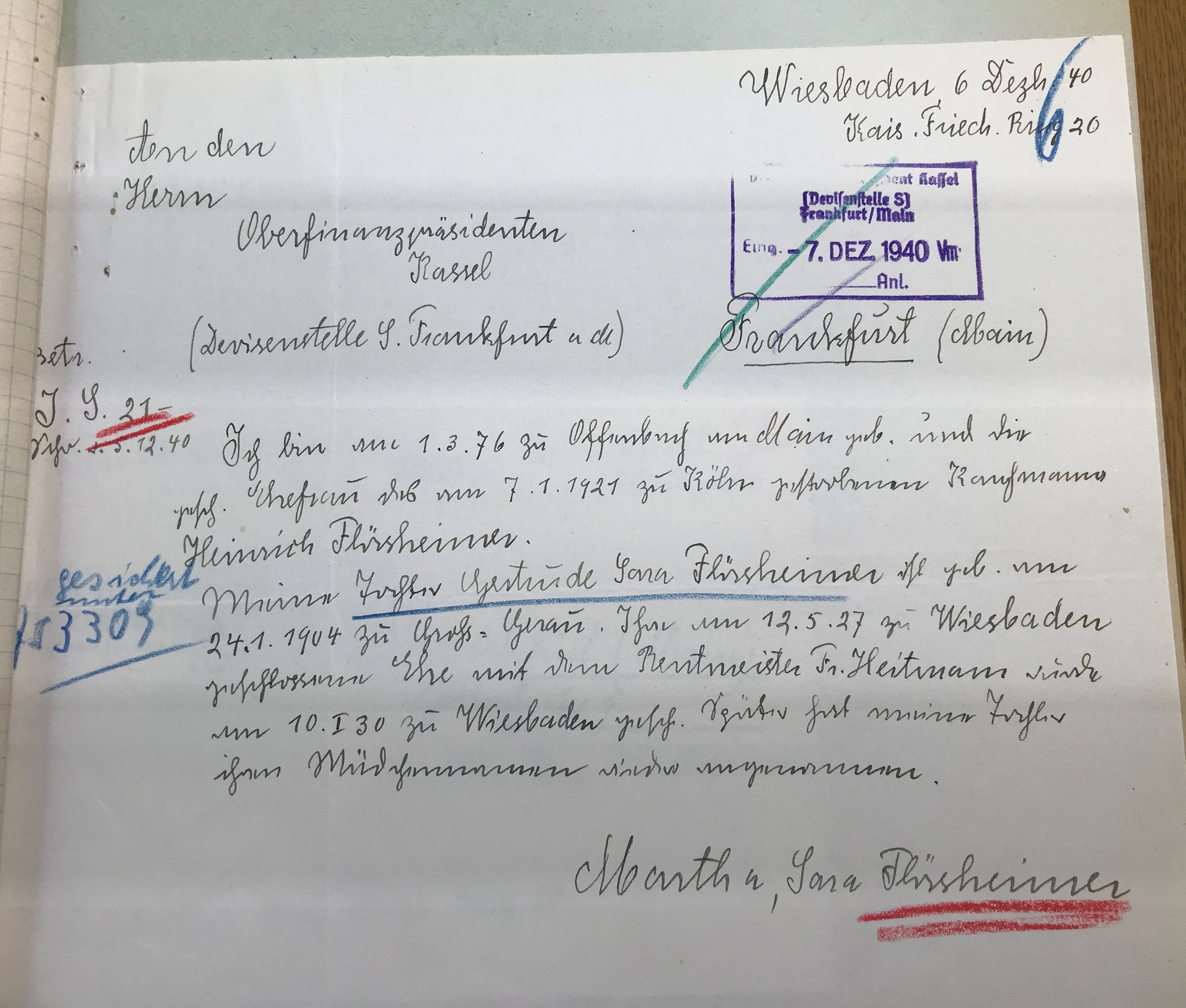
On December 6, 1940, Martha wrote this note in Wiesbaden:

Thank you to the members of the German Genealogy group who worked to decipher this difficult handwriting. This was the translation done by Matthias Steinke:

Wiesbaden, 6th December 40

Kaiser Friedrich Ring 20

I am at the 1st march 1876 in Offenbach/Main born and the wife of the at the 7th January 1921 in Cologne deceased merchant Heinrich Flörsheimer.

My daughter Gertrude Sara Flörsheimer was born at the 24th january 1904 in Gross Gerau. Her at the 12th May 1927 in Wiesbaden happened matrimony with the administrator Fr. Heitmann was at the 10th January 1930 in Wiesbaden divorced. My daughter took her maiden-name back later.

Martha Sara Flörsheimer

I am not sure who this note was written to or for what purpose, except perhaps to register their names and marital status with the officials in Wiesbaden. Or perhaps it was a follow-up to the earlier document seen above.

This typewritten letter is dated March 23, 1943, three years later:

We hereby indicate that the aforementioned Jewish woman has been restricted due to your security order from 9 14 40 to 25 8 42, because she expected the receipt of a larger payment, coming from furniture sales. On 4 9 42, the only entry received the amount of RM 594. Due to the disposition of the Governmental Practitioner Wiesbaden from 27 8 42 I 9-337 / 42, the fortune of this Jewish woman has been confiscated in favor of the Reich. We have therefore transferred the above amount to Finanzkasse Wiesbaden under file number O. 5205/494. Heil Hitler.

I am not sure what all of this means, but I got the gist of this—that all of Martha’s assets had been confiscated by the Nazis.

Aaron Knappstein located Martha’s death record:

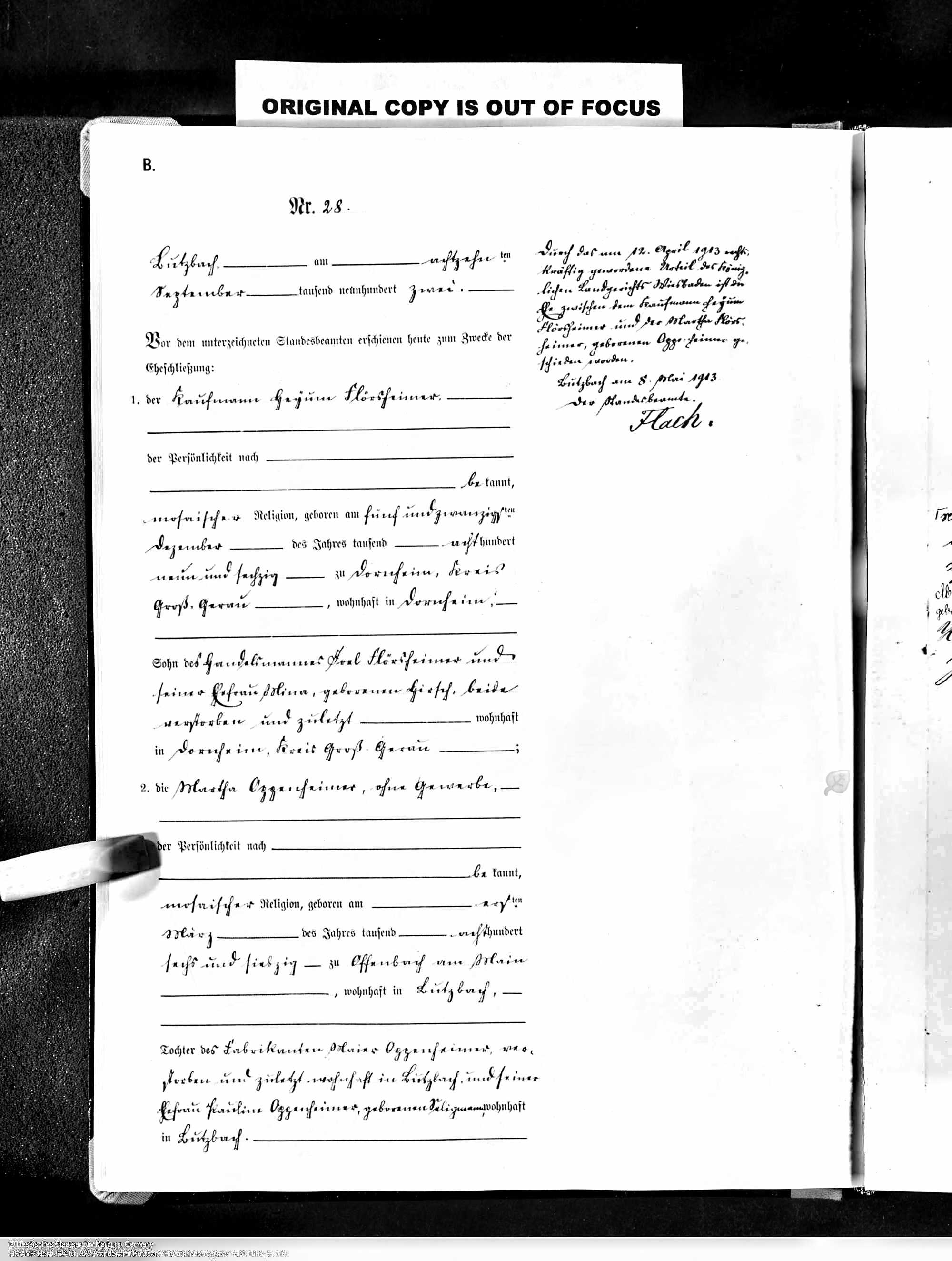
One thing of note on these forms is that Martha is identified as a widow, not as a divorcee, even though her marriage record records the divorce:

Martha Oppenheimer marriage and divorce record, Hessisches Hauptstaatsarchiv; Wiesbaden, Deutschland; Bestand: 924; Laufende Nummer: 323
Source Information
Ancestry.com. Hesse, Germany, Marriages, 1849-1930

And interestingly she did not hide her daughter’s status as a divorcee, as seen above. So why hide hers?

Finally, Aaron also sent me a photograph of Heinrich Florsheimer’s headstone, which confirms the date of death reported by his ex-wife Martha in 1940:

These extra documents fill in some of the gaps in Martha’s life. The documents from the Nazi era are particularly poignant. Martha lost so much. Of course, losing her children was the most horrific loss, but she also lost all her property to the Nazis.


Anna Segher’s The Seventh Cross: A Story of Moral Choices

Back on May 1, I wrote about my cousin Netti Reiling, who under the pseudonym Anna Seghers became a well-known leftist intellectual, activist, and author. I wrote about her best-known book, The Seventh Cross, published both in German and in English while she and her family were living in Mexico in 1942. Two years later it was made into a film starring Spencer Tracy, Hume Cronyn, Jessica Tandy, and others.

I’ve just finished reading the book. It took me quite a while to read in part because I seem to read in short spurts these days, often when I am sleepy. It also was a difficult book to read—both in terms of the painfulness of the subject matter and in the way it was written. But when I got to the second half, I couldn’t put it down as it turned from a slow-moving set of character studies to a suspenseful escape and chase.

It is an extremely well-written book. Seghers takes you into the minds of her characters so that you see their psychological development as well as their actions. The basic plot is simple: a man named George along with six others escapes from a German prison camp where political prisoners are kept, and the Gestapo and SS chase them down. Various people living in the nearby towns get involved in different ways with the escape and the chase. I won’t spoil the story more than that, but it’s not really the story that is Segher’s dominant focus. Rather, her focus is on how this story affects and, in some ways, reveals and changes the inner thinking and moral choices of the numerous characters.

The structure of the book is what makes it difficult to read at first. Seghers introduces numerous characters without linking them to each other or to the main character, George. Both the number of characters and the fact that the reader has no idea why they matter to the story made the first half of the book a struggle for me. I couldn’t keep the characters straight. Who was Ernst the shepherd and why did I care about him? Why do I care about this boy named Fritz and his girlfriend? What role does Franz have in this whole story? Who are all these various Nazis working at the prison camp? And so on. Perhaps if I’d read the book faster and not just one short segment at a time, I’d more quickly would have seen the forest and not just each individual tree. But at the pace I was reading, I’d forget who Franz or Fritz or Ernst was and have to flip back a few chapters to refresh my memory.

But once I reached the middle of the book and was able to read more quickly, I realized what a brilliant work this is and well worth the struggle to get to know the various characters. Seghers’ ability to get into the heads of the characters and see how they struggle to choose between their own safety and what they know is right is masterful. As you read, you wonder whether Fritz and Franz and all the others will do what’s needed to be done to help George or to save themselves. That’s what makes the book suspenseful. It’s not a typical crime or war story where the suspense lies in finding clues or in watching the bad guys get closer to the good guy while the good guy uses his brain to find a new way to get away. No, the suspense lies inside the minds of the characters and their personal moral codes. Frankly, I still have no idea what role Ernst the shepherd has in the story. Maybe someone who’s read the book will have an explanation. But overall each character does in the end become three-dimensional and integral to the overall story.

One thing that I did find odd about the book is that aside from one very brief mention of the mistreatment of a Jewish man, Seghers does not at all address the Nazi persecution and slaughter of Jews; she does not refer to the Nuremberg Laws or the concentration camps or Kristallnacht. Seghers was, after all, Jewish. Yet she wrote a book about Nazi Germany that is only about political prisoners, not about the way the Nazis treated Jews. Did she do that to reach a broader audience? Or did she perhaps recognize that although ordinary Germans might assist a fellow German who escaped from a camp for political prisoners, they would not have had made the same choices if it had been a Jewish person who’d escaped from a concentration camp?

I’ve not yet seen the film, and unfortunately it’s not available on any streaming service. I could buy a DVD from Amazon, but alas—I no longer have a DVD player. Damn modern technology! Do I invest in a DVD player just to watch one movie? I am debating it. But usually I find that movies based on books are not nearly as good as the books themselves, and it was my cousin Netti’s writing that I was most interested in.

As I wrote about in my post about Netti/Anna, The New York Times review of the movie, which was overall a very positive review, made one unusual comment at the end.1 I will quote it again here:

Without in the least overlooking the bestiality of the Nazi brutes nor the miserable self-surrender of German citizens to their black regime, this film … visions a burning zeal for freedom in some German rebels and a core of decency in common folk. …[T]he basic theme…is that in men—even in Germans—there is an instinct for good that cannot be destroyed.….

The big reservation which this writer holds with regard to this film is that regarding the discretion of its theme at this particular time. Without any question, it creates a human sympathy for the people of a nation with whom we are at war and it tends, as have others, to load Germany’s crimes on Nazi backs. Obviously this film can make sentiment for a “soft” peace. It looks as though we are getting a dandy “thriller” at a pretty high price.

It is true that the book (and apparently the film) portrays many of the characters in ways that reveal their basic morality although it also certainly portrays those who worked at and led the prison camp as inhumane and lacking in moral decency and many of the minor characters as spineless and complicit with the Nazis. But I can understand why in 1944 when the US was fighting Germany in World War II a reviewer might have objected to a film that portrayed any German in a flattering light.

But with the perspective of hindsight, that seems less objectionable. Seghers was at heart an optimist about human nature and perhaps she needed some hope in 1942 that many ordinary Germans would make the right choices and act morally. She had fled from Germany and then from France, seen her husband arrested and then released, and would ultimately learn that her own mother, Hedwig Fuld Reiling, had been murdered by the Nazis. She was not naïve; she was not sympathetic to the Nazis or those who supported their cause or their actions. She was just a human being holding out hope that other human beings would do the right thing. Sadly, not enough of them did. Most Germans were too afraid to resist the Nazis or had been coopted and persuaded to adopt the Nazi cause, and thus far too many people were not saved from their murderous captors.

But Seghers’ point was that when good and brave people do stand up for what is right, evil can be defeated. We need that lesson today in 2020 as much as people did in 1942.

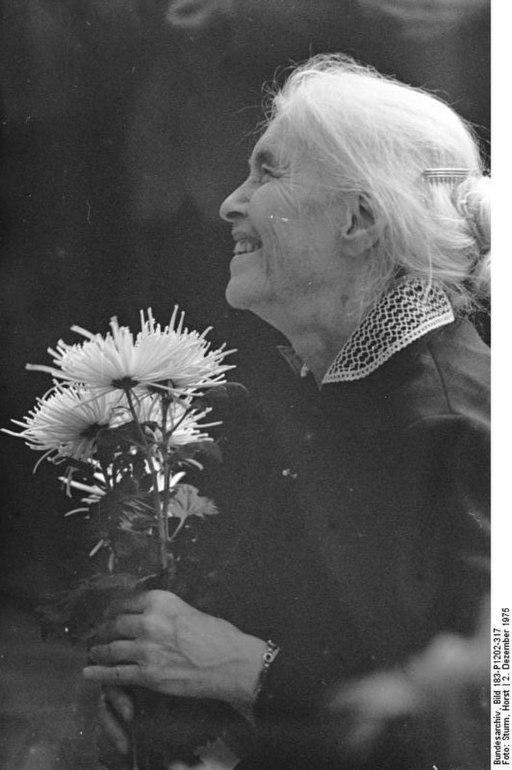
Anna Seghers (Netti Reiling) Bundesarchiv, Bild 183-P1202-317 / Sturm, Horst / CC-BY-SA 3.0 / CC BY-SA 3.0 DE (https://creativecommons.org/licenses/by-sa/3.0/de/deed.en)


  1. Bosley Crowther, “The Seventh Cross, Anti-Nazi Drama, with Spencer Tracy, at Capitol,” The New York Times, September 29, 1944, p. 18. 

Minna Fuld and Her Descendants: New Cousins from Sao Paulo, But A Brick Wall Remains

Back in April, I posted about the dead ends I’d reached in my research of Minna Fuld and her family. To recap, Minna was the daughter of Helene Goldschmidt and Salmon Fuld,  the granddaughter of Jacob Meier Goldschmidt, and the great-granddaughter of Meyer Goldschmidt, who was my four-times great-uncle. Minna was married three times. First, she married Leo Offenstadt in 1894 when she was eighteen, and that marriage ended in divorce in 1904. She and Leo had had one child, Flora, in 1894. Then Minna married Ladislaus Polacovits in 1906, and he died in 1913; Minna had one child with Ladislaus, Liselotte, who was born in 1907. Finally, Minna married Hermann Heinrich Karl Reuss in 1923, with whom she had no children.

The first mystery was about Minna’s whereabouts during the 1930s and 1940s. I knew that her third husband Hermann was listed in the 1940 Frankfurt directory and died in Frankfurt on September 27, 1947. But several unsourced trees reported that Minna died in Tel Aviv on May 3, 1944. So had Minna gone to Palestine alone and died there? Had Hermann gone with her and returned to Germany after the war?

The second mystery was the fate of Minna’s daughter Flora Offenstadt during the Holocaust. Flora Offenstadt married Hermann Durlacher in 1918 and had two children with him, Siegfried Julius Thomas (known as Thomas) Durlacher and Ulla Louise Durlacher. I had records showing that Flora and the two children immigrated to Brazil in 1939, but no records for her husband Hermann or any information about what happened to them after they immigrated.

I also had no luck locating more information about Liselotte, Minna’s younger daughter with her second husband Ladislaus, although I knew she and Ladislaus were living in Palestine/Israel during the 1940s and that their son had married in England.

Having exhausted the usual genealogy tools and newspaper databases and Google, I turned to Tracing the Tribe to see if there was anyone with connections in Brazil who might be able to help me. And I was very, very fortunate that a group member named Jacqueline who is from Sao Paulo volunteered to help me.  She first located a marriage announcement for a son of Siegfried Julius Thomas Durlacher, which can be found here.

Then Jacqueline found a long magazine article, partly in German but mostly in Portuguese, that she summarized for me. According to the article, Thomas Durlacher started a library of German-language books in Atibaia, a town in the countryside outside of Sao Paulo; the library now has ten thousand books, some of which were Thomas’ parents’ books that they took with them out of Germany when they escaped from the Nazis and others were donated by other refugees from Germany. The article also mentioned that Thomas had two sons, one a doctor in Brazil and the other residing in Germany.

And then—the icing on the cake—Jacqueline located those sons and other members of the Durlacher family on Facebook! At that point, I took over and sent messages and friend requests to these descendants of Minna Fuld. And almost immediately two of Thomas Durlacher’s sons responded. They then connected me to their cousin Sergio, the son of Ulla Durlacher (Flora and Hermann’s daughter), who contacted me by email.

Sergio told me that his grandfather Hermann Durlacher was the first member of the family to immigrate to Brazil. When I asked him why Brazil, he explained that it was the destination of the first available ship that Hermann could take.  Hermann and Flora had already sent Thomas to the Netherlands to study; he lived with a wealthy family who were close friends of the family. Flora and her daughter Ulla remained in Germany, and Sergio said that his mother had very painful memories of those years.

Unfortunately, Sergio did not have any information about the fate of Minna Fuld, his great-grandmother, so that mystery remained unsolved.

He provided me with more contacts, however, and one of those contacts who was in fact on Sergio’s father’s side found this document about Minna:

The National Archives; Kew, London, England; HO 396 WW2 Internees (Aliens) Index Cards 1939-1947; Reference Number: HO 396/73, Description, Piece Number Description: 073: Internees at Liberty in UK 1939-1942: Reu-Rop, Source Information
Ancestry.com. UK, WWII Alien Internees, 1939-1945

I also realized that one of the documents I’d found about Hermann indicated that Minna had immigrated to England:

Arolsen Archives, Digital Archive; Bad Arolsen, Germany; Lists of Persecutees 2.1.1.1
Reference Code: 02010101 oS, Ancestry.com. Europe, Registration of Foreigners and German Persecutees, 1939-1947

So Minna was in England in 1940. I then located her on the 1939 England and Wales Register:

The National Archives; Kew, London, England; 1939 Register; Reference: RG 101/419G
Enumeration District: APDF, Ancestry.com. 1939 England and Wales Registe

Note that she reported that her marital status was married, but Hermann was not living with her in England. That might explain why he was still listed in the 1940 Frankfurt directory. Hermann was not Jewish and may have stayed behind to protect their interests in Germany.  But I could not find any later record for Minna. Since Hermann was a widower when he died in Frankfurt in 1947, Minna must have died sometime between 1940 and 1947, but where and when remains a mystery.

On the other hand, thanks to Jacqueline, I now am in touch with several of Minna’s descendants, my cousins who grew up in Brazil after their parents and grandparents escaped there from Germany in the 1930s. Someday someone will learn what happened to their ancestor Minna.


Berthold Goldschmidt Revisited: His Second Family

A year and a half ago I wrote about the tragic life of my cousin Berthold Goldschmidt, who outlived not only his wife Mathilde Freudenstein but six of their seven children. Their only surviving child, their son Siegfried Goldschmidt, was murdered in the Holocaust. I believed that Berthold had only one grandchild, Siegfried’s son Max, who had no children. Thus, I believed that Berthold Goldschmidt had no living descendants.

I’ve received two updates about Berthold’s family since then. In February, my friend in Germany, Julia Drinnenberg, sent me these photographs of two of Berthold and Mathilde’s sons taken during their service in World War I, Leopold, who was killed in the war, and the above-mentioned Siegfried.

Siegfried Goldschmidt

Leopold Goldschmidt

Then back in April, I received an email from David Baron, asking if I wanted to Zoom with a cousin named Rickey Slezak. I had no idea who Rickey was or how she was related to me, but soon discovered that she is a descendant of none other than Berthold Goldschmidt.

How does he have any descendants, you might wonder?

Well, in telling Berthold’s story I totally overlooked the fact that he had remarried after Mathilde’s death and had in fact had six more children with his second wife, Rika Giesberg, Rickey’s namesake. You can imagine how embarrassing this is!

Not that this takes away from the tragedies suffered by Berthold; that is still unimaginable. But Berthold’s story is somewhat softened by the fact that he went on to have a second family. And I was delighted not only to learn about this, but to make the connection to Rickey, my third cousin, once removed. Rickey shared with me an amazing album of old photographs of Berthold’s second family. This post is devoted to their story.

After losing his first wife Mathilde in 1911, Berthold Goldschmidt was left with four surviving children from that marriage: Paul, Leopold, Siegfried, and Hedwig. They were all still teenagers at that time.

On August 25, 1912, Berthold married Rika (sometimes spelled Richa or referred to as Rickchen) Giesberg, daughter of Jonas Giesberg and Henriette Loewenstein, in Trendelburg, Germany. Rika was born in Trendelburg on May 29, 1882, and was little more than ten to fifteen years older than her four stepchildren.

TitelStandesamt Trendelburg Heiratsnebenregister 1912 (HStAMR Best. 909 Nr. 9383)AutorHessisches Staatsarchiv MarburgErscheinungsortTrendelburg

Here are photographs of Berthold and Rika, courtesy of their granddaughter and my cousin, Rickey.

Berthold Goldschmidt, courtesy of the family

Rika Giesberg Goldschmidt, courtesy of the family

Rika and Berthold’s first child together, Walter Goldschmidt, was born in Oberlistingen, Germany, on April 24, 1913.1 A second son Herbert was born on December 20, 1914.2

Three of Berthold’s children from his first marriage died between 1915 and 1916, as discussed here. By 1917, Siegfried was then the only surviving child of the children Berthold had with Mathilde Freudenstein.

After those losses, Berthold and Rika had their first daughter, Hedwig, born June 1, 1918. She presumably was named for Berthold’s deceased daughter Hedwig from his first marriage.3

Here is a photograph of their family in about 1920 before their three youngest children were born:

Berthold and Rika (Rickchen) Goldschmidt and family, c. 1920. Courtesy of the family

Their third son Jacob Julius Goldschmidt (known as Julius) was born on March 17, 1921.4 Albert Goldschmidt was born on September 9, 1924.5 Finally, their sixth and final child Elfriede was born August 17, 1926.6

This is a photograph of their home in Oberlistingen:

Berthold Goldschmidt family home in Oberlistingen. Courtesy of the family

Berthold Goldschmidt died on November 8, 1927. He was survived by his son Siegfried from his first marriage and the six children he had with Rika. Those six children lost their father before they reached adulthood. Their oldest child Walter was just fourteen, and their youngest child Elfriede just a year old. Rika was herself only 45 and left to care for the six children including four who were under ten years old.

Berthold Goldschmidt death record, Personenstandsregister Sterberegister; Signatur: 8196
Ancestry.com. Hesse, Germany, Deaths, 1851-1958 [

Rika was not destined to live a long life. She died at the age of 52 in Merxhausen, Germany, on March 1, 1935.7 I wondered why she died in Merxhausen, which is about 35 kilometers from Oberlistingen, and learned that there was a hospital there.

By that time Walter was almost 22, Herbert going on 21, Hedwig was almost seventeen, Julius almost fourteen, and the two youngest were still quite young; Albert was ten, and Elfriede only nine. I wonder who took care of these children, especially the three youngest, after they were orphaned.

Here are some photographs of some of the siblings taken in Germany before their lives changed forever:

Walter Goldschmidt
Courtesy of the family

Hedwig Goldschmidt Courtesy of the family

Julius Goldschmidt
Courtesy of the family

By the time of Rika’s death, the Nazis had taken power in Germany, and the Nuremberg Laws were adopted six months after her death.  It’s thus not surprising that by 1937 her two oldest sons decided to leave for the United States. Herbert left first, arriving in New York on July 30, 1937. According to the ship manifest, he left behind his brother Walter in Oberlistingen and was  going to a cousin, Leighton Steele, in Detroit, Michigan.  Leighton Steele was the son of Hedwig Goldschmidt Steele, a younger sister of Berthold Goldschmidt. Thus, Leighton, who was American-born, was Herbert’s first cousin, but they probably had never met.8

Walter Goldschmidt arrived just a few months after his brother Herbert; he arrived in New York on October 1, 1937. According to the ship manifest, he was heading to New York to a “cousin” named Joseph Guhl and was leaving behind an “uncle,” Salomon Strauss in Frankfurt. Salomon Strauss was married to Jenny Giesberg, Rika Giesberg Goldschmidt’s sister. Joseph Guhl was married to Meta Giesberg, the daughter of Leopold Giesberg, Rika’s brother.9

This photograph is labeled “Leaving for America” and shows Walter in Hamburg:

Courtesy of the family

The next sibling to arrive in the US was the youngest, Elfriede. She was only twelve years old when she arrived on March 24, 1939, and was sailing with her aunt Jenny Giesberg Strauss, her husband Salomon Strauss, and their son Walter. The ship manifest indicates that they all had been living in Frankfurt, so perhaps Elfriede had been taken in by her aunt after Rika died in 1935. They were leaving behind Salomon’s brother Julius and going to his cousin, Max Schoenmann, who lived at 1770 Andrews Avenue in the Bronx. I mention that only because my husband grew up down the block from there at 1940 Andrews Avenue. Small world.10

I don’t know whether or not Herbert ever went to Detroit to see Leighton Steele, but in 1940 both he and Walter were working as waiters for a restaurant in North Castle, New York, where they were both also living, according to the 1940 census.11  My cousin Rickey told me that the restaurant where they worked was a spot that became extremely popular as a music venue during the Big Band era, called Log Cabin Farms. You can see it mentioned on Herbert’s World War II draft registration.

Walter Goldschmidt, World War II draft registration, Ancestry.com. U.S. WWII Draft Cards Young Men, 1940-1947

Herbert Goldschmidt, World War II draft registration, Ancestry.com. U.S. WWII Draft Cards Young Men, 1940-1947

The North Castle Historical Society published an article about the Log Cabin Farms and all the performers who came there; you can find it here. As you can see from this postcard, the restaurant had a seating capacity of 1500!

Meanwhile, their sister Elfriede was living in the Bronx with their aunt Jenny Giesberg Strauss and her family in 1940.12 Rickey told me that her father revered his aunt Jenny, at least in part because of the care she gave to his little sister.

Herbert enlisted in the US military on January 22, 1941, almost a year before Pearl Harbor.13 I don’t know anything specific about his military service, but here is a photograph of him in uniform.

Herbert Goldschmidt/Goldsmith
Courtesy of the family

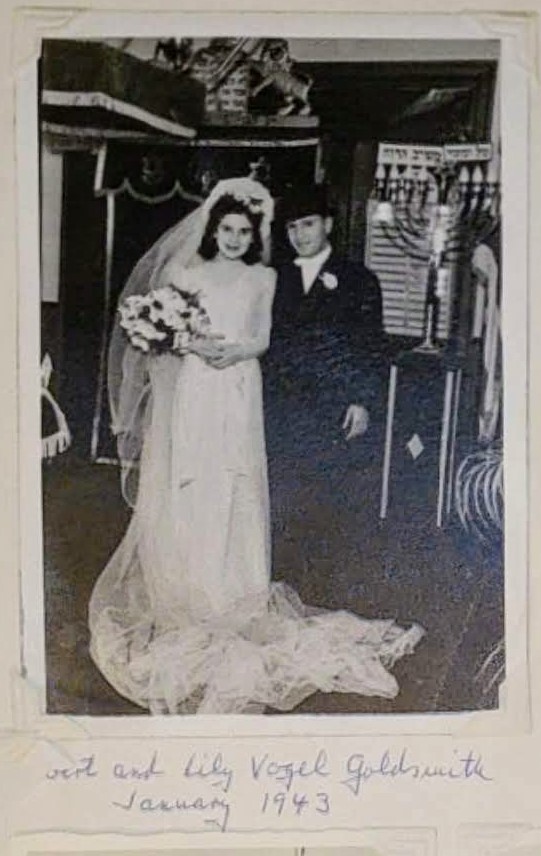
He applied for a marriage license to marry Lilly Vogel on January 19, 1943, in New York City.14

courtesy of the family

They did not have any children. According to my cousin Rickey, her uncle Herbert died in 1963.

His brother Walter enlisted on January 29, 1943, just ten days after Herbert and Lilly’s wedding.15 According to records his daughter Rickey has, Walter served three years including a year overseas. He was decorated several times, receiving the following medals: American Service Medal; Good Conduct Medal; European African Middle Eastern Service Medal; and a World War II Victory Medal.

On February 12, 1944, Walter married Hilda Weis,16 who was born on October 8, 1922, to Siegfried Weis and Else Scheuer in Gelnhausen, Germany.17 They had one child, my cousin Rickey, the source of all these wonderful photographs. Walter died on October 4, 1991; his widow Hilda died in 2001.18 They are survived by their daughter Rickey as well as several grandchildren and great-grandchildren.

Hilda Weis and Walter Goldschmidt/Goldsmith
Courtesy of their daughter Rickey

Elfriede married Alvin Kruger Colin with whom she had two children. This is a picture of them taken in March 1948. Given the way they are dressed, I assume this was their wedding day.19

Elfriede Goldschmidt and Al March 1948
Courtesy of the family

Elfriede died on January 6, 2011; she was survived by her children and grandchildren.20

Here is a photograph of the three siblings who made it to the US. I’d guess it was taken sometime after the war.

Courtesy of the family

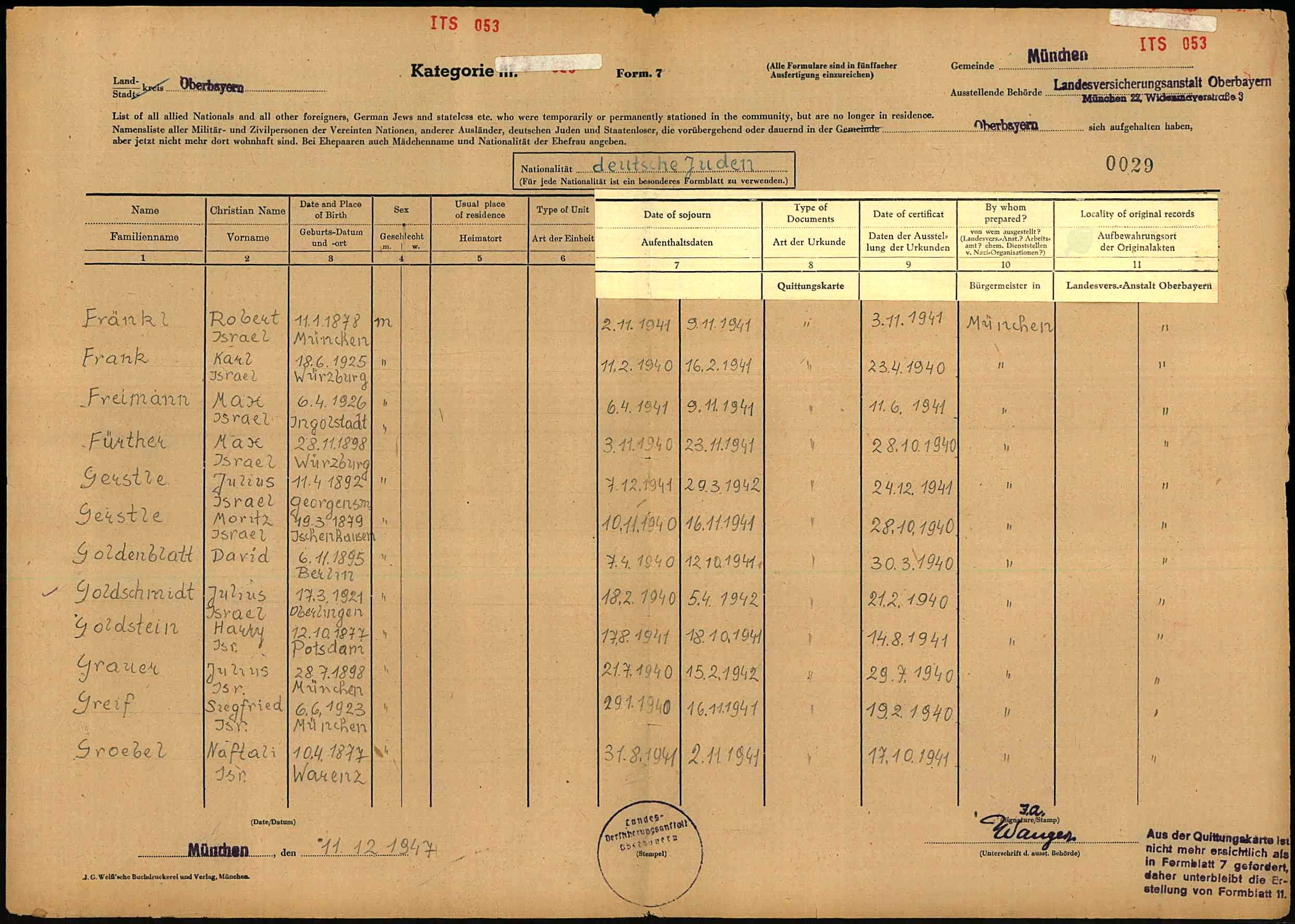
Unfortunately, two of the other children of Berthold and Rika did not leave Germany and were killed in the Holocaust. According to the Memorial Book for Victims of the Persecution of Jews under the National Socialist Tyranny in Germany 1933 – 1945, Jacob Julius Goldschmidt was sent to Dachau concentration camp on November 10, 1938, after Kristallnacht and was released from Dachau on December 8, 1938. He still, however, did not leave Germany. According to this document, he was living in Munich from February 18, 1940, until April 5, 1942.

UPDATE: Thank you to barb276 for finding more information about Jacob Julius Goldschmidt here. According to this page from the Munich archives, Jacob Julius had moved from Kassel to Munich by January 1, 1936, and was living there until October 26, 1940, when he went to a Hachsharah, a Zionist training camp in Steinhofel, where Jews were trained for life in Palestine/Israel. Unfortunately, Jacob Julius never got there.

Arolsen Archives, Digital Archive; Bad Arolsen, Germany; Lists of Persecutees 2.1.1.1
Reference Code: 02010101 oS, Ancestry.com. Europe, Registration of Foreigners and German Persecutees, 1939-1947

He was then deported to Poland and murdered at some unnamed location.

Hedwig Goldschmidt was also murdered by the Nazis. She had married Horst Starsky, who was born on July 10, 1909, in Wingeruppen, Germany. According to the Memorial Book for Victims of the Persecution of Jews under the National Socialist Tyranny in Germany 1933 – 1945, they were living in Berlin, and both were first imprisoned in a Jewish forestry labor camp in Kersdorf-Briesen. They were then deported to Auschwitz on April 19, 1943, where they were killed. As far as I’ve been able to determine, they did not have any children.

The fate of Albert Goldschmidt, Berthold and Rika’s youngest son, is less clear. My cousin Rickey believes that he ended up immigrating to Buenos Aires, Argentina, but I have no documentation showing that. Rickey also believed he married and had a child there, but again, we have no documentation. What we do have is this photograph of Albert apparently taken in front of a restaurant that has a Spanish name, I think—Coveteria Vievo Viena? Google Translate could not make sense of coveteria but translated Vievo Viena as I come Vienna. Possibly a restaurant serving Viennese (or German-style) food?

UPDATE: Thank you to my cousin Susana, who also came from Buenos Aires, for helping me to translate what this says. She said that it says “Confitería Viejo Viena” (Old Vienna tearoom) and would have been a patisserie or tearoom that likely specialized in German/Austrian pastries and cakes.

Courtesy of the family

Thus, Berthold Goldschmidt’s family with his second wife Rika endured a great deal of tragedy just as his family with his first wife Mathilde Freudenstein had. But the record must stand corrected. Berthold Goldschmidt does indeed have living descendants—his grandchildren, his great-grandchildren, and even some great-great-grandchildren.  And one of them is my wonderful cousin Rickey who helped me tell and illustrate their family’s story.


  1. Walter Goldschmidt, Birth Date: 24 Apr 1913, Birth Place: Oberlistingen, Germany,
    Ancestry.com. U.S. WWII Draft Cards Young Men, 1940-1947 
  2. Herbert Goldschmidt, Birth Date: 20 Dec 1914, Birth Place: Oberlistingen, Germany, Ancestry.com. U.S. WWII Draft Cards Young Men, 1940-1947 
  3.  Hedwig Goldschmidt, Birth Date: 1 Jun 1918, Birth Place: Oberlistingen, Reference Number: 02010101 oS, Document ID: 70442392, Arolsen Archives, Digital Archive; Bad Arolsen, Germany; Lists of Persecutees 2.1.1.1, Ancestry.com. Europe, Registration of Foreigners and German Persecutees, 1939-1947 
  4.  Julius Israel Goldschmidt, Birth Date: 17 Mrz 1921 (17 Mar 1921), Birth Place: Oberlingen, Reference Number: 02010101 oS, Document ID: 70126154, Arolsen Archives, Digital Archive; Bad Arolsen, Germany; Lists of Persecutees 2.1.1.1, Ancestry.com. Europe, Registration of Foreigners and German Persecutees, 1939-1947 
  5. I have no record of Albert’s birth date; this comes from the Goldschmidt family report done by Roger Cibella and David Baron. 
  6.  Elfriede Colin, Social Security Number: 112-16-3514, Birth Date: 17 Aug 1926
    Death Date: 6 Jan 2011, Social Security Administration; Washington D.C., USA; Social Security Death Index, Master File, Ancestry.com. U.S., Social Security Death Index, 1935-2014 
  7.  Richa Goldschmidt, Maiden Name: Giesberg, Gender: weiblich (Female)
    Age: 52, Birth Date: 29 Mai 1882 (29 May 1882), Death Date: 1 Mrz 1935 (1 Mar 1935)
    Death Place: Merxhausen, Hessen (Hesse), Deutschland (Germany), Civil Registration Office: Merxhausen, Certificate Number: 16, Personenstandsregister Sterberegister; Signatur: 6991, Ancestry.com. Hesse, Germany, Deaths, 1851-1958 
  8. Herbert Goldschmidt, ship manifest, Year: 1937; Arrival: New York, New York, USA; Microfilm Serial: T715, 1897-1957; Line: 25; Page Number: 38, Ancestry.com. New York, Passenger and Crew Lists (including Castle Garden and Ellis Island), 1820-1957 
  9. Walter Goldschmidt, ship manifest, Year: 1937; Arrival: New York, New York, USA; Microfilm Serial: T715, 1897-1957; Line: 8; Page Number: 36, Ancestry.com. New York, Passenger and Crew Lists (including Castle Garden and Ellis Island), 1820-1957. Salomon Strauss and Jenny Giesbech [sic], Arolsen Archives, Digital Archive; Bad Arolsen, Germany; Lists of Persecutees 2.1.1.1, Reference Code: 02010101 oS, Ancestry.com. Europe, Registration of Foreigners and German Persecutees, 1939-1947. Meta Giesberg, Marriage Date: 30 Apr 1936, Marriage Place: Manhattan, New York, USA, Spouse: Joseph A Guhl, Certificate Number: 11992, Ancestry.com. New York, New York, Extracted Marriage Index, 1866-1937 
  10. Elfriede Goldschmidt, ship manifest, Year: 1939; Arrival: New York, New York, USA; Microfilm Serial: T715, 1897-1957; Line: 6; Page Number: 8, Ancestry.com. New York, Passenger and Crew Lists (including Castle Garden and Ellis Island), 1820-1957 
  11. Walter Goldschmidt and Herbert Goldschmidt, 1940 US census, Year: 1940; Census Place: North Castle, Westchester, New York; Roll: m-t0627-02811; Page: 3B and Page 24A, Enumeration District: 60-250, Ancestry.com. 1940 United States Federal Census 
  12. Elfriede Goldschmidt, 1940 US census, Census Place: New York, Bronx, New York; Roll: m-t0627-02497; Page: 10B; Enumeration District: 3-1449, Ancestry.com. 1940 United States Federal Census 
  13. Ancestry.com. U.S., World War II Army Enlistment Records, 1938-1946 
  14.  Herbert Goldschmidt, Gender: Male, Marriage License Date: 19 Jan 1943
    Marriage License Place: Manhattan, New York City, New York, USA, Spouse: Lilly Vogel
    License Number: 1202, New York City Municipal Archives; New York, New York; Borough: Manhattan; Volume Number: 1, Ancestry.com. New York, New York, Marriage License Indexes, 1907-2018 
  15. Ancestry.com. U.S., Department of Veterans Affairs BIRLS Death File, 1850-2010 
  16.  Hilda Weis, Gender: Female, Marriage License Date: 10 Feb 1944
    Marriage License Place: Manhattan, New York City, New York, USA. Spouse: Walter Goldschmidt, License Number: 3826, New York City Municipal Archives; New York, New York; Borough: Manhattan; Volume Number: 6, Ancestry.com. New York, New York, Marriage License Indexes, 1907-2018 
  17. Hilda Goldsmith, [Hildegard Weis], [Hilda Goldschmidt] , Gender: Female,
    Birth Date: 8 Oct 1922, Birth Place: Gelnhausen, Federal Republic of Germany
    Death Date: 18 Sep 2001, Father: Siegfried Weis, Mother: Else Scheuer
    SSN: 085180692, Ancestry.com. U.S., Social Security Applications and Claims Index, 1936-2007 
  18. Name: Walter Goldsmith, Gender: Male, Birth Date: 24 Apr 1913, Death Date: 4 Oct 1991, Claim Date: 6 Mar 1975, SSN: 077165081, Ancestry.com. U.S., Social Security Applications and Claims Index, 1936-2007. For Hilda, see Note 17. 
  19.  Elfriede Goldsmith, Marriage License Date: 27 Feb 1948, Marriage License Place: Bronx, New York City, New York, USA, License Number: 1705, New York City Municipal Archives; New York, New York; Borough: Bronx, Ancestry.com. New York, New York, Marriage License Indexes, 1907-2018 
  20. Elfriede Colin, Social Security Number: 112-16-3514, Birth Date: 17 Aug 1926
    Issue Year: Before 1951, Issue State: New York, Last Residence: 33308, Fort Lauderdale, Broward, Florida, USA, Death Date: 6 Jan 2011, Social Security Administration; Washington D.C., USA; Social Security Death Index, Master File, Ancestry.com. U.S., Social Security Death Index, 1935-2014 

Martha Loewenthal Wolff’s Family: An Update from Israel

One of the more elusive Goldschmidt family members to research has been Martha Loewenthal Wolff and her family. Martha was the daughter of Kiele Stern and Abraham Loewenthal, the granddaughter of Sarah Goldschmidt and Salomon Stern, and my third cousin, twice removed. Thanks to my friend Aaron Knappstein, I now have more information and documents and even photographs of Martha and her family.

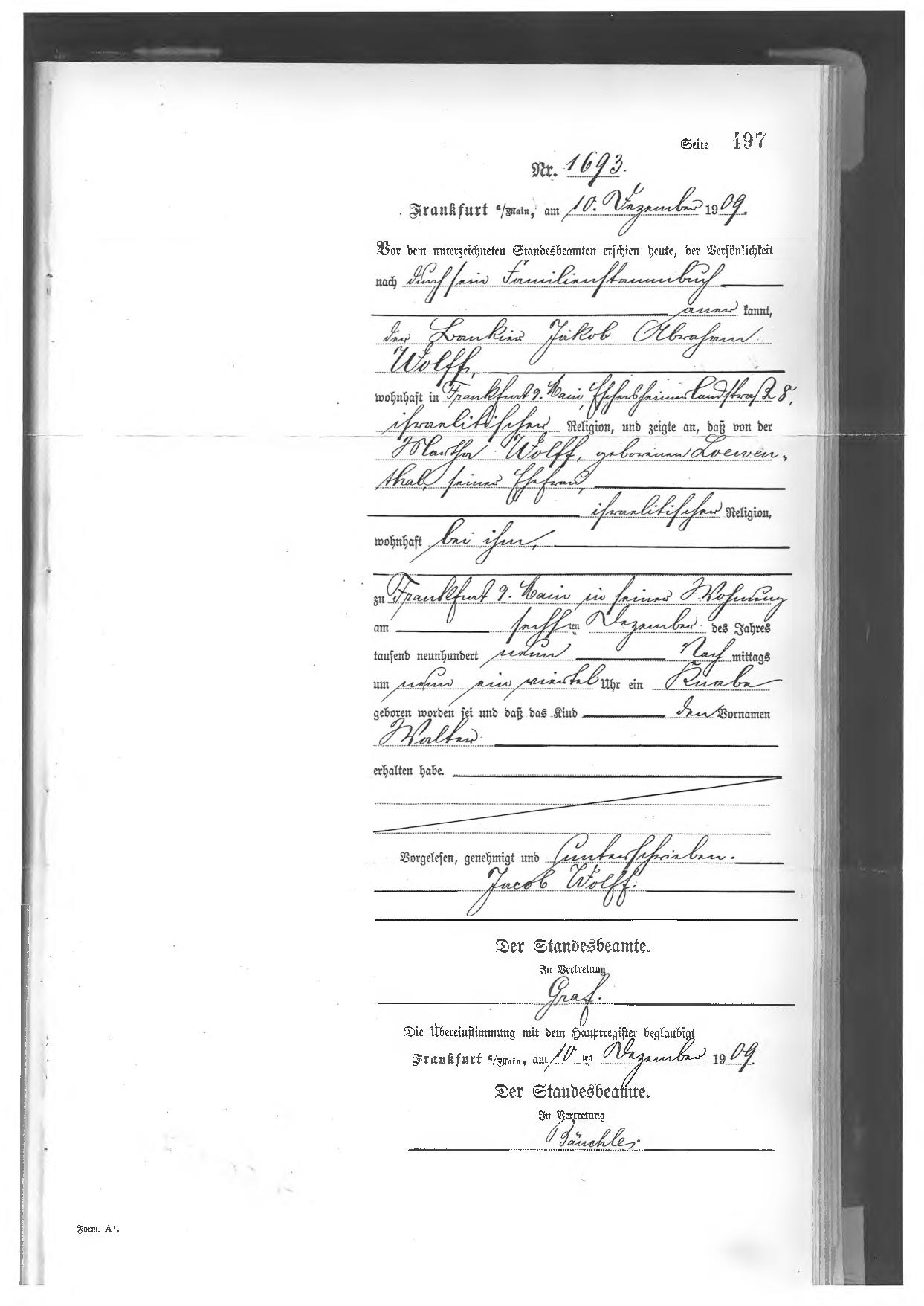
Martha was married to Jakob Wolff, as discussed here, and they had three children: Anna, Hans Anton, and Walter. I was missing birth records for all three children, and Aaron was able to locate all of them.

Birth record of Anna Wolff

Birth record of Hans Anton Abraham Wolff

Birth record of Walter Wolff

Martha died in 1930, and I could not find a death record for her until Aaron located it, as I wrote about here.

After Martha’s death and the Nazi takeover of Germany, Jakob Wolff and all three of their children immigrated to Israel, as I wrote about here.

But I did not know what happened to Jakob or his children after their immigration. And then Aaron came through for me again and located Hans Anton Wolff’s son Benjamin in Israel and connected me to him and his daughter Ravid. Now I have firsthand information about Martha’s family as well as photographs, thanks to Ravid Wolff, my fifth cousin, once removed.

First, some photographs of the family taken before they left Germany.

Jacob and Martha Wolff and their first car Courtesy of the Wolff family

Anna Wolff and her mother Martha Loewenthal Wolff Courtesy of the Wolff family

Anna Wolff as a child Courtesy of the Wolff family

Hans Anton and Walter Wolff Courtesy of the Wolff family

Ravid shared with me that her great-grandmother Martha was a very talented artist and sent me this image of a painting that Martha did while traveling with Jakob in what was then Palestine in the 1920s.

Painting by Martha Loewenthal Wolff

According to Ravid, her great-grandparents Martha and Jakob Wolff owned two banks in Frankfurt, Germany, and were quite wealthy. After Martha died from ovarian cancer in 1930, Jakob married Ilse Gruenebaum. When Hitler came to power, Jakob recognized how dangerous he was and, as a Zionist, decided to leave Germany for Israel (then Palestine) before it was too late. He was able to obtain visas to immigrate for a thousand pounds each, an exorbitant amount of money at that time, but had to leave all his other property and possessions behind. All of it including their home in Frankfurt was confiscated by the Nazis and never returned to the family.

Ravid shared two letters with me that show that the requests for restitution of their property in Frankfurt were denied:

Google Translate helped me translate these letters. The one above translates as:

Upon your request of 17 December 1956, we will inform you: The property Leerbachstrasse 36 was registered until 17 September 1937 on:
Banker Jakob Wolff on the ideal half
Instead of his wife Martha Wolff [names of children] for ideal half in undivided community of heirs. [I am not sure what “ideal half” means.]
In the way of the forced auction, this plot of land on 17 9 1937 is given to Frau Therese Ried geb Stromer, [address]. It is still owned by them.
The owner of the Paulsplatz 14 property was the merchant Carl Seitz in Baden near Vienna in 18 1 1923 and the owner of the Paulsplatz 16 property was the Jakob Wolff & Co., Open Trade Company since 18 March 1922.
The current owner of both properties has been the municipal district of Frankfurt since August 10, 1934 bze, October 15, 1935. A piece of land at Paulsplatz 18 does not exist.

The second letter translated as:

The aforementioned property became the property of the City of Frankfurt on the basis of an additional resolution dated 2 4 1935. The compulsory auction had already started in 1932. The JRSO, which had previously asserted claims for reimbursement for the aforementioned property, accepted its application on Feb. 1, 1951. For your further information, we would like to inform you that the city has always contested a claim for reimbursement.
We hope to have served you with the above statements.

As for Martha and Jakob’s three children, Anna, the oldest, was married to Simon Wittekind when she immigrated, and they had two sons, Aharon and Baruch (as they were known in Israel) who were born in Berlin. Simon was a doctor who wanted to move to South Africa, but Anna felt safer in Israel, so she stayed there with her children.

Anna later married Herbert Feige. According to Ravid, Anna hated Germany and suffered great trauma because of what had happened there and unlike her brother Hans Anton refused to reclaim her German citizenship when that right became available to her. Her sons changed their surname to Yardeni (for the Jordan River) to identify with their new homeland. Ravid did not know exactly when Anna died, only that like her mother Martha, she died young and from cancer.

Ravid’s grandfather was Hans Anton Wolff, the second child of Martha Loewenthal and Jakob Wolff.  He married Susana Meseritz, another refugee from Germany, whom he met in Palestine. They had one child, Ravid’s father Benjamin. Hans had a doctorate in chemistry. He died from colon cancer in 1974, and his wife Susana died in 2002.

Walter, the youngest of the siblings, also married in Palestine/Israel. He owned a hotel in Jerusalem for many years. He and his wife Hedy Buller had two children. Walter died in 1968 in Jerusalem, also from cancer.

I am so indebted to Aaron Knappstein for finding the missing records of the Wolff children and even more so for connecting me to my cousin Ravid. And I am very, very grateful to Ravid for sharing her family’s story with me. Ravid, like her great-grandmother Martha and so many others in the extended Goldschmidt family, has a great interest in and great talents in art. Her photography captures in simple and yet complex ways the beauty of the world around us by using unusual perspectives and contrasting light and colors.