Hermann Gutmann Becomes Dennis Goodman: An Oral History, Part II

By the spring of 1940, Hermann Gutmann was seventeen years old and had been in England and separated from his parents since the fall of 1936.  He had completed his secondary education and had been working at a leather factory in Lancashire in the north of England since February 1940 and moved to London that May.1

On July 2, 1940, at 6 am he heard a knock on his door. The police told him to pack his bags and come with them to the police station. He protested, but to no avail, and along with many other German Jewish “enemy aliens,” he was taken to a camp, Huyton Camp, and housed in a tent with other young refugees from Nazi Germany. All those who were under eighteen, including Hermann, were told they were being taken out of England. He again protested and was told by the commanding officer that those leaving England would have the best chance of survival because England was likely to lose the war.

As the internees boarded the HMT Dunera on July 10, 1940, all their personal possessions were taken and never returned. The Jewish internees were placed in the hold in the rear of the ship and kept there by barbed wire fencing. They were only allowed up on the deck for thirty minutes a day for exercise where they were barefooted and often stepping on the broken beer bottles left behind by the guards, whom Hermann described as “football hooligans.” The internees slept on the hard floor and had open toilet stalls that he described as “awful.”  Hermann described the morale of the younger internees as fairly good, but said that those who were older had a much harder time and that there were even a few suicides during their voyage. There were also Nazi and Italian internees on the ship, but they were kept in a different location.

HMT Dunera. Not stated in the AWM record / Public domain

The internees had no idea where they were going until they arrived in Australia on September 6, 1940. Once in Australia, they were sent to New South Wales and housed at the Hay Internment Camp. There were about two thousand internees kept there, many of whom had been successful professionals—doctors, lawyers, professors, and so on. They formed their own government and even printed their own money. Hermann distributed newspapers and even started a Boy Scout group that was officially recognized by the London headquarters of the Boy Scouts.

They lived in huts, about forty to a hut, and conditions were good. Hermann noted several times that as a young man (he was seventeen), he was not as uncomfortable as those who were older, and he didn’t mind some of the living conditions. When asked whether he now resented having been interned during this time, he said no—that he understood it was done without much thought based on fear when the war started and that it was an awful waste of time and money, but that he did not feel any resentment towards the British for their actions.

In the fall of 1941, Hermann volunteered to join the British military as a means of getting out of the internment camp. He left Austrialia on October 13, 1941, and arrived back in England on November 28, 1941, just over a week before Pearl Harbor. He and other Jewish refugees were given no choice as to where to serve and were assigned to the Pioneer Corps, a corps assigned “light engineering tasks [that] included building anti-aircraft emplacements on the Home Front, working on the Mulberry harbours for D-Day, and serving during beach assaults in France and Italy. Pioneers also carried stretchers, built airfields, repaired railways, and moved stores and supplies.”

Pioneer Corps clearing rubble, Ministry of Information Photo Division Photographer / Public domain

It was during this time that his commanding officer asked him to change his name to something less German-sounding. Hermann chose the name Dennis John Goodman, his first name for a friend who had been killed in the war and Goodman as an Anglicized version of Gutmann. In the interview, he commented that he now regretted that he never returned to his birth name Hermann Gutmann as it had a very long history in his family.

Dennis was not content being in the Pioneer Corps because he wanted to be fighting the Nazis. In 1943, British policy changed, and Jewish German refugees like Dennis were allowed to serve more directly in combat. Dennis joined a tank unit and was on the beach at Normandy three days after D-Day, that is, on June 9, 1944. He ended up fighting in France, Belgium, the Netherlands, and finally in Germany. He was involved in many difficult and dangerous battles, made more dangerous by the fact that the English tanks were outmatched by the German Tiger Tanks they were facing. He experienced some very close encounters with death or capture by the Germans.

The interviewer asked him how he felt when he entered Germany, his country of birth, and fought on German soil. Dennis commented that “by that time I felt more English than German” and that he had no difficulty facing his former countrymen in battle. When the war ended, he was in Berlin for the British Victory Parade on July 21, 1945.

British Victory Parade in Berlin, National Archives and Records Administration / Public domain

By that time he already knew about the concentration camps.  He was given compassionate leave to go to Amsterdam to learn what had happened to his parents and learned of the deportation to and murder at Sobibor. In the interview, Dennis mentioned that at that time he learned that his grandmother had been hidden in the northern part of Holland and had survived.

I checked to see which grandmother, and it had to be his maternal grandmother, Hedwig Goldschmidt, because his paternal grandmother had died in 1932. I have no wartime records for Hedwig after March 15, 1938, when she was a passenger coming to England from Amsterdam.2 I initially thought that meant that she had moved to England at that time, but it appears from Hermann’s information that she had returned to Amsterdam, perhaps after visiting him in England.

Dennis remained in Germany after the war and joined the Review and Interrogation staff in Neuengamme, near Hamburg, where he was involved in interrogating Nazis about war crimes. He was struck by the ordinariness of the people who committed these crimes and their weak excuses for what they did. He also found some of them very arrogant. Several times during the interview, Dennis made the point that it was well known throughout Germany that Jews were being persecuted and that those who afterwards claimed that they hadn’t been aware of what was happening were either lying or repressing what they’d known.

In 1947, Dennis was discharged from the military and returned to England. He married a Polish-born Holocaust survivor after the war and had three children. I don’t know much about his life after the war, but did find several immigration documents from Brazil, starting in 1949, suggesting he might have been involved in international business or perhaps visiting family members who had immigrated to Brazil.

Ancestry.com. Rio de Janeiro, Brazil, Immigration Cards, 1900-1965. Original data: “Rio de Janeiro Brazil, Immigration Cards, 1900-1965”. FamilySearch, Salt Lake City, Utah, 2013.

Dennis John Goodman, born Hermann Gutmann, died in England in 2007. He had lived an extraordinary life, leaving his parents and homeland as a thirteen year old boy, being interned for over a year in Australia as an “enemy alien,” and then fighting valiantly against the Nazis for several years including post-war interrogation of war criminals. His parents had been murdered at Sobibor. He had every right to be an angry, resentful man.

But listening to his voice in the oral history interview, I detected no resentment towards his adopted country, despite the internment. Certainly he harbored anger with the Nazis for what they did to his parents and all the Jews in Europe and continuing bewilderment over the German citizenry’s acquiescence to it all. But I did not come away from the interview thinking of him as bitter or defeated; instead I heard a then 72 year old man who looked back on his life with pride in his ability to endure and succeed against all odds and in his strength and independence even as a young man. His story will stay with me forever.


  1. These facts come almost entirely from the oral history interview of Dennis Goodman, aka Hermann Gutmann, found on the Imperial War Museum website. Some of the dates in this post were found in an article written by his daughter, Naomi Levy, and published in the AJR [Association of Jewish Refugees] Journal of December 2018, on page 11, and found here. ↩
  2.  Hedwig Goldschmidt, Arrival Age: 61, Birth Date: abt 1877, Port of Departure: New York, New York, United States, Arrival Date: 15 Mar 1938, Port of Arrival: Plymouth, England, Ports of Voyage: New York, Ship Name: Washington, Shipping Line: United States Line, Official Number: 232210, The National Archives of the UK; Kew, Surrey, England; Board of Trade: Commercial and Statistical Department and successors: Inwards Passenger Lists.; Class: BT26; Piece: 1158, Ancestry.com. UK and Ireland, Incoming Passenger Lists, 1878-1960 ↩
Hermann Gutmann, Child Refugee from the Nazis: An Oral History

As we saw last time, my cousin Else Goldschmidt Gutmann, daughter of Marcel Goldschmidt and Hedwig Goldschmidt, was murdered by the Nazis in 1943 at the Sobibor concentration camp along with her husband Siegfried Gutmann. They were, however, survived by their son, Hermann Gutmann. His story is captured in a moving and detailed oral history interview that was recorded for the British Imperial War Museums in 1995 and available online here.

The oral history interview is two hours long, and I listened to it in the course of one afternoon. If anyone has the time and the interest to listen, even if just to the first thirty minutes, it will provide insights into the strength and courage of those who escaped Nazi Germany as children. My words cannot possibly capture the emotion and the personality expressed by this man in retelling his life story fifty to sixty years after these tumultuous events. When you listen, the clarity of his memory, his composure, and his strength come shining through. Despite living in England since 1936, he still had the traces of a German accent. I will try and do justice to his story, but again, if you have time, listen to at least some of this interview.

One other editorial explanation. Hermann Gutmann changed his name in 1943 to Dennis John Goodman. I will refer to him as Hermann in discussing the years before that change and then as Dennis for the years after the name change. I hope that’s not too confusing.

All the facts in this post come directly from the oral history interview with Dennis John Goodman at the Imperial War Museum, Catalogue 15101.


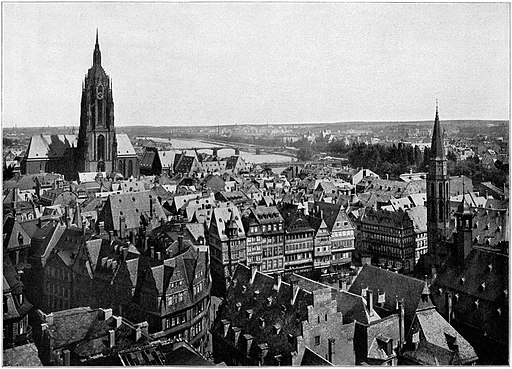
Hermann Gutmann’s father Siegfried Gutmann was from a family of bankers in Stuttgart, and after the Stuttgart bank was taken over by a larger bank, Siegfried moved to Frankfurt to work for a bank in that city where he met and married Else Goldschmidt. Their only child Hermann Gutmann was born in Frankfurt on February 28, 1923. Hermann believed that the economic circumstances experienced in Germany in the 1920s made his parents reluctant to have more than one child. He described his childhood as a happy middle-class childhood in Frankfurt where his family was actively involved in the Jewish community as well as the general community.

Frankfurt, Germany, 1918,Carl Andreas Abt / Public domain

Hermann experienced anti-Semitism as early as 1931 when he was eight years old and saw people carrying anti-Semitic political posters while marching in the streets of Frankfurt. But things grew much worse after 1933 when Hitler was elected Chancellor. Hermann described himself as an outspoken and opinionated boy who fought back when he was attacked by students for being Jewish. When he finished primary school, his parents could no longer send him to a general secondary school because Jews were banned. Instead they sent him to an excellent Jewish day school where he was one of several hundred students.

But by 1936, his parents were concerned that Hermann would not be able to receive a quality education, and they decided that the best thing to do for their son was to send him to boarding school in England. His father spoke to young Hermann, expressing his fears, given how Hitler had perverted Germany and how their non-Jewish friends had drifted away out of fear.  When asked by the oral history interviewer how he felt about leaving his parents and his home, Hermann responded that he “just had to face it.” His acceptance of this reality seemed remarkable to me, especially given that he was only thirteen at the time.

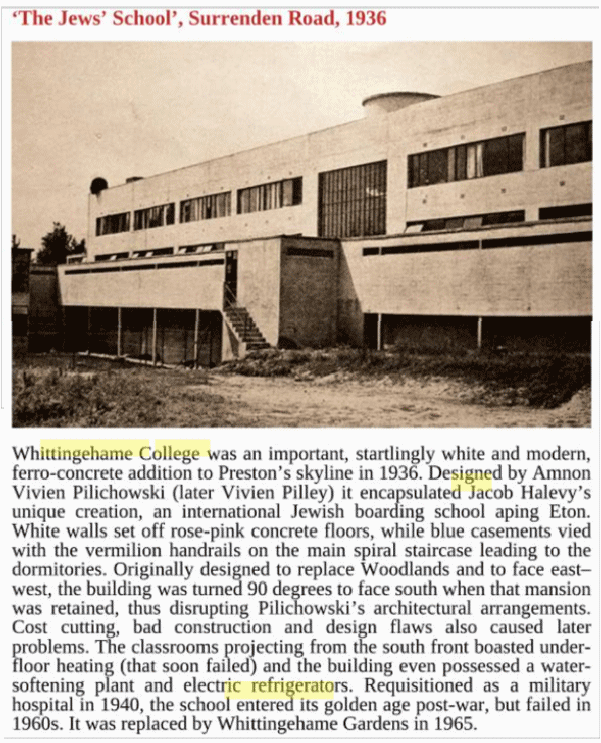
So on October 5, 1936, thirteen year old Hermann Gutmann traveled to England with a family friend who happened also to be heading to England.  When they arrived in London, a relative met him at the station and made sure he boarded the right train to Brighton, where his new school, a Jewish boarding school called Whittinghame College, was located. He described his first year there as very lonely. He knew just a little English when he arrived, and there were only one or two other German students at the school. More German refugees had arrived by the time he left in 1939.

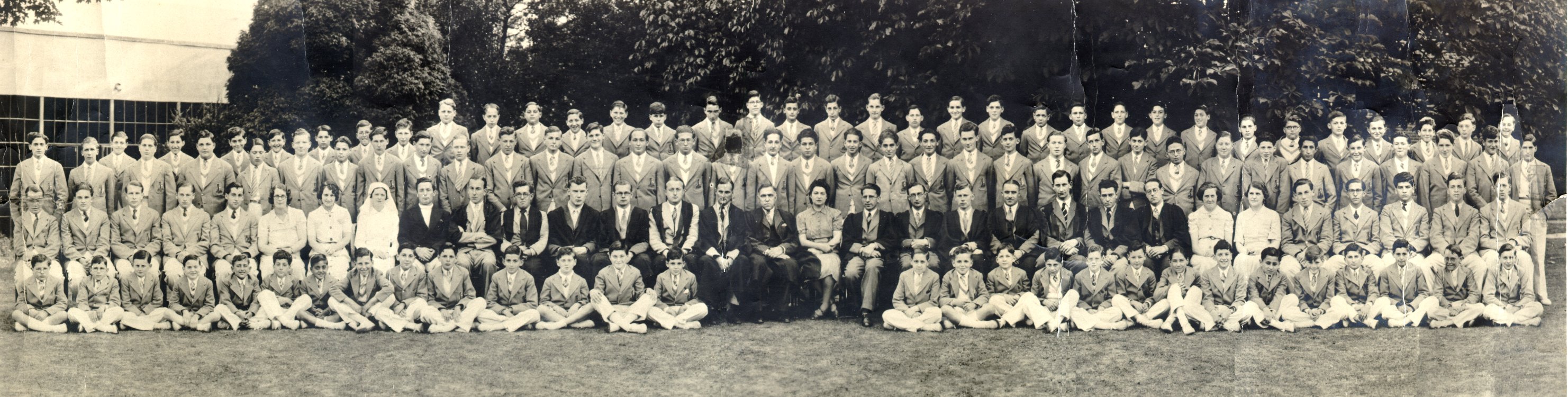
Thank you to the alumni association of Whittinghame College for permission to use these two photographs.

Hermann is probably in this photograph, but I don’t know which young man he is.

Whitinghame College students, 1939

His parents left Germany for Amsterdam in 1937. The interviewer asked him why his parents hadn’t come to England instead of Amsterdam, and he explained that his father had been offered a job in Amsterdam and that his parents believed they would be safe there. He said that no one anticipated in 1937 that Hitler would later invade the Netherlands and deport Jews to concentration camps. Hermann was able to visit his parents in Amsterdam during this time, and he said that although it was a big adjustment for them and especially for his father, whose new job was not in the banking field, they were reasonably happy living there.

Although Hermann said that he did not enjoy the “monastic existence” of the all-boys boarding school, he stated that he received an excellent education and that he even qualified to matriculate at Cambridge University for the fall of 1939, but “events intervened,” that is, the start of World War II. Once the war started, Hermann also was no longer able to visit his parents.

He finished his time at Whittinghame and obtained a job in a leather manufacturing factory in Lancashire, England, where he worked from February, 1940 until May, 1940. He had been in England for more than three years at that point. He had coped with adjusting to a new country, learning a new language, completing his secondary education at a Jewish boarding school, and enduring the long separation from his parents. In the interview, he commented that he had experienced no hostility in England based on his German background and that people had been very friendly.

But his life was about to change in the spring of 1940.

Marcel Goldschmidt’s Children: The Two Who Did Not Survive

Although Marcel Goldschmidt’s widow (and cousin) Hedwig and two of their children escaped safely from Germany and survived the Holocaust, their other two children, Nelly and Else, met tragic fates.

Nelly and Else were the two middle children, and they married brothers. Nelly was married to Moritz Gutmann and Else to Siegfried Gutmann. Each had one child; Nelly’s son was Karl Hermann Gutmann, and Else’s son was Hermann Gutmann; both were named for their paternal grandfather, Hermann Gutmann. Up until the Nazi era, both families were living in Frankfurt. I have no information about Siegfried Gutmann’s occupation, but his brother Moritz was an art dealer like so many of his Goldschmidt in-laws.1

Nelly Goldschmidt Gutmann’s story is particularly heartbreaking because she could have survived had the family made a different decision. On January 13, 1936, Moritz Gutmann arrived in the United States and filed a declaration of intention to become a US citizen two months later. On his declaration he listed his wife Nelly and reported that she was residing in Frankfurt and that their son Karl was living in Holland. Moritz also indicated that his prior residence before entering the US had been Toronto, Canada, and that he had entered the US in Buffalo, New York, but was now residing in New York City.

The National Archives at Philadelphia; Philadelphia, Pennsylvania; NAI Title: Declarations of Intention for Citizenship, 1/19/1842 – 10/29/1959; NAI Number: 4713410; Record Group Title: Records of District Courts of the United States, 1685-2009; Record Group Number: 21
Source Information
Ancestry.com. New York, State and Federal Naturalization Records, 1794-1943

Moritz and Nelly’s son Karl arrived the following year on December 16, 1937 when he was fourteen. On the ship manifest he indicated that he was going to his father in New York and leaving behind his uncle, “S. Gutmann,” i.e. Siegfried Gutmann, in Amsterdam. Thus, by that time Else Goldschmidt and her husband Siegfried Gutmann had also left Germany.2

But where was Else’s Goldschmidt’s sister Nelly Goldschmidt Gutmann, the wife of Moritz Gutmann, mother of Karl Gutmann? She was still in Germany, now in Coblenz, according to the petition for naturalization that Moritz filed on November 21, 1941. She and Moritz had divorced in August, 1940 in Florida.3

Moritz Gutmann petition for naturalization, National Archives and Records Administration; Washington, DC; NAI Title: Index to Petitions for Naturalizations Filed in Federal, State, and Local Courts in New York City, 1792-1906; NAI Number: 5700802; Record Group Title: Records of District Courts of the United States, 1685-2009; Record Group Number: RG 21
(Roll 1347) Petition No· 390451 – Petition No· 390950, Ancestry.com. New York, State and Federal Naturalization Records, 1794-1943

Nelly thus never came to live in the US and was still in Germany as late as November 21, 1941, two years after the beginning of World War II. According to the Page of Testimony filed at Yad Vashem by her cousin Regina Blanche Rosenberger, Nelly was living in a mental institution during the war and was killed sometime during the war. She was gassed on a train.

We don’t know all the circumstances surrounding Nelly’s life—why she was institutionalized and when, why her extended family wasn’t able to take her with them when they left Germany, or even where and when she was murdered. But we know that her life ended tragically and violently at the hands of the Nazis.

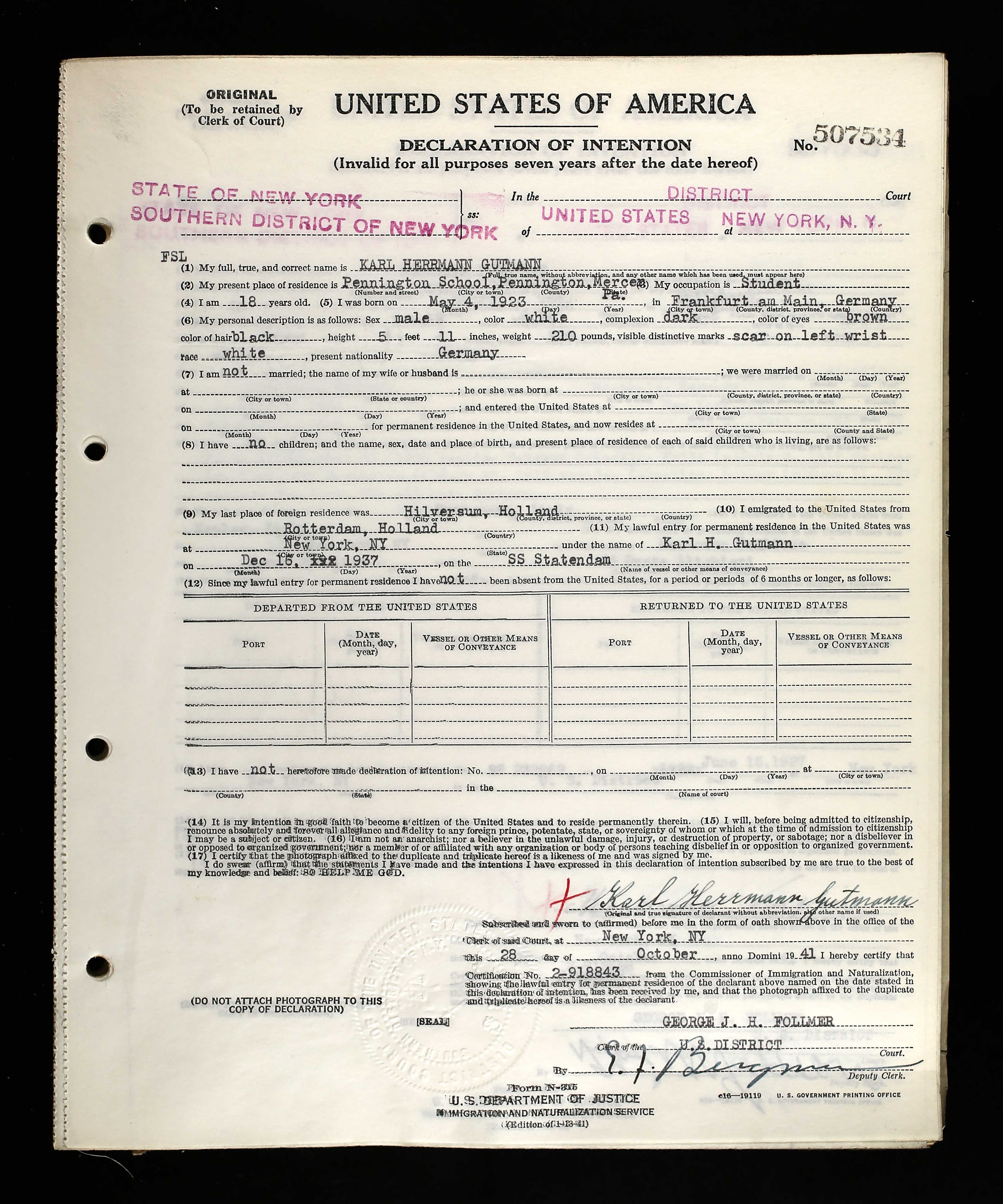
Fortunately, Nelly was survived by her son Karl, who did escape in time. As noted above, Karl had arrived in 1937 when he was fourteen years old. According to his declaration of intention filed on October 28, 1941, when he was seventeen, Karl was at that time a student at Pennington School, a boy’s college preparatory school in Pennington, New Jersey. (The declaration says Pennsylvania, but that’s incorrect.)

Karl Gutmann declaration of intention, The National Archives at Philadelphia; Philadelphia, Pennsylvania; NAI Title: Declarations of Intention for Citizenship, 1/19/1842 – 10/29/1959; NAI Number: 4713410; Record Group Title: Records of District Courts of the United States, 1685-2009; Record Group Number: 21,  (Roll 638) Declarations of Intention for Citizenship, 1842-1959 (No 507401-508300), Ancestry.com. New York, State and Federal Naturalization Records, 1794-1943

Karl enlisted in the US Army on February 11, 1943, and petitioned for naturalization while stationed in Spartanburg, South Carolina.4 In August 1945 he was hospitalized in an unidentified hospital for a non-battle-related injury to his eye caused while cleaning a firearm.5 I could not (yet) find other records of his military service, but I did find him on a Navy transport ship returning from France on April 12, 1946, a year after the war in Europe had ended.6

Interestingly, Karl married Joan C. Fenton just six days after returning from Europe. They were married on April 18, 1946, in New York, and had three children.7  Karl and Joan later divorced, and he married Gisela Bartels in 1974.8 They moved to Florida, where Karl died on February 8, 1995, at the age of 71.9

Thus, although Nelly did not survive the Holocaust, she has descendants who are alive today and living in the United States. I hope that I can connect with them and learn more about their grandmother.

As mentioned above, Nelly’s sister Else Goldschmidt Gutmann did leave Germany before World War II started. She and her husband Siegfried Gutmann were in Amsterdam when their nephew Karl arrived in the US in 1937.  Unfortunately Else and Siegfried were not safe from the Nazis in the Netherlands. At some point after Hitler conquered the Netherlands, they were sent to the camp at Westerbork in the Netherlands and then from there on July 20, 1943, they were deported to the Sobibor concentration camp where they were murdered. These Pages of Testimony and a letter found in their files at Yad Vashem attests to the cruelty of their deaths:

Siegfried was 57 when he was killed, and Else only forty.

But as was the case with Else’s sister Nelly, Else and Siegfried were survived by their son, Hermann Gutmann. His story merits separate posts that will come next.


  1. Moritz Gutmann, Declaration of Intent, The National Archives at Philadelphia; Philadelphia, Pennsylvania; NAI Title: Declarations of Intention for Citizenship, 1/19/1842 – 10/29/1959; NAI Number: 4713410; Record Group Title: Records of District Courts of the United States, 1685-2009; Record Group Number: 21, Ancestry.com. New York, State and Federal Naturalization Records, 1794-1943 ↩
  2. Karl Gutmann, passsenger manifest, Year: 1937; Arrival: New York, New York, USA; Microfilm Serial: T715, 1897-1957; Line: 1; Page Number: 143, Ship or Roll Number: Statendam, Ancestry.com. New York, Passenger and Crew Lists (including Castle Garden and Ellis Island), 1820-1957 ↩
  3. Moritz Gutmann, Gender: Male, Spouse’s name: Nelly Gutmann, Divorce Date: 1940, Divorce Place: Dade, Florida, USA, Certificate Number: 6976, Ancestry.com. Florida, Divorce Index, 1927-2001 ↩
  4.  Karl Hermann Gutmann, Gender: Male, Declaration Age: 20, Record Type: Petition
    Birth Date: 4 May 1923, Birth Place: Frankfort On Maim, Germany, Arrival Date: 16 Dec 1937, Arrival Place: New York, NY,Declaration Date: 8 May 1943, Declaration Place: Greenville, South Carolina, USA, Court District: U.S. District Court for the Greenville Division of the Western District of South Carolina. (06/26/1926 – 03/18/1966)
    Petition Number: 2589, The National Archives at Atlanta; Morrow, Georgia, USA; Record Group Title: 21; Record Group Number: Records of District Courts of the United States, Ancestry.com. South Carolina, Naturalization Records, 1868-1991; Ancestry.com. U.S., World War II Army Enlistment Records, 1938-1946. ↩
  5. National Archives and Records Administration; Hospital Admission Card Files, ca. 1970 – ca. 1970; NAI: 570973; Record Group Number: Records of the Office of the Surgeon General (Army), 1775-1994; Record Group Title: 112,
    Ancestry.com. U.S. WWII Hospital Admission Card Files, 1942-1954 ↩
  6. Karl Gutmann, ship manifest, Year: 1946; Arrival: New York, New York, USA; Microfilm Serial: T715, 1897-1957; Line: 1; Page Number: 285, Ancestry.com. New York, Passenger and Crew Lists (including Castle Garden and Ellis Island), 1820-1957 ↩
  7.  Karl H Gutmann, Marriage License Date: 18 Apr 1946, Marriage License Place: Manhattan, New York City, New York, USA, Spouse: Joan C Fenton, License Number: 12447, New York City Municipal Archives; New York, New York; Borough: Manhattan; Volume Number: 18, Ancestry.com. New York, New York, Marriage License Indexes, 1907-2018 ↩
  8. Karl H Gutmann, Marriage License Date: 1974, Marriage License Place: Manhattan, New York City, New York, USA, Spouse: Gisela E Bartels, License Number: 23231, New York City Municipal Archives; New York, New York; Borough: Manhattan, Ancestry.com. New York, New York, Marriage License Indexes, 1907-2018 ↩
  9. Karl Gutmann, Birth Date: 4 May 1923, Death Date: 6 Feb 1995, SSN: 067180184
    Ancestry.com. U.S., Department of Veterans Affairs BIRLS Death File, 1850-2010 ↩

Ferdinand and Friederike Meyer: Why Did She Stay Behind?

As noted in my earlier post, Regina Goldschmidt and Aaron Meyer’s four oldest children had varying experiences during the Holocaust. Alfred appears to have escaped to France, but I don’t know where he was thereafter. Jacob died in 1928, but his wife and children escaped to England and Argentina in the 1930s; Max had his family ended up in Argentina. And Siegfried was killed at the Nazi concentration camp Theresienstadt in 1943. Their youngest child Amalie escaped to England and then the US. Today I will tell the story of their son Ferdinand.

Ferdinand Meyer had married Friederike Jaenecke, a non-Jewish woman, in 1920, and they had two children, Eleanore and Erich.  Even though Friederike was not born Jewish and her children were only half-Jewish, it appears that they faced persecution as Jews.

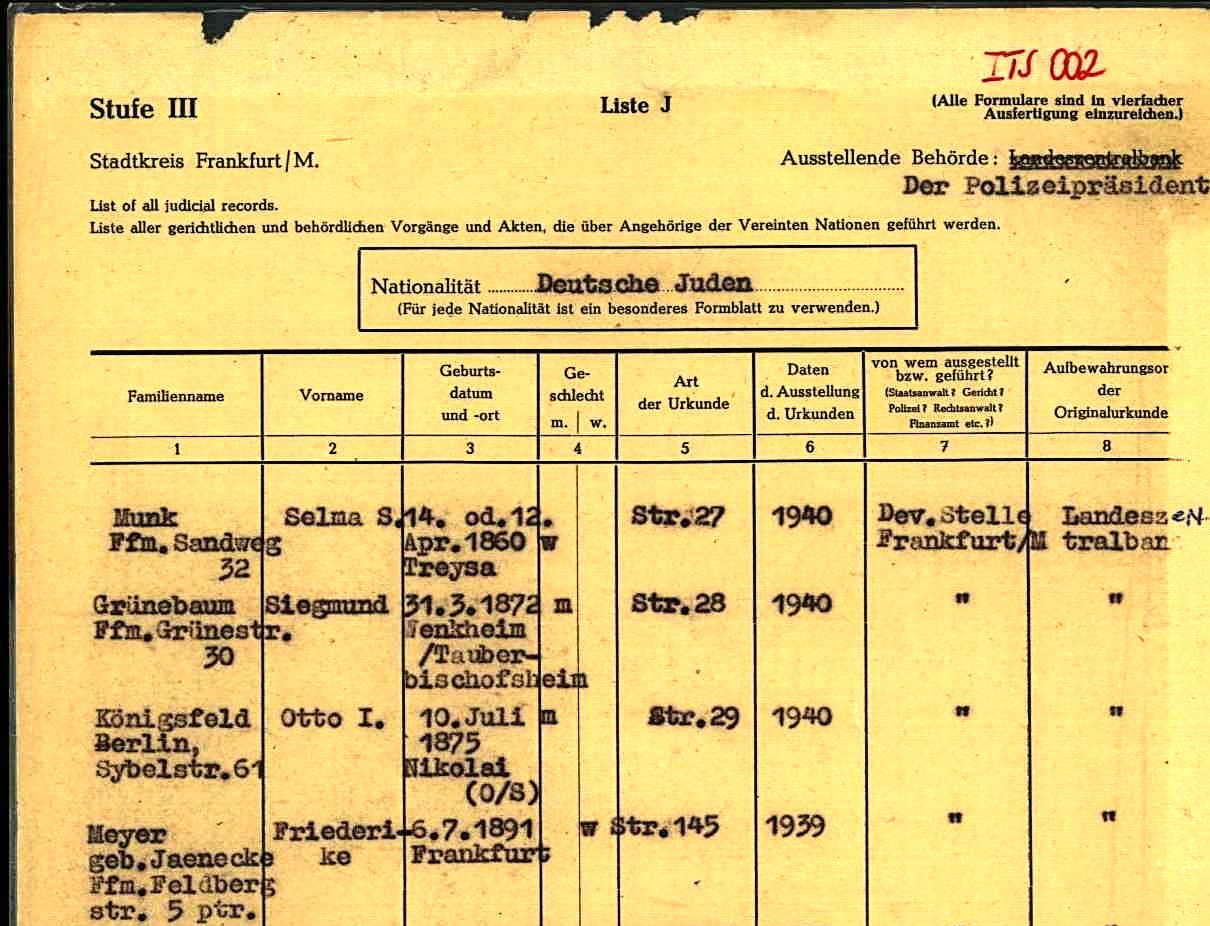
Friederike herself is included on a document from the Arolsen Archives that lists the “Deutsche Juden,” German Jews, living in Frankfurt. For Friederike, it records that the “Daten d. Austellung d. Urkunden,” the date of exhibiting certificates, was in 1939. What I didn’t understand is why Friederike was listed here, but not her husband or children.

Arolsen Archives, Digital Archive; Bad Arolsen, Germany; Lists of Persecutees 2.1.1.1; Series: 2.1.1.1, Description, Reference Code: 02010101 oS, Ancestry.com. Europe, Registration of Foreigners and German Persecutees, 1939-1947

Also, she was still classified as Aryan (Arisch) on this document found in the Arolsen Archives:

Arolsen Archives, Digital Archive; Bad Arolsen, Germany; Lists of Persecutees 2.1.1.1
Ancestry.com. Europe, Registration of Foreigners and German Persecutees, 1939-1947.
Original data: Arolsen Archives. Registration of Foreigners and German Persecutees by Public Institutions, Social Securities and Companies (1939-1947). Bad Arolsen, Germany. 2.1.1.1 American Zone; Bavaria Hesse; 2.1.1.2 American Zone: Bavaria, Wurttemberg-Baden, Bremen; 2.1.1.3 American Zone; Bavaria, Hesse (Children).

How do I reconcile this? And where was the rest of her family?

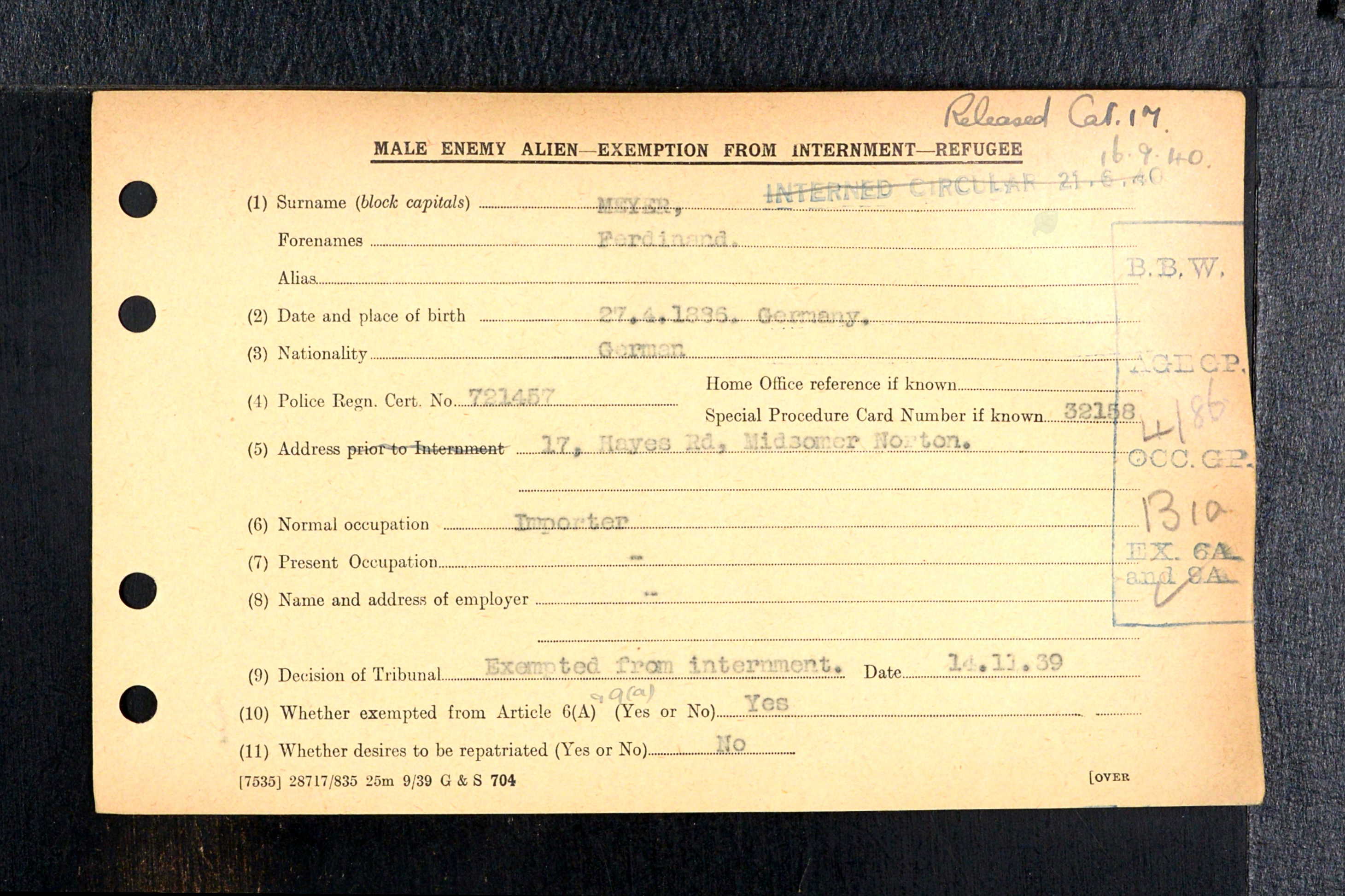
From several other documents I was able to piece together some of what happened. Ferdinand escaped to England some time before November 14, 1939, when he was initially exempted from being interned as an enemy alien. His record, however, indicates that he was interned as an enemy alien from June 21, 1940, until September 16, 1940.

Name: Ferdinand Meyer, Gender: Male, Nationality: German, Internment Age: 54, Birth Date: 27 Apr 1886, Birth Place: Germany, Internment Date: 21 Jun 1940, Discharge Date: 16 Sep 1940
The National Archives; Kew, London, England; HO 396 WW2 Internees (Aliens) Index Cards 1939-1947; Reference Number: HO 396/187, Ancestry.com. UK, WWII Alien Internees, 1939-1945

On October 31, 1940, Ferdinand left England and immigrated permanently to the US, arriving in Boston on November 16, 1940. The ship manifest recorded that his daughter E. Meyer was the person he left behind in England and that he was going to his son, E. Meyer, who resided at 627 Commonwealth Avenue in Boston, Massachusetts. Thus, Erich was already in the US.

Ferdinand Meyer, ship manifest, The National Archives at Washington, D.C.; Washington, D.C.; Series Title: Passenger Lists of Vessels Arriving at Boston, Massachusetts, 1891-1943; NAI Number: 4319742; Record Group Title: Records of the Immigration and Naturalization Service, 1787-2004; Record Group Number: 85; Series Number: T843; NARA Roll Number: 451 Description Month or Roll: 451  Ancestry.com. Massachusetts, Passenger and Crew Lists, 1820-1963

Erich had arrived on March 9, 1940, from England, so he also had escaped from Germany to England, presumably with his father and sister. He was only sixteen when they then put him on a ship for the US. Interestingly, the ship manifest indicates that he was heading to Niagara Falls, New York, as his permanent destination after landing in New York. Handwritten on the manifest it names August Kuhlman of Niagara Falls, New York as the person at his destination, but it also says that he was headed to an aunt, Lotto Karlmuller, who was living at 627 Commonwealth Avenue in Boston.1 That is the same address his father gave eight months later as Erich’s residence, so it appears that Erich did not end up going to Niagara Falls.

Erich Meyer, ship manifest, Year: 1940; Arrival: New York, New York; Microfilm Serial: T715, 1897-1957; Microfilm Roll: Roll 6452; Line: 1; Page Number: 78, Ancestry.com. New York, Passenger and Crew Lists (including Castle Garden and Ellis Island), 1820-1957

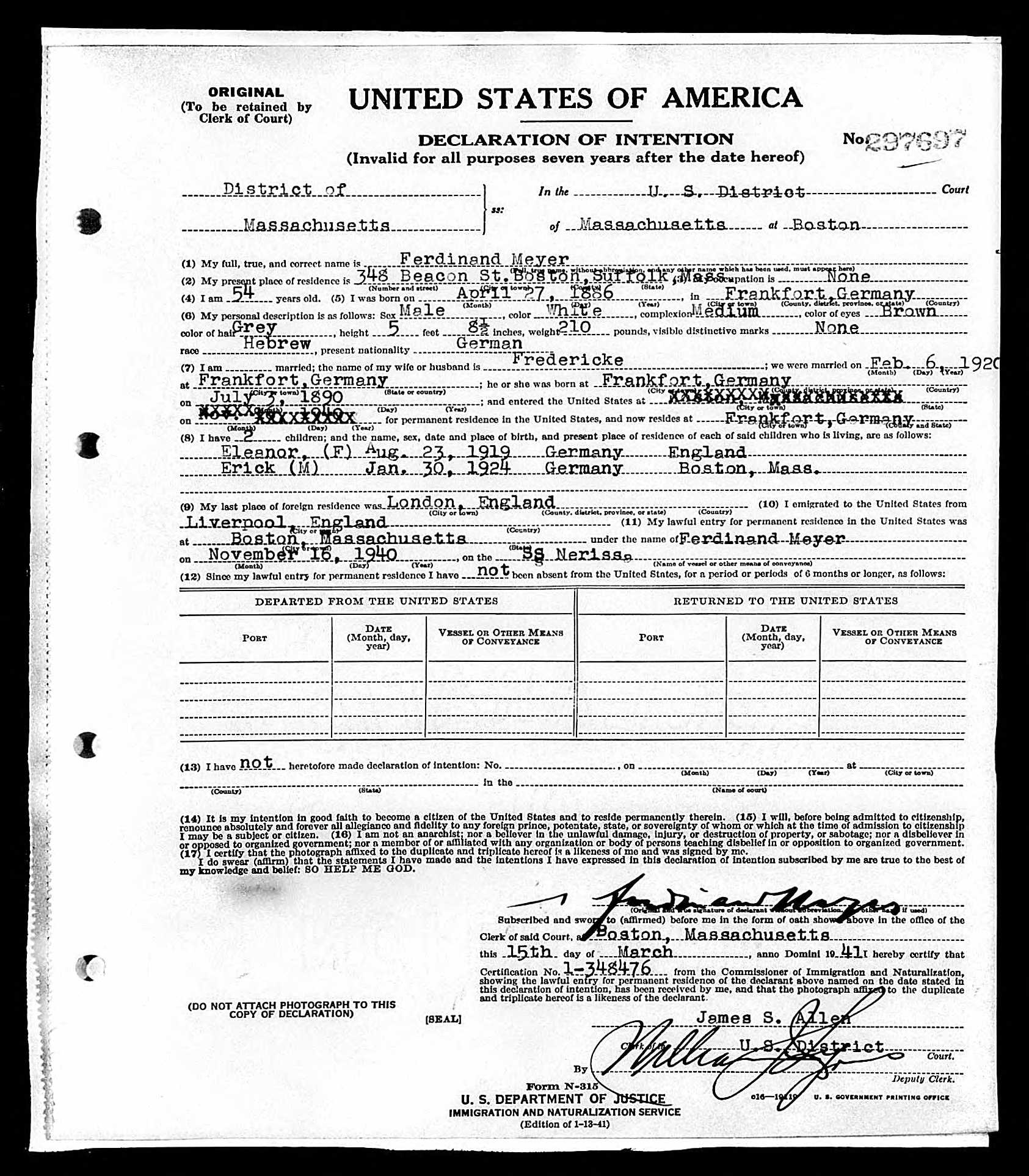
Ferdinand filed a declaration of intention to become a US citizen on March 15, 1941. On that declaration he indicated that his daughter Eleanor was in England and his son Eric was in Boston. Friederike must have still been outside of the US because the line indicating when she entered the country is crossed out. The 1941 Boston directory lists his address as 348 Beacon Street and his occupation as “atndt,” attendant, I assume. (He had listed no occupation on his declaration of intention.)2

Ferdinand Meyer, National Archives at Boston; Waltham, Massachusetts; ARC Title: Petitions and Records of Naturalization , 8/1845 – 12/1911; NAI Number: 3000057; Record Group Title: Records of District Courts of the United States, 1685-2009; Record Group Number: RG 21
Description: Declaration of Intention, V 501 No 295271, 2 Dec 1940 Breedy – V 503 No 297720, 17 Mar 1941 Oberg, Ancestry.com. Massachusetts, State and Federal Naturalization Records, 1798-1950

Friederike finally arrived in the US on August 9, 1941. Her declaration of intention to become a US citizen was filed on December 9, 1941, two days after Pearl Harbor. She indicated that her prior residence had been Frankfurt, Germany, so it appears she had not left when her husband and children did, and that explains why only she was listed on the Nazi record that appears above.  Her declaration also states that Eleanora (spelled with the A here) was still in England.

Friederike Meyer, declaration of intention, National Archives at Boston; Waltham, Massachusetts; ARC Title: Petitions and Records of Naturalization , 8/1845 – 12/1911; NAI Number: 3000057; Record Group Title: Records of District Courts of the United States, 1685-2009; Record Group Number: RG 21, Description: Declaration of Intention, V 512 No 305021, Oct 1941 Rydar – V 514 No 307480, Jan 1942 Patturelli, Ancestry.com. Massachusetts, State and Federal Naturalization Records, 1798-1950

Ferdinand and his son Eric both registered for the draft in the US. Ferdinand listed his address as 99 Norway Street in Boston and also reported that he was self-employed at 152 Massachusetts Avenue in Arlington, Massachusetts. That caught my eye because for six years from 1975 to 1981 we lived in Arlington less than a mile from that address. I was very curious as to what Ferdinand might have been doing there since he lived in Boston, not Arlington, but I had no luck figuring that out.

Ferdinand Meyer, World War II draft registration, The National Archives at St. Louis; St. Louis, Missouri; World War II Draft Cards (Fourth Registration) for the State of Massachusetts; Record Group Title: Records of the Selective Service System; Record Group Number: 147; Series Number: M2090, Ancestry.com. U.S., World War II Draft Registration Cards, 1942

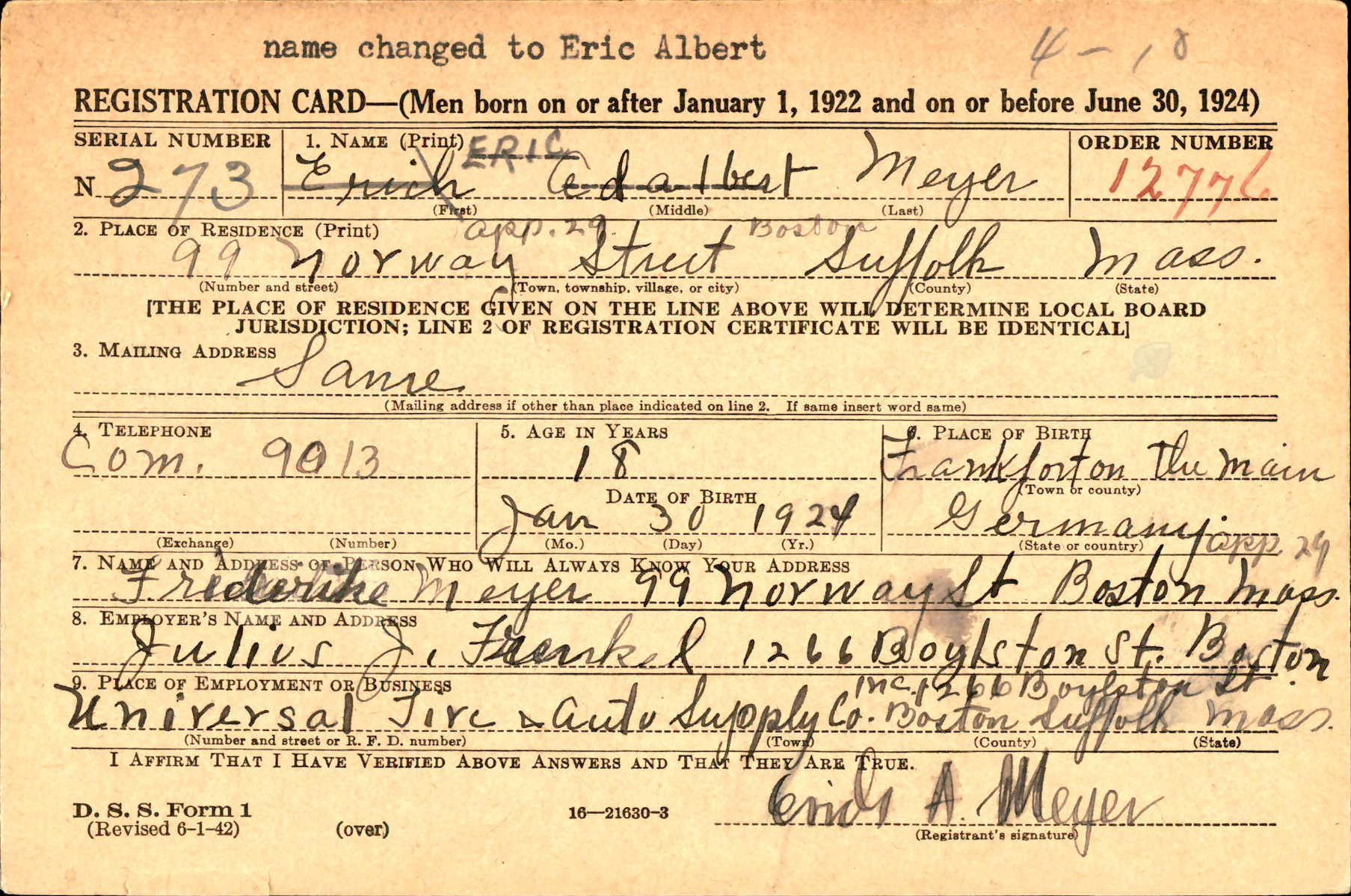
Erich registered for the draft, changing his name from Erich Adalbert Meyer to Eric Albert Meyer. He was living at the same address as his father Ferdinand, 99 Norway Street in Boston, and was working for Universal Tire and Auto Supply Company in Boston.

Eric Meyer, World War II draft registration, The National Archives in St. Louis, Missouri; St. Louis, Missouri; Draft Registration Cards for Massachusetts, 10/16/1940-03/31/1947; Record Group: Records of the Selective Service System, 147; Box: 662, Ancestry.com. U.S. WWII Draft Cards Young Men, 1940-1947

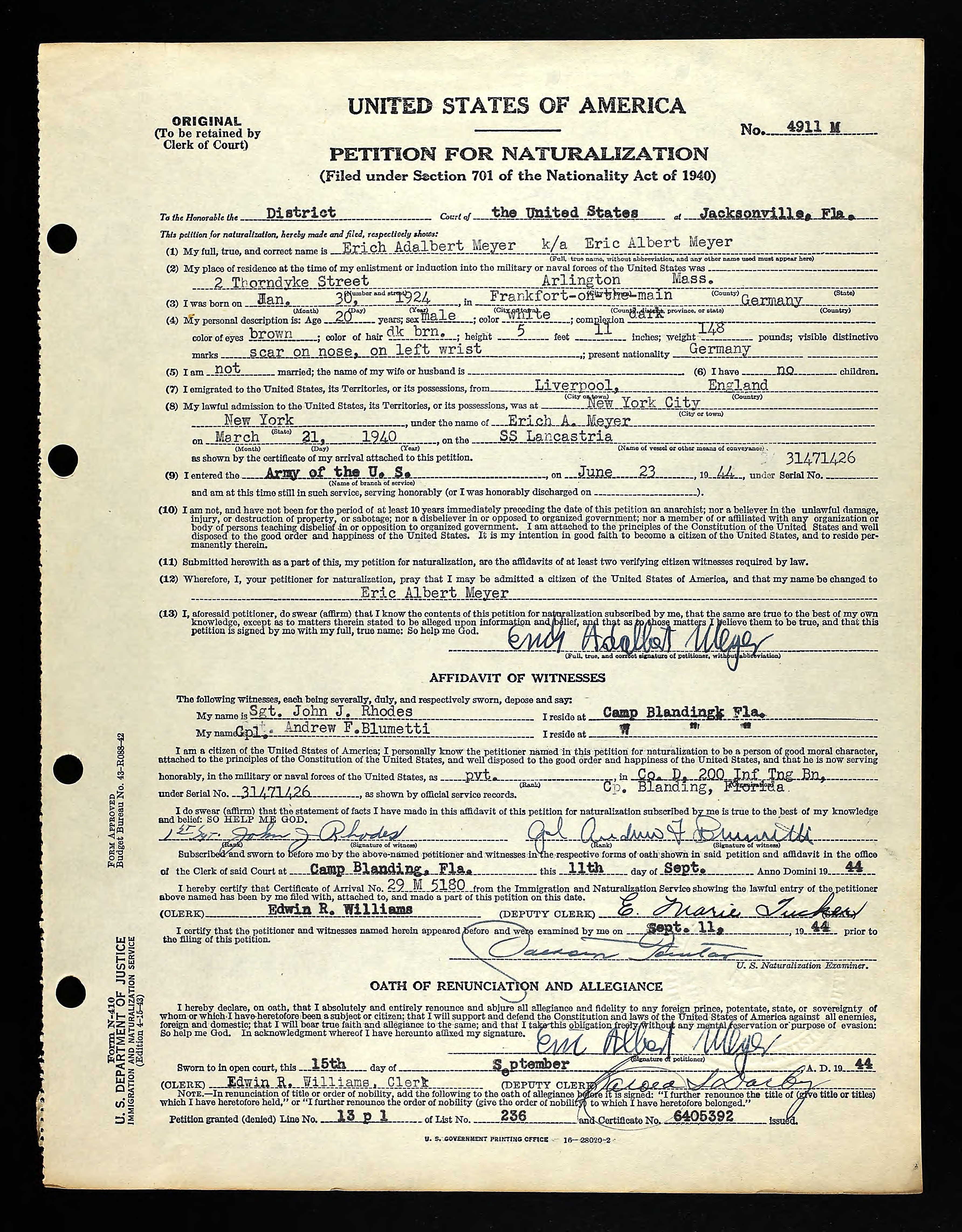
He enlisted in the US Army on June 23, 1944, for the duration of the war.3 While he was in the service and stationed in Jacksonville, Florida, he petitioned for naturalization.

Eric Meyer, petition for naturalizaiton, The National Archives at Atlanta, Georgia; Atlanta, Georgia; ARC Title: Petitions for Naturalization, compiled 1880 – 1975; NAI Number: 2111793; Record Group Title: Records of District Courts of the United States; Record Group Number: 21
Description: Jacksonville Petitions 1895-1975 (Box 09), Ancestry.com. Florida, Naturalization Records, 1847-1995

Ferdinand Meyer did not live long after his immigration to the United States. He died in 1946 in Arlington, Massachusetts.4 He was only sixty years old. His wife Friederike survived him by close to thirty years. She died in September, 1974; her last residence was Yonkers, New York.5

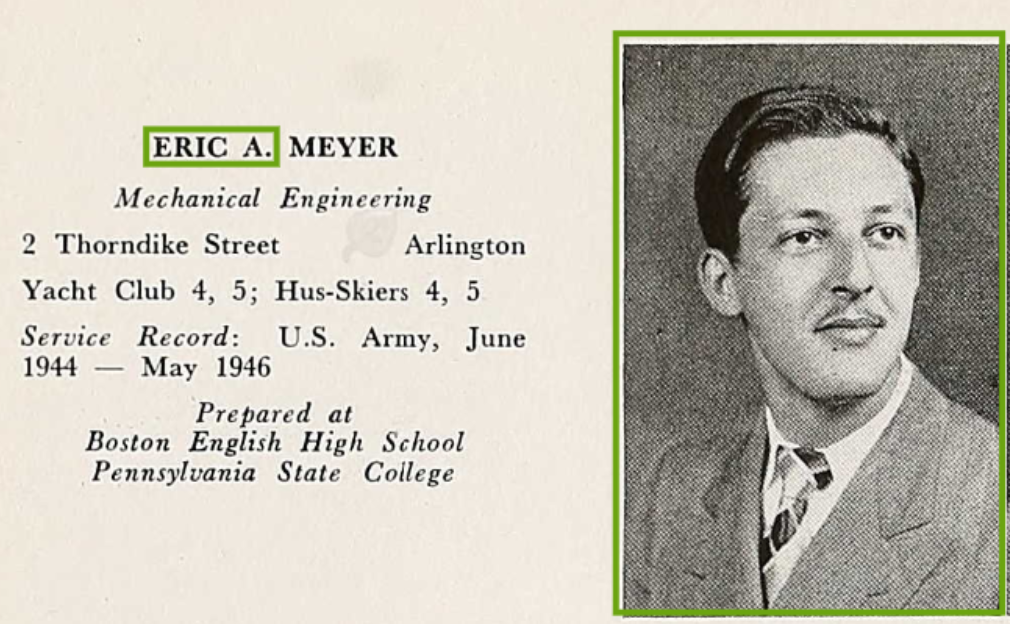
Eric A. Meyer survived his parents. He graduated from Northeastern University in 1950 with a degree in mechanical engineering and married Carol Zimmerman in 1953.5 In 1960 they were living in Cortlandt, New York, where Eric was working as a project engineer for Trinity Equipment Company.6 Eric died in February 1987 in Alabama at 63, only three years older than his father had been at his death;7 his wife Carol died in 2010.8 They were survived by eight children and numerous grandchildren and great-grandchildren.

“U.S., School Yearbooks, 1880-2012”; School Name: Northeastern University; Year: 1950b
Ancestry.com. U.S., School Yearbooks, 1900-1999

I’ve been able to connect with one of Ferdinand and Friederike’s grandchildren, and she told me that Eleanore Meyer remained in England. She married a man named Francis Alban Cowper in 1948 in Chaddesley Corbett, Worcestershire, England, and they had five children.9 Thanks to my newly found cousin, I now have an obituary for Eleanore; she died on December 23, 2013, in Chaddesley Corbett, and was survived by her children and grandchildren. She was 94 years old.10

Unfortunately, my newly found cousin was unable to answer some of the questions that remain unanswered. For example, she didn’t know why Friederike did not leave Germany when her husband and children left. Did Friederike think that she  would be safe because she was not born Jewish? Had Friederike stayed behind for health reasons or to protect the family’s property? We don’t know, and we don’t know what her life was like between the time Ferdinand and her children left and her own departure from Germany.

So many questions left to answer, as there always are.


  1. There is an August Kuhlman in Niagara Falls on the 1930 and 1940 census who was born in about 1900 in Kansas; his mother Clara and his wife Irma were born in Germany. I don’t know how they were connected to Erich Meyer. I could not find anyone named Lotto Karlmuller or even with just the surname Karlmuller in Boston or anywhere else. ↩
  2.  Boston, Massachusetts, City Directory, 1941, Ancestry.com. U.S. City Directories, 1822-1995 ↩
  3.  Ancestry.com. U.S., World War II Army Enlistment Records, 1938-1946. Original data: National Archives and Records Administration. Electronic Army Serial Number Merged File, 1938-1946 [Archival Database]; ARC: 1263923. World War II Army Enlistment Records; Records of the National Archives and Records Administration, Record Group 64; National Archives at College Park. College Park, Maryland, U.S.A. ↩
  4. Ferdinand Meyer, Death Date: 1946, Death Place: Arlington, Massachusetts, USA
    Volume Number: 2, Page Number: 231, Index Volume Number: 109, Reference Number: F63.M363 v.109, Ancestry.com. Massachusetts, Death Index, 1901-1980 ↩
  5.  Eric A Meyer, Marriage Date: 26 Dec 1953, Marriage Place: Manlius, New York, USA, Spouse: Carol M Zimmerman, Certificate Number: 53763, New York State Department of Health; Albany, NY, USA; New York State Marriage Index, Ancestry.com. New York State, Marriage Index, 1881-1967 ↩ ↩
  6. Cortland, New York, City Directory, 1960, Ancestry.com. U.S. City Directories, 1822-1995 ↩
  7.  Eric Meyer, Social Security Number: 028-16-9998, Birth Date: 30 Jan 1924,
    Issue State: Massachusetts, Last Residence: 35226, Birmingham, Jefferson, Alabama, USA, Death Date: Feb 1987, Social Security Administration; Washington D.C., USA; Social Security Death Index, Master File, Ancestry.com. U.S., Social Security Death Index, 1935-2014 ↩
  8. Carol Z. Meyer, Social Security Number: 278-22-7901, Birth Date: 2 May 1927
    Issue State: Ohio, Last Residence: 35048, Clay, Jefferson, Alabama, Death Date: 24 Aug 2010, Social Security Administration; Washington D.C., USA; Social Security Death Index, Master File, Ancestry.com. U.S., Social Security Death Index, 1935-2014 ↩
  9. Eleanore Meyer, Registration Date: Jan 1948, [Feb 1948], [Mar 1948],
    Registration Quarter: Jan-Feb-Mar, Registration district: Kidderminster, Inferred County: Worcestershire, Spouse: Frances A Cowper, Volume Number: 9d, Page Number: 315
    General Register Office; United Kingdom; Volume: 9d; Page: 315, Ancestry.com. England & Wales, Civil Registration Marriage Index, 1916-2005 ↩
  10. https://www.worcesternews.co.uk/announcements/deaths/deaths/10702391.Eleonore_Cowper/ ↩

Regina Goldschmidt’s Children: Did They Escape in Time or Not?

When Hitler came to power in Germany in 1933, Regina Goldschmidt Meyer had already outlived her husband Aaron Meyer, who had died in 1902, and two of her seven children, Sally having died in childhood and Jacob in 1928. Her other five children—Alfred, Max, Siegfried, Ferdinand, and Amalie— were still living as well as a number of grandchildren.

But Regina died in Frankfurt on October 7, 1938, just a month before Kristallnacht. She was 83 years old.

Regina Goldschmidt Meyer, death record, Personenstandsregister Sterberegister; Bestand: 903; Signatur: 11076, Year Range: 1938, Ancestry.com. Hesse, Germany, Deaths, 1851-1958

Some of her five surviving children fared better than others during the Holocaust. For some, I ran into brick walls when I tried to learn more about their lives during or after the war. For others, I discovered tragedy. This post will focus on her four oldest children and their families.

The fate of Regina’s oldest child, Alfred Meyer, is somewhat unclear. I found only two documents for him after his birth record. First, I found this card in the Arolsen Archives:

With help from the German Genealogy group, I learned that this card says that Alfred was a widower and that he had no occupation. The final column indicates that Alfred was still living in Frankfurt on April 24, 1939, and then left for France and was there until November 3, 1939.

The second card, also from the Arolsen Archives, came up through a search on Ancestry.com:

Arolsen Archives, Digital Archive; Bad Arolsen, Germany; Lists of Persecutees 2.1.1.1; Series: 2.1.1.1, Reference Code: 02010101 oS, Ancestry.com. Europe, Registration of Foreigners and German Persecutees, 1939-1947

According to the description on Ancestry, this document was prepared after the war by the American forces occupying West Germany as an attempt to document the Jews who had been persecuted by the Nazis. This particular document lists those who had become or were French citizens. Under the last category, “Aufenthaltsdaten,” or dates of stay, it says April 24, 1939, to November 3, 1939. This appears to be consistent with the other card from the Arolsen Archives.

But what happened to Alfred after November 3, 1939? Did he return to Frankfurt and survive? Was he killed? He does not appear in either the Yad Vashem database or the US Holocaust Memorial and Museum database. There are many other post-war records for men named Alfred Meyer, but the name is so common and the records so vague in identification information that I have no idea what happened to my cousin Alfred Meyer. Cibella and Baron say he died in a concentration camp, and I fear that that is probably the case even though I can’t find him at Yad Vashem.

As noted above, Alfred’s brother Jacob Meyer had died in 1928, leaving his wife Elli and their children to survive him. I was able to find records for Elli showing that she had immigrated to England by 1939; she and her son Arthur are listed together on the 1939 England and Wales Register.

Ellie and Arthur Meyer, The National Archives; Kew, London, England; 1939 Register; Reference: RG 101/416H, Enumeration District: APCA, Ancestry.com. 1939 England and Wales Register

Arthur also registered as an enemy alien in 1939; at that time he was working as an apprentice shirt cutter for Harrod’s. Note that his address is 28c Maida Avenue.

Arthur Meyer, The National Archives; Kew, London, England; HO 396 WW2 Internees (Aliens) Index Cards 1939-1947; Reference Number: HO 396/187, Piece Number Description: 187: German Internees Released in UK 1939-1942: Mayer-Morgens, Ancestry.com. UK, WWII Alien Internees, 1939-1945

Also living at 28c Maida Avenue in 1939 when she registered as an enemy alien was Arthur’s sister Hilde Meyer, who was a student and an unemployed domestic worker.

Hilde Meyer, The National Archives; Kew, London, England; HO 396 WW2 Internees (Aliens) Index Cards 1939-1947; Reference Number: HO 396/61, Piece Number Description: 061: Internees at Liberty in UK 1939-1942: Mer-Mid, Ancestry.com. UK, WWII Alien Internees, 1939-1945

On the 1939 England and Wales Register, Hilde was working as a parlor maid and living elsewhere, so she must have found work by the time that was enumerated.1

As for the third child whom Cibella/Baron identified as a child of Jacob and Elli Meyer, Lotte Henriette Meyer, I did not have much luck locating records. Cibella/Baron report that she married Helmut Leopold Wallach in Frankfurt on April 27, 1934, and that they had twin daughters born in 1935, but I could not find a marriage record or birth records for the twins. I did find a 1937 ship manifest for a Lotte Wallach with two daughters born in 1935, heading from England to Argentina2 and a separate 1937 manifest for a Helmut Leopold Wallach heading to Uruguay,3 but nothing more specific to tie Lotte to Jacob and Elli Meyer or to Helmut Wallach.

Elli Loeser Meyer lived the rest of her life in England, dying there on April 18, 1966. The listing for her in the England & Wales, National Probate Calendar names “Arthur Meyers, company director,” as one of the executors.4 I have been unable so far to find any other later records for any of her children. Thus, I do not know when or where they died, whether or not they married or had children, or anything else.

Max Meyer and his family escaped from Nazi Germany to Argentina. It appears that their son Arnold had immigrated there in July, 1936, but had been living in Basel, Switzerland prior to heading to Buenos Aires:

Arnold Meyer, Ancestry.com. Swiss Overseas Emigration, 1910-1953. Original data: Schweizerisches Auswanderungsamt und Auswanderungsbüro. Überseeische Auswanderungen aus der Schweiz, 1910-1953. Schweizerisches Bundesarchiv (National Archives of Switzerland). E 2175 – 2.

According to Cibella/Baron, Arnold’s parents Max and Anna also both immigrated to Buenos Aires and died there, Anna in 1941 and Max in 1952. Unfortunately, I have no records for these events or for Arnold’s death in 1959.

Siegfried Meyer met a tragic end. He immigrated to the Netherlands, but on April 21, 1943, he was deported to the Theresienstadt concentration camp, where he was murdered on November 23, 1943, and cremated.5

Arolsen Arhives, 1 Incarceration Documents / 1.1 Camps and Ghettos / 1.1.42 Theresienstadt Ghetto /1.1.42.2 Card File Theresienstadt /Ghetto Theresienstadt Card File, Reference Code
11422001

Thus, for Regina’s four oldest children, I have mixed results. Jacob’s family ended up in England and possibly Argentina; Max’s family ended up in Argentina. Tragically, Siegfried was murdered by the Nazis, and Alfred probably was also.

The next post will report on Regina’s youngest son, Ferdinand, and his family.


  1.  Hilde Meyer, Gender: Female, Marital status: Single, Birth Date: 21 Nov 1912, Residence Year: 1939, Address: 24, Residence Place: Yiewsley and West Drayton, Middlesex, England, Occupation: Parlourmaid, Schedule Number: 167, Sub Schedule Number: 3, Enumeration District: BZAA, Registration district: 127/1, The National Archives; Kew, London, England; 1939 Register; Reference: RG 101/994A, Ancestry.com. 1939 England and Wales Register ↩
  2. Lotte Wallach, Gender: Female, Age: 31, Birth Date: abt 1906, Departure Date: 16 Oct 1937, Port of Departure: Southampton, England, Destination Port: Buenos Aires, Argentina, Ship Name: Almanzora, Shipping Line: Royal Mail Lines Limited, Official Number: 136353, Ancestry.com. UK and Ireland, Outward Passenger Lists, 1890-1960 ↩
  3. Helmut Wallach, Gender: Male, Age: 31, Birth Date: abt 1906, Departure Date: 5 Feb 1937, Port of Departure: Southampton, England, Destination Port: Montevideo, Uruguay, Ship Name: Arlanza, Shipping Line: Royal Mail Lines Limited
    Official Number: 132021, Ancestry.com. UK and Ireland, Outward Passenger Lists, 1890-1960 ↩
  4. Elli Meyer, Death Date: 18 Apr 1966, Death Place: London, England, Probate Date: 6 Jun 1966, Probate Registry: London, England, Ancestry.com. England & Wales, National Probate Calendar (Index of Wills and Administrations), 1858-1995 ↩
  5. Siegfried Meyer, entries at Yad Vashem:  https://tinyurl.com/yazazrxa and https://tinyurl.com/y6v946fm ↩

My Cousin Anna Seghers: Activist, Author, and Survivor

The youngest child of Helene Goldschmidt and Salomon Fuld was their daughter Hedwig, born in 1880 and married to Isidor Lutz Reiling. They had one daughter, Netti, born in Mainz, Germany, in 1900. Hedwig was my third cousin, twice removed, and her daughter Netti was my fourth cousin, once removed. Their stories are those of tragedy and triumph.

Hedwig did not share the good fortune of her older siblings. She and her husband Isidor were still living in Mainz in 1940 when Isidor died on March 10 at the age of 72.

Isidor Reiling death record, Year Range: Sterberegister 1940, Band 1
Ancestry.com. Mainz, Germany, Deaths, 1876-1950. Original data: Personenstandsregister, Sterberegister, 1876-1950. Mainz Stadtarchiv.

Hedwig did not get out of Germany in time. She was deported to the ghetto in Plaski, Poland, on March 21, 1942, and was murdered sometime thereafter by the Nazis. The record on Yad Vashem has no date or place of her death.

This Page of Testimony filed by her cousin Regina Blanche Rosenberger1 indicates that she was killed in a concentration camp, but does not name which one or when. Thus, Hedwig was one of the millions of Jews whose deaths were not recorded by the Nazis, but who were murdered by them.

Hedwig Fuld Reiling, Page of Testimony, Yad Vashem at https://tinyurl.com/t6vr4dg

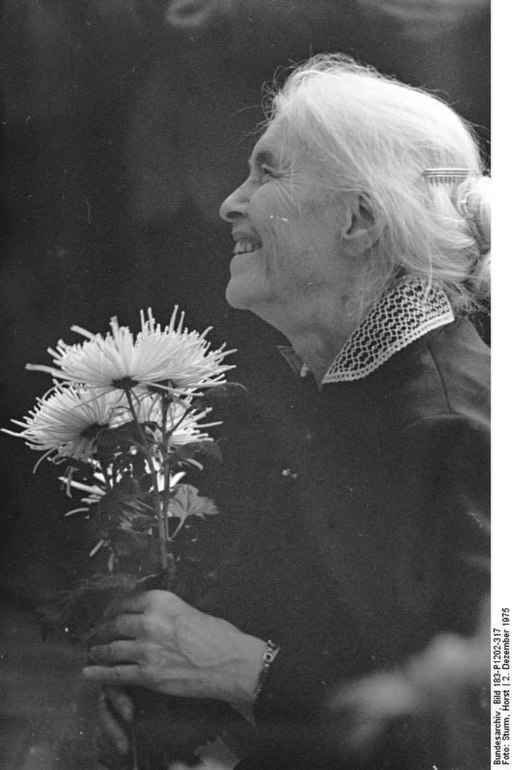
Hedwig and Isidor’s daughter Netti did survive. If you look at the Page of Testimony above, you will see that Hedwig was identified as “mother of the author Anna Seghers.” Anna Seghers was Netti Reiling’s pseudonym, and she was a well-known author. Because of her renown, I was able to find a treasure trove of material about Netti including some old photographs.2

Isidor Reiling was an art expert and antique dealer like so many of his Goldschmidt in-laws. His daughter Netti developed an interest in art history, and in 1920 she moved to Heidelberg to attend the university there. She wrote her doctoral thesis on “Aspects of Jews and Jewishness in the Work of Rembrandt.”

It was while she was at the university in Heidelberg that she joined a group of left-wing intellectuals and met her husband, Laszlo Radvanyi. Laszlo was born in Budapest, Hungary on December 13, 1900. He studied economics and philosophy at the University of Budapest in 1918 and became interested in radical politics. He eventually ended up at the University of Heidelberg and continued his studies there.

In August 1925, Netti and Laszlo were married. Each had adopted a pseudonym for their writings. Netti became Anna Seghers, inspired by a Dutch artist Hercules Seghers whom she had studied at the university. Laszlo’s pseudonym was Johann Lorenz Schmidt after an 18th century German theologian. They had two children, Peter (later known as Pierre)(1926) and Ruth (1928) and were living in Berlin in 1928.

Seghers published her first novel The Revolt of the Fisherman in 1928, the same year she joined the Communist Party in Germany. She published a second book of short stories about poor workers in 1930 and two more books in 1932 and 1933.

Her left-wing views resulted in her books being banned when Hitler came to power in January, 1933, and she was even briefly arrested, according to some sources.  According to her son Pierre, he was sick with scarlet fever at the time, and his mother had taken him to a children’s home in the Black Forest to recover. When she heard of the Reichstag fire on February 27, 1933, she returned to Berlin. The Nazis claimed that communists had set the fire, and Netti/Anna was denounced by a neighbor. The police showed up at their home to arrest her. According to Ruth, the police did not remain long because they were afraid of catching scarlet fever. Whether or not Netti/Anna was ever taken into custody seems unclear.

The family left Germany soon thereafter and escaped to France. They lived in Paris for seven years where Laszlo started a free university for German refugees; he continued to work on anti-fascist, left-wing causes; Netti/Anna published several books during this time and also spent some time in Vienna and in Spain during the Spanish Civil War.

As a Hungarian and known communist, Laszlo/Johann was interned as a “suspected national” by the French in a camp in southern France. When the Nazis invaded France and occupied Paris in the spring of 1940, Netti/Anna and the children hid in Paris until they were able to escape to Marseilles. They were eventually able to free Laszlo and leave France on March 24, 1941, when the family sailed to the US and ultimately Mexico, where they settled.

During their time in Mexico, Anna Seghers wrote her best known book, The Seventh Cross, about seven political prisoners who escape from a Nazi concentration camp. It was first published in the United States and Mexico in 1942 and became the basis of a 1944 film of the same title starring Spencer Tracy, Hume Cronyn, Jessica Tandy, and Agnes Moorehead.

The New York Times review of the film in 1944 is quite interesting. The reviewer, Bosley Crowther, found Spencer Tracy’s performance “splendid” and Jessica Tandy’s “emotionally devastating.” He described the plot as “hair-raising” and the production as filled with “crackling tension and hard-packed realism” and as preserving the “monstrousness” of Segher’s book.3

But Crowther found reason to criticize the film as being too soft on the Germans:

Without in the least overlooking the bestiality of the Nazi brutes nor the miserable self-surrender of German citizens to their black regime, this film … visions a burning zeal for freedom in some German rebels and a core of decency in common folk. …[T]he basic theme…is that in men—even in Germans—there is an instinct for good that cannot be destroyed.….

The big reservation which this writer holds with regard to this film is that regarding the discretion of its theme at this particular time. Without any question, it creates a human sympathy for the people of a nation with whom we are at war and it tends, as have others, to load Germany’s crimes on Nazi backs. Obviously this film can make sentiment for a “soft” peace. It looks as though we are getting a dandy “thriller” at a pretty high price.

I have not yet read the book nor seen the film, but hope to do one or the other while being confined during this pandemic. There are more current reviews of the book, including this one from The New York Review of Books written upon the publication of a new translation of the book in 2018:

The Seventh Cross is one of the most powerful, popular, and influential novels of the twentieth century, a hair raising thriller that helped to alert the world to the grim realities of Nazi Germany and that is no less exciting today than when it was first published in 1942. … Anna Seghers’s novel is not only a supremely suspenseful story of flight and pursuit but also a detailed portrait of a nation in the grip and thrall of totalitarianism.

Anna Seghers wrote a number of other books while living in Mexico. It was also during this time that she learned that her mother had been killed by the Nazis. Nevertheless, after the war she and her family returned to Germany, first West Berlin, later East Berlin. She continued to be a left wing and communist political activist and to write books based on her political views for the rest of her life. She was a loyal supporter of the Soviet Union and East Germany.

Laszlo Radanvanyi died on July 3, 1978, in Berlin. Like his wife, he had remained a political activist as well as a professor. Netti/Anna died five years later on June 1, 1983, in Berlin.

Rüdiger Wölk,  Münster,  CC BY-SA (https://creativecommons.org/licenses/by-sa/2.5)

On November 19, 2000, the German publication Der Welt published an interview with Netti and Laszlo’s two adult children, Pierre and Ruth, which revealed a more personal perspective on their mother. Ruth described her as “very warm, a normal mother,” and Pierre said she was “a very intuitive, extremely sensitive, even compassionate woman.”

Ruth Radanyi died on July 18, 2010 at the age of 82. Her brother Pierre, an author and physicist, is still living as far as I can tell. At this link, you can hear him read one of his mother’s poems.

The story of Netti Reiling/Anna Seghers and her family is yet another example of the literary talents of the Goldschmidt family as well as another example of the courage and resilience of the human spirit in the face of devastating hatred and danger. Although it may be hard to understand how Netti could support the totalitarianism of the Soviet Union, I cannot judge her for her views, given what she endured and what she lost as a young woman.

Bundesarchiv, Bild 183-P1202-317 / Sturm, Horst / CC-BY-SA 3.0 / CC BY-SA 3.0 DE (https://creativecommons.org/licenses/by-sa/3.0/de/deed.en)


  1. Regina Blanche Rosenberg was born Regina Blanche Goldschmidt, and she was the daughter of Julius Goldschmidt, younger brother Helene Goldschmidt Fuld, Hedwig Fuld Reiling’s mother. That is, she was Hedwig’s first cousin. Regina immigrated to Canada and died in 1992. More on Regina when I get to her father’s story. ↩
  2. Since I don’t know when these works were first published, I can’t determine whether they are in the public domain—even though many of them were taken before 1923. See https://www.legalgenealogist.com/2012/03/06/copyright-and-the-old-family-photo/  Thus, I won’t be posting them, tempting as it might be to do so. But if you follow some of the links in the post, you will be able to see the photos. ↩
  3. Bosley Crowther, “The Seventh Cross, Anti-Nazi Drama, with Spencer Tracy, at Capitol,” The New York Times, September 29, 1944, p. 18. ↩

Escaping from Germany to Brazil and Israel: Brick Walls


We’ve already seen that Helene Goldschmidt Fuld’s second child, Minna Fuld, who was born in 1875, had a complicated marital history. First, she married Leo Offenstadt in 1894 when she was eighteen, and that marriage ended in divorce in 1904. She and Leo had had one child, Flora, in 1894. Then Minna married Ladislaus Polacovits in 1906, and he died in 1913; Minna had one child with Ladislaus, Lisolette, who was born in 1907.

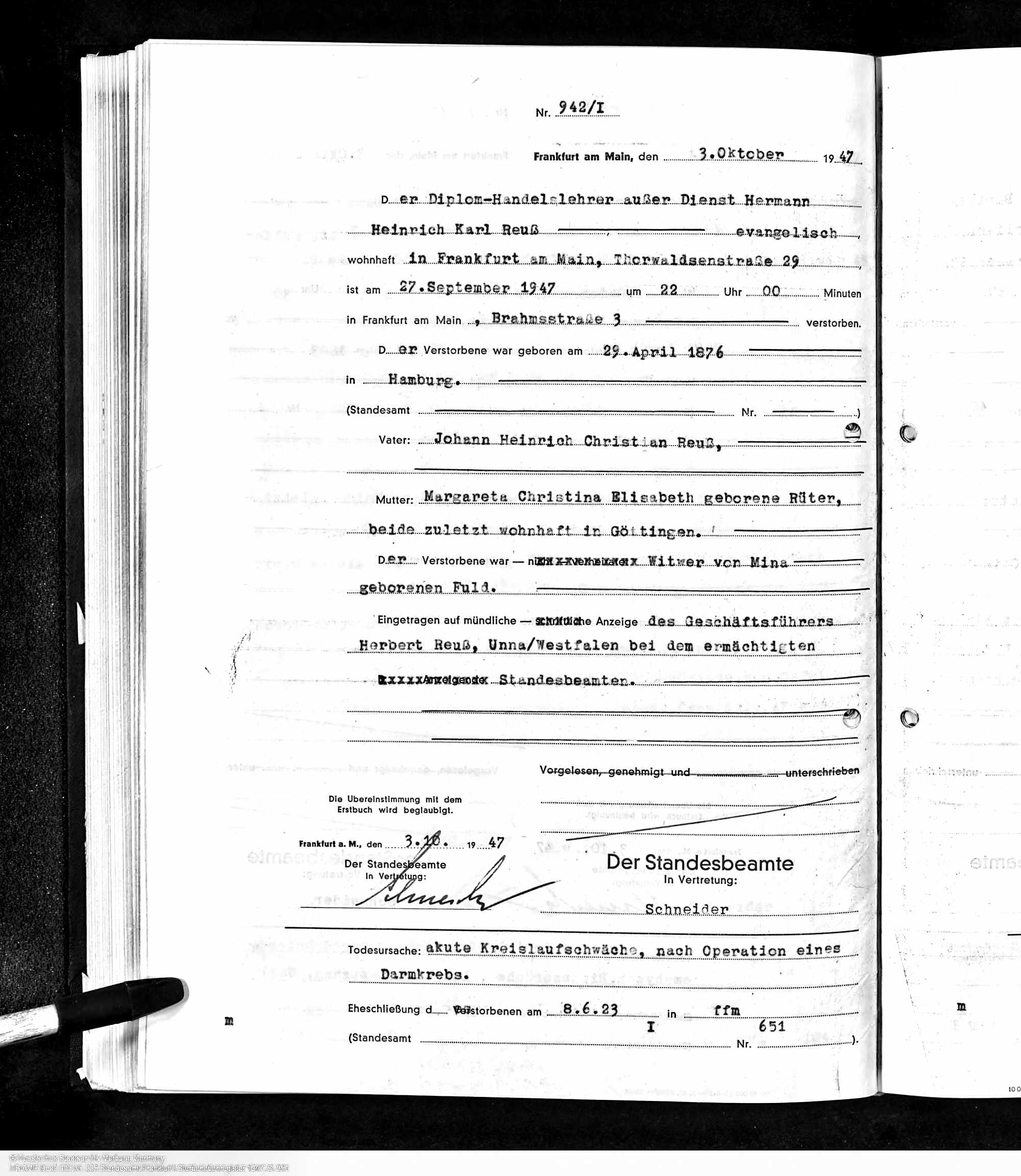
Finally, Minna married Hermann Heinrich Karl Reuss in 1923, with whom she had no children. Hermann is listed in the 1940 Frankfurt directory1 and died in Frankfurt on September 27, 1947.

Hermann Reuss death record, Personenstandsregister Sterberegister; Bestand: 903; Signatur: 225
Year Range: 1947, Ancestry.com. Hesse, Germany, Deaths, 1851-1958

His death certificate indicates that he was a widower at the time of his death. I have no record for Minna’s death, but unsourced trees indicate that she died in Tel Aviv on May 3, 1944. Had Hermann gone with her to Palestine and returned to Germany after she died? Or had Hermann never left Germany?  I don’t know.

As we saw, Minna’s daughter Flora Offenstadt2 married Hermann Durlacher in 1918 and had two children with him, Siegfried Julius Thomas (known as Thomas) and Ulla Louise Sara. Flora and the two children immigrated to Brazil in 1939, as seen in these immigration cards.

Flora Offenstadt Durlacher, Digital GS Number: 004764836
Ancestry.com. Rio de Janeiro, Brazil, Immigration Cards, 1900-1965

Siegfried Julius Thomas Durlacher, Digital GS Number: 004916940
Ancestry.com. Rio de Janeiro, Brazil, Immigration Cards, 1900-1965

Ulla Durlacher, Digital GS Number: 004916940
Ancestry.com. Rio de Janeiro, Brazil, Immigration Cards, 1900-1965

I could not locate any further records for Hermann Durlacher, but several unsourced trees indicate that he died in Sao Paolo, Brazil, on November 15, 1954, so perhaps he also immigrated to Brazil either before, with, or after his family. I don’t know what happened to Flora or her two children after they immigrated to Brazil in 1939. An unsourced tree on Geni reports that Thomas died in Sao Paulo on December 23, 2007.

Minna’s second daughter, Liselotte Polacovits, married Wilhelm Strauss-Reich on June 5, 1928, and had one child, as discussed here. I was not able to find information about their whereabouts during the 1930s, but by 1942 Liselotte and Wilhelm both had Palestinian passports that they renewed in 1947. I was able to locate a marriage record for their son (who may still be living) in England, so perhaps they also ended up in England or maybe they stayed in Israel.

Liselotte Strauss-Reich, Israel Archives, at https://tinyurl.com/wwdy88x

Thus, there is much to do to learn more about Minna and her descendants. So far, however, I’ve hit dead ends and brick walls. Searching online for answers in Brazil and Israel has led me nowhere. Not knowing how to read either Portuguese or Hebrew (except some basic terms) makes the task even more difficult. If anyone has any thoughts, please let me know.


  1.  Title: Amtliches Frankfurter Adressbuch, Deutsche National Bibliothek; Leipzig, Deutschland; Publisher: August Scherl; Signatur: ZC 811; Laufende Nummer: 1, Ancestry.com. Germany and Surrounding Areas, Address Books, 1815-1974 ↩
  2. Flora’s father, Minna’s first husband Leo Offenstadt, died at Theriesenstadt concentration camp on January 9, 1943. See his entry at Yad Vashem at https://tinyurl.com/tz3gz73. ↩

Escaping from Germany, Part IV: Helene and Martha Loewenthal, An Unfinished Research Project

I am really torn. Do I post about my family history in these times when we are all so anxious and focused on the present and the future, not the past? I prepared this post a few weeks ago, and in re-reading it now, I decided that reading about how others faced serious threats to their lives and their family’s lives might provide hope and strength to some who read it. So I am going forward.


Thus far we have seen what happened to three of Abraham Loewenthal and Keile Stern’s children and their children during the Holocaust. This post will report on the two youngest siblings, Helene and Martha, and their families. How did their lives change as a result of the Holocaust?

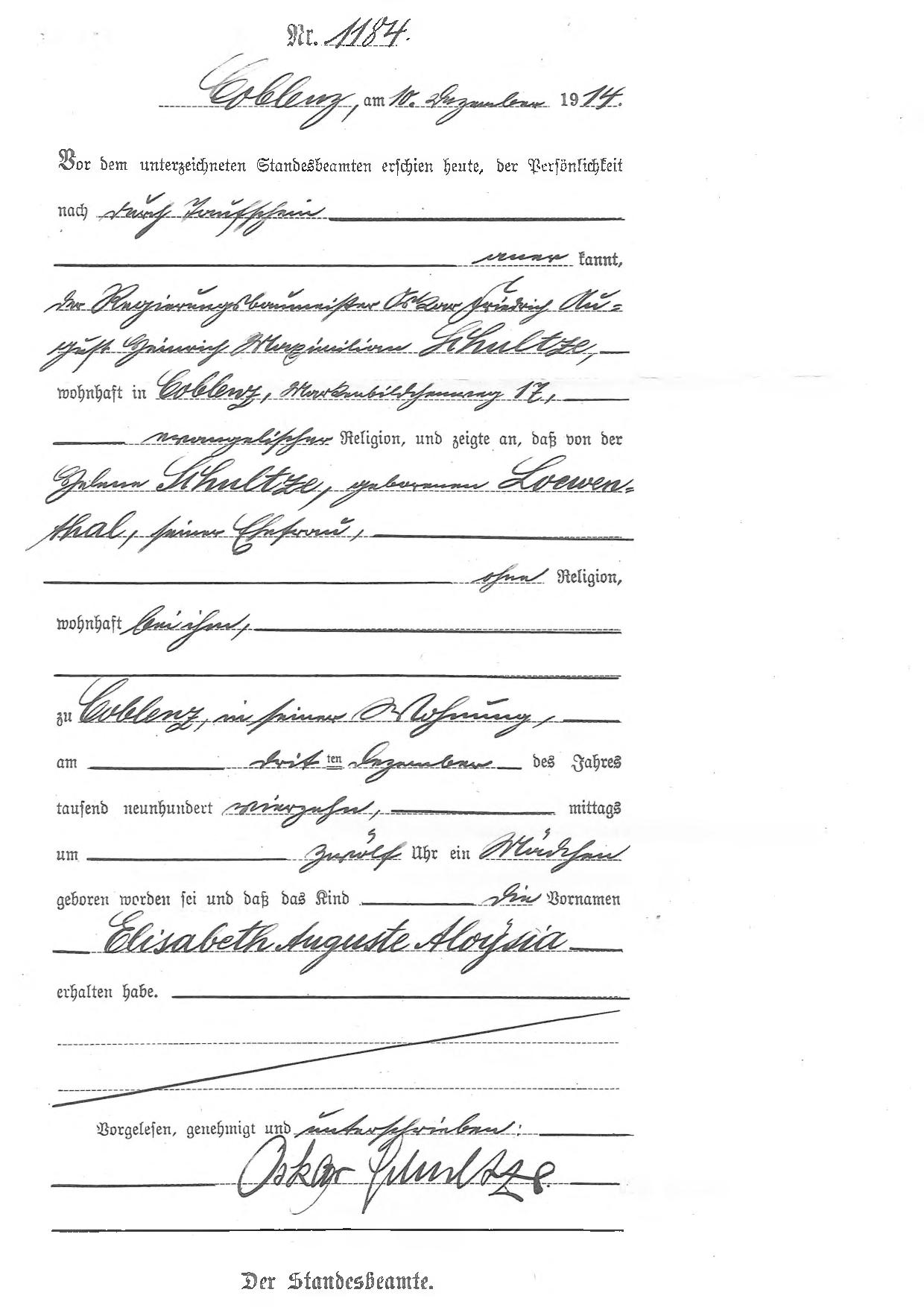
We saw that Helene Loewenthal’s first marriage to Edward Feuchtwanger had not lasted and that in 1913 she had married Oscar Friedrich August Heinrich Maximilian Schultze. They had one child, Elisabeth Auguste Aloysia Schultze, born on December 3, 1914, in Coblenz, Germany, where she was baptized on May 12, 1915. Thanks to my dear friend Aaron Knappstein, I now have Elisabeth’s birth record.

Notice that it indicates that her religion was evanglische, i.e., Protestant.
Elisabeth Schultze, birth record, Coblenz

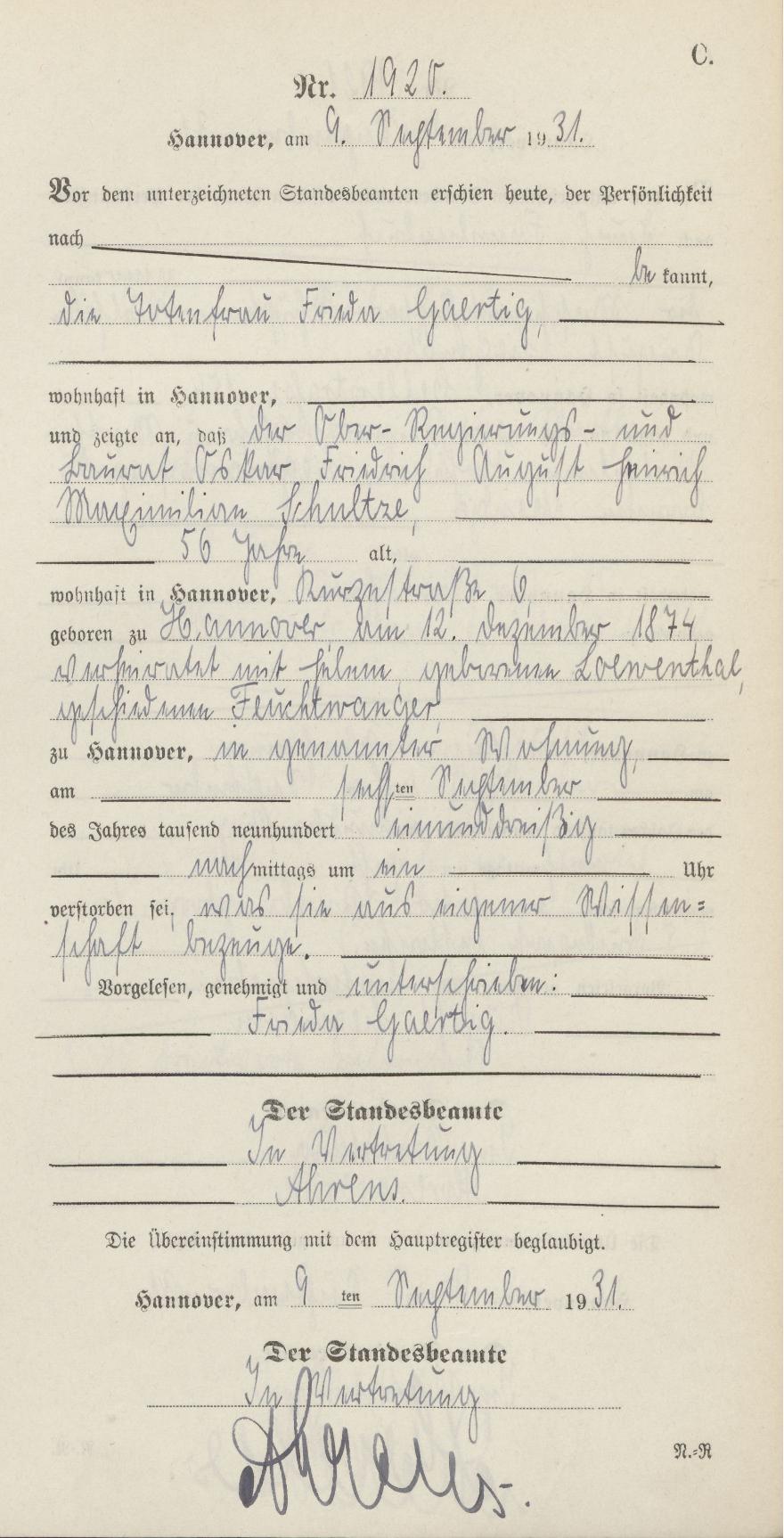
Oscar Schultze died on September 6, 1931, in Hanover, Germany. (Thank you again to Aaron Knappstein for obtaining this death record for me.) He was survived by his widow Helene and daughter Elisabeth.

StadtAH_1_NR_3_08_2_1057_1920_1931 Oscar Schultze death certificate

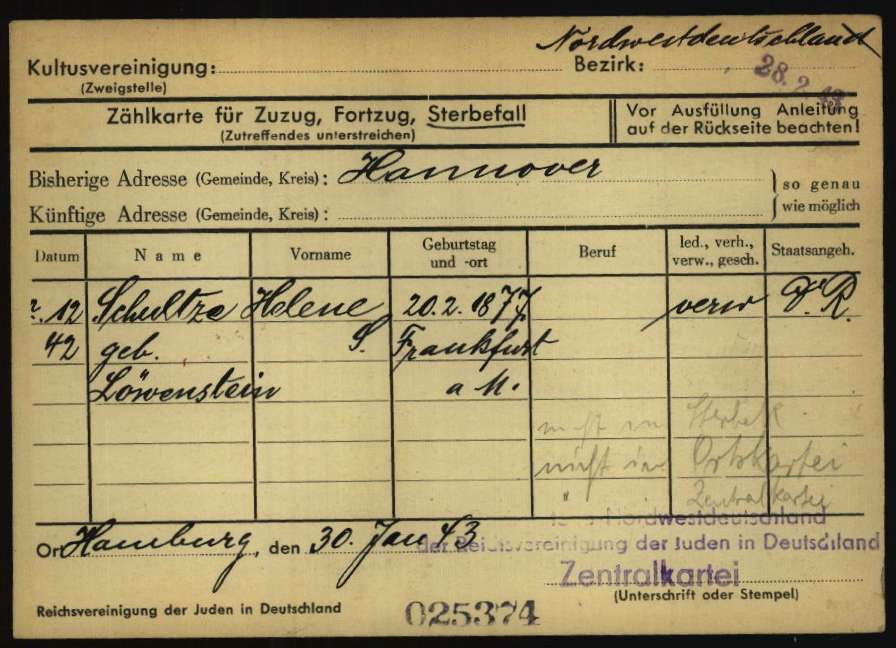
Despite the fact that Elisabeth was raised as a Christian and that her mother Helene had married a Christian, both Elisabeth and Helene were enumerated as minorities on the 1939 Minority Census in Germany, living in Hannover.1 Helene died three years later on November 28, 1942, according to this document found in the Arolsen Archives. She was 65. It incorrectly lists her birth name as Loewenstein, not Loewenthal, but this is definitely my cousin Helene.

1 Incarceration Documents / 1.2 Miscellaneous / 1.2.4 Various Organizations /
1.2.4.1 “Reichsvereinigung der Juden” Card File / 12673184 – HELENE SCHULTZE. ITS Digital Archive, Arolsen Archives

I don’t know what happened to Elisabeth during the Nazi era after 1939. She would have been considered a “Mischling” of the first degree since her mother was born Jewish as were her mother’s parents, and not as a Jew because she was not disqualified from being a Mischling under the criteria enumerated by the Nazis, that is, she was not raised as a Jew nor was she married to one before 1935. Whether she faced any persecution or not is not clear, but we’ve seen that other Mischlings were persecuted.

But Elisabeth did survive the war. As indicated on the annotation to the birth record shown below, Elisabeth married in Hamburg in 1955 and died in Bad Krozingen in 1991. Aaron Knappstein is now looking to see if he can find her marriage and death records. Since it appears that Elisabeth married when she was 41, I assume she did not have children.

Annotation to birth record of Elisabeth Schultze

As for Martha Loewenthal, I have mostly secondary information from my cousins Roger Cibella and David Baron and numerous unsourced family trees on Ancestry and Heritage, but I will report what I can as best I can to do honor to these cousins. We’ve seen already that she married Jakob Wolff and that they had three children in the first decade of the 20th century: Anna, Hans Anton, and Hans Walter.

UPDATE: Thank you once again to Aaron Knappstein, who has located the marriage record for Anna Wolff and Simon Wittekind. They were married on June 7, 1929, in Frankfurt. Simon was the son of Wilhelm Wittekind and Fanny Mendele, and he was born in Bad Kissingen on December 10, 1892. He had served in World War I for Germany.2 He was a doctor.

Less than a year after witnessing her daughter’s marriage, Martha Loewenthal Wolff died on May 19, 1930, in Frankfurt, as we saw.

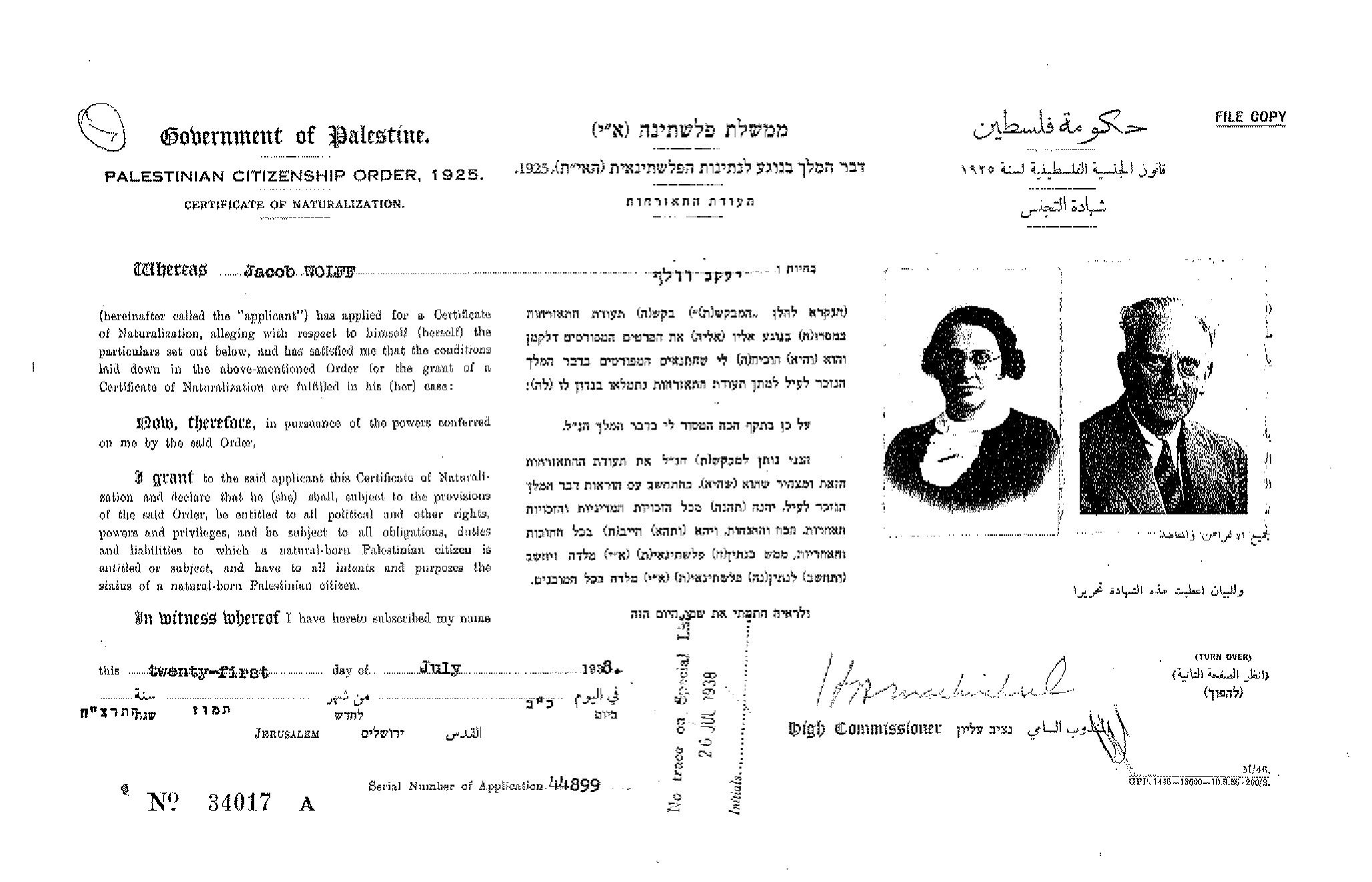
Her widower Jakob Wolff immigrated to Palestine on August 21, 1934. By that time Jakob had remarried; his second wife was Ilse Gruenebaum, born October 27, 1901, in Maden, Germany. They became naturalized citizens of Palestine on July 21, 1938.3

Naturalization Certificate of Jacob and Ilse Wolff found at https://www.archives.gov.il/en/archives/#/Archive/0b07170680034dc1/File/0b07170680e4ea29

MyHeritage reports that Jakob and Martha (Loewenthal) Wolff’s children all also ended up in Palestine/Israel, where they married and had children and have descendants still living in Israel. Their father Jakob died on October 14, 1953, in Israel. He was 77.4

If and when I find more documentation for Elisabeth Schultze and the descendants of Martha Loewenthal Wolff, I will update this post. For now, that brings to a close the stories of the children of Sarah Goldschmidt Stern’s daughter Keile and her husband Abraham Loewenthal. Next I will turn to the families of Keile’s brother Abraham Stern and his wife and cousin, Johanna Goldschmidt, and their fate during and after the Nazi era.


  1. Helene and Elisabeth Schultze, German Federal Archives, Abteilung R (Deutsches Reich), List of Jewish Residents of the German Reich 1933-1945, found at https://tinyurl.com/tyzfaab and at https://tinyurl.com/tjfhud3 ↩
  2.  Bayerisches Hauptstaatsarchiv; München; Abteilung IV Kriegsarchiv. Kriegstammrollen, 1914-1918; Volume: 20351. Kriegsstammrolle, Ancestry.com. Bavaria, Germany, WWI Personnel Rosters, 1914-1918 ↩
  3. Immigration and Naturalization File of Jacob and Ilse Wolff, Israel Archives, found at https://tinyurl.com/r7524xh ↩
  4. https://tinyurl.com/regavyr ↩

Escaping from Germany, Part III: A Family Divided Across the World

The story of my cousin Siegfried Loewenthal is the story of how one family ended up separated and spread all over the world in order to escape Nazi Germany.

Abraham Loewenthal and Keile Stern’s younger son Siegfried and his wife Henriette Feuchtwanger had five children, as we have seen: Rosel (or Rosa) (1908), Albert (1909), Louise (1910), Grete (1913), and Lotte (1914).

Rosa Loewenthal married Justin Held in Frankfurt on August 24, 1928. Justin was born in Kulsheim, Germany on October 18, 1900.

Marriage record of Justin Held and Rosa Loewenthal, Hessisches Hauptstaatsarchiv; Wiesbaden, Deutschland; Bestand: 903. Year Range: 1928, Ancestry.com. Hesse, Germany, Marriages, 1849-1930

Rosa and Justin had two daughters born in Germany, one in 1929, one in 1930.

When Hitler came to power in 1933, Siegfried and Henriette’s family began to disperse. First, their son Albert Loewenthal went to Palestine on March 26, 1934.1 I do not have a marriage record for Albert, but my cousins Roger Cibella and David Baron report that he married Hilda Weingarten in Jerusalem on June 12, 1935. Hilda was born in Hamburg, Germany, on April 10, 1911. I do know that they were married by the time they applied to become naturalized citizens of Palestine in April 1938, and they had a son born in Jerusalem in 1937.2 According to Cibella/Baron, Hilda died in Switzerland in 1954, Albert in 1995 in Jerusalem (after marrying two more times and having several more children).

Naturalization certificate for Albert and Hilda Loewenthal, found at https://www.archives.gov.il/en/archives/#/Archive/0b07170680034dc1/File/0b07170680fd584e

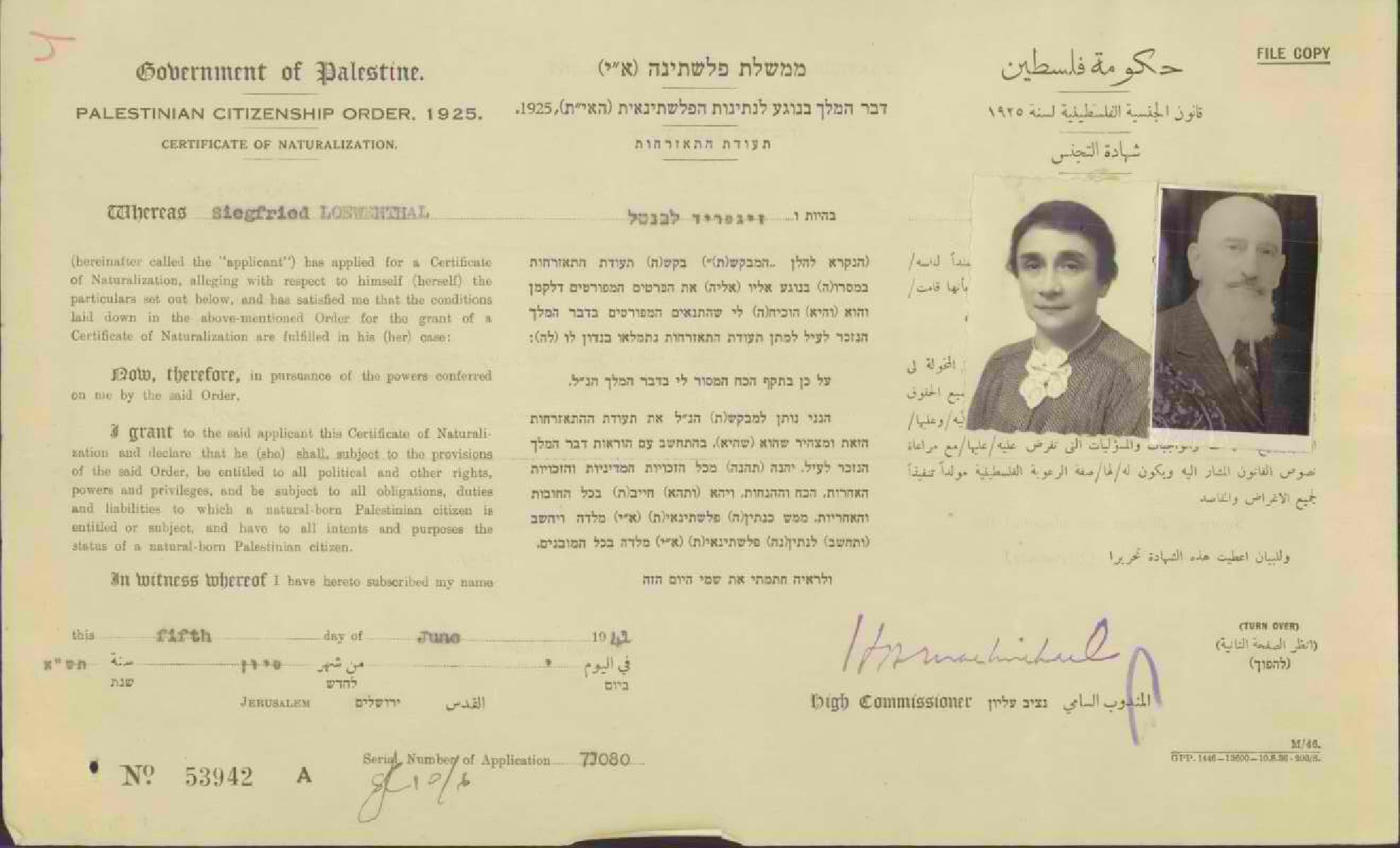
By 1939, the rest of Siegfried’s family had also left Germany. Siegfried and Henriette themselves arrived in Palestine on March 20, 1939, and became naturalized citizens in 1941.3 Unfortunately, Siegfried died just a year later in Tel Aviv on February 25, 1942. He was 62 years old and survived by his wife and all five of his children.4

Naturalization certificate of Siegfried and Henriette (Feuchtwanger) Loewenthal, https://www.archives.gov.il/en/archives/#/Archive/0b07170680034dc1/File/0b07170680b9fac4

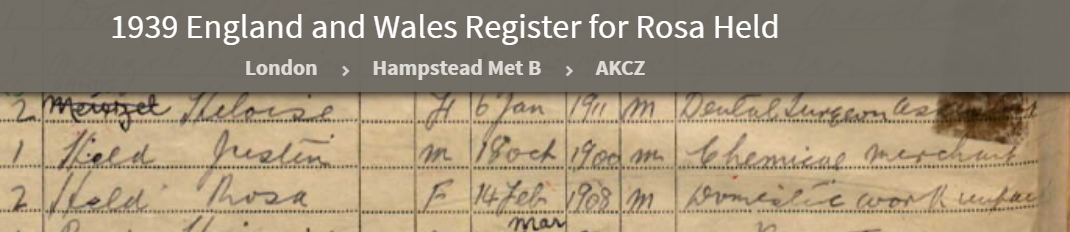
And those children were all over the world by then. Rosa Loewenthal and Justin Held and their children left for England in 1939 and then immigrated to the United States in 1940.5 They ended up living in New York and becoming naturalized citizens.6 Justin died in 1980,7 Rosa in 1993.8

The National Archives; Kew, London, England; 1939 Register; Reference: RG 101/243J
Enumeration District: AKCZ, Ancestry.com. 1939 England and Wales Register

Louise Loewenthal had married Walter Meier Strauss in Basel, Switzerland. Walter was native to Frankfurt, where he was born on December 18, 1909.9 I was fortunate to find a long biography of Walter written by one of his grandsons and posted on the family genealogy website.  According to this document, Walter was employed by a woolen factory in Frankfurt when he was a teenager, and when he was in his early twenties or in the early 1930s, the company moved to Switzerland, and the owner asked Walter to come with them, which he did. By that time he had been dating Louise Loewenthal for seven years, and they soon married and moved to Basel, Switzerland. According to the grandson’s biography of Walter:

During the War, friends from home that were now in the concentration camps sent him letters about the atrocities that were going on in the War and specifically in the Camps. Trying to help, he established a group consisting of himself… and a few other men from Basel. The group would send very small care packages periodically to the people in the camps. The packages consisted of food such as salami, sardines, and any other small items that the people requested or needed and was small enough that it could be sent. Every sunday they would load up the packages in a car and drive all over Basel putting them in many different mailboxes, for if they were all dumped in one mailbox they would surely not arrive at the camps.

Thus, Louise and Walter were able to survive the Holocaust; Walter’s parents and brother were, however, murdered at Sobibor.10

In 1946, after the war ended, Louise and Walter Strauss and their two children immigrated to the US; Max Stern, husband of Louise’s first cousin Hilda, helped them get a visa. The ship manifest listed Justin Held, Louise’s brother-in-law married to her older sister Rosa, as the person they were going to in the US.11 They settled in New York where Walter once again got a job with a woolen factory. Walter died in 1990 while on a business trip in Switzerland and was buried in Israel.12 Louise died in New York on August 11, 2003; she was 92 and was survived by her two children and her grandchildren.13

Grete Loewenthal immigrated to Palestine, arriving on April 6, 1936. She became a naturalized citizen on November 29, 1938. She was working as an assistant pharmacist at the time and was unmarried.14

Cibella/Baron report that she married Fritz Altar in 1948, but I have no records to verify that fact. I did find two ship manifests, one outgoing from England, one arriving in New York, in May 1958, that list Grete and Fritz Altar, residents of Austria and working as hotel managers.15 The English manifest indicates that they were headed to the US as “the country of intended permanent residence.” But I have found no records showing that Grete and Fritz lived in the US. Fritz died in Vienna on January 30, 1993, and is buried there.16 Unsourced trees on Geni and MyHeritage report that Grete died on September 27, 1995, also in Vienna. I have no verification of that fact.

Lotte Loewenthal also had left Germany by 1939. She and her husband Erich Posen are listed on the 1939 England and Wales Register showing residence in England by 1939. Erich was working as an optical goods salesman.

Lotte Loewenthal and Erich Posen, The National Archives; Kew, London, England; 1939 Register; Reference: RG 101/980H, Enumeration District: BXHY, Ancestry.com. 1939 England and Wales Register

Unfortunately I have no marriage record for Lotte and Erich, but I know this is the correct person because after the war when she and Erich had their first child in January 1946, Lotte had serious complications and her mother Henriette had to get permission to leave Palestine to go to England for a few months to help Lotte with the new baby.16

Immigration and Naturalization File for Siegfried and Henriette (Feuchtwanger) Loewenthal, Israel Archives, found at https://www.archives.gov.il/en/archives/#/Archive/0b07170680034dc1/File/0b07170680b9fac4

Lotte was not destined for a long life. She died at the age of 52 in 1967 in England, survived by her husband Erich and two children.17 Her mother also survived her; Henriette Feuchtwanger Loewenthal died at the age of 93 in Israel, according to the work of Roger Cibella and David Baron.

Despite the lack of sources for some of the stories of Siegfried Loewenthal and his family, there is enough information to conclude that he, his wife, and all five of their children and their grandchildren escaped Germany in time and survived the Holocaust. In doing so, they ended up spread across three continents and three different countries.

There are always costs to these relocations and disruptions. Siegfried’s early death in 1942 certainly could have been just one of those costs.

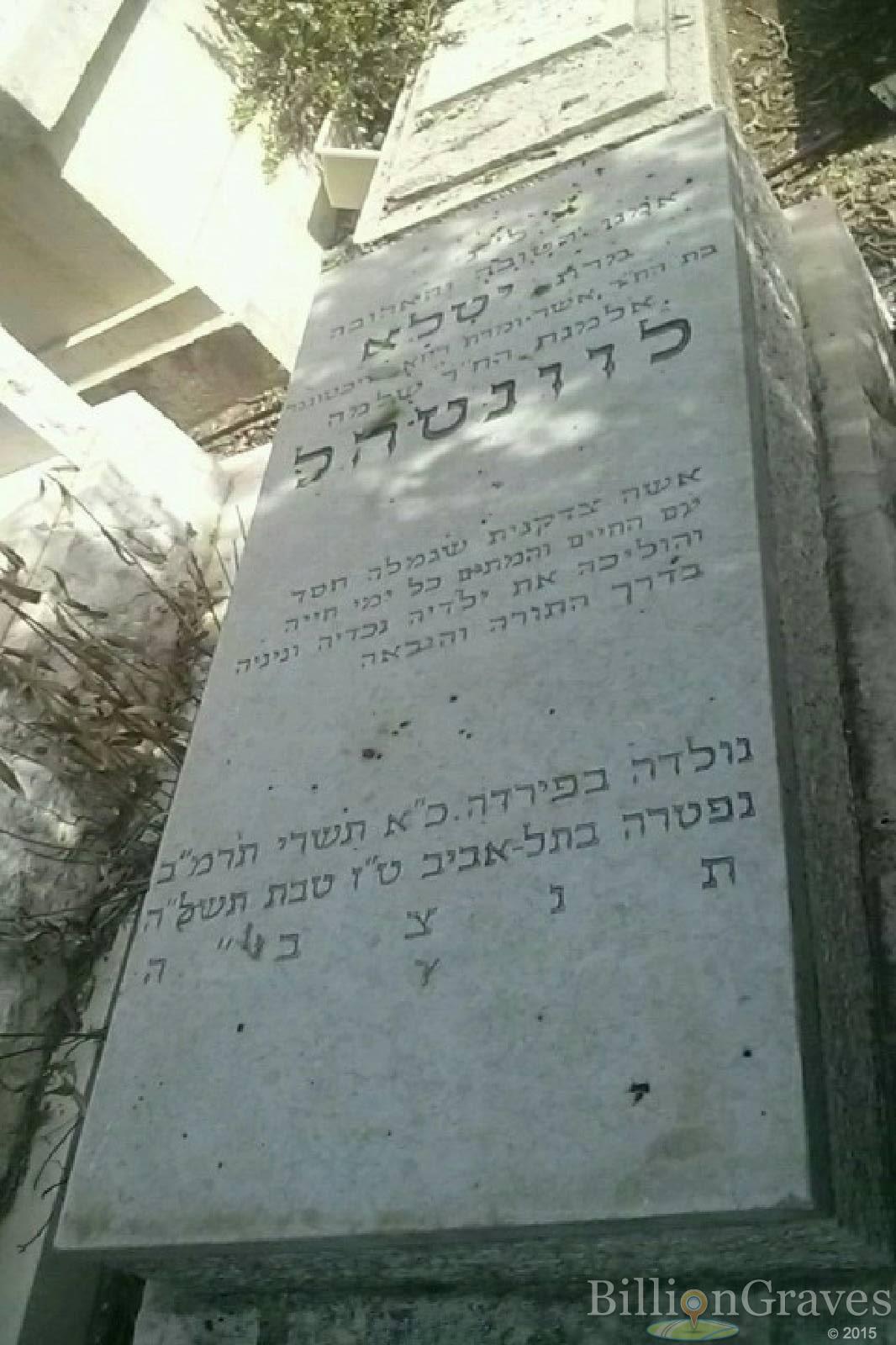
Gravestone of Siegfried Loewenthal, photograph by Ben Ariel October 17, 2015, found at https://billiongraves.com/grave/%D7%A9%D7%9C%D7%9E%D7%94-%D7%9C%D7%95%D7%95%D7%A0%D7%98%D7%94%D7%9C/18779141?referrer=myheritage

Gravestone of Henriette Feuchtwanger Loewenthal photo by Ben Ariel October 17, 2015 , found at https://billiongraves.com/grave/%D7%A9%D7%9C%D7%9E%D7%94-%D7%9C%D7%95%D7%95%D7%A0%D7%98%D7%94%D7%9C/18779141?referrer=myheritage


  1. Immigration and Naturalization File for Albert and Hilda (Weingarten) Loewenthal, Israel Archives, found at https://tinyurl.com/w33mluf ↩
  2. Ibid. ↩
  3. Immigration and Naturalization File for Siegfried and Henriette (Feuchtwanger) Loewenthal, Israel Archives, found at https://tinyurl.com/tjk92a5 ↩
  4. https://tinyurl.com/u3jsyyc ↩
  5. Rosa and Justin Held and family, passenger ship manifest, Year: 1940; Arrival: New York, New York; Microfilm Serial: T715, 1897-1957; Microfilm Roll: Roll 6459; Line: 16; Page Number: 81, Ancestry.com. New York, Passenger and Crew Lists (including Castle Garden and Ellis Island), 1820-1957 ↩
  6. Name: Rosa Held, Birth Date: 14 Feb 1908, Age: 39, Naturalization Date: 20 Nov 1947, Residence: New York, New York, Title and Location of Court: New York Southern District, Ancestry.com. New York, Index to Petitions for Naturalization filed in New York City, 1792-1989. Justin Held, Birth Date: 18 Oct 1900, Age: 47, Naturalization Date: 15 Jul 1948, Residence: New York, New York, Title and Location of Court: New York Southern District, Ancestry.com. New York, Index to Petitions for Naturalization filed in New York City, 1792-1989. ↩
  7.  Justin Held, Social Security Number: 092-14-6607, Birth Date: 18 Oct 1900
    Death Date: Dec 1980, Social Security Administration; Washington D.C., USA; Social Security Death Index, Master File, Ancestry.com. U.S., Social Security Death Index, 1935-2014 ↩
  8. Rose Held, Birth Date: 14 Feb 1908, Death Date: Mar 1993, SSN: 095144557,
    Ancestry.com. U.S., Social Security Applications and Claims Index, 1936-2007 ↩
  9. Walter Meier Strauss, Birth Date: 18 Dec 1909, Naturalization Date: 24 Mar 1952,
    Residence: New York, New York, Title and Location of Court: New York Southern District, Ancestry.com. New York, Index to Petitions for Naturalization filed in New York City, 1792-1989 ↩
  10. “My Genealogy Home Page:Information about Walter Meyer Strauss,” Jonathan Strauss, found at https://tinyurl.com/ttlo7rl ↩
  11. Walter and Louise Strauss and children, ship manifest, Year: 1946; Arrival: New York, New York; Microfilm Serial: T715, 1897-1957; Microfilm Roll: Roll 7161; Line: 1; Page Number: 267, Ancestry.com. New York, Passenger and Crew Lists (including Castle Garden and Ellis Island), 1820-1957 ↩
  12. See footnote 10. Walter M Strauss, Death Date: 15 Oct 1990, SSN: 065246257,
    Ancestry.com. U.S., Social Security Applications and Claims Index, 1936-2007 ↩
  13. Louise Strauss, Death Date: 11 Aug 2003, SSN: 122285989, Ancestry.com. U.S., Social Security Applications and Claims Index, 1936-2007 ↩
  14. Immigration and Naturalization File for Grete Loewenthal, Israel Archives, found at https://tinyurl.com/v5mxvs9 ↩
  15. Fritz and Grete Altar, ship manifest, 15 May 1958, Port of Departure: Southampton, England, Destination Port: New York, USA, Ship Name: Ryndam
    Ancestry.com. UK and Ireland, Outward Passenger Lists, 1890-1960. Grete and Fritz Altar, ship manifest, 24 May 1958, Arrival Place: New York, New York, USA, Ship: Ryndam, The National Archives at Washington, D.C.; Washington, D.C.; NAI Number: 2990227; Record Group Title: Records of the Immigration and Naturalization Service, 1787 – 2004; Record Group Number: 85; Series Number: A4115; NARA Roll Number: 447, Ancestry.com. New York State, Passenger and Crew Lists, 1917-1967 ↩
  16. See multiple letters in Immigration and Naturalization File for Siegfried and Henriette (Feuchtwanger) Loewenthal, Israel Archives, found at https://tinyurl.com/tjk92a5 ↩ ↩
  17. Lottie V Posen, Death Age: 52, Registration Date: Jul 1967, Registration district: Hampstead, Inferred County: Greater London, General Register Office; United Kingdom; Volume: 5b; Page: 583, Ancestry.com. England & Wales, Civil Registration Death Index, 1916-2007 ↩

Escaping from Germany, Part II: Julius Loewenthal’s Family

Although the story of Selma Loewenthal Schwabacher’s family had happy endings in that the entire family safely left Germany and made new lives for themselves in the US, the story of Selma’s brother Julius is more complicated and more heartbreaking.

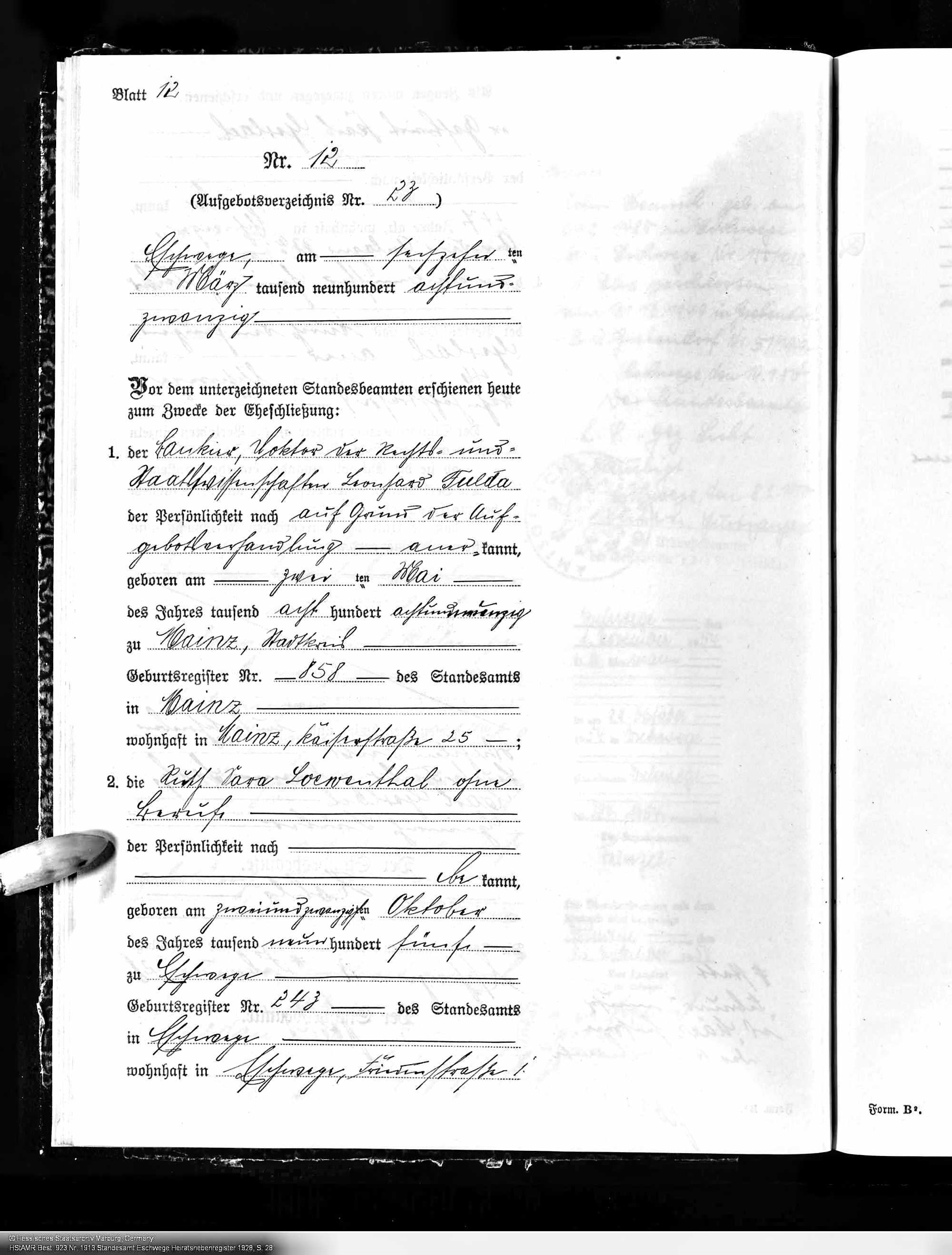
Julius Loewenthal and his wife Elsa Werner had four children, as we have seen: Ruth, born in 1905, Herbert, born in 1907, Hilda, born in 1911, and Karl Werner Loewenthal, born in 1918. Ruth had married Leonhard Fulda on March 16, 1928, in Eschwege, where her family lived.

Marriage Record of Ruth Loewenthal and Leonhard Fulda, Hessisches Hauptstaatsarchiv; Wiesbaden, Deutschland; Bestand: 923; Laufende Nummer: 1913
Ancestry.com. Hesse, Germany, Marriages, 1849-1930

On September 21, 1930, Ruth gave birth to their daughter, Margot Fulda, in Mainz, Germany.1

That happy event was followed by the marriage of Julius and Elsa’s younger daughter Hilda Loewenthal to Max Stern on July 25, 1934, in Hamburg.

Hilda Loewenthal and Max Stern marriage record (found in a biography of Max Stern posted on Ancestry)

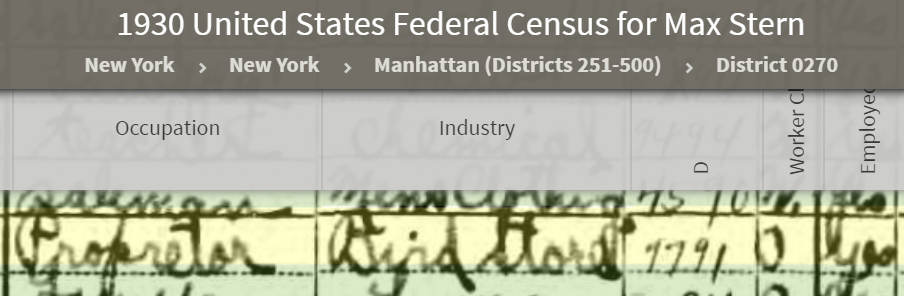
Max Stern was born in Fulda, Germany, on October 22, 1898, to Emanuel and Caroline Stern,2 and had immigrated to the United States in 1926.3 He brought with him a shipment of five thousand singing canaries he’d accepted as repayment for a debt4 and started a bird store, as seen on the 1930 census. That business eventually grew into the highly successful pet and pet food company, Hartz Mountain Corporation.

Max had returned to Germany to marry Hilda Loewenthal, and then he and his bride returned to New York in August 1934.5 They visited Germany in 1935,6 but returned to New York, where their three children were thereafter born.

Max Stern, 1930 US census, Census Place: Manhattan, New York, New York; Page: 9A; Enumeration District: 0270; FHL microfilm: 2341293, Ancestry.com. 1930 United States Federal Census

Meanwhile, during these years, Hitler had taken power in Germany, and the Nazi persecution of the Jews had begun by the time Hilda and Max married in 1934. Herbert Loewenthal, Julius and Elsa’s second child and older son, left Germany and arrived in New York on February 22, 1935, with the intention of remaining permanently. He filed a declaration of intention to become a citizen on September 20, 1935, describing his occupation as international clearing and barter.

Herbert Loewenthal, Declaration of Intention, The National Archives at Philadelphia; Philadelphia, Pennsylvania; NAI Title: Declarations of Intention for Citizenship, 1/19/1842 – 10/29/1959; NAI Number: 4713410; Record Group Title: Records of District Courts of the United States, 1685-2009; Record Group Number: 21, Description: (Roll 489) Declarations of Intention for Citizenship, 1842-1959 (No 367301-368300), Ancestry.com. New York, State and Federal Naturalization Records, 1794-1943

Julius and Elsa came to New York to visit their children in February, 1936, but only for sixty days, according to the ship manifest.7

To learn more details about what happened to the family of Julius Loewenthal thereafter, I was fortunate to find the award and decision of the Claims Resolution Tribunal (hereinafter referred to as the “Warner-Loewenthal Claims Resolution Tribunal Opinion”) issued in response to a claim filed in the Holocaust Victim Assets Litigation by Julius and Elsa’s youngest child Karl Werner Loewenthal, also known as Garry Warner-Loewenthal .

According to the official website for the Holocaust Victim Assets Litigation:

In 1996 and 1997, a series of class action lawsuits were filed in several United States federal courts against Swiss banks and other Swiss entities, alleging that financial institutions in Switzerland collaborated with and aided the Nazi Regime by knowingly retaining and concealing assets of Holocaust victims, and by accepting and laundering illegally obtained Nazi loot and profits of slave labor. All of the cases were consolidated in the United States District Court for the Eastern District of New York (“the Court”). ….

The lawsuits were filed because in the decades after the Holocaust, Swiss financial institutions had failed to return deposits to the Nazi victims (or their relatives) who had entrusted their assets to the banks. Although the issue of these bank accounts had been raised many times during the decades after the Holocaust, in the late 1990s, the banks’ behavior came under scrutiny of a type that Switzerland had not experienced before.

The litigation was settled in 2000, and a special master was appointed to establish a process for distributing compensation to claimants. Garry Warner-Loewenthal filed a claim for the account of his father, and the tribunal’s full decision on his claim can be found here. It details the facts alleged by Julius’ son in support of his claim, for which he was awarded 47,400 Swiss francs.

According to the Warner-Loewenthal Claims Resolution Tribunal Opinion, Herbert Loewenthal moved from the US to Zurich, Switzerland before 1937. Ruth Loewenthal and her husband Leonhard Fulda were planning to move to the US and in the fall of 1937, they went to visit Ruth’s brother Herbert in Switzerland before immigrating, accompanied by Ruth and Herbert’s father Julius Loewenthal. Central to the claim was the allegation that Julius had deposited money in a Swiss bank while in Zurich.

Tragically, Ruth and Leonhard were killed in a terrible automobile accident on October 3, 1937, while returning to Germany from Switzerland. Julius was seriously injured, but survived. Ruth and Leonhard’s daughter Margot, orphaned at seven years old, went to live with her father’s parents, Isaak and Joanna Fulda in Mainz.

In November 1937, just a month after the accident that killed their daughter and son-in-law, Julius and Elsa again visited New York for a limited time but returned to Germany.8 I have to wonder whether at this point they wanted to immigrate, given what was happening in Germany. Perhaps they could not get a visa allowing them to stay permanently. According to information given to Warner-Loewenthal Claims Resolution Tribunal Opinion, after the Nazis confiscated Julius’ business, he and Elsa fled to the Netherlands in 1938 and then to London. Finally, in May 1939, they were able to immigrate permanently to the United States.9

Julius and Elsa Loewenthal, ship manifest from England to New York, Ancestry.com. UK and Ireland, Outward Passenger Lists, 1890-1960 . Original data: Board of Trade: Commercial and Statistical Department and successors: Outwards Passenger Lists. BT27. Records of the Commercial, Companies, Labour, Railways and Statistics Departments. Records of the Board of Trade and of successor and related bodies. The National Archives, Kew, Richmond, Surrey, England.

By the time the 1940 census was enumerated, Julius and Elsa were living in Kew Gardens, Queens, New York. Neither listed an occupation.10 Their daughter Hilda and her family were living in Manhattan, and Max Stern listed his occupation as a bird food merchant.11

Julius and Elsa’s youngest child Karl had fled to England in 1938, according to the Warner-Loewenthal Claims Resolution Tribunal Opinion. In November, 1939, Karl was found exempt from being interned as an enemy alien. He was working as a trainee in a hosiery factory in Leicester.

The National Archives; Kew, London, England; HO 396 WW2 Internees (Aliens) Index Cards 1939-1947; Reference Number: HO 396/56,  056: Internees at Liberty in UK 1939-1942: Lir-Lov
Ancestry.com. UK, WWII Alien Internees, 1939-1945

During the war Karl joined the British Armed Forces and was advised to change his name to Garry Charles Warner “for his own protection.”  When he immigrated to the United States after the war in August, 1946, he added “Loewenthal” back to his name and was known as Garry Charles Warner-Loewenthal, as described in the Warner-Loewenthal Claims Resolution Tribunal Opinion.

It might seem that Julius Loewenthal’s family was relatively fortunate as Julius, Elsa, Hilda and her husband Max Stern, Herbert, and Karl/Garry all survived the Holocaust and the war. Ruth and her husband Leonhard Fulda were killed, but not by the Nazis; they died in a car accident. Of course, Ruth and Leonhard might never have been involved in an accident if they hadn’t gone to Switzerland to visit Herbert, who had been forced to leave Germany because of the Nazis.

But that is not the end of the story. Recall that Ruth and Leonhard’s daughter Margot had gone to live with her paternal grandparents, the Fuldas, in Mainz after losing her parents in October 1937. The Fulda family—Isaac and Johanna, their son Ernst and his wife Emma, and Margot, Ruth and Leonhard’s orphaned daughter—all escaped to Amsterdam in 1939. But they were ultimately deported from there to Sobibor, where every single one of them was murdered by the Nazis in 1943, including little Margot, who was not yet thirteen years old.12

Julius Loewenthal had survived a terrible car accident that caused him serious harm, the deaths of his daughter Ruth and her husband Leonhard in that accident, the confiscation of his business, the loss of his homeland, the escape first to the Netherlands, then England, and finally to the US, and, worst of all, the murder of his granddaughter Margot. Having survived all that, he died not long after the war ended on November 20, 1946, at the age of 72.13

Four years later, his daughter Hilda divorced Max Stern. She would marry again, but that marriage also did not last.14 Her mother Elsa Werner Loewenthal died in 1961 in New York at the age of 77,15 and then her brother Herbert died in Zurich in 1962; he was only 53 and had never married.16 Hilda Loewenthal Stern Duschinsky died on July 29, 1980; she was 68 and was survived by her children and grandchildren.17

That left only Garry Charles Warner-Loewenthal, born Karl Werner Loewenthal. He had married after the war and had one child.18 I could not find much other information about Garry, but we do know that just a few years before he died when he was already in his eighties, he filed a claim in the Holocaust Victim Assets Litigation and received some compensation for all that his family had lost. Garry died at the age of 87 in West Palm Beach, Florida, on March 1, 2005.19

The story of the family of Julius Loewenthal serves as a painful reminder that even those who survived the Holocaust suffered greatly and lived with those scars forever after.


  1. German Federal Archives Residents’ List Annotations:Für tot erklärt.,
    1939 Census ID Number(s):VZ392415, German Federal Archive ID Number: 871897, found at https://tinyurl.com/vb6ntsu ↩
  2. Birth record of Max Stern, Familien- und Geburtsregister der Juden von Fulda 1748-1899 (HHStAW Abt. 365 Nr. 345)AutorHessisches Hauptstaatsarchiv, Wiesbaden, p. 202. ↩
  3.  Staats Archiv Bremen; Bremen, Germany; Bremen Passenger Lists; Archive Number: AIII15-18.08.1926-2_N, Ancestry.com. Web: Bremen, Germany, Passenger Lists Index, 1907-1939 ↩
  4. “Max Stern, Founder of Hartz Mountain,” The Herald-News
    Passaic, New Jersey, 21 May 1982, Fri • Page 31 ↩
  5. Max and Hilda Stern, ship manifest, Year: 1934; Arrival: New York, New York; Microfilm Serial: T715, 1897-1957; Microfilm Roll: Roll 5526; Line: 1; Page Number: 118, Ancestry.com. New York, Passenger and Crew Lists (including Castle Garden and Ellis Island) ↩
  6. Max and Hilda Stern, ship manifest, Year: 1935; Arrival: New York, New York; Microfilm Serial: T715, 1897-1957; Microfilm Roll: Roll 5683; Line: 1; Page Number: 8,
    Ancestry.com. New York, Passenger and Crew Lists (including Castle Garden and Ellis Island), 1820-1957 ↩
  7. Julius and Elsa Loewenthal, ship manifest, Year: 1936; Arrival: New York, New York; Microfilm Serial: T715, 1897-1957; Microfilm Roll: Roll 5769; Line: 1; Page Number: 4, Ancestry.com. New York, Passenger and Crew Lists (including Castle Garden and Ellis Island), 1820-1957 ↩
  8. Julius and Elsa Loewenthal, ship manifest, Year: 1937; Arrival: New York, New York; Microfilm Serial: T715, 1897-1957; Microfilm Roll: Roll 6081; Line: 25; Page Number: 48, Ancestry.com. New York, Passenger and Crew Lists (including Castle Garden and Ellis Island), 1820-1957 ↩
  9. Julius and Elsa Loewenthal, ship manifest, Year: 1939; Arrival: New York, New York; Microfilm Serial: T715, 1897-1957; Microfilm Roll: Roll 6328; Line: 1; Page Number: 6, Ancestry.com. New York, Passenger and Crew Lists (including Castle Garden and Ellis Island), 1820-1957 ↩
  10. Julius and Elsa Loewenthal, 1940 US census, Census Place: New York, Queens, New York; Roll: m-t0627-02746; Page: 2B; Enumeration District: 41-1374B, Ancestry.com. 1940 United States Federal Census ↩
  11. Max and Hilda Stern and family, 1940 US census, Census Place: New York, New York, New York; Roll: m-t0627-02642; Page: 4B; Enumeration District: 31-774, Ancestry.com. 1940 United States Federal Census ↩
  12. German Federal Archives Residents’ List Annotations:Für tot erklärt.
    1939 Census ID Number(s):VZ392415, German Federal Archive ID Number: 871897 at https://tinyurl.com/vb6ntsu  Also, see the entries at Yad Vashem, https://tinyurl.com/ts3xacc ↩
  13. Certificate Number: 9313, Ancestry.com. New York, New York, Extracted Death Index, 1862-1948 ↩
  14. Divorce Date: Mar 1950, County: Elmore, Ancestry.com. Alabama Divorce Index, 1950-1959. Original data: Alabama Center for Health Statistics. Alabama Divorce Index, 1950-1959. Montgomery, AL, USA: Alabama Center for Health Statistics. Marriage of Hilda Stern to Eugene Duschinsky, License Number: 609, New York City Municipal Archives; New York, New York; Borough: Manhattan, Ancestry.com. New York, New York, Marriage License Indexes, 1907-2018 ↩
  15. Death Date: 22 Mar 1961, Death Place: Queens, New York, New York, USA
    Certificate Number: 3535, Ancestry.com. New York, New York, Death Index, 1949-1965 ↩
  16. See Warner-Loewenthal Claims Resolution Tribunal Opinion ↩
  17.  Social Security Number: 057-38-8878, Birth Date: 22 Oct 1911, Death Date: Jul 1980, Social Security Administration; Washington D.C., USA; Social Security Death Index, Master File, Ancestry.com. U.S., Social Security Death Index, 1935-2014 ↩
  18.  License Number: 650, New York City Municipal Archives; New York, New York; Borough: Queens, Ancestry.com. New York, New York, Marriage License Indexes, 1907-2018 ↩
  19. Death Date: 1 Mar 2005, SSN: 056244639, Ancestry.com. U.S., Social Security Applications and Claims Index, 1936-2007 ↩