Searching for Helene Rapp Lehmann and Her Family: A Genealogy Adventure

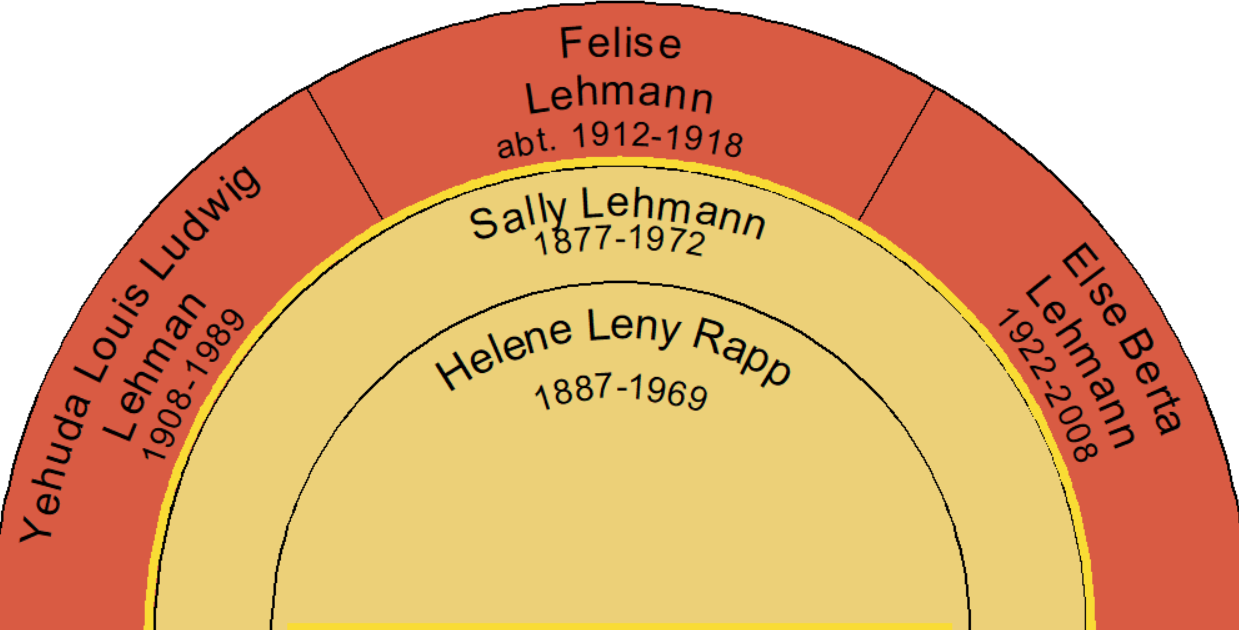
Helmina Goldschmidt’s oldest child, her daughter Helene Rapp Lehmann, was harder to trace than her two younger siblings, Arthur and Alice. I knew that Helene, her husband Sally, their daughter Else Berta, and their son Ludwig all eventually ended up in the United States because all four are listed in the Social Security Death Index. But it was hard to find information about their departure from Germany and about their eventual arrival and life in the US and the years in between.

This document from the Arolsen Archives on Ancestry provided the first clues. It shows that Sally Lehmann was a dentist and that Else Berta, daughter of Helene and Sally Lehmann, had immigrated to Palestine.

Arolsen Archives, Digital Archive; Bad Arolsen, Germany; Lists of Persecutees 2.1.1.1 Description Reference Code: 02010101 oS Source Information Ancestry.com. Europe, Registration of Foreigners and German Persecutees, 1939-1947

I then found Else’s immigration papers showing that she first entered Palestine on February 21, 1939, when she would have been only seventeen. She became a naturalized citizen of Palestine on June 25, 1941. She was unmarried at that time and a hair dresser. (These papers are located at the Israel Archives website located here.)

I assumed that since Else was so young, the rest of her family might have immigrated to Palestine also around the same time, but I could at first not find any Palestinian immigration papers for her parents Helene and Sally or for her brother Ludwig.

At the same time I was researching them all, I received an email from someone in Israel who had questions about one of my other relatives, and so I asked him for advice about finding more information about those who had left Europe for Israel in the 1930s and 1940s. He recommended that I become a member of IGRA—the Israel Genealogy Research Association. I had seen their website many times before, but had hesitated to spend the money to become a member. This time I bit the bullet and joined.

And I am so glad that I did because a quick search uncovered two records for Sally Lehmann. Sally was listed in a 1940 and a 1946 Tel Aviv directory of doctors, dentists, pharmacists and other medical professionals. Thus, I know now that he had immigrated to Israel by 1940.

In addition, I found a 1948 divorce record for Else Berta Lehman, daughter of Shlomo (Sally), from Leopold Ickelheimer, suggesting that Else was likely still in Israel in 1948.

Finally, the IGRA website had a file indicating that a Ludwig Lehmann had changed his name to Yehuda in April 1936. I couldn’t be certain that this was the same Ludwig Lehmann, but if it was, that would mean that the Lehmann family, or at least Ludwig, was in Palestine as early as 1936.

And then, you know how sometimes you search and search and find nothing, and then you return to the same source days later and suddenly a record appears? That’s what happened here. I returned to the Israel Archives website where the Palestinian immigration records are available, and this time found Sally and Helene (Rapp) Lehmann’s immigration and naturalization. The file revealed that Sally and Helene had first arrived in Palestine on July 4, 1938, and that they became naturalized citizens on June 17, 1941.

Sally Lehmann and Helene Rapp Palestinian immigration file found at https://www.archives.gov.il/en/archives/#/Archive/0b07170680034dc1/File/0b07170680bf6119

However, no one in the Lehmann family remained permanently in Israel. I found a 1955 manifest for a ship sailing from Haifa, Israel, to New York, that lists Sally and Helene Lehmann as passengers and as Israeli citizens.1

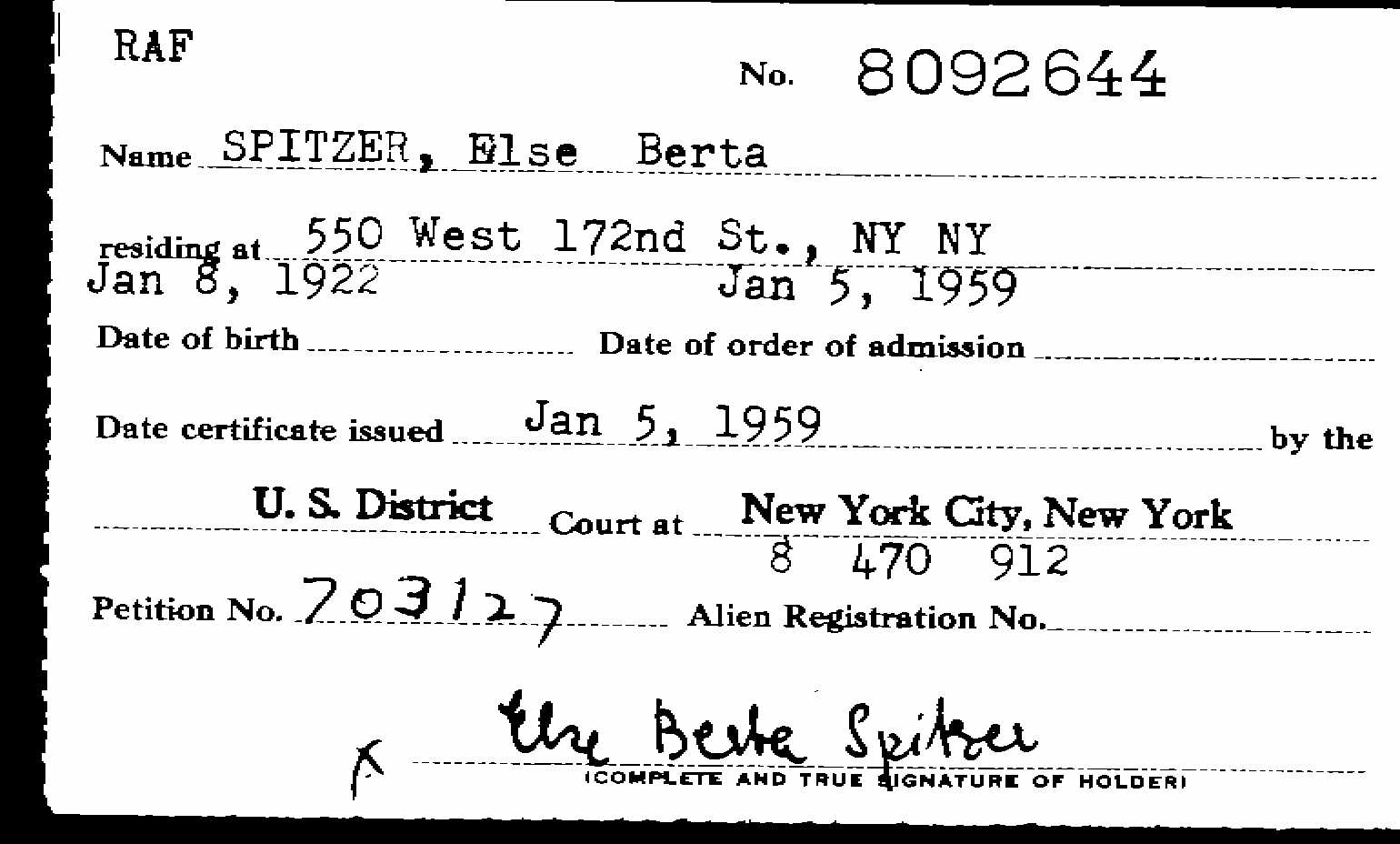
I also found one for an Else B. Spitzer, arriving April 24, 1953, that I thought might be Else Berta Lehmann, but wasn’t sure. There was no age or other identifying information, and she was listed as a German citizen, not an Israeli citizen. 2 But then I located this naturalization index card that shows an Else Berta Spitzer with the same birth date as Elsa Berta Lehmann, residing at 550 West 172nd Street in New York City.

Ancestry.com. New York, Index to Petitions for Naturalization filed in New York City, 1792-1989

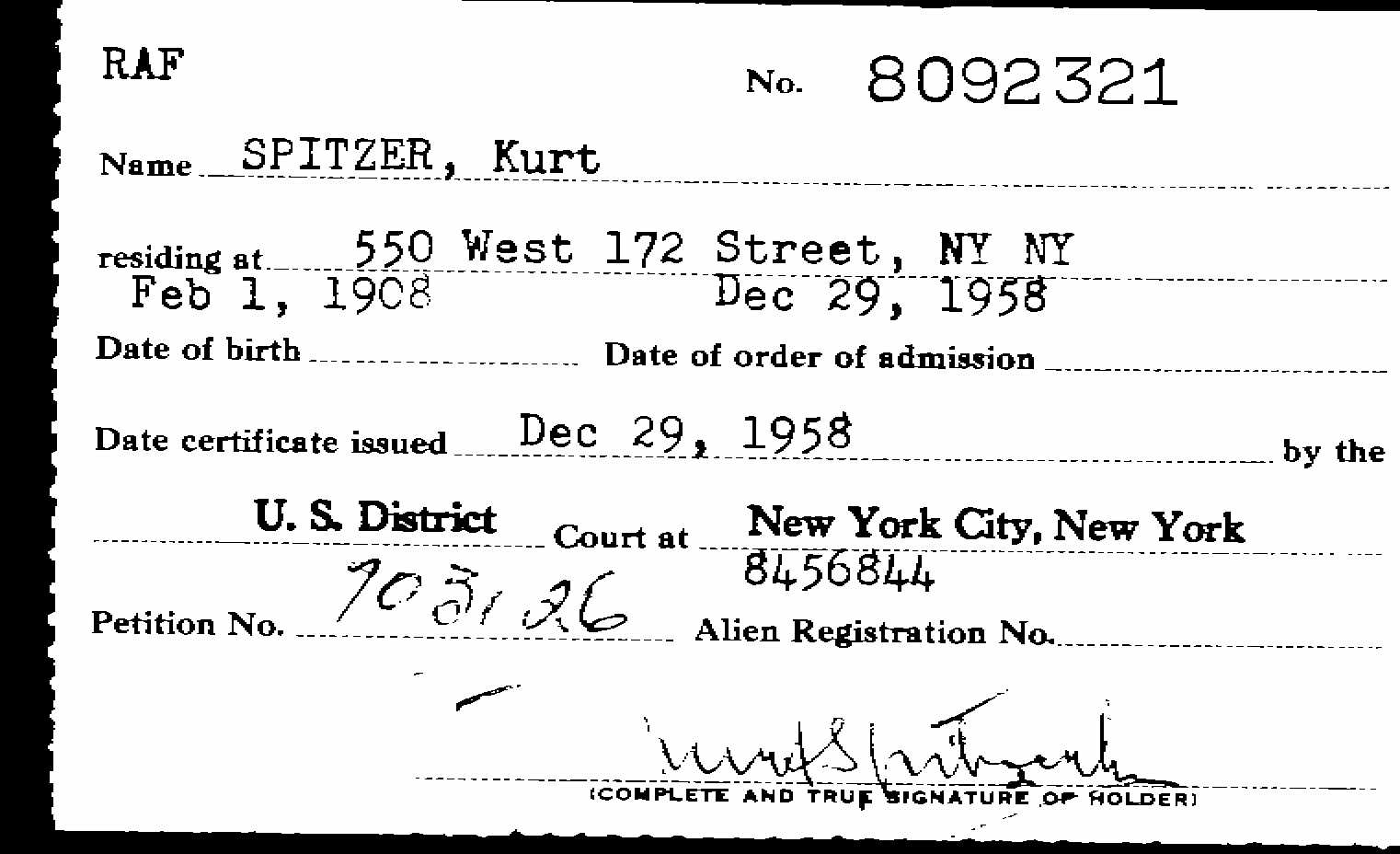
I used that address to search for Spitzers in the 1959 New York City directory living at 550 West 172nd Street and found a Kurt Spitzer living at that address, so now I knew that Else’s second husband was Kurt Spitzer.3 I also found his naturalization index card:

Ancestry.com. New York, Index to Petitions for Naturalization filed in New York City, 1792-1989

Unfortunately I cannot find any records showing Else with Kurt except for these two cards that show that they were living at the same address at the time of their naturalization. I did, however, find a record for Kurt’s enlistment in the US military on October 28, 1942, in New York, showing that he was a barber, beautifician, or manicurist, meaning he and Else were both in the hair dressing field. Kurt was already at that time a US citizen;4 he was born in Wurzburg, Germany, and immigrated to the US in 1925.5

Else’s brother, Sally and Helene’s son Yehuda Ludwig Lehmann, was particularly hard to locate with much certainty, After searching under all possible combinations of his names, I found a manifest with a Yehuda L. Lehmann coming to the US on December 29, 1952, from Cannes, France. He identified himself as divorced and as an Israeli citizen. He was 44 years old, and that would be consistent with the 1908 birth date I have for Ludwig Lehmann.

Yehuda Lehman, passenger manifest, Year: 1952; Arrival: New York, New York, USA; Microfilm Serial: T715, 1897-1957; Line: 1; Page Number: 137, Ship or Roll Number: Constitution
Ancestry.com. New York, Passenger and Crew Lists (including Castle Garden and Ellis Island), 1820-1957

Thus, all the members of Sally and Helene’s family had left Israel for the US in the 1950s. I don’t have much information about their lives after their arrival, although records show that Yehuda married in 1954, was divorced in 1956, and remarried in 1965.  I don’t know whether either Yehuda or Else had children in any of their marriages.

Their mother Helene Rapp Lehman died when she was 82 on September 17, 1969, in New York;6 her husband Sally was 94 when he died three years later in 1972.7 Their son Yehuda Louis Ludwig Lehmann died October 7, 1989, when he was 81.8 And Else Berta Lehmann Spitzer died on March 15, 2008, at age 86.9 According to her listing in the SSDI, her last residence had been in Berlin, Germany.

Thus, Helene Rapp Lehmann was among the fortunate ones who escaped Nazi Germany along with her husband and her children, first to Palestine/Israel, and then to the US. In fact, her siblings Arthur and Alice and their families as well as their mother Helmina Goldschmidt Rapp were also among those who safely escaped. That is quite remarkable.


Having completed the story of the family of Helmina Goldschmidt Rapp, I have now written about all the children of Jacob Meier Goldschmidt and Jettchen Cahn. Next I will turn to Jacob’s younger sister Malchen Goldschmidt, the fourth of the seven children of Meyer Goldschmidt and Lea Katzenstein and their youngest daughter. But first some updates to prior stories.


  1. Sally Lehmann and Helene Lehmann, passenger manifest, Year: 1955; Arrival: New York, New York, USA; Microfilm Serial: T715, 1897-1957; Line: 1; Page Number: 149, Ship or Roll Number: Jerusalem, Ancestry.com. New York, Passenger and Crew Lists (including Castle Garden and Ellis Island), 1820-1957 
  2. Else B. Spitzer, passenger manifest, Year: 1953; Arrival: New York, New York, USA; Microfilm Serial: T715, 1897-1957; Line: 1; Page Number: 347, Ship or Roll Number: Ryndam, Ancestry.com. New York, Passenger and Crew Lists (including Castle Garden and Ellis Island), 1820-1957 
  3. Manhattan, New York, City Directory, 1959, Ancestry.com. U.S. City Directories, 1822-1995 
  4.  Kurt B Spitzer, Marital status: Single, without dependents (Single), Rank: Private
    Birth Year: 1908, Nativity State or Country: Danzig or Germany, Citizenship: Citizen
    Residence: New York, New York, Education: Grammar school, Civil Occupation: Barbers, beauticians, and manicurists, Enlistment Date: 28 Oct 1942, Enlistment Place: New York City, New York, Service Number: 32610147, Branch: Branch Immaterial – Warrant Officers, USA, Component: Selectees (Enlisted Men), Source: Civil Life
    Height: 66, Weight: 149, National Archives at College Park; College Park, Maryland, USA; Electronic Army Serial Number Merged File, 1938-1946; NAID: 1263923; Record Group Title: Records of the National Archives and Records Administration, 1789-ca. 2007; Record Group: 64; Box Number: 05392; Reel: 203, Ancestry.com. U.S., World War II Army Enlistment Records, 1938-1946 
  5. Kurt Spitzer, Born: 1 Feb 1908, Birth Place: Wuerzburg, District: Lower Franconia
    Father: Josef, Mother: Karoline (Lina) nee STRAUSS, Last Residence: New York, NY
    Occupation: Merchant, employee, Naomi Teveth, comp. Germany, Jews in Würzburg, 1900-1945; Kurt Spitzer, ship manifest, Year: 1925; Arrival: New York, New York, USA; Microfilm Serial: T715, 1897-1957; Line: 1; Page Number: 197, Ship or Roll Number: Luetzow, Ancestry.com. New York, Passenger and Crew Lists (including Castle Garden and Ellis Island), 1820-1957 
  6. Helene Rap Lehmann, Gender: Female, Birth Date: 25 Aug 1887, Birth Place: Federal Republic of Germany, Claim Date: 21 Mar 1966, Father: Leopold Rapp
    Mother: Hermine[sic] Godschmidt, SSN: 076424080, Ancestry.com. U.S., Social Security Applications and Claims Index, 1936-2007 
  7.  Sally Lehmann, Social Security Number: 057-38-7312, Birth Date: 2 Sep 1877
    Issue Year: 1963, Issue State: New York, Last Residence: 10474, Bronx, Bronx, New York, USA, Death Date: Feb 1972, Social Security Administration; Washington D.C., USA; Social Security Death Index, Master File, Ancestry.com. U.S., Social Security Death Index, 1935-2014 
  8. Lou Ludwig Lehman, [Lou L Lehman], Gender: Male, Race: White
    Birth Date: 9 Feb 1908, Birth Place: Frankfort, Federal Republic of Germany
    Death Date: 7 Oct 1989, Father: Sally Lehmann, Mother: Helene Rapp
    SSN: 120280768,nAncestry.com. U.S., Social Security Applications and Claims Index, 1936-2007 
  9.  Else B. Spitzer, Social Security Number: 109-28-8645, Birth Date: 8 Jan 1922
    Issue Year: 1952-1954, Issue State: New York, Last Residence: 702, (U.S. Consulate) Berlin, Germany, Death Date: 15 Mar 2008, Social Security Administration; Washington D.C., USA; Social Security Death Index, Master File, Ancestry.com. U.S., Social Security Death Index, 1935-2014 

Gaps in the Story: How Did Amalie and Charles Bloch Escape from Nazi Germany?

Back in May, I wrote about Amalie Meyer Bloch, the granddaughter of Jacob Meier Goldschmidt and Jettchen Cahn, daughter of Regina Goldschmidt and Aaron Meyer. One question that lingered was how Amalie and her daughter Ilse ended up separated from Amalie’s husband Charles Bloch.

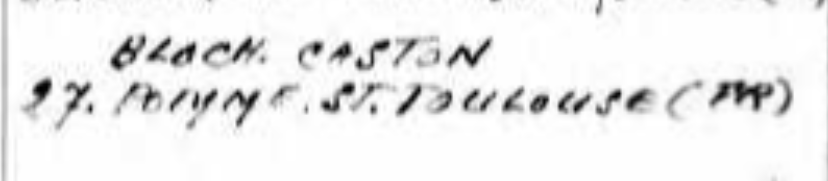
I knew from one of the Arolsen Archives document available through Ancestry that Charles had gone to Paris, and I knew that he eventually rejoined Amalie and Ilse in the US in 1946, reporting that his last address had been in Toulouse, France. But what I didn’t know was when Charles had gone to Paris and where he was in France during the war after Germany’s invasion of France in 1940.

Arolsen Archives, Digital Archive; Bad Arolsen, Germany; Lists of Persecutees 2.1.1.1; Series: 2.1.1.1, Reference Code: 02010101 oS, Ancestry.com. Europe, Registration of Foreigners and German Persecutees, 1939-1947

Barb276, one of my readers, suggested that I contact the ITS (International Tracing Service) and file a request for more information about Charles since not all of their documents are available through the Arolsen Archives. I did as she suggested back in May and was told that it would take ten months to complete the investigation and report back. I prepared myself for a long wait.

You can imagine my surprise when just a week or so ago I received a report back from ITS with more documents about Charles. Those documents don’t really answer my questions, unfortunately, but they did reveal one more piece of the puzzle.

Charles was one of the thousands of Jewish men who were rounded up during and after Kristallnacht in November 1938 and sent to the Buchenwald concentration camp. He was released in December 1938.

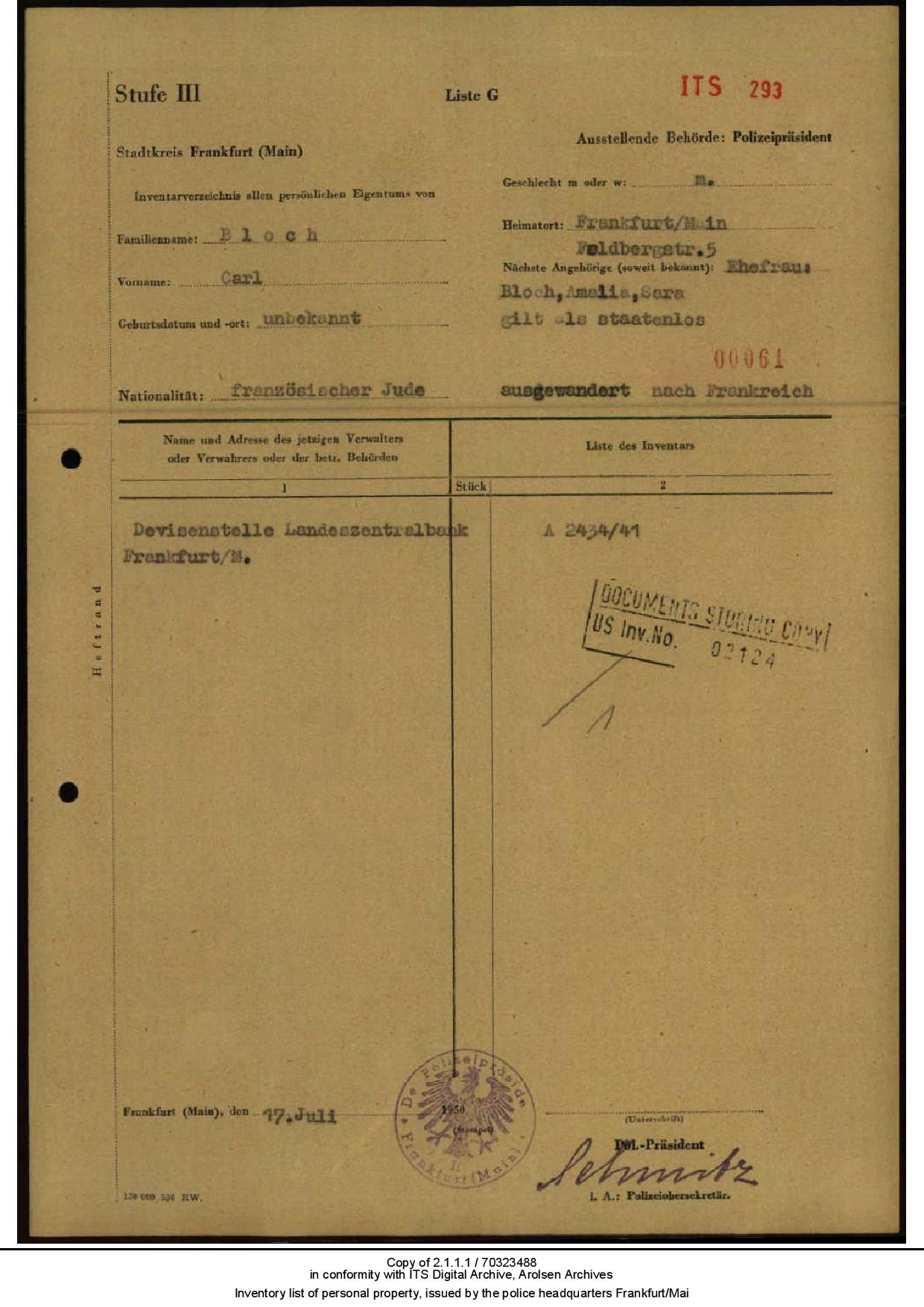
My working hypothesis is that upon his release, he left Germany for France. One of the ITS documents, a property inventory prepared after the war in 1950, described Charles as a “französischer Jude,” a French Jew. I wasn’t sure what to make of that since Charles was also documented as German-born—born in Frankfurt in 1881. That same document also states that Amalie is “gilt als staatenlos,” considered stateless. So maybe the reference to Charles as a French Jew meant that he had become a citizen of France after immigrating there.

It would make sense that Charles would leave Germany in early 1939 after his experience at Buchenwald. As seen in my earlier post, his daughter Ilse had gone to England by 1939. But it seems that Amalie was not in England or France at that point. On her November 27, 1941, declaration of intention to become a US citizen, Amalie reported that Charles was at that time residing in France, Ilse was residing in New York, and that Amalie herself had last resided in Lisbon, Portugal.

Amalie Meyer Bloch, declaration of intent, The National Archives at Philadelphia; Philadelphia, Pennsylvania; NAI Title: Declarations of Intention for Citizenship, 1/19/1842 – 10/29/1959; NAI Number: 4713410; Record Group Title: Records of District Courts of the United States, 1685-2009; Record Group Number: 21
Description: (Roll 641) Declarations of Intention for Citizenship, 1842-1959 (No 510101-511000)
Ancestry.com. New York, State and Federal Naturalization Records, 1794-1943

My hunch is that Amalie stayed behind in Germany longer than her husband and daughter and then somehow escaped to Portugal after the war started. But I could be wrong. My other hunch is that Charles escaped from Paris after the Nazis invaded and somehow survived the war in southern Vichy-controlled France, finally arriving in the US a year after the war. Although I don’t know more about Charles’ time there, I did find a Jewish Telegraphic Agency news release dated April 29, 1941, reporting that Jewish refugees had been expelled from Toulouse. I’ve no idea, however, how that impacted Charles Bloch.

Unfortunately, the ITS documents do not reveal anything about Charles’ time in France during or after the war. Nor do I have any more information about how Amalie ended up in Portugal or when. And since they have no living descendants, I fear I can only rely on my hunches and speculation to fill in these gaps.


How The Nazis Destroyed My Cousin Moritz Oppenheimer

Last time I shared the documents my cousin Wolfgang Seligmann found at the Wiesbaden archives about our mutual cousin Martha Oppenheimer Florsheimer. Today I want to share the documents Wolfgang found about Martha’s brother Moritz James Oppenheimer. Martha and Moritz were my great-grandmother Eva Seligman Cohen’s first cousins; they were the children of Pauline Seligmann, the sister of my great-great-grandfather Bernard Seligman.

As I’ve previously written, Moritz Oppenheimer was born on June 10, 1879, in Butzbach, Germany. Sometime before 1902, Moritz married Emma Katherina Neuhoff, who was not Jewish. Moritz and Emma had two children: Paula (1902) and Walter (1904). Moritz owned a paper factory in Frankfurt before the war as well as a large and very successful horse stud farm where thoroughbred horses were raised and sold. As his granddaughter Angelika reported to me, Moritz was a member of the board of directors of several companies throughout Germany. He was a very successful and wealthy man.

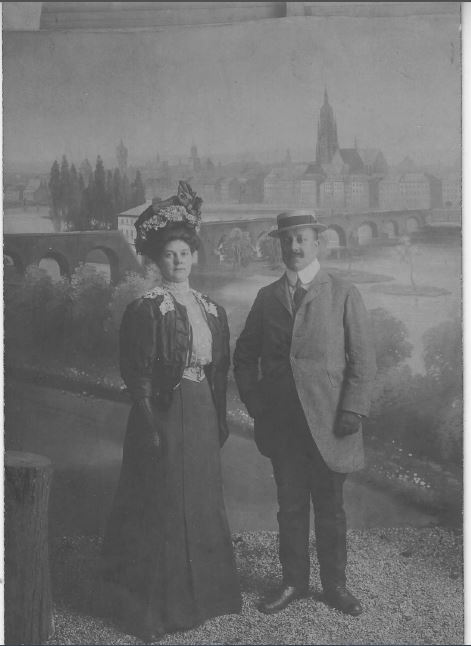
Emma Neuhoff and Moritz James Oppenheimer
photo courtesy of Angelika Oppenheimer

Moritz was arrested in the autumn of 1933. His marriage to Emma was dissolved because mixed marriages were not legal under the Nazi regime. Then his assets including his horse farm were confiscated and put into the hands of an administrator, who sold them at far below their market value. According to his son Walter, Moritz had been in good health up to this time, but these actions caused him to become quite ill. After being visited by Gestapo, he reportedly took his own life on May 4, 1941.

Wolfgang found three documents that illustrate just how desperate Moritz’s situation was. I am deeply grateful to Cathy Meder-Dempsey of the blog, Opening Doors in Brick Walls, who translated all three of these documents.

The first is a letter written by Moritz in early 1941 regarding his taxes for the year 1940.

Letter by Moritz James Oppenheimer 1941

Transcribing and translating this letter presented some real challenges because, as you can see, the first several letters of the first word on the left side of the letter were not visible, but somehow Cathy was able to make sense of it all.

Here is her transcription and her translation of the letter:

[…] 10.6.1879 in Butzbach (Hessen)

[…]kenkarte H 0240/39

An das Finanzamt Wiesbaden

Im Jahre 1933 wurde über mein Vermögen das Konkurs

[verfahren] eröffnet (Frankfurt a. Main)

[Ich] besitze weder irgend welches Vermögen noch Wertgegen-

[stande], noch Möbel, Wäsche, etc.

Im Jahre 1934 wurde ich in Folge schwerer Erkrankung,

[…Er]weiterung und Verlagerung, Wasserbildung, Angina pektoris

[…auf]störungen, Kopfbeschwerden etc. nach Bad-Nanheim

[…] Dort war ich bis vergangenes Jahr in ärztlicher

behandlung und Aufsicht.

[…] schwerer Gelenkrheumatismus hinzutrat, kam ich

[ein art]ztliche Verordnung nach Wiesbaden zur Kur.

[Einko]mmen aus irgend welchen Möglichkeiten habe ich

[nicht]. Ich wohne möbliert.

[…]welche Neuanschaffungen habe nicht seit 1933 in Folge

meiner Mittellosigkeit nicht gemacht.

[Meine]Lebensunterhalt sowie Arzt, Apotheke, Zimmer und Kur

hatte ich aus Unterstützungen von ?200 Mk (monatlich)

[nur] von Verwandten gegeben werden.

[Diese] Zuwendungen stammen aus bereits versteuerten

[…]gen, Einkünfte meiner Verwandten.

Nach wie vor bin ich schwer erkrankt

[Meine] Ehe was Mischehe, Frau Arierin. Meine Kinder sind

[…]ft, konfirmiert und gelten nicht als Juden.

[…] ich eine andere Steuerklärung abgeben müssen,

[…] um Zusendung eines Formulares.

Moritz Israel Oppenheimer

Weisbaden

Pagenstecherstrasse 4 (?? Marx)

Zur Abgabe einer (Einkommen) Eink. Erklarung

fur 1940 aufgefordert.

Translation:

To the tax office in Wiesbaden

In 1933, bankruptcy was declared on my assets (Frankfurt a. Main). I have neither assets nor other things of value, furniture, laundry, etc. In 1934, as a result of serious illness, (enlargement and relocation – ??), water retention, angina pectoris, (other) disorders, headache etc. I was sent to Bad-Nanheim. Until last year I was there under medical treatment and supervision. As severe rheumatoid arthritis set in, I received medical orders to take a cure in Wiesbaden. I don’t have any income possibilities and live in a furnished place. No new acquisitions have been made since 1933 as I am penniless. My livelihood as well as doctor, pharmacy, room and spa expenses have been supported with [?] 200 Mk (monthly) from my relatives. This support came from already taxed income of my relatives. I am still seriously ill.

My marriage was a mixed marriage, my wife was Aryan. My children are ____, confirmed and are not considered Jews. [I assume that the word that we cannot see was Mischling.]

I have to file another tax return, and request a form be sent.

Signature and address

Notation in pencil: He was asked to submit a declaration of income for the year 1940.

Cathy thought he was writing to get the correct tax form for someone in his financial position.

Although I had read his son Walter’s description of Moritz’s financial and medical condition, reading this letter written by Moritz himself was just heartbreaking. Here was a man who had found incredible success in business brought down to being very sick and penniless.

The second document I received from Wolfgang was a letter written by Walter Oppenheimer, Moritz’s son.

Letter by Walter Oppenheimer 1941

Cathy translated the typed section, written by Walter, as follows:

In an immediate polite reply to your letter of the 15th of this month that I received only today, I inform you that my father died on May 4th, 1941. Who the legal heirs are now I am not able to tell you as the two children, my sister and I, refused the inheritance in a publicly certified declaration before the local court.

Heil Hitler!

Walter Georg Oppenheimer

I was very disturbed to see that Walter had used “Heil Hitler” in this letter, but Cathy explained that that was to be expected in a letter to officials during Hitler’s reign. Nevertheless, it made the hair on my arms stand to see a relative of mine use that expression.

I wondered why Walter and his sister Paula would have refused the inheritance, and Cathy suggested that it was a means of avoiding taking on their father’s debts since there were apparently no assets to inherit.

The handwritten notes on the bottom of the letter appear to have been made by some official commenting on the status of Moritz’s inheritance, as transcribed and translated by Cathy:

Anfrage beim Amtsgericht Frankfurt am Main

wer Nachlassverwalter ist, und

wer die gesetzlichen Erben sind,

nachdem die Kinder ausgeschlagen

haben.

Translation:

Inquiry to the district court Frankfurt am Main

who is administrator, and who are the legal heirs, after the children refused inheritance.


An das Amtsgericht ffm (Frankfurt am Main)

Der fruher dort wohnhaft gewesene Moritz Israel Oppenheimer

geb. am 10.6.1879 ist hier am 4.5.41 verstorben.

Der Sohn des selbend Dr. Walter Georg Oppenheimer ffm. Schumannstr. 47 wohnhaft, hat mitgeteilt daß seine Schwester und er ? haben.

Ich bitte nur ____ von 2 zu 4 Wochen.

Translation

To the district court Frankfurt am Main

Moritz Israel Oppenheimer, who previously lived there, born on June 10, 1879 died here on May 4, 1941. The son of the same, Dr. Walter Georg Oppenheimer, a resident of Frankfurt am Main, Schumannstrasse 47, announced that his sister and he (symbols? probably mean disclaimed inheritance). I only ask ____ from 2 to 4 weeks.

Finally, the third document Wolfgang found in the Wiesbaden archives about Moritz is this handwritten page of notes about Moritz’s “income” for the first few months of 1941 before his death:

Oppenheimer ist am 4.5.41 gestorben.

Eink. 41 wurde geschätzt und wie folgt errechnet: freiwillige zuwandungen seines Sohnes 1940 = 4060 Rm : 12 = 338

von 1.1 – 30.4.41 je 338 Rm = 1352 Rm

                                       4x

./. Sondereingaben 4 x 15   =       60                                                1292

                                                   -60         1432 Rm

angaben des Nachlasspflegers Spring:  Bl. 22

__                                    

Translation

Oppenheimer died on 4.5.41. Income for 1941 was estimated and calculated as follows: voluntary contributions of his son 1940 = 4060 Rm : 12 = 338 per monthfrom 1.1 – 30.4.41 338 Rm = 1352 Rm

                                    4x

./. Special income 4 x 15           – 60

                                                 1292

                                                    -60      1432 Rm 

information from the estate administrator Spring: Bl. 22

I’m not really sure what to make of all the numbers or the value in today’s money. I also have no idea what were the practical consequences of these calculations. Did Moritz (or his estate) owe taxes based on the money he was getting from his son?

What I think I can safely infer from these last two documents is that even after seizing all of the assets of Moritz Oppenheimer and driving him into bankruptcy, poor health, and ultimately suicide, the German government was still looking for some way to collect more money from his family.

Thank you again to Cathy Meder-Dempsey for her hard work in transcribing and translating these difficult to read documents. They add insights into the awful suffering of my cousin Moritz Oppenheimer.

Moritz Oppenheimer

UPDATE: A few readers asked me what I know about Emma Neuhoff-Oppenheimer’s life after Moritz died in 1941. I asked Angelika, Emma’s granddaughter, and she sent me this article:

Emma Neuhoff article-page-001

Most of it is about her life as a horseback rider, but the last part of the article addresses her life during and after the Nazi era. I will translate just that section:

“Ms. Emma never lost her dignity and discipline. Even in the bitter years of the ghost, when the beloved man fell victim to the Nazi regime, when her life became dark, often lonely. A courage deeply rooted in her and the quiet cheerfulness accompanied her to the age that she now enjoys with good reading with the two children and children-in-law, the two grandchildren, and many loyal friends.”

Emma Neuhoff-Oppenheimer died on February 2, 1968, at the age of 86, three years after this article was written. Angelika also told me that her grandmother owned a shop in Frankfurt and played the piano.


Seligmann Updates: Martha Oppenheimer Florsheimer

Turning for a bit from the Goldschmidt family, I need to discuss some updates involving the Seligmann family. Some of this information came from my cousin Wolfgang, some from Aaron Knappstein.  In this post I will look at some documents that Wolfgang located about Martha Oppenheimer Florsheimer, and then in the next post some relating to her brother Moritz Oppenheimer.

Martha and Moritz were the children of Pauline Seligmann and Maier Oppenheimer. Pauline was the sister of my great-great-grandfather Bernard Seligman and Wolfgang’s great-grandfather August Seligmann. So Martha and Moritz were my first cousins, three times removed, or the first cousins of my great-grandmother Eva Seligman Cohen. I’ve written about them both before.

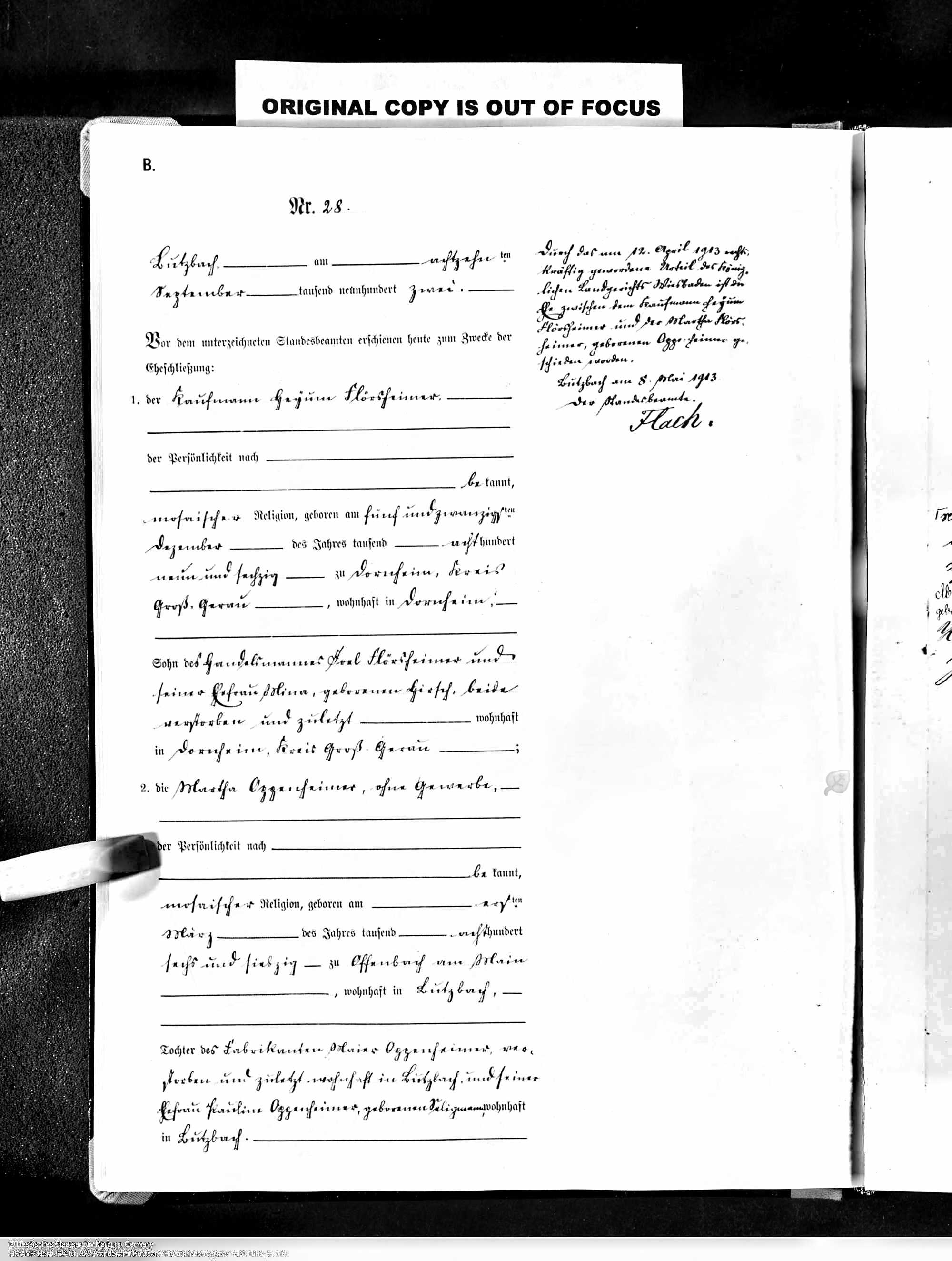
Martha married Heinrich Florsheimer on September 18, 1902, in Butzbach, Germany. They had two children, Gertrud and Paul. Martha and Heinrich were divorced on April 12, 1913. Martha was sent to the concentration camp at Theriesenstadt on September 2, 1942, and was released from there on July 8, 1945. She returned to Wiesbaden, where she’d been living before the Holocaust, only to learn that both of her children had been murdered by the Nazis, Gertrud at Sobibor and Paul at Majdanek.

The earliest of the new documents that Wolfgang located at the archives in Wiesbaden about Martha was dated March 7, 1940, and appears to be a form Martha submitted to report her assets and expenses. She appears to have reported no assets, and under expenses she reported 78.50 Reich Marks a month (I’m not sure what the 65 refers to) for rent, heat, gas, electricity, and water.

On page 2 of this document, Martha wrote the following note:

Ich werde unterstützt von meiner bis jetzt beschäftigte Tochter und meinem beschäftigt gewesenen Sohn.

Matthias Steinke of the German Genealogy group kindly translated this for me as, “I am supported by my still working daughter and my formerly employed son.”


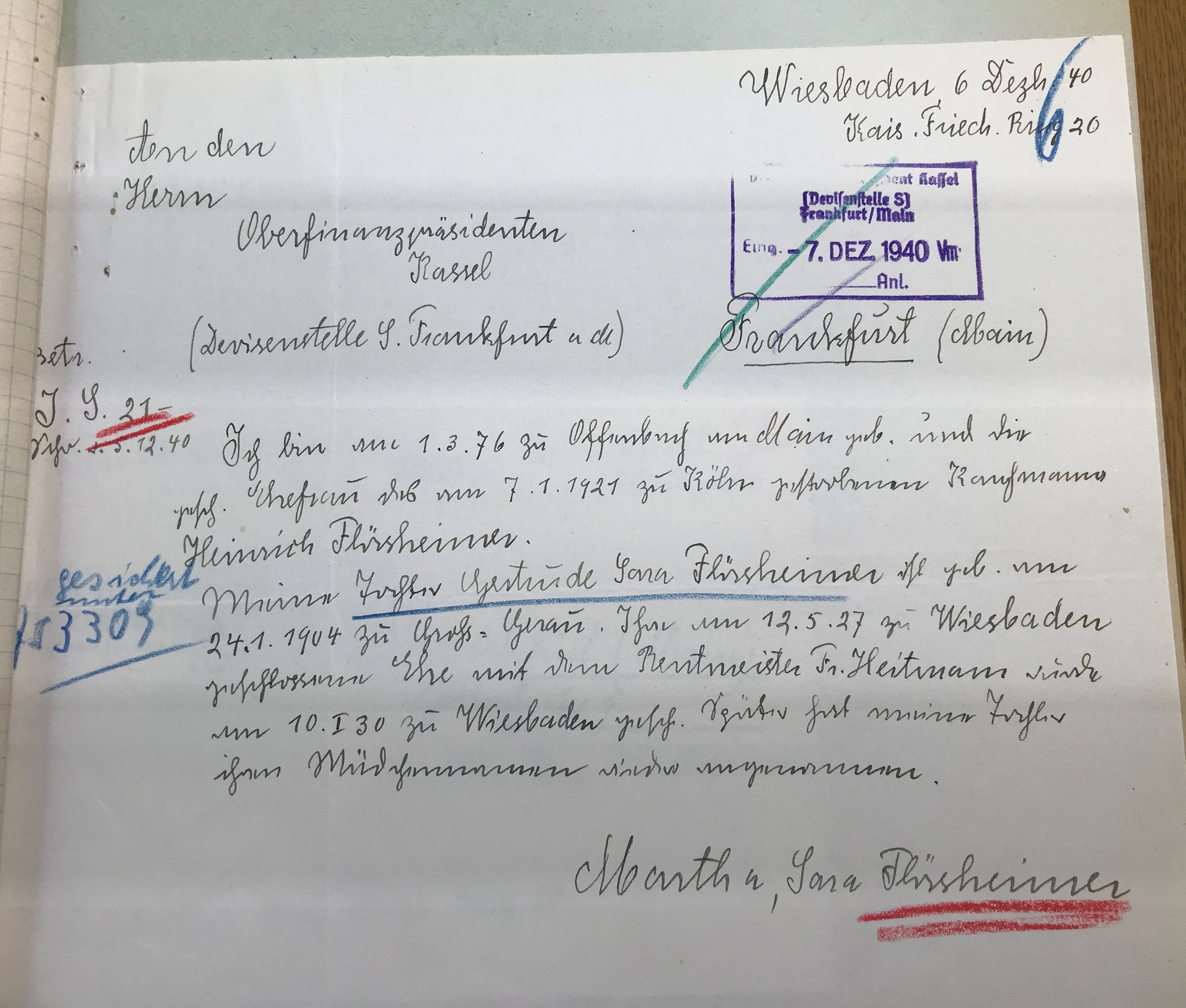
On December 6, 1940, Martha wrote this note in Wiesbaden:

Thank you to the members of the German Genealogy group who worked to decipher this difficult handwriting. This was the translation done by Matthias Steinke:

Wiesbaden, 6th December 40

Kaiser Friedrich Ring 20

I am at the 1st march 1876 in Offenbach/Main born and the wife of the at the 7th January 1921 in Cologne deceased merchant Heinrich Flörsheimer.

My daughter Gertrude Sara Flörsheimer was born at the 24th january 1904 in Gross Gerau. Her at the 12th May 1927 in Wiesbaden happened matrimony with the administrator Fr. Heitmann was at the 10th January 1930 in Wiesbaden divorced. My daughter took her maiden-name back later.

Martha Sara Flörsheimer

I am not sure who this note was written to or for what purpose, except perhaps to register their names and marital status with the officials in Wiesbaden. Or perhaps it was a follow-up to the earlier document seen above.

This typewritten letter is dated March 23, 1943, three years later:

We hereby indicate that the aforementioned Jewish woman has been restricted due to your security order from 9 14 40 to 25 8 42, because she expected the receipt of a larger payment, coming from furniture sales. On 4 9 42, the only entry received the amount of RM 594. Due to the disposition of the Governmental Practitioner Wiesbaden from 27 8 42 I 9-337 / 42, the fortune of this Jewish woman has been confiscated in favor of the Reich. We have therefore transferred the above amount to Finanzkasse Wiesbaden under file number O. 5205/494. Heil Hitler.

I am not sure what all of this means, but I got the gist of this—that all of Martha’s assets had been confiscated by the Nazis.

Aaron Knappstein located Martha’s death record:

One thing of note on these forms is that Martha is identified as a widow, not as a divorcee, even though her marriage record records the divorce:

Martha Oppenheimer marriage and divorce record, Hessisches Hauptstaatsarchiv; Wiesbaden, Deutschland; Bestand: 924; Laufende Nummer: 323
Source Information
Ancestry.com. Hesse, Germany, Marriages, 1849-1930

And interestingly she did not hide her daughter’s status as a divorcee, as seen above. So why hide hers?

Finally, Aaron also sent me a photograph of Heinrich Florsheimer’s headstone, which confirms the date of death reported by his ex-wife Martha in 1940:

These extra documents fill in some of the gaps in Martha’s life. The documents from the Nazi era are particularly poignant. Martha lost so much. Of course, losing her children was the most horrific loss, but she also lost all her property to the Nazis.


Berthold Goldschmidt Revisited: His Second Family

A year and a half ago I wrote about the tragic life of my cousin Berthold Goldschmidt, who outlived not only his wife Mathilde Freudenstein but six of their seven children. Their only surviving child, their son Siegfried Goldschmidt, was murdered in the Holocaust. I believed that Berthold had only one grandchild, Siegfried’s son Max, who had no children. Thus, I believed that Berthold Goldschmidt had no living descendants.

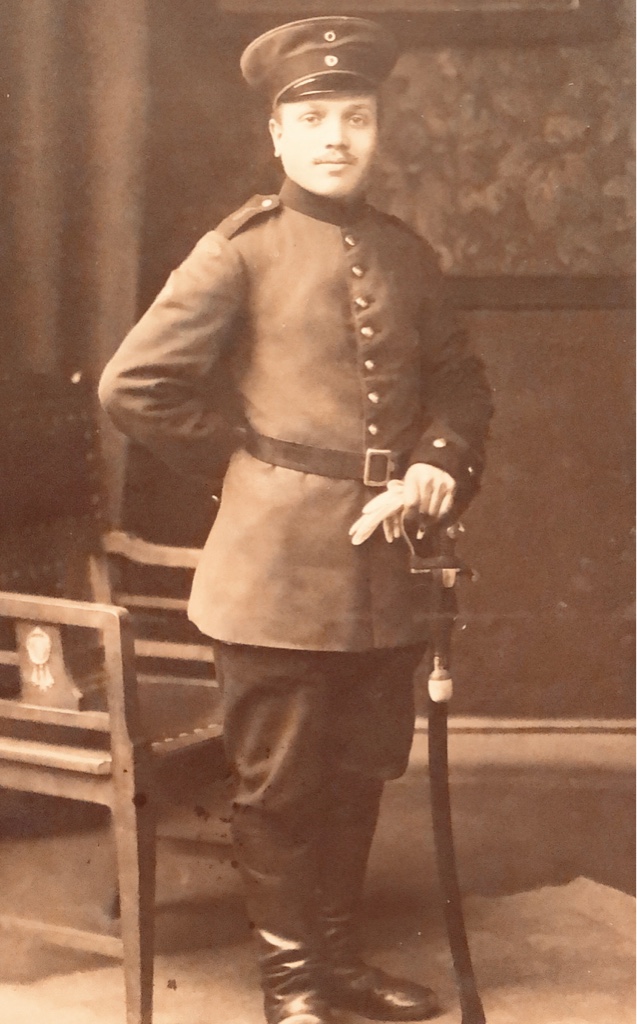
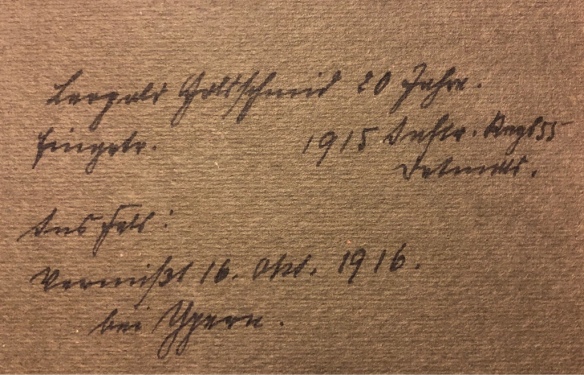
I’ve received two updates about Berthold’s family since then. In February, my friend in Germany, Julia Drinnenberg, sent me these photographs of two of Berthold and Mathilde’s sons taken during their service in World War I, Leopold, who was killed in the war, and the above-mentioned Siegfried.

Siegfried Goldschmidt

Leopold Goldschmidt

Then back in April, I received an email from David Baron, asking if I wanted to Zoom with a cousin named Rickey Slezak. I had no idea who Rickey was or how she was related to me, but soon discovered that she is a descendant of none other than Berthold Goldschmidt.

How does he have any descendants, you might wonder?

Well, in telling Berthold’s story I totally overlooked the fact that he had remarried after Mathilde’s death and had in fact had six more children with his second wife, Rika Giesberg, Rickey’s namesake. You can imagine how embarrassing this is!

Not that this takes away from the tragedies suffered by Berthold; that is still unimaginable. But Berthold’s story is somewhat softened by the fact that he went on to have a second family. And I was delighted not only to learn about this, but to make the connection to Rickey, my third cousin, once removed. Rickey shared with me an amazing album of old photographs of Berthold’s second family. This post is devoted to their story.

After losing his first wife Mathilde in 1911, Berthold Goldschmidt was left with four surviving children from that marriage: Paul, Leopold, Siegfried, and Hedwig. They were all still teenagers at that time.

On August 25, 1912, Berthold married Rika (sometimes spelled Richa or referred to as Rickchen) Giesberg, daughter of Jonas Giesberg and Henriette Loewenstein, in Trendelburg, Germany. Rika was born in Trendelburg on May 29, 1882, and was little more than ten to fifteen years older than her four stepchildren.

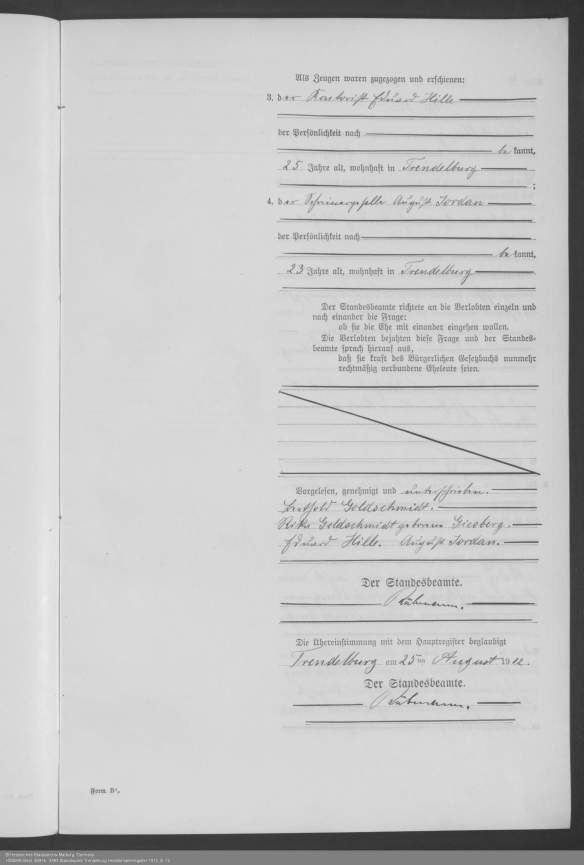
TitelStandesamt Trendelburg Heiratsnebenregister 1912 (HStAMR Best. 909 Nr. 9383)AutorHessisches Staatsarchiv MarburgErscheinungsortTrendelburg

Here are photographs of Berthold and Rika, courtesy of their granddaughter and my cousin, Rickey.

Berthold Goldschmidt, courtesy of the family

Rika Giesberg Goldschmidt, courtesy of the family

Rika and Berthold’s first child together, Walter Goldschmidt, was born in Oberlistingen, Germany, on April 24, 1913.1 A second son Herbert was born on December 20, 1914.2

Three of Berthold’s children from his first marriage died between 1915 and 1916, as discussed here. By 1917, Siegfried was then the only surviving child of the children Berthold had with Mathilde Freudenstein.

After those losses, Berthold and Rika had their first daughter, Hedwig, born June 1, 1918. She presumably was named for Berthold’s deceased daughter Hedwig from his first marriage.3

Here is a photograph of their family in about 1920 before their three youngest children were born:
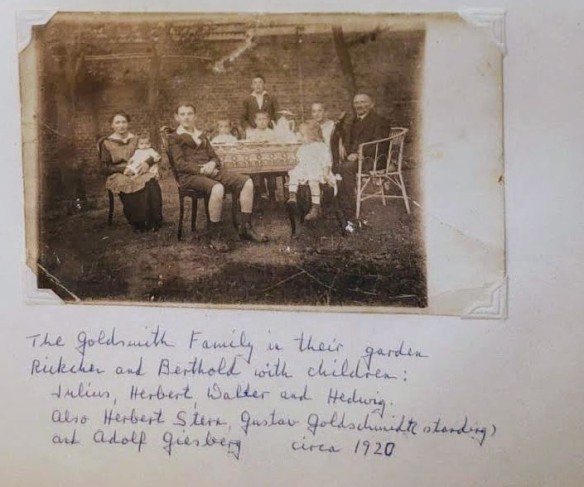
Berthold and Rika (Rickchen) Goldschmidt and family, c. 1920. Courtesy of the family

Their third son Jacob Julius Goldschmidt (known as Julius) was born on March 17, 1921.4 Albert Goldschmidt was born on September 9, 1924.5 Finally, their sixth and final child Elfriede was born August 17, 1926.6

This is a photograph of their home in Oberlistingen:

Berthold Goldschmidt family home in Oberlistingen. Courtesy of the family

Berthold Goldschmidt died on November 8, 1927. He was survived by his son Siegfried from his first marriage and the six children he had with Rika. Those six children lost their father before they reached adulthood. Their oldest child Walter was just fourteen, and their youngest child Elfriede just a year old. Rika was herself only 45 and left to care for the six children including four who were under ten years old.

Berthold Goldschmidt death record, Personenstandsregister Sterberegister; Signatur: 8196
Ancestry.com. Hesse, Germany, Deaths, 1851-1958 [

Rika was not destined to live a long life. She died at the age of 52 in Merxhausen, Germany, on March 1, 1935.7 I wondered why she died in Merxhausen, which is about 35 kilometers from Oberlistingen, and learned that there was a hospital there.

By that time Walter was almost 22, Herbert going on 21, Hedwig was almost seventeen, Julius almost fourteen, and the two youngest were still quite young; Albert was ten, and Elfriede only nine. I wonder who took care of these children, especially the three youngest, after they were orphaned.

Here are some photographs of some of the siblings taken in Germany before their lives changed forever:

Walter Goldschmidt
Courtesy of the family

Hedwig Goldschmidt Courtesy of the family

Julius Goldschmidt
Courtesy of the family

By the time of Rika’s death, the Nazis had taken power in Germany, and the Nuremberg Laws were adopted six months after her death.  It’s thus not surprising that by 1937 her two oldest sons decided to leave for the United States. Herbert left first, arriving in New York on July 30, 1937. According to the ship manifest, he left behind his brother Walter in Oberlistingen and was  going to a cousin, Leighton Steele, in Detroit, Michigan.  Leighton Steele was the son of Hedwig Goldschmidt Steele, a younger sister of Berthold Goldschmidt. Thus, Leighton, who was American-born, was Herbert’s first cousin, but they probably had never met.8

Walter Goldschmidt arrived just a few months after his brother Herbert; he arrived in New York on October 1, 1937. According to the ship manifest, he was heading to New York to a “cousin” named Joseph Guhl and was leaving behind an “uncle,” Salomon Strauss in Frankfurt. Salomon Strauss was married to Jenny Giesberg, Rika Giesberg Goldschmidt’s sister. Joseph Guhl was married to Meta Giesberg, the daughter of Leopold Giesberg, Rika’s brother.9

This photograph is labeled “Leaving for America” and shows Walter in Hamburg:

Courtesy of the family

The next sibling to arrive in the US was the youngest, Elfriede. She was only twelve years old when she arrived on March 24, 1939, and was sailing with her aunt Jenny Giesberg Strauss, her husband Salomon Strauss, and their son Walter. The ship manifest indicates that they all had been living in Frankfurt, so perhaps Elfriede had been taken in by her aunt after Rika died in 1935. They were leaving behind Salomon’s brother Julius and going to his cousin, Max Schoenmann, who lived at 1770 Andrews Avenue in the Bronx. I mention that only because my husband grew up down the block from there at 1940 Andrews Avenue. Small world.10

I don’t know whether or not Herbert ever went to Detroit to see Leighton Steele, but in 1940 both he and Walter were working as waiters for a restaurant in North Castle, New York, where they were both also living, according to the 1940 census.11  My cousin Rickey told me that the restaurant where they worked was a spot that became extremely popular as a music venue during the Big Band era, called Log Cabin Farms. You can see it mentioned on Herbert’s World War II draft registration.

Walter Goldschmidt, World War II draft registration, Ancestry.com. U.S. WWII Draft Cards Young Men, 1940-1947

Herbert Goldschmidt, World War II draft registration, Ancestry.com. U.S. WWII Draft Cards Young Men, 1940-1947

The North Castle Historical Society published an article about the Log Cabin Farms and all the performers who came there; you can find it here. As you can see from this postcard, the restaurant had a seating capacity of 1500!

Meanwhile, their sister Elfriede was living in the Bronx with their aunt Jenny Giesberg Strauss and her family in 1940.12 Rickey told me that her father revered his aunt Jenny, at least in part because of the care she gave to his little sister.

Herbert enlisted in the US military on January 22, 1941, almost a year before Pearl Harbor.13 I don’t know anything specific about his military service, but here is a photograph of him in uniform.

Herbert Goldschmidt/Goldsmith
Courtesy of the family

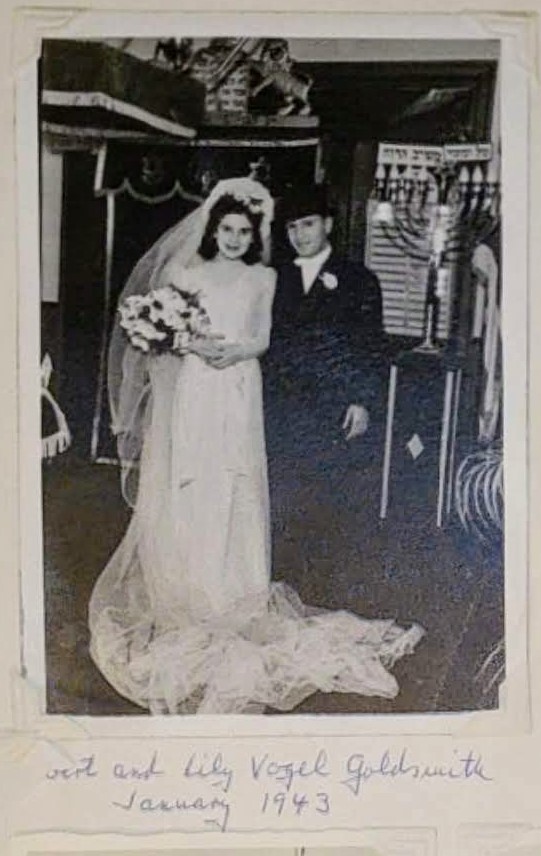
He applied for a marriage license to marry Lilly Vogel on January 19, 1943, in New York City.14

courtesy of the family

They did not have any children. According to my cousin Rickey, her uncle Herbert died in 1963.

His brother Walter enlisted on January 29, 1943, just ten days after Herbert and Lilly’s wedding.15 According to records his daughter Rickey has, Walter served three years including a year overseas. He was decorated several times, receiving the following medals: American Service Medal; Good Conduct Medal; European African Middle Eastern Service Medal; and a World War II Victory Medal.

On February 12, 1944, Walter married Hilda Weis,16 who was born on October 8, 1922, to Siegfried Weis and Else Scheuer in Gelnhausen, Germany.17 They had one child, my cousin Rickey, the source of all these wonderful photographs. Walter died on October 4, 1991; his widow Hilda died in 2001.18 They are survived by their daughter Rickey as well as several grandchildren and great-grandchildren.

Hilda Weis and Walter Goldschmidt/Goldsmith
Courtesy of their daughter Rickey

Elfriede married Alvin Kruger Colin with whom she had two children. This is a picture of them taken in March 1948. Given the way they are dressed, I assume this was their wedding day.19

Elfriede Goldschmidt and Al March 1948
Courtesy of the family

Elfriede died on January 6, 2011; she was survived by her children and grandchildren.20

Here is a photograph of the three siblings who made it to the US. I’d guess it was taken sometime after the war.

Courtesy of the family

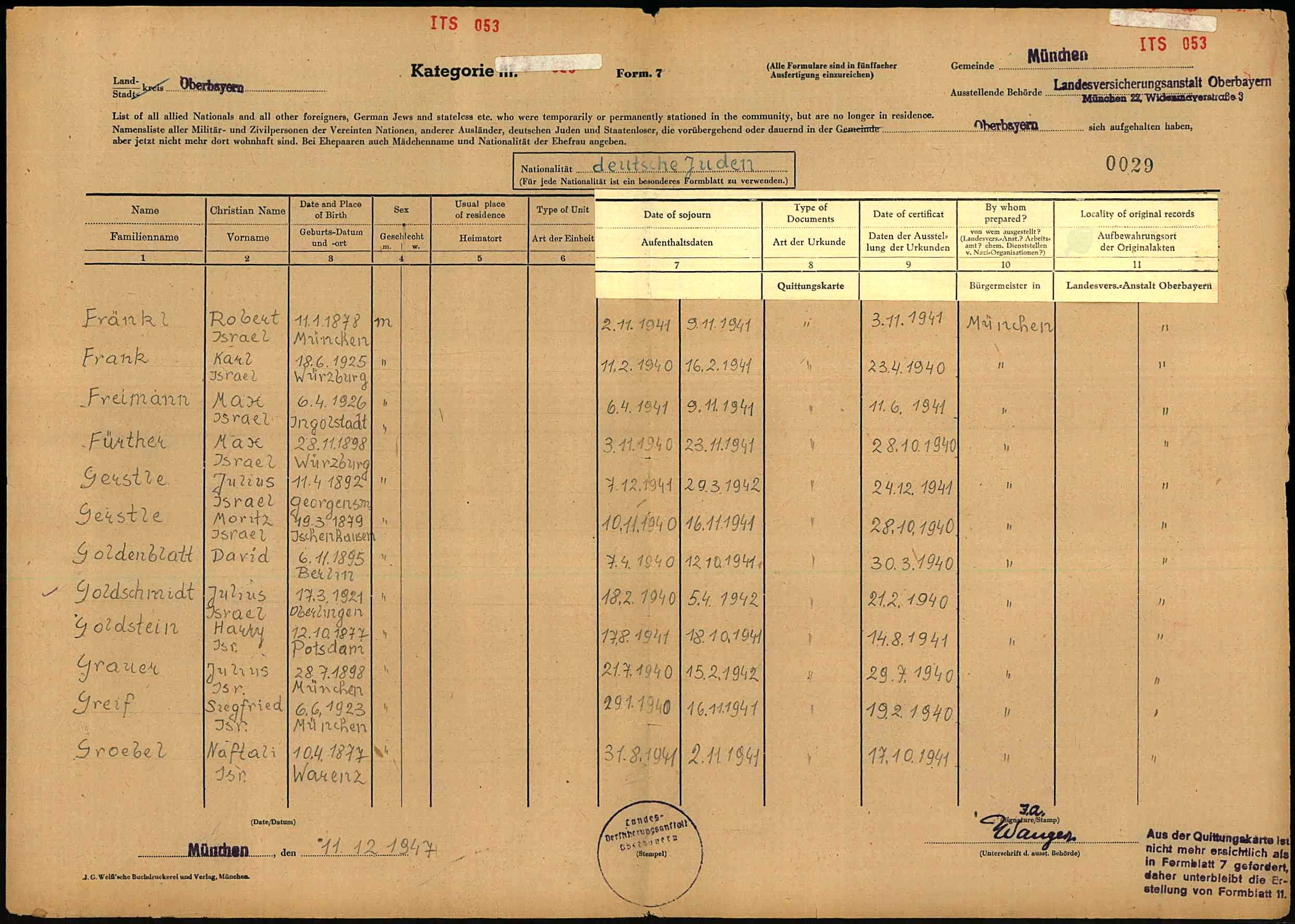
Unfortunately, two of the other children of Berthold and Rika did not leave Germany and were killed in the Holocaust. According to the Memorial Book for Victims of the Persecution of Jews under the National Socialist Tyranny in Germany 1933 – 1945, Jacob Julius Goldschmidt was sent to Dachau concentration camp on November 10, 1938, after Kristallnacht and was released from Dachau on December 8, 1938. He still, however, did not leave Germany. According to this document, he was living in Munich from February 18, 1940, until April 5, 1942.

UPDATE: Thank you to barb276 for finding more information about Jacob Julius Goldschmidt here. According to this page from the Munich archives, Jacob Julius had moved from Kassel to Munich by January 1, 1936, and was living there until October 26, 1940, when he went to a Hachsharah, a Zionist training camp in Steinhofel, where Jews were trained for life in Palestine/Israel. Unfortunately, Jacob Julius never got there.

Arolsen Archives, Digital Archive; Bad Arolsen, Germany; Lists of Persecutees 2.1.1.1
Reference Code: 02010101 oS, Ancestry.com. Europe, Registration of Foreigners and German Persecutees, 1939-1947

He was then deported to Poland and murdered at some unnamed location.

Hedwig Goldschmidt was also murdered by the Nazis. She had married Horst Starsky, who was born on July 10, 1909, in Wingeruppen, Germany. According to the Memorial Book for Victims of the Persecution of Jews under the National Socialist Tyranny in Germany 1933 – 1945, they were living in Berlin, and both were first imprisoned in a Jewish forestry labor camp in Kersdorf-Briesen. They were then deported to Auschwitz on April 19, 1943, where they were killed. As far as I’ve been able to determine, they did not have any children.

The fate of Albert Goldschmidt, Berthold and Rika’s youngest son, is less clear. My cousin Rickey believes that he ended up immigrating to Buenos Aires, Argentina, but I have no documentation showing that. Rickey also believed he married and had a child there, but again, we have no documentation. What we do have is this photograph of Albert apparently taken in front of a restaurant that has a Spanish name, I think—Coveteria Vievo Viena? Google Translate could not make sense of coveteria but translated Vievo Viena as I come Vienna. Possibly a restaurant serving Viennese (or German-style) food?

UPDATE: Thank you to my cousin Susana, who also came from Buenos Aires, for helping me to translate what this says. She said that it says “Confitería Viejo Viena” (Old Vienna tearoom) and would have been a patisserie or tearoom that likely specialized in German/Austrian pastries and cakes.

Courtesy of the family

Thus, Berthold Goldschmidt’s family with his second wife Rika endured a great deal of tragedy just as his family with his first wife Mathilde Freudenstein had. But the record must stand corrected. Berthold Goldschmidt does indeed have living descendants—his grandchildren, his great-grandchildren, and even some great-great-grandchildren.  And one of them is my wonderful cousin Rickey who helped me tell and illustrate their family’s story.



  1. Walter Goldschmidt, Birth Date: 24 Apr 1913, Birth Place: Oberlistingen, Germany,
    Ancestry.com. U.S. WWII Draft Cards Young Men, 1940-1947 
  2. Herbert Goldschmidt, Birth Date: 20 Dec 1914, Birth Place: Oberlistingen, Germany, Ancestry.com. U.S. WWII Draft Cards Young Men, 1940-1947 
  3.  Hedwig Goldschmidt, Birth Date: 1 Jun 1918, Birth Place: Oberlistingen, Reference Number: 02010101 oS, Document ID: 70442392, Arolsen Archives, Digital Archive; Bad Arolsen, Germany; Lists of Persecutees 2.1.1.1, Ancestry.com. Europe, Registration of Foreigners and German Persecutees, 1939-1947 
  4.  Julius Israel Goldschmidt, Birth Date: 17 Mrz 1921 (17 Mar 1921), Birth Place: Oberlingen, Reference Number: 02010101 oS, Document ID: 70126154, Arolsen Archives, Digital Archive; Bad Arolsen, Germany; Lists of Persecutees 2.1.1.1, Ancestry.com. Europe, Registration of Foreigners and German Persecutees, 1939-1947 
  5. I have no record of Albert’s birth date; this comes from the Goldschmidt family report done by Roger Cibella and David Baron. 
  6.  Elfriede Colin, Social Security Number: 112-16-3514, Birth Date: 17 Aug 1926
    Death Date: 6 Jan 2011, Social Security Administration; Washington D.C., USA; Social Security Death Index, Master File, Ancestry.com. U.S., Social Security Death Index, 1935-2014 
  7.  Richa Goldschmidt, Maiden Name: Giesberg, Gender: weiblich (Female)
    Age: 52, Birth Date: 29 Mai 1882 (29 May 1882), Death Date: 1 Mrz 1935 (1 Mar 1935)
    Death Place: Merxhausen, Hessen (Hesse), Deutschland (Germany), Civil Registration Office: Merxhausen, Certificate Number: 16, Personenstandsregister Sterberegister; Signatur: 6991, Ancestry.com. Hesse, Germany, Deaths, 1851-1958 
  8. Herbert Goldschmidt, ship manifest, Year: 1937; Arrival: New York, New York, USA; Microfilm Serial: T715, 1897-1957; Line: 25; Page Number: 38, Ancestry.com. New York, Passenger and Crew Lists (including Castle Garden and Ellis Island), 1820-1957 
  9. Walter Goldschmidt, ship manifest, Year: 1937; Arrival: New York, New York, USA; Microfilm Serial: T715, 1897-1957; Line: 8; Page Number: 36, Ancestry.com. New York, Passenger and Crew Lists (including Castle Garden and Ellis Island), 1820-1957. Salomon Strauss and Jenny Giesbech [sic], Arolsen Archives, Digital Archive; Bad Arolsen, Germany; Lists of Persecutees 2.1.1.1, Reference Code: 02010101 oS, Ancestry.com. Europe, Registration of Foreigners and German Persecutees, 1939-1947. Meta Giesberg, Marriage Date: 30 Apr 1936, Marriage Place: Manhattan, New York, USA, Spouse: Joseph A Guhl, Certificate Number: 11992, Ancestry.com. New York, New York, Extracted Marriage Index, 1866-1937 
  10. Elfriede Goldschmidt, ship manifest, Year: 1939; Arrival: New York, New York, USA; Microfilm Serial: T715, 1897-1957; Line: 6; Page Number: 8, Ancestry.com. New York, Passenger and Crew Lists (including Castle Garden and Ellis Island), 1820-1957 
  11. Walter Goldschmidt and Herbert Goldschmidt, 1940 US census, Year: 1940; Census Place: North Castle, Westchester, New York; Roll: m-t0627-02811; Page: 3B and Page 24A, Enumeration District: 60-250, Ancestry.com. 1940 United States Federal Census 
  12. Elfriede Goldschmidt, 1940 US census, Census Place: New York, Bronx, New York; Roll: m-t0627-02497; Page: 10B; Enumeration District: 3-1449, Ancestry.com. 1940 United States Federal Census 
  13. Ancestry.com. U.S., World War II Army Enlistment Records, 1938-1946 
  14.  Herbert Goldschmidt, Gender: Male, Marriage License Date: 19 Jan 1943
    Marriage License Place: Manhattan, New York City, New York, USA, Spouse: Lilly Vogel
    License Number: 1202, New York City Municipal Archives; New York, New York; Borough: Manhattan; Volume Number: 1, Ancestry.com. New York, New York, Marriage License Indexes, 1907-2018 
  15. Ancestry.com. U.S., Department of Veterans Affairs BIRLS Death File, 1850-2010 
  16.  Hilda Weis, Gender: Female, Marriage License Date: 10 Feb 1944
    Marriage License Place: Manhattan, New York City, New York, USA. Spouse: Walter Goldschmidt, License Number: 3826, New York City Municipal Archives; New York, New York; Borough: Manhattan; Volume Number: 6, Ancestry.com. New York, New York, Marriage License Indexes, 1907-2018 
  17. Hilda Goldsmith, [Hildegard Weis], [Hilda Goldschmidt] , Gender: Female,
    Birth Date: 8 Oct 1922, Birth Place: Gelnhausen, Federal Republic of Germany
    Death Date: 18 Sep 2001, Father: Siegfried Weis, Mother: Else Scheuer
    SSN: 085180692, Ancestry.com. U.S., Social Security Applications and Claims Index, 1936-2007 
  18. Name: Walter Goldsmith, Gender: Male, Birth Date: 24 Apr 1913, Death Date: 4 Oct 1991, Claim Date: 6 Mar 1975, SSN: 077165081, Ancestry.com. U.S., Social Security Applications and Claims Index, 1936-2007. For Hilda, see Note 17. 
  19.  Elfriede Goldsmith, Marriage License Date: 27 Feb 1948, Marriage License Place: Bronx, New York City, New York, USA, License Number: 1705, New York City Municipal Archives; New York, New York; Borough: Bronx, Ancestry.com. New York, New York, Marriage License Indexes, 1907-2018 
  20. Elfriede Colin, Social Security Number: 112-16-3514, Birth Date: 17 Aug 1926
    Issue Year: Before 1951, Issue State: New York, Last Residence: 33308, Fort Lauderdale, Broward, Florida, USA, Death Date: 6 Jan 2011, Social Security Administration; Washington D.C., USA; Social Security Death Index, Master File, Ancestry.com. U.S., Social Security Death Index, 1935-2014 

Martha Loewenthal Wolff’s Family: An Update from Israel

One of the more elusive Goldschmidt family members to research has been Martha Loewenthal Wolff and her family. Martha was the daughter of Kiele Stern and Abraham Loewenthal, the granddaughter of Sarah Goldschmidt and Salomon Stern, and my third cousin, twice removed. Thanks to my friend Aaron Knappstein, I now have more information and documents and even photographs of Martha and her family.

Martha was married to Jakob Wolff, as discussed here, and they had three children: Anna, Hans Anton, and Walter. I was missing birth records for all three children, and Aaron was able to locate all of them.

Birth record of Anna Wolff

Birth record of Hans Anton Abraham Wolff

Birth record of Walter Wolff

Martha died in 1930, and I could not find a death record for her until Aaron located it, as I wrote about here.

After Martha’s death and the Nazi takeover of Germany, Jakob Wolff and all three of their children immigrated to Israel, as I wrote about here.

But I did not know what happened to Jakob or his children after their immigration. And then Aaron came through for me again and located Hans Anton Wolff’s son Benjamin in Israel and connected me to him and his daughter Ravid. Now I have firsthand information about Martha’s family as well as photographs, thanks to Ravid Wolff, my fifth cousin, once removed.

First, some photographs of the family taken before they left Germany.

Jacob and Martha Wolff and their first car Courtesy of the Wolff family

Anna Wolff and her mother Martha Loewenthal Wolff Courtesy of the Wolff family

Anna Wolff as a child Courtesy of the Wolff family

Hans Anton and Walter Wolff Courtesy of the Wolff family

Ravid shared with me that her great-grandmother Martha was a very talented artist and sent me this image of a painting that Martha did while traveling with Jakob in what was then Palestine in the 1920s.

Painting by Martha Loewenthal Wolff

According to Ravid, her great-grandparents Martha and Jakob Wolff owned two banks in Frankfurt, Germany, and were quite wealthy. After Martha died from ovarian cancer in 1930, Jakob married Ilse Gruenebaum. When Hitler came to power, Jakob recognized how dangerous he was and, as a Zionist, decided to leave Germany for Israel (then Palestine) before it was too late. He was able to obtain visas to immigrate for a thousand pounds each, an exorbitant amount of money at that time, but had to leave all his other property and possessions behind. All of it including their home in Frankfurt was confiscated by the Nazis and never returned to the family.

Ravid shared two letters with me that show that the requests for restitution of their property in Frankfurt were denied:

Google Translate helped me translate these letters. The one above translates as:

Upon your request of 17 December 1956, we will inform you: The property Leerbachstrasse 36 was registered until 17 September 1937 on:
Banker Jakob Wolff on the ideal half
Instead of his wife Martha Wolff [names of children] for ideal half in undivided community of heirs. [I am not sure what “ideal half” means.]
In the way of the forced auction, this plot of land on 17 9 1937 is given to Frau Therese Ried geb Stromer, [address]. It is still owned by them.
The owner of the Paulsplatz 14 property was the merchant Carl Seitz in Baden near Vienna in 18 1 1923 and the owner of the Paulsplatz 16 property was the Jakob Wolff & Co., Open Trade Company since 18 March 1922.
The current owner of both properties has been the municipal district of Frankfurt since August 10, 1934 bze, October 15, 1935. A piece of land at Paulsplatz 18 does not exist.

The second letter translated as:

The aforementioned property became the property of the City of Frankfurt on the basis of an additional resolution dated 2 4 1935. The compulsory auction had already started in 1932. The JRSO, which had previously asserted claims for reimbursement for the aforementioned property, accepted its application on Feb. 1, 1951. For your further information, we would like to inform you that the city has always contested a claim for reimbursement.
We hope to have served you with the above statements.

As for Martha and Jakob’s three children, Anna, the oldest, was married to Simon Wittekind when she immigrated, and they had two sons, Aharon and Baruch (as they were known in Israel) who were born in Berlin. Simon was a doctor who wanted to move to South Africa, but Anna felt safer in Israel, so she stayed there with her children.

Anna later married Herbert Feige. According to Ravid, Anna hated Germany and suffered great trauma because of what had happened there and unlike her brother Hans Anton refused to reclaim her German citizenship when that right became available to her. Her sons changed their surname to Yardeni (for the Jordan River) to identify with their new homeland. Ravid did not know exactly when Anna died, only that like her mother Martha, she died young and from cancer.

Ravid’s grandfather was Hans Anton Wolff, the second child of Martha Loewenthal and Jakob Wolff.  He married Susana Meseritz, another refugee from Germany, whom he met in Palestine. They had one child, Ravid’s father Benjamin. Hans had a doctorate in chemistry. He died from colon cancer in 1974, and his wife Susana died in 2002.

Walter, the youngest of the siblings, also married in Palestine/Israel. He owned a hotel in Jerusalem for many years. He and his wife Hedy Buller had two children. Walter died in 1968 in Jerusalem, also from cancer.

I am so indebted to Aaron Knappstein for finding the missing records of the Wolff children and even more so for connecting me to my cousin Ravid. And I am very, very grateful to Ravid for sharing her family’s story with me. Ravid, like her great-grandmother Martha and so many others in the extended Goldschmidt family, has a great interest in and great talents in art. Her photography captures in simple and yet complex ways the beauty of the world around us by using unusual perspectives and contrasting light and colors.

The Families of Kiele Stern Loewenthal and Abraham Stern: An Update

My last post provided new information about the descendants of Kiele Stern Loewenthal’s daughter Selma Loewenthal Schwabacher. Today I will look at updates for the family of Kiele Stern Loewenthal’s daughter Helene Loewenthal Schultze and specifically updates for her only child, Elisabeth Auguste Aloysia Schultze, daughter of Helene’s second husband Oskar Schultze. I had several gaps in the story of Elisabeth.

First, I did not have Elisabeth’s birth record, and Aaron Knappstein located it for me:

Elisabeth was born on December 3, 1914, in Coblenz, Germany. Perhaps the most interesting thing I learned from this record was that Helene, her mother, was identifying as “ohne,” or without, religion. As I wrote about here, Elisabeth’s mother Helene was born Jewish, but her father Oskar Schultze was Protestant. But both Helene and Elisabeth were included on the 1939 Minority census in Germany.

The notes at the bottom of the record indicate that Elisabeth was married in February 24,1955, in Hamburg and that she died on November 23, 1991 in Bad Krozingen.

That helped Aaron locate Elisabeth’s marriage record and death record. Here is the marriage record.

This document shows that Elisabeth married Ulrich Carl Albert Wilke on February 24, 1955, in Hamburg, Germany. Ulrich was born on August 16, 1906, in Hamburg; his parents were Emil Ludwig Gustav Wilke and Catherine Wilhelmine Frieda Auguste Schreiber. The marriage record states that Ulrich was a bank clerk and that Elisabeth was a merchant. She was 41 when they married, and he was 49. The marriage record indicates that neither had children, and as far as I know, Elisabeth and Ulrich also did not have children. Both Elisabeth and Ulrich reported that they were Lutheran.

In the upper left-hand margin of the marriage record is a note indicating that Elisabeth left the church in 1969. Aaron explained to me that this could have been done to avoid the religion tax or it could have indicated that she was not religious and did not want to pay a tax to support the church.

The second note in the left-hand margin reports that Ulrich died on December 5, 1984.

The third document that Aaron located about Elisabeth Schultze Wilke is a transcription of her death record.

From this document I know that she died in Bad Krozingen on November 23, 1991 and that she identified as “evanglische” (Protestant), so perhaps she had returned to the church between her marriage and her death. Elisabeth was 77 when she died.

Thanks to Aaron Knappstein, I now have a much more complete story of Elisabeth’s life; what’s still missing is the story of where she was and how she managed during the 1940s, and that may remain a mystery as she had no children to carry on her story.

I also have updates that relate to the descendants of Kiele Stern’s brother Abraham Stern and his children. These updates came from Abraham’s great-grandson Rafi Stern, who has previously shared photographs and information about his relatives. This time he sent two documents in German.

The first is a letter written by his uncle Erich Stern to Erich’s brother and Rafi’s father Guenther Stern. Erich and Guenther were the sons of Siegfried Salmon Stern, son of Abraham Stern and Johanna Goldschmidt. I discussed this letter in the earlier post, but now have a scan of the original letter in German. It is the letter Eric wrote describing in the first paragraph what had happened to the family on Kristallnacht. As you can see, it is dated November 13, 1938, just a few days after that nightmarish event throughout Germany.

The remaining two paragraphs are rather vague but appear to concern the family’s property and business and how to protect it from the Nazis.

Thank you for your various letters.
Unfortunately we have very bad news from Frankfurt. Uncle Siegfried, who wanted to go to Palestine with your family on Sunday, was arrested on Friday, as well as Aunt Sittah, Maguerite and Helmuth. Aba had fled and no one knew where. Really horrible conditions. Bickhardts still seem to be undisturbed.

Under these circumstances, I personally think it is more correct if you do not entrust Mr. Goldschmidt with the handling of the matter, since he cannot do the thing in the future. An Aryan lawyer, as I hear, is also not allowed to accept new Jewish customers, but if you turned to Peters, that [problem]would also disappear.  [I assume this means that because the family had previously used Peters, the prohibition against new clients would not apply.] Please write to him immediately. The matter can surely also be processed via the foreign exchange office in Cologne, since we are responsible here. Please let me know about it immediately. I will not enclose the list of assets with you, because maybe it will not be required in Cologne. I am also very reluctant to submit a list of 35 & 38, because I do not know about Eburonenstrasse and have given only very vague information about the general property registration.

As far as the matter of the foreign  papers, Father gave the matter to one of his lawyers (I don’t know his name), who is said to have first-class relationships. I haven’t heard anything yet. Father took it on the condition that if the lawyer got all or part of the papers in my name, we would share them.

Did you hear about the transfer of the proceeds from the sale of Kaiserstrasse to our accounts?
Greeting and kiss. Yours, Erich

Rafi also sent me a memoir written by his great-aunt, Siegfried’s sister Alice Lea Stern Oppenheimer.  It’s 58 pages long and in German, and since my German group is not meeting this summer, I am going to try to read it myself to keep up with my German. I will report back once I’ve accomplished that task.

Thank you again to Aaron Knappstein and to Rafi Stern for helping to tell the stories of these descendants of Sarah Goldschmidt and Salomon Stern.


A Photo Essay of the Family of Selma Loewenthal Schwabacher

Another cousin who found my blog during these pandemic days is my fifth cousin, once removed, Carrie Schwabacher. She is the granddaughter of Gerhard Schwabacher, the great-granddaughter of Selma Loewenthal Schwabacher, great-great-granddaughter of Kiele Stern Loewenthal, three times great granddaughter of Sarah Goldschmidt Stern, and four-times great-granddaughter of Meyer Goldschmidt.

Carrie kindly shared with me these wonderful photographs as well as some heartwarming stories about her family. They start with her great-great-grandmother, Kiele (Caroline) Stern Loewenthal, the daughter of Sarah Goldschmidt and Salomon Stern, wife of Abraham Loewenthal. I wrote about Kiele here and here.

Kiele Stern Loewenthal.
Courtesy of her family

Here is a lovely photograph of Kiele and Abraham Loewenthal’s daughter, Selma, as a young woman; I see a strong resemblance to her mother.

Selma Loewenthal
Courtesy of her family

Selma married Nathan Schwabacher:

Nathan Schwabacher Courtesy of the Schwabacher family

And they had three children. Their daughter Alice was the oldest:

Alice Schwabacher Courtesy of the Schwabacher family

Alice was followed by Julius Alfred Schwabacher:

Julius Alfred Schwabacher Courtesy of the Schwabacher family

Gerhard Schwabacher, Carrie’s grandfather, was Selma and Nathan’s youngest child:

Gerhard Schwabacher
Courtesy of the family

The two sons look remarkably similar to each other and to their father Nathan.

Alice Schwabacher married David Weinstein (later Wenten) and had one child, Wolfgang, depicted here as a young boy with his dog:

Wolfgang Weinstein and dog

Julius Schwabacher married Margaret Wuertenberg and had one child, Eva Lore, the adorable little girl shown here:

Eva Lore Schwabacher
Courtesy of the family

This photograph of Selma Loewenthal Schwabacher and her brother Julius Loewenthal is undated, but must have been taken before 1936 when Julius left for the United States. Selma died in 1937 in Berlin.

Selma Loewenthal Schwabacher and brother Julius Loewenthal
Courtesy of the family

Here is a closer one of Selma, probably taken around the same time:

The remaining photographs that Carrie shared with me appear to have been taken after the family immigrated to the United States. Their full story has been told here, so I won’t tell it again, but will share these photographs of the Schwabacher family in their new country and some of Carrie’s memories of her extended family.

She has wonderful memories of her grandparents, as she shared with me: “I have such great memories of my grand parents even though they died when I was 7. Christmas was a very special time – like a scene from the Nutcracker. As children, we celebrated Hanukkah, Christmas and Epiphany ( my mom’s side of the family is Russian Orthodox). We got presents for months, or it seemed like it.” She also wrote that her Opa, Gerhard Schwabacher, always gave each of his grandchildren a quarter every time he saw them.

Other holidays were spent with her great-uncle Julius Schwabacher, who became Fred Wenten in the US, and his wife Else in Proctor, Vermont: Fred and Elsa owned an Inn in Proctor Vt. The entire family spent a few holidays there as well. The toasts would go on for so long that someone would finally say “let the children eat their fruit cocktails before they fall asleep”. And then, dinner would start.”

Here’s a photograph of Fred Wenten in the US:

Fred Wenten (born Julius Alfred Schwabacher)
Courtesy of the family

Fred’s daughter Eva Lore was also a favorite of Carrie. Eva Lore married Henry Corton in 1951. Carrie wrote this about them:

“Henry was a fabulous dancer and would sometimes break into buck and wing ( tap dancing) in the kitchen even when he was old. We visited then often when they lived in Jamaica, Queens. We always went out for walks. We met Bella Abzug at the Cloisters in NY. He was very fond of Pavorotti and considered him a “distant cousin“. It got him back stage at the Met many times. Eva and Henri took us to Ringling Bro’s. And Barnum & Bailey Circus and the Ice Capades when we were little. We visited Eva Lore in LaGuna Hills, helped her pack and move to Baltimore, and took her to her first McDonalds meal. The “Apple Strudel “ was her favorite. Apple Pie. Even at 79, she was booking her own travel on her computer. They never had children, but spoiled us.”

Here are some of the photographs of Eva Lore and Henry that Carrie shared with me:

Eva Lore Schwabacher and Henry Corton Courtesy of the family

Eva Lore Schwabacher Corton Courtesy of the family

Eva Lore Schwabacher Corton Courtesy of the family

Eva Lore and Henry Corton Courtesy of the family

Carrie also has warm memories of her great-aunt Alice Schwabacher Weinstein (Wenten in the US):

“We went to visit Tanta Alice for the holidays every year in Washington Heights, NY. I always wanted to take a nap, because I loved the big square Feather pillows on the bed. She always had such great treats for us, German delicacies. She was extremely socially active. Wolf would remark that he had to make an appointment just to visit his mother. We had her 90 th birthday party at window on the worlds – top of the World Trade Center. It was incredible to meet so many people originally named Schwabacher.”

This photograph shows Alice with her son Wolfgang and his wife Ruth.

Alice Schwabacher Wenten Kingsley, Wolfgang Wenten, Ruth Pollinger Wenten
Courtesy of the family

Finally, this is a photograph of the three Schwabacher siblings and their spouses taken in the US:

Arthur Kingsley, Alice Schwabacher Kingsley, Julius (Fred Wenten) Schwabacher, Else Wenten, Alice Ferron Schwabacher, Gerhard Schwabacher
Courtesy of the family

I am extremely grateful to my cousin Carrie for sharing her memories and these photographs. She really has brought to life this strong and loving family who escaped from Germany and started a wonderful new life in the United States.

Hermann Gutmann, Child Refugee from the Nazis: An Oral History

As we saw last time, my cousin Else Goldschmidt Gutmann, daughter of Marcel Goldschmidt and Hedwig Goldschmidt, was murdered by the Nazis in 1943 at the Sobibor concentration camp along with her husband Siegfried Gutmann. They were, however, survived by their son, Hermann Gutmann. His story is captured in a moving and detailed oral history interview that was recorded for the British Imperial War Museums in 1995 and available online here.

The oral history interview is two hours long, and I listened to it in the course of one afternoon. If anyone has the time and the interest to listen, even if just to the first thirty minutes, it will provide insights into the strength and courage of those who escaped Nazi Germany as children. My words cannot possibly capture the emotion and the personality expressed by this man in retelling his life story fifty to sixty years after these tumultuous events. When you listen, the clarity of his memory, his composure, and his strength come shining through. Despite living in England since 1936, he still had the traces of a German accent. I will try and do justice to his story, but again, if you have time, listen to at least some of this interview.

One other editorial explanation. Hermann Gutmann changed his name in 1943 to Dennis John Goodman. I will refer to him as Hermann in discussing the years before that change and then as Dennis for the years after the name change. I hope that’s not too confusing.

All the facts in this post come directly from the oral history interview with Dennis John Goodman at the Imperial War Museum, Catalogue 15101.


Hermann Gutmann’s father Siegfried Gutmann was from a family of bankers in Stuttgart, and after the Stuttgart bank was taken over by a larger bank, Siegfried moved to Frankfurt to work for a bank in that city where he met and married Else Goldschmidt. Their only child Hermann Gutmann was born in Frankfurt on February 28, 1923. Hermann believed that the economic circumstances experienced in Germany in the 1920s made his parents reluctant to have more than one child. He described his childhood as a happy middle-class childhood in Frankfurt where his family was actively involved in the Jewish community as well as the general community.

Frankfurt, Germany, 1918,Carl Andreas Abt / Public domain

Hermann experienced anti-Semitism as early as 1931 when he was eight years old and saw people carrying anti-Semitic political posters while marching in the streets of Frankfurt. But things grew much worse after 1933 when Hitler was elected Chancellor. Hermann described himself as an outspoken and opinionated boy who fought back when he was attacked by students for being Jewish. When he finished primary school, his parents could no longer send him to a general secondary school because Jews were banned. Instead they sent him to an excellent Jewish day school where he was one of several hundred students.

But by 1936, his parents were concerned that Hermann would not be able to receive a quality education, and they decided that the best thing to do for their son was to send him to boarding school in England. His father spoke to young Hermann, expressing his fears, given how Hitler had perverted Germany and how their non-Jewish friends had drifted away out of fear.  When asked by the oral history interviewer how he felt about leaving his parents and his home, Hermann responded that he “just had to face it.” His acceptance of this reality seemed remarkable to me, especially given that he was only thirteen at the time.

So on October 5, 1936, thirteen year old Hermann Gutmann traveled to England with a family friend who happened also to be heading to England.  When they arrived in London, a relative met him at the station and made sure he boarded the right train to Brighton, where his new school, a Jewish boarding school called Whittinghame College, was located. He described his first year there as very lonely. He knew just a little English when he arrived, and there were only one or two other German students at the school. More German refugees had arrived by the time he left in 1939.

Thank you to the alumni association of Whittinghame College for permission to use these two photographs.

Hermann is probably in this photograph, but I don’t know which young man he is.

Whitinghame College students, 1939

His parents left Germany for Amsterdam in 1937. The interviewer asked him why his parents hadn’t come to England instead of Amsterdam, and he explained that his father had been offered a job in Amsterdam and that his parents believed they would be safe there. He said that no one anticipated in 1937 that Hitler would later invade the Netherlands and deport Jews to concentration camps. Hermann was able to visit his parents in Amsterdam during this time, and he said that although it was a big adjustment for them and especially for his father, whose new job was not in the banking field, they were reasonably happy living there.

Although Hermann said that he did not enjoy the “monastic existence” of the all-boys boarding school, he stated that he received an excellent education and that he even qualified to matriculate at Cambridge University for the fall of 1939, but “events intervened,” that is, the start of World War II. Once the war started, Hermann also was no longer able to visit his parents.

He finished his time at Whittinghame and obtained a job in a leather manufacturing factory in Lancashire, England, where he worked from February, 1940 until May, 1940. He had been in England for more than three years at that point. He had coped with adjusting to a new country, learning a new language, completing his secondary education at a Jewish boarding school, and enduring the long separation from his parents. In the interview, he commented that he had experienced no hostility in England based on his German background and that people had been very friendly.

But his life was about to change in the spring of 1940.

Marcel Goldschmidt’s Children: The Two Who Did Not Survive

Although Marcel Goldschmidt’s widow (and cousin) Hedwig and two of their children escaped safely from Germany and survived the Holocaust, their other two children, Nelly and Else, met tragic fates.

Nelly and Else were the two middle children, and they married brothers. Nelly was married to Moritz Gutmann and Else to Siegfried Gutmann. Each had one child; Nelly’s son was Karl Hermann Gutmann, and Else’s son was Hermann Gutmann; both were named for their paternal grandfather, Hermann Gutmann. Up until the Nazi era, both families were living in Frankfurt. I have no information about Siegfried Gutmann’s occupation, but his brother Moritz was an art dealer like so many of his Goldschmidt in-laws.1

Nelly Goldschmidt Gutmann’s story is particularly heartbreaking because she could have survived had the family made a different decision. On January 13, 1936, Moritz Gutmann arrived in the United States and filed a declaration of intention to become a US citizen two months later. On his declaration he listed his wife Nelly and reported that she was residing in Frankfurt and that their son Karl was living in Holland. Moritz also indicated that his prior residence before entering the US had been Toronto, Canada, and that he had entered the US in Buffalo, New York, but was now residing in New York City.

The National Archives at Philadelphia; Philadelphia, Pennsylvania; NAI Title: Declarations of Intention for Citizenship, 1/19/1842 – 10/29/1959; NAI Number: 4713410; Record Group Title: Records of District Courts of the United States, 1685-2009; Record Group Number: 21
Source Information
Ancestry.com. New York, State and Federal Naturalization Records, 1794-1943

Moritz and Nelly’s son Karl arrived the following year on December 16, 1937 when he was fourteen. On the ship manifest he indicated that he was going to his father in New York and leaving behind his uncle, “S. Gutmann,” i.e. Siegfried Gutmann, in Amsterdam. Thus, by that time Else Goldschmidt and her husband Siegfried Gutmann had also left Germany.2

But where was Else’s Goldschmidt’s sister Nelly Goldschmidt Gutmann, the wife of Moritz Gutmann, mother of Karl Gutmann? She was still in Germany, now in Coblenz, according to the petition for naturalization that Moritz filed on November 21, 1941. She and Moritz had divorced in August, 1940 in Florida.3

Moritz Gutmann petition for naturalization, National Archives and Records Administration; Washington, DC; NAI Title: Index to Petitions for Naturalizations Filed in Federal, State, and Local Courts in New York City, 1792-1906; NAI Number: 5700802; Record Group Title: Records of District Courts of the United States, 1685-2009; Record Group Number: RG 21
(Roll 1347) Petition No· 390451 – Petition No· 390950, Ancestry.com. New York, State and Federal Naturalization Records, 1794-1943

Nelly thus never came to live in the US and was still in Germany as late as November 21, 1941, two years after the beginning of World War II. According to the Page of Testimony filed at Yad Vashem by her cousin Regina Blanche Rosenberger, Nelly was living in a mental institution during the war and was killed sometime during the war. She was gassed on a train.

We don’t know all the circumstances surrounding Nelly’s life—why she was institutionalized and when, why her extended family wasn’t able to take her with them when they left Germany, or even where and when she was murdered. But we know that her life ended tragically and violently at the hands of the Nazis.

Fortunately, Nelly was survived by her son Karl, who did escape in time. As noted above, Karl had arrived in 1937 when he was fourteen years old. According to his declaration of intention filed on October 28, 1941, when he was seventeen, Karl was at that time a student at Pennington School, a boy’s college preparatory school in Pennington, New Jersey. (The declaration says Pennsylvania, but that’s incorrect.)

Karl Gutmann declaration of intention, The National Archives at Philadelphia; Philadelphia, Pennsylvania; NAI Title: Declarations of Intention for Citizenship, 1/19/1842 – 10/29/1959; NAI Number: 4713410; Record Group Title: Records of District Courts of the United States, 1685-2009; Record Group Number: 21,  (Roll 638) Declarations of Intention for Citizenship, 1842-1959 (No 507401-508300), Ancestry.com. New York, State and Federal Naturalization Records, 1794-1943

Karl enlisted in the US Army on February 11, 1943, and petitioned for naturalization while stationed in Spartanburg, South Carolina.4 In August 1945 he was hospitalized in an unidentified hospital for a non-battle-related injury to his eye caused while cleaning a firearm.5 I could not (yet) find other records of his military service, but I did find him on a Navy transport ship returning from France on April 12, 1946, a year after the war in Europe had ended.6

Interestingly, Karl married Joan C. Fenton just six days after returning from Europe. They were married on April 18, 1946, in New York, and had three children.7  Karl and Joan later divorced, and he married Gisela Bartels in 1974.8 They moved to Florida, where Karl died on February 8, 1995, at the age of 71.9

Thus, although Nelly did not survive the Holocaust, she has descendants who are alive today and living in the United States. I hope that I can connect with them and learn more about their grandmother.

As mentioned above, Nelly’s sister Else Goldschmidt Gutmann did leave Germany before World War II started. She and her husband Siegfried Gutmann were in Amsterdam when their nephew Karl arrived in the US in 1937.  Unfortunately Else and Siegfried were not safe from the Nazis in the Netherlands. At some point after Hitler conquered the Netherlands, they were sent to the camp at Westerbork in the Netherlands and then from there on July 20, 1943, they were deported to the Sobibor concentration camp where they were murdered. These Pages of Testimony and a letter found in their files at Yad Vashem attests to the cruelty of their deaths:

Siegfried was 57 when he was killed, and Else only forty.

But as was the case with Else’s sister Nelly, Else and Siegfried were survived by their son, Hermann Gutmann. His story merits separate posts that will come next.


  1. Moritz Gutmann, Declaration of Intent, The National Archives at Philadelphia; Philadelphia, Pennsylvania; NAI Title: Declarations of Intention for Citizenship, 1/19/1842 – 10/29/1959; NAI Number: 4713410; Record Group Title: Records of District Courts of the United States, 1685-2009; Record Group Number: 21, Ancestry.com. New York, State and Federal Naturalization Records, 1794-1943 
  2. Karl Gutmann, passsenger manifest, Year: 1937; Arrival: New York, New York, USA; Microfilm Serial: T715, 1897-1957; Line: 1; Page Number: 143, Ship or Roll Number: Statendam, Ancestry.com. New York, Passenger and Crew Lists (including Castle Garden and Ellis Island), 1820-1957 
  3. Moritz Gutmann, Gender: Male, Spouse’s name: Nelly Gutmann, Divorce Date: 1940, Divorce Place: Dade, Florida, USA, Certificate Number: 6976, Ancestry.com. Florida, Divorce Index, 1927-2001 
  4.  Karl Hermann Gutmann, Gender: Male, Declaration Age: 20, Record Type: Petition
    Birth Date: 4 May 1923, Birth Place: Frankfort On Maim, Germany, Arrival Date: 16 Dec 1937, Arrival Place: New York, NY,Declaration Date: 8 May 1943, Declaration Place: Greenville, South Carolina, USA, Court District: U.S. District Court for the Greenville Division of the Western District of South Carolina. (06/26/1926 – 03/18/1966)
    Petition Number: 2589, The National Archives at Atlanta; Morrow, Georgia, USA; Record Group Title: 21; Record Group Number: Records of District Courts of the United States, Ancestry.com. South Carolina, Naturalization Records, 1868-1991; Ancestry.com. U.S., World War II Army Enlistment Records, 1938-1946. 
  5. National Archives and Records Administration; Hospital Admission Card Files, ca. 1970 – ca. 1970; NAI: 570973; Record Group Number: Records of the Office of the Surgeon General (Army), 1775-1994; Record Group Title: 112,
    Ancestry.com. U.S. WWII Hospital Admission Card Files, 1942-1954 
  6. Karl Gutmann, ship manifest, Year: 1946; Arrival: New York, New York, USA; Microfilm Serial: T715, 1897-1957; Line: 1; Page Number: 285, Ancestry.com. New York, Passenger and Crew Lists (including Castle Garden and Ellis Island), 1820-1957 
  7.  Karl H Gutmann, Marriage License Date: 18 Apr 1946, Marriage License Place: Manhattan, New York City, New York, USA, Spouse: Joan C Fenton, License Number: 12447, New York City Municipal Archives; New York, New York; Borough: Manhattan; Volume Number: 18, Ancestry.com. New York, New York, Marriage License Indexes, 1907-2018 
  8. Karl H Gutmann, Marriage License Date: 1974, Marriage License Place: Manhattan, New York City, New York, USA, Spouse: Gisela E Bartels, License Number: 23231, New York City Municipal Archives; New York, New York; Borough: Manhattan, Ancestry.com. New York, New York, Marriage License Indexes, 1907-2018 
  9. Karl Gutmann, Birth Date: 4 May 1923, Death Date: 6 Feb 1995, SSN: 067180184
    Ancestry.com. U.S., Department of Veterans Affairs BIRLS Death File, 1850-2010