What Happened to Adolf Michel?

In looking through my email exchanges with my cousin Wolfgang and my friend Aaron Knappstein, I remembered one of the unsolved mysteries that remain on our Seligmann family tree, the mystery of Adolf Michel, father of Fred Michel and ex-husband of Franziska Seligmann.

I have written a number of posts about my cousin Fred (born Fritz) Michel. Aaron Knappstein was able to locate several records related to Fred Michel and his parents, including Fred’s birth record. He was born in Bingen on June 6, 1906, to Adolf Michel and Franziska Seligmann.

Fred Michel and Franziska Seligmann Michel
Courtesy of the Family of Fred and Ilse Michel

Birth record of Fritz Michel

Franziska was the daughter of August Seligmann and Rosa Bergmann and brother of Julius Seligmann, Wolfgang’s grandfather.  Since August Seligmann was a brother of my great-great-grandfather Bernard, Franziska was my great-grandmother Eva Seligman Cohen’s first cousin. Here is Franziska’s birth record, also located by Aaron Knappstein:
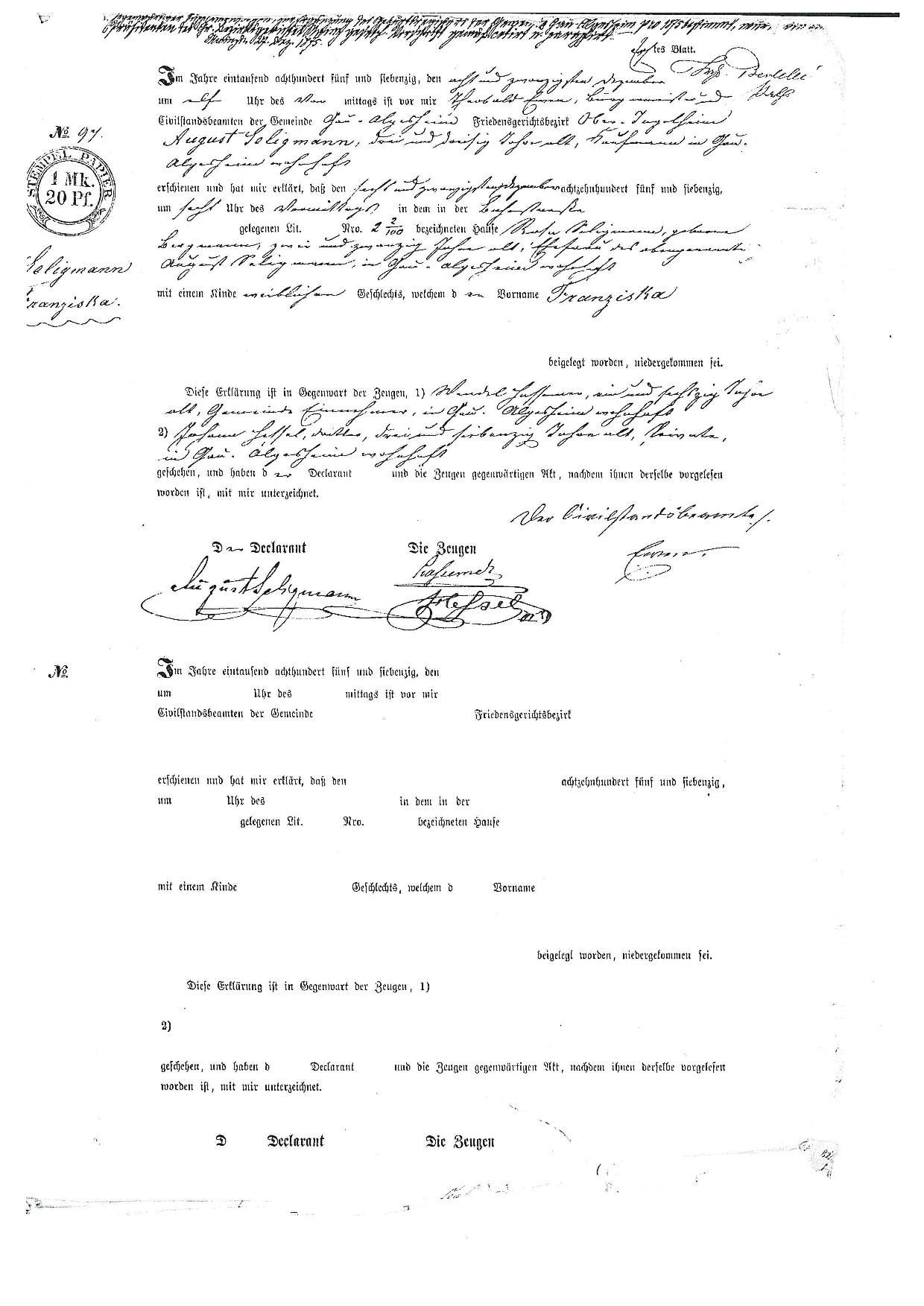
Birth record of Franziska Seligmann

Although the stories of Fred’s life and his mother’s life have been told on the blog, his father Adolf Michel has remained a mystery. Aaron Knappstein located the marriage record of Adolf Michel and Franziska Seligmann, which shows that they were married on July 11, 1904, and divorced on February 16, 1915.

Marriage record of Franziska Seligmann and Adolf Michel

Aaron also located Franziska’s death certificate.
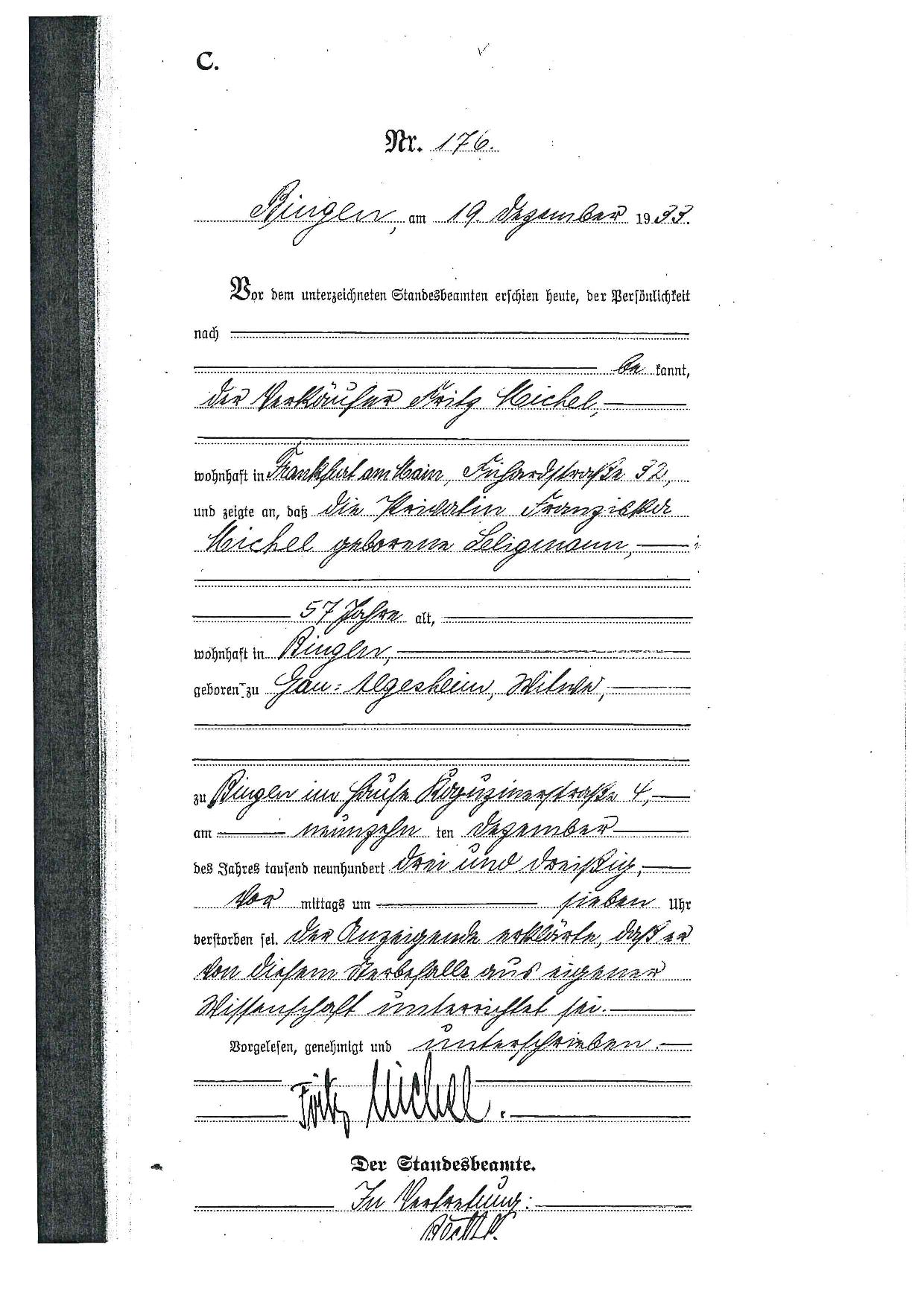
Death record for Franziska Seligmann Michel

Matthias Steinke from the German Genealogy group on Facebook translated the death record for me:

Nr. 176
Bingen, at the 19th December 1933
To the sigming registrar came today the personally known seller Fritz Michel, residing in Frankfurt am Main, Fuhardstreet 32, and reported that the privateer Franziska Michel born Seligmann, 57 years old, residing in Bingen, born in Algesheim, widow, in Bingen in the house Kapuzinerstreet 4, at the 19th December of the year 1933, pre midday at seven o’clock is deceased.
The reporter declared, that he knew about the death due to his own knowledge.
Readed, confirmed and signed
Fritz Michel
The registrar
In representation
Signature

Although it identified Franziska as a widow when she died in 1933, it is impossible to know whether that meant Adolf had died or whether their son Fritz (Fred), the informant, was just saving his mother from the stigma of divorce.

In any event, despite searches by Wolfgang, Beate Goetz, and Aaron Knappstein, no other records for Adolf Michel after that marriage certificate have been located. Fred Michel’s children also have no information about the fate of their grandfather Adolf.

We thought we had a possible lead when Wolfgang discovered this remarkable letter that Fred Michel wrote on August 18, 1958, to the International Tracing Service in Bad Arolsen, Germany (now known as the Arolsen Archives and searchable online), searching for his missing relatives.
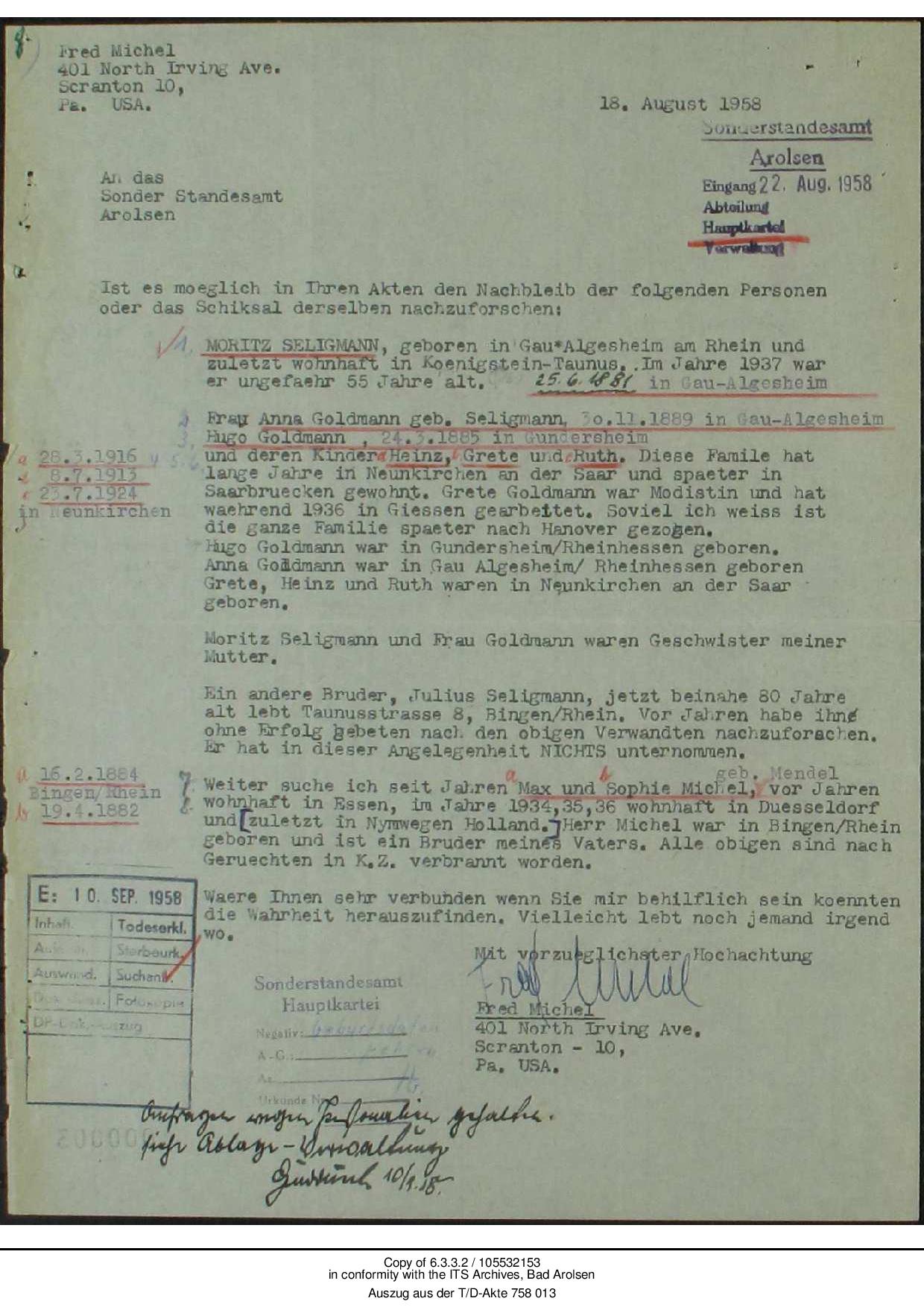
There is much in this letter to discuss later in this post, but for now I want to focus on the last paragraph where Fred wrote:

Weiter such ich seit Jahren Max und Sophie [geb. Mendel] Michel vor Jahren wohnhaft in Essen, im Jahre 1934, 1935, 1936 in Duesseldorf und zuletzt im Nimwegen Holland. Herr Michel war in Bingen/Rhein geboren und ist ein Bruder meines Vaters. Alle obigen sind nach  Geruechten in K.Z. verbrannt worden.

For years I have been looking for Max and Sophie (nee. Mendel) Michel lived in Essen years ago, in 1934, 1935, 1936 in Duesseldorf and most recently in Nijmegen Holland. Mr. Michel was born in Bingen/ Rhein and is a brother of my father. All the above are rumored to have been burned in the concentration camps.

We were excited to learn that Adolf Michel had a brother and hoped that if we found that brother’s family, we might learn what happened to Adolf. Unfortunately, the rumors Fred mentioned in his letter were true; both Max and his wife Sophie were killed in the Holocaust. They were deported to Auschwitz and murdered there on May 22, 1944, according to records at Yad Vashem. As far as we can tell, Max and Sophie did not have any children, and so far we have not found anyone one else to ask about the fate of Adolf Michel.

As for the other relatives Fred was asking about in his 1958 letter, sadly they also were murdered in the Holocaust. I wrote here about Moritz Seligmann (son of August Seligmann and Rosa Bergmann), who was killed in the Holocaust in 1942, and here about his sister Anna Seligmann and her husband Hugo Goldmann and their three children, all of whom also were killed during the Holocaust (the Goldmann family information will be updated in a post to come). Moritz and Anna were the siblings of Fred’s mother Franziska and Wolfgang’s grandfather Julius.

About his uncle Julius, the remaining child of August and Rosa, Fred wrote:

Eine andere Bruder Julius jetzt beinahe 80 Jahre alt lebt Taunusstrasse 8 Bingen. Vor Jahre habe ihne ohne Erfolg gebeten nach den Verwandten nachzuforachen. Er hat in dieser Angelgenheit NICHTS unternommen.

Another brother Julius now almost 80 years old lives at Taunusstrasse 8 in Bingen. Years ago I had asked him without success to trace the relatives. He has done NOTHING in this matter.

Julius was Wolfgang’s grandfather, and Wolfgang and I were puzzled by this paragraph. We are not sure what Fred meant here or why he was expressing his frustration with Julius to the ITS. The use of ALL CAPS seems to suggest that Fred was angry with Julius.

Wolfgang wondered why his grandfather would not have helped look for his lost siblings. There is probably more to that story, given that, as discussed before on the blog, there was a family dispute between Julius and the rest of the family when Julius married a Catholic woman, Magdalene Kleisinger, and Julius ended up leaving the family business and moving away from Gau-Algesheim. More on Julius to come in a subsequent post.

Julius and Magdalena Seligmann

One thing, however, that we may be able infer from this letter is that Fred Michel knew what had happened to his father since he did not list him among the many relatives he was seeking. Either Adolf Michel died before or after the Holocaust, or he was killed during the Holocaust (though he is not in the Yad Vashem or Arolsen records) and Fred already knew when and how his father was killed. It’s also possible that Adolf Michel was still alive in 1958. He would have been 89 years old at that time. I just wish we knew the answer.

UPDATE: Although I still have no information about Adolf’s death or whereabouts after his divorce from Franziska in 1915, Aaron Knappstein was able to locate Adolf’s birth record:
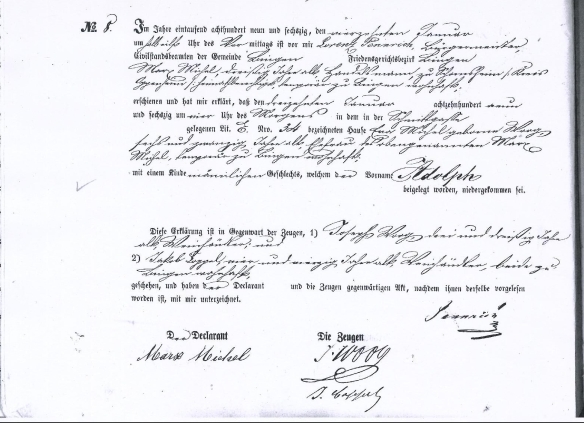
Adolf Michel birth cert from AK-page-001

Birth record for Adolph Michel. father: Marx Michel, 30years old, tradesman *13.01.1869 in Bingen mother: Eva Michel née Woog, 26years old

Aaron also wrote to the archives in Berlin for any information about Adolf’s death, but he did not appear in their index. So the brickwall remains. Thank you, Aaron!



Seligmann updates: The work is never done

Next in my series of updates from my cousins are a number of research discoveries made by my cousin Wolfgang Seligmann, the first of my cousins who found me through my blog. That was over four years ago, and together Wolfgang, his mother Annlis, and I were able to reconstruct major parts of the Seligmann family tree going back as far as my fifth-great-grandfather Seligmann ben Hirsch, the father of Jacob Seligmann, my fourth-great-grandfather, who was born in 1773 and gave the family Seligmann as its surname.

Some of you may remember the “magic suitcase” that Wolfgang and his mother had, filled with letters and papers about the Seligmann family. When I visited Wolfgang and Annlis in Mainz in 2017, I saw this wonderful suitcase. There were still many, many papers yet to be read and digested, and still much work to be done to uncover the rest of the story of the Seligmann family in Germany. So while I have gone on to other family lines, Wolfgang has continued to dig into our Seligmann family history and share his discoveries with me. Although I have updated my tree with this information, I haven’t updated the blog in quite a while. I want to take some time now to do that and share the other information that Wolfgang has uncovered.

First, Wolfgang found several directories that included listings for various members of the Seligmann family, including this 1845 directory from the city of Mainz where a number of our Seligmann relatives resided. On this page Salomon Seligmann is listed as a Handelsmann or merchant.

Mainz Adressbuch, 1845

Mainz Adressbuch, 1845

Salomon was a son of Jacob Seligmann and younger brother of Moritz Seligmann, my three-times great-grandfather (and Wolfgang’s great-great-grandfather). He was born in Gaulsheim, Germany, on March 26, 1812, and married Anna Chailly on August 8, 1843, in Mainz.1 They had four children: Emilie (born 1844), Mathilde (1846), Siegmund (1847), and Jacob (1853).2 Salomon died on January 12, 1876, in Mainz.3

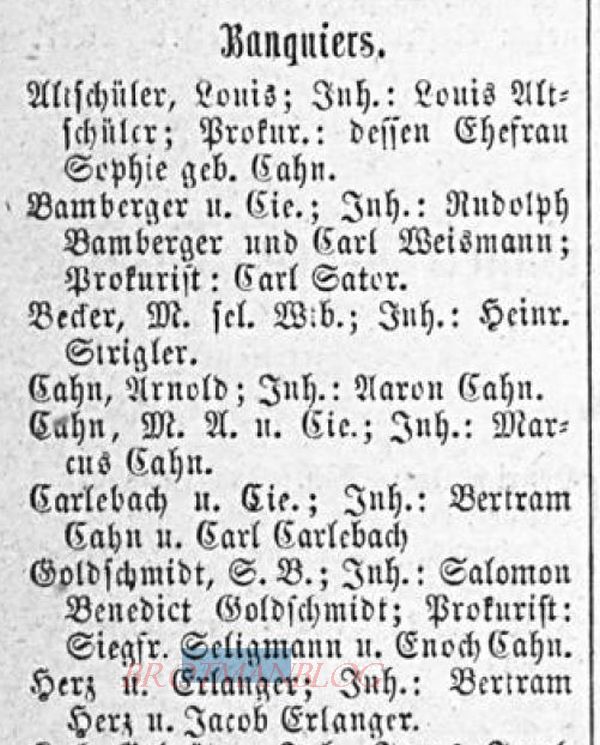
The second directory listing Wolfgang shared was also from Mainz, this one dated 1868. It lists as a “Banquier” our cousin Siegfried Seligmann. More specifically, Siegfried is described as a Prokurist or authorized officer of the bank. This is consistent with the description of him in Mathilde Mayer’s book, Die Alte und Die Neu Welt.  [The Old and The New World] (1951). Siegfried Seligmann was the son of Martha Seligmann, who was the sister of Moritz Seligmann and thus my four-times great-aunt. Martha Seligmann had married her own first cousin, Benjamin Seligmann, son of Hirsh Seligmann, Jacob Seligmann’s brother. So Siegfried was his own second cousin. He was born in Bingen on June 18, 1824.4

To make matters even more convoluted, Siegfried married his first cousin, Carolina Seligmann, daughter of Moritz Seligmann and my three-times great-aunt. Carolina was born in Gau-Algesheim on March 18, 1833,5 and she was the half-sister of my great-great-grandfather Bernard Seligman, the one who traveled the Santa Fe trail and became a successful business leader and political leader in Santa Fe. As I’ve already written, Caroline and Siegfried had seven children, only one of whom lived long enough to survive the Holocaust.

Mainz Adressbuch, 1868

The third directory Wolfgang shared with me is dated 1906 and is a listing from the Hessen-Rheinhessen directory for Bingen that includes a number of our relatives. One is Ferdinand Seligmann. Ferdinand was the son of Martha Seligmann and Benjamin Seligmann and was thus the first cousin of my great-great-grandfather Bernard Seligmann. His niece Martha Mayer wrote about him in her book Die Alte und Die Neu Welt, describing him as “Onkel Hut” or Uncle Hat because he was known for wearing a distinctive hat. He was a successful businessman in Bingen, born on April 23, 1836, and died in Bingen on November 21, 1906.6

Adressbuch Hessen-Rheinhessen 1906

Also listed is Emil Jacob Seligmann, son of Siegfried and Carolina Seligmann. He was born in Mainz on December 23, 1863, and married Anna Maria Angelika Illien, according to his death record.7 They had two children, Emil and Christine. Emil Jacob Seligmann was perhaps the first Seligmann family historian; it was his family tree that helped Wolfgang, Annlis, and me unlock many of the mysteries in the Seligmann family. Emil died from arteriosclerosis on August 9, 1942, in Wiesbaden.8

There are two men listed here who may be our relatives, but since both died before the 1906 directory was issued, I am not sure. Ludwig Seligmann and Richard Seligmann were the sons of Isaac Seligmann, brother of Moritz Seligmann, and Rosine Blad. Ludwig was born in Bingen on December 6, 1827, and died there on May 9, 1887, long before this directory was published. He was married to Auguste Gumbel, and they had five children. Since Auguste was still living in 1906, perhaps she had left this listing under her husband’s name. She died in 1910. Ludwig is listed here as a coal merchant (Holhenhandler).

Living at the same address as “Ludwig Seligmann” were at least two other Seligmanns: Karolina, a pensioner, and Ferdinand, another pensioner, and then a third Ferdinand in the wood and coal business with his son (this couldn’t be Uncle Hat as he never married or had children). I do not know who these people were, so perhaps this Ludwig and these other Seligmanns were not our relatives at all.

According to Emil Seligmann’s family tree, Richard Seligmann was born in Bingen on November 4, 1831, and died there on January 17, 1906. He must have died after the 1906 directory went to print. He is listed there as a merchant. He was married to Jeanette Gumbel. I’ve not been able to determine whether Auguste Gumbel and Jeanette Gumbel were related. Emil reported that Richard and Jeanette had three children, Wilhelmina (born 1864), Florentine (1866), and Heinrich (1870). I have not found much about any of them. Looking at these names on my tree has reminded me how much more work I still have to do on the Seligmann family.

The last directory listing that Wolfgang sent to me, also dated 1906 and from Hessen-Rheinhessen, must be the most precious to him as it includes his great-grandfather August Seligmann, brother of my great-great-grandfather Bernard, and their younger brother Jacob, later known as James when he immigrated to England (more on James to come). August is listed as an iron merchant, and Jacob is listed as a wine merchant.

Adressbuch Hessen-Rheinhessen, 1906

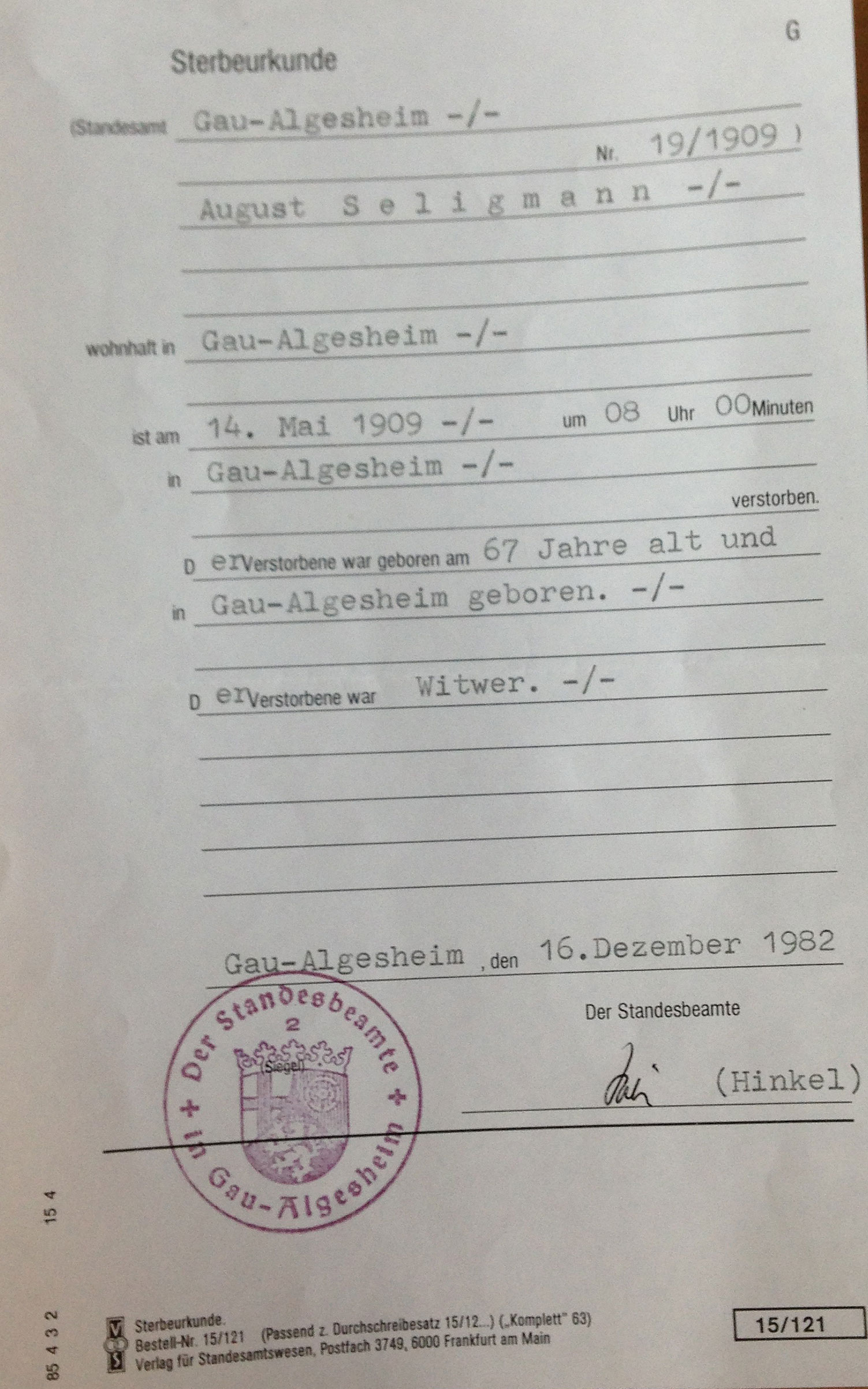
August was born on December 10, 1841,9 and died in Gau-Algesheim on May 14, 1909.10 He was married to Rosa Bergmann, and they had four children, including Wolfgang’s grandfather Julius, who was born in 1877 and died in 1967. (More on Julius to come as well.) I have written about August and Rosa and their children previously; two were killed during the Holocaust, Moritz and Anna. Their oldest child, Franziska, married Adolf Michel, and had one child Fred Michel, about whom I’ve written and about whom I have more to report. Franziska died in 1933.11

August Seligmann death certificate

Thus, as you can see, the story of the Seligmanns is not yet finished. Some of what I have is based on an unsourced family tree that I since learned has numerous errors. I need to go back and verify all that information if I can.

And that’s an important lesson for all of us involved in family history. The stories are never finished, the work is never done. Thank you, Wolfgang, once again, for all your generosity and hard work and for keeping me on task! There are more Seligmann updates to come.


  1. Marriage record, Certificate Number: 179, Stadtarchiv Mainz; Mainz, Deutschland; Zivilstandsregister, 1798-1875; Signatur: 50 / 124, Ancestry.com. Mainz, Germany, Births, Marriages and Deaths, 1798-1875 ↩
  2. Family Number: 10393, Ancestry.com. Mainz, Germany, Family Registers 1760-1900 ↩
  3. Civil Registration Office: Mainz, Certificate Number: 49, Laufendenummer: 866,
    Ancestry.com. Mainz, Germany, Deaths, 1876-1950 ↩
  4. Certificate Number: 294, Personenstandsregister Sterberegister; Bestand: 903; Signatur: 10482, Ancestry.com. Hesse, Germany, Deaths, 1851-1958 ↩
  5. Certificate Number: 1614, Stadtarchiv Mainz; Mainz, Deutschland; Zivilstandsregister, 1798-1875; Signatur: 50 / 234, Ancestry.com. Mainz, Germany, Births, Marriages and Deaths, 1798-1875 ↩
  6. http://www.steinheim-institut.de/cgi-bin/epidat?id=bng-0541 ↩
  7.  Personenstandsregister Sterberegister; Bestand: 925; Laufende Nummer: 2934,
    Year Range: 1942, Ancestry.com. Hesse, Germany, Deaths, 1851-1958 ↩
  8. Civil Registration Office: Wiesbaden, Certificate Number: 1691, Personenstandsregister Sterberegister; Bestand: 925; Laufende Nummer: 2934Ancestry.com. Hesse, Germany, Deaths, 1851-1958 ↩
  9. FHL Film Number: 342201, Ancestry.com. Germany, Select Births and Baptisms, 1558-1898. ↩
  10. Die Geschichte der Gau-Algesheimer Juden by Ludwig Hellriegel (1986, revised 2008)[The History of the Jews of Gau-Algesheim]. ↩
  11. http://www.steinheim-institut.de/cgi-bin/epidat?id=bng-745&lang=de ↩

Milton Goldsmith’s Family Album, Part XII: The Mystery of His Stepmother Francis

Will you help me solve a mystery?

The next page in Milton Goldsmith’s family album was devoted to his stepmother, Francis (sometimes spelled Frances) Spanier Goldsmith. But his story about her background and childhood left me with quite a mystery.

Milton was fifteen when his father remarried, and from this tribute to Francis, it is clear that he was extremely fond of and grateful to her.

Francis Spanier Goldsmith, the second wife of Father, Abraham Goldsmith, was born in Germany in 1854. Left an orphan at an early age, she was brought up in the home of Rabbi Krimke of Hanover, Germany. At the age of 20 she came to America, and having an Uncle, Louis Spanier, living in Washington, D.C. she went there for a while but soon settled in Baltimore, and became friends with our cousins, the Siegmunds. It was there that father met her, having been introduced by Mr. S. Father had been a widower for two years with five young children to bring up, and was looking for a wife, a lady with no relatives. He fell in love with Miss Spanier, proposed after two days and married within two months. She was 22 and he past forty. She was an attractive girl, dark-eyed, brunette, speaking a cultivated German but very little English;- of an amiable disposition. Father’s greatest mistake was to keep the parents of his first wife in the house. This naturally led to friction. A brother, Julius Spanier soon came in our home and lived there for a while. Later a sister, Rose, came from Hanover and also lived with us for several years. She eventually married and lived in Birmingham, Ala, where her brother also made his home. Within a year the oldest son, Alfred was born, and within five years there came Bertha, Alice and Louis. The later years of father’s life were embittered by sickness, loss of money and finally a stroke, rendering him helpless. He suffered for 12 years before he passed away in 1902. During that time Francis was an untireing [sic] nurse and faithful companion. She died of a stroke in Philada, 1908.

[handwritten underneath] She was distantly related to Heinrich Heine.]

I found this essay heartwarming, but also sad. Francis was orphaned, married a man  with five children who was more than twenty years older than she was, had to put up with his first wife’s parents, raise five stepchildren plus four of her own, and tend to Abraham when he suffered financial and medical problems. What a hard life! But how much of Milton’s essay was true?

When I first wrote about Francis over a year ago, I noted that I’d been able to find very little about her background, so finding this essay was very exciting because it provided many clues about Francis’ background. I’ve placed in bold above the many hints in Milton’s essay about people and places that I thought might reveal more about Francis.1

For example, who was Rabbi Krimke who allegedly brought up Francis? Was he just some rabbi from Hanover, or did Milton provide such a specific name because he was a well-known rabbi? It turns out that it was the latter. In Die Rabbiner der Emanzipationszeit in den deutschen, böhmischen und großpolnischen Ländern 1781-1871 (Michael Brocke, Julius Carlebach, Carsten Wilke, Walter de Gruyte, eds. 2010)( p. 549), there was this short biography of Rabbi Isaac Jakob Krimke of Hanover:

Here is a partial translation:

Rabbi Isaak Jakob Krimke, born in Hamburg in 24 June 1824, died in Hannover 20 Nov 1886. From orthodox school, 1857 third foundation rabbi at the Michael Davidschen Foundation School in Hannover, at the same time teacher at the Meyer Michael Foundation School and lecturer at the Jewish Teacher seminary, around 1869 first Foundation Rabbi. at the Michael Davidschen Foundation. Married to Rosa Blogg (died 1889), daughter of the Hebrew scholar Salomon Ephraim B.  ….  Was buried in the Jewish cemetery An der Strangriede. The tombstone for the foundation rabbi Isaac Jakob Krimke is preserved; it is adorned with a Magen David and also decorated with strong oak leaves….

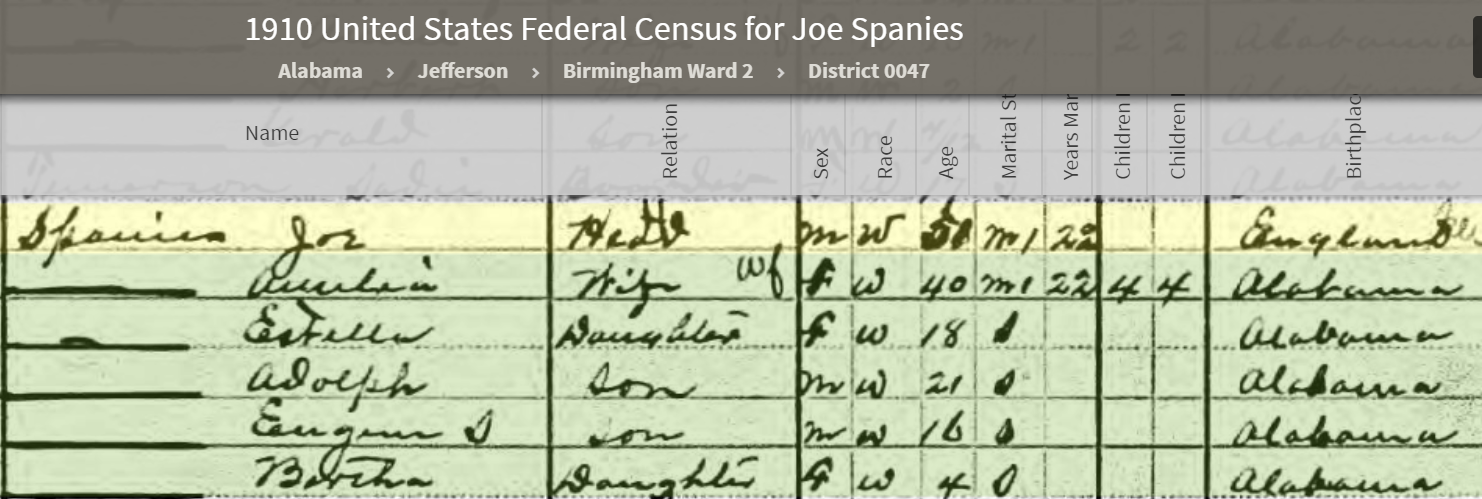
I then fell into a very deep rabbit hole when I tried to track down Louis, Julius, and Rose Spanier, Francis’ uncle, brother, and sister, respectively. I was able to find a Joseph Spanier living with his wife and family in Birmingham, Alabama, on the 1910, 1920 and 1930 census reports.2  But Joseph Spanier was born in England, according to all three census records. I was skeptical as to whether this was Julius Spanier, the brother of Francis Spanier Goldsmith living in Birmingham, as mentioned in Milton’s essay.

Jos. Spanier and family, 1910, US census, Census Place: Birmingham Ward 2, Jefferson, Alabama; Roll: T624_18; Page: 14A; Enumeration District: 0047; FHL microfilm: 1374031
Ancestry.com. 1910 United States Federal Census

But when I searched further for Julius Spanier, I found this page from the 1861 English census:

Spanier family, 1861 English census, Class: RG 9; Piece: 243; Folio: 61; Page: 28; GSU roll: 542598
Enumeration District: 20, Ancestry.com. 1861 England Census

This certainly appears to be the same man described in Milton’s essay and found on the census records for Birmingham, Alabama, as he was the right age, born in England, and had two sisters, one named Frances, one named Rose. Could it just be coincidence? Also, my Francis was the same age as the Frances on the 1861 English census. This certainly appeared to be the same family as the Spanier family described in Milton’s essay about his stepmother.

What really sealed the deal for me were the names of Joseph Spanier’s children in Birmingham, Alabama. His first child was Adolph; Julius Spanier’s father on the 1861 census was Adolphus. Julius Spanier’s mother was Bertha. Joseph Spanier also had a daughter named Bertha.

And consider the names of the first two children Francis Spanier had with Abraham Goldsmith: a son named Alfred, a daughter named Bertha. It all could not simply be coincidence. I hypothesized that Joseph Spanier was born Julius Spanier in England to Adolphus and Bertha Spanier and that Francis Spanier Goldsmith was his sister.

But then things got murky. Look again at the 1861 English census. It shows that Frances was not born in Germany, but in Boston—in the US. Every American record I had for Francis indicated that she was born in Germany, not the United States. How could I square that with the 1861 English census and the connection to the siblings mentioned in Milton’s essay—Julius and Rose?

And if Frances was born in Boston and living in England in 1861, is it really possible that she did not speak much English when she met Abraham in 1876, as Milton claimed in his essay?

Spanier family, 1861 English census, Class: RG 9; Piece: 243; Folio: 61; Page: 28; GSU roll: 542598
Enumeration District: 20, Ancestry.com. 1861 England Census

Then I found a birth record for Frances Spanier born in Boston to “Radolph” and Bertha Spanier on September 10, 1854. “Radolph” was clearly a misspelling of Adolph, and this had to be the same Frances Spanier who appeared on the 1861 English census.  Francis Spanier Goldsmith had a birth date of September 13, 1855, on her death certificate, so just a year and few days different from this Boston birth record (though the death certificate said she was born in Germany.)

“Massachusetts Births, 1841-1915,” database with images, FamilySearch (https://familysearch.org/ark:/61903/3:1:S3HT-XHB7-DJH?cc=1536925&wc=M61J-KNL%3A73565601 : 1 March 2016), 004023162 > image 102 of 857; Massachusetts Archives, Boston.

Frances Spanier Goldsmith death certificate
Pennsylvania Historic and Museum Commission; Pennsylvania, USA; Certificate Number Range: 006001-010000, Ancestry.com. Pennsylvania, Death Certificates, 1906-1966

I also found records showing that Francis Spanier Goldsmith’s uncle Louis was living in Boston in the 1850s.3 It certainly seemed more and more like Francis Spanier Goldsmith was born in Boston, not Germany, as Milton had written and American records reported.

What about the story that she was an orphan and raised by Rabbi Krimke? Francis’ mother Bertha died in England in 1862,4 when Francis was seven or eight years old, so she was partially orphaned as a child. But her father Adolphus died in England in 1873, so Francis was eighteen or nineteen when he died.5 But when Francis immigrated to the US in 1876, the ship manifest stated that she was a resident of Germany, not England.

Franziska Spanier, Year: 1876; Arrival: New York, New York; Microfilm Serial: M237, 1820-1897; Microfilm Roll: Roll 403; Line: 1; List Number: 344, Ancestry.com. New York, Passenger and Crew Lists (including Castle Garden and Ellis Island), 1820-1957

Was Milton’s story just a family myth, or was there some way to reconcile it with these records?

Here is my working hypothesis:

After Bertha Spanier died in 1862, Adolphus was left with five  young children. Francis (then seven or eight) and at least some of her siblings were sent to Hanover, Germany, to live with Rabbi Isaak Jakob Krimke, as the family story goes. By the time Francis immigrated to the US fourteen years later, she might have forgotten most of the English she once knew, so she was speaking only German, and the Goldsmith family only knew that she was an orphan who had come from Germany so assumed she was born there, and the family myth grew and stuck.

How ironic would it be if Francis was, like Milton and his siblings, a child whose mother died, leaving her father with five young children? After all, Francis also ended up marrying a man whose first wife died, leaving him with five young children. Francis may have saved her stepchildren from the fate she might have suffered—being taken away from her father after her mother died and sent to live in a foreign country  with a stranger, who happened to be a well-known rabbi.

What do you think? Am I missing something here? Where else can I look to try and solve this mystery?

This is Part XII of an ongoing series of posts based on the family album of Milton Goldsmith, generously shared with me by his granddaughter Sue. See Part I, Part II, Part III, Part IV, Part V,  Part VI, Part VII , Part VIII,  Part IX,  Part X and Part XI at the links.


  1. I also spent far too much time trying to track down the Siegmund family of Washington, DC, whom Milton described as his cousins. I had no luck figuring this one out and finally forced myself to stop looking. I also resisted the temptation to try and track down the distant connection between Francis Spanier and Heinrich Heine, the great nineteenth century German-Jewish poet. ↩
  2. Jos. Spanier, 1910 US census, Census Place: Birmingham Ward 2, Jefferson, Alabama; Roll: T624_18; Page: 14A; Enumeration District: 0047; FHL microfilm: 1374031, Ancestry.com. 1910 United States Federal Census; Joe Spanier, 1920 US census, Census Place: Birmingham, Jefferson, Alabama; Roll: T625_25; Page: 21A; Enumeration District: 99, Ancestry.com. 1920 United States Federal Census; Joseph E. Spanier, 1930 US census, Census Place: Birmingham, Jefferson, Alabama; Page: 32B; Enumeration District: 0071; FHL microfilm: 2339762, Ancestry.com. 1930 United States Federal Census ↩
  3. Birth record for Clara Spanier, daughter of Louis Spanier, Massachusetts Births, 1841-1915,” database with images, FamilySearch (https://familysearch.org/ark:/61903/1:1:FXDT-91R : 11 March 2018), Clara Spanier, 01 Oct 1855, Boston, Massachusetts; citing reference ID #p72 #3222, Massachusetts Archives, Boston; FHL microfilm 1,428,236. ↩
  4. Bertha Spanier death record, Inferred County: London, Volume: 1c, Page: 147, FreeBMD. England & Wales, Civil Registration Death Index, 1837-1915 ↩
  5. Adolphe Spanier death record, Inferred County: London, Volume: 1d, Page: 577, FreeBMD. England & Wales, Civil Registration Death Index, 1837-1915 ↩

Milton Goldsmith’s Family Album, Part V: A Love Letter

This is Part V of an ongoing series of posts based on the family album of Milton Goldsmith, so generously shared with me by his granddaughter Sue. See Part I, Part II, Part III and Part IV at the links.

As promised, today I am sharing a letter that Samuel Adler wrote to his beloved fiancée, Sarah Kargau, shortly before their marriage in 1837.

Once again, I am indebted to Matthias Steinke for his generous help in transcribing this letter:

Würzburg, den 6ten November 1837

Meine Geliebte!
Voll unbeschreiblicher Sehnsucht zähle ich mit dir jede Stunde. Ja, mit heisser Sehnsucht sehe auch ich dem heiligen Momente unserer Einsegnung, unserer ewigen Verbindung entgegen. Nur noch wenige Tage und wir haben das Ziel unserer Wünsche erreicht. O, wie freue ich mich darauf! Schneller durchströmt bei diesem Gedanken das Blut meine Adern, heftiger schlägt bei diesen Gefühlen mein Herz. Ja, dieses Blättchen würde nicht hinreichen, die alle meine dieshaltigen(?) Gefühle zu schildern, und ich will daher davon abbrechen. Ich habe nun noch eine Bitte: Wir werden nämlich an unserem Hochzeitstage nur eine Vase (Chaise?) mit nach Fürth bringen,

The letter must have continued on the back of the page, as Sue could see there was writing on the reverse side. But she did not want to risk damaging this 182-year-old letter by trying to remove it from the album, so we don’t know how Samuel closed out the letter.

Using Google Translate and my rudimentary knowledge of German, I was able to translate the letter as follows:

Würzburg, November 6, 1837

My beloved! Full indescribable longing I count with you every hour. Yes, with a hot longing I too see the holy moments of our consecration, our eternal connection. Only a few days left and we have reached the goal of our wishes. Oh, how happy I am! The blood rushes through my veins faster at this thought, my heart beats harder with these feelings. Yes, this leaflet would not suffice to describe all of my heartfelt (?) Feelings, and I therefore want to stop it. I have one more request: we will bring only one vase (chaise?) to Fürth on our wedding day,

What a passionate letter! This was no marriage of convenience arranged by parents or a matchmaker. This was a true affair of the heart. I admit to being surprised by the ardor expressed so openly in this letter—the desire is palpable. Samuel was certainly a man in love (or at least in lust). But what was the vase or chaise reference all about? I guess some things are best left to the imagination.

Samuel Adler


Milton Goldsmith’s Family Album, Part IV: His Mother’s Parents

This is Part IV of an ongoing series of posts based on the family album of Milton Goldsmith, so generously shared with me by his granddaughter Sue. See Part I, Part II, and Part III at the links.

In addition to the biographies of his father Abraham and paternal grandfather Seligmann Goldschmidt, Milton Goldsmith wrote about his mother’s family. His mother was Cecelia Adler, Abraham’s first wife, and she was the daughter of Samuel Adler and Sarah Kargau. Although Cecelia’s family is only related to mine through her marriage to Abraham, it is nevertheless fascinating to read about her parents.

Here is Milton’s page about his maternal grandfather, Samuel Adler:

Samuel Adler,–my grandfather, was born in Biebergau, Germany in 1814. He had the usual school education, but was never much of a scholar.  He was a stout, benevolent looking gentleman, hearty and genial, with a host of friends.  He married Sarah Kargau, and we have letters from him to her, also their marriage settlement. A year after my mother was born, they came to American in a sailing vessel, and settled in Philadelphia. For a while he manufactured Mantillas, but was not over-successful. He was one of the founders of the first Reform Temple, the Rodef Scholom in Philada, and became its president. Later, he was one of the founders of the Keneseth Israel Congregation, to which he belonged for the rest of his life.

After the marriage of his daughter, to my father, he came to live with them, until he died of ptomaine poisoning in 1886 at the age of 72. During the later years of his life, he went into the haberdashery business, but it was not successful, my father helping him along and providing for his needs.  Neither he nor my grandmother ever mastered the English language properly, which proved a great handicap. His sister, Mrs. Greenbaum, lived in Burlington, Ia. and died at 90 years of age.

I was left with the impression that Samuel was a wonderful man and well-loved by his family and his community, but not much of a businessman. Certainly he did not measure up to Abraham’s success in business in Milton’s eyes, but this is nevertheless a very loving tribute to his grandfather.

Milton also included this photograph of his grandfather Samuel.

Samuel Adler

But is the man depicted on the lower left side of the page supposed to be Samuel looking like a young George Washington? Or someone else? Any ideas?

As for his maternal grandmother and her family, Milton provided this page:

From looking at this page, I realized that some of the decorative art in this album was probably supplied by whoever manufactured the album. The inserted article at the top overlaps some of that decoration. It is a short biography of Mendel Kargau, Cecelia Adler’s maternal grandmother and Milton’s maternal great-grandmother:

This short biography (taken from the Jewish Encyclopedia, according to Milton) shows that unlike her father Samuel Adler, Cecelia’s maternal grandfather was quite scholarly. In his essay about Mendel Kargau and his daughter Sarah Kargau Adler, Milton wrote:

Mendel Kargau, as the attached biography taken from the Jewish Encyclopedia shows, was an eminent Rabbi in Fuerth, Bavaria. I was named for him, Milton being the English equivalent of Mendel.  He lived and died in Europe.

His only daughter, SARAH, was my maternal grandmother. She emigrated to America about two years after her marriage with SAMUEL ADLER, my grandfather. My mother, Cecelia Adler was a baby when they sailed, and during their sixty day voyage in a sailing vessel, she learned to walk. There were several brothers, one of them Moritz, was still living in Fuerth a few years ago. A nephew, Emanuel Kargau, is a dentist in Chicago. Grandma Adler, was a unique person. She was small in stature and not good looking, but must have been very sprightly in her youth. She was witty, and read a great deal. Her preference was for spicy books.  She lived with us for many years, later in life when the family grew too large, she lived near-by. She outlived her husband by many years, died in 1907 at advanced age of 93, retaining her faculties to the end, although she was always hard of hearing. After mother died, she helped to raise our family of 6 children.

When I researched Milton’s family, I noted that after his mother Cecelia died, his maternal grandparents Samuel and Sarah Adler lived with the family, and I’d assumed that Sarah had taken on part of the responsibility of caring for her daughter’s motherless children. Milton’s essay confirmed that assumption and painted a picture of a grandmother who was lively, interesting, and, his words, unique. I found it amusing that he said she wasn’t good looking. Maybe at 93 she wasn’t or even in her fifties when Milton was a child. Like most children, he probably just saw his grandma as an old lady.

I love this photograph of his grandmother. I have zoomed in on it here so that we can see Sarah Kargau Adler more clearly. I bet she was attractive as a young woman when she swept Samuel Adler off his feet. The letter he wrote before their wedding certainly reveals a man deeply in love. I will save that for my next post.


My Cousin Sue and Her Grandfather’s Amazing Album

A few weeks back I connected with my third cousin, once removed, Sue Jacobson. Sue is the granddaughter of Milton Goldsmith, and I had been hoping to connect with her for a long time.

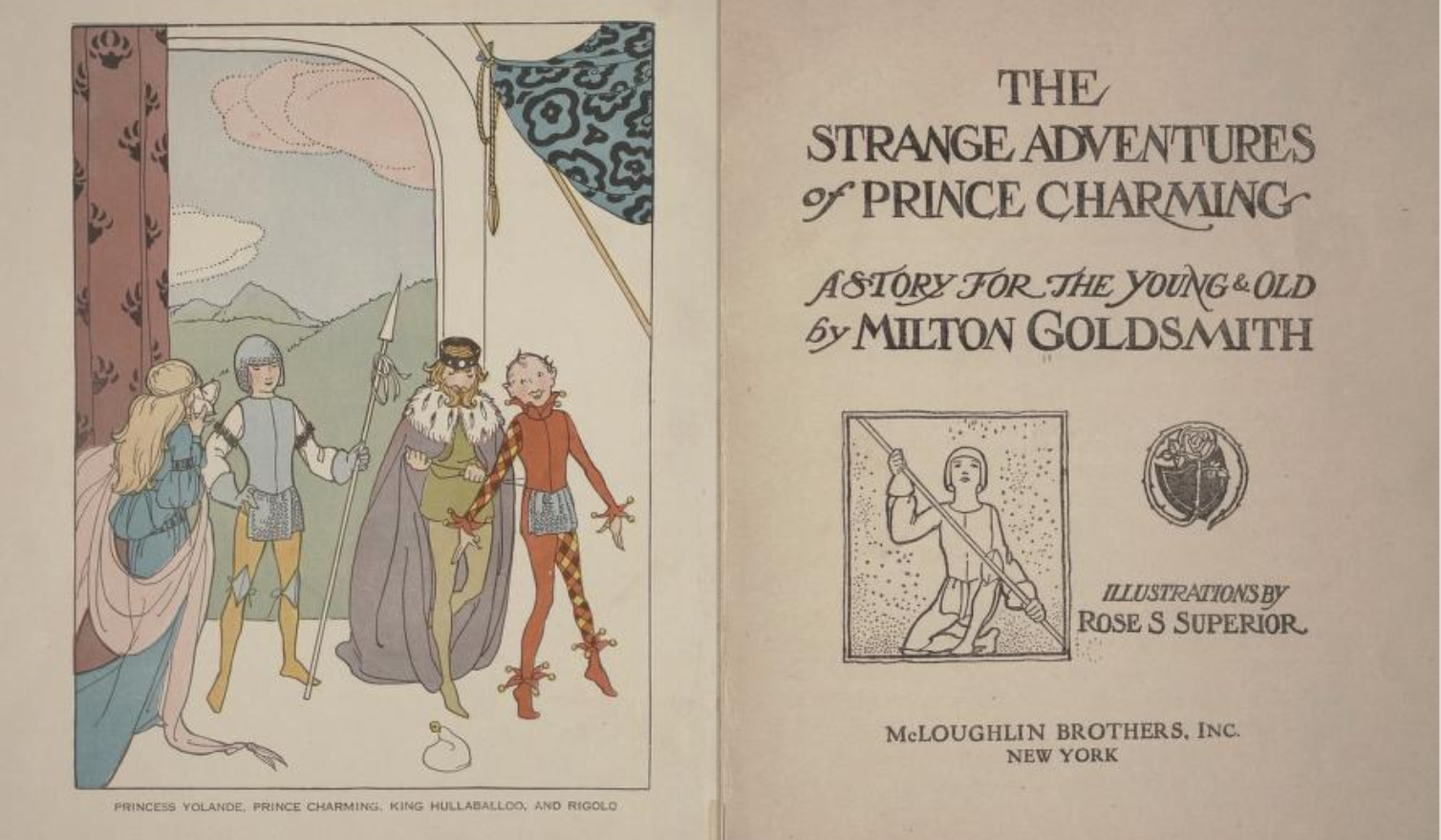
Some of you may remember the long series of posts I wrote about my cousin Milton Goldsmith, the author. Milton, the son of Abraham Goldsmith, was my great-grandmother Hilda Katzenstein’s first cousin; both were the grandchildren of Seligmann Goldschmidt and Hinka Alexander. And my father recalled meeting Milton when he was growing up, remembering him as the author of children’s books. So I was fascinated by Milton and his life for many reasons, and finding Sue has been a true gift.

Not only has Sue answered some of my lingering questions and commented on my blog posts to update and respond to those questions, she has shared with me an incredible album that her grandfather Milton compiled in 1936 when he was 75 years old. It includes biographical information, some photographs, and family trees created by Milton. Sue has generously given me permission to post images from this album, and I have decided to add a third day a week to my blogging schedule to post this wonderful material a page or two at a time.  I plan to post these each Monday, keeping my regular posts on Tuesdays and Fridays.

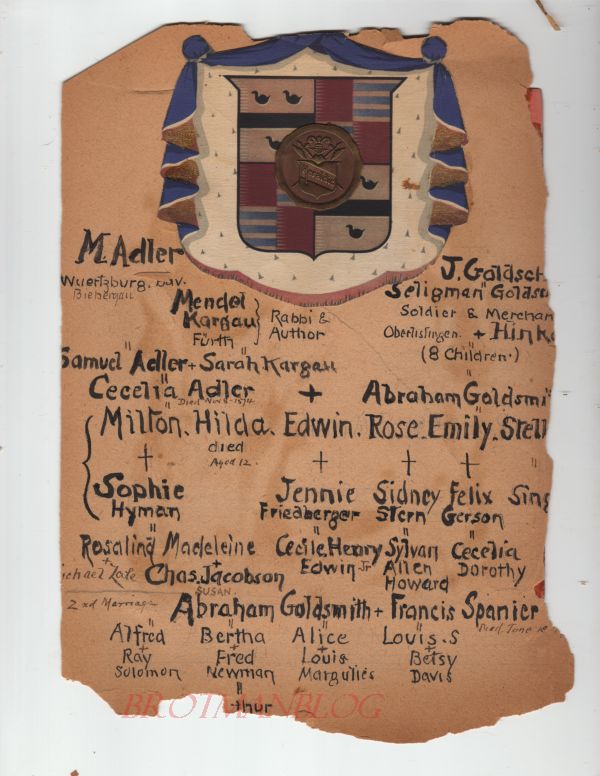
Today I am posting the cover of the album and its inside cover, which is a beautiful rendition of Abraham Goldsmith’s family tree, showing all his children and grandchildren from both his first marriage to Celia Adler and his second marriage to Frances Spanier.

I am very curious about the illustrations. Did Milton buy this album with the illustrations already printed on the cover and on the pages that follow? Or did he have someone do these illustrations? They look not dissimilar to some that appeared in his books. Has anyone ever seen an album like this before?

Next time I will post the page that follows these in the album where Milton reported on the children of Seligmann Goldschmidt, his father’s father. I was delighted that Milton’s report corroborated the research I had done on Seligmann’s family. But I was even more delighted when I learned about a cousin I had not known about before. I am excited to share that discovery next week. Stay tuned.


Simon Goldschmidt: From German Criminal to American Grandfather

Before my break, I noted that I had finished writing about the descendants of Seligmann Goldschmidt and Hinka Alexander, my three-times great-grandparents, and the descendants of Seligmann’s brother, Lehmann Goldschmidt.

Now I would like to turn to Seligmann’s youngest sibling, Simon Goldschmidt, whose story I’ve already told in bits and pieces at other times because his second wife, Fradchen Schoenthal, was the sister of my Schoenthal great-great-grandfather Levi Schoenthal, and because one of his grandchildren, Ella Bohm, married my great-great-uncle Jacob Katzenstein.

But let me tie together those bits and pieces into one story so that I can continue Simon’s story with some background. Simon was born in Oberlistingen in about 1795 to Jacob Falcke Goldschmidt and Eva Reuben Seligmann (no connection to my Seligmanns). In 1822, he married Eveline Katzenstein of Grebenstein (no known familial connection to my Katzensteins). Their first child, Jacob, was born in about 1825 in Oberlistingen. 1

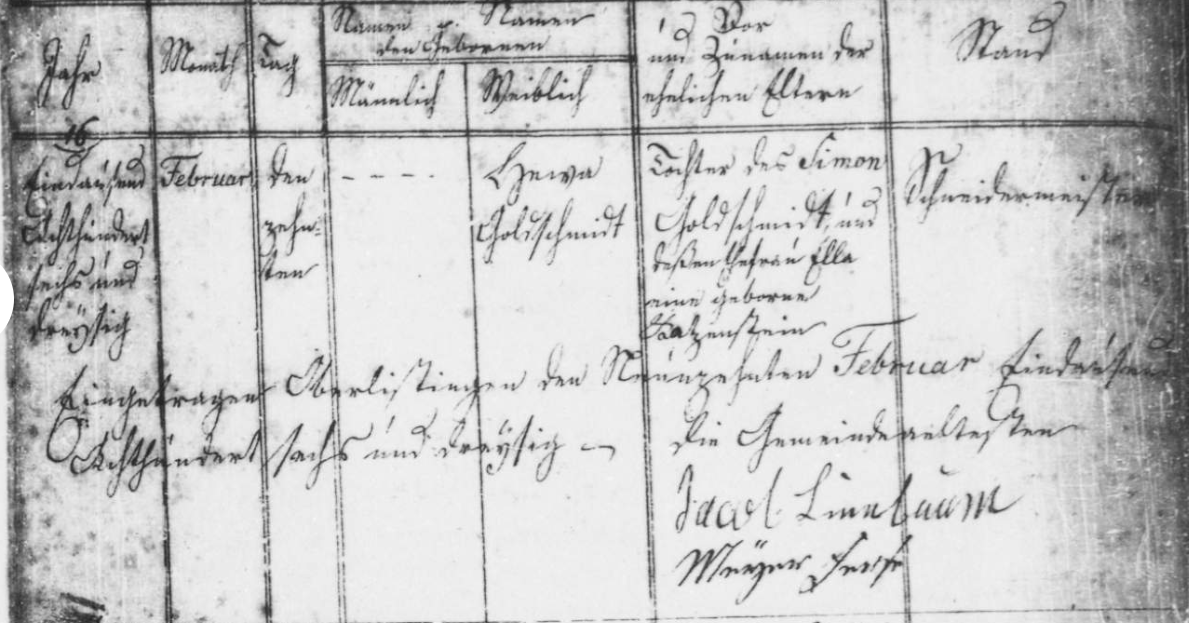
In May, 1826, Simon was charged with burglary and attempted robbery.2  As I wrote about at length in this post, in 1830 there was a trial, and Simon was convicted and sentenced to ten years in prison with his legs shackled. Simon appealed, and on December 24, 1830, the appellate court upheld the verdict, but reduced the sentence from ten years to four years because the victim’s injuries were not dangerous or life-threatening and because Simon had not used any lethal weapons. The court also observed that the delay in trial was not Simon’s fault and took that into consideration in reducing his sentence.

Simon and Eveline had four more children after Jacob: Lena (1828),3 born while he was awaiting trial, and three born after he was released, Hewa “Eva” (1836), Joseph (1837), and Jesajas (1839), all born in Oberlistingen. Sadly, Simon and Eveline’s last two babies did not survive. Both Joseph and Jesajas died in infancy.

Eva (Hewa) Goldschmidt birth record, Geburtsregister der Juden von Oberlistingen (Breuna) 1826-1852 (HHStAW Abt. 365 Nr. 668)AutorHessisches Hauptstaatsarchiv, Wiesbaden, p.7


Joseph Goldschmidt death record
Sterberegister der Juden von Oberlistingen (Breuna) 1827-1852 (HHStAW Abt. 365 Nr. 671), p. 6

Jesajas Goldschmidt death record
Sterberegister der Juden von Oberlistingen (Breuna) 1827-1852 (HHStAW Abt. 365 Nr. 671), p. 7

A year after the death of Jesajas, Simon’s wife Eveline died on August 19, 1840. Simon was left on his own to raise his fifteen-year-old son Jacob, twelve-year-old daughter Lena, and four-year-old Eva.

Eveline Katzenstein Goldschmidt death record
Sterberegister der Juden von Oberlistingen (Breuna) 1827-1852 (HHStAW Abt. 365 Nr. 671), p. 8

Simon’s son Jacob left Germany that same year and immigrated to the US.4  By 1850, Jacob was living in Washington, Pennsylvania, working as a tailor and living with two other men who were tailors, and had changed his surname to Goldsmith.

Jacob Goldsmith (Simon’s son) 1850 US census
Year: 1850; Census Place: Washington, Washington, Pennsylvania; Roll: M432_834; Page: 363A; Image: 244

On September 10, 1844, Simon married Fradchen Schoenthal, my three-times great-aunt, in Oberlistingen. Fradchen was already 37 at that time, and Simon was 49.

Marriage of Simon Goldschmidt and Fradchen Schoenthal
HHStAW Abt. 365 Nr. 669, S. 11

Almost exactly a year later, Simon and Fradchen arrived in the United States along with Simon’s youngest daughter, Eva, who was then nine years old.

Simon, Fradchen, and Eva Goldschmidt on 1845 passenger manifest
The National Archives at Washington, D.C.; Washington, D.C.; Records of the US Customs Service, RG36; NAI Number: 2655153; Record Group Title: Records of the Immigration and Naturalization Service, 1787-2004; Record Group Number: 85

They must have settled first in Baltimore because Simon and Fradchen had two children who were born there, Henry on January 10, 1847,5 and Hannah on June 5, 1848.6 Since Henry and Hannah’s mother and father were both my blood relatives, they are my double cousins: first cousins, three times removed through Fradchen, and first cousins, four times removed through Simon.

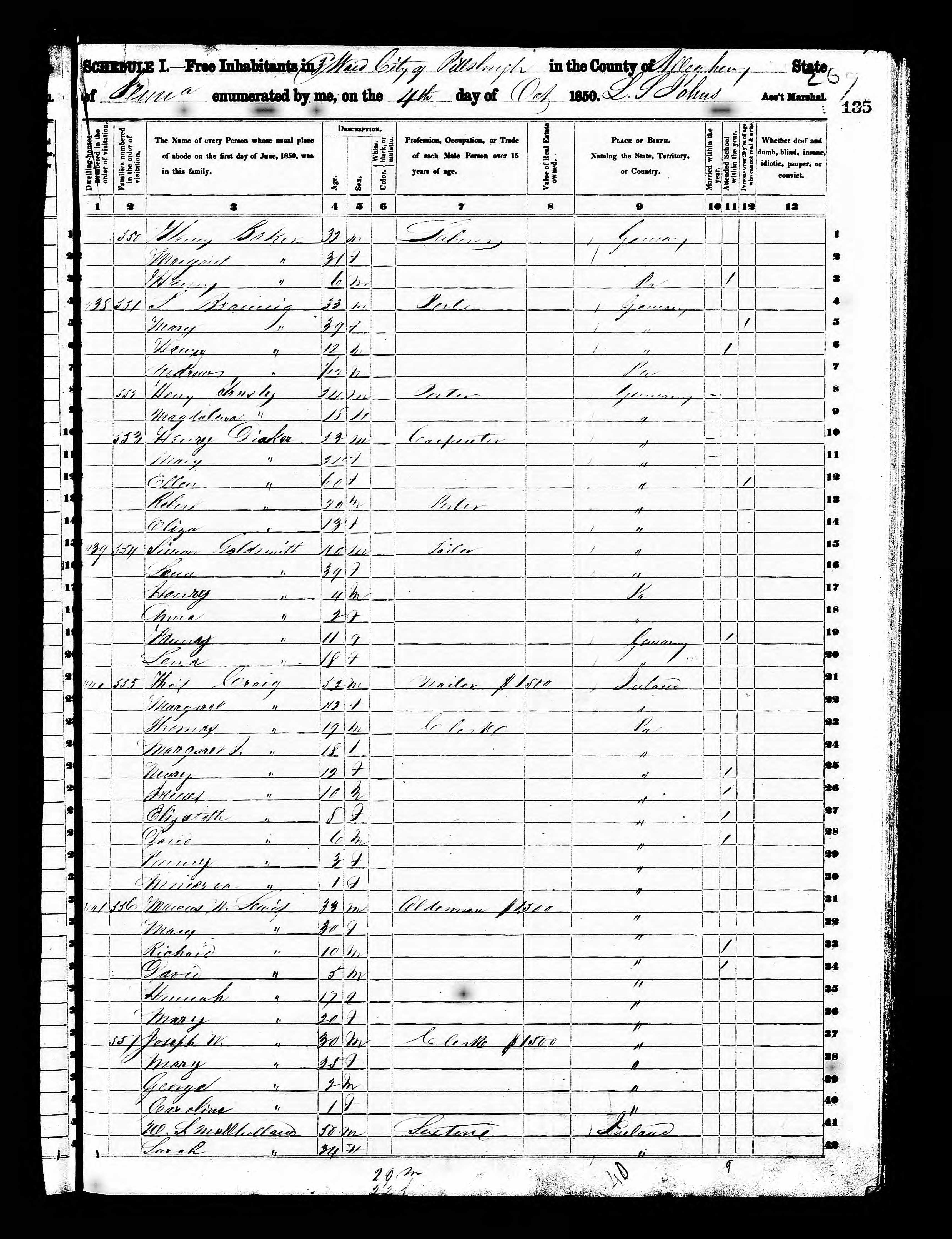
By 1850, Simon and Fradchen (also known as Fanny) were living in Pittsburgh with Henry and Hannah as well Simon’s two daughters from his first marriage, Lena and Eva. Simon was working as a tailor and had, like his son Jacob, Americanized his surname to Goldsmith.

Simon lost his second wife Fradchen soon thereafter; she died on August 11, 1850, at age 43. Once again Simon was left with young children—Henry was three, Hannah was two.

Fanny Schoenthal Goldsmith Troy Hill Pittsburgh

By 1853, Simon’s son Jacob had married Fannie Silverman, also a German immigrant, and together they had six daughters born between 1853 and 1860: Ellena (1853)7, Emma (1854),8 Annie (1855),9 Rachel (1857),10 Leonora (1858),11 and Celia (1860).12  By 1860, Simon and his two youngest children, Henry and Hannah, had moved to Washington, Pennsylvania, and were living with Jacob and Fannie and their six daughters. Henry and Hannah were only five and six years older than their oldest niece, Ellena.

Simon Goldsmith and family 1860 US census
Year: 1860; Census Place: Washington, Washington, Pennsylvania; Roll: M653_1192; Page: 1188; Image: 627; Family History Library Film: 805192

Simon’s daughter Lena married another German immigrant, Gustavus Basch in 1856.13 In 1860, they were living in Connellsville, Pennsylvania, with their first two children, Frank (1858) and Jacob (1859). Connellsville is under fifty miles from Washington, Pennsylvania, where Lena’s father Simon and her brother Jacob were then living.

Basch family, 1860 US census, Census Place: Connellsville, Fayette, Pennsylvania; Roll: M653_1110; Page: 421; Family History Library Film: 805110 Source Information Ancestry.com. 1860 United States Federal Census

As for Simon’s youngest child with Eveline, his daughter Eva, her whereabouts in 1860 are unknown. I cannot find her anywhere on the 1860 census. More on Eva here and here and in a subsequent post.

Thus, by 1860, all the members of the family of Simon Goldschmidt (except possibly Eva) were living in western Pennsylvania, most of them in Washington, Pennsylvania.  That was as far as I’d gotten with Simon’s story in my earlier posts. Now I can pick up with Simon and his children in the years after 1860.


  1. I don’t have original birth or marriage records for these facts, but have relied on various US records as well as the research of others to reach these conclusions. ↩
  2.  HStAM Fonds 261 Kriminalakten 1822-1836 No G 40. See the linked post for more information about my source for this information. ↩
  3.  Ancestry.com. Web: Columbus, Ohio, Green Lawn Cemetery Index, 1780-2010 ↩
  4. Jacob Goldsmith, 1900 US census, Census Place: Denver, Arapahoe, Colorado; Page: 8; Enumeration District: 0072; FHL microfilm: 1240119, Ancestry.com. 1900 United States Federal Census ↩
  5. Henry Goldsmith, passport application, National Archives and Records Administration (NARA); Washington D.C.; Roll #: 156; Volume #: Roll 0156 – Certificates: 69177-70076, 01 Apr 1912-11 Apr 1912, Ancestry.com. U.S. Passport Applications, 1795-1925 ↩
  6. Hannah Goldsmith Benedict, death certificate, Michigan Department of Community Health, Division for Vital Records and Health Statistics; Lansing, Michigan, Ancestry.com. Michigan, Death Records, 1867-1950, File Number: 007791. ↩
  7. Ellena Goldsmith Feldstein, death certificate, Pennsylvania Historic and Museum Commission; Pennsylvania, USA; Pennsylvania, Death Certificates, 1906-1965; Certificate Number Range: 061391-064480, Ancestry.com. Pennsylvania, Death Certificates, 1906-1966 ↩
  8. Emma Goldsmith, death certificate, Pennsylvania, Philadelphia City Death Certificates, 1803-1915,” database with images, FamilySearch (https://familysearch.org/ark:/61903/1:1:JX5B-3PG : 9 March 2018), Emma Goldsmith, 06 Jan 1902; citing cn14552, Philadelphia City Archives and Historical Society of Pennsylvania, Philadelphia; FHL microfilm 1,853,338. ↩
  9. Annie Goldsmith, 1860 US census, Year: 1860; Census Place: Washington, Washington, Pennsylvania; Roll: M653_1192; Page: 1188; Family History Library Film: 805192, Ancestry.com. 1860 United States Federal Census ↩
  10. Rachel Goldsmith, 1860 US census, Year: 1860; Census Place: Washington, Washington, Pennsylvania; Roll: M653_1192; Page: 1188; Family History Library Film: 805192, Ancestry.com. 1860 United States Federal Census ↩
  11. Leonora Goldsmith, 1860 US census, Year: 1860; Census Place: Washington, Washington, Pennsylvania; Roll: M653_1192; Page: 1188; Family History Library Film: 805192, Ancestry.com. 1860 United States Federal Census ↩
  12. Celia Goldsmith, 1860 US census, Year: 1860; Census Place: Washington, Washington, Pennsylvania; Roll: M653_1192; Page: 1188; Family History Library Film: 805192, Ancestry.com. 1860 United States Federal Census ↩
  13. Lena and Gustavus Basch, 1900 US census, Census Place: Columbus Ward 6, Franklin, Ohio; Page: 3; Enumeration District: 0068; FHL microfilm: 1241268, Ancestry.com. 1900 United States Federal Census ↩

Max Goldschmidt: A Survivor

As seen in my last few posts, although my cousin Betty Goldschmidt and her husband (and our cousin) Jacob Goldschmidt had eight children, I only have adult records for one of them, their son Berthold. Berthold and his wife Mathilde Freudenstein had seven children, but their son Siegfried Goldschmidt was the only child of the seven to live long enough to marry and have a child of his own; Siegfried and his wife Frieda Fanny Pless had one child, a son Max born November 30, 1924, in Frankfurt, Germany.

Siegfried and his wife were among the six million murdered in the Holocaust, but their young son Max, the last known remaining descendant of Betty and Jacob, survived. Max was only eight years old when Hitler came to power and not yet eighteen when his parents were deported in 1942. How had he survived? At first all I knew was that he had immigrated to the US from Israel in 1948, but thanks  to the generous assistance of Elan Oren of the Tracing the Tribe group on Facebook, I have been able to piece together much of the story of Max’s life.

Elan located Max’s file in the Israeli archives, which revealed that Max had escaped to Switzerland at some point during the Nazi era. After the war, Max sailed on the ship Plus Ultra from Barcelona, Spain, to Haifa, arriving in Haifa on June 19, 1945.

From Max Goldschmidt Israeli immigration file: Ship manifest for the Plus Ultra from Barcelona to Haifa, arriving June 19, 1945. Max is on line 94. http://www.archives.gov.il/en/archives/?fbclid=IwAR1y3d5C1X3pi2R1_jyX0MAbgeHLQoNhL6TM7F5P7ZT7CE4sFJgPPuql11A#/Archive/0b0717068002258e/File/0b071706856dcab1

Max’s file in the Israeli archives did not reveal how or when he got to Switzerland or to Barcelona, but Max’s A-file—his US immigration file—from the US Customs and Immigration Service (USCIS) revealed further details.1 According to a German police certificate included in Max’s application to the US Consul in Palestine for an immigration visa in 1947, Max lived in Warburg, Germany, from April 1927 until September 1936. That is also where his parents were residing during that time, according to records  at Yad Vashem.

On Max’s 1947 US visa application he stated that he’d immigrated to Switzerland in January 1939. He was only fourteen at that time. He lived in Basel, Switzerland, from January, 1939, until May, 1945, when he must then have left for Barcelona and ultimately Palestine. As for how he escaped from Germany in 1939, Elan Oren suggested that a Zionist youth group such as HeHalutz  might have helped him get out of Germany.

After arriving in Haifa, Max was transferred to Atlit, a detention camp built by the British, who were then in control of what was then Palestine. With the help of Elan Oren and his translation of Max’s Israeli naturalization file, I learned that Max left Atlit and first lived in Petach Tikvah and then moved to Tel Aviv to live with the Laks family. (More on them in a bit.)

Document that states that Max moved from Petah Tikvah to Tel Aviv where the Laks family lived. Translated by Elan Oren. http://www.archives.gov.il/en/archives/?fbclid=IwAR1y3d5C1X3pi2R1_jyX0MAbgeHLQoNhL6TM7F5P7ZT7CE4sFJgPPuql11A#/Archive/0b0717068002258e/File/0b071706856dcab1

But Max decided not to settle permanently in Israel. Max left Haifa on January 29, 1948, and arrived in New York on February 14, 1948. The manifest lists Max’s occupation as a gardener, his primary languages as English and Hebrew, his last residence as Tel Aviv, Palestine, and his birthplace as Frankfort [sic], Germany.

Max Goldschmidt passenger manifest, Year: 1948; Arrival: New York, New York; Microfilm Serial: T715, 1897-1957; Microfilm Roll: Roll 7546; Line: 19; Page Number: 197, Ancestry.com. New York, Passenger and Crew Lists (including Castle Garden and Ellis Island), 1820-1957

The second page of the manifest lists a friend named Pinil Laks as the contact person from Max’s prior residence of Tel Aviv and an uncle “Bernh Laks” of Blackwood, New Jersey, as the person he was going to join in the United States.

So who were the Laks? Bernhard Laks, also known as Bernhard Lachs, Berek Laks, and Bernard Laks, was married to Rosa Pless,2 who must have been a sister of Frieda Pless Goldschmidt, Max’s mother, since Max identified Bernard as his uncle and Rosa as his aunt on various documents.  Moreover, Bernard Laks (then spelled Bernhard Lachs) was one of the witnesses on the marriage record for Max’s parents, Siegfried and Frieda.

Bernhard Lachs as witness on the marriage record of Siegfried Goldschmidt and Frieda Fanny Pless. Hessisches Hauptstaatsarchiv; Wiesbaden, Deutschland; Bestand: 903
Ancestry.com. Hesse, Germany, Marriages, 1849-1930

When Max arrived at Ellis Island on February 14, 1948, he was denied admission to the United States because he did not have in his possession the immigration visa that he had been granted by the US consul in Palestine on November 17, 1947. A hearing was held on February 18, 1948 before a Board of Special Inquiry, at which Max testified that he had last seen his visa on the day he embarked from Haifa while at customs, that he had left it with his other papers in his baggage, and that while at sea he’d discovered that the visa was missing.

Max also testified that he had no relatives living outside of the US and no money. He stated that he was coming to the US in order to join his relatives, the Laks family of Blackwood, New Jersey, and that his uncle Bernard Laks had paid for his ticket from Haifa. In addition, Max presented an affidavit from Bernard and Rosa Laks in which they, as “his sole surviving relatives,” promised to “receive and care for [Max] and …not permit him to became a public charge.”

Although the Board of Special Inquiry found that Max had a valid Palestinian passport with a stamp indicating that a visa had been issued to him by the US Consulate in Jerusalem, they concluded that he was not admissible without possession of the actual visa. On February 20, 1948, however, the Commissioner of Immigration and Naturalization (INS) recommended that the decision to deport Max be deferred for ninety days to give him time to locate the visa or to obtain a certified copy.

On March 3, 1948, the ninety day stay was granted, and Max was also granted parole during that period, meaning that on March 4, 1948, he was allowed to enter the country though he was required to report in writing on a monthly basis to the Deportation and Parole Section at Ellis Island. Max had thus been detained for eighteen days at Ellis Island before his parole.

On March 18, 1948, his attorney wrote to INS to notify them that the American Consulate in Jerusalem had confirmed that Max had been granted a visa on November 17, 1947, and that the Visa Division in Washington, DC, had been so notified.  On April 8, 1948, the State Department submitted a certified copy of the visa. However, it was not until four months later on August 11, 1948, that an order was entered to re-open Max’s case. A new hearing was scheduled for September 15, 1948.  Fortunately, Max had better luck at this hearing, and he was granted legal admission into the country on September 15, 1948, more than seven months after arriving at Ellis Island on February 14, 1948. (I assume Max had received extensions of the 90 day parole period initially granted in March, 1948.)

Then began the next chapter of his life and more experiences with the slowly grinding wheels of American bureaucracy. He started the process of becoming a US citizen on October 1, 1948, just two weeks after entering the country officially.  But before Max’s papers could be processed, he was inducted into the US Army on January 1, 1949, the very day the government had scheduled a meeting to discuss his citizenship application. He amended his address to reflect that he was now stationed at Fort Dix in New Jersey as a member of the 9th Infantry Division. He was honorably discharged from the army on November 2, 1951, and on March 11, 1955, a certification of his service was issued to INS. His formal petition for naturalization was filed on October 14, 1955, with Bernard and Rosa Laks attesting to his character.

On January 24, 1956, the government received reports from the army that on January 2, 1951, while serving in the army, Max had “stated in substance … that if the Army is an example of democracy, he would take communism” and that on June 4, 1951 while giving a training lecture to his unit, “he introduced the Crusades as an illustrative example in this history of warfare, and then proceeded to interject his own thoughts on the persecution of Jews by Christians at the time of the Crusades, allegedly making rather strong remarks about the Roman Catholic Church. [Max] has at various times in the past tried to turn a topic of conversation into ‘making a case’ for Zionism.”

I suppose Max took the meaning of the First Amendment more literally than the US Army thought appropriate. Whether this had any impact on his citizenship application is not clear. On a page of examiner’s notes dated November 9, 1956, the examiner gave Max a final rating of “deny,” but then that was crossed out, and on May 17, 1957, his application was granted and he was finally issued a certificate of naturalization; he also changed his name to Goldsmith at that time. Despite his service in the US Army, it had taken almost eight years to complete the process of becoming a citizen.

Two months later in July 1957, Max married Shirley Larve in Trenton, New Jersey.3 Shirley was born in Trenton on May 29, 1923, to Joseph and Anna Larve.4 She was 34 when they married, and Max was 32. They did not have any children.

Shirley died at age 70 on July 24, 1993, in Broward County in Florida.5 Her obituary in the South Florida Sun-Sentinel on August 15, 1993, filled in some of the gaps in their lives between 1957 and 1993.  Here are some excerpts:

…Shirley worked during WWII for the U.S. Army Finance Dept. and later for 25 years for the Department of Motor Vehicles, State of NJ, retired supervisor in 1985. Married Max Goldsmith July, 1957, an immigrant to the U.S.A. They resided at various locations throughout the U.S.A. … Her life was devoted to her husband, being a true companion to him who had lost his family of 68 members during the Nazi era.

She served two terms as President of the Ladys Auxiliary of the Jewish War Veterans of the U.S.A. Post 697 in Levittown, PA. A life member in the American Red Star of David for Israel. In 1989 she received the Lady of the Year award of the Star-Faye Post 672. She was very mild mannered, yet forceful. A lady in her own right. Always unpretending with an inherent sense of justice. She had her golds [goals?] and she never let go until accomplished. She had little patience for people who sat around and complained. Although small in stature yet big in ability and courage.

Shirley and Max thus lived in or near Trenton, New Jersey until 1985 when she retired after 25 years working for the Department of Motor Vehicles. (Levittown, Pennsylvania, is less than eight miles from Trenton.) By 1990, they had moved to Pompano Beach, Florida.6

I am troubled by the reference in her obituary to 68 members of Max’s family being killed in the Holocaust. Who were those 68 people? How were they related to Max? Were they his mother’s relatives? Or were they Goldschmidts I just haven’t found? It haunts me.

Max died in Fort Lauderdale, Florida, eleven years after Shirley on July 2, 2004, at age 80.7  He’d endured a great deal in his life—fleeing from his homeland and his family as a young teenager, the murder of his parents, the move to Palestine and then to the US, and all the hassles he endured to become first a legal resident and then a  citizen of the United States.

But I was very comforted after reading Shirley’s obituary; I assume that Max wrote it himself. It is clear from his words that he loved her very deeply and that he felt loved and taken care of by her.  It is wonderful to know how devoted they were to each other, especially after all he’d been through in the first 32 years of his life.

Max Goldsmith, my third cousin, once removed, was a true survivor.  As best I can tell, he was the only and last surviving descendant of  his great-grandparents, Betty Goldschmidt and Jacob Goldschmidt, two first cousins who married each other, both grandchildren of Jacob Falcke Goldschmidt and Eva Reuben Seligmann, my four-times great-grandparents. By remembering Max, I hope to honor not only him, but all those who came before him.


  1. The references in this post to documents relating to Max’s immigration to the US are all from his A-file from USCIS, copies of which are in my possession. References to his immigration to Palestine and his time there are from the Israeli archives here. ↩
  2. On the 1937 passenger manifest for Berek and Rosa Laks, the person they named as their closest relative living in their former residence of Frankfurt was E.Pless, identified as Berek’s mother-in-law and Rosa’s mother. From this I inferred that Rosa’s birth name was Pless and that she was the sister of Frieda Pless Goldschmidt, Max’s mother.  Laks family, passenger manifest, Year: 1937; Arrival: New York, New York;Microfilm Serial: T715, 1897-1957;Microfilm Roll: Roll 6022; Line: 1; Page Number: 127, Ancestry.com. New York, Passenger and Crew Lists (including Castle Garden and Ellis Island), 1820-1957 ↩
  3. Certificate Number: 21705, New Jersey State Archives; Trenton, New Jersey; Marriage Indexes; Index Type: Bride; Year Range: 1957; Surname Range: L – Z, Ancestry.com. New Jersey, Marriage Index, 1901-2016 ↩
  4. Ancestry.com. U.S., Social Security Applications and Claims Index, 1936-2007,SSN: 146160447 ↩
  5. Ancestry.com. U.S., Social Security Applications and Claims Index, 1936-2007,SSN: 146160447 ↩
  6.  Ancestry.com. U.S. Public Records Index, 1950-1993, Volume 1. Original data: Voter Registration Lists, Public Record Filings, Historical Residential Records, and Other Household Database Listings. ↩
  7.  Ancestry.com. U.S., Social Security Applications and Claims Index, 1936-2007, SSN: 129240166 ↩

Berthold Goldschmidt’s Surviving Child, Siegfried

As seen in the last post, six of the seven children born to Berthold Goldschmidt and his wife Mathilde Freudenstein died early in life, including their son Leopold, who was killed in World War I fighting for Germany. The only child who one survived to adulthood was their youngest son Siegfried.

Siegfried was born on April 15, 1896, in Oberlistingen:

Siegfried Goldschmidt birth record, Hessisches Hauptstaatsarchiv; Wiesbaden, Deutschland; Bestand: 909; Signatur: 8079,  1896, Ancestry.com. Hesse, Germany, Births, 1851-1901

Matthias Steinke of the German Genealogy group kindly translated this record for me:

Nr. 10
Oberlistingen, at the 20st April 1896
To the below signing registrar came today the personally known merchant Berthold Goldschmidt,
residing in Oberlistingen Nr. 56, jewish religion, and reported, that by the
Mathilde Goldschmidt, born Freudenstein, his wife, jewish religion, residing at him,
in Oberlistingen, in his residence, at the 15th April of the year 1896, pre midday at four o’ clock a child of male gender was born, who got the firstname
Siegfried.
Readed, confirmed and signed  Berthold Goldschmidt

The registrar signature

Note the addition made to the right in 1938 after the Nazis required all Jewish men to take the name “Israel” as a middle name:

right text:
Oberlistingen, at the 17th December 1938
The beside named has “suddenly” taken the first name “Israel”
The registrar
(signature)
The correctness with the main register is herewith certified.
Oberlistingen, 17th December 1938

Siegried married  Fanny Frieda Pless on April 18, 1922, in Frankfurt, Germany.  Fanny Frieda was born on August 6, 1895 in Zachan, then part of Germany in the Pomeranian region, but today known as Suchan in Poland. As Siegfried and Fanny Frieda were married in Frankfurt, I assume that Fanny Frieda’s family must have relocated to Frankfurt sometime after her birth. According to the marriage record (also generously translated by Matthias Steinke), Siegfried was living at the time in Holzminden and Fanny Frieda in Frankfurt. Holzminden is about 180 miles north of Frankfurt and 36 miles north of Oberlistingen where Siegfried was born. How did Siegfried meet Fanny Frieda, a woman born far from where he was born and living far from where he lived? I don’t know.

Siegfried Goldschmidt and Fannie Pless marriage record, Hessisches Hauptstaatsarchiv; Wiesbaden, Deutschland; Bestand: 903 Ancestry.com. Hesse, Germany, Marriages, 1849-1930

Nr. 427
(bann-register nr. 235)
Frankfurt/Main, at the 18th April 1922

To the below signing registrar came today for the reason of a marriage:

1. the merchant Siegfried Goldschmidt, known personally, born at the 15th April of
the year 1896 in Oberlistingen, county of Wolfhagen, birth-register nr. 10 of the civil-registration-office
Oberlistingen, residing in Holzminden,

2. the Fanny Frieda Pless, warehouse assistant, known personally, born the 6th August 1895 in
Zachan, county of Saatzig, birth-register nr. 23 of the civil-registrationoffice in Zachan, residing
in Frankfurt/Main, Uhlandstrasse 15.

As witnesses were present:

3. the hatmaker Bernhard Lachs, known personally, 37 years old, residing in Frankfurt/Main,
grosse B…kt 12,

4. the merchant Jakobi Pless, known personally, 72 years old, residing in Frankfurt/Main, Uhlandstrasse 15,

The registrar asked the engaged couple one after another whether they want to marry each other.
After both confirmed this question, he declared, that they are from now on a legally married couple.

Read, confirmed and signed

(signatures)

This document was also amended in 1938 to reflect the Nazi requirement that Siegfried take the middle name Israel and Fannie the middle name Sara to identify them as Jews and then to reflect the cancellation of that amendment in 1949 after the war:

According the law from August 17, 1938 gets
the groom the additional first name Israel, the bride the additional first name
Sara,
24th July 1939
The regisrar

This order was cancelled by the registrar at the 24th July 1949.

As far as I have been able to find, Siegfried and Fanny Frieda had only one child, a son named Max born on November 30, 1924, in Frankfurt.1

Tragically, Siegfried and Fanny Frieda were both murdered in the Holocaust. They were deported to the Warsaw Ghetto in 1942 and killed sometime thereafter.2 These are the first Goldschmidt family members I’ve located who died in the Holocaust, but I fear not the only ones. I just haven’t yet found the others. Given that Siegfried’s brother Leopold had died fighting for Germany in World War I, Siegfried and Fanny’s deaths are that much more painful and infuriating. The cruel irony and immorality of that just leave me stunned.

Recently I had an opportunity to make that point to the Goldschmidts’ hometown, Oberlistingen. Back in September, I was contacted by my friend Ernst Klein, who had been our guide in Volkmarsen, Breuna, and Oberlistingen back in 2017. Ernst told me that he was involved in planning an event to take place in Oberlistingen to commemorate the  Jewish soldiers who fought for Germany in World War I. He asked whether I would be willing to write some remarks to be read at the ceremony since my cousin Leopold Goldschmidt was being honored at the ceremony.

When Ernst told me that Leopold had been killed in World War I, it was new information for me as I had not yet found any record of Leopold’s death. Nor did I then know what had happened to Leopold’s younger brother Siegfried.  How I wish I had known what I now know about Leopold and Siegfried so that I could have made my remarks more personalized and specific. Instead I drafted some general remarks and sent them to Ernst.

My remarks were translated into German and printed in the September 21, 2018, issue of Hessische Niedersächsische Allgemein (p. 3):

Here is my best attempt at translating the article with much help from Google Translate and a dictionary:

Caption under picture: Changed in the footsteps of her Jewish ancestors: Amy Cohen of Massachusetts/America visited the home of her ancestors last year. Ernst Klein, chairman of the association Flashback-Against Forgetting, accompanied her and told her a lot about the history of the Jewish inhabitants in the area of North Hesse. 

May it never happen again

Peace Weeks: Remarks of Amy Cohen, a Jewish woman from America

OBERLISTINGEN. As a sign of peace and hope, a ginkgo tree was planted as part of Peace Week in Wolfhager Land at the cemetery in Oberlistingen. The war memorial commemorated the dead who died in the First World War, including Leopold Goldschmidt. The name Goldschmidt is on the plaque at the cemetery as “Goldsehmied” and is probably a distortion of the name. An additional plaque at the memorial calls for tolerance and vigilance. The lecture by Jürgen Damm, Honorary Chairman of the Volksbund German War Graves Welfare (VDK), addressed the history of German Jewish soldiers in the First World War.

As part of the prayer of peace in the church in Oberlistingen, Ernst Klein, chairman of the association Flashback-Against Forgetting, read aloud a greeting from Amy Cohen. She is a relative of Leopold Goldschmidt and lives in Massachusetts/USA. In her greeting, she writes:

“In May 2017, my husband and I had the great pleasure of visiting Germany to see where my father’s ancestors once lived. My visit here in northern Hesse was very moving. It was wonderful to meet so many kind-hearted and hard-working people like Ernst and his colleagues who do everything they can to preserve the history of the Jewish communities that once existed in this area. I am also moved that today people are reminded of the Jewish soldiers who fell in the fight for their German homeland in the First World War, as did my distant cousin Leopold Goldschmidt of Oberlistingen.

And it is also important to remember those Jewish men who survived their service in the German army. Far too many of these men were victims of Nazi persecution 20 years later, despite having fought for Germany in World War I.”

And she goes on to write: “I know that today there are many people in Germany, the US, and elsewhere in the world who are spreading hatred, prejudice and anti-Semitism again. We must do everything we can to remember the past so that what happened under Hitler will never happen again.”

I am glad that I made that point about Jewish soldiers who fought in World War I becoming targets of Nazi terror, but I wish I could have told the specific story of Leopold and Siegfried instead. It would have been much more personal and more powerful.

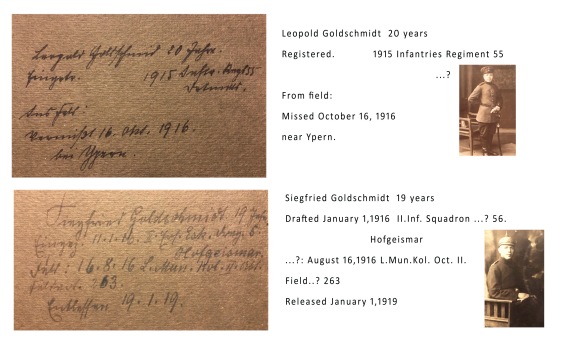
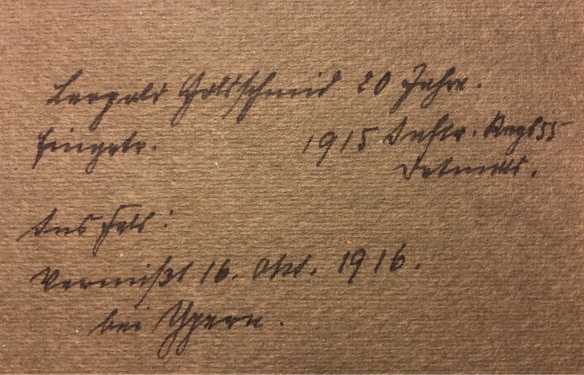
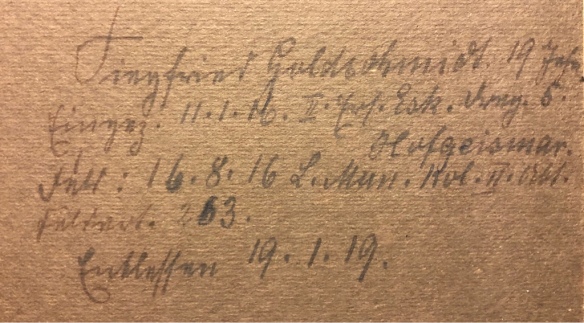
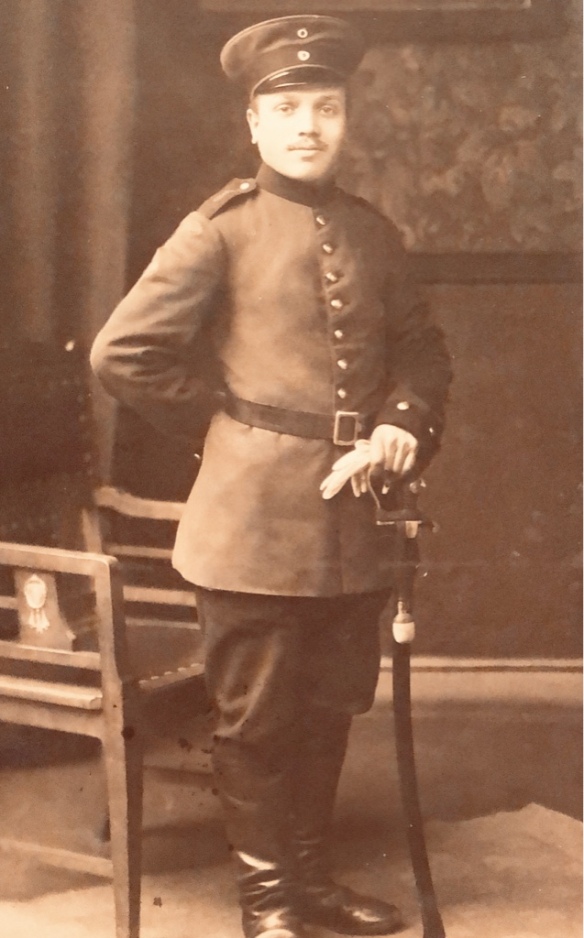
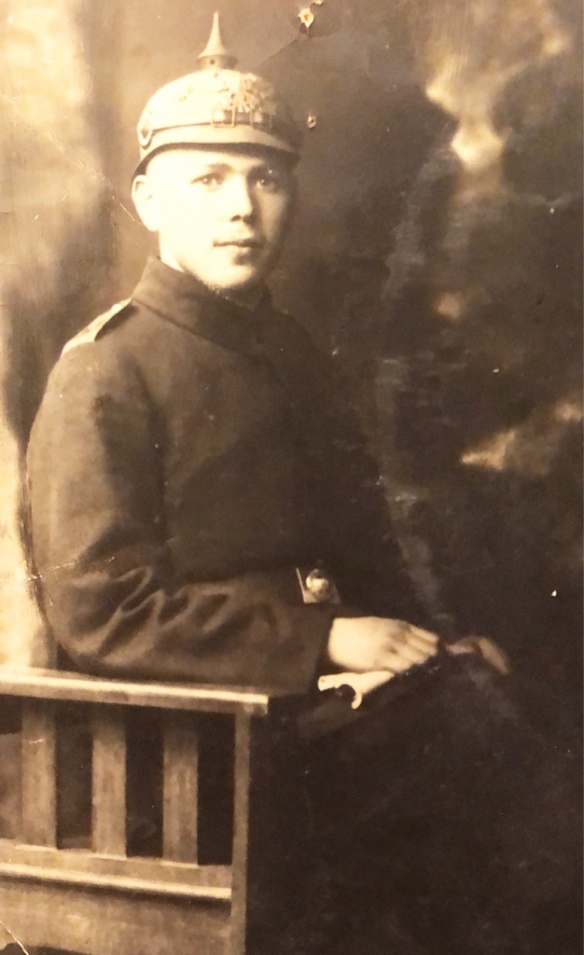
UPDATE: In February 2020, Julia Drinnenberg sent me these photographs of Leopold and Siegfried taken during their service in World War I and the index cards describing their service. She also translated the cards for me, as seen below.

Goldschmidt Oberlistingenimg_6161img_6162

Leopold Goldschmidt

Leopold Goldschmidt

Siegfried Goldschmidt

Siegfried Goldschmidt


There was one bright light left for this family.  Somehow Siegfried and Fanny Frieda’s only child, their young son Max, survived. His story in the next post.


  1. Ancestry.com. U.S., Social Security Applications and Claims Index, 1936-2007, SSN: 129240166. ↩
  2.  https://yvng.yadvashem.org/nameDetails.html?language=en&itemId=11507807&ind=12, https://yvng.yadvashem.org/nameDetails.html?language=en&itemId=11507231&ind=0 ↩

The Heartbreaking Story of Berthold Goldschmidt

As seen in my last post, as far as I’ve been able to determine, of the eight children born to Jacob Goldschmidt and Betty Goldschmidt, only their son Berthold survived to adulthood.

Berthold married Mathilde Freudenstein, and they had seven children: Paul (1893),1 Leopold (1895),2 Siegfried (1896),3 Hedwig (1898),4 Ida (1899),5 Hilda Johanna (1903),6 and Rosa (1906).7

Hilda, Rosa and Ida all died before their first birthdays.8  Thus, of the seven children born to Berthold and Mathilde, it appears that only Paul, Leopold, Siegfried, and Hedwig lived past infancy. It must have been devastating for Berthold and Martha to lose three babies like that. Between 1895 and 1909, Berthold also lost his parents Jacob and Betty. Thus, he suffered five losses in a very short period of time.

Then Berthold suffered four more tragic losses in the 1910s. First his wife Mathilde Freudenstein Goldschmidt died at age 43 in Marburg, Germany, on December 29, 1911. She left Berthold with four teenagers to raise alone. Paul was 18, Leopold was 16, Siegfried was 15, and Hedwig was 13.

Mathilde Freudenstein Goldschmidt death record, Personenstandsregister Sterberegister; Bestand: 915; Laufende Nummer: 5700, Ancestry.com. Hesse, Germany, Deaths, 1851-1958

But Berthold’s heartbreak was far from over. His daughter Hedwig died on August 5, 1915 in the Elisabeth hospital in Volkmarsen, as attested to by a nurse at that facility; she was only seventeen. Matthias Steinke generously translated Hedwig’s death record, which reports that Hedwig had been residing in Oberlistingen at the time of her death. I have tried to find some document showing the cause of death, but have had no success.

Hedwig Goldschmidt death record, Personenstandsregister Sterberegister; Bestand: 922; Signatur: 11405, 1915, Ancestry.com. Hesse, Germany, Deaths, 1851-1958

Less than a year after Hedwig’s death, Paul Goldschmidt, Berthold and Mathilde’s first child, died in the state hospital in Haina, Germany, on July 20, 1916, at age 22.  The death record did not reveal a cause of death or the duration of Paul’s time at the state hospital, and I wondered whether, given his age and the year, he had died as a result of injuries suffered fighting for Germany in World War I.

Paul Goldschmidt death record, Personenstandsregister Sterberegister; Signatur: 4613
Ancestry.com. Hesse, Germany, Deaths, 1851-1958

I was able to determine that the hospital in Haina was a psychiatric hospital and also that it cared for some soldiers during World War I, but I needed more information to determine why Paul died there. I wrote to the authorities in Haina to learn more, and I received the following response based on the hospital’s records  from Dr. Horst Hecker of the Haina branch of the Landeswohlfahrtsverband Hessen :

At the age of four, Paul Goldschmidt fell ill with hydrocephalus. He was first treated at the “Idiotenanstalt” (idiot asylum) [in] Idstein. In November 1900 Paul was admitted to the “Hessisches Brüderhaus (Anstalten Hephata”) near Treysa. On September 23, 1914, he was transferred to Haina Hospital. There he died on July 20, 1916, of “Marasmus bei Idiotie”.

Dr. Hecker sent me the entire file, and although I have not been able to translate much of it that is hand-written, I was able to translate one type-written entry that revealed that Paul was developing normally until he was four.  His parents attributed the hydrocephalus to a fall; Paul had hit his head on the corner of their stove and received four to five stitches. Whether that could cause hydrocephalus is beyond my area of expertise. But apparently soon thereafter his behavior and his development regressed, and he was institutionalized. How very sad that this boy spent eighteen years institutionalized before dying at age 22.

UPDATE: My medical consultant tells me that it is extremely unlikely that hydrocephalus would have been caused by a fall.  More likely it had been progressing. Perhaps the fall was caused by the hydrocephalus, not the other way around. On the other hand, one reader told me that her son had hydrocephalus caused when he was elbowed in the head, moving an undetected tumor in such a way as to cause hydrocephalus. Fortunately her son recovered after surgery removed the tumor.  Thank goodness for modern medicine.

But Berthold’s heartbreak was still not over. One of his two remaining children, his son Leopold, was killed just a few months after Paul’s death while fighting for Germany in World War I. He was only 21 years old. With the help of those in the Jekke group on Facebook, especially the incredibly generous help of Andre Gunther and Doris Benter of that group, I believe I have been able to piece together some of what happened to Leopold.

Leopold was injured in the fall of 1915 while serving in the 12th Company of the Reserve Infantry Regiment, No. 256.9 He returned to active duty after recovering from these injuries, and in December 1916 he was listed as missing.10 As seen below, it was reported that he had been missing since the end of October in the West. At that time he had been serving with the 8th Company of Infantry Regiment No. 364, to which he must have been transferred when he returned to duty.

Leopold Goldschmidt, listed as missing, https://grandeguerre.icrc.org/en/File/Details/900539/1/2/

In a book published in 1932 that compiled the names of all the Jewish soldiers who died fighting for Germany in World War I, Leopold Goldschmidt is listed with Company 8 of the 364th Infantry Regiment. His date of death is given as October 25, 1916, and the list categorized his death as judicially determined, indicating that his body was not found but that he was declared dead in a legal proceeding. 11

I am not sure how they determined the date when he died, but on the assumption that that is accurate, I checked to see what battles on Germany’s western front occurred in late October, 1916, and whether the 364th Infantry Regiment participated in those battles. Although I have no conclusive evidence, my best guess is that Leopold was killed or taken prisoner during the Battle of Verdun. Encyclopedia Britannica, for example, provided this information:

In September, Gen. Charles Mangin, who had held command of a section of the French defensive line from Fleury to the right bank of the Meuse from June 22, proposed a scheme to liberate the Verdun region. Nivelle approved, and that offensive was initiated on October 21 with an artillery barrage across a broad front. An infantry assault followed on October 24, with three divisions advancing behind a creeping artillery barrage. By that evening the French had retaken Douaumont along with 6,000 German prisoners, and by November 2 the fort at Vaux was once again in French hands.

According to other sources, the 364th Infantry Regiment was among those participating in the October 24 battle for Fort Douamont. Thus, Leopold likely participated in that action and was among the many German soldiers who were either killed or taken prisoner by the French during that battle.

Leopold Goldschmidt died serving his German homeland in 1916. He was survived by his father Berthold and his only remaining sibling, Siegfried Goldschmidt. This fall his hometown of Oberlistigen honored his memory and his service to his country. More on that in the next post.

Thus, by 1916, Berthold Goldschmidt had outlived his wife and seven of his eight children. It’s hard to fathom how someone endures so many losses. Berthold died in Oberlistingen on November 8, 1927, eleven years after his sons Paul and Leopold; he was 69 years old.

Berthold Goldschmidt death record, Personenstandsregister Sterberegister; Signatur: 8196
Description
Year Range: 1927
Source Information
Ancestry.com. Hesse, Germany, Deaths, 1851-1958

Siegfried Goldschmidt, the only child of Berthold and Mathilde still living, attested to his father’s death. As we will see, Siegfried’s life ended in tragedy as well.


  1. Hessisches Hauptstaatsarchiv; Wiesbaden, Deutschland; Bestand: 909; Signatur: 8076, 1893, Ancestry.com. Hesse, Germany, Births, 1851-1901 ↩
  2. Hessisches Hauptstaatsarchiv; Wiesbaden, Deutschland; Bestand: 909; Signatur: 8078, Ancestry.com. Hesse, Germany, Births, 1851-1901 ↩
  3. Hessisches Hauptstaatsarchiv; Wiesbaden, Deutschland; Bestand: 909; Signatur: 8079, Ancestry.com. Hesse, Germany, Births, 1851-1901 ↩
  4. Hessisches Hauptstaatsarchiv; Wiesbaden, Deutschland; Bestand: 909; Signatur: 8081, Ancestry.com. Hesse, Germany, Births, 1851-1901 ↩
  5.  Hessisches Hauptstaatsarchiv; Wiesbaden, Deutschland; Bestand: 909; Signatur: 8082, Ancestry.com. Hesse, Germany, Births, 1851-1901 ↩
  6. Personenstandsregister Sterberegister; Signatur: 8172, Ancestry.com. Hesse, Germany, Deaths, 1851-1958 ↩
  7. Personenstandsregister Sterberegister; Signatur: 8175, Ancestry.com. Hesse, Germany, Deaths, 1851-1958 ↩
  8.  Personenstandsregister Sterberegister; Signatur: 8169, Ancestry.com. Hesse, Germany, Deaths, 1851-1958; also, see footnotes 6 and 7. ↩
  9.  Verlustlisten 1. Weltkrieg, page 10082: Goldschmidt Leopold (Oberlistingen, Wolfhagen), found at http://des.genealogy.net/search/show/3324952 ↩
  10.  Verlustlisten 1. Weltkrieg, page 16803: Goldschmidt Leopold (Oberlistingen, Wolfhagen), found at http://des.genealogy.net/search/show/5035892 ↩
  11.  [^9]:Die Judischen Gefallenen Des Deustchen Heeres, Der Deutschen Marine und Der Deutschen Schutztruppen 1914-1918 (Herausgegeben vom Reichsbund Judischer Frontsoldaten, 1932), pp. 38, 309. ↩